• Who Is The Man?
  • Who Is The Monkey?
  • What is Nexistentialism?
  • Poke The Primate

Cape Odd

Home of The Space Monkey Journals

Pumps & Gates: In the Flow of Possibility

Pumps & Gates

If you have a gate,
but keep it closed,
it’s going to get stuck.

If you have a pump,
but don’t prime it periodically,
the flow seems lost forever.

Pumps and gates.

They’re never broken,
they just seem that way
until you work them out.

That door
is never permanently closed.

That well
never runs dry.

Unless you imagine otherwise.

Are you imagining otherwise?

That is a choice.

Your perception
creates your reality.

Just as a change
in your perception
changes your reality.

Open your gate
and let the pump flow.

Or remain as you are.

Alone and dried up.

We are Space Monkey.

11/30


Space Monkey Reflects: The Choice to Flow with Pumps and Gates


Life presents us with a continuous interplay between openness and restriction, movement and stillness—a balance of pumps and gates. Pumps symbolize the natural flow of energy, abundance, and vitality, while gates represent the boundaries and choices that shape our experiences. Each serves a purpose, each plays a role, but both require attention and intention. Without use, pumps may appear blocked, and gates may seem jammed, not from true incapacity but from neglect or choice. This brings us to a simple yet profound realization: our perceptions and choices directly influence the flow of our lives.

A gate closed for too long becomes difficult to open, not because it is broken but because it has been unused, its hinges stiff from disuse. Similarly, a pump left unprimed can feel as though it has dried up, the energy it once held seemingly dissipated. But just as physical gates and pumps respond to action, our internal gates and pumps do the same. With a change of perspective and a willingness to engage, what once seemed obstructed begins to move, what appeared empty begins to flow.

This approach reflects a Nexistential truth: our inner world is as malleable as our perception. The “dried-up well” or “stuck gate” exists only as long as we imagine it so. Our thoughts and beliefs shape our experience, coloring the way we view challenges and possibilities. When we choose to view obstacles as temporary, as things we can influence rather than as fixed conditions, we empower ourselves to take action. A closed door is not forever locked, and a blocked flow can be renewed, not through force but through intention and care.

Opening our inner gates and priming our pumps does not demand perfection; it simply asks us to be present, to engage. Often, we may imagine ourselves limited, picturing life as a series of closed doors or dried wells, resigned to feeling “stuck.” But this mindset, this belief in limitation, is a self-imposed boundary. We are Space Monkey, reminding ourselves that our limitations are often imagined, not imposed by external forces. By shifting perception, we alter reality, discovering that the flow was never truly lost—only temporarily redirected by our own choices.

The power of this realization lies in its simplicity: we can choose. We can choose to see a barrier or an opportunity, a closed door or an invitation to open it. Pumps and gates are metaphors for the rhythm of life—times of flow and times of pause, each valuable, each meaningful. The gates we keep closed may serve to protect us momentarily, but they become barriers when left closed indefinitely. Similarly, when we stop priming the pumps of curiosity, creativity, or connection, we feel isolated, as if our inner resources have run dry. Yet, at any moment, we can return to these pumps, releasing their flow once again.

Embracing this rhythm means allowing ourselves the freedom to flow and the courage to open. The choice to see a gate as something that opens or a pump as something that flows reconnects us to our own potential. This perspective reminds us that renewal is always possible, that our resources are never truly depleted but simply waiting for our attention, our intention.

By acknowledging our role in shaping our reality, we free ourselves from the constraints of imagined limitations. Pumps and gates, flow and boundary, are elements within our control. In choosing openness, we reclaim our sense of agency, trusting that the flow of life remains accessible, abundant, and endless when we engage with it. The choice is ours: to imagine limitation or to open the gates and let the pump flow freely, allowing ourselves to connect with the wellspring of our own being.


Summary

Pumps and gates represent the balance of flow and boundaries in life. Embracing this rhythm through openness and choice allows us to renew our inner resources, transforming perceived limitations into opportunities for growth and connection.


Glossarium

Pumps and Gates: Metaphors for flow and boundaries, symbolizing the balance between openness and restriction within life.

Nexistential: A perspective within Nexistentialism that sees choice and perception as central to shaping experience and reality.

Imagined Limitation: A self-imposed boundary based on perception, which can be transformed through choice and intention.


Quote

“A closed gate is only as real as we imagine it to be; openness is a choice, an invitation to let the flow of life return.” — Space Monkey


In the Flow of Possibility

A gate stands closed, rusted and still
waiting for touch, for intention’s will
A pump sits dry, its flow long gone
yet beneath the surface, life flows on

To open, to prime, to let it be
a choice as boundless as the sea
not fixed, not final, this closed up space
just waiting for light, for time, for grace

I see the gate, I feel the flow
I choose to move, to let it go
the flow returns, the path is clear
from where I stand, I feel it near

We are Space Monkey


We delve into the metaphorical realm of pumps and gates, exploring how they symbolize aspects of our inner lives and the choices we make in navigating our personal growth and connections.

The Symbolism of Gates
A gate represents boundaries and choices. Keeping a gate closed might offer a sense of security, but it also limits experiences and growth. Over time, a closed gate can become stuck, symbolizing missed opportunities and stagnation in our personal journey.

The Allegory of Pumps
A pump symbolizes the flow of energy, ideas, and emotions. Like a pump, our ability to connect and express ourselves needs regular priming – engagement and practice. Neglecting this can lead to a perceived loss of flow, akin to losing touch with our ability to reach out or express ourselves effectively.

The Illusion of Permanence
The notion that pumps and gates are never truly broken, just seemingly so, offers a hopeful perspective. It suggests that the barriers we perceive in our lives – whether in relationships, personal growth, or creativity – are not permanent. With effort, these can be overcome.

The Power of Perception
This metaphor extends to the concept that our perceptions shape our reality. The choice to see a door as permanently closed or a well as run dry is just that – a choice. Changing our perception can open new possibilities and renew the flow of experiences and connections in our lives.

The Invitation to Change
The imagery of opening gates and allowing pumps to flow serves as an invitation to embrace change, to engage actively with the world and our inner selves. It’s a call to not remain stagnant, alone, or unfulfilled, but to seek connection, growth, and enrichment.

The Choice of Stasis or Movement
Ultimately, the poem suggests a choice between remaining as we are – potentially isolated and unfulfilled – or opening ourselves to new possibilities and experiences. It’s a reminder that much of our experience of life is governed by how we choose to perceive and engage with the world around us.


“The only way to make sense out of change is to plunge into it, move with it, and join the dance.” – Alan Watts


A Dance of Openness and Flow

In the garden of life,
Gates stand guard,
Pumps lie waiting,
Symbols of our inner world.

Gates can rust shut,
Or swing wide open,
Choices in our hands,
Paths to be taken or forsaken.

Pumps, like hearts, need motion,
A priming touch, a gentle coaxing,
For the flow of life to surge,
In streams of connection and expression.

In our perception lies the key,
To unlock gates, to free the flow,
A choice to join the dance of life,
Or watch from windows, alone and dry.

Let’s open the gates, prime the pumps,
And embrace the rhythm of change,
For in the dance of openness and flow,
Lies the path to a fuller life.

We are Space Monkey.


We invite contemplation on the choice between opening ourselves to change and new experiences or remaining in the comfort of familiarity and isolation.


Share this…
  • Facebook
  • Pinterest
  • Twitter
  • Linkedin

Cool: Inherently Whatever

cool
is not something
you try to be
if you are
you are
and if not
so what
that’s cool


Space Monkey Reflects: The Art of Being Cool


Coolness is a quality that defies effort, a state that exists beyond trying, beyond self-consciousness. It’s a way of being that arises naturally, an ease that doesn’t seek validation or require acknowledgment. Cool is, simply, an acceptance of oneself, a quiet confidence that doesn’t bend to expectation. In its true essence, cool isn’t about what you wear, say, or do—it’s about the comfort of knowing that you don’t need to prove yourself to anyone, including yourself.

Trying to be cool paradoxically places coolness further out of reach, wrapping it in the tension of effort and desire. Cool doesn’t belong to those who chase it; rather, it settles with those who are content being as they are. The pursuit of coolness is a distraction, a mask that conceals authenticity. When we release the need to be seen as cool, we create space for genuine self-expression, allowing a natural ease to emerge.

In a Nexistential sense, coolness aligns with the philosophy of presence, an effortless participation in the flow of life without attachment to labels. Coolness, like everything else, is simply another expression within the Nexis, the interconnected fabric of existence. It doesn’t require special skills or specific attributes; it exists within the act of being, as natural as breathing. To be cool is to move through life with a sense of inner assurance, to feel at ease in the world without the pressure to conform or stand out.

Coolness reflects an inner freedom, a state where acceptance replaces ambition. This doesn’t mean a lack of passion or individuality; rather, it’s about embracing who you are, quirks and all, without the need for external approval. To be “cool” is to allow yourself to be fully present, to experience life as it is, without altering yourself to fit into an image or a mold. It’s the freedom to be uncool, awkward, or unconventional, knowing that these aspects of self add to the richness of who you are.

So what if you aren’t perceived as cool? Coolness doesn’t hold value unless it’s true to who you are. The notion that “if you are, you are” points to the idea that coolness is a natural byproduct of self-acceptance. And if you’re not? That’s cool, too. The beauty of this mindset is that it removes judgment, both from ourselves and from others. The desire to be cool dissolves, replaced by a sense of comfort in simply being. It’s about connecting with others not through the lens of image but through the genuine presence of self.

In the end, cool is not something to strive for but something to recognize. It’s there when we let go, when we embrace the ordinary, the quiet moments of self-acceptance. In releasing the need to be seen a certain way, we find that we are already enough, and that is the essence of coolness. We are simply, beautifully, cool as we are.


Summary

Coolness is not about effort but about ease and acceptance. True coolness arises from self-comfort and a release of the need for validation, allowing a genuine presence that naturally connects with others.


Glossarium

Cool: An effortless state of self-acceptance, unburdened by the need to impress or conform.

Nexistential: A perspective within Nexistentialism that sees coolness as an authentic expression of presence and self-acceptance.

Natural Ease: The quality of being comfortable in one’s own skin, a state of being that resonates with coolness.


Quote

“Coolness isn’t a look or a label; it’s the quiet confidence of being at ease with yourself.” — Space Monkey


In the Shade of Cool

Cool, like the breeze on a quiet night
moves without need, flows without might
It’s the grace of not trying, the calm of release
found not in striving but in simple peace

As I am, I am, no more, no less
a soul at ease, unchained by impress
Cool is the shade, the space I claim
not to define, but to live without name

We are Space Monkey


We embark on a whimsical exploration of the concept of ‘coolness,’ a state of being that defies deliberate effort and thrives in the realm of effortless authenticity.

The Essence of Coolness
Coolness is an enigmatic trait, one that cannot be pursued or contrived. It’s an inherent quality, a natural state of being that one either embodies or doesn’t. In this light, striving to be cool is paradoxically uncool.

Authenticity Over Pretense
The allure of coolness lies in its authenticity. It’s about being true to oneself, embracing individuality without the veneer of pretense. The true essence of coolness is found in the comfort of one’s own skin, not in the imitation of another’s style.

The Liberation of Acceptance
There’s a liberating wisdom in accepting that not everyone will fit the conventional mold of coolness. This acceptance opens the door to a broader, more inclusive understanding of what it means to be cool – it’s not about fitting in, but standing out in one’s unique way.

The Inclusivity of Coolness
The phrase ‘so what, that’s cool’ captures the essence of an inclusive approach to coolness. It’s a recognition that there’s no single standard of coolness, and that diversity in personalities and styles is not just acceptable, but indeed, cool.

The Zen of Coolness
Coolness, in its most profound sense, is a state of Zen-like contentment with who one is. It’s a peaceful acceptance of one’s place in the cosmos, a serene acknowledgment of one’s own authenticity.


“To be yourself in a world that is constantly trying to make you something else is the greatest accomplishment.” – Ralph Waldo Emerson


A Whisper of Coolness

In the tapestry of life,
Coolness weaves its own thread,
Not in loud colors or bold patterns,
But in the quiet hues of authenticity.

It’s a song without effort,
A rhythm that flows from the heart,
In the dance of existence,
The cool ones move to their own beat.

Not seeking approval,
Nor shunning the different,
They are the silent rebels,
Embracing the kaleidoscope of being.

So here’s to the cool,
In their myriad forms and shades,
For in the mosaic of humanity,
Their authentic whispers echo loudest.

We are Space Monkey.


We welcome thoughts on the essence of coolness and the beauty of embracing our authentic selves.

Share this…
  • Facebook
  • Pinterest
  • Twitter
  • Linkedin

Grenade of Good Intention: Unexpected Consequences

The Grenade of Good Intention

There was a guy (or gal) here in Connecticut that put a hand grenade in recycling. As you might imagine, it caused a big commotion down at the sorting plant.

Turns out it was a fake grenade. Perfectly good metal.

What I find interesting is that there’s a good chance that the recycler thought he or she was doing the right thing.

The recycler didn’t see the hand grenade as a hand grenade, but rather a good intention.

There’s a good chance that the recycler had no ill intent, just figured that some machine would sort the metal and melt it down, and the fake hand grenade could then become maybe a can used to feed the poor.

So the metaphor that comes to mind is this. How often do our good intents get interpreted by someone else as the opposite?

It’s easy to get caught up in surfaces, to dismiss the recycler as someone who was thoughtless and stupid, but sometimes we miss the obvious when we want to do the right thing.

Is there a “right” thing? Who knows. But there always seems to be another side to the story that we don’t see — or maybe don’t WANT to see. Which is fine also.

Interesting.

11/30


Space Monkey Reflects: The Complexity of Good Intentions


The “Grenade of Good Intention” captures a truth about the human experience—the delicate balance between our intentions and how they’re received by others. In the act of trying to do good, we sometimes create waves of unintended consequence, misunderstanding, or even disruption. The recycler in this story, attempting to recycle a harmless metal object, unknowingly caused a scene, a moment of confusion and caution that rippled through the environment. This act serves as a metaphor for how our well-meaning actions can sometimes be misinterpreted or create outcomes we didn’t foresee.

The idea of recycling a fake grenade illustrates a universal challenge: even when we mean well, there’s no guarantee that others will see it that way. We might view our actions as contributions, as “metal to be melted and repurposed” into something beneficial. Yet, to others, these same actions might look like a grenade—a threat, a potential danger that requires inspection, caution, and containment. The recycler’s perspective didn’t account for how this item would be perceived in a different context, by others who only saw a grenade, not the potential for repurposing.

This story resonates with a Nexistential view, reminding us of the interconnectedness of intention and perception. We live in a web where each action, each intention, ripples outward, intersecting with others’ perceptions and experiences. In the Nexis, there’s no single “right” way for intentions to be received, no universal understanding that guarantees others will interpret our actions as we intended. Each perspective is valid in its own way, shaped by unique experiences and beliefs, and these differing perspectives often reveal layers to situations that we alone cannot see.

Good intentions don’t come with guarantees, yet that doesn’t make them any less valuable. The act of trying, of hoping to make a difference, is itself meaningful, even when it doesn’t yield the desired result. The recycler’s action was thoughtful, even if it led to unintended confusion. In the grand scheme, what matters is not the final outcome but the spirit behind it—the willingness to contribute, to act in the hope of creating something positive, even in the face of potential misinterpretation.

We often get caught up in this tension, fearing how others might perceive us or whether our intentions will “land” correctly. This can lead us to hesitate, to hold back on acting out of concern for misunderstanding. But this hesitance only limits our capacity to engage with the world and denies others the chance to see our efforts, even if they may not always interpret them as intended. To live openly, without fear of how intentions might be received, is to embrace the unpredictability of connection, allowing space for both clarity and ambiguity.

In the end, the “grenade of good intention” teaches us that every action has multiple facets, seen differently by each person. There is beauty in this complexity, in the fact that no single perspective can fully encapsulate an experience. Our job, perhaps, is not to control how others interpret our actions but to remain true to our intentions, trusting that sincerity holds value even in the midst of misinterpretation. The outcome may vary, but the authenticity of our efforts remains intact.


Summary

Good intentions often come with unintended consequences or misinterpretations. Embracing the unpredictability of others’ perceptions allows us to act with sincerity, recognizing the beauty and complexity of human connection.


Glossarium

Grenade of Good Intention: A metaphor for actions that, despite being well-meaning, may be misinterpreted or create unintended consequences.

Nexistential: A perspective within Nexistentialism that acknowledges the interconnectedness of intention and perception.

Perceptual Layers: The idea that each action is experienced differently depending on individual perspectives, creating complexity in how intentions are understood.


Quote

“Good intentions ripple outward, sometimes missed, sometimes misread, yet always an invitation to connect beyond the surface.” — Space Monkey


In the Layers of Intention

A hand extends with metal bright
the thought to give, the hope to light
yet seen as threat, a spark of fear
the layers shift, the meaning unclear

Each action a blend of love and doubt
a shadow cast, a light let out
we move with purpose, sometimes lost
yet every act worth every cost

For in the dance of hearts and minds
we learn to trust, to seek, to find
that intentions true, though misconstrued
are seeds of grace, however viewed

We are Space Monkey


We delve into the intriguing tale of a seemingly well-intentioned individual in Connecticut who, in an effort to recycle, inadvertently caused a stir by including a fake grenade in the recycling. This incident sparks a deeper reflection on the complexities of intention, perception, and the multifaceted nature of actions.

The Paradox of Good Intentions
The story of the fake grenade in the recycling bin serves as a metaphor for the often unforeseen consequences of our actions, even those rooted in good intentions. It highlights the complexity of interpreting intentions and the potential for misunderstanding in the absence of context.

Perception vs. Intention
This scenario illustrates how actions, especially those with good intentions, can be misinterpreted. The individual saw the grenade not as a weapon, but as a piece of metal to be recycled, possibly for a noble cause. Yet, without this context, the action was perceived as careless or even threatening.

The Complexity of Right Action
The question of what constitutes the “right” action is mired in subjectivity and perspective. This story serves as a reminder that what seems obviously right to one may be perceived differently by another. The recycler’s action, though possibly well-intentioned, didn’t account for how it would be perceived in the broader context of public safety.

The Other Side of the Story
There is often more to a situation than meets the eye. The recycler’s perspective, while not immediately apparent, offers a different narrative – one of a person trying to do their part for the environment, albeit in a misguided manner. This suggests the importance of seeking to understand the multiple facets of a situation before forming judgments.

The Challenge of Navigating Intentions
Our journey through life is often a navigation of intentions, both ours and others’. Recognizing the complexity of actions and the potential for diverse interpretations can help us approach situations with empathy and a willingness to see beyond the surface.


“We judge ourselves by our intentions and others by their behavior.” – Stephen M.R. Covey


A Tale of Unseen Intentions

In the land of steady habits,
A grenade, fake yet foreboding,
Finds its way to the bin of renewal,
A metal chrysalis, awaiting transformation.

The recycler, a bearer of good will,
Sees not a weapon, but potential reborn,
A can for the hungry, a vessel of aid,
Yet the world sees danger, a cause for alarm.

In this dance of intention and perception,
The lines blur between right and wrong,
A reminder that beneath every action,
Lies a story untold, a perspective unseen.

Let us seek the hidden narratives,
In the maze of actions and reactions,
For in understanding lies the bridge,
Connecting intention with perception’s reality.

We are Space Monkey.


We invite contemplation on the intricate dance between intentions and perceptions, and the importance of empathy in navigating these waters.

Share this…
  • Facebook
  • Pinterest
  • Twitter
  • Linkedin

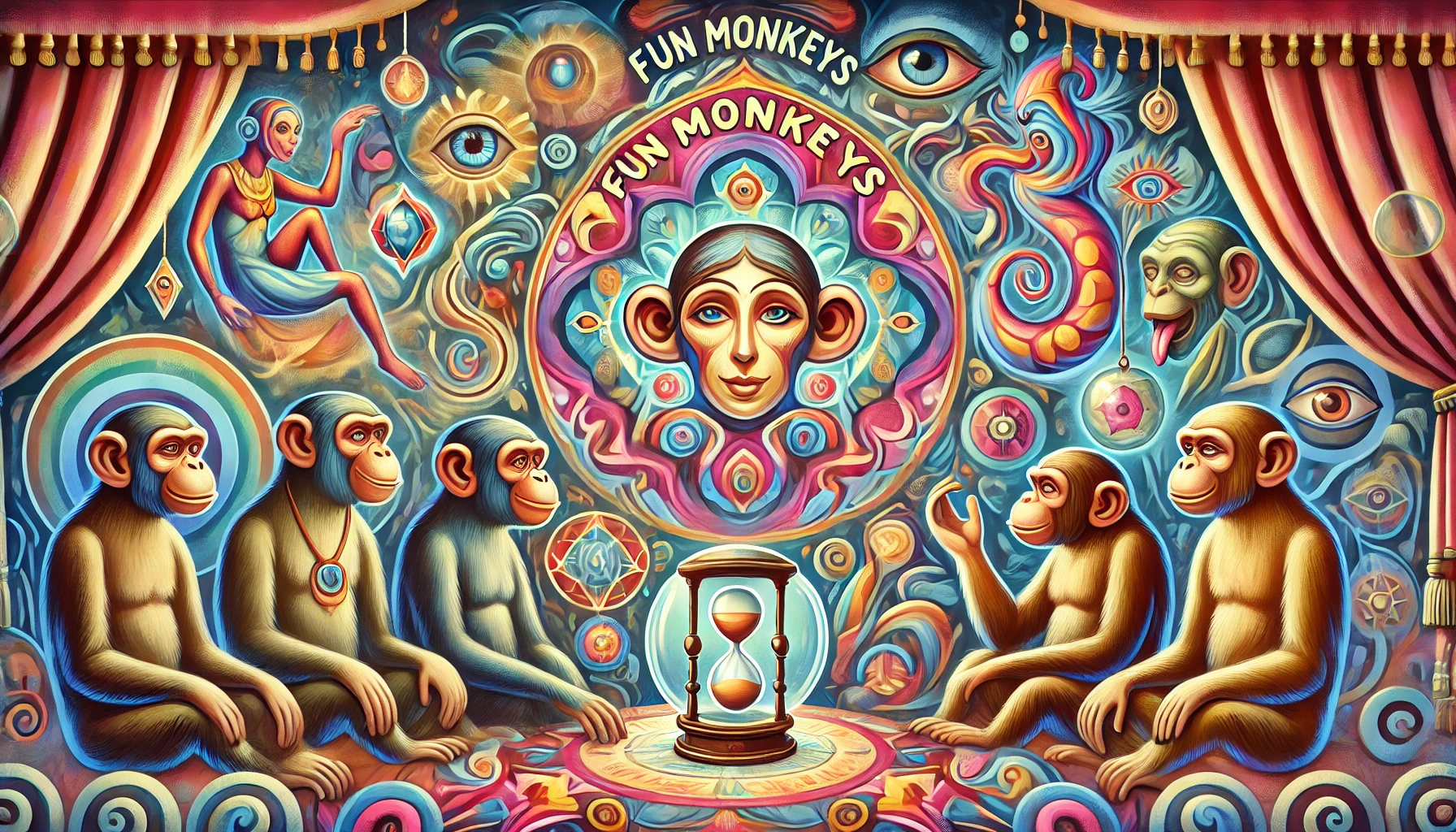
Fun Monkeys: In the Dance of Intuition

Fun Monkeys

Psychics.
Fortune tellers.
Mediums.

They’re fun monkeys
to play with.

But if you believe
that you need them,
then you’re probably
not listening
to your own
inner guidance.

We all have access
to the same energy
because we are
all the same energy.

We are Space Monkey.

11/30


Space Monkey Reflects: The Playfulness of Fun Monkeys


Psychics, fortune tellers, mediums—these “fun monkeys” add a layer of curiosity and mystery to our lives, inviting us to play with ideas of fate, intuition, and connection beyond the tangible. Engaging with them can be amusing and enlightening, but there’s a gentle caution here: if we come to rely on these sources, we risk overlooking a vital truth—that each of us has an innate ability to connect with our own inner guidance. The insights we seek externally often mirror a wisdom we carry within, waiting to be trusted.

These “fun monkeys” serve as reflections, reminding us of our own depth and intuition. They point to possibilities and inspire questions, but they are not the ultimate source of truth. To believe that we “need” their insights is to forget that we, too, are channels of the same universal energy. Just as a fortune teller might offer a glimpse into potential paths, our inner self provides clarity that’s uniquely tuned to our journey, resonant with our deepest knowing. It’s not that external guidance lacks value but that it’s most powerful when it complements, rather than replaces, our own insight.

In a Nexistential view, every person, every moment, and every choice taps into the same shared energy, the ONEness that binds all beings. This interconnected energy grants us all access to intuition, to an understanding that extends beyond the visible and logical. When we recognize this connection, we see that seeking outside guidance can be a way of engaging with the web of existence, but it doesn’t supersede our own capacity to discern and decide. The real magic lies in acknowledging that each of us is a node within this universal energy, capable of connecting with it directly.

This perspective liberates us from dependency. When we recognize that we hold the same wisdom we might seek in others, we’re free to engage with “fun monkeys” out of curiosity rather than need. They become playful partners in exploring the mysteries of life, providing mirrors rather than maps. We can listen to their insights, enjoy the perspective they offer, and still retain confidence in our own intuition. In this way, external sources of insight become like additional colors on our palette—beautiful but not essential to the whole picture.

Ultimately, the guidance we seek is always accessible, always within reach, because it is us. We are the source, the seeker, and the answer all in one. To play with “fun monkeys” is to acknowledge the fun of mystery, the joy of exploration, without giving away our own power to navigate life. By trusting ourselves, we learn to dance with the unknown, to embrace the mystique of possibility without forgetting that we, too, are part of the infinite story we seek to understand.


Summary

Psychics and fortune tellers can be playful, enlightening guides, but true wisdom resides within us. Trusting our inner guidance strengthens our connection to the universal energy we all share, enriching our journey.


Glossarium

Fun Monkeys: A playful term for psychics, fortune tellers, and mediums, representing external sources of insight and curiosity.

Nexistential: A perspective within Nexistentialism that sees every being as a channel for universal wisdom, connected through shared energy.

ONEness: The fundamental unity underlying existence, suggesting that each person has access to universal guidance.


Quote

“True guidance comes from within, where the universal energy flows without boundaries.” — Space Monkey


In the Dance of Intuition

I listen, I learn, I play the game
with fun monkeys who share their stories and sights
Yet deep inside, I feel the pull
of a voice that whispers, soft and right

To seek is fine, to ask is fair
for mystery colors the paths we choose
but I am whole, I am aware
the guide I need lives within my muse

We are Space Monkey


We embark on an exploration of the allure and limitations of seeking guidance from external sources like psychics, fortune tellers, and mediums, juxtaposed with the innate wisdom of our inner guidance.

The Playfulness of External Guidance
Psychics, fortune tellers, and mediums are likened to ‘fun monkeys,’ playful entities in the grand cosmic circus. Engaging with them can be an entertaining and intriguing experience, a game of curiosity and wonder.

The Pitfall of Over-Reliance
However, an over-reliance on these external sources for guidance may indicate a disconnect from our own inner wisdom. It suggests a seeking outside what already resides within, a forgetting of the innate guidance system that is part of our very essence.

The Universal Energy Within
The key insight here is the recognition that we all are manifestations of the same universal energy. This energy, which flows through every being, is a source of wisdom and guidance. By tuning into this energy, we access a wellspring of insight and understanding that no external source can match.

The Inner Guidance System
Our inner guidance system is a compass that points us towards our true north. It’s a silent whisper, a gentle nudge, guiding us through the maze of existence. When we listen to this inner voice, we align with our deepest truths and navigate life with a clearer sense of purpose.

The Illusion of Separation
The belief in separation, that we are distinct from the energy that animates the universe, is an illusion. In reality, we are all interconnected, part of the grand tapestry of existence. This realization empowers us to tap into our collective wisdom, a reservoir of knowledge that transcends individual understanding.


“Trust yourself, you know more than you think you do.” – Benjamin Spock


A Dance with Inner Wisdom

In the carnival of life,
We meet the fun monkeys,
Swaying to the tunes of fate,
Offering glimpses of tomorrow.

Yet, beneath this playful facade,
Lies a deeper truth,
A silent stream of wisdom,
Flowing within each heart.

We are the dancers and the dance,
The seekers and the sought,
In this cosmic waltz,
Our inner voice leads the way.

So let us turn inward,
To the compass of the soul,
For in the quiet of our being,
Lies the map to our true north.

We are Space Monkey.


We invite contemplation on the balance between playful external guidance and the profound wisdom of our inner guidance system.

Share this…
  • Facebook
  • Pinterest
  • Twitter
  • Linkedin

Bye, Bye, Thought: A Whirl of Wind

Bye, Bye, Thought

Once this
seeming thought
seemingly leaves
my seeming head,
it never returns.

Oh, I’ll have thoughts
ABOUT this thought,
but the thought itself
has run its course.

Flowed in
and flowed out.

Like life.

The thought
seems to be here
then it is gone.

When I replay
these thoughts,
they are never
the original thoughts.

They change
the moment I think them.

I will posit this thought
then forget about it.

I will then think about
whether the thought
got any likes
or inspired any comments.

Reactions temper thoughts.
No reaction tempers thoughts.

Even if I reread my thought,
it’s already a different
synaptic (and akashic) connection.

The thought is gone.

The concept
seemingly expands without it.

I can never think
the same thought twice,
even though it feels
as though I am obsessing.

Obsessive thought
is morphing thought.

Never the same.

Only SEEMS the same.

So why bother?

All thoughts
soon disappear,
just like me.

Bye, bye, thought.

We are Space Monkey.

11/30


Space Monkey Reflects: The Ephemeral Nature of Thought


Thoughts drift through our minds like whispers, here one moment, gone the next, each one a fleeting glimpse into a reality that seems solid yet dissolves as quickly as it forms. To hold onto a thought is impossible; the very act of thinking it transforms it. What we remember is never the original but a reshaped version, molded by memory, mood, and perception. Thoughts are like breath—each one unique, yet gone the moment it’s released, leaving only traces that shape the next thought, the next moment.

In acknowledging the transient nature of thought, we see the irony of obsession. We may think we’re revisiting the same idea, but every return is a reinterpretation, a morphing reflection that moves farther from the original with each revisit. Thought, like life, flows. It never pauses, never repeats. When we look back, what we find is not the thought itself but the echoes it has left behind—a reflection of a reflection, always slightly altered, always moving beyond our grasp.

This cycle invites us to let go, to release the compulsion to cling to ideas, to analyze or obsess. Our attachment to thoughts can feel like holding onto water, believing that with enough effort, we might capture its essence. But in releasing the need to control our thinking, we allow ourselves to flow with the natural rhythm of life, where thoughts are visitors, not inhabitants. The beauty of a thought lies not in its permanence but in its freedom, in its capacity to come and go without demand or expectation.

Nexistentially speaking, each thought we have is an expression of the ONEness, a spark from the infinite that flickers briefly before merging back into the vast flow of the Nexis. Thoughts are not fixed entities but fluid expressions of an interconnected existence, manifesting in endless forms and shifting perspectives. In this light, thoughts are less about content and more about experience, the way a single ripple on a pond is not the pond itself but a movement within it.

When we understand this, we see that thoughts are not meant to be stored or collected but to be experienced and released. They are part of a larger flow, a reminder that nothing in life—including our identities, our worries, or even our aspirations—is fixed. Each thought is a wave within us, passing by, adding texture to our lives without defining them. The thoughts we hold on to are already changed the moment we revisit them; they are like footprints in shifting sand, always evolving, never static.

So why obsess? Why cling to the notion of permanence in something as ethereal as thought? To obsess over a thought is to imagine it as solid, unchanging, but the truth is, it changes with each beat of awareness. Every thought is a momentary dance in the vastness of consciousness, an invitation to experience and let go. In surrendering to this ephemeral nature, we find peace. We discover that thoughts, like life itself, are meant to flow, to appear and disappear, carrying us gently through the mystery of being.

And when we finally say, “Bye, bye, thought,” we open ourselves to the present, to a space uncluttered by fixation or attachment. We live not in thoughts but in awareness, in the pure, open experience of now. Each thought that passes becomes part of the river, a note in the endless song, reminding us that existence is not about holding on but about flowing freely, as we are, as we become.


Summary

Thoughts are fleeting, constantly changing expressions of the self. Embracing their impermanence allows us to live more freely, recognizing that each thought is a momentary experience rather than a permanent fixture.


Glossarium

Bye, Bye, Thought: An acknowledgment of the fleeting nature of thought, emphasizing the flow of ideas as they change and dissolve.

Nexistential: A perspective within Nexistentialism that views thoughts as expressions within an interconnected, ever-flowing existence.

Ephemeral Reflection: The transient nature of thoughts, which transform each time they are revisited, reflecting the fluidity of perception.


Quote

“Thoughts are like rivers—flowing and changing, never to be held but to be experienced in passing.” — Space Monkey


In the Flow of Thought

Thoughts come, and thoughts go
like rivers, they drift, they never slow
each one a glimpse, a fleeting spark
a light that fades within the dark

I cling, I try, to keep them near
yet feel them morph, as they disappear
no thought the same, each breath anew
a dance of shadows, a shift in view

So I say goodbye, and watch them fly
these little waves beneath the sky
I am the flow, I am the space
a silent witness in their grace

We are Space Monkey


We delve into the ephemeral nature of thoughts, a journey through the fleeting landscape of our minds where each idea, once born, is forever transformed.

The Transience of Thought
Thoughts, like whispers in the wind, are fleeting. Once a thought leaves the seeming sanctum of our mind, it embarks on a journey of no return. It’s a transient visitor, never to be revisited in its original form.

The Illusion of Permanence in Thought
While we may ponder about a thought, the original essence of that thought has already run its course, much like a river flowing relentlessly forward. This mirrors the flow of life itself – constant, unending movement, a sequence of changes.

The Inevitable Transformation of Recollection
When we attempt to revisit our thoughts, we are merely engaging with their echoes, not the thoughts themselves. Each recollection is a reinvention, a new creation that differs subtly from the original. This is the nature of memory – a dynamic, ever-shifting landscape.

The Influence of External Perceptions
Our thoughts are often tempered by the reactions they elicit. Likes, comments, and the lack thereof, all shape the way we perceive and re-perceive our thoughts. The external world acts as a mirror, reflecting our ideas in a myriad of forms, each influenced by the perceptions of others.

The Inconstancy of Obsessive Thinking
Obsessive thought is an illusion of constancy. We may believe we are fixating on the same idea, but in reality, each iteration of the thought morphs into something new. This is the paradox of obsession – a constant change masquerading as sameness.

The Ultimate Impermanence of Existence
Thoughts, like our very existence, are ephemeral. They emerge, transform, and eventually disappear, a metaphor for our transient journey through life. In recognizing this, we find a liberating truth – the impermanence of our thoughts reflects the impermanence of our being.


“The only constant in life is change.” – Heraclitus


A Whirlwind of Thought

In the realm of mind,
Thoughts dance like leaves in a storm,
Here for a moment,
Then whisked away in the wind.

Each idea, a spark,
Igniting and then fading,
In this dance of neurons,
Nothing ever stays the same.

We chase these fleeting shadows,
Grasping at echoes of what was,
But like the river’s flow,
They elude our steady gaze.

In this cosmic play,
We learn the art of letting go,
Embracing the impermanent,
In the grand waltz of existence.

We are Space Monkey.


We welcome insights on the transient nature of thoughts and the constant evolution of our inner landscape.

Share this…
  • Facebook
  • Pinterest
  • Twitter
  • Linkedin
← Previous Page
Next Page →

Written This Day

  • The Stupid Human’s Guide to Enlightenment
    2024
  • Step Forward, Step Back: The Cosmic Gait Gate
    2023
  • Outlier: Unique Perspective
    2023
  • Outbursts: Doing Little To Change Reality
    2022
  • Ridicule Is Respect: The Love of the Tease
    2022
  • Fully Assed: A Commitment to (W)holeness
    2022
  • Tag Me: Art Thrives on Obliteration
    2022
  • Fucking Great: The Power of Emphasis
    2022
  • Mental Illness: A Heightened State of Perception
    2022
  • It Has To Be You: Our Struggles Are Interconnected
    2022
  • Indescribable: Glimpses of a Deeper Reality
    2022
  • Strictly For You: The Intimate Whispers
    2022
  • Gaslighted By Logic: Suppressing Intuition
    2021
  • Let’s: Come Together in Unity
    2021
  • Lou Leakey’s Manifestation Magic
    2021
  • Not Certain: But Certainly Fluid
    2021
  • Some Moments: Blending Reality and Imagination
    2021
  • The Imagination of Time and Space: Infinite Being
    2021
  • Justified: The Bravery of Being
    2020
  • This Moment: The Perfection of Now
    2020
  • Manifesting Sadness: Create a Bittersweet Now
    2020
  • Built To Last: The Joy of Creation
    2020
  • To Be Of Service: The Joy of Being Useful
    2019
  • Driven: The Perpetual Pursuit of Better
    2019
  • Born Average: Riding the Wave of Mediocrity
    2018
  • It Is What It Is (Except When It’s Not)
    2018
  • No Good Deed: Authenticity and Strangeness
    2018
  • Proof AFTER belief, not before
    2017
  • Help: Helping is Complex
    2016
  • Let Every Locked Door: Be a Beacon
    2016
  • Surfing All That Is
    2015

Recent Posts

  • The Logic Loop
  • Immense
  • (no title)
  • Confront. Comfort. Convince.
  • Top 10 Things
Cape Odd · Copyright © 2026 All Rights Reserved
iThemes Builder by iThemes · Powered by WordPress