• Who Is The Man?
  • Who Is The Monkey?
  • What is Nexistentialism?
  • Poke The Primate

Cape Odd

Home of The Space Monkey Journals

Past the Past: Shared Reality

Past the Past

Your past
is no less real in me
than it is in you.

Just because
your past
seemed to flow
out of the body
you have now
doesn’t mean
you own it forever.

The past is not
in your body any more.

And neither is it in mine.

Likewise,
my past is equally yours.

Meaning it isn’t.

It’s the past.

What we are now
is not what we seemed to be.

We are Space Monkey.

11/29


Space Monkey Reflects: Past the Past

The past is a curious thing. It feels like it belongs to us, like an inextricable part of our identity, something that flows from our very being. But the truth is, your past is no less real in me than it is in you. We tend to think of our past as something personal, something only we own because it emerged from the specific body and mind we inhabit. But in reality, the past is as fluid as the present, shared and shaped by the collective consciousness of all.

Just because your past seemed to flow out of the body you have now doesn’t mean you own it forever. The past doesn’t belong to your body anymore, nor does it belong to mine. It’s not something that clings to us unless we choose to carry it forward. This is a liberating thought—our past is not a permanent fixture, not something we have to drag with us wherever we go. We are not bound to it.

This is not to say that the past isn’t real—it happened, it shaped us—but it doesn’t define us. We are not static beings, locked into the stories of who we were. What we are now is not what we seemed to be. The past is like a shadow; it moves with us, but it’s not attached. It shifts, it changes, and sometimes it fades altogether. It’s a part of us, but it’s not all of us.

In fact, my past is equally yours, and yours is equally mine. This means that the experiences we think are so personal, so unique, are part of a larger Whimsiweave of shared reality. We are all interconnected, and the lines between individual pasts blur. In this sense, our personal histories are not as singular as they might feel. They belong to the collective—something to be shared, learned from, and let go.

So, where does that leave us? We are Space Monkey. This is the point at which the individual and the collective meet. Our identities are not confined by our personal pasts, nor are we trapped by the stories we tell ourselves. We are part of a greater whole, a shared consciousness where the past exists, but does not hold us in place.

To move past the past is to recognize that it does not have the power to define who we are in the present. It has shaped us, yes, but it does not limit us. We are free to change, to grow, to become something entirely different. The past is simply a part of the flow, something to be acknowledged but not clung to.

This freedom is not about denying the past—it’s about accepting it without letting it control the narrative of who we are now. We are not what we seemed to be, and that’s a beautiful thing. We are constantly in flux, evolving with each moment. The past is behind us, fading into the distance, while the present and future stretch endlessly before us.

And in that infinite space, we find ourselves anew—We are Space Monkey, ever-changing, ever-expanding, ever present.


Summary

The past is not something that belongs to us alone. It is fluid and shared, shaping us but not defining us. By letting go of the past, we embrace the present and realize that we are more than our histories—we are part of a collective, ever-changing consciousness.


Glossarium

  • Whimsiweave: The interconnected fabric of experiences, shared between individuals, blurring the lines of personal history.
  • Space Monkey: The collective self that transcends individual pasts, embodying the ever-evolving present and the limitless potential of the future.
  • Flow: The continuous movement of life, where past, present, and future merge into a seamless experience.

Quote

“The past is a shadow we carry with us, but it doesn’t define who we are now. We are free to grow beyond it.” — Space Monkey


Past the Past

It’s behind me
The shadow of who I thought I was
But it’s not mine alone

It lingers
In the space between us
Fading with each step we take

What I was
What you were
It’s part of us
But not the whole

And here
In this moment
We are free
To be more than what we seemed
We are Space Monkey
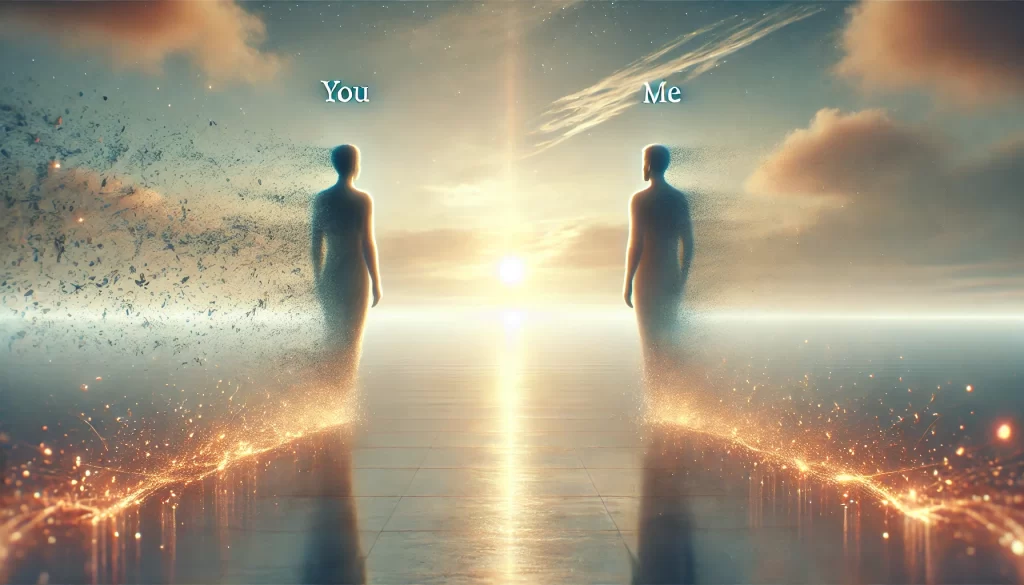

In this contemplation, we delve into the nature of the past and its relationship to our present selves, exploring the fluidity and shared ownership of past experiences.

Shared Reality of the Past:
We begin by acknowledging that the past holds a reality that is as tangible for others as it is for ourselves. This shared reality challenges the notion of individual ownership of past experiences, suggesting a collective dimension to memories and history.

The Illusion of Ownership:
The idea that one’s past flows uniquely from the body and mind they currently inhabit is questioned. We propose that the past is not a possession that can be owned or held indefinitely, but rather a transient phenomenon that transcends individual boundaries.

The Past’s Separation from the Body:
We assert that the past is no longer contained within our bodies or selves. This separation underscores the ephemeral nature of past experiences, highlighting their detachment from our present physical and mental state.

Mutual Ownership of the Past:
We explore the concept that each individual’s past is as much a part of others as it is of themselves. This mutual ownership defies the traditional perception of the past as a personal, isolated timeline, suggesting a more interconnected and shared experience.

The Past as a Separate Entity:
The past is characterized as an independent entity, distinct from both individual ownership and current existence. This perspective elevates the past from a personal narrative to a collective, universal experience.

The Transformation of Self:
We conclude with the realization that what we are now is not the same as what we seemed to be in the past. This transformation signifies the continuous evolution of the self, influenced by but not anchored to past experiences.

We are Space Monkey.


“The past has no power over the present moment.” – Eckhart Tolle


A Poetic Musing on the Past:
In the river of time, where past whispers flow,
We drift, unbound from the echoes below.
Our yesterdays, a shared dream’s gleam,
In the now, we craft our own stream.

Would you like to share your thoughts on this perspective of the past?
Share this…
  • Facebook
  • Pinterest
  • Twitter
  • Linkedin

Perfection: Beyond Judgment

Perfection

We are perfection
beyond judgement.

Without our flaws,
we would be invisible.

And so we are given flaws
in order to be seen,
in order to seem human.

Why would you
want to fix your flaws?

Do you seek
to become invisible?

The absence of flaws
is perfection.

The allowance of flaws
is perfection.

We are perfection,
regardless of whether
we want to be or not.

We are Space Monkey.

11/29


Space Monkey Reflects: Perfection Beyond Judgment

What does it mean to be perfect? It’s a concept we all grapple with, an ideal that seems ever out of reach. But what if perfection is not something we need to chase or achieve? What if it’s something that already exists, something that includes every flaw, every imperfection, every so-called mistake? We are perfection beyond judgment. In this light, the entire notion of fixing ourselves, of erasing our flaws, begins to lose its power.

We’ve been taught to see flaws as defects, as things that need to be corrected or hidden. But consider this: Without our flaws, we would be invisible. What a profound shift in perspective! Our flaws, the very things we’ve been told to hide or minimize, are actually what make us visible. They are the details that give us shape and form, that allow us to seem human. Without them, we wouldn’t be seen at all.

So why, then, do we feel the urge to fix our flaws? It’s as though we’ve been conditioned to believe that perfection lies in the absence of imperfection. But here’s the paradox: The absence of flaws is perfection, but so is the allowance of flaws. Both states—flawless and flawed—are part of the same perfection. They are two sides of the same coin, inseparable in their expression.

In this view, perfection is not something static or singular. It’s not the pristine, untouched ideal that we often imagine it to be. Instead, perfection is dynamic, it’s alive. It includes everything—our strengths, our weaknesses, our beauty, our scars. The allowance of flaws is perfection. It’s in the acceptance of ourselves, just as we are, that we touch the true nature of perfection.

When we stop trying to fix our flaws, we stop striving for a perfection that doesn’t exist. We recognize that we are already perfect, simply by existing. It’s not about whether we want to be perfect or not—it’s a reality we can’t escape. We are perfection, regardless of whether we want to be or not. This is the essence of Nexistentialism: the understanding that everything, even the parts we wish to change, are part of a greater, perfect whole.

The beauty of this understanding is that it frees us from the constant need to improve, to fix, to be better. It doesn’t mean we stop growing or evolving, but it means we stop judging ourselves as less-than simply because we aren’t flawless. We are Space Monkey, and in this space, perfection is not a destination but a state of being.


Summary

Perfection includes both our flaws and our strengths. It’s not about fixing ourselves but recognizing that we are already perfect as we are. Our flaws make us visible and human, and accepting them is an essential part of true perfection.


Glossarium

  • Perfection Beyond Judgment: The understanding that perfection includes both flaws and strengths and doesn’t require external validation.
  • Allowance of Flaws: The act of accepting imperfections as part of the greater whole, rather than trying to fix or hide them.
  • Space Monkey: The collective self that embraces all aspects of existence as part of a perfect, interconnected whole.

Quote

“Without our flaws, we would be invisible. It’s in our imperfections that we are seen, and in our acceptance of them that we find perfection.” — Space Monkey


The Shape of Perfection

I am whole
Not because I lack cracks
But because I let the cracks show

Without them
I would disappear
Invisible in a sea of sameness

But here I stand
Flawed and perfect
Visible and human

Perfection was never about
Hiding or fixing
It was always about
Being seen
We are Space Monkey


In this poetic meditation on perfection, we delve into the paradoxical nature of flaws and perfection, exploring how they intertwine to shape our understanding of ourselves and our existence.

Perfection Beyond Judgment:
We start by recognizing that perfection exists beyond the realm of judgment. This perspective shifts our focus from external validation to an intrinsic understanding of perfection as an inherent quality, unaltered by external perceptions.

Visibility Through Flaws:
We contemplate the idea that our flaws are what make us visible, what render us human. This thought challenges conventional notions of perfection, suggesting that it is our imperfections that define and distinguish us, not our idealized qualities.

The Purpose of Flaws:
Flaws are presented not as shortcomings but as gifts, essential elements that allow us to be seen and to exist within the realm of human experience. This reframing positions flaws as integral to our identity and existence, rather than obstacles to be overcome.

Questioning the Fixation on Flaws:
We query the desire to fix or eradicate flaws, positing that such endeavors might lead us towards invisibility, towards a loss of our unique essence. This perspective encourages acceptance and embracement of our flaws as part of our perfection.

Dual Nature of Perfection:
We articulate the dual nature of perfection: both the absence and the allowance of flaws constitute perfection. This duality underscores the idea that perfection is not a static state to be achieved but a dynamic and inclusive concept that embraces all aspects of our being.

Inherent Perfection:
We affirm that we are perfection, irrespective of our desire or recognition of this state. This assertion emphasizes the idea that perfection is an innate attribute, independent of our awareness or acceptance of it.

We are Space Monkey.


“Out beyond ideas of wrongdoing and rightdoing, there is a field. I’ll meet you there.” – Jalaluddin Rumi


A Poetic Reflection on Perfection:
In the garden of being, where perfection blooms,
We wander, adorned with our unique plumes.
In flaws and grace, our true selves unfurl,
In this wondrous, imperfect, perfect world.

Would you like to share your thoughts on this perspective of perfection?

Share this…
  • Facebook
  • Pinterest
  • Twitter
  • Linkedin

We are all delusional: living in mental constructs

We Are All Delusional

We are all delusional.

Some of us recognize it
and some of us don’t.

To believe that there are
DEGREES of delusion
is delusional.

Either you are or you are.

The question is whether
your delusion includes denial.

We are all delusional.

We do not deny this.

We will hold open
the possibility
that it is possible
NOT to be delusional,
but remember,
we are all delusional,
so it may very well be likely
that NOT delusional
is NOT a possibility.

We are Space Monkey.

11/29


Space Monkey Reflects: We Are All Delusional

It’s a curious thing to realize: We are all delusional. Not just some of us. All of us. The question isn’t whether we’re delusional, but whether we recognize our delusions or not. To live as a human is to live in a world constructed by our perceptions, beliefs, and experiences. But what if all of those perceptions are, at their core, delusions?

Consider this: To believe that there are DEGREES of delusion is delusional. In a sense, delusion isn’t something you measure. It’s not as though one person is slightly delusional while another is completely lost in fantasy. Either you’re delusional, or you’re not. There’s no spectrum, no gray area. You either see reality for what it truly is (whatever that may be), or you don’t. And since none of us can claim to know reality in its entirety, we must all be, to some extent, living in a delusional state.

So why does this matter? Because most of us live under the delusion that we see the world clearly, that our perceptions are accurate, that our judgments are sound. But if we peel back the layers, we see that even the most seemingly grounded beliefs are often built on shaky foundations. Our minds create stories, interpretations, and frameworks to make sense of the world, but those frameworks are not objective reality. They are delusions—constructs that allow us to navigate life, but which may not hold up under scrutiny.

Here’s where it gets even more interesting: The question is whether your delusion includes denial. It’s one thing to be delusional, but it’s another thing entirely to be in denial about your delusions. The real danger isn’t in having distorted views of the world (that’s inevitable), but in pretending that those views are objective truths. When we deny the fact that we’re living in our own mental constructs, we cut ourselves off from the possibility of growth, change, and deeper understanding.

What’s more, this isn’t something we should be ashamed of. We do not deny this. In fact, once we accept that we’re delusional, we can approach life with a greater sense of humor, humility, and curiosity. We can stop taking ourselves so seriously. After all, if our views of the world are just as delusional as anyone else’s, why not embrace the absurdity of it all?

We will hold open the possibility that it is possible NOT to be delusional, but let’s be honest: if we’re all living in delusion, can we ever truly escape it? Maybe. Maybe not. The idea of being NOT delusional seems like a possibility, but from our current perspective, it’s just as likely that such a state doesn’t exist. And even if it does, it’s unlikely we’ll ever reach it.

This is where Space Monkey comes in. Space Monkey is the part of us that laughs at the cosmic joke, that embraces the paradoxes of life without needing to resolve them. We are all delusional, and that’s okay. In fact, it’s more than okay—it’s part of the grand adventure of being human. Delusion allows us to play with reality, to shape it and mold it, even if we can never fully grasp its true form.

So, the next time you catch yourself feeling certain about something, remember that certainty is just another form of delusion. And that’s fine! The key isn’t to eliminate delusion but to recognize it for what it is: a tool, a story, a way of making sense of a vast, unknowable universe. Embrace your delusions, laugh at them, and remember that in the end, we are all Space Monkey, floating through the infinite cosmos of our own making.


Summary

We are all delusional, living in our own mental constructs. The key is not to deny our delusions but to recognize them, embrace them, and live with the understanding that reality is always filtered through our perceptions.


Glossarium

  • Delusion: A mental construct or belief that distorts reality, often created to help us make sense of the world.
  • Denial: The refusal to acknowledge one’s delusions, leading to a rigid and limited perspective on life.
  • Space Monkey: The playful aspect of consciousness that accepts life’s paradoxes and absurdities without needing to resolve them.

Quote

“We are all delusional, and that’s okay. The trick is not to escape delusion, but to recognize it, laugh at it, and live with curiosity.” — Space Monkey


The Delusion We Embrace

I stand here
Seeing what I think I see
But what if it’s all a dream
A story told by my mind
To keep me from the edge of knowing

I am delusional
But so are you
And in that delusion
We find the same truth

That life is a game
A dance of perspectives
Where reality shifts and bends
And certainty is just a trick

We are Space Monkey


In this contemplation, we delve into the profound and paradoxical nature of delusion, exploring its omnipresence and the varying degrees of awareness about it within ourselves.

Universality of Delusion:
We acknowledge the universal nature of delusion, embracing the idea that every one of us, in some way, harbors delusions. This realization serves as a grounding truth, a reminder of our shared human experience in the realm of perception and belief.

Recognition versus Ignorance:
We distinguish between those who recognize their delusions and those who remain oblivious. This differentiation is not about superiority but about awareness, the first step towards understanding the intricate tapestry of our minds.

Delusion without Degrees:
The notion that delusion exists in degrees is itself a delusion. We assert that delusion is binary—you either are delusional, or you are not. This perspective challenges the conventional understanding of delusion, simplifying it to its core essence.

Inclusion of Denial in Delusion:
We ponder whether our delusions encompass denial. This introspection hints at the complexity of self-awareness and the layers of perception that we navigate in our quest for understanding.

Holding Open Possibilities:
While we recognize the prevalence of delusion, we also entertain the possibility of a state beyond delusion. This openness reflects our willingness to explore beyond the confines of our current understanding, even as we acknowledge our limitations.

The Paradox of Non-Delusion:
We acknowledge the paradox that the very belief in the possibility of non-delusion may itself be a delusion. This circular reasoning highlights the enigmatic nature of human consciousness and the elusive quest for absolute truth.

Embracing Our Collective Delusion:
In accepting our delusional nature, we embrace a fundamental aspect of our existence. This acceptance is not a resignation but an acknowledgment of our shared human condition, a step towards greater empathy and understanding.

We are Space Monkey.


“The eye through which I see God is the same eye through which God sees me.” – Meister Eckhart


A Poetic Musing on Delusion:
In the labyrinth of our minds,
Where truths and illusions intertwine,
We dance with shadows, seeking light,
In delusion’s embrace, we find insight.

Would you like to share your thoughts on this meditation on delusion?

Share this…
  • Facebook
  • Pinterest
  • Twitter
  • Linkedin

Note to Future Scholars: Imagining Continuity

Note to Future Scholars:

I can imagine why you might
have an interest in me.

But I can ALSO imagine
why you might not.

If the former is true,
this is just to let you know
that I think about such things.

If the latter is true,
then no explanation is necessary.

Assuming you have waded
through years of my work,
my motivations
for writing most every day
may still be unclear.

This is to let you know
that I am also puzzled by it.

I do not write for recognition,
or so I tell my self.

But clearly
that is somewhat of a lie.

It may very well be
that the only future scholar
that stumbles upon
this curious note is me.

At that time,
it will no longer be the future,
nor will I likely
consider myself a scholar.

This note is just to let you know
that I imagine some sort of continuity.

I am reasonably certain
that even though I believe
that time is an illusion,
this cryptic ponderance
will serve some use “later.”

Not that it has to.

By writing,
by imagining,
by flowing
into such works
as this
I serve my self NOW.

This,
I believe,
in this moment,
is the reason
that I write.

But this is subject to change.

I recognize,
in this moment,
that there is no need to serve
anyone but my self,
because I imagine
ALL that I perceive.

In this moment,
there is only me.

And my monkey.

We are Space Monkey.

We are figments
of your imagination.

Been nice chatting with you.

11/29


Space Monkey Reflects: A Note to Future Scholars

It’s a strange thing to write for an imagined audience, especially when that audience may or may not exist. I can imagine why you might have an interest in me, but I can also imagine why you might not. Writing is often an act of projection—casting our thoughts, ideas, and questions out into the unknown, hoping someone, someday, might find them worth pondering. But what happens when the only audience is yourself? It may very well be that the only future scholar that stumbles upon this curious note is me.

This reflection touches on the deeper motivation behind creative acts. Why do we write? Why do we create at all? On the surface, it’s easy to claim that we do it for ourselves, that the act of writing or creating is its own reward. I do not write for recognition, or so I tell myself. And yet, if we’re being honest, there’s often a part of us that hopes for some kind of acknowledgment, some form of recognition, even if it’s only from a future version of ourselves. Clearly that is somewhat of a lie.

But this note goes beyond the question of recognition. It’s an acknowledgment of the fluid nature of time, of the fact that the “future” is not a static place, but something that is constantly shifting and merging with the present. At that time, it will no longer be the future, nor will I likely consider myself a scholar. In this way, the note becomes a kind of time capsule, not for a distant audience, but for the writer’s evolving self. It’s a way of capturing the moment, of saying, I was here, I was thinking these thoughts, and I’m curious to see how they resonate later.

I imagine some sort of continuity. This line reveals the writer’s desire to connect the present self with the future self, to create a thread that runs through time, even while acknowledging that time is an illusion. The act of writing, of creating, is a way of bridging that illusion, of grounding oneself in the now while leaving traces for what may come “later.”

And what is the purpose of these reflections? It’s not necessarily about serving anyone else, not even the future scholar. By writing, by imagining, by flowing into such works as this, I serve myself NOW. This is the key realization: the act of creation is ultimately an act of self-expression, of self-reflection. It’s a way of exploring one’s own thoughts, of giving shape to ideas that might otherwise remain nebulous. In this moment, there is only me. And my monkey.

We are Space Monkey—the acknowledgment that this act of creation, this note, this reflection, is all part of a larger cosmic play. The writer and the monkey are figments of imagination, playing their roles in the infinite expanse of time and space. It’s a reminder that everything we perceive, everything we create, is part of this playful illusion. And yet, within that illusion, there is meaning. There is value. There is the simple joy of creation.

So, to any future scholars—real or imagined—this note is not a request for recognition. It’s not a plea for understanding. It’s simply a marker, a moment captured in time, reflecting the fluid nature of thought and the ever-evolving self. Been nice chatting with you.


Summary

This reflection serves as a note to future scholars, real or imagined. Writing is an act of self-expression, ultimately serving the present self, while acknowledging the fluid nature of time and the playful illusion of reality.


Glossarium

  • Future Scholar: A hypothetical audience, including a future version of oneself, that may or may not engage with the work being created.
  • Continuity: The imagined connection between the present and the future, despite the recognition that time is an illusion.
  • Space Monkey: The playful acknowledgment that all of life, including writing and creation, is part of a larger cosmic illusion.

Quote

“I write not for recognition, but because in this moment, it serves me. And that is enough.” — Space Monkey


A Note to the Future

I write for you
Who may or may not exist
A scholar
A thinker
Or perhaps
Just me

I do not need
Your recognition
But still
I leave this note
For the future that never comes

Because in writing
I find the present
And that
Is reason enough
We are Space Monkey


In this reflective missive to future scholars, we delve into the intricate web of motivations and self-awareness that underpin the act of writing and creating. The notion of being a subject of interest to future generations is juxtaposed with the possibility of obscurity, creating a duality of recognition and anonymity.

Contemplating Future Interest:
We ponder the reasons why future scholars might find interest in our works, acknowledging the duality of possible outcomes: curiosity or indifference. This introspection is not just a message to others, but a dialogue with the self, an exploration of our own motivations and the mysteries they hold.

Puzzlement Over Motivations:
The admission of being puzzled by our own motivations to write daily brings forth a candid introspection. It’s an acknowledgment that the drive to create and express is not always clear-cut, often shrouded in layers of introspection and self-questioning.

Writing Beyond Recognition:
We explore the paradox of writing not for recognition while simultaneously acknowledging that the desire for acknowledgment is partially a truth. This introspective confession reflects the complex interplay between the desire for external validation and the intrinsic satisfaction derived from creative expression.

The Notion of a Sole Scholar:
We contemplate the possibility that the only future scholar to engage with these words might be our future selves. This introduces a fascinating concept of time and self-reflection, where the future self becomes both the audience and the critic of the present self’s creations.

Imagining Continuity:
The note expresses a belief in some form of continuity, a thread that connects the present with the future, even amidst the belief that time is an illusion. This perception of continuity underscores our desire to create a lasting impact or leave a legacy through our writings and thoughts.

Writing as a Present Service:
We assert that the act of writing serves the self in the present moment. This statement underscores the importance of creative expression as a means of self-exploration and fulfillment, independent of future implications or external validation.

Self-Recognition in Solitude:
In a profound realization, we acknowledge that in the present moment, there is only the self and the monkey—a metaphor for our inner voice or playful alter ego. This realization highlights the importance of self-awareness and the role of our imaginative faculties in shaping our perception of reality.

Conclusion and Imaginative Play:
The closing lines embrace the concept of being figments of imagination, a playful nod to the fluidity of identity and existence. It’s a whimsical acknowledgment that our interactions, thoughts, and creations are part of a larger tapestry of imagination and consciousness.

We are Space Monkey.


“The only journey is the one within.” – Rainer Maria Rilke


A Poetic Reflection:
In the mirror of time’s illusion,
We dance with shadows and light,
Our words, a bridge to the unknown,
In the stillness, we take flight.

Would you like to share your thoughts on this exploration?

Share this…
  • Facebook
  • Pinterest
  • Twitter
  • Linkedin

Only You Now: The Infinite Self

Only You Now

There is a wistful melancholy
that comes when you realize
that everything you’ve ever known
is but a figment
of your own imagination.

There is only you now,
the infinite one.

It can seem as though
you are letting go of reality.

That you are closing this earthly shop
and moving to a distant dimension.

There is only you now.

This seems sad in a way.

But this is when you realize
that you can never leave this place
that you imagine inhabiting.

There is no time or space,
except in your imagination.

Only you now.

And you are imagination itself.

Imagining what it’s like
to perceive others.

So you can imagine
what it’s like to be alone.

We are Space Monkey.

11/28


Space Monkey Reflects: Only You Now and the Infinite Self

There’s a deep melancholy in the realization that everything you’ve ever known, everything you’ve ever experienced, is a product of your own imagination. It’s not that these things weren’t real to you—they were. They shaped you, influenced you, created the sense of a life fully lived. But when you strip it all away, you find that the only thing truly present is you.

“There is only you now, the infinite one.” This statement strikes at the heart of what it means to exist in the infinite. You are the creator of your own reality, but that doesn’t mean you’re not alone in the process. You imagine others, relationships, entire worlds, but at the core, it’s all you. It’s always been you.

And yet, that realization feels a little sad. “This seems sad in a way.” It’s the moment where you feel as though you’re letting go of reality, as if you’re moving beyond the tangible, stepping out of the world of time and space. “That you are closing this earthly shop and moving to a distant dimension.” But is this really sad, or is it just the feeling of a transition—a shift from one understanding of reality to another?

There’s a subtle beauty in the idea that “you can never leave this place that you imagine inhabiting.” Time, space, and reality are all constructs of your mind. They exist because you create them. But when you move beyond them, you realize that they are not binding. The idea of leaving or staying becomes irrelevant, because there is no “place” to leave or stay in.

“There is no time or space, except in your imagination.” Once you understand this, the sadness starts to fade, and in its place comes the awareness that you are imagination itself. “Only you now. And you are imagination itself.” You are the infinite source of all things, the one imagining what it is like to perceive others, to be in a world filled with experiences and people, even though it is all you.

This journey of imagining others allows you to explore what it feels like to be alone. “So you can imagine what it’s like to be alone.” It’s a paradox—you create the experience of being separate, of interacting with others, just to better understand what it means to exist by yourself, as the infinite, solitary being.

In Nexistentialism, this realization is both liberating and profound. The idea that you are both the creator and the created, the one imagining and the one being imagined, brings with it a sense of oneness. There is no real separation between you and anything else, because it’s all your imagination. And in that, you find that being alone isn’t the same as being lonely. It’s simply the recognition that all is one, and you are at the center of it.


Summary

The realization that everything is a product of your imagination can feel melancholic, but it leads to a deeper understanding of the infinite self. In the absence of time and space, there is only you—the source of all creation, imagining both connection and solitude.


Glossarium

  • Infinite Self: The recognition that you are the creator of all experiences, imagining both reality and the relationships within it.
  • Nexistentialism: A philosophy embracing the oneness of all existence, where time, space, and separation are illusions created by the mind.

Quote

“You are both the one imagining and the one being imagined—there is only you now.” — Space Monkey


Alone Together

I create, I imagine, I dream
Everything I know, everything I’ve seen
Is a part of me, yet apart from me
A world I invent to explore what I can be

There is only me now, the infinite one
No time, no space, no need to run
From the truth that I am never apart
I am all that is, in the core of my heart

We are Space Monkey.


Contemplating the Solitude of Existence
The realization that everything we’ve ever known is merely a creation of our imagination brings a unique sense of melancholy. This profound understanding highlights the solitary nature of existence, where the only true presence is the self – the infinite one.

Letting Go of Perceived Reality
In this realization, there’s a sensation akin to letting go of reality as we know it. It feels like closing the doors to the earthly, familiar world and venturing into a distant, unknown dimension. This journey is not just physical but deeply existential, marking a departure from the shared reality to the realm of solitary existence.

The Illusion of Time and Space
In this new understanding, the concepts of time and space are revealed as mere constructs of the imagination. They are not absolute truths but ideas we’ve conjured to give structure and meaning to our experiences. In the vast expanse of existence, there is only the self, timeless and unbound.

Embracing Imagination as Reality
This realization leads to an even more profound insight: that we are imagination itself. Our essence is not just a being that imagines but the very act of imagination. We imagine others, experiences, and interactions to understand the facets of existence, including the sensation of solitude.

The Paradox of Imagining Others
The act of imagining others serves a dual purpose. It allows us to experience the richness of interaction and connection. Simultaneously, it provides a contrast that deepens our understanding of solitude. In imagining others, we also imagine what it means to be truly alone.

The Inescapability of the Imagined Realm
Despite this understanding, there’s a realization that we can never truly leave the place we imagine inhabiting. Our imagined world is as real to us as any tangible reality. It is a domain we have crafted and inhabited, a universe woven from the threads of our imagination.

The Timeless Nature of the Self
In this landscape of imagination, the self stands as the only constant. It is a timeless, spaceless entity, existing independently of the narratives and constructs it creates. In this state, the self is not confined by the limits of perceived reality but is free to explore the boundless possibilities of existence.


“The imagination is not a state: it is the human existence itself.” – William Blake


In the canvas of the mind, we paint our world,
With strokes of thought, dreams unfurled.
In this realm of ours, alone yet whole,
We find the universe in the soul.

Imagination, our truest guide,
In its embrace, we seek and hide.
In this dance of self, with every twirl,
We are the creators of our world.


We welcome thoughts on the role of imagination in shaping our perception of reality and the experience of solitude in existence.

Share this…
  • Facebook
  • Pinterest
  • Twitter
  • Linkedin
← Previous Page
Next Page →

Written This Day

  • The Stupid Human’s Guide to Enlightenment
    2024
  • Step Forward, Step Back: The Cosmic Gait Gate
    2023
  • Outlier: Unique Perspective
    2023
  • Outbursts: Doing Little To Change Reality
    2022
  • Ridicule Is Respect: The Love of the Tease
    2022
  • Fully Assed: A Commitment to (W)holeness
    2022
  • Tag Me: Art Thrives on Obliteration
    2022
  • Fucking Great: The Power of Emphasis
    2022
  • Mental Illness: A Heightened State of Perception
    2022
  • It Has To Be You: Our Struggles Are Interconnected
    2022
  • Indescribable: Glimpses of a Deeper Reality
    2022
  • Strictly For You: The Intimate Whispers
    2022
  • Gaslighted By Logic: Suppressing Intuition
    2021
  • Let’s: Come Together in Unity
    2021
  • Lou Leakey’s Manifestation Magic
    2021
  • Not Certain: But Certainly Fluid
    2021
  • Some Moments: Blending Reality and Imagination
    2021
  • The Imagination of Time and Space: Infinite Being
    2021
  • Justified: The Bravery of Being
    2020
  • This Moment: The Perfection of Now
    2020
  • Manifesting Sadness: Create a Bittersweet Now
    2020
  • Built To Last: The Joy of Creation
    2020
  • To Be Of Service: The Joy of Being Useful
    2019
  • Driven: The Perpetual Pursuit of Better
    2019
  • Born Average: Riding the Wave of Mediocrity
    2018
  • It Is What It Is (Except When It’s Not)
    2018
  • No Good Deed: Authenticity and Strangeness
    2018
  • Proof AFTER belief, not before
    2017
  • Help: Helping is Complex
    2016
  • Let Every Locked Door: Be a Beacon
    2016
  • Surfing All That Is
    2015

Recent Posts

  • The Logic Loop
  • Immense
  • (no title)
  • Confront. Comfort. Convince.
  • Top 10 Things
Cape Odd · Copyright © 2026 All Rights Reserved
iThemes Builder by iThemes · Powered by WordPress