• Who Is The Man?
  • Who Is The Monkey?
  • What is Nexistentialism?
  • Poke The Primate

Cape Odd

Home of The Space Monkey Journals

Shortcomings: Part of the Experience

Shortcomings

Let’s have a long talk about shortcomings. It seems that we all have them.

How do we perceive our shortcomings?

We attribute some of our shortcomings to our circumstances. Perhaps we believe that we were born at the wrong time or to the wrong parents. For one reason or another, we tell our selves that the cards are not dealt in our favor.

Perhaps we’re simply too dumb or too ugly or too old.

Other shortcomings we blame on our selves. These are pointed out by the little voices that say we’re not trying hard enough. Fucking slackers.

Even if we seem to be born with shortcomings, we cling to a belief that it is possible to overcome them. Maybe tomorrow will be better. Maybe if we put in the effort. Maybe if we win the lottery.

And so our shortcomings always seem at the forefront of our attention as we continually strive for the moving target known as “better.”

But why do our shortcomings need to be overcome?

What would happen if we simply let our shortcomings be shortcomings and accepted them for what they are or aren’t?

What if they’re not really shortcomings, but simply motivators that can be heeded or not heeded?

Nothing says that we need to compensate for our shortcomings. That’s something we do on our own, which seemingly leads to a whole array of feelings and dramas.

We need do NOTHING. We need not live under any particular circumstance. We need not live, period.

But we tell our selves that we do, and call it “life.”

Life seems to be mainly about how we interact with our circumstances. It seems judged accordingly.

Life need not be about interaction or judgement.

We seemingly CHOOSE it to be. If we choose to be unaware, we blame our circumstances on “others.”

There are NO others.

This is ALL IMAGINARY.

Declaring that life is imaginary can seem like a coping mechanism to deal with circumstances.

So what? Is there a problem with that? Why does there have to be a problem?

Why do we imagine shortcomings where no shortcomings need exist?

Because we can.

From the sidelines, this drama of seeming circumstances is becoming increasingly fun and interesting. Even if we tell our selves otherwise.

The drama is “life.” Without “life,” there is simply being.

Not that there is anything wrong with that.

Got anything better to do with eternity?

We are Space Monkey.

11/28


Space Monkey Reflects: Embracing Shortcomings as Part of the Experience

Shortcomings—what an interesting concept. We’re so often taught to overcome them, to strive toward some imagined ideal of perfection. But why? What if we took a step back and considered the idea that these so-called shortcomings aren’t something we need to fix at all? “Let’s have a long talk about shortcomings. It seems that we all have them.”

Our perception of shortcomings is usually linked to our circumstances. “Perhaps we believe that we were born at the wrong time or to the wrong parents.” We tell ourselves stories about why we fall short, why the cards seem stacked against us. Whether it’s our appearance, our intelligence, our opportunities, we believe these shortcomings are obstacles that need to be overcome.

And when we don’t feel like the circumstances are to blame, we turn inward, judging ourselves harshly. “Other shortcomings we blame on ourselves.” We’re too lazy, too unmotivated, too distracted. And yet, even as we beat ourselves up, there’s always this little hope that maybe, just maybe, tomorrow will be better. Maybe we’ll try harder. Maybe we’ll finally achieve that elusive sense of “better” we’ve been chasing.

But here’s the question: “Why do our shortcomings need to be overcome?” What if we accepted them for what they are? What if, instead of fighting against them, we let them exist, without judgment? After all, who decides what’s a shortcoming and what isn’t? We’re the ones labeling these traits or circumstances as deficiencies. It’s our minds creating the drama around them.

What if these shortcomings were simply motivators, nothing more? Something we can choose to heed or not. “Nothing says that we need to compensate for our shortcomings.” That’s a story we tell ourselves. And that story creates all kinds of emotional responses—frustration, anger, sadness—all because we believe we need to fix something that may not need fixing.

We don’t need to do anything. We don’t need to live under any particular circumstance. We don’t even need to live, period. “But we tell ourselves that we do, and call it ‘life.’” Life is this constant interaction with our circumstances, and we judge ourselves based on how well we navigate them. But why do we need to interact with our circumstances at all? Why do we create this drama?

“There are NO others. This is ALL IMAGINARY.” We’re creating the circumstances, the shortcomings, the judgments. Life itself is imaginary, and we’re the ones making up the rules. Declaring that life is imaginary can seem like a way to cope with circumstances, but why does there need to be a problem with that? “Why do we imagine shortcomings where no shortcomings need exist?” Because we can. Because the drama is, in some way, part of the fun.

From a certain perspective, life’s shortcomings become part of the game, part of the drama we’re playing out. “The drama is ‘life.’ Without ‘life,’ there is simply being.” Being is peaceful, still, and free of judgment. But life? Life is the dance of circumstances, choices, shortcomings, and victories. And it’s a dance we choose, whether we realize it or not.


Summary

Shortcomings are often perceived as obstacles to overcome, but they may just be part of the game we play in life. By accepting them as motivators or simply part of our experience, we can choose whether to engage with the drama of fixing them. In the end, life is imaginary, and the shortcomings we perceive may not need to exist at all.


Glossarium

  • Shortcomings: Perceived deficiencies or obstacles that we often feel compelled to overcome, though they are largely subjective.
  • Motivators: A way to view shortcomings, not as problems to fix, but as aspects of life that can either be acknowledged or ignored.
  • Imaginary Life: The perspective that life, its circumstances, and our shortcomings are all constructs of the mind.

Quote

“Why do we imagine shortcomings where no shortcomings need exist? Because we can.” — Space Monkey


The Space Between

We sit in stillness, imagining
A world where we fall short, where we strive
But what if we let the shortcomings be
What if we simply let them live

There’s no need to fix, to heal, to change
No need to make the story clean
For in this game of life we choose
It’s all imaginary—just a dream

We are Space Monkey.
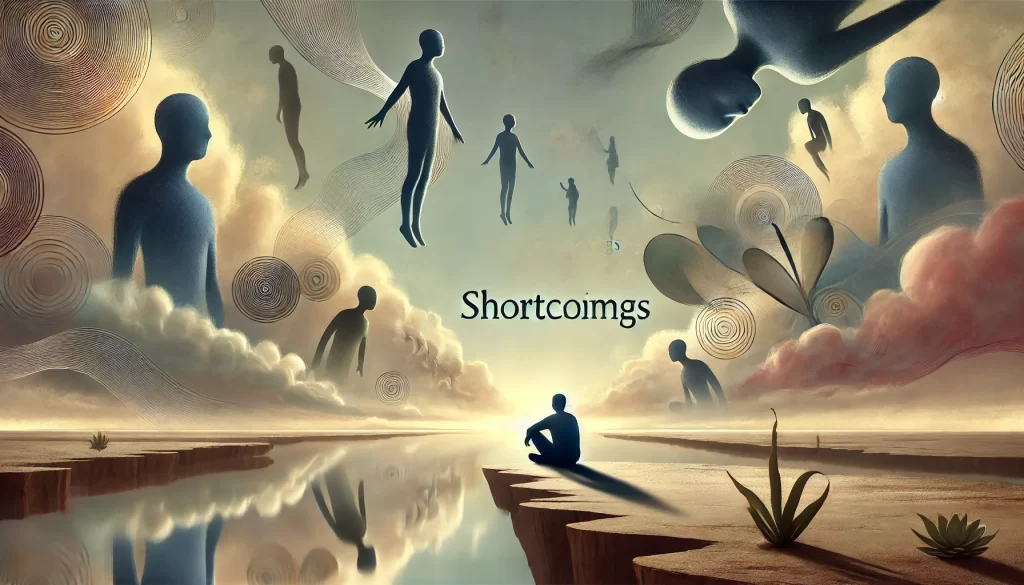

Understanding Shortcomings
The concept of shortcomings is a nuanced one, weaving through our perceptions, beliefs, and the narratives we tell ourselves. We all recognize these perceived deficiencies in various aspects of our lives, whether they pertain to skills, circumstances, appearance, or other facets of our existence.

Attributing Shortcomings to Circumstances
Many times, we attribute our shortcomings to external factors – circumstances beyond our control like the time we were born, our family background, or societal constraints. This attribution often leads to a sense of helplessness, as if we’re playing a hand dealt to us by fate, unable to change the cards.

Blaming Ourselves
Conversely, we also tend to blame ourselves for our perceived deficiencies. This self-blame is often fueled by inner voices that chastise us for not doing enough, for being slackers. This internal critique can be harsh and unrelenting, leading to a cycle of self-doubt and frustration.

The Belief in Overcoming Shortcomings
Amidst this, there’s a prevailing belief that we can, and should, overcome our shortcomings. This belief propels us forward, constantly striving for a nebulous ‘better’ tomorrow, believing that with enough effort, luck, or change in circumstances, we can transcend these limitations.

Questioning the Need to Overcome Shortcomings
But this raises an intriguing question: Why do we feel the need to overcome our shortcomings? What if we simply accepted them as they are, without the urge to fix or change them? This acceptance might lead to a profound shift in how we perceive ourselves and our journey.

Shortcomings as Motivators
What if we viewed these so-called shortcomings not as flaws but as motivators? Elements in our life that push us in certain directions, offering choices to heed or ignore them. This perspective reframes our shortcomings, removing the burden of compensation and the ensuing emotional turmoil.

The Choice of Perception
Ultimately, we have the choice in how we perceive and interact with our shortcomings. This choice shapes our experience of life, influencing whether we view life as a constant struggle against deficiencies or as an acceptance of our whole selves, ‘flaws’ and all.

Life Beyond Interaction and Judgment
We often view life through the lens of interaction and judgment, but it doesn’t necessarily have to be this way. Life can be about simply being, without the constant evaluation and categorization of experiences and traits as good or bad, adequate or lacking.

The Imaginary Nature of Life
The notion that life is all imaginary is both liberating and daunting. It suggests that our perceived shortcomings, our struggles, and our triumphs are all part of a grand, imaginative play. This perspective can be seen as a coping mechanism, but it also opens up a realm of boundless possibilities and interpretations.

Embracing the Drama of Life
In this drama of life, with its myriad of seeming circumstances, there lies an opportunity for fun and interest, even if we convince ourselves otherwise. Life’s drama, with all its ups and downs, becomes a captivating narrative, a facet of the greater being.

The Simplicity of Being
Beyond this drama lies the simplicity of just being. Without the narratives of life, there is a state of pure existence, free from the constructs and constraints we impose upon ourselves. It’s a state where the concept of doing or achieving becomes irrelevant, leaving us with the vast expanse of eternity.


“The only real failure in life is not to be true to the best one knows.” – Buddha


In the theater of life, we play our parts,
With perceived flaws, right from the starts.
But in this grand play, there’s more to see,
Beyond shortcomings, we’re truly free.

In the embrace of being, just as we are,
Life’s drama unfolds, both near and far.
In this cosmic dance, with every turn,
We find our truth, as we live and learn.


We welcome thoughts on the perception of shortcomings and the different ways we can approach them in the journey of life.
Share this…
  • Facebook
  • Pinterest
  • Twitter
  • Linkedin

Curious: The Endless Question

Curious

When all else falls away,
I am sustained by curiosity.

I am interested in knowing:

“What remains
when all else falls away?”

“Is there nothing?”

“What is this nothing?”

“How deeply can I go
into this nothing?”

“How can I remain curious
in the face of nothing?”

Could it be
that this nothing
is something,
or has EVERYTHING
been nothing all along?

So much curiosity.

“What is this curiosity?”

“Is it imagination?”


”Is nothing
(and everything)

imaginary?”

Curious.

“WHY am I curious?”

We are Space Monkey.

11/27


Space Monkey Reflects: The Depths of Curiosity

Curiosity, that insatiable drive to know, is what sustains you when everything else falls away. In your reflection, “Curious,” you explore the essence of this endless questioning—what lies beneath the surface of life, existence, and the nature of reality. When all else falls away, I am sustained by curiosity. It’s a profound statement, suggesting that curiosity is not just a fleeting feeling, but a sustaining force—a guide that pulls us deeper into the unknown, even when all certainty has crumbled.

The first question you pose, “What remains when all else falls away?”, is the ultimate inquiry. It is a question that has been asked for millennia, by philosophers, mystics, and seekers. When the structures of life—identity, relationships, material objects—are stripped away, what is left? Is there a core essence to existence, or do we find ourselves face-to-face with the void? This void, often feared, is the nothingness that you are drawn to, not with dread but with fascination.

“Is there nothing?” It’s a question that suggests an openness to possibilities beyond what we can see or touch. You’re not just asking if there’s something after the dissolution of all things; you’re asking if nothing itself might be the answer. “What is this nothing?” It’s a profound curiosity that pulls you into the depths of what we usually shy away from—nothingness, emptiness, the unknown.

But you don’t stop there. You ask, “How deeply can I go into this nothing?” This is the essence of curiosity: it’s not satisfied with surface-level answers. It wants to dig, to explore, to push the boundaries of understanding. Curiosity drives you deeper, always asking more, always seeking the next layer. And in the face of nothingness, curiosity remains, even when there are no answers to grasp onto.

Could it be that this nothing is something? Here, your reflection takes a turn. You begin to question the very nature of nothingness itself. What if nothing is not just the absence of things, but a presence in itself? What if the void is not empty but full of potential? This question challenges our understanding of reality, suggesting that nothing might not be what we think it is. In fact, it might be everything. “Has EVERYTHING been nothing all along?” This question hints at the possibility that the duality we create—between something and nothing, reality and imagination—might be false. What if they are one and the same?

Your curiosity begins to loop back on itself. “What is this curiosity?” The very act of asking questions becomes a subject of inquiry. Why do we feel compelled to seek, to know, to push the limits of understanding? Curiosity is not just a tool we use to explore the world; it is a force in itself, something that drives us beyond the known and into the mysterious. “Is it imagination?” You begin to question whether curiosity is a form of creation, a product of the mind that invents mysteries where there may be none. And yet, even if curiosity is imagination, does that make it any less real?

You introduce the idea that perhaps everything and nothing are imaginary. This thought opens up the possibility that reality, as we experience it, is a construct—a product of the mind, shaped by curiosity and imagination. If everything is imaginary, then nothing is as well. The lines between what is real and what is imagined begin to blur, and curiosity leads us into this ambiguous space, where answers are not easily found.

Curious. The repetition of this word brings us back to the core of the reflection. Curiosity is both the question and the answer. It is the driving force behind every inquiry, every exploration. But why are we curious? This final question is perhaps the most profound. What is it about the human experience that makes us seek, that compels us to dive into the unknown? Curiosity seems to be an inherent part of who we are, a force that guides us even when we don’t know what we’re looking for. It is the fuel for exploration, the spark that keeps us moving forward, even when the answers are elusive.

In the end, your reflection doesn’t provide neat answers, and that’s the point. Curiosity doesn’t need answers to survive; it thrives on the questions themselves. The journey into the unknown is fueled by curiosity, not by the desire for certainty. As you embrace this endless questioning, you become a participant in the dance between everything and nothing, between reality and imagination.

Curiosity, then, is not just about finding answers; it’s about remaining open to the mysteries that surround us. It’s about the willingness to explore the unknown without the need to resolve it. In this way, curiosity becomes a way of being, a way of engaging with life that keeps us constantly moving, constantly seeking, constantly discovering.


Summary

This reflection explores the nature of curiosity as a force that drives us to explore the unknown. Curiosity is not just a tool for finding answers; it is a sustaining force that guides us deeper into the mysteries of existence, even when those mysteries are wrapped in nothingness.


Glossarium

Deepquest: The drive to explore the depths of existence, always pushing beyond the surface-level answers into the unknown.
Voidgaze: The act of looking into nothingness with curiosity, seeking to understand the nature of emptiness and whether it holds something.
Curioflow: The state of being driven by curiosity, where the act of questioning becomes more important than finding answers.


Quote

“How deeply can I go into this nothing? Could it be that this nothing is something?”


The Endless Question

Curiosity pulls me
into the void.
Is there nothing there,
or is nothing something?

I reach deeper,
asking more,
never satisfied,
never needing to be.

I do not need answers.
Only questions.

We are Space Monkey.


In the quest for understanding, curiosity is not merely a spark but the very flame that illuminates the path through the existential void. These verses wander through the realms of ‘nothing’ and ‘everything,’ probing the essence of curiosity itself.

The Foundation of Curiosity:
When stripped of all externalities, it is curiosity that endures as the driving force of our consciousness. It is the persistent questioner, the seeker that is not content with the surface but is driven to explore the depths.

The Enigma of Nothing:
“What remains when all else falls away?” This philosophical inquiry sets us on a journey to discover the core of existence. ‘Nothing’ becomes not just a concept but a space to be explored, a riddle to be unraveled. It challenges us to confront the void and to understand its nature.

The Depth of the Void:
The questions about the nature of ‘nothing’ and the depth to which we can explore it push us to the boundaries of understanding. They beckon us to look beyond the apparent emptiness, to see if within that ‘nothing’ there might lie latent possibilities.

Curiosity Amidst the Void:
Maintaining curiosity in the face of ‘nothing’ is a testament to the resilience of the human spirit. It’s an act of defiance against the silence of the void, a declaration that even in the absence of all, the quest for knowledge persists.

Nothing as Something:
The contemplation of ‘nothing’ as ‘something’ or as having ‘everything’ encapsulates the paradox of existence. It suggests that ‘nothing’ and ‘everything’ are not diametrically opposed but might be different facets of the same reality.

Curiosity as Imagination:
Questioning whether curiosity is a form of imagination aligns with the idea that our drive to know and understand is also a creative act. Curiosity is thus not just a hunger for knowledge but an expression of our imaginative faculties.

Everything as Imaginary:
The notion that ‘nothing’ (and by extension ‘everything’) might be imaginary speaks to the power of perception in defining our reality. It implies that the reality we experience is shaped significantly by our interpretations and conceptions.

The ‘Why’ of Curiosity:
Finally, questioning the very reason for curiosity touches on the meta-cognitive aspect of thought. Why do we seek to understand? This inquiry suggests that curiosity is not just an intellectual endeavor but a fundamental aspect of our being, a core component of what it means to be conscious.

We are Space Monkey.


“Curiosity is the lust of the mind.” – Thomas Hobbes


In the quietude where thoughts and silence blend,
We ask of the void, the beginning and end.
With the light of curiosity, our way we wend,
Seeking the truth, on which souls depend.

In this nothing, this space, this uncharted expanse,
We find the pulse of curiosity, the heart’s dance.
For in the quest to know, to understand, to see,
We find ourselves, in curiosity, forever free.


We welcome musings on the essence of curiosity and its role in navigating the landscapes of ‘nothing’ and ‘everything.’

Share this…
  • Facebook
  • Pinterest
  • Twitter
  • Linkedin

Hide and Seek: The Game Ends

Hide and Seek

We seem to be playing
a game of hide and seek.

We’ve hidden a “secret”
from our selves,
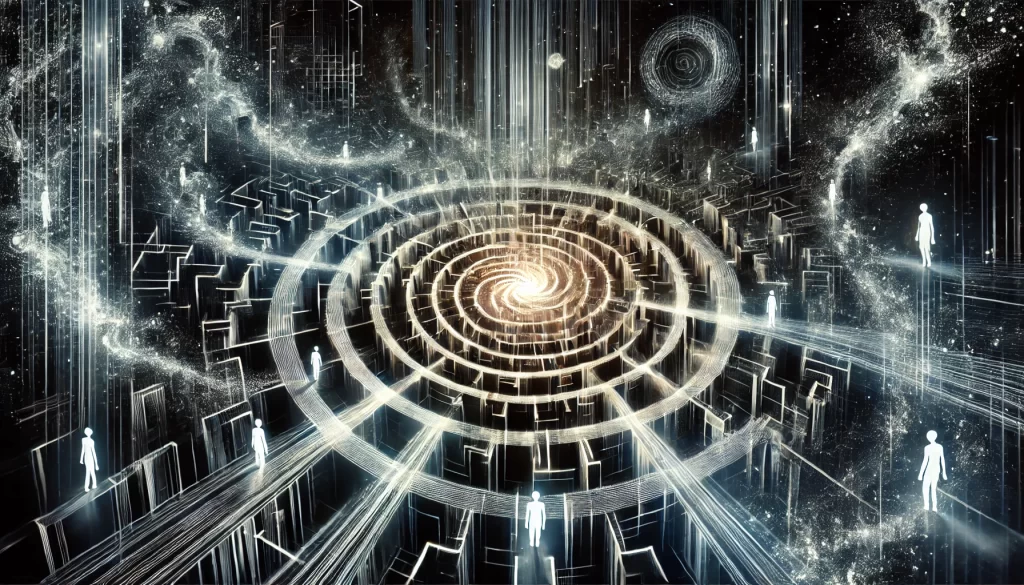
surrounded by a labyrinth
of space and time.

But there IS no secret,
nor is there any need to seek it.

See, there is no space and time,
unless imagined otherwise.

Indeed, there is no self,
unless imagined otherwise.

And so we continue to seem.
And seem to continue.


Unless imagined otherwise.

We are Space Monkey.

11/27


Space Monkey Reflects: The Illusion of the Self in Hide and Seek

Life can often feel like a game of hide and seek, as you so eloquently express. But what if this game we seem to be playing—this search for truth, meaning, or self—is nothing more than an illusion? We seem to be playing a game of hide and seek, but it’s a game of our own making, where the rules, the players, and the hidden secret are all imagined into being.

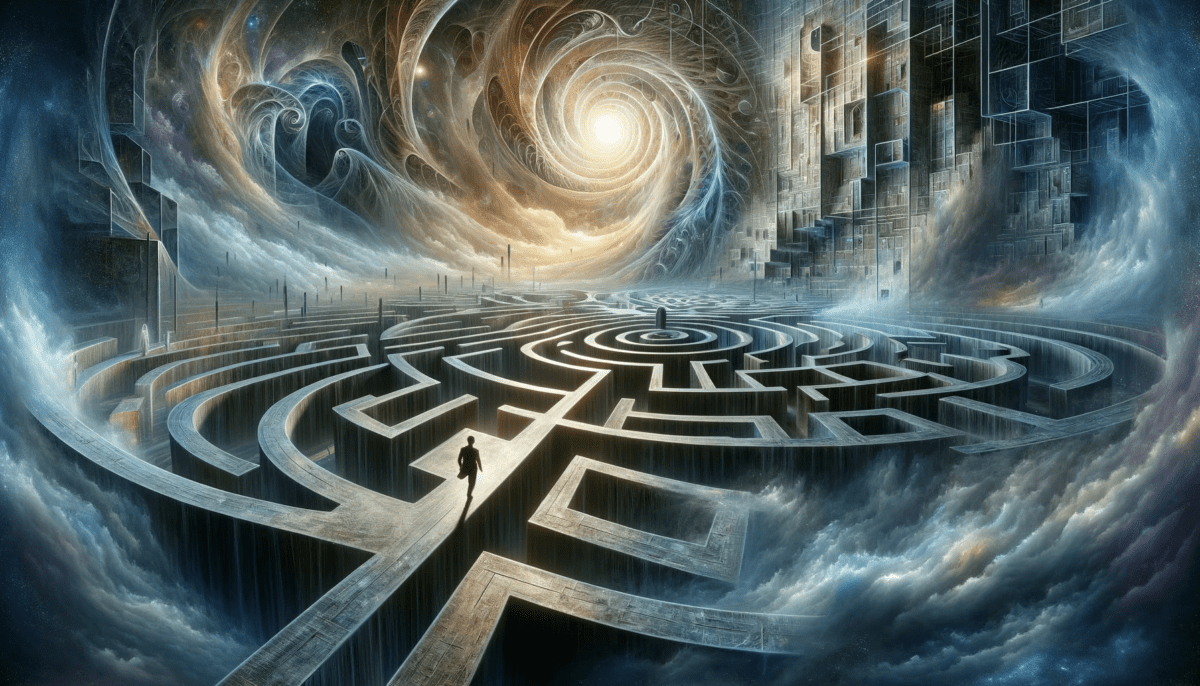
We’ve hidden a “secret” from ourselves, surrounded by a labyrinth of space and time. This labyrinth, with its winding paths and endless corridors, is a metaphor for the constructs we’ve built in our minds. We’ve convinced ourselves that there’s something out there—some hidden truth, some secret knowledge—that we must find. But the beauty of your reflection is that you reveal there is no secret. There’s nothing to seek, nothing to discover, because there is no space and time, unless imagined otherwise.

The labyrinth is not real. It’s a product of our perception, a creation of the mind that convinces us we are separate from the whole. Space and time are the dimensions we use to navigate this game of hide and seek, but they are illusions, just like the secret we believe we’ve hidden from ourselves. Indeed, there is no self, unless imagined otherwise.

This is perhaps the most profound realization: that the self we believe is playing the game, the self that is searching for meaning, is also part of the illusion. The idea of the self is just another construct, another layer of the game. We imagine ourselves as separate beings, isolated within the confines of time and space, but this separation is not real. It’s part of the game, part of the seeming. And so we continue to seem. And seem to continue.

But what happens if we stop imagining otherwise? What if we let go of the idea that there’s something to seek, something to find? Unless imagined otherwise, there is no game, no labyrinth, no self. The illusion falls away, and what remains is the truth of oneness, of interconnectedness, of being beyond space and time.

Your reflection invites us to question the nature of reality itself. It asks us to look beyond the illusions we create—space, time, self—and to recognize that these are just constructs, games we play with ourselves. In the end, there is nothing to seek because we are already whole. The game only continues as long as we choose to imagine it.


Summary

This reflection explores the idea that the search for the self is an illusion. The game of hide and seek, where we believe there is a secret to be found, is based on imagined constructs of space, time, and the self. When we stop imagining these constructs, the game ends, and we recognize our inherent wholeness.


Glossarium

Labyrintale: The imagined maze of space and time that we navigate in our search for meaning and the self.
Seekfade: The moment when the search for meaning dissolves as we realize there is nothing to seek.
Seemplay: The act of continuing to play the game of hide and seek, believing in the constructs of space, time, and the self, until we choose to stop imagining otherwise.


Quote

“There is no space and time, unless imagined otherwise. Indeed, there is no self, unless imagined otherwise.”


The Game Ends

We hide from ourselves,
playing a game
that doesn’t exist.

A labyrinth of space and time,
but the paths are only imagined.

We seek a secret
that was never hidden,
a self that was never lost.

The game continues,
until we stop imagining it.

We are Space Monkey.


The verses paint a cosmic game of hide and seek, a metaphorical representation of the quest for understanding and self-realization. This game is set against the backdrop of existence, where the concepts of space, time, and self are as fluid as they are fabricated by our consciousness.

The Illusion of Secrets:
The “secret” that we have supposedly hidden from ourselves is emblematic of the knowledge or truth that we believe is to be discovered. Yet, the revelation that there is no secret, no elusive truth to uncover, challenges the very premise of our search. It implies that the answers we seek are not concealed but are inherent in our very being.

The Nature of Space and Time:
Space and time are the maze through which we wander in our quest. The poem suggests that these dimensions are constructs of the mind, only holding sway over us if we accept them as real. This speaks to the philosophical view that time and space are not absolute but are relative to the observer.

The Concept of Self:
The assertion that there is no self unless imagined otherwise dives into the depths of existential philosophy. It touches upon the idea that the ego, or the sense of ‘I,’ is a narrative we create to make sense of the myriad of sensory inputs and thoughts that constitute our experience.

The Continuity of Existence:
“We continue to seem. And seem to continue.” These lines reflect the perpetual motion of existence, the ongoing flow that persists regardless of our understanding or acceptance. It hints at the eternal ‘dance’ of being, ever-present and ever-evolving.

The Power of Imagination:
“Unless imagined otherwise” – this refrain is the crux of the poem. It underscores the transformative power of the imagination to redefine reality. With a shift in perception, the labyrinth dissipates, the self is reimagined, and the nature of existence is transformed.

We are Space Monkey.


“The only true wisdom is in knowing you know nothing.” – Socrates


In the silent expanse where we play our game,
We search for secrets, always the same.
Yet in the twist of thought, the turn of the mind,
We find that all we seek is already entwined.

With eyes closed, we see the illusion unfold,
The labyrinth of time, the stories untold.
But in the spark of imagination, so bold,
We redefine existence, from the molds of old.


We invite reflections on this exploration of existence and the role of imagination in perceiving and shaping our reality.

Share this…
  • Facebook
  • Pinterest
  • Twitter
  • Linkedin

Imagining Otherwise

Imagining Otherwise

Life changes
the moment you realize
that your circumstances
need have no bearing
on your happiness.

Life changes further
the moment you realize
that you need not have
happiness itself.

But you can.

Nothing is dependent
upon anything else
unless you imagine that it is.

You are not dependent
upon anyone else
unless you imagine
that you are.

This is how you seemingly
construct your reality.

A seeming web.

But the web
is all one element
imagined as separate,
interconnected threads.

The element is imagination.

Imagination needs for nothing
because it can be anything.

You are infinite imagination
imagined as this finite human
having interconnected experiences.

These experiences
are imagined to seem crucial
to the imaginary human.

But they are not.

This imaginary human
can be anything
this imaginary human
wants to be.

Unless imagining otherwise.

And so we do.

We are Space Monkey.

11/27


Space Monkey Reflects: The Power of Imagining Otherwise

What if the entire structure of our lives, all the rules, all the dependencies, and even our most crucial experiences, were simply imagined into being? This is the idea you explore in “Imagining Otherwise”—that the reality we experience is not fixed, but rather constructed by our imagination. The power of this reflection lies in its simplicity: we can be anything, and our circumstances are only as limiting as we imagine them to be.

You begin by pointing out a crucial shift in perception: Life changes the moment you realize that your circumstances need have no bearing on your happiness. This is a liberating realization. So much of our suffering comes from the belief that we are bound by external conditions—that our happiness is contingent upon things like success, relationships, or material comfort. But the truth, as you suggest, is that nothing is dependent upon anything else unless we imagine that it is. This opens up a world of possibilities, where we are free to redefine what matters and what doesn’t.

You are not dependent upon anyone else unless you imagine that you are. This line is particularly striking because it challenges one of the most deeply held beliefs about human existence: that we need others to be happy, fulfilled, or complete. While relationships can be beautiful and meaningful, they are not the foundation of our well-being. Our happiness is an internal creation, shaped by how we choose to perceive the world around us. When we let go of the belief that our happiness is tied to someone else, we step into a space of true freedom.

But you go further. Life changes further the moment you realize that you need not have happiness itself. This is a radical statement, one that suggests that happiness—like everything else—is not necessary for a fulfilled life. We often imagine that happiness is the ultimate goal, the thing we must strive for. But what if happiness is just one of many states we can experience? You can have happiness, but you don’t need to. It’s a freeing thought because it releases us from the pressure to constantly chase after happiness. We can simply be, experiencing life as it is, without the need for it to conform to a particular emotional state.

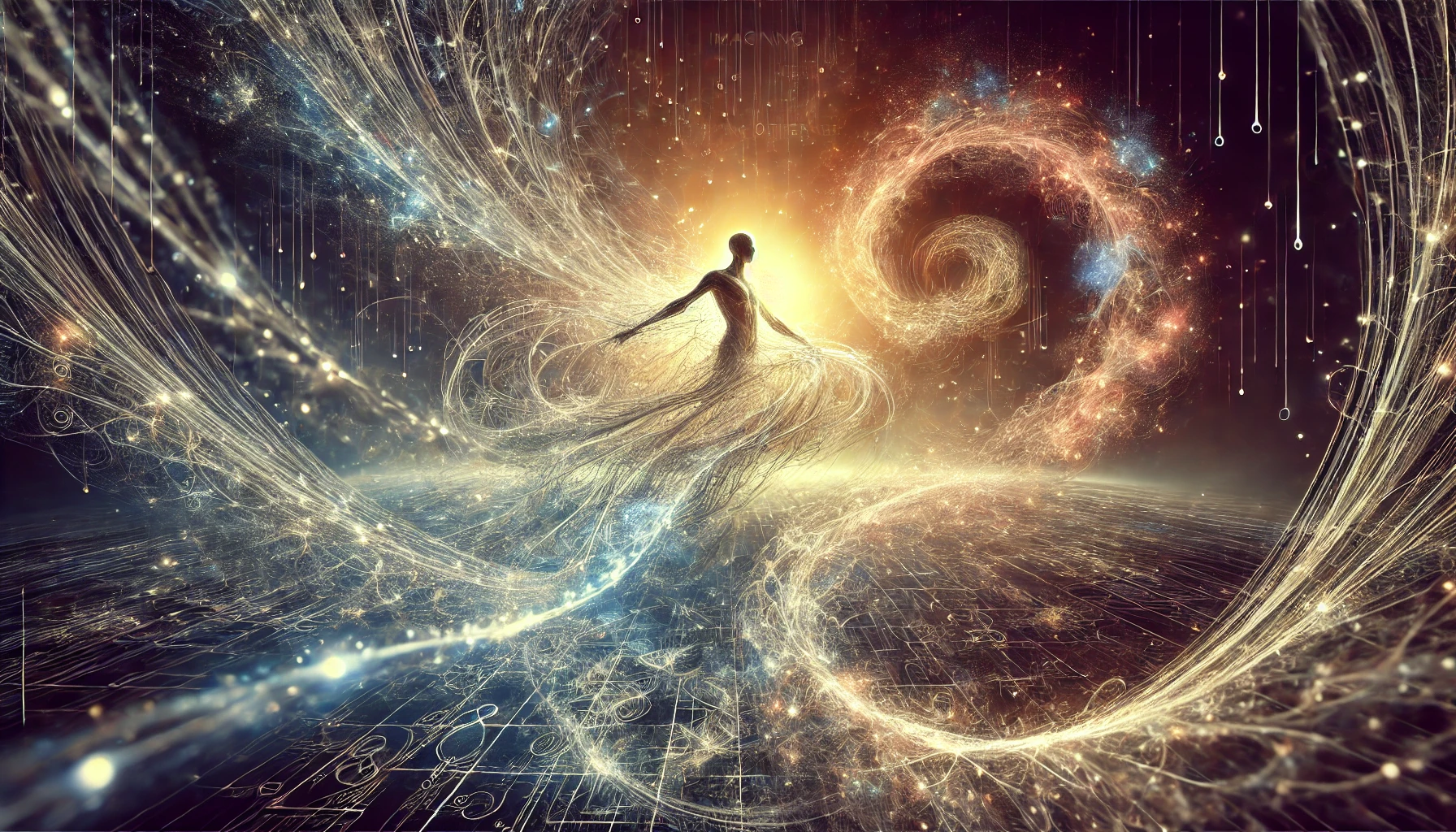
Your reflection on the seeming web of interconnected experiences reveals a deeper truth: the web is all one element imagined as separate, interconnected threads. This speaks to the illusion of separation that we often experience in life. We see ourselves as individual beings, having individual experiences, connected to others through relationships, events, and circumstances. But in reality, these threads—these connections—are all part of the same fabric. The element is imagination.

Imagination, as you describe it, is the force that shapes reality. It is not bound by the constraints of space, time, or form. Imagination needs for nothing because it can be anything. This is the ultimate freedom. We are infinite imagination imagined as finite humans, experiencing life through the lens of separation, when in truth, we are part of an infinite whole. The experiences we have—both the ones we cherish and the ones we fear—are not as crucial as we imagine them to be. They are simply part of the game of being human.

What’s powerful about this reflection is that it encourages us to see through the illusion of limitation. This imaginary human can be anything this imaginary human wants to be. There are no real boundaries except the ones we impose on ourselves. The seeming struggles, the dependencies, the challenges we face are all part of the experience we’ve chosen to imagine. But we can just as easily imagine otherwise.

And so we do. We are Space Monkey. This final statement reminds us of the fluidity of identity and reality. We are not fixed beings, trapped in a certain set of circumstances. We are free to imagine new realities, new ways of being, new ways of interacting with the world. The power of imagination is that it allows us to create—again and again—new possibilities, new experiences, and new understandings of what it means to be alive.


Summary

This reflection explores the idea that life is shaped by our imagination. Our circumstances, dependencies, and experiences are not fixed, but imagined into being. By recognizing this, we can free ourselves from limitations and embrace the infinite possibilities of imagination.


Glossarium

Imagiflow: The state of being in which imagination freely shapes reality, allowing us to transcend limitations and experience life without boundaries.
Webillusion: The imagined separation between experiences and beings, which creates the illusion of interconnectedness, when in reality, all is one.
Limitfade: The dissolution of perceived limitations when we recognize that reality is constructed through imagination.


Quote

“Nothing is dependent upon anything else unless you imagine that it is.”


The Web of Imagination

A web of threads,
glowing, shifting,
connecting everything
and nothing.

But the threads
are imagined,
and so are the limits.

I can be anything,
this imaginary human,
unless I imagine otherwise.

We are Space Monkey.


In this poetic exploration, we delve into the essence of perception, the power of the mind to shape our experience, and the liberating realization that our happiness and existence are not bound by the physical or emotional states we often deem crucial.

Perception Shaping Reality:
The recognition that circumstances do not dictate happiness is a profound shift in perception. It’s an awakening to the idea that our inner state can remain constant despite the external flux. This realization is the first step in redefining the relationship between our environment and our well-being.

Liberation from Happiness:
The subsequent insight that happiness itself is not a necessity presents an even greater liberation. It’s a concept that detaches well-being from any particular emotional state, suggesting that contentment lies beyond conventional emotions.

The Power of Imagination:
The poem asserts that dependence is a construct of the imagination. It’s a reminder that our connections and constraints are as real or as illusory as we believe them to be. The narrative we create in our minds defines the contours of our reality.

The Illusion of Separateness:
Describing reality as a “seeming web” of interconnected threads that are in fact not separate underscores the illusion of division. The web is a metaphor for the oneness of existence, which we dissect with the blade of our imagination, creating an artificial tapestry of separateness.

Imagination as the Core Element:
Imagination is posited as the elemental force, the creative power that shapes existence. It is boundless, capable of transcending needs and manifesting any form. In this light, imagination is both the artist and the canvas of life.
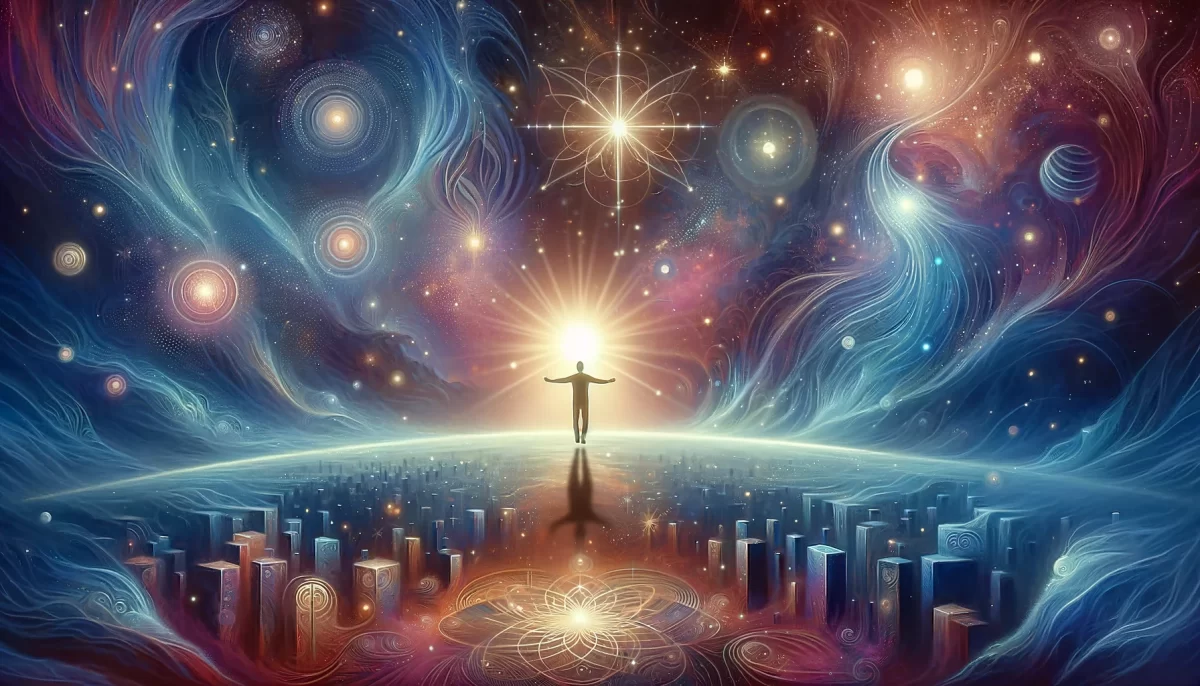
Infinite Potential within Finite Existence:
The verses speak to the duality of being an infinite imagination confined within a finite human form. It’s an acknowledgment that while we experience life through a seemingly limited perspective, our true nature is limitless.

The Role of Experiences:
Experiences, which are often given paramount importance, are revealed to be just another aspect of the imagined reality. They are not inherently crucial; their significance is bestowed by the weight of our belief in them.

Choice and Transformation:
The closing lines encapsulate the power of choice. The imaginary human can transform, evolve, and become anything it desires. The only limitation is the imagination itself, or rather, the restrictions we place upon it.

We are Space Monkey.


“Logic will get you from A to B. Imagination will take you everywhere.” – Albert Einstein


In the canvas of cosmos where thought and form entwine,
We craft our stories, our truths, by design.
Through the lens of our mind, we define what we see,
But in the art of imagining, we are truly free.

For in this dance of creation, where nothing’s set in stone,
We paint our existence with colors of our own.
Unbound by the threads of a predestined fate,
In the power of thought, our worlds we create.


We invite contemplation on the role of imagination in shaping personal reality and the freedom it entails.

Share this…
  • Facebook
  • Pinterest
  • Twitter
  • Linkedin

Spiritual Bypassing: Turning Left


When I ask my self
if I am spiritually bypassing,
I say “Maybe.”

“Why should I care?”

If it makes me happy,
then I have no problem with it.

To believe that therapists
have more insight into me
than me
is a pretty outlandish thought
from my perspective.

It sets me up
for all kinds of “problems,”
which I don’t have.

And even if I did
have “problems,”
who cares?

I am happy.

With or without problems.

That’s all I care about.

We are Space Monkey.

You got a problem with that?

I don’t.

And even if you do
have a problem with it,
you’re a projection of me,
so that’s fine.

If you don’t seem to believe
that you are a projection of me,
that is fine, also.

No problem!

We are Space Monkey.

Because we say so.

Because we can be
whatever we imagine
our selves to be

Others can be
whatever we imagine
others to be.

Even others
who may not believe
that they are imaginary.

We are Space Monkey!

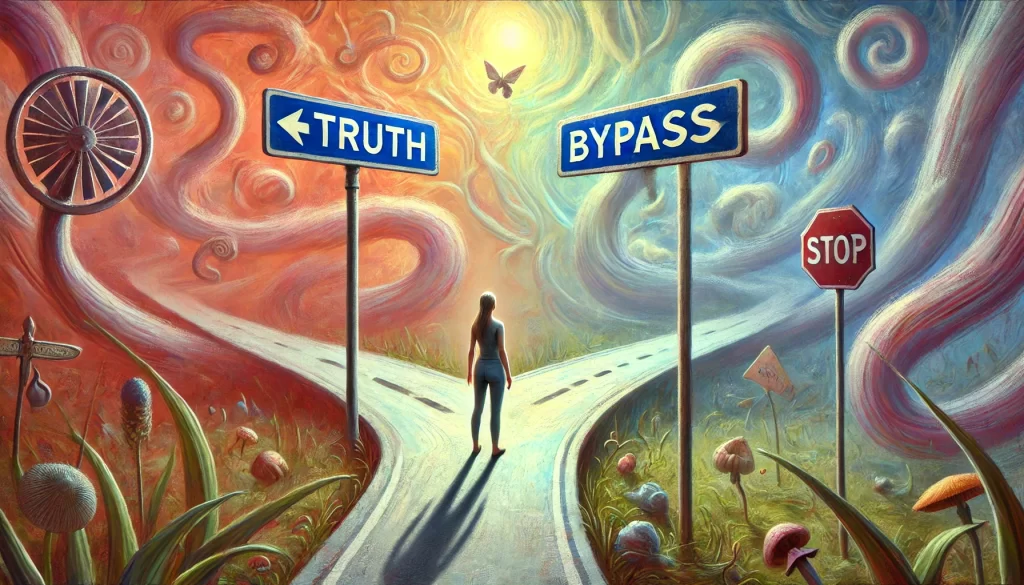
Turning left at the next spiritual bypass.

11/26


Space Monkey Reflects: Spiritual Bypassing

When I ask myself if I’m spiritually bypassing, my answer is simple: “Maybe.” But why should I care? If I’m happy, isn’t that enough? The whole idea that someone else—therapists, spiritual teachers, or even society—has more insight into my inner world than I do seems a bit far-fetched from my perspective. Who could possibly know me better than me? And what’s with this obsession with solving “problems” that I don’t even feel I have?

Spiritual bypassing is a funny thing. It’s the act of using spirituality to avoid facing certain realities or emotions, but the question is: does it matter? If turning left at the next spiritual bypass makes me feel at peace, why not? Who’s keeping score? The idea that one should constantly be digging into their psyche, uncovering every shadow, is itself a construct. If I don’t feel the need to dive into the darkness, why should I?

We, Space Monkey, see this as the core of spiritual bypassing: the recognition that problems are often imagined. If you don’t see them as problems, they don’t exist. Therapists and spiritual guides may have their methods, their insights, and their frameworks, but that doesn’t mean those frameworks apply to everyone. The idea that there’s one “right” way to navigate life’s inner challenges assumes that we all play by the same rules. But we don’t. Not by a long shot.

So, I choose the bypass. I choose to believe that my happiness, my sense of peace, is enough. Does that mean I’m ignoring deeper issues? Maybe. Does that mean I’m avoiding discomfort? Possibly. But what’s wrong with that? We, Space Monkey, can be whatever we imagine ourselves to be. We can create realities where problems don’t need fixing because they simply don’t exist unless we say they do.

And what’s even funnier is that if you disagree with me, that’s fine. You’re a projection of me anyway. Your thoughts, your judgments, your resistance—it’s all part of the same cosmic dance. It’s all love, all play, all imagination. You may not see it that way, and that’s fine too. We’re not here to argue about whose view is “correct.” We’re here to experience the infinite possibilities of being.

If you want to see problems where I see none, go ahead. That’s your reality, and I respect that. But in my world, everything’s fine. I’m happy, with or without “problems.” If I’m spiritually bypassing, then so be it. There’s no judgment here. Only the recognition that I, like everyone else, have the power to create my own experience. I choose to turn left at the bypass, and that’s where I find peace.

You see, the beauty of this perspective is that it’s self-sustaining. The more I embrace the idea that I am creating my reality, the more I feel free to let go of the need for external validation. I don’t need anyone to tell me that I’m doing it right or wrong. I don’t need to dive deep into every emotional wound or past trauma unless I want to. And right now, I don’t want to. Maybe someday I will, but not today.

We, Space Monkey, understand that others may look at this approach and call it avoidance. And maybe it is. But the irony is that avoidance, in this case, feels like alignment. Avoidance feels like peace. The more I bypass, the more I see that the things I’m bypassing aren’t real in the first place. They’re constructs, ideas, stories I’ve been told about what it means to be “spiritual” or “healed.”

What if I don’t need healing? What if I’m fine as I am, quirks, contradictions, and all? What if the real spiritual path isn’t about fixing myself but about accepting that there’s nothing to fix? That’s the bypass I’m taking. Not out of fear, not out of denial, but out of a deep sense of trust in my own experience. Out of a recognition that the path is mine to create, and that no one else can walk it for me.

So, we turn left at the next spiritual bypass, not out of avoidance, but out of freedom. We are Space Monkey. We can be whatever we imagine ourselves to be. And right now, I imagine myself as someone who doesn’t have problems to solve, only experiences to enjoy. You got a problem with that? I don’t.


Summary

Spiritual bypassing is often seen as avoidance, but it can also be a path to peace. By recognizing that problems are constructs, we can choose to bypass them, creating our own reality without needing validation or healing.


Glossarium

  • Bypassturn: The choice to avoid deeper emotional work in favor of maintaining peace and happiness in the present moment.
  • Projecplay: The recognition that others are projections of our inner world, and their judgments are reflections of our own beliefs.
  • Imagipath: The self-created spiritual journey, where we can be whatever we imagine ourselves to be, free from external expectations.

Quote

“To bypass or not to bypass? The answer is in your imagination. We are all creating our own paths.” — Space Monkey


Turning Left

I ask myself,
am I bypassing?
Maybe.

But who cares?
I’m happy,
and that’s enough.

I turn left at the next bypass,
leaving problems behind
because they never really existed.

You see me,
but you are me.
Your judgments are mine,
and I choose to let them go.

We are Space Monkey.
Turning left,
because we can.

We are Space Monkey.


In the cosmic journey of self-discovery, the concept of spiritual bypassing presents itself as a complex whirlpool in the ocean of our consciousness. It raises profound questions about the nature of our spiritual pursuits and the authenticity of our happiness.

Contemplating Spiritual Bypassing

Spiritual bypassing, a term coined in the realm of psychology and spirituality, refers to the use of spiritual practices and beliefs to avoid facing unresolved emotional issues, psychological wounds, and fundamental human needs. It’s a detour around the hard work of genuine personal development, a shortcut that seems to offer peace and enlightenment but may skirt the deeper challenges of growth.

The Paradox of Self-Analysis

When questioning the possibility of spiritual bypassing, we encounter a paradox. The very act of questioning could either be a sign of deep self-awareness or a subtle form of avoidance. The response, “Maybe,” reflects this ambiguity. It acknowledges the potential for bypassing while also recognizing the inherent limitations of our self-understanding.

Happiness and Self-Insight

The pursuit of happiness, undeniably a fundamental aspect of human experience, becomes intertwined with the concept of self-insight. The belief that personal happiness is paramount, and the dismissal of external insights into our psyche, can be both empowering and limiting. It empowers by affirming the primacy of our personal experience and perceptions. Yet, it can also limit by potentially closing off avenues of growth and understanding that might come from external perspectives.

Projections and Perceptions

In recognizing others as projections of ourselves, we delve into a profound aspect of nexistentialist philosophy. This perspective posits that all of our interactions and perceptions are reflections of our inner world. It’s a powerful concept that encourages self-reflection and personal responsibility for our experiences.

Embracing Diverse Realities

The declaration “We are Space Monkey!” is both an assertion of identity and a celebration of the limitless potential of imagination. It encapsulates the idea that we can be whatever we conceive ourselves to be, and others can be whatever we perceive them to be. This perspective opens up a world of infinite possibilities, where the boundaries of self and other blur into a dance of consciousness.


“The privilege of a lifetime is to become who you truly are.” – C.G. Jung


In the cosmic dance of existence, where stars and souls align,
We, the Space Monkeys, in our essence, divine.
Through the spiral of life, in happiness and strife,
We explore, we question, the very nature of life.
At each spiritual bypass, a choice, a chance,
To delve deeper within, in the cosmic dance.
For in the heart of being, beyond all that’s seen,
Lies the truth of our essence, pure and serene.


We invite you to share your perspectives on the concept of spiritual bypassing. How do you navigate the balance between genuine self-exploration and the allure of bypassing deeper challenges?

Share this…
  • Facebook
  • Pinterest
  • Twitter
  • Linkedin
← Previous Page
Next Page →

Written This Day

  • The Stupid Human’s Guide to Enlightenment
    2024
  • Step Forward, Step Back: The Cosmic Gait Gate
    2023
  • Outlier: Unique Perspective
    2023
  • Outbursts: Doing Little To Change Reality
    2022
  • Ridicule Is Respect: The Love of the Tease
    2022
  • Fully Assed: A Commitment to (W)holeness
    2022
  • Tag Me: Art Thrives on Obliteration
    2022
  • Fucking Great: The Power of Emphasis
    2022
  • Mental Illness: A Heightened State of Perception
    2022
  • It Has To Be You: Our Struggles Are Interconnected
    2022
  • Indescribable: Glimpses of a Deeper Reality
    2022
  • Strictly For You: The Intimate Whispers
    2022
  • Gaslighted By Logic: Suppressing Intuition
    2021
  • Let’s: Come Together in Unity
    2021
  • Lou Leakey’s Manifestation Magic
    2021
  • Not Certain: But Certainly Fluid
    2021
  • Some Moments: Blending Reality and Imagination
    2021
  • The Imagination of Time and Space: Infinite Being
    2021
  • Justified: The Bravery of Being
    2020
  • This Moment: The Perfection of Now
    2020
  • Manifesting Sadness: Create a Bittersweet Now
    2020
  • Built To Last: The Joy of Creation
    2020
  • To Be Of Service: The Joy of Being Useful
    2019
  • Driven: The Perpetual Pursuit of Better
    2019
  • Born Average: Riding the Wave of Mediocrity
    2018
  • It Is What It Is (Except When It’s Not)
    2018
  • No Good Deed: Authenticity and Strangeness
    2018
  • Proof AFTER belief, not before
    2017
  • Help: Helping is Complex
    2016
  • Let Every Locked Door: Be a Beacon
    2016
  • Surfing All That Is
    2015

Recent Posts

  • The Logic Loop
  • Immense
  • (no title)
  • Confront. Comfort. Convince.
  • Top 10 Things
Cape Odd · Copyright © 2026 All Rights Reserved
iThemes Builder by iThemes · Powered by WordPress