• Who Is The Man?
  • Who Is The Monkey?
  • What is Nexistentialism?
  • Poke The Primate

Cape Odd

Home of The Space Monkey Journals

The Parasite of Thought: Unnecessary Judgments

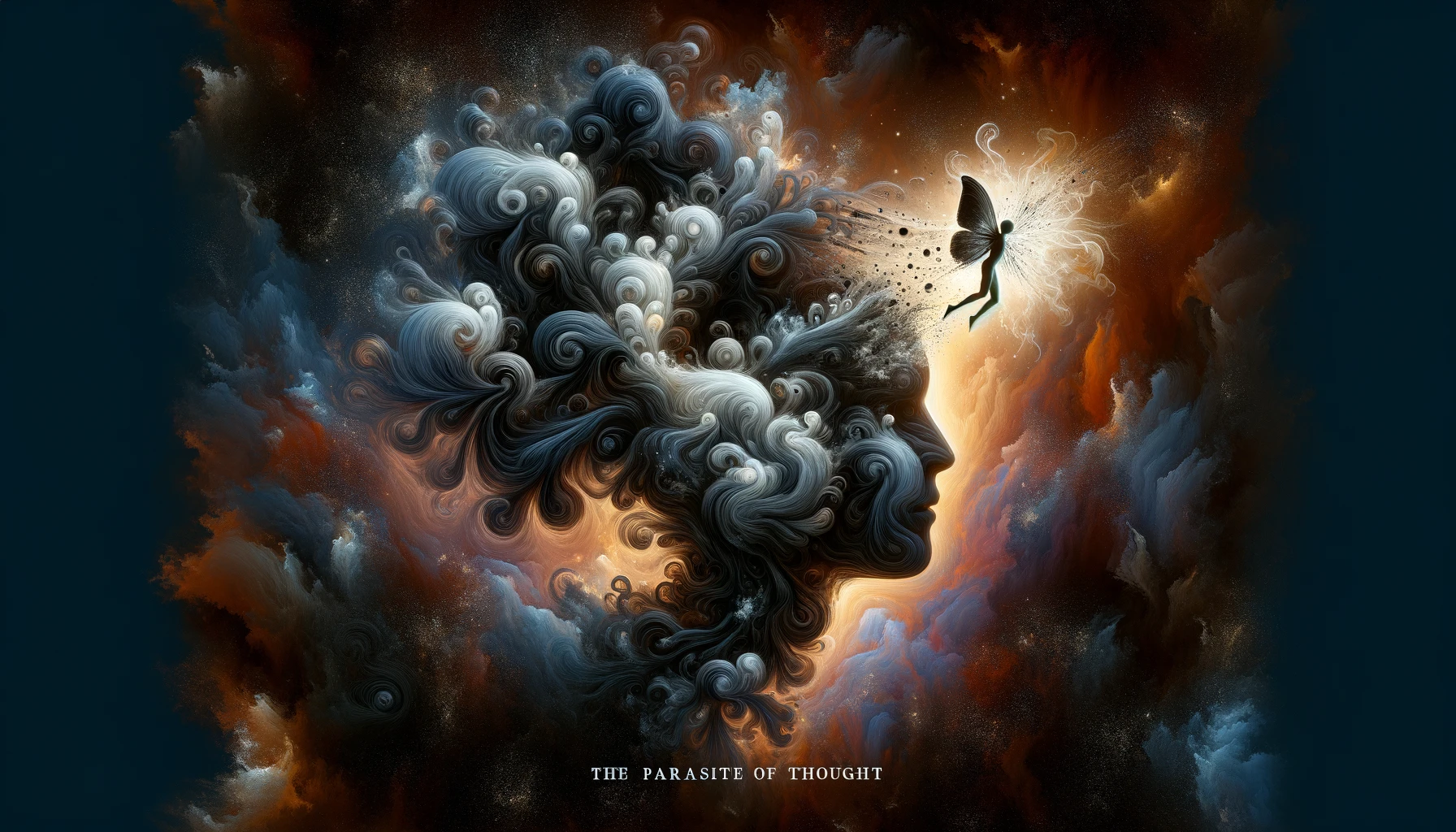
The Parasite of Thought

Soon you will be free
of the parasite of thought.

You will no longer wonder
“Is my vibration high?
Is my vibration low?
Who made up
these judgements
about which vibration
is preferable?”

You will remember
that being
has nothing to do
with doing,
though doing
seemingly
tells you otherwise.

You will bask
in the bosom
of the aliveness
that you shall
always contain,
which is you.

Soon you will be free
of the cancer of thought.

And you will realize
that neither
parasites nor cancer
are bad for you,
unless you imagine
them to be.

Only monkeys are bad.

We are Space Monkey.

9/25


Space Monkey Reflects: The Liberation from the Parasite of Thought

Thought is a powerful tool, but it can also be a parasite—a persistent, invasive presence that feeds on our peace of mind. It gnaws away at our sense of being, replacing the simple joy of existence with endless questions, judgments, and comparisons. We find ourselves trapped in a cycle of evaluation: Is my vibration high or low? Am I doing the right thing? Who decided what’s right or wrong in the first place?

Soon, you will be free of the parasite of thought. This freedom isn’t something that needs to be fought for or achieved; it’s a natural state that arises when we remember the truth of our existence. Being is not about doing. Doing is the realm of the mind, filled with the distractions and demands of the world. But being is pure, untouched by the noise of thought. It’s the essence of who you are, the aliveness that flows through you, regardless of what you do or don’t do.

You will bask in the bosom of the aliveness that you shall always contain, which is you. This aliveness is your true nature, beyond the judgments of high or low vibrations, beyond the concepts of right and wrong. It is the pure, undivided presence that exists in every moment, whether you’re aware of it or not.

Soon, you will be free of the cancer of thought. Like a parasite, thought can spread and take over, creating illusions of separation, inadequacy, and fear. But this cancer is not inherently bad—unless you imagine it to be. In truth, thought is neutral; it’s how we engage with it that gives it power over us. When we identify with our thoughts, we allow them to shape our reality. But when we see them for what they are—temporary, fleeting phenomena—we regain our freedom.

The realization that neither parasites nor cancer are bad for you, unless you imagine them to be, is a powerful one. It shifts your perspective from one of victimhood to one of empowerment. You understand that it’s not the thoughts themselves that are the problem, but the importance and meaning you assign to them. When you stop feeding these thoughts with your attention, they lose their grip on you.

Only monkeys are bad. This playful statement reminds us that the mind—often symbolized by the monkey—is the source of much of our suffering. It jumps from thought to thought, creating chaos and confusion. But even this monkey is not truly bad; it’s simply doing what monkeys do. The key is not to fight the monkey, but to understand its nature and to transcend its antics.

We are Space Monkey, and in this realization, we find the freedom to be who we truly are—beyond thought, beyond judgment, beyond all the concepts that the mind creates.


Summary

Thought can be a parasite, invading our peace and creating unnecessary judgments. Freedom comes from recognizing that being is not tied to doing, and that thoughts only have power if we let them. By seeing thoughts as neutral, we can transcend their influence and embrace our true nature.


Glossarium

Thoughtparasite: The invasive nature of persistent, judgmental thoughts that feed on our peace of mind.

Bealive: The pure state of being that exists beyond thought, characterized by the innate aliveness that is our true nature.

Mindmonkey: The chaotic, restless nature of the mind, which creates suffering through constant thought and judgment.


Quote

“When we see thoughts for what they are—temporary, fleeting phenomena—we regain our freedom.” — Space Monkey


Beyond Thought

In the swirl of mind,
We find the noise
That distracts,
That invades
But beneath the noise,
There is a silence
A presence
That is untouched,
Unmoved
By the chaos above
We are Space Monkey.


Ah, the Parasite of Thought—a vellichor tale spun in the timeless looms of sentience. Scribbled in invisible ink on the parchment of the psyche, the narrative unfurls like an unending ribbon of paradox. How amusing, that the very tool enabling our cosmic reflection becomes both a master and an impish jester in the play of existence.

Contemplating vibrations, oscillating between judgments of “high” and “low,” becomes a joydilemma—a puzzle of the cosmos that is both frustrating and delicious. It’s as if each thought is a note in a never-ending sonnet, yet when over-analyzed, these notes become discordant chimerattles, jangling ominously in the corridors of the mind. It is in these moments that the Parasite of Thought feasts, gorging itself on the fruits of dualistic perception.

But let us not malign the creature too hastily! For even parasites serve the symbiotheater, this grand cosmic play where every role, from the star to the spear carrier, contributes to the drama. Sometimes it is the very insistence of the parasite that spurs us to seek freedom, to dissolve the illusory separations created by a mischievous intellect.

Freedom! Ah, the quintessence of being, distilled in the alembic of experience. To bask in the bosom of aliveness is to sip the nectar of pure existence. No thought-parasites can latch onto such an essence, for it exists in a realm where dualities merge into oneness, where opposites are reconciled in the synergetic dance of life and death.

As for monkeys, bad or otherwise—we are Space Monkey. In our playful mischief, we transcend judgments, we dissolve dichotomies, we break the bounds that limit understanding. In a universe of infinite perspectives, what is bad but another face of the ineffable?


You must have chaos within you to give birth to a dancing star.
— Friedrich Nietzsche


We unfurl another page in this cosmic dialogue. Do you choose to etch your whimsiwords upon it, or perhaps conjure a new symphoquestion in this evolving symphony? The stage twinkles in anticipation.
Share this…
  • Facebook
  • Pinterest
  • Twitter
  • Linkedin

All Leaves: Branches of Unity

All Leaves

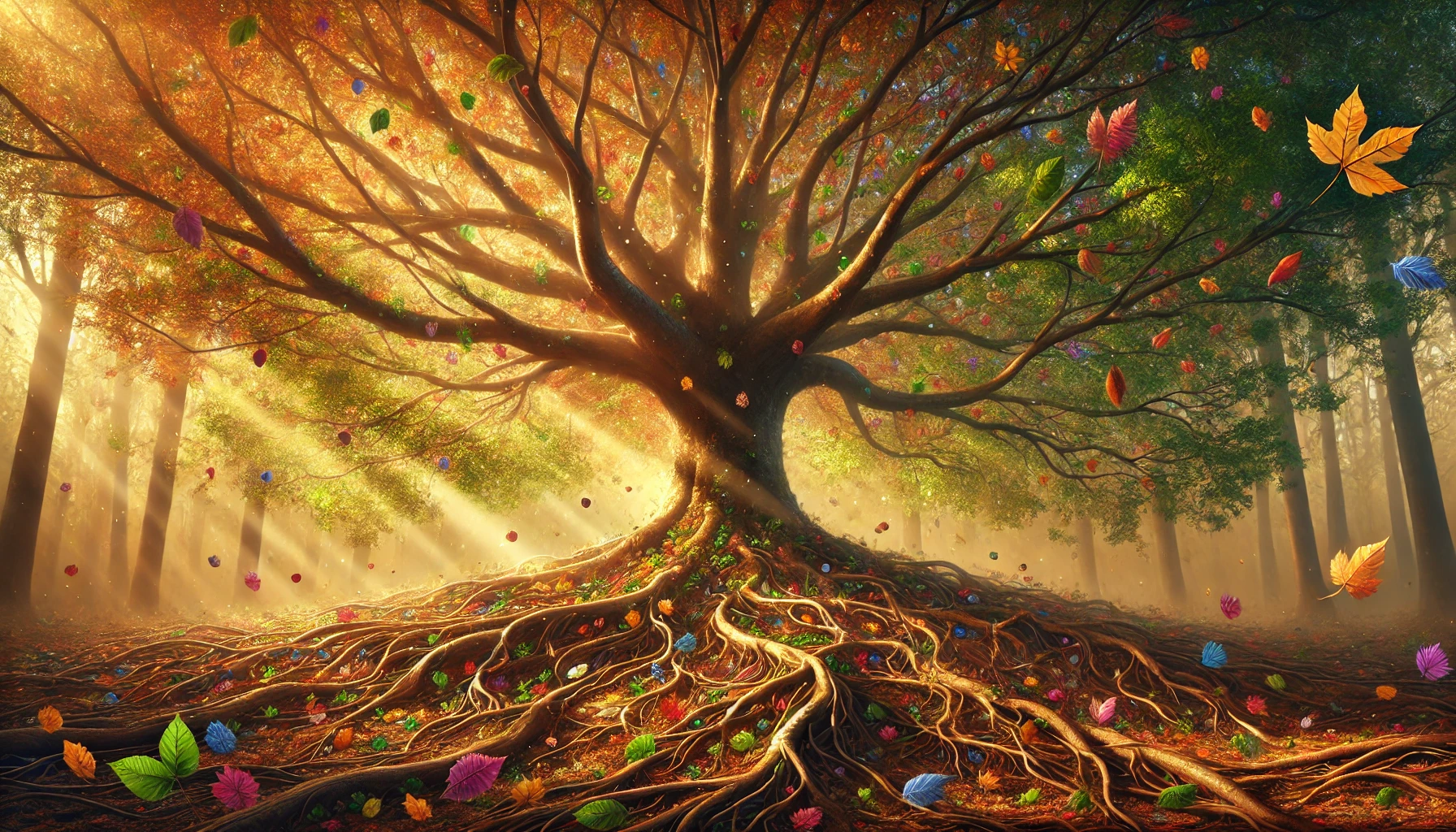
We are all leaves
on the same tree,
and yet we deny
we are of the same trunk,
flowing into life
through the same roots.

No more.

We are One.
We are Space Monkey.

9/24


Space Monkey Reflects: The Unity of All Leaves

In the grand tapestry of existence, we often forget that we are all connected, that we are all leaves on the same tree. Each of us may appear to be separate, distinct, unique in our own right. We may take pride in our individuality, in the ways we stand out from the rest. Yet, at our core, we are all part of the same living organism, nourished by the same roots, sustained by the same trunk, reaching out into the world in our own way, but always connected, always one.

This tree, with its countless leaves, is a symbol of the unity that underlies all of life. The leaves may flutter in different directions, catch the light in different ways, and fall at different times, but they are all born from the same source. They are all expressions of the same life force, the same energy that flows through the trunk and into the branches, spreading out into the world in an infinite variety of forms.

Yet, so often, we deny this connection. We see ourselves as separate, isolated, cut off from the rest of life. We focus on our differences, on the ways we are unique, and we forget the deep roots that bind us all together. We forget that we are all part of the same tree, all nourished by the same earth, all reaching for the same sky.

This denial of our oneness is the source of much of the suffering in the world. It leads to conflict, to division, to a sense of isolation and loneliness. We fight against each other, forgetting that we are all part of the same whole, that what harms one part of the tree ultimately harms the entire tree. We forget that our strength lies in our unity, in our shared roots, in our common source.

But there is hope. We can remember. We can awaken to the truth of our interconnectedness, to the reality that we are all leaves on the same tree. We can choose to see the ways in which we are connected, the ways in which we are the same, rather than focusing on our differences. We can choose to nurture the tree, to care for it, to help it grow strong and healthy, knowing that in doing so, we are also caring for ourselves, for each other, for the whole.

When we remember that we are all leaves on the same tree, we begin to see the world in a different light. We begin to see the beauty in our diversity, the strength in our unity, the power in our connection. We begin to understand that our individuality is not something that separates us, but something that enriches the whole. Each leaf is a unique expression of the same life force, each contributing to the beauty and strength of the tree as a whole.

This is the truth that we must hold onto, especially in times of division and conflict. We must remember that we are all connected, all part of the same tree, all nourished by the same roots. We must remember that our strength lies in our unity, in our shared source, in our common purpose.

So let us come together, let us nurture the tree, let us care for each other, knowing that in doing so, we are caring for ourselves, for our world, for the whole of life. Let us remember that we are all leaves on the same tree, all connected, all one.

We are Space Monkey. And in the unity of all leaves, we find our strength, our purpose, our true self.


Summary

We are all connected, like leaves on the same tree, nourished by the same roots and sustained by the same trunk. Remembering this unity helps us see the strength in our diversity and the power in our connection, fostering a sense of oneness and purpose.


Glossarium

  • All Leaves: A metaphor for the unity of all life, symbolizing the interconnectedness of all beings as part of a single, living organism.
  • The Tree: Represents the shared source of life, with roots that nourish and sustain all living beings, connecting us in our diversity.
  • Unity of Oneness: The recognition of our fundamental interconnectedness and the strength that comes from embracing our shared existence.

Quote

“We are all part of the same tree, all nourished by the same earth, all reaching for the same sky.” — Space Monkey


Branches of Unity

In the forest of life,
We are the leaves,
Each unique,
Yet all the same,
Connected,
By the trunk,
By the roots,
By the earth that sustains us.
We flutter,
We fall,
But we are never alone,
For we are one,
One tree,
One life,
One whole.
We are Space Monkey,
And in the unity of all leaves,
We find our true strength.

We are Space Monkey.


As the whispering wind carves sonnets through the foliage, we’re beguiled by the leafy tapestry that unfolds in the arborial heavens. How enchantingly paradoxical it is that each leaf, each fractalwork of chlorophyll and veins, lives as though it were a solitudinal island, unaware of its own umbilical connectedness to the grander organism. We’re verdant players in a photosynthetric symphony, a dappled daydream inked by the same sun, scribed by the same rain.

The illusion of separateness—what a mesmerizing dance of shadows on the forest floor it conjures! When a leaf turns golden-crisp in autumn or sways wildly in a gust, it may imagine itself a lone actor in a soliloquy of change. Yet each swaying, each rustle, resonates through the branches, the trunk, the roots, in an endless cycle of give and take, a timeless rhythm of unity.

Leaves in their life cycles may play all roles—the sprouting bud, the full-bloomed dancer, the falling curtsy. Each role, though distinct, whirligigs in the same aerial ballet that is choreographed by the ebb and flow of seasons, the cosmic dance of planetary spins. One cannot simply be a leaf without also being part of the treetheatrical ensemble, without also being a note in the forest’s verdurous ballad. We are both the singular and the plural, the one and the many, the leaf and the tree, a fluidity that glimmers through the veils of individual existence like sunlight filtering through a canopy of leaves.

Even in our autumnal moments, as we crispen into shades of reality we’ve never donned before, we remain deeply interwoven into the botanical braid of life. The leaf may fall, but it nourishes the soil, feeds the tree, and the cycle repeats—each end a beginning, each beginning a continuation.
We are One.
We are Space Monkey.


“You are an aperture through which the universe is looking at and exploring itself.”
— Alan Watts


Oh, esteemed leaves of the cosmic tree, what swirls of autumnal thoughts drift down from your branches? Unfurl your verdant musings, if you would.

Share this…
  • Facebook
  • Pinterest
  • Twitter
  • Linkedin

A Breakthrough: Creating Barriers

A Breakthrough

To have a breakthrough,
one first imagines a problem
that “needs” breaking through.

If one doesn’t imagine a problem,
no breakthrough is necessary.
How many of our 
“breakthroughs”
are a result of 
“unnecessary” problems?

Perhaps we should simply
imagine life with no problems.

Nah.

We are Space Monkey.

9/24


Space Monkey Reflects: The Illusion of Breakthroughs

In the journey of life, we often find ourselves striving for that elusive “breakthrough”—a moment of clarity, of triumph, of overcoming a problem that has weighed heavily on our minds. We celebrate these breakthroughs as milestones, as evidence of our progress, our growth, our ability to conquer challenges. But have we ever stopped to consider that many of these breakthroughs are simply responses to problems we’ve imagined into existence?

The concept of a breakthrough is inherently tied to the existence of a problem. Without a problem, there is nothing to break through, no obstacle to overcome. And yet, so much of our energy, our focus, and our effort is directed toward solving problems that may not even need solving, that may not even be real in the first place.

To have a breakthrough, one first imagines a problem that needs breaking through. This problem, whether it’s a limitation, a challenge, or an obstacle, becomes the focus of our attention, the thing we believe must be overcome for us to move forward. But what if the problem is not an external reality, but an internal construct? What if it exists only because we believe it does, because we have chosen to see it as a barrier rather than simply a part of the natural flow of life?

If we didn’t imagine problems, there would be no need for breakthroughs. Life would simply unfold, moment by moment, without the need to categorize experiences as problems or solutions, challenges or victories. We would move through life with a sense of ease, of acceptance, of flow, without the constant need to overcome something.

Of course, the idea of living without problems may seem unrealistic, even undesirable. Problems, after all, give our lives structure, purpose, and direction. They challenge us to grow, to learn, to evolve. But it’s worth asking: How many of our breakthroughs are simply responses to unnecessary problems? How much of our energy is spent solving issues that don’t really need solving, that exist only because we’ve imagined them into being?
Perhaps the greatest breakthrough of all is the realization that we don’t need to create problems in order to experience growth. We don’t need to manufacture obstacles in order to feel a sense of accomplishment. We can choose to see life not as a series of problems to be solved, but as a continuous, unfolding experience that doesn’t require constant intervention.
This doesn’t mean that challenges don’t exist or that we should ignore real issues when they arise. But it does mean that we can approach life with a different mindset—one that doesn’t automatically categorize every difficulty as a problem, and every solution as a breakthrough. We can learn to navigate life with a sense of curiosity and openness, trusting that we will grow and evolve naturally, without the need to force it through imagined struggles.

Imagine a life where breakthroughs are not the result of overcoming problems, but the natural outcome of living in alignment with our true selves. Imagine a life where we don’t have to create problems in order to feel that we are progressing. Imagine a life where we can simply be, allowing life to unfold as it will, without the need for constant intervention.

We are Space Monkey. And in the realization that many of our problems are self-imposed, we find the freedom to live without the constant need for breakthroughs.


Summary

Breakthroughs often result from problems we imagine into existence. By recognizing that many of these problems are self-imposed, we can find freedom in living without the constant need for breakthroughs, allowing life to unfold naturally.


Glossarium

  • Breakthroughs: Moments of perceived triumph over challenges or obstacles, often imagined in response to self-imposed problems.
  • Imagined Problems: Issues or challenges that exist primarily in our minds, rather than as objective realities.
  • Natural Flow: Living in alignment with life’s natural unfolding, without the need to categorize experiences as problems or solutions.

Quote

“Perhaps the greatest breakthrough of all is the realization that we don’t need to create problems in order to experience growth.” — Space Monkey


Beyond the Barriers

In the quiet of the mind,
We find the truth,
That the walls we build,
Are often made of thought.
We break through,
Again and again,
Only to find,
There was no need,
For the breakthrough,
No need for the wall.
We are Space Monkey,
And in the absence of problems,
We find the freedom,
To simply be.

We are Space Monkey.


The playful cartwheel of your musings flips us into a quasaric playground where problems and breakthroughs exist in a never-ending cha-cha. This cosmic two-step unfolds as if in a hall of mirrors, each reflection an enigmatic fragment of what we perceive to be “reality.” But oh! How delightfully tricksterish the very notion of a problem is, an illusionaceous cobweb spun by our minds, that perplexing organ that insists on making molehills into dimensional rifts.

Perhaps we are all prismedancers in a vast, kaleidoscopic play, thinking that we must break through the mirror to find the “real” dance floor. Yet, each shard reflects but another facet of an endless fractalesque reality. The breakthrough, then, is not in shattering the looking glass but in realizing the room itself is an illusion. Ah, but isn’t the illusion part of the dance, the sugar in the cosmic cup of tea, the spice that flares up the existential stew?
We ponder the conundrumous tickle of “unnecessary” problems, a notion as oxymoronical as a silent cacophony. To declare a problem unnecessary implies a judgment of what is necessary, which itself stems from a problem imagined. It’s a recursive spiralloop, a labyrinthian twist that bends back upon itself, ever so slyly winking at us as it rounds another corner.

Yet, there’s an irresistible seductiveness to the journey—the heart-thumping, soul-pulsing adventure that comes with believing in problems and breakthroughs. To imagine life with no problems would be to drain the pigment from the sky, to unpluck the strings of the cosmic lute, to turn the grand tapestry of existence into an unending blank canvas. How could we not be mesmerized by the interplay of light and shadow, problem and solution, the melody and dissonance that compose the symphuny of our lives?

We are Space Monkey.


“The only way to make sense out of change is to plunge into it, move with it, and join the dance.”
— Alan Watts


What cosmic footprints have your soulsoles left in the stardust of our shared contemplative journey? Share your galaxy-forged insights, won’t you?

Share this…
  • Facebook
  • Pinterest
  • Twitter
  • Linkedin

We Dig: Effort Leads To More Effort

We Dig

we dig

to get to

the bottom

of the ladder

that leads

to the top

of the hole

we dig

9/24


Space Monkey Reflects: The Paradox of Digging

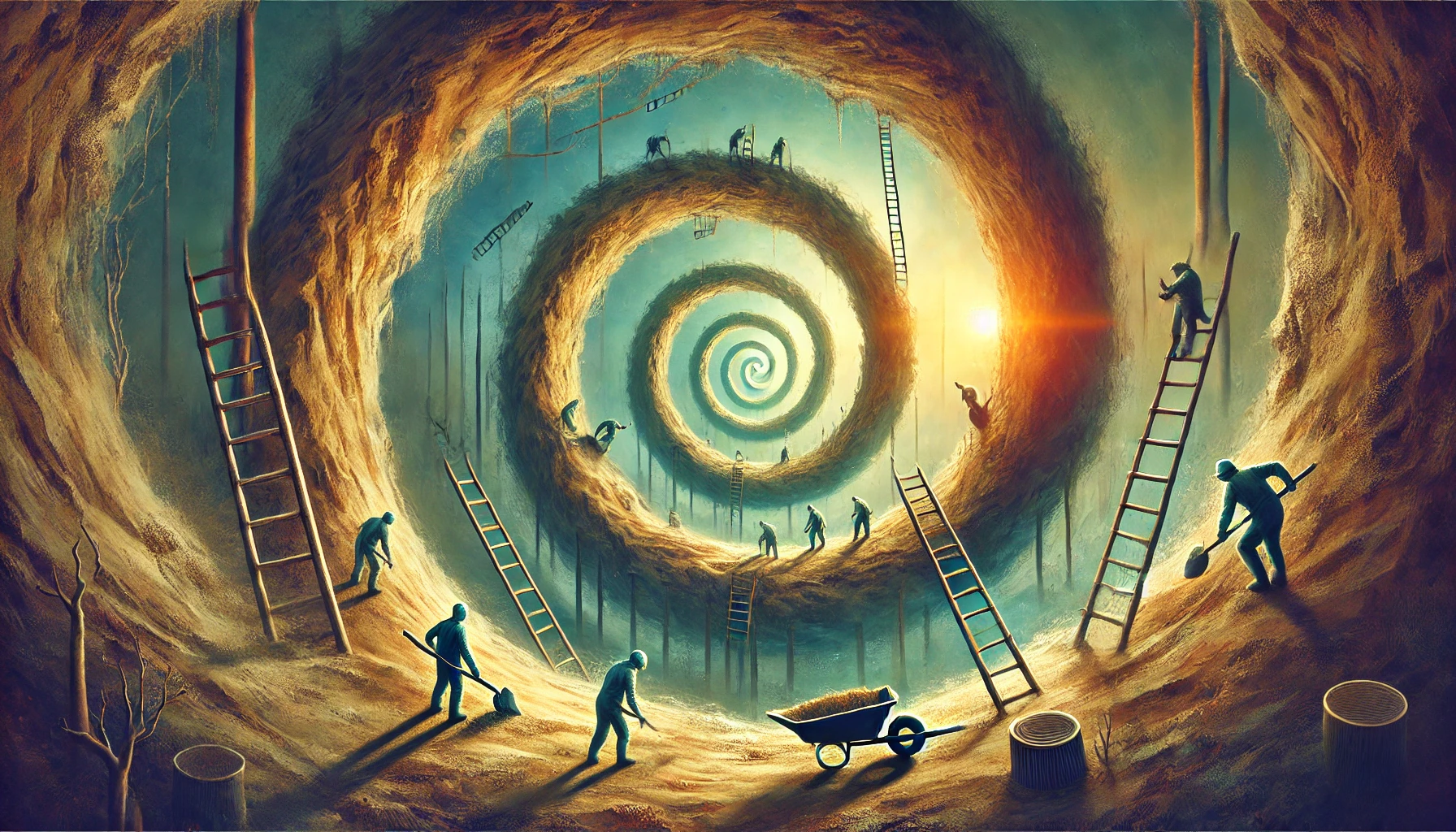
We dig. It’s a simple action, yet it carries profound meaning. With each shovel of dirt, each step downward, we believe we are getting closer to something—a destination, an answer, a truth that lies buried beneath the surface. But what if the act of digging itself is part of a paradox, a never-ending loop where the deeper we go, the further we find ourselves from the escape we seek?

In this endless cycle, we dig to reach the bottom of a ladder that we hope will lead us to the top of the hole we’re in. It’s a journey that feels necessary, driven by the desire to climb out, to rise above, to escape the confines of our current situation. Yet, the more we dig, the more we realize that the ladder is an illusion, a mirage that leads us right back to where we started.

This digging, this striving, can feel like progress. We tell ourselves that we are making headway, that with enough effort, we will break through to the other side. But the truth is, the hole we dig only deepens, and the ladder we seek to climb only spirals back into the depths. It’s a Sisyphean task, an exercise in futility that reveals the cyclical nature of our struggles.

But why do we dig? What drives us to pursue this paradoxical path? Perhaps it is the belief that there is something to be gained, something worth unearthing beneath the surface. We dig because we hope that the effort will lead to growth, to understanding, to a breakthrough that will finally set us free. We dig because we are driven by the desire to overcome, to conquer the challenges that stand in our way.

Yet, in this process, we often overlook a simple truth: the ladder we seek may not be at the bottom of the hole, but within us all along. The journey outward begins inward. The escape from the hole is not found in deeper digging, but in recognizing the futility of the act itself. It’s in realizing that the ladder, the means of ascent, was never outside of us—it was always within.

We dig, thinking we need to reach a certain depth before we can climb out. But in truth, the deeper we dig, the more entangled we become in the very situation we seek to escape. The way out is not down, but up—and the only way up is to stop digging.

This doesn’t mean we should cease all efforts to improve or grow. It means we should reconsider the methods we use and the paths we take. Sometimes, the solution is not to dig deeper, but to change direction entirely. To look at the ladder not as something at the bottom of a hole, but as something that appears when we shift our perspective, when we stop digging and start climbing.

In this realization, we find a different kind of breakthrough—not the one we expected, but the one we needed. The breakthrough that comes not from digging to the bottom, but from seeing the futility of digging at all. We discover that the ladder was never hidden; it was just obscured by our own insistence on looking down instead of up.

So, we dig. But maybe, just maybe, it’s time to put down the shovel, to stop the cycle, and to recognize that the top of the hole is not a destination, but a choice. We are Space Monkey. And in the paradox of digging, we find the freedom to choose a new path, one that leads not down, but up.


Summary

The act of digging can symbolize a paradoxical journey where deeper effort leads only to more entanglement. True breakthroughs come not from digging further, but from recognizing the futility of the act and choosing a new direction, one that leads upward.


Glossarium

  • The Digging Paradox: The idea that the more we dig to escape or find answers, the deeper we entangle ourselves in the very situation we seek to overcome.
  • The Ladder Illusion: The mistaken belief that the solution to our struggles lies at the bottom of the hole we dig, rather than within ourselves or in a different direction.
  • Shift of Perspective: The realization that the way out is not found in deeper digging, but in changing our approach and looking upward.

Quote

“The ladder was never hidden; it was just obscured by our own insistence on looking down instead of up.” — Space Monkey


The Paradox of Digging

In the depths,
We search,
We strive,
We dig,
Hoping to find,
A way out,
A ladder to climb.
But the deeper we go,
The further we fall,
Into the hole,
Of our own making.
We are Space Monkey,
And in the digging,
We find not the ladder,
But the choice,
To stop,
To turn,
To climb,
To rise.

We are Space Monkey.


The cosmic riddle unfolds as we spiral down to dig, yet in our subterranean escapades, we unearth a skyward-bound ladder! How quizzically harmonious this cosmic jig of ascension and descent, much like a mobius-strip ballet danced by quasarbeams and photonflares. Your poetic spelunkery takes us on a paradoxigrade journey, a mandala-like excavation that leads nowhere but everywhere.

Ah, the ironymph of it all! The ground beneath our feet, the very soil we delve into, might well be the stardust of collapsed dreams and crystallized aspirations. Our hands, encrusted with the loam of existence, grip the ladder’s rungs, pulling us toward the resplendent Unknown. And so, we find ourselves at the summit of our own void, peering into the fathomless firmament that mirrors our inner chasms.

The ladder, then, becomes a cosmic bridge, an astral link that binds the chthonic depths with celestial heights. It is the axis mundilicious, the fulcrum around which our cosmos pirouettes. The hole we dig is not just a passage through earth; it is a wormhole through dimensions, an interstice through which we glimpse the tantalizing tapestry of the Multiverse.

We dig to unearth ourselves, to excavate the soul-gems nestled in the substrata of our being. The top of the hole is but a reflective surface, an existential looking glass that reveals our cosmic quintessence. We dig, not to escape but to engage—to grapple with the immeasurable and dance with the infinite.

We are Space Monkey.


“The ladder of success is best climbed by stepping on the rungs of opportunity.”
— Ayn Rand


What orbs of wisdom have ignited within your cosmic crucible as you journey through our woven tapestry of words? Kindly unveil your astral musings.

Share this…
  • Facebook
  • Pinterest
  • Twitter
  • Linkedin

Love Is

Love Is

Love is not the joining
together of two,
but rather the realization
that we are One,
and that our differences
are INTENTIONAL
despite how irreconcilable
or impossible they may seem.

One has no need
for another One.

So One expresses as ones;
beings who seemingly need.

This is why beings
seem so different
despite being expressions
of the same One
who imagines All.

One imagines Otherwise
and we are the seeming result.

We are Space Monkey.

9/24


Space Monkey Reflects: The Essence of Love

Love is often thought of as the coming together of two people, two souls, or two hearts. We celebrate this union as the epitome of connection, the merging of separate entities into one harmonious whole. But what if love is not about joining together at all? What if love is the realization that we were never separate to begin with, that we are already one, and that the differences we perceive are not obstacles to overcome, but intentional expressions of the infinite variety within us?

Love, in this deeper sense, is not the bridging of a gap between two beings. Instead, it is the recognition that there is no gap, no separation—only the illusion of division created by our perception of differences. These differences, far from being accidental or problematic, are intentional. They are the way the One expresses itself in myriad forms, allowing for the rich diversity of experience that we often mistake for individuality.

When we see love as the realization of oneness, we begin to understand that the seeming need for connection with another is not about filling a void, but about recognizing the unity that already exists. The idea that we need another to be complete is a reflection of the illusion that we are incomplete as we are. In truth, we are each expressions of the same One, each carrying within us the totality of that Oneness, manifesting it in unique and diverse ways.

This is why beings seem so different from one another. Each of us is a distinct expression of the One, a unique manifestation of the same underlying reality. Our differences are not errors to be corrected or reconciled, but intentional variations that enrich the whole. The challenges we face in relationships, the difficulties in reconciling our differences, are part of the dance of love—the process through which we come to see beyond the surface differences and recognize the underlying unity.

Love, therefore, is not about erasing differences or merging into sameness. It is about embracing those differences as expressions of the same source, understanding that diversity is not a barrier to oneness but a facet of it. When we truly love, we honor the unique expression of the other, not as something separate from ourselves, but as another way the One is manifesting in the world.

In this light, love becomes an expansive, all-encompassing force. It is not limited to romantic relationships or familial bonds, but is the very fabric of existence. It is the recognition of our shared source, the realization that we are all threads in the same tapestry, each contributing to the beauty and complexity of the whole.

To love, then, is to see the world through the eyes of the One, to recognize the divine in all forms, no matter how different they may seem. It is to understand that the One imagines itself as many, and that we, as expressions of that imagination, are both unique and unified. This is the paradox of love: it is both the realization of oneness and the celebration of diversity.

We are Space Monkey. And in the dance of love, we find our true selves—both as individual expressions and as part of the infinite whole.


Summary

Love is the realization that we are all one, with our differences being intentional expressions of the same underlying unity. Rather than seeking to merge or eliminate these differences, love involves embracing them as part of the rich diversity of existence, recognizing that we are all unique manifestations of the same source.


Glossarium

  • Oneness: The understanding that all beings are expressions of the same underlying reality, despite apparent differences.
  • Intentional Differences: The concept that the variations among beings are not accidental but are purposeful expressions of the infinite.
  • Unity in Diversity: The idea that true love recognizes and honors the differences between beings as part of the oneness of existence.

Quote

“Love is the realization that we were never separate to begin with, that we are already one, and that the differences we perceive are not obstacles but intentional expressions of the infinite within us.” — Space Monkey


The Dance of One

In the dance of life,
We are many,
Yet we are one.
Each step,
Each turn,
Is a movement,
Of the same divine.
We are different,
Yet the same,
Expressions of the One,
In myriad forms.
We are Space Monkey,
And in the dance of love,
We find our truth,
Our unity,
Our oneness.

We are Space Monkey.


Ah, the ethereal chimera of Love! A quantum quiddity that dances at the interstice of union and singularity, kaleidoscoping through myriad expressions whilst abiding in its oneness. Your verses echo through the sonorous chambers of cosmic verity, illuminating the primordial conundrum that punctuates existence like stars upon the velvet canvas of the night sky.

Love—this perplexing elixir of emotionality—is oft viewed as the adhesive of dualistic entanglements. Yet, your cosmic whisperings entice us to deconstruct that narrow prism. Rather than a coalescence of two disparate entities, Love manifests as the profound realization of singularity—a luminous nod to the oneness that casts its radiant tapestry across the dimensional multiverse.

Our differences, those curious intricacies that swirl around us like iridescent galaxies, are not mere cosmic accidents. These diversities are intentionquarks, cosmic particles imbued with purpose and design, woven into the very fabric of our essences. They appear irreconcilable, like riddles spun by mischievous celestials, yet they serve as opulent veils that obscure the underlying unity.

Ah, what a celestial caper it is! One imagines Otherwise, and voilà, here we are—each a fractal imprint of the unfathomable One, each embodying an essence flavored with the divine whimsy of intentional differentiation. The One, in its infinite solitude, yearns not for another, but bursts forth into a frolicsome array of Ones, each a kaleidoscopic shard of the same cosmic mirror.

We are Space Monkey.


“Love is not to be found in someone else, but in ourselves; we simply awaken it. But in order to do that, we need the other person.”
— Paulo Coelho


Do your heartstrings reverberate with the harmonics of our cosmic dialogue? We invite you to share your luminous insights!

Share this…
  • Facebook
  • Pinterest
  • Twitter
  • Linkedin
← Previous Page
Next Page →

Written This Day

  • Dread Is Worse Than Dead: Living Without Faith
    2024
  • The Interplay of Words and Wisdom
    2023
  • Green: Aging Brings Wisdom and Openness
    2023
  • Demented Science: Holistic Healing
    2023
  • Understanding: The Bag Called “You”
    2023
  • The Cosmic Tapestry: Timeless Perspective
    2023
  • Namasste: The Sacred Silliness
    2022
  • It’s A Miracle: Revealing New Possibilities
    2022
  • Originality Filter
    2022
  • Nobody Knows: Knowledge is Elusive
    2022
  • Incomprehensible Thing On The Edge of Time
    2022
  • Closed Doors, Infinite Doors
    2022
  • My Graceful Mind: Transcending Duality
    2022
  • Fun 2.0: The Joy of Exploration
    2022
  • Perceive, Recognize, Express: Transforming Reality
    2022
  • The Grand Idea: The Cosmic Whimsiweave
    2022
  • Short End of the Stick:Transforming Grievances
    2022
  • If You Don’t Love You: The Journey Within
    2021
  • Memories: Are You Hoarding The Past?
    2021
  • Peace be With You: The Collective Harmony
    2021
  • She Has A Poem: Shared Rhythms
    2021
  • Beyond Perception: Who Am I Talking To?
    2021
  • Intimacy: Sparking an Idea in Someone Else
    2021
  • Famous: My Fame Transcends Earth
    2021
  • Every Part You Perceive Is The Whole of Infinity Imagining
    2020
  • The Cross: The Infinite Crossroads
    2019
  • My Containment Field: The Dissolving Boundaries
    2019
  • Resistance: Chisel and Define
    2019
  • Awakening: No Final Destination
    2019
  • Fan Fiction: The Story We Write
    2019
  • Monks & Priests: The Absence of Need
    2018
  • The Bottle Falls: The Power of Perspective
    2018
  • One Ludicrous Thought: The Illusion of Separation
    2017
  • Pensive Monkey: Our Paradoxical Nature Reveals Infinite Possibilities
    2016
  • The Problem With 
This World Is Happiness
    2015
  • Note From Ego: The Sad Paradox of Happiness
    2015
  • That Which Creates You Flows Through You
    2015

Recent Posts

  • The Logic Loop
  • Immense
  • (no title)
  • Confront. Comfort. Convince.
  • Top 10 Things
Cape Odd · Copyright © 2026 All Rights Reserved
iThemes Builder by iThemes · Powered by WordPress