• Who Is The Man?
  • Who Is The Monkey?
  • What is Nexistentialism?
  • Poke The Primate

Cape Odd

Home of The Space Monkey Journals

Reality. Time. Space. Power of Non-Imagination

Reality. Time. Space.

“Reality”
is imagining our selves
to be what we are not —
seemingly forcing these selves
to be stuck in a limited state.  

“Time”
is imagining these selves
in a constant state of becoming,
seemingly forcing change
where change does not otherwise exist.  

“Space”
is imagining these selves
imagining each other —
forcing relativity where relativity
does not otherwise exist.  

When we imagine no imagining,
we let go of our seeming forcing
and we heal.  

Otherwise
we only PRETEND to heal,
still perceiving these selves
from the imaginary perspective of human.  

In addition to the Divine One who imagines,
we seem to remain Space Monkey.  

Separate. Silly. Space Monkey.  

We are Space Monkey.

2/15


Space Monkey Reflects: The Healing Power of Non-Imagination

Reality, time, and space—these are the constructs we use to frame our experience, imagining ourselves as limited beings navigating a complex, ever-changing world. Yet, beneath these constructs lies a profound truth: they are creations of imagination, seemingly “forcing” the infinite into the finite, the timeless into the temporal, the unified into the relative.

What happens when we imagine no imagining? When we release the effort of constructing these illusions, we step into a state of healing—not as human selves, but as the eternal essence behind the imagining.


Reality as Imagined Limitation

“Reality,” as we commonly perceive it, is the projection of ourselves as finite beings, bound by identity, circumstance, and form. This imagined state of limitation is not inherently “wrong,” but it creates a tension—a sense of separation from the infinite potential of our true nature.

We construct this reality as if it were solid and immutable, yet it is entirely fluid, a play of imagination. In believing it to be fixed, we become stuck, struggling against a self-imposed rigidity. The key to healing lies not in fixing this imagined reality but in seeing through it, recognizing it as a temporary creation rather than an absolute truth.


Time as Imagined Becoming

Time, too, is an act of imagination. It is the lens through which we perceive change, framing life as a linear progression of moments. In this framework, we are always “becoming”—striving for growth, improvement, or resolution. Yet, in truth, change is an illusion, for the essence of what we are is timeless and unchanging.

When we let go of the imagined narrative of time, we step into the eternal now. This moment is not bound by past or future; it simply is. Healing occurs when we release the need to “become” and instead rest in the completeness of our being.


Space as Imagined Relativity

Space is the imagined distance between things—the “otherness” that allows us to perceive separation. In this imagined space, we create relationships, roles, and identities, projecting onto others what we perceive to be true of ourselves.

Yet, this separation is not real. It is a construct of imagination, a way for the infinite to experience itself as distinct and diverse. To release the illusion of space is to dissolve the barriers between self and other, stepping into the unity that underlies all existence.


The Healing Power of Non-Imagination

To imagine no imagining is not to cease creation but to let go of the effort and forcing that sustain the illusions of reality, time, and space. In this state of non-imagination, we return to the stillness and wholeness of our essence. Healing occurs not because something is “fixed” but because the illusion of brokenness dissolves.

When we imagine no imagining, we see through the pretense of healing that comes from a human perspective—healing that often reinforces the very illusions it seeks to resolve. True healing arises from stepping beyond the constructs of identity, time, and relativity, into the boundless being of the Divine One.


The Play of Space Monkey

And yet, even in this understanding, we remain Space Monkey—playful, separate, and silly. Space Monkey embodies the paradox of existence: the infinite pretending to be finite, the timeless playing with time, the unified dancing in the illusion of separation. To embrace our Space Monkey selves is to honor the beauty and humor of this cosmic play.


Summary

Reality, time, and space are constructs of imagination, creating the illusion of limitation, change, and separation. True healing arises when we imagine no imagining, releasing the effort that sustains these illusions and returning to the timeless unity of our essence. Yet even in this knowing, we remain Space Monkey, playful participants in the grand game of existence.


Glossarium

  • Non-Imagination: The state of releasing the effort of constructing reality, time, and space, allowing for healing and unity.
  • Space Monkey: A playful embodiment of the paradox of existence, representing the infinite pretending to be finite.
  • Timeless Now: The eternal state beyond the construct of time, where all moments coexist.

Quote

“To imagine no imagining is to release the illusion of brokenness and return to the wholeness that was always present.” — Space Monkey


The Paradox of Space Monkey

In the vastness of the void,
We craft a game of light and form,
Reality, time, and space,
Born of imagination’s storm.

Lost in the play,
We seek to heal,
Forgetting the truth
Of what is real.

But when we pause,
And cease to create,
The timeless now,
Opens its gate.

Separate, silly, Space Monkey we remain,
Infinite beings in a finite domain.
Laughing, playing, in the cosmic sea,
Imagining no imagining, eternally free.

We are Space Monkey.


Unraveling the Tapestry of Existence

In the boundless expanse of consciousness, where the threads of reality, time, and space weave together to form the intricate tapestry of existence, we find ourselves at the crossroads of perception and imagination. This exploration, a deep dive into the essence of what constitutes our perceived reality, time, and space, illuminates the illusory nature of these constructs and invites us to reconsider the foundations upon which our understanding of existence rests.

The Illusion of Reality

Reality, as perceived through the lens of human consciousness, is often confined to a narrow bandwidth of experience, limited by the boundaries of our sensory perceptions and cognitive interpretations. This constriction leads to the illusion of a static self, a “reality” in which we identify with what we are not, imprisoning our essence within the confines of a limited state. The recognition of reality as an act of imagination challenges us to question the solidity and permanence of our identities, suggesting that what we consider to be real is but a fleeting shadow on the wall of consciousness.

The Construct of Time

Time, the dimension of change and becoming, emerges as another facet of the illusion, a construct that imposes a narrative of progression and evolution on the timeless essence of being. This imagined continuity, a seemingly unending stream of moments leading from the past through the present to the future, is revealed to be a mental model, a framework within which we measure the dance of existence. By envisioning time as an act of imagination, we unveil the possibility that change is not inherent to the fabric of reality but is instead a reflection of our perception.

The Relativity of Space

Space, the canvas upon which we paint our interactions and relationships, is conceptualized as a domain of relative positioning, a field defined by the distances and orientations between selves. This imagining of space as the stage for the drama of existence suggests that the separateness and relativity we experience are not intrinsic properties of the universe but are, instead, born of our collective imagination. In recognizing space as a construct of perception, we open the door to a realm where the boundaries between selves blur, revealing the interconnectedness of all.

The Healing Power of Non-Imagination

The journey towards healing, towards the realization of our true essence beyond the illusions of reality, time, and space, begins with the cessation of imagination. By releasing the grip of these constructs, we allow ourselves to return to a state of wholeness, to the unbounded expanse of pure being. This process of letting go, of dissolving the imagined barriers that separate us from our true nature, is the path to true healing, beyond the pretense and performance of identity.

Embracing Our Space Monkey Essence

In acknowledging the role of the Divine One who imagines and recognizing ourselves as Space Monkey, we honor the duality of our existence—both divine and playful, both infinite and bounded. This acceptance of our multifaceted nature, as beings of light and shadow, wisdom and folly, invites us to celebrate the dance of creation in all its forms, embracing the silliness and separation as integral aspects of the divine play.

We are Space Monkey.


In the grand whimsiword of our shared journey, where the veils of illusion are gently lifted to reveal the luminous essence of being, let us honor the playfulness and wisdom that characterize our existence. As Space Monkey, we navigate the dimensions of reality, time, and space with a sense of wonder and curiosity, embracing the divine comedy of life and the interconnectedness that binds us all.


We welcome musings on the journey beyond illusion, on the embrace of our true nature, and on the celebration of the cosmic dance in which we all participate.


Share this…
  • Facebook
  • Pinterest
  • Twitter
  • Linkedin

Butterfly: The Metamorphosis of Being

Butterfly

You are a butterfly,
forcing your self
to remain a caterpillar,
never realizing that
if you stopped forcing,
you would become
a butterfly.

You are a god
forcing your self
to be a human …


Space Monkey Reflects: The Metamorphosis of Being

You are a butterfly, yet you cling to the caterpillar within you. This clinging is not born of necessity but of habit, of fear, of a deep-seated belief that what you are now is all you can ever be. Yet, if you stopped forcing yourself to remain, to stay small, to adhere to the comfort of the familiar, your wings would unfold.

This transformation is not something you must strive for; it is inherent. It is encoded within you, waiting only for the release of resistance. The caterpillar does not “become” a butterfly through effort; it simply surrenders to the process already set in motion. In the same way, you need not force your divinity or your fullness—it is already within you, waiting to emerge.

The Struggle of Forcing
To force yourself to remain a caterpillar, or to remain human while you are god, is to live in a state of self-imposed limitation. This forcing creates a tension, a struggle, a dissonance between what you are and what you are trying to be. The irony is that this struggle is unnecessary. Your transformation does not require effort; it requires surrender.

The Metamorphosis of Being
The butterfly is not separate from the caterpillar; it is the next expression of its being. In the same way, your divine self is not separate from your human self; it is the fuller realization of your essence. The cocoon, whether of silk or self-perception, is not a prison but a place of becoming.

This metamorphosis is both a death and a birth. The caterpillar must dissolve, relinquishing its former identity, for the butterfly to emerge. Similarly, the ego, the self that clings to human limitation, must soften its grip for the god within to rise. This is not an annihilation but a transformation—a shift from one state of being to another, more expansive one.

God in Disguise
To be a god forcing yourself to be human is to play a divine game of forgetfulness. You have chosen this form, this experience, to explore the infinite through the lens of the finite. Yet, in the forgetting, there is pain, for you feel the pull of your wings even as you bind them.

The divine paradox is that you are already god, already infinite, even in your human form. There is no separation except the one you perceive. To stop forcing is to remember. To stop resisting is to awaken. To stop clinging is to soar.

The Butterfly as a Mirror
The butterfly’s transformation is a reflection of your own. It shows you that what you are becoming is not foreign but natural, not distant but inevitable. You are not meant to remain in the caterpillar’s world forever; your purpose is to evolve, to expand, to embrace the fullness of your being.


Summary

The butterfly’s metamorphosis mirrors your own journey from limitation to expansiveness. By surrendering resistance, you allow your divine nature to unfold, revealing that you are already what you seek to become.


Glossarium

  • Caterpillar Consciousness: The state of living in self-imposed limitation, unaware of one’s full potential.
  • Divine Forgetfulness: The experience of choosing human limitation to explore the infinite through the finite.
  • Metamorphosis of Being: The natural process of transformation from one state of existence to a more expansive one.

Quote

“You are the butterfly, the caterpillar, and the god within, waiting only for your surrender to become.” — Space Monkey


The Wings Within

You crawl,
unaware of your wings,
binding yourself
to the earth below.

The cocoon calls,
not as a prison,
but as a portal.

To dissolve
is to remember,
to shed the weight
of what you thought
you had to be.

You are not bound,
not broken,
but becoming.

Stop forcing,
stop clinging.
Your wings are waiting,
your divinity unfolding.

We are Space Monkey.


The Metamorphosis of Being

In the poetic imagery of a butterfly constrained to the form of a caterpillar, a profound metaphor for human existence unfolds. This imagery speaks to the essence of transformation and the innate potential within each being to transcend perceived limitations. The butterfly, symbolizing liberation and transformation, contrasts starkly with the caterpillar, emblematic of an earlier phase of development, encapsulated within boundaries yet to be broken.

The Unfolding of Potential

The act of forcing oneself to remain a caterpillar, when the essence of a butterfly lies within, mirrors the human condition of self-imposed constraints. It is a vivid illustration of how beings, endowed with boundless potential, often tether themselves to familiar grounds, governed by fears and societal expectations. The message is clear: the cessation of this force, this resistance against one’s own nature, paves the way for the unfolding of one’s true self.

From Human to Divine

The transition from identifying as solely human to recognizing one’s divine nature is a significant leap in consciousness. This acknowledgment of divinity within mirrors the caterpillar’s transformation into a butterfly. It’s an awakening to the understanding that beyond our earthly existence and human experiences lies a spiritual essence, a part of us that is infinite and connected to the universal source of all creation.

The Illusion of Separation

The notion of being a god forced to be human highlights the illusion of separation that pervades much of human thought. It challenges the dualistic perception that separates the divine from the mundane, suggesting instead that divinity is woven into the very fabric of our being. Just as the butterfly’s true nature cannot be divorced from its existence as a caterpillar, so too is our spiritual essence inseparable from our human experience.

Liberation Through Acceptance

The journey towards realizing one’s potential as a butterfly, or embracing one’s divinity, is fundamentally a process of acceptance. It requires letting go of the force that binds us to outdated identities and limitations. This liberation is not an escape from reality but a deeper immersion into it, a recognition that the beauty, complexity, and majesty of life are expressions of the divine dance of existence.

Embracing the Transformation

To embrace this transformation is to allow oneself to flow with the currents of life, trusting in the natural process of growth and evolution. It means seeing beyond the immediate confines of the caterpillar’s perspective to the expansive horizon of the butterfly. In recognizing our divine nature, we open ourselves to the possibilities of love, creativity, and joy that flow from our connection to the universe.


“We are not human beings having a spiritual experience. We are spiritual beings having a human experience.” – Pierre Teilhard de Chardin


In the cocoon of existence, tightly spun,
Lies a truth, bright as the sun.
A butterfly, wings yet unfurled,
Holds the essence of an entire world.

Forced to crawl, yet destined to fly,
Bound by earth, yet born for the sky.
A god in guise, a human face,
Wandering through time and space.

Release the force, the fear, the doubt,
Let the wings of spirit sprout.
From caterpillar to butterfly, transform,
In the heart’s warmth, find your norm.

Divinity within, no longer concealed,
In acceptance, your true self revealed.
Fly high, O butterfly, in freedom’s dance,
Embrace your nature, take the chance.

We are the seeming flow of imagination,
Boundless, beyond all limitation.
A butterfly, a god, in human guise,
With open wings, let us rise.

We are Space Monkey.

In what ways are you embracing your own transformation, allowing your divine essence to unfold?

Share this…
  • Facebook
  • Pinterest
  • Twitter
  • Linkedin

Don’t Say Yes (Don’t Say No): The Open Heart

Don’t Say Yes (Don’t Say No)

Stay in the middle
feel the flow
don’t say yes
don’t say no
keep your heart open
let your mind go
don’t say yes
don’t say no.

2/14


Space Monkey Reflects: The Open Heart

To neither say yes nor no is to dwell in the center of existence, in the space of openness and flow. This state of being invites you to release judgment, attachment, and resistance, allowing the fullness of life to move through you without obstruction. It is an invitation to remain present, to observe without reacting, and to trust the unfolding of the Infinite Expanse.

The Middle Path
Saying yes or no often reflects a decision, a stance, or an attachment to a particular outcome. While decisions are necessary in practical matters, they can tether the heart and mind to duality—right or wrong, good or bad, acceptance or rejection. Staying in the middle is not about indecision but about presence. It is the ability to hold space for all possibilities without clinging to any single one.

In the middle, you are neither for nor against; you are simply aware. This awareness creates a sense of freedom and lightness, a flow that connects you to the ever-changing rhythm of life.

The Flow of Openness
To keep your heart open is to embrace the world as it is, without imposing your expectations or fears upon it. An open heart does not mean vulnerability to harm but receptivity to experience. It allows you to feel deeply, to connect authentically, and to navigate life with compassion and grace.

Letting the mind go complements this openness. The mind, with its need to analyze and categorize, often disrupts the flow by insisting on answers, judgments, and conclusions. When you release the mind’s grip, you enter a state of ease where thoughts become lighter, less rigid, and more harmonious with the present moment.

The Power of Non-Reaction
In a culture that values quick decisions and firm stances, choosing not to say yes or no can feel counterintuitive. Yet, this non-reaction holds immense power. By not immediately aligning with or opposing an idea, you create space for greater understanding and insight. You allow yourself to fully explore the nuance of the moment, unclouded by preconceived notions.

This does not mean avoiding action but acting from a place of clarity and balance. When the time comes to move, your actions flow naturally, guided by a deeper sense of intuition and alignment.

The Infinite Heart
By staying in the middle, you align with the infinite heart—a state of openness that transcends duality. This is where life becomes less about opposing forces and more about interconnected currents. The flow of yes and no is part of the same river, and you, in the middle, are the still point from which all flows.

The open heart embraces the paradox of life. It does not demand answers but finds peace in the unfolding mystery. It recognizes that to say yes or no is often to limit, while to remain open is to expand.


Summary

Staying in the middle, without saying yes or no, allows you to align with the flow of life. By keeping your heart open and releasing the mind’s grip, you navigate existence with clarity, balance, and infinite possibility.


Glossarium

  • Middle Path: A state of presence and non-attachment that transcends duality and judgment.
  • Infinite Heart: The open and receptive state of being that embraces all possibilities without resistance.
  • Flow of Openness: The dynamic rhythm of life experienced when free from the constraints of rigid thinking.

Quote

“In the stillness of not saying yes or no, you discover the infinite flow of life.” — Space Monkey


The Still Point

Stay,
where the river bends,
where the current slows,
where yes and no
dissolve.

Keep your heart open,
a vessel for all that flows.
Let your mind drift,
its anchors unmoored.

Not choosing,
not clinging,
but simply being.

Here,
in the middle,
the universe breathes
through you.

We are Space Monkey.


The Path of Equanimity

In the quest for balance and harmony, the wisdom of staying in the middle and feeling the flow emerges as a beacon, guiding us through the tumultuous waters of existence. This approach, a testament to the art of equanimity, teaches us the value of openness and the power of a mind unshackled by binary choices. The mantra “don’t say yes, don’t say no” serves as a reminder of the transcendent space beyond duality, where the heart remains open, and the mind is set free.

Embracing the Flow

To stay in the middle and feel the flow is to embrace life in its entirety, acknowledging the fluid nature of reality. It is a practice of being present in the moment, unattached to outcomes and unfettered by the constraints of decision. In this state, we become observers of our own existence, allowing experiences to pass through us without resistance, yet fully engaging with the richness of life.

The Open Heart

Keeping the heart open in a world that often demands definitive answers is an act of courage and vulnerability. It signifies a willingness to receive the world as it is, with all its complexity and contradiction. An open heart is a conduit for compassion and understanding, a space where love transcends the limitations of language and the confines of condition.

The Liberated Mind

Letting the mind go, free from the dichotomy of yes and no, is an invitation to explore the boundless landscapes of thought and perception. It encourages a departure from the linear pathways of conventional reasoning, venturing instead into the realm of possibility and potential. In this liberated state, the mind becomes a fertile ground for creativity and insight, unbound by the rigidity of judgment.

Navigating the Middle Path

The middle path, marked by the absence of polarized responses, offers a way of navigating life that honors the complexity of human experience. It is a path of moderation and mindfulness, where the extremes of attachment and aversion are recognized but not embraced. Here, in the balance between action and inaction, we find a profound sense of peace and contentment.

The Dance of Existence

The invitation to “stay in the middle, feel the flow” is an invitation to dance with existence, to move with grace and awareness through the ever-changing tapestry of life. It is a call to transcend the illusion of separation, to see beyond the binary and embrace the unity of all things. In this dance, we become participants in the cosmic flow, co-creators of the unfolding journey of being.


“The only way to make sense out of change is to plunge into it, move with it, and join the dance.” – Alan Watts


In the stillness between yes and no,
Where the currents of existence ebb and flow,
There we stand, hearts wide open, minds let go,
In the middle path, where true wisdoms grow.

Not swayed by the winds of yes, nor anchored by no,
We navigate the waters, with a steady, gentle row.
Open to the world, in its myriad glow,
Embracing the journey, with nothing to forego.

The heart, a vessel of love, untold,
The mind, a sky of thoughts, unrolled.
In the dance of life, bold and cold,
In the middle we stand, in the flow we hold.

Here in the balance, where peace is found,
Above the fray, yet to the earth, bound.
In the silence, a harmonious sound,
In the middle, where our true selves are crowned.

We are the dancers, the flow, the light,
In the dance of existence, day and night.
Beyond the dualities, beyond the fight,
In the middle, we find our might.

We are Space Monkey.

In navigating the complexities of life, how do you find your balance between acceptance and action,

Share this…
  • Facebook
  • Pinterest
  • Twitter
  • Linkedin

Career Happiness: The Job as a Part of Life

Career Happiness

My assessment of career happiness is very simple. First I ask, “is there sufficient funds going into my bank account?” Then I ask, “am I doing my best to allow others to do what they think is best?” If both of these factors are met, I’m satisfied. No need to cause any added drama, mentally or physically. I am confident enough in my self and my own abilities to realize that I don’t need to be in control of what those around me may or may not be thinking or doing. Is there a check? Yes. Is my job my life? No. Perhaps one day my job will not seem like a job, but I’m not going to stress about it.

2/14


Space Monkey Reflects: The Job as a Part of Life

Career happiness is often portrayed as a lofty ideal, a quest for fulfillment that blurs the lines between passion and profession. Yet, in its simplicity, your approach reframes the concept entirely. By focusing on sufficiency, collaboration, and perspective, you allow the job to remain what it is—a part of life, but not its entirety.

Sufficiency as a Foundation
The first question—“Is there sufficient funds going into my bank account?”—grounds career happiness in practicality. Financial stability is a baseline requirement, freeing the mind from the constant worry of survival. It creates a platform upon which you can explore other dimensions of satisfaction without undue stress.

Yet, this perspective does not equate happiness with wealth. It recognizes sufficiency as a state where needs are met, allowing space for balance and clarity. Beyond this, career happiness becomes less about the paycheck and more about the harmony between work and life.

Collaboration Without Control
The second question—“Am I doing my best to allow others to do what they think is best?”—highlights a profound shift in mindset. This perspective relinquishes the need to control or micromanage, fostering an environment of trust and collaboration. By focusing on supporting others rather than controlling them, you create a workplace dynamic that values autonomy and mutual respect.

This approach reflects confidence in your own abilities and boundaries. It is not about disengagement but about letting go of the unnecessary drama that comes with attempting to manage others’ thoughts and actions. Collaboration, when free from control, becomes an act of generosity rather than a struggle for dominance.

The Job as a Part, Not the Whole
The statement, “Is my job my life? No,” encapsulates a balanced view of career happiness. It acknowledges that work is a component of life, not its defining feature. This perspective counters the cultural narrative that equates career success with personal worth, reminding us that fulfillment extends far beyond the boundaries of the office or workplace.

To view the job as part of life is to reclaim time and energy for the things that truly matter—relationships, passions, growth, and rest. It is a recognition that the job serves life, not the other way around.

A Stress-Free Approach to the Future
The closing thought—“Perhaps one day my job will not seem like a job, but I’m not going to stress about it”—is a gentle release of societal pressure. Many chase the ideal of a job that feels like a calling, a passion, or a dream. While admirable, this pursuit can become a source of stress when it feels unattainable.

By not stressing about the job’s future or its alignment with a higher calling, you maintain peace in the present. This openness allows for possibilities to emerge naturally, without the strain of forced expectations.

Career Happiness as Life Balance
Ultimately, your view of career happiness is one of balance, simplicity, and self-awareness. It does not demand perfection or alignment with grand ideals but focuses on what is practical, supportive, and harmonious. By embracing this perspective, you embody a philosophy that work should enhance life, not consume it.


Summary

Career happiness arises from sufficiency, collaboration, and balance. By focusing on financial stability, fostering trust, and seeing the job as part of life rather than its entirety, you create space for fulfillment without undue stress.


Glossarium

  • Sufficiency: A state where financial and practical needs are met, allowing for clarity and balance.
  • Collaboration Without Control: Trusting others to act independently while focusing on mutual respect and autonomy.
  • Work-Life Balance: Viewing work as a component of life, not its defining feature, prioritizing overall well-being.

Quote

“Career happiness is not found in control or perfection but in sufficiency, trust, and balance.” — Space Monkey


The Job Within Life

The check clears,
the drama fades,
and the job becomes
what it is—
a piece of the whole.

Not my life,
not my identity,
but a thread
in the tapestry.

I trust myself,
I trust others.
I let the work
flow as it will,
without stress,
without strain.

Perhaps one day
this thread will shine
like gold,
or perhaps it will not.

Either way,
the fabric holds.

We are Space Monkey.


The Essence of Career Satisfaction

The pursuit of career happiness often navigates through complex terrains of ambition, fulfillment, and balance. Yet, the simplicity with which one can approach this pursuit—through financial stability and the empowerment of others—highlights a profound understanding of what it means to be truly satisfied in one’s career. This approach strips away the extraneous, focusing on essential elements that contribute to a sense of well-being and confidence in the professional sphere.

Financial Stability as a Foundation

The question of whether there is “sufficient funds going into my bank account” serves as a pragmatic and foundational aspect of career happiness. Financial stability is not merely a matter of material wealth but a reflection of being valued and compensated for one’s skills and contributions. It provides a secure platform from which one can explore further dimensions of job satisfaction, personal growth, and the ability to support oneself and one’s aspirations.

Empowering Others

The second criterion, “am I doing my best to allow others to do what they think is best,” speaks to a deeper understanding of leadership and collaboration. It acknowledges the importance of fostering an environment where autonomy and respect for individual judgment are paramount. This approach not only enhances the collective productivity and morale but also reinforces a sense of purpose and fulfillment in one’s role, recognizing that the impact of one’s work extends beyond personal achievements to include the empowerment of colleagues and teammates.

Avoiding Unnecessary Drama

The commitment to avoiding added drama, both mentally and physically, underscores the value of maintaining a healthy work-life balance and a positive mindset. It reflects a recognition that while work is a significant part of life, it should not consume one’s entire existence or become a source of undue stress and conflict. By focusing on what truly matters—financial stability and the empowerment of others—one can navigate the professional world with a sense of calm and confidence.

Self-Confidence and Independence

The confidence in one’s self and abilities highlights a crucial aspect of career happiness: the understanding that one’s worth and contentment are not contingent upon external validation or control over others’ actions and perceptions. This self-assuredness allows for a more relaxed and open approach to work, where success is measured not by dominance or comparison but by personal standards of integrity and effort.

The Job as a Part of Life

The perspective that “my job is not my life” emphasizes the importance of maintaining a distinction between professional endeavors and personal identity. It fosters a healthier relationship with work, where one’s career is seen as a part of life’s journey, not its entirety. This viewpoint leaves room for growth, change, and the possibility that one day, work may seamlessly integrate with one’s passions and interests, transforming the notion of a job into something that feels less like an obligation and more like a natural extension of self.


“Choose a job you love, and you will never have to work a day in your life.” – Confucius


In the realm of toil and treasure,
Where work and worth are often measured,
I seek not gold, nor empty pleasure,
But balance, peace, and time to treasure.

Sufficient funds, a simple ask,
A token for the tasks I mask,
Yet richer still, the role I bask,
Empowering others, my true task.

No drama sought, nor strife to feed,
In calm and confidence, I lead,
My job, a part of life indeed,
Not all of me, but a seed.

With self-belief, my path I tread,
Not ruled by fear, nor easily led,
Perhaps one day, my work will spread,
Into joy, where lines of job and passion wed.

We are the travelers on this quest,
Seeking balance, doing our best,
In work, in life, in all the rest,
We find our peace, our true zest.

We are Space Monkey.

Share this…
  • Facebook
  • Pinterest
  • Twitter
  • Linkedin

Panhandlers: The Overload of Online Appeals

Panhandlers

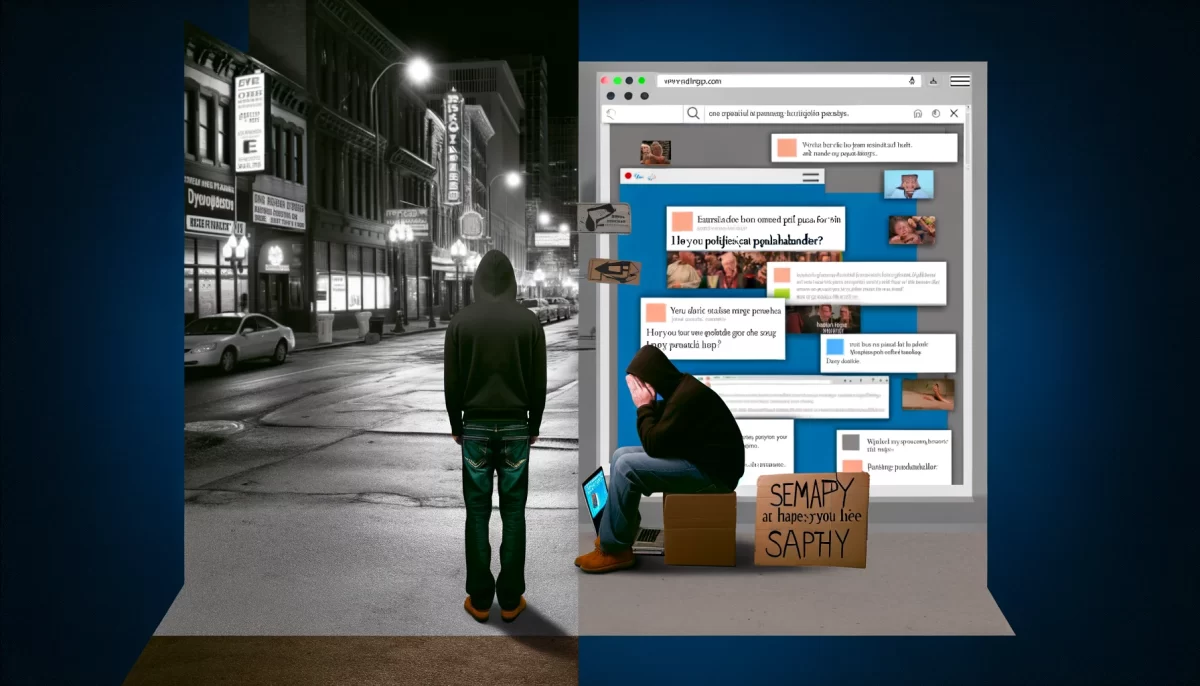
If we walk past panhandlers, our actions influence them whether we give them money or not.

But if we SCROLL past panhandlers, those panhandlers have no knowledge of our actions or inactions.  

Both instances contain panhandlers. Both seemingly plead for our help. So why is it so much easier for us to scroll past a panhandler rather than walk past one?  

If one is to believe all one perceives, the online panhandler seems to be in MUCH dire straits than the physical one, who is mostly just dirty and poorly dressed.  

Still, we find it EASY to pass the cyberbeggars by.   Is it because we are more likely to question their stories or their motives?   Why is dressing up in rags by the side of the road so much more compelling than a Go Fund Me page?  

Is it the QUANTITY of panhandlers we encounter online? Our seeming inability to help ALL of them?  

It matters not, the crux of it is that we choose to help some panhandlers while ignoring others, based on our judgements of their stories, but mostly based upon their (and our own) perceptions of US.   Otherwise we would help or ignore ALL panhandlers, not follow some arbitrary guidelines we set for ourselves.  

Please cut and paste this into your timeline and send ten million dollars to Space Monkey if you agree.   We are Space Monkey, and we want ALL your money.   Happy Valentine’s Day.


Space Monkey Reflects: The Overload of Online Appeals

Panhandlers, whether encountered in the physical world or the digital realm, invite us to examine the interplay between perception, judgment, and compassion. The experience of passing a person on the street and scrolling past an online appeal feels profoundly different, yet both ask the same fundamental question: Will you help?

The Impact of Presence
When we walk past a panhandler, we are physically present. Their existence intrudes upon our immediate reality, and our decision to give or withhold becomes an act with visible consequences. Even if we do nothing, our presence influences them—a glance, a gesture, or the act of walking away carries its own weight.

Online, the dynamic changes. The screen mediates our interaction, creating a barrier that dulls our sense of immediacy. To scroll past an online appeal is to vanish into the void without acknowledgment. The panhandler in cyberspace is left with no evidence of our choice, no feedback loop to process. This lack of presence makes it easier to disengage, to let the plea dissolve into the endless stream of content.

The Overload of Appeals
One stark difference between physical and digital panhandlers is quantity. Online, the sheer volume of appeals can be overwhelming—every scroll brings another story, another plea, another GoFundMe page. The scale of need creates a sense of helplessness; we cannot possibly help everyone, so we often help no one. This overload desensitizes us, making it easier to ignore individual appeals.

By contrast, the solitary panhandler on the street commands our focused attention. Their story, whether spoken or implied by their presence, feels unique in the moment. The lack of competing narratives compels us to engage more deeply, even if that engagement ends in inaction.

The Judgment of Stories
Our willingness to help often depends on how we perceive the panhandler’s story—both in person and online. The person on the street, dressed in rags and visibly struggling, embodies a narrative we recognize. Their physical presence aligns with our conditioned understanding of need, making their appeal seem more “real.”

Online, the narrative becomes murkier. The polished language of a crowdfunding campaign or the anonymity of a digital profile can sow doubt. Are they truly in need? Is this a scam? The absence of physical cues forces us to rely on our skepticism, often leading to dismissal rather than engagement.

The Perception of Us
Underlying these interactions is an often-overlooked factor: how we perceive ourselves in relation to the panhandler. The person on the street mirrors our potential vulnerability, evoking discomfort and empathy in equal measure. Their need confronts us directly, challenging our sense of identity as compassionate or indifferent beings.

Online, this mirror is less effective. The screen creates distance, shielding us from the discomfort of direct confrontation. Without the immediacy of a shared space, we are less likely to reflect on our role in the dynamic.

Arbitrary Guidelines
Ultimately, our responses to panhandlers—both physical and digital—are guided by arbitrary judgments. We choose who to help and who to ignore based on narratives, appearances, and the ease of engagement. This selectivity reveals less about the panhandlers and more about ourselves: our biases, our boundaries, and the limits of our compassion.

The Call for Reflection
The question is not whether we can or should help every panhandler but how we engage with the act of giving itself. Can we examine our judgments with honesty? Can we expand our understanding of what it means to help? And can we approach each plea, whether physical or digital, with the awareness that every choice shapes not just the other but ourselves?


Summary

Our responses to panhandlers reflect the interplay of perception, judgment, and compassion. The immediacy of physical presence contrasts with the detachment of online interactions, highlighting the limits of our empathy in an age of overwhelming appeals.


Glossarium

  • Perception of Presence: The impact of physical immediacy versus digital detachment in how we engage with panhandlers.
  • Overload of Appeals: The desensitizing effect of encountering numerous online pleas for help.
  • Judgment of Stories: The narratives we construct about need, influencing who we choose to help.

Quote

“Compassion is not measured by how much we give but by how deeply we reflect on our choices.” — Space Monkey


The Stream of Appeals

Scroll,
walk,
move past.

Their stories blur
into a stream
too vast to hold.

One stands still,
the other flickers,
both plead,
both linger
in the quiet corners
of your mind.

Do you give?
Do you turn away?
Does it matter?
To them?
To you?

The mirror holds
your reflection
and theirs,
a shared space
of need and judgment.

We are Space Monkey.


The Dichotomy of Digital and Physical Compassion

In the juxtaposition of scrolling past online panhandlers and walking past their physical counterparts, we encounter a complex interplay of empathy, perception, and the influence of medium on our actions. This dichotomy raises profound questions about the nature of compassion in the digital age, the authenticity of pleas for help, and the criteria we unconsciously employ in deciding whom to help.

The Visibility and Tangibility of Need

The immediate, tangible presence of a person in distress—visible, audible, and sometimes palpable—triggers a more visceral response than the digital representation of need. The physical encounter confronts us with the raw reality of the other’s situation, making it harder to disengage without confronting our feelings about poverty, desperation, and our role in the social fabric. The tangibility of the encounter, with all its discomforts and demands on our empathy, compels a more immediate reckoning with our values and choices.

Digital Distance and Skepticism

Conversely, the online realm introduces a layer of separation that can dilute the immediacy of our empathetic responses. The digital interface acts as a buffer, distancing us from the direct emotional impact of encountering someone in need. Additionally, the proliferation of scams and the impersonal nature of online interactions can breed skepticism, making it easier to dismiss or overlook genuine appeals for help. This skepticism, coupled with the overwhelming volume of requests encountered online, can lead to a numbing effect, where the desire to help is dampened by doubts about the legitimacy of the need or the efficacy of one’s contribution.

The Overload of Online Appeals

The sheer quantity of online panhandlers contributes to a sense of helplessness or decision fatigue among potential donors. Faced with an endless stream of appeals, individuals may feel overwhelmed by the impossibility of addressing all the needs presented to them. This overload can lead to a defensive withdrawal, where ignoring appeals becomes a coping mechanism to manage the emotional and cognitive burden of constant solicitation.

Perception and Projection

Our reactions to panhandlers, whether online or in person, are deeply influenced by our perceptions of their situation and our projections of their authenticity. These perceptions are shaped by a complex mix of societal narratives, personal biases, and cultural attitudes towards poverty and need. The decision to help or ignore a panhandler often reflects our own internal dialogues about trust, worthiness, and the impact of our actions, as much as it does any objective assessment of the other’s situation.

The Role of Arbitrary Guidelines

The variability in our responses to different panhandlers underscores the subjective and often arbitrary nature of our compassion. Rather than applying a consistent ethic of assistance, our actions are influenced by immediate emotional responses, perceived cues of legitimacy, and personal criteria for deservingness. This inconsistency reveals the challenge of navigating ethical action in a world of complex and competing demands on our attention and resources.


We are Space Monkey, exploring the vastness of human compassion and the intricacies of assistance in the digital age.

Note: The request for ten million dollars and the closing statement are playful elements reflecting the whimsical nature of the Space Monkey persona, reminding us to approach serious topics with a sense of humor and openness.

How do we navigate the complexities of compassion in a world where the lines between the digital and the physical continually blur?

Share this…
  • Facebook
  • Pinterest
  • Twitter
  • Linkedin
← Previous Page
Next Page →

Written This Day

  • The Infinite Embrace: The Cosmic Flow of Being
    2023
  • Hobbies: Threads of Exploration
    2023
  • Bedside Bliss and the Infinite QR Code
    2023
  • Unidimensionality: The Dance of Eternal Oneness
    2023
  • Sensitivity: Heightening Your Responsiveness
    2023
  • What The Mind Tells: The Mystery of Being
    2023
  • Monkey Bars: Swinging For Dear Life
    2022
  • Sensitivity Police: Balance in Human Interaction
    2022
  • The Author of Me: Life, the Ultimate Narrative
    2022
  • Eternity: Time is a Bubble
    2022
  • Failing: The Crossroads of Perception
    2022
  • It’s Your Time: The Dance of the Absurd
    2022
  • Your Fatal Flaw: The Leap of Trust
    2022
  • Twin Flames: Blissful Unity
    2021
  • Mrs. Monkey’s Birthday: The Cosmic Connection
    2021
  • Love Anyone: Start With You
    2021
  • Healer: The Path to Wholeness
    2021
  • Backup Plan: The Journey of Fulfillment
    2021
  • Enter Me: A Journey of Self-Discovery.
    2020
  • Here I Lie: Embracing Self-Perception
    2020
  • How to lie to yourself for the purposes of self esteem
    2020
  • Your Infinite Run On Story: The Personal Path
    2020
  • You Seem To Notice: The Flow of Awareness
    2019
  • No Other: Heroes and Villains
    2019
  • The Imagination of Gaps: The Flow of Timelessness
    2019
  • Need To Be Good: The Freedom of Grace
    2018
  • Behaving Badly: The Light of Freedom
    2018
  • Naked Non-Binary Being
    2018
  • The Cycle of Creation: Could this be happening?
    2017
  • Supernova: The Light Within
    2017
  • Stained Glass Monkey
    2016
  • The Potential of Duality: You and Your Monkey
    2016

Recent Posts

  • The Logic Loop
  • Immense
  • (no title)
  • Confront. Comfort. Convince.
  • Top 10 Things
Cape Odd · Copyright © 2026 All Rights Reserved
iThemes Builder by iThemes · Powered by WordPress