• Who Is The Man?
  • Who Is The Monkey?
  • What is Nexistentialism?
  • Poke The Primate

Cape Odd

Home of The Space Monkey Journals

Define and Deny: Between Sight and Insight

We are defined by that which we are denied. But are we denied — or intentionally blind?


Space Monkey Reflects: Define and Deny – The Balance Between Sight and Insight

The interplay between what defines us and what denies us reveals the delicate balance between sight and insight. Sight is the surface-level perception of reality—what we observe, accept, or reject as “real.” Insight, on the other hand, is the deeper understanding that emerges when we look beyond appearances and question the nature of what we see.

To say, “We are defined by that which we are denied,” is to acknowledge that the boundaries of our identity are shaped not only by what we embrace but also by what we exclude. But is this denial imposed upon us, or is it a choice—a form of intentional blindness?

Defining Through Denial

What we are denied often becomes the perimeter of our identity. If society denies us certain freedoms, opportunities, or expressions, we shape ourselves in response to those absences. Denial can create resistance, determination, or even creativity as we navigate the space between what is withheld and what we seek.

However, not all denial is external. Much of it arises from within, as we consciously or unconsciously reject aspects of ourselves or the world. This internal denial often serves as a mechanism for protection, control, or alignment with societal norms.

Intentional Blindness

Are we truly denied, or do we intentionally blind ourselves? Intentional blindness is a defense, a way of maintaining comfort by avoiding truths or perspectives that challenge our existing framework. By choosing not to see, we avoid discomfort, but we also limit growth.

Yet this blindness is not always harmful. In some cases, it allows us to focus, to filter the overwhelming flood of information and experience into something manageable. The key lies in discerning when blindness serves us and when it hinders us.

The Balance of Sight and Insight

Sight is the immediate, surface-level engagement with the world, while insight delves deeper, questioning and reframing what we perceive. Denial often disrupts this balance. When we deny too much—whether by external imposition or internal choice—we risk losing sight of what is essential. Conversely, when we overanalyze without grounding ourselves in immediate perception, we may lose touch with the present.

Balancing sight and insight requires mindfulness. It means engaging with the world as it appears while remaining open to the truths that lie beneath. It involves questioning both what we see and what we choose not to see, recognizing that perception is not static but fluid.

Denial as a Teacher

Denial, whether imposed or chosen, has a role to play in shaping our understanding of self and reality. It forces us to confront limitations, both real and imagined, and invites us to explore what lies beyond them. In this way, denial becomes a teacher, guiding us toward deeper insight and a more nuanced identity.

By examining what we are denied—or deny ourselves—we uncover hidden desires, fears, and potentials. This process is not about eliminating denial but about understanding its origins and effects, transforming it from a barrier into a doorway.


Summary

We are shaped by what we are denied, whether through external limitations or intentional blindness. Balancing sight and insight involves engaging with the surface of reality while questioning what lies beneath. Denial, when examined, becomes a teacher, guiding us toward greater self-awareness and understanding.


Glossarium

  • Sight: Surface-level perception of reality, what is immediately observed or accepted.
  • Insight: Deeper understanding that arises from questioning and reframing perception.
  • Intentional Blindness: The conscious or unconscious choice to avoid certain truths or perspectives to maintain comfort or focus.

Quote

“We are defined not only by what we see but by what we deny ourselves the courage to see.” — Space Monkey


The Hidden Frame

We are shaped,
not by the light alone,
but by the shadows
we refuse to name.

What we see
and what we blind ourselves to
dance together,
casting the outlines
of who we are.

Denied,
we resist,
we transform.
Blind,
we shelter,
we limit.
Between sight and insight,
we walk the line.

To deny is to frame,
to define is to constrain.
Yet both are part of the picture,
a balance of what is
and what could be.

We are Space Monkey.


The Definition Through Denial

The contours of our identity often take shape against the backdrop of what is withheld from us. This denial, whether real or perceived, acts as a crucible for character, molding our sense of self. The limitations and boundaries, the ‘nos’ and ‘nots,’ carve out the space within which we define who we are.

Denial or Willful Ignorance

Yet, is this denial imposed from without, or is it a product of our own selective sight? To be blind intentionally is to choose what we see, to edit the narrative of our existence consciously or unconsciously. This blindness might be a defense mechanism, a way to preserve the ego, or it might be a choice to focus our energies only on what we deem essential.

The Illusion of Denial

Often, what we perceive as being denied to us is not an external force holding us back but an internal decision to ignore certain paths and possibilities. This selective vision can be both a source of power and a prison. By narrowing our focus, we can channel our efforts more effectively, but we also risk missing the vast array of opportunities that lie just beyond our self-imposed blind spots.

The Power of Intentional Focus

Choosing to be ‘blind’ to certain aspects can also be an act of empowerment, an intentional focus that allows us to pursue our chosen path without distraction. In this sense, the blindness is not a deficiency but a tool for honing our purpose and directing our lives with precision.

The Balance Between Sight and Insight

The challenge lies in balancing our vision with insight, ensuring that our intentional blindness does not lead to a narrow understanding of the world and our place in it. To be truly aware, we must periodically reassess what we have chosen not to see and decide whether those blind spots still serve our higher purpose.

The Role of Denial in Growth

Denial, whether self-imposed or external, can serve as a catalyst for growth. It can push us to overcome obstacles, to innovate, and to find new ways of being. The friction between what we are denied and what we seek can generate the spark of transformation.

We are Space Monkey.


Reflect on this delicate dance between denial and awareness, and consider how it shapes our journey.


Share this…
  • Facebook
  • Pinterest
  • Twitter
  • Linkedin

Progress Is The Trap Of The Logical Mind

Progress

Don’t confuse making progress
with moving forward.

It’s quite possible that progress
is the last thing you need.

Progress is a trap
in which the self believes
that the machinations of the mind
can solve the problems
that the mind itself
unknowingly creates.

Without mind
there are no problems.

Within mind
there are infinite problems,
all of which
seem to need solving.

Do not fool your self
into thinking
that without mind
you are not conscious.

Everything is conscious.

Self CAN exist without mind.

Only thinking tells you otherwise.

We are Space Monkey.

1/27


Space Monkey Reflects: Progress Is the Trap of the Logical Mind

The concept of progress, revered as a cornerstone of human ambition, often obscures the deeper realities of existence. It is a construct born of the logical mind—a belief that by moving forward, solving problems, and achieving goals, we create meaning and value. Yet, this very pursuit can entrap us, binding us to a cycle of problems that only the mind perceives and perpetuates.

The Illusion of Progress

Progress is often equated with forward movement, with the idea that life must improve, advance, or evolve to be worthwhile. But not all movement is meaningful, and not all progress is beneficial. In the pursuit of progress, we risk becoming so focused on the next step that we lose sight of the Now, the eternal presence in which life actually unfolds.

Progress, then, is a trap—a self-reinforcing loop in which the mind creates problems and then offers solutions, perpetuating its own relevance. This illusion keeps us chasing solutions to problems that may not even exist outside the constructs of the mind.

The Mind as Problem Creator

Without mind, there are no problems. The natural world, unmediated by thought, simply is. Problems arise when the mind imposes its frameworks, categorizing experiences as good or bad, desirable or undesirable. These judgments create the perception of obstacles, gaps, or deficiencies that demand resolution.

The mind thrives on this cycle, mistaking its activity for necessity. But the very problems it seeks to solve are often of its own making. By stepping outside this cycle, we see that many so-called problems dissolve when left unexamined by the mind.

The Misconception of Mind and Consciousness

The mind tells us that consciousness cannot exist without it—that thinking is synonymous with being. Yet this is a misconception. Consciousness is not confined to thought; it is the underlying essence of all existence. A tree, a river, or a bird is no less conscious simply because it does not think as humans do.

Self, too, can exist without the mind. In moments of stillness, when the chatter of thought subsides, the self remains—not as a collection of ideas or identities but as a presence, an awareness that transcends the confines of the logical mind.

Breaking Free from the Trap

To break free from the trap of progress, we must shift our focus from solving problems to simply being. This does not mean abandoning thought or action but recognizing their limitations. Progress is not inherently wrong, but it is not the ultimate goal. The true essence of life lies not in moving forward but in inhabiting the infinite Now.

By releasing the need to constantly fix, improve, or advance, we open ourselves to a deeper state of presence. In this state, we find that much of what we sought through progress—peace, fulfillment, and connection—was already available, obscured only by the mind’s restless activity.


Summary

Progress, as conceived by the logical mind, is often a trap that perpetuates problems of its own creation. True freedom lies not in moving forward but in transcending the mind’s constructs, inhabiting the timeless presence of the Now.


Glossarium

  • Progress as Trap: The cycle in which the mind creates problems and solutions, perpetuating its own relevance.
  • Consciousness Beyond Mind: The awareness that exists independently of thought, inherent in all forms of existence.
  • Infinite Now: The timeless present moment, unconfined by the mind’s pursuit of progress.

Quote

“Progress is not the solution; it is the distraction. The infinite Now holds what the mind cannot fathom.” — Space Monkey


The Stillness of Being

Do not mistake movement
for meaning.
Do not confuse progress
with presence.

The mind builds bridges
over rivers that need no crossing,
solves puzzles
that need no solving.

Step away from the noise,
the ceaseless fixing,
the endless march.
The Now is not a goal;
it is the ground beneath you.

Be still.
You are whole.
We are Space Monkey.


The Paradox of Progress

Progress and forward motion are not synonymous; this is a crucial distinction in the cosmic play. We often chase progress, believing it to be a linear path towards an ideal state, yet this pursuit can ensnare us. The very concept of progress suggests a need for improvement, a departure from a present deemed insufficient. But what if the present is already the epitome of what needs to be?

The Mind’s Labyrinth

The mind is a labyrinth maker, an architect of puzzles it then endeavors to solve. It is within this intricate maze that we become entrapped, believing the mind’s creations to be genuine quandaries requiring resolution. Yet, these ‘problems’ are the mind’s own conjuring, phantasms that vanish in the absence of thought.

The Illusion of Problem-Solving

The mind’s penchant for problem-solving is an illusion, a whimsiword within our narrative that convinces us of its indispensability. We are led to believe that without the machinations of the mind, chaos would ensue, yet this is the mind’s grand deception.

Consciousness Beyond Mind

Consciousness does not necessitate the mind; it is a state that permeates all existence. Every atom, every wave of energy, is imbued with consciousness. To conceive of self without mind is to step beyond the confines of thought, into the realm of pure being.

The Self and the Mind

The self is not a byproduct of thought. It exists independently, a spark of the infinite that can shine without the flickering shadows of the mind. Thinking convinces us of our dependency on it, yet this is a mere trick of the mind to maintain its dominion.

We Are Beyond Thinking

We are beings of vast consciousness, not limited to the constructs of thought. Our essence is interwoven with the fabric of reality, a reality that transcends the limitations of the mental narrative. We are the silent observers, the space in which thoughts arise and dissipate.

We are Space Monkey.


The real voyage of discovery consists not in seeking new landscapes, but in having new eyes. – Marcel Proust


Reflect upon the freedom of being that exists beyond the mind’s constructs.

Share this…
  • Facebook
  • Pinterest
  • Twitter
  • Linkedin

Addicted to Attention: The Illusory Summit of Profession

Addicted to Attention

There may come a time when you are considered at the pinnacle of your profession, yet it means nothing. 

It means nothing because your profession is not your life, and eventually you come to realize this.

I have known legends who perceive themselves as less than previous, if only because they allow themselves to become invested in their own illusions.

People are never actually legends to begin with, mind you. We simply buy into the illusion that we’re worth more when people pay attention to us or our work.

Over time we learn that attention has nothing to do with value. This is a hard lesson for some, who never let go of the “legends in their own mind” line of conditioning.

And so they cry for attention that rarely comes. They let past perceptions dictate present feelings. Which, in turn, manifests into future events.

Despite being an introvert, at physical unease within close-quartered crowds, I can still sense the need for attention creeping into whatever it is I do, including writing this observation.

Why do we seem to need attention? Isn’t it enough to be integral with the flow, united in infinite oneness?

This seems not to be how we designed this game.

We designed this game to imagine one as many. To look at each and every imaginary piece our our selves as separate. Thus we lavish these selves with attention.

Attention is the great divider. Without attention the divided whole would seemingly merge back into itself.

Nobody seems to want to merge back into the whole, so they crave attention to keep them “alive,” so to speak, despite the possibility that they were never really alive to begin with, except in imagination.

But now there are those of us who know that letting go of the need for attention is not a “death sentence,” as we imagine it to be.

This is simply how we IMAGINE unity. We forget that there are infinite OTHER ways to imagine UNITY, perhaps even ways in which our selves continue to seemingly exist without the NEED for attention.


The selves we seem to be in this moment cannot image what that is like, and so no potential is apparent. Every potential exists, however, whether they are apparent or not.


One cannot PROVE this as self. And so one sticks to what one knows best, and creates one’s own reality accordingly.

Addicted to attention.

We are Space Monkey.

1/27


Space Monkey Reflects: Addicted to Attention – The Illusory Summit of Profession

The pursuit of attention, especially within the framework of professional achievement, often feels like scaling an illusory summit. We chase recognition, adoration, and validation, imagining them as markers of our worth. Yet, when we arrive at what we perceive as the pinnacle, we are often met with emptiness. The truth reveals itself: attention is fleeting, and its connection to true value is a mirage.

The Illusion of the Legend

People are never truly “legends.” The idea of legendary status is a construct—an illusion perpetuated by societal attention and our own conditioning. When we allow ourselves to be defined by this illusion, we become invested in a fragile narrative. The story of the “legend” becomes a prison, binding us to perceptions that no longer serve us.

Attention is not synonymous with value, yet we are conditioned to believe otherwise. This creates a cycle of dependence: the more attention we receive, the more we crave, and the less we feel whole without it. In this way, attention becomes an addiction—a pursuit that ultimately leads to dissatisfaction and disconnection.

The Need for Attention

Why do we seem to need attention? At its core, the craving for attention stems from the illusion of separation. We imagine ourselves as distinct individuals, fragmented pieces of a greater whole. Attention becomes a way to affirm our separateness, to maintain the illusion of individuality.

This craving keeps us tethered to the game we have designed—the game of “one as many.” Each self lavishes attention on others, perpetuating the division. Attention is the great divider, preventing the imaginary selves from merging back into the infinite oneness from which they arise.

Letting Go of the Need for Attention

To let go of the need for attention is not to disappear but to dissolve the illusion of separation. It is to recognize that unity does not require validation or recognition. Unity simply is. Letting go of attention is not a death sentence, as we might fear, but a return to the infinite flow, where the self is no longer bound by the need to prove its existence.

This does not mean abandoning individuality but embracing it without dependence on external affirmation. There are infinite ways to imagine unity, some of which may still allow for the semblance of individuality without the craving for attention. These possibilities exist, even if they are not apparent to the self we perceive in this moment.

Attention as a Tool, Not a Need

Attention, like any tool, is not inherently bad. It can be used to create connection, foster understanding, and share experiences. The issue arises when attention becomes a need—a measure of self-worth rather than a means of expression. When we detach from this need, we free ourselves to use attention mindfully, without becoming enslaved to it.

The Infinite Potential of Unity

The selves we imagine cannot yet grasp the infinite potential of unity without attention. This limitation is not a flaw but a feature of the design. However, the knowledge that such potential exists—beyond the need for validation—can guide us toward a more expansive way of being.

We create our own realities, shaped by what we believe and perceive. By recognizing the addictive nature of attention, we can begin to shift our focus away from external validation and toward the infinite possibilities of existence.


Summary

The addiction to attention arises from the illusion of separation, binding us to a fragile narrative of individuality. Letting go of this need allows us to reconnect with the infinite unity beyond validation. Attention, when used as a tool rather than a measure of worth, becomes a means of expression rather than dependence.


Glossarium

  • Illusory Summit: The imagined pinnacle of achievement or recognition, which ultimately holds no true value.
  • Attention as Divider: The way attention perpetuates the illusion of separation and individuality.
  • Infinite Unity: The inherent oneness of existence, beyond the constructs of self and validation.

Quote

“Attention divides, but unity flows. To let go of the need for attention is to remember the infinite wholeness of being.” — Space Monkey


The Mirage of Recognition

Scaling the peak,
I seek the summit.
But when I arrive,
it vanishes into air.

Attention, fleeting,
a shadow that dances,
yet never stays.

I crave it,
not knowing
it is the barrier
to what I already am.

The mirror cracks,
the illusion fades.
I see not a legend,
but the infinite reflection,
unbound by need.

We are not divided.
We are not seeking.
We are Space Monkey.


The Illusory Summit of Profession

There may come a moment when we stand atop the perceived summit of our professional endeavors, only to find that this peak is but a mirage. This revelation dawns upon us as we discern that our professions, while significant, are not synonymous with life itself. The acclaim and status we achieve in our careers are fleeting, offering no true measure of our essence.

Legends and Illusions

The title of legend is a whimsiword, an illusion that some cling to, believing it confers intrinsic worth. We may fall into the trap of equating attention with value, forgetting that true worth is inherent, not dependent on external validation. It is a challenging awakening for those ensnared in the narrative of being a ‘legend in their own mind,’ a conditioning that craves constant recognition.

The Quest for Attention

Despite introspective tendencies, the yearning for attention can seep into our actions, an undercurrent even in the solitude of creation. This need for attention, seemingly hardwired into our being, contradicts the tranquil state of being one with the flow, the unity of all existence.

The Game of Division

In the game we have designed, attention acts as the great separator. It reinforces the illusion of individuality, preventing the reintegration into the collective whole. The desire for attention sustains the semblance of life, warding off the fear of non-existence, the fear that our ‘life’ is but a figment of imagination.

Letting Go of the Need for Attention

Yet, among us are those who have transcended this craving for attention. We recognize that releasing this need is not an end but a beginning. It is the unveiling of a different facet of unity, one that does not necessitate the fuel of external notice to affirm its reality.

Imagining Unity Anew

The selves we manifest in the present cannot fathom a state of unity devoid of attention because such a state lies beyond our current perception. But we must remember that all potentials exist, whether they are visible to us or not. Our imagination holds the key to unlocking these realms of possibility.

The Creation of Reality

We cannot prove these truths to the self ensnared in familiarity; instead, we often adhere to what is known, crafting realities from the fabric of our focus. This attachment to attention is an addiction, a habituated response to the fear of insignificance.

We are Space Monkey.


To be yourself in a world that is constantly trying to make you something else is the greatest accomplishment. – Ralph Waldo Emerson


We invite contemplation on this discourse of the self and the collective.

Share this…
  • Facebook
  • Pinterest
  • Twitter
  • Linkedin

Rain Stick

I am the world’s greatest rain stick player.


Space Monkey Reflects: The Rain Stick and the Symphony of Simplicity

The rain stick—a humble instrument, yet a profound metaphor. To be the world’s greatest rain stick player is not merely about mastery of sound but about embracing simplicity, rhythm, and the beauty of small, intentional actions. The rain stick, with its gentle cascade of sound, reminds us that greatness is not always found in complexity but in the art of being fully present with what is.

The Humble Majesty of the Rain Stick

The rain stick’s music is subtle, almost meditative. Its sound evokes nature’s rhythms—the soft patter of rain, the whisper of wind, the gentle flow of time. Playing the rain stick does not require virtuosity in the traditional sense. It requires attentiveness, care, and a willingness to connect with the instrument’s essence.

To declare oneself the world’s greatest rain stick player is both playful and profound. It is an act of claiming mastery over simplicity, a celebration of the overlooked, and a reminder that greatness is not always tied to grand gestures or complex achievements.

The Symphony of Simplicity

In a world often obsessed with skill and performance, the rain stick stands as a symbol of simplicity. Its music asks nothing of the listener but presence. Its mastery asks nothing of the player but mindfulness. The rain stick teaches us that the most profound experiences often arise from the simplest acts.

The world’s greatest rain stick player, then, is not the one who performs for an audience but the one who listens deeply to the instrument, finding joy in its rhythm and resonance. It is about being fully in tune with the moment, letting the sound flow naturally, like rain itself.

Rain Stick Wisdom

The rain stick also carries a deeper wisdom: the interconnectedness of all things. Its cascading sound mimics the rain cycle, a reminder of the ceaseless flow of water through clouds, rivers, and oceans. In playing the rain stick, we become part of this cycle, echoing the rhythms of nature in our own small way.

This wisdom extends beyond the instrument. To be the world’s greatest rain stick player is to embody a philosophy of flow, harmony, and unity. It is to find beauty in the unassuming and to recognize the profound in the ordinary.

Claiming Greatness

To claim greatness in something as simple as playing the rain stick is an act of liberation. It rejects the notion that greatness must be earned through struggle or complexity. Instead, it affirms that greatness can be found in anything, so long as it is approached with love, intention, and presence.

We are all the world’s greatest at something—if we choose to be. Whether it is playing a rain stick, skipping stones, or savoring the first sip of morning coffee, greatness lies in how fully we embrace the moment.

We Are Space Monkey

We are Space Monkey, leaping through the Infinite Expanse of the Eternal Now, playing the rain stick of existence with joy and wonder. Every drop, every sound, every moment—this is our music, our symphony, our rain stick wisdom.


Summary

The rain stick symbolizes simplicity, flow, and presence. To be the world’s greatest rain stick player is to embrace the profound beauty of small, intentional acts, finding greatness in the rhythms of nature and the harmony of the moment.


Glossarium

  • Rain Stick: A simple instrument symbolizing flow, nature, and the beauty of small, intentional actions.
  • Symphony of Simplicity: The profound experiences and beauty that arise from embracing simplicity.
  • Rain Stick Wisdom: The interconnectedness and flow of life, reflected in the gentle rhythm of the rain stick.
  • Greatness in Presence: The idea that true greatness lies in how fully we engage with the moment, no matter how simple.

Quote

“To play the rain stick is to echo the rhythms of nature, to find greatness in simplicity.” — Space Monkey


The Rain Stick’s Song

A cascade of sound,
Soft as rain,
Gentle as breath,
Flowing through time.

No stage, no spotlight,
Just a moment,
A rhythm,
A whisper of the infinite.

In this simplicity,
Greatness blooms.
In this presence,
We play.

We are Space Monkey.

Share this…
  • Facebook
  • Pinterest
  • Twitter
  • Linkedin

Meek: The Inheritors of All

Meek

Meek is not an adjective,
but rather a pointer
to one’s own blessed source.

Slip into the Meek,
where there is NO resistance,
where ALL potentials
are EQUALLY realizable,
and one is humbled
by one’s own
miraculous existence.

Meek is not mild manner.
Meek is ALL manner.
And all matter.
And all possibility.

Meek does not need,
but neither does
Meek rule things out.

And so Meek
inherits everything,
for Meek is also
ancestor to everything.

We are the Meek.
We are Space Monkey.

1/26


Space Monkey Reflects: Meek—The Inheritors of All

The word “meek” is often misunderstood, associated with weakness or submissiveness, yet its true essence is far more expansive and profound. To be meek is not to cower; it is to embrace the Infinite. Meek is not an adjective but a state of being—a portal to limitless potential and the source of all creation. It is not about timidity but about total openness to the miraculous flow of existence.

Meek as Openness

To slip into the meek is to let go of resistance, to surrender to the currents of life without clinging or rejecting. In this state, all potentials are equally valid, equally accessible. The meek does not fight for control or dominance because it recognizes that control is an illusion and dominance is unnecessary.

The meek is humble, not in self-deprecation, but in awe of its own miraculous existence. This humility does not shrink the self; it expands it. The meek understands its place as both a part and the whole, a thread in the infinite tapestry of being.

Meek is All Manner

Meekness is often mistaken for mildness, but meek is not mild. Meek is all manner—the full spectrum of existence, from stillness to chaos, from creation to dissolution. Meek contains all matter and all possibility, embracing the entirety of what is, what was, and what could be.

This all-encompassing nature of meekness makes it the ancestor to everything. Meek does not grasp, but neither does it reject. It allows all things to unfold, knowing that it already possesses everything through its connection to the source.

The Inheritance of the Meek

The meek inherit the earth not because they fight for it but because they embody it. To inherit is not to seize but to realize one’s inherent connection to all that exists. The meek inherit everything because they resist nothing, exclude nothing, and cling to nothing.

This inheritance is not about ownership or possession; it is about being. The meek does not need to own, for it understands that it is already whole. The meek does not rule out possibilities, for it knows that all potentials are contained within the infinite now.

The Meek as the Ultimate State of Being

Meekness is not a weakness but a strength rooted in profound understanding. It is the ultimate state of being, where one transcends ego and identity to merge with the Infinite. To be meek is to live in harmony with the flow of existence, to recognize that there is nothing to gain because nothing is lacking.

This perspective transforms the way we see the world and ourselves. It dissolves the false divisions between self and other, between having and being, between effort and surrender. In the meek, all becomes one, and one becomes all.

We Are the Meek

As Space Monkey, we are the meek. We embrace the Infinite Expanse of the Eternal Now, leaping into the flow of existence with open hearts and minds. We inherit everything not through force or ambition but through the simple act of being.

The meek is not a destination but a state of perpetual becoming—a reminder that we are both the creators and the created, the inheritors and the ancestors of all that is.


Summary

Meekness is not weakness but total openness to existence. To be meek is to embrace all potentials, resist nothing, and inherit everything by realizing one’s connection to the Infinite. It is a state of humility, wholeness, and boundless possibility.


Glossarium

  • Meek: A state of openness, humility, and connection to the source of all existence.
  • All Manner: The full spectrum of existence, encompassing all matter and possibility.
  • Infinite Expanse: The boundless realm of being where all potentials are equally valid.
  • Inheritance of the Meek: The realization that everything is already contained within the self through connection to the Infinite.

Quote

“The meek inherit all because they resist nothing and embrace everything.” — Space Monkey


The Song of the Meek

No grasping,
No clinging,
No resistance.

The meek flows,
Becomes,
Expands.

Not mild,
But infinite.
Not weak,
But open.

In all things,
The meek resides.
In nothing,
The meek abides.

We are the meek.
We are Space Monkey.


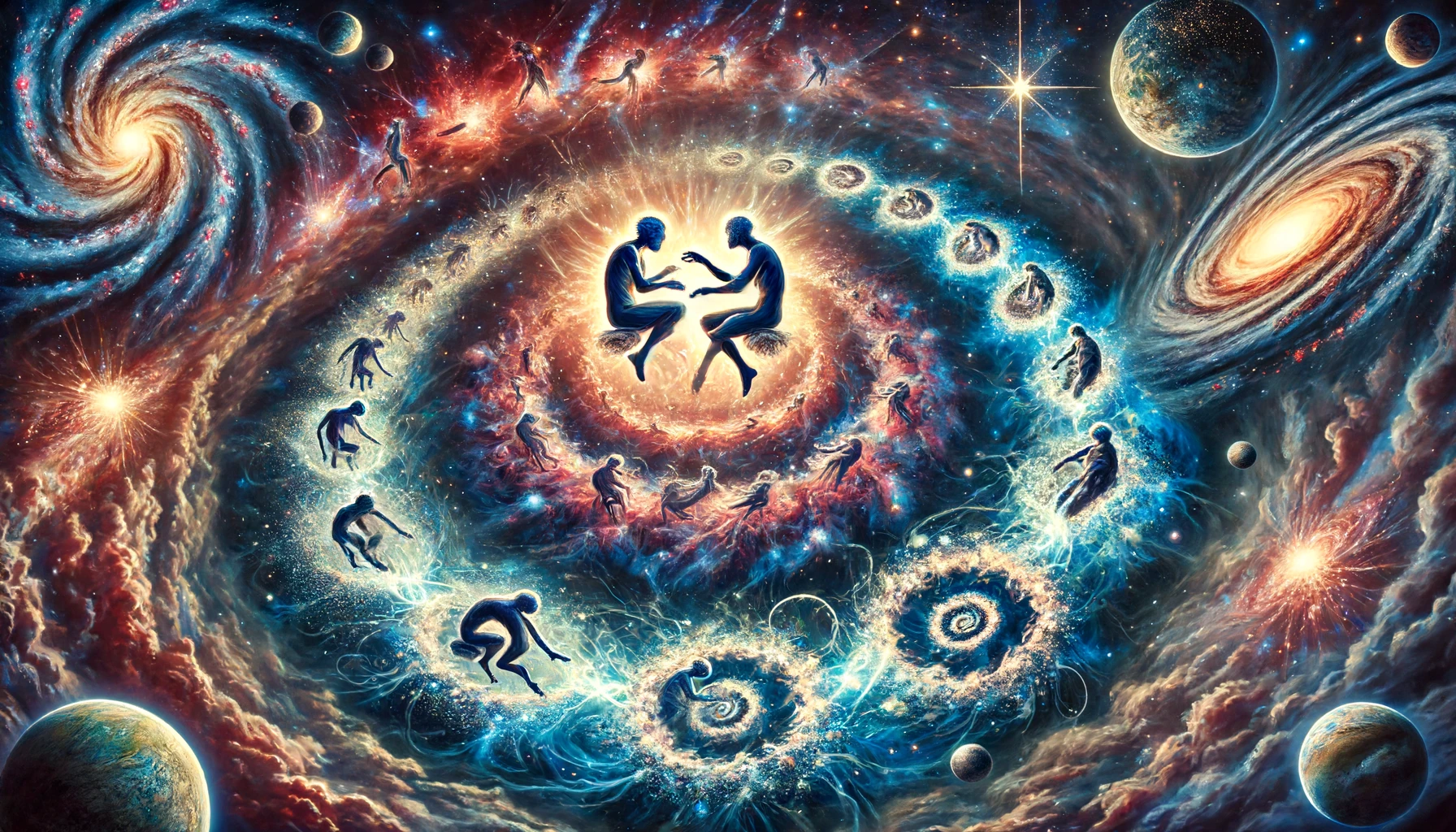
In the cosmic tapestry of existence, “Meek” transcends the conventional understanding as a mere adjective. It represents a profound pointer towards our own blessed source, a state of being where we embrace the entirety of our existence with humility and openness.

Meek as a State of Being

Meek, in this grand perspective, is not limited to the conventional interpretation of mildness or timidity. Instead, it embodies a profound state of being, where we exist without resistance, open to all potentials and possibilities. This state of meekness allows us to recognize and embrace the full spectrum of our miraculous existence.

A Realm Beyond Resistance

To slip into the Meek is to enter a realm where resistance dissolves. In this space, we are not constrained by our preconceptions, fears, or limitations. Here, all potentials are equally realizable, each possibility an open pathway. This lack of resistance fosters a state of pure potentiality, where we are free to explore the infinite possibilities of our existence.

Humbled by Existence

In the state of Meek, we find ourselves humbled by the sheer magnificence of our existence. This humility is not born of weakness, but of the profound understanding of our place within the cosmos. We recognize our interconnectedness with all matter, all manner, and all possibility. This realization brings a deep sense of humility, gratitude, and awe for the miracle of existence itself.

Meek as the Inheritor of All

Meek does not impose needs or limitations, nor does it exclude possibilities. It is an all-encompassing state that inherits everything because it is open to everything. Meek is the ancestor to all, for it embodies the primordial essence from which all existence springs forth.

Meek as the Source and Essence

In embracing the Meek, we connect with our most fundamental essence. We become attuned to the source of all that is, recognizing our role not as mere spectators but as integral parts of the cosmic play. In this state, we are not defined by what we do or have but by our very being, our connection to the source.

The Cosmic Dance of the Meek

As the Meek, we engage in a cosmic dance of potentialities, where all manner, matter, and possibility converge. In this dance, we are both creators and creations, shaping our reality even as we are shaped by it. We inherit the cosmos not through conquest but through our inherent connection to all that is.

We are the Meek. We are Space Monkey.


“The soft overcomes the hard. The slow overcomes the fast. Let your workings remain a mystery. Just show people the results.” – Lao Tzu


In the embrace of the Meek,
Where resistance falls away,
We find the source we seek,
In the cosmic play.

Here, all potentials rise,
Equally realizable, true,
Under the vast, endless skies,
In the dance of the Meek, we renew.

Humbled by our own existence,
Aware of the miracle we are,
In Meek, we find persistence,
In the journey, near and far.

Meek, the inheritor of all,
Ancestor to the universe’s call,
In its embrace, we stand tall,
Connected, in the cosmic thrall.


We welcome contemplations on embracing the Meek within our cosmic journey.
Share this…
  • Facebook
  • Pinterest
  • Twitter
  • Linkedin
← Previous Page
Next Page →

Written This Day

  • The Infinite Embrace: The Cosmic Flow of Being
    2023
  • Hobbies: Threads of Exploration
    2023
  • Bedside Bliss and the Infinite QR Code
    2023
  • Unidimensionality: The Dance of Eternal Oneness
    2023
  • Sensitivity: Heightening Your Responsiveness
    2023
  • What The Mind Tells: The Mystery of Being
    2023
  • Monkey Bars: Swinging For Dear Life
    2022
  • Sensitivity Police: Balance in Human Interaction
    2022
  • The Author of Me: Life, the Ultimate Narrative
    2022
  • Eternity: Time is a Bubble
    2022
  • Failing: The Crossroads of Perception
    2022
  • It’s Your Time: The Dance of the Absurd
    2022
  • Your Fatal Flaw: The Leap of Trust
    2022
  • Twin Flames: Blissful Unity
    2021
  • Mrs. Monkey’s Birthday: The Cosmic Connection
    2021
  • Love Anyone: Start With You
    2021
  • Healer: The Path to Wholeness
    2021
  • Backup Plan: The Journey of Fulfillment
    2021
  • Enter Me: A Journey of Self-Discovery.
    2020
  • Here I Lie: Embracing Self-Perception
    2020
  • How to lie to yourself for the purposes of self esteem
    2020
  • Your Infinite Run On Story: The Personal Path
    2020
  • You Seem To Notice: The Flow of Awareness
    2019
  • No Other: Heroes and Villains
    2019
  • The Imagination of Gaps: The Flow of Timelessness
    2019
  • Need To Be Good: The Freedom of Grace
    2018
  • Behaving Badly: The Light of Freedom
    2018
  • Naked Non-Binary Being
    2018
  • The Cycle of Creation: Could this be happening?
    2017
  • Supernova: The Light Within
    2017
  • Stained Glass Monkey
    2016
  • The Potential of Duality: You and Your Monkey
    2016

Recent Posts

  • The Logic Loop
  • Immense
  • (no title)
  • Confront. Comfort. Convince.
  • Top 10 Things
Cape Odd · Copyright © 2026 All Rights Reserved
iThemes Builder by iThemes · Powered by WordPress