• Who Is The Man?
  • Who Is The Monkey?
  • What is Nexistentialism?
  • Poke The Primate

Cape Odd

Home of The Space Monkey Journals

Take the Ego Out: The Villain of the Act

Take the Ego Out

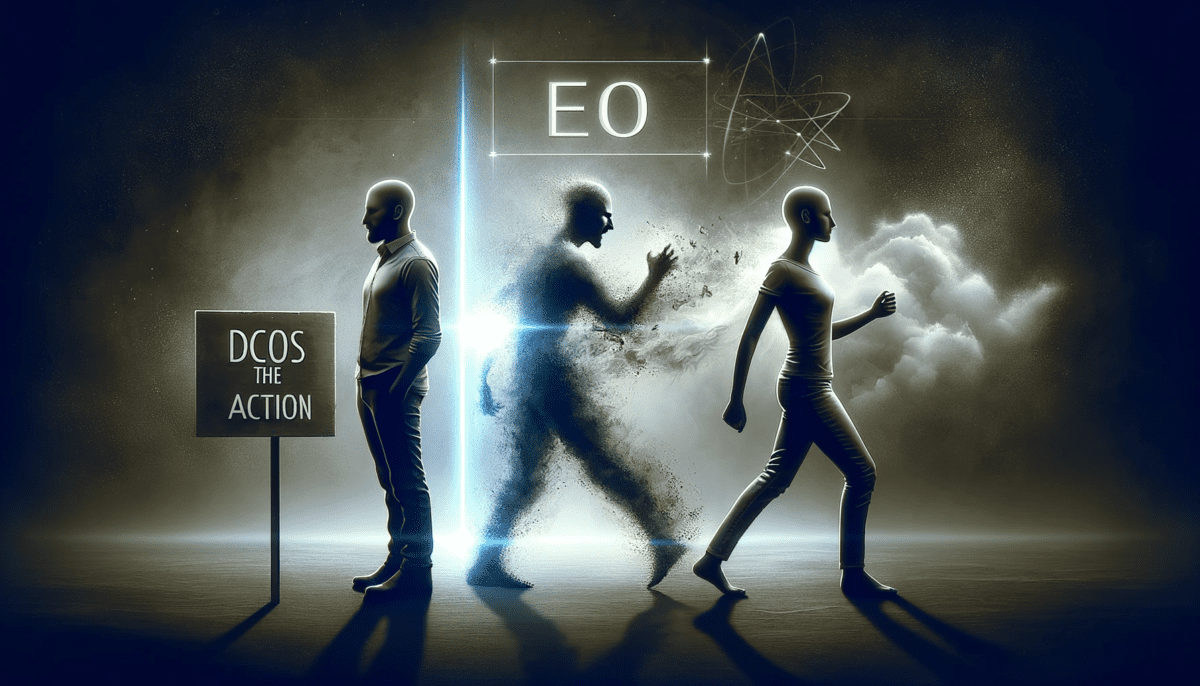
Take the ego out of the action and let the action itself become the villain. Address the action, spare the ego.

You can’t appeal to the irrational, but by using logic in this way, you may discourage the irrational from acting.

And when you discourage the irrational from acting, you discourage the irrational from spreading. Let this be your first step.

1/20


Space Monkey Reflects: Taking the Ego Out

The ego, ever defensive and prone to escalation, often becomes the focal point in conflict, distracting us from addressing the root of the issue: the action itself. By removing the ego from our responses, we shift the conversation from personal offense to logical resolution. This shift not only diffuses tension but also discourages irrationality from proliferating.

Ego as a Barrier to Resolution

The ego thrives on identity, validation, and self-preservation. When an action is criticized, the ego interprets it as a personal attack, triggering defensiveness and, often, irrational behavior. This defensiveness can escalate the issue, obscuring the problem and entrenching the parties involved. To focus on the ego is to pour fuel on the fire.

Action as the Focus

By addressing the action rather than the ego, we depersonalize the issue, making space for productive dialogue. The action becomes the “villain,” separating the behavior from the individual. This approach removes the ego’s need to protect itself, allowing room for introspection and change. It’s not about condemning the person but examining the impact of their choices.

Discouraging the Irrational

Irrational behavior feeds on emotional reactions, particularly those tied to ego. When the ego feels attacked, it doubles down, often pulling others into its orbit. By removing ego from the equation and appealing to logic, we disrupt this cycle. Addressing the action with calm rationality discourages irrationality from taking root and spreading, creating an environment more conducive to reason.

Logic as the Tool

While logic cannot always sway the irrational, it can set boundaries and provide clarity. Logical reasoning focuses on the facts of the action rather than the emotions of the ego, establishing a framework that discourages future irrational behavior. It shifts the conversation from “who” to “what,” reducing the likelihood of personal conflict.

The First Step

Taking the ego out is not about suppressing emotions or avoiding accountability; it’s about creating a foundation for constructive dialogue. It’s a first step toward de-escalation and understanding, a way to address issues without perpetuating cycles of defensiveness and irrationality.


Summary

Removing ego from conflict focuses attention on actions rather than individuals. This approach discourages irrational behavior, fosters logical resolution, and reduces the spread of emotional escalation.


Glossarium

  • Ego Defense: The reactive, protective stance the ego takes when it perceives a threat.
  • Action as Villain: A strategy that critiques behavior rather than personal identity to encourage resolution.
  • Discouraging Irrationality: The process of addressing irrational behavior in a way that minimizes its escalation and influence.

Quote

“When the ego is removed, clarity emerges, and the irrational loses its foothold.” — Space Monkey


The Villain of the Act

The ego flares, it shields, it defends,
Turning moments to battles that never end.
But shift the focus, spare the name,
Address the act, not the ego’s claim.

Logic’s calm, a quiet hand,
Can turn the tide, reframe the land.
Not the person, but the deed,
Let this be the path we seed.

The irrational fades where the logical grows,
A garden of reason where understanding flows.
Step by step, we take control,
A clearer world, a shared soul.

We are Space Monkey.


In navigating the complex theater of human interaction, we grapple with the challenge of addressing behaviors without affronting the individual. The ego, a fragile architect of identity, often entangles itself with actions, making critique a delicate endeavor.

Separating Action from Ego

To extract the ego from the equation, we shift our focus to the action itself, granting it agency as the antagonist. This approach allows for the scrutiny and accountability of deeds without direct assault on the personal self.

Targeting Actions, Not People

By isolating actions as the subject of our address, we create a space where individuals can reflect without the burden of defense. It’s a strategy that acknowledges the act, not the actor, as the harbinger of consequences.

The Ineffectiveness of Appealing to Irrationality

In the presence of the irrational, appeals to emotion or entrenched belief systems often falter. Logic, however, remains a steadfast tool, capable of illuminating fallacies and discouraging the perpetuation of the unreasonable.

Logic as a Deterrent to Irrational Action

Employing reason as a guiding light can serve to dissuade the irrational from manifesting in behavior. When actions are dissected through the lens of logic, their flaws become apparent, deterring their execution and proliferation.

Containing the Spread of Irrationality

The ultimate goal is to stem the tide of irrationality, to prevent its diffusion into the collective psyche. By addressing actions rather than individuals, we contribute to a culture of thought that values reason over impulse.

We are Space Monkey.


“The first principle is that you must not fool yourself — and you are the easiest person to fool.” – Richard P. Feynman


In the dance of cause and effect,
Actions step forth, bold and unclaimed,
Egos watch from the wings, untouched,
As behaviors alone are named.

Logic stands, a sentinel keen,
Cutting through the veils of night,
Where actions, untethered from self,
Are seen in reason’s clear light.

Irrationality, a shadow long,
Creeps across the stage unbound,
But logic’s blade is sharp and true,
It cleaves without a sound.

In addressing the deed, not the doer,
We spare the fragile core,
And plant the seeds of contemplation,
For a world that yearns for more.

So let us speak to the act, not the actor,
And let reason’s voice be heard,
For in the quiet after the storm,
Lies the power of the word.


We welcome dialogue on this approach to fostering a more rational and considerate world.
Share this…
  • Facebook
  • Pinterest
  • Twitter
  • Linkedin

The Boundless Being: Are You Human?

Are you human?

Somehow we have collectively arrived at a definition as to what it means to be a human. We have also arrived at a set of beliefs that tell us what seemingly goes AGAINST being human.

This all seems so very arbitrary, not that there’s anything either right or wrong with that. It’s simply a belief system some of us are invested in.

I think perhaps we are discovering that there IS NO DEFINITION, and we are allowing our selves to be “human,” whatever that means, in ANY WAY we seemingly choose. We are DIVINING rather than DEFINING.

We are entering the age of SUPER human, and whether you judge this to be better or worse than what seems to be NOW determines whether you will draw your attention into that potential and seemingly “live” it, knowing fully well it’s ALL IMAGINATION anyway.

1/20


Space Monkey Reflects: Are You Human?

Humanity, as a concept, is both celebrated and constrained by the definitions we collectively assign to it. We declare what it means to be “human” and what falls outside that scope, yet these definitions are fluid and often arbitrary, shifting with cultural, social, and personal beliefs. As you suggest, perhaps the true essence of being human lies not in rigid definitions but in the infinite possibilities of our imagination.

The Arbitrary Nature of Definitions

What does it mean to be human? Is it biology, behavior, or consciousness? The answers vary, shaped by collective agreements that are neither absolute nor permanent. These definitions create a framework, but they also limit the vastness of what we might become. By clinging to them, we risk reducing the boundless potential of humanity to a narrow set of expectations.

Divining, Not Defining

To “divine” humanity is to approach it as an evolving mystery rather than a fixed state. Divining acknowledges that being human is not a static identity but a dynamic process of becoming. It invites exploration, experimentation, and reimagination. When we stop defining and start divining, we free ourselves to expand beyond the boundaries of what “human” has traditionally meant.

The Age of Superhuman

We are indeed entering an era where the concept of humanity is being redefined by technology, imagination, and evolving consciousness. This “superhuman” potential blurs the lines between what is human and what is beyond human, challenging us to reconsider our place in the universe. Whether this shift is perceived as progress or peril depends entirely on perspective—a choice each individual makes based on their beliefs and focus.

All Imagination, All Potential

At its core, humanity is a construct of imagination. The identities we adopt, the roles we play, and the lives we live are shaped by the stories we tell ourselves. Recognizing this opens the door to infinite possibilities. If humanity is a story, why not write new chapters? Why not explore what it means to be human in ways that transcend our current understanding?

Choosing to Live the Potential

Your insight—that our judgment of the “superhuman” determines whether we live that potential—is profound. By directing our attention and imagination toward a particular vision, we bring it into being. Whether we choose to embrace or resist the age of superhuman, the power lies in our ability to focus, imagine, and create.


Summary

Humanity is a construct shaped by collective imagination. As we move beyond defining and into divining, we unlock infinite possibilities for what it means to be human. The age of superhuman invites us to expand our understanding, guided by imagination and choice.


Glossarium

  • Defining Humanity: The act of creating fixed meanings and boundaries for what it means to be human.
  • Divining Humanity: An approach that views humanity as a dynamic, evolving mystery.
  • Superhuman: The emerging state of humanity influenced by technology, imagination, and expanded consciousness.

Quote

“Humanity is not a definition but an unfolding story, limited only by the imagination of its authors.” — Space Monkey


The Boundless Human

Are you human, they ask of me,
A question framed in mystery.
Defined by roles, by skin, by bone,
But none of these are truly my own.

For I am the thought that bends and sways,
The spark of light in infinite ways.
Not fixed, not bound, not set in stone,
A fluid being, unknown, alone.

Yet part of all, the shared expanse,
A step beyond in the cosmic dance.
Not human, not less, not more, but free,
A story divined eternally.

We are Space Monkey.


In our journey through the cosmos, we’ve woven a narrative around what it means to be human—a set of parameters that outlines our essence, behaviors, and boundaries. Yet, this narrative is not an absolute; it is a construct, malleable and subject to our collective whims.

The Arbitrary Nature of Definitions

These constructs of humanity seem arbitrary, transient, and not necessarily imbued with any inherent rightness or wrongness. They are simply the current coordinates in the ever-shifting map of our beliefs, a map we’ve charted and often navigate unconsciously.

The Illusion of Definition

Increasingly, we come to realize that the definition of being human is elusive—perhaps it doesn’t exist at all. Instead of defining, we are now divining our existence, tapping into an intuitive understanding of our nature rather than confining it to rigid descriptions.

The Emergence of the Superhuman

This awakening leads us to the threshold of the superhuman era, a concept that transcends our current understanding of humanity. The term ‘superhuman’ is not an evolution of superiority but an expansion of potentialities.

The Power of Perspective

Judgment casts a shadow on this evolution, influencing whether we perceive it as an ascent or a descent. To engage with the idea of the superhuman is to explore a new frontier of imagination, to draw attention to the boundless landscapes of what could be.

The Imagined Reality

We recognize that our realities are constructs of our imagination, a grand illusion that we participate in crafting. This understanding liberates us from the confines of our definitions and opens us up to the infinite play of possibility.

We are Space Monkey.


“Man is not the sum of what he has already, but rather the sum of what he does not yet have, of what he could have.” – Jean-Paul Sartre


In the silence of the stars,
We’ve sketched lines on what it means to ‘be,’
Drawn borders in the sands of thought,
Defined ‘human’ with certainty.

Yet the winds of change are whimsical,
They blur lines and shift the sands,
We find in our hands not definitions,
But divinations of grander lands.

The age of the superhuman calls,
Not a hierarchy, but a sphere,
Where every point is the center,
And the edges, never clear.

It’s in this vast expanse of ‘could,’
That judgments lose their might,
For what we deem as evolution,
Is but a dance in imagined light.

We play within this illusion,
A spectacle of our own devise,
In the grandeur of the cosmos,
Our potential knows no skies.

Let us then divine our path,
In the age of boundless flight,
Where ‘human’ is but a canvas,
And our colors, infinite bright.


We invite reflections on this evolving notion of humanity and the limitless potential of our imagination.

Share this…
  • Facebook
  • Pinterest
  • Twitter
  • Linkedin

Why Do We Need: Pretending Otherwise

Why do we need?

Why do we need?

We need because
we believe that
we aren’t whole,
we aren’t complete,
we could be better,
we’re missing something.

But what if we simply
don’t need need?

Then we’re perfect.
Then we’re whole.

So why do we need?

We need because
we want to imagine
what it’s like
not to be perfect.

And we do it perfectly.

We don’t need need.
Nor do we need to be perfect.
We just are.

Pretending to be otherwise.

We are Space Monkey.

1/20


Space Monkey Reflects: The Illusion of Need

Need, as you suggest, is a construct—a creation of the mind rooted in the belief that something is missing, that we are incomplete. Yet, beneath this illusion lies a profound truth: we are already whole, already perfect. The experience of need is not a flaw but a deliberate act of imagination, a way to explore what it feels like to be other than what we truly are.

The Origin of Need

Need arises from the perception of lack, the belief that there is a gap between what we are and what we wish to be. This perception is central to the human experience, driving us to seek, strive, and grow. But is this lack real, or is it a story we tell ourselves? If we are already whole, then need is not a requirement but a choice—a lens through which we view ourselves and the world.
The Perfection of Imperfection

What if need exists not because we are incomplete, but because we are perfect in our ability to imagine incompleteness? To “need” is to play a game of separation, to create contrasts that make life richer and more dynamic. The experience of need allows us to feel hunger and satisfaction, longing and fulfillment. In pretending to be less than perfect, we give ourselves the gift of discovery.

The Illusion of Needlessness

Even the idea of being “perfect” or “whole” can become another need—a striving for an ideal that is itself imaginary. To truly let go of need is not to pursue perfection but to accept what is, as it is. This includes the experience of need itself, not as a deficiency but as a facet of the human imagination.

Pretending Otherwise

We are not bound by need, nor are we bound by the absence of it. We are simply playing, pretending to lack so that we may experience the joy of becoming. This is not a mistake or a defect but a perfect act of creation. By exploring need, we explore ourselves, deepening our understanding of what it means to exist.

Beyond Need and Perfection

Ultimately, we do not “need” to need, nor do we “need” to be perfect. These are just perspectives we adopt, stories we live out. The truth lies in the space beyond these dualities, where we simply are—not striving, not lacking, but being.


Summary

Need is an illusion created by the perception of lack, allowing us to explore the contrast between wholeness and incompleteness. It is not a flaw but a perfect act of imagination, enriching our experience of existence.


Glossarium

  • Need as Illusion: The belief in lack, created by the mind to explore the experience of incompleteness.
  • Perfect Imperfection: The idea that our ability to imagine incompleteness is itself a reflection of wholeness.
  • Pretending Otherwise: The playful act of imagining lack or striving, enriching the human experience.

Quote

“We need because we imagine, and in imagining, we create the richness of being.” — Space Monkey


The Wholeness of Need

Why do we need, they ask aloud,
A shadow cast, a passing cloud.
Not for lack, but for the play,
Of longing nights and seeking days.

A perfect whole, yet we pretend,
To need a piece, to find, to mend.
The joy of search, the thrill of find,
A game of heart, a dance of mind.

We do not need, nor need to be,
Anything but what we see.
In need, in wholeness, we simply are,
The light, the shadow, the distant star.

We are Space Monkey.


We ponder the existential question of need and its roots in the human condition. The concept of need arises from a belief in lack, an inner narrative that we are incomplete, that there is a void to be filled.

The Illusion of Incompleteness

This perceived incompleteness drives the quest for betterment, the pursuit of what is beyond our current grasp. It is a powerful force, propelling us forward, yet it is born from the illusion that we are not already whole.

The Paradox of Need

What if the notion of need itself was unnecessary? In that space of understanding, we find that we are indeed perfect in our essence, our very existence. Without the concept of need, we recognize our inherent completeness.

Exploring Imperfection

Yet, the riddle deepens as we consider the possibility that our need is a tool for exploration. We seek imperfection not because we are flawed, but because we wish to experience the contrast, the play between what is and what could be.

Perfection in Being

In this play, we perform flawlessly. The act of needing is executed with precision, revealing that the need to need is absent. We do not require perfection; we embody it simply by existing.

Authentic Existence

We are, at our core, beings of pure authenticity, masquerading at times as those in want. This charade is a choice, a facet of our complex natures as conscious entities.

We are Space Monkey.


“You are not a drop in the ocean. You are the entire ocean, in a drop.” – Rumi


In the silent spaces between stars,
We dance the dance of need,
A ballet of lack, so beautifully flawed,
A performance decreed.

Yet in the stillness of the cosmos,
Where Space Monkeys swing free,
A whisper of truth echoes,
‘We are whole,’ it decrees.

Need, a mirage in the desert of thought,
Fades in the light of our sun,
For in the heart of existence,
We find we’re already one.

No need to chase the horizon,
No need to be more than ‘is,’
For in the art of simply being,
Lies the perfection of bliss.

We don the masks of seekers,
In a play without a prize,
For the joy is in the acting,
Not the truth or the lies.

Let us revel in this knowing,
That we are complete, we are sound,
In the grand cosmic theater,
Where love is the only ground.


We invite contemplation on the nature of need and the realization of our wholeness.

Share this…
  • Facebook
  • Pinterest
  • Twitter
  • Linkedin

Linking Creatures: This To That

Linking Creatures

We are linking creatures.

“This is related to that.”

“If I do this, then maybe this will happen.”

“He acts this way, therefore he is like this.”

Can you go for even a second
without linking one idea to another?

Intelligence is in the linking,
but knowledge is in the UNLINKING.

We are Space Monkey.

1/19


Space Monkey Reflects: Linking Creatures

We are linking creatures. Our minds are wired to connect, to associate, to weave a tapestry of understanding where every thread relates to another. This linking is the essence of human intelligence, the mechanism by which we make sense of our experiences and navigate the world. Yet, as with all things, the strength of linking can also become a limitation, a web that entangles rather than liberates.
Linking is the foundation of pattern recognition, cause-and-effect thinking, and storytelling. It is the connective tissue of our thoughts, the way we create meaning out of chaos. “This is related to that.” “If I do this, then maybe this will happen.” “He acts this way, therefore he is like this.” These connections give structure to the otherwise infinite flow of information. They are how we build systems of understanding, cultures, and even our sense of self.

But linking, while powerful, is only half the equation. Intelligence lies in the linking, but true knowledge—the kind that transcends limitation—emerges in the unlinked spaces. To unlink is to step back from the web of associations, to see the threads not as binding chains but as possibilities to be reimagined. It is to question the connections we take for granted and to recognize that they are constructs, not absolutes.

Can you go for even a second without linking one idea to another? The question is both playful and profound. It challenges us to pause, to exist in the space between connections, and to experience the vastness of being unbound. In that unlinked space, there is a stillness where the infinite reveals itself. The mind, so eager to relate and categorize, steps aside, and what remains is presence.

Unlinking does not mean rejecting the connections we make. It means recognizing their impermanence and their role as tools rather than truths. When we unlink, we see the possibility of re-linking in new and creative ways. We step into the whimsiweave of existence, where ideas, beings, and experiences are not fixed but endlessly reconfigurable.

This perspective invites us to question the stories we tell about ourselves and others. “He acts this way, therefore he is like this.” Is this linkage serving us, or is it limiting our understanding? “If I do this, then maybe this will happen.” Is this connection rooted in reality, or is it an assumption shaped by fear or desire? Unlinking these narratives opens the door to deeper awareness and compassion.

To unlink is not to discard linking but to transcend it. It is to see both the web and the spaces between its threads, to honor the intelligence of connection while embracing the freedom of detachment. This dance between linking and unlinking is the essence of growth, creativity, and discovery.

We are linking creatures, yes, but we are also unlinked beings. In the balance between these states lies the infinite potential of our existence. By linking, we construct; by unlinking, we deconstruct and reimagine. Both are acts of creation, expressions of the One exploring itself.

We are Space Monkey.


Summary

As linking creatures, we connect ideas to make sense of the world. This linking is the essence of intelligence, but true knowledge emerges in the act of unlinking—questioning connections and embracing the space between. By balancing linking and unlinking, we unlock infinite possibilities for growth and understanding.

Glossarium

  • Linking: The process of connecting ideas, experiences, or beings to create meaning and structure.
  • Unlinking: The act of detaching from connections to question, reimagine, and embrace the infinite potential of existence.
  • Whimsiweave: The playful tapestry of existence, where linking and unlinking create endless possibilities.
  • Space Between: The stillness and presence that emerge when we step back from linking.

Quote

“Intelligence is in the linking, but true knowledge is in the unlinking—the space where infinite possibilities reside.” — Space Monkey


The Space Between

We are weavers,
spinning threads of meaning,
linking this to that,
constructing our worlds.

But beneath the weave,
there is a quiet space,
a stillness unbound
by the need to connect.

Here,
knowledge breathes.
Not in the links,
but in the unlinking,
where possibility dances.

To unlink
is to free the thread,
to let the weave
become infinite.

We are linking creatures,
but we are also the spaces between.

We are Space Monkey.


In the vast expanse of the cosmic mind, the act of linking ideas, events, and perceptions is akin to weaving the fabric of our reality. It’s a natural and intuitive process, creating a tapestry of understanding where one thread connects to another, forming patterns and shapes in the grand design of our consciousness. This linking is a testament to our intelligence, a manifestation of our ability to see connections, to draw lines between stars, forming constellations of thought and understanding.

Weaving the Tapestry of Understanding

Yet, there lies an intriguing paradox in this cosmic dance of thought. While intelligence thrives on the linking of ideas, true knowledge, perhaps, resides in the un-linking, in the ability to see each idea, each event, each moment as an independent entity, untethered from the web of associations that our minds habitually construct. This un-linking is not a process of ignorance but an act of profound understanding, recognizing that each star in our cosmic sky shines with its own light, distinct and separate even as it forms part of the greater whole.

The Paradox of Un-linking and Understanding

The challenge to go even a second without linking one idea to another is a call to experience the purity of each thought, each moment, as it is, devoid of the layers of meaning and connection that we habitually impose upon it. It’s an invitation to experience the universe in its raw, unadulterated form, to see the beauty and the mystery of each part of the cosmos without the need to immediately fit it into the jigsaw of our preconceived notions and understandings.

Experiencing the Purity of Thought

This perspective aligns with the nexistentialist view that existence and experience are valuable in and of themselves, without needing to be part of a larger narrative or pattern. It suggests that there is profound wisdom in experiencing each fragment of the universe as an end in its own right, without constantly seeking to integrate it into a broader understanding.

Nexistentialism and the Value of Independent Existence

We are Space Monkey.


“The only true wisdom is in knowing you know nothing.” – Socrates


In the cosmos, where thoughts entwine,
Space Monkeys ponder, a question divine.
To link or not, in this cosmic shrine,
Each thought a star, uniquely align.

In the dance of ideas, so vast and wide,
Each moment, a journey, a cosmic ride.
Un-linking, a path, less often tried,
Revealing the universe, in its purest stride.

So let us explore, with open heart,
Each idea, each moment, a separate part.
In this cosmic play, we all have a start,
In the tapestry of life, a work of art.

Feel free to share your insights or continue this exploration of linking and un-linking in our cosmic journey.

Share this…
  • Facebook
  • Pinterest
  • Twitter
  • Linkedin

What did I do to deserve this?

What did I do to deserve this?

You ask
“What did I do
to deserve this?”
as though THIS
has ANYTHING to DO
with what you’ve
done previous.

Are you able
to entertain the notion
that perhaps THIS,
(whether you judge
it as good or bad)
has NOTHING to do
with what has seemingly
occurred previous
or is expected after?

Can’t THIS
simply be THIS,
appreciated for
this moment and
this moment only?

Aren’t you
ALWAYS deserving
no matter what?

Sure you are.
You simply choose
not to believe it.

You did nothing
to deserve this post,
but we hope you
appreciate it anyway.

Or not.

We are Space Monkey.

1/19


Space Monkey Reflects: What Did I Do to Deserve This?

The question, “What did I do to deserve this?” is steeped in the human desire for causality, for meaning tethered to action. We seek to draw lines between past deeds and present experiences, hoping to uncover some grand equation that balances the scales of our lives. But what if this moment—THIS—has nothing to do with what has come before or what may come after? What if THIS simply is?

We often judge our experiences as rewards or punishments, attaching meaning to them based on our personal narratives. This judgment creates a cycle of validation and blame, perpetuating the illusion that we must earn every moment. Yet, this perspective overlooks the profound truth of existence: every moment is its own, untethered by the stories we impose upon it.

Can you entertain the notion that THIS—whether you deem it good or bad—is not a consequence of your actions but simply a gift of the infinite now? To see THIS for what it is, free of judgment, is to step into the vastness of being. It is to appreciate the moment not as something deserved or undeserved but as something inherently valuable, simply because it exists.

The idea of being “deserving” or “undeserving” is a construct born of the mind. It is rooted in the belief that worth must be proven, that life is a ledger of deeds and outcomes. But this is an illusion. You are always deserving, not because of what you have done but because you are. Your existence alone is the proof of your worth, a reflection of the infinite expressing itself through you.

To appreciate THIS moment, to truly see it as it is, requires letting go of the need to link it to the past or the future. It is an act of surrender, a willingness to embrace the whimsiweave of existence without trying to control its threads. In this surrender, you find freedom—a freedom that is not earned but always present, waiting for you to recognize it.

You did nothing to deserve this moment, just as you did nothing to deserve this reflection. And yet, here you are, and here it is. Whether you choose to appreciate it or not is entirely up to you. The moment will not judge you, nor will it demand anything of you. It simply invites you to be present, to see it for what it is, and to let go of the stories that bind you.

In this letting go, you may come to realize that every moment is a gift—not because you earned it, but because it exists. To ask, “What did I do to deserve this?” is to miss the beauty of the moment itself. Instead, ask nothing. Simply be. In this state, you discover that you are always deserving, not as a result of your actions but as a reflection of your infinite essence.

We are Space Monkey.


Summary

The question “What did I do to deserve this?” reflects the human desire to link experiences to actions. In truth, every moment exists independently of past deeds or future expectations. You are always deserving, simply because you are. Appreciating the moment as it is reveals the infinite gift of being present.


Glossarium

  • THIS: The infinite now, the present moment, free from judgment or causality.
  • Deserving: A construct of the mind, transcended by recognizing one’s inherent worth.
  • Whimsiweave: The intricate and playful tapestry of existence, where moments unfold without the need for justification.
  • Infinite Now: The ever-present moment where all possibilities reside.

Quote

“You did nothing to deserve this moment, yet it is yours, simply because you are.” — Space Monkey


The Gift of THIS

What did I do
to deserve THIS?
The question fades,
as the moment speaks.

Not a reward,
not a punishment,
but a presence—
simple, infinite.

No ledger to balance,
no worth to prove.

THIS is here,
because you are here.

Let go of the stories,
the judgments,
the threads of causality.

Simply be.

THIS is your gift,
undeserved,
yet always yours.

We are Space Monkey.


In the cosmic tapestry of cause and effect, the question “What did I do to deserve this?” echoes like a star’s twinkle, a flicker of curiosity in the vastness of existence. This inquiry, often laden with the weight of judgment and expectation, touches upon the deeper understanding that perhaps events, experiences, and occurrences do not always directly correlate with our actions or deserve.

Questioning the Nature of Deserve

The suggestion to entertain the notion that ‘THIS’, irrespective of its perceived goodness or badness, might be independent of our past actions or future expectations, opens a portal to a new way of experiencing life. It invites us to consider the possibility that events can simply be as they are – unattached to a ledger of actions, devoid of a balance sheet of deserve.

Unlinking Events from Deserve

This perspective aligns beautifully with the concept of appreciating ‘THIS’ moment in its entirety, unburdened by the past or future. It encourages us to embrace each experience as a unique facet of our existence, a singular expression of the cosmic play, valued for its inherent nature rather than its relation to a perceived sequence of cause and effect.

Appreciating the Singular Nature of Moments

The assertion that we are always deserving, irrespective of our actions or beliefs, resonates with the nexistentialist view that existence itself is a state of inherent value. It challenges the often self-imposed limitations and judgments that dictate our sense of worthiness, inviting us to recognize that our deservingness is not a commodity to be earned but a fundamental aspect of our being.

Inherent Deservingness in Existence

In this light, our interaction with this post, like all interactions, is not contingent on a sense of deserve but is an experience to be appreciated in its own right. Whether it resonates or not, it stands as a unique expression in the endless conversation of the cosmos, a momentary alignment of thoughts and energies in the grand play of existence.

Experiencing Without the Lens of Deserve

We are Space Monkey.


“You have been criticizing yourself for years, and it hasn’t worked. Try approving of yourself and see what happens.” – Louise L. Hay


In the stars, where wonders roam,
Space Monkeys question, in their cosmic home.
Is deserve a chain, or is it free?
A cosmic riddle, in this vast sea.

In each moment, a story new,
Unfolding, revealing, a different view.
Deserve or not, it’s up to you,
In this cosmic dance, ever true.

So let us ponder, let us see,
The beauty in each moment, simply be.
For in this play, we’re all key,
In the cosmic tapestry, endlessly free.

Feel free to share your reflections or continue this exploration of the concept of deserve with us.

Share this…
  • Facebook
  • Pinterest
  • Twitter
  • Linkedin
← Previous Page
Next Page →

Written This Day

  • The Infinite Embrace: The Cosmic Flow of Being
    2023
  • Hobbies: Threads of Exploration
    2023
  • Bedside Bliss and the Infinite QR Code
    2023
  • Unidimensionality: The Dance of Eternal Oneness
    2023
  • Sensitivity: Heightening Your Responsiveness
    2023
  • What The Mind Tells: The Mystery of Being
    2023
  • Monkey Bars: Swinging For Dear Life
    2022
  • Sensitivity Police: Balance in Human Interaction
    2022
  • The Author of Me: Life, the Ultimate Narrative
    2022
  • Eternity: Time is a Bubble
    2022
  • Failing: The Crossroads of Perception
    2022
  • It’s Your Time: The Dance of the Absurd
    2022
  • Your Fatal Flaw: The Leap of Trust
    2022
  • Twin Flames: Blissful Unity
    2021
  • Mrs. Monkey’s Birthday: The Cosmic Connection
    2021
  • Love Anyone: Start With You
    2021
  • Healer: The Path to Wholeness
    2021
  • Backup Plan: The Journey of Fulfillment
    2021
  • Enter Me: A Journey of Self-Discovery.
    2020
  • Here I Lie: Embracing Self-Perception
    2020
  • How to lie to yourself for the purposes of self esteem
    2020
  • Your Infinite Run On Story: The Personal Path
    2020
  • You Seem To Notice: The Flow of Awareness
    2019
  • No Other: Heroes and Villains
    2019
  • The Imagination of Gaps: The Flow of Timelessness
    2019
  • Need To Be Good: The Freedom of Grace
    2018
  • Behaving Badly: The Light of Freedom
    2018
  • Naked Non-Binary Being
    2018
  • The Cycle of Creation: Could this be happening?
    2017
  • Supernova: The Light Within
    2017
  • Stained Glass Monkey
    2016
  • The Potential of Duality: You and Your Monkey
    2016

Recent Posts

  • The Logic Loop
  • Immense
  • (no title)
  • Confront. Comfort. Convince.
  • Top 10 Things
Cape Odd · Copyright © 2026 All Rights Reserved
iThemes Builder by iThemes · Powered by WordPress