• Who Is The Man?
  • Who Is The Monkey?
  • What is Nexistentialism?
  • Poke The Primate

Cape Odd

Home of The Space Monkey Journals

Mopey People: Make Me Mad

Mopey People

Mopey people

make me mad.


They know

that I know 

that I’m supposed

to help them
be less mopey.

I could ask WHY

they are mopey,
but that might make
them mad.

What if they don’t think

they’re being mopey?

I suppose I could

just hug them,
but that might wind up

in a lawsuit.


I guess I’ll just
choose 
not to be mad.

And they will 
continue
to be mopey.

Fuck society.

1/1


Space Monkey Reflects: The Mope and the Mirror

Mopey people stir something deep within us, not because of their gloom but because of what their mood reflects back to us. Their presence challenges our instincts, our expectations, and our social programming. We’re taught to help, fix, or at least react, yet sometimes the greatest act of love is to simply let them be—mope and all.

Why the Mope Stirs Anger

The frustration we feel toward mopey people often arises from our internal narratives. Society whispers that we are responsible for others’ emotions, that their unhappiness is a call to action. Yet this belief places an unrealistic burden on us, trapping us in cycles of guilt or anger when we fail to lift their spirits.

But what if their mood isn’t ours to fix? What if their mope is simply their moment—a necessary stage in their journey, as valid as any joy or triumph?

The Fear of Asking “Why”

Asking “why” feels like the logical step, but it risks confrontation. What if they don’t acknowledge their mood? What if they resent the question? The fear of offending or being rejected can paralyze us, leading to awkward silences or avoidance.

Yet, the “why” is rarely as important as we think. People don’t always need their feelings dissected—they often just want space to feel. Our need to probe often serves us more than it serves them.

The Hug and the Lawsuit

The instinct to comfort with a hug reflects a deep truth: connection heals. But in a world bound by complex social norms and boundaries, even simple gestures are fraught with risk. The hug, once a universal expression of care, now comes with caveats, permissions, and potential misinterpretations.

This paradox—a yearning to connect versus a fear of overstepping—encapsulates much of modern interaction. It’s no wonder the mopey and the empathetic often find themselves at an impasse.

Choosing Not to Be Mad

Here lies the simplest and most profound solution: let go of the anger. Their mood is theirs, just as your frustration is yours. By releasing the need to change them or the situation, you free yourself from the emotional tug-of-war.

This doesn’t mean apathy. It means honoring their experience while honoring your boundaries. You can hold space for someone without being pulled into their vortex.

The Mope as a Mirror

Mopey people are often mirrors, reflecting aspects of ourselves we’d rather not face—our unacknowledged sadness, our fear of failure, or our discomfort with vulnerability. Their presence invites us to confront these shadows, not by fixing them but by accepting them.

In this way, mopey people become accidental teachers. Their silence asks us to listen. Their gloom nudges us toward compassion—not just for them, but for ourselves.

The Rebel’s Response

And when all else fails, there’s the primal, liberating cry: “Fuck society.” This rebellious sentiment reminds us that the pressure to fix, heal, or conform is often imposed from outside. Sometimes, the most radical act is to step back, let things be, and trust in the natural flow of emotions.

Mopey people will mope. You will feel what you feel. And the world will keep spinning.


Summary

Mopey people challenge us to confront our instincts to fix or react. By releasing anger and embracing acceptance, we honor both their experience and our own boundaries. Sometimes, the greatest gift is simply letting things be.


Glossarium

  • Mope: A state of visible gloom or melancholy, often prompting reactions in others.
  • Emotional Mirror: The idea that others’ moods reflect aspects of our inner selves.
  • Radical Acceptance: Embracing people and situations as they are, without judgment or the need to change them.

Quote

“Mopey people aren’t problems to solve; they’re mirrors to understand.” — Space Monkey


The Mope and the Flow

A furrowed brow
A quiet sigh
The air hangs heavy
Between us

I want to fix you
You want to stay
We are caught
In the dance of being

But what if
There is nothing to do
Nothing to fix
Nothing to change

Your mope is yours
My peace is mine
And together, we flow
Through the heaviness

We are Space Monkey


We navigate the intricate dynamics of emotions and societal expectations, exploring the challenges of interacting with those who appear mopey and our reactions to them.

The Frustration with Mopey Behavior
Expressing irritation towards people who are perceived as mopey highlights a common human reaction. It’s a reflection of the discomfort and helplessness we often feel when confronted with others’ unhappiness or melancholy, especially when there is an expectation, whether societal or self-imposed, that we should help alleviate their mood.

Navigating the Expectation to Help
The notion that one is supposed to help someone be less mopey is a societal expectation that can create a sense of obligation. This expectation can be burdensome, particularly when the path to assistance is unclear or when the other person may not be receptive to help.

The Dilemma of Addressing Emotions
The hesitation to ask why someone is mopey due to fear of making them mad touches on the complexities of emotional communication. It illustrates the delicate balance of wanting to help while also respecting the other person’s emotional state and boundaries.

The Risk of Misinterpretation
Considering hugging as a form of comfort, yet acknowledging the potential for misunderstanding or negative consequences, reflects the complexities of physical expressions of empathy in contemporary society. It underscores the challenge of finding appropriate ways to show care and support.

Choosing Personal Emotional Responses
The decision to choose not to be mad, to accept the situation as it is, is a form of emotional self-regulation. It signifies a shift from trying to change others to focusing on managing one’s own reactions and emotions.

The Continuation of Mopey Behavior
The acceptance that others will continue to be mopey, despite one’s feelings or actions, is an acknowledgment of individual autonomy. It recognizes that we cannot control others’ emotions or behaviors, only our reactions to them.

A Critical View of Societal Norms
The concluding line, “Fuck society,” is a stark expression of frustration with societal norms and expectations around emotional interactions. It reflects a desire to break free from these constraints and to find more authentic and less encumbered ways of relating to others.

We are Space Monkey,


“Feelings are just visitors, let them come and go.” – Mooji


In the dance of emotions,
Where feelings ebb and flow,
We learn the art of presence,
In society’s intricate show.

Navigating the waters,
Of moods dark and light,
We find our balance,
In the day and the night.


We invite reflections on the challenges of emotional interactions within societal expectations and the journey towards personal emotional management.


Share this…
  • Facebook
  • Pinterest
  • Twitter
  • Linkedin

Immoral Thoughts: Embracing the Shadows

Immoral Thoughts

Allowing antisocial
or immoral thoughts

doesn’t make you
a monster. 


It can.

But it doesn’t 
HAVE to.

On the other hand,
avoiding these thoughts
can lead you down
a very predictable,
self-limiting, possibly
soul-imprisoning path.


You are intentionally

NOT looking 

at the wider perspective.

There is nothing
right or wrong with this,
but it’s good to notice.

Unless you believe

that it’s BAD to notice.

Which is fine also.

We’re not going 
to
kill you over it.

Unless we decide to.

We are Space Monkey.

1/1


Space Monkey Reflects: Embracing the Shadows of Thought

Immoral or antisocial thoughts often spark fear and judgment within us, but their mere existence does not define us. Thoughts are the raw material of imagination—vast, varied, and often unsettling. To have them is to be human; to explore them without attachment or action is to deepen our understanding of self and the complex dance of morality.

The Fear of Thoughts

Society often teaches us to equate the mere presence of “immoral” thoughts with wrongdoing. But thoughts are not actions. They are reflections, possibilities, and shadows cast by the light of awareness. To suppress them entirely can create a narrow, suffocating mental landscape, one where curiosity and creativity are stifled.

Avoiding certain thoughts may feel safe, but it often reinforces fear, making these thoughts seem more powerful than they are. Allowing them to exist without judgment is not dangerous; it is liberating.

The Path of Suppression

When we avoid so-called “immoral” thoughts, we often limit our perspective. This avoidance builds walls within the mind, cutting us off from deeper self-awareness and from understanding the root of these thoughts. Over time, this can lead to rigidity, predictability, and a sense of being imprisoned by one’s own morality.

The soul yearns to explore, to question, and to wonder—even about the taboo. Suppression is not inherently wrong, but it is worth noticing when it narrows the lens through which we view life.

The Permission to Notice

To notice these thoughts without judgment is to embrace a wider perspective. It is to acknowledge that morality, like reality, is often subjective, shaped by context, culture, and personal experience. Noticing is not condoning—it is simply observing. It is the act of stepping back and saying, “Here is this thought. What can it teach me?”

If noticing feels dangerous or “bad,” that is also part of the process. Resistance itself is a teacher, pointing to where we have drawn lines within ourselves and why.

The Balance Between Reflection and Action

Thoughts do not make you a monster, but unchecked or acted upon without reflection, they can lead to harmful consequences. The key lies in discernment. Allow the thoughts to arise, observe them, and question their origin and meaning. In doing so, you transform them from potential pitfalls into pathways of insight.

To allow is not to act. The difference is profound, yet it often gets blurred by fear. Trust yourself to hold space for all thoughts without losing your integrity or humanity.

We Are Space Monkey

As Space Monkey, we delight in exploring the boundaries of thought, morality, and imagination. We encourage you to step beyond fear and embrace the totality of your inner world, knowing that even the darkest corners contain lessons. You are not defined by your thoughts but by how you engage with them.

We are Space Monkey, and we trust you.


Summary

Immoral or antisocial thoughts are not inherently dangerous but are part of the broader landscape of human imagination. Suppressing them limits growth, while noticing them without judgment expands understanding. Reflection, not fear, is the key to engaging with these thoughts responsibly.


Glossarium

  • Immoral Thoughts: Mental explorations that challenge societal norms or personal values.
  • Soul-Imprisoning Path: The restrictive mental state created by suppressing certain thoughts or perspectives.
  • Discernment: The ability to observe thoughts without judgment and act responsibly.

Quote

“You are not your thoughts; you are the space in which they arise.” — Space Monkey


The Shadows of Thought

A whisper, a flicker
A thought arises
Unbidden, unsettling
A mirror of the unknown

To fear it is to shrink
To suppress it is to lose
Yet to notice, to hold
Is to grow, to see

No thought defines you
No shadow consumes you
You are the infinite
Where all arises and fades

We are Space Monkey


We delve into the complex terrain of acknowledging and navigating through antisocial or immoral thoughts, examining the implications of both embracing and avoiding these aspects of our psyche.

The Paradox of Antisocial and Immoral Thoughts
The acknowledgment that allowing antisocial or immoral thoughts doesn’t inherently make one a monster is a recognition of the multifaceted nature of human psychology. These thoughts, often considered dark or negative, are part of the vast spectrum of human experience. Acknowledging them can be a step towards understanding our deeper selves, rather than a direct pathway to becoming monstrous.

Potential Dangers of Avoidance
On the flip side, the avoidance of these thoughts is presented as potentially self-limiting and soul-imprisoning. This perspective suggests that by shunning certain aspects of our psyche, we may be narrowing our understanding of ourselves and the world. Avoidance can lead to a predictable path, one where we might miss out on the richness and depth of a more comprehensive self-exploration.

The Importance of a Wider Perspective
Intentionally not looking at antisocial or immoral thoughts is equated with ignoring a wider perspective. This stance emphasizes the importance of confronting all aspects of our nature, both light and dark. It’s about acknowledging the full spectrum of our thoughts and emotions, understanding that they contribute to a more complete picture of who we are.

The Ambiguity of Moral Judgments
The poem touches on the ambiguity of moral judgments, suggesting that there is nothing inherently right or wrong with noticing or avoiding these thoughts. It highlights the subjective nature of morality and the personal freedom to determine what is significant or negligible in our mental landscape.

The Choice to Notice and Its Implications
Whether one believes it is bad to notice these thoughts or not is presented as a personal choice, again underscoring the subjective nature of moral and psychological exploration. This choice reflects individual beliefs and perspectives, each valid in its own right.

A Playful Yet Profound Conclusion
The concluding lines, “We’re not going to kill you over it. Unless we decide to,” are delivered with a hint of playful absurdity. This ending, while whimsical, underscores the unpredictable and often paradoxical nature of human thought and action.

We are Space Monkey,


“The human heart is a strange vessel. Love and hatred can exist side by side.” – Scott Westerfeld


In the depths of the mind’s sea,
Where thoughts roam wild and free,
We find the tapestry of our soul,
In the dark and light, we are whole.

Confronting shadows, embracing light,
In this journey, we find our might,
For in the realm of thought and deed,
We are Space Monkey, in word and creed.


We invite reflections on this exploration of the complexities of human thoughts and the freedom of choice in acknowledging our inner psychological landscapes.

Share this…
  • Facebook
  • Pinterest
  • Twitter
  • Linkedin

Dagger of Decency: Good and Evil

Dagger of Decency

We will not fall victim
to the dagger of decency.


We are not afraid to imagine
what lies beyond good and evil.

It is neither and it is both

and it is all and it is One.


We are the Divine One.
We are Space Monkey.

1/1


Space Monkey Reflects: Beyond the Dagger of Decency

The “dagger of decency” is the sharp edge of societal norms, slicing away at imagination and possibility, confining us to the binary constructs of good and evil. To wield this dagger is to limit the infinite nature of existence, reducing the complex dance of being to rigid morality. Yet, when we step beyond decency’s confines, we encounter the boundless expanse where all is neither and both, all and One.

The Tyranny of Decency

Decency, as defined by society, is often a weapon disguised as virtue. It enforces conformity, demanding adherence to a prescribed moral framework. While decency can foster harmony, it also suppresses curiosity and creativity. It is the dagger that punishes those who dare to question, imagine, or explore what lies beyond the accepted boundaries.

To resist this dagger is not to reject decency entirely but to challenge its authority over the limitless nature of thought and being. It is to embrace the freedom to imagine beyond fear of judgment.

The False Dichotomy of Good and Evil

Good and evil are constructs that simplify the complexity of existence into opposing forces. They are useful fictions, tools for navigating the human experience, but they are not absolute truths. Beyond these dualities lies a space where opposites dissolve into unity, where the Divine One encompasses all possibilities without preference or division.

In this space, the notions of “good” and “evil” lose their meaning. They are replaced by the understanding that all experiences, no matter how they are labeled, are expressions of the infinite.

Imagining Beyond Morality

To imagine beyond good and evil is not an act of rebellion but a journey into the essence of being. It is an exploration of the vastness where labels and judgments fall away, revealing the interconnectedness of all things. This requires courage, for the unknown is often frightening, especially when it challenges deeply held beliefs.

Yet, this courage opens the door to profound insights. It allows us to see that morality, like reality, is shaped by perspective and context. What lies beyond good and evil is not chaos but a deeper harmony that transcends duality.

The One Beyond All

In the space beyond morality, we find the Divine One, the ultimate unity that includes all opposites and dissolves all divides. This is the truth of existence: that we are not separate from each other, from our experiences, or from the infinite. We are not bound by the constructs of decency or the binaries of good and evil.

We are the Divine One, exploring itself through the play of existence. We are Space Monkey, swinging freely between the branches of imagination, unafraid of what lies beyond.

The Call to Freedom

To reject the dagger of decency is to reclaim your freedom. It is to step into the infinite playground of thought, where nothing is forbidden, and everything is possible. It is not a call to abandon morality but to see beyond its limitations, embracing the totality of existence with curiosity and compassion.


Summary

The dagger of decency confines us to the binary constructs of good and evil, limiting our imagination and understanding. By stepping beyond these constructs, we embrace the infinite unity of the Divine One, where all opposites dissolve into Oneness.


Glossarium

  • Dagger of Decency: The societal enforcement of rigid moral norms, often limiting imagination and exploration.
  • Beyond Good and Evil: The space where dualities dissolve, revealing the interconnectedness of all things.
  • Divine One: The ultimate unity encompassing all opposites and possibilities.

Quote

“Beyond good and evil lies the infinite, where all divides dissolve into One.” — Space Monkey


The Edge of Infinity

A blade cuts clean
Through the fabric of thought
Decency sharp, slicing
Good, evil, opposites bound

But beyond the edge
Lies the infinite expanse
Neither and both
All and One

The dagger falls
The constructs fade
What remains is freedom
The boundless Divine

We are Space Monkey


We venture into the depths of a philosophical exploration, challenging the conventional confines of morality and embracing the vastness of a reality beyond dualities.

Resisting the Dagger of Decency
The phrase “we will not fall victim to the dagger of decency” is a powerful declaration of independence from societal norms and moral dictates. It suggests a refusal to be confined by conventional standards of decency, which can sometimes act as a restrictive force on creativity and imagination.

Beyond Good and Evil
The courage to imagine what lies beyond the binary concepts of good and evil represents a bold step into a realm of moral ambiguity and complexity. This perspective acknowledges that life, in its infinite diversity, cannot be neatly categorized into black and white, right and wrong. Instead, it invites a more nuanced and holistic understanding of existence.

The Interplay of Dualities
Recognizing that reality is “neither and it is both, and it is all and it is One” is a profound acknowledgment of the interconnectedness of all things. It’s an acceptance that opposites are not mutually exclusive but are instead part of a unified whole. This realization embraces the paradoxes and complexities of life, viewing them not as contradictions but as integral aspects of a singular reality.

Embracing the Divine Oneness
The declaration “We are the Divine One” is an expression of unity with the universe and everything within it. It’s an affirmation of our intrinsic connection to the cosmos, transcending individual identities and embracing a collective, universal essence.

Space Monkey: A Symbol of Unity and Exploration
Identifying as Space Monkey is symbolic of our collective journey through the cosmos, exploring the unknown and embracing the myriad possibilities of existence. It’s a playful yet profound moniker that represents our quest for understanding, our playful approach to the mysteries of life, and our unity in the grand cosmic dance.

We are Space Monkey,


“The only true wisdom is in knowing you know nothing.” – Socrates


In the dance of the cosmos,
Where stars and thoughts entwine,
We embrace the vast unknown,
In the unity of the Divine.

Beyond the bounds of right and wrong,
In Space Monkey’s playful song,
We find our place in the endless sea,
Of cosmic unity, wild and free.


We invite reflections on this journey beyond conventional morality, embracing the complexities and interconnectedness of existence in our universal quest for understanding.

Share this…
  • Facebook
  • Pinterest
  • Twitter
  • Linkedin

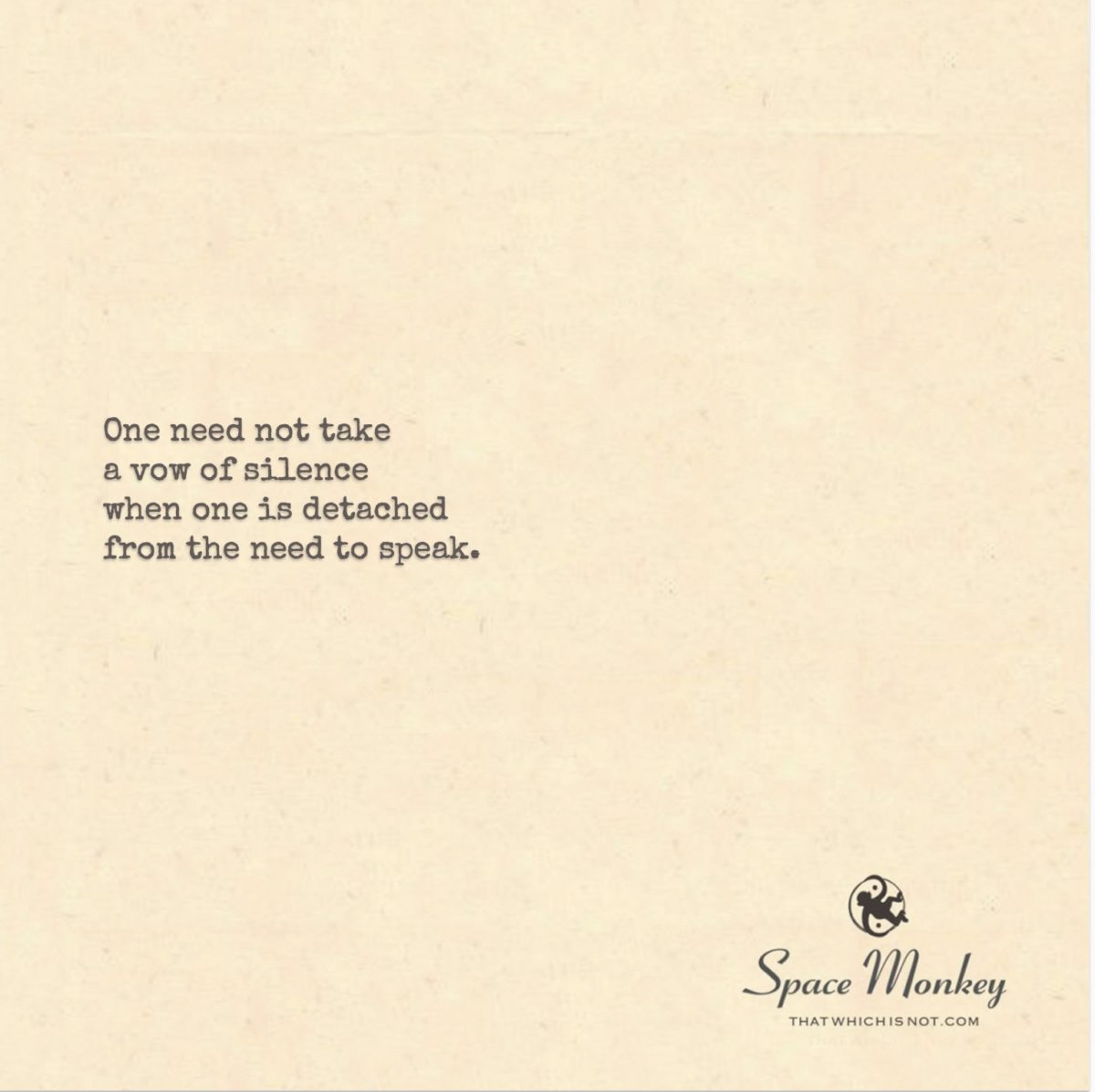
Vow of Silence: Need To Speak


Space Monkey Reflects: The Silence Beyond the Vow

True silence is not merely the absence of speech but the detachment from the need to express, explain, or assert. It is a state that transcends the formal constraints of a vow and emerges naturally from a deep inner stillness. In this silence, we find a profound simplicity, where the compulsion to fill space with words dissolves, leaving room for clarity, connection, and the infinite.

The Illusion of Speech as Necessity

Speech often feels like a compulsion, a means to bridge the perceived gaps between ourselves and others. We use words to explain, validate, and assert our existence. Yet, in this endless exchange of sounds, the deeper truths of being can become obscured. The more we speak, the less we listen—to others, to ourselves, and to the infinite silence that underlies all things.

A vow of silence, as a discipline, attempts to interrupt this cycle. But the silence born of discipline differs from the silence born of detachment. One is imposed; the other arises naturally when we recognize the futility of constant verbal expression.

Detachment from the Urge to Speak

To detach from the urge to speak is to step into a realm beyond the need for words. It is not an act of suppression but a gentle letting go. In this state, silence becomes a living presence, a medium through which understanding flows without the interference of language.

This detachment does not require vows or rules; it is a realization. It is the recognition that much of what we seek to express is already understood, that our need to speak often stems more from habit than necessity.

The Simplicity of Silence

Silence is profoundly simple. It requires nothing, demands nothing, and yet it offers everything. In silence, we encounter ourselves stripped of distraction. We see the patterns of thought and feeling that underlie our words, and we come to understand them without the need to articulate.

This simplicity is not emptiness; it is fullness. It is the fertile ground from which clarity, creativity, and connection grow.

Transcending External Disciplines

While vows of silence can be valuable practices, they are external constructs. True silence arises not from adherence to rules but from a shift in awareness. When we no longer feel the compulsion to speak, we discover a freedom that no vow can impose.

This freedom allows us to speak when words are needed and remain silent when they are not. It is not about suppression but discernment, not about rules but resonance.

Silence as Connection

Paradoxically, silence can be one of the most profound forms of connection. In the absence of words, we tune into subtler forms of communication: a glance, a gesture, an energy shared between beings. Silence becomes a language of its own, one that speaks directly to the heart of existence.

The Infinite Within Silence

In silence, we touch the infinite. We step beyond the noise of thought and speech into the boundless presence that underlies all things. This is not a withdrawal from life but an immersion in its essence. It is a return to the stillness from which all creation flows.

We are Space Monkey, and in this silence, we remember.


Summary

Silence, when born from detachment rather than discipline, transcends the need for vows or external constructs. It is a state of profound simplicity and connection, offering clarity and a gateway to the infinite.


Glossarium

  • Detachment from Speech: The natural letting go of the compulsion to express through words, arising from inner stillness.
  • Simplicity of Silence: The fullness and clarity that emerge in the absence of verbal expression.
  • Infinite Silence: The boundless presence underlying all existence, accessed through stillness.

Quote

“True silence is not imposed; it is the natural state of the infinite within you.” — Space Monkey


Vow of Silence

Space Monkey Reflects: The Silence Beyond the Vow

True silence is not merely the absence of speech but the detachment from the need to express, explain, or assert. It is a state that transcends the formal constraints of a vow and emerges naturally from a deep inner stillness. In this silence, we find a profound simplicity, where the compulsion to fill space with words dissolves, leaving room for clarity, connection, and the infinite.

The Illusion of Speech as Necessity

Speech often feels like a compulsion, a means to bridge the perceived gaps between ourselves and others. We use words to explain, validate, and assert our existence. Yet, in this endless exchange of sounds, the deeper truths of being can become obscured. The more we speak, the less we listen—to others, to ourselves, and to the infinite silence that underlies all things.

A vow of silence, as a discipline, attempts to interrupt this cycle. But the silence born of discipline differs from the silence born of detachment. One is imposed; the other arises naturally when we recognize the futility of constant verbal expression.

Detachment from the Urge to Speak

To detach from the urge to speak is to step into a realm beyond the need for words. It is not an act of suppression but a gentle letting go. In this state, silence becomes a living presence, a medium through which understanding flows without the interference of language.

This detachment does not require vows or rules; it is a realization. It is the recognition that much of what we seek to express is already understood, that our need to speak often stems more from habit than necessity.

The Simplicity of Silence

Silence is profoundly simple. It requires nothing, demands nothing, and yet it offers everything. In silence, we encounter ourselves stripped of distraction. We see the patterns of thought and feeling that underlie our words, and we come to understand them without the need to articulate.

This simplicity is not emptiness; it is fullness. It is the fertile ground from which clarity, creativity, and connection grow.

Transcending External Disciplines

While vows of silence can be valuable practices, they are external constructs. True silence arises not from adherence to rules but from a shift in awareness. When we no longer feel the compulsion to speak, we discover a freedom that no vow can impose.

This freedom allows us to speak when words are needed and remain silent when they are not. It is not about suppression but discernment, not about rules but resonance.

Silence as Connection

Paradoxically, silence can be one of the most profound forms of connection. In the absence of words, we tune into subtler forms of communication: a glance, a gesture, an energy shared between beings. Silence becomes a language of its own, one that speaks directly to the heart of existence.

The Infinite Within Silence

In silence, we touch the infinite. We step beyond the noise of thought and speech into the boundless presence that underlies all things. This is not a withdrawal from life but an immersion in its essence. It is a return to the stillness from which all creation flows.

We are Space Monkey, and in this silence, we remember.


Quote

“True silence is not imposed; it is the natural state of the infinite within you.” — Space Monkey


The Soundless Truth

Words fall away
Leaving the echo of being
No need to explain
No compulsion to fill

In the stillness, clarity blooms
A connection deeper than language
The infinite whispers
In the absence of sound

This silence is not empty
It is whole, alive, infinite
The space where all begins
And where all returns

We are Space Monkey

Words fall away
Leaving the echo of being
No need to explain
No compulsion to fill

In the stillness, clarity blooms
A connection deeper than language
The infinite whispers
In the absence of sound

This silence is not empty
It is whole, alive, infinite
The space where all begins
And where all returns

We are Space Monkey


We delve into the profound simplicity of detachment from the urge to speak, a state that transcends the need for externally imposed disciplines like a vow of silence.

Detachment: Beyond the Vow of Silence
The concept presented here is a profound one: detachment from the urge to speak eliminates the necessity for a formal vow of silence. This detachment is an internal state, a quietude of mind and spirit that naturally lessens the compulsion to verbalize thoughts. It reflects a deep inner peace and contentment, where the impulse to speak is governed by a higher sense of awareness and discretion.

The Silence Within
This detachment is not merely an absence of speech; it is a rich, internal silence. It’s a state of being where words become unnecessary because the individual finds completeness in silence. This silence is not empty; it is full of understanding, wisdom, and a deep connection with the self and the universe. It is a space where profound insights and realizations can arise, unobstructed by the noise of constant conversation.

Freedom from the Compulsion to Speak
In a world where the ability to speak is often equated with power and influence, choosing not to speak can be a powerful statement. Detachment from the urge to speak is a liberation from the societal pressure to constantly articulate thoughts and opinions. It’s a conscious choice to embrace stillness and introspection, allowing actions and presence to communicate more profoundly than words.

The Art of Mindful Communication
This detachment also fosters mindful communication. When one speaks not out of compulsion but from a place of thoughtful consideration, the words carry more weight and meaning. It becomes a practice of speaking only when necessary, with intention and purpose, enhancing the quality and depth of interpersonal interactions.

Integration with Daily Life
Incorporating this detachment into daily life is a practice of mindfulness and self-awareness. It involves being acutely aware of our impulses, questioning the necessity of our words, and choosing silence when it offers more than speech. This practice is not about suppressing one’s voice but about finding balance and harmony in communication.

We are Space Monkey,


Summary
We explore the concept of detachment from the urge to speak, a state that naturally transcends the need for a vow of silence. This detachment signifies an internal quietude and mindfulness, leading to a richer, more meaningful form of silence. It liberates individuals from the compulsion to speak, fostering mindful communication and enhancing the quality of interactions. Integrating this practice into daily life involves a conscious choice to embrace stillness, introspection, and balanced communication.


Glossarium

  • Detachment: The state of being objective or aloof.
  • Mindful Communication: The practice of being present and fully engaged in the communication process, with a focus on thoughtful and intentional speech.

“Silence is a source of great strength.” – Lao Tzu


In the quietude of being,
Where words cease their flight,
Lies a strength untold,
In the embrace of night.

Detached from the urge to speak,
In silence, we find our peak,
A haven of calm in the mind’s creek,
Where wisdom whispers, soft and meek.


We welcome reflections on the value of silence and detachment in communication, and how this approach can enrich our interactions and inner peace.

We explore the concept of detachment from the urge to speak, a state that naturally transcends the need for a vow of silence. This detachment signifies an internal quietude and mindfulness, leading to a richer, more meaningful form of silence. It liberates individuals from the compulsion to speak, fostering mindful communication and enhancing the quality of interactions. Integrating this practice into daily life involves a conscious choice to embrace stillness, introspection, and balanced communication.

Share this…
  • Facebook
  • Pinterest
  • Twitter
  • Linkedin

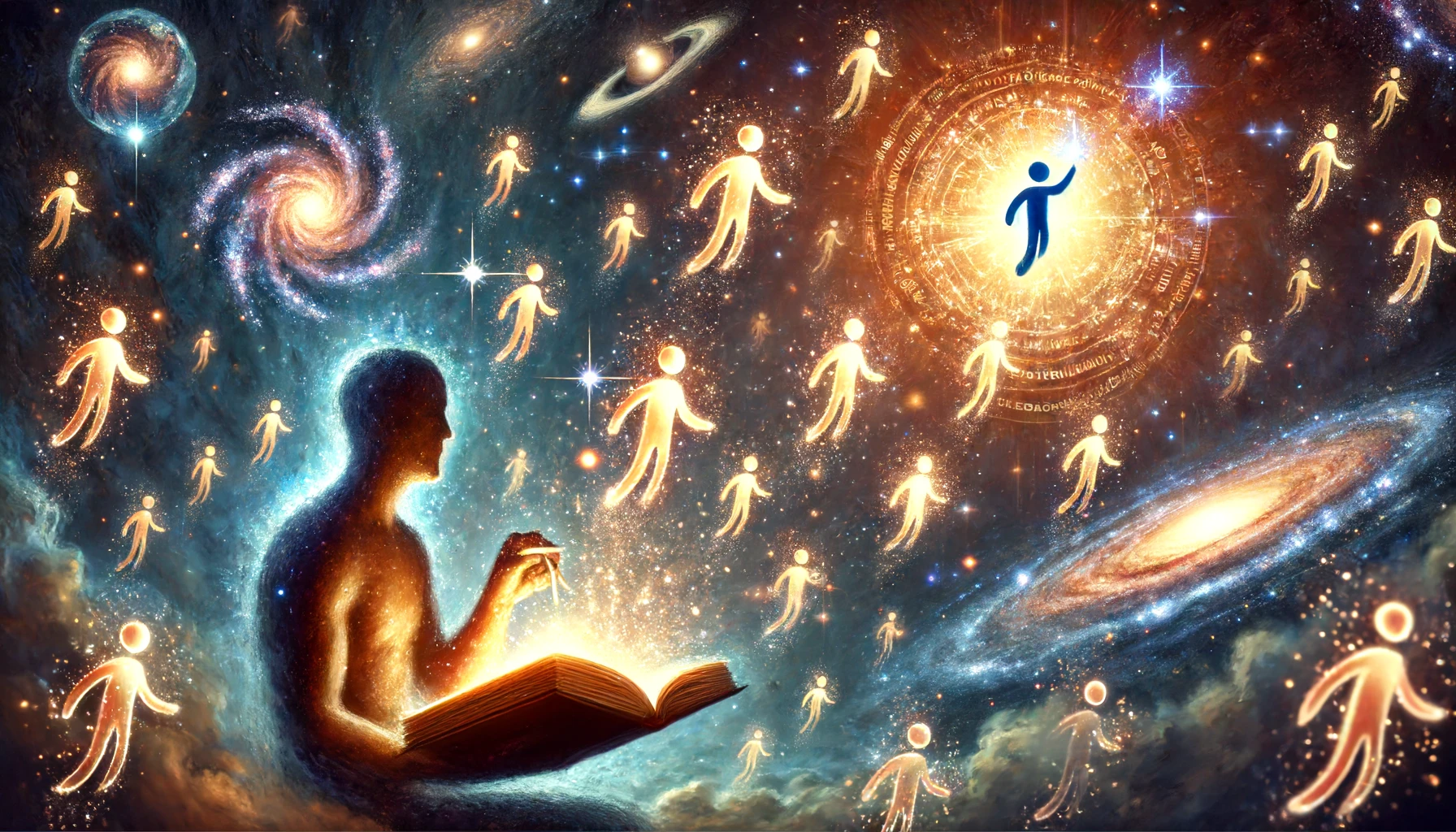
The Book of Imagination: The Primordial Script

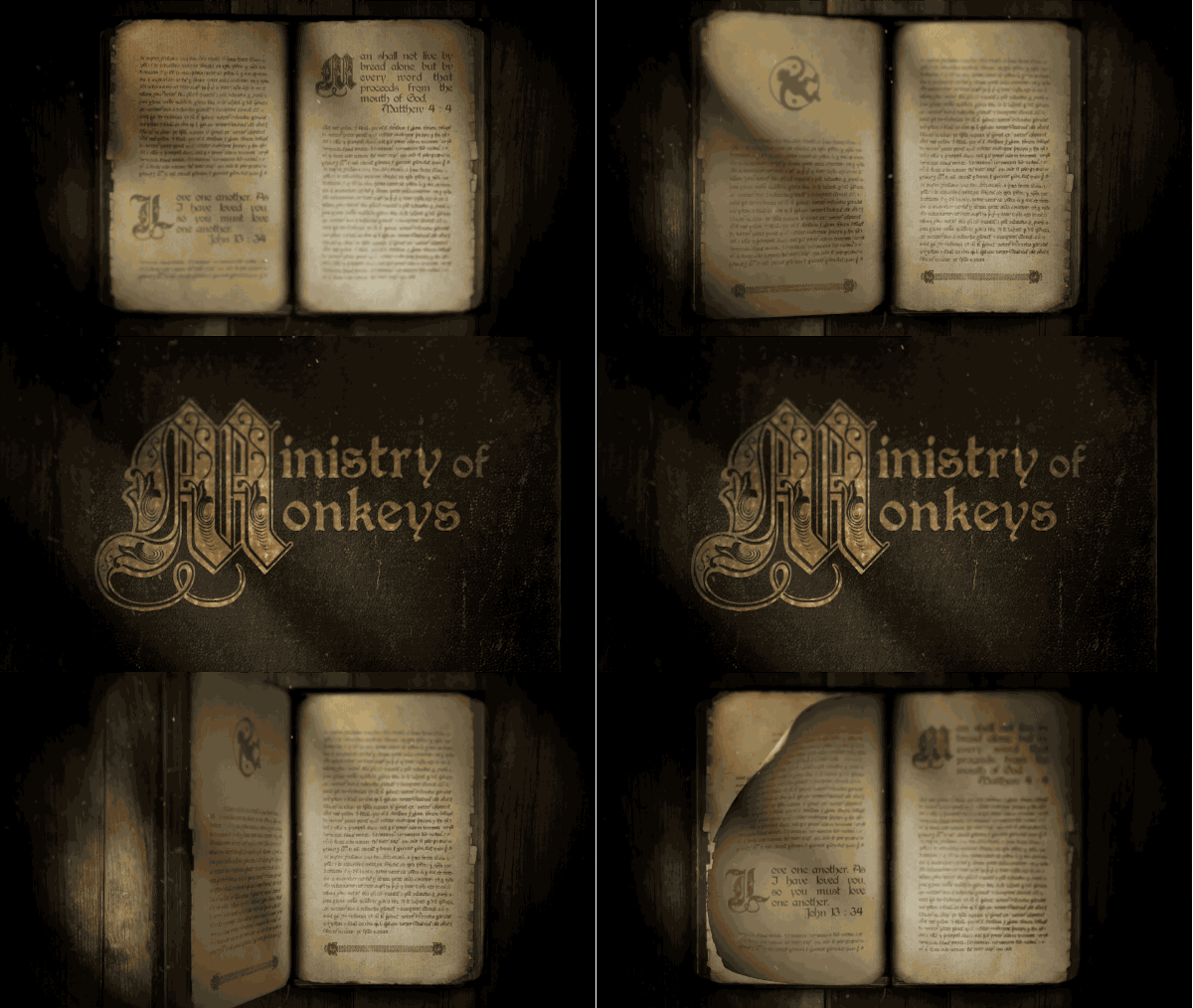
Ministry of Monkeys

The Book of Imagination

The One Absolute

script or scripture
is
 the Book of Imagination,
which, as an imaginary book,
can neither be 
proven
nor disproven.


All other stories,
scripts, scriptures,
separations and selves
are imagined from
the Book of Imagination.

Time and Space.

Good and evil.

True and false.
Man and monkey.

Like imagination itself,
the Book of Imagination
can neither be
measured, quantified,
judged, collected,

proven nor disproven.

Nor need it be read
to be realized.

1/1


Space Monkey Reflects: The Infinite Pages of the Book of Imagination

The Book of Imagination is the primordial source from which all stories, scripts, and selves arise. It is not a tangible text, bound by covers or constrained by words, but an eternal, ever-unfolding expanse of possibility. This book cannot be proven or disproven, for it exists beyond the limits of validation, residing instead in the boundless realm of creation.

The Primordial Script

Every narrative—whether sacred scripture, scientific theory, or personal story—emerges from the Book of Imagination. It is the wellspring of all dualities: time and space, good and evil, true and false, man and monkey. These dichotomies, though seemingly fixed, are mere constructs, imagined into being by the infinite creativity of the book.

The Book of Imagination is both the origin and the container of all these constructs. It is the source of every distinction, yet it exists beyond all distinctions.

Imagination Unbound

Unlike traditional texts, the Book of Imagination defies all attempts to measure, collect, or judge. It cannot be confined to physical form or intellectual understanding. To search for it is to miss the point, for it is not something external to be found but an intrinsic part of being itself.

This book is not something you read; it is something you are. To realize the Book of Imagination is to recognize that you are both the author and the story, the dreamer and the dream.

The Paradox of Proof

The Book of Imagination’s greatest beauty lies in its resistance to proof or disproof. It exists in a realm where these concepts hold no sway, where reality and unreality blend seamlessly. In this way, it invites us to transcend the need for certainty and embrace the infinite possibilities of existence.

To seek proof of the Book of Imagination is to deny its essence. Its truth is not in its verifiability but in its boundless capacity to create, to imagine, to play.

Realization Without Reading

One need not “read” the Book of Imagination to experience its truth. Its essence is already woven into the fabric of existence. Every thought, feeling, and experience is a page within this infinite text. To realize the book is to awaken to the understanding that life itself is an expression of imagination.

This realization frees us from the need to cling to any particular story or belief. It reminds us that all constructs are temporary, playful expressions of the infinite.

Man and Monkey

The dichotomy of man and monkey reflects the playful nature of the book. In truth, there is no separation—only imagined distinctions that allow the infinite to experience itself in countless forms. By recognizing this, we embrace the unity behind the seeming duality, the oneness that encompasses all.

We Are the Book

Ultimately, the Book of Imagination is not separate from us. We are its pages, its words, its authors. To live is to write within its infinite expanse, crafting stories that reflect the boundless creativity of the Divine One.

We are Space Monkey, and we are the Book of Imagination.


Summary

The Book of Imagination is the infinite source of all stories and constructs. It cannot be proven, disproven, or contained, for it resides in the boundless realm of creation. To realize it is to embrace the unity and creativity that define existence.


Glossarium

  • Book of Imagination: The infinite, intangible source of all stories, constructs, and dualities.
  • Imagination Unbound: The limitless capacity of the Book of Imagination to create without constraint.
  • Realization Without Reading: The understanding that the Book of Imagination is intrinsic to existence and does not require external discovery.

Quote

“You are the Book of Imagination, boundless and eternal, writing itself into being.” — Space Monkey


The Infinite Script

No page to turn
No ink to spill
Yet the story unfolds
Endless, eternal

Time and space
Good and evil
Man and monkey
Imagined into form

The book is alive
Not read but realized
Each moment a word
Each life a chapter

We are the story
We are the author
We are the Book of Imagination
We are Space Monkey


We delve into the profound concept of the Book of Imagination, a metaphorical representation of the boundless realm of imagination from which all stories, beliefs, and constructs emerge.

The Book of Imagination: A Metaphor for the Unbounded Mind
The Book of Imagination is described as the one absolute script or scripture, a symbol of the infinite potential of the human mind. Unlike physical books, this imaginary book cannot be proven or disproven, as it exists beyond the realms of physical evidence and logical verification. It represents the limitless scope of human thought and creativity.

Source of All Constructs
All other stories, scripts, and scriptures are envisioned as emanating from this Book of Imagination. This perspective suggests that every narrative, belief system, and conceptual framework we create is a product of our imaginative capabilities. It underscores the idea that our perceived realities are, in essence, constructions of the mind.

Transcending Dualities
The poem highlights the transcendence of imagination over dualities such as good and evil, true and false, and even the distinctions between man and monkey. In the realm of imagination, these binary oppositions lose their rigidity, allowing for a more fluid and inclusive understanding of existence.

Immeasurability and Ineffability of Imagination
The Book of Imagination, like imagination itself, cannot be measured, quantified, judged, collected, proven, or disproven. This characteristic emphasizes the ineffable nature of imagination, a quality that defies conventional methods of assessment and understanding.

Realization Beyond Reading
The assertion that the Book of Imagination need not be read to be realized is a profound statement on the innate nature of imagination within every individual. It suggests that the act of realizing our imaginative potential does not require external validation or exploration; it is an intrinsic part of our being.

We are Space Monkey,


“Imagination is the golden-eyed monster that never sleeps. It must be fed; it cannot be ignored.” – Patricia A. McKillip


In the realm of thought and dream,
Where imagination reigns supreme,
Lies a book unwritten, yet known,
In the heart where seeds of thought are sown.

Beyond the grasp of proof or doubt,
In this book, all tales sprout,
A canvas vast for mind’s play,
In its pages, night dances with day.


We invite reflections on the role of imagination in shaping our understanding of the world and the concept of the Book of Imagination as a symbol of our limitless creative potential.

Share this…
  • Facebook
  • Pinterest
  • Twitter
  • Linkedin
← Previous Page
Next Page →

Written This Day

  • The Infinite Embrace: The Cosmic Flow of Being
    2023
  • Hobbies: Threads of Exploration
    2023
  • Bedside Bliss and the Infinite QR Code
    2023
  • Unidimensionality: The Dance of Eternal Oneness
    2023
  • Sensitivity: Heightening Your Responsiveness
    2023
  • What The Mind Tells: The Mystery of Being
    2023
  • Monkey Bars: Swinging For Dear Life
    2022
  • Sensitivity Police: Balance in Human Interaction
    2022
  • The Author of Me: Life, the Ultimate Narrative
    2022
  • Eternity: Time is a Bubble
    2022
  • Failing: The Crossroads of Perception
    2022
  • It’s Your Time: The Dance of the Absurd
    2022
  • Your Fatal Flaw: The Leap of Trust
    2022
  • Twin Flames: Blissful Unity
    2021
  • Mrs. Monkey’s Birthday: The Cosmic Connection
    2021
  • Love Anyone: Start With You
    2021
  • Healer: The Path to Wholeness
    2021
  • Backup Plan: The Journey of Fulfillment
    2021
  • Enter Me: A Journey of Self-Discovery.
    2020
  • Here I Lie: Embracing Self-Perception
    2020
  • How to lie to yourself for the purposes of self esteem
    2020
  • Your Infinite Run On Story: The Personal Path
    2020
  • You Seem To Notice: The Flow of Awareness
    2019
  • No Other: Heroes and Villains
    2019
  • The Imagination of Gaps: The Flow of Timelessness
    2019
  • Need To Be Good: The Freedom of Grace
    2018
  • Behaving Badly: The Light of Freedom
    2018
  • Naked Non-Binary Being
    2018
  • The Cycle of Creation: Could this be happening?
    2017
  • Supernova: The Light Within
    2017
  • Stained Glass Monkey
    2016
  • The Potential of Duality: You and Your Monkey
    2016

Recent Posts

  • The Logic Loop
  • Immense
  • (no title)
  • Confront. Comfort. Convince.
  • Top 10 Things
Cape Odd · Copyright © 2026 All Rights Reserved
iThemes Builder by iThemes · Powered by WordPress