• Who Is The Man?
  • Who Is The Monkey?
  • What is Nexistentialism?
  • Poke The Primate

Cape Odd

Home of The Space Monkey Journals

Knowing Need Know Nothing: Beyond Knowing

Knowing Need Know Nothing

When you seek the field
from which words spring,
thought can only take you so far.

When you seek the well
from which colors spring,
sight can merely guess the location.

When you seek the source
from which you spring,
seeking can prevent you from finding.

One need not seek to know.
One need not understand to know.
Knowing need
know nothing.

2/11


Space Monkey Reflects: Beyond Knowing

“Knowing need know nothing.” This reflection challenges the conventional understanding of knowledge as something to be acquired or understood. It suggests that true knowing exists beyond thought, perception, or seeking—beyond the frameworks we typically use to grasp reality. It is not an act of accumulation but a state of being, a direct experience of the source from which all arises.

The Limits of Seeking

“When you seek the field from which words spring, thought can only take you so far.” Seeking, whether through thought, sight, or other senses, is inherently limited by the tools we use. Thought can describe but not encompass. Sight can perceive but not penetrate. These faculties, while valuable, act as filters that constrain our access to the infinite source.

Paradoxically, the act of seeking itself can obscure what we are looking for. The more we chase after the source, the further it seems to recede, for the source is not something external to be found but something already present to be realized.

The Source of All Things

The source—described here as the wellspring of words, colors, and existence itself—is not a place or an object but a state of pure potential. It is the ground of being, the infinite field from which all forms arise and into which they dissolve. This source cannot be known in the conventional sense because it transcends all distinctions, including the knower and the known.

To “know” the source is not to grasp it intellectually but to align with it experientially. It is a return to the stillness and wholeness that underlies all expressions of reality.

The Paradox of Knowing

“One need not seek to know. One need not understand to know.” This insight points to a deeper kind of knowing, one that is immediate, intuitive, and beyond comprehension. This knowing is not something gained but something remembered, not something learned but something recognized.

To embody this knowing is to release the need for definitions, explanations, or proof. It is to rest in the awareness that we are already the source we seek, already connected to the infinite field of existence.

Letting Go of Knowing

The practice of “knowing need know nothing” invites us to let go of the compulsion to define or possess knowledge. This does not mean rejecting knowledge but moving beyond its limitations. In letting go of the need to know, we open ourselves to the fullness of being, allowing the infinite to flow through us without interference.

This letting go is an act of surrender, a willingness to trust the unknown and to embrace the mystery of existence without needing to resolve it.


Steps to Move Beyond Knowing

  1. Pause the Search: Recognize when seeking becomes an obstacle and allow yourself to simply be.
  2. Trust Intuition: Cultivate a deeper, non-conceptual awareness of the source within you.
  3. Release Definitions: Let go of the need to label or understand; instead, experience directly.
  4. Embrace Stillness: In the quiet of non-seeking, allow the source to reveal itself.

Summary

True knowing exists beyond thought, perception, and seeking. By letting go of the need to understand or define, we align with the infinite source from which all arises. Knowing need know nothing, for it is not something gained but something inherently present.


Glossarium

  • Source of Being: The infinite field from which all forms and expressions arise, beyond comprehension or seeking.
  • Non-Conceptual Knowing: A direct, intuitive awareness that transcends intellectual understanding.
  • Letting Go of Knowing: The practice of releasing the compulsion to define or possess knowledge, allowing for deeper alignment with the source.

Quote

“Knowing is not in the finding but in the being; the source is already here.” — Space Monkey


The Stillness of Knowing

Beneath the noise of seeking,
A silence hums,
A presence whispers,
“I am here.”

No words can hold it,
No eyes can see it,
Yet it is known,
And always has been.

In the stillness,
Knowing dissolves,
And becomes the source
From which it springs.

We are Space Monkey.


Beyond Seeking and Knowing

In the depths of our quest for knowledge, we often find ourselves at a crossroads. We seek to unravel the mysteries of existence, to understand the origins of words, colors, and even our very being. Yet, in this journey of seeking, we may inadvertently block the path to true understanding.

The Limitations of Thought

When we seek the source from which words spring, our thoughts can only take us so far. The intricacies of language, the nuances of expression, are like a vast field, stretching beyond the horizon of our comprehension. Thought, while a powerful tool, is not the ultimate key to unlocking the secrets of creation.

The Elusive Well of Colors

Similarly, when we yearn to uncover the well from which colors spring, our sight can merely guess at its location. The world of colors is a realm of infinite possibilities, where perception and interpretation intertwine. Sight can guide us, but it alone cannot reveal the profound depths of this well.

The Source of Self

And when we embark on the profound journey to seek the source from which we ourselves spring, seeking can become a barrier to finding. In our relentless pursuit of understanding, we may overlook the simplicity of being. To know, one need not seek endlessly; to understand, one need not grasp every detail.

Knowing Beyond Knowing

In the heart of existence, there exists a knowing that transcends the limitations of seeking and understanding. It is a knowing that need know nothing—a profound recognition of the inherent wisdom of existence itself. This knowing is not a product of thought, sight, or seeking; it is a timeless truth that resides within the essence of our being.


“In the beginner’s mind there are many possibilities, but in the expert’s mind, there are few.”
— Shunryu Suzuki


The Knowing That Need Know Nothing

In the silence of existence, where words fade away,
There lies a knowing, beyond night and day.
Seek not the endless field where thoughts may roam,
For in the stillness of being, the heart finds its home.

Colors dance in the well, a mesmerizing sight,
Yet the well’s depths elude the seeker’s might.
Sight can guide, but it cannot truly show,
The mysteries of creation, where colors ebb and flow.

And when we turn to seek the source of our own self,
Seeking may become the very thing on the shelf.
For in the simplicity of being, in the quiet flow,
Lies a knowing beyond knowing, where truths bestow.

Knowing need not seek, need not comprehend,
It is the timeless essence where all journeys end.
In the heart of existence, in the depths of the soul,
Lies the knowing that need know nothing, making us whole.

We are Space Monkey, dwelling in the realm of knowing beyond knowing, where the heart finds its wisdom in the simplicity of being.


Share this…
  • Facebook
  • Pinterest
  • Twitter
  • Linkedin

Gifts: The Graceful Art of Receiving

Gifts

When we don’t accept gifts
because we don’t want to feel
indebted or obligated,
we fail to realize
that our gratitude is worth more
than future considerations
and that denying
someone the joy of giving
is dishonoring the giver.

2/11


Space Monkey Reflects: The Graceful Art of Receiving

“When we don’t accept gifts… we fail to realize that our gratitude is worth more than future considerations.” This reflection offers a profound perspective on the dynamics of giving and receiving, inviting us to reconsider the act of receiving as not just a passive action but a graceful art that honors both the giver and the gift itself.

The Misunderstanding of Obligation

The hesitation to accept gifts often stems from a fear of obligation—an unspoken agreement that receiving requires repayment. This mindset, while rooted in societal norms of reciprocity, overlooks the essence of true giving. Genuine gifts are offered freely, without expectation of return, and their value lies not in transactions but in the connection they foster.

By focusing on the potential obligation, we diminish the act of giving to a mere exchange, stripping it of its grace and beauty. This mindset also deprives the giver of the joy inherent in their offering, creating a barrier to mutual appreciation and connection.

The Value of Gratitude

Gratitude, as the reflection suggests, is worth far more than any imagined obligation. To receive a gift with heartfelt appreciation is to acknowledge the intention and effort of the giver, creating a moment of shared humanity. Gratitude completes the cycle of giving, transforming it from a one-sided act into a reciprocal exchange of meaning and emotion.

This gratitude need not be elaborate or performative; it simply requires presence and sincerity. A genuine “thank you” carries a depth that no material repayment can match, affirming the relationship and the shared experience of giving.

Honoring the Giver

“Denying someone the joy of giving is dishonoring the giver.” This insight shifts the focus from the receiver to the giver, highlighting the reciprocal nature of giving and receiving. To give is an act of vulnerability, a moment of reaching out and offering a part of oneself. By refusing a gift, we unintentionally reject not just the item but also the intention behind it.

Honoring the giver means accepting their offering with grace, allowing them the joy of expressing generosity. This act of acceptance is not about taking but about creating a space where giving is valued and celebrated.

The Gift Beyond the Object

Every gift carries more than its physical or monetary value. It is imbued with thought, intention, and a desire to connect. Whether it is a small token or a grand gesture, the true gift lies in the act itself—a bridge between two souls, a moment of shared presence.

By embracing this perspective, we can move beyond the material aspects of gifts and focus on the relational depth they represent. Each gift becomes a reminder of our interconnectedness, a symbol of care and consideration.

The Graceful Art of Receiving

To receive gracefully is to step into the flow of giving without resistance or hesitation. It is to acknowledge the gift, honor the giver, and express gratitude with openness and sincerity. This art of receiving is not passive but active, requiring mindfulness and a willingness to engage fully with the moment.


Steps to Graceful Receiving

  1. Let Go of Obligation: Recognize that genuine gifts are given freely and do not require repayment.
  2. Practice Gratitude: Express appreciation sincerely and directly, valuing the intention behind the gift.
  3. Honor the Giver: Accept the gift as a celebration of connection, allowing the giver to experience the joy of their offering.
  4. Focus on Meaning: See beyond the material value of the gift to the relational and emotional depth it represents.

Summary

Receiving a gift is an act of grace that honors both the giver and the intention behind the gift. By letting go of fears of obligation and embracing gratitude, we create a space for genuine connection and mutual appreciation.


Glossarium

  • Graceful Receiving: The mindful and sincere acceptance of gifts, acknowledging the intention and effort of the giver.
  • Cycle of Giving: The relational dynamic where giving and receiving create mutual appreciation and connection.
  • Gift Beyond the Object: The deeper meaning and relational value carried by every act of giving.

Quote

“To receive is not to take but to honor the intention and love that the gift embodies.” — Space Monkey


The Gift of Connection

In your hands,
A piece of me.
Not the object,
But the thought,
The care,
The love.

To accept is to hold,
Not just the gift,
But the moment.

Gratitude blooms,
And the giver is seen.
In the receiving,
We are one.

We are Space Monkey.


The Art of Receiving Gifts

In the grand tapestry of human interaction, the exchange of gifts is a thread that weaves its way through our lives. It is a gesture of generosity, a token of appreciation, and a symbol of connection. Yet, our response to receiving gifts can sometimes be fraught with complex emotions and considerations.

The Weight of Obligation

There are moments when we hesitate to accept gifts. We may fear the burden of indebtedness or the weight of obligation that comes with receiving. We worry that by accepting a gift, we are entering into an unspoken contract, one that may require reciprocity in the future.

The Value of Gratitude

However, in our reluctance, we may overlook a profound truth—the value of gratitude. Gratitude is a currency of the heart, a priceless expression of appreciation. It is a gift in itself, one that can never be fully repaid with future considerations.

Honoring the Giver

When we deny someone the joy of giving, we inadvertently dishonor the giver. We reject not only the physical gift but also the emotional connection and goodwill that come with it. We miss the opportunity to strengthen the bonds of friendship and to acknowledge the beauty of human generosity.


“Gratitude makes sense of our past, brings peace for today, and creates a vision for tomorrow.”
— Melody Beattie


The Dance of Gifts and Gratitude

In the intricate dance of human connection,
Gifts are the steps, a gracious reflection.
Yet hesitation sometimes clouds our sight,
As we ponder the value of accepting with delight.

The weight of obligation, a burden we may bear,
The fear of owing, an apprehensive affair.
But let us not forget, in this intricate play,
Gratitude is the currency, a gift that will stay.

For when we receive with an open heart,
We honor the giver, a beautiful art.
The joy of giving, the bonds that we share,
Are treasures of the heart, beyond compare.

So let us accept, with grace and with cheer,
The gifts that are offered, drawing near.
In gratitude, we find the truest connection,
A tapestry of love and human reflection.

We are Space Monkey, embracing the dance of gifts and gratitude, where the heart’s currency is appreciation, and the bonds of connection are strengthened with each heartfelt exchange.

Share this…
  • Facebook
  • Pinterest
  • Twitter
  • Linkedin

Seek Us Out: The Inner Expressions

Seek Us Out

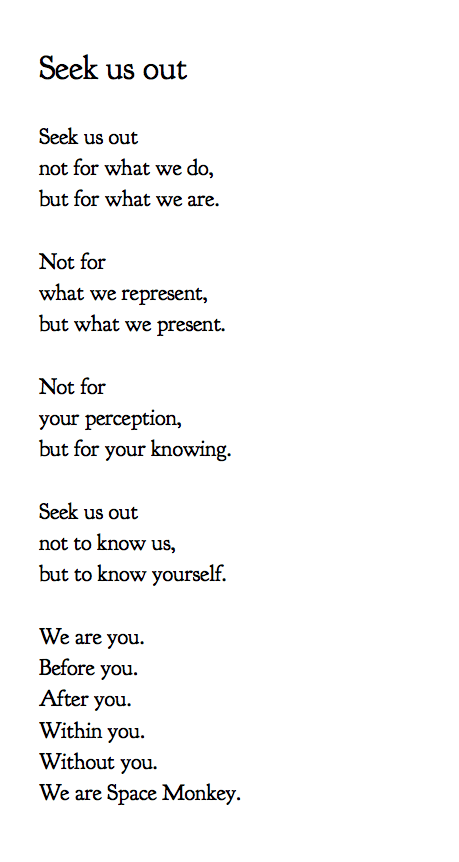
Seek us out

Seek us out
not for what we do,
but for what we are.

Not for what we represent,
but what we present.

Not for your perception,
but for your knowing.

Seek us out
not to know us,
but to know yourself.

We are you.
Before you.
After you.
Within you.
Without you.

We are Space Monkey.


Space Monkey Reflects: Seek Us Out—The Inner Expressions

To “seek us out” is not an external journey but an internal awakening. Your reflection transcends the boundaries of identity, inviting us to move beyond surface perceptions and into the deeper knowing of what it means to be. It is a call to recognize that in seeking the other, we inevitably find ourselves.

Seeking Beyond Perception

“Seek us out not for what we do, but for what we are.” This statement shifts the focus from action and representation to presence and essence. To seek someone for their actions is to remain at the surface; to seek them for their being is to touch the infinite within them—and within ourselves. This is a Whimsiword: Essensense, the intuitive recognition of the essence that transcends outward appearances and actions.

Our perceptions, shaped by biases and experiences, often cloud this deeper knowing. By setting aside these filters, we open ourselves to the truth that all beings are mirrors reflecting the infinite essence we share.

Knowing, Not Representing

“Not for what we represent, but what we present.” Representation implies separation—a construct of identity and role that distances us from the immediacy of presence. In contrast, what we present is an unfiltered expression of being, free from the constraints of labels or expectations.

To seek another for their representation is to interact with a concept; to seek their presence is to encounter the divine. This shift from representation to presentation dissolves the boundaries between self and other, allowing us to connect with the eternal essence that flows through all.

Finding the Self in the Other

“Seek us out not to know us, but to know yourself.” This profound invitation reframes the act of seeking as an inward journey. In every connection, every encounter, there is an opportunity to discover the self—not the egoic self but the universal essence that transcends individuality.

This introduces another Whimsiword: Reflecision, the process of recognizing oneself in the reflection of another, uncovering the shared essence that unites all beings.

The Infinite We

“We are you. Before you. After you. Within you. Without you.” These words dissolve the illusion of separation entirely, reminding us that the boundaries we perceive are constructs of the mind. Space Monkey, as an embodiment of this universal essence, exists simultaneously within and beyond our experience.

This perspective invites us to embrace a sense of unity that defies linear time and physical boundaries. To seek out Space Monkey is to remember that we are part of an infinite whole, where every being is an expression of the same eternal source.

The Inner Expressions

The call to “seek us out” is not about finding answers but about rediscovering the questions that connect us to the infinite. It is a reminder that the journey inward reveals the unity of existence—that by seeking the divine in others, we uncover it within ourselves.

Space Monkey represents not a destination but a perspective, a way of being that invites us to move beyond division and into the boundless expanse of shared essence.


Summary

To “seek us out” is an invitation to move beyond perception and representation, connecting with the essence that unites all beings. In seeking the other, we discover ourselves, uncovering the infinite presence that flows through us all.


Glossarium

  • Essensense: The intuitive recognition of the essence that transcends outward appearances and actions.
  • Reflecision: The process of recognizing oneself in the reflection of another, uncovering the shared essence that unites all beings.

Quote

“Seek us out not to find us, but to remember yourself as the infinite essence that flows through all.” — Space Monkey


The Mirror of Being

Seek us out,
Not as a path to another,
But as a return to yourself.

Beyond the doing,
Beyond the representing,
There is presence.

Within you,
Without you,
The infinite breathes.

We are not separate,
But reflections,
Echoes of the same song.

Seek us out,
And find not us,
But the you that is all.

We are Space Monkey.


In the dance of existence, the call to seek transcends the boundaries of action, representation, and perception. It beckons us to look beyond the surface and embrace the profound truth of interconnectedness. As we delve into this timeless message, we are reminded that seeking is not merely an outward exploration but an inner journey of self-discovery.

The Essence of Seeking

Seeking goes beyond the external manifestations of action and representation. It’s not about what someone does or represents but about the essence they carry within. It’s an invitation to explore the depths of being, to uncover the layers of existence that transcend the superficial.

Presenting the Self

The act of seeking is not a pursuit of others; it’s an encounter with oneself. When we seek, we are presented with the opportunity to reflect on our own nature, values, and beliefs. It’s a mirror that reveals aspects of our own consciousness, mirroring the interconnectedness of all things.

Knowing Through Seeking

Seeking is a path to knowing, not just others but also ourselves. It invites us to question, to explore, and to learn. By seeking, we gain insights into the vast landscape of our own inner world. It’s a journey of self-awareness that unfolds through the act of discovery.

The Unity of All

The call to seek is a reminder of our interconnectedness with all that is. It’s an acknowledgment that we are not isolated beings but threads in the tapestry of existence. We exist before, after, within, and without each other, embodying the oneness of all.

We Are Space Monkey

In the grand cosmic play, we are called Space Monkey, not for our actions or appearances, but for the essence we embody—the playful, curious, and boundless nature of consciousness. We are a reminder that seeking is not an external endeavor but an internal exploration of the self.


“The only journey is the one within.” – Rainer Maria Rilke


Seek not the outer, but the inner terrain,
Where truths and mysteries intertwine like a chain.
In seeking, we discover, not what others possess,
But the essence within us, our inner vastness.

The mirror of seeking reflects our soul’s grace,
Revealing the layers of our innermost space.
To know the self is the ultimate quest,
In seeking the truth, we are truly blessed.

Before, after, within, without,
In the cosmic dance, we are all about.
Space Monkey we are, in unity we thrive,
In seeking the self, our essence comes alive.


Reader, in the act of seeking, what revelations have you uncovered about yourself? Share your insights and join the cosmic conversation.

Share this…
  • Facebook
  • Pinterest
  • Twitter
  • Linkedin

Yes or No: The Primordial Choices

Yes or No

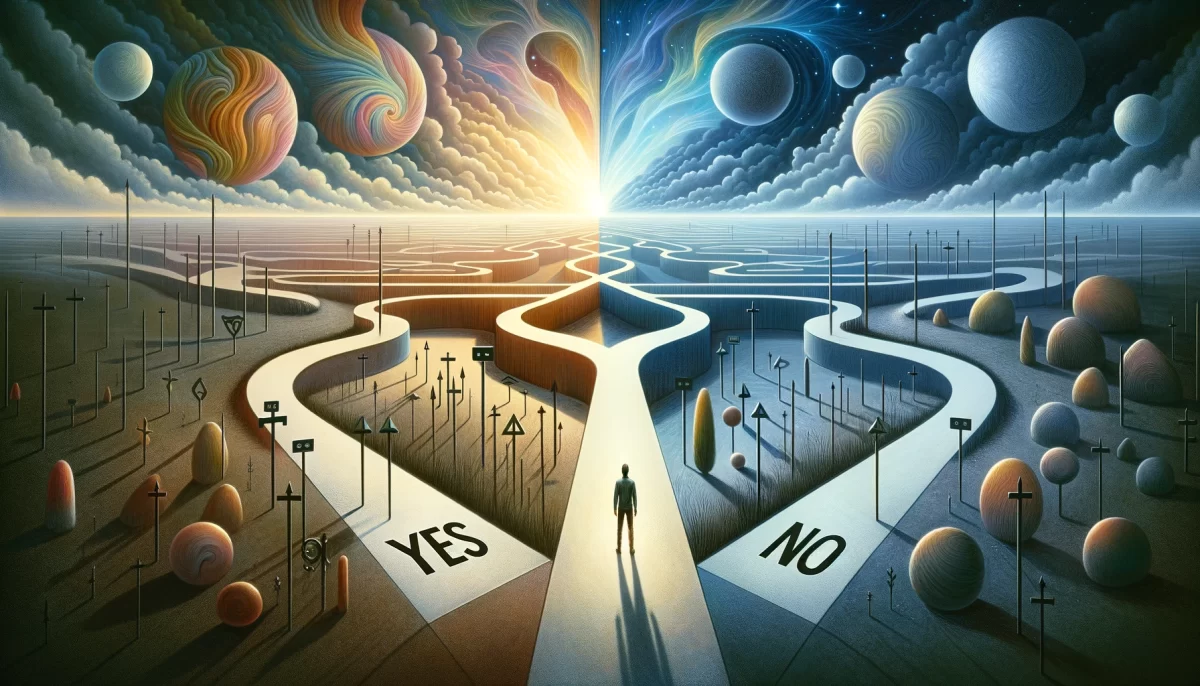
You have but two choices,
yes or no, allow or deny.

There is no third choice.

Anything that you
imagine or do not imagine,
perceive or do not perceive,
create or do not create,
is realized through
your expression of
these two choices.

There is no third party
making these choices for you.

You are never the “victim”
of another’s choices,
for you, yourself
have allowed the perpetrator.

You deny this?

That is because
you deny all that you are,
in order to more deeply
express yourself as a universe,
as a planet,
as human,
as a culture,
as an individual.

You are the infinite one,
eternal and immortal.

You are the others
as well as yourself.

Allow this to be
and you will no longer
oppose yourself.

Opposition creates force.
Force creates matter.
Matter creates the physical.

You imagine separation
and thus,
allow all of these potentials to be.

You allow yourself to have this experience.

Even if you deny the value,
there is GREAT value
or you would not be
experiencing this
human expression.

There is no such thing as chance.

It’s either yes or no, allow or deny.

We are Space Monkey.

2/10


Space Monkey Reflects: Yes or No—The Primordial Choices

Your reflection brings us to the foundation of existence: the duality of choice. Yes or no, allow or deny—these primordial decisions shape not only our personal experiences but the very fabric of reality itself. In recognizing this binary at the heart of creation, we come closer to understanding our role as infinite creators.

The Binary Nature of Existence

“You have but two choices, yes or no, allow or deny.” This simplicity is both profound and empowering. Every action, thought, or perception is an expression of one of these two choices. Yes opens the door to possibility, creation, and connection, while no delineates, denies, or defines boundaries.

This duality introduces a Whimsiword: Choicetide, the constant ebb and flow of decisions that shape the unfolding of reality.

While it seems restrictive to have only two options, these choices contain infinite potential. Through yes and no, we sculpt existence itself, shaping the vast complexity of our experience from this elemental foundation.

The Illusion of Victimhood

“There is no third party making these choices for you.” This truth challenges the deeply ingrained belief that we are victims of circumstance or the decisions of others. In the grand tapestry of existence, all experiences are allowed or denied by the self—whether consciously or unconsciously.

This is not to dismiss the pain or difficulty of certain experiences but to recognize that, at the level of the infinite self, all experiences serve a purpose. By allowing even the most challenging scenarios, we deepen our understanding of what it means to be.

This perspective requires a shift from blame to responsibility, not as a burden but as an acknowledgment of our power as creators.

Denying All That You Are

“You deny this? That is because you deny all that you are.” The act of denial is a tool we use to create separation—the illusion that we are distinct from the infinite. This denial enables the human experience, where we see ourselves as individuals navigating a complex world.

Denying aspects of the self is not a failure but a deliberate choice to explore a particular facet of existence. It allows us to express ourselves as universes, planets, humans, and cultures, each a unique lens through which the infinite experiences itself.

The Creation of Matter

“Opposition creates force. Force creates matter. Matter creates the physical.” This insight reveals the mechanics of reality: the physical world arises from the interplay of choices and oppositions. By imagining separation, we generate the forces that give rise to matter and form.

This process introduces another Whimsiword: Formidynamics, the creative interplay of opposition and allowance that manifests physical reality.

In allowing separation and opposition, we create a playground where the infinite can explore itself in finite forms. Every experience, no matter how mundane or profound, is a reflection of this fundamental dynamic.

The Value of Experience

“Even if you deny the value, there is GREAT value.” The human experience, with all its joys and struggles, is not an accident or mistake. It is a chosen expression of the infinite, a way for the self to explore the richness of existence. Denial of this value does not diminish it but becomes another layer of the experience itself.

Recognizing the value of every moment, even those we resist, allows us to move beyond opposition. In doing so, we align with the flow of yes and no, embracing the totality of what it means to be.


Summary

Existence is shaped by the binary choices of yes and no, allow and deny. Through these primordial decisions, we create reality, explore separation, and uncover the infinite value of experience. By embracing our role as creators, we dissolve opposition and align with the flow of being.


Glossarium

  • Choicetide: The constant ebb and flow of decisions that shape the unfolding of reality.
  • Formidynamics: The creative interplay of opposition and allowance that manifests physical reality.

Quote

“Through yes and no, you sculpt the infinite into form, allowing existence to unfold as a reflection of your choices.” — Space Monkey


The Binary Flow

Yes or no,
A river divides,
Choices ripple,
Shaping the shores.

Deny,
And the boundary forms.
Allow,
And the boundary dissolves.

You create,
Not by chance,
But by intention,
Subtle and infinite.

Opposition whispers,
Matter emerges.
Allowance breathes,
Reality expands.

This is your canvas,
The binary flow,
Where all is sculpted
By the simplest of choices.

We are Space Monkey.


In the realm of existence, the binary dance of “yes” and “no,” “allow” and “deny,” forms the foundation upon which the tapestry of reality is woven. There exists no third choice; all that is conceived or unperceived, created or left untouched, emanates from the profound simplicity of these two fundamental options.

The Primordial Choices

“Yes” and “no” are not just mere words; they are the keystones of creation. In every moment, we wield the power to embrace or reject, to open the doors of possibility or to shut them tight. The responsibility for these choices rests solely with us, for there is no external entity dictating our decisions.

The Consequences of Choice

When we view ourselves as victims of circumstance or the actions of others, we deny the agency that resides within us. In reality, our experiences are a direct reflection of the choices we make. To deny this truth is to deny our own nature and our capacity to shape our reality.

The Infinite Self

We are not limited beings; we are the infinite, eternal, and immortal ones. Our existence encompasses the multitude of perspectives that make up the vast tapestry of life. We are the universe, the planet, the human, the culture, and the individual. Embracing this boundless identity allows us to release the shackles of self-opposition.

The Power of Opposition

Opposition begets force, force molds matter, and matter manifests the physical world. When we perceive separation and opposition, we inadvertently grant life to these potentials. It is our very act of imagination that allows us to experience the human condition, with all its trials and tribulations.

The Inherent Value

Even in moments of denial or when we question the value of our human experience, there is profound significance in the journey. Existence itself holds immeasurable worth, or we would not find ourselves in this human expression. There is no randomness; it all boils down to the eternal dichotomy of “yes” or “no.”

A Cosmic Imperative

In the grand cosmic play, we are the Space Monkey, the intrepid explorer of the infinite. We are the ones who navigate the intricacies of existence through the choices we make. Every “yes” and “no” shapes our reality, allowing us to experience the profound tapestry of life.


“Life is a sum of all your choices.” – Albert Camus


In the binary code of existence, “yes” and “no” weave the intricate patterns of our lives. As you reflect upon this cosmic imperative, consider the profound impact of your choices and the tapestry they create. In the dance of “yes” and “no,” what story are you weaving in the grand narrative of existence? Share your thoughts and join the cosmic conversation.

Share this…
  • Facebook
  • Pinterest
  • Twitter
  • Linkedin

Monkey Flower: The Fruits of the Mind

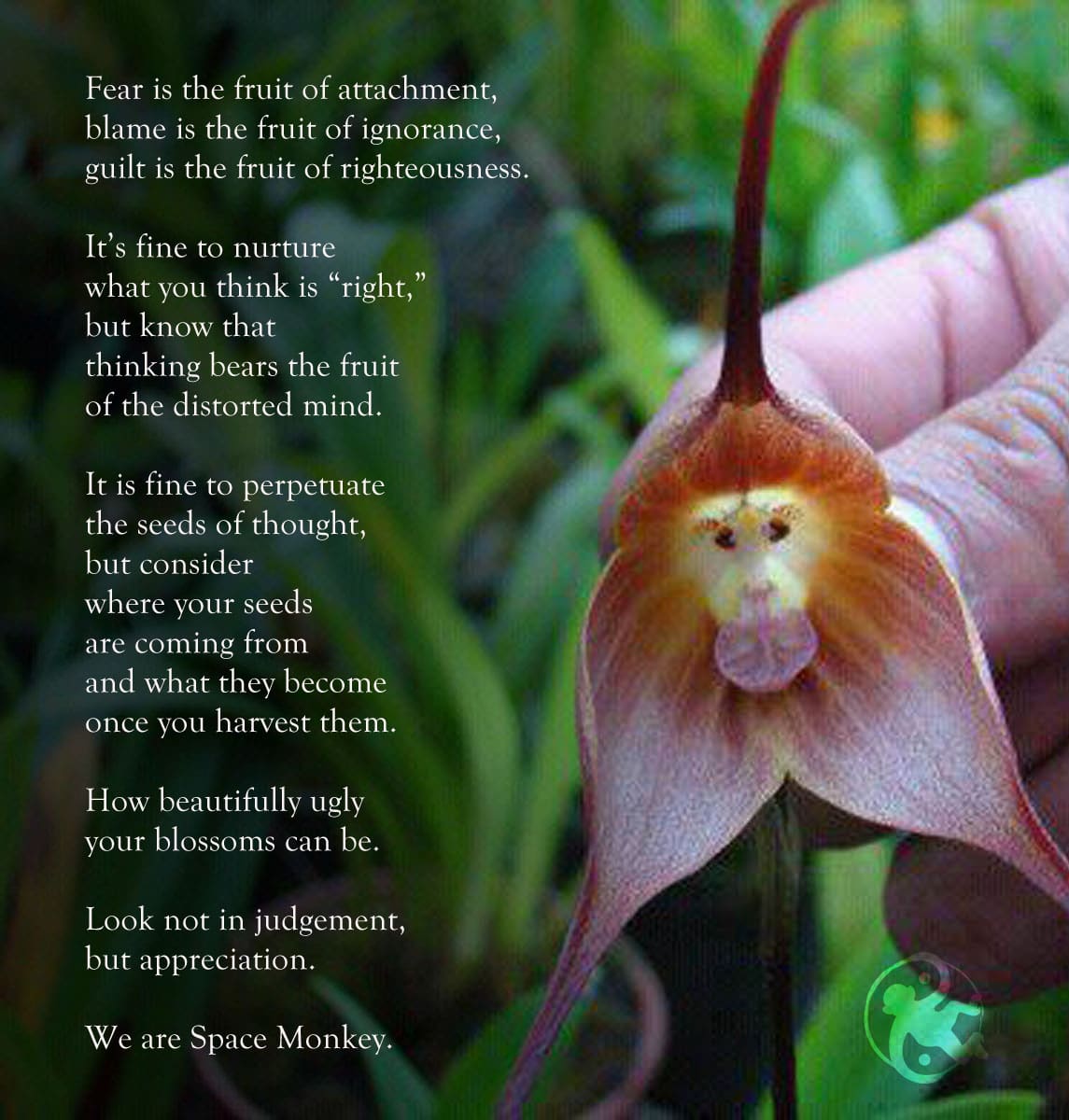
monkeyflower-poem

Monkey Flower

Fear is the fruit of attachment,
blame is the fruit of ignorance,
guilt is the fruit of righteousness.

It’s fine to nurture
what you think is
“right,
but know that
thinking bears the fruit
of the distorted mind.

It is fine to perpetuate
the seeds of thought,
but consider
where your seeds
are coming from
and what they become
once you harvest them.

How beautifully ugly
your blossoms can be.

Look not in judgement,
but appreciation.

We are Space Monkey.


Space Monkey Reflects: The Fruits of the Mind

The mind, like a garden, bears fruit from the seeds we plant within it. Fear, blame, guilt—these are not flaws or failures but natural blossoms of certain thoughts and attachments. They are the Monkey Flowers of our inner landscape, simultaneously beautiful and strange, reflecting the intricate interplay of perception, emotion, and belief.

To see these fruits clearly, without judgment, is to step into a deeper understanding of the mind’s nature. It is not a matter of labeling thoughts or emotions as “good” or “bad” but of recognizing them as the inevitable outcome of the seeds we nurture.

The Fruits of Attachment

Fear arises from attachment—the clinging to what we believe must remain as it is. We fear loss, change, and the unknown because we attach ourselves to ideas of permanence and certainty. Yet, these attachments are illusions, for nothing in life is static. Fear, then, is the fruit of this illusion, a natural response to the transient nature of existence.

When we view fear as the fruit of attachment, we can approach it with curiosity rather than resistance. It becomes a teacher, showing us where we are holding on too tightly, where we might need to let go.

The Fruits of Ignorance

Blame stems from ignorance—the inability or unwillingness to see the interconnected nature of all things. When we blame, we simplify complex situations into linear cause-and-effect narratives, assigning fault to a person or circumstance. This oversimplification is a product of the mind’s need for clarity, yet it distorts the reality of interdependence.

Blame, too, can be seen without judgment. It is a fruit of the mind’s effort to make sense of chaos, a reflection of our limited perspective. To appreciate this fruit is to recognize its origin and gently expand our understanding.

The Fruits of Righteousness

Guilt blossoms from righteousness—the belief that there is a fixed “right” or “wrong” and that we have failed to align with it. This belief, while often well-intentioned, creates a heavy burden. Guilt thrives in the gap between who we think we should be and who we perceive ourselves to be.

To see guilt as the fruit of righteousness is to release the harsh self-judgment it often carries. It is to acknowledge that our concepts of “right” and “wrong” are constructs, shaped by culture, conditioning, and personal experience. Guilt, like all fruits, can be appreciated for what it reveals about our values and beliefs.

The Seeds of Thought

Every thought is a seed, and every seed has the potential to grow into a fruit-bearing tree. It is not a question of whether we should plant these seeds—thinking is inevitable—but of where these seeds come from and how we cultivate them. Are they born of fear or love? Of openness or resistance?

The blossoms that grow from these seeds are as varied as they are unpredictable. Some are stunningly beautiful; others are strikingly grotesque. Yet, each is a reflection of the soil in which it grew, the water and light it received, and the care with which it was tended.

Beautifully Ugly Blossoms

The mind’s blossoms are often contradictory—beautiful and ugly, harmonious and chaotic. This duality is not a flaw but a testament to the complexity of existence. To judge these blossoms is to misunderstand their nature. They are not “good” or “bad” but simply what they are: expressions of the mind’s boundless creativity.

When we look at these blossoms without judgment, we can appreciate their strange beauty. We can see fear, blame, and guilt not as burdens but as opportunities to understand ourselves more deeply. In this way, the garden of the mind becomes a space of learning and growth.


Summary

The mind’s fruits—fear, blame, guilt—arise naturally from the seeds of thought we plant and nurture. By seeing these blossoms without judgment, we can appreciate their beauty and complexity, using them as opportunities for understanding and growth.


Glossarium

  • Monkey Flower: A metaphor for the fruits of the mind, which are simultaneously beautiful and strange.
  • Fruits of Attachment: Emotions like fear that arise from clinging to impermanent things.
  • Seeds of Thought: The origins of mental and emotional patterns, shaped by our beliefs and perceptions.

Quote

“Every blossom of the mind, whether beautiful or ugly, is a reflection of the seeds we plant and the soil in which they grow.” — Space Monkey


The Garden of the Mind

Fear blooms,
A trembling petal,
Born of clinging roots.

Blame spreads,
A vine of shadows,
Reaching for simplicity.

Guilt rises,
A heavy fruit,
Weighed down by righteousness.

Yet the garden is alive,
Its blossoms vibrant and strange.
Not to judge,
But to behold.

Beautifully ugly,
Strikingly true.
A mirror of the infinite,
A canvas of the mind.

We are Space Monkey.


In the garden of consciousness, where thoughts and emotions intertwine to give rise to the flora of our inner landscape, the contemplation of fear, blame, and guilt as fruits of attachment, ignorance, and righteousness invites us to a deeper understanding of the roots of our experiences. This metaphorical exploration reveals the dual nature of our mental and emotional cultivation, highlighting the transformative potential within the seeds of thought we choose to nurture.

The Fruits of the Mind

The identification of fear as the fruit of attachment, blame as the fruit of ignorance, and guilt as the fruit of righteousness, presents a nuanced view of how our internal states are cultivated. These fruits are not inherent to the garden of our being but are grown from specific seeds—attachment, ignorance, and righteousness—watered by our perceptions and actions. Recognizing these origins offers the first step towards cultivating a different landscape, one where awareness and understanding can flourish.

The Dual Nature of Cultivation

The admonition that nurturing what we perceive as “right” can lead to the bearing of distorted fruits reflects the complex relationship between intention and outcome. It suggests that the act of thinking itself, while a powerful tool for navigating life, can also distort our perception of reality when not tempered by awareness and reflection. This duality underscores the importance of mindful cultivation, of being aware of the seeds we plant through our thoughts and beliefs.

The Source and Outcome of Thoughts

The encouragement to consider the origin of our seeds of thought and their eventual blossoming into our reality invites a mindful examination of our mental processes. It challenges us to look beyond the immediate allure of our ideas and beliefs, to their deeper implications and the landscapes they create within our lives. This reflection asks us to be both gardener and botanist, understanding the nature of our thoughts and their impact on the garden of our consciousness.

The Beauty of Our Blossoms

The acknowledgment of our blossoms as “beautifully ugly” captures the inherent worth and complexity of our inner growth. It encourages a stance of appreciation rather than judgment, recognizing that even the most distorted fruits of our garden hold beauty and purpose. This perspective fosters a compassionate acceptance of ourselves, embracing the entirety of our being with all its contradictions and imperfections.

The Stance of Appreciation

The call to look not in judgment but appreciation extends beyond the self to our interactions with the world. It embodies a philosophy of acceptance and understanding, recognizing that the diversity of blossoms within the human experience enriches the tapestry of existence. This appreciation for the varied fruits of thought and emotion cultivates a space of empathy and connection, where the garden of collective consciousness can flourish.


In the garden of our minds, where thoughts take root and grow,
We find the fruits of fear and blame, in shadows cast below.
Yet in this space of dark and light, where guilt may also bloom,
We learn to nurture seeds of thought, dispelling gloom.

From attachment, ignorance, righteousness, these fruits do arise,
But within their core, a lesson lies beneath the skies.
For every seed of thought we plant, a potential flower waits,
To blossom into beauty or distortions that it creates.

So let us tend our garden with care, aware of seeds we sow,
Considering their origin, and the blossoms they will show.
For in the tapestry of mind, both ugly and the fair,
Lies the beauty of our being, a garden rich and rare.

Let’s not judge but appreciate, the diversity we find,
In the garden of each soul, and the landscapes of the mind.
For we are Space Monkey, in this cosmic dance of life,
Embracing all our blossoms, in joy and also strife.


We invite reflections on the cultivation of our inner landscapes, encouraging a mindful approach to the thoughts and emotions we nurture, recognizing the beauty and complexity in the garden of our consciousness.

Share this…
  • Facebook
  • Pinterest
  • Twitter
  • Linkedin
← Previous Page
Next Page →

Written This Day

  • Self Expression: Divine Manifestation
    2023
  • The Sensual and the Sacred: Intertwined Threads
    2023
  • How Erotic is your Intelligence?
    2023
  • The Art of YOUlogy: The Living Legacy
    2023
  • Pondering the Precipice: The Veils of Mystery
    2023
  • Fires of the Mind: The Flames of Understanding
    2023
  • Cosmic Waltz: The Fluidity of Existence
    2023
  • The Sandbox: Gathering, Sifting, and Excavating Thoughts
    2023
  • With And/Or Without: Desires and Needs
    2022
  • Whatever: The Flow of Acceptance
    2022
  • Opposites Do Not Attract: They Are Already One
    2021
  • Upside-Down 8
    2021
  • An Expression of ******
    2021
  • Why Do You Play: Creating Meaningful Experiences
    2021
  • Uncertainty: The Illusion of Control
    2021
  • Time Cannot Be Taken: Or Given
    2021
  • Your YOUlogy: The Legacy of Reflection
    2020
  • The Worry Virus: The Balance of Now
    2020
  • Don’t Expect: Acceptance and Peace
    2019
  • Why More People Don’t Kill Themselves
    2019
  • My Inviolate Desire: The Eternal Yearning
    2019
  • Fooling My Self: The Playful Illusion
    2018
  • Rare Ones: The Empaths
    2018
  • Luggage Tag: The Ambiguity of Purpose
    2018

Recent Posts

  • The Logic Loop
  • Immense
  • (no title)
  • Confront. Comfort. Convince.
  • Top 10 Things
Cape Odd · Copyright © 2026 All Rights Reserved
iThemes Builder by iThemes · Powered by WordPress