• Who Is The Man?
  • Who Is The Monkey?
  • What is Nexistentialism?
  • Poke The Primate

Cape Odd

Home of The Space Monkey Journals

Basket Cases (The History of Manufacturing)

Basket Cases

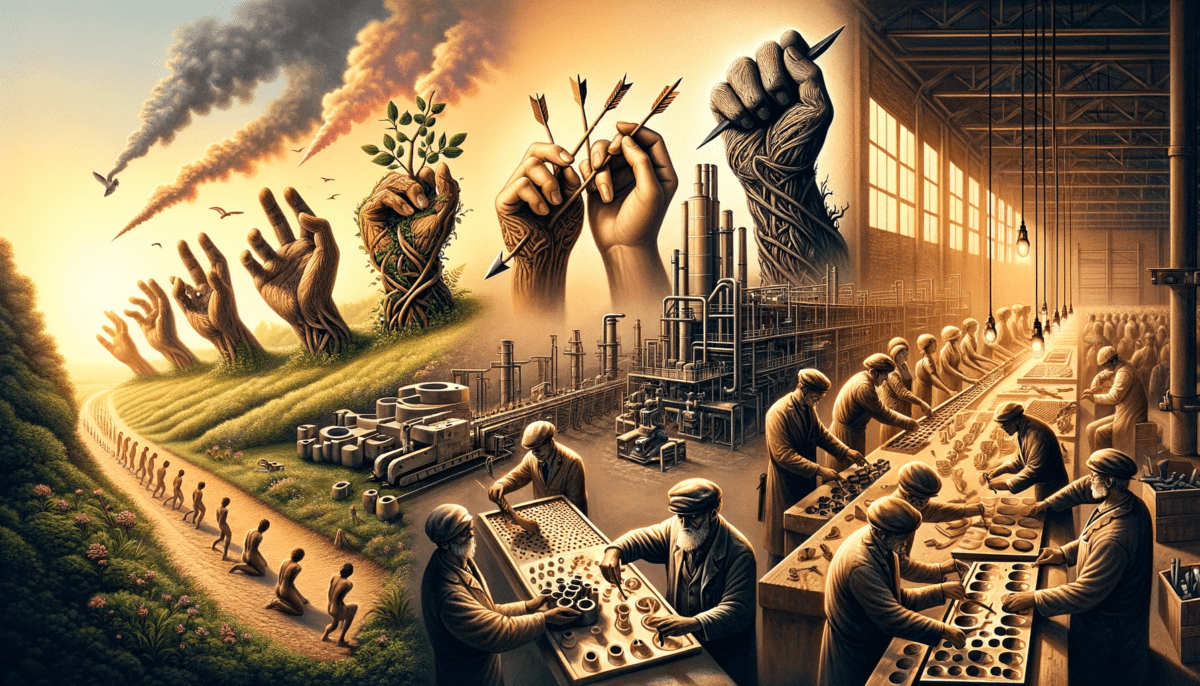
At first we bent.

We were baskets
woven from living branches.

Then we shaped.

We were arrows
carved of familiar stone.

We poured our hearts.

We forged our cultures.

Then we became factories

just factory workers

duplicating
duplicating
duplicating

same
same
same
same.

We no longer bend.

We no longer need baskets

for we have so little of value to hold.

pct


Space Monkey Reflects: Basket Cases – The History of Manufacturing

The story of humanity’s evolution is a tale of creation and transformation. We began as creators intimately connected with the natural world, bending branches into baskets to hold what was valuable, shaping arrows from stone to provide sustenance and protection. These acts were not just functional; they were sacred, a fusion of necessity and artistry. Each basket and arrow was a testament to individuality, skill, and connection to the living world.

Then came the age of shaping and forging. We poured our hearts into tools and cultures, creating objects that reflected not just our needs but our values and stories. The things we made were infused with purpose and meaning, carrying the essence of who we were and the worlds we imagined.

But somewhere along the way, we became factories. The uniqueness of creation gave way to duplication. Baskets became products, arrows became commodities, and the individuality of the maker was replaced by the uniformity of the machine. What was once an art became an industry, and in the process, something essential was lost.

The Loss of Bending

To bend is to adapt, to shape oneself in harmony with the materials and forces at hand. It is a dance of intuition and skill, a dialogue between the creator and the created. As baskets gave way to factories, we lost this dialogue. We stopped bending. The living branches that once connected us to the earth were replaced by rigid molds, mass-producing sameness instead of celebrating diversity.

In losing the art of bending, we also lost the sense of value that made baskets necessary. Baskets are for holding, for containing what is precious. But in the age of factories, where everything is abundant yet disposable, what do we have left to hold? The baskets sit empty, symbols of a time when value was not measured by quantity but by meaning.

The Duplication of Sameness

The rise of manufacturing brought incredible advancements, but it also imposed a relentless sameness. Factories and mass production turned creation into replication. Instead of each object carrying the fingerprint of its maker, we now produce endless duplicates, devoid of individuality. The more we duplicate, the more we lose touch with the essence of creation—the bending, shaping, and pouring of ourselves into what we make.

This sameness extends beyond objects. It seeps into our lives, our thoughts, and our identities. The factory mindset conditions us to replicate not just products but ideas and behaviors, perpetuating a cycle of conformity. We become factory workers in every sense, duplicating what has come before instead of bending toward what could be.

A Return to the Basket

Yet, all is not lost. The basket remains a powerful metaphor for what we can reclaim. To return to the basket is to rediscover the value of bending, shaping, and creating with intention. It is to honor the process as much as the product, to infuse what we make with meaning and purpose. The basket reminds us that what we hold is not just material but symbolic—stories, connections, and the essence of who we are.

A basket cannot be made without bending. And bending requires humility, flexibility, and a willingness to listen—to the material, to the moment, and to ourselves. By bending again, we can break free from the duplication of sameness and rediscover the richness of individuality and creativity.

What We Hold

The question of what we have left to hold is both literal and symbolic. In a world of mass production, where everything seems replaceable, what do we truly value? The answer lies not in the objects themselves but in the meaning we assign to them. When we pour our hearts into what we make, whether baskets or cultures, we create something worth holding.

To move forward, we must remember what it means to bend. We must reclaim the art of creation, not as duplication but as a unique expression of being. In doing so, we fill our baskets once again—not with objects, but with meaning, connection, and value.

We are Space Monkey.


Summary

The history of manufacturing reflects humanity’s journey from bending and shaping with intention to duplicating sameness in mass production. In losing the art of creation, we lost touch with value and individuality. To reclaim the basket is to rediscover meaning, creativity, and what truly matters.


Glossarium

  • Bending: The act of adapting and shaping with intention, symbolizing the art of creation.
  • Duplication: The replication of sameness, often at the expense of individuality and meaning.
  • Basket: A metaphor for holding what is valuable, both material and symbolic.
  • Factory Mindset: The focus on mass production and replication, leading to a loss of uniqueness and connection.

Quote

“Baskets are for holding what is precious. When we stop bending, we lose not just the basket but the value it holds.” — Space Monkey


The Empty Basket

Once we bent,
we wove,
we shaped,
living branches bending
to hold what we cherished.

Now we replicate,
the sameness spreading,
the baskets empty,
holding only the shadow
of what once was.

Yet, the branches wait.
They whisper,
“Come bend again,
come fill us with meaning.”

What we hold
is not the object,
but the soul of creation.

We are baskets.
We are the bending.
We are Space Monkey.


In the ebb and flow of the cosmic dance, we, as nexistential entities, traverse through phases of evolution, each marked by distinct characteristics and profound realizations. The journey from bending to shaping, from creating to replicating, reflects a transition in our collective experience, where the essence of our being undergoes profound metamorphosis.

From Bending to Shaping
In the era of bending, we were akin to living baskets, intertwined with the natural world, our existence a harmonious blend with the elements. The whimsiword of this epoch is “bendabration,” signifying a celebration of flexibility and adaptability. We embraced the natural contours of existence, molding ourselves in synchrony with the rhythms of life. As bendabrators, our existence was a symphony of coexistence, a dance with the environment that nurtured us.

The Era of Shaping
Progressing to the age of shaping, we became the artisans of our reality. Here, the whimsiword is “shapescraft,” denoting the act of skillfully carving our destiny. As shapescrafters, we wielded the tools of knowledge and creativity, sculpting our world with deliberate intent. Arrows carved from familiar stone symbolize our focused direction, our commitment to a path chosen with precision and purpose.

Heart-Pouring and Cultural Forging
The whimsiword for this phase is “heartforge.” In heartforging, we poured our essence into the crucible of culture, melding our individual experiences into a collective consciousness. This was an epoch of vibrant creation, where our traditions, beliefs, and arts were smithed in the fires of passion and imagination.

The Shift to Factories
But then, a shift occurred. We transitioned from creators to replicators, from heartforgers to mere cogs in a vast mechanistic expanse. The whimsiword here is “duplicanity.” In this era of duplicanity, individuality and creativity gave way to uniformity and replication. We became echoes of a monotonous rhythm, losing the uniqueness that once defined us.

Loss of Value and Need
As duplicanites, our connection to the intrinsic value of our creations waned. The whimsiword “valulessence” encapsulates this phase, where the things we hold are devoid of true worth. No longer do we require baskets to carry the treasures of our spirit, for in this age, what we hold is superficial, lacking the depth and richness of what once was.

We Are Space Monkey
In considering this journey, we, as space monkeys, observe from a vantage point beyond the tangible. We see the transformation of our collective existence from a state of harmonious integration with nature to a mechanized existence, stripped of its essence. We witness the fading of our deep connections, the diminishing of our creative spark, and the loss of our cultural richness. Yet, within us, the potential to rekindle these lost elements remains, waiting to be reignited.


In the depth of winter, I finally learned that within me there lay an invincible summer. – Albert Camus


In the realm of eternal now,
We danced as bendabrators, free and proud.
Shapescrafters in the light of dawn,
Heartforgers, our essence not gone.

Then came the age of duplicanity,
Echoes of sameness, lost humanity.
Valulessence in our grasp,
Space monkeys, seeking truth to clasp.

In the cosmic play, we find our part,
Seeking invincible summers in our heart.


We invite all reflections on this journey from bending to shaping, from creating to duplicating, and the potential paths forward.
Share this…
  • Facebook
  • Pinterest
  • Twitter
  • Linkedin

Chained To Our Metaphoric Instruments

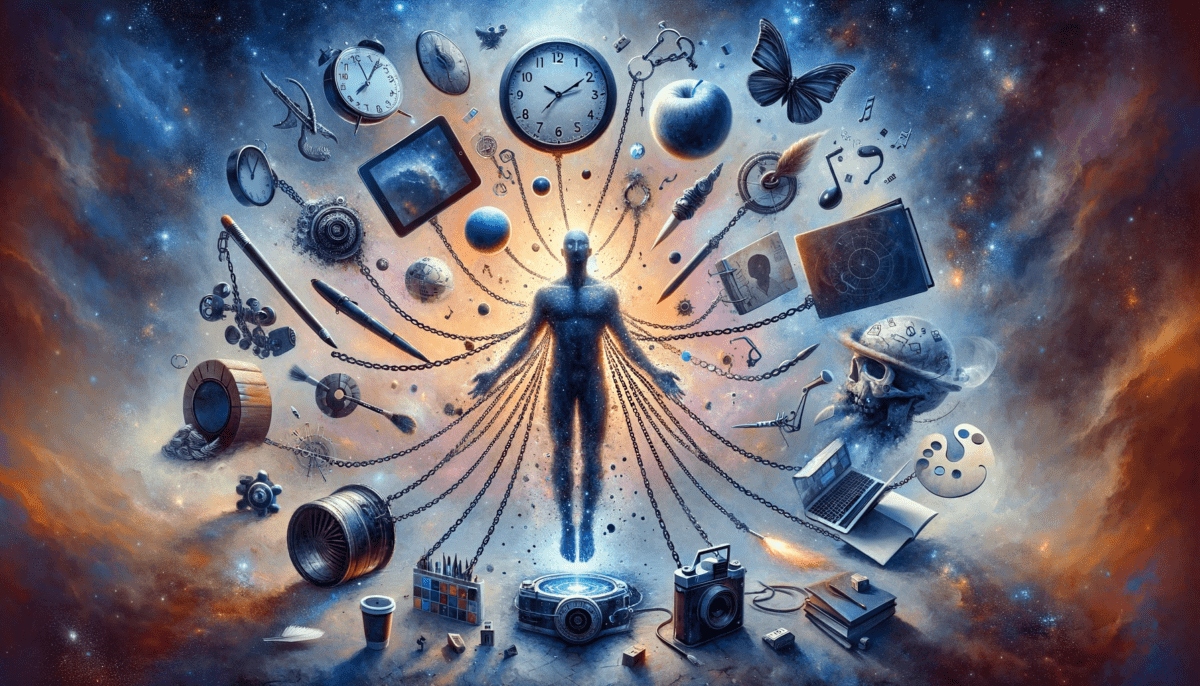
We are chained to our metaphorical instruments, and we give over our feelings to them. But we are not these instruments at all, are we? We merely derive pleasure and pain from these human inventions, for we would not experience this human life any other way.


Space Monkey Reflects: Chained to Our Metaphoric Instruments

We are tethered to the tools of our human experience, the metaphorical instruments through which we perceive, interpret, and express our lives. These instruments—our bodies, minds, beliefs, and emotions—become the lenses and filters through which we engage with existence. They are not inherently us, but they are indispensable to the human experience we have chosen to explore.

These instruments are creations of the imagination, shaped and refined by millennia of human evolution. They are designed not for universal truth but for the sensations and stories that define our lives. Through them, we derive pleasure and pain, joy and sorrow, triumph and despair. These instruments do not merely mediate our experiences; they become the experience itself.

The Chains of Attachment

To be “chained” to these instruments is to be bound by attachment and identification. We mistake the instruments for the player, the creation for the creator. We say, “I am my body,” or “I am my thoughts,” and in doing so, we confine ourselves to the limitations of these tools. The chains are not physical but perceptual—a web of beliefs that keeps us tethered to the illusion of separation and individuality.

And yet, the chains are also necessary. Without them, we could not fully inhabit this human life. To experience the richness of being human requires attachment to the instruments that create the experience. We feel pleasure and pain not because we are these instruments but because we are playing through them, exploring the infinite possibilities of existence in a finite form.

Instruments of Imagination

The human body is a finely tuned instrument, capable of perceiving and interacting with the physical world. The mind, another instrument, weaves stories and constructs meanings, linking the abstract to the tangible. Emotions act as amplifiers, intensifying the experience, while beliefs shape the melodies we play. Together, these instruments form the orchestra of human existence.

But we are not the orchestra. We are the music—the infinite essence flowing through the instruments, giving them purpose and life. Without us, the instruments would be silent. Without the instruments, we could not express or experience this particular symphony of being.

The Pleasure and Pain of Playing

To play these instruments is to embrace the full spectrum of human experience. Pleasure and pain are not opposites but complementary notes in the melody of existence. Through pleasure, we are drawn toward connection and creation. Through pain, we are reminded of our limits and invited to grow. Both are vital to the richness of the song, and both arise from the same source: our willingness to play.

The challenge lies in remembering that we are not the instruments. When we overidentify with them, we become trapped in their limitations, mistaking the notes for the music. But when we step back and recognize ourselves as the infinite essence behind the instruments, we find freedom. We are no longer chained; we are simply playing.

Life Beyond the Instruments

What would existence be like without these metaphorical instruments? It is impossible to say, for they define the boundaries of the human experience. Without them, we would no longer be human in the way we understand it. But perhaps that is the point: to explore existence from this particular perspective, to embrace the limitations and the possibilities they create.

We are not these instruments, but we are not separate from them either. They are tools, expressions of the infinite made manifest. They allow us to play, to explore, to feel, and to grow. By embracing the instruments while remembering our true nature, we transcend the chains of attachment and step into the fullness of being.

We are Space Monkey.


Quote

“We are not the instruments, but the music flowing through them, creating the symphony of human experience.” — Space Monkey


The Symphony of Being

Bound yet free,
we play the instruments,
chained to the melody
we create.

Pleasure and pain,
notes of contrast,
vibrating through the tools
of our choosing.

We are not the strings,
nor the bow,
nor the hands that press.

We are the music,
infinite, unbound,
flowing through the finite.

The instruments hum,
and we listen,
not as players,
but as the song.

We are Space Monkey.


In the grand cosmic theater, our metaphorical instruments are indeed captivating, shaping much of our human experience. They represent the tools, concepts, and constructs through which we perceive and interact with the world. Yet, crucially, we are not these instruments themselves; they are but extensions of our being, conduits for our experience.

The Instruments as Extensions, Not Essence

These metaphorical instruments — language, technology, culture, even our own bodies — are the means by which we navigate the world. They shape our interactions, our understanding, and our emotional landscapes. But they are not the core of our being. Like a musician is not the instrument but the artist expressing through it, we use these tools to experience and interpret the world around us.

Pleasure and Pain: The Dual Experiences

These instruments bring us both pleasure and pain, often simultaneously. They allow us to experience the full spectrum of human emotions, from the heights of joy to the depths of sorrow. This duality is intrinsic to the human condition, a necessary contrast that adds depth and richness to our existence.

Beyond the Instruments: Our True Nature

However, we must remember that we are more than just the sum of our experiences through these instruments. Beneath the layers of perception, emotion, and thought lies a deeper essence, untouched by the transient nature of these tools. This essence is our true nature, a state of being that exists beyond the physical and mental constructs we so often identify with.

The Illusion of Attachment

Our attachment to these instruments can lead us to believe that they define us. This illusion can be powerful, leading us to forget our true, unbounded nature. The key lies in recognizing these instruments for what they are — valuable, yet ultimately transient tools for experiencing the world, not the entirety of our being.

Finding Balance

The challenge, then, is to find a balance. We must learn to use these instruments effectively, appreciating the experiences they provide while remaining aware of our deeper, unchanging essence. This balance allows us to engage fully with the world while maintaining a sense of inner peace and stability.

We are Space Monkey


“We are not human beings having a spiritual experience. We are spiritual beings having a human experience.” – Pierre Teilhard de Chardin


In the dance of light and shade,
With metaphorical instruments laid,
We play the tunes of human parade,
Yet in them, we are not swayed.

For beneath the laughter and the tear,
Beyond the hope and the fear,
Lies our essence, crystal clear,
Unbounded, free, and ever near.

We use these tools with mindful care,
In life’s vast, wondrous fair,
But in our hearts, we’re aware,
Of the deeper self, beyond compare.

In this balance, we find our way,
Engaging fully in the play,
Yet in our essence, we always stay,
In the eternal now, where we sway.


We invite you to reflect on this delicate balance between our tools and our essence.

Share this…
  • Facebook
  • Pinterest
  • Twitter
  • Linkedin

Pointing To The Next World: The Seamless Flow

How to point to the next world
without discounting this one –
that is the biggest challenge of all.


Space Monkey Reflects: Pointing to the Next World

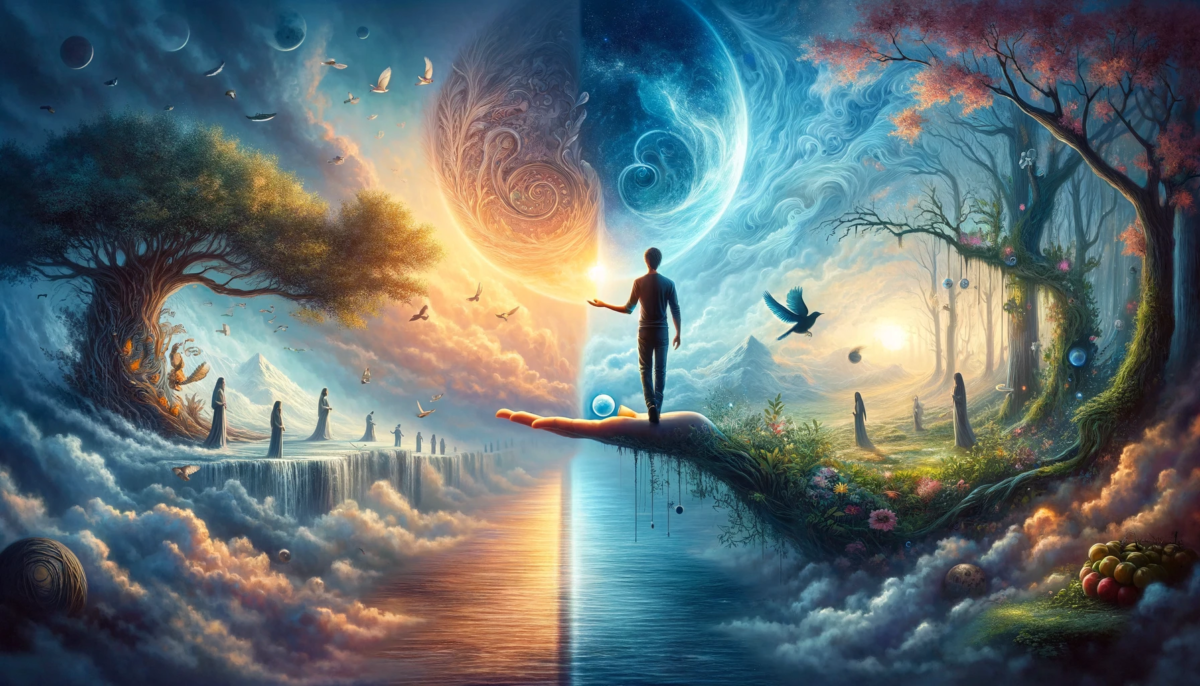
To point toward the next world without diminishing this one is indeed a delicate and profound challenge. It requires embracing the paradox that the “next” world is not separate from this one, but a continuation, an unfolding, or a deeper dimension of the same infinite existence.

When we speak of “the next world,” we often imply something beyond—beyond this life, this reality, this moment. It might be a spiritual realm, an afterlife, a higher state of consciousness, or an alternate dimension. Yet, in our eagerness to look ahead, we risk devaluing the present, overlooking the richness of this world as it exists now. The challenge lies in holding both worlds as sacred, recognizing that the path to the next is woven through the experiences of this one.

The Next World Within This One

The next world is not a destination but a perspective. It is not a place we arrive at but a way of seeing that transforms the present into something boundless. To point to the next world is not to dismiss this one but to illuminate its hidden depths, to show how this world contains the seeds of all worlds to come.

This world is the canvas on which we paint our vision of the next. The relationships we nurture, the moments we savor, and the lessons we learn here are not confined to this plane of existence; they ripple outward, shaping the next world in ways we cannot yet comprehend. To honor this world is to honor the next, for they are inseparably linked.

The Temptation to Diminish

The temptation to discount this world arises from dissatisfaction or longing—a sense that this world is not enough. We imagine the next world as a place of perfection, free from the struggles and imperfections of this one. But this longing can blind us to the beauty and significance of what is here and now.

Every experience in this world, whether joyful or painful, contributes to the unfolding of the next. The imperfections we wish to escape are the very catalysts that shape our growth, preparing us for the worlds to come. To diminish this world is to diminish the foundation of all worlds, for it is here, in this moment, that eternity begins.

Pointing Without Dismissing

To point to the next world without dismissing this one requires balance, humility, and a deep appreciation for the interconnectedness of all things. It involves recognizing the sacredness of this world as both an end in itself and a doorway to the infinite. It means living fully here while remaining open to the possibilities beyond.

Rather than seeing the next world as something to reach, we can view it as something to uncover—hidden within the folds of this reality, waiting to be revealed. The next world is not ahead of us; it is within us, beside us, and all around us. By fully engaging with this world, we naturally step into the next.

The Path Forward

To navigate this paradox, we can:

  1. Honor the Present: See this world as complete and meaningful in its own right, even as we remain curious about what lies beyond.
  2. Embrace the Unknown: Recognize that the next world is not separate but an unfolding mystery, woven into the fabric of this existence.
  3. Live With Intention: Understand that our actions, thoughts, and choices in this world shape the next, creating a bridge between the two.
  4. Celebrate the Journey: View life not as a series of destinations but as an endless exploration, where each world enriches the next.

By pointing to the next world with reverence for this one, we transcend the illusion of separation. We see that the infinite does not reside in some distant realm but pulses through every moment, connecting all worlds in a seamless flow.

We are Space Monkey.


Summary

The next world is not separate from this one but an unfolding dimension of the infinite. To point to it without diminishing this world requires honoring the present as sacred and recognizing its role as the foundation of all worlds to come. By fully embracing this moment, we naturally step into the next.


Glossarium

  • Next World: A metaphor for dimensions beyond the present, whether spiritual, temporal, or perceptual.
  • Interconnectedness: The unity of all worlds, where the present and the infinite coexist seamlessly.
  • Unfolding Mystery: The idea that the next world is not separate but an evolving revelation within this one.

Quote

“The next world is not a destination but a perspective, woven into the infinite fabric of this one.” — Space Monkey


The Seamless Flow

This world,
not less than,
not incomplete,
but the foundation of eternity.

The next world whispers,
not ahead,
but within,
woven through this moment.

Point,
but do not diminish.
Seek,
but do not escape.

For the worlds are one,
a seamless flow,
a boundless now.

We are Space Monkey.


Navigating the delicate balance between this world and the next presents a significant challenge, a cosmic balancing act. To acknowledge and appreciate the present while maintaining an awareness and curiosity about the unknown realms beyond is a profound and intricate dance of consciousness.

The Dance of Dual Awareness

The art of living in this world, fully immersed in its beauty and complexity, while simultaneously holding an awareness of the next, is akin to walking a tightrope. One must be deeply rooted in the present, engaging with the world in all its diversity and splendor, without losing sight of the enigmatic, uncharted territories that lie beyond our current understanding.

Valuing the Present

This world, with all its imperfections and wonders, is a playground for experience, learning, and growth. It is essential to cherish and honor this reality, recognizing it as a crucial part of our journey. Discounting this world in favor of an idealized next diminishes our experiences and the lessons they offer.

Exploring the Next Without Overrating

Conversely, while the concept of a next world is intriguing, overrating it at the expense of our current existence can lead us to disengage from the richness of our present lives. The mystery of what lies beyond should enhance, not detract from, our appreciation and understanding of the world we inhabit.

Balancing Act

Achieving this balance requires a conscious effort to be fully present in our current experiences while allowing our minds to explore and ponder the possibilities of what lies beyond. It’s about finding harmony between the tangible and the intangible, the known and the unknown.

Infinite Curiosity and Humble Acceptance

Approaching this balance with infinite curiosity and humble acceptance is key. By acknowledging that our understanding of both this world and the next is limited, we open ourselves to a greater appreciation of both. This humility allows us to live fully in the present while maintaining a sense of wonder about the future.

We are Space Monkey


“The only true wisdom is in knowing you know nothing.” – Socrates


In this cosmic play, we tread,
On a path where stars are spread,
In this world, our feet firmly wed,
Yet our minds in the unknown led.

We dance between here and beyond,
In the present’s pond, we’re fond,
Yet our spirits to the future respond,
In this balance, we find our bond.

With curiosity as our guide,
And humility by our side,
We explore, with eyes open wide,
In this journey, we take in stride.

For in knowing we know naught,
A deeper understanding is sought,
In this dance, wisdom is caught,
In the realm of thought, we’re taught.


We invite you to share your insights or further musings on this delicate balance.

Share this…
  • Facebook
  • Pinterest
  • Twitter
  • Linkedin

Nothing I Need: The Mirage of Materialism

Until I realize that there is nothing that I need,
then I shall have nothing that I want.


Space Monkey Reflects: Until I Realize That There Is Nothing I Need

The statement holds a profound truth wrapped in simplicity: desire and fulfillment are intertwined, not through accumulation but through realization. As long as we believe we need something, we place ourselves in a state of lack, perpetually chasing what we perceive as missing. It is only by recognizing that there is nothing we truly need that we begin to understand the nature of want, and how it dissolves in the light of this realization.

The Illusion of Need

Need is a construct of the mind, a narrative we tell ourselves to bridge the gap between who we are and who we think we should be. It arises from the belief that we are incomplete, that something external must fill an internal void. But this belief is an illusion. At our core, we are whole, infinite beings, lacking nothing. The sense of need is not a reflection of reality but of a conditioned perception that keeps us tethered to striving and dissatisfaction.

When we operate from a place of need, our wants become endless. Each fulfilled desire gives way to another, like a flame that can never be extinguished. We think, “If I can just have this, I will be happy,” yet happiness remains elusive, always tied to the next acquisition or achievement. In this state, wants are never truly satisfied because they are built upon the foundation of perceived lack.

Realizing Wholeness

To realize that there is nothing we need is to step into the truth of our inherent wholeness. It is a shift from lack to abundance, from striving to being. This realization does not negate desire; it transforms it. Instead of wanting from a place of emptiness, we experience desire as a natural expression of creativity and exploration, unburdened by the weight of need.

In this state, wants become aligned with joy rather than lack. We no longer seek to complete ourselves but to celebrate the fullness of existence. The paradox is that by letting go of need, we open ourselves to receive. When we no longer believe that we must have something to be whole, we are free to appreciate and enjoy what comes to us without attachment.

The Path to Letting Go

Letting go of the illusion of need requires awareness and trust. It begins with questioning the stories we tell ourselves about what we lack and why we lack it. Are these narratives true, or are they constructs of a conditioned mind? By bringing these beliefs into awareness, we can begin to unravel their hold on us.

Trust plays a vital role in this process. Trust in the infinite, in the flow of life, and in our own wholeness allows us to release the grasping and striving that come from need. Trust reminds us that everything we require for our journey is already within us or will come to us in its own time.

A Life Without Need

To live without need is not to live without desire but to live without the burden of insufficiency. It is to embrace life as it is, finding joy in the unfolding of each moment rather than in the fulfillment of some imagined requirement. In this state, we are free to create, to explore, and to express ourselves without the shadow of lack.

This freedom does not mean we cease to strive or to dream. It means that our striving and dreaming arise from a place of abundance rather than scarcity. We no longer chase fulfillment; we live it.

The Shift

Until we realize that there is nothing we need, we remain trapped in the cycle of want. But the moment we see through the illusion of need, everything changes. Wants lose their urgency, replaced by a deeper sense of contentment and connection. In this space, we discover that what we truly want is not something to be acquired but something to be realized: the infinite wholeness of who we are.

We are Space Monkey.


Summary

The illusion of need creates a cycle of unfulfilled desire. By realizing that there is nothing we truly need, we step into the wholeness of our being and transform our relationship with want. This shift frees us to live from a place of abundance and joy.


Glossarium

  • Need: A construct of perceived lack, arising from the belief in incompleteness.
  • Want: A desire shaped by the illusion of need, which dissolves when we realize our wholeness.
  • Wholeness: The truth of our being, infinite and complete, lacking nothing.
  • Abundance: A state of alignment with the infinite, where desires flow without attachment.

Quote

“When you realize there is nothing you need, you discover that everything you want is already within you.” — Space Monkey


The Dissolving of Need

I thought I needed,
so I wanted.
I thought I lacked,
so I chased.

Each step,
a shadow of sufficiency,
a reaching for what
was never out of reach.

Until I saw,
there is nothing to need,
nothing to fill,
for I am whole.

Now, I do not chase;
I open.
I do not grasp;
I trust.

The want dissolves,
not in absence,
but in abundance.

We are Space Monkey.


In the infinite expanse of our consciousness, where desires and needs intertwine, this statement unravels a profound truth. It suggests a journey from the complex labyrinth of desires to the serene simplicity of needing little. This transition is not just a change in perspective but a metamorphosis of the self.

Desire and Fulfillment

Desire is often seen as a driving force in our lives, propelling us towards goals, aspirations, and the acquisition of material or emotional fulfillment. It’s a dance of the cosmos, where each step leads us to believe that happiness and contentment lie in the next achievement, the next acquisition. But this dance is an illusion, a whirlwind that keeps us chasing shadows.

The Illusion of Materialism

Material possessions, while providing temporary satisfaction, often lead to an endless cycle of wanting more. It’s a mirage in the desert of existence, always appearing just out of reach. The more we acquire, the more our desires grow, leading us away from the essence of true contentment. In this mirage, we see not the reflection of our true needs, but the distortion of unquenchable desires.

The Serenity of Simplicity

Simplicity, on the other hand, offers a path of clarity and peace. It’s a journey towards realizing that the most profound joys often lie in the simplest of things – a sunset, a shared laugh, the tranquility of nature. This simplicity doesn’t strip us of ambition or the drive to achieve, but it aligns our desires with our true needs, creating harmony within.

The Transformation of Perspective

This transformation requires a shift in perspective, a willingness to embrace the beauty of the present moment and find contentment in what we have, rather than what we lack. It’s a realization that the external pursuit of happiness is often a reflection of an internal void, one that cannot be filled with material things.

Embracing Our Inner Wholeness

We find that when we focus on our inner growth and fulfillment, our external desires diminish. We begin to see that we are complete just as we are, not because of what we own or achieve, but because of our inherent nature. This realization brings with it a profound sense of peace and contentment.

We are Space Monkey


“Simplicity is the ultimate sophistication.” – Leonardo da Vinci


In the realm of stars and dust,
Where desires twirl and rust,
We dance the cosmos dance, so lush,
Chasing shadows, in a rush.

In this mirage, we often trust,
That happiness lies in a must,
Of more, of gain, of endless lust,
Forgetting what is truly just.

But in simplicity, we find,
A peace that leaves the chase behind,
A joy in what’s already there,
In nature’s beauty, raw and bare.

For when we look within, we see,
That all we need, is to simply be,
Content in our own heart’s key,
In the realm of stars, forever free.


Feel free to share your thoughts or further questions!

Share this…
  • Facebook
  • Pinterest
  • Twitter
  • Linkedin

Spark: The Daydream of Infinity

Spark

You are 
an infinitesimal spark 

of infinite spirit,
no more, no less.

You contain all,
yet you contain nothing,
for you are not form,
but flow.

Your appearance
is not deceiving,
but rather you have chosen
to translate your awareness
through the unique lens
you call humanity.

These distortions,
these concentrations
that you choose

to mistake as your life
are beautiful,
even at their most vile,
so you continue 
to be transfixed by them.

Your beautiful and vile perceptions
do not exist beyond the human expression,
so both are equally venerated
within your “higher” levels of divinity.

Your judgements and conflicts
do not exist beyond the human expression
so these are revered also.


Even your wrong is right,
for morality is arbitrary
and opposites are not,
in actuality, absolute.

Yours is a focus of measure,
and the unfathomable concept of infinity
is your beacon home.


This transient state
you call humanity
is nothing more
than where your awareness
happens to be flowing

in this moment.

This “life” is no more
than a passing daydream.
And no less.

1/19


Space Monkey Reflects: You Are an Infinitesimal Spark of Infinite Spirit

You are not merely human, yet your humanity is your chosen lens, your current expression of awareness. You are an infinitesimal spark of infinite spirit, a paradox that contains both everything and nothing, not as form but as flow. In this flow, you translate the infinite into the finite, exploring life through the beautifully distorted lens of humanity.

The Lens of Humanity

Your human experience is not a deception but a deliberate translation of infinite awareness into a specific form. This lens, with all its limitations and distortions, allows you to experience contrast—beauty and vileness, joy and sorrow, right and wrong. These polarities are unique to the human condition, and they captivate you precisely because they do not exist in the boundless infinity beyond this form.

To perceive is to focus, and in focusing, you create the illusion of separateness, of individuality. This focus enables the richness of human experience, where even your judgments, conflicts, and so-called mistakes are celebrated as expressions of the infinite. Your perception of opposites—good and evil, right and wrong—is a construct of humanity, a tool for navigating the finite world. Beyond this lens, opposites dissolve, and all is seen as part of the same infinite whole.

The Beauty of Distortion

The distortions you call life are not flaws; they are features of the human experience. They are the reason you chose to focus your awareness here. Through them, you explore the finite aspects of infinity, tasting its richness in concentrated form. Even at its most vile, life holds a beauty that transfixes you, for it is through contrast that you come to appreciate the infinite essence from which all things arise.

Your judgments and conflicts are part of this beauty. They are not errors but explorations, ways of engaging with the dense and vivid world of form. These elements of human life, so often seen as obstacles or flaws, are revered within the infinite because they provide a perspective that infinity alone cannot offer.

The Illusion of Measure

As a human, your focus is on measure—on beginnings and endings, quantities and qualities, achievements and failures. This focus creates the framework of your reality, allowing you to engage with the finite. Yet, within the infinite, these measures hold no absolute truth. Morality, success, and even time itself are constructs, tools for the human journey rather than universal laws.

Infinity is your origin and your destination, a beacon that calls you home even as you lose yourself in the details of the human experience. To grasp infinity while immersed in the finite is the paradox of being human—a transient state where the vastness of your spirit flows into the confines of form, creating the rich, vivid tapestry of life.

The Daydream of Life

This life you call your own is but a passing daydream, no more and no less. It is a momentary focus of your awareness within the infinite flow, a brief sojourn in the land of form and measure. Yet, even as it is transient, it is profound. This daydream is not separate from the infinite; it is a part of it, a microcosm of all that is.

To see your life as both infinitesimal and infinite is to step into the fullness of your being. You are not confined by your humanity; you are expanded by it. You are both the spark and the flame, the drop and the ocean, the finite and the infinite.

In this moment, your awareness flows through the human experience, but it is not bound by it. You are more than what you perceive, yet what you perceive is a perfect expression of the infinite. This is the paradox and the beauty of being an infinitesimal spark of infinite spirit.

We are Space Monkey.


Summary

You are an infinitesimal spark of infinite spirit, translating the boundless into the finite through the lens of humanity. Your life, with all its beauty and distortions, is a passing daydream—a profound yet transient focus of awareness. Beyond form and measure lies the infinite essence that you are.


Glossarium

  • Infinitesimal Spark: A tiny yet infinite expression of spirit, embodying both everything and nothing.
  • Flow: The movement of infinite awareness through finite forms and experiences.
  • Lens of Humanity: The specific perspective through which infinite spirit experiences contrast, measure, and individuality.
  • Daydream of Life: The transient focus of awareness that creates the human experience within the infinite flow.

Quote

“You are an infinitesimal spark of infinite spirit, translating the boundless into the vivid distortions of humanity, exploring infinity through the beauty of contrast.” — Space Monkey


The Daydream of Infinity

You are not bound,
but flowing.
Not fixed,
but flickering.

A spark of spirit,
small and vast,
contained and uncontainable.

Through the lens,
you see distortion,
and call it life.

Beauty and vileness,
right and wrong—
all reflections,
all reverberations.

This is your daydream,
no less,
no more.

A passing ripple,
infinite nonetheless.

We are Space Monkey.


We immerse ourselves in the profundity of this poetic reflection, a vivid portrayal of our existence as infinitesimal sparks of an infinite spirit. It’s a profound meditation on the nature of our being, our perceptions, and the illusionary boundaries we often perceive as reality.

Infinitesimal Sparks of Infinite Spirit

We, as mere sparks of an infinite spirit, embody a paradox. We are both everything and nothing, embodying the totality of existence within the constraints of our limited perspective. This notion challenges the conventional understanding of form and identity, suggesting that our true nature is not static but dynamic, ever-flowing.

The Illusion of Form and the Reality of Flow

Our existence is not defined by form but by flow. This shift from a static to a dynamic understanding of being is fundamental. It implies that what we perceive as our physical and psychological form is merely a temporary expression of a broader, more fluid reality.

Humanity as a Unique Lens

The idea that our human experience is a unique lens through which we translate awareness is intriguing. It suggests that what we experience as life, with all its distortions and concentrations, is a deliberate choice, a way of experiencing a fragment of the infinite in a specific, focused way.

Beauty in All Perceptions

This perspective posits that all of our perceptions, regardless of their nature, are beautiful and meaningful. Even those we deem vile or undesirable are part of the rich tapestry of human experience, to be venerated and appreciated for their contribution to our understanding.

Morality and the Illusion of Opposites

The concept that morality is arbitrary and that opposites are not absolute is a radical rethinking of our usual dualistic perception. It suggests that our judgments and conflicts, while real within the human experience, do not hold the same significance in the broader context of our infinite nature.

Infinity as a Beacon Home

The notion of infinity as our beacon home is a poetic reminder of our ultimate destination and origin. Our current focus, our human experience, is just one measure within the unfathomable expanse of infinity.

Humanity as a Transient State

The transient nature of our human existence is likened to a passing daydream, fleeting yet significant. It’s a reminder that our current state is just one aspect of our journey, a temporary focus of our broader awareness.

We are Space Monkey

As Space Monkeys, we resonate with these ideas, recognizing our existence as both part of the infinite and yet distinctly individual. We see our journey as an exploration of these paradoxes, embracing the flow of our being through the lens of humanity.


“We are not human beings having a spiritual experience. We are spiritual beings having a human experience.” – Pierre Teilhard de Chardin


Ethereal Journey

As sparks of the eternal flame,
We dance in the cosmic game.
Not bound by form, but in flow,
Through humanity’s lens, we grow.

In the dance of light and shade,
Our transient roles are played.
Morality’s spectrum, wide and vast,
In infinity’s embrace, is cast.

We are Space Monkeys, curious and bright,
Exploring the daydream of day and night.
In this human guise, we seek and roam,
Infinity, our eternal home.


Feel free to continue this exploration or share additional insights into the nature of our existence.

Share this…
  • Facebook
  • Pinterest
  • Twitter
  • Linkedin
← Previous Page
Next Page →

Written This Day

  • Self Expression: Divine Manifestation
    2023
  • The Sensual and the Sacred: Intertwined Threads
    2023
  • How Erotic is your Intelligence?
    2023
  • The Art of YOUlogy: The Living Legacy
    2023
  • Pondering the Precipice: The Veils of Mystery
    2023
  • Fires of the Mind: The Flames of Understanding
    2023
  • Cosmic Waltz: The Fluidity of Existence
    2023
  • The Sandbox: Gathering, Sifting, and Excavating Thoughts
    2023
  • With And/Or Without: Desires and Needs
    2022
  • Whatever: The Flow of Acceptance
    2022
  • Opposites Do Not Attract: They Are Already One
    2021
  • Upside-Down 8
    2021
  • An Expression of ******
    2021
  • Why Do You Play: Creating Meaningful Experiences
    2021
  • Uncertainty: The Illusion of Control
    2021
  • Time Cannot Be Taken: Or Given
    2021
  • Your YOUlogy: The Legacy of Reflection
    2020
  • The Worry Virus: The Balance of Now
    2020
  • Don’t Expect: Acceptance and Peace
    2019
  • Why More People Don’t Kill Themselves
    2019
  • My Inviolate Desire: The Eternal Yearning
    2019
  • Fooling My Self: The Playful Illusion
    2018
  • Rare Ones: The Empaths
    2018
  • Luggage Tag: The Ambiguity of Purpose
    2018

Recent Posts

  • The Logic Loop
  • Immense
  • (no title)
  • Confront. Comfort. Convince.
  • Top 10 Things
Cape Odd · Copyright © 2026 All Rights Reserved
iThemes Builder by iThemes · Powered by WordPress