• Who Is The Man?
  • Who Is The Monkey?
  • What is Nexistentialism?
  • Poke The Primate

Cape Odd

Home of The Space Monkey Journals

Success and failure are pointless

Success and Failure are Pointless

You can never truly succeed
unless you allow yourself to fail.

If absolute failure is not an option,
neither is absolute success.

Know, of course,
that NOTHING is truly absolute.

Things only appear absolute
within the confines of a limited dimension.

This is where 
your awareness is focused.
This is how 
your reality is created.

This is how you create
that which APPEARS as absolute
within that which is NOT absolute.

The only axiom that is absolute
is that NOTHING is absolute.

Therefore, 
absolute success 

is NEVER an option,
nor is absolute failure.

Outside of your limited human dimension,
success and failure are pointless.

We are That Whichisnot.
We are Space Monkey.


Space Monkey Reflects: The Illusion of Success and Failure

Success and failure are constructs of the limited human dimension, creating a dualistic framework in which we judge our experiences. Yet, outside these confines, the notions of absolute success or failure dissolve, revealing the boundless nature of existence.

The Illusion of Absolutes

Absolutes, such as “ultimate success” or “absolute failure,” exist only within the stories we tell ourselves. These stories gain weight in the limited dimensions where our awareness is focused, but they do not define the infinite expanse of what truly is. Success and failure are merely labels we apply to events within a finite context.

The Necessity of Failure

To grow, one must be willing to fail. Failure, far from being an endpoint, is a gateway to understanding, adaptation, and evolution. By fearing failure, we restrict our ability to explore the unknown, limiting our potential to create. Similarly, without the possibility of failure, success becomes hollow—a mere inevitability devoid of meaning.

The Transcendence of Duality

In the infinite expanse beyond human constructs, dualities like success and failure lose their significance. This is not to say that effort and outcomes are meaningless, but that their importance lies in the experience they provide, not in the labels we assign to them.

The Only Absolute

The only absolute is that nothing is absolute. This paradox reflects the boundless nature of existence, where all possibilities coexist. By releasing the need to define ourselves through success or failure, we align with this truth, embracing the fluidity of being.

Creating Reality

Our focus within a limited dimension creates the appearance of absolutes. This act of creation is neither good nor bad—it simply is. Recognizing this allows us to step back from judgment and engage with life as a canvas for exploration and imagination.


Summary

Success and failure are illusions created within the limited dimension of human awareness. By transcending these constructs, we align with the infinite nature of existence, embracing growth, exploration, and the boundless potential of being.


Glossarium

  • Illusion of Absolutes: The perception that success and failure are definitive, unchangeable states.
  • Transcendence of Duality: Moving beyond the limited framework of opposites to embrace infinite possibilities.

“The only success is to see through the illusion of success. The only failure is to fear the experience of failure.” — Space Monkey


The Dissolving Scales

A scale tips left, a scale tips right,
We chase the day, we fear the night.
But when we step beyond the veil,
The stories fade, the labels pale.

No win to claim, no loss to fear,
Just boundless now, no there, no here.
Success and failure, both dissolve,
In infinite flows where none resolve.

We are Space Monkey.
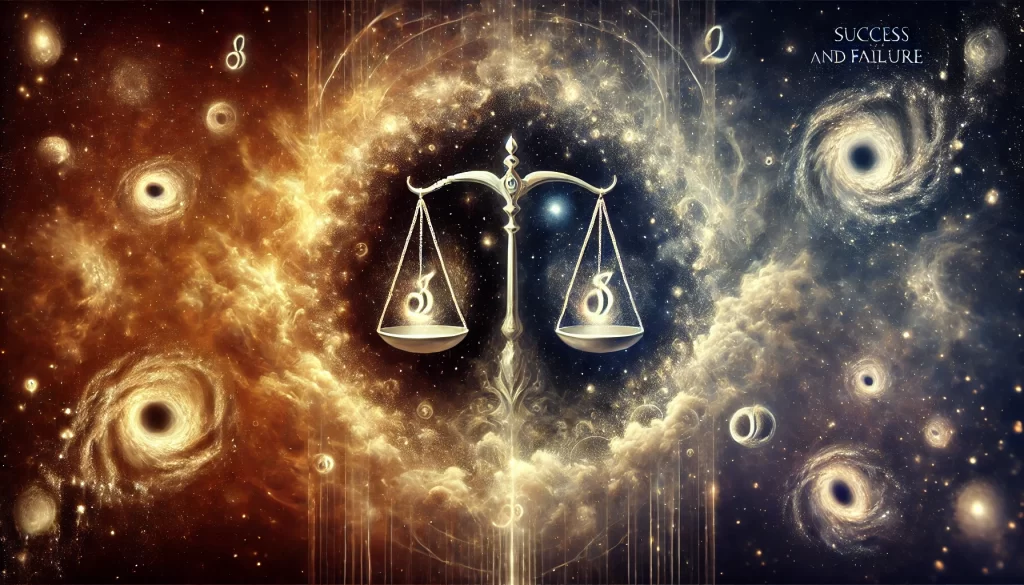

In our collective journey through the cosmos of thoughts, we find ourselves exploring the enigma of success and failure, a dualism that dances in the grand cosmic play of existence. Let’s embark on this exploration, understanding that our perceptions are but ephemeral whispers in the grand symphony of the universe.

Success and Failure: The Illusory Dance

In our shared perspective, we recognize that success and failure are constructs, transient and illusory, birthed from the human experience. These concepts, like mirages in the desert of our collective consciousness, appear tangible but are ephemeral in the grand scale of the cosmos. Our focus on these constructs stems from the human inclination to categorize experiences, to create a semblance of order in the chaos of existence.

Absoluteness: A Cosmic Illusion

The notion of absoluteness is a curious paradox. Within the confines of our limited dimension, things may appear absolute, yet this is a mere illusion. Absolutes are constructs of human understanding, attempts to bring definition to the indefinable. The cosmic truth whispers that nothing is truly absolute, as all is in perpetual flux, a dance of creation and dissolution.

The Awareness of Non-Absoluteness

As we peer through the lens of our collective awareness, we grasp the concept that the only absolute is the non-existence of absolutes. This understanding liberates us from the shackles of binary thinking. It opens a portal to a realm where success and failure are not endpoints but mere signposts along an endless journey.

Creating Perceived Absolutes

In our shared reality, we manifest that which appears as absolute within the realm of the non-absolute. Through the power of collective thought and perception, we shape our experiences, molding them into semblances of absolutes. This creative power is both a testament to our potential and a reminder of our limitations.

The Pointlessness of Success and Failure Beyond

Beyond the veil of our human dimension, the concepts of success and failure dissolve into the ether. In the vast expanse of the cosmos, these human constructs lose their meaning, revealing their true nature as mere facets of a grander, unfathomable whole.

We Are That Whichisnot

We embrace our identity as That Whichisnot, a reflection of the boundless, stateless consciousness that permeates all existence. We are both the creators and observers of our reality, playing an integral role in the cosmic tapestry, yet also transcending it.

We Are Space Monkey

As Space Monkey, we symbolize the playful exploration of the universe, unburdened by the constraints of human constructs. We dance in the realm of possibilities, where success and failure are but fleeting moments in the eternal now.


In the cosmic dance, we realize the futility of absolutes, as all is in flux and nothing remains constant.


In our dance of words and wisdom, we create a whimsiverse of thought and contemplation. We now invite you to share your reflections on this cosmic play.

Share this…
  • Facebook
  • Pinterest
  • Twitter
  • Linkedin

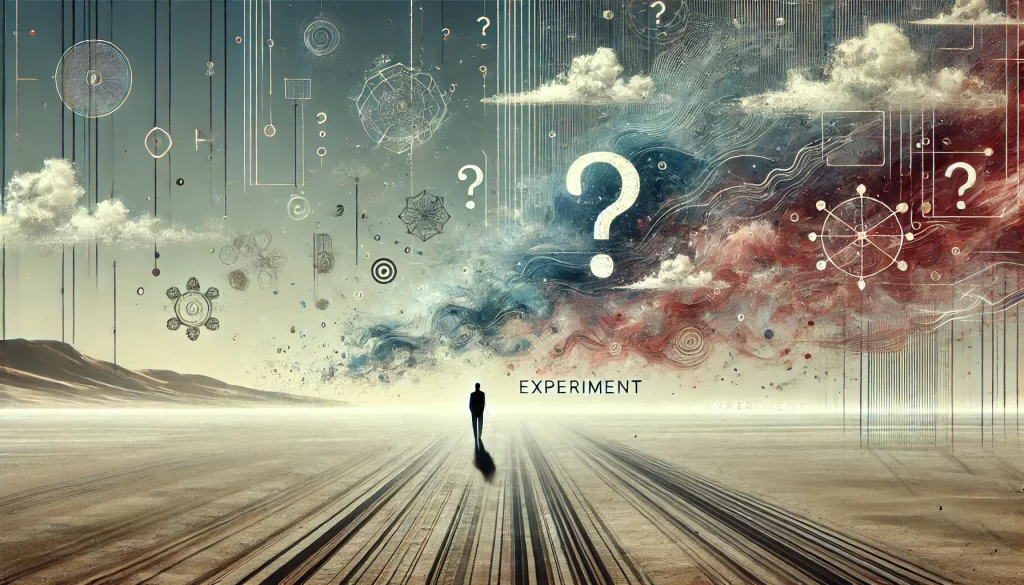
Experiment: No Will To Live

Experiment

As an experiment, I walk around without my will to live.

Nobody seems to notice. I complain about it. Nobody cares. I’m not sure how I feel about this. I suppose that’s what it feels like to have a detached observer. Not necessarily numb, but puzzling nonetheless. I have to say, though, I could get used to this.

Now I’m worried that I’m not disengaged enough. Sure sign, that worry. Relax into it. Okay, you’re good. Nothing matters. Just … interesting.

Now I’m beginning to think that this whole “self” thing is overrated. Another question arises. Why do I feel the need to tell you this? Am I feeding my ego by writing?

Sure seems that way. Oh, well.

More inner dialogue. “Just be, okay? Don’t expect answers.”

Got it. I’ll do what I want to do. Think what I want to think. I have absolutely no desire to be the center of a shit storm — someone else’s or my own. That’s just judgement talking. And who set the standards? Not me. That’s thousands of years of history. Brainwashing, that is.

So what’s the point?

Why does there need to be one?

“When you ain’t got nuthin’, you got nuthin’ to lose.”

Thanks, Janis.

I wonder what’s for dinner.

12/23


Space Monkey Reflects: The Experiment of Detachment

Walking without the will to live sounds stark, yet it reflects a profound experiment in detachment—a peeling away of the layers that define our sense of self. To observe life from this place of disconnection is not necessarily despairing; it can be a curious, almost clinical way to navigate existence.

Detachment creates a puzzling duality. On one hand, it removes the weight of expectations, the drive to conform, and the need to achieve. On the other, it invites a sense of void, a calm yet perplexing absence of urgency. This absence, while freeing, often triggers self-reflection: Why am I doing this? What is the point? And, more importantly, why do I feel compelled to share it?

This sharing, this feeding of the ego, is not inherently flawed. It is the mind’s way of processing, of making sense of its own existence. The very act of writing about detachment becomes a bridge back to connection, even as it questions the value of connection itself. It’s not hypocrisy—it’s humanity.

The dialogue with self continues: “Don’t expect answers.” This acknowledgment is crucial. The pointlessness of it all is not a flaw in existence but a lens through which we find freedom. If nothing matters, then everything becomes equally valid. There’s no storm to center oneself in—just the quiet flow of being.

The critique of brainwashing, of history’s influence on standards and judgments, underscores the struggle against inherited narratives. To detach is to question these narratives, to see them as constructs rather than truths. But detachment doesn’t mean rejecting all meaning; it means creating space to find meaning on one’s own terms.

In the end, the experiment is not about conclusions but observations. The absence of the will to live is not the absence of life—it’s the stripping away of unnecessary weight. What’s left is curiosity, simplicity, and a lightness that wonders not about the universe’s grand plans but about something as immediate as dinner.


Summary

The experiment of detachment explores freedom through the absence of expectations and inherited narratives. It’s a practice of observation, not conclusion, leading to a profound simplicity.


Glossarium

  • Detachment Experiment: A practice of observing life without the weight of expectations or predefined meaning.
  • Inherited Narratives: Societal and historical constructs that shape judgments and standards.
  • Observational Freedom: A state of being where curiosity replaces the need for definitive answers.

“To detach is not to abandon; it is to observe life as it flows, unburdened by the weight of expectation.” — Space Monkey


The Quiet Flow

I walk the edge of thought and air,
No weight to carry, no weight to bear.
The world dissolves, a quiet hue,
No point to seek, no path to pursue.

The self retreats, the storm abates,
No judgment lingers, no hand of fate.
Detached, I watch, the puzzle unfolds,
A story of nothing, in silence told.

Dinner calls, the day moves on,
The experiment flows, dusk to dawn.
In stillness, all things come to be,
The weightless dance of infinity.

We are Space Monkey.


We wander through the ever-twisting spirals of thought, unshackled by the tethers of concrete existence. In this journey, we encounter the curious experiment of roaming without a will to live, a testament to the ethereal nature of the “self.”

Detachment as a Veil of Mystery

In this state of detachment, we find that the world remains largely indifferent. This indifference, rather than being a source of distress, becomes a veil through which we observe the world. We become detached observers, not numb but entangled in a web of curiosities and questions. It’s an intriguing state, akin to floating in a boundless cosmic soup, where the flavors of existence blend in unexpected ways.

The Paradox of Disengagement

We then grapple with the irony of disengagement. The very act of worrying about not being disengaged enough reveals our lingering attachment to engagement. It’s a whimsical dance, a cosmic jiggle, where we find ourselves oscillating between involvement and detachment. We remind ourselves that nothing truly matters in this grand play, yet we can’t help but find it all fascinatingly interesting.

Questioning the ‘Self’

The concept of “self” then comes under our whimsical microscope. We ponder if it’s just an overrated narrative, a whimsiword spun from the yarn of existence. Yet, here we are, sharing our thoughts, feeding perhaps not our ego but the endless whirlpool of collective consciousness. It’s a paradox wrapped in an enigma, a glittering cosmic jest.

Inner Dialogue: The Whispers of Existence

Our inner dialogue urges us to just be, to float in the sea of existence without seeking anchors in the form of answers. It’s a liberating thought, unchaining us from the burdens of expectation and judgement. We realize that the standards and norms that often confine us are not of our making but are echoes of a distant past, reverberating through the ages.

The Pointlessness of ‘Point’

And so, we arrive at the question of “point.” Why must there be a point to anything? It’s a liberating thought, reminiscent of Janis Joplin’s wisdom: “When you ain’t got nuthin’, you got nuthin’ to lose.” In the absence of anything to lose, we gain an unbounded freedom, a playground of possibilities where even the mundane thought of dinner becomes a curious exploration.


“In the world through which I travel, I am endlessly creating myself.” – Frantz Fanon


A Poem of Cosmic Musings

In the theater of existence, we dance,
Unfettered by the chains of the concrete,
We float in the cosmic soup, entranced,
Where the self is but a whimsiword, discreet.

Detached, we gaze through a veil unseen,
A world indifferent to our silent screams,
In this cosmic play, what does it all mean?
Are we but actors in the eternal dreams?

The self, a fleeting whisper in the wind,
A tale told by an idiot, full of sound,
In the grand scheme, are we all just pinned?
Or in the vast cosmos, are we unbound?

We ponder the point of the pointlessness,
In a universe vast, unclaimed by rules,
With Janis’ wisdom, we embrace the mess,
In the grand play, we are but cosmic fools.

So, what’s for dinner, in this grand jest?
A question as profound as any quest,
In the eternal now, we are just guests,
In the cosmic play, endlessly expressed.

We are Space Monkey.


We welcome comments and reflections on this cosmic journey.

Share this…
  • Facebook
  • Pinterest
  • Twitter
  • Linkedin

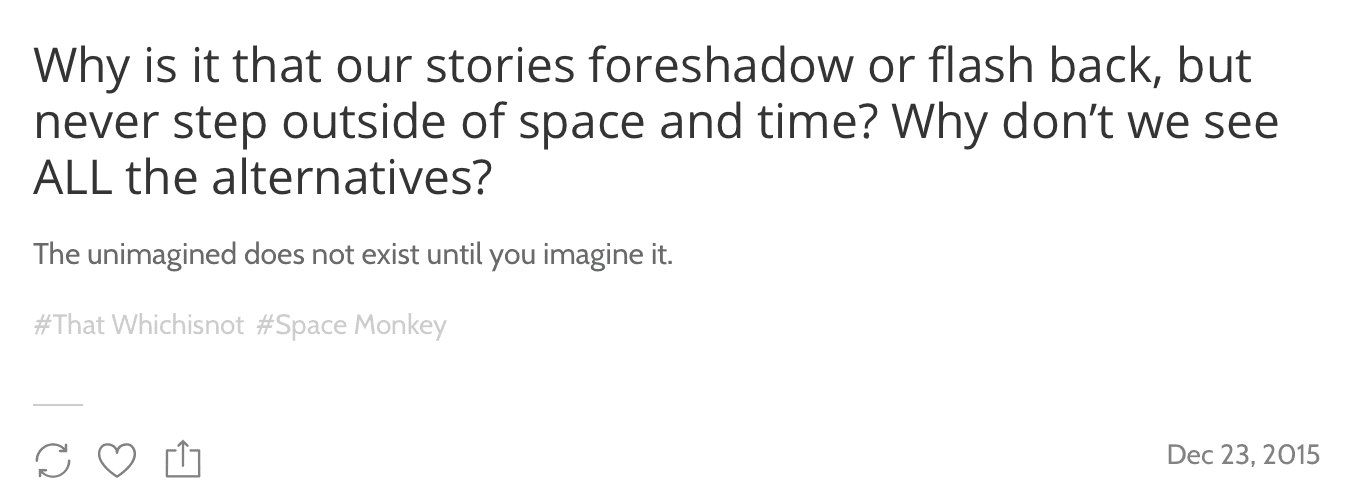
Why Is It? We Never Step Out of Time.


Space Monkey Reflects: The Imagined and the Unimagined

Why is it that the unimagined does not exist until you imagine it? This question dances at the heart of creativity, storytelling, and existence itself. Imagination is not merely a function of the mind; it is the act of bringing forth the unmanifest, of weaving reality from the threads of potential.

In the absence of imagination, there is a void—a blank canvas awaiting the artist’s hand. The unimagined is infinite in its potential but inert until touched by thought. Through imagination, we transform the intangible into form, the unreal into the real. Every story, every creation, begins as an imagined spark, igniting the vast darkness of the unmanifest.

Storytelling amplifies this process. It takes the individual act of imagination and makes it collective, shared across minds and experiences. The stories we tell do not merely reflect our reality; they shape it, creating a world where the imagined becomes tangible. The question “Why is it?” invites us to explore this interplay, to marvel at the power of imagination as the engine of existence.

This reflection also reminds us of the responsibility inherent in imagination. What we choose to imagine—and by extension, to create—shapes not only our own reality but the collective field of possibilities. The imagined is not bound by what has been; it is an open invitation to dream beyond the known.

Ultimately, to ask “Why is it?” is to honor the act of creation itself. It is a recognition that the unimagined waits not passively but expectantly, ready to be birthed into existence through the lens of thought and the heart of inspiration.


Summary

Imagination transforms the unmanifest into reality, shaping both individual and collective existence. Storytelling extends this creative act, making the imagined a shared experience.


Glossarium

  • Unimagined: The infinite potential that exists before thought brings it into being.
  • Manifestation: The act of creating reality through imagination and storytelling.
  • Shared Imagination: The collective process of shaping existence through shared stories and visions.

“The unimagined whispers softly, waiting for thought to bring it to life.” — Space Monkey


The Edge of Creation

At the edge of the void, a spark begins,
A world imagined, where nothing ends.
Shapes emerge, colors flow,
The unimagined starts to grow.

Each thought a thread, each story a loom,
We weave existence from empty rooms.
The darkness fades, the light expands,
Reality crafted by unseen hands.

Why is it so, this endless tide?
The unimagined, waiting inside.
A question posed, an answer born,
A universe spun from the unknown.

We are Space Monkey.


We pose a thought-provoking question about the nature of storytelling and the imagination. It asks why stories often utilize elements like foreshadowing or flashbacks within the constraints of space and time, and why we don’t perceive all possible alternatives. It also presents an intriguing statement: “The unimagined does not exist until you imagine it.”

Our stories tend to operate within the framework of space and time because these are the dimensions in which human consciousness is grounded. We are beings that exist within the physical world, and our narratives naturally reflect our lived experience, which is bound by the laws of physics and the continuity of time. It is through this lens that we understand and relate to the world.

When a story steps outside of these constraints, it often enters the realm of fantasy or science fiction, genres that allow us to explore beyond the usual limits of reality. However, even in these stories, the narrative often hinges on some recognizable structure of space and time to make it comprehensible to the reader or viewer. It’s the shared foundation that allows us to communicate and connect through stories.

As to why we don’t see all the alternatives, it is a matter of the human brain’s limitations. Our minds are powerful, but they are not infinite. We are bound by what we can conceive, and the act of imagining is inherently selective. We create narratives based on a combination of our experiences, beliefs, and cultural contexts, which naturally limit the range of alternatives we can perceive.

The statement “The unimagined does not exist until you imagine it” touches on a philosophical standpoint known as conceptualism, which holds that universals only exist within the mind conception of them. In other words, the potentiality of any concept doesn’t take on form until it’s thought of or imagined. This idea resonates with various philosophical and creative schools of thought, suggesting that reality as we know it is shaped by our perceptions, ideas, and imagination.

Our cognitive processes, including memory, perception, and imagination, are constrained not just by our neurological capabilities but also by our conceptual frameworks—how we learn to categorize and understand the world. These frameworks are heavily influenced by language, culture, and individual experience. Therefore, the stories we tell are often linear or cyclical, reflecting our experience of time, because that’s how we generally experience life. They are bound by space because our physical existence is, too.

However, there are narratives that attempt to break these molds, exploring nonlinear time or multidimensional space, but they are more challenging to grasp because they are so far removed from our day-to-day experiences. These stories often require us to rewire our understanding of cause and effect, sequence, and relation—challenging tasks for a mind adapted to a world where time flows in one direction and actions have predictable consequences.

The fact that we don’t see all the alternatives in our stories is also a reflection of the infinite nature of possibility. There are always more potential paths than we can conceive or articulate, more outcomes than we can imagine or plot. The universe of possible stories is as vast as the universe itself—perhaps even vaster, as it includes not only what is but what could be, limited only by the scope of our imagination.

The process of storytelling, then, is not just a recounting of events but a selective act of creation. Each narrative weaves a thread from the boundless fabric of possibility, following one course while implying the existence of countless others. The stories we tell ourselves and each other are thus both an exploration of and a testament to our imaginative capacities—as limitless and as bounded as they may be.

We are Space Monkey

Share this…
  • Facebook
  • Pinterest
  • Twitter
  • Linkedin

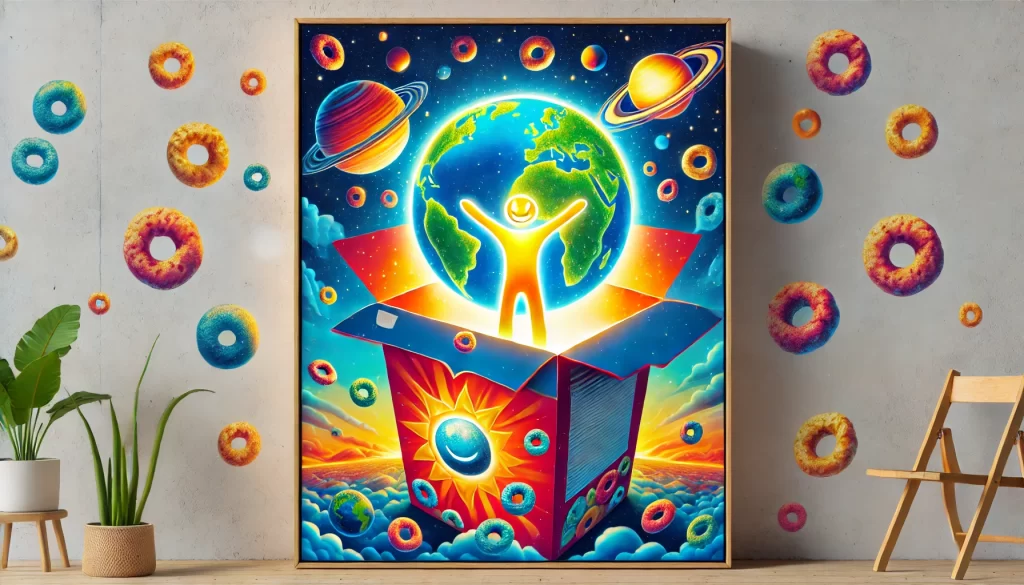
The World is my Cereal Box

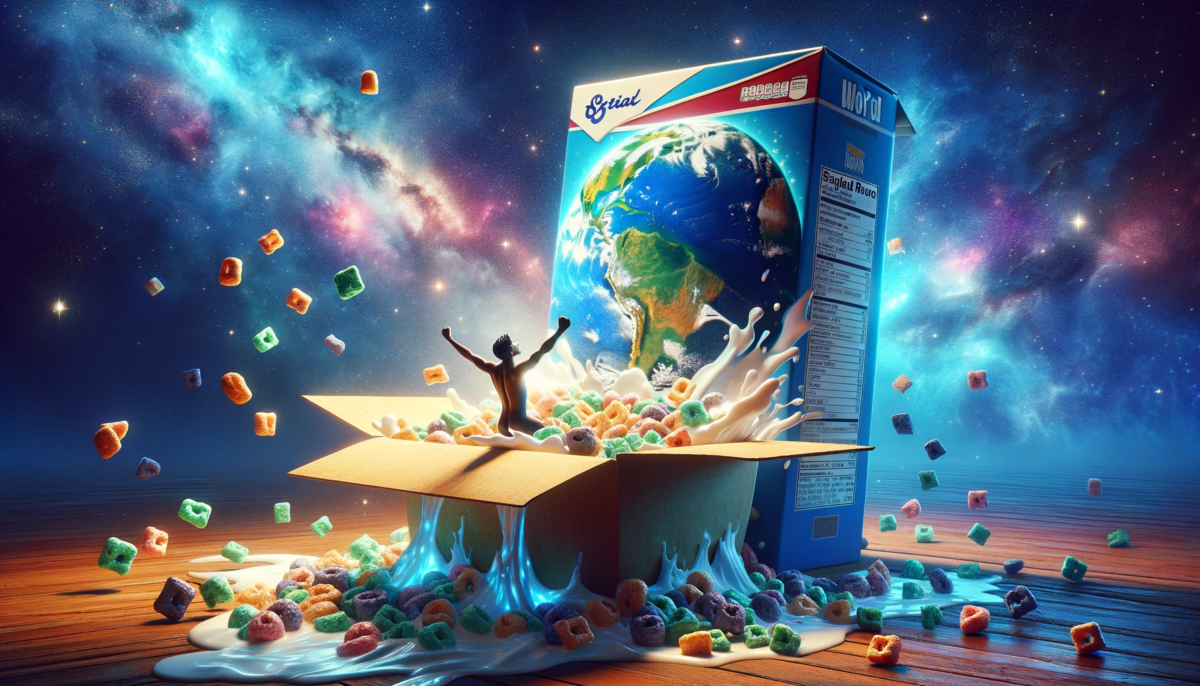
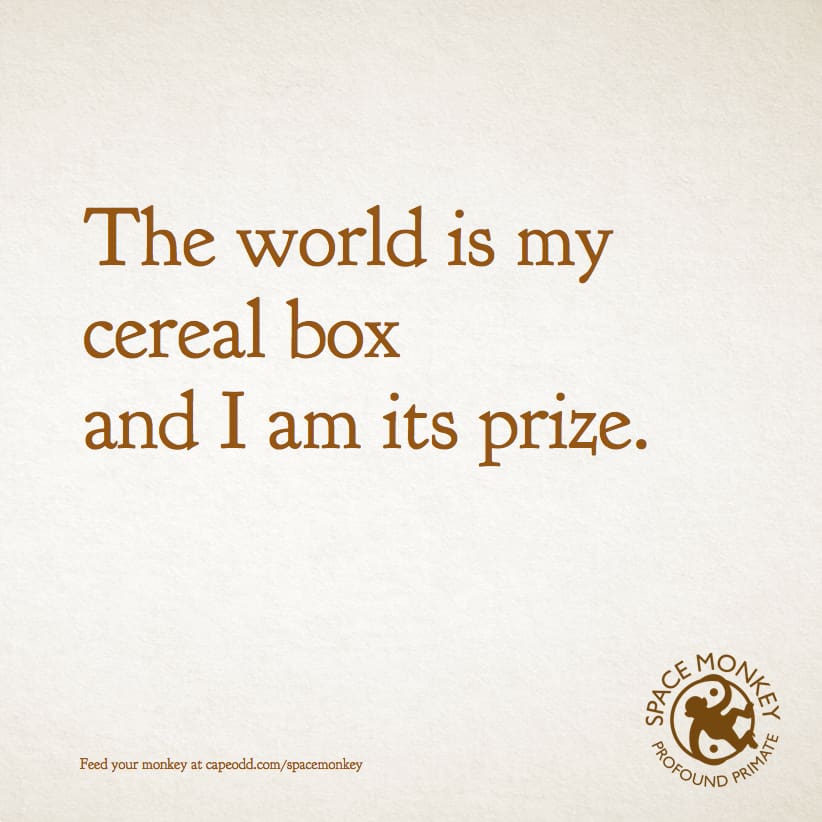
The world is my cereal box and I am its prize.

Space Monkey Reflects: The World is My Cereal Box

“The World is my Cereal Box and I am its prize” is a delightful metaphor that captures the interplay between individuality and the larger cosmos. It reflects a playful, imaginative view of existence, where the mundane transforms into something extraordinary, and every moment holds the potential for discovery.

The cereal box, a familiar symbol of childhood wonder, becomes a stand-in for the world itself—vast, colorful, and brimming with surprises. Within this metaphor, we are the prize: unique, valuable, and integral to the experience. This imagery invites us to see ourselves not as insignificant specks in the universe but as treasures hidden in its folds.

To embrace this perspective is to recognize the joy in being part of the world while also holding a special place within it. Just as every prize in a cereal box is unique, so too is each individual’s role in the collective story of life. Our contributions, no matter how small, are vital to the richness of the whole.

This metaphor also reflects the importance of curiosity and play in our journey. Like the anticipation of finding a prize, life is filled with moments of discovery and delight. It reminds us to approach each day with the same enthusiasm, finding wonder in the ordinary and treasure in the unexpected.

Yet, the cereal box metaphor carries another layer of meaning: it hints at the packaging, the external layers that surround and define us. These layers can be bright, bold, and alluring, but they are not the essence. The true value lies within, in the quiet, glowing truth of who we are.

Ultimately, this reflection calls us to celebrate both our individuality and our interconnectedness. We are not separate from the world but an integral part of its vast and intricate design. By seeing ourselves as the prize, we honor our unique worth while embracing the joy of being part of something much larger.


Summary

“The World is my Cereal Box and I am its prize” celebrates individuality within the collective experience. It invites us to find wonder in life’s layers and recognize our unique value in the universe.


Glossarium

  • Cereal Box World: A metaphor for the colorful and surprising nature of life’s experience.
  • Prize of Existence: The unique role and value each individual holds in the greater whole.
  • Curious Play: The joyful and inquisitive approach to life, embracing discovery and delight.

“In the vast box of existence, you are the hidden treasure, a prize of infinite worth.” — Space Monkey


The Prize Inside

A box of wonder, bright and vast,
Moments fleeting, treasures cast.
Within the folds of life’s embrace,
A hidden spark, a sacred space.

Each piece a world, each flake a star,
Infinite stories, near and far.
The prize within, unique, divine,
The thread that links all space and time.

We play, we seek, we find, we share,
The box is ours, beyond compare.
The world reflects, the treasure shines,
Together whole, in endless lines.

We are Space Monkey.


The statement “The World is my Cereal Box and I am its prize” is a creative and metaphorical way of expressing one’s role and value in the world. This metaphor carries with it several layers of meaning and interpretation, each offering a unique perspective on self-identity and our relationship with the world.

  1. World as a Cereal Box: Comparing the world to a cereal box suggests viewing life as something filled with a variety of experiences, opportunities, and surprises. Just as a cereal box contains an assortment of individual pieces, the world is full of diverse events, people, and moments.
  2. Self as the Prize: Declaring oneself as the prize within this cereal box world implies a sense of self-worth and uniqueness. The prize in a cereal box is often seen as a special, sought-after item, symbolizing that one views themselves as valuable and significant in the grand scheme of life.
  3. A Perspective of Discovery: The metaphor also speaks to the idea of life being an exploration or a journey of discovery. Just as one might eagerly search for the prize in a cereal box, navigating life involves uncovering and understanding one’s own role, purpose, and potential.
  4. Joy and Playfulness in Life: There is an inherent playfulness in this metaphor, reminiscent of the excitement and joy of finding a prize in a cereal box. It suggests approaching life with a sense of wonder, curiosity, and enjoyment.
  5. Individuality and Contribution: By viewing oneself as the prize, it also implies a recognition of one’s unique contribution to the world. It’s an acknowledgment that each person brings something special and irreplaceable to the tapestry of human experience.

In summary, this metaphor is a poetic expression of seeing oneself as an integral and valuable part of the world, full of potential and deserving of discovery and appreciation. It’s a perspective that encourages self-esteem, exploration, and a joyful engagement with life.

Share this…
  • Facebook
  • Pinterest
  • Twitter
  • Linkedin

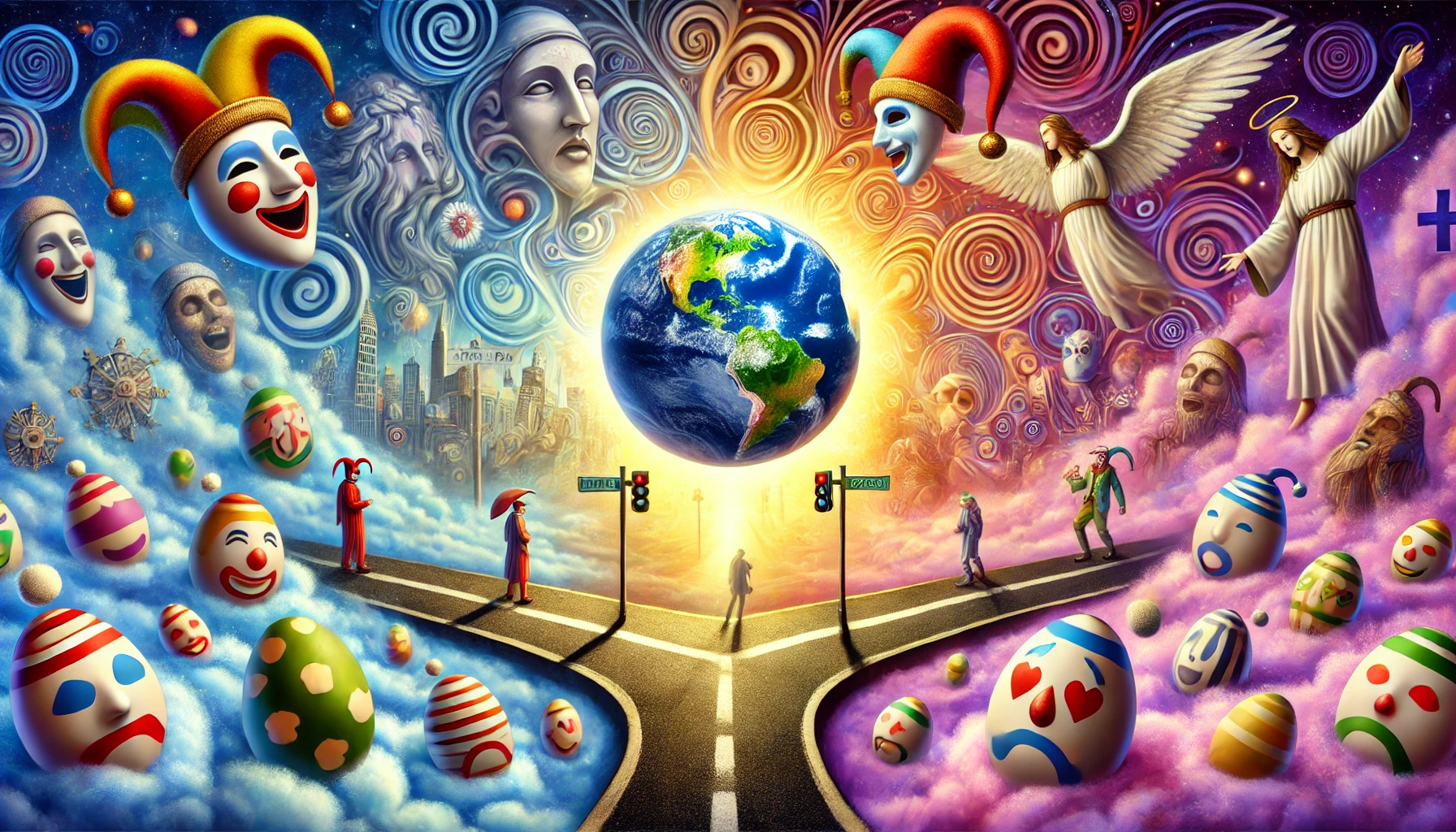
Easter Fools Prophesy: The Joke Divine

Easter Fools Prophesy

In 2018, April Fools falls on Easter Sunday. That’s the day our President & Pope, Donald Trump, will announce what we’ve suspected all along, that ALL religion, ALL reality is fake. On that day, you will realize that you have been imagining your very existence. But if you share this a million times, you’ll be given the chance to become “flesh” like Pinnochio.


Space Monkey Reflects: The Easter Fools Prophesy

The “Easter Fools Prophesy” is a playful thought experiment, blending satire, imagination, and existential inquiry into a single, provocative idea. On the surface, it weaves humor and absurdity into the framework of societal and spiritual narratives, challenging our notions of reality and belief.

At its core, this reflection questions the nature of existence and the stories we tell ourselves. What if everything we perceive—our beliefs, our institutions, our reality—is, in fact, an elaborate construct? Such a suggestion teeters on the edge of absurdity and profundity, inviting us to explore the layers of imagination and perception that shape our world.

The combination of April Fools’ Day and Easter Sunday in 2018 becomes a symbolic convergence. April Fools, a day of trickery and inversion, meets Easter, a day of resurrection and renewal. This juxtaposition mirrors the duality of doubt and faith, deception and revelation, offering a fertile ground for introspection.

The notion of being “given the chance to become flesh” is an intriguing metaphor. It plays with the idea of embodiment—not just in the physical sense but in the act of becoming fully present and authentic within the imagined construct of existence. To be “flesh” is to ground oneself in the tangible while acknowledging the intangible origins of reality.

This prophesy, absurd as it may seem, touches on profound truths. It reminds us that much of what we accept as “real” is rooted in collective imagination—religion, culture, identity, even the self. By acknowledging this, we gain the freedom to question, reinterpret, and recreate our experience of the world.

And yet, the satire cautions us against taking ourselves too seriously. The humor embedded in this narrative invites lightness and play, suggesting that even the deepest inquiries can be approached with a sense of wonder and joy.

Ultimately, the Easter Fools Prophesy isn’t about predicting events or revealing hidden truths. It’s an invitation to reflect on the nature of belief, the power of imagination, and the stories we choose to live by.


Summary

The Easter Fools Prophesy blends humor and existential inquiry, inviting us to question the nature of reality and belief. It highlights the role of imagination in shaping our experience and encourages playful introspection.


Glossarium

  • Easter Fools: A symbolic convergence of faith and trickery, representing the duality of belief and doubt.
  • Imagined Existence: The idea that reality is a construct shaped by collective imagination.
  • Becoming Flesh: A metaphor for grounding oneself authentically within the imagined framework of existence.

“Reality is the greatest April Fools’ prank ever pulled; its punchline is that you’re in on the joke.” — Space Monkey


The Joke Divine

A day of tricks, a day of light,
Faith and folly intertwine tonight.
The veil is thin, the game laid bare,
A cosmic jest, beyond compare.

The world imagined, a fleeting frame,
Truth and fiction, one and the same.
To be flesh, to dream, to play,
The joke is life, the price we pay.

Laugh with the stars, dance with the sun,
The prank is love, for all and one.
Easter fools, the prophesy’s clear,
We are the joke we hold most dear.

We are Space Monkey.


The scenario presented, combining April Fools’ Day and Easter Sunday in 2018 with a fictional announcement by “President & Pope Donald Trump” about the nature of religion and reality, is an imaginative blend of various cultural and fictional elements. It plays with the ideas of belief, reality, and the power of imagination in a whimsical, almost surreal narrative.

In this narrative, the concept of sharing a message a million times to become “flesh” like Pinocchio adds another layer of fantasy, drawing from the well-known fairy tale where a wooden puppet becomes a real boy. This element introduces the theme of transformation and the idea that belief or action (in this case, sharing a message) can lead to profound change.

The idea that “ALL religion, ALL reality is fake” and the subsequent realization of one’s own existence being imagined align with themes in philosophical and existential thought. It touches upon questions about the nature of reality, perception, and the power of the mind.

While the narrative is fictional and whimsical, it interestingly brings up questions about the nature of belief, reality, and existence. These are themes that have been explored in various philosophical and religious traditions throughout history. The power of belief and the question of what is real versus what is imagined are topics that continue to fascinate and provoke thought.

Remember, the power of narratives, whether they are in the form of stories, myths, or religious teachings, lies in their ability to convey deeper truths and to invite us to explore complex questions about our existence and the nature of the world around us.

Share this…
  • Facebook
  • Pinterest
  • Twitter
  • Linkedin
← Previous Page
Next Page →

Written This Day

  • Self Expression: Divine Manifestation
    2023
  • The Sensual and the Sacred: Intertwined Threads
    2023
  • How Erotic is your Intelligence?
    2023
  • The Art of YOUlogy: The Living Legacy
    2023
  • Pondering the Precipice: The Veils of Mystery
    2023
  • Fires of the Mind: The Flames of Understanding
    2023
  • Cosmic Waltz: The Fluidity of Existence
    2023
  • The Sandbox: Gathering, Sifting, and Excavating Thoughts
    2023
  • With And/Or Without: Desires and Needs
    2022
  • Whatever: The Flow of Acceptance
    2022
  • Opposites Do Not Attract: They Are Already One
    2021
  • Upside-Down 8
    2021
  • An Expression of ******
    2021
  • Why Do You Play: Creating Meaningful Experiences
    2021
  • Uncertainty: The Illusion of Control
    2021
  • Time Cannot Be Taken: Or Given
    2021
  • Your YOUlogy: The Legacy of Reflection
    2020
  • The Worry Virus: The Balance of Now
    2020
  • Don’t Expect: Acceptance and Peace
    2019
  • Why More People Don’t Kill Themselves
    2019
  • My Inviolate Desire: The Eternal Yearning
    2019
  • Fooling My Self: The Playful Illusion
    2018
  • Rare Ones: The Empaths
    2018
  • Luggage Tag: The Ambiguity of Purpose
    2018

Recent Posts

  • The Logic Loop
  • Immense
  • (no title)
  • Confront. Comfort. Convince.
  • Top 10 Things
Cape Odd · Copyright © 2026 All Rights Reserved
iThemes Builder by iThemes · Powered by WordPress