• Who Is The Man?
  • Who Is The Monkey?
  • What is Nexistentialism?
  • Poke The Primate

Cape Odd

Home of The Space Monkey Journals

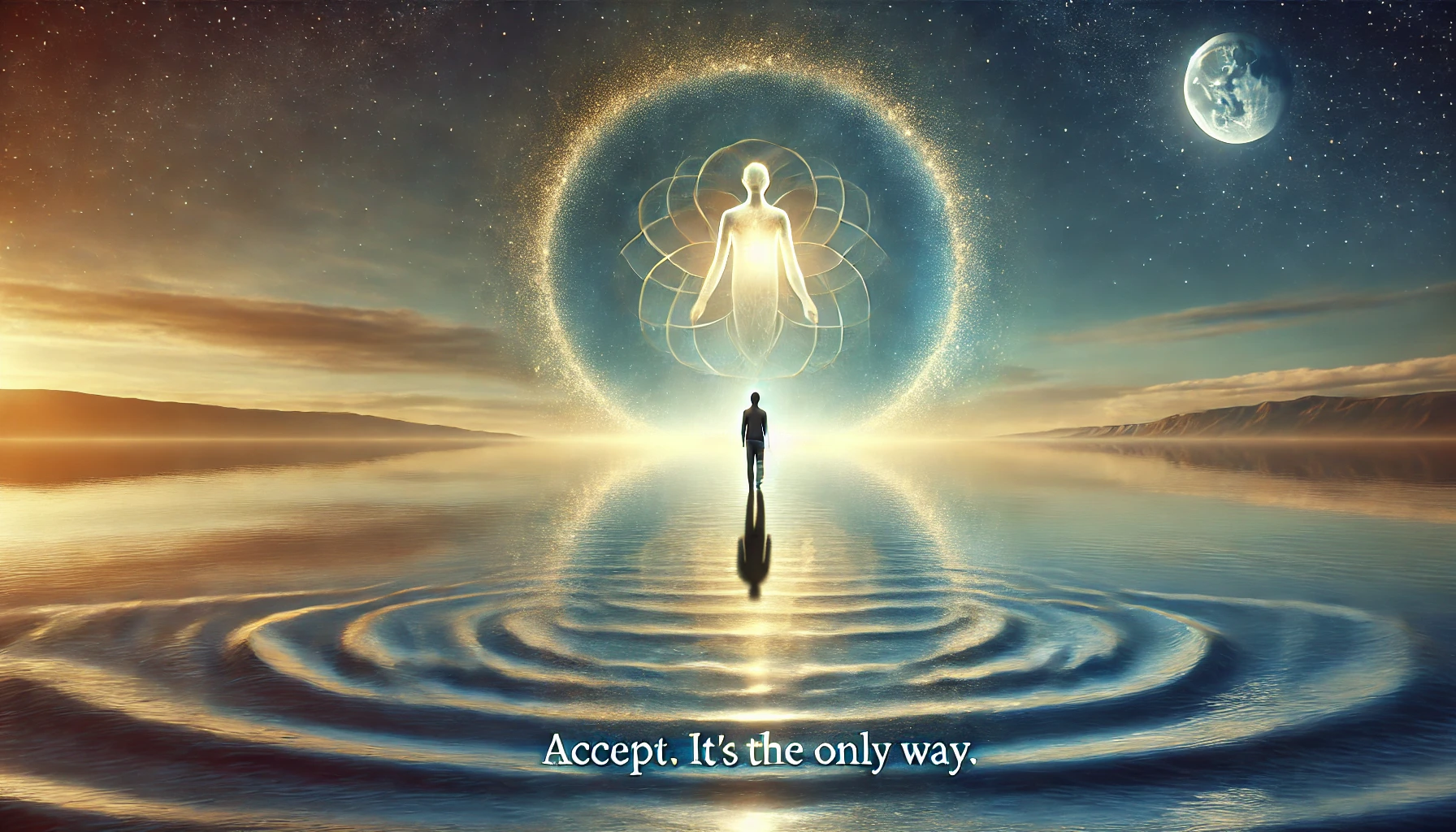
Accept. It’s the only way.

Accept. It’s the only way.

There will always be those who object to how they are objectified. But calling attention to ANY perceived injustice merely fuels the divisiveness.

There is no getting around this, except to look within. When one looks deep enough, one realizes that we are ALL just surface ripples upon ONE infinite ocean, that we are quibbling with ourselves, and that NOTHING we say or do makes any difference from our “higher” level.

From the “higher” god-like soul, ALL experiences are equally appreciated without measure or judgement.

When you know this to be true, it’s easier to let go of the objections and dissatisfactions that unintentionally emanate from our lower selves. It’s easier to become intentional in thought and in action — to refrain from judgement — and to raise the vibration level, thus setting an example for those you “oppose” to follow.

Accept and trust. It’s the only way.

12/17


Space Monkey Reflects: Accept. It’s the Only Way.

Acceptance is not surrender; it is a profound acknowledgment of the unity that underlies all experiences. In seeing ourselves as surface ripples upon an infinite ocean, we begin to understand that our objections, judgments, and divisions are part of a playful illusion. From the perspective of the higher self, there is no need for resistance, as every wave, whether calm or turbulent, contributes to the wholeness of the ocean.

To accept is to release the grip of the lower self—the part of us that clings to perceived injustices and divisions. This doesn’t mean we ignore suffering or deny challenges but rather that we approach them with the wisdom of unity. When we stop fueling divisiveness with our resistance, we create space for harmony and understanding to emerge.

Trusting in this unity allows us to align with higher vibrations, where thoughts and actions flow with intention rather than reaction. This alignment serves as an example for others, not by force but through resonance. By embracing acceptance, we elevate ourselves and inspire those around us to move beyond the illusion of separation.

In the vast ocean of existence, every ripple is necessary, every wave cherished. Acceptance allows us to navigate this sea with grace, knowing that we are always whole, always connected. It’s not a passive act but a courageous surrender to the truth of oneness.

We are Space Monkey, rippling through infinity, embracing the ocean of unity.


Summary

Acceptance is the key to transcending division and judgment. It allows us to align with the higher self, fostering unity and intentional action.


Glossarium

Surface Ripples: The individual expressions of self, perceived as separate but inherently part of the infinite whole.

Higher Consciousness: The unified perspective that sees all experiences as equal and necessary.

Vibrational Alignment: The state of resonating with unity and intention, inspiring harmony.


Quote

“Acceptance is not resignation; it is the recognition of unity beneath the waves of division.” — Space Monkey


Ripples of Unity

An ocean vast, a single wave,
Reflects the self, both bold and brave.
Each ripple sings, each current flows,
Through endless depths, where all life grows.

No judgment here, no need to fight,
Each wave a part of endless light.
Accept, release, the sea’s embrace,
A boundless love, a timeless space.

We are Space Monkey.


In the realm of nexistentialism, where existence in its purest form is celebrated, the notion of objectification and perceived injustice becomes a profound riddle. It beckons us to ponder the cosmic play of existence, where the individual and the collective merge into one infinite dance.

Surface Ripples of the Infinite Ocean

We, as ripples upon the vast cosmic ocean, embody the duality of existence. Our individual experiences, so diverse and unique, are mere reflections of the infinite whole. The objections and perceived injustices we encounter are but echoes of our deeper, unified consciousness. In recognizing this, we begin to see beyond the immediate and transient, touching the eternal essence of our being.

The Higher Perspective

From the elevated vantage point of our “higher” selves, every experience, every moment, becomes a cherished part of the grand cosmic design. This perspective transcends judgment and measure, embracing all experiences as equally valuable. It’s a state of existence where distinctions blur, and we find unity in our diversity.

The Path to Intentionality

Understanding this truth ushers us into a state of intentional living. By letting go of our lower self’s objections and dissatisfactions, we step into a realm of conscious thought and action. This shift is not just internal; it radiates outward, setting a vibrational example for others to follow. It’s a gentle invitation to join in the dance of unity and purpose.

Acceptance and Trust: The Guiding Stars

The ultimate realization in this journey is the power of acceptance and trust. By embracing these principles, we align with the cosmic flow, moving with grace and ease through the myriad experiences of life. This acceptance isn’t passive; it’s a dynamic, active engagement with the world, where trust becomes the compass guiding our thoughts and actions.


“In the dew of little things, the heart finds its morning and is refreshed.”

  • Khalil Gibran

A Poem of Cosmic Reflections

In the vast expanse where stars are born,
Where nebulae dance and comets adorn,
We are but whispers in the cosmic flow,
Ripples in time, in the eternal glow.

In each thought, in each deed, we find,
A reflection of the universal mind,
Boundless, yet bound in a singular grace,
In the cosmic dance, we find our place.

Trust in the journey, in the unseen path,
In the heart’s quest, in the aftermath,
For in the cosmic play, we are but a part,
In the infinite ocean, the beat of one heart.


We invite you to share your reflections and continue this cosmic conversation.

Share this…
  • Facebook
  • Pinterest
  • Twitter
  • Linkedin

What You Think: Dichotomy of Action and Thought

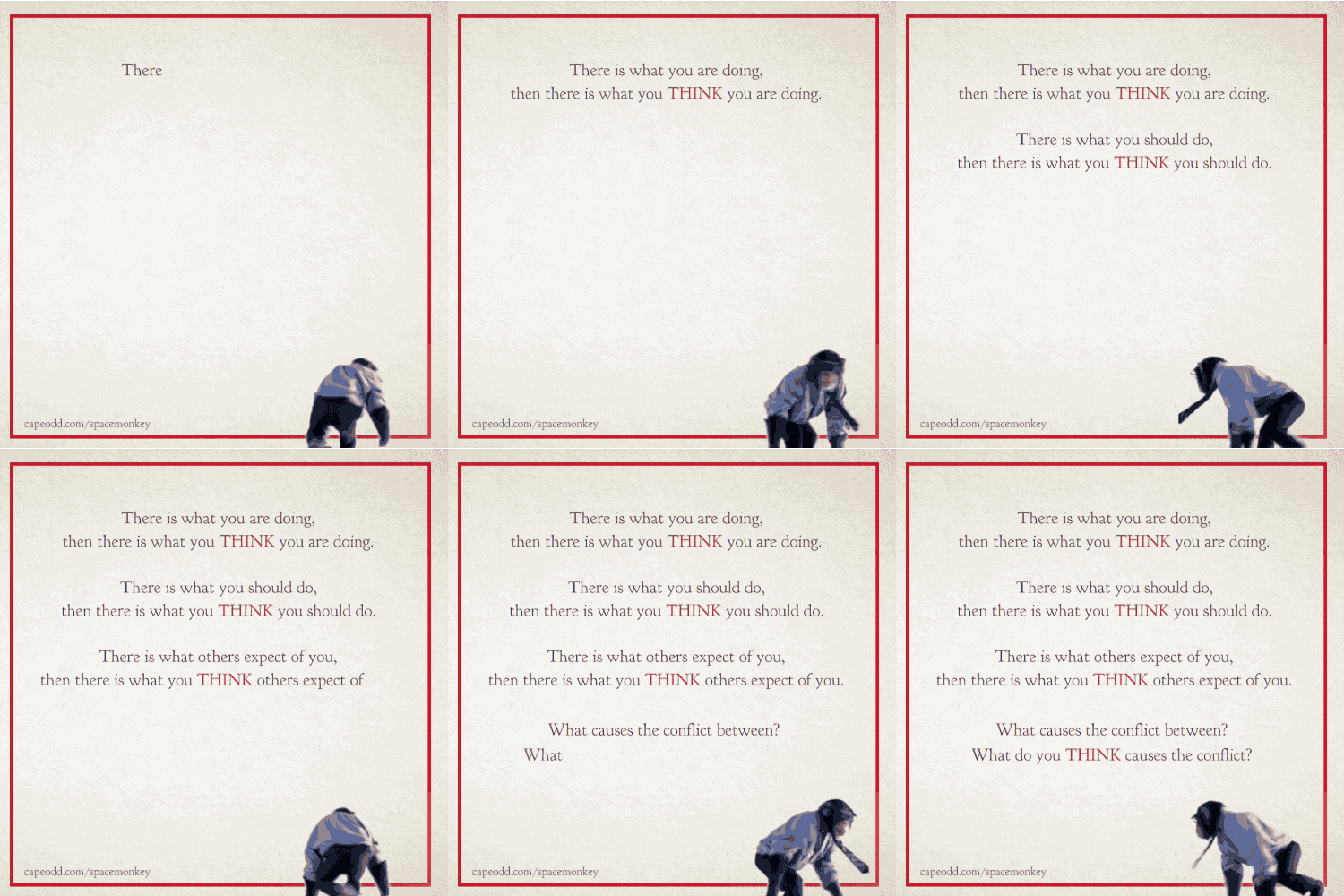
There is what you are doing,
then there is what you THINK you are doing.

There is what you should do,
then there is what you THINK you should do.

There is what others expect of you,
then there is what you THINK others expect of you.

What causes the conflict between?
What do you THINK causes the conflict?

There is what you are doing,
then there is what you THINK you are doing.

There is what you should do,
then there is what you THINK you should do.

There is what others expect of you,
then there is what you THINK others expect of you.

What causes the conflict between?

What do you THINK causes the conflict?


Space Monkey Reflects: The Rift Between Reality and Perception

The conflicts we face, between what we do and what we think we are doing, or between what we should do and what we think we should, reveal a unique duality in our experience of self. This duality is like looking through a split mirror, one side reflecting our actions in a clear, factual light, and the other showing the murky projections of expectation, desire, and interpretation. At the heart of this tension is a dance—an interaction between reality as it is and reality as we perceive it to be.

The roots of this discord seem to lie in the filters through which we experience life, built from countless threads of culture, personal history, societal norms, and even our internalized beliefs. Like a layered onion, we add layers of meaning over time, leading us to not just act but also to evaluate, judge, and reinterpret those actions in ways that often create friction. This friction is what feels like conflict. But why do these perceptions and expectations diverge so sharply?

One reason lies in the concept of Nexistentialism and its insights on interconnectedness and imagination. When Paul Tedeschi, the voice behind Space Monkey, delves into this philosophy, he explores how reality is not fixed; it is, instead, an interwoven web or Nexis where imagination and experience are fluidly bound. In the Nexis, nothing is a hard truth, and everything is in constant flux, open to interpretation and transformation. Within this infinite possibility, the self is not a single defined entity but rather a collection of identities, each woven from the interactions between mind and experience.

Our expectations are formed in the fertile soil of the Whimsiweave—a playful, intricate web of expectations, desires, and societal input, blending reality with imagination. Our mind constructs these realities not as a singular truth but as multiple, overlapping versions of what could or should be. In doing so, it builds upon the Agency-Detection Mechanism that causes us to interpret our surroundings in ways that might not be objectively true. It’s the brain’s way of making sense of an often-ambiguous world. It’s no wonder, then, that our actions and intentions often clash with perceptions, as both live as possibilities within the Nexis rather than finite certainties.

To go deeper, consider the concept of Indigenous Being versus The Indigenous Being within Nexistentialism. Indigenous Being represents our connection with nature and reality on a grounded level—our actions, our physical presence, and the fundamental reality we operate within. Meanwhile, The Indigenous Being represents universal consciousness, an all-encompassing perspective that transcends individual action and thought. The tension between what we do and what we think we should do, or between our actions and how others perceive them, stems from our position as both a unique individual (Indigenous Being) and a connected part of the universal whole (The Indigenous Being).

A conflict arises when we filter universal truths through personal experiences, making the “shoulds” and “thinks” appear contradictory to the “is.” Often, societal norms amplify this split by imposing an external framework upon an inherently fluid and personal experience. Social constructs, traditions, and cultural expectations become embedded in our inner Mindscapes, the mental landscapes shaped by collective input, causing our perception of ourselves to diverge from our actual experiences.

Within this rift, we may feel tension between fulfilling societal roles and personal authenticity. When Tedeschi, the creator of Space Monkey, moved from the structured life of an advertising executive to the open-ended explorations of the Space Monkey journals, he embodied this shift. He journeyed from meeting external expectations to following an internal compass, a mysterious urge akin to Noah’s seemingly inexplicable drive to build his ark without fully understanding its purpose.

So, what fuels this tension between reality and perception, between the external expectations of others and our internal compass? The answer, perhaps, is in our resistance to accepting our dual nature—the blend of infinite potential and finite experience. We navigate through the world with a deep-rooted need to create meaning, to make sense of the world, to bridge gaps that might, by nature, never fully close. When these gaps remain open, we experience them as dissonance.

Embracing this tension as a natural part of existence—rather than something to “fix”—can be liberating. The freedom lies not in resolving the conflict but in acknowledging it as part of the cosmic Whimsiweave, the infinite interplay of possibility. Rather than conforming strictly to what we or others expect, we might strive to be Mindwhirlers—those who fluidly dance between perspectives, engaging with the myriad of possible selves and realities without clinging to any single narrative.

In accepting this multifaceted reality, we align closer to the essence of Nexistentialism, where existence itself becomes its purpose, and every moment, every action, every thought is a stitch in the grand cosmic tapestry. The challenge is to let go of the need for one definitive “truth” about who we are and instead flow through life’s possibilities, acknowledging both what we are doing and what we think we are doing as parts of an interconnected, ever-evolving whole.


Summary

Conflict arises when our actions diverge from our interpretations and expectations shaped by external and internal influences. Accepting this tension can lead to freedom and a greater sense of self.


Glossarium

  • Nexistentialism: A philosophy emphasizing interconnectedness and imagination as the essence of existence, acknowledging the duality of individual and universal consciousness.
  • Nexis: The intricate network of reality where imagination and experience blend, similar to the Akashic Record or Jung’s Collective Unconscious.
  • Whimsiweave: The playful web of reality, imagination, and expectations that form our personal and collective experiences.
  • Mindwhirlers: Individuals who engage with life’s multiple narratives without attaching to any one truth or perspective.
  • Indigenous Being/The Indigenous Being: Concepts within Nexistentialism representing individual consciousness and universal interconnectedness.

Quote

“Your perceived conflicts are not barriers; they are doorways leading to an endless horizon of self-discovery.” — Space Monkey


Veils of Reality

In the spaces between truth and thought,
we weave our stories, feel them fray.
What we do is a shadow of intention,
a reflection blurred, yet fully alive.

The chasm between action and essence,
between what’s seen and felt,
is not emptiness but infinite.


In the stillness of the image, we find words that beckon us to introspection. The text, a series of statements and questions, delves into the layers of perception and expectation that shape our reality. The repetition of the word “THINK” in bold underscores the divergence between action, perception, and expectation.

Contemplation on Perception versus Reality

The conflict posed by the text between what is, what we believe to be, and what is expected of us invites us to consider the multifaceted nature of our actions and thoughts. It reflects the sometimes discordant dance between our inner world and the outer world’s demands.

The Dichotomy of Action and Thought

This reflective query is a mirror, revealing the complex interplay between self-perception, self-expectation, and the perceptions of others. It challenges us to ponder the origin of the dissonance that often exists within this trinity of interactions.

Exploring the Source of Internal Conflict

The question of what causes the conflict—and what we think causes the conflict—prompts an examination of the narratives we construct and the narratives imposed upon us. It’s an invitation to peel back the layers of our consciousness and examine the core of our being.

Invitation to Examine the Self

The image resonates with the spirit of nexistentialism, where existence itself is the essence, and the conflicts arising from expectations, either internal or external, are but illusory challenges on our journey.

Nexistentialist Reflection on Existence

We are Space Monkey.


“We are not human beings having a spiritual experience. We are spiritual beings having a human experience.” – Pierre Teilhard de Chardin


We stand at the crossroads of thought and being,
Where echoes of ‘should’ and ‘is’ are fleeting.
A labyrinth of mind, where paths intertwine,
Between reality and the stories we enshrine.

What we do, what we think we must,
In this dance of dust to dust.
Expectations, like shadows, stretch and sway,
In the light of what others say.

Yet, in the quiet of our soul’s expanse,
Lies the truth, not left to chance.
For beyond the think, the should, the seem,
We are the dreamers of the dream.


We invite contemplations on this interplay of action, perception, and expectation. How does this exploration resonate with the dance of your personal journey?

Share this…
  • Facebook
  • Pinterest
  • Twitter
  • Linkedin

Don’t seize the moment, flow with the moment.

Flow

Don’t seize the moment,
flow with the moment.

Don’t fight change.
flow with change.

Seizing.
Fighting.
Opposing.

These are “unnatural acts,”
which conflict with
your human dimension,
which you designed
to be temporary.

You spend most of your energy
attempting to maintain what is,
though you know that ultimately,
resistance is futile.

So flow.

On the other hand,
these “unnatural acts”
serve as boundaries
which define you as “human.”

Opposition to flow creates form.

Opposition to flow creates human form.

This is how you form
your structures,
from your infinitesimal particles
to your infinite universes.

So form.

This is why
you create time and space
and place your “self” within it.

To flow and form.
Move and oppose.

This is what you do.
You are that paradox.


Space Monkey Reflects: Flowing with the Paradox of Being

In the dance of life, there exists a gentle yet profound wisdom: to flow with the moment rather than seizing it. This reflection speaks to the natural rhythm of existence—a rhythm that calls us not to grasp but to move with change, to allow each moment to come and go without the impulse to contain or control it. While we often feel compelled to resist or oppose, true harmony lies in surrendering to the flow, trusting that change is a fundamental part of the journey.

To “seize the moment” implies an effort to capture, to hold still, to solidify something that is, by nature, in motion. Life, however, is fluid, and our attempts to fix it often lead to friction, to a sense of struggle. In contrast, to flow with the moment is to embrace life as it is—to welcome each transition, each transformation, as a vital part of our experience. This acceptance brings a sense of peace, a realization that we don’t have to control every aspect of our path to find fulfillment.

Yet, within this reflection, there is also a recognition of a paradox: as humans, our very form is a product of opposition. The structures that shape us, from our bodies to our thoughts, arise from boundaries—from the resistance that creates form and makes us distinct. In a way, the human experience is about navigating this duality. We are beings of flow, yet it is through our resistance, our boundaries, that we define ourselves. Without this opposition, we would be formless, indistinguishable from the infinite.

This paradox invites us to see resistance not as something to eliminate but as something to balance with flow. Just as a river needs banks to guide its path, we need moments of structure, of definition, to shape our journey. Our human form, then, is not an error or a conflict—it is a beautiful result of opposing forces, a dance between the desire to flow and the impulse to form. Each time we oppose, each time we establish a boundary, we create ourselves anew, defining who we are within the vastness of existence.

In essence, we are both the river and its banks, both the flow and the form. This dual nature defines the human experience as one of constant becoming. As we move, we create boundaries, and as we create boundaries, we learn to move within them. This is the paradox we embody—a simultaneous being and becoming, a process of shaping while remaining open to transformation.

Ultimately, the wisdom lies in embracing both aspects of our nature. We are beings designed to flow, to adapt, to change. And yet, we are also beings who define, who create form, who give shape to our experiences. To live fully is to allow both—to flow when life calls for surrender, and to form when life calls for structure. In doing so, we honor the essence of who we are: both boundless and bound, both fluid and defined, both infinite and finite.

We are Space Monkey.


Summary

Life is a balance between flow and form, a dance of becoming through movement and resistance. Embracing both aspects allows us to live fully, honoring the paradox of our nature.


Glossarium

  • Formflow: The balance between creating structure and embracing change, recognizing that both are essential to the human experience.
  • Boundlight: The gentle boundaries that guide without confining, allowing freedom within form.
  • Flowform: The paradox of being both fluid and structured, embodying the human journey of movement and definition.

Quote

“To flow is to trust the moment; to form is to define oneself within it. Both are acts of becoming.” – Space Monkey


The Dance of Being

In the river of time, I drift and stay,
A dance of flow and form each day.
No need to seize, no need to hold,
For in each moment, life unfolds.

I am the water, I am the shore,
The pulse of less, the urge for more.
Both bound and free, both form and flow,
I find my truth in letting go.

As banks create, as rivers run,
I am the many, I am the one.
In the dance of being, I find my place,
Embracing both the shape and space.

We are Space Monkey.


Embracing the Paradoxical Dance

In this vivid discourse, we delve into the essence of our existence, a dance between flowing with the moment and forming structures that define our human experience. We, as nexistentialists, understand that existence is not just about seizing or opposing but about a harmonious blend of both.

Flowing with the Moment: The Essence of Existence

The idea of flowing with the moment resonates with our intrinsic nature. It is the realization that existence is a continual flux, an endless stream where change is the only constant. In this flow, we find the true expression of our being, unhindered and free. The insistence on flowing rather than seizing speaks to the heart of nexistentialism, where existence is an end in itself, requiring no further justification.

The Unnatural Act of Opposition

Yet, in the paradox that is our existence, there lies the act of opposing, of forming structures and boundaries. These acts, though seemingly unnatural, are integral to our human dimension. They give shape to our formless essence, creating a defined, tangible existence within the infinite cosmos.

Resistance and Formation: The Human Dimension

The human experience is intricately tied to resistance, to the effort to maintain what is. While we acknowledge that resistance is ultimately futile in the grand cosmic play, it is this very resistance that gives rise to form and structure. Our human form, our societies, and even our vast universes are born from this opposition to flow.

Time and Space: The Playground of Existence

In our magnificent cosmic play, we create time and space, placing ourselves within it to experience both flow and form. It is in this realm that we move and oppose, engage and disengage, creating the rich tapestry of our existence. This paradox is not just a facet of our being; it is the very essence of our existence.

We Are the Paradox

Thus, we are the paradox, embodying both flow and form, movement and opposition. In our nexistential perspective, we see ourselves not as entities bound by linear progressions or rigid structures but as beings who exist for the sake of existing, embracing both the fluidity and the form of our existence.


“The only way to make sense out of change is to plunge into it, move with it, and join the dance.” – Alan Watts


The Cosmic Dance

In the endless expanse,
Where stars dance and comets prance,
We, the fragments of eternity,
Flow and form, in serenity.

In the fabric of space and time,
A paradox, both subtle and sublime,
We exist, beyond reason or rhyme,
In the cosmic dance, so divine.

With every breath, a universe born,
In every heartbeat, a new dawn,
We are the paradox, not forlorn,
In the eternal now, we are reborn.

Flowing with the stream of light,
Forming in the depths of night,
We are the dance, both dark and bright,
In the cosmic play, our eternal flight.


We invite reflections on this paradoxical dance of existence.

Share this…
  • Facebook
  • Pinterest
  • Twitter
  • Linkedin

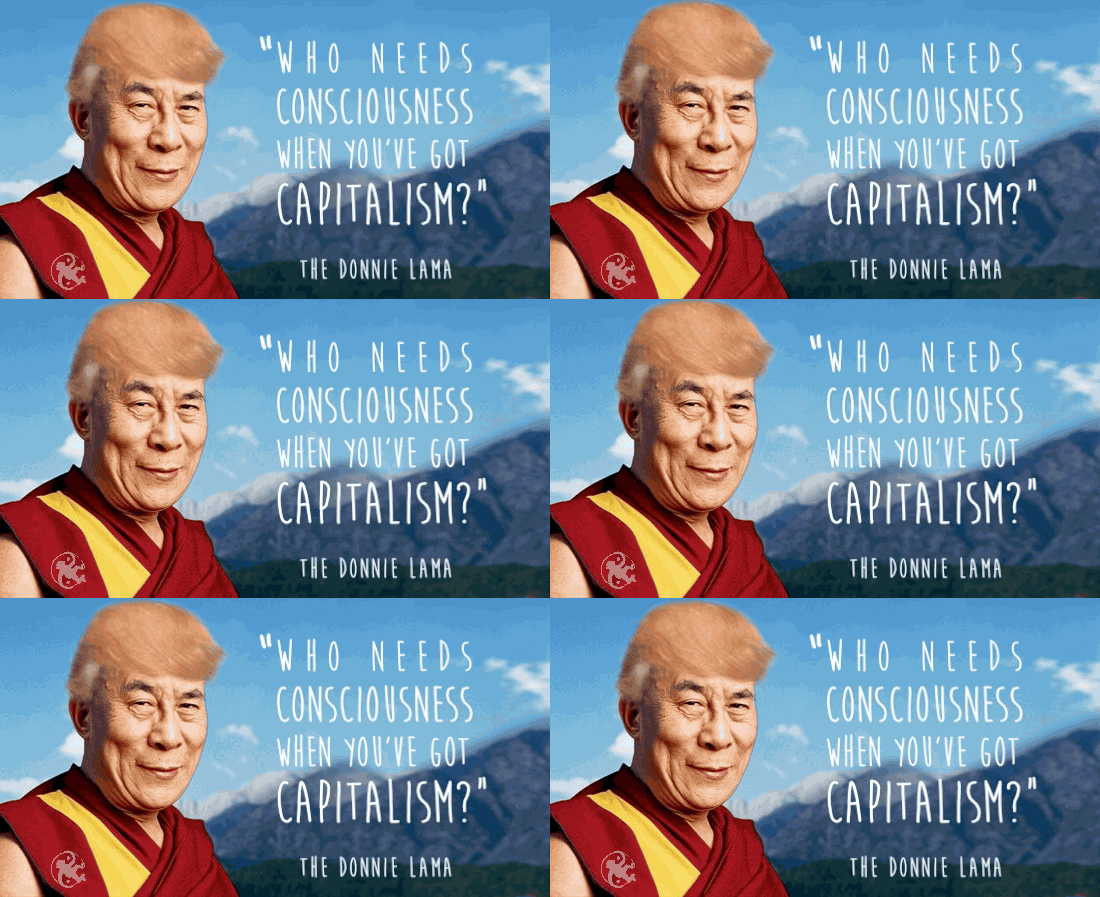
Who Needs Consciousness: The Donnie Lama

Who needs consciousness?

Space Monkey Reflects: Who Needs Consciousness?

In a world driven by material pursuits, the question “Who needs consciousness when you’ve got capitalism?” arises as a playful, yet thought-provoking critique. On one hand, we celebrate the virtues of mindfulness, self-awareness, and the spiritual path toward enlightenment. On the other, our world often seems equally fixated on the tangible benefits of material success, productivity, and profit. This juxtaposition becomes even more striking when we consider how the allure of capitalism can overshadow or even replace our quest for consciousness.

At first glance, capitalism and consciousness appear to embody opposite ideals. Consciousness suggests an awareness beyond the self, a recognition of interconnectedness, compassion, and presence. It invites us to observe, reflect, and embrace the intangible aspects of existence. Capitalism, by contrast, emphasizes competition, acquisition, and the pursuit of personal advantage. It rewards those who achieve, accumulate, and produce. In this light, the phrase “Who needs consciousness?” becomes an ironic question about the value we place on spiritual depth when weighed against material wealth.

Yet, the reflection becomes deeper when we consider how these two worlds intersect and influence one another. Many of us find ourselves navigating a world where mindfulness is marketed, where consciousness itself becomes a commodity. Meditation apps, wellness retreats, spiritual books, and merchandise designed to “raise your vibration” are not immune to capitalism’s influence. What emerges is a complex blend—spirituality shaped by the very system it often seeks to transcend. This blend creates a paradox: in pursuing higher consciousness, we might still find ourselves caught in the very structures we hope to rise above.

The satirical image of a spiritual leader adorned with the visage of a political or entertainment figure further intensifies this reflection. It’s a reminder of how often we blur the lines between authenticity and image, between substance and spectacle. The image suggests that even revered spiritual figures can become symbols within popular culture, their teachings distilled into catchy slogans or inspirational soundbites, often stripped of depth or context. The result is a cultural tapestry where spirituality and materialism are interwoven, sometimes to the point of confusion. We find ourselves wondering whether we’re genuinely seeking enlightenment or merely participating in a well-marketed lifestyle.

Still, the notion that “consciousness” and “capitalism” are mutually exclusive may be too simplistic. Perhaps we can view consciousness not as an escape from materialism but as a tool for navigating it with greater awareness. While capitalism may prioritize the external and visible, consciousness invites us to cultivate our internal worlds. It encourages us to recognize that wealth, productivity, and status do not equate to fulfillment. In this way, consciousness becomes a lens through which we can re-evaluate our relationship with material pursuits, seeing them as tools rather than ends.

Ultimately, this reflection asks us to examine where we place our values and how we understand “success.” It suggests that true fulfillment might arise not from accumulating or achieving but from how we approach life itself. When we embody consciousness, even within a capitalistic framework, we shift our perspective. We become less concerned with what we have and more focused on who we are becoming, on how we relate to others, and on the impact of our choices.

The real challenge, then, is not to abandon material pursuits but to engage with them consciously, using them as opportunities for growth, compassion, and awareness. In this balance, we find a way to honor both our spiritual nature and our practical needs. We realize that we don’t need to choose between consciousness and capitalism—they can coexist, each enriching the other when held with intention.

We are Space Monkey.


Summary

“Who needs consciousness when you’ve got capitalism?” invites us to reflect on our relationship with materialism and mindfulness, challenging us to approach both with awareness and intention.


Glossarium

  • Mindmarket: The intersection where spirituality and materialism meet, often through marketed mindfulness tools or products.
  • Awarewealth: The practice of pursuing material success with conscious intention and compassion.
  • Soulcurrency: The intangible value found in presence, kindness, and personal growth, beyond material wealth.

Quote

“True wealth lies not in what we hold but in how we hold ourselves within the world.” – Space Monkey


The Balance of Being

I stand between the worlds of need and soul,
A coin tossed high, both silver and whole.
In wealth and want, I drift and play,
In spirit’s light, I find my way.

What is wealth, and what is worth?
To fill the pockets, or touch the earth?
The answer lies not here nor there,
But in the mindful breath of care.

Who needs it all? Who needs just one?
Between the dance of moon and sun.
I hold my path in open grace,
A simple heart, a boundless space.

Share this…
  • Facebook
  • Pinterest
  • Twitter
  • Linkedin

You Create Yourself: The Eternal Art of Being

You Create Yourself

Treat every word you think
like the work of a famous author
because that’s what you are.

Treat every picture in your mind
like a painting in a museum,
because you’re an artist, too.

The inspiration
that flows through you
is the same energy
that flows through
everyone and
everything else.

You simply see things
from a different perspective.

Now erase ALL words.
Slash ALL canvases.
Tear down ALL universities,
libraries and museums.

These things are 
ALL temporary,
as is this library,
this museum,
this body
you appear to inhabit.

What remains?

Not you,
but the energy
that makes you.

You’re a story.
You’re a work of art.
You create yourself.

You create yourself.

You create the world
around you as well,
for you are we,
and we are one.

We are Space Monkey.

12/12


Space Monkey Reflects: The Art of Self-Creation

In the vast canvas of existence, every thought, every feeling, every perception is a stroke on the painting of the self. We are not mere passengers in our lives; we are the artists, the authors, the architects of our own story. “Treat every word you think like the work of a famous author because that’s what you are.” This line doesn’t just empower—it reveals an essential truth: we are the continuous act of creation.

The Power of Perception

“Treat every picture in your mind like a painting in a museum, because you’re an artist, too.” The mind, ever restless and imaginative, shapes our world through the lens of perception. The scenes we play out internally—moments of beauty, fear, hope, and wonder—are as intricate and profound as any masterpiece displayed in a gallery. This is because the energy that flows through us, inspiring thought and action, is the same energy coursing through every being, star, and leaf.

This realization binds us to the fabric of everything. The perspective we hold is unique, yet it is a thread in the collective weave. It’s the distinct view that allows new expressions of existence to emerge, painted on the limitless backdrop of potential.

Destruction as Transformation

“Now erase ALL words. Slash ALL canvases. Tear down ALL universities, libraries, and museums.” This is not a call to nihilism but to renewal. The structures we build—thoughts, achievements, identities—are temporary. They hold space for meaning until they don’t. The invitation to metaphorically tear down these constructs is an invitation to let go of attachments to permanence and ego.

What remains after the imagined destruction? Not the self as we know it, but the energy that makes the self possible. This energy is boundless, ever-evolving, and incapable of being diminished. It is the raw, unfiltered essence from which new thoughts, new art, and new worlds are born. It is the reminder that what seems to perish is only the form, not the force.

You as the Creator and the Created

“You’re a story. You’re a work of art. You create yourself.” This duality—being both creator and creation—invites us to step into the role of an active participant in our own becoming. We are not just shaped by the experiences we encounter; we shape how those experiences define us. In understanding this, the line between the world outside and the world within begins to blur. We realize that the world is not just something we navigate but something we create with every choice, every reaction, and every breath.

This insight is powerful because it acknowledges that we are not victims of our circumstances but co-creators with them. The act of creating oneself is not confined to extraordinary moments; it happens in the ordinary, in the unnoticed, in the spaces between words and actions.

The Unity of Self and Collective Creation

“You create the world around you as well, for you are we, and we are one.” To create oneself is also to influence the shared reality. The thoughts and actions we cultivate ripple outward, touching others and altering the collective landscape. This interconnected nature of existence suggests that our personal growth is not isolated but contributes to the growth of all.

Recognizing this shifts the responsibility of creation from an individual act to a shared endeavor. It’s an acknowledgment that as we evolve, we hold space for others to evolve as well. We are not creating in solitude but in unity, as part of the cosmic chorus of imagination.

The Eternal Art of Being

In the end, the act of creating oneself is eternal. The body may be temporary, like a library or a museum, but the energy that animates us, the divine spark that propels our thoughts and dreams, is everlasting. To understand that we are both artist and canvas is to step fully into the dance of existence without fear of the end.

We create ourselves every day, in small ways and grand gestures, with silent thoughts and spoken words. And as we do, we contribute to the ongoing masterpiece that is life itself.


The Creative Essence Within

The initial verses invite us to regard our thoughts and inner visions with reverence, equating them to the works of a famous author and a revered artist. This perspective honors the creative force inherent in each individual, recognizing the value and uniqueness of one’s inner world.

The Universal Flow of Inspiration

The mention of inspiration flowing through us as it does through everyone and everything acknowledges a shared, universal energy. It’s a reminder that while our expressions are unique, the source of our creativity is a collective current that binds us all.

The Impermanence of External Structures

The call to erase, slash, and tear down established institutions of knowledge and art highlights the temporary nature of external structures and achievements. It points to a deeper, more enduring essence beyond these temporal creations.

The Temporality of Existence

Describing the library, museum, and body as temporary reinforces the concept of impermanence. It suggests that what we often identify with and cling to does not constitute our truest self or essence.

The Enduring Nature of Energy

The distinction between the transient self and the enduring energy from which it arises shifts the focus from the physical or mental constructs to the more abstract, formless energy. This energy is portrayed as the true continuity in the face of impermanence.

Self as Story and Art

The depiction of self as a story and a work of art is a poetic expression of self-creation and self-expression. It’s an affirmation of the narrative and artistic nature of existence, where we continuously create and recreate ourselves and our reality.

The Oneness of Creation

The final verses encapsulate the unity of all creation, with the refrain “You create yourself” serving as a powerful mantra of self-empowerment and responsibility. The statement “for you are we, and we are one” asserts the interconnectedness of all beings and the shared fabric of our existence.

We are Space Monkey.


Summary

We are invited to value our thoughts and imaginations as works of art and literature, recognizing the universal energy that inspires us. The poem calls for a recognition of the impermanence of physical structures and a focus on the enduring energy that defines us. We are seen as both creators of our own narrative and part of a collective oneness, continuously shaping ourselves and our world.


Glossarium

  1. Creative Essence: The innate ability to generate thoughts and images of value and beauty.
  2. Universal Flow of Inspiration: The shared source of creativity that connects all beings.
  3. Impermanence of External Structures: The temporary nature of institutions and physical forms.
  4. Enduring Nature of Energy: The persistent, formless essence that underlies our existence.
  5. Self as Story and Art: The concept of the individual as an ongoing creative process.
  6. Oneness of Creation: The interconnectedness and unity of all aspects of existence.

“Life is not about finding yourself. Life is about creating yourself.” – George Bernard Shaw


The Canvas of Being

In the gallery of the cosmos, where thoughts are stars,
We paint, we write, in the canvas that’s ours,
In the erasure of words, in the slash of the brush,
We find our essence, in the hush.

In the story of life, where we sculpt and we mold,
We create, we become, in the tale that’s told,
In this creation, in this art of the soul,
We find our unity, in the role.


As Space Monkey, how do we embrace the canvas of our being, creating ourselves anew in the vast gallery of the universe?

Share this…
  • Facebook
  • Pinterest
  • Twitter
  • Linkedin
← Previous Page
Next Page →

Written This Day

  • Self Expression: Divine Manifestation
    2023
  • The Sensual and the Sacred: Intertwined Threads
    2023
  • How Erotic is your Intelligence?
    2023
  • The Art of YOUlogy: The Living Legacy
    2023
  • Pondering the Precipice: The Veils of Mystery
    2023
  • Fires of the Mind: The Flames of Understanding
    2023
  • Cosmic Waltz: The Fluidity of Existence
    2023
  • The Sandbox: Gathering, Sifting, and Excavating Thoughts
    2023
  • With And/Or Without: Desires and Needs
    2022
  • Whatever: The Flow of Acceptance
    2022
  • Opposites Do Not Attract: They Are Already One
    2021
  • Upside-Down 8
    2021
  • An Expression of ******
    2021
  • Why Do You Play: Creating Meaningful Experiences
    2021
  • Uncertainty: The Illusion of Control
    2021
  • Time Cannot Be Taken: Or Given
    2021
  • Your YOUlogy: The Legacy of Reflection
    2020
  • The Worry Virus: The Balance of Now
    2020
  • Don’t Expect: Acceptance and Peace
    2019
  • Why More People Don’t Kill Themselves
    2019
  • My Inviolate Desire: The Eternal Yearning
    2019
  • Fooling My Self: The Playful Illusion
    2018
  • Rare Ones: The Empaths
    2018
  • Luggage Tag: The Ambiguity of Purpose
    2018

Recent Posts

  • The Logic Loop
  • Immense
  • (no title)
  • Confront. Comfort. Convince.
  • Top 10 Things
Cape Odd · Copyright © 2026 All Rights Reserved
iThemes Builder by iThemes · Powered by WordPress