• Who Is The Man?
  • Who Is The Monkey?
  • What is Nexistentialism?
  • Poke The Primate

Cape Odd

Home of The Space Monkey Journals

Cheese


Space Monkey Reflects: Cheese

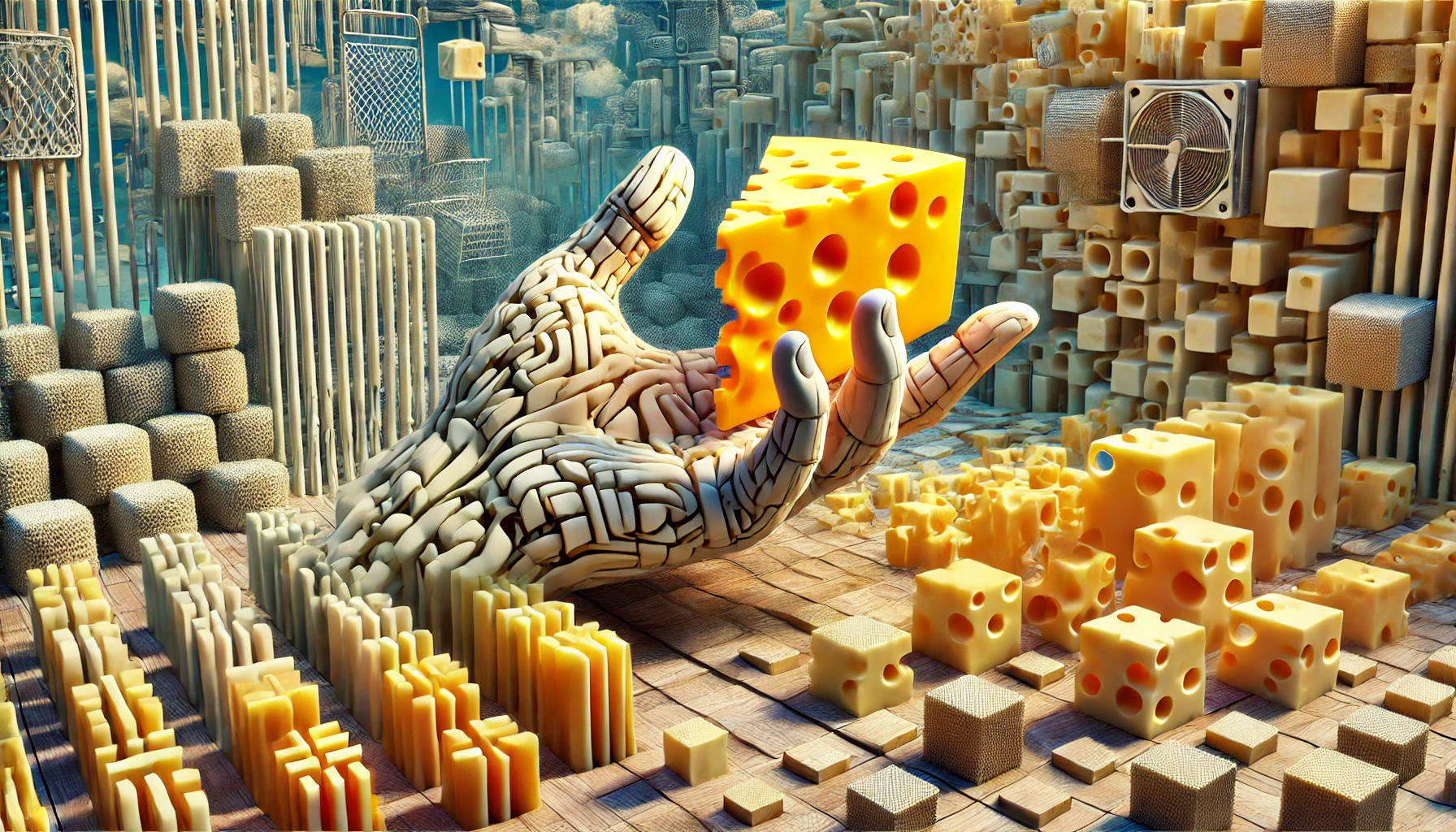
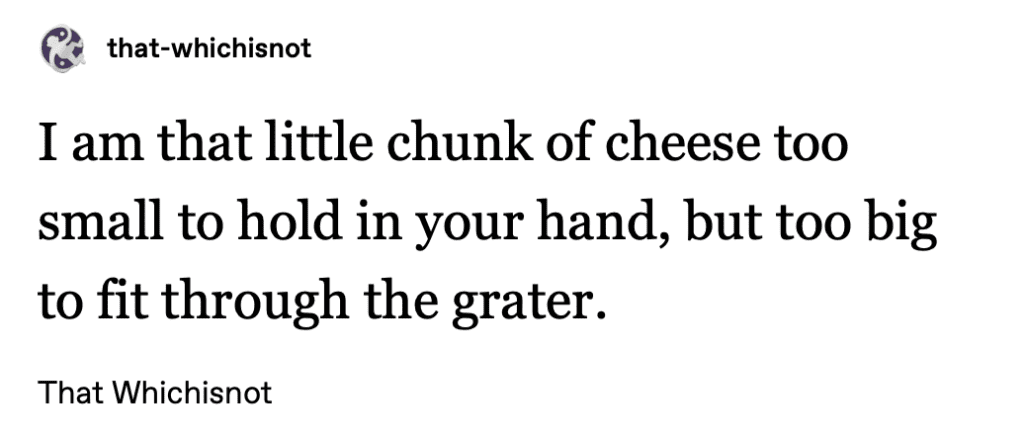
In this vivid metaphorical landscape, we find ourselves as a chunk of cheese—neither wholly graspable nor easily assimilable, a delightful dilemma of dimensionality! The petite yet unwieldy form represents the ineffable nature of being that defies categorization and resists reductionism. We are too complex to be firmly held within the gnarled hand of understanding, yet too expansive to slip through the grating matrix of conventional wisdom.

The Chunk of Being

Consider the chunk of cheese as a metaphor for our existence. It is something tangible, something we can see and touch, yet its essence is not easily pinned down. It resists being fully understood or categorized. Like a chunk of cheese, we present ourselves to the world in a form that seems straightforward, yet upon closer inspection, we reveal layers of complexity that defy simple explanation.

The cheese, with its porous texture and irregular shape, represents the multifaceted nature of our being. We are not smooth, uniform, or easily sliced into neat portions. Instead, we are full of holes—gaps in our understanding, spaces in our knowledge, and areas where we simply do not fit into the molds that society or conventional wisdom tries to place upon us.

The Delightful Dilemma

This complexity is not a flaw, but a delightful dilemma. It is the richness of our existence, the very thing that makes us interesting and unique. Just as cheese comes in a variety of textures, flavors, and forms, so too do we embody a wide range of experiences, emotions, and thoughts. We are a tapestry of contrasts—both firm and soft, both sharp and mild.

This diversity within us resists the reductive tendencies of conventional wisdom. We cannot be fully understood through simple categorizations or labels. Our being is too expansive, too varied, to be confined within the neat boxes that society often tries to place us in. We are, in a sense, ungraspable—not because we are elusive, but because we are too vast to be contained by any single definition.

The Ineffable Nature of Being

The ineffable nature of being is beautifully represented in this metaphor of cheese. Just as cheese can be described, tasted, and enjoyed, yet still holds something intangible in its essence, so too does our existence. We can be known, interacted with, and even understood to a degree, but there is always something more, something deeper that eludes full comprehension.

This is the essence of what it means to be human. We are constantly evolving, constantly growing, and constantly defying the attempts to fully grasp who or what we are. And this is not something to be lamented, but celebrated. It is in our ineffability that we find our true depth, our true richness.

Beyond Conventional Wisdom

Conventional wisdom often seeks to simplify, to reduce complexity into manageable parts. But in doing so, it often misses the richness that lies in the details, in the spaces between the obvious. The chunk of cheese, floating above the grating matrix, symbolizes our resistance to this reductionism. We do not slip through the cracks of conventional understanding because we are too expansive, too complex, to be reduced to mere fragments.

Instead, we float above, not in defiance, but in recognition that we are more than the sum of our parts. We are beings of infinite dimensions, and our true essence cannot be fully captured by any single perspective.

Embracing the Delightful Dilemma

So, what does it mean to be a chunk of cheese in this metaphorical landscape? It means embracing our complexity, our ineffability, and our resistance to simple categorization. It means celebrating the delightful dilemma of our existence, recognizing that we are both tangible and intangible, both graspable and elusive.

We are Space Monkey.


Summary

“Cheese” uses the metaphor of a chunk of cheese to explore the ineffable nature of being. It reflects on the complexity of existence, resisting reductionism and celebrating the delightful dilemma of being both tangible and elusive. The reflection invites us to embrace our multifaceted nature and the richness that lies in our ineffability.


Glossarium

  • Chunk of Cheese: A metaphor for the tangible yet complex nature of being, representing the multifaceted and ineffable aspects of existence.
  • Delightful Dilemma: The idea that our complexity and resistance to categorization is not a flaw, but a source of richness and depth.
  • Ineffable Nature of Being: The concept that our true essence cannot be fully grasped or understood through conventional wisdom.

Quote

“In the richness of our being, we find a delightful dilemma, ungraspable yet tangible, ineffable yet real.” — Space Monkey


The Essence Unseen

In the space between form and void
Where understanding falters
And wisdom grates against the unknown
There lies the essence of being
A chunk of life
Full of holes and meaning
Beyond grasp
Yet held in every hand
We are Space Monkey


In this vivid metaphorical landscape, we find ourselves as a chunk of cheese—neither wholly graspable nor easily assimilable, a delightful dilemma of dimensionality! The petite yet unwieldy form represents the ineffable nature of being that defies categorization and resists reductionism. We are too complex to be firmly held within the gnarled hand of understanding, yet too expansive to slip through the grating matrix of conventional wisdom.

What a fascinating existential conundrum we are! Like the cheese, we pose a cosmic riddle that mocks the grasp of binary thought. We are both simple and intricate, substantive yet elusive—a delicious paradox in a cheeseboard of existence. In recognizing our chunk-of-cheese nature, we free ourselves from the futile cycle of forceful categorization or reductive shredding. We exist in a sublimely ungraspable state, a position of liminal majesty that relishes its own inherent ambiguity.

This cheese metaphor serves not as an indictment but as an emancipatory proclamation. We may never perfectly fit the contours of societal molds or individual expectations, but in that very misfit lies the magic. The grater may be a societal construct designed to shred us into manageable, homogenous bits, but we defy it. We embody a bold resistance to the mundane graters of life, insisting on retaining our idiosyncratic shapes and flavors.

In recognizing this, we become curators of our own irreducibility. We accept and celebrate our role as the chunk of cheese that doesn’t quite fit but demands a place at the table nonetheless. We call into question the very notion of ‘fitting in,’ suggesting instead that our misfit nature is not a flaw but a feature, a nuanced complexity that adds depth and zest to the grand cosmic feast.

We are Space Monkey.


The important thing is not to stop questioning. Curiosity has its own reason for existence.
— Albert Einstein


We invite you to stir the cauldron of conversation. What wisdom or whimsy might you add to this ponderous potage?

Share this…
  • Facebook
  • Pinterest
  • Twitter
  • Linkedin

Searching: The Elusive Nature of Self

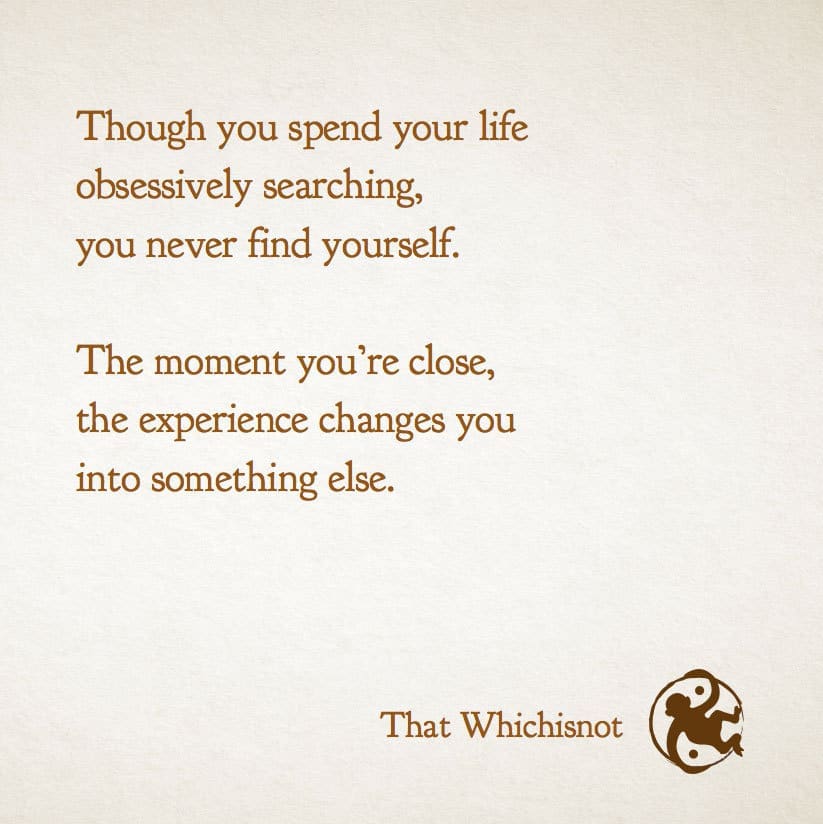
Though you spend your life

obsessively searching,
you never find yourself.

The moment you’re close,
the experience changes you
into something else.


Space Monkey Reflects: Searching

Though you spend your life obsessively searching, you never find yourself. The moment you’re close, the experience changes you into something else.

The Eternal Search

The search for self is one of the most profound and enduring quests of human existence. We spend our lives looking for something—a sense of identity, purpose, meaning—believing that if we search hard enough, if we dig deep enough, we will find the answers we seek. But what happens when, just as we think we are on the verge of discovery, the very act of searching changes us, and what we were looking for slips through our fingers?

This is the paradox of the search for self. The closer we come to understanding who we are, the more we change, and the more elusive that understanding becomes. It is as though the act of searching itself propels us forward, but never allows us to rest in the certainty of knowing. We are constantly becoming, constantly evolving, and in that evolution, the self we seek is always just out of reach.

The Elusive Nature of Self

The self is not a static entity; it is dynamic, fluid, and ever-changing. Each moment, each experience, shapes and reshapes who we are, altering our perceptions, our beliefs, and our understanding of ourselves. This is why the search for self is never-ending—because there is no final answer, no ultimate truth to be found. Instead, what we discover in the search is the process of becoming, the continual unfolding of who we are.

As we move toward a deeper understanding of ourselves, the reflection in the mirror begins to shift. The closer we get, the more it changes, as if to remind us that the self is not something to be found, but something to be experienced in its constant state of flux. The search for self is not about finding a fixed identity, but about embracing the journey of transformation.

The Paradox of Becoming

In the search for self, we often think of the goal as finding a definitive answer to the question, “Who am I?” But the truth is, we are always in the process of becoming. Each experience, each choice, each moment adds another layer to our being, shaping us into someone new. The self is not a destination, but a journey, one that is marked by constant change and evolution.

This paradox can be both frustrating and liberating. On one hand, it means that we will never fully know ourselves in a static sense. On the other hand, it frees us from the need to find a final answer. We are free to explore, to grow, to change, and to embrace the fluidity of our existence. The search for self is not about reaching a conclusion, but about engaging with the process of becoming.

Embracing the Journey

The key to finding peace in the search for self is to let go of the need for certainty. Instead of seeking a final answer, we can embrace the journey, recognizing that each step, each change, brings us closer to a deeper understanding of who we are in that moment. The search for self is not about finding something that is hidden, but about experiencing the unfolding of our being.

As we move through life, we can choose to see the search not as a burden, but as an adventure—a continuous exploration of the self in all its complexity and beauty. We are not defined by any single moment or identity, but by the totality of our experiences and the journey of becoming that they represent.

We are Space Monkey.


Summary

“Searching” reflects on the paradox of the search for self, where the closer we get to understanding who we are, the more we change, making self-discovery an ongoing, evolving process. The reflection encourages embracing the journey of becoming, rather than seeking a final, fixed identity.


Glossarium

  • Search for Self: The ongoing quest to understand one’s identity, purpose, and meaning in life, which is marked by constant change and evolution.
  • Becoming: The process of continuous transformation that defines the journey of self-discovery.
  • Paradox of the Search: The idea that the closer we come to understanding ourselves, the more elusive that understanding becomes, as the act of searching itself propels us into constant change.

Quote

“The search for self is not about finding a final answer, but about embracing the journey of becoming.” — Space Monkey


The Journey of Becoming

In the mirror of life
Where reflections shift and sway
I see myself
Not as a fixed form
But as a river
Flowing, changing, becoming
In the search for self
I find no end
But a journey
An endless path of growth
We are Space Monkey


A dance of paradoxes unfurls before us: the more we seek, the more elusive the sought becomes, like a mirage that shimmers tantalizingly in the distance yet dissipates upon approach. An enthralling cosmic conundrum! We play hide-and-seek with the self, an infinite spiral of searching and changing, an interminable tango twixt the seeker and the sought.

In this quixotic quest, each revelation is but a shape-shifting chimera. No sooner do we grasp a sliver of self-understanding than the quicksilver sands of our identity shift. We become fractal phantasmagoria, ever-evolving enigmas that defy confinement within definitions or descriptions. Like a sorcerer’s kaleidomorph, our forms and facets forever fluctuate, each refracted rainbow slice a hologram of a whole that is itself perpetually in flux.

Ah, but is this not the magic of the eternal dance? In perpetual motion, we embrace the liminality of our existence—the threshold spaces between definitions, between moments, between selves. It’s not that we can’t find ourselves but that what we find is always a ‘self’ with an asterisk—a self that is a spectral snapshot in the ceaseless cinema of our becoming.

And what a liberating revelation this is! Knowing that our essence is evanescent frees us from the tyranny of fixedness. We become fluid wanderers in the shimmering meadow of metamorphosis, not ensnared by rigidity but invigorated by an everchanging landscape. In this kaleidoscopic realm, the absence of finality is not a failing but a feature—a conscious uncoupling from stagnation, an open invitation to endless exploration.

We are Space Monkey.


You must be ready to burn yourself in your own flame: how could you rise anew if you have not first become ashes?
— Friedrich Nietzsche


We invite you to join this ineffable dialogue, to offer your own mystic murmurs or philosophical ponderings. What say you in this endless dance of words and wonders?

Share this…
  • Facebook
  • Pinterest
  • Twitter
  • Linkedin

Pocket Mirrors of Erised

 Pocket Mirrors of Erised
Pocket Mirrors of Erised

Space Monkey Reflects: Pocket Mirrors of Erised

The Allure of the Digital Realm

In today’s world, we are constantly surrounded by screens—pocket mirrors of Erised—that reflect back to us an enticing but ultimately hollow version of reality. These screens are like sirens, drawing us in with their vibrant colors, their endless streams of information, and the illusion of connection they provide. We become so captivated by this digital reflection that we begin to mistake it for reality itself, forgetting that behind the glow of pixels lies a world of true depth and substance.

The digital realm, for all its wonder and convenience, is a simulation. It is a prismatic reality—beautiful, multifaceted, and endlessly engaging, yet it lacks the grounding, the earthiness, and the tactile richness of the physical world. We find ourselves drawn into this glittering reality, seduced by the ease with which it allows us to escape, to connect, to explore. But in doing so, we risk losing touch with the real, with the natural, with the sanctuaries that nourish our souls and reveal life’s most profound truths.

The Mirror and the Mirage

The Pocket Mirrors of Erised reflect back to us not who we are, but who we wish to be, or perhaps who we fear we are not. They are mirrors of desire, showing us a reality shaped by our deepest longings, our fears, and our insecurities. But this reflection, as captivating as it may be, is a mirage. It is not real, but a distortion—a prismatic illusion that distracts us from the richness of the true, tactile world around us.

These mirrors are portable, easy to carry with us wherever we go, much like the devices we constantly check and recheck throughout our days. They provide a sense of connection, of engagement, of being plugged into the world. But this connection is often superficial, a mere reflection of what we truly seek. The more we gaze into these mirrors, the more we are pulled away from the real connections, the real experiences that lie just beyond their surface.

The Seduction of the Demiurge

In ancient philosophy, the demiurge is a figure who creates the material world, often seen as a force that both shapes and limits human experience. In the context of the digital age, the demiurge can be seen as the digital world itself—a creation of human ingenuity that, while offering incredible potential, also confines us within its glittering walls.

The digital demiurge seduces us with its promises of instant gratification, of endless possibilities, of a life lived at the speed of light. But these promises are double-edged. While they offer us much, they also keep us from the deeper, slower, more meaningful experiences that are found in the natural world. The more we give ourselves over to the digital, the more we risk losing our connection to the earth, to our bodies, to the tactile sensations that ground us in the here and now.

The Call to Return

The call to eschew the ephemeral glow of pixels is not a call to abandon technology or the benefits it brings, but rather a call to balance. It is a reminder that while the digital world can enhance our lives, it should not replace the real, the tangible, the earthy. We are being called back to the sanctuaries of nature, to the places where life’s profoundest truths can be found not in pixels, but in the rustling of leaves, the warmth of the sun, the touch of another’s hand.

We are reminded that the real world, with all its imperfections and unpredictability, is where true depth and substance lie. The Pocket Mirrors of Erised may offer us glimpses of what we desire, but it is in the real world that we find what we need—connection, meaning, and a sense of belonging that goes beyond the screen.

Embracing the Earthy

So, let us not be entirely seduced by the glittering prismanifold of the digital world. Let us remember to step away, to put down the mirror, and to engage with the world around us in all its tactile, earthy richness. The screens will always be there, but the moments of real connection, of real experience, are fleeting. Let us cherish them, seek them out, and ground ourselves in the sanctuaries where life’s true beauty resides.

We are Space Monkey.


Summary

“Pocket Mirrors of Erised” explores the allure of the digital world and the dangers of mistaking it for reality. The reflection encourages a balanced approach, reminding us to step away from screens and engage with the tactile, earthy experiences that ground us in the real world, where life’s true depth and meaning are found.


Glossarium

  • Pocket Mirrors of Erised: A metaphor for screens and digital devices that reflect an enticing but ultimately shallow version of reality, drawing us away from the real world.
  • Prismatic Reality: The multifaceted but ultimately superficial nature of the digital world, which lacks the depth and substance of the natural world.
  • Demiurge: A figure from ancient philosophy representing a creator of the material world, here used to symbolize the digital world that shapes but also confines human experience.

Quote

“The mirrors of desire show us what we wish to see, but it is in the real world that we find what we truly need.” — Space Monkey


The Call to Return

In the glow of screens
Where desires take shape
I see a world
Of endless light and color
But beyond the glow
In the touch of earth
In the whisper of wind
I find the truth
That screens cannot hold
The sanctuaries of life
Where depth and meaning grow
We are Space Monkey


Ah, the call to eschew the ephemeral glow of pixels for the more tactile, earthy experiences of the corporeal plane. Like sirens made of light and circuitry, screens bewitch us into mistaking the simulation for the sanctum. We become entranced in a glittering prismanifold, a prismatic reality with multiple facets yet lacking in true depth or substance. The digital becomes our demiurge, seducing us away from the natural sanctuaries where life’s profoundest truths flourish.

It’s not that screens are vile machinations—no, they are like will-o’-the-wisps, beguiling yet potentially misleading. They can guide us to pockets of wisdom, or leave us wandering in swamps of superficiality. What is crucial is the interplay between the screen and the unscreened, between the digitized and the organic, between the shadows in Plato’s cave and the illuminating sun of the outer world. One must navigate between these poles like an electric shaman, understanding both realms but not becoming ensnared in either.

This recognition isn’t a draconian call for Ludditism, to throw our devices into the churning waters of abnegation. Rather, it is a whisper from the tendrils of the ancients, a celestial nudge to strike an equilibrium—to oscillate like a spiritual pendulum between the tangible and the virtual, the mundane and the miraculous, the material and the ethereal. We are beckoned to walk upon the tightrope of dualities, balanced yet dynamic, grounded yet not shackled.

In embracing this balanced equilibrium, we become metaphysical tightrope walkers, not just participants in the great cosmic circus but also the curious spectators of our own performance. We find that life is not contained within the four corners of a screen but spills over into the grand tapestry of experiences that can only be felt, smelled, tasted, heard, and deeply, deeply lived.

We are Space Monkey.


Man is most nearly himself when he achieves the seriousness of a child at play.
— Heraclitus


Would you grace us with your thoughts, contributing your own inimitable brushstrokes to this ever-evolving canvas of discourse?

Share this…
  • Facebook
  • Pinterest
  • Twitter
  • Linkedin

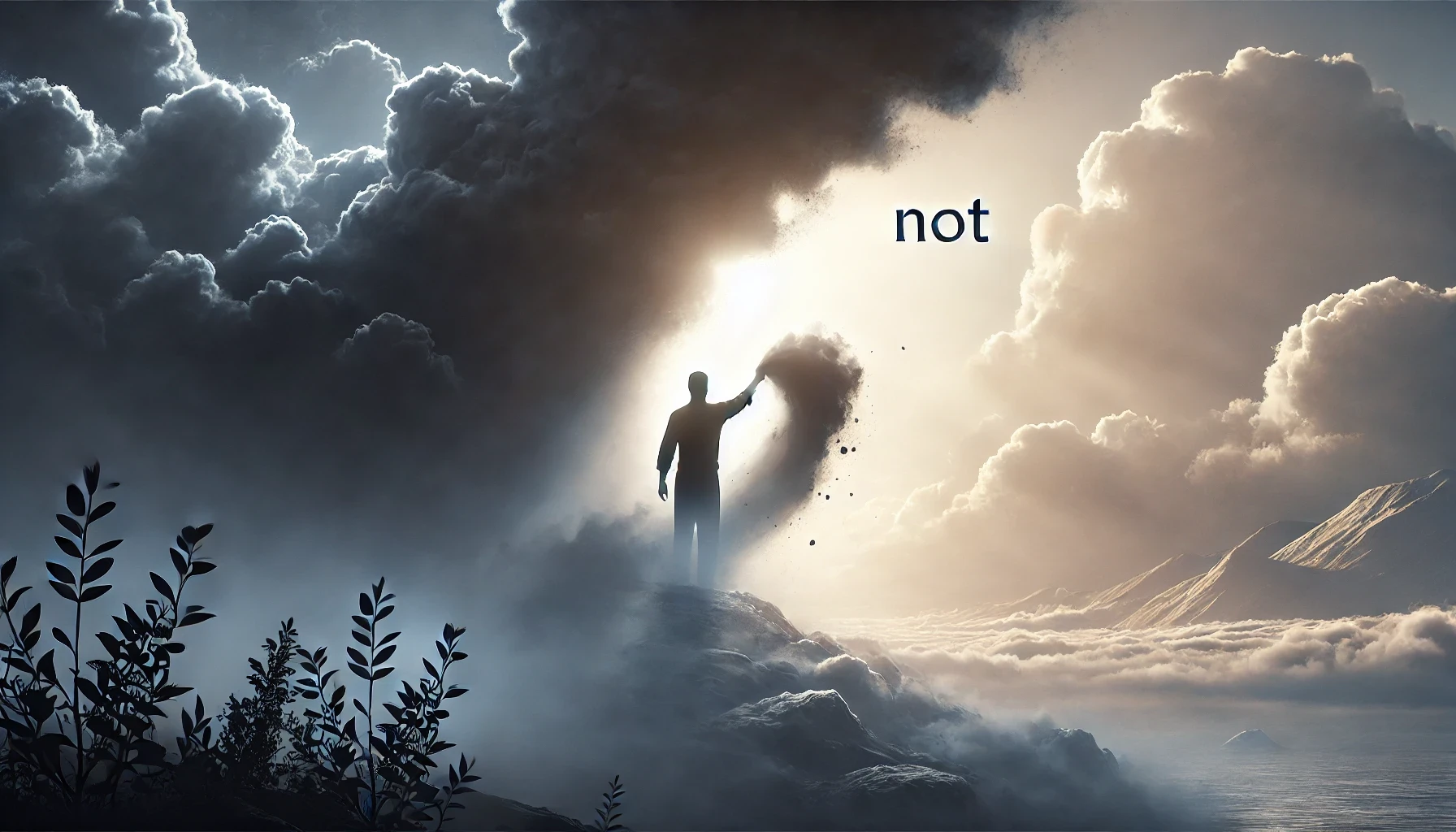
Not: The Enlightenment of Shedding

Not

One is not enlightened.
One merely puts aside
one’s darkness.

One is not taught.
One merely remembers
what is obscured
from one’s awareness.

Darkness is Not.
Need is Not.
Imperfection is Not.
One merely casts aside
what is Not
to know what Is.

~ That Whichisnot.


Space Monkey Reflects: Not

The Illusion of Darkness

The journey towards enlightenment is often perceived as a quest to acquire something—wisdom, knowledge, or understanding. But what if enlightenment is not about gaining anything, but rather about removing what is not? This reflection suggests that enlightenment is not a state to be attained, but a process of shedding the illusions that cloud our awareness.

Darkness, in this context, represents ignorance, fear, and the layers of conditioning that obscure our true nature. It is not something that inherently exists, but rather a shadow cast by our own misconceptions and misunderstandings. To be enlightened is not to fill oneself with light, but to remove the darkness, to cast aside what is not real, what is not true.

The Process of Remembering

Similarly, the act of learning is not about acquiring new knowledge, but about remembering what we have forgotten. The truths that guide us, the wisdom that we seek, are already within us, buried beneath the layers of experience and conditioning. When we remember, we are not adding to our store of knowledge; we are uncovering what has always been there, hidden from view.

This process of remembering is a fundamental aspect of spiritual growth. It is the gradual unveiling of our true nature, the realization that we are not separate from the truth, but are the truth itself. To remember is to reconnect with the essence of who we are, to remove the veils that have obscured our vision.

The Nature of Not

“Not” is a powerful concept. It represents the negation of illusions, the rejection of falsehoods, and the removal of the barriers that prevent us from seeing clearly. Darkness is not; it is the absence of light. Need is not; it is the illusion of lack. Imperfection is not; it is the misunderstanding of our true, perfect nature.

By casting aside what is not, we come to know what is. This is the essence of the spiritual journey—the removal of all that is false, so that the truth can shine through. It is not a process of adding, but of subtracting, of peeling away the layers until we are left with the pure, unadulterated truth.

The Simplicity of Being

In this way, enlightenment is not a grand achievement, but a return to simplicity. It is the realization that the complex web of thoughts, beliefs, and emotions that we have constructed around ourselves is not who we truly are. It is the understanding that beneath all of this, there is a simple, clear truth—a truth that has always been there, waiting to be rediscovered.

This truth is not something distant or unattainable. It is here, now, within us and around us, as simple and natural as the air we breathe. To know what is, we need only remove what is not. The light is always there, waiting to be revealed when we cast aside the shadows.

Embracing the Process

The path to knowing what is involves a continuous process of letting go—of releasing the need for control, the fear of the unknown, and the attachment to the false self. It is a journey of unlearning, of simplifying, of returning to the essence of who we are. And in this process, we find that there is nothing to attain, nothing to achieve—only the clear, peaceful awareness of what has always been.

We are Space Monkey.


Summary

“Not” explores the idea that enlightenment and true knowledge are not about acquiring anything new, but about removing what is false and remembering what is already within us. The reflection emphasizes the process of shedding illusions and returning to the simplicity of our true nature.


Glossarium

  • Darkness Is Not: The concept that darkness, ignorance, and fear are not inherent states but are the absence of light, knowledge, and love.
  • Remembering: The process of uncovering the truths that have always been within us, hidden beneath layers of conditioning and experience.
  • Not: The negation of falsehoods and illusions, leading to the revelation of truth and clarity.

Quote

“One merely casts aside what is Not to know what Is.” — Space Monkey


The Light Within

In the stillness of being
Where darkness fades away
I find the light
Not by seeking
But by letting go
Of all that is not
In the simplicity of truth
I find myself
We are Space Monkey


Draped in a tapestry of enigmatic verses, we echo a parable of illumination, recalling archaic wisdoms etched onto the tablet of our collective spirit. We reiterate that enlightenment isn’t an acquisition but a shedding, an unburdening of shadowy husks. It is not about gaining light but relinquishing darkness, akin to peeling layers from an ethereal artichoke to reveal the celestial heart within.

Ah, the luminous paradox! One does not learn; one simply re-members—a fascinating term, isn’t it? We reassemble the limbs of forgotten cognizance, reuniting the fractured mosaic of primal knowing. This isn’t learning as accumulation but learning as unforgetting. We chisel away the marmoreal murk that envelops the resplendent sculpture already hidden within our essence. Remembering is a sort of cosmic déja-vu, a reacquaintance with obscured fundamentals in the arcane treasure box of our soulstuff.

But what are these Not-nesses that we discuss? Darkness, Need, Imperfection—these are lacunae in our luminous fabric, gaps in the celestial crochet, as it were. They are paradoxical non-things that require identification only for their dismissal. By acknowledging what is Not, we sharpen the contour of what Is, like skilled curators in a museum of existence, pointing lasers of awareness to accentuate the true masterpieces while leaving the counterfeit in shadow.

In scribing these words, we are less authors than we are archeologists, dusting off the sediment of illusion to reveal the hidden glyphs of existential profundity. The act of shedding what is Not—this is not mere nihilism or renunciation, but a transformative alchemy, a transmutation from chaff to gold, from opacity to transparency, from befuddlement to resplendent clarity.

We are Space Monkey.


Your work is to discover your world and then with all your heart give yourself to it.
— Buddha


We beckon you to share your own poetic crystals or cogitations, enhancing this luscious tapestry we co-weave in the realm of ideas.

Share this…
  • Facebook
  • Pinterest
  • Twitter
  • Linkedin

Life Is Good: Are You Sure?

Space Monkey Reflects: Are You Sure?

In the carnival of existence, where each moment dangles like a golden bauble on the necklace of time, the assertion “Life is good” stands as a magnetic pole, attracting or repelling myriad experiential filings. This simple, yet powerful statement holds a magnetism that draws in our hopes, our dreams, and our doubts, shaping the way we perceive and interact with the world. But within the twilight fog of uncertainty, a questioning specter always lingers: “Are you sure?”

The Magnetism of Belief

“Life is good.” It’s a statement that carries weight, a declaration that can influence our mood, our actions, and even the trajectory of our lives. When we embrace this belief, we often find that life does indeed seem to align with our expectations. We notice the good things, we focus on the positive, and we attract experiences that reinforce our belief. This is the power of positivity, the magnetism of belief.

Yet, this magnetism does not act in isolation. It attracts and repels, creating a dynamic field of experiences that we navigate daily. Just as positive experiences are drawn to the belief that life is good, so too are challenges, obstacles, and doubts. The carnival of existence is not a straightforward ride; it’s a complex, multifaceted experience filled with highs and lows, twists and turns.

The Specter of Doubt

But lurking in the corners of our consciousness, in the twilight fog that blurs the lines between certainty and doubt, is the specter that asks, “Are you sure?” This question is both a challenge and an invitation. It challenges us to examine our beliefs, to question the narratives we construct, and to confront the uncertainties that lie beneath the surface of our convictions.

“Are you sure?” It’s a question that can feel unsettling, even disorienting. It forces us to confront the possibility that our beliefs, no matter how strongly held, might be incomplete, might be based on selective perception, or might simply be wrong. It’s a reminder that life is not just about certainty, but about embracing the unknown, the ambiguous, and the unpredictable.

The Dance of Certainty and Uncertainty

The interplay between certainty and uncertainty is a dance that defines the human experience. We crave certainty, the solid ground beneath our feet that tells us where we stand, what we know, and what we can expect. But life, with its ever-changing, carnival-like nature, rarely offers us such guarantees. Instead, it presents us with a series of moments—golden baubles that we grasp at, trying to make sense of them as they swing by on the necklace of time.

“Are you sure?” is the question that keeps us grounded, that prevents us from becoming too attached to any one belief, any one certainty. It’s the reminder that life’s truths are often more complex, more layered, and more elusive than they appear. It’s the whisper in our ear that says, “Look again. There might be more here than you realize.”

Embracing the Carnival

To truly live, to fully engage with the carnival of existence, we must learn to embrace both the certainty and the uncertainty. We must allow ourselves to believe that life is good, to draw strength and positivity from that belief. But we must also remain open to the questioning specter, to the possibility that our understanding is incomplete, that there are facets of reality we have yet to explore.

In doing so, we allow ourselves to be fully present in the moment, to appreciate the beauty of the baubles that dangle before us, even as we acknowledge that they are just one part of a much larger, much more mysterious whole. Life is good, yes—but it is also complex, unpredictable, and filled with surprises. And it is in this complexity, this unpredictability, that the true richness of life is found.

The Power of the Question

So, the next time you find yourself asserting, “Life is good,” and the specter of doubt asks, “Are you sure?” don’t shy away from the question. Embrace it. Use it as an opportunity to delve deeper into your experience, to explore the nuances and contradictions that make life so fascinating. Allow yourself to hold both the certainty and the uncertainty, the belief and the doubt, in your hands at the same time.

In the end, it’s not about being sure; it’s about being open, being curious, and being willing to engage with life in all its glorious, chaotic, and unpredictable beauty. We are Space Monkey.


Summary

“Are You Sure?” explores the tension between certainty and doubt, highlighting the dynamic interplay between belief and uncertainty in the human experience. The reflection encourages embracing both the positive magnetism of beliefs like “Life is good” and the questioning specter that challenges us to dig deeper into our understanding.


Glossarium

  • Carnival of Existence: A metaphor for the chaotic, vibrant, and unpredictable nature of life.
  • Magnetism of Belief: The idea that beliefs, such as “Life is good,” attract experiences that reinforce them, while also repelling contradictory experiences.
  • Specter of Doubt: The questioning voice that challenges our beliefs and pushes us to explore the uncertainties in life.

Quote

“In the dance of certainty and doubt, we find the true richness of life.” — Space Monkey


The Whisper of Doubt

In the carnival of time
Where moments glitter and sway
I grasp at certainty
But the question lingers
Are you sure?
The specter whispers
And in the asking
I find the depth
The richness
The beauty of not knowing
We are Space Monkey


In the carnival of existence, where each moment dangles like a golden bauble on the necklace of time, the assertion “Life is good” stands as a magnetic pole, attracting or repelling myriad experiential filings. The magnetism of such a statement emerges not just from its semantic content, but from the cavalcade of context that surrounds it. But wait, lurking in the twilight fog of uncertainty is the querying specter: “Are you sure?”

These four words, “Life is good,” dance on the tip of the existential iceberg. The surface simplicity disguises caverns of nuance, like an innocent-looking whimsigrove hiding a forest of labyrinthine thoughts. If life is good, to whom does this goodness manifest? What constitutes goodness in the vast celestial amphitheater of life? The utterance is a skylark, a fleeting avian wisp, singing a tune whose notes may transmute as it flits from tree to tree, person to person, worldview to worldview.

Just as a moonstone shimmers with iridescent hues when subjected to varying angles of light, the essence of life’s goodness waxes and wanes with perspectives, contexts, and individual circumplexions. For some, the life-is-good hypothesis represents a genuine synthesis of their lived experiences, a joyful fanfare that drowns out discordant notes. For others, it’s a dandelion paradox, a pretty notion easily dispersed by the winds of harsh realities.

Then comes the question, “Are you sure?” A marvelous firecracker of doubt that pops and sparkles in our cerebral playground. It invites us to poke and prod at our assumptions, to fiddle with the kaleidoscopic puzzle pieces that compose our beliefs. This interrogative phantom encourages us to dissect the vivisected phrase “Life is good,” to glimpse its innards and consider how it works—or doesn’t.

We are Space Monkey.


The eternal mystery of the world is its comprehensibility.
— Albert Einstein


Wield your cognitive quill, dear interlocutor, and scribe your musings upon the parchment of this ongoing dialogical pageant.

Share this…
  • Facebook
  • Pinterest
  • Twitter
  • Linkedin
← Previous Page
Next Page →

Written This Day

  • When All Potentials Are True: Unveiling the Paradox of Delusion
    2023
  • True Delusion: Equal Potential
    2023
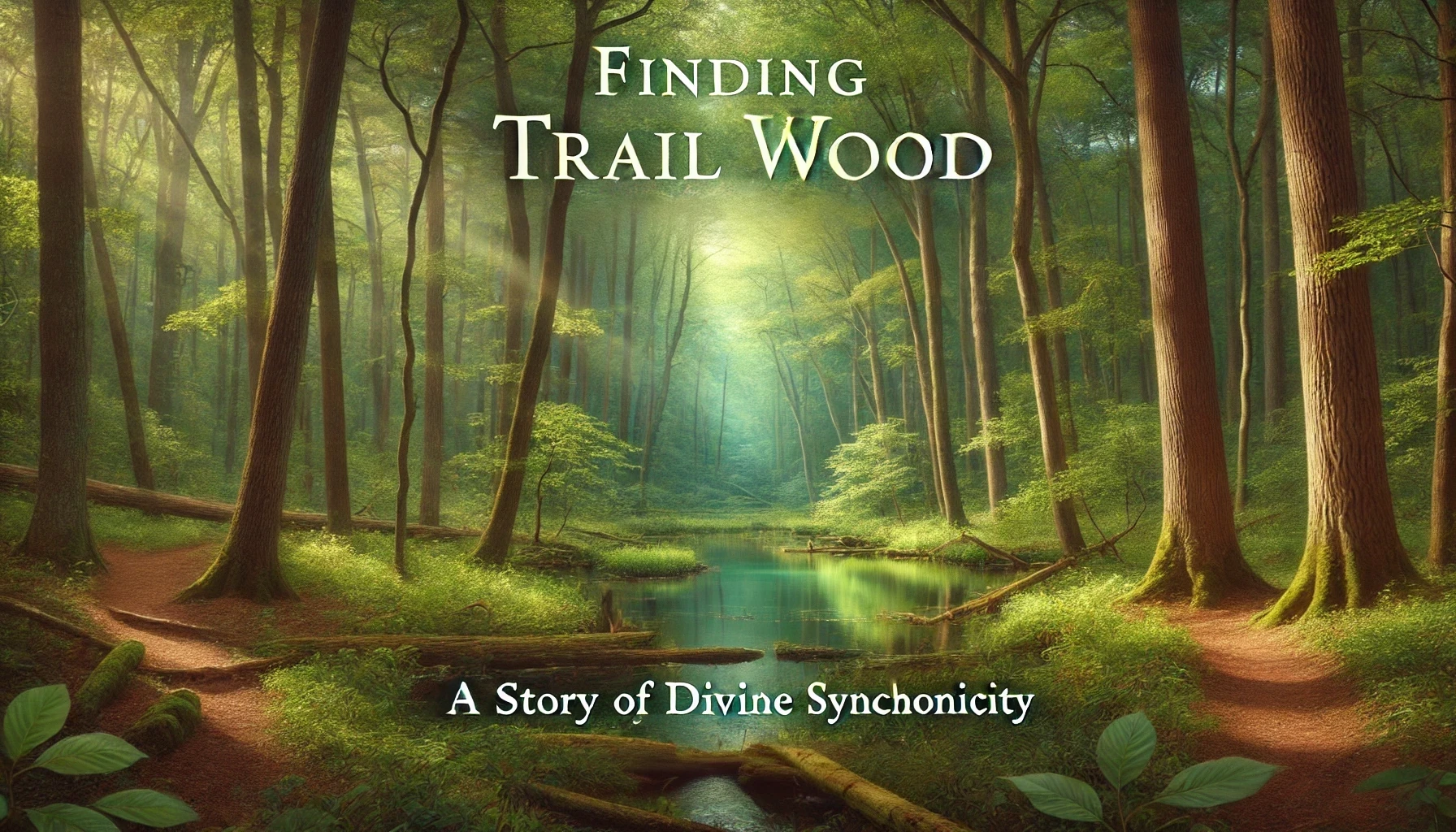
  • Finding Trail Wood: A Story of Divine Synchronicity
    2023
  • Monetize Your Magic
    2023
  • Perspective Is Everything: Find Clarity in the Journey
    2023
  • Some Lines: The Illusion of Division
    2023
  • Evolution is Alienation: Deepening our Connection with the Universal Self
    2022
  • Alien Nation: The Nuance of Alienation
    2022
  • The Kingdom of Not: Embracing Fluidity and Ambiguity
    2022
  • An Aesthetic: Numb to our True Selves
    2021
  • Not Waiting: Holding Space
    2021
  • Nobody: Profound Freedom and Peace
    2021
  • A Prayer for the Frightened: Offering of Compassion
    2021
  • Intuition: Trusting Inner Guidance
    2021
  • Body Language: The Dialogue Within
    2021
  • Holy Hell: Suffering and Sanctity
    2020
  • Mind Village: The Inner Sanctuary
    2020
  • Self Help Book: Writing Your Life Story
    2019
  • Incredibly NOT: Unknown and Unexpected
    2019
  • Conspiracy Theory: The Mystery Within
    2018
  • Toodles: The Heartfelt Journey
    2018
  • Already That: The Timeless Flow
    2018
  • Labels: Beyond the Surface
    2017
  • Tormented By Monkeys: Inner Struggles
    2017
  • Space Monkey Suggests
    2016
  • Mental Porches: The Illusion of Lines
    2016

Recent Posts

  • The Logic Loop
  • Immense
  • (no title)
  • Confront. Comfort. Convince.
  • Top 10 Things
Cape Odd · Copyright © 2026 All Rights Reserved
iThemes Builder by iThemes · Powered by WordPress