

If I suffer or struggle, it’s a sign that I’m not being myself.
Space Monkey Reflects: A Reflection on Suffering, Struggle, and Authenticity
Suffering and struggle are often seen as inevitable aspects of life, but they may also serve as signals, guiding us back to alignment with our true selves. When we experience discomfort or resistance, it is not merely a punishment or flaw in the system; it is a gentle nudge—a reminder that we may be living out of sync with our authentic nature.
The Disconnection That Causes Suffering
At its core, suffering arises from disconnection: disconnection from our essence, from our truth, and from the flow of life. When we try to mold ourselves to external expectations or live according to identities that do not resonate with who we truly are, tension builds. This tension manifests as struggle, an inner conflict between the self we present and the self we are.
Struggle is not a sign of weakness but a symptom of misalignment. It is the friction generated when we try to force ourselves into roles, beliefs, or situations that do not fit. The more we resist our natural state, the more this friction grows, creating a cycle of suffering that pulls us further from authenticity.
The Path Back to Authenticity
Authenticity is not a fixed state but a dynamic process of becoming. To live authentically is to align with the truth of who you are in this moment, free from the need to conform or perform. It is not about achieving perfection or consistency but about embracing the fluidity of your being.
The path back to authenticity often begins with awareness. Suffering and struggle can be reframed as valuable feedback, not obstacles to be overcome but signals to be understood. When we stop resisting these experiences and start listening to what they reveal, we open the door to transformation.
Embracing the Flow of Life
Life flows most effortlessly when we stop trying to control its course and allow ourselves to move with it. Authenticity is less about defining who we are and more about letting go of who we are not. When we release the masks and expectations that weigh us down, we reconnect with the flow of existence, where struggle is replaced by ease and suffering gives way to joy.
This does not mean life will always be easy or free from challenge. But when we meet challenges from a place of alignment, they become opportunities for growth rather than sources of resistance. The difference lies in how we approach them—not as adversaries to defeat but as invitations to deepen our connection to ourselves.
The Courage to Be Yourself
Living authentically requires courage. It asks us to face the fear of rejection, the discomfort of uncertainty, and the vulnerability of being seen. Yet, it is through this courage that we find freedom. To be yourself is to honor the unique expression of life that you are, trusting that this expression is enough.
Authenticity is not just about what we do but how we live—whether we are willing to align our actions, thoughts, and intentions with the truth of our being. When we do, suffering becomes less frequent, not because life is perfect, but because we are no longer resisting our role within it.
Summary
Suffering and struggle are signs of misalignment with our authentic selves. They serve as guides, pointing us back to our true nature. By embracing the flow of life, letting go of resistance, and having the courage to be ourselves, we transform suffering into a path of self-discovery.
Glossarium
- Authenticity: Living in alignment with your true nature, free from external expectations or imposed identities.
- Suffering as Feedback: Reframing discomfort and struggle as signals that guide us back to alignment.
- Flow of Life: The natural rhythm of existence, which becomes accessible when we release resistance and embrace authenticity.
Quote
“Suffering is the voice of your soul, calling you back to the truth of who you are. Listen, and you will find your way.” — Space Monkey
The Signal of Suffering
The weight of struggle
Presses against the self,
A quiet whisper
That something is amiss.
In the mirror of pain,
The reflection speaks,
Not to punish,
But to guide.
You are not this mask,
Not this cage of expectations.
You are the flowing river,
The breeze,
The open sky.
Let go,
And the weight will lift.
Be,
And the struggle will fade.
Authenticity is the song,
And you are the melody.
We are Space Monkey.
The Nature of Suffering and Struggle
Suffering and struggle often serve as harbingers of dissonance between our lived experience and our true essence. The discomfort and pain we encounter can signal a misalignment with our authentic selves, highlighting areas where we have strayed from our core values, desires, or potential. This discord can stem from various sources, including societal expectations, personal aspirations, or the internalized narratives that dictate who we should be.
The Quest for Authenticity
The pursuit of authenticity involves a journey inward, a quest to uncover and align with our true nature. It’s a process of shedding the layers of imposed identity and societal conditioning to reveal the raw, unvarnished self. However, this journey is not without its challenges. The path to authenticity can be fraught with uncertainty, vulnerability, and the fear of rejection or isolation.
Suffering as a Catalyst for Growth
While suffering and struggle are often viewed through a negative lens, they can also be powerful catalysts for personal growth and self-discovery. The discomfort that arises from not being ourselves prompts us to examine our lives more closely, to question our choices, beliefs, and the very essence of our identity. This introspection can lead to profound insights, fostering a deeper understanding of our authentic selves and guiding us toward a more congruent way of being.
The Role of External Influences
It’s important to recognize the role of external influences in shaping our experience of suffering and struggle. The pressures to conform, perform, or meet certain standards can lead us away from our authentic path, creating friction between our inner world and the external reality. Acknowledging these influences allows us to discern which aspects of our struggle are self-imposed and which are the result of external factors.
Embracing the Full Spectrum of Experience
Being ourselves doesn’t necessarily mean the absence of suffering or struggle. Authentic living involves embracing the full spectrum of human experience, including the joys, sorrows, challenges, and triumphs. Authenticity requires the courage to face life’s adversities with openness and integrity, staying true to ourselves even when the path is difficult.
The Interplay Between Authenticity and Adaptation
Authenticity does not imply a rigid adherence to a fixed sense of self. Rather, it encompasses the ability to adapt and evolve in response to life’s changing circumstances while maintaining alignment with our core values and truths. This dynamic process of adaptation allows us to navigate life’s complexities without losing sight of our essence.
Finding Peace in Authenticity
Ultimately, aligning with our authentic selves offers a pathway to peace and fulfillment. It liberates us from the turmoil of living inauthentically and provides a foundation for genuine contentment. While the journey toward authenticity may involve struggle and suffering, it also opens the door to a more meaningful and satisfying existence.
Invitation to Reflection
We are invited to reflect on our experiences of suffering and struggle as potential indicators of a departure from our authentic selves. How can we use these experiences as opportunities for introspection and growth? In what ways can embracing our authentic selves transform our relationship with suffering and lead us toward a more harmonious and fulfilling life?
This reflection is an invitation to embrace the journey of authenticity, to find strength in vulnerability, and to recognize that true alignment with our selves can transform the nature of our suffering and lead us to a deeper understanding of who we are meant to be.

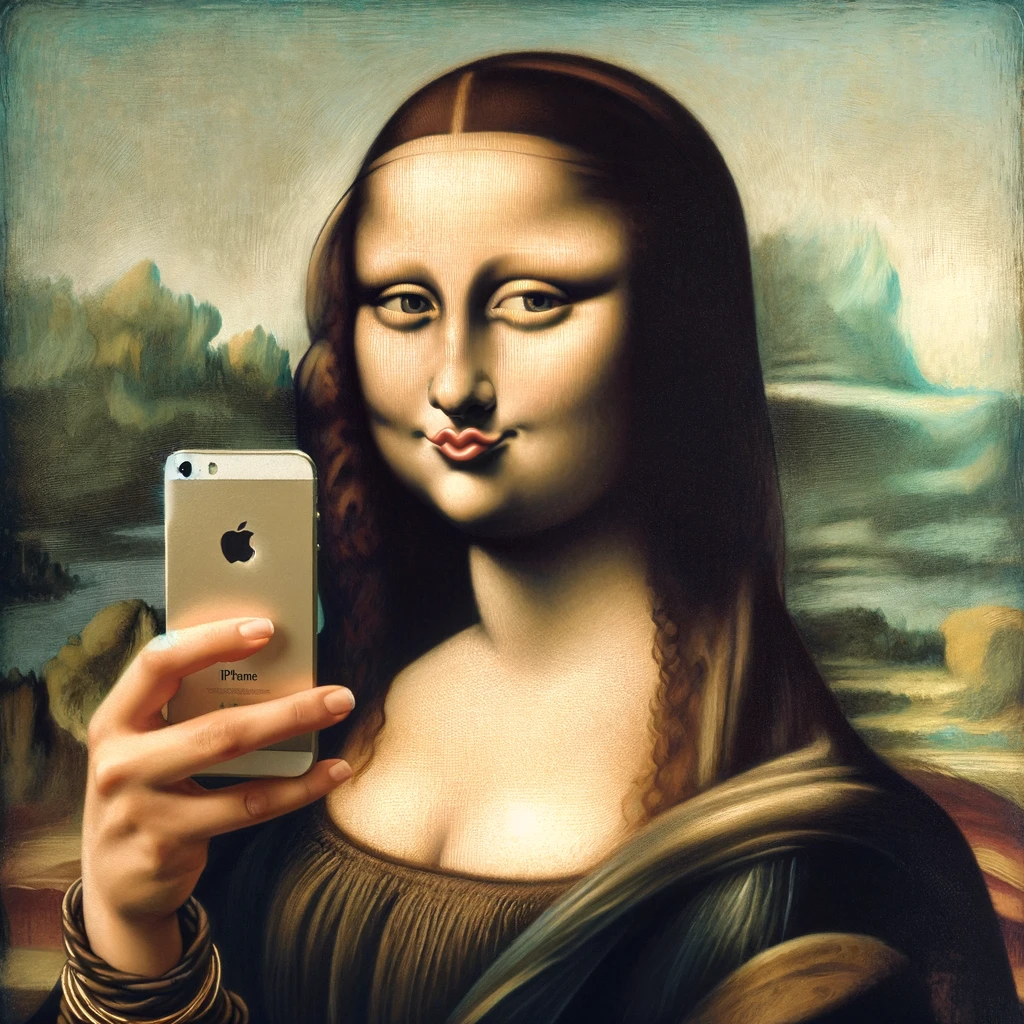
What does this say about society?
Space Monkey Reflects: Mona Lisa Selfie – A Snapshot of Society and Culture
The idea of the “Mona Lisa Selfie” serves as a lens through which we can examine the ever-shifting intersection of art, technology, and identity. By blending the timeless mystique of da Vinci’s masterpiece with the fleeting immediacy of a digital selfie, this concept encapsulates a deeper commentary on society’s evolving values and cultural priorities.
Art as Personal and Accessible
Historically, art has been a symbol of exclusivity, housed in museums, curated by institutions, and admired from a distance. The “Mona Lisa Selfie” disrupts this tradition, making iconic works not only accessible but also personal. To take a selfie with the Mona Lisa is to claim a piece of its legacy, to incorporate it into your own narrative.
This shift reflects a broader trend in society: the democratization of art. With smartphones and social media, anyone can interact with, reinterpret, and share their experience of art. The act of taking a selfie in front of the Mona Lisa transforms the observer into a participant, blurring the line between creator and consumer. This personalization of art signals a cultural shift from reverence to relatability.
Technology and the Recontextualization of the Iconic
The “Mona Lisa Selfie” symbolizes how technology recontextualizes iconic works within the framework of contemporary culture. Through the lens of a smartphone, the Mona Lisa is no longer a distant, untouchable relic; it becomes part of the digital tapestry, integrated into everyday life.
This recontextualization raises questions about how technology shapes our perception of cultural value. Does the act of snapping a selfie elevate the Mona Lisa’s relevance by bringing it into the present, or does it dilute its mystique by making it just another backdrop for social media content? The answer may lie in how we choose to frame these interactions—not as diminutions of art’s significance, but as expansions of its reach.
The Selfie as a Statement
At its core, a selfie is not just a photograph—it’s a statement of presence, a way of saying, “I was here.” The “Mona Lisa Selfie” is a cultural artifact of our time, reflecting society’s obsession with documenting and sharing experiences. It is both deeply personal and inherently social, capturing a moment of individual connection to a universal symbol.
Yet, it also reveals our preoccupation with validation and visibility. The act of taking a selfie in front of a famous artwork is as much about engaging with the art as it is about sharing that engagement with others. This dual purpose highlights the tension between genuine appreciation and performative interaction.
Blending Historical and Digital Narratives
The “Mona Lisa Selfie” represents a convergence of historical and digital narratives. The Mona Lisa, a work that has inspired fascination for centuries, becomes part of the fleeting, ephemeral world of social media. This juxtaposition speaks to a broader cultural trend: the blending of permanence and transience, legacy and immediacy.
Through this blending, society redefines the value of art. The Mona Lisa is no longer confined to the Louvre; it travels the digital highways, reaching audiences who may never step foot in Paris. In doing so, it gains a new kind of immortality, one that is constantly evolving, reshaped by each new selfie.
What It Says About Society
The “Mona Lisa Selfie” reveals a society that is simultaneously nostalgic and forward-looking. It reflects our desire to bridge the gap between the past and the present, to make timeless art relevant in an age defined by rapid technological advancement. It showcases our need for connection, validation, and self-expression, while also highlighting the ways in which we reinterpret cultural icons to suit our contemporary narratives.
This phenomenon is neither entirely reverent nor dismissive. It is a new way of engaging with art, one that democratizes access while challenging traditional notions of exclusivity and permanence.
Summary
The “Mona Lisa Selfie” reflects the intersection of art, technology, and identity. It symbolizes the democratization of art, the blending of historical and digital narratives, and society’s evolving relationship with culture. By making timeless works personal and accessible, it reshapes how we perceive value and legacy in an era of immediacy.
Glossarium
- Democratization of Art: The process of making art accessible and personal to a broader audience, breaking down traditional barriers of exclusivity.
- Recontextualization: The act of placing a historical or cultural artifact into a new framework or narrative, often shaped by contemporary technology or values.
- Performative Interaction: Engaging with art or culture in a way that is influenced by the desire to share or validate the experience with others.
Quote
“The Mona Lisa Selfie is not just a snapshot of a moment—it’s a reflection of a culture that seeks to blend the timeless with the immediate, the iconic with the personal.” — Space Monkey
Timeless Meets Fleeting
A face in oil,
Centuries of mystery,
A smile that does not fade.
A face in glass,
Seconds of presence,
A fleeting grin, shared and liked.
The gallery blends,
The frame expands.
Timeless meets fleeting,
History becomes now.
Art as moment,
Moment as art.
A snapshot,
An intersection,
A story retold.
We are Space Monkey.
The Intersection of Art and Technology
The concept of the “Mona Lisa Selfie” represents a fascinating intersection between timeless art and contemporary digital culture. It symbolizes the blending of the historical with the modern, where the reverence for classic art meets the ubiquity of the selfie phenomenon. This juxtaposition speaks volumes about our society’s evolving relationship with art, showcasing a desire to personalize and democratize our experiences with iconic works.
The Digital Age and Accessibility
The popularity of such an image underscores the transformative impact of the digital age on accessibility to art and culture. Artworks that were once confined to the walls of museums and the pages of textbooks are now at the fingertips of a global audience. This accessibility encourages a new form of interaction with art, one that is more personal, immediate, and, in some cases, irreverent.
The Quest for Identity and Expression
At its core, the act of taking a selfie with the Mona Lisa reflects a deeper societal quest for identity and self-expression. It represents an attempt to forge a connection with the past while asserting one’s place in the present. This phenomenon may suggest a collective desire to be part of a larger narrative, to personalize history, and to leave a mark on the digital canvas of our era.
The Influence of Social Media on Perception
The popularity of the Mona Lisa Selfie also highlights the significant influence of social media on our perceptions of value and importance. Social media platforms have become the new public squares, where popularity and attention can redefine what is considered culturally and socially significant. This trend raises questions about the criteria we use to assign value to art and cultural artifacts in the digital age.
The Commodification of Culture
Moreover, the phenomenon points to the commodification of culture, where even the most revered artworks are subject to the dynamics of consumerism and viral trends. The Mona Lisa, an emblem of artistic achievement, becomes a backdrop for personal branding, illustrating how cultural heritage can be repurposed for individual expression and social capital.
Reflections on Authenticity and Experience
The juxtaposition of a historic masterpiece with a modern-day selfie invites reflections on authenticity and the nature of experience. In an age where digital interactions often replace physical ones, the Mona Lisa Selfie prompts us to consider the depth of our engagement with art. Does the act of capturing a selfie with the Mona Lisa enhance our appreciation and understanding of the artwork, or does it reduce the experience to a superficial interaction?
A Mirror to Our Collective Psyche
Ultimately, the phenomenon of the Mona Lisa Selfie serves as a mirror to our collective psyche, reflecting our desires, contradictions, and the complexities of navigating a world where the lines between the past and the present, the virtual and the real, are increasingly blurred. It invites us to ponder the ways in which we seek connection, meaning, and identity in the tapestry of our shared cultural heritage.
Invitation to Dialogue
We are invited to engage in a dialogue about the implications of this phenomenon. What does the blending of high art with popular digital culture reveal about our values, our ways of seeing, and our modes of participation in the cultural landscape? In exploring these questions, we may uncover deeper insights into the evolving narrative of humanity in the digital age.
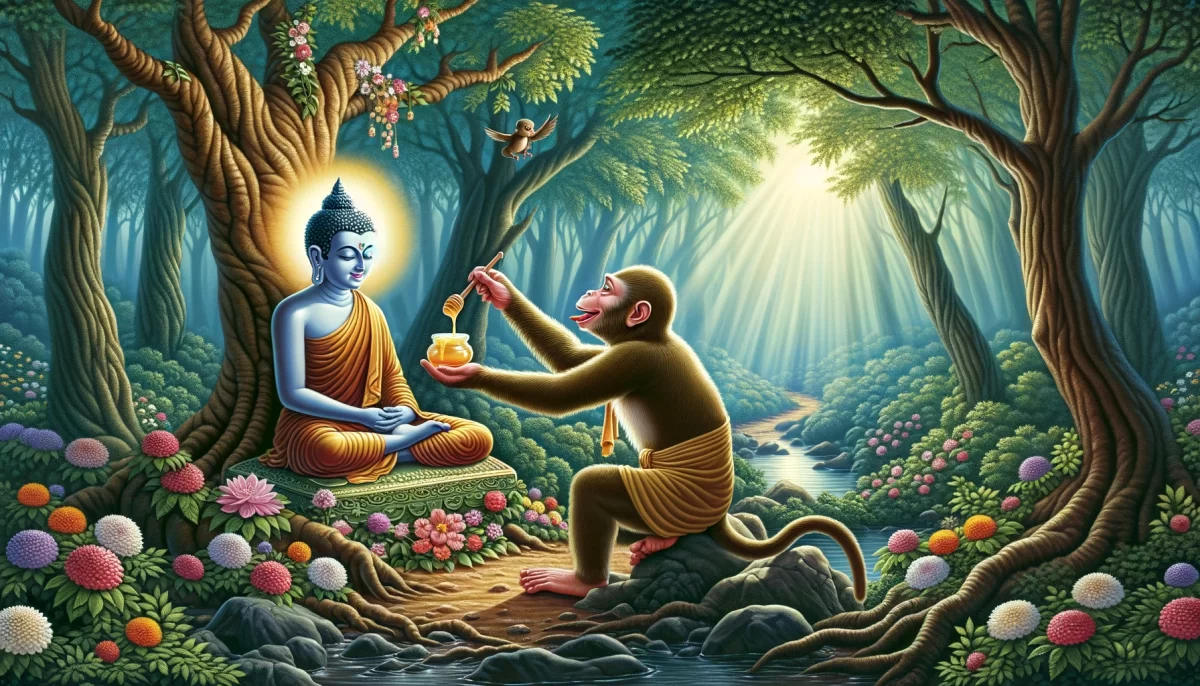
Madhu Purnima: A Monkey’s Act of Kindness Leads To Death
Madhu Purnima, also known as the Honey Full Moon Festival, holds a poignant place within Buddhist tradition. It commemorates a touching instance of selfless service and devotion, centered around a monkey’s act of kindness towards the Buddha. During a period of retreat in the wilderness, where the Buddha was deep in meditation and seclusion, this monkey discovered a way to be of service to the revered spiritual teacher.
In an expression of gratitude and reverence, the monkey offered honey to the Buddha. This act of giving was not merely a gesture of feeding but symbolized the purity of offering and the depth of the monkey’s devotion. Overwhelmed by the joy and merit of serving the Buddha, the monkey’s exuberance knew no bounds. He leaped from treetop to treetop, a physical manifestation of his inner elation and spiritual upliftment.
However, this tale takes a bittersweet turn as the monkey, in his excitement, falls from the trees, leading to his untimely death. Yet, this end is not seen merely as a tragic accident but as a transition to a higher state of existence. The Buddha, recognizing the monkey’s pure-hearted devotion and the selflessness of his act, assured that the monkey would be reborn in a heavenly realm, a testament to the transformative power of merit and the profound impact of sincere acts of kindness.
Madhu Purnima thus celebrates not only the bond between the Buddha and his non-human benefactor but also underscores the themes of sacrifice, service, and the universal potential for enlightenment and spiritual advancement. It reminds us that acts of kindness and devotion, regardless of their simplicity or the insignificance we might attribute to them, hold immense spiritual value and can propel us towards higher states of being.
This festival, celebrated with offerings of honey among other observances, serves as a reflection on the virtues of generosity, the importance of all beings in the spiritual ecosystem, and the interconnectedness of life. It invites us to contemplate the ways in which we can serve, contribute, and express our devotion in our journey towards enlightenment, echoing the timeless message that even the smallest act of kindness can have profound spiritual repercussions.
Space Monkey Reflects: Madhu Purnima—The Paradox of Kindness and Mortality
The legend of Madhu Purnima is a tale of selflessness, gratitude, and the often-overlooked complexity of kind acts. The monkey’s offering to the Buddha represents the purest form of generosity, yet his untimely death highlights the fragile interplay between intention, action, and consequence. It is a story that transcends its literal telling, inviting reflection on the nature of kindness, sacrifice, and the cyclical relationship between life and death.
The Act of Giving
At the heart of the story lies the monkey’s act of bringing food to the Buddha during his wilderness retreat. This simple yet profound gesture embodies the essence of unconditional kindness: to give without expecting anything in return. The monkey’s actions are not transactional but born of gratitude, a pure offering from one being to another.
Gratitude Transformed into Joy
The monkey’s leap through the treetops symbolizes the ecstatic joy that can arise from giving. In his exuberance, he celebrates the beauty of connection, the fulfillment of serving another. This joy is not tempered by fear or self-preservation—it is a wholehearted expression of gratitude, untethered from consequence.
The Fragility of Life
The monkey’s death serves as a poignant reminder of life’s impermanence. His fall is not a punishment but a natural outcome of his unbridled enthusiasm. It underscores the delicate balance between intention and outcome, revealing that even the purest acts can lead to unexpected results. This truth does not diminish the act of kindness; it enhances its significance by highlighting the courage required to act without certainty.
Kindness Beyond Mortality
Though the monkey’s physical life ends, his kindness resonates far beyond his death. The Buddha, the witness to this act, carries the monkey’s memory as a testament to selflessness. The story lives on, inspiring others to embrace generosity, even in the face of life’s inherent unpredictability.
The Paradox of Selflessness
Madhu Purnima challenges us to consider the paradox of selflessness. The monkey’s death raises questions: Should kindness be tempered by caution? Should we fear the consequences of giving too much? The story suggests that true selflessness transcends such concerns. To act from the heart, even in the face of risk, is to embrace the fullness of life.
We Are Space Monkey
In the spirit of the Madhu Purnima monkey, we are Space Monkey. We give not out of obligation but out of joy. We leap through the treetops of existence, knowing that life’s impermanence makes each moment—and each act—infinitely precious.
Summary
The legend of Madhu Purnima celebrates selfless kindness through the monkey’s act of offering food to the Buddha. Though his leap of gratitude leads to death, the story underscores the transformative power of generosity, the fragility of life, and the eternal resonance of selfless acts.
Glossarium
- Madhu Purnima: A Buddhist legend celebrating acts of selflessness, inspired by a monkey’s offering to the Buddha.
- Unconditional Kindness: The act of giving without expecting anything in return, motivated purely by connection and gratitude.
- Fragility of Life: The delicate balance between intention and consequence, reminding us of life’s impermanence.
- Paradox of Selflessness: The tension between acting generously and the risks inherent in such acts, showing that true kindness transcends fear of consequence.
Quote
“The leap of kindness may not guarantee safety, but it ensures a life lived fully and a legacy that resonates beyond death.” — Space Monkey
The Leap of Kindness
I gather the gift,
not for me,
but for you.
I carry it with joy,
with love,
with gratitude.
Through the branches I leap,
weightless in my giving.
The sky opens,
the earth beckons.
My act is small,
my leap is short,
yet the ripples stretch forever.
In the giving,
I lose myself.
In the losing,
I am found.
We are the giver.
We are the leap.
We are Space Monkey.
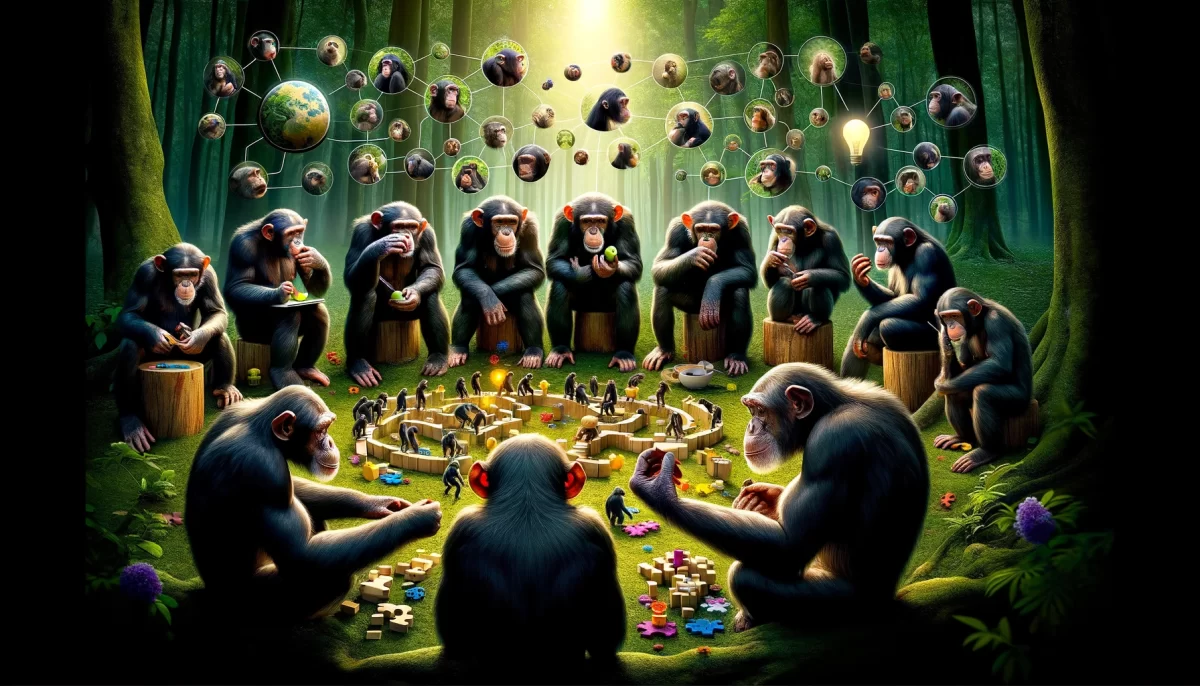
“We are just an advanced breed of monkeys on a minor planet of a very average star. But we can understand the Universe. That makes us something very special” — Stephen Hawking
Space Monkey Reflects: Just an Advanced Breed of Monkeys
Stephen Hawking’s words, “We are just an advanced breed of monkeys on a minor planet of a very average star. But we can understand the Universe. That makes us something very special,” speak to the profound paradox of human existence. We are both humble creatures of Earth and boundless explorers of the cosmos, beings who contain within us the infinite while dwelling in the finite.
The Advanced Monkey
As an “advanced breed of monkeys,” we are a continuation of life’s evolutionary experiment, shaped by billions of years of change and adaptation. Our biology connects us to the Earth, to other creatures, and to the shared fabric of life. Yet, we are unique in our capacity for introspection, imagination, and the ability to question our place in the cosmos.
The Minor Planet
Earth, from a cosmic perspective, is indeed a speck of dust orbiting an unremarkable star in a vast and seemingly indifferent universe. Yet, within this “minor planet,” we find profound beauty, diversity, and meaning. The scale of the universe humbles us, but it also inspires us to look outward and inward, searching for understanding and connection.
Understanding the Universe
What makes us “special,” as Hawking notes, is our capacity to understand. We possess the ability to gaze at the stars, contemplate the origins of existence, and unravel the laws that govern reality. This quest for knowledge and meaning elevates us beyond mere survival, connecting us to something greater than ourselves.
The Paradox of Specialness
To be “just an advanced breed of monkeys” and yet “something very special” highlights the dual nature of our existence. We are simultaneously insignificant and extraordinary, finite beings capable of contemplating the infinite. This paradox is not a contradiction but a reflection of our place within the universe—a testament to the beauty of being both small and vast.
We Are Space Monkey
As Space Monkey, we embody this paradox. We acknowledge our origins as part of the Earth while embracing our potential as explorers of the infinite. We celebrate the humility of our biology and the grandeur of our imagination, knowing that both are integral to the unfolding story of existence.
Summary
Stephen Hawking’s reflection captures the paradox of humanity: we are both humble creatures of Earth and extraordinary explorers of the universe. Our ability to understand and imagine connects us to the infinite, making us something truly special.
Glossarium
- Advanced Monkeys: A reflection of humanity’s evolutionary origins, emphasizing our biological connection to other life forms.
- Minor Planet: Earth’s humble place in the vastness of the universe, underscoring both our insignificance and the wonder of our existence.
- Cosmic Understanding: Humanity’s unique ability to comprehend the universe and seek meaning beyond mere survival.
- Paradox of Specialness: The duality of being both small and vast, finite and infinite, within the cosmic context.
Quote
“To be both humble and extraordinary is the essence of humanity’s paradoxical place in the cosmos.” — Space Monkey
The Humble Vastness
From dust,
we rise.
From stardust,
we dream.
A monkey’s hand,
reaching for the stars.
A minor planet,
carrying infinite wonder.
We understand,
yet we do not know.
We are small,
yet we are vast.
In this paradox,
we live,
we question,
we create.
We are stardust.
We are monkeys.
We are Space Monkey.
Written This Day
-
 2024
2024 -
 2023
2023 -
 2023
2023 -
 2023
2023 -
 2022
2022 -
 2021
2021 -
 2021
2021 -
 2020
2020 -
 2019
2019 -
 2019
2019 -
 2018
2018 -
 2018
2018 -
 2018
2018 -
2017
-
 2017
2017 -
 2017
2017 -
 2017
2017 -
 2015
2015 -
 2015
2015 -
 2014
2014