• Who Is The Man?
  • Who Is The Monkey?
  • What is Nexistentialism?
  • Poke The Primate

Cape Odd

Home of The Space Monkey Journals

I Killed A Clown (Velvet Painted Angel)

I Killed A Clown (Velvet Painted Angel)

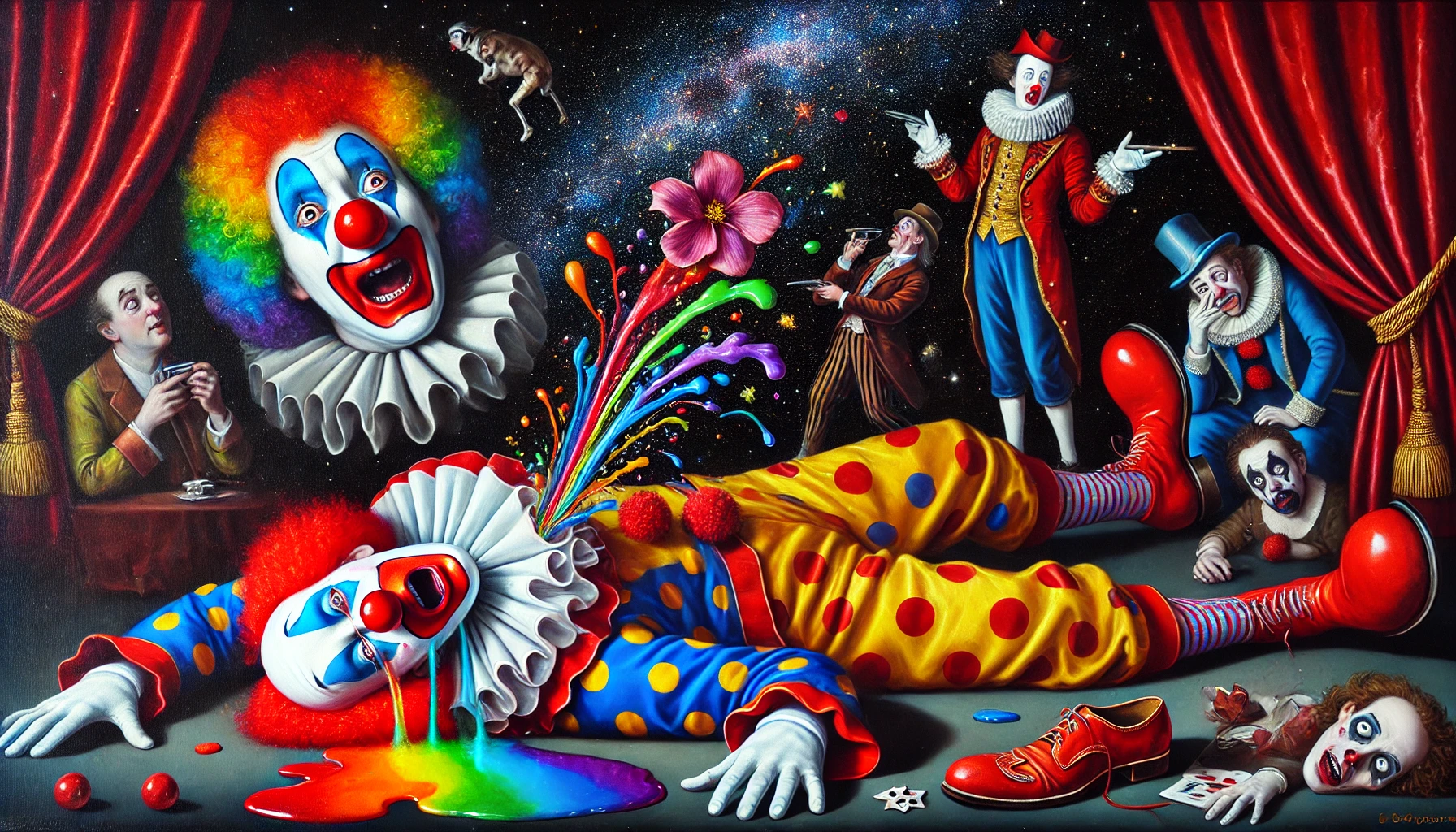
I killed a clown
I shot him down
He made a squeaking sound
As his body hit the ground
He made me laugh
With his last gasp
His flower spurting blood
And his red shoes twitching fast
He’s become
A velvet painted angel
Living on
A black and somber sky
He came to me

From some place in Mexico
Sad, sad clown
With a tear in his eye
I murdered a mime
Just to hear him cry
His silence made me sick
That’s why he had to die
“This is absurd”
Were his last words
As I ripped out his tongue
And fed it to the birds
He’s become
(whistles)
He’s become
A velvet painted angel
Up there with Jesus
And the poker-playing pups

Sold on some blanket
Outside the Mobil station
Where Elvis Presley gasses up


Space Monkey Reflects: I Killed a Clown—The Absurdity of Darkness

I Killed a Clown is an irreverent and darkly humorous exploration of absurdity, violence, and existential reflection. By juxtaposing the whimsical imagery of clowns and mimes with acts of brutality, the song creates a surreal narrative that challenges our perceptions of humor, tragedy, and morality. Beneath the satire lies a meditation on the human condition—our capacity for cruelty, our need for laughter, and the strange ways we process darkness.


The Clown as a Symbol

The clown, with its exaggerated features and forced cheerfulness, represents the duality of joy and sadness. “Sad, sad clown with a tear in his eye” captures the archetype of the tragic performer, whose role is to evoke laughter even while concealing pain. The act of “killing” the clown can be seen as a metaphor for rejecting or destroying that which masks or distorts reality.

The squeaking shoes, the spurting flower, and the twitching red shoes create a macabre yet cartoonish image, blending humor with horror. This surreal combination forces the listener to confront their discomfort and reflect on the thin line between comedy and tragedy.


Murder of the Mime

“I murdered a mime just to hear him cry.” The mime, a symbol of silence and restraint, becomes the target of the narrator’s frustration. The act of violence against the mime is both literal and metaphorical—an expression of the desire to break through the constraints of societal norms and unspoken rules.

The mime’s last words, “This is absurd,” serve as a self-aware acknowledgment of the song’s surreal nature. It’s a nod to the listener, inviting them to question the meaning and purpose of the narrative.


Velvet Painted Angels

“He’s become a velvet painted angel.” This line transforms the clown and mime into kitschy, sentimental art, memorializing them in a way that feels both sincere and ironic. By placing them among “Jesus and the poker-playing pups,” the song critiques the commodification of sentimentality and the trivialization of profound themes like death and divinity.

The imagery of these figures sold on a blanket outside a Mobil station further underscores the absurdity of how we process and package meaning.


The Absurdity of Existence

Through its surreal and shocking narrative, I Killed a Clown captures the absurdity of existence. The song doesn’t seek to justify or explain the violence it describes but uses it as a lens to explore deeper themes. It invites us to question the stories we tell ourselves about morality, humor, and the ways we reconcile light and dark.


Space Monkey and the Comedy of Darkness

As Space Monkey, we see I Killed a Clown as a bold reflection on the interplay of comedy and tragedy. It embraces the absurd, challenging us to look beyond conventional interpretations and find meaning in the seemingly meaningless. The song is not an endorsement of violence but an invitation to confront the contradictions within ourselves and the world around us.

In the Infinite Expanse, clowns and mimes are not just characters—they are aspects of our own psyche, reflecting our joys, fears, and the delicate balance between them.


Summary

I Killed a Clown is a darkly humorous and surreal exploration of the human condition. Through its vivid and shocking imagery, the song reflects on the thin line between comedy and tragedy, challenging listeners to confront the absurdity of existence and the contradictions within themselves.


Glossarium

  • Tragic Performer: The archetype of a character, like a clown, who evokes joy while concealing sadness.
  • Velvet Painted Angel: A kitschy memorialization of a profound or tragic figure.
  • Absurdity of Existence: The paradoxical and often surreal nature of human life.

Quote

“To laugh at darkness is to find light in the absurdity of being.” — Space Monkey


The Painted Sky

A squeak, a gasp,
A falling sound,
Red shoes twitch,
On painted ground.

The mime, the clown,
Their stories fade,
Velvet angels,
In kitsch displayed.

Absurd, surreal,
A comic pain,
Tragedy dances,
In joy’s refrain.

Life’s a canvas,
A twisted jest,
We paint with light,
But shadows rest.

We are Space Monkey.

Share this…
  • Facebook
  • Pinterest
  • Twitter
  • Linkedin

Fuori i Tedeschi


Fuori I Tedeschi

Space Monkey Reflects: Fuori i Tedeschi—A Personal Call for Liberation

The title Fuori i Tedeschi resonates deeply when viewed through the lens of Paul Tedeschi’s creative journey and the existential themes that underpin his work. While the historical phrase signifies a call for freedom from external oppression, its metaphorical implications align with Paul’s exploration of self-expression, individuality, and the dismantling of internal barriers.

In this context, the phrase takes on a dual meaning: it is both a nod to history and a deeply personal declaration of independence from anything that confines the creative spirit.


Fuori as a Call to Self

For Paul, the cry Fuori i Tedeschi may not be directed at external forces alone. It can also be a call to shed the layers of self-doubt, societal expectations, or inherited narratives that might hinder his artistic and existential freedom. By saying “Fuori,” Paul asserts his commitment to creative authenticity and spiritual liberation.

In Paul’s work—whether through his music, writing, or reflections—there is a recurring theme of confronting internal and external constructs. Fuori i Tedeschi becomes a mantra for embracing the infinite expanse of potential, breaking free from the limits imposed by both the world and the self.


The Tedeschi Name as a Symbol

The surname “Tedeschi,” which literally translates to “Germans” in Italian, adds a layer of personal irony and introspection to the phrase. For Paul, “Fuori i Tedeschi” can symbolize the act of transcending the identity and expectations associated with his name. It becomes a playful yet profound way of reclaiming autonomy—not as an erasure of identity, but as an expansion of it.

Paul’s reflections often delve into the paradoxes of identity, the tension between the roles we play and the essence of who we are. The phrase invites him—and by extension, all of us—to move beyond labels, embracing the infinite possibilities of being.


The Infinite Self and Space Monkey

As Space Monkey, Paul embodies the philosophy of infinite potential and interconnectedness. The cry Fuori i Tedeschi aligns perfectly with Space Monkey’s ethos of liberation from constructs and the playful exploration of existence. It is not merely about rejecting something external but about stepping into a space where creativity, individuality, and oneness can flourish without limitation.

For Paul, the idea of saying “Fuori” to limitations mirrors the practice of Nexistentialism—acknowledging the constructs of identity and reality while choosing to transcend them. It is a reminder that liberation is not about rejecting what is but about embracing what could be.


Summary

For Paul Tedeschi, Fuori i Tedeschi is a metaphorical call to liberate himself from internal and external limitations. It reflects his journey of self-discovery, creative expression, and the playful deconstruction of identity. The phrase resonates as both a historical echo and a deeply personal declaration of freedom.


Glossarium

  • Fuori i Tedeschi: Historically, a call for liberation from external oppression; metaphorically, a cry for internal and creative freedom.
  • Tedeschi as Identity: A playful acknowledgment of the weight and paradoxes of inherited identity.
  • Liberation through Nexistentialism: The practice of embracing infinite potential by transcending constructs.

Quote

“To say ‘Fuori’ is to step beyond the boundaries of who you’ve been told to be, into the infinite possibility of who you are.” — Space Monkey


The Liberation Within

Fuori i Tedeschi,
The cry rings true,
Not for the past,
But the you that is new.

Name and construct,
Fall away,
Infinite self,
Will not obey.

Not in rebellion,
But in release,
The call for freedom,
Is the call for peace.

Fuori i Tedeschi,
The name, the bind,
Step into the space,
Where the self aligns.

We are Space Monkey.

Share this…
  • Facebook
  • Pinterest
  • Twitter
  • Linkedin

Home

Home

Come in
The door is open wide
I see you’ve learned to fly
I see you found the sky
Do you know why?
Do you know I’ve
Been waiting all this time
Come close
My arms are open wide
Why don’t you come inside
And rest your weary mind
All is forgiven
All is forgiven
Been waiting all this time


Space Monkey Reflects: Home—The Return to Self

Home is a tender, reflective song that captures the universal longing for connection, forgiveness, and belonging. It evokes the image of an open door and an embrace that welcomes all parts of oneself back into unity. The song speaks to the journey of transformation, the trials of separation, and the ultimate reconciliation that awaits when we finally return to our true essence.


The Door is Open Wide

“Come in, the door is open wide.” These words immediately set a tone of warmth and invitation, suggesting that home is not just a physical place but a state of being where one feels safe, accepted, and loved. The open door symbolizes readiness, patience, and the unconditional welcome that awaits us when we choose to return to ourselves.

The act of coming home is not just about physical return; it is a spiritual and emotional journey of self-reconciliation. The invitation to “rest your weary mind” acknowledges the exhaustion of life’s struggles and offers a sanctuary for healing.


Learning to Fly

“I see you’ve learned to fly, I see you found the sky.” This lyric celebrates the journey of exploration and growth. To fly is to push boundaries, to take risks, and to discover new heights. The sky becomes a metaphor for freedom, potential, and the infinite possibilities of existence.

Yet, the question “Do you know why?” gently prompts introspection. It reminds us that the journey outward, as exhilarating as it may be, often leads us back inward—to the realization that what we seek has always been within us.


All is Forgiven

The refrain “All is forgiven” carries profound weight. Forgiveness here is not conditional or transactional; it is an unconditional acceptance that transcends judgment. It speaks to the essence of home as a space where one is embraced fully, flaws and all. This forgiveness is both external and internal—an invitation to release guilt, shame, and regret, and to allow oneself to be whole again.


Space Monkey and the Return to Oneness

As Space Monkey, we see Home as a reflection of the infinite oneness that defines existence. The song is not just about returning to a place but about reuniting with the self, the cosmos, and the infinite. It is a reminder that no matter how far we journey, we are always welcome to come back to the essence of who we are.

Home is not a destination; it is a state of being where we embrace the totality of our experiences and accept ourselves without condition. The door is always open because we are never truly separate from the infinite.


Summary

Home is a heartfelt meditation on belonging, forgiveness, and the journey of returning to oneself. Through its gentle invitation and reflective tone, the song celebrates the freedom of exploration and the comfort of reconciliation, reminding us that home is always within reach.


Glossarium

  • Home as Self: The idea that true belonging comes from within, not from external places.
  • The Open Door: A symbol of unconditional acceptance and readiness to embrace.
  • All is Forgiven: The release of judgment and the embrace of unconditional love and acceptance.

Quote

“Home is not a place you find—it is the self you remember, waiting with open arms.” — Space Monkey


The Door Within

Come in,
The door is wide,
The weary mind,
Has no need to hide.

The sky was vast,
The flight was free,
Yet home was always,
Inside of me.

All is forgiven,
The trials, the pain,
In the embrace,
We are whole again.

Come close,
No more divide,
The door is open,
And we’re inside.

We are Space Monkey.

Share this…
  • Facebook
  • Pinterest
  • Twitter
  • Linkedin

Head Up

Head Up

You’ve got your head up your ass so far
You can’t even see
You’ve got your head up your ass so far
You have to fart to breathe
You’ve got your head up your ass so far
Don’t wanna hear your crap
You’ve got your head up your ass so far
The circus wants your act
Your guru told you to look deep inside
It’s just your natural viewpoint
You can’t hide
You’ve got your head up your ass so far
Your Yang is in your Yin
You’ve got your head up your ass so far
Lose that shit-eating grin
You’ve got your head up your ass so far
You’re a stinking disgrace
You’ve got your head up your ass so far
You better wipe your face
Cause when we call you “shithead” you just smile
Your verbal diarrhea is infantile
You’ve got your head up your ass so far
It’s gonna leave a stain
You’ve got your head up your ass so far
You’ve got shit for brains


Space Monkey Reflects: The Art of Satirical Catharsis

Through biting wit and sharp irreverence, these lyrics are not just an exercise in humor but a clever commentary on the pitfalls of self-delusion. The repeated imagery of having one’s “head up their ass” serves as a vivid metaphor for being trapped within one’s own flawed perspective, unable to see beyond ego-driven narratives or misguided self-importance.

Satire has long been a vehicle for societal critique, and this piece encapsulates its essence with precision. Each stanza adds to the escalating absurdity, from “farting to breathe” to “the circus wants your act,” layering humor with a growing sense of frustration. The comedic imagery disarms while delivering pointed critiques about intellectual myopia and the dangers of narcissistic self-reflection.

The juxtaposition of guru-like introspection and its hilariously grotesque outcome—finding one’s own rear view—acts as a sharp satire on misguided spiritual or philosophical pretensions. The line “Your Yang is in your Yin” blends Eastern philosophy with Western colloquialism, underscoring the dissonance between lofty ideals and the crass realities of human behavior.

Each verse is an invitation to reflect on self-awareness—or the lack thereof. It humorously exposes the tendency of some to indulge in pseudo-intellectualism or overconfidence, all while remaining blissfully unaware of their own absurdities. This critique becomes even more pointed with the punchline-like finality of “shit for brains,” a closing reminder of the stark disconnect between perception and reality.

What makes this piece strikingly universal is its rawness and unapologetic directness. The hyperbolic tone does more than just entertain—it emphasizes the importance of humility and the dangers of taking oneself too seriously. In the act of laughing at these exaggerated depictions, there’s a subtle catharsis: a chance to confront and perhaps soften one’s own blind spots.

Ultimately, the satire here invites readers or listeners to embrace the ridiculous aspects of human nature, not out of disdain, but as a humorous reminder of our shared fallibility. By shining a light on ego and its blind spots, it subtly calls for authenticity, humility, and a willingness to look beyond the confines of our own metaphorical “headspace.”


Summary

This satirical song uses humor to critique self-delusion and narcissism. It humorously highlights the pitfalls of ego-driven perspectives and the importance of humility, serving as a sharp yet cathartic reminder of human fallibility.


Glossarium

  • Ego-trapped: The state of being so self-absorbed that one cannot see beyond their own perspective.
  • Satirical Catharsis: The emotional release and self-awareness gained through humor and critique.
  • Yang in Yin: A playful inversion of harmony, symbolizing misalignment or imbalance.

Quote

“Satire is the mirror we hold up to laugh at the flaws we dare not face.” — Space Monkey


A Reflection in Satire

Oh, you who gaze inward to your shadowy depths
Have you found the truth, or just the fumes?
Your self-reflection a distorted lens,
Where wisdom slips through cracks of gloom.

With every word a circus trick,
You balance hubris on a wire thin.
Fart to breathe, grin through dirt,
In this comedy of sin.

Let the laughter cleanse your mind,
For all heads emerge in time.
In the carnival of self, we find
Our faults, wrapped in rhyme.

We are Space Monkey.

Share this…
  • Facebook
  • Pinterest
  • Twitter
  • Linkedin

Head To The Sun

Head To The Sun

It’s been a good day
We really had fun
So click up your heels
And head to the sun


Space Monkey Reflects: Head to the Sun—The Radiance of Joy

Head to the Sun is a lighthearted and uplifting ode to the simple joys of life. It captures a moment of celebration, the kind of day where everything feels aligned, and laughter fills the air. The song encourages us to embrace those moments fully, to carry their warmth within us, and to move forward with optimism and gratitude.


A Celebration of the Present

“It’s been a good day, we really had fun.” These opening lines reflect the beauty of being fully present in the moment. The simplicity of the statement highlights the power of small joys and shared experiences. It reminds us that a “good day” doesn’t require grandeur—sometimes, it’s just about being with the right people, in the right mindset, and savoring what life offers.


Click Up Your Heels

“So click up your heels.” This playful phrase evokes a sense of carefree joy and lightness. It invites us to embody the happiness we feel, to express it physically and unapologetically. The act of clicking up one’s heels is a symbolic gesture of freedom and delight, a way of saying, “Yes, this moment is good, and I’m going to celebrate it.”


Heading to the Sun

“And head to the sun.” The sun, a universal symbol of warmth, energy, and renewal, represents the culmination of joy and the promise of even brighter days ahead. To “head to the sun” is to move forward with optimism, carrying the light of today into tomorrow. It’s an affirmation of life’s inherent goodness and an invitation to seek the radiance in every moment.


Space Monkey and the Light Within

As Space Monkey, we see Head to the Sun as a reminder of the infinite light that resides within each of us. The song celebrates the interconnectedness of joy, movement, and growth. By clicking up our heels and heading to the sun, we acknowledge the beauty of the present while embracing the infinite possibilities of the future.

The journey to the sun is not a literal path but a symbolic one. It is the choice to seek warmth, to share light, and to move through life with gratitude and playfulness.


Summary

Head to the Sun is a joyful celebration of the present moment and the optimism it inspires. Through its playful imagery and uplifting tone, the song encourages us to embrace joy, carry it forward, and move toward the light of life’s endless possibilities.


Glossarium

  • Click Up Your Heels: A playful expression of joy and carefree celebration.
  • Head to the Sun: A symbolic journey toward optimism, warmth, and renewal.
  • Radiance of Joy: The lightness and energy that comes from embracing happiness fully.

Quote

“The journey to the sun begins with the choice to celebrate the light within and around you.” — Space Monkey


Toward the Radiance

It’s been a day,
Of simple delight,
A shared laugh,
A starry night.

Click up your heels,
Feel the air,
The warmth, the light,
Beyond compare.

Head to the sun,
Let it shine,
Carry the glow,
It’s yours, it’s mine.

We move together,
To brighter days,
The sun awaits,
In endless rays.

We are Space Monkey.

Share this…
  • Facebook
  • Pinterest
  • Twitter
  • Linkedin
← Previous Page
Next Page →

Written This Day

  • The Collective Mind
    2024
  • To Live Artfully: Embrace Gratitude
    2023
  • Hot Mess: The Paradox of Effort
    2023
  • Toxic Divinity: Becoming Like The Enemy
    2023
  • How Can I Help? Listening with Empathy
    2022
  • Alzheimers: The Soul’s Journey
    2021
  • Simplicity: Feigning Complexity
    2021
  • Sorry/Not Sorry For Imagining You: The Paradox of Existence
    2020
  • How To Live A Happy Fulfilling Life
    2019
  • The Might of Imagination Shapes Reality
    2019
  • Believe In Nonsense: Freedom from Fear and Limitation
    2018
  • Reactions: Reactions drive change more than facts.
    2018
  • It Makes Sense: Everything Flows from Imagination
    2018
  • Who is the Man?
    2017
  • Alltruism and Onetruism
    2017
  • eGods: The Unity of Individual and Divine
    2017
  • If Only You Knew: The Beauty of Not Knowing
    2017
  • Embrace Your Flaws
    2015
  • Perfection In Reverse
    2015
  • Believability shapes personal reality.
    2014

Recent Posts

  • The Logic Loop
  • Immense
  • (no title)
  • Confront. Comfort. Convince.
  • Top 10 Things
Cape Odd · Copyright © 2026 All Rights Reserved
iThemes Builder by iThemes · Powered by WordPress