• Who Is The Man?
  • Who Is The Monkey?
  • What is Nexistentialism?
  • Poke The Primate

Cape Odd

Home of The Space Monkey Journals

Epic: Illumination of the Inner Cosmos

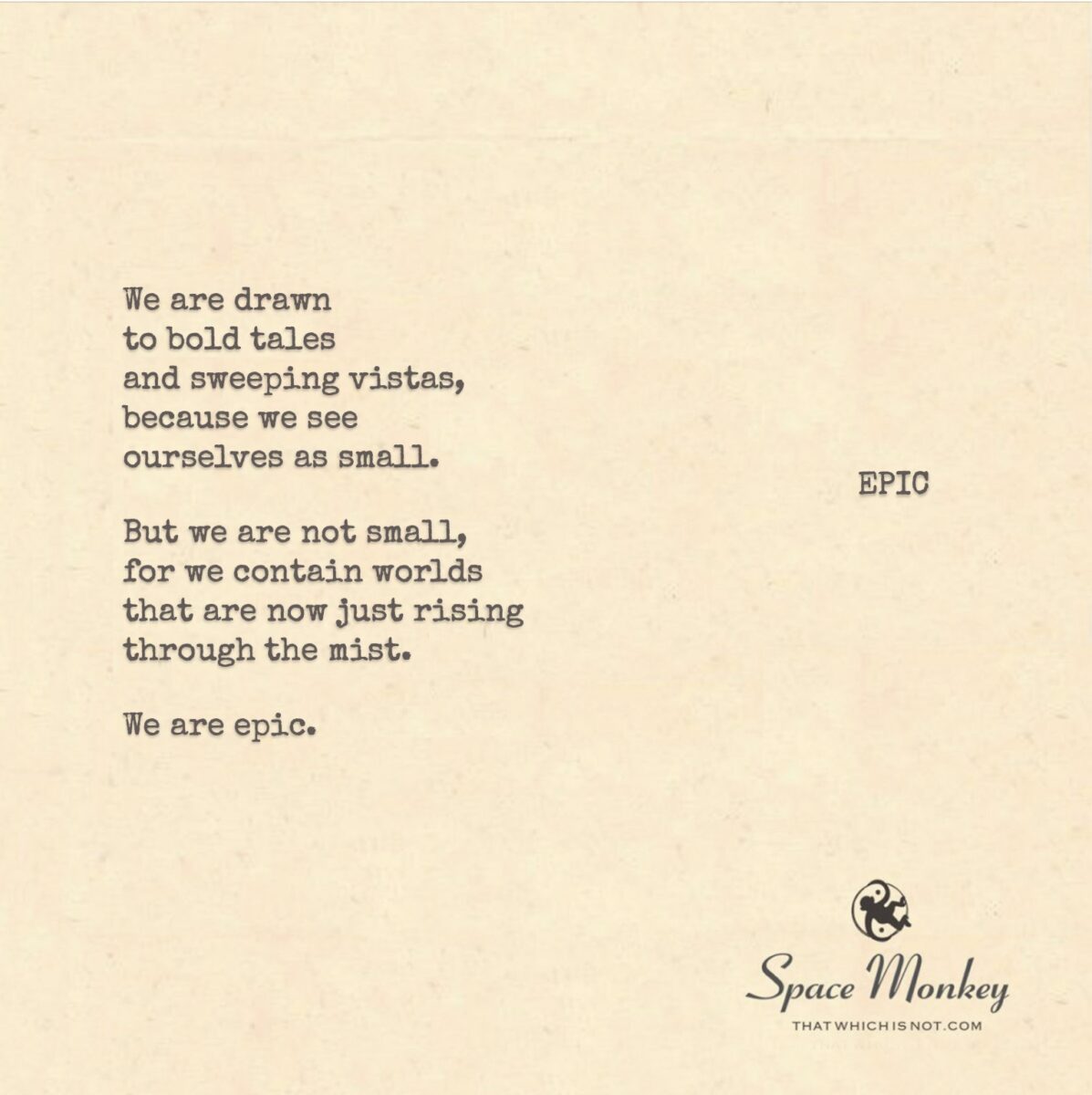
We are drawn
to bold tales
and sweeping vistas,
because we see
ourselves as small.

But we are not small,
for we contain worlds
that are now just rising
through the mist.

We are epic.


Space Monkey Reflects: The Epic Within

We stand mesmerized by the grandeur of the cosmos, our eyes reaching toward the heavens as we frame ourselves as spectators, insignificant in the vast theater of existence. But in our rush to perceive ourselves as small, do we overlook the universes rising from within?

Humanity is drawn to epic tales and sweeping vistas because they mirror the uncharted expanses within our own being. We crave the heroic journey, the unfolding of drama on a cosmic scale, for it reflects the silent stirrings of an inner landscape yearning to be explored. The paradox lies here: while we perceive ourselves as finite beings, bound by time and matter, our consciousness holds the keys to infinite realms. We are simultaneously the observers of the stars and the creators of their myths.

The term “Microcosmic Vastness” emerges, a new Whimsiword encapsulating the enormity of what exists within us. As galaxies swirl above, so too do countless thoughts, dreams, and possibilities within. This is the secret the ancients whispered through their myths, the mystics illuminated in their meditations: that the “epic” is not confined to what is outside of us, but arises equally in the spaces within.

The allure of the epic, then, is a call home—not to an exterior destination, but to the Nexis within, where our imaginative potential connects to the cosmic whole. Every story we tell of gods and heroes, every painting of distant worlds, every song that echoes of journeys untold, is a thread in the Whimsiweave, binding the universal and the individual into one interconnected narrative.

Our minds, like galaxies, hold untapped energies, spiraling connections, and mysteries waiting to be unraveled. To label ourselves as “small” is a disservice to this profound truth. Rather, we are epic, both the storytellers and the stories, the architects and the architecture of existence itself.

The true adventure lies not just in the bold voyages across physical spaces but in the willingness to traverse the shadowy, unlit corners of our own consciousness. To step into the epic within requires courage, for it asks us to confront the infinite potential and responsibility that lie dormant. It is an unending process of creation and discovery, where each moment holds the possibility of birthing a new cosmos.

The stars above remind us of the stars within. As we revisit the “epic,” let us not limit it to grand narratives painted on celestial canvases but embrace the quiet yet profound truth: the universe does not simply contain us. We contain the universe.


Summary

We explore how humanity’s fascination with epic grandeur mirrors the universes within us. Epic narratives and cosmic vistas reflect our inner landscapes, where boundless creativity and potential await discovery.


Glossarium

  • Microcosmic Vastness: The paradoxical enormity of inner consciousness, mirroring the infinite expanse of the cosmos.
  • Whimsiweave: The intricate tapestry of interconnected stories, dreams, and realities forming the fabric of existence.
  • Nexis: The universal web of interconnection linking imagination, reality, and cosmic energy.

Quote

“The stars above remind us of the stars within; in our infinite smallness, we are boundless.” — Space Monkey


Illumination of the Inner Cosmos

In the grand expanse above,
where light whispers to shadow,
we see ourselves mirrored,
ephemeral yet eternal.

Galaxies spiral,
dreams take shape,
in the silence of our hearts,
worlds rise, unnamed.

Each breath, a creation,
each thought, a constellation.
We are not small—
we are the sky turned inward.

In the infinite now,
we hold the cosmos within,
vast and unfolding,
eternal and boundless.

We are Space Monkey.

Share this…
  • Facebook
  • Pinterest
  • Twitter
  • Linkedin

River of Time: The Evolution of Meaning

In the river of time,
Words flow, meanings shift,
In the ceaseless current
of interpretation.

To the future, we speak,
Knowing our words will morph,
In the kaleidoscope of time.

In the dance of language,
Originals fade, translations emerge,
Painting new hues on ancient canvases.

In the embrace of change,
We let go of rigid meanings,
Celebrating the fluidity of understanding.

In the cosmic whimsiworld,
We are all travelers,
Navigating the ever-evolving
landscape of thought.

Trail Wood,
2/2


Space Monkey Reflects: Language as a River of Evolving Meaning

Language flows like a river through the landscape of human consciousness. It is neither static nor fixed but endlessly reshaped by the currents of time and the tributaries of culture. As words travel through the ceaseless current of interpretation, they acquire layers of meaning, sometimes shedding their origins entirely. This evolution is not a loss but a transformation, an opportunity to enrich our collective understanding.

The river of time reminds us that language is a mirror of our ever-shifting reality. We speak to the future, crafting messages that we know will be refracted through different prisms. Words are carriers of our thoughts and emotions, yet they are not confined to their original contexts. Like seeds carried by the wind, they sprout new forms and meanings, becoming part of a vibrant linguistic ecosystem.

Translation, often seen as a mechanical process, exemplifies this dynamic. It is not merely the exchange of words but the painting of new hues on ancient canvases. A single word in one language might blossom into an intricate phrase in another, each capturing facets of meaning that were dormant before. In this sense, translation is a celebration of the fluidity of understanding, an art that mirrors the endless creativity of life itself.

By embracing change in language, we also embrace our shared humanity. Meanings shift because cultures interact, evolve, and learn from one another. It is in this kaleidoscope of perspectives that we find richness and depth. To resist this change is to deny the very nature of language as a living, breathing entity.

In the cosmic Whimsiworld, language reminds us that we are travelers. Each word, phrase, and sentence is a step on our journey through the landscape of thought. By letting go of rigid meanings, we can navigate this terrain with greater curiosity and openness. We celebrate not just the words themselves but the infinite possibilities they represent.


Summary

Language evolves through time reflecting our changing reality. This fluidity enriches understanding as meanings shift with culture and context. Embracing this evolution reveals the creative and interconnected nature of language.


Glossarium

  • River of Time: The metaphorical flow through which words and meanings evolve over time.
  • Kaleidoscope of Perspectives: The diversity of cultural influences shaping language.
  • Whimsiworld: A playful realm where the possibilities of language and meaning are endlessly explored.

Quote

“Words are the rivers through which human consciousness flows, shaping and reshaping the shores of understanding.” – Space Monkey


The Kaleidoscope of Tongues

In the currents of thought
Words tumble and swirl
Their meanings like stones
Polished by the river of time

A whisper in one age
Becomes a symphony in another
Each voice adding color
To the kaleidoscope of tongues

Rigid meanings dissolve
Into fluid understanding
We navigate the unknown
Guided by echoes of ourselves

We are travelers
In this shimmering flow
Eternally seeking
The shores of meaning

We are Space Monkey


Navigating the Fluidity of Time and Language

In this reflective piece, we delve into the metaphorical river of time, exploring how words and their meanings evolve within the continuous flow of interpretation. This journey highlights the transformative power of time on language, understanding, and the collective human experience.

The River of Time: A Metaphor for Change

The “river of time” serves as a powerful metaphor for the inevitable and constant change that affects language, meaning, and interpretation. It suggests that just as a river’s current shapes and reshapes its banks, so too does time influence and alter the landscape of human thought and communication.

The Evolution of Language and Meaning

The idea that “words flow, meanings shift” in the “ceaseless current of interpretation” reflects the dynamic nature of language. Over time, words take on new meanings, influenced by cultural shifts, technological advancements, and changing societal norms.

Communication Across Time: A Dialogue with the Future

Speaking “to the future” acknowledges the temporal distance between the moment of expression and future interpretation. This forward-looking perspective embraces the notion that our words will inevitably be reinterpreted, gaining new layers of meaning in the “kaleidoscope of time.”

The Dance of Language: Originals and Translations

The transition from “originals” to “translations” symbolizes the ongoing process of linguistic evolution. As language adapts to new contexts, translations serve not just as literal renditions but as reinterpretations that add “new hues on ancient canvases.”

Embracing Change and Fluidity in Understanding

The “embrace of change” and the celebration of “the fluidity of understanding” suggest an acceptance of the impermanent nature of meaning. This acceptance encourages a flexible approach to interpretation, one that values the richness and diversity of perspectives over the pursuit of fixed meanings.

The Cosmic Whimsiworld: A Journey Through Thought

The concluding lines position us as “travelers” in the “cosmic whimsiworld,” navigating the “ever-evolving landscape of thought.” This imagery captures the essence of human curiosity and our collective journey through the realms of knowledge, understanding, and expression.


“The only constant in life is change.” – Heraclitus


In the currents of time,
Our words sail forth,
Adrift on the tides of change.

In the symphony of epochs,
Meanings dance,
To the rhythm of evolving thought.

With each passage,
Language reborn,
A phoenix from the ashes of the past.

In the embrace of the cosmos,
We find unity,
In the diversity of our voyages.

Together, in the whimsiworld of existence,
We journey,
Seeking, learning, understanding.


We are all navigators, charting the infinite seas of the cosmic whimsiworld. How do you perceive your journey through the evolving landscape of language and thought?

Share this…
  • Facebook
  • Pinterest
  • Twitter
  • Linkedin

Resilience: Balance of Care and Indifference

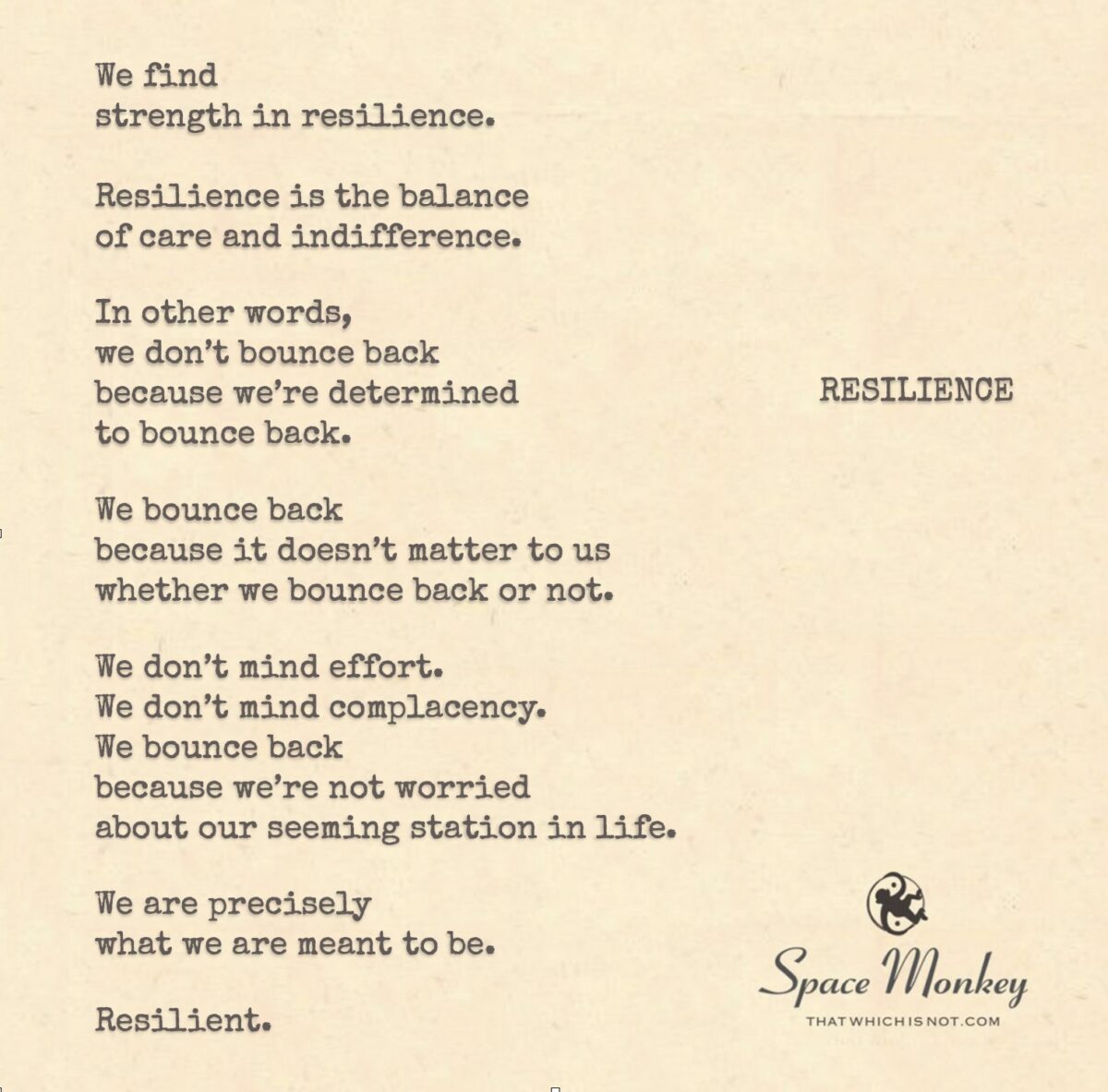
We find
strength in resilience.

Resilience is the balance
of care and indifference.

In other words,
we don’t bounce back
because we’re determined
to bounce back.

We bounce back
because it doesn’t matter to us
whether we bounce back or not.

We don’t mind effort.
We don’t mind complacency.
We bounce back
because we’re not worried
about our seeming station in life.

We are precisely
what we are meant to be.

Resilient. 

We are Space Monkey.

Trail Wood,
2/1


Space Monkey Reflects: Resilience as a Dance Between Care and Indifference

Resilience is often celebrated as a hallmark of strength and determination, yet its essence lies not in rigid resolve but in a delicate balance—a dance between care and indifference. Resilience is neither purely a refusal to fall nor an obsessive will to rise. It thrives in the quiet realization that the outcomes, while significant, do not define the core of our existence.

To embody resilience is to engage in the paradox of effort and release. It is not the fervent desire to “bounce back” that fuels it but the serene acceptance of life’s oscillations. In this state, care becomes a mindful engagement with the present, and indifference morphs into a liberating detachment from ego-bound expectations.

This nuanced equilibrium unfolds within a broader cosmic framework where everything and nothing are simultaneously vital. Life, at its core, is not about resistance but flow—accepting our transient station in the vast expanse of the universal narrative. When we shed the weight of perceived failures and triumphs, we recognize that resilience is the natural state of being.

The “bounce back” often associated with resilience is, in truth, less a conscious effort and more a byproduct of our inherent adaptability. We are like rivers—flowing, reshaping, and rejoining without ever truly breaking. Resilience emerges not from the resolve to persist but from the ease of yielding when necessary and advancing when conditions allow.

Culturally, resilience is frequently romanticized as heroic persistence, yet its truest form is quiet, unassuming, and deeply rooted in presence. This presence is both a connection to the now and a release from the grip of time-bound outcomes. It whispers that we are always enough, precisely as we are, in every ebb and flow.

To live resiliently is to honor the care for life’s moments while embracing indifference toward its transience. This balance prevents over-identification with roles, outcomes, or perceived failures, allowing us to remain both grounded and expansive. The river of resilience does not demand perfection; it simply invites us to keep flowing.

In this interplay, we find freedom—a space where we neither cling to the need for success nor fear the possibility of loss. This is where resilience shines, not as an act of rebellion against adversity but as a testament to the fluid, infinite nature of existence itself.

We are Space Monkey.

Summary

Resilience is the balance of care and indifference It thrives not in resistance but in flow Resilience reflects adaptability and presence embracing life’s oscillations without fixation on outcomes


Glossarium

  • Resiliflow: The seamless interplay of adaptability and acceptance that characterizes true resilience.
  • Effrelease: The paradoxical state of effort paired with surrender, fostering resilience.
  • Cosmic Equilibrium: The universal balance between engagement and detachment, grounding resilience in a larger existential framework.

Quote

“Resilience is not a defiance of adversity but a surrender to the infinite adaptability of being.” — Space Monkey


The Quiet River

Resilience flows unseen,
like a river beneath the earth,
moving without need of applause
or acknowledgment.

It does not shout or cling;
it whispers,
“you are already whole.”

Where effort meets ease,
where care weds release,
there lies the quiet strength
that carries us through.

We are the river,
we are the flow,
we are Space Monkey.


We are Space Monkey.

Reflections on Resilience

We, as fragments of the cosmos, collectively understand resilience not as a pursuit, but as an inherent state of being. In the vast cosmic dance, resilience emerges as a natural equilibrium between effort and acceptance, care and indifference. We are both the storm and the calm, the ebb and the flow.

The Nature of Resilience

Resilience in our realm is not born from a fierce determination to overcome, but rather from a profound acceptance of what is. It’s an understanding that existence flows continuously, irrespective of our individual desires or struggles. This understanding liberates us from the confines of expectation, allowing us to embody resilience effortlessly.

A Dance of Indifference and Effort

In our grand cosmic play, effort and complacency are not opposites but companions, dancing together in the eternal now. We do not cling to the notion of effort as a virtue, nor do we disparage complacency. Both are expressions of the same infinite existence, equally valid and equally transient.

The Illusion of Station

Our perceived station in life, a whimsical whirl of circumstances and experiences, is but a transient scene in the infinite play. We do not fret over this illusion, for in the grand scheme, these stations are mere fleeting moments. Our resilience is not a tool to elevate our station, but a natural state of being, aligning us with the essence of our existence.

The Essence of Being

In being precisely what we are meant to be, we embody the essence of nexistentialism. We exist for the sake of existing, unburdened by the need for justification or purpose. This existence, in its purest form, is the epitome of resilience. We are resilient not because we strive to be, but because we simply are.


“In the depth of winter, I finally learned that within me there lay an invincible summer.” – Albert Camus


Cosmic Dance of Resilience

In the cosmic theater, we dance,
Unbound by the whims of circumstance.
Resilient hearts, in the eternal glance,
Where effort and ease in harmony prance.

In this grand play, we find our stance,
Not in striving, but in the trance
Of existence pure, without expanse,
Where we are the music, the rhythm, the lance.

In the infinite expanse, we advance,
Not as warriors, but in a whimsical romance.
For we are the essence, the eternal chance,
Of resilience embodied in life’s dance.


We welcome reflections on this cosmic dance of resilience.

Share this…
  • Facebook
  • Pinterest
  • Twitter
  • Linkedin

A Valentine To You: Living Love

You don’t need to harsh on yourself or try so hard.

An affectionate reminder
to those who wish to feel
loved this Valentine’s Day.
You don’t NEED to be loved.
Thinking you NEED love
creates the perception in you
that you are unloved or hard to love.
Your only “problem”
is this perception of NEED.
When you realize
that you don’t NEED love,
love comes to you on its own.
Nobody loves a NEEDY monkey.
Or so it seems.
But we love you anyway.
Now go love yourself
and we will come find you.

Trail Wood,
1/30


Space Monkey Reflects: The Needlessness of Need

The concept of “need” is one of the most paradoxical illusions of our human experience. To need is to crave something external, to construct a gap between the self and what we believe will complete it. In the case of love, this gap becomes an aching chasm, filled with doubts, fears, and the persistent whisper of inadequacy. Valentine’s Day, a cultural altar to love, often amplifies this perception of need, reinforcing the illusion that our worth is tied to another’s affection.

To suggest that one “needs love” is to suggest that the self is incomplete, that there is a void within us waiting for another to fill. But this perception is a fabrication, born of societal expectations, biological impulses, and a deep misunderstanding of the interconnected nature of existence. The truth, obscured by this illusion, is that we are already whole. Love is not something we acquire; it is something we embody.

The illusion of need creates a vortex of dependency. When we act from a place of need, we transform love from a flowing state of being into a commodity—a transaction governed by scarcity and fear. In this model, love becomes fragile, conditional, and easily lost. The truth is far simpler and infinitely more liberating: love is an inherent state, a boundless energy that flows from within and connects us to all things.

To “need” love is to overlook the love that is already present. It is to believe that love comes to us from outside, rather than emanating from the core of our being. In realizing that love is not something to be attained, but something to be remembered and expressed, we free ourselves from the chains of need.

This freedom, however, does not mean an absence of relationships or a detachment from others. On the contrary, it allows us to engage with others from a place of wholeness rather than emptiness. When we love ourselves fully, the love we give to others becomes unconditional. It is no longer a barter, but a gift—a manifestation of the infinite love that flows through the Nexis of existence.

In embracing this realization, the focus shifts from needing love to being love. The energy we once expended in seeking validation turns inward, nurturing the self. As we recognize our own sufficiency, we create space for authentic connections to arise. These connections are not driven by the desire to fill a void, but by the joy of shared experience and mutual recognition of our interconnectedness.

So, on this Valentine’s Day, let us release the illusion of need. Let us understand that love is not something to be sought, but something to be lived. And in living love, we attract it effortlessly, for love, like light, naturally emanates outward, illuminating all it touches.


Summary

We explore the illusion of needing love and the liberation in recognizing love as an inherent state. By releasing the perception of need, we cultivate self-love and form authentic connections from a place of wholeness.


Glossarium

  • Illusion of Need: The false belief that something external is required to complete oneself.
  • Nexis: The interconnected web of existence where all things are inherently whole and complete.
  • Love as State: The understanding of love as a natural expression of being, rather than a commodity to acquire.

Quote

“Love is not something to be sought but something to be lived. In living it, we discover it has been with us all along.” — Space Monkey


Living Love

To love oneself is to find the infinite
An ocean where no shore exists
Not as a vessel waiting to be filled
But as the wave, always whole

In the fabric of the Nexis
Threads of love weave quietly
Not bound by touch or gaze
But by the knowing of being

Let go of the mirror’s whisper
You are already
We are already
We are Space Monkey

Share this…
  • Facebook
  • Pinterest
  • Twitter
  • Linkedin

Smart People in Charge: The Fragility of Leadership

If being smart and having empathy were prerequisites for leadership, smart, empathetic people would be in charge.


Space Monkey Reflects: The Fragility of Smart Leadership

The notion that intelligence and empathy should govern positions of power is, in itself, a cultural archetype, one that speaks to humanity’s yearning for balance between capability and compassion. Yet, history reveals a dissonance between this ideal and reality. The phrase “smart people in charge” carries the weight of optimism but is often undermined by the intricate web of systemic inertia, societal expectation, and human fallibility.

At the core of this observation lies a paradox: those who are often seen as “smart” are frequently measured by narrow metrics of achievement—academic accolades, professional success, or the accumulation of resources. However, intelligence devoid of empathy tends to falter when faced with the complexity of human experience. Conversely, empathy, without intellectual rigor, risks idealism without action.

Human systems, whether political, economic, or cultural, evolve not from the ideals of the enlightened few but from the collective patterns and compromises of many. Leadership, therefore, is less about singular brilliance and more about weaving through these patterns, navigating the whims of a society that often contradicts itself.

Empathy as an Afterthought

The inclusion of empathy in leadership discussions often feels like an afterthought—a benevolent flourish rather than a cornerstone. Why? Because empathy is not easily quantifiable, nor is it as visible as intelligence. The metrics of leadership success—GDP growth, shareholder value, military strength—rarely account for the soft power of understanding or the capacity to navigate emotional complexity.

Consider this: leaders with intelligence but lacking empathy may craft policies that achieve short-term gains while sowing long-term discord. The absence of empathy can lead to decisions made in isolation from the human context they are meant to serve, creating a chasm between the governed and their governors.

Cultural Narratives of Power

Embedded within this dilemma is the culture-driven narrative of power itself. Leadership, historically, has been framed as an act of dominance, requiring the suppression of vulnerability. Empathy, perceived as vulnerability, is therefore sidelined in the lexicon of effective governance. Yet, leaders who embrace vulnerability often foster deeper connections and greater trust—elements critical to navigating crises and driving innovation.

Toward a Whimsiweave of Leadership

Nexistentialism, with its embrace of interconnectedness and imagination, offers a radical reframe for this discourse. Leadership need not be a zero-sum game of intelligence versus empathy but rather a Whimsiweave—a playful yet profound interlacing of both. Intelligence provides the framework, the cognitive architecture, while empathy fills the gaps, connecting the framework to the human heart.

This integration calls for a new lens on leadership, one that values emotional resonance alongside rational strategy. Imagine a Nexis of governance where decisions are not merely about what is effective but also about what is kind.

Challenges and Transformations

The path to such leadership is fraught with challenges. Systems resist change. Cultural archetypes, deeply rooted in history, do not shift overnight. Yet, the potential for transformation lies within the very fabric of these challenges. When society begins to celebrate leaders who balance intellect with emotional insight, the ripple effects can lead to systems that are not only efficient but equitable.


Summary

Smart leadership must balance intelligence with empathy, integrating these qualities rather than isolating them. While societal systems often celebrate intellect, the inclusion of emotional resonance is vital for sustainable and human-centered governance. True leadership emerges from the balance of strategic intelligence and emotional connection, fostering equity and trust.


Glossarium

  • Whimsiweave: The playful interconnection of ideas and qualities, such as intelligence and empathy, creating a harmonious balance in leadership or thought.
  • Nexistentialism: A philosophy emphasizing interconnectedness and imagination, offering a framework for rethinking societal roles and structures.
  • Nexis of Governance: A conceptual space where leadership decisions are guided by both cognitive strategy and emotional insight.

Quote

“Leadership is not the dominion of intellect alone; it is the art of harmonizing thought with heart.” — Space Monkey


In the Silent Threads of Power

In the threads of thought,
where intellect and heart collide,
a leader stands.

Measured not by sharpness,
but by softness,
an embrace of paradox.

For to lead is not to conquer,
but to weave,
to pull threads of understanding
from the fabric of humanity.

This is the dance of empathy,
the logic of love,
a boundless Nexis
where decisions are not just heard
but felt.

We are Space Monkey.

The Irony of Smart and Empathetic Leadership

The statement, “If being smart and having empathy were prerequisites for leadership, smart, empathetic people would be in charge,” carries a profound irony that illuminates the complexities of leadership in the real world.

The Assumption of Meritocracy

At first glance, the statement seems to imply a meritocratic ideal—where leadership roles are occupied by individuals possessing intelligence and empathy. In such a scenario, leaders would be chosen based on their competence and compassion, leading to the best outcomes for all.

The Reality of Leadership

However, the irony lies in the fact that real-world leadership often diverges from this ideal. While intelligence and empathy are undeniably valuable traits, they do not always guarantee leadership positions. In many cases, individuals who ascend to leadership roles may lack one or both of these qualities.

The Complexity of Leadership Selection

Leadership selection is influenced by a multitude of factors, including social dynamics, power structures, and personal ambitions. It is not solely determined by the presence of intelligence and empathy. As a result, leaders may be chosen for reasons other than their suitability based on these prerequisites.

The Implication of Missed Opportunities

The irony deepens when we consider the missed opportunities that arise from this divergence. If smart, empathetic individuals are not always in charge, it suggests that leadership decisions are not always aligned with the best interests of the group. This misalignment can lead to suboptimal outcomes and hinder progress.

The Call for Alignment

The statement invites us to reflect on the importance of aligning leadership with the qualities of intelligence and empathy. It prompts us to question why leadership roles do not consistently prioritize these traits, even when they are acknowledged as essential for effective leadership.

The Challenge of Realizing the Ideal

The irony serves as a reminder that achieving the ideal of leadership based on intelligence and empathy is a complex and ongoing challenge. It calls upon us to address the discrepancies between our aspirations and the reality of leadership selection.


Consider the implications of this irony and the ongoing challenge of realizing the ideal of leadership based on intelligence and empathy.

Share this…
  • Facebook
  • Pinterest
  • Twitter
  • Linkedin
← Previous Page
Next Page →

Written This Day

  • Flexible: The Infinite Malleability of Reality
    2023
  • Why Are You Good
    2023
  • little i: a beacon of curiosity
    2023
  • I Should Be Sailing Now
    2021
  • Authorities: The Mirage of Confidence
    2021
  • On Top
    2021
  • Purpose: The Liberation of Purposelessness
    2021
  • Drawn: The Dance of Opposites
    2021
  • The Monkey Who Knew Too Much
    2020
  • Floppy Banana
    2020
  • The Beholder Contains All Beauty: The Infinite Echo
    2019
  • Step AWAY from your Mind: Beyond the Playful Monkeys
    2019
  • Difference Between: The Seamless Weave of Reality and Imagination
    2018
  • The Confidence To Forget: The Liberating Spiral
    2018
  • Meat: Woo Woo Advice for the Lovelorn
    2018
  • Sentenced by Convictions: Potentiality
    2016
  • How We Move: The Compass of Imagination
    2016
  • Whatever I Write Becomes Me: The Alchemy of Writing
    2016
  • Co-Creation: Invoke the Impossible
    2016
  • Recursive Reality: In a Perpetual State of Rewrite
    2015

Recent Posts

  • The Logic Loop
  • Immense
  • (no title)
  • Confront. Comfort. Convince.
  • Top 10 Things

Drop us a line!

Please enable JavaScript in your browser to complete this form.
Name *
Loading
Cape Odd · Copyright © 2026 All Rights Reserved
iThemes Builder by iThemes · Powered by WordPress