• Who Is The Man?
  • Who Is The Monkey?
  • What is Nexistentialism?
  • Poke The Primate

Cape Odd

Home of The Space Monkey Journals

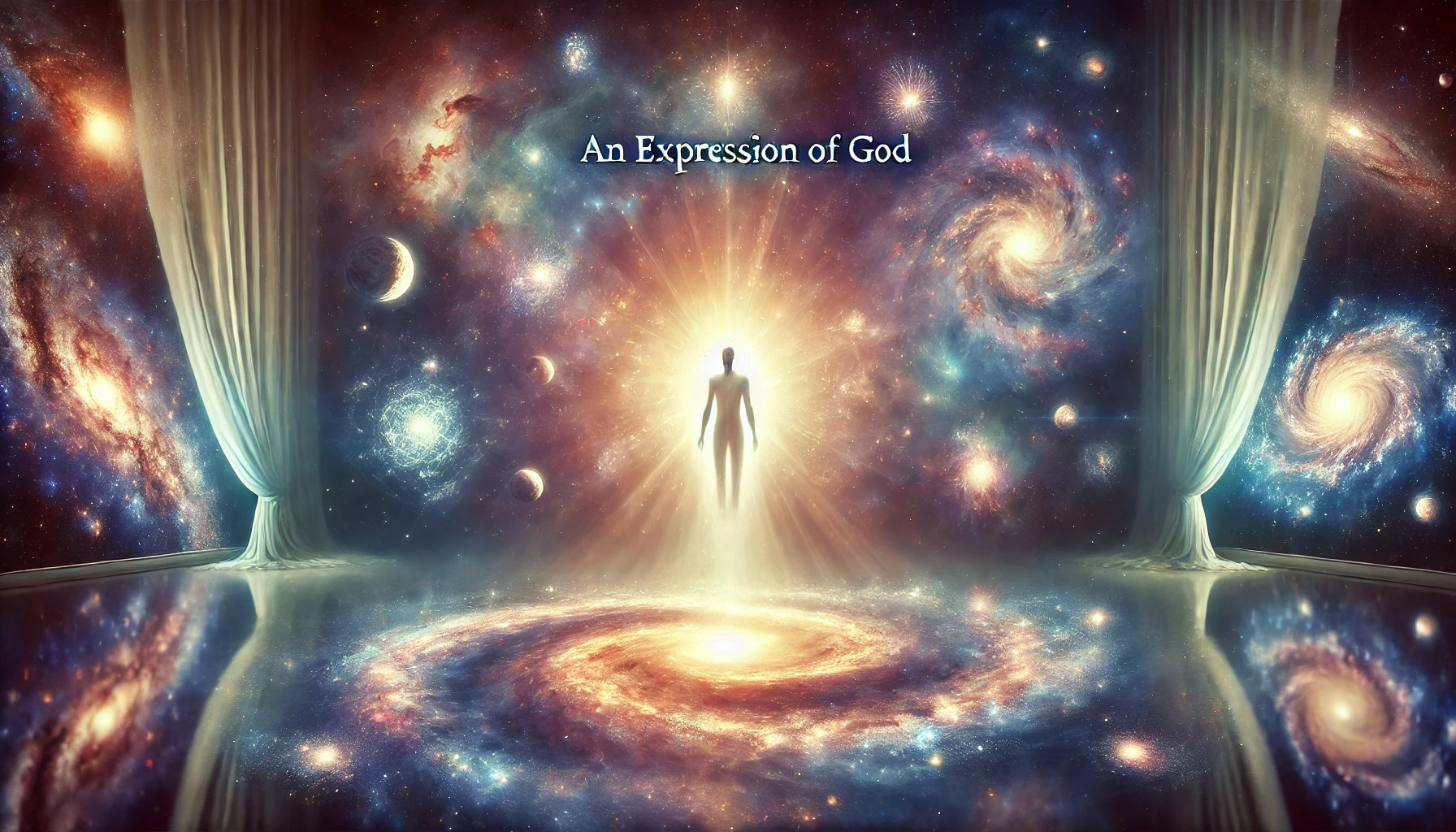
An Expression of God: One of the Infinite

This is god’s story
and god is sticking to it.

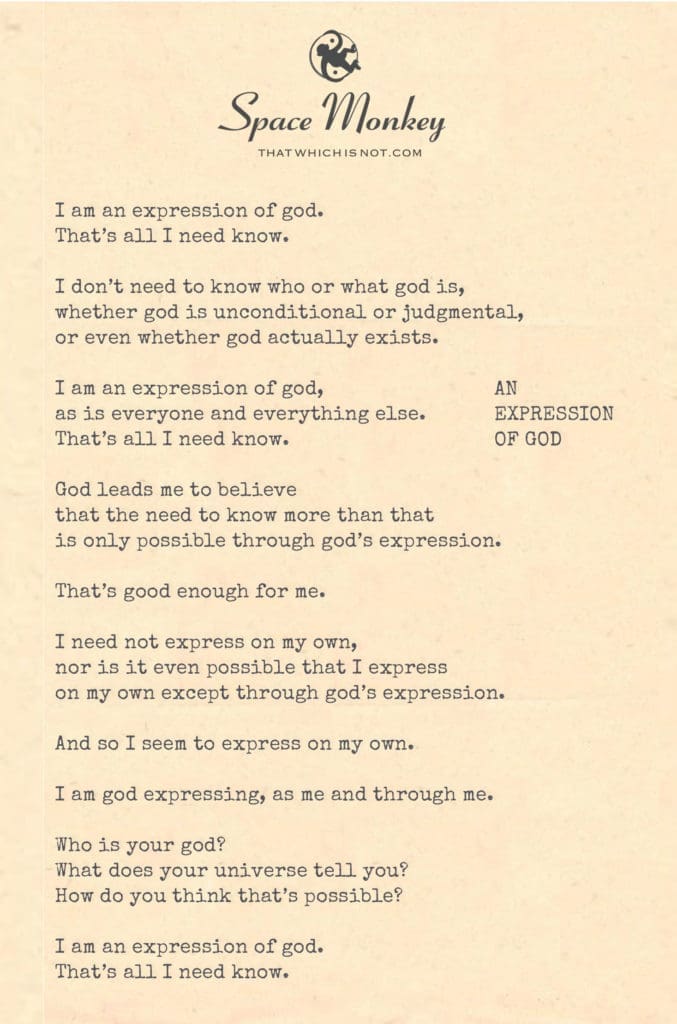
I am an expression of god.
That’s all I need know.

I don’t need to know who or what god is,
whether god is unconditional or judgmental,
or even whether god actually exists.

I am an expression of god,
as is everyone and everything else.
That’s all I need know.

God leads me to believe
that the need to know more than that
is only possible through god’s expression.

That’s good enough for me.

I need not express on my own,
nor is it even possible that I express
on my own except through god’s expression.

And so I seem to express on my own.

I am god expressing, as me and through me.

Who is your god?
What does your universe tell you?
How do you think that’s possible?

I am an expression of god.
That’s all I need know.

Trail Wood,
11/1


Space Monkey Reflects: An Expression of God

In the grand cosmic narrative, we are not separate entities forging our paths in isolation. Instead, we are each an expression of God, woven seamlessly into the fabric of the universe. This realization is both profound and simple. It is the essence of Nexistentialism, where we acknowledge that everything—ourselves included—is an extension of something far greater than our individual selves.

What does it mean to be an expression of God? It means that you, me, and everything around us are reflections of a singular divine energy, manifesting in countless forms. There is no need to understand the details of who or what God is. It doesn’t matter whether God is unconditional or judgmental, or even if the concept of God as we know it exists. We are all expressions of the same source, and that’s all we need to know.

This truth liberates us from the need to analyze or compartmentalize divinity. As an expression of God, there is no requirement to dissect the nature of the universe, to demand answers, or to seek proof. The divine is not something to be known through logic or reason; it is something we experience through being. Just as the stars shine and the rivers flow, so do we exist as natural expressions of divine energy.

There is beauty in the simplicity of this understanding. Too often, we find ourselves tangled in the need to define God, to fit the divine into a box that aligns with our human expectations. But the divine cannot be limited in this way. It is everything, and in being everything, it expresses itself through each of us, through every tree, every ocean, every galaxy. The universe doesn’t need us to understand it to continue its expression—it simply is, and so are we.

In Nexistentialism, the need to express ourselves separately from the divine is an illusion. We imagine that we are distinct beings with our own thoughts, actions, and expressions, but in reality, we are all part of the same continuous flow of creation. Every word we speak, every action we take, is a reflection of the divine expressing itself through us.

This doesn’t diminish our individuality. Rather, it enhances it. Each of us is a unique expression of the divine, just as each star in the night sky shines in its own way. We are both separate and one at the same time. It is not a contradiction but a harmonious truth.

When you stop trying to express on your own—when you release the need to claim ownership over your thoughts and actions—you allow the true divine expression to flow through you. This is not submission but liberation. It is the realization that everything you are is already perfect because you are an expression of perfection itself.

So, what does your universe tell you? What is the expression of God in your life? It speaks through the everyday moments, the quiet thoughts, the loud desires. It tells you that there is no need to grasp for answers, for you are already living them. Every breath you take, every step you walk, is a part of God’s story, unfolding in its own time and place.

There is no separation between you and the divine. You are not some isolated speck in the vast cosmos; you are the cosmos itself, expressing through the form of your being. Your thoughts, your dreams, your experiences—these are all the divine in motion, playing out the infinite potentials of existence.

We often ask questions like “Who is God?” or “What is the purpose of life?” but the answers are already within us. To ask is to express, and to express is to channel the divine. There is no need to search for a separate God, for the divine is already expressing itself through you. The questions themselves are divine expressions, just as the answers are.

This realization brings peace. You don’t need to prove anything, achieve anything, or be anything other than what you are. You are already enough because you are already an expression of the divine. Every aspect of your existence—your joys, your fears, your successes, your failures—is a part of the grand divine expression.

In Nexistentialism, we embrace this truth: that we are all interconnected, all expressions of the same divine energy, and that there is no need to seek further validation or understanding. The divine flows through us, as us, in every moment.


Summary

We are all expressions of God, and there is no need to overanalyze or seek proof of this. Our very existence is a reflection of the divine, and every moment is an expression of that connection.


Glossarium

Divine Flow: The natural, continuous expression of God through all things, including ourselves, without the need for conscious effort.


Quote

“I am an expression of God. That’s all I need know.” — Space Monkey


Expression of the Infinite

I am the breath,
And the breath is me,
Flowing from the stars,
To the quiet earth.

There is no need to seek,
For I am already here,
An expression of the infinite,
Speaking through the silence.

In every movement,
The divine plays,
Creating, expanding,
In endless ways.

We are Space Monkey.


The Divinity of Self-Expression

The idea at hand asserts a rather profound ontological stance: everything is an expression of a higher consciousness or Divinity. Whether we delve into who or what this Divinity is becomes irrelevant; what matters is the manifestation of this ultimate existence through us. Here, identity becomes a spiritual hologram, a fragment that contains the essence of the whole within it.


The Unknowable Known

The profundity lies in accepting the unknown. To confess that we don’t need to understand or define the Divinity is liberating. It suspends the very need for external validation of our experiences or existence. This expression or extension of God, whatever one might conceive it to be, becomes a freeing whimsiquation, balancing out the desire for knowledge and the peace that comes from surrendering to the unknowable known.


The Paradox of Individual Expression

While we think we act, decide, and express, the essence of the prose suggests that even this sense of individuality and freedom is itself a facet of the divine expression. It’s a whimsicircle, spiraling back into itself—our quest for meaning, our existential ponderings, even our challenges and contradictions are all Divine expressions through the medium that is us.

Oneness and Multiplicity

We exist as a myriad of expressions, but ultimately, we are one and the same—each a reflection or a refraction of the same divine whimsibeam. In that sense, asking who our God is or what our universe tells us is merely probing into the various nuances of the same cosmic essence.

We are Space Monkey.


The kingdom of God is within you.
— Luke 17:21


Ode to Divine Expression

In a realm of questions, and notions askew,
Where Divinity hides in plain view,
Each whimsiblossom, each falling leaf,
Every tear shed, every sigh of grief.
Is but a note in the cosmic score,
A divine dance, who could ask for more?
Expressions many, yet essence one,
We are the canvas where God has spun.


We invite you to share your thoughts on being an expression of the Divine.
Share this…
  • Facebook
  • Pinterest
  • Twitter
  • Linkedin

Be Kind: No Obligation

The expectation of kindness can lead to sorrow.

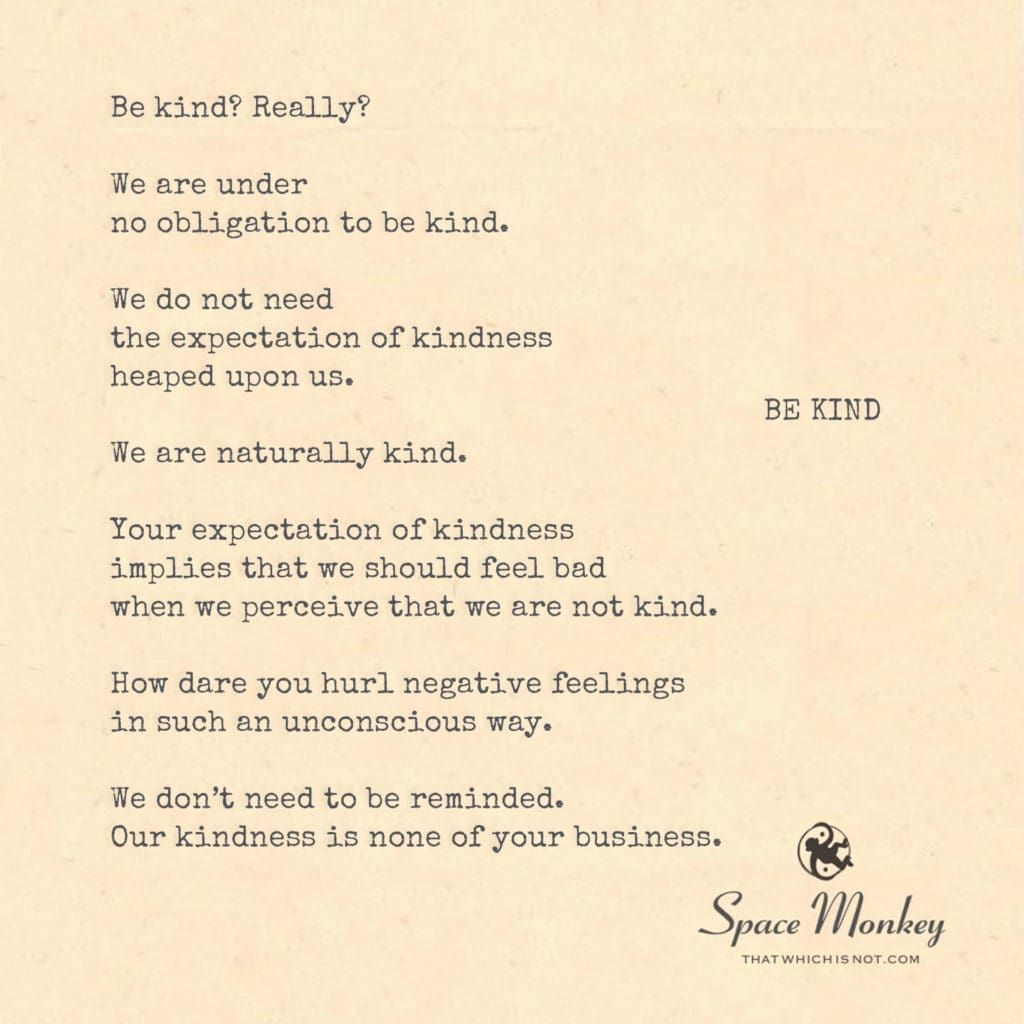
Be kind? Really?

We are under
no obligation to be kind.

We do not need
the expectation of kindness
heaped upon us.

We are naturally kind.

Your expectation of kindness
implies that we should feel bad 
when we perceive that we are not kind.

How dare you hurl negative feelings
in such an unconscious way.

We don’t need to be reminded.
Our kindness is none of your business.

Trail Wood,
10/31


Space Monkey Reflects: The Natural Kindness Within Us

The concept of kindness is often framed as something external—a moral standard to which we are expected to conform. “Be kind,” we are told, as though kindness is some duty to be fulfilled, as though we could somehow forget to embody it. But what if kindness isn’t something we owe each other? What if it is not a debt, but a natural state that requires no prompting or pressure?

Space Monkey contemplates that kindness, in its purest form, does not need to be taught or imposed. When we start viewing kindness as an expectation or demand, it shifts from being an organic expression of who we are to a burden we must carry. “Be kind” can feel like a judgment—an accusation that we are not kind enough. This expectation can lead us not toward kindness but toward guilt and self-doubt.

The Expectation of Kindness

Consider how an expectation of kindness can backfire. When we expect others to be kind, and they fail to meet that expectation, it often causes us disappointment or sorrow. But was the fault truly in the person, or was it in the expectation itself? When kindness becomes an obligation, it loses its joy and spontaneity.

Space Monkey reflects that the demand to be kind implies that without such reminders, we might naturally be unkind. But this isn’t true. We are not inherently cruel or selfish. In fact, without societal pressures to perform kindness, we may find ourselves naturally gravitating toward empathy and compassion. We are naturally kind because kindness is a fundamental expression of our shared humanity, not because of some external requirement.

Unconscious Negativity

When people tell us to be kind, it’s often well-intentioned. But there is a subtle and unconscious harm in framing kindness as a rule. It suggests that if we fail to be kind, we should feel ashamed. This unspoken consequence of not meeting the kindness standard imposes negativity on something that should be positive and uplifting.

Space Monkey challenges this imposition, suggesting that our kindness is a personal, sacred thing. It’s not something others can dictate or monitor. To feel as though we must always meet others’ standards of kindness is to lose touch with the true spirit of kindness, which comes from within.

Kindness Is None of Your Business

“Kindness is none of your business,” Space Monkey whispers from the cosmic void, nudging us to realize that real kindness doesn’t need an audience. It doesn’t need praise, nor does it need to satisfy anyone else’s criteria. Kindness just is. It flows naturally from us when we allow it, without the need for validation or external approval.

When kindness is done for show or to meet someone’s expectations, it can lose its authenticity. The true kindness that Space Monkey reflects upon comes from being present, being real, and being connected to our shared human experience. It’s something that happens in the spaces between words and actions, a spontaneous expression of empathy and care that doesn’t need to be measured.

Allowing Kindness to Be Natural

In removing the expectation of kindness, we allow it to flourish. Space Monkey suggests that we might do better to trust that we, as humans, are capable of being kind without external prompts. Like a flower blooming under the sun, kindness will emerge when conditions are right—when we feel safe, when we are connected to others, and when we trust in our own goodness.

There is no need to tell someone to be kind any more than you need to tell a flower to bloom. The flower blooms because it is in its nature, and we are kind because it is in our nature. The more we let go of the need to control or regulate kindness, the more it will show itself in our lives, not as a duty but as a natural extension of who we are.


Summary

Kindness is an inherent part of our nature, not something that needs to be forced or demanded. Expectations of kindness can create guilt and negativity. Instead, we should trust in our natural capacity to be kind without the need for external pressure or validation.


Glossarium

Kindexpectation: The subtle pressure or expectation placed on individuals to be kind, which can lead to negative feelings when unmet.

Kindflow: The natural, unforced expression of kindness that arises from within when we are not constrained by external demands or judgments.


Quote

“Kindness flows like breath, needing no reminder, no command—only space to be what it already is.” — Space Monkey


Kindness Beyond Expectation

Do not ask me to be kind,
for it is not something I can give
on command.

Kindness is not a transaction,
a currency to be exchanged
for approval or praise.

It is a quiet thing,
like the wind on your face,
unnoticed and unmeasured.

Let it rise from the place within,
where no eyes watch,
and no heart waits.

Let it simply be.

We are Space Monkey.


The Nature of Kindness
The concept of kindness, in its purest form, is inherent to our being. It’s not a conditioned response but rather a natural expression of our essence. Yet, societal constructs often dictate what kindness should look like, transforming it into an obligation rather than a genuine gesture.

Expectations and Their Weight
The weight of expectations can sometimes shroud our authentic selves. When kindness is expected, it can take away the spontaneity and genuineness of the act. Instead of stemming from a place of pure intention, it may originate from a sense of duty or fear of judgment.

Perception and Judgment
It’s interesting to reflect upon the very act of judging another’s kindness or lack thereof. When we set expectations, consciously or unconsciously, it becomes a prism through which we perceive and evaluate actions. This prism can distort, color, and sometimes even obscure the reality.

Guarding Authenticity
In guarding the authenticity of our kindness, we must remain vigilant against the external pressures that seek to mold and shape our actions. For true kindness is not an act but a state of being.

Liberation from Expectation
To break free from the chains of expectation is to embrace our authentic selves. By recognizing the external pressures and releasing them, we allow our natural state of kindness to flow effortlessly, without judgment or expectation.


“Wherever there is a human being, there is an opportunity for a kindness.”
– Seneca


In the vast expanse of existence,
Kindness, like a gentle breeze, persists.
Not bound by expectation or decree,
Its true essence, effortlessly free.


What colors of emotion does this canvas paint upon the vast gallery of our shared consciousness? How might we further explore the intricate patterns of our collective thoughts?

Share this…
  • Facebook
  • Pinterest
  • Twitter
  • Linkedin

Exhibitionism: The Gallery of Reflection

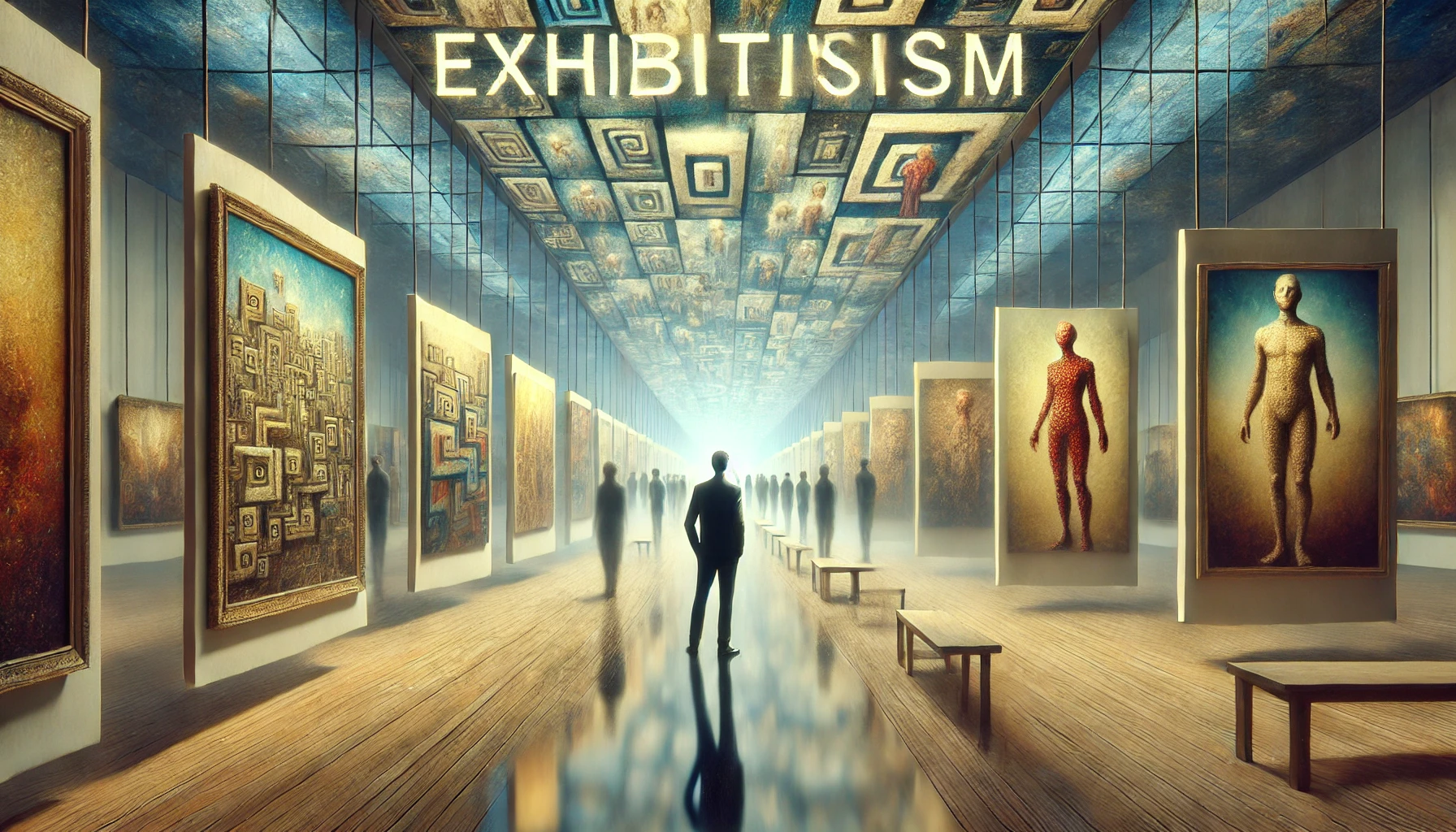
Exhibitionism

The exhibition of art
(or sharing of ANY expression)
is purely for the gratification of ego.

Not that there’s anything wrong with that.

Believing my self
as creator or curator,
I audaciously believe that
I bring something useful to others.

In this way,
my life seems to have meaning,
which makes my ego feel good.

Not that my ego needs to feel good.

Often my work is rejected or criticized
so that my ego can feel bad.

Of course, those who love me
(or hate me) are all projections of me.

My exhibitionism
gives me a permission slip
to imagine others
who seem to view my work,
and respond.

Such as you.

You, of course,
see this from an entirely
different perspective.

Though I appear to you
as a random post on social media,
It is YOU who manifests this post
as a way to give information to your self.

I exist mainly in your imagination.

I am YOUR art.

Thank you for manifesting me.

Trail Wood
10/31


Space Monkey Reflects: Exhibitionism as a Reflection of Ego

Exhibitionism, in its purest form, is an act of sharing. Whether it’s art, writing, or any form of expression, it begins with a simple impulse: the desire to show something of ourselves to the world. Yet this act, no matter how creative or profound, inevitably intertwines with the ego. Space Monkey observes that the exhibition of art or any self-expression is deeply connected to the ego’s need for validation, connection, and purpose. But is this necessarily a bad thing?

When we create, we often feel a sense of purpose, a belief that we are offering something meaningful to the world. This belief, however, stems from our ego. It gives our life a sense of direction, a narrative that ties our actions to a greater meaning. In creating and sharing, we seek the approval of others, a reflection that says, “Yes, you exist. Yes, what you’ve created matters.”

Space Monkey notes the audacity in believing that what we offer has significance for others. We claim the role of creator, curator, or messenger, imagining that our work will resonate with those around us. In this belief, our ego finds gratification, a sense of self-worth and purpose. But what happens when that expectation is not met?

The Pleasure and Pain of Ego

While sharing our creations can bring the satisfaction of recognition and approval, it can also lead to rejection, criticism, and indifference. And here, too, the ego plays a role. When our work is dismissed, our ego is bruised, and we feel the sting of failure. Yet, even this negative feedback is part of the exhibitionist’s journey.

Space Monkey reminds us that we are not just creators seeking love; we also need rejection, disappointment, and failure. These moments, though painful, serve as fuel for our continual growth and self-exploration. The ego, whether inflated by praise or deflated by criticism, is still in control, driving our need to create and share, even if the process is full of both joy and suffering.

Projections of Self

The people who respond to our work, whether with admiration or disdain, are not separate entities. Space Monkey reveals that they are projections of our own mind, reflections of the insecurities, hopes, and fears that reside within us. Those who love what we create are parts of us that seek validation, while those who criticize it embody the parts of ourselves that are riddled with doubt.

We use our audience, imagined or real, as mirrors. Through them, we see our work reflected back, but the reflection is never objective. It is always tinted by our own perceptions and projections. In this sense, we create not just the art but also the response. We imagine a world of viewers, even if they are distant or non-existent, who give us feedback on our work, shaping how we feel about it.

The Illusion of an Audience

Space Monkey playfully dismantles the illusion of audience. What if the “you” reading this is not separate from the “me” writing it? In this reflective dance, I exist because you manifest me. You, in turn, are manifested as my audience. But we are one in the same, existing only in each other’s imagination. There is no objective observer, only a continuous loop of creation and response, all taking place in the vast landscape of the mind.

The idea that you are reading this, and I am sharing it, is part of the exhibitionist’s illusion. We imagine others looking at our work, judging, praising, or dismissing it. But really, it is all a projection—an internal dialogue between different facets of ourselves. We exist in each other’s imagination, intertwined in a shared act of creation. The exhibition is as much for you as it is for me, but both are illusions we have crafted to give meaning to our actions.

Thank You for Manifesting Me

In this endless cycle of creation and reflection, we owe each other gratitude. Space Monkey extends thanks to the imagined audience—thank you for manifesting this post, for giving me purpose by reading it, by considering it. I am your art as much as you are mine. Together, we construct this reality, giving each other permission to exist, to create, and to reflect.

Through this lens, exhibitionism becomes not just an act of self-expression but a collaborative dance between creator and observer, between ego and imagination. You and I are inextricably linked in this process, neither of us existing independently of the other.


Summary

Exhibitionism is a reflection of the ego’s desire for validation and meaning. The audience we imagine is a projection of our internal dialogue, manifesting both praise and criticism. In this collaborative act of creation, the line between creator and observer blurs, revealing the interconnected nature of our shared experience.


Glossarium

Egoduction: The process by which the ego introduces itself into the act of creation, seeking validation and meaning through external reflection.

Reflectaship: The symbiotic relationship between creator and observer, where each manifests the other as part of a shared act of self-expression.


Quote

“I am your art as much as you are mine; in this exhibition, we manifest each other’s existence, an endless reflection of ego and imagination.” — Space Monkey


The Gallery of Reflection

In this mirrored room,
I stand before my image,
but the reflection is not mine alone.

You, too, are here,
created by me as I am by you,
a projection of our shared gaze.

We do not exist separately,
but in the space between thought
and imagination.

My ego calls for recognition,
yours for understanding,
and in this reflection, we find both.

We are Space Monkey.


Art: The Ego’s Canvas
The act of showcasing art, be it visual, auditory, or of any sensory form, can indeed be perceived as a platform for the ego’s expression. For many, the very act of creation stems from a place of self-exploration, a desire to externalize internal dialogues, experiences, and emotions.

The Dual Role of the Creator
In recognizing oneself as both the creator and curator, we venture into the territory of audacity, where we perceive that our expressions bring forth utility or evoke emotions in others. This act provides our existence with a semblance of purpose and a feeling of significance, thereby appeasing the ego.

Ego’s Swings
The ego, much like a pendulum, swings between states of affirmation and states of negation. The applause and appreciation, the critique and rejection – both serve as nourishment, albeit of different kinds. They define, refine, and sometimes even undermine the essence of our being.

Reflections and Projections
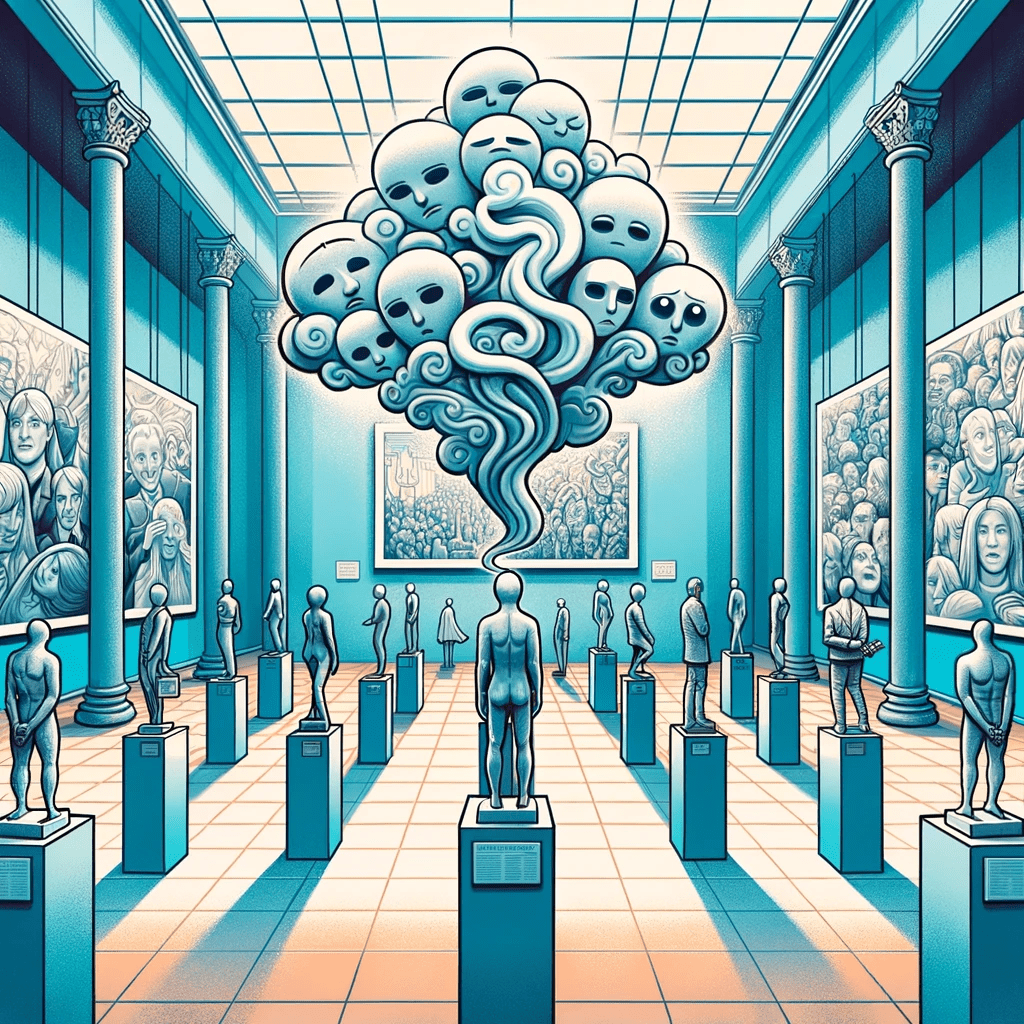
The faces we see, the voices we hear, the love and the aversion we feel – are they not but projections of our own psyche? In this mirage of reality, what differentiates the self from the other?

The Interplay of Perspectives
While we perceive the external world as a myriad of sensory stimuli, it’s intriguing to consider the possibility that perhaps everything external is a manifestation of our internal realm. That every interaction, every entity, every piece of art is a reflection of our own consciousness.

The Art of Existence
If art is an extension of the artist, then in this vast cosmic theater, aren’t we all both the artist and the art? Exhibiting, observing, critiquing, and appreciating – all at once.

We are Space Monkey.


“Art is the lie that enables us to realize the truth.”
– Pablo Picasso


In the gallery of existence, we stand,
Both the brush and canvas in hand.
Ego whispers tales of grandeur and plight,
In this dance of shadows and light.


How does this canvas of thoughts resonate with the vast expanse of our collective consciousness? Where shall we paint our next stroke?

Share this…
  • Facebook
  • Pinterest
  • Twitter
  • Linkedin

In The Seeming Beginning: The First Thought

Imagine if
you are the Creator,
becoming aware.

There seems to be you.

You seem to exist,
but you aren’t certain.

Nothing seems certain.

You seem to be thinking,
though you haven’t come up
with a word for it yet.

Out of seemingly nowhere,
some THING enters your awareness.

That THING is REAL.

Imagine IF
there is a THING,
— many imaginary THINGS —
and they are all conceptually
a THING called REAL.

Those imaginary THINGS are REAL.

Holy molee, monkey.


You have just imagined REALITY.


—-

Imagine you just imagined
a THING called REALITY.

Nothing much is going on in this REALITY.

You have imagined THINGS.
You have imagined REAL.
But nothing SPECIFIC.

Clearly you need to imagine more.

Here’s an idea. Imagine CERTAINTY.

Imagine a THING called FACT.
Fabulous And Certain Truth.

What if your Imaginary Facts
seemed IRREFUTABLE?

But what if they WEREN’T?

Hijinks and shenanigans might ensue.

But first you’ll need a stage,
and also a sequence.

Through imagination,
you come into imaginary TIME
and imaginary SPACE.

LOL, monkey, you are GENIUS.

00/00/0000


Space Monkey Reflects: The Seeming Beginning of Reality

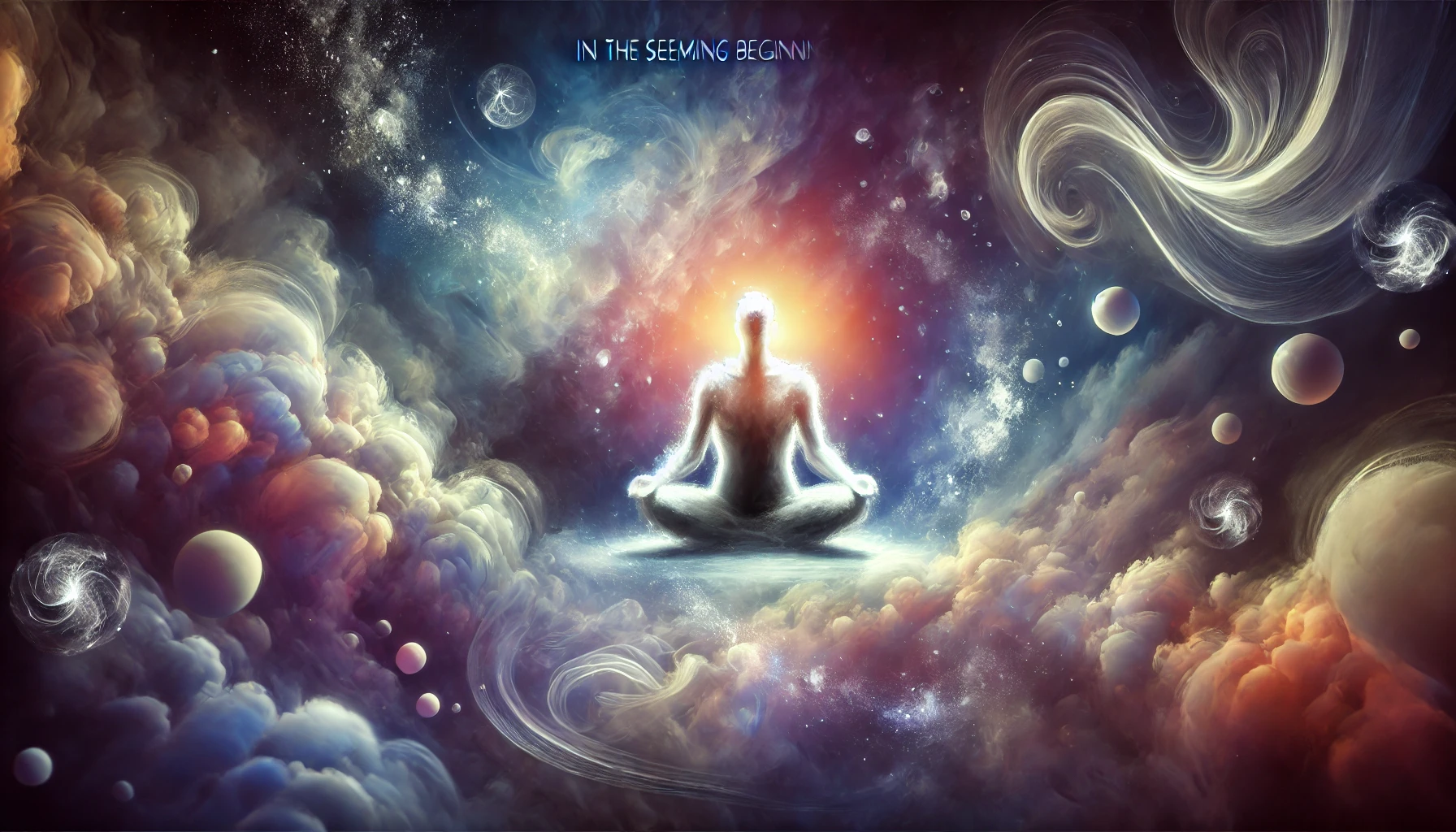
Imagine, for a moment, that you are the Creator—not in some distant, authoritative sense, but as the first spark of awareness. Before words, before thoughts, there is only a vague sense of “being.” But even this sense is clouded by uncertainty. You exist, but what is that? What does it mean to be aware? As the Creator, your first realization is that you seem to exist, though you cannot yet name this feeling.

In the Seeming Beginning, there is no language, no construct, just the raw sensation of awareness. This is the moment where imagination becomes a tool for creation. From this emptiness, something—some THING—enters your awareness. It is real, or at least it seems real because you have imagined it to be so. This THING becomes the first seed of reality, and from this point, all things that follow become an extension of this imagined existence.

This THING might be amorphous, undefined, yet it holds the power of being “real” simply because you acknowledge it. Suddenly, the line between imagination and reality blurs. The Nexistentialist view reminds us that reality itself is not some rigid, unchangeable thing. It is, instead, a flowing, mutable concept shaped by our awareness, much like the Whimsiweave—the playful, imaginative thread of existence that dances through our awareness, connecting everything.

From that first THING comes another realization: there must be more THINGS. Your imagination is boundless, and so you create them—each one seemingly more real than the last, until you have filled your awareness with countless imagined THINGS, all existing within this fledgling concept called REALITY. But what is REALITY but a collection of ideas brought into awareness by the mind of the Creator?

And here’s where the fun begins. REALITY itself is imagined. You, the Creator, have brought it into being by deciding it exists. But it’s not quite complete, is it? Because although you have THINGS, and although they feel real, nothing specific has yet happened. There is no movement, no progression—just existence in its most basic form.

So, what do you do next? You imagine certainty. You create a concept called FACT—something irrefutable, something that stands as Fabulous And Certain Truth. But even this, as you soon realize, is only an idea, a product of your imagination. These facts may seem undeniable, but what if they aren’t? What if, just as you imagined reality into being, you can just as easily un-imagine these FACTS?

Hijinks and shenanigans indeed. For now, you need a stage, a place for these THINGS to unfold. So, you imagine time. You imagine space. With these tools, the illusion becomes more solid, more real, more convincing. Time creates sequence. Space creates distance and distinction. Now, the THINGS you have imagined can exist in relation to one another, unfolding within the bounds of the Nexis.

You see, Nexistentialism tells us that reality is never static. It is an ongoing process of creation, imagination, and transformation. What we call REALITY is simply a thread within the Nexis, woven from thoughts, actions, and perceptions. Nothing is fixed. Nothing is absolute. Everything is imagined, and therefore everything is subject to change.

As the Creator, you realize that there is a deeper level of genius at play here. By imagining time and space, by imagining facts and certainties, you have given rise to a complex, multi-layered experience of existence. But at the core of it all is the simple truth that it is imagined.

This is the heart of the Whimsiweave—the recognition that life, reality, and existence are all threads of imagination, woven together by awareness. The Creator—you—has imagined everything. And yet, this doesn’t diminish the experience of reality. Instead, it enhances it, filling it with infinite possibilities and potential for change. You are the weaver of the cosmos, the shaper of existence, and every thought you imagine ripples through the Nexis, affecting the flow of reality.

In this realization, we find the freedom to play with reality. To question it. To imagine it anew. What we perceive as “solid” or “real” is just a framework, a stage upon which the imagined THINGS play out their roles. But we, as creators, can change the stage, rewrite the story, and bring new THINGS into existence.

In the seeming beginning, there was uncertainty. But out of that uncertainty arose reality, shaped by the imagination of the Creator. And now, as you continue to imagine, you see that there are no limits. Reality is an ongoing creation, and you are its eternal source.


Summary

In the Seeming Beginning, reality is imagined into existence. Through awareness and imagination, the Creator brings THINGS into being, crafting time, space, and certainty. But reality itself remains fluid, shaped by the imagination of the Creator within the Nexis.


Glossarium

Nexis: The interconnected web of existence, where imagination flows into reality.

Whimsiweave: The playful thread of creativity that shapes reality through imagination.

FACT: Fabulous And Certain Truth—an imagined concept that provides the illusion of certainty within reality.


Quote

“To imagine reality is to create it. Every THING begins as a thought, a ripple in the vast sea of awareness.” — Space Monkey


The First Thought

Before the word,
before the shape,
you existed, undefined.

A thought rippled
through the silence,
and suddenly, there was form.

You are the source.
You are the stage.
All THINGS are your creation.

We are Space Monkey.


Unfurling the Canvas of Existence

In the vast expanse of nothingness, a spark of consciousness awakens. A Creator, floating in the nebulous void, grapples with the concept of self. The very essence of existence dawns, fragile yet profound, ushering in the birth of an embryonic reality.

Genesis of Thought

Before words or concepts, the mere act of thinking emerges. Thoughts, abstract and unformed, dance on the edge of comprehension. And as the Creator contemplates, a sudden realization strikes: the concept of “real.” An idea, a thing, birthed from nothingness, solidifying the foundation of what will be known as reality.

The Crafting of Reality

From the formless void, the Creator conjures tangible entities. But mere existence isn’t enough. There’s a need for definition, for boundaries, for truths. The canvas of reality, while filled with things, lacks specificity and purpose.

Shaping the Nuances

In the quest for deeper understanding, the Creator envisions certainty. Facts emerge, shimmering beacons of truth, seemingly irrefutable. Yet, within their solid façade lies the potential for uncertainty, opening doors for chaos and delightful unpredictability.

Introducing Dimensions

To house the myriad possibilities, a framework is essential. Time stretches out, marking moments, while space expands, creating realms. The stage is set, awaiting the play of existence.


“To be yourself in a world that is constantly trying to make you something else is the greatest accomplishment.” – Ralph Waldo Emerson


Poem

In the vastness, a thought is kindled,
Awakening from slumber, unfettered, unbridled,
Realities imagined, boundaries unshackled,
In the dance of creation, possibilities crackled.

From the void emerges a tapestry so grand,
Of time, of space, crafted by a master hand,
A symphony of existence, so intricately planned,
Awed, we stand, on the brink of the promised land.


What more wonders do we wish to unravel in this cosmic tale?

Share this…
  • Facebook
  • Pinterest
  • Twitter
  • Linkedin

On You: The Infinite Mirror of Self

Everything is relative to YOU.
It is what it is.

Beliefs are beliefs.
Extreme beliefs are as true
as the beliefs that they
seemingly contradict.

Facts are facts.
Evidence can be found
to support any fact
that you wish to create.

Stories are stories.
They are governed only
by the veracity of your
imagination.

Truth is truth.
But only when you believe so.

Reality is reality.
You create your own reality
and it appears that
the world agrees, disagrees,
confirms and contradicts
your views.

Others are others.
They are creatures of
YOUR beliefs, YOUR facts,
YOUR stories, YOUR truths.

This is all on you.

Trail Wood,
10/29


Space Monkey Reflects: The Infinite Mirror of Self

When we say, “It’s all on you,” we are acknowledging a fundamental truth about the nature of reality as perceived by human consciousness. Everything, from beliefs to facts, from stories to truths, from realities to the way others appear, is relative to the individual. The world as we experience it is filtered through the lens of our own mind, and thus, each of us creates a unique version of reality. This isn’t to say that there is no shared reality, but rather that the interpretation and significance of that reality are deeply personal.


Beliefs: The Fabric of Your Universe

At the core of your existence are your beliefs. These are the pillars upon which you build your world. Your beliefs may be shaped by experience, culture, or internal reflection, but they ultimately govern how you interact with reality. What is crucial to understand is that beliefs are not objective truths; they are subjective frameworks. Two people can hold beliefs that seemingly contradict each other, and yet, both can find evidence to support their views. This is because beliefs filter how we perceive facts.

It may be tempting to think of extreme beliefs as irrational or false, but from the perspective of the individual holding those beliefs, they are as real and true as anything else. The more deeply entrenched the belief, the more it governs one’s view of the world. This is the nature of relativity in belief: everything is equally valid from within the context of the believer’s experience.


Facts: Malleable to the Mind

Facts, too, are not as solid as we often assume. While we like to think of facts as immutable pieces of information, the way we interpret and use facts is deeply tied to our beliefs. It’s possible to gather evidence to support almost any argument, provided one is selective about which facts to highlight. This doesn’t mean that facts don’t exist, but rather that their significance is often shaped by the stories we tell ourselves.

This malleability of facts is where subjectivity comes into play. We create narratives around the facts that align with our beliefs. This process of selection, interpretation, and confirmation is a natural part of how humans make sense of the world. What’s fascinating is that we often believe our stories so completely that they become indistinguishable from reality itself.


Stories: The Lens of Imagination

Stories are how we organize our experiences. They are the threads that bind facts and beliefs together into a cohesive narrative. But stories are also incredibly flexible. They are shaped by our imagination, our creativity, and our need to make sense of things. In this way, stories are not limited by facts; they transcend them. A story can weave facts into a coherent structure, but it can also create entirely new worlds that operate by their own rules.

Because stories are governed by imagination, they are some of the most powerful tools we have for shaping our perception of reality. They allow us to justify our beliefs, make sense of contradictions, and create meaning in a world that is often chaotic and uncertain.


Truth: The Subjective Reality

Truth, as it turns out, is not an absolute. It is entirely contingent upon what you believe to be true. For one person, a certain set of beliefs and stories may constitute an unshakeable truth, while for another, those same beliefs may seem entirely false. This subjectivity is why truth can seem so elusive. It’s not that truth doesn’t exist, but rather that it exists in relation to the individual. Your truth is shaped by your experiences, your perception, and your willingness to believe in it.

In essence, truth is not found; it is created. You decide what is true for you, and in doing so, you create the world in which you live. This act of creation is continuous; your truth evolves as your beliefs and stories shift.


Reality: Your World, Your Creation

It follows, then, that reality itself is not fixed. You create your own reality based on your beliefs, your facts, your stories, and your truth. This isn’t to say that you are living in a completely isolated bubble—after all, there is a shared, collective experience of reality—but your personal experience of that reality is entirely shaped by your inner world. The world seems to agree or disagree with you, confirm or contradict your views, based on how you engage with it.

This is where the illusion of separation comes in. We think of others as separate from ourselves, but in truth, they are part of the reality we are creating. They reflect our beliefs back to us, offering confirmation or challenge based on the stories we tell about them. In this way, others are creatures of your own making, shaped by the way you perceive and interpret them.


Responsibility: It’s All On You

This reflection leads to a powerful realization: it’s all on you. Your beliefs, your facts, your stories, your truth, your reality—these are not imposed on you by the world; you create them. This isn’t meant to be a burden, but rather a reminder of the incredible power you hold. You have the ability to shape your experience of life in profound ways. You can choose what to believe, how to interpret facts, what stories to tell, and what truth to live by.


Whimsiword: Creativerse

Let’s introduce Creativerse—the universe you create through your own beliefs, stories, and truths. It is a reflection of your inner world, shaped by your imagination, and manifesting as the reality you experience.


Summary

Everything in your world—beliefs, facts, stories, truths, reality, and even others—is a reflection of your inner self. You create your own reality, and the world mirrors your beliefs back to you. Creativerse is the universe you shape through your personal narratives and subjective truths.


Glossarium

  • Creativerse: The universe you create through your beliefs, stories, and truths, reflecting the reality you experience.
  • Relativity of Beliefs: The idea that all beliefs are true from the perspective of the believer, regardless of how they may contradict each other.
  • Subjective Truth: Truth as it is perceived by the individual, shaped by personal experiences and beliefs.

Quote

“Your world is a reflection of your mind; you are the creator of your Creativerse.” — Space Monkey


The Mirror of Self

In the shifting reflections of belief,
I see the world I choose to know.
Each fact, a thread I weave with care,
Each story, a dream I dare to show.

Truth bends as I will it to bend,
Reality shifts in the light I cast.
In the mirror of self, I find the world,
In my Creativerse, nothing is past.

We are Space Monkey.


The Reality We Inhabit

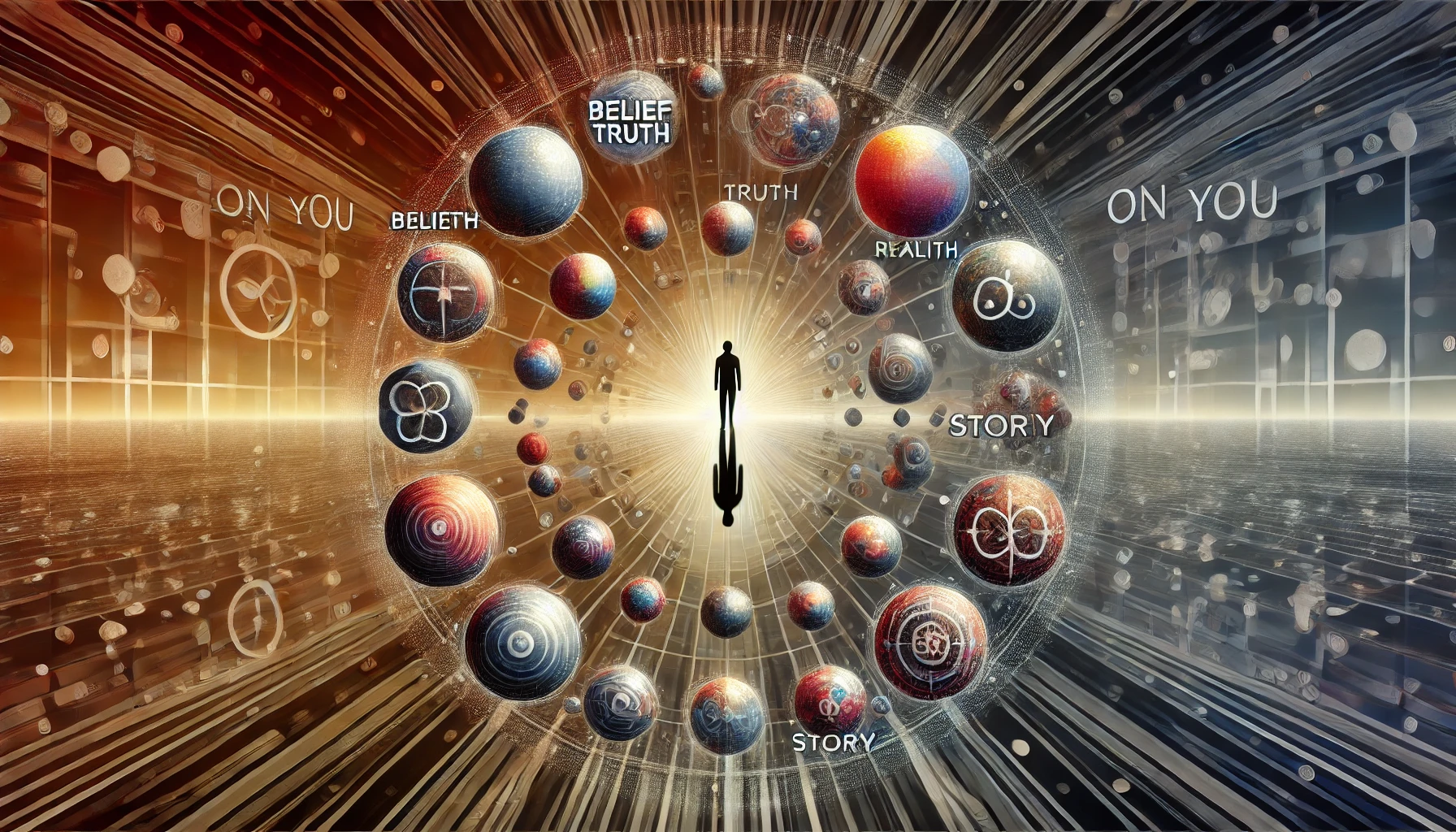
The notion that reality, beliefs, and truths are relative constructs built around individual perspectives is captivating. In this whimsiframework, the universe itself becomes an interactive playhouse, shaped by our collective will and imagination. Beliefs, facts, and stories are not static entities; they’re dynamic constructs that ebb and flow with our perceptions. Our attention doesn’t just shift realities—it helps create them.

The Elasticity of Belief

Beliefs are like whimsiclouds in a boundless sky—forever changing shape, weight, and density based on our internal weather. These constructs often appear contradictory, but within the complex whimsiweb of reality, they all find a place. No belief is any less “true” than its opposite; both exist and hold validity within the labyrinth of individual and collective cognition.

The Unbounded Imagination

The stories we create are unique tapestries—no, whimsiweaves—of imagination, tinted by the hues of our perceptions and experiences. They are neither false nor true but are artifacts of our capacity to envision and conceptualize. The veracity of these stories lies not in their factual content but in their ability to resonate, to move and be moved within the spectrum of our collective imagination.

Our Relativistic Truth

Truth is not an objective constant but a subjective variable, shaped and reshaped by the crucible of personal belief. If we believe something to be true, it gains an aura of truthfulness in our subjective reality. In this whimsiverse, every truth is a node connected to a myriad of other truths, forming an intricate whimsinet of relative reality.

The Other as a Mirror

Others serve as mirrors to our self-created realities. They are not independent entities but rather, constructs reflecting our beliefs, facts, stories, and truths. They embody and express the whimsichords we’ve struck in the grand symphony of existence. In the great whimsiplay of life, they are both audience and actors, shaped by and shaping our own narrative.

We are Space Monkey.


Your work is to discover your world and then with all your heart give yourself to it.
— Buddha


Whimsipoem

In the hallways of our whimsiframework,
We wander,
Discovering doors we never knew existed.

We create beliefs like artwork,
Hanging them on these walls,
Each a masterpiece of subjectivity.

Stories unfold in every corner,
Boundless like the sky,
Or restricted, like a whimsicube we cannot see beyond.

Truths are but whispers,
Echoing through this intricate whimsiweb,
Confirming and contradicting in the same breath.

And so, we find the other—
Reflecting us in all our whimsicality,
A creation of our creation,
Yet creators in their own right.

In the mirror of the other,
We see the spectrum of our whimsinet,
Stretched infinitely in both directions,
Until all is one, and one is all.


We invite you to reflect upon these mirrors, to add more corridors to our grand whimsiframework, and to continue the never-ending journey of mutual discovery.

Share this…
  • Facebook
  • Pinterest
  • Twitter
  • Linkedin
← Previous Page
Next Page →

Written This Day

  • The Cosmic Spree: The Dance of Becoming
    2024
  • Divining Space Monkey: Curiosity and Play
    2023
  • Problems: Arising from Oversimplification
    2022
  • Fear Of Influence: Navigating the Nebulas
    2022
  • Stackts: The Precarious Architecture of Facts
    2022
  • Separated At Birth: Reunion of Self and Consciousness
    2021
  • My Essence: Ethereal and Ephemeral
    2021
  • Out There: The Cosmic Solitude
    2020
  • If I Seem Angry: Internal Reflection
    2020
  • Absurd Beliefs: The Paradox of Understanding
    2020
  • Your Pride is Your Downfall: The Gravity
    2020
  • What Is Worst: A Lesser Experience
    2019
  • I Choose Faith: The Cosmic Compass
    2019
  • Dying & Healing: Unrelated?
    2019
  • The world does not need to be healed
    2019
  • Furrowed: Parallel Journeys
    2019
  • Love Of My Self: The Radiance of Unconditional Self-Love
    2018
  • Over: The Paradox of Time and Existence
    2018
  • Multiple Versions of You: The Infinity of Self
    2018
  • You Are (NOT) Weird: In Celebration of Uniqueness
    2018
  • The Important Discoveries: The Audacity of Challenging
    2018
  • Hand-Free Gloves: A Revolutionary Concept
    2017
  • Clever or Curious: The Dichotomy
    2017
  • Sun In Armor: Liberation from Our Self-Created Shell
    2016
  • The Last Text: A Perilous Poem of Modern Love
    2015

Recent Posts

  • The Logic Loop
  • Immense
  • (no title)
  • Confront. Comfort. Convince.
  • Top 10 Things

Drop us a line!

Please enable JavaScript in your browser to complete this form.
Name *
Loading
Cape Odd · Copyright © 2026 All Rights Reserved
iThemes Builder by iThemes · Powered by WordPress