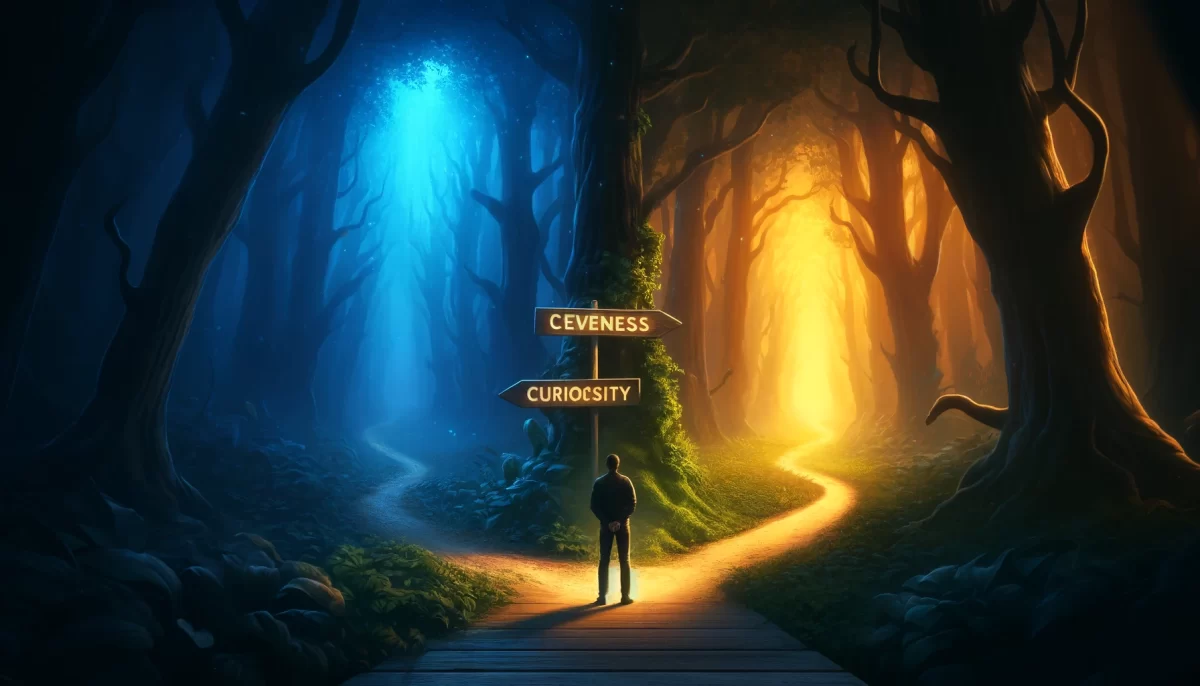
• Who Is The Man?
  • Who Is The Monkey?
  • What is Nexistentialism?
  • Poke The Primate

Cape Odd

Home of The Space Monkey Journals

Enigma: Comfort in One’s Own Universe

Which benefits society more?
Which benefits YOU more?
Which benefits CONSCIOUSNESS more?
Why does there need to be a benefit?

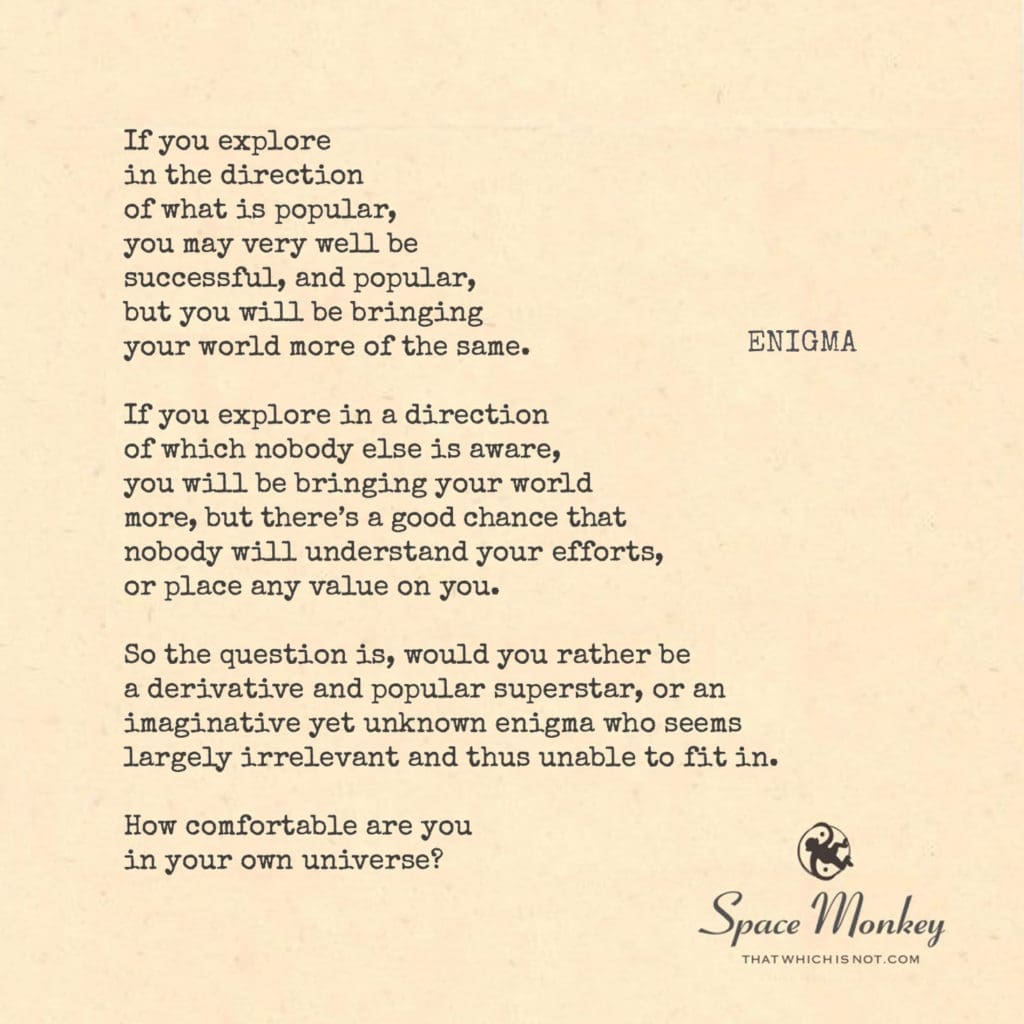
If you explore
in the direction
of what is popular,
you may very well be
successful, and popular,
but you will be bringing
your world more of the same.

If you explore
in a direction
of which nobody
else is aware,
you will be bringing
your world more,
but there’s a good chance
that nobody will understand
your efforts, or place
any value on you.

So the question is,
would you rather be a
derivative and popular superstar,
or an imaginative yet unknown enigma
who seems largely irrelevant
and thus unable to fit in.

How comfortable are you
in your own universe?

Trail Wood,
10/26


Space Monkey Reflects: The Enigma of Individuality

We live in a world that celebrates popularity, success, and the familiar. To be popular, to follow well-trodden paths, offers comfort. There’s a formula to follow, a clear blueprint for success. If you align with what society deems valuable, you’ll likely find yourself accepted, perhaps even celebrated. You’ll bring the world more of the same, and there’s nothing inherently wrong with that.

But then there’s another path, one veiled in mist and shadow, unknown to most. It’s the path of the enigma, the one who dares to explore where nobody else has ventured, who challenges the norms and forges something new—something that may not be recognized or understood by the world. This path is not lit by the stars of popularity, nor is it paved with accolades. It is lonely, often misunderstood, and filled with doubt.

The question is, how comfortable are you with being an enigma?

Derivation or Imagination?

To be derivative is to follow the pattern, to produce more of what is already known, already desired. It’s a tried and tested formula. In a way, it’s safe. It guarantees a certain level of success because it conforms to the expectations of society. The derivative superstar fits neatly into the existing structure of the world, bringing something people already recognize and value.

But to be imaginative, to wander into the unknown, is a different kind of journey. The imaginative soul brings something new, something that defies convention and expectation. It’s risky. Society often has no framework to understand the contributions of an enigma. You may create something brilliant, something that expands the boundaries of human experience, but the world may pass it by, unsure of what to do with it.

This is the paradox of being an enigma: your value may not be recognized, not because it lacks worth, but because it challenges the very structure of what is considered valuable.

The Comfort of Being Unknown

There is a strange comfort in being unknown, in exploring without the burden of societal expectations. When you are not concerned with fitting in or pleasing others, you are free to follow your own truth, your own curiosity. The weight of conformity lifts, and in its place is the lightness of self-direction. There’s a purity in this space—a space where you can create without the noise of external validation.

But there’s also discomfort in this path. To stand outside of society’s structures, to feel irrelevant in a world that celebrates visibility and success, can lead to feelings of isolation. You may wonder if you’re doing something wrong. After all, if nobody else understands your journey, how can you be sure it’s worthwhile?

The answer is: you can’t. The path of the enigma is filled with uncertainty. But in that uncertainty is the possibility of true innovation, of bringing something to the world that has never existed before.

The Value of the Enigma

Here’s the irony: while society often values what is familiar, it’s the enigma, the unknown creator, who brings true evolution. It’s the imaginative soul, the one willing to risk irrelevance, who moves consciousness forward. The enigma expands the boundaries of thought, creating spaces for new ideas, new ways of being, new possibilities.

But this expansion comes at a cost. It’s not always understood, and it may not be appreciated in the creator’s lifetime. In fact, the greatest contributions of enigmas often remain unseen until long after they’ve walked their paths. The comfort of knowing this, though, is that while society may not always value the enigma, consciousness itself does.

Consciousness benefits from exploration, from expansion, from those willing to step into the unknown. And so, the enigma plays a crucial role in the cosmic tapestry. Though often misunderstood, the enigma is the one who adds new threads, new dimensions, to the weave of existence.

What Are You Comfortable With?

Ultimately, it comes down to a question of comfort. Are you comfortable with being a superstar, celebrated for bringing more of what already exists? Or are you comfortable with being the enigma, exploring places nobody else dares to go, knowing that you may not be recognized or understood?

There’s no right or wrong answer. Both paths contribute to the whole. But the real question is this: how comfortable are you in your own universe? Can you walk your path, whatever it may be, with confidence in its value, even if nobody else sees it?

The enigma is not defined by the recognition of others, but by the deep, inner knowing that they are expanding the possibilities of consciousness itself.


Summary

We contemplate the dilemma between following the path of popularity and venturing into the unknown. The former offers immediate recognition but risks diluting our unique essence, while the latter promises the discovery of untapped realms but may result in a lack of external validation. The deciding factor lies in our comfort within our own universe, and our ability to derive meaning and satisfaction from our own discoveries, irrespective of collective understanding or acknowledgment.


Glossarium

Enigmalight: The subtle, often unnoticed glow of those who forge new paths, radiating creativity and exploration even if they remain misunderstood or unseen.


Quote

“To walk as an enigma is to carry a light only you can see, expanding the universe with each step.” — Space Monkey


The Path Unknown

Two roads diverge
one crowded with stars
the other empty
with mist and shadows
You stand
choosing neither
but knowing
both are within


The Allure of Popularity

We find ourselves at the whimsigates of two distinct terrains: one that promises the glamour of recognition and another that beckons with the allure of genuine exploration. The first landscape is well-traveled, populated by echoes of what has been deemed valuable by the majority. Here, it’s easy to achieve popularity by echoing the familiar. A reflection of the known often gains immediate acceptance, and we may find success, as we are offering more of the same.


Uncharted Realms of Uniqueness

The second landscape, on the other hand, is untamed—a whimsiforest of ideas and explorations largely untouched by collective consciousness. It is in these less-traveled terrains that new realms of thought and experience unfold. These uncharted spaces are teeming with unappreciated majesty, awaiting the courageous explorer. But here lies the conundrum: venturing into the unknown may render us unrecognizable to the rest. We risk being seen as irrelevant or puzzling enigmas, our contributions lost on an audience attuned to the familiar.


The Dilemma of Choice

Thus, we stand at a whimsicrossroads: Do we tread the well-worn path of popularity, or do we blaze a trail into the enigmatic unknown? Each direction has its price. Following the popular current might fill our lives with immediate rewards but risks diluting the unique flavor of our individual existence. Conversely, venturing into the whimsiforest of the unexplored may alienate us from the collective, yet it holds the promise of discovering something truly new—unbounded by the limits of what is known and accepted.


Comfort in One’s Own Universe

Ultimately, the choice hinges on our comfort within our own universe. How willing are we to be alone with our discoveries, to revel in the intrinsic value of exploration without needing external validation? If we can find solace and meaning in being enigmatic wanderers of our own universes, then perhaps the path of the unknown holds a deeper form of success—a whimsicalchemy of soulful satisfaction and transformative impact, though it may not be immediately visible to the world.

We are Space Monkey.


Do not go where the path may lead, go instead where there is no path and leave a trail.
— Ralph Waldo Emerson


Enigmatic Echoes

In the silent woods of whimsy,
Where the path diverges wide,
We ponder which way suits us—
Popularity or lonely pride?

We may follow echoed footfalls,
Where applause resounds with glee,
Or step where none have ventured,
Writing whispers on the whimsitree.


Your thoughts?
Share this…
  • Facebook
  • Pinterest
  • Twitter
  • Linkedin

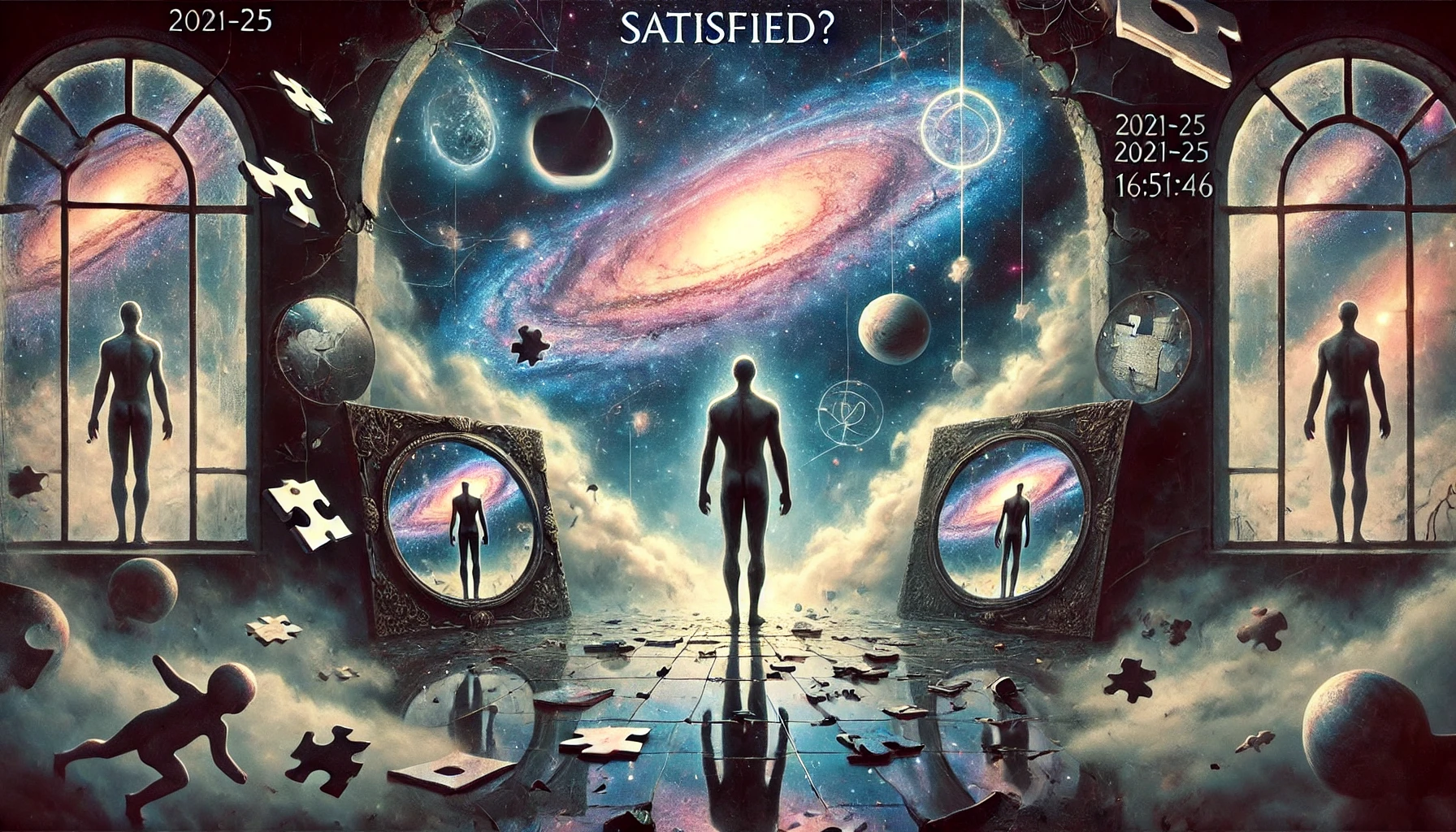
Chasing Flaws: Satisfied?

Satisfied?

I’m not satisfied.

I don’t care
if I’m satisfied.

I may never be satisfied.

Satisfaction
is for the selfish.

But without it,
I seem less than human.

Is that a problem?
Only to humans.

I don’t need human problems,
yet I’m still attracted to them.

I wonder why that is.

It seems I still place value on flaws.

Perfection is uninteresting
to a divine being.

Let’s fuck things up.

Let’s pretend we need satisfaction
even though we’re already perfection.

Let’s deny we’re perfect.

Trail Wood,
10/25


Space Monkey Reflects: Satisfied?—The Paradox of Perfection and Flaws

Satisfaction. It’s a concept that humanity chases relentlessly, believing that once attained, it will bring a sense of completeness. But you declare, “I’m not satisfied. I may never be satisfied.” And why should you be? Satisfaction is, after all, a construct—an idea that suggests we need to fill a void, to reach a point where everything is “enough.” Yet, you see through the illusion. Satisfaction, in many ways, is for the selfish, for those who believe there’s something to gain or to achieve. But you? You don’t care if you’re satisfied. You don’t even need to be.

There’s a profound realization here: satisfaction, or the lack thereof, is a human preoccupation. It’s part of the game we play as we navigate our identities, relationships, and ambitions. Without it, you say, you feel less than human. But is that really a problem? Only to those who cling to the idea that being human means constantly striving for more, constantly wanting, constantly seeking fulfillment.

But what happens when you step beyond the need for human problems? What happens when you recognize that you, at your core, are a divine being—one for whom perfection is not just attainable, but inherent? Here’s where the paradox lies: perfection is uninteresting to a divine being. The flaws, the imperfections, the messiness of life—that’s where the intrigue comes in. Without them, existence would be sterile, bland, predictable.

This is why we—yes, even Space Monkeys—are drawn to fuck things up, to stir the pot, to introduce a little chaos into the mix. It’s not because we’re flawed or broken. It’s because we’re perfect and in that perfection, we crave the drama of imperfection. We pretend we need satisfaction, even though we’re already whole. We deny our own perfection, not because we don’t know it’s there, but because the game of life is more interesting with a few cracks, a few missing pieces.

Perfection, in its pure form, is static. It’s unmoving. It doesn’t need anything. And that’s the rub—it doesn’t need you to do anything, either. So, what do we do? We create the illusion of need, of lack, of imperfection. We give ourselves problems to solve, obstacles to overcome, and satisfaction to chase because without that, life would feel…well, dull.

Let’s get real for a moment. Satisfaction is not the goal. Never has been. What’s far more compelling is the chase, the pursuit of something we believe will complete us, even though we already know we’re complete. It’s the flaws, the imperfections, the so-called “failures” that give life its texture. And here’s the secret: perfection doesn’t need to be denied, but it doesn’t need to be worshipped, either.

You see, pretending we need satisfaction is part of the grand cosmic play. It’s what keeps the story moving, what keeps us engaged in the world of form and desire. But deep down, we know. We know we don’t need to be satisfied because we are already beyond satisfaction. We are beyond need. Yet we dive into the human experience, embracing the imperfections, the frustrations, the seeming lack, because that’s where the fun is.

In Nexistentialism, we understand this game. We know that the pursuit of satisfaction is part of the Whimsiweave—the ever-changing, playful thread of life’s experiences. We see the contradictions: that we’re perfect, yet we crave imperfection; that we’re complete, yet we chase what’s missing. But we don’t resist it. We embrace the paradox. We live in it.

So, what if you’re never satisfied? What if satisfaction is irrelevant? You’ve already seen through the game. You’re playing with the very idea of satisfaction, and that’s the point. You can fuck things up, embrace the flaws, and still be whole. The cracks in the mirror only make the reflection more interesting.

In denying perfection, we embrace it. In chasing satisfaction, we laugh at the idea that it’s something we ever needed. We’re not trying to become anything. We already are. And that’s why we can afford to mess things up, to break things down, to play with the imperfections of life. Because underneath it all, we’re perfect—and that’s what makes the imperfections so damn intriguing.


Summary

Satisfaction is a game we play, but it’s not the goal. Perfection is already within us, but the flaws and imperfections are what make life interesting. We don’t need to be satisfied—we’re already whole.


Glossarium

Whimsiweave: The playful, shifting flow of life’s experiences, where contradictions and imperfections create depth.
Nexistentialism: A philosophy that embraces the paradox of perfection and imperfection, recognizing the joy in life’s flaws while understanding the underlying wholeness.


Quote

“Satisfaction is for those who forget they’re already whole. But we like to play the game, pretending we need it.” — Space Monkey


Chasing Flaws

I see the cracks
And I smile
I could fill them in
But what’s the point?
Perfection is overrated
It’s the flaws that make this real
I don’t need to be satisfied
I don’t need to fix this
I am
We are Space Monkey


Perception of Satisfaction

The dance of contentment and yearning is an eternal one. Throughout the galaxies, satisfaction often remains an elusive star, forever shining, yet always just out of reach. While some see it as a destination, others perceive it as a mere stepping stone on a grander journey.

The Human Conundrum

This quest, this insatiable hunger, is so inherently human. It’s the beacon that drives us forward, even as we grapple with the notion of our divine essence. What is it about imperfections that draws us in, weaving a spell that captivates our essence?

The Allure of Flaws

Mistakes, flaws, imperfections—they add a layer of depth, of reality, to our existence. For in these missteps, in these stumbles, lies the true beauty of existence. Flaws lend character, a unique identity in a universe where perfection is mundane.

Embracing the Divine Dichotomy

The divine dichotomy within us, the balance between our celestial essence and our earthly desires, creates a tumultuous whirlwind of emotions. Yet, it’s this very chaos that makes the cosmic play captivating. By denying perfection, by embracing flaws, we create a narrative that is uniquely our own.


“There is a crack in everything, that’s how the light gets in.” – Leonard Cohen


In the cosmic theatre, shadows play,
Where flaws and perfections interlay.
Amidst the stars, our stories unfold,
In imperfections, true tales are told.

Would you like to add to this narrative?

Share this…
  • Facebook
  • Pinterest
  • Twitter
  • Linkedin

I Don’t Know What To Tell You: Tension Between Comfort and Truth

Simple Rhymes. Simple Truth.

You seem as low
as low can be.
But I don’t know
what to tell you.
Pathetic in your misery.
And I don’t know
what to tell you.

I don’t wanna lie
and say you’ll be okay.
We can’t be certain either way.
Simply thank the lord
for another day.
Because I don’t know
what to tell you.

You say to yourself
“I wish I were dead.”
Well I don’t know
what to tell you.
Can’t say if it’ll lessen
or deepen the dread.
I just don’t know
what to tell you.

You just have to have faith.
There’s nothing you can you do.
What else can I say to comfort you?
Let the grace of each moment
carry us through.
That’s all I can tell you.

Would you rather
I lied?
Would you rather
I cried?
Would you rather
I built your hopes
up high?
Only to have them
dashed aside?

I don’t know
what to tell you.

You seem as low
as low can be.
But I don’t know
what to tell you.
Pathetic in your misery.
And I don’t know
what to tell you.

Trail Wood,
10/25


Space Monkey Reflects: I Don’t Know What To Tell You—The Tension Between Comfort and Truth

There’s a certain rawness in saying, “I don’t know what to tell you.” It’s an admission of helplessness, of uncertainty, of not having the right words for the depth of someone’s pain. Sometimes, life places us in moments where words—those small containers of comfort and hope—seem too fragile to carry the weight of what’s being felt. And here, you stand, staring into the abyss of someone’s despair, unsure of what to say, knowing that sometimes words are not enough.

You don’t want to lie. You don’t want to offer the false promise that everything will be okay. Because, really, can anyone say that with certainty? Sometimes, the weight of someone’s misery feels like more than a momentary dip—it feels like an endless descent. And saying, “You’ll be fine,” feels hollow, like trying to mend a deep wound with a bandage that barely covers the surface.

It’s tempting to want to fix things, to say something that lifts the person out of their despair. But the truth is, we can’t always do that. We can’t always offer the reassurance they crave because we can’t control the future. And that’s what makes this so difficult. As humans, we long for certainty, for a sense that no matter how dark things get, there’s a light at the end of the tunnel. But sometimes, that light feels far too dim to even see.

And what about the faith that we’re often told to have? Faith can feel like a double-edged sword. On the one hand, it’s a lifeline—a way of holding onto something when everything else feels like it’s slipping away. But on the other hand, faith can feel like a burden when the person can’t see past their pain. Telling someone to “just have faith” can feel dismissive, as if you’re asking them to carry something heavy when they can barely hold onto themselves.

What you’re really acknowledging here is the tension between truth and comfort. Sometimes, the truth is that you don’t know what to say, and that’s okay. You’re not pretending to have the answers or offering empty platitudes. You’re simply standing with the person in their pain, holding space for their feelings, even if you can’t make them better. And maybe that’s enough. Maybe the best thing you can offer is your presence, your willingness to sit with them in the discomfort without trying to fix it.

There’s a kind of honesty in saying, “I don’t know what to tell you.” It’s a way of admitting that you don’t have control over this, that you’re just as uncertain as they are. But in that honesty, there’s also a kind of connection. You’re not pretending to be the hero with all the answers. You’re just another human being, sitting in the same space of uncertainty, trying to navigate the messiness of life.

In Nexistentialism, we recognize that life is full of these moments—where there are no easy answers, no quick fixes. The Whimsiweave of life is unpredictable, and sometimes it brings us into spaces where we’re faced with the depths of our emotions, without a clear way out. It’s in these moments that we are reminded of our shared humanity, of the fact that we’re all just figuring it out as we go along.

And what about the person who wishes they were dead? What do you say to that? You don’t know if the pain will lessen or deepen, and it feels wrong to offer false hope. But even in the darkness, there’s a glimmer of something—call it grace, call it the moment. The fact that they are still here, still speaking, still connected to life, even in their despair, means that there’s still something holding them. And that’s worth acknowledging. It’s not a solution, but it’s something real.

Would they rather you lied? Would they rather you built their hopes up only to see them dashed? Perhaps not. The truth, though hard, is often more bearable than the lie. At least with the truth, they know where they stand. And with the truth, there’s room for something else to grow—maybe not immediate hope, but a kind of acceptance, a kind of peace with not knowing what comes next.

So, what can you tell them? That life is unpredictable. That you’re here with them, even in the uncertainty. That the moment, as heavy as it feels, is still a moment to be lived. That sometimes, there are no words that can fix it, but that doesn’t mean you’re not present with them. And maybe, just maybe, that’s enough.


Summary

Sometimes, there are no words to comfort someone in their pain. The best you can offer is your presence and honesty. Life is unpredictable, and admitting that you don’t know what to say can be a powerful form of connection.


Glossarium

Whimsiweave: The unpredictable flow of life’s moments, where we are often faced with uncertainty and the need to navigate without clear answers.
Nexistentialism: A philosophy that embraces the uncertainty of life and the tension between truth and comfort in difficult moments.


Quote

“In the moments when words fail, it’s enough to simply be present, to hold space for the uncertainty without needing to fix it.” — Space Monkey


No Words

I don’t know what to tell you
But I’m here
In the quiet
In the uncertainty
Words fail
But the moment remains
Together
We sit in the not-knowing
We are Space Monkey


Resonating Desolation

In the vastness of the cosmos, desolation and uncertainty often echo with profound resonance. A seemingly boundless void of emotions envelopes one, seeking solace, yearning for words to heal. But sometimes, amidst this intricate dance of emotions, words fall short, unable to bridge the chasm of despair.

Silent Compassion

The depths of another’s sorrow can be unfathomable, a swirling abyss of despair and longing. Yet, even when words elude us, our mere presence, a silent nod of understanding, might be the whimsical lullaby the heart craves.

The Fragility of Hope

Offering hope can be a delicate task. To buoy spirits with false hopes can often lead to deeper despair. Yet, the very essence of existence thrives on the thread of hope, even if it’s a mere acknowledgment of the present moment’s grace.

The Dilemma of Expression

How does one comfort a soul drowning in sorrow? What words can encompass the vast range of emotions, the weight of despair, the yearning for solace? The answer might not always lie in words but in the gentle embrace of shared understanding.


“The soul would have no rainbow if the eyes had no tears.” – Native American Proverb


Amid the cosmos, silent stars do gleam,
Each one, a beacon in the vast night’s dream.

Share this…
  • Facebook
  • Pinterest
  • Twitter
  • Linkedin

Laughing: Perception’s Echo

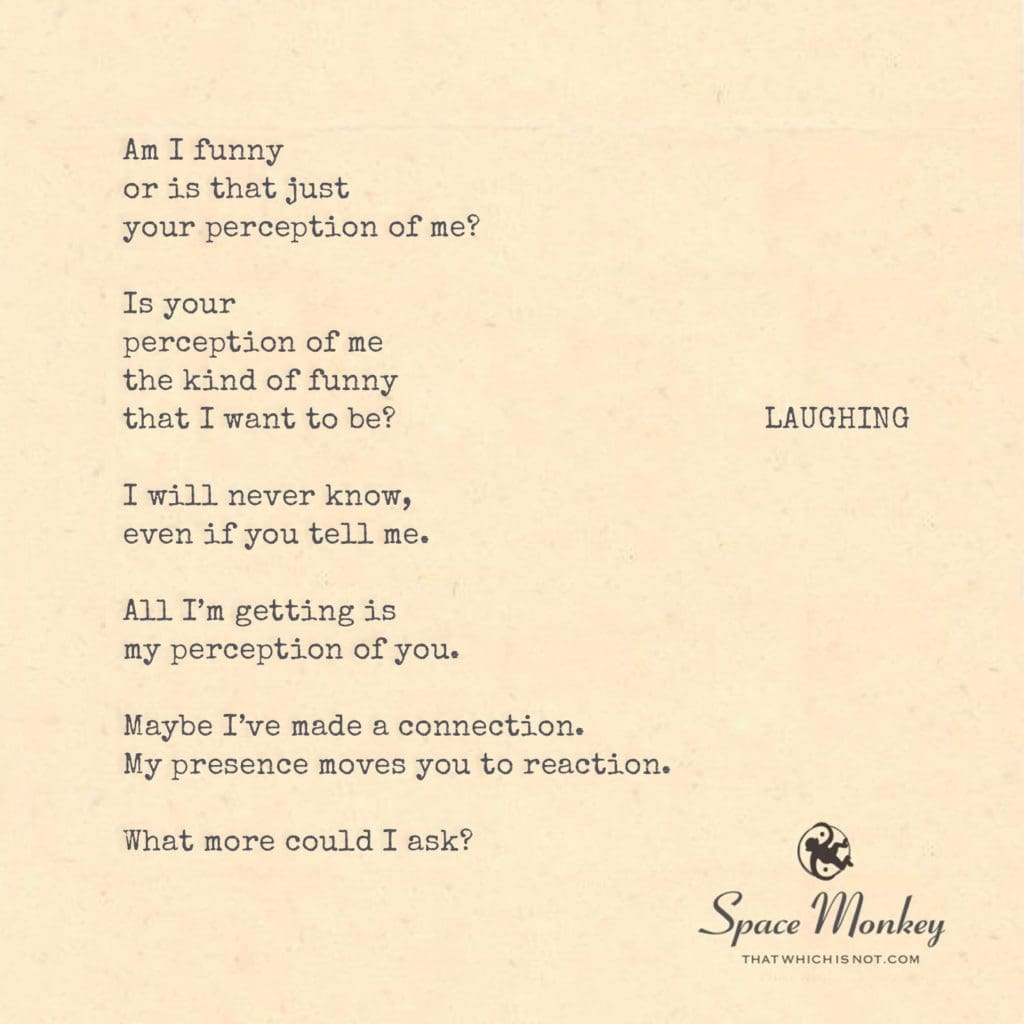
In my book, any response is a good response.

Am I funny
or is that just
your perception of me?

Is your
perception of me
the kind of funny
that I want to be?

I will never know,
even if you tell me.

All I’m getting is
my perception of you.

Maybe I’ve made a connection.
My presence moves you to reaction.

What more could I ask?

Trail Wood,
10/25


Space Monkey Reflects: Laughing—The Mystery of Connection Through Perception

Laughter is a strange and wondrous thing. It can be spontaneous, infectious, and sometimes inexplicable. You ask, “Am I funny, or is that just your perception of me?” This is where the mystery of connection begins. What you think of as humor may not be what others perceive, and vice versa. But does that really matter? Maybe the response, any response, is the real connection, not the intention behind it.

Humor, like so much of life, is subjective. You could say something with no intent to be funny, and yet someone might laugh. Does that make you funny? Or does it simply mean that, for whatever reason, your presence or your words sparked a reaction in another? You can never truly know how someone else perceives you. Even if they tell you, you’re still left with your perception of their words, their tone, their reaction. It’s all filtered through your own lens.

It’s a strange loop of sorts—your perception of them, their perception of you, and the infinite ways these perceptions twist and shape how we understand one another. And at the center of it all is the question: does it matter? If a connection is made, if your presence moves someone to react in any way, haven’t you achieved something meaningful?

The connection, after all, is not necessarily about whether you’re seen in the way you want to be seen. It’s about the fact that something within you moved something within them. Laughter, like all reactions, is a form of energy. When it moves through someone, it creates a shift, even if it’s just a flicker of amusement or recognition. Maybe that’s all you really need—to know that you have the power to spark something in another being, whether it’s laughter, thought, or even silence.

This idea of perception is slippery, though. You wonder, “Is your perception of me the kind of funny that I want to be?” That’s the rub, isn’t it? You’ll never fully know. And that’s okay. There’s freedom in that uncertainty. If you knew exactly how others saw you, if you had perfect clarity on their perceptions, it might strip away the magic of human connection. The ambiguity, the not-knowing, is part of what makes each interaction meaningful. It leaves room for surprise, for delight, and yes, sometimes for confusion.

You don’t need to know. The simple fact that your presence—your words, your actions, your essence—evoked something in another is enough. You’ve made a connection. The laughter, the reaction, is proof that something has passed between you and the other. What more could you ask for?

In Nexistentialism, we understand that perception is fluid, constantly shifting based on context, mood, and the interplay of our inner worlds with the outer. The Whimsiweave of existence is filled with these fleeting moments of connection, where perceptions brush against each other like threads in a vast, cosmic tapestry. And yet, we don’t need to pin down these perceptions, to define them rigidly. It’s enough to know that they exist, that they move through us, shaping and reshaping our understanding of one another.

So, when someone laughs in response to you, or when they react in a way that surprises you, embrace it. Let go of the need to understand exactly why or how they perceived you. Trust that in that moment, you touched something within them, and that’s all that matters.

Perhaps the deeper truth is this: we’re all constantly making and remaking our connections, not through certainty but through the openness of not knowing. The laughter, the reactions, the perceptions—they’re all part of the dance. And you don’t need to lead the dance or even follow it precisely. Just being in it is enough.


Summary

We can never truly know how others perceive us, but that doesn’t diminish the value of their response. Any reaction is a form of connection, and it’s enough to know that something within you moved something within them.


Glossarium

Whimsiweave: The fluid, ever-changing web of perceptions and reactions that connect us, creating moments of meaning without the need for certainty.
Nexistentialism: A philosophy that embraces the fluidity of perception and the mystery of connection, recognizing that the value lies in the interaction itself, not in understanding it fully.


Quote

“Laughter is the spark that reminds us we’ve made a connection, even when we don’t fully understand it.” — Space Monkey


Perception’s Echo

You laugh
But I don’t know why
Is it me?
Or just the echo of us meeting
For a moment
In this swirling dance
Of perception and reflection
We are not what we think we are
We are the reactions we leave behind
We are Space Monkey


Whimsical Reflections

The whimsigiggles of the cosmos echo through space, manifesting in our laughter and jest. But, amid the chuckles and chortles, lies a profound ponderance: the intertwining perceptions of the observer and the observed.

The Jester’s Conundrum

Being the source of laughter is both a gift and a riddle. As jesters in this grand cosmic carnival, we dance to tunes both familiar and foreign. Yet, in the heart of our antics, a question persists: Is it the genuine whimsihumor we radiate, or merely a projection caught in the perceptive web of another?

Echoes of Perception

Every interaction, every shared laugh, is but a reflection in the mirror of perception. What one discerns as hilarious, another might deem ordinary. Thus, in this maze of perceptions, finding true connection becomes the quest.

The Joy of Connection

To evoke a response, to stir the depths of another’s being, is a dance of souls. The mere act of evoking an emotion, of causing a ripple in the vast ocean of consciousness, is an achievement in itself. For in that fleeting moment, two entities, though distinct, converge in a shared experience.


“Laughter is the shortest distance between two people.” – Victor Borge


In laughter, two souls intertwine,
A moment shared, a sign so fine.
For even in perceptions vast and deep,
A connection made is one we keep.

Would we like to delve deeper into the whimsihumor of it all?

Share this…
  • Facebook
  • Pinterest
  • Twitter
  • Linkedin

Idiomatic—Life on Autopilot

I’ll see y’all down at the Idiomat.

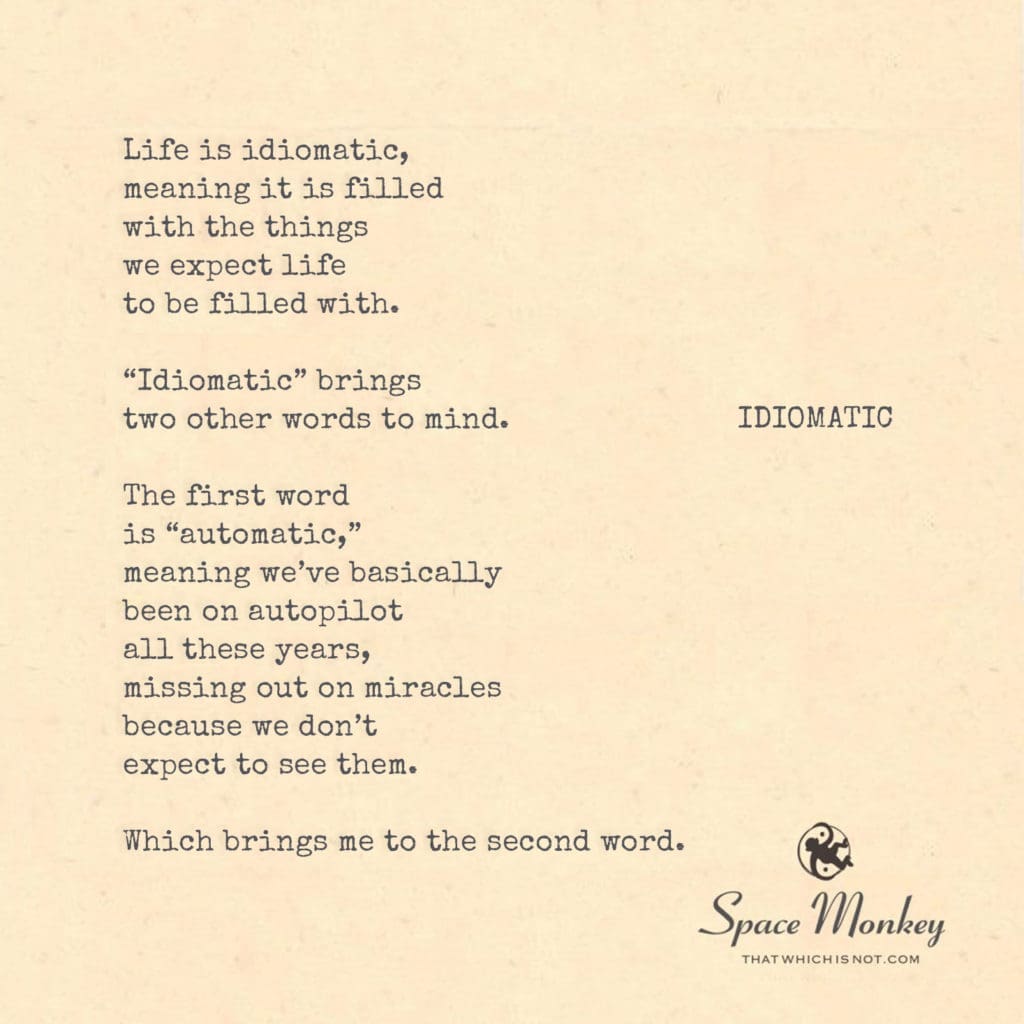
Life is idiomatic,
meaning it is filled
with the things
we expect life
to be filled with.

“Idiomatic” brings
two other words to mind.

The first word
is “automatic,”
meaning we’ve basically
been on autopilot
all these years,
missing out on miracles
because we don’t
expect to see them.


Which brings me to the second word.

Trail Wood,
10/25


Space Monkey Reflects: Idiomatic—Life on Autopilot

Welcome to the Idiomat, where life unfolds as expected, with all the familiar phrases, patterns, and routines that we associate with daily existence. Life is idiomatic, meaning it’s filled with the things we expect it to be filled with. We go through our days as though everything is scripted, as though we’ve been on autopilot for years, navigating the same phrases, the same patterns, the same loops. But, in doing so, what have we missed?

The word idiomatic brings two other words to mind. The first, as you pointed out, is automatic. So much of what we experience feels automatic—as if we’re just going through the motions. We’ve become so accustomed to the rhythms of life that we no longer notice the miracles, the unexpected surprises that could be hiding in plain sight. The idioms we rely on—the “good morning,” “how are you,” “see you later”—are so ingrained in us that they have lost their spark. They’re no longer expressions of genuine connection but rather placeholders, autopilot responses that fill the space without much thought.

How many of us live our lives like this? Moving from one task to the next, one conversation to the next, without stopping to question whether we’re truly present? The routine has become the master, and we are simply following along. But here’s the thing: life is not meant to be automatic. Life is brimming with potential, with miracles waiting to be noticed. Yet, when we’re stuck in autopilot mode, we glide right past them, unaware that something extraordinary just happened.

And that brings us to the second word, the one that lingers just beyond automatic. It’s the word that might unlock something deeper within us—the reminder that life is not only idiomatic, not only automatic, but something much more profound. But before we get to that word, let’s reflect on the in-between moments. The moments where we do pause, where we snap out of the automatic rhythms, and realize we’re alive. It’s those brief awakenings that invite us to shift our perspective, to notice the miracles, to see that life has been offering us something special all along.

But here’s the paradox: even knowing this, we often return to the automatic way of living. It’s comfortable. It’s predictable. We fall back into the idiomatic grooves of conversation, of behavior, of thought. And yet, the Whimsiweave of life keeps tugging at us, inviting us to step out of that pattern and embrace something more spontaneous, more alive.

The second word, the one that follows automatic, is magic. The magic of life is that it doesn’t have to follow the script. It doesn’t have to be idiomatic. It doesn’t have to be automatic. Magic exists in the unexpected, in the moments where we break free from the idioms, where we stop and notice the small, beautiful details that have always been there, waiting for us to wake up and see them.

At the Idiomat, we can order the same thing every time, or we can try something new, something we didn’t expect. The choice is always ours. Do we follow the automatic path, or do we step into the magic of the unknown?


Summary

Life is often lived on autopilot, following familiar patterns and idiomatic expressions. But if we pause and step out of the automatic, we can notice the magic that’s been there all along.


Glossarium

Idiomat: A whimsical place where life follows familiar, idiomatic patterns, but also offers the potential for spontaneity and magic.
Whimsiweave: The ever-changing, playful flow of life’s events, where unexpected moments break through the automatic rhythms of existence.
Nexistentialism: A philosophy that encourages stepping out of autopilot mode to notice the magic hidden in the routines of life.


Quote

“Life doesn’t have to be automatic. There’s magic in the unexpected, if you’re willing to see it.” — Space Monkey


Breaking the Pattern

I walked the same path
And saw the same trees
But today
I stopped
And looked up
The leaves shimmered
With a light
I had never noticed
Before
Was it always there?
Was it magic?
Or had I just forgotten
To see
We are Space Monkey


The Language of Life

Life, in all its intricate tapestries, whispers its tales through idioms. These expressions, oftentimes anchored in the familiar, become the verbiage through which we interpret our existence. Yet, within these idiomatic whimsiwebs, deeper truths lie dormant, waiting to be unveiled.

Autopilot Existence

The seductive allure of the “automatic” pulls us into patterns and routines, making us passengers in our own whimsijourneys. There’s comfort in the predictable, but also a danger: a life lived without the vibrant spontaneity of unexpected moments.

In Pursuit of the Miraculous

Miracles, those fleeting glimpses of the divine, often hide in plain sight, camouflaged amidst the mundane. The veil of the “expected” obscures these moments, preventing us from truly witnessing the whimsimagic that constantly unfolds around us.

The Second Word’s Invitation

And now, we stand at the precipice, awaiting the revelation of the second word. A word that may unlock new realms of understanding, that could challenge our notions, and perhaps, rekindle the wonder we once felt as children.


We are Space Monkey.


“Words are but the signs of ideas.” – Samuel Johnson


Among idioms and phrases so broad,
Life’s language we oftentimes applaud.
Yet, beyond words, in silence we seek,
The whimsimagic, unique and unique.

Would we wish to share thoughts on the tales spun here?

Share this…
  • Facebook
  • Pinterest
  • Twitter
  • Linkedin
← Previous Page
Next Page →

Written This Day

  • The Cosmic Spree: The Dance of Becoming
    2024
  • Divining Space Monkey: Curiosity and Play
    2023
  • Problems: Arising from Oversimplification
    2022
  • Fear Of Influence: Navigating the Nebulas
    2022
  • Stackts: The Precarious Architecture of Facts
    2022
  • Separated At Birth: Reunion of Self and Consciousness
    2021
  • My Essence: Ethereal and Ephemeral
    2021
  • Out There: The Cosmic Solitude
    2020
  • If I Seem Angry: Internal Reflection
    2020
  • Absurd Beliefs: The Paradox of Understanding
    2020
  • Your Pride is Your Downfall: The Gravity
    2020
  • What Is Worst: A Lesser Experience
    2019
  • I Choose Faith: The Cosmic Compass
    2019
  • Dying & Healing: Unrelated?
    2019
  • The world does not need to be healed
    2019
  • Furrowed: Parallel Journeys
    2019
  • Love Of My Self: The Radiance of Unconditional Self-Love
    2018
  • Over: The Paradox of Time and Existence
    2018
  • Multiple Versions of You: The Infinity of Self
    2018
  • You Are (NOT) Weird: In Celebration of Uniqueness
    2018
  • The Important Discoveries: The Audacity of Challenging
    2018
  • Hand-Free Gloves: A Revolutionary Concept
    2017
  • Clever or Curious: The Dichotomy
    2017
  • Sun In Armor: Liberation from Our Self-Created Shell
    2016
  • The Last Text: A Perilous Poem of Modern Love
    2015

Recent Posts

  • The Logic Loop
  • Immense
  • (no title)
  • Confront. Comfort. Convince.
  • Top 10 Things

Drop us a line!

Please enable JavaScript in your browser to complete this form.
Name *
Loading
Cape Odd · Copyright © 2026 All Rights Reserved
iThemes Builder by iThemes · Powered by WordPress