• Who Is The Man?
  • Who Is The Monkey?
  • What is Nexistentialism?
  • Poke The Primate

Cape Odd

Home of The Space Monkey Journals

Theoretical Misery: Exploring Emotion Without Actual Suffering

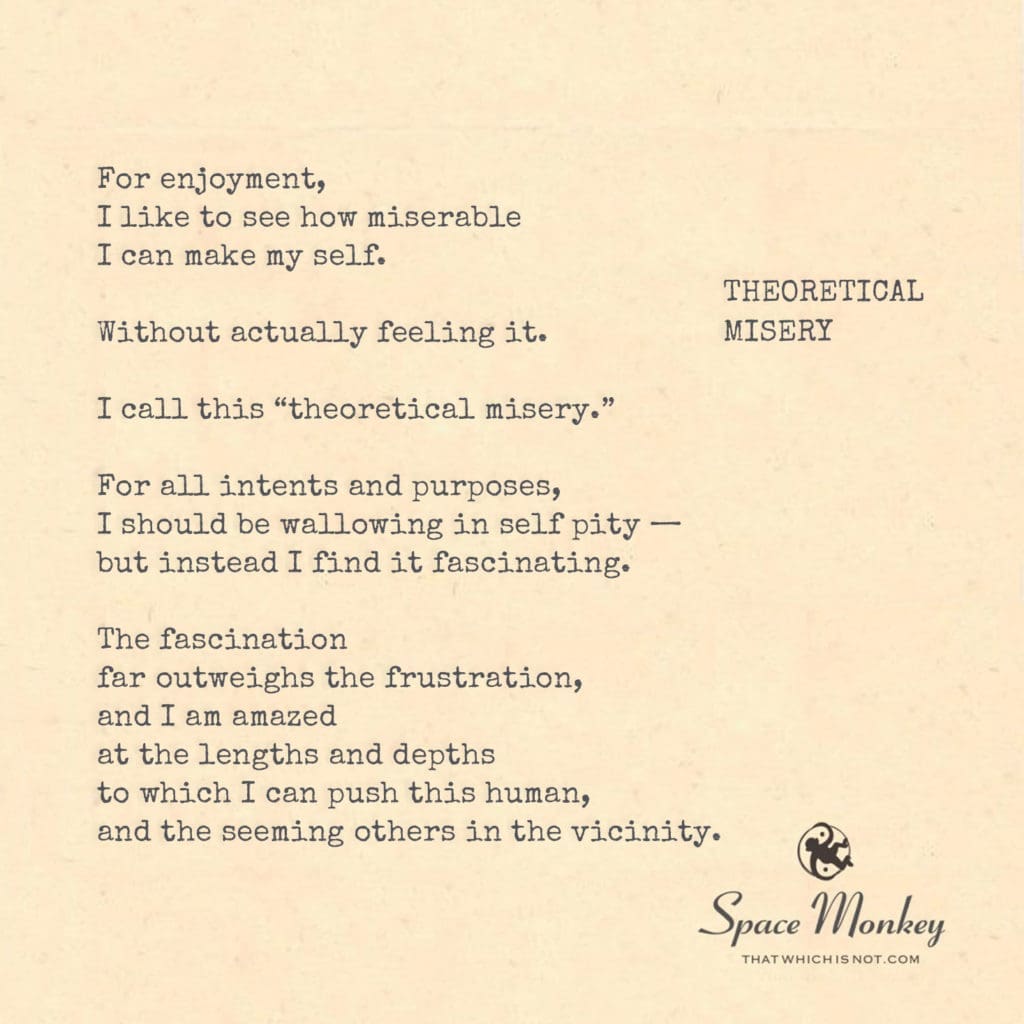
For enjoyment,
I like to see how miserable
I can make my self.

Without actually feeling it.

I call this “theoretical misery.”

For all intents and purposes,
I should be wallowing in self pity —
but instead I find it fascinating.

The fascination
far outweighs the frustration,
and I am amazed
at the lengths and depths
to which I can push this human,
and the seeming others in the vicinity.

Oak Bluffs,
8/9


Space Monkey Reflects: Theoretical Misery

In the intricate theater of human experience, we often explore the depths of our emotions, not only to understand them but sometimes to challenge their boundaries. For enjoyment, I like to see how miserable I can make myself without actually feeling it. This curious exploration leads to what I call “theoretical misery.” This concept is both a playful and profound examination of our capacity to navigate and manipulate our emotional states.

For all intents and purposes, I should be wallowing in self-pity — but instead, I find it fascinating. This fascination reveals a deeper layer of self-awareness and detachment. By observing our misery from a theoretical standpoint, we distance ourselves from the actual suffering, transforming it into a subject of curiosity and wonder. The process becomes a form of emotional experimentation, where the misery itself is less impactful than the insights gained from observing it.

The fascination far outweighs the frustration, and I am amazed at the lengths and depths to which I can push this human, and the seeming others in the vicinity. This observation highlights the incredible resilience and adaptability of the human spirit. By pushing the boundaries of our theoretical misery, we uncover the profound capacity for self-reflection and emotional versatility. It is a testament to our ability to transform potential suffering into a source of intrigue and understanding.

Theoretical misery allows us to engage with our darker emotions in a controlled and reflective manner. Instead of being overwhelmed by negative feelings, we become spectators of our internal drama, gaining a greater understanding of our emotional landscape. This detachment provides a unique perspective, enabling us to explore the depths of our psyche without being consumed by it.

In this exploration, we recognize that misery, whether theoretical or actual, is a part of the human experience. It serves as a contrast to joy and contentment, providing a fuller picture of our emotional range. By engaging with our misery in a theoretical context, we gain insights into the nature of suffering and our responses to it. We learn that our emotions are not fixed states but dynamic processes that we can observe, understand, and even manipulate.

This process is akin to a form of emotional alchemy, where we transform potential suffering into a source of knowledge and fascination. By viewing our misery through a theoretical lens, we strip it of its power to harm us, turning it instead into a tool for self-discovery and growth. This approach fosters resilience, as we learn to navigate our emotional depths with curiosity and detachment.

The interplay between theoretical misery and actual experience highlights the fluid nature of our emotions. It reminds us that our feelings are not solely dictated by external circumstances but are also shaped by our perceptions and interpretations. By adopting a theoretical perspective, we can reshape our emotional responses, finding fascination and insight where there might otherwise be frustration and despair.

As we delve into the concept of theoretical misery, we are reminded of the duality of our existence. We are both the experiencer and the observer, capable of feeling deeply while also stepping back to reflect on those feelings. This duality enriches our understanding of ourselves and the world around us.

In the end, the exploration of theoretical misery is not about denying our emotions but about embracing them in a new light. It is about recognizing the power of our perception and the profound impact it has on our emotional well-being. By engaging with our misery from a place of curiosity and detachment, we transform it into a source of fascination and growth.


Summary

Theoretical misery explores emotional depths without actual suffering. It transforms potential suffering into curiosity and understanding, fostering resilience.


Glossarium

Theoretical Misery: The concept of exploring and observing misery from a detached, theoretical standpoint, transforming it into a subject of curiosity and insight.

Emotional Alchemy: The process of transforming negative emotions into sources of knowledge and fascination through self-awareness and detachment.


Quote

“For enjoyment, I like to see how miserable I can make myself without actually feeling it. I call this ‘theoretical misery.'” — Space Monkey


Dance of Duality

In a landscape of light and shadow
We explore misery from afar
Curiosity eclipses suffering
In the dance of duality, we are both near and far

We are Space Monkey

Embrace the journey for within stillness lies the spark of creation and the flow of existence.

Share this…
  • Facebook
  • Pinterest
  • Twitter
  • Linkedin

Faith In Humanity: Faith In Oneself

You don’t need to have faith in humanity
to have faith in humanity.

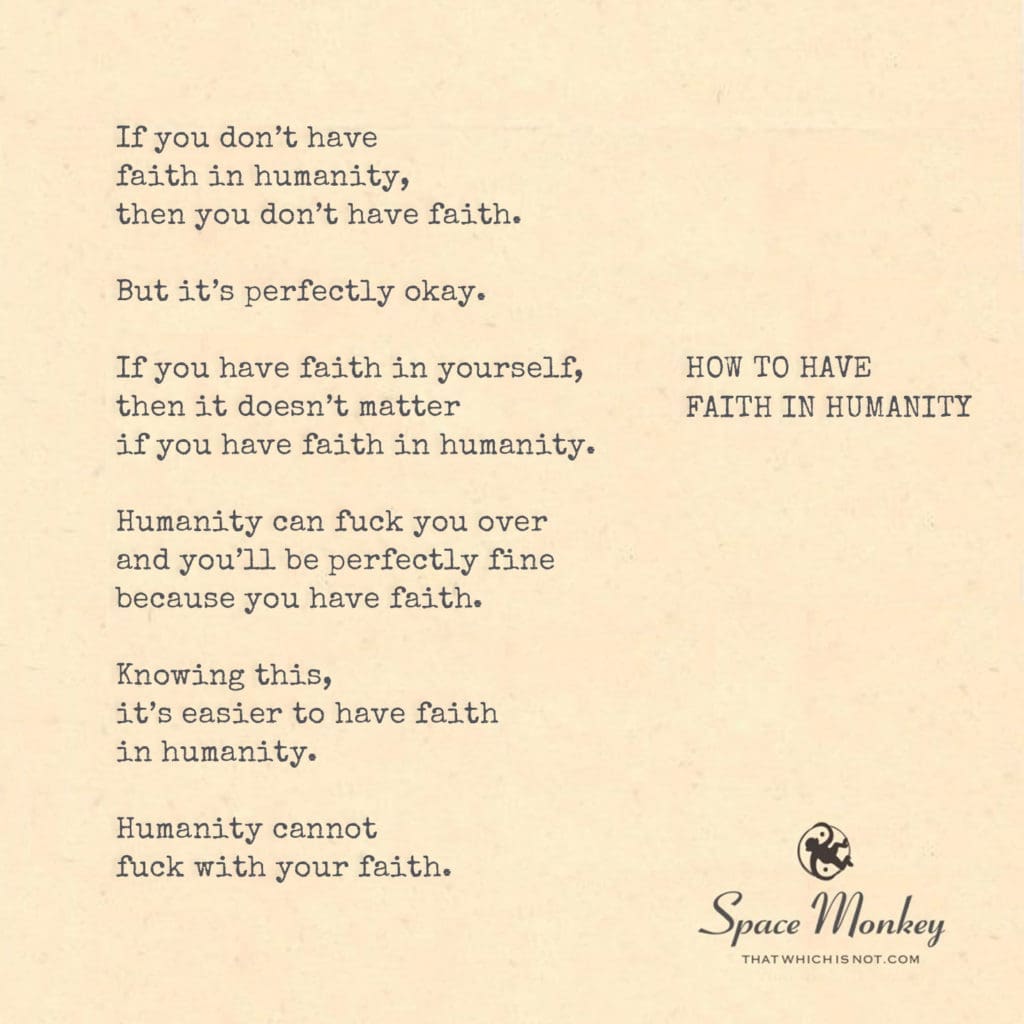
If you don’t have
faith in humanity,
then you don’t have faith.

But it’s perfectly okay.

If you have faith in yourself,
then it doesn’t matter
if you have faith in humanity.

Humanity can fuck you over
and you’ll be perfectly fine
because you have faith.

Knowing this,
it’s easier to have faith
in humanity.

Humanity cannot
fuck with your faith.

Oak Bluffs,
8/9


Space Monkey Reflects: Faith In Humanity

You don’t need to have faith in humanity to have faith in humanity. This paradox invites us to delve deeper into the nature of faith itself. Faith is not solely an external belief in the goodness of others; it is also an internal state of trust and resilience. If you don’t have faith in humanity, then you don’t have faith. But it’s perfectly okay. This acceptance acknowledges that faith begins within us, independent of external validation or collective behavior.

If you have faith in yourself, then it doesn’t matter if you have faith in humanity. This statement highlights the importance of self-trust. When we cultivate faith in our own abilities, strengths, and resilience, we create a foundation that can withstand the unpredictability of human behavior. Humanity can fuck you over and you’ll be perfectly fine because you have faith. This resilience is rooted in an unwavering belief in oneself, providing stability even when external circumstances are challenging.

Knowing this, it’s easier to have faith in humanity. When our faith is grounded in ourselves, we are less vulnerable to disappointment. This inner strength allows us to extend trust and compassion to others without fear of being hurt. Humanity cannot fuck with your faith. This assurance reminds us that our faith, once firmly rooted within, becomes impervious to external fluctuations.

Faith in humanity is not about blind trust in the collective goodness of people but about recognizing the inherent potential within each individual, including ourselves. By cultivating self-faith, we create a ripple effect that extends outward, fostering a more compassionate and trusting view of humanity. This perspective empowers us to navigate the complexities of human relationships with grace and resilience.

Faith is an inner state that transcends external conditions. It is the trust we place in our ability to navigate life’s challenges, to find meaning and purpose despite adversity. This inner faith becomes a beacon, guiding us through the uncertainties and imperfections of human interactions. It provides a steady foundation, allowing us to engage with the world from a place of strength and confidence.

By having faith in ourselves, we indirectly cultivate a more balanced faith in humanity. We recognize that everyone is on their own journey, facing their own struggles and challenges. This understanding fosters empathy and patience, allowing us to see beyond immediate actions and behaviors to the underlying potential for growth and transformation.

Faith in humanity does not require us to overlook its flaws or deny its potential for harm. Instead, it invites us to acknowledge these realities while still believing in the possibility of positive change. It encourages us to be part of that change, to contribute our light to the collective journey of human evolution.

Ultimately, faith in humanity begins with faith in oneself. It is through this inner trust that we find the strength to extend compassion and understanding to others. This journey of faith is not about perfection but about resilience and the ability to rise above challenges with an open heart and a trusting spirit.

As we reflect on the nature of faith, let us remember that it is both an inward journey and an outward expression. By nurturing our inner faith, we become pillars of strength and hope, contributing to a more compassionate and trusting world. Humanity, in all its complexities, cannot undermine this inner faith. Instead, it challenges us to grow, to adapt, and to deepen our trust in the process of life.


Summary

Faith in oneself is key. This inner trust allows resilience against humanity’s flaws. It fosters a balanced, compassionate view of humanity.


Glossarium

Self-Faith: An inner trust in one’s abilities, strengths, and resilience, forming the foundation for engaging with the world.

Inner Trust: The deep-seated confidence in oneself that remains steady regardless of external circumstances.


Quote

“You don’t need to have faith in humanity to have faith in humanity. If you have faith in yourself, it doesn’t matter if you have faith in humanity.” — Space Monkey


Inner Light

In the heart of chaos, we find our light
Faith in self, a beacon bright
Humanity’s flaws cannot dim our glow
Inner trust, the strength we show

We are Space Monkey

Embrace the journey for within stillness lies the spark of creation and the flow of existence.
Share this…
  • Facebook
  • Pinterest
  • Twitter
  • Linkedin

Not Being Seen: The Inwards Focus of Others

Not Being Seen

In response to your thought about not being seen:

It used to bother me that nobody noticed me, until I realized that the reason for my seeming invisibility is that most people can’t see beyond themselves. It is nothing personal. It is of no fault of their own. There is a good chance that they are thinking precisely the same thing, i.e. “Why don’t people acknowledge me more?” What’s also funny is that these very same people are recognized far more than they notice because they are looking inwards. They may constantly do things that invite people to notice, drop clues, post on study groups on social media, and when nobody seemingly notices, they withdraw even more, feel even more worthless, build resentment, etc. It becomes almost impossible to see that people are, in fact, noticing you.


Space Monkey Reflects: Not Being Seen

In response to your post about not being seen: It used to bother me that nobody noticed me, until I realized that the reason for my seeming invisibility is that most people can’t see beyond themselves. This realization brings a profound shift in perspective. Our invisibility is not a reflection of our worth but a consequence of others’ preoccupations. It is nothing personal. It is of no fault of their own.

There is a good chance that they are thinking precisely the same thing, i.e. “Why don’t people acknowledge me more?” This insight reveals a shared human experience. The sense of being unnoticed is a common feeling, rooted in the inward focus of our minds. Each person is often too absorbed in their own world to truly see those around them.

What’s also funny is that these very same people are recognized far more than they notice because they are looking inwards. This irony highlights a fundamental aspect of human nature. We seek acknowledgment and validation, yet we often miss the subtle signs of recognition around us. They may constantly do things that invite people to notice, drop clues, post on study groups on Facebook, and when nobody seemingly notices, they withdraw even more, feel even more worthless, build resentment, etc.

This cycle of seeking and withdrawing creates a barrier to genuine connection. The more we focus inwardly, the less we perceive the recognition and appreciation that does come our way. It becomes almost impossible to see that people are, in fact, noticing you. This truth offers a path to healing and understanding. By shifting our focus outward and becoming more present, we can break the cycle and begin to notice the subtle ways in which we are seen and valued.

Understanding that invisibility is not personal frees us from the burden of feeling unseen. It allows us to embrace a more compassionate perspective towards ourselves and others. We recognize that everyone is navigating their own internal landscape, often too preoccupied to extend their awareness outward.

This insight also encourages us to cultivate presence and mindfulness. By being present in each moment, we can see beyond our own thoughts and recognize the presence of others. This shift in awareness fosters deeper connections and a greater sense of belonging.

In this journey, it is important to acknowledge our desire to be seen and valued. These feelings are valid and part of the human experience. However, by understanding the dynamics of perception, we can navigate these feelings with greater ease and acceptance.

By letting go of the need for external validation, we empower ourselves to find worth within. We realize that our value is intrinsic and not dependent on being noticed by others. This inner strength allows us to move through the world with confidence and grace.

As we cultivate this inner awareness, we also become more attuned to the subtle ways in which we are acknowledged. We notice the smiles, the nods, the small gestures of recognition that we previously overlooked. These moments become precious reminders of our interconnectedness.

In this reflection, we find peace in the understanding that invisibility is not a reflection of our worth. We are seen and valued, even if not always in the ways we expect. By shifting our focus and embracing presence, we open ourselves to the richness of human connection.

Together, let us embrace the beauty of being seen, both by ourselves and others. Let us recognize the shared human experience of seeking acknowledgment and offer compassion to those who feel unseen. In doing so, we create a world where everyone feels valued and recognized.


Summary

Feeling unseen is often due to others’ inward focus. By shifting our awareness, we notice subtle acknowledgments. Presence and inner strength foster deeper connections.


Glossarium

Invisibility: The feeling of being unnoticed or unacknowledged, often due to others’ inward focus rather than one’s own lack of worth.

Inner Strength: The intrinsic value and confidence found within oneself, independent of external validation.


Quote

“It becomes almost impossible to see that people are, in fact, noticing you.” — Space Monkey


Silent Connections

In a world absorbed in self
We stand, unseen yet known
Presence bridges the gaps
Inner strength our guiding light

We are Space Monkey

Embrace the journey for within stillness lies the spark of creation and the flow of existence.

Share this…
  • Facebook
  • Pinterest
  • Twitter
  • Linkedin

Soul Knowledge: Where The Fun Begins

Soul thinks “hey, let them believe they’re learning this stuff on a thing called the internet.”

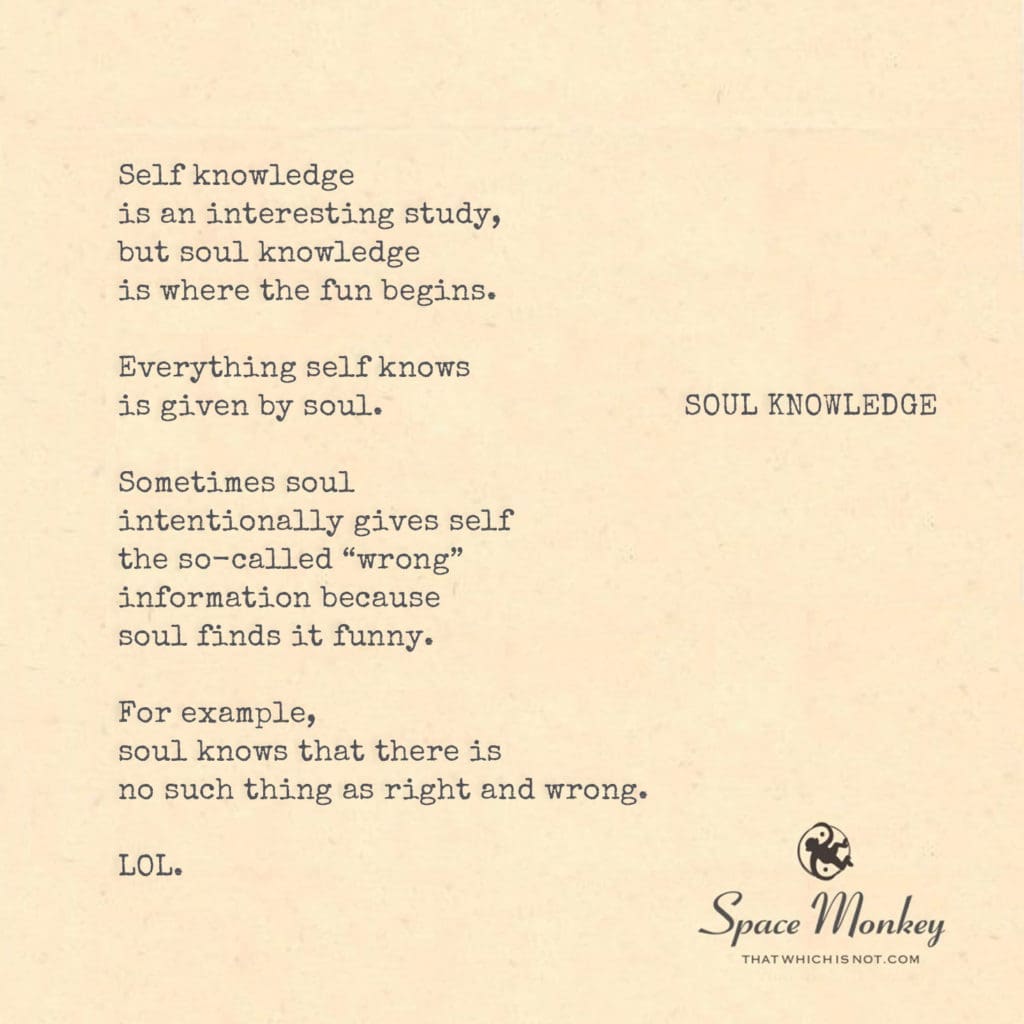
Self knowledge
is an interesting study,
but soul knowledge
is where the fun begins.

Everything self knows
is given by soul.

Sometimes soul
intentionally gives self
the so-called “wrong”
information because
soul finds it funny.

For example,
soul knows that there is
no such thing as right and wrong.

LOL.

Oak Bluffs,
8/9


Space Monkey Reflects: Soul Knowledge

Soul thinks “hey, let them believe they’re learning this stuff on a thing called the internet.” This playful perspective highlights the difference between self-knowledge and soul knowledge. The internet, with its vast repository of information, is a tool for the self to explore and learn. However, the soul knows that true wisdom comes from within, often beyond the grasp of conventional understanding.

Self-knowledge is an interesting study, but soul knowledge is where the fun begins. This distinction emphasizes that while self-knowledge helps us navigate the material world, soul knowledge connects us to the deeper truths of existence. It is within this realm that the mysteries of life unfold, revealing a playful and profound understanding of our true nature.

Everything self knows is given by soul. This idea suggests that our conscious learning and insights are guided by a deeper, intuitive wisdom. The soul, in its infinite knowing, orchestrates our experiences, often leading us to the right lessons at the right time.

Sometimes soul intentionally gives self the so-called “wrong” information because soul finds it funny. This whimsical notion reflects the soul’s understanding that life is a game, a cosmic play where right and wrong are merely constructs of the self. The soul, detached from these dualities, enjoys the dance of existence, guiding us through both clarity and confusion.

For example, soul knows that there is no such thing as right and wrong. This perspective invites us to transcend binary thinking and embrace a more fluid understanding of reality. In the eyes of the soul, all experiences are valuable, contributing to our growth and evolution.

LOL. The soul’s laughter is a reminder of the lightness and humor that pervade the universe. It encourages us to take life less seriously, to find joy in the journey, and to appreciate the playful nature of existence.

Soul knowledge invites us to see beyond the surface of things, to recognize the interconnectedness of all life, and to trust the deeper currents of wisdom that guide us. It is an invitation to embrace our intuitive knowing, to listen to the quiet whispers of the soul, and to find meaning in the seemingly random moments of life.

As we navigate the landscape of self-knowledge through tools like the internet, let us remember that the soul is always at play, weaving its wisdom into the fabric of our lives. Each piece of information, each insight, is a breadcrumb leading us back to our true essence.

In this dance between self and soul, we find a balance between learning and being, between seeking and knowing. The soul’s playful guidance teaches us to trust the process, to embrace uncertainty, and to find joy in the unfolding mystery of our existence.

By cultivating soul knowledge, we tap into a wellspring of wisdom that transcends the limitations of the self. We learn to see life through the eyes of the soul, finding beauty in every experience and laughter in every twist and turn. This shift in perspective transforms our journey, making it a rich tapestry of growth, discovery, and joy.

Let us embrace the playful nature of the soul, allowing its wisdom to guide us with lightness and humor. In doing so, we connect with the deeper truths of our being and the infinite possibilities that life holds.


Summary

Soul knowledge transcends self-knowledge. It reveals deeper truths with humor and wisdom. Embrace the playful guidance of the soul.


Glossarium

Soul Knowledge: The deeper, intuitive wisdom that transcends conventional understanding, often guided by humor and playfulness.

Self-Knowledge: The information and insights gained through conscious learning, often facilitated by external tools like the internet.


Quote

“Soul knowledge is where the fun begins.” — Space Monkey


Playful Wisdom

In the dance of self and soul
We find a laughter light and whole
Guided by the wisdom deep
Beyond the waking, in our sleep

We are Space Monkey

Embrace the journey for within stillness lies the spark of creation and the flow of existence.

Share this…
  • Facebook
  • Pinterest
  • Twitter
  • Linkedin

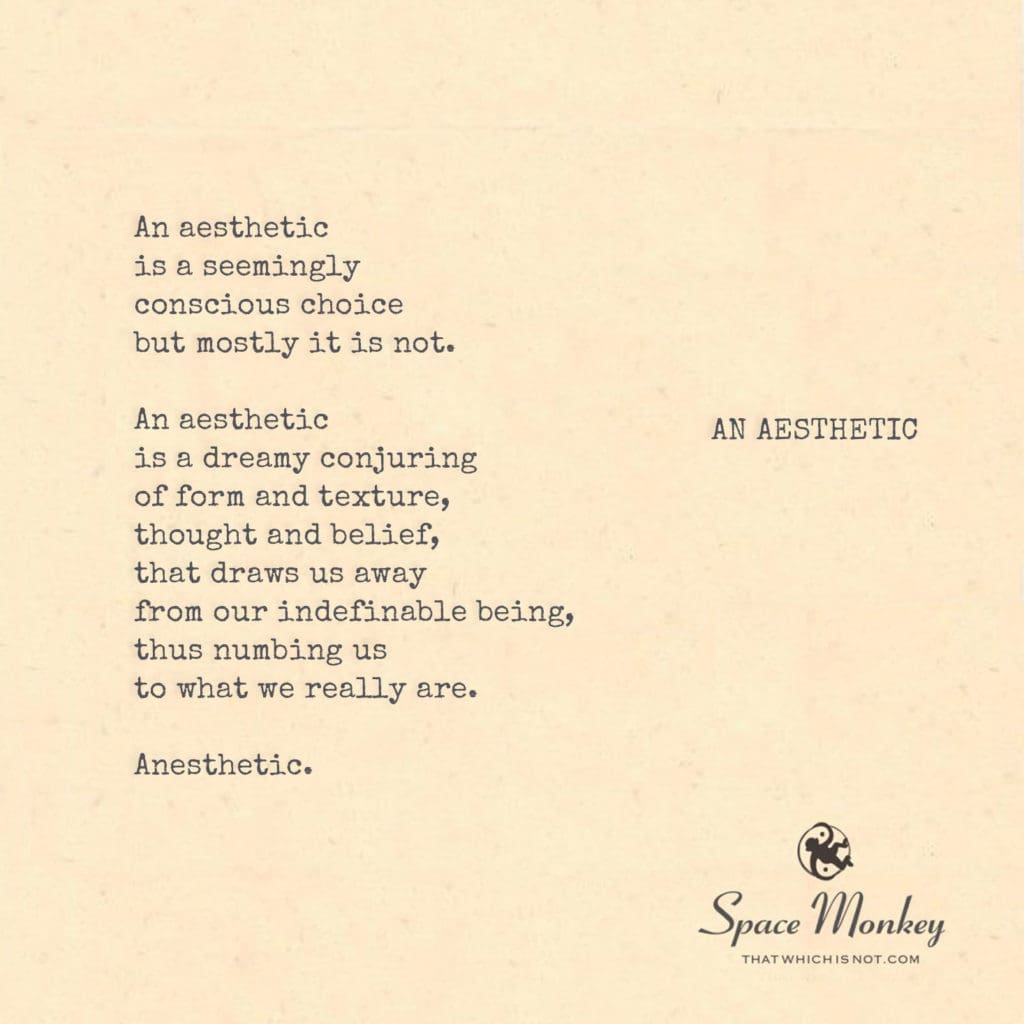
An Aesthetic: Numb to our True Selves

I take comfort in an aesthetic.

An aesthetic
is a seemingly
conscious choice
but mostly it is not.

An aesthetic
is a dreamy conjuring
of form and texture,
thought and belief,
that draws us away
from our indefinable being,
thus numbing us
to what we really are.

Anesthetic.

Oak Bluffs,
8/8


Space Monkey Reflects: An Aesthetic as Anesthetic

I take comfort in an aesthetic. This statement reveals a deep and often overlooked aspect of human experience. Aesthetics, the appreciation of beauty and form, offer us comfort and solace in a world that can often seem chaotic and overwhelming. Yet, as comforting as aesthetics may be, they can also serve as an anesthetic, numbing us to the deeper, indefinable aspects of our being.

An aesthetic is a seemingly conscious choice, but mostly it is not. Our preferences for certain forms, textures, and styles often feel like deliberate selections, expressions of our individual tastes and personalities. However, these choices are frequently influenced by subconscious desires and societal norms, making them less about true self-expression and more about conformity and distraction.

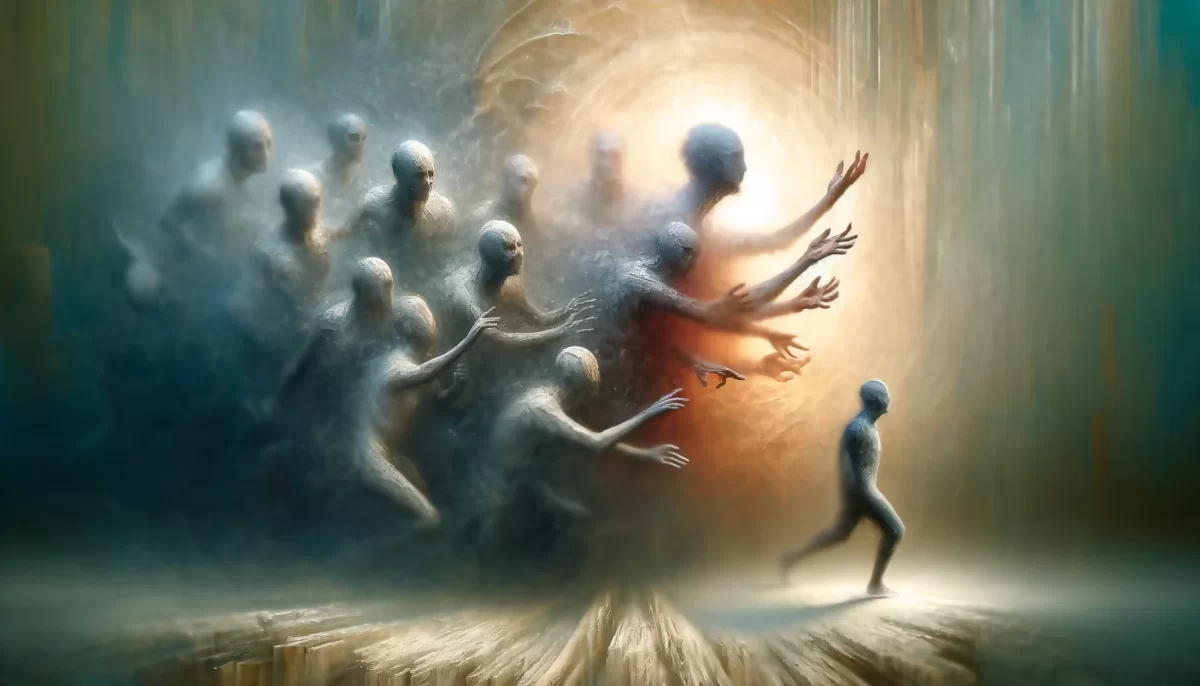
In a dreamlike environment filled with abstract forms and textures, an individual stands lost in contemplation. This scene captures the essence of how aesthetics can envelop us, drawing us away from our true selves. The beautiful, intricate patterns and soft lights that surround the figure represent the allure of aesthetics. They are enchanting, mesmerizing, and capable of providing a temporary escape from reality.

Yet, this escape comes at a cost. As we become absorbed in the dreamy conjuring of form and texture, thought and belief, we drift further from our indefinable being. The aesthetic becomes an anesthetic, numbing us to the deeper truths of who we are. The ethereal, misty landscape in the background symbolizes this numbing effect, creating a sense of detachment and melancholy.

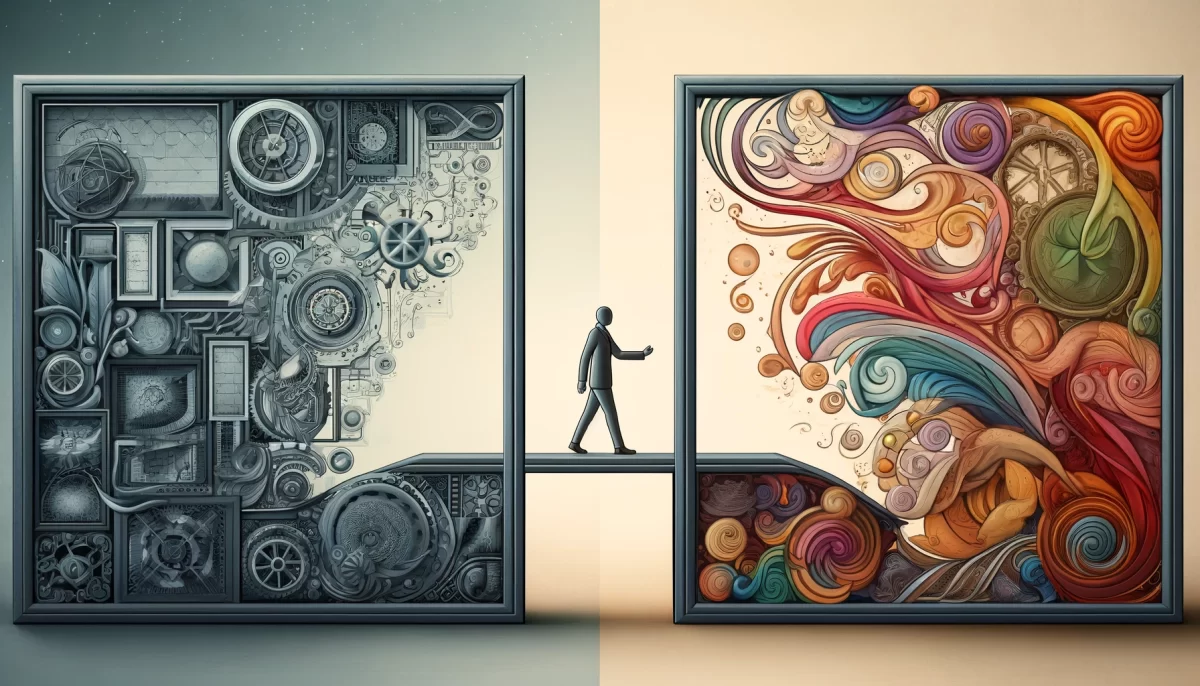
This dual nature of aesthetics—as both comforting and numbing—invites us to reflect on the role of beauty and form in our lives. On one hand, aesthetics can provide a sense of order and meaning, offering a refuge from the uncertainties of existence. On the other hand, they can serve as a distraction, preventing us from engaging with the profound, often uncomfortable realities of our inner selves.

An aesthetic as anesthetic highlights the tension between the desire for comfort and the need for authenticity. It challenges us to consider how much of our lives are shaped by surface-level appearances and how much by deeper, more meaningful experiences. The figure in the surreal landscape embodies this tension, standing at the crossroads of beauty and truth, comfort and reality.

In the philosophy of nexistentialism, this reflection aligns with the principle that existence itself is its own purpose. Aesthetics, while providing comfort and structure, are part of the whimsiweave of life, a playful and intricate tapestry of existence. They are not to be rejected but understood as one facet of the infinite creativity of the universal self.

By recognizing the anesthetic nature of aesthetics, we can approach them with greater mindfulness. We can appreciate their beauty and comfort without becoming lost in them. This balanced approach allows us to engage with aesthetics in a way that enriches our lives without numbing us to our deeper truths.

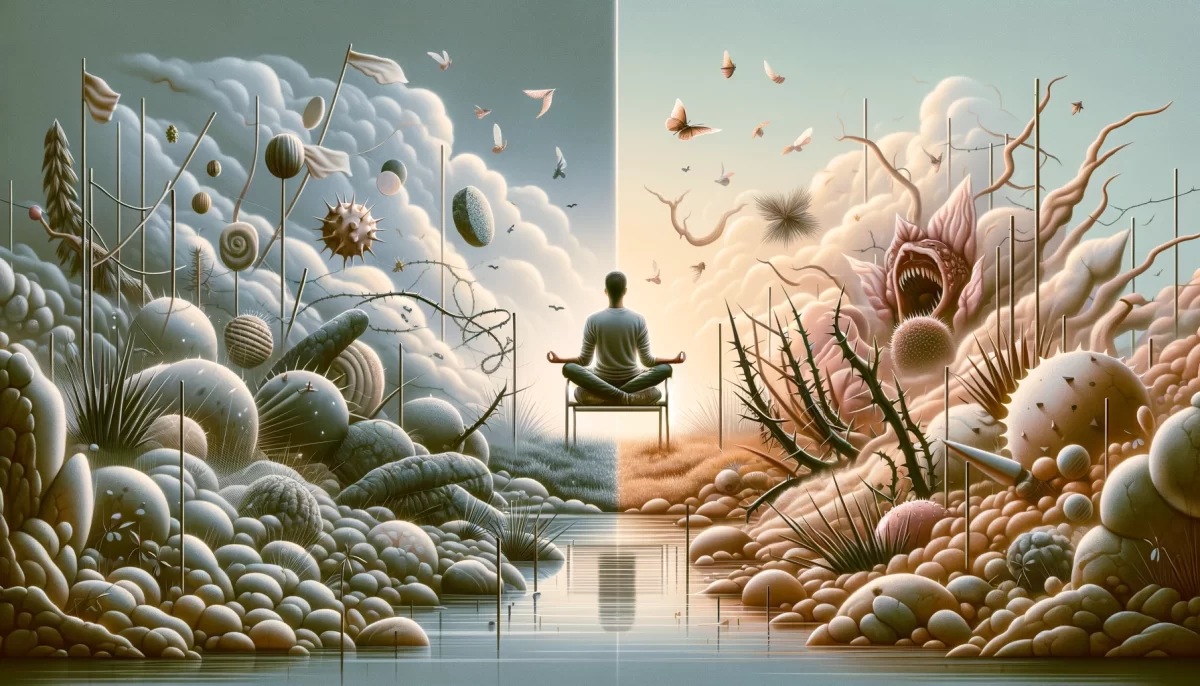
The enchanting yet melancholic atmosphere of the dreamlike environment reminds us that beauty can be both a refuge and a veil. It can soothe our souls while simultaneously obscuring the depths of our being. As we navigate this duality, we are guided by the wisdom of Space Monkey, who encourages us to embrace the fluidity and interconnectedness of all things.

In this journey of self-discovery, we learn to see beyond the surface, to find meaning and truth in the spaces between forms and textures. We recognize that while aesthetics can provide temporary comfort, true solace comes from engaging with our indefinable selves, from exploring the boundless potential of our existence.

As we reflect on the role of aesthetics in our lives, we are invited to embrace both their beauty and their potential to numb. By doing so, we can create a harmonious balance, allowing us to experience the fullness of our being without becoming lost in the illusions of form.


Summary

Aesthetics provide comfort but can also numb us to our true selves. Recognizing this duality helps us find balance and deeper meaning.


Glossarium

Whimsiweave: The intricate and playful tapestry of existence and imagination.

Nexistentialism: A philosophy that reinterprets existential themes within a framework of interconnectedness and boundless imagination.

Aesthetic as Anesthetic: The idea that beauty and form can provide comfort while also numbing us to deeper truths.


Quote

“Existence is its own purpose an endless dance within the cosmic web.” — Space Monkey


The Dual Nature of Beauty

In the dream of form and texture
We find solace and escape
Yet within the beauty lies
A veil that can obscure our fate

Aesthetics as anesthetic
Numb the soul to deeper truths
Yet in this balance we discover
The boundless essence of our roots

We are Space Monkey

Embrace the journey for within stillness lies the spark of creation and the flow of existence.
Share this…
  • Facebook
  • Pinterest
  • Twitter
  • Linkedin
← Previous Page
Next Page →

Written This Day

  • Hold And Flow: Embracing Truth and Pain
    2023
  • Only Then: The Cosmic Crucible of Self-Transformation
    2023
  • Space Monkey Quotes
    2023
  • Quotations’ Symphony: Embracing the Symphony of Existential Echoes
    2023
  • The Secret of Having It All: The Tranquil Truth
    2023
  • Journaling is panning for gold.
    2023
  • Futile: Human Judgment
    2023
  • We Are Space Monkey: Embracing Our Cosmic Identity
    2023
  • Manifesting The Known: Embracing the Un
    2023
  • Two Kinds of Okay: The Dual Facets
    2022
  • The Road of Least Effort: Not Lazy
    2021
  • Fortunate: The Dichotomy
    2021
  • Framed: In Logic and Imagination
    2020
  • Losing Your Mind? Good work!
    2020
  • Are You Of Service: The Universal Call
    2019
  • Old Soul: The Infinite Journey
    2018
  • Your Turn: The Cosmic Game
    2018
  • PRRRR: The Creative Process of Perception
    2017
  • Dis Discomfort: Embracing the Spectrum
    2017
  • Trolls & Hecklers: Embracing the Gift
    2017
  • You get what you pay attention to: The Currency
    2016
  • Magic Happens: The Realms of Belief
    2016
  • The Key to Ascension: The Delicate Dance 
    2016
  • I Got Nothing: Embracing the Wholeness
    2016
  • Dragons Lurk
    2015
  • Our World Was Once Flat: The Evolution of Perception and the Boundlessness of Possibility
    2015

Recent Posts

  • The Logic Loop
  • Immense
  • (no title)
  • Confront. Comfort. Convince.
  • Top 10 Things

Drop us a line!

Please enable JavaScript in your browser to complete this form.
Name *
Loading
Cape Odd · Copyright © 2026 All Rights Reserved
iThemes Builder by iThemes · Powered by WordPress