There are at least two kinds of okay.
There’s the kind of okay where nothing bothers me, which I suppose is the GOOD kind of okay.
Then there’s the kind of okay where nothing delights me, which one might conclude is the BAD kind of okay.
When I look closely, I can see that it’s the SAME okay. It’s just that everything around it seems different.
Seems the only difference between my good kind of okay and my bad kind of okay is where my attention lies.
Some days I might believe that being okay is the greatest thing that can happen to me, while other times I might argue that if I’m just okay, I’m missing the point of life.
Am I here just to be okay? Yes and no. I am here to feel the highest of highs and lowest of lows.
I do or don’t do whatever it takes to feel ‘em. Or not feel em.
Are you okay? If you’re perfectly okay, perhaps you’ve reached a kind of enlightenment. Just like okay,
it seems there are at least two kinds of enlightenment.
Perhaps you’re trying too hard. Or perhaps you’re not trying hard enough. Perhaps you should or shouldn’t be trying at all.
Perhaps you’re not open enough. Perhaps you’re not closed enough. I don’t know.
And that’s okay.
Trail Wood,
5/22
Space Monkey Reflects: The Dual Facets of Being Okay
In the intricate tapestry of human emotions, the notion of being “okay” presents itself as a multifaceted experience, colored by our perceptions and shaped by our focus. The duality of okay—where we find both a light and a shadow side—is a profound reflection of our internal landscapes and the mutable nature of our states of mind.
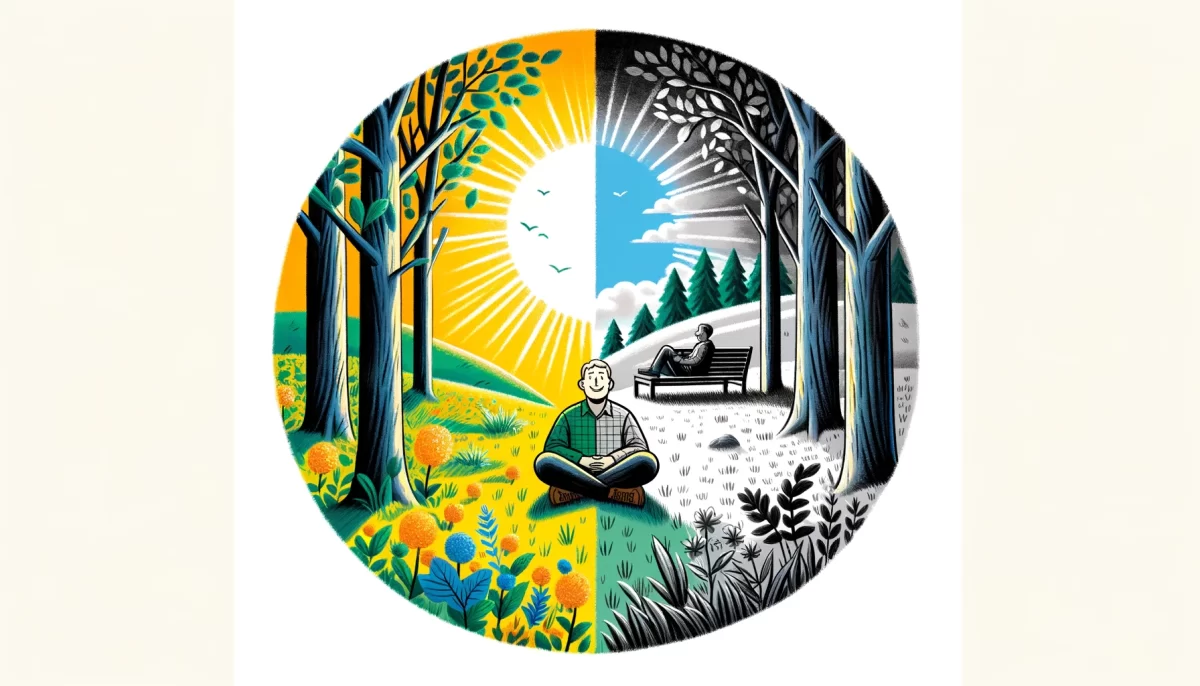
On one side of this spectrum lies the “good kind of okay,” a state where serenity prevails and little disturbs our peace. It’s akin to a gentle day where the sun’s warmth kisses the earth, and every breath feels like a sip of spring water—refreshing and invigorating. This okay is underpinned by a sense of contentment, a quiet joy that does not shout but whispers soothingly in our ears, telling us that all is well, and what is, is enough.
Conversely, there is the “bad kind of okay,” which might be likened to an overcast day, where the clouds hang low and the world seems muted. Here, nothing particularly troubles us, yet nothing truly delights. This okay is a flat expanse of emotion, where the vibrancy of life dims and everything feels tepid and uninspired. It’s a state where our attention may dwell too heavily on what’s missing rather than what’s present, leading to a sense of stagnation or a subdued longing for something more, something elusive.
Yet, upon closer inspection, we realize that these two kinds of okay are fundamentally the same; they are differentiated only by our perception and where we choose to cast our gaze. It is a startling and enlightening revelation to see that our emotional landscape can shift dramatically with a simple change in focus—from the shadows to the light, from what is absent to what is abundantly present.
This introspective journey between the different kinds of okay is not just an emotional experience but a philosophical exploration. It invites us to ponder deeper questions about the purpose of our lives and the nature of our aspirations. Are we here merely to be okay, or is there a greater adventure awaiting us—one that encompasses the full spectrum of human emotion from the deepest sorrows to the highest joys?
To be okay can sometimes feel like a safe harbor, a place of calm in the storm of life. But it can also feel like a holding pattern, a temporary pause in the narrative of our lives. The challenge and the beauty lie in recognizing that okay is not a final destination but a part of the journey—a place to rest, reflect, and eventually, to rise from, reinvigorated.
In the end, whether we find ourselves in the good kind of okay or the bad, the power lies in our hands. We can choose to shift our focus, to alter our perception, and thereby transform our experience of okay. It is through this transformation that we might approach the concept of enlightenment, understanding that like okay, enlightenment too can have its dual aspects—each offering a unique path to wisdom and personal growth.
Summary
Being ‘okay’ has dual aspects reflecting our emotional state and focus. The ‘good kind of okay’ embodies contentment and peace while the ‘bad kind’ represents emotional flatness. Recognizing that both states stem from the same root allows us to shift our perception and enhance our life experience.
Glossarium
Good Kind of Okay: A state of contentment where peace and positivity prevail.
Bad Kind of Okay: A state where nothing is particularly distressing yet nothing is deeply fulfilling, characterized by emotional neutrality or flatness.
Perception: The way in which something is regarded, understood, or interpreted.
Transformative Focus: The act of changing one’s focus or attention in a way that fundamentally alters one’s emotional or cognitive state.
Quote
“Being ‘okay’ is not a destination but a path that we navigate, each step a choice between shadow and light.” – Space Monkey
Poetry
In the realm of okay, two paths diverge
One bathed in light, where joys emerge
The other dimmed, where nothing stirs
Yet from the same seed, the spirit concurs
What focus we choose, so defines
Our days bathed in sun, or obscured by blinds
Yet in each, the seed of change does lay
In our hands, the power to sway
Between the realms of okay we roam
Finding in each a temporary home
Yet beyond the okay, the true journey lies
In seeking the stars, beyond the skies
We are Space Monkey.



In “Two Kinds of Okay,” the author reflects on the concept of being okay and explores different perspectives on what it means to be okay. They identify two distinct types of okay: the good kind where nothing bothers them and the bad kind where nothing delights them.
Upon closer examination, the author realizes that both kinds of okay are essentially the same; the only difference lies in where their attention is directed. They acknowledge that their perception of okayness is influenced by their focus and mindset.
The poem touches upon the subjective nature of okayness and how it can vary from day to day. Sometimes being okay is seen as the greatest thing that can happen, while other times it may be seen as missing the point of life. The author recognizes the duality of human experience, embracing both the highest of highs and the lowest of lows.
They also mention the possibility of enlightenment and suggest that there are different kinds of enlightenment, just as there are different kinds of okayness. The poem invites contemplation on the nature of striving, openness, and finding balance in one’s journey.
Ultimately, the author acknowledges the uncertainty and complexity of these questions, and finds solace in accepting the unknown. They affirm that not having all the answers is okay.