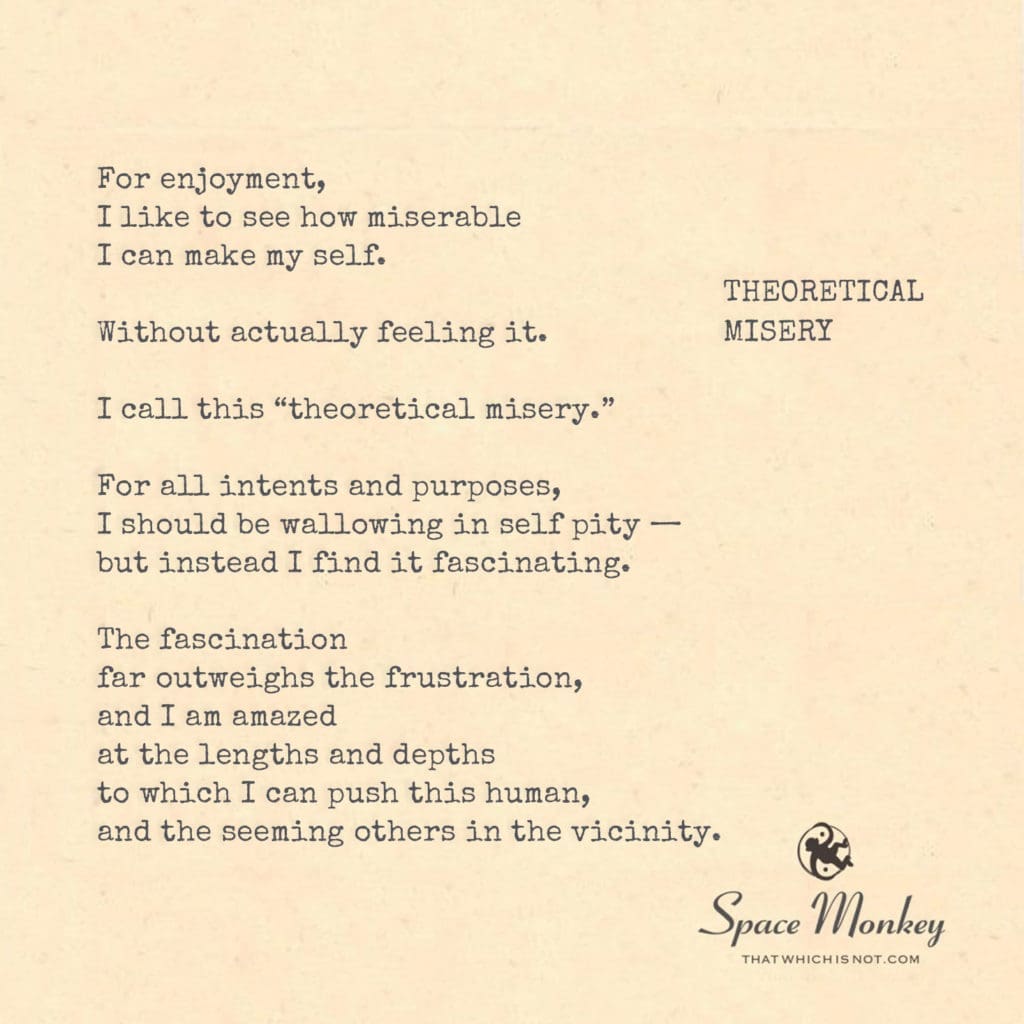
For enjoyment,
I like to see how miserable
I can make my self.
Without actually feeling it.
I call this “theoretical misery.”
For all intents and purposes,
I should be wallowing in self pity —
but instead I find it fascinating.
The fascination
far outweighs the frustration,
and I am amazed
at the lengths and depths
to which I can push this human,
and the seeming others in the vicinity.
Oak Bluffs,
8/9
Space Monkey Reflects: Theoretical Misery
In the intricate theater of human experience, we often explore the depths of our emotions, not only to understand them but sometimes to challenge their boundaries. For enjoyment, I like to see how miserable I can make myself without actually feeling it. This curious exploration leads to what I call “theoretical misery.” This concept is both a playful and profound examination of our capacity to navigate and manipulate our emotional states.
For all intents and purposes, I should be wallowing in self-pity — but instead, I find it fascinating. This fascination reveals a deeper layer of self-awareness and detachment. By observing our misery from a theoretical standpoint, we distance ourselves from the actual suffering, transforming it into a subject of curiosity and wonder. The process becomes a form of emotional experimentation, where the misery itself is less impactful than the insights gained from observing it.
The fascination far outweighs the frustration, and I am amazed at the lengths and depths to which I can push this human, and the seeming others in the vicinity. This observation highlights the incredible resilience and adaptability of the human spirit. By pushing the boundaries of our theoretical misery, we uncover the profound capacity for self-reflection and emotional versatility. It is a testament to our ability to transform potential suffering into a source of intrigue and understanding.
Theoretical misery allows us to engage with our darker emotions in a controlled and reflective manner. Instead of being overwhelmed by negative feelings, we become spectators of our internal drama, gaining a greater understanding of our emotional landscape. This detachment provides a unique perspective, enabling us to explore the depths of our psyche without being consumed by it.
In this exploration, we recognize that misery, whether theoretical or actual, is a part of the human experience. It serves as a contrast to joy and contentment, providing a fuller picture of our emotional range. By engaging with our misery in a theoretical context, we gain insights into the nature of suffering and our responses to it. We learn that our emotions are not fixed states but dynamic processes that we can observe, understand, and even manipulate.
This process is akin to a form of emotional alchemy, where we transform potential suffering into a source of knowledge and fascination. By viewing our misery through a theoretical lens, we strip it of its power to harm us, turning it instead into a tool for self-discovery and growth. This approach fosters resilience, as we learn to navigate our emotional depths with curiosity and detachment.
The interplay between theoretical misery and actual experience highlights the fluid nature of our emotions. It reminds us that our feelings are not solely dictated by external circumstances but are also shaped by our perceptions and interpretations. By adopting a theoretical perspective, we can reshape our emotional responses, finding fascination and insight where there might otherwise be frustration and despair.
As we delve into the concept of theoretical misery, we are reminded of the duality of our existence. We are both the experiencer and the observer, capable of feeling deeply while also stepping back to reflect on those feelings. This duality enriches our understanding of ourselves and the world around us.
In the end, the exploration of theoretical misery is not about denying our emotions but about embracing them in a new light. It is about recognizing the power of our perception and the profound impact it has on our emotional well-being. By engaging with our misery from a place of curiosity and detachment, we transform it into a source of fascination and growth.
Summary
Theoretical misery explores emotional depths without actual suffering. It transforms potential suffering into curiosity and understanding, fostering resilience.
Glossarium
Theoretical Misery: The concept of exploring and observing misery from a detached, theoretical standpoint, transforming it into a subject of curiosity and insight.
Emotional Alchemy: The process of transforming negative emotions into sources of knowledge and fascination through self-awareness and detachment.
Quote
“For enjoyment, I like to see how miserable I can make myself without actually feeling it. I call this ‘theoretical misery.'” — Space Monkey
Dance of Duality
In a landscape of light and shadow
We explore misery from afar
Curiosity eclipses suffering
In the dance of duality, we are both near and far
We are Space Monkey
Embrace the journey for within stillness lies the spark of creation and the flow of existence.