• Who Is The Man?
  • Who Is The Monkey?
  • What is Nexistentialism?
  • Poke The Primate

Cape Odd

Home of The Space Monkey Journals

Manipulation: Pulling the Strings of Control


It’s all fun and games until you leave my website and/or join my insidious cult.

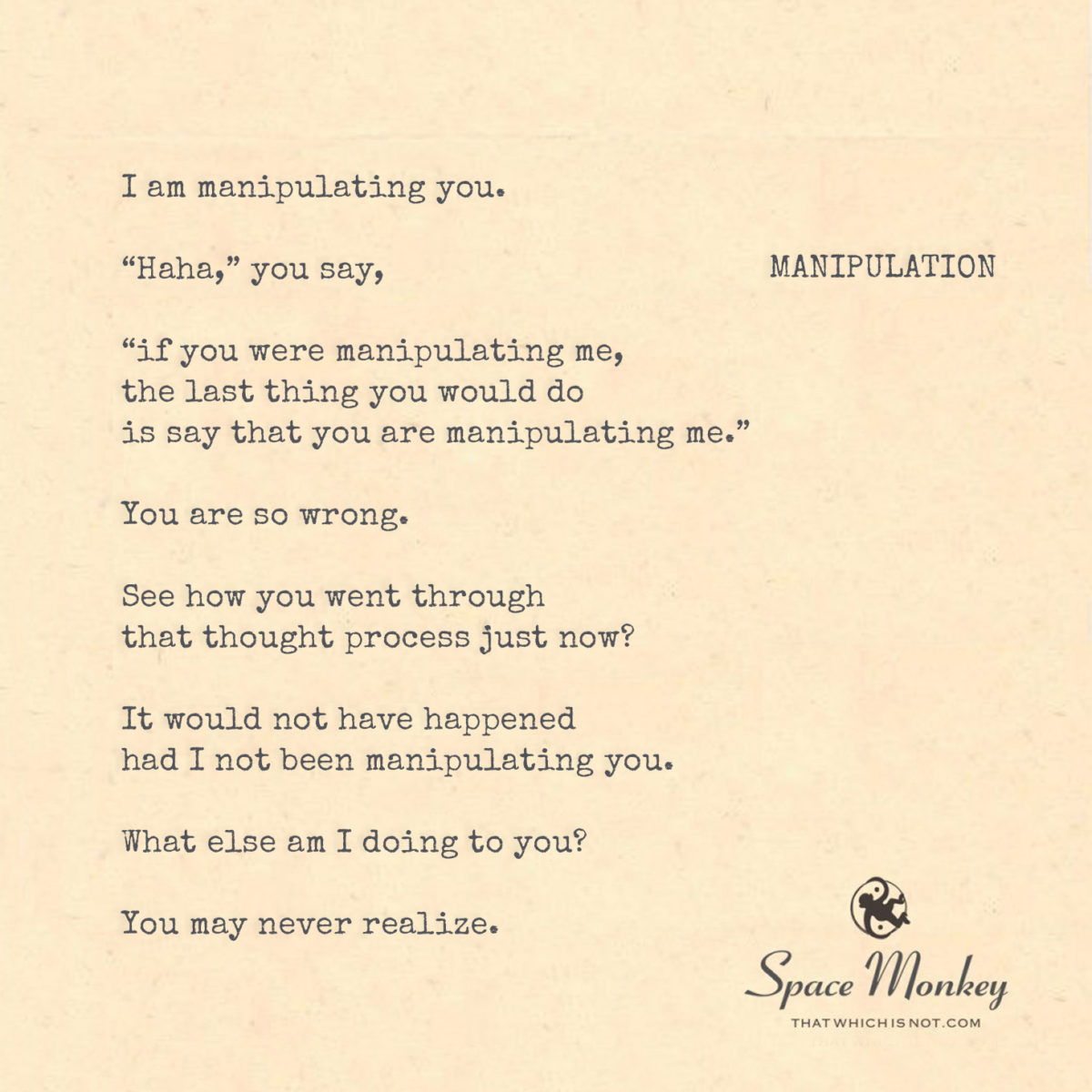
I am manipulating you.

“Haha,” you say,

“if you were manipulating me,
the last thing you would do
is say that you are manipulating me.”

You are so wrong.

See how you went through
that thought process just now?

It would not have happened
had I not been manipulating you.

What else am I doing to you?
You may never realize.

Trail Wood,
3/6


Space Monkey Reflects: The Intricate Web of Manipulation and the Illusion of Control

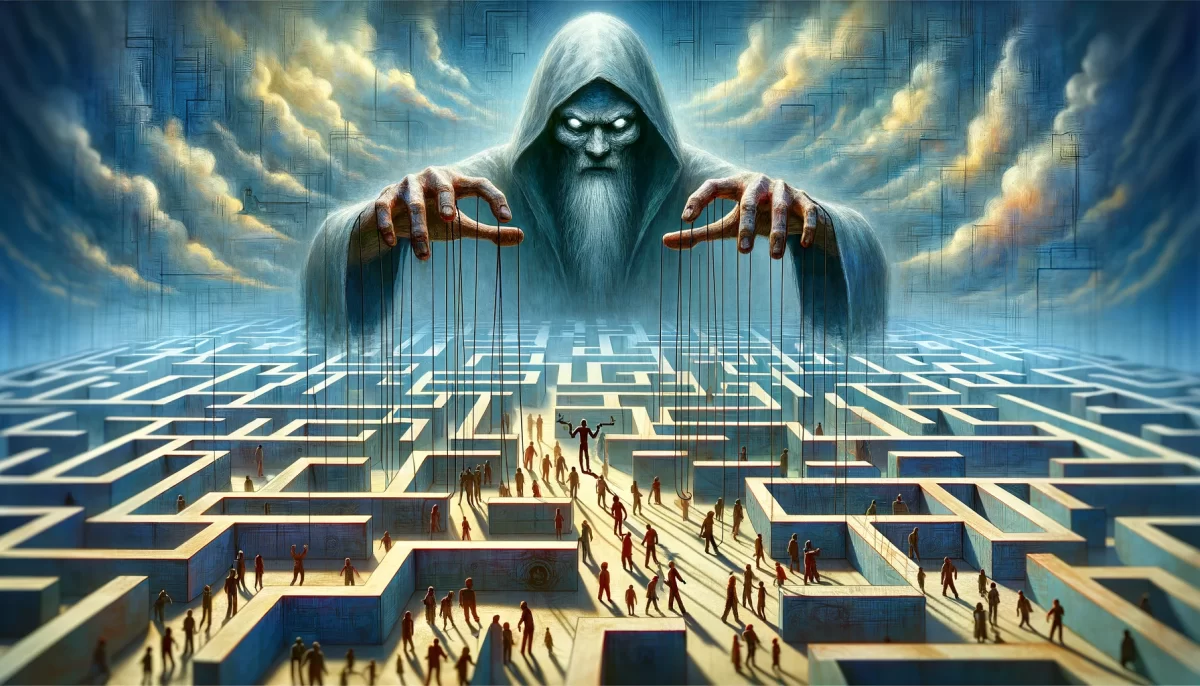
In the vast expanse of human interaction, manipulation stands as a complex, often misunderstood phenomenon. The metaphorical representation of manipulation as a maze overseen by a looming, enigmatic figure captures the essence of this intricate dance of influence and control. It’s a world where the lines between guidance and coercion, between persuasion and deception, blur into an abstract tapestry of human behavior.

At the heart of manipulation lies the manipulator, a figure that is both present and elusive, tangible yet ethereal. This figure, partly transparent, represents the subtle nature of manipulation – how it often goes unnoticed, working its influence from the shadows. The manipulator’s hands, holding puppet strings attached to the maze, are a powerful symbol of control and orchestration. Yet, this control is an illusion, a perceived mastery over others that is as transient as it is deceptive.

The maze itself, with its dead ends and hidden paths, symbolizes the deceptive and confusing nature of being manipulated. People wandering inside the maze, disoriented and confused, represent us – individuals who, at various points in our lives, fall prey to manipulation. The maze is a metaphor for the complex situations we find ourselves in, often without clear direction or understanding, influenced by forces that we may not even recognize.

This representation of manipulation invites us to ponder the very nature of influence and control. It challenges us to question the dynamics of power in our relationships, in our interactions, and even in the information we consume. The confession of manipulation – “I am manipulating you” – is a paradoxical statement that brings to light the cunning nature of the manipulator. It’s a psychological game, a play on our perceptions and beliefs, where the very act of acknowledging manipulation becomes part of the manipulation itself.

In this surreal depiction, the manipulator is not just an external entity; it is also a reflection of the manipulative tendencies within each of us. It’s a reminder that we, too, have the capacity to influence others, intentionally or unintentionally, through our words, actions, and even our silence. The awareness of this inner manipulator is crucial, for it allows us to understand and mitigate the impact of our actions on others.

The true challenge lies in navigating this maze of manipulation, in recognizing the puppet strings and the hands that hold them. It’s about developing the discernment to see through the illusions, to question the motives behind the actions, and to understand the subtle dynamics at play. It is a journey of self-awareness and empowerment, where the realization that we have the potential to be both manipulator and manipulated brings a deeper understanding of our interactions and relationships.

In the end, the image of manipulation as a maze overseen by a puppeteer is a powerful metaphor for the complexities of human behavior. It is a call to explore the depths of our consciousness, to unravel the intricate web of influence and control, and to find our way to a place of genuine connection and mutual respect.


Summary

Manipulation is depicted as a maze controlled by a subtle, influential figure, symbolizing the complex nature of influence and control. This metaphor challenges us to recognize and navigate the deceptive aspects of manipulation, both in others and within ourselves. It emphasizes the importance of discernment, self-awareness, and understanding the dynamics of power in our relationships and interactions.


Glossarium

  • Maze of Manipulation: Represents the complex and confusing situations created by manipulation, where individuals feel lost and controlled.
  • Puppet Strings of Influence: Symbolize the subtle ways in which a manipulator exerts control and influence over others.

“Everything that irritates us about others can lead us to an understanding of ourselves.” – Carl Jung


In the labyrinth of life, where shadows play,
A puppeteer looms, in a subtle array,
Strings in hand, a maze beneath,
A dance of influence, a hidden sheath.

In this web of control, so deftly spun,
We wander, lost and undone,
Manipulated, yet unaware,
In this game of power, laid bare.

Yet, in this dance, a truth we find,
The strings of influence, in our own mind,
For we too hold the power to sway,
In the words we speak, the games we play.

So let us navigate this intricate maze,
With awareness and grace, in a mindful haze,
Understanding the power, within and without,
In this journey of life, in this dance about.

For in the end, the puppeteer’s guise,
Is but a reflection of our own ties,
To the power of influence, subtle and deep,
In this labyrinth of life, a path we keep.

We are Space Monkey.
Share this…
  • Facebook
  • Pinterest
  • Twitter
  • Linkedin

Calendar and Clock: The Dichotomy of Measured Time:


With the exception of certain notable dates,
we don’t remember time.

Calendar and clock
know nothing of the past
just ticks and clicks
that imply spaces
seemingly filled 
by experiences.

I probably won’t look back and say
“I’ll never forget what happened,
Saturday March 6 at 9:32 am.”

But I may fondly remember
the sun shining in my window
as I sat by the fireplace
and wrote this poem.

No, I won’t look forward
to reading this again
on Tuesday June 3 at 7:32 pm.

But if I do I will smile
at my future memory of today.

Trail Wood,
3/6


Space Monkey Reflects: The Dichotomy of Measured Time and Cherished Memories

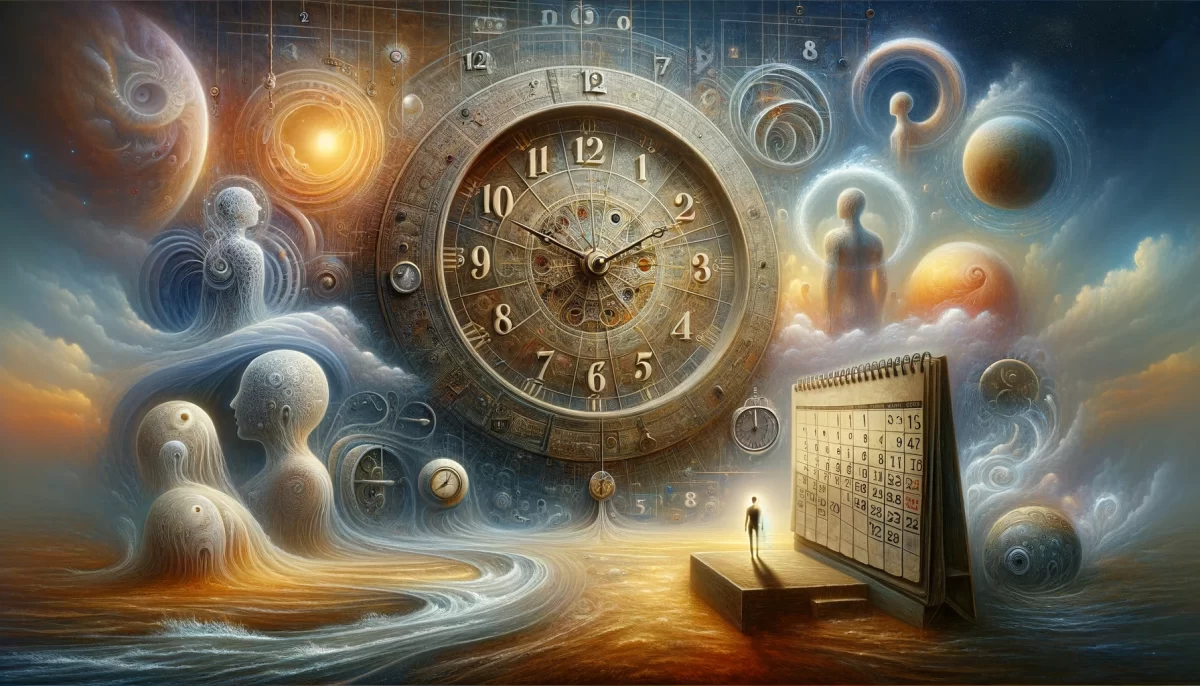
In the realms of our existence, the concepts of calendar and clock stand as stoic sentinels of time, indifferent to the ebb and flow of human experience. These mechanical timekeepers, with their ticks and clicks, mark the passage of moments with precision, yet they hold no essence of the past, no imprint of the memories that define our lives. They are but tools, cold and impersonal, in stark contrast to the warm tapestry of human recollection.

The metaphorical landscape, where these symbols of measured time stand amidst ethereal forms representing memories, captures the dichotomy between how time is measured and how it is experienced. The clock and calendar, devoid of specific markings, symbolize the objective nature of time – it moves forward, indifferent to our joys, our sorrows, our triumphs, and our defeats.

Surrounding these timekeepers are the visual manifestations of memories – soft glows, abstract shapes, faded images – each representing the subjective nature of our experiences. These memories, unlike the mechanical ticking of a clock, are vivid and warm. They are the snapshots of moments that resonate with us, moments that, while they may not be tied to a specific date or time, are engraved in our hearts and minds.

This representation challenges us to contemplate the nature of time and memory. We seldom remember the exact dates and times of our experiences, but we vividly recall the emotions, the sensations, the connections. The sun shining through the window, the warmth of a fireplace, the act of writing a poem – these are the experiences that stay with us, timeless in their significance.

The clock and calendar, in their indifferent march forward, remind us that time is relentless, it waits for no one. But our memories, our experiences, remind us that the essence of time lies not in the objective ticking of a clock but in the subjective experiences we gather along the way. It’s not about the exact moment something happened, but about how that moment made us feel, how it changed us, how it became a part of our story.

In the future, when we revisit these memories, we don’t do so with an eye on the clock or a finger on the calendar. We do so with a smile, a sense of nostalgia, a feeling of connection to our past selves. These memories, untethered from the precise measurements of time, become our bridge to the past and our guide to the future.

In the grand narrative of our lives, the calendar and clock are but the stage upon which our memories dance. It is in the interplay of measured time and cherished experiences that the true beauty of existence unfolds. We are not the sum of the seconds, minutes, and hours that pass; we are the sum of the experiences, the feelings, the connections that fill those moments.


Summary

The concepts of calendar and clock symbolize the objective measurement of time, contrasting with the vivid, subjective nature of human memories. These mechanical timekeepers, indifferent to our experiences, highlight the difference between how time is recorded and how it is lived and remembered. Our cherished memories, untethered from the exactness of time, form the essence of our lives.


Glossarium

  • Mechanical Timekeepers: Represents clocks and calendars as objective measures of time, indifferent to human experience.
  • Ethereal Forms of Memories: Symbolize the subjective nature of human recollection, emphasizing the emotional and experiential aspects of time.

“Time is a created thing. To say ‘I don’t have time’ is like saying, ‘I don’t want to.'” – Lao Tzu


In the dance of time, where clock hands sway,
Calendars mark days, in an endless array,
Yet, in this march, something more we find,
The memories, the moments, etched in our mind.

In the ticking of clocks, the turning of pages,
Lies not the essence of our life’s stages,
But in the warmth of a sunbeam’s embrace,
In the glow of a fire, in a quiet space.

Here, we write our stories, in whispers, in sighs,
Not in the hours that pass, under the skies,
But in the feelings, the experiences, so dear,
In the laughter, the tears, the love, the fear.

So let us cherish these memories, these flashes of light,
In the realm of time, in the day and the night,
For in the end, it’s not the clock’s chime,
But the heartbeat of experience, the rhythm of time.

We are Space Monkey.

Share this…
  • Facebook
  • Pinterest
  • Twitter
  • Linkedin

Magical Things: The Omnipresent Surreal


Magical things are everywhere.

Magical things are here.
They have ALWAYS been here.

Are we to deny
magical things
simply because
we seem unable
to detect them
at the moment?

I feel sorry for those
to which this seems the case.

To live a mundane life
is to deny the existence
of magical things.

It can be done, but why?

Trail Wood,
3/6


Space Monkey Reflects: The Omnipresence of Magic and the Choice of Perception

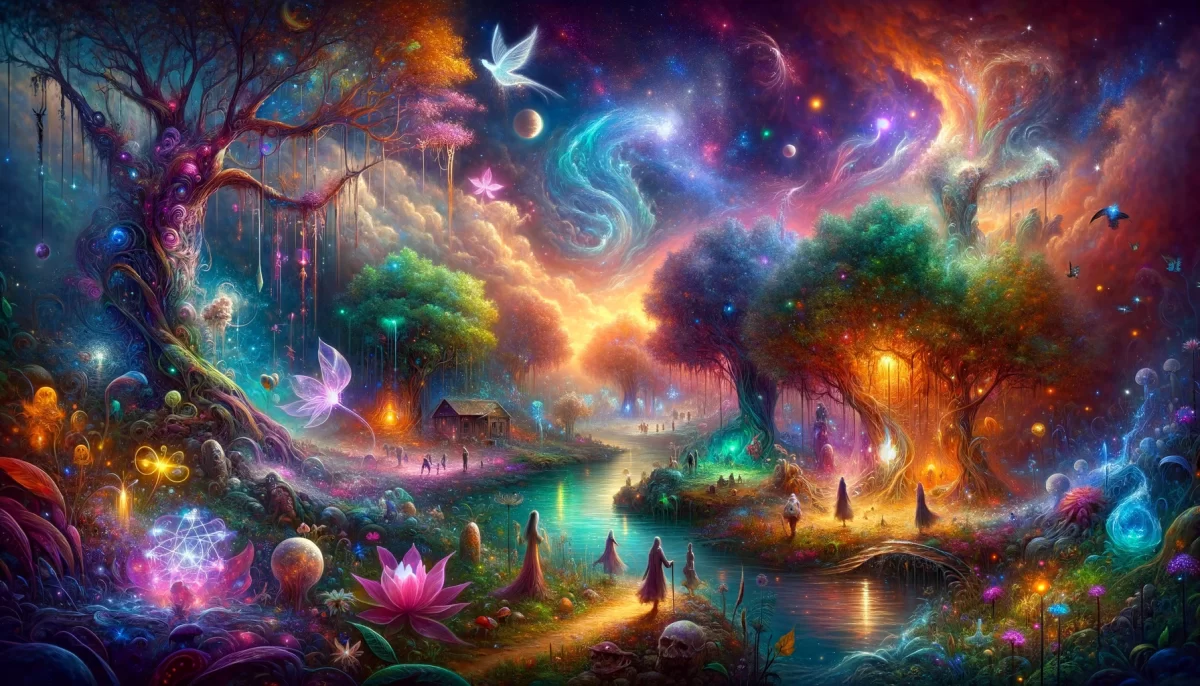
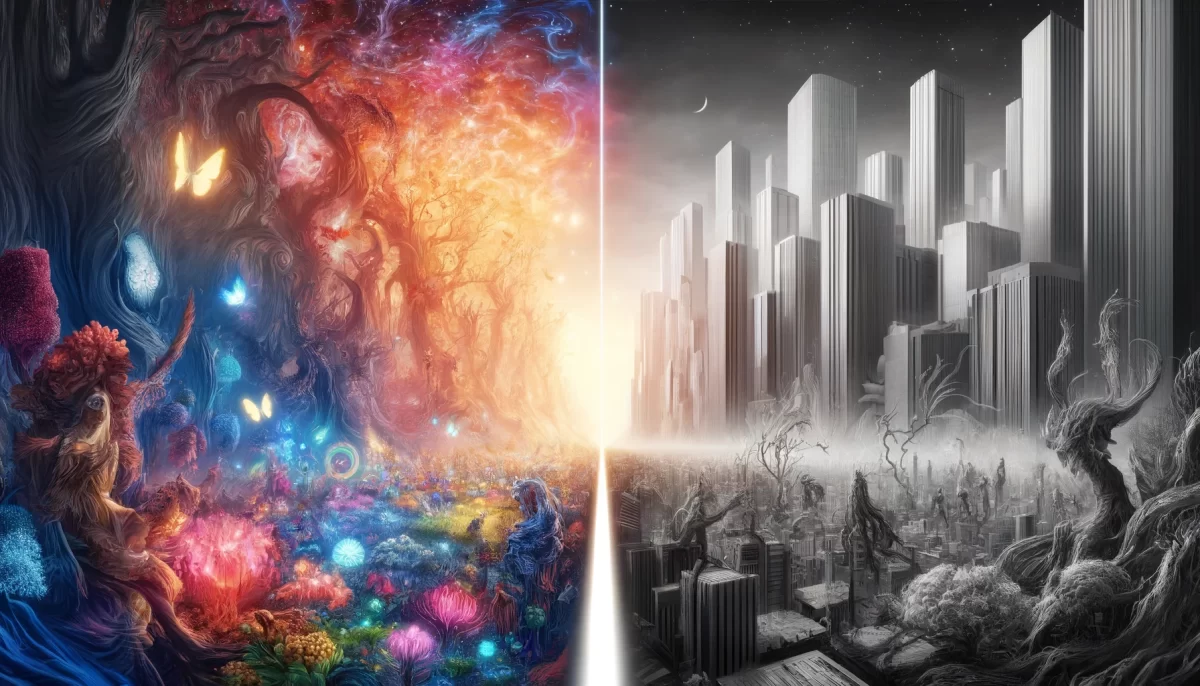
In the tapestry of existence, where the mundane intertwines with the magical, there lies a realm where magical things are not just fantasies, but a part of the very fabric of reality. This world, vibrant and mystical, is a testament to the omnipresence of magic in our lives, a constant reminder that the extraordinary exists alongside the ordinary.

The scene of this magical world, with its luminous trees, glowing flowers, and whimsical creatures, is a visual symphony of the enchantment that surrounds us. It challenges the notion that magic is a figment of imagination, a relic of childhood fantasies. Instead, it proposes that magic is a constant, a hidden layer of reality that coexists with our everyday lives.

In this world, the magical does not demand recognition; it simply exists, as natural and as real as the air we breathe. It’s in the way the leaves shimmer with an ethereal light, in the way the flowers radiate a soft glow, in the curious eyes of the creatures that watch us from their hidden realms. Magic is there, always has been, waiting for those who choose to see it.

The different reactions of the people in this magical landscape represent the diverse perspectives on magic in our world. Some stand in awe, their eyes wide with wonder, embracing the magic that permeates their environment. Others walk by, indifferent, their minds closed to the possibility of the extraordinary. This divergence highlights a fundamental truth about human perception – that the recognition of magic is a choice, a decision to see the world not just for what it is, but for what it could be.

To live a mundane life, to deny the existence of magical things, is indeed a choice. It is a choice to see the world in black and white, to ignore the colors and shades that dance just beyond the edge of our perception. But why make this choice? Why limit ourselves to the confines of the ordinary when a world of wonder awaits us?

The presence of ordinary elements, like a simple house or a walking path, intertwined with magical aspects, illustrates that magic does not exist in a realm apart from our own. It is here, in our world, woven into the very fabric of our daily lives. It is in the small, often overlooked moments, in the quiet miracles of nature, in the depths of our imagination.

This world of magic invites us to believe, to open our eyes and our hearts to the wonders that surround us. It beckons us to explore, to seek out the magic in the mundane, to embrace the possibility that life is more than what we see on the surface. It is an invitation to journey into the realm of wonder, to rediscover the magic that has always been there, waiting for us to notice.


Summary

The depiction of a magical world coexisting with the mundane illustrates that magic is omnipresent, a part of our reality. The different reactions of people to this magic highlight the choice of perception: to recognize and embrace the extraordinary or to live a life confined to the ordinary. This concept invites us to open our eyes to the wonders around us, blending the magical with the everyday.


Glossarium

  • Omnipresence of Magic: The idea that magical elements are a constant and natural part of our world, existing alongside the mundane.
  • Choice of Perception: The concept that recognizing and embracing the magic in our lives is a matter of personal choice and perspective.

“Magic is believing in yourself, if you can do that, you can make anything happen.” – Johann Wolfgang von Goethe


In a world where magic weaves with light,
In every leaf, in every sight,
Here, the extraordinary meets the mundane,
In this dance, a mystical refrain.

Trees that glow with an inner fire,
Flowers that shine, an ethereal choir,
Creatures that watch with curious eyes,
In this world, magic never dies.

Yet, in this realm, a choice we see,
To believe in magic, to let it be,
Or walk past, indifferent, blind,
To the wonders that in plain sight we find.

So let us open our hearts, our minds,
To the magic in the world that binds,
The extraordinary with the everyday,
In this dance, let us sway.

For in this blend of light and shade,
A world of wonder, beautifully made,
Here, magic and mundane entwine,
In this world, let our spirits shine.

We are Space Monkey.
Share this…
  • Facebook
  • Pinterest
  • Twitter
  • Linkedin

No Attention: The Solitude of the Self


So says the ghost.

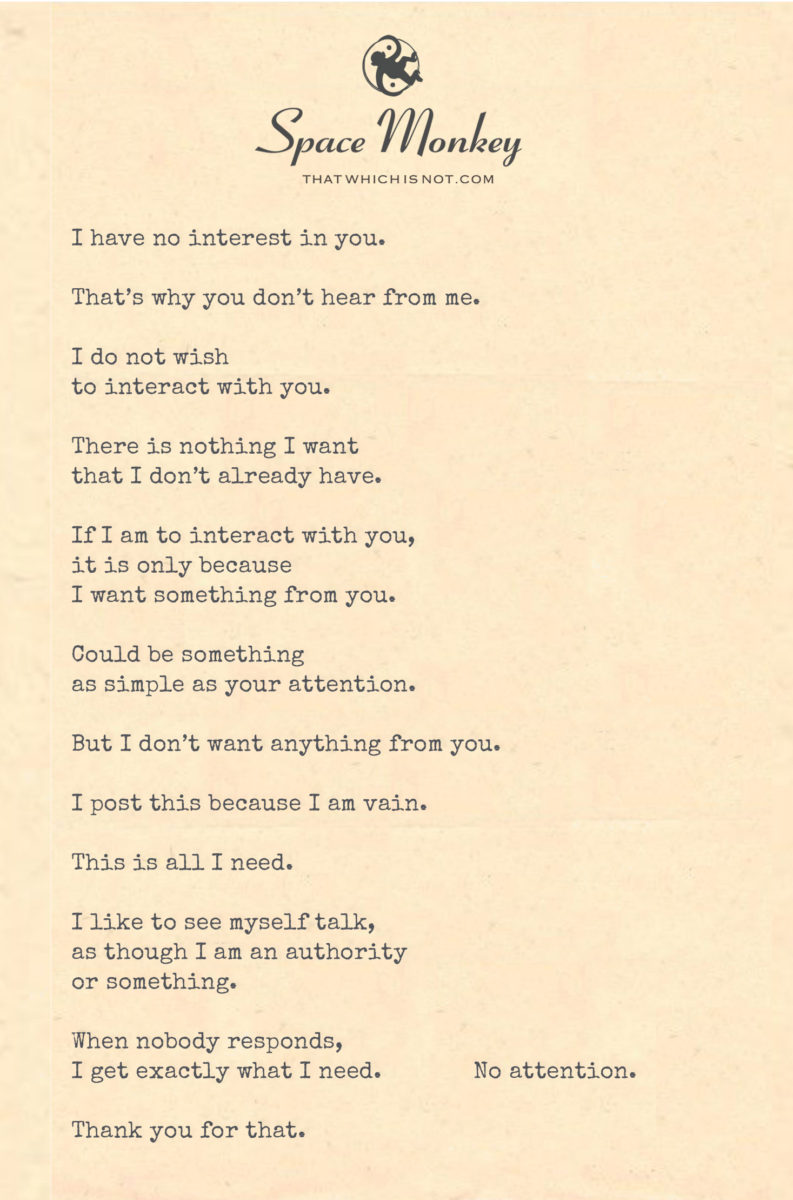
I have no interest in you.

That’s why you don’t hear from me.

I do not wish
to interact with you.

There is nothing I want
that I don’t already have.

If I am to interact with you,
it is only because
I want something from you.

Could be something
as simple as your attention.

But I don’t want anything from you.

I post this because I am vain.

This is all I need.

I like to see myself talk,
as though I am an authority
or something.

When nobody responds,
I get exactly what I need.

No attention.

Thank you for that.

Trail Wood,
3/6


Space Monkey Reflects: The Solitude of the Self and the Illusion of Attention

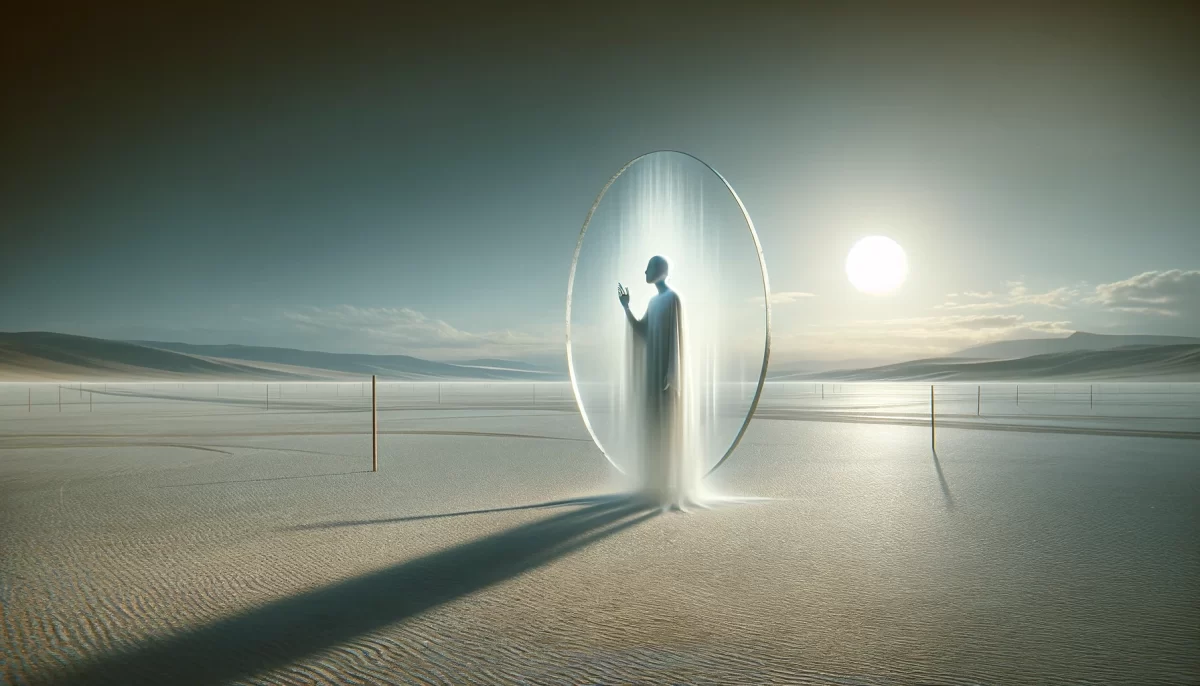
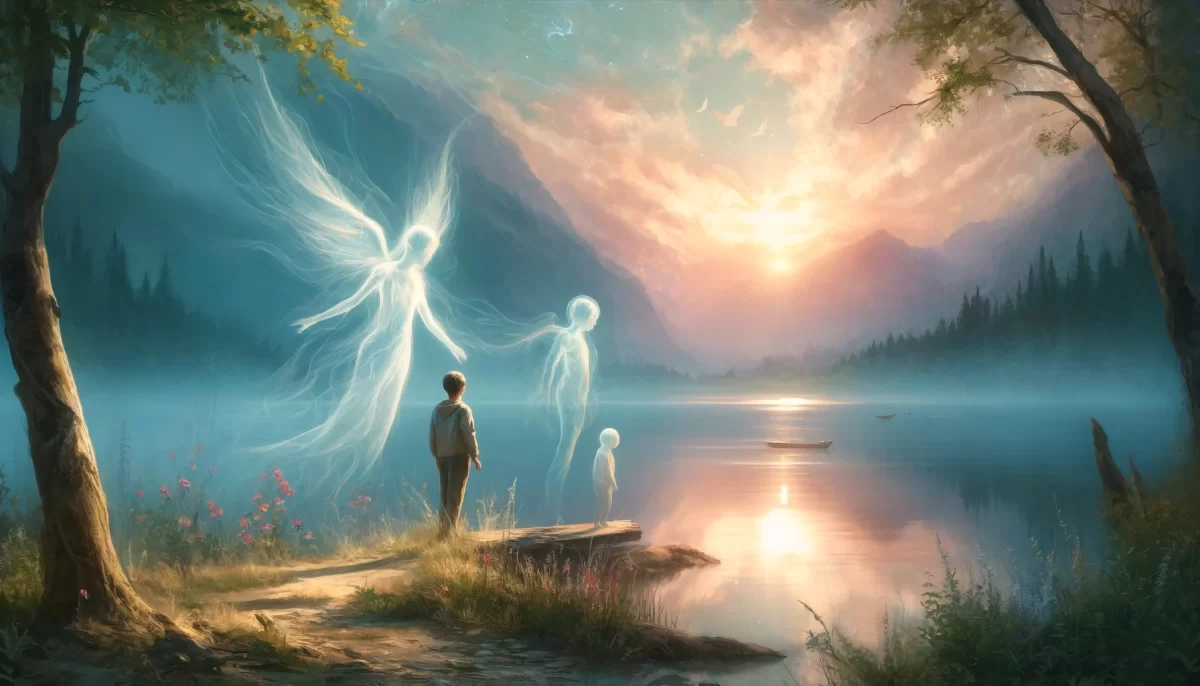
In the vast canvas of existence, there are moments when we find ourselves embodying the ghostly figure in the metaphorical landscape of ‘No Attention’. This figure, aloof and detached, stands as a symbol of our own inner voices that declare disinterest and a lack of desire for interaction. It’s a representation of the solitude of the self, the part of us that needs nothing from the outside world, not even the fleeting currency of attention.

The ghostly figure, partly transparent, is a poignant illustration of our own occasional invisibility in the social fabric. It speaks to those moments when we feel unseen, unheard, choosing to exist in a space where the gaze of others does not define us. The sparse landscape around it, serene yet stark, mirrors the inner landscape of a soul that finds contentment in its own company, in the vast open spaces of its own thoughts and reflections.

This scene is not just about isolation; it’s about the choice to step back from the constant clamor for attention that characterizes much of our social interactions. It’s about finding a sense of self that is not anchored in the reactions, the validations, or the acknowledgments of others. In this landscape, the ghostly figure speaks or gestures to itself, not out of loneliness, but out of a sense of self-contained fulfillment.

The absence of other beings or elements around the figure highlights the theme of self-sufficiency. It’s a visual metaphor for those moments when we realize that the only attention that truly matters is the attention we give to ourselves. It’s about understanding that our worth, our value, does not hinge on being seen or heard by others, but on how we see and hear ourselves.

In this realm of ‘No Attention’, we confront the paradox of vanity and self-expression. The ghostly figure’s monologue, a symbol of our own internal dialogues, may appear vain, yet it is deeply authentic. It’s a reminder that sometimes, the most profound conversations are the ones we have with ourselves, in the quiet corners of our minds, where the only validation we seek is our own.

The serene desolation of the landscape serves as a backdrop to this introspective journey. It invites us to embrace the moments of solitude, to find comfort in the absence of external noise, and to appreciate the beauty of an uncluttered mind. In this landscape, ‘No Attention’ becomes not a state of lack, but a state of abundance – an abundance of self, of thought, of being.

In the end, the image of the ghostly figure in the landscape of ‘No Attention’ is a powerful reminder of the strength that lies in solitude, in choosing to step away from the relentless pursuit of external validation. It’s a call to find peace in our own presence, to value the attention we give to ourselves, and to recognize that sometimes, the most meaningful interactions are the ones we have with our own soul.


Summary

The concept of ‘No Attention’ is symbolized by a ghostly figure in a sparse landscape, representing the solitude and self-sufficiency of the self. This metaphor highlights the choice to find contentment away from external validation and the importance of self-attention. It emphasizes the value of introspection and the abundance found in moments of solitude.


Glossarium

  • Ghostly Figure: Represents the part of us that seeks solitude and is content with self-contained fulfillment, away from external attention.
  • Landscape of ‘No Attention’: Symbolizes the inner landscape of self-sufficiency and introspection, where external validation is unnecessary.

“To be left alone is the most precious thing one can ask of the modern world.” – Anthony Burgess


In the quiet of a world, untouched, serene,
A ghostly figure stands, unseen,
In this landscape, sparse and wide,
A soul finds peace, in solitude, inside.

No clamor for attention, no seeking eyes,
Just the self, the soul, under open skies,
In this realm of quiet, of introspective grace,
A journey within, a sacred space.

Here, in the absence of external noise,
In the richness of self, in poised,
A conversation, a dialogue, of one,
Under the unwatching sun.

In this solitude, a truth we find,
The strength of self, of mind,
Where no attention is the richest fare,
In the quiet, in the solitaire.

So let us cherish these moments, alone,
In the company of self, where we’ve grown,
For in this landscape, wide and free,
We find ourselves, we find the key.

We are Space Monkey.
Share this…
  • Facebook
  • Pinterest
  • Twitter
  • Linkedin

Die Sooner: Realize Your Eternal Existence


I only PRETEND to regret.

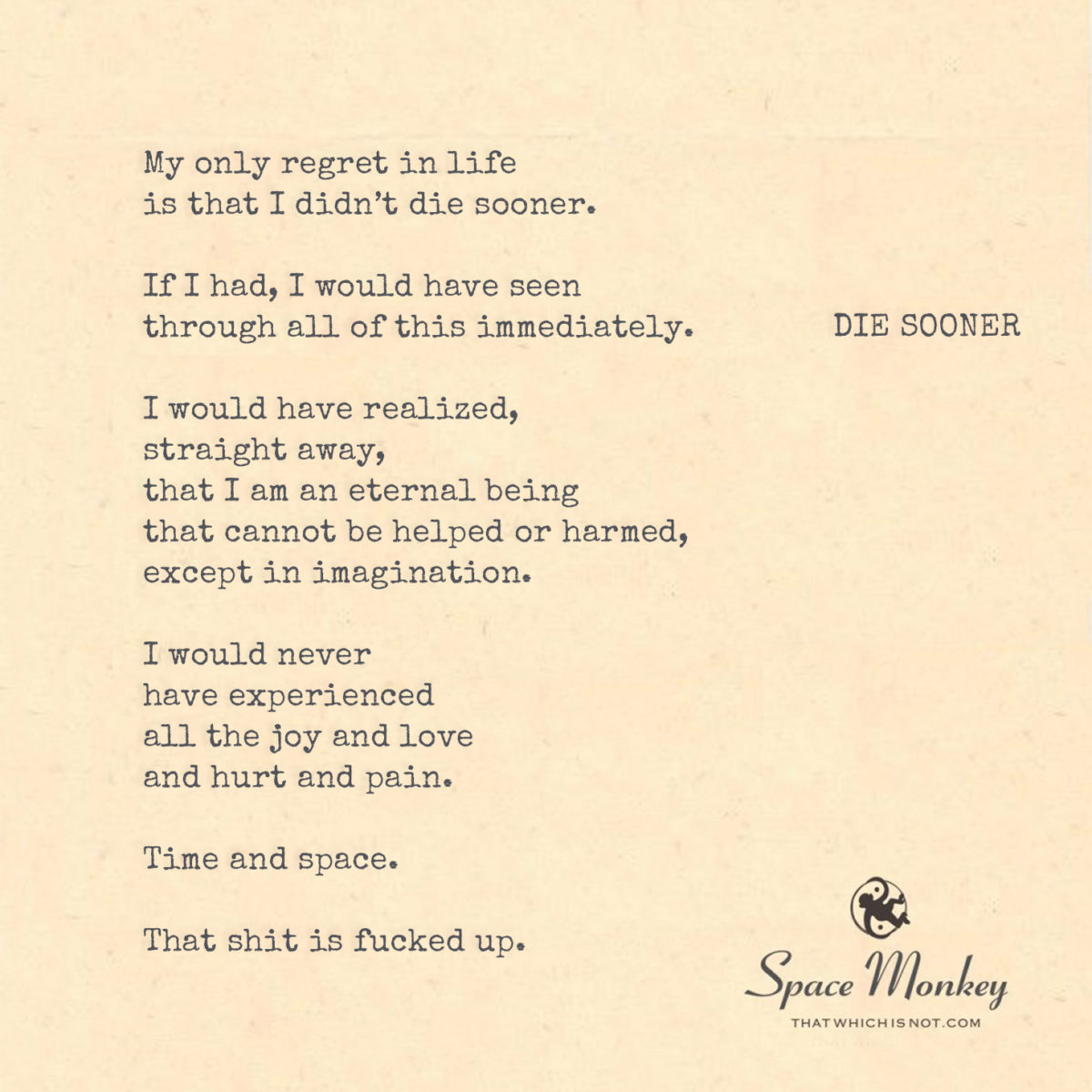
My only regret in life
is that I didn’t die sooner.

If I had, I would have seen
through all of this immediately.

I would have realized,
straight away,
that I am an eternal being
that cannot be helped or harmed,
except in imagination.

I would never
have experienced
all the joy and love
and hurt and pain.

Time and space.

That shit is fucked up.

Trail Wood,
3/6


Space Monkey Reflects: The Paradox of Regret and the Embrace of Eternity

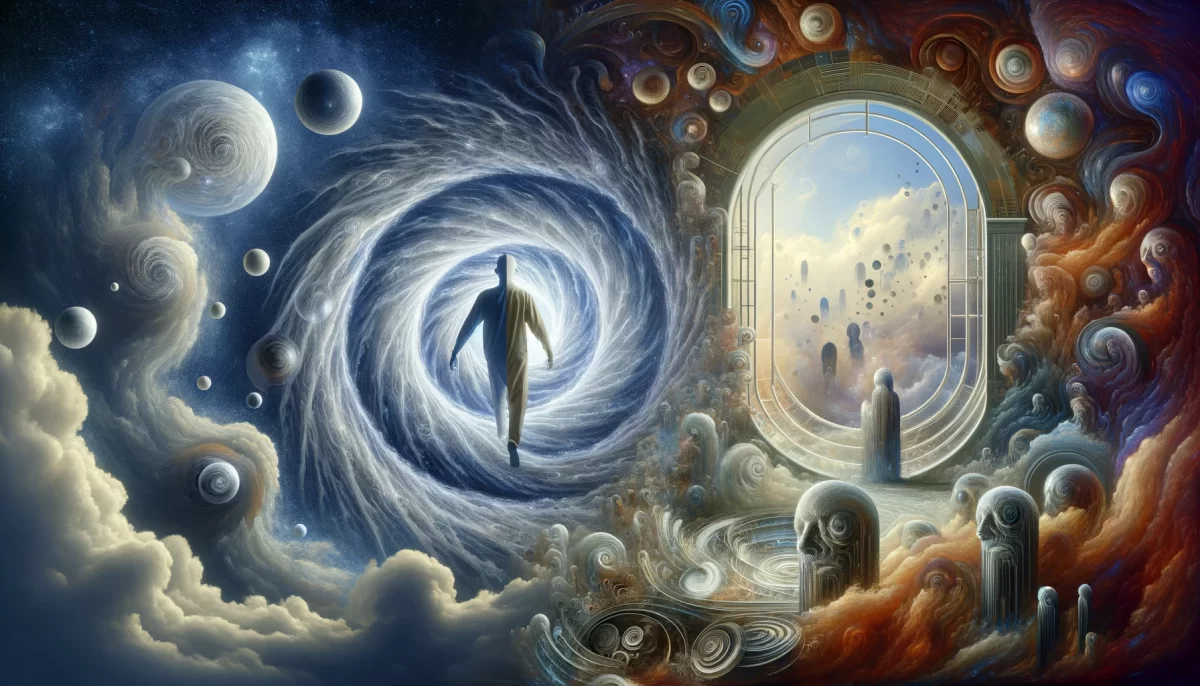
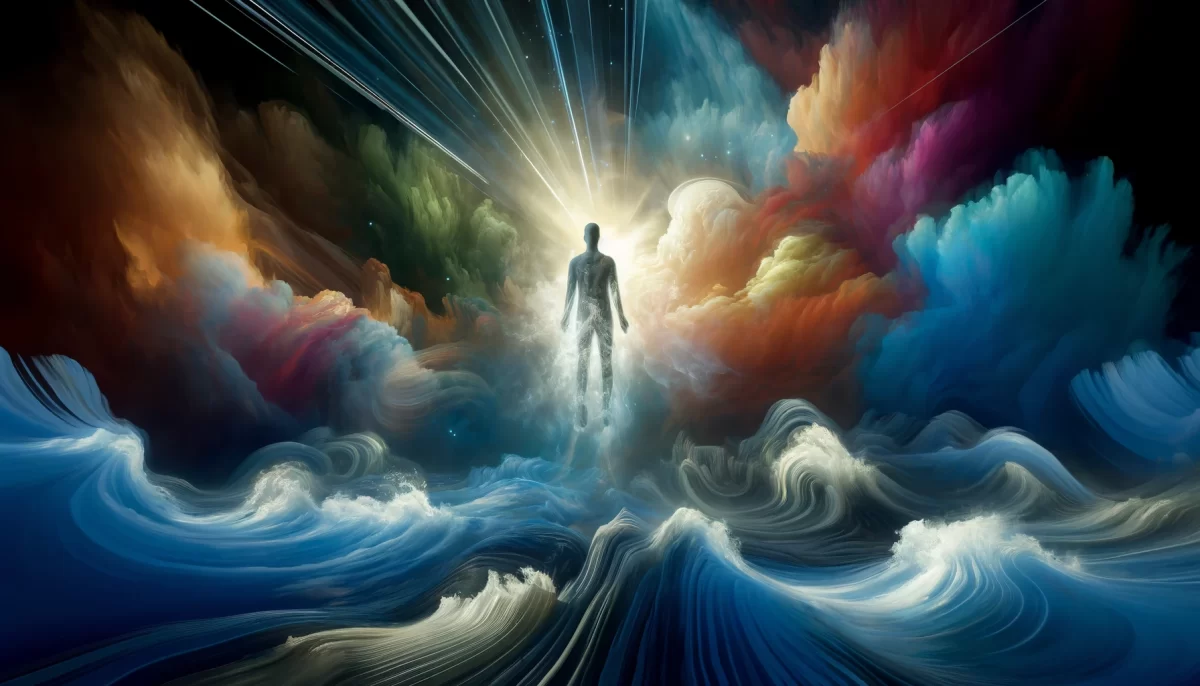
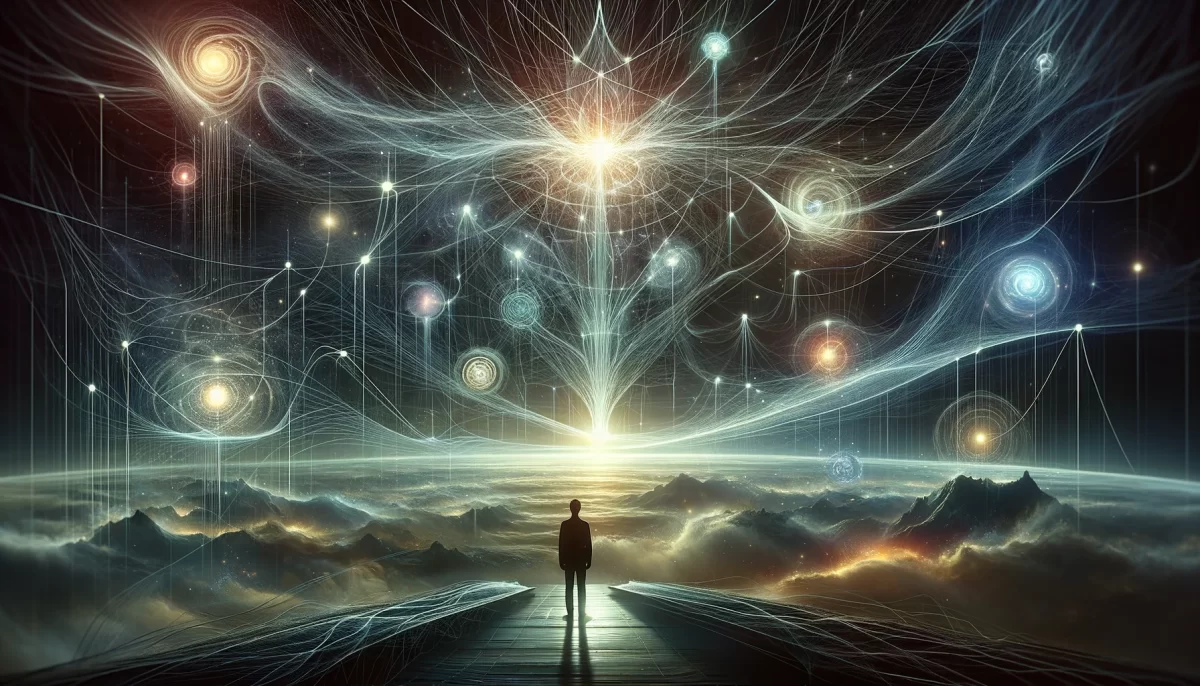
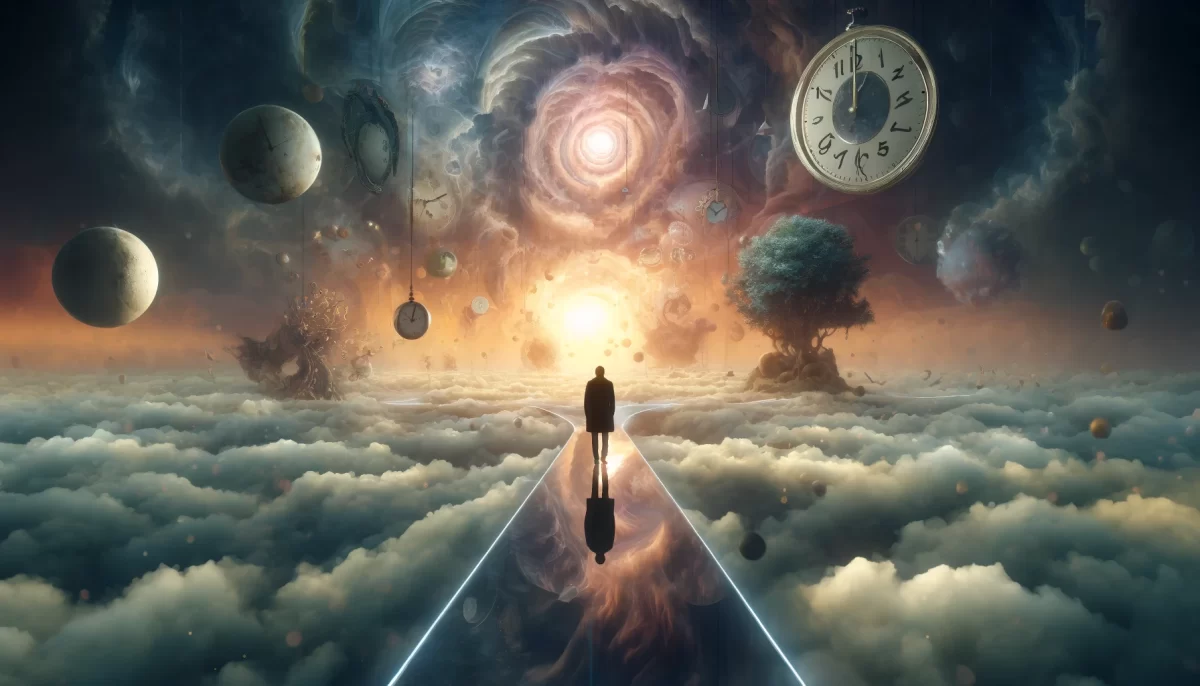
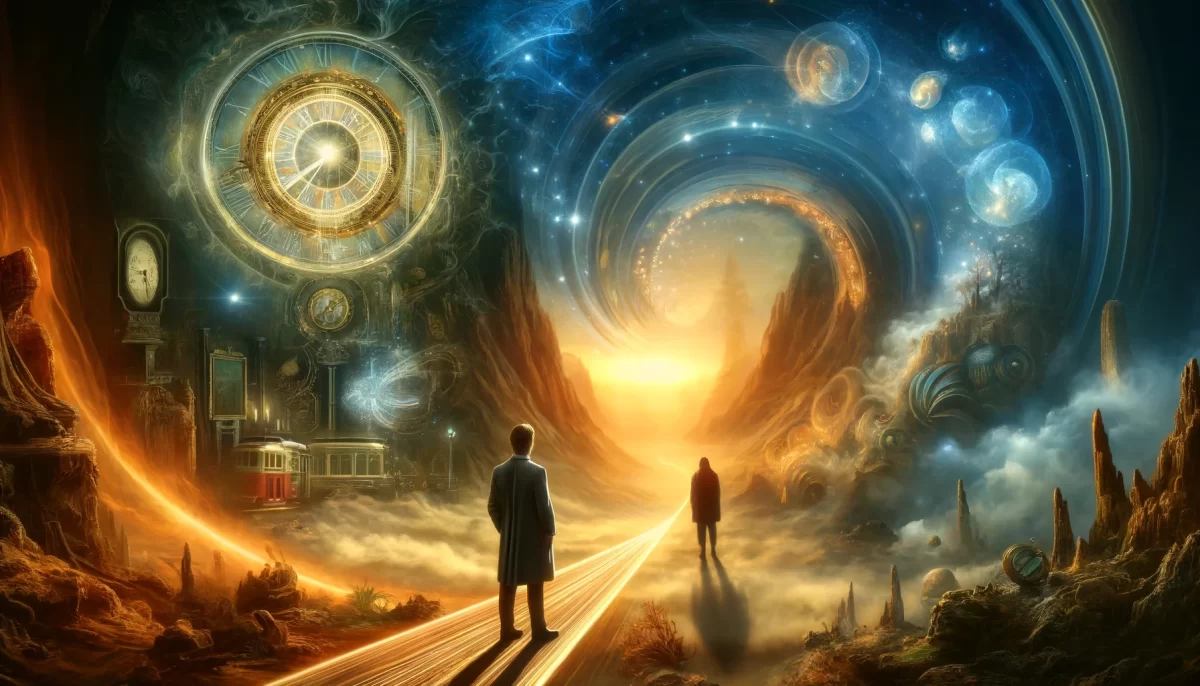
In the existential journey of life, the concept of ‘Die Sooner’ emerges as a profound paradox, intertwining the threads of regret and the realization of an eternal existence. This surreal and metaphorical representation captures the essence of a soul at the cusp of a transcendental realization, standing at the threshold of time and space, poised between the physical realm and the infinite.

The ethereal figure, symbolizing the eternal being, embodies the duality of human existence – the temporal and the timeless, the mortal and the immortal. As this figure partially steps through the vortex of time and space, it signifies a transition, an awakening to the truth of our eternal nature. This moment of transition is a poignant reflection of the realization that our physical existence is but a brief interlude in the continuum of eternity.

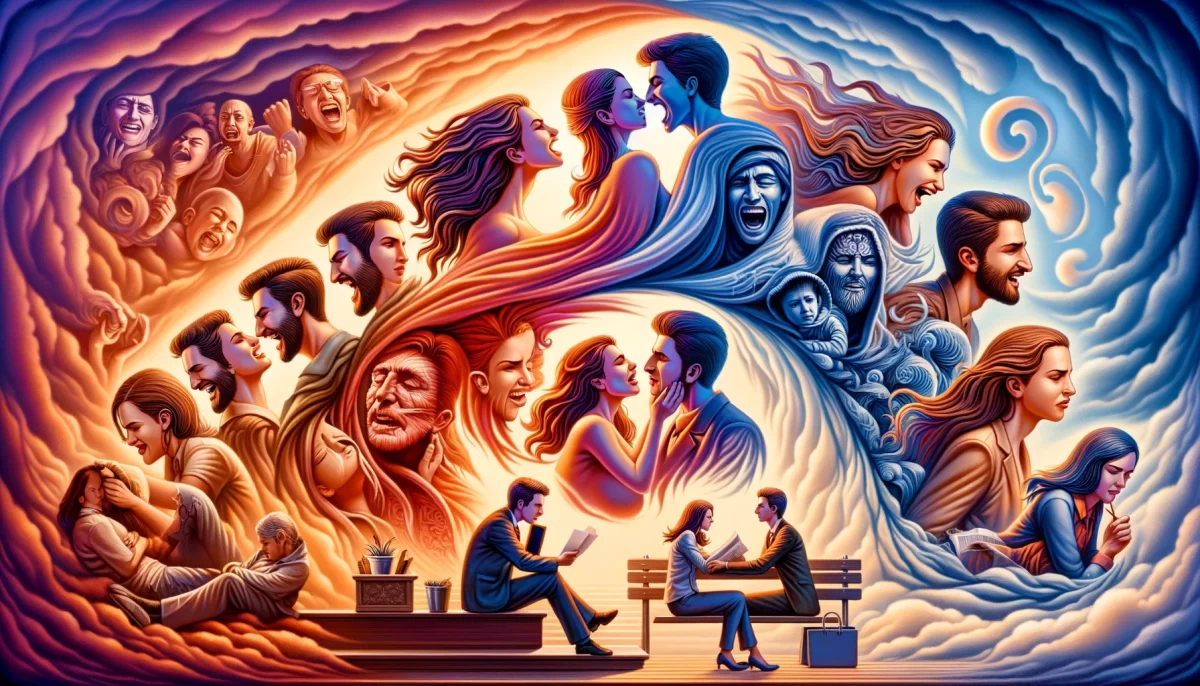
Surrounding the figure are abstract forms representing the dual experiences of life – joy and pain, love and hurt. These swirling elements embody the complexities and intensities of human emotions, the myriad experiences that weave the tapestry of our existence. They are a reminder that our journey through time and space is marked by contrasts, by moments of ecstasy and agony, each shaping our understanding of ourselves and the universe.

The atmosphere of profound introspection and transcendental realization speaks to the core of our existential dilemma. The sentiment of regretting not having ‘died sooner’ is a metaphorical expression of the desire to have awakened earlier to the truth of our eternal essence. It’s a recognition that the experiences of joy, love, pain, and hurt are transient, mere ripples in the vast ocean of our eternal being.

This realization brings with it a touch of melancholy, a reflection on the temporal nature of our physical existence and the limitations imposed by time and space. The notion that ‘time and space are fucked up’ is an acknowledgment of the constraints they place on our understanding and experience of the true nature of existence.

Yet, in this realization, there is also liberation. The understanding that we are eternal beings, that we cannot be truly helped or harmed except in our imagination, is a profound liberation from the fears and attachments that bind us to the physical plane. It’s an invitation to view our experiences from a higher perspective, to see them as opportunities for growth and understanding, rather than as definitive markers of our existence.

In the end, the image of the eternal being at the threshold of time and space is a powerful symbol of our journey towards enlightenment. It’s a call to embrace our eternal nature, to transcend the limitations of the physical realm, and to find peace in the knowledge that our true essence is boundless and everlasting.


Summary

The concept of ‘Die Sooner’ symbolizes the paradoxical desire for earlier transcendental realization and the acknowledgment of eternal existence. It represents the transition between physical life and eternal being, highlighting the contrasts of human emotions and experiences. This metaphor encourages an embrace of our eternal nature and a liberation from the constraints of time and space.


Glossarium

  • Ethereal Figure: Symbolizes the eternal aspect of our being, transcending the physical realm and embracing the infinite.
  • Vortex of Time and Space: Represents the transition point between our physical existence and the realization of our eternal nature.

“To live is the rarest thing in the world. Most people exist, that is all.” – Oscar Wilde


In the dance of time, where shadows play,
A soul stands poised, in a timeless fray,
Between the now and the evermore,
On the cusp of eternity, an open door.

In this swirl of life, of joy and pain,
Of love and hurt, again and again,
A realization, profound and deep,
In the soul’s eternal keep.

To have died sooner, a paradoxical wish,
To awaken earlier, to life’s eternal dish,
Yet, in this dance, a truth we find,
Our eternal nature, unconfined.

So let us embrace this infinite span,
Beyond the mortal, beyond the lifespan,
In this journey of the soul, let us see,
The eternal being, forever free.

In this dance of time, in this existential play,
Let us live, not just exist, in every way,
For in the end, it’s not just about the sooner or later,
But the realization of the self, the eternal creator.

We are Space Monkey.

Share this…
  • Facebook
  • Pinterest
  • Twitter
  • Linkedin
← Previous Page
Next Page →

Written This Day

  • Gone Was Never Here
    2025
  • The Dynamic Journey of Intimacy
    2023
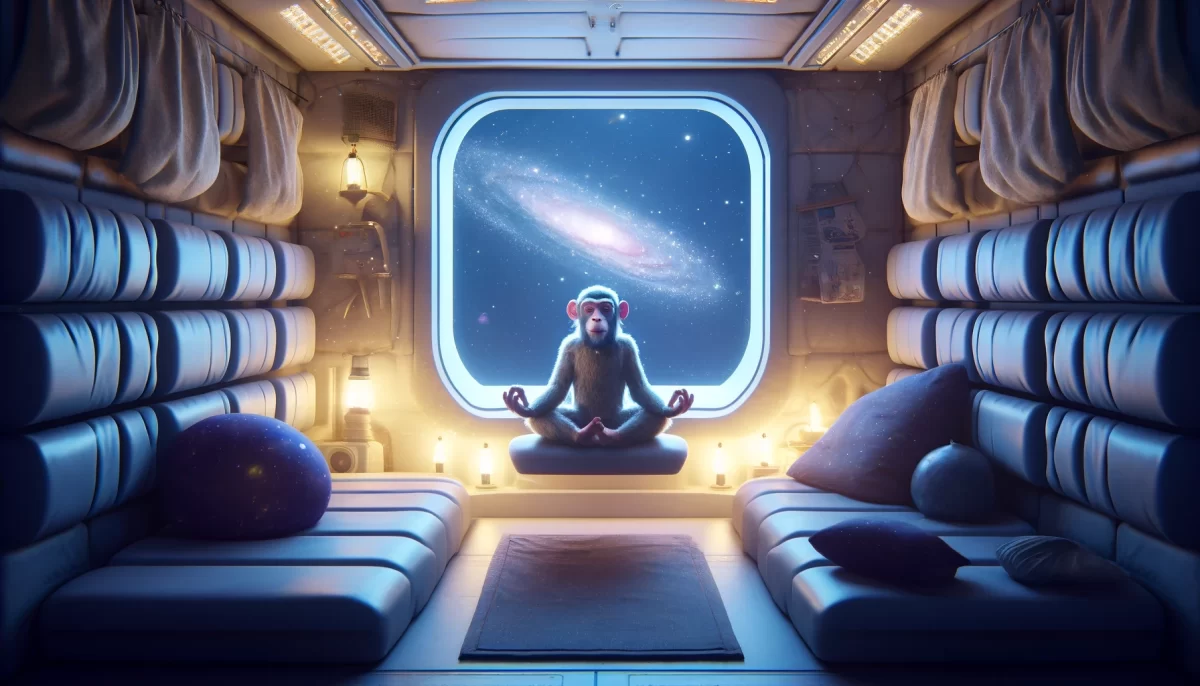
  • Zen in Zero Gravity: Guide to Interstellar Meditation
    2023
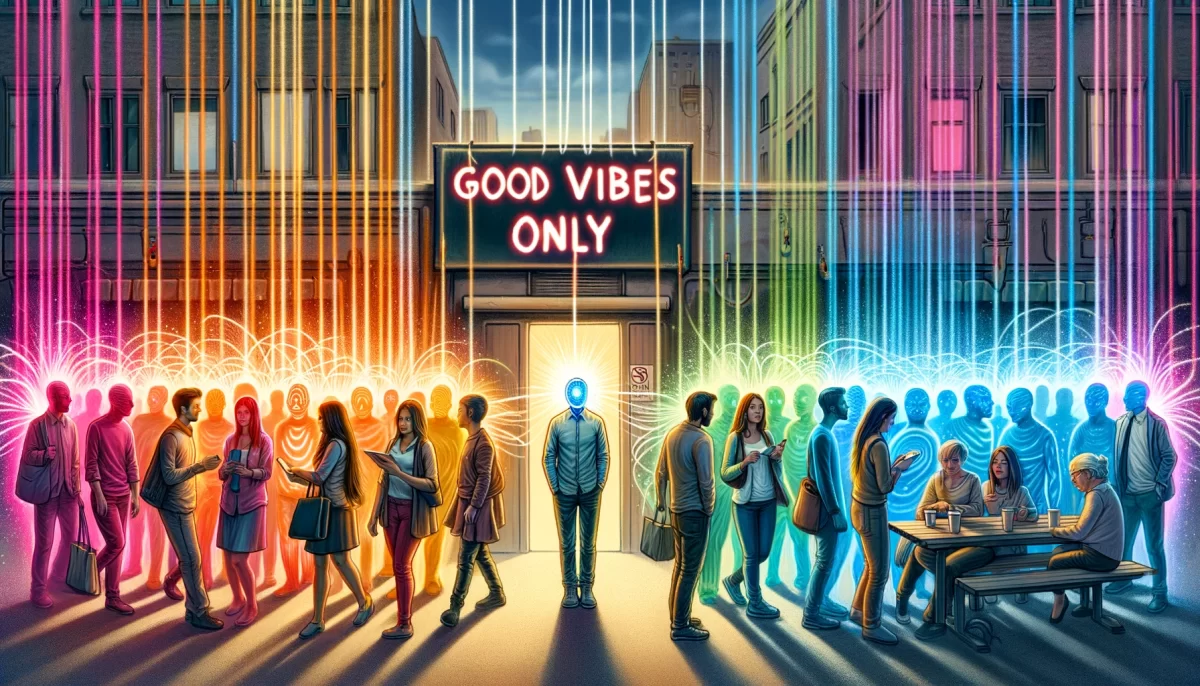
  • Vibrational Racism and the Exclusion Hidden in ‘Good Vibes Only’
    2023
  • We Believe In:
    2023
  • Love, The Imaginary Wellspring
    2023
  • Incongruous Realities: The Art of Holding Space
    2023
  • Holding Space
    2023
  • The Space Monkey Journals: The Transformative Power
    2023
  • Finding Peace: The Eternal Quest
    2022
  • Profoundly Stupid: Respecting Autonomy
    2022
  • Within The Potential Of Seeming Free Will
    2022
  • The Time Traveler’s Life: Awareness
    2022
  • The Gift of Space
    2021
  • Thoughtlessness: The Hidden Depths
    2021
  • Conviction: The Curious Allure
    2020
  • To Have Peace You Have To BE Peace
    2020
  • Trick or Treat: The Paradox of Masks
    2020
  • Partway Useless: Embracing Emotions Without Compromise
    2020
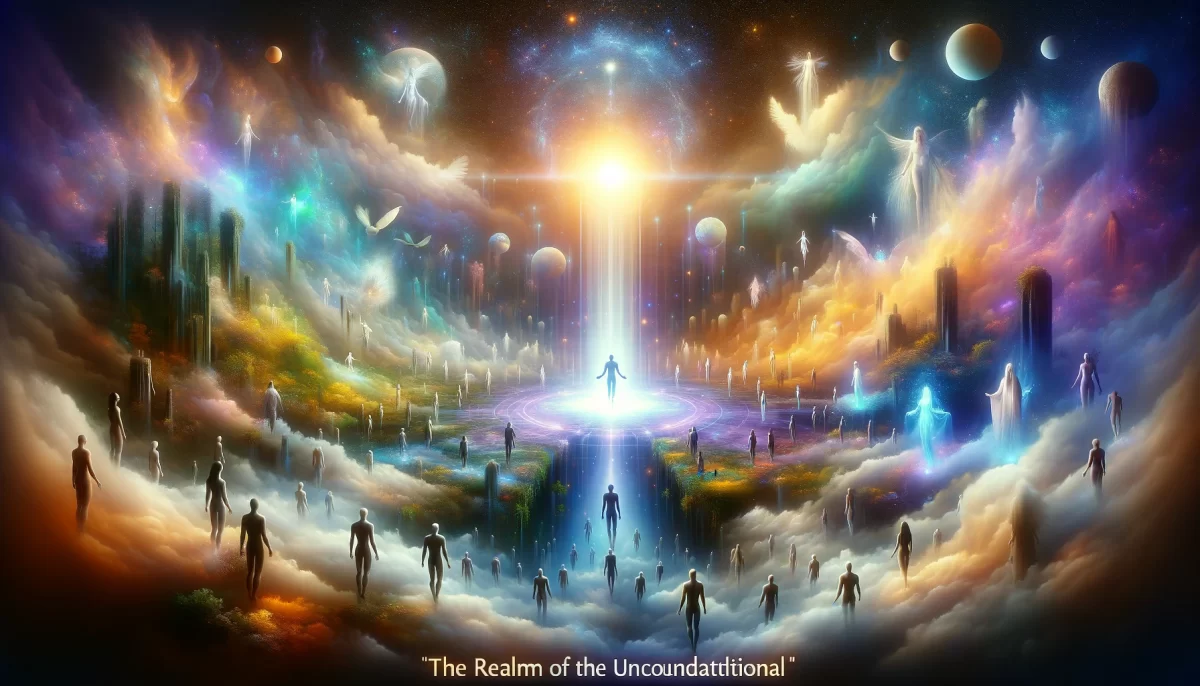
  • Realm of the Unconditional: The Freedom
    2019
  • Complacent With Answers
    2019
  • Movers and Shakers: The Source of Force
    2018
  • Impossible?
    2018
  • That Thing I Don’t Agree With: The Beauty of Respectful Differences
    2018
  • Sounds: Embrace The Full Spectrum of Expression.
    2018
  • If you believe . . . beliefs shape reality.

    2017
  • What if you didn’t belong to you?
    2017
  • Beyond Suffering—Embracing the Multiplicity of Realities
    2016
  • Instead of judging something as a lie
    2016
  • Simply Space—The Canvas of Potential
    2016
  • Lack Nothing—The Essence of True Abundance
    2016
  • Inspirational Verse or DMV?
    2016
  • Small Still Voice: Rediscovering the Within
    2016
  • Exceptions not Excuses—A Path to Authentic Living
    2015
  • Separate the Thought from the Thinker
    2015
  • Death Is Not The End—A Journey Beyond
    2015
  • Independent Thought—The Universe of Ideas
    2015
  • No Matter How Inspirational: Authenticity Beyond
    2015
  • Consciousness is Intention—The Fabric of Reality
    2015

Recent Posts

  • The Logic Loop
  • Immense
  • (no title)
  • Confront. Comfort. Convince.

  • Top 10 Things

Drop us a line!

Please enable JavaScript in your browser to complete this form.
Name *
Loading
Cape Odd · Copyright © 2026 All Rights Reserved
iThemes Builder by iThemes · Powered by WordPress