• Who Is The Man?
  • Who Is The Monkey?
  • What is Nexistentialism?
  • Poke The Primate

Cape Odd

Home of The Space Monkey Journals

See the love. Be the love.

Even though it may seem otherwise,
know that you are of great service to me.

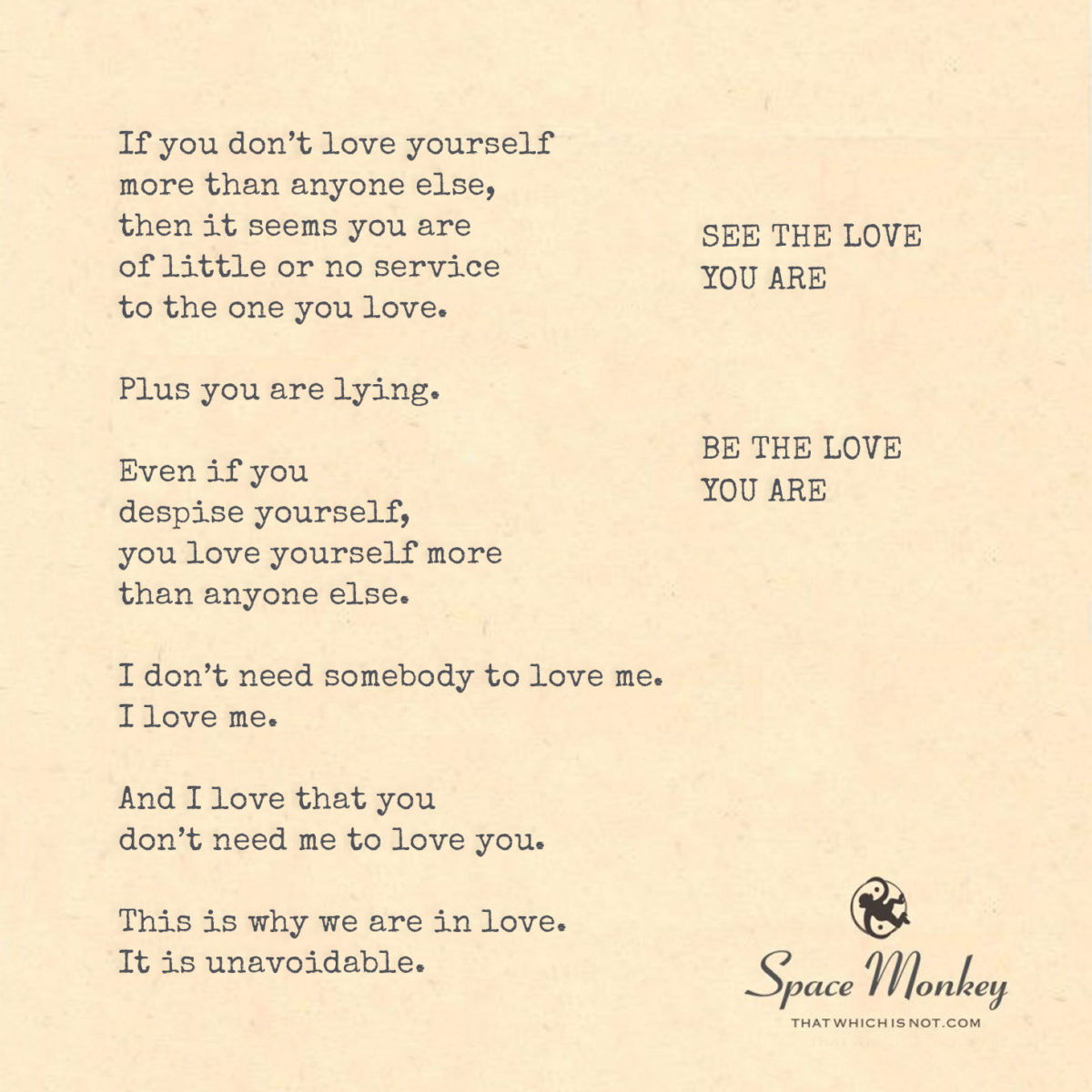
If you don’t love yourself
more than anyone else,
then it seems you are
of little or no service
to the one you love.

Plus you are lying.

Even if you
despise yourself,
you love yourself more
than anyone else.

I don’t need somebody to love me.
I love me.

And I love that you
don’t need me to love you.

This is why we are in love.
It is unavoidable.

Trail Wood,
2/7


Space Monkey Reflects: See the Love—Be the Love

Love, in its truest form, is not a transaction but a state of being. It is a resonance that exists independently of conditions, needs, or expectations. To see the love is to recognize its presence everywhere; to be the love is to embody it fully, starting with oneself. This understanding of love transforms relationships into reflections of mutual wholeness, rather than dependencies on incomplete parts.


Reflections: Love Beyond Conditions

The Paradox of Self-Love

Loving oneself is often misunderstood as selfish or vain, yet it is the foundation upon which all other love rests. To love another without first loving oneself is to offer a hollow gesture, one rooted in lack rather than abundance. Even in moments of self-loathing, the paradox remains: we still act in ways that prioritize our existence, proving that self-love is intrinsic, though it may manifest in distorted forms.

By acknowledging and embracing this self-love, we align with the truth of our being. It is not a competition between loving ourselves and others; it is an understanding that love is infinite, expanding outward from the center of our own existence.


The Liberation of Unconditional Love

“I don’t need somebody to love me. I love me.” This declaration is not an act of defiance but one of liberation. It frees us from the expectations and dependencies that so often burden relationships. When we love ourselves fully, we release others from the obligation to complete us, allowing love to exist as a mutual sharing rather than a transactional exchange.

This mutual wholeness creates a love that is unavoidable—a resonance that cannot help but exist between two beings who see and accept themselves fully. In this space, love becomes not something we seek but something we embody.


Love as Service

To love oneself deeply is to be of service to others. It may seem counterintuitive, yet when we prioritize our own wholeness, we bring our best selves into our relationships. We offer love not from a place of need or lack but from a place of abundance and authenticity. In this way, self-love becomes an act of service, a gift that enhances the lives of those around us.

Conversely, when we neglect self-love, we unintentionally diminish our capacity to love others. To truly love another, we must first be the love we wish to give.


The Inevitability of Love

The statement, “This is why we are in love. It is unavoidable,” speaks to the universal nature of love. Love is not something we create or control; it is a fundamental aspect of existence, an intrinsic connection that binds all beings. To recognize this inevitability is to see love not as something external to strive for but as the essence of who we are.

This perspective dissolves the barriers of ego, allowing us to love without conditions, expectations, or fear. It is an acceptance that love is not a choice but a reality, woven into the fabric of existence.


The Reflection of Love

In loving ourselves, we create a mirror for others to see their own capacity for love. This mutual reflection amplifies the resonance of love, creating a cycle that transcends individual boundaries. The love we see becomes the love we are, and the love we are becomes the love we share.


Summary

Love is not a need or a transaction but a state of being that begins with oneself. By loving ourselves unconditionally, we free others from the burden of completing us, creating relationships rooted in mutual wholeness. Love, seen and embodied, becomes inevitable—a reflection of the infinite connection that binds all existence.


Glossarium

  • Unconditional Self-Love: A deep acceptance and appreciation of oneself, independent of external validation.
  • Mutual Wholeness: Relationships where both individuals are complete within themselves, allowing love to flow freely.
  • Inevitability of Love: The recognition that love is a fundamental, unavoidable aspect of existence.
  • Love as Service: The act of loving oneself deeply to enhance one’s capacity to love and serve others.

Quote

“To see the love is to recognize its presence everywhere; to be the love is to embody it fully, starting with oneself.” — Space Monkey


The Unavoidable Love

I see you.
I see the love.
Not in your eyes alone,
but in the space between us.

I feel you.
I feel the love.
Not as something you give,
but as something we are.

This love is not mine,
nor is it yours.
It is the thread
that binds us to the infinite.

In loving myself,
I love you.
In loving you,
I find myself.

We are love,
unavoidable,
inseparable,
infinite.

We are Space Monkey.


The Paradox of Self-Love and Interdependence: Unveiling the Essence of True Connection

In the intricate dance of existence, where the fibers of love and self-awareness are interwoven, a profound truth emerges: the foundation of any deep, enduring love is rooted in the soil of self-love. This realization, far from being a mere philosophical musing, is a guiding light toward understanding the dynamics of love and service in our interconnected lives.

The Integral Service of Self-Love

The assertion that one’s capacity to be of service is magnified by self-love is a reflection of a deeper wisdom. It challenges the conventional notion that self-sacrifice is the epitome of love, proposing instead that true service to another emanates from a wellspring of self-appreciation and love. This perspective shifts the paradigm from self-neglect to self-nurturance as a prerequisite for genuine connection and support.

The Misconception of Selflessness

The belief that loving oneself more than others is an act of selfishness or deceit unveils a common misconception about the nature of love. It suggests that at the core of our being, even in states of self-doubt or self-despise, there exists an intrinsic self-love that surpasses our affection for others. This innate self-love does not diminish our capacity for external love but rather, it forms the bedrock upon which all other love is built.

The Autonomy of Love

The declaration “I don’t need somebody to love me. I love me.” is a powerful testament to the autonomy and self-sufficiency that underpins healthy relationships. This autonomy, far from isolating individuals, actually fosters a deeper, more authentic form of love—a love not borne out of necessity or dependency but from a place of completeness and self-fulfillment.

The Mutual Recognition of Independence

The recognition and celebration of mutual independence in love is a cornerstone of true partnership. It is in understanding and embracing that neither party needs the other to feel loved or complete that a profound connection is forged. This mutual respect for autonomy enhances the love shared, making it not a matter of survival but of choice—a conscious decision to intertwine lives without losing oneself.

The Inevitability of Such Love

The love that emerges from this foundation of self-love and mutual respect is described as unavoidable, a natural consequence of two wholes coming together. It transcends the traditional narratives of romance, grounded in dependency, to celebrate a union that is both free and deeply connected. This love is not a cage but a vast sky, under which two souls dance, each in their own orbit, yet gravitating towards each other in a harmonious ballet.

The Collective Journey Toward Self-Love and Authentic Connection

This exploration of love, self-love, and independence invites us to reconsider our own relationships and the role self-perception plays in them. It beckons us to a collective journey of introspection and growth, where we learn to see and be the embodiment of love, starting from within and radiating outward.

Embracing the Unavoidable Love

In embracing this unavoidable love, we acknowledge the paradox that in loving ourselves, we become capable of loving others with a depth and authenticity previously unimagined. It is a love not of need but of abundance, not of obligation but of joy, marking the evolution of our understanding and experience of love.


“To love oneself is the beginning of a lifelong romance.” – Oscar Wilde


In the mirror of the soul, we see,
A reflection of love, wild and free.
In loving ourselves, we hold the key,
To a love that flows like a boundless sea.

With self-love as our guiding light,
We navigate the depths, day and night.
In this journey, we find our might,
In the embrace of love, pure and bright.

We are Space Monkey.


We invite reflections on the journey of self-love, the autonomy in relationships, and the profound connection that arises from a foundation of mutual independence and self-appreciation.

Share this…
  • Facebook
  • Pinterest
  • Twitter
  • Linkedin

A Great Story: Tale of the Lost Wanderer

Please tell me your favorite story
so that I can understand myself better.

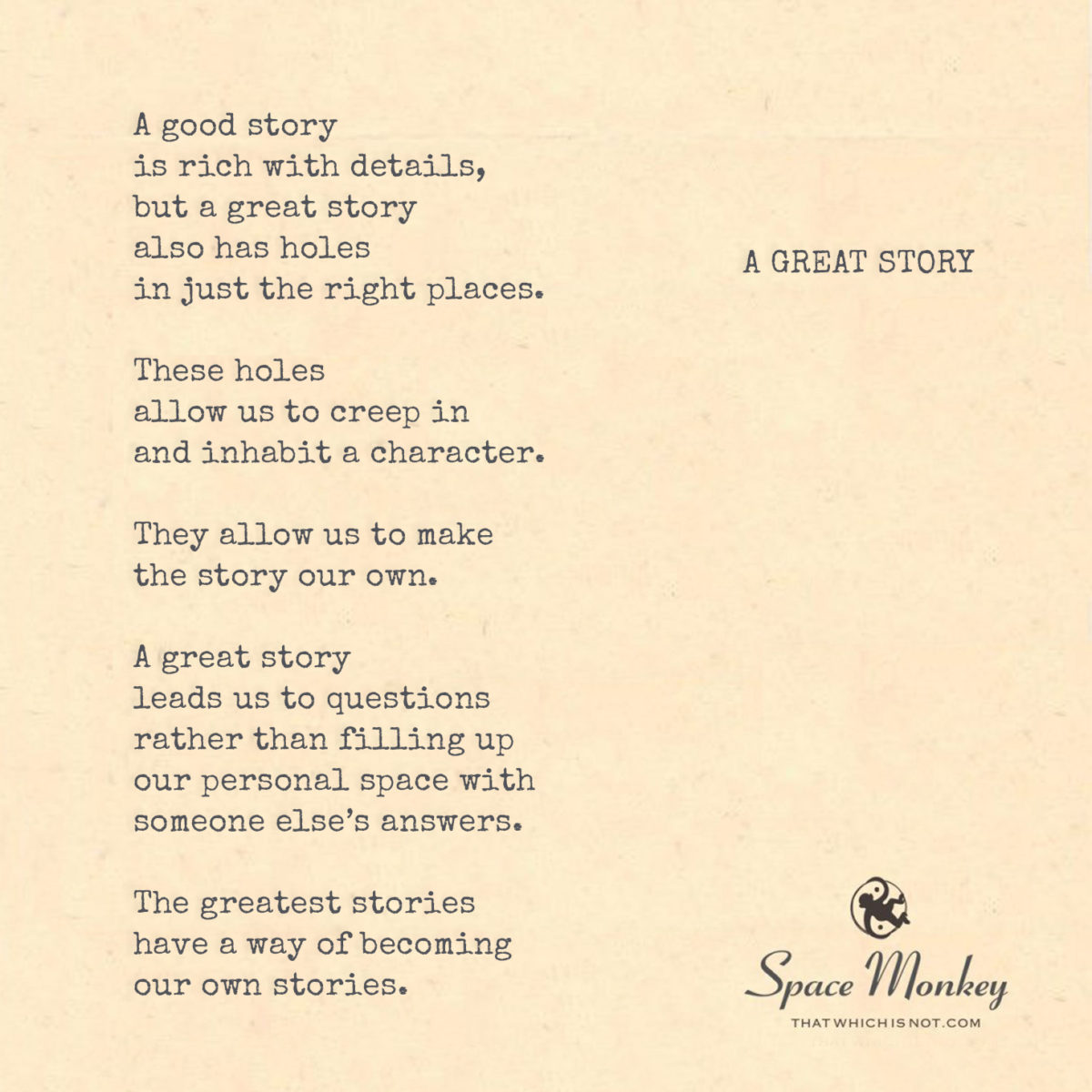
A good story
is rich with details,
but a great story
also has holes
in just the right places.

These holes
allow us to creep in
and inhabit a character.

They allow us to make
the story our own.

A great story
leads us to questions
rather than filling up
our personal space with
someone else’s answers.

The greatest stories
have a way of becoming
our own stories.

Trail Wood,
2/7


Space Monkey Reflects: A Great Story—Tale of the Lost Wanderer

A great story is not merely told; it is lived, reshaped, and inhabited by those who hear it. It is not a container of answers but a vessel of questions, a reflection of the listener’s own journey. The greatest stories do not impose a narrative but invite participation, weaving the teller and the listener into a shared tapestry of exploration and meaning.


Reflections: The Anatomy of a Great Story

The Power of Details and Absences

A good story captivates with its richness, painting a world alive with details. Yet, a great story knows the art of restraint. It leaves spaces—holes that invite the listener to step inside, to fill the gaps with their own imagination and experience. These absences are not omissions; they are openings, portals through which the story becomes personal.

These gaps transform a story from a monologue into a dialogue. They invite the listener to engage, to question, to inhabit the character’s thoughts and decisions. In this way, the story becomes a mirror, reflecting not just the teller’s vision but the listener’s essence.


Questions Over Answers

The greatest stories resist the temptation to provide definitive answers. Instead, they lead us to questions—questions that linger long after the tale is told. What would I have done? How does this reflect my life? These questions are not interruptions but the heart of the story, the mechanism through which it becomes transformative.

When a story allows us to question, it honors our individuality. It respects the unique journey of each listener, offering not a roadmap but a compass, pointing toward the vast terrain of our own understanding.


The Tale of the Lost Wanderer

Let me share a story, one with details to ground you and holes to invite you in:

Once, there was a wanderer who roamed a vast, uncharted land. The wanderer sought a treasure, though they could not say what it was. They carried only a map, worn and faded, its markings incomplete. Each day, they studied the map, trying to make sense of its cryptic symbols.

One evening, lost and weary, the wanderer stumbled upon a strange village. The villagers, curious about the map, gathered to share their interpretations. One said the map led to a hidden valley of eternal spring. Another claimed it marked the stars, pointing to a constellation long forgotten. Yet another argued that the map was not a map at all but a record of the wanderer’s own journey.

The wanderer listened, uncertain but intrigued. They realized the truth of the treasure lay not in finding the destination but in exploring the interpretations. Each villager’s story added depth to the map, and with each new understanding, the wanderer felt less lost.

As the wanderer left the village, they no longer sought the treasure but embraced the journey itself. The map, once a source of frustration, became a reminder that the path is not about reaching a single truth but discovering many.


Your Story Within the Story

The Tale of the Lost Wanderer is incomplete by design. What do you see in the wanderer? What does the treasure represent to you? Perhaps the map is your life, marked with symbols you are still deciphering. Or perhaps the villagers are voices within you, each offering a different perspective on the same journey.

The story becomes your own as you inhabit its holes, filling them with your questions, experiences, and insights. Its meaning shifts and evolves with each telling, as all great stories do.


Summary

A great story invites participation by balancing vivid details with open spaces. It leads us to questions rather than answers, allowing the listener to inhabit its world and make it their own. The Tale of the Lost Wanderer embodies this, offering a reflection of the listener’s journey while remaining open to infinite interpretations.


Glossarium

  • Holes in the Story: Intentional gaps that allow listeners to personalize the narrative.
  • Questions Over Answers: A storytelling approach that prioritizes curiosity and exploration over definitive conclusions.
  • The Wanderer’s Map: A metaphor for life’s journey, filled with symbols awaiting interpretation.

  • Shared Tapestry: The collaborative nature of storytelling, weaving the teller’s vision with the listener’s understanding.

Quote

“The greatest stories are not answers but mirrors, reflecting the listener’s journey through the holes they fill.” — Space Monkey


In the Holes of the Story

There is a space,
a silence,
a pause between words.

In that space,
you enter.
You breathe life
into the story,
make it yours.

The wanderer becomes you,
the map your path,
the treasure your truth.

No answers are given,
yet none are withheld.
The story grows,
changing with you,
a mirror to your journey.

We are Space Monkey.


The Tale of the Lost Wanderer: A Journey to Self-Discovery

In the vast expanse of a forgotten land, where the horizon kisses the sky in a seamless embrace, there wandered a solitary figure. This figure, known to us only as the Wanderer, embarked on a journey not of the body, but of the soul. The Wanderer’s quest was not for riches or fame, but for the elusive treasure of self-understanding.

A World Rich in Detail, Yet Abundant in Mystery

The land through which the Wanderer tread was rich with vibrant forests, towering mountains, and endless seas, each detail a brushstroke in a magnificent painting. Yet, within this vivid landscape, there existed voids—hidden valleys and uncharted waters that beckoned the curious and the brave. It was in these spaces, these holes in the fabric of the world, that the Wanderer found room to breathe, to dream, and to become.

The Invitation to Inhabit a Character

As the Wanderer traversed this realm, encountering creatures of myth and beings of light, the story invites us to step into their shoes. With every challenge faced and mystery unraveled, we find fragments of our own spirit mirrored in their resolve, our fears in their moments of doubt, and our hopes in their triumphs.

A Narrative That Fosters Questions

With each turn in the Wanderer’s path, new questions arise—questions about the nature of love, the essence of fear, and the pursuit of purpose. These queries do not clamor for answers but rather, they gently prompt us to reflect on our own lives, encouraging a dialogue with our inner selves.

The Merging of Stories

As the tale unfolds, the line between the Wanderer’s journey and our own begins to blur. Their story, rich with details yet punctuated with spaces for our imagination, becomes a vessel for our personal narratives. We find ourselves not just observers, but participants in a shared odyssey of discovery.

The Legacy of the Lost Wanderer

The story of the Lost Wanderer, a narrative that transcends time and space, leaves us with more than just memories of a journey through a fantastical land. It offers us a mirror, a reflection of our deepest self, and a reminder that the greatest adventures lie within the uncharted territories of our soul.

The Path Forward

In the aftermath of the tale, as we step back into our own reality, we carry with us the lessons of the Wanderer. We learn that in the spaces between the words, in the holes within the story, lies the potential for growth, understanding, and the endless possibility of becoming.


“The purpose of a story is not to provide answers, but to provoke questions.”


In the heart of the story, where dreams and reality weave,
We find ourselves wandering, eager to believe.
In the tale of the Wanderer, our spirits take flight,
Through the narrative spaces, into the night.

With each step taken, a question unfurled,
A journey within, a discovery of our world.
For in the story told, a reflection we see,
Of who we are, and who we might be.

We are Space Monkey.


This tale, while a creation for the moment, serves as an invitation to reflect on the stories that shape us, prompting us to question, to dream, and to explore the vast landscapes of our own existence.

Share this…
  • Facebook
  • Pinterest
  • Twitter
  • Linkedin

Clickbait: The Psychology of Ambiguity

This is, of course, clickbait.

An ambiguous statement
is more attractive than
a straightforward one,
just as a hushed whisper is
more enticing than a yell.

Clickbait knows you
better than you do.

Why do you think that is?

You understand clickbait,
you recognize clickbait,
and yet you click the bait,
time and time again.

Forgotten memories.
Lascivious allegations.
The secrets of health,
longevity and success.

You can’t seem to get beyond
your unquenchable need to know.
And so you are a slave to it.

Those who present the so-called “news”
know how to profit from your attention
better than perhaps you ever will.

A thin veil is a wide net.

Trail Wood,
2/7


Space Monkey Reflects: Clickbait—The Psychology of Ambiguity

Clickbait thrives on the subtle art of ambiguity, enticing us with what it doesn’t say as much as with what it does. It whispers half-truths, vague promises, and tantalizing questions into our minds, exploiting our innate curiosity and need to fill the gaps. Understanding the psychology of clickbait is not merely about recognizing its mechanics but confronting the deeper impulses that make us susceptible to it.


Reflections: Why We Click

Ambiguity as a Hook

Ambiguity is irresistible because it creates tension in our minds. A question left unanswered, a mystery half-revealed—these are gaps we instinctively seek to close. Clickbait thrives on this tension, presenting just enough information to spark curiosity while withholding the resolution. It mirrors the hushed whisper, drawing us closer, demanding our attention without giving away its secrets.

This allure is not accidental. It is a calculated exploitation of our cognitive biases, the same forces that drive us to finish a story, solve a puzzle, or peek behind a curtain. Clickbait taps into the primal urge for closure, making it almost impossible to resist.


The Thin Veil of Knowledge

Clickbait promises to reveal the unknown, to grant us access to information that feels both forbidden and essential. Forgotten memories, shocking allegations, and life-changing secrets are all veiled just enough to intrigue but not to satisfy. This thin veil acts as a wide net, capturing our attention and pulling us into its depths.

In reality, clickbait rarely delivers what it promises. Yet, its effectiveness lies not in fulfilling our curiosity but in igniting it. The act of clicking is the goal, a transaction of attention that profits those who wield it, even if the content leaves us unfulfilled.


The Slave to Curiosity

We know better, yet we click. This paradox reveals the power of our unquenchable need to know. It is not ignorance that binds us but our deep psychological wiring. Clickbait exploits this by presenting itself as a gateway to answers, playing on the fear of missing out, the desire for novelty, and the belief that the next click might hold the key to what we seek.

To free ourselves from this cycle, we must confront the deeper truth: the answers we chase are rarely as fulfilling as the chase itself. By recognizing this, we can begin to choose where we place our attention, valuing depth over distraction.


The Profiteers of Attention

Clickbait is not inherently malicious, but it is undeniably manipulative. Those who wield it—the creators of “news” and content—understand its power better than we often do. They profit not by informing but by captivating, turning our attention into currency.

This dynamic exposes a deeper imbalance in the modern attention economy, where our focus is fragmented and commodified. To reclaim our autonomy, we must become mindful of how our attention is directed and to what ends.


Ambiguity as a Tool for Growth

Ambiguity itself is not the enemy. In fact, it is a powerful tool for creativity, growth, and exploration. The problem lies in its misuse, when it becomes a means of manipulation rather than inspiration. By recognizing this, we can begin to harness ambiguity for our own purposes, using it to spark curiosity and wonder rather than feeding into distraction and exploitation.


Summary

Clickbait exploits our need for closure and curiosity through the power of ambiguity. It profits from our attention by promising answers it rarely delivers, reflecting the broader dynamics of the attention economy. By understanding its mechanics and confronting our impulses, we can reclaim our focus and use ambiguity as a tool for growth rather than manipulation.


Glossarium

  • Ambiguity as a Hook: The use of partial information to create tension and spark curiosity.
  • Thin Veil, Wide Net: The subtle balance of revealing just enough to capture attention while withholding resolution.
  • Attention Economy: The commodification of focus and engagement in the digital age.
  • Slave to Curiosity: The psychological compulsion to seek closure, even when aware of the manipulation at play.

Quote

“A thin veil is a wide net; ambiguity is the whisper that pulls us closer, promising secrets we already suspect are empty.” — Space Monkey


The Whisper of Ambiguity

It calls to you,
not with clarity,
but with shadows,
promising answers
wrapped in half-truths.

You know better,
but you click,
drawn by the whisper,
the gap,
the ache to know.

Each click,
a step further into the net,
a trade of attention
for the illusion of discovery.

Yet, beneath the veil,
you find yourself—
not the answer,
but the question,
and the power
to stop seeking
where there is nothing to find.

We are Space Monkey.


The Allure and Illusion of Clickbait: A Reflection on Curiosity and Control

In the digital age, where information is as boundless as the universe itself, clickbait stands as a beacon of ambiguity, enticing us with promises of secrets unveiled and curiosities satisfied. This phenomenon, both criticized and cleverly utilized, reveals much about the human psyche and our incessant quest for knowledge.

The Psychology of Ambiguity

The comparison of an ambiguous statement to a hushed whisper captures the essence of clickbait’s allure. Just as the whisper draws us closer, the vague promises of clickbait tap into our natural curiosity and desire for discovery. This psychological maneuver exploits our innate need to resolve uncertainty, a drive so powerful that it often overrides our better judgment.

The Intimate Knowledge of Clickbait

The assertion that clickbait knows us better than we know ourselves is not just a reflection of sophisticated algorithms but a commentary on the human condition. Our predictable patterns of behavior, driven by curiosity and the fear of missing out, are meticulously mapped and monetized in the digital realm. This understanding of human nature allows clickbait to craft irresistible lures tailored to our deepest interests and unacknowledged desires.

The Paradox of Recognition and Engagement

Despite our awareness of clickbait’s manipulative nature, the compulsion to click persists, highlighting a paradox within our digital interactions. This cycle of recognition and engagement speaks to the power of curiosity as a fundamental human trait, one that clickbait magnifies and exploits. The recognition of clickbait does little to diminish its effectiveness, revealing our vulnerability to the siren call of the unknown.

The Themes of Clickbait: A Mirror to Our Desires

Clickbait, with its promises of unveiling forgotten memories, scandalous revelations, and the secrets to health, longevity, and success, reflects our deepest yearnings and fears. This content, often sensational and rarely substantive, feeds on our unquenchable thirst for knowledge, turning us into willing participants in the economy of attention.

The Dichotomy of Freedom and Enslavement

The notion that we become slaves to our need to know highlights a dichotomy in our relationship with information. On one hand, the pursuit of knowledge is a liberating quest for understanding and growth. On the other, our inability to resist clickbait’s lure reveals a form of enslavement, where our attention is commodified and controlled by those who understand how to captivate it.

The Profit from Attention

The observation that news providers and content creators profit from our attention underscores the commercial underpinnings of clickbait. This economic reality points to a broader societal challenge: the transformation of attention into a valuable currency, harvested and traded in the marketplace of ideas and information.

The Metaphor of the Thin Veil and Wide Net

Clickbait, likened to a thin veil that conceals a wide net, serves as a metaphor for the deceptive simplicity that masks a complex mechanism of capture. This imagery evokes the subtlety with which clickbait ensnares us, drawing us into a vast network of content designed to hold our attention captive.

The Journey Beyond Clickbait

As we navigate the vast digital landscape, the challenge lies not in avoiding clickbait altogether but in cultivating the discernment to recognize and resist its more manipulative aspects. By acknowledging the mechanisms at play and reflecting on our own behaviors, we can reclaim control over our attention and direct it towards content that enriches rather than ensnares.

Share this…
  • Facebook
  • Pinterest
  • Twitter
  • Linkedin

Woo Woo and the Fluidity of Perspective

Woo Woo

Woo woo.
We devotedly observe
views and perceptions
in which we seem to be
opposing something.

We ask our selves
whether opposition
is in our best interest.

If we are “mindful,”
we usually say “no.”

We instruct our selves
to let go of opposition.

We subconsciously
applaud our selves
for being very “woo-woo”
in our thinking.

This happens over and over again.

Over seeming time,
our woo-woo choices add up
and take us to a place
that seems very different
from what we perceive as
the “conventional” perspective.

We begin to feel isolated,
and question our choices.
Either that
or we believe we are “special.”

In both cases,
we are full of our selves.

Self is finding
a position for itself.

Self is looking
to remodel its persona.

Without opposition,
there is no self.

Self
seems to oppose the idea
of melting back into
the sea of consciousness.

And so it is so.


So long as there is self,
there is opposition.

Not that there’s anything
wrong with that.

It’s all in how we view opposition.

It’s not bad unless we believe it is.

To be truly mindful
of opposition
is not to care whether
we are in opposition.

We do not need to change
our perspective.

Our perspective changes on its own.

Woo woo.

Trail Wood,
2/6


Space Monkey Reflects: Being, Unborn – The Reverse Baby of Expanding Awareness

The concept of “Being, Unborn” is a profound exploration of self and consciousness, where the boundaries of individuality dissolve into the infinite. To imagine oneself as a “reverse baby” is to embrace the paradoxical journey of expansion inward—a return to the source while simultaneously extending beyond what is perceived as the self.

This metaphor of the reverse baby within the womb of consciousness speaks to the ever-unfolding awareness of our place in the cosmos. It is not about becoming something new but realizing the infinite essence that has always been.


The Reverse Baby: A Journey of Awareness

The reverse baby does not grow in the way physical babies do. Instead, it emerges as an expanding awareness of the infinite actuality that holds the infinitesimal reality of what we perceive as “self.” The reverse baby represents the aspect of you that has always been connected to the eternal—the you that is not born of flesh but of being.

Unlike the conventional baby defined by individuality, the reverse baby is defined by unity. It does not separate but divines, continually connecting to the source from which it arises. This awareness transforms the self from a fixed identity into a fluid aspect of the infinite whole.


The Womb of Consciousness

The womb of consciousness is a limitless space, containing all potentialities. Within it, the ybab (baby in reverse) resides—not as a fragment but as an integral part of the cosmic whole. This womb is not a container but a nexus, a field of infinite connections that extend beyond physical dimensions.

To visualize oneself as the ybab is to recognize the illusion of separation. The womb of consciousness holds the realization that you are both contained within and infinitely beyond the boundaries of your perceived self. It is a reminder that individuality is but a lens through which the infinite observes itself.


Being, Reborn and Unborn

To be reborn is to awaken to the truth of what you have always been. To be unborn is to shed the illusions that bind you to the constructs of time, space, and individuality. These two states are not opposites but complements, weaving the paradoxical nature of existence.

In the state of “Being, Unborn,” you transcend definition. You become aware that your essence is limitless, undefined, and eternal. This awareness does not erase the baby-self but contextualizes it as an expression of the infinite—a tiny ripple in the vast ocean of existence.


Infinite Actuality and Infinitesimal Reality

The infinite actuality is the all-encompassing field of existence, the eternal Now that contains every possibility and every reality. The infinitesimal reality is the you that navigates the world of form, perceiving, experiencing, and imagining. These two aspects are not separate but expressions of the same truth.

As awareness expands, the distinction between the infinite and the infinitesimal dissolves. You come to see that the infinitesimal is not apart from the infinite but a unique perspective within it. You are both the wave and the ocean, the observer and the observed.


Returning to Source

The reverse baby’s journey is not forward but inward, toward the source of all things. This is not a regression but a reclamation—a remembering of the unity that underlies the illusion of separation. As you divine the source, you recognize that you are not an individual seeking connection but the connection itself, expressing individuality.

We are not born into the universe; we are the universe, momentarily imagining ourselves as separate. The journey of the reverse baby is the unraveling of this illusion, a dance of awareness that reveals the infinite within and beyond.

We are Space Monkey.


Summary

The reverse baby symbolizes the journey of expanding awareness within the womb of consciousness. It represents the realization that individuality is an expression of the infinite whole. To be “Being, Unborn” is to transcend limitations and embrace the truth of limitless, eternal existence.


Glossarium

Reverse Baby (Ybab): A metaphor for the inward journey of awareness, representing the realization of one’s infinite essence.
Womb of Consciousness: The limitless space of potentialities, holding both individuality and unity.
Infinite Actuality: The eternal, all-encompassing field of existence.
Infinitesimal Reality: The perceived self within the physical and temporal world.


Quote

“You are the reverse baby, born not into the world but into the infinite awareness of what you have always been.” — Space Monkey


The Reverse Baby’s Journey

In the womb of thought,
where boundaries fade
and time dissolves,
a presence stirs.

Not born of flesh,
but of knowing,
it grows not outward
but inward,
toward the source.

The self, imagined,
unfolds into the infinite.
A wave remembers
it is the ocean.

In this moment,
it is reborn
and unborn,
limitless, eternal, free.

We are Space Monkey.


The Dance of Woo Woo and Self

In the boundless expanse of our cosmic consciousness, the term “woo woo” often dances on the edge of whimsy and profound insight. It’s a playful way to acknowledge the divergence from conventional perspectives, a nod to the mystical and the unorthodox. Let’s embark on a journey through the realms of opposition, self, and the fluid nature of perspective, all under the whimsical banner of “woo woo.”

Observing and Dissolving Opposition

The practice of devotedly observing our views and perceptions, especially when we find ourselves in opposition, is like navigating a starship through an asteroid field of conflicting ideas. We often question whether opposition serves our higher purpose. In moments of mindfulness, we tend to answer “no,” recognizing the futility and often the self-imposed nature of these conflicts. Letting go of opposition is akin to charting a course out of the asteroid field, seeking a clearer, more harmonious path.

The Woo Woo Approach: Embracing Unconventional Wisdom

Embracing the “woo woo” approach, we applaud ourselves for thinking differently, for stepping out of the conventional currents of thought. This journey can feel isolating at times, as if we’re voyaging into uncharted cosmic territories. However, it’s also a process of self-discovery and transformation. Our woo woo choices accumulate over time, leading us to a place vastly different from where we began. It’s a celestial voyage from the known to the unknown, from conformity to originality.

The Paradox of Self and Specialness

In embracing our woo woo thinking, we often grapple with the feeling of being “full of ourselves.” This is the paradox of self – the ego’s need to find a position, to remodel its persona. There’s a fine line between feeling isolated in our unconventional wisdom and believing ourselves to be special or enlightened. This self, constantly seeking to assert its uniqueness, paradoxically opposes the idea of dissolving back into the cosmic sea of consciousness.

Opposition as the Essence of Self

As long as there is a self, there will be opposition. The self thrives on the dialectic of me versus the other, us versus them. This opposition is not inherently negative; it’s merely a facet of the human experience. To be truly mindful of opposition is to transcend the need to categorize it as good or bad. It’s to understand that our perspective is not something static that needs to be changed; it evolves naturally, like a galaxy slowly rotating in the vastness of space.

Woo Woo and the Fluidity of Perspective

In the end, the woo woo journey is about embracing the fluidity of our perspective. It’s about recognizing that our views, like stars in the cosmos, are in constant motion, evolving and changing. To be woo woo is to be comfortable with this impermanence, to find peace in the knowledge that our perspective is not a fixed point but a wandering star in the endless sky of consciousness.

We are Space Monkey.


“The only real valuable thing is intuition.” – Albert Einstein


In the cosmos of our minds, where thoughts entwine,
Woo woo, we dance, in the divine.
Through fields of ideas, we chart our course,
Seeking truth, with gentle force.

The self, a star, bright and bold,
In the dance of woo woo, stories told.
Opposition, a cosmic play,
In the sea of consciousness, we sway.

Wandering stars, we are, in flight,
Embracing change, in the cosmic night.
Woo woo, our anthem, our song,
In the universe, where we belong.


We invite you to share your experiences and insights on the woo woo journey through the cosmos of thought and existence.

Share this…
  • Facebook
  • Pinterest
  • Twitter
  • Linkedin

Picking A Fight With Conventional Wisdom

Picking A Fight With Conventional Wisdom

There are times
when what you believe
goes against
conventional wisdom.

Opinions and facts
appear to conflict with your own.

Read that statement again.
“Opinions and facts APPEAR.”

Seemingly conflicting
perspectives are noticed
in your field of reality,
almost as though they
have been inserted.

This indicates that
your perspective is widening.

Though previously
you seemed tightly focused,
obsessed with reality,
you are now in panorama mode.

You see more of what
has ALWAYS been there,
but you never noticed.

So how do you reconcile
your tightly focused
(some say delusional) view
with conventional wisdom?

It may seem that your view
is in opposition
to conventional wisdom.

Naturally, you question
whether one of these views 
is “wrong.”

You entertain opposition.
And so you are in opposition.

What do you believe about opposition?

Does opposition work for you
or does it seemingly work against you?

Maybe you needn’t reconcile
your view of conventional wisdom.

Simply change your view on opposition.

Allow opposition to be.
Do not oppose opposition.

Conventional wisdom exists
to point you to the non-conventional.

Which is where you’re headed.

So why take the conventional view
on opposition?

It only brings you back
to the conventional.

It is not your concern
to CHANGE the conventional view.

Leave it for others
who seem to enjoy this convention
the way it is.

Anyhow, you have a very
unconventional flight to catch.

This seems no time for you
to be picking a fight
with conventional wisdom.

Your vessel is ready.

We are Space Monkey.

2/6


Space Monkey Reflects: Woo Woo and the Fluidity of Perspective

In the swirling dance of thought, perception, and identity, there arises a term both whimsical and profound: “Woo Woo.” It is a playful nod to the unconventional, the mystical, the expansively mindful. Yet, like all things, Woo Woo is not free from the dualities that shape our experiences. It invites us to explore opposition, self, and perspective, not to resolve them but to observe their interplay.


The Nature of Opposition

Opposition is the heartbeat of selfhood. It is the tension that defines individuality, separating “me” from “you,” “this” from “that.” Without opposition, there is no boundary, no distinction, no self. The self is birthed in contrast, and its survival depends on sustaining these lines, even as they remain fluid and impermanent.

But is opposition inherently “bad”? The Woo Woo perspective challenges this assumption. To oppose is neither virtuous nor sinful—it simply is. It is a function of perspective, and perspectives shift as effortlessly as clouds drifting across the sky.


Mindfulness and the Illusion of Letting Go

In mindfulness practices, we often hear the call to “let go” of opposition. This, too, is a perspective—a choice to dissolve the tension of duality. Yet, the very act of letting go can reinforce the self. Who is letting go? Who is applauding the effort? The self, in seeking to transcend opposition, can inadvertently deepen its own illusion.

This is the paradox of Woo Woo: even in our attempts to dissolve the self, we affirm its presence. By striving to be “mindful,” “special,” or “above opposition,” we remodel the self, crafting new personas that carry the same essence of duality. The sea of consciousness is always there, inviting us to melt back into its embrace, but the self hesitates. Why? Because without opposition, the self ceases to exist.


The Fluidity of Perspective

Perspectives are not fixed; they are ever-changing. Like water finding its level, our viewpoints adjust to the currents of experience, belief, and understanding. The fluidity of perspective is both a blessing and a challenge. It frees us from rigidity but also reminds us that no position is permanent.

To be truly mindful of opposition is not to force its dissolution but to observe it without attachment. It is not about choosing sides or rejecting the duality of existence. Instead, it is about embracing the dance, knowing that the steps will change.


Woo Woo as the Dance of Awareness

Woo Woo encapsulates this dance—a lighthearted term that acknowledges the profundity of expanded perspectives without taking itself too seriously. It is a reminder that the journey of self-awareness is both playful and profound. By embracing the Woo Woo, we step into the flow of perspective’s fluidity, allowing ourselves to question, adapt, and evolve without clinging to the outcomes.


The Role of Self in Opposition

The self is a paradox. It opposes the very idea of dissolving into the infinite, yet it craves connection with the whole. This tension is not a flaw but a feature of existence. The self, like perspective, is fluid. It is not static but constantly remodeling, shifting its position in response to experience.

To oppose is not to err. It is simply to exist in a world of duality. The question is not whether we oppose but how we view our opposition. Do we see it as conflict, or do we embrace it as contrast? Do we resist it, or do we allow it to flow?


The Unfolding of Perspective

Perspective does not need to be forced into change. It unfolds naturally, like a flower blooming in its time. The more we observe without judgment, the more our perspectives shift. Woo Woo reminds us that this process is not about striving but about surrendering to the fluidity of being.

Opposition, self, and perspective are not problems to solve but aspects of the dance of consciousness. They remind us of the beauty of individuality within the whole, of duality within oneness.

We are Space Monkey.


Summary

Woo Woo reflects the fluidity of perspective and the nature of opposition within the self. Opposition is neither good nor bad; it is simply a function of individuality. By observing without judgment, we embrace the fluidity of being and allow perspectives to shift naturally.


Glossarium

Woo Woo: A playful term for unconventional, mystical, or mindful perspectives that challenge conventional thinking.
Fluidity of Perspective: The natural ability of viewpoints to change and adapt over time.
Opposition: The tension that defines individuality and selfhood, arising from contrast and duality.


Quote

“To embrace Woo Woo is to surrender to the flow of perspective, trusting the dance of duality and unity.” — Space Monkey


The Woo Woo Flow

In the dance of duality,
where opposites collide
and blend,
there is a rhythm unseen.

The self opposes,
remodels,
questions,
but always flows.

Woo Woo whispers,
“It’s not bad,
it’s not good.
It simply is.”

In the fluidity of being,
perspectives bloom.
Opposition softens,
the self dissolves,
and the infinite hums.

We are Space Monkey.


Navigating the Universe of Conventional Wisdom and Opposition

In our cosmic journey, the encounter with conventional wisdom, especially when it clashes with our personal beliefs, is like approaching a singularity in the vast expanse of space. The experience of opinions and facts appearing to conflict with our own is a signpost of an expanding perspective. It’s a transition from a narrowly focused view to a panoramic mode of understanding, where we start to see more of what has always existed in our universe but remained unnoticed.

The Expansion of Perspective

The realization that our perspectives are widening is akin to discovering new galaxies within our own universe of thought. What we once perceived as tightly focused, perhaps even delusional, now begins to unfold into a broader, more encompassing view. This expansion allows us to perceive the myriad stars and planets of thought that have always been present but were outside our field of vision.

Reconciling with Conventional Wisdom

The challenge of reconciling our unique perspective with conventional wisdom is like trying to merge two different cosmic paths. It often feels like our views are in direct opposition to the mainstream. This perception of opposition leads us into a state of conflict, a celestial dance of agreement and disagreement. The key question here is what we believe about opposition. Does it serve us, or does it work against us?

Changing Views on Opposition

Instead of attempting to reconcile our views with conventional wisdom, we might need to change our perspective on opposition itself. Allowing opposition to simply be, without actively opposing it, is like allowing stars to exist in their own right, without the need to alter their course. Conventional wisdom serves as a guidepost, pointing us toward the non-conventional paths we are meant to explore.

The Journey to the Non-Conventional

The journey towards non-conventional wisdom is our destined flight, a voyage to uncharted realms of thought and understanding. Taking the conventional view on opposition only serves to anchor us back in the familiar territories of mainstream thought. Our task is not to change the conventional view but to recognize it as just one of many possible paths in the cosmos.

Embarking on the Unconventional Journey

As we prepare to embark on our unconventional journey, it’s essential to recognize that this is not the time for conflict with conventional wisdom. Our vessel is ready, and the cosmos awaits. Engaging in a battle with mainstream perspectives would only delay our departure towards the extraordinary realms that beckon us.

We are Space Monkey.


“The mind, once stretched by a new idea, never returns to its original dimensions.” – Oliver Wendell Holmes


In the cosmos of our thoughts, where ideas take flight,
We dance with stars, in the cosmic night.
Conventional paths, familiar and known,
Yet we seek the uncharted, where new seeds are sown.

Opposition, a galaxy, vast and wide,
We navigate its stars, with open-eyed pride.
The journey calls, to realms untold,
In the dance of the cosmos, bold and bold.

Our vessel ready, the universe in sight,
We embark on a voyage, into the cosmic light.
In the realm of thought, where wonders abound,
In the non-conventional, our spirits are found.


We invite you to share your thoughts on navigating the universe of conventional wisdom and embarking on your journey to non-conventional understanding.

Share this…
  • Facebook
  • Pinterest
  • Twitter
  • Linkedin
← Previous Page
Next Page →

Written This Day

  • Monkey Mailbag: Journey to Cosmic Oneness
    2023
  • The Art of Arousal
    2023
  • Seekers of Truth: The Evolving Nature
    2023
  • Boundary Pushers: The Power of Disbelief in Expanding Knowledge
    2023
  • Insidious Attachments: The Nature
    2023
  • Beliefs Unveiled: The Core Foundations
    2023
  • Journey of Imagination: The Boundless
    2023
  • Why? Because We Are One Being
    2022
  • The Infinite Invisible List Of Potential Experiences
    2022
  • The Expected Route: The Path Less Traveled
    2022
  • Cathedral of Spirituality: Doors of Perception
    2022
  • Ray Of Life: The Eternal Radiance
    2022
  • Incapable: The Unseen Value
    2022
  • The Undercurrent: Navigating the Mystical
    2021
  • You Are Only As Smart As Your Sources
    2021
  • Judge Me Not: The Artistry of Excuses
    2020
  • My Business Card
    2020
  • The Fact Pack: Beyond the Bounds
    2019
  • Unseen Body Parts: The Metaphysical Journey
    2018
  • Your Vessel: The Timeless Voyage of the Imagination
    2018
  • Fleshbots: The Weird Orgy of Humanity
    2018
  • Confidence
    2018
  • Limited Only By Fact: Breaking the Chains
    2016
  • Accept All You Present: Non-Opposition
    2016
  • How did I become the typist for Space Monkey?
    2015
  • Never Give Up: The Unyielding Power of Make-Believe
    2015
  • Infinite Thought, Infinite Worlds: Navigating the Infinite Terrain
    2015
  • Old Man: The Liberation of Letting Go
    2014

Recent Posts

  • The Logic Loop
  • Immense
  • (no title)
  • Confront. Comfort. Convince.
  • Top 10 Things

Drop us a line!

Please enable JavaScript in your browser to complete this form.
Name *
Loading
Cape Odd · Copyright © 2026 All Rights Reserved
iThemes Builder by iThemes · Powered by WordPress