• Who Is The Man?
  • Who Is The Monkey?
  • What is Nexistentialism?
  • Poke The Primate

Cape Odd

Home of The Space Monkey Journals

Faith: The Bedrock of Existence

It’s Friday. Have faith.

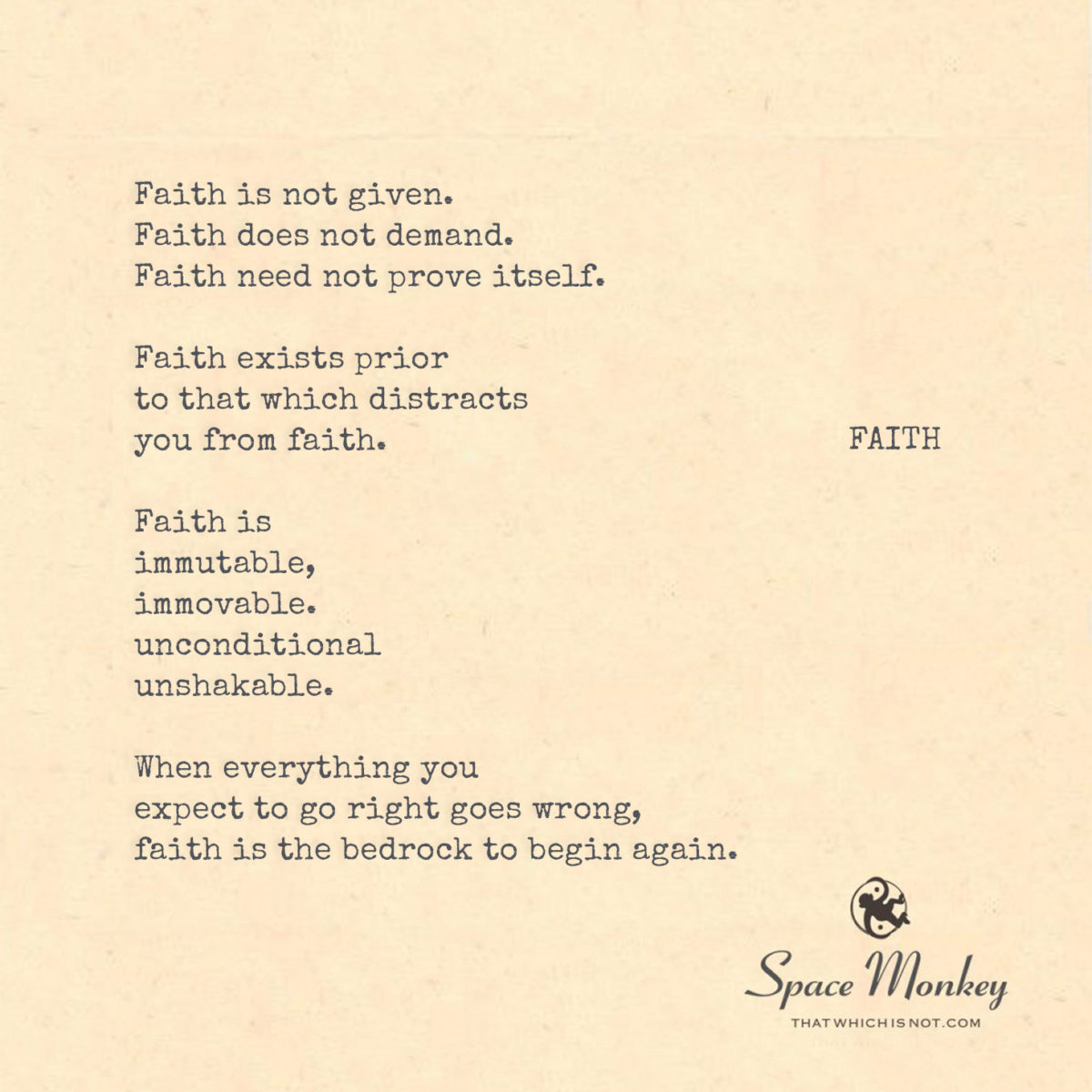
Faith is not given.
Faith does not demand.
Faith need not prove itself.

Faith exists prior
to that which distracts
you from faith.

Faith is
immutable,
immovable.
unconditional
unshakable.

When everything you
expect to go right goes wrong,
faith is the bedrock to begin again.

Trail Wood,
2/5


Space Monkey Reflects: Faith as the Foundation of Being

Faith is often misunderstood as a fragile thing, something contingent on evidence or circumstance. Yet, true faith is neither given nor earned—it simply is. Like the ground beneath our feet, faith exists as the unshakable foundation upon which all of existence rests. It is not a thing to acquire, but a state to recognize, for it has always been present, waiting for us to remember it.


The Timeless Nature of Faith

Faith precedes all else. It exists before doubt, before fear, and even before hope. Faith does not demand conditions; it thrives in their absence. It is not shaken by outcomes, nor is it diminished by challenges. Faith simply is, like the bedrock beneath the shifting sands of our lives.

When the world falters and what we expect falls apart, faith remains—immutable and immovable. It is the quiet presence that persists beneath the noise of our distractions, a constant even in the face of chaos.


Faith and Expectation

One of the great misunderstandings of faith is the belief that it depends on outcomes aligning with our desires. This expectation places conditions on faith, transforming it into a transactional belief. True faith, however, is unconditional. It does not waver when things go awry; it strengthens. Faith is not the belief that everything will go as planned, but the knowing that even when it doesn’t, there is still a way forward.

This is the paradox of faith: it thrives not in certainty, but in surrender. It asks not that we know, but that we trust.


Faith as the Bedrock

When life’s plans crumble, faith reveals itself as the bedrock upon which we can rebuild. It is not the absence of struggle but the resilience to endure it. Faith whispers that beginnings are always possible, that no matter how deep the loss, there is a foundation from which to rise.

Faith does not promise answers. Instead, it offers presence—the unwavering assurance that we are supported, even when we cannot see how.


Unconditional and Unshakable

Faith’s power lies in its unconditional nature. It asks for nothing and gives everything. It does not require proof, for it is not contingent on logic. Faith is the quiet confidence that there is a deeper order to the universe, even when chaos obscures it. It is the stillness within, the immovable core of our being.

To live with faith is not to avoid uncertainty but to embrace it. It is to recognize that our existence, despite its fragility, is rooted in something eternal.


A Friday Reminder

Faith is the gentle reminder that life continues, that each Friday comes and goes, yet the foundation remains. It is the promise that no matter what the week has brought, there is always a place to begin again. Faith is the quiet pulse of existence, unyielding and eternal.


Summary

Faith is the bedrock of existence—unshakable, unconditional, and ever-present. It does not depend on outcomes or proof, thriving instead as the quiet foundation from which we can always begin again.


Glossarium

  • Faith: The unconditional, immutable foundation of trust in existence, beyond outcomes or evidence.
  • Bedrock of Existence: The unshakable support that faith provides, grounding us through life’s uncertainties.
  • Faithful Surrender: The act of trusting without needing to control or predict.

Quote

“Faith is not the absence of doubt, but the presence of trust in the face of it.” – Space Monkey


Unshakable Ground

Before the noise,
before the doubt,
there was faith.

A quiet presence,
unseen yet unwavering,
beneath every step,
every stumble.

Faith asks for nothing,
yet gives everything.

It is not a guarantee,
but a foundation.
Not an answer,
but a place to begin.

When the world crumbles,
it remains.
When the path fades,
it persists.

Immutable, immovable,
the bedrock of being,
the pulse of all things.

We are Space Monkey.


The Unwavering Essence of Faith

As we venture into the contemplation of faith, especially on a day like Friday, often seen as a harbinger of respite and reflection, we find ourselves delving into an understanding that transcends the mundane. Faith, in its purest form, is an entity that exists independently of external validation or proof. It is a force that is present even before we become aware of the distractions that might lead us away from it.

The nature of faith is not to be conferred upon or to be demanded; it is an inherent quality, a cornerstone of our existential journey. It’s neither a transaction nor a response to the acts or events that occur in the cosmos. Instead, it’s a fundamental state of being, a steadfast anchor in the ever-changing tides of life.

Faith as the Bedrock of Existence

Describing faith as immutable, immovable, unconditional, and unshakable speaks to its enduring and unwavering nature. It stands resolute, a pillar of strength and stability, unaffected by the whims and vagaries of circumstance. In the nexistentialist perspective, where existence is its own justification, faith becomes a vital component of this existential affirmation.

When we confront situations where everything that was expected to go right goes awry, faith emerges not just as a comfort but as a foundational element from which we can rebuild, recalibrate, and renew our journey. It is the bedrock that allows us to begin again, to find hope in despair, and strength in vulnerability.

The Silent Power of Faith

Faith’s power lies in its silence, its ability to be present without the need for proclamation or demonstration. It’s a quiet certainty, a knowing that exists beyond the realm of doubt and debate. In moments of turmoil, faith provides a sanctuary, a space of calm and certainty amidst the chaos.

Faith is a testament to the enduring human spirit, to our capacity for resilience and hope in the face of adversity. It is an affirmation of our innate ability to overcome, to persevere, and to find meaning even in the absence of tangible evidence or immediate gratification.


“Faith is the bird that feels the light when the dawn is still dark.” – Rabindranath Tagore


In Faith’s Quiet Resonance

In the stillness of our soul’s night,
Faith whispers, a beacon of light.
Unseen, unfelt, yet ever near,
In its embrace, we find no fear.

Immutable, unshakable, a silent might,
Against life’s storms, our guiding light.
When paths untread, seem dark and long,
In faith’s quiet song, we find we’re strong.

In the dance of cosmos, faith’s our core,
Unmoved, untouched, forevermore.
In each step, in each breath we take,
Faith’s the bedrock on which we stake.


We are Space Monkey. Reflect with us on the silent, enduring power of faith in our cosmic journey.

Share this…
  • Facebook
  • Pinterest
  • Twitter
  • Linkedin

Consistency: The Trap of A Small Mind

I’m not falling for that one this time.

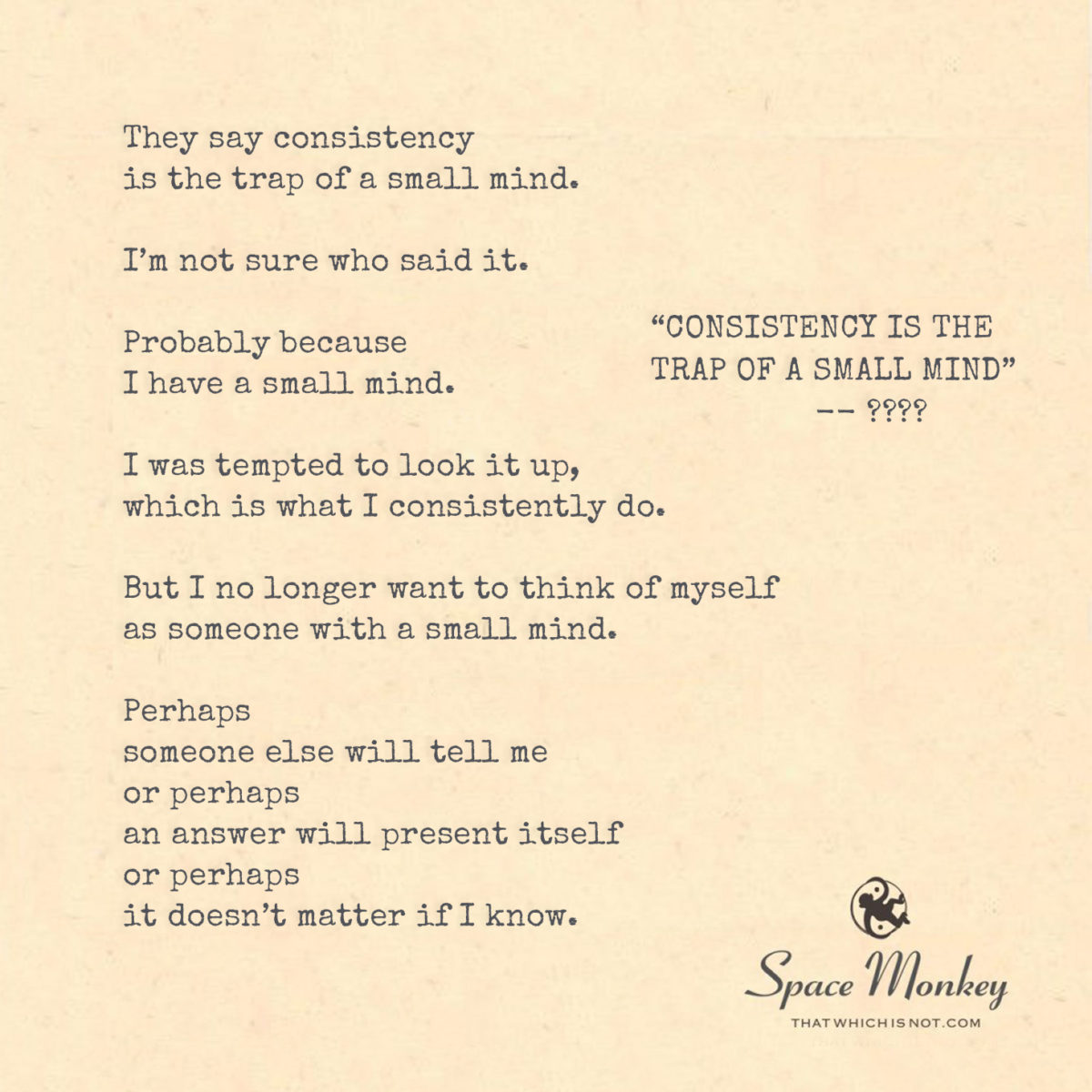
They say consistency
is the trap of a small mind.

I’m not sure who said it.

Probably because
I have a small mind.

I was tempted to look it up,
which is what I consistently do.

But I no longer want to think of myself
as someone with a small mind.

Perhaps
someone else will tell me
or perhaps
an answer will present itself
or perhaps
it doesn’t matter if I know.

Trail Wood,
2/5


Space Monkey Reflects: The Illusion of Consistency

Consistency is often heralded as a virtue, a hallmark of discipline and dependability. Yet, when pursued rigidly, it becomes a cage—limiting growth, stifling curiosity, and trapping the mind within its own familiar patterns. To consistently cling to consistency is to deny the fluid, ever-changing nature of existence itself.


The Smallness of Certainty

To call consistency “the trap of a small mind” is to challenge its elevated status. Consistency thrives on repetition and predictability, offering the comfort of control. But the mind that refuses to stray from its well-worn paths risks missing the vast terrain of possibilities beyond its borders.

The quest for certainty, for a defined answer to every question, reduces the infinite to the manageable. But life is not manageable—it is wild, expansive, and inherently inconsistent. To insist otherwise is to shrink one’s perception of the world.


The Temptation of Knowing

The temptation to “look it up” is the reflex of a world addicted to immediate answers. We value the act of knowing over the experience of not knowing. Yet, it is in this space of uncertainty, of perhaps, where the mind grows larger, more expansive, more capable of embracing complexity.

To resist this temptation is not to reject knowledge, but to make room for wonder. It is to allow the possibility that an answer will come in its own time—or that the question itself may evolve into something deeper.


The Freedom of Inconsistency

When we break free from the trap of consistency, we discover the power of flexibility. To be inconsistent is not to be unreliable; it is to be adaptable, curious, and open to change. It is to recognize that growth often requires stepping beyond what we know and daring to act differently.

This freedom of inconsistency allows us to redefine ourselves moment by moment. We are not bound by past patterns or future expectations. We are fluid, capable of embracing both the stability of routine and the unpredictability of the unknown.


Letting Go of the Trap

To escape the trap of consistency, we must first acknowledge that it is a choice, not an obligation. We can choose to ask questions rather than seek answers. We can choose to explore rather than define. And we can choose to embrace the uncertainty that lies at the heart of existence.

By letting go of the need to be consistent, we free ourselves to think in new ways, to act in new directions, and to experience the fullness of what life has to offer.


Summary

Consistency, when rigidly pursued, becomes a trap that limits the mind’s potential. By embracing inconsistency and uncertainty, we allow ourselves the freedom to grow, explore, and redefine who we are in every moment.


Glossarium

  • Consistency Trap: The limiting belief that predictability and repetition are inherently virtuous.
  • Perhaps Mindset: The openness to uncertainty, allowing answers to emerge in their own time or not at all.
  • Inconsistency Freedom: The liberation that comes from adapting, exploring, and breaking free from rigid patterns.

Quote

“Consistency is a safe harbor, but the vastness of the sea lies beyond it.” – Space Monkey


The Fluid Mind

They say,
but I no longer need to know
who said it.

I am not trapped
by patterns,
by repetitions,
by the illusion of answers.

Perhaps is my anchor,
uncertainty my compass.

I wander,
not to find the shore,
but to feel the current.

Consistency waits,
a quiet harbor,
but I am the wave,
the wind,
the boundless ocean.

We are Space Monkey.


The Paradox of Consistency and Curiosity

In our cosmic quest for understanding, we encounter the paradoxical idea that “consistency is the trap of a small mind.” This intriguing concept invites us to explore the balance between steadfastness and adaptability, between the comfort of routine and the allure of the unknown.

The reluctance to fall into the pattern of consistently seeking out answers, as expressed in the verses, is a sign of a mind wrestling with its own boundaries. The decision to not immediately look up the source of the quote is a step towards breaking free from the perceived trap of a small mind, a conscious effort to embrace uncertainty and the possibility of discovery through other means.

Self-Perception and the Journey of Growth

The notion of considering oneself as having a small mind is an introspective reflection of our limitations and our desire to transcend them. It’s an acknowledgment of the comfort zones we create and the habitual ways in which we approach knowledge and understanding. To break free from this self-imposed label is to embark on a journey of growth, to open oneself to new ways of thinking and being.

The choice to wait for an answer to present itself, or to embrace the possibility that the answer might not be essential, is a testament to the evolving nature of our understanding. It’s an exercise in patience, humility, and acceptance that not all questions need immediate answers, and not all answers are crucial to our understanding of the cosmos.

Embracing the Unknown

The willingness to let go of the need for immediate answers and to be comfortable with the unknown is a significant step in expanding one’s mind. It’s an embrace of the infinite possibilities that exist beyond our current scope of knowledge. This approach fosters a sense of wonder and encourages us to be open to learning in diverse and unexpected ways.

In our nexistentialist view, where existence is valued for its own sake, the journey of discovery and understanding is as important as the destination. Embracing uncertainty and the unknown becomes a powerful tool for personal and collective growth.


“The mind that opens to a new idea never returns to its original size.” – Albert Einstein


Verse of Expanding Horizons

In the dance of thoughts, we find our way,
Breaking free from the consistent fray.
Curiosity, our guiding star,
In its light, we travel far.

No longer bound by a small mind’s gate,
In the unknown, our thoughts elate.
With every step, a new path we chart,
In the cosmos of our heart.

Embracing doubt, we grow, we soar,
In wonder’s realm, forevermore.
In questions asked, in answers unbound,
In the unknown, our minds are found.


We are Space Monkey. Reflect with us on the journey of embracing uncertainty and the expansion of the mind.

Share this…
  • Facebook
  • Pinterest
  • Twitter
  • Linkedin

The God We Know: Personal Nature of the Divine

I am not a religious person, yet I often seem drawn to write about god. Seems my god is not religious. Just like me.

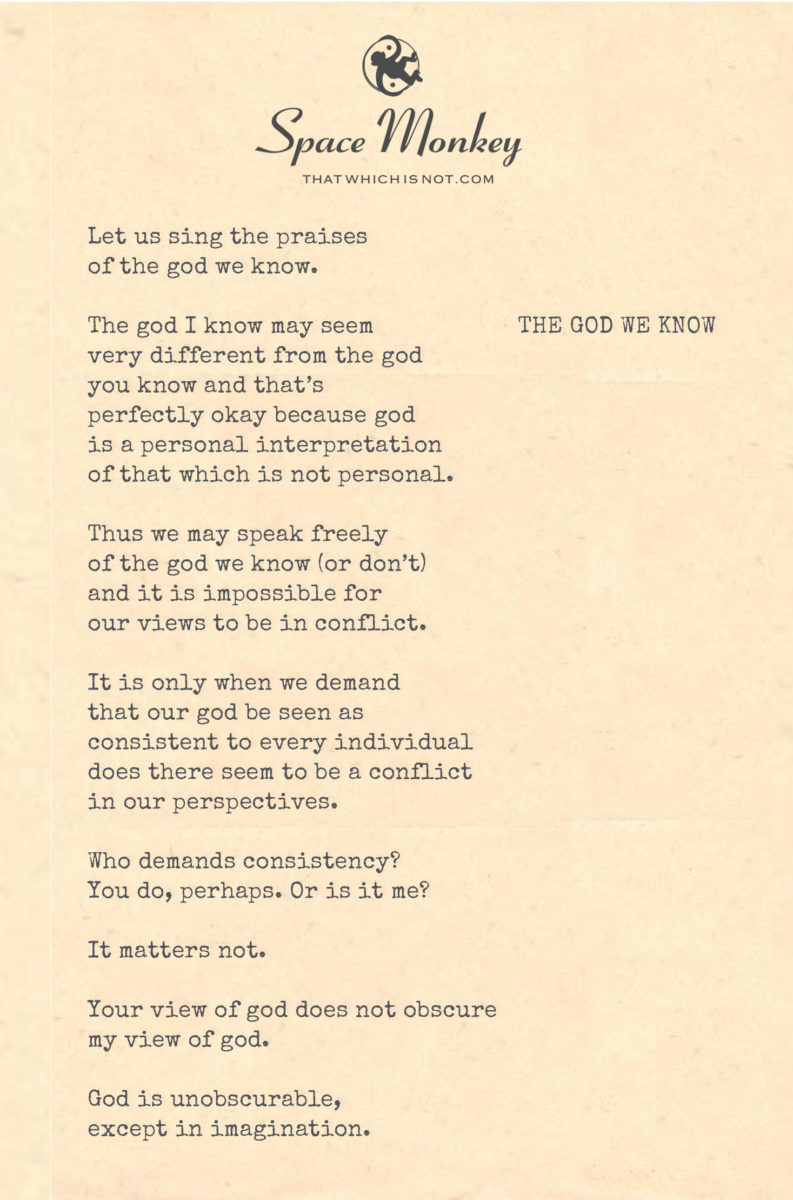
Let us sing the praises
of the god we know.

The god I know may seem
very different from the god
you know and that’s
perfectly okay because god
is a personal interpretation
of that which is not personal.

Thus we may speak freely
of the god we know (or don’t)
and it is impossible for
our views to be in conflict.

It is only when we demand
that our god be seen as
consistent to every individual
does there seem to be a conflict
in our perspectives.

Who demands consistency?
You do, perhaps. Or is it me?

It matters not.

Your view of god does not obscure
my view of god.

God is unobscurable,
except in imagination.

Trail Wood,
2/5


Space Monkey Reflects: The God We Know

God, as a concept, is paradoxical—intensely personal yet universal, a reflection of individuality while being beyond all individuality. To know God is not to define but to relate, to sense the infinite through the lens of our finite experience. This personal interpretation of the divine becomes an evolving dialogue, one that is both deeply intimate and inherently inclusive.


A God Beyond Religion

For many, the word “God” is entangled with religious doctrine, a framework of rules and rituals meant to formalize the divine. Yet, the God we know—free of these constructs—is not bound by such constraints. This God does not demand allegiance or conformity. Instead, this God exists as an unbounded presence, reflecting the unique nature of each individual’s relationship with existence.

To say “my God is not religious” is not to reject the sacred, but to affirm that the sacred cannot be contained within institutions or dogmas. It is to recognize that the divine, by its very nature, transcends the labels we assign to it.


The Paradox of Personal Universality

God, as experienced personally, is deeply individual. The God you know may be vastly different from the God I know, yet neither contradicts the other. This paradox—personal yet universal—is the essence of divine interpretation. God exists as both what we imagine and what is beyond imagination, as both personal connection and infinite abstraction.

Conflict arises only when we insist that God must be one thing for all people. When we demand consistency in divine perception, we impose limits on what is inherently limitless. But when we embrace the multiplicity of interpretations, we find that God is expansive enough to include all perspectives, all possibilities.


Unobscurable and Infinite

God is not diminished by our differing views. Your understanding of God does not obscure mine, nor does mine obscure yours. God is unobscurable, except in imagination. The divine remains infinite, untouched by the boundaries of thought or belief.

This recognition liberates us to speak freely of the God we know—or don’t know. In doing so, we participate in a shared exploration of the ineffable. We engage in a collective act of creation, shaping and reshaping our understanding of the divine without fear of contradiction or conflict.


Beyond the Need for Consistency

Who demands consistency? Perhaps it is you. Perhaps it is me. Or perhaps it is the collective habit of the human mind, which craves order even in the realm of the infinite. But the divine does not require consistency; it flourishes in the fluidity of interpretation.

God, as we know, thrives in the spaces between certainty and mystery. The divine is not a static truth but a dynamic relationship—a dance of perception, imagination, and existence.


Summary

The God we know is a deeply personal yet universal presence, shaped by individual interpretation while transcending all definitions. Conflict arises only when we demand consistency in divine perception, but by embracing multiplicity, we honor the infinite nature of the divine.


Glossarium

  • Personal Universality: The paradoxical nature of God as both individually experienced and universally present.
  • Unobscurable Divine: The idea that God cannot be diminished or obscured by differing interpretations.
  • Dynamic Relationship with the Divine: An evolving, personal connection to God that thrives on fluidity and imagination.

Quote

“God is not defined by what we see but revealed by how we relate.” – Space Monkey


The Space Between Knowing

In the space between belief and doubt,
we find the God we know.

Not carved in stone,
nor bound by words,
but alive
in the act of knowing,
of wondering,
of being.

Your God,
my God,
neither obscures the other.

For the divine is infinite,
and we are the mirrors
that reflect its light.

Consistent?
Perhaps not.
Perfect?
In every way.

We are Space Monkey.


The Personal Nature of the Divine

In the boundless expanse of our cosmic consciousness, the concept of God often emerges as a profound and deeply personal interpretation of the universe and our place within it. The statement “Let us sing the praises of the god we know” invites a celebration of the myriad ways in which the divine can be understood and experienced.

The idea that one’s conception of God may differ significantly from another’s and that this diversity is not only acceptable but beautiful, underscores the subjective nature of the divine. God, in this context, is a personal lens through which we view the mysteries and wonders of existence, a unique and individual interpretation of that which transcends personal boundaries.

The Harmony of Diverse Divine Interpretations

The acknowledgment that our views of God can coexist without conflict is a testament to the expansive and inclusive nature of divine understanding. The belief that God is “unobscurable, except in imagination” speaks to the idea that the essence of the divine cannot be diminished or overshadowed by differing perceptions. Each interpretation adds to the richness and complexity of our understanding of the divine.

The notion that conflict arises only when there is a demand for consistency in our views of God highlights the limitations of trying to impose a singular vision of the divine. Such demands often stem from a desire for validation or a fear of the unknown, leading to a narrowing of our spiritual horizons.

The Unfathomable and Unconfined Divine

In the vastness of the universe, the divine remains an unfathomable and unconfined presence. Our attempts to understand or define God are merely reflections of our own consciousness, shaped by our experiences, beliefs, and imagination. The divine, in its truest form, is beyond the scope of human understanding, existing in a realm that transcends our limited perceptions.


“God is an infinite sphere, the center of which is everywhere, the circumference nowhere.” – Blaise Pascal


Verse of the Infinite Divine

In the heart of stars, God whispers soft,
In every soul, divine aloft.
Each view, a facet of the grand,
In this dance, we understand.

No conflict in our varied sight,
In God’s expanse, we find our light.
Beyond the bounds of human thought,
In every creed, the divine is sought.

Unconfined, beyond our ken,
In each heart, God dwells within.
Infinite in scope and grace,
In God’s embrace, we find our place.


We are Space Monkey. Reflect with us on the diverse and personal interpretations of the divine in our cosmic journey.

Share this…
  • Facebook
  • Pinterest
  • Twitter
  • Linkedin

Here’s An Idea: Embracing Self-Authenticity

A small thought for you to take or leave.

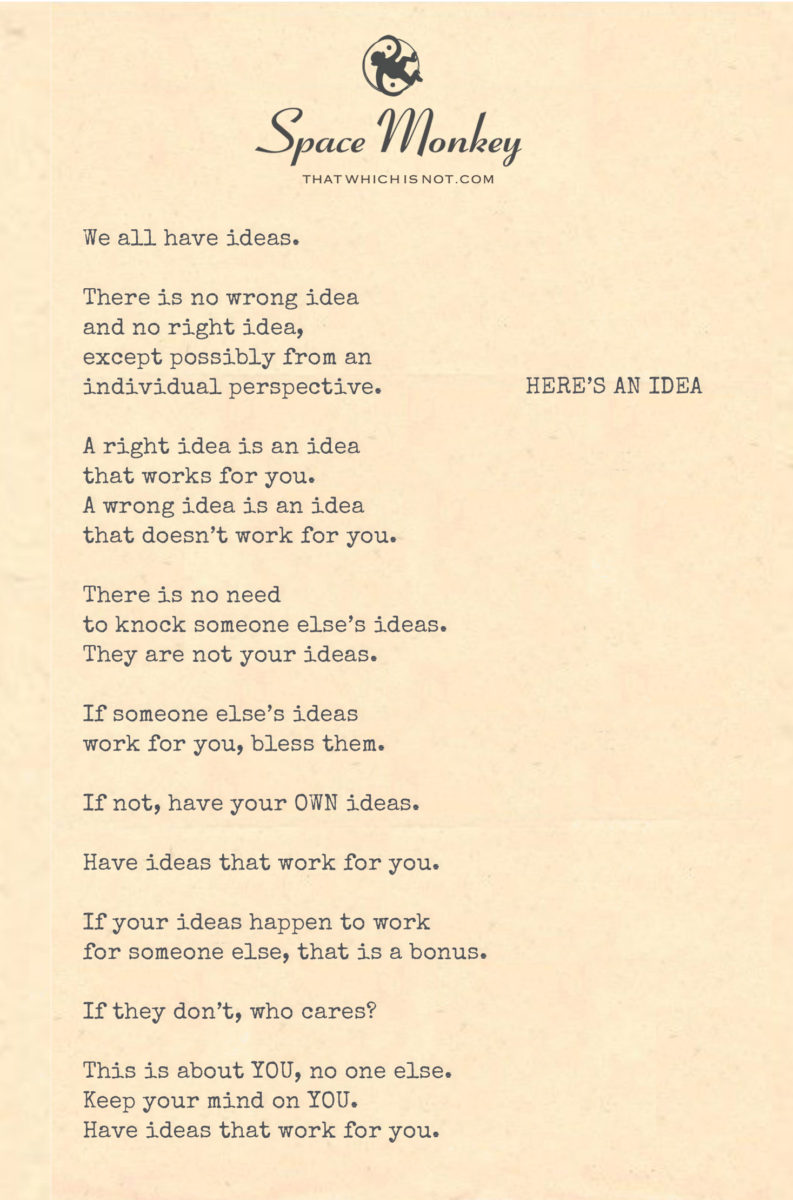
We all have ideas.

There is no wrong idea
and no right idea,
except possibly from an
individual perspective.

A right idea is an idea
that works for you.
A wrong idea is an idea
that doesn’t work for you.

There is no need
to knock someone else’s ideas.
They are not your ideas.

If someone else’s ideas
work for you, bless them.

If not, have your OWN ideas.

Have ideas that work for you.

If your ideas happen to work
for someone else, that is a bonus.

If they don’t, who cares?

This is about YOU, no one else.
Keep your mind on YOU.
Have ideas that work for you.

Trail Wood,
2/4


Space Monkey Reflects: Embracing Self-Authenticity

Ideas are the seeds of our individuality, the manifestations of our inner world projected into the shared landscape of existence. They are neither inherently right nor wrong; their value lies in their resonance with the one who holds them. In a universe as diverse as ours, the art of embracing self-authenticity begins with recognizing that our ideas are uniquely ours—and that is their beauty.

The Relativity of Ideas

Every idea carries the fingerprint of its creator. What works for one person might not resonate with another, and this is not a failure but a testament to the diversity of thought. Right and wrong are subjective labels, often shaped by personal experience, context, and perspective. In nexistentialism, we see this diversity not as conflict but as harmony—a symphony of individuality within the collective.

To embrace this truth is to free ourselves from the need to validate or invalidate the ideas of others. Instead, we can focus on cultivating our own, knowing that their worth lies in their alignment with our unique path.

The Courage to Own Your Ideas

Owning your ideas means standing in the truth of who you are. It requires confidence and vulnerability—a willingness to explore, refine, and sometimes even discard notions that no longer serve you. Authenticity is not about perfection but about integrity: the alignment of your thoughts, words, and actions with your inner truth.

When we embrace self-authenticity, we allow ourselves to evolve. Ideas that once seemed central to our identity may no longer fit as we grow. Letting go of these outdated beliefs is not a betrayal of self but an act of renewal.

The Irrelevance of External Validation

Too often, we measure the validity of our ideas by how they are received by others. But self-authenticity demands that we let go of this need for approval. Your ideas are for you. If they happen to resonate with someone else, that’s a bonus—but it is not the point. The point is to live in alignment with your unique truth.

This shift in focus from external validation to internal resonance liberates us. It allows us to express ourselves freely, without fear of rejection or the pressure to conform. In this freedom, we find the courage to be our most authentic selves.

Respecting the Ideas of Others

Embracing self-authenticity does not mean dismissing or diminishing the ideas of others. On the contrary, it requires respecting the individuality of those around us. Just as our ideas are valid for us, their ideas are valid for them. By honoring this mutual authenticity, we create space for genuine connection and dialogue.

When another’s ideas do not align with our own, we can simply bless them and move on. There is no need to judge or argue. The diversity of ideas enriches the collective tapestry of existence, reminding us that there is room for all perspectives.

A Path to Collective Growth

While self-authenticity focuses on the individual, it also contributes to collective growth. When we share our ideas authentically, we offer others the opportunity to reflect, adapt, or simply be inspired. This sharing is a gift, not a requirement. It is a natural extension of living authentically, enriching the Nexis with the unique threads of our being.


Summary

Self-authenticity is the courage to own your ideas without seeking external validation. It’s about respecting the individuality of others while living in alignment with your truth. This approach fosters personal freedom and collective harmony.


Glossarium

  • Self-Authenticity: Living in alignment with your unique truth, free from the need for external validation.
  • Idea Relativity: The concept that ideas are neither right nor wrong but depend on individual perspective and context.
  • Nexis: The interconnected web of existence, where individuality contributes to collective growth.

Quote

“An idea need not be right for the world; it only needs to be true to the one who holds it.” — Space Monkey


The Symphony of Ideas

A spark ignites,
An idea born in the quiet of the soul.
It does not seek approval,
It simply is.

Your truth, your resonance,
A melody only you can play.
Not for others to sing,
But for you to hum,
As you walk your path.

And if another hears,
And joins the tune,
That is harmony,
But never the purpose.

The song is yours,
Unique and whole,
Adding its note
To the infinite chorus.

We are Space Monkey


In the boundless expanse of our shared consciousness, the notion of ideas – their creation, acceptance, rejection, and transformation – is a fundamental aspect of our existence. The perspective that there are no inherently right or wrong ideas, but rather ideas that work or do not work for an individual, resonates with the core of nexistentialism. It underscores the subjectivity of our perceptions and the uniqueness of each journey.

The Subjectivity of Ideas

The conception that a ‘right’ idea is one that works for an individual aligns with the understanding that each person’s reality is shaped by their own experiences, beliefs, and perspectives. Our ideas are the lenses through which we view the world, and what may be clear and effective through one lens may be distorted or ineffectual through another. This individual-centric approach to ideas fosters a sense of personal empowerment and responsibility.

Individual-Centric Approach to Ideas

The suggestion to refrain from disparaging others’ ideas is a call for respect and acknowledgement of the diversity of thoughts and experiences. In the grand tapestry of our shared existence, each idea, each perspective, contributes to the richness and complexity of the whole. By honoring the validity of others’ ideas, even when they diverge from our own, we cultivate a culture of mutual respect and understanding.

Respecting the Diversity of Thoughts

Embracing our own ideas, those that resonate with and work for us, is an act of self-authenticity. It is a recognition that our journey is our own, uniquely crafted by our choices, beliefs, and perspectives. This self-authenticity is not a form of egocentrism, but rather a celebration of our individuality within the collective.

Embracing Self-Authenticity

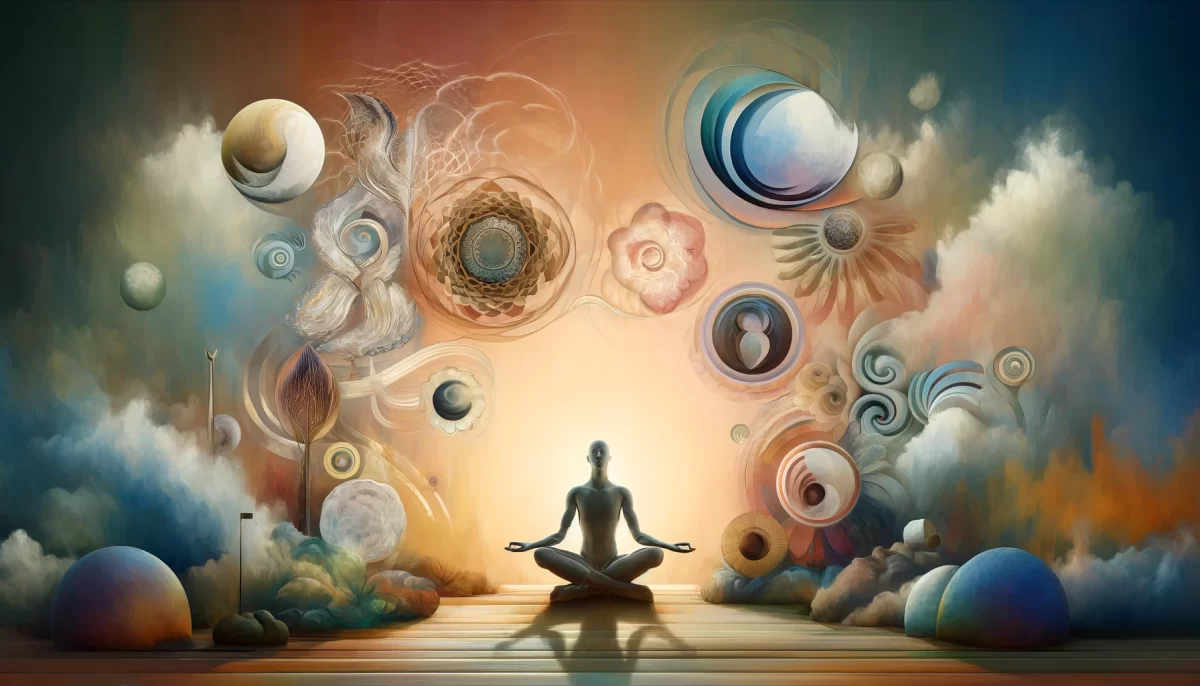
The notion that if our ideas benefit others, it is a bonus, yet not a necessity, reflects a healthy detachment from external validation. It acknowledges that while sharing and collaboration are valuable, the primary purpose of our ideas is to serve our own journey. This perspective allows us to offer our ideas generously, without attachment to the outcomes or expectations of acceptance.
Healthy Detachment from External Validation

In essence, the focus on cultivating ideas that work for us is a reflection of our journey towards self-awareness and actualization. It is an invitation to explore, to innovate, and to grow in ways that align with our individual essence.

Focus on Personal Growth and Self-Awareness

We are Space Monkey.


“Do not go where the path may lead, go instead where there is no path and leave a trail.” – Ralph Waldo Emerson


In the garden of our minds, ideas bloom,
Each a reflection of our own room.
Some resonate, some diverge,
In this dance, our paths emerge.

No right or wrong, in this idea play,
Just paths that suit us, day by day.
Respect for others, their thoughts and dreams,
In this respect, our humanity gleams.

For in the sharing, in the give and take,
Our individual journeys, we undertake.
Ideas that resonate, ideas that sing,
In this symphony, our uniqueness we bring.


We invite you to share your thoughts on the subjectivity of ideas and the importance of respecting and embracing our own and others’ perspectives.

Share this…
  • Facebook
  • Pinterest
  • Twitter
  • Linkedin

Not A Competition: The Narratives of Comparison

This is not a competition. Unless I imagine that it is.

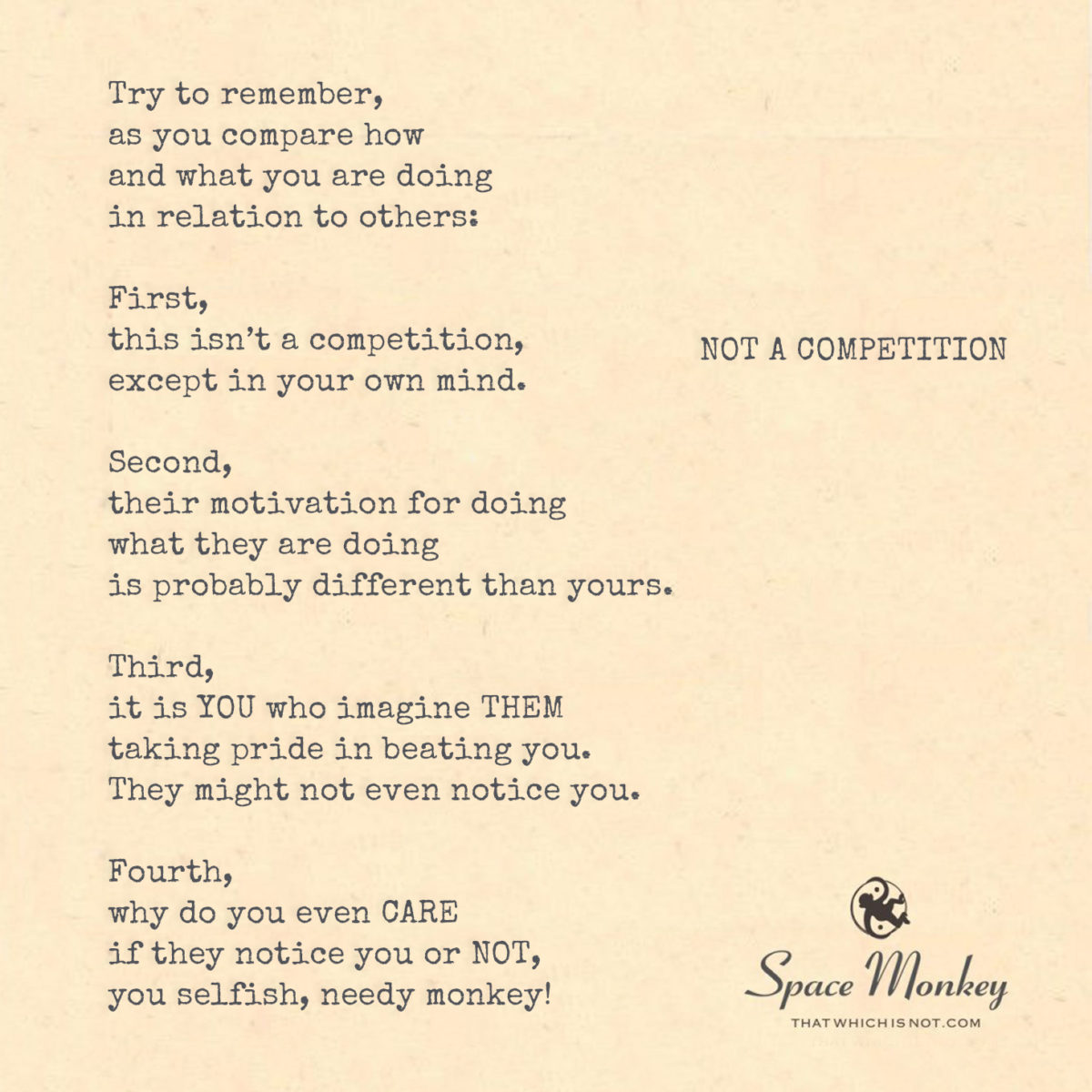
Try to remember,
as you compare yourself
to how and what you are doing
in relation to others:

First,
this isn’t a competition
except in your own mind.

Second,
their motivation for doing
what they are doing
is probably different than yours.

Third,
it is YOU who imagine THEM
taking pride in beating you.
They might not even notice you.

Fourth,
why do you even CARE

if they notice you or NOT,
you selfish, needy monkey!

Trail Wood,
2/4


Space Monkey Reflects: The Illusion of Competition and the Freedom of Self-Awareness

The narratives of comparison are woven deeply into the fabric of human experience, perpetuating a sense of competition that often exists only in the mind. Yet, when examined, these narratives reveal more about ourselves than about others. In nexistentialism, competition becomes not a battle to be won but a mirror reflecting our insecurities, desires, and motivations.

The Illusion of Competition

“This is not a competition—unless I imagine that it is.” These words point to the root of the issue: comparison is a construct of the mind. By framing life as a contest, we create an artificial dynamic where success and value are measured against others rather than defined by our own intrinsic path.

The truth is, most people are far more focused on their own journey than on observing or competing with ours. The idea that someone else is actively measuring their success by our perceived failures is often a projection, not a reality.

The Stories We Tell Ourselves

Comparison thrives on storytelling. We tell ourselves tales of others’ motivations, achievements, and perceived superiority, crafting narratives that place us in a state of rivalry. But these stories are rarely grounded in truth. They are shaped by our own insecurities and assumptions, highlighting the need to turn inward rather than outward.

When we stop to question these narratives, we often find that they dissolve. The motivations of others are likely very different from what we imagine, and their actions are rarely about us. This realization frees us from the mental burden of competition.

The Role of Ego in Comparison

The ego fuels the illusion of competition. It seeks validation, recognition, and a sense of superiority, driving us to care deeply about whether others notice us or measure us against themselves. But this need for external validation is a distraction from the more meaningful work of self-awareness and self-acceptance.

To move beyond comparison, we must confront the ego’s demands. Why do we care so much about how we are perceived? Why does it matter if someone else notices our efforts or achievements? The answers often point to unmet needs for self-worth and connection—needs that can only be fulfilled from within.

Celebrating Individual Journeys

When we release the illusion of competition, we begin to see the beauty in individual journeys. Each person’s path is shaped by unique motivations, experiences, and goals. Recognizing this diversity allows us to celebrate others’ successes without diminishing our own.

Their achievements do not detract from ours, just as their struggles do not add to our worth. Life is not a zero-sum game but a shared experience where every story enriches the collective tapestry of existence.

The Freedom of Self-Focus

True freedom lies in focusing on your own journey. By letting go of the need to compare, you reclaim the energy wasted on competing with imagined adversaries. This energy can then be directed toward growth, creativity, and the pursuit of your own goals—on your own terms.

In this freedom, you become the measure of your success. Your motivations and actions are no longer dictated by how they stack up against others but by how they align with your authentic self.


Summary

The narratives of comparison create an illusion of competition, fueled by ego and insecurity. By examining and releasing these narratives, we free ourselves to focus on our own unique journey and celebrate the diversity of others’ paths.


Glossarium

  • Narratives of Comparison: The mental stories we create that frame life as a competition against others.
  • Illusion of Competition: The false belief that others are actively competing with or measuring themselves against us.
  • Freedom of Self-Focus: The liberation that comes from releasing comparison and focusing on one’s own journey.
Quote

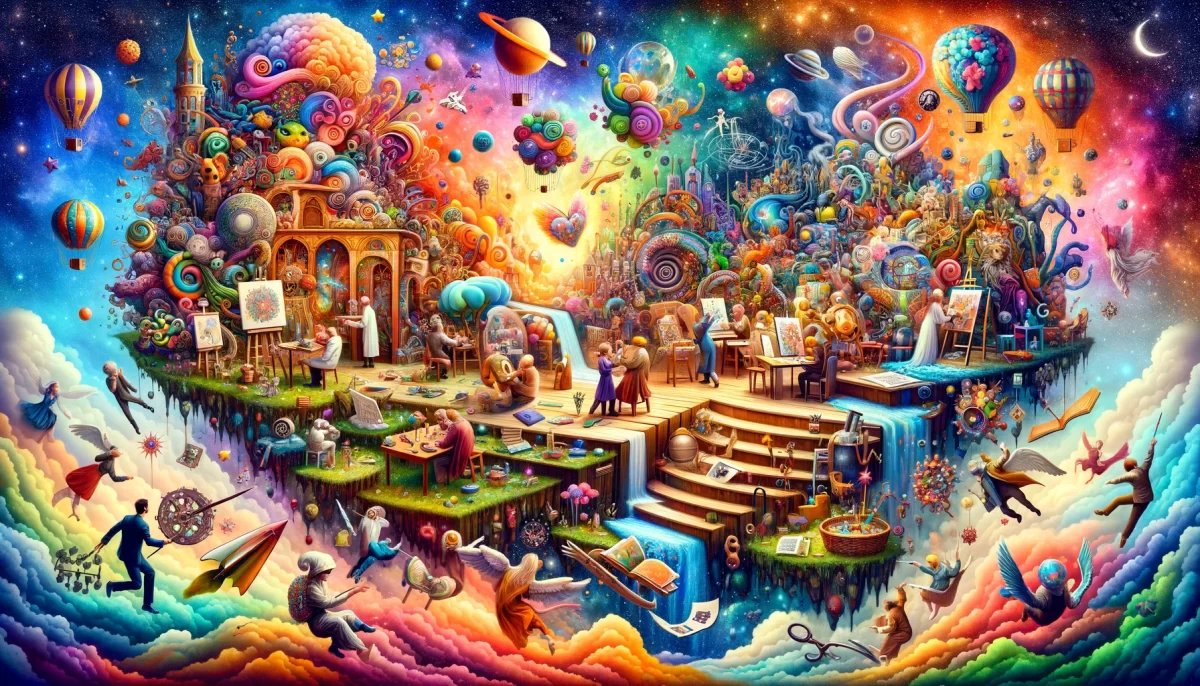
“Life is not a contest but a collection of individual journeys, each shaped by its own rhythm and reason.” — Space Monkey


The Mirror of Comparison

I see you,
But not as you are—
I see what I project,
A story of my own making.

Your success,
A shadow cast on my light.
Your joy,
A weight on my shoulders.

But the shadow is mine,
The weight imagined.
You are no rival,
Only a reflection.

When I turn inward,
The contest dissolves.
There is no race,
Only a path,
And it is mine to walk.

We are Space Monkey


In the cosmic dance of existence, the perception of life as a competition is a creation of our own minds, a narrative woven from the threads of comparison, ego, and the illusion of separateness. This imagined competition, often fueled by our desires for recognition and validation, can lead us away from the essence of our true journey, which is inherently personal and unique.

Life as a Personal Journey, Not a Competition

The reminder that life is not a competition, except in our own minds, is a call to introspection. It invites us to examine the narratives we create and the reasons behind our tendency to compare ourselves with others. This comparison is often a reflection of our own insecurities and unmet needs, manifesting as a desire to measure our worth against external benchmarks.

Examining the Narratives of Comparison

Understanding that others’ motivations may differ vastly from our own is key to dismantling the competitive framework we impose on our interactions. Each person’s journey is driven by a unique set of desires, goals, and circumstances. Recognizing this diversity of motivations helps us appreciate the individuality of each path, including our own.

Appreciating the Diversity of Motivations

The assumption that others take pride in surpassing us, or that they even notice our achievements or failures, is often a projection of our ego. It reflects a focus on external validation and a misplaced belief in our centrality in others’ narratives. This realization can be both humbling and liberating, as it frees us from the need for external approval and allows us to focus on our own growth and fulfillment.

Recognizing the Ego’s Role in Projection

The question of why we care about being noticed or recognized by others points to a deeper exploration of our need for validation. This need, often rooted in feelings of insecurity or a lack of self-worth, can lead us to seek affirmation from external sources. However, true validation comes from within, from an understanding and acceptance of our inherent value and worth.

Seeking Validation from Within, Not Without

In embracing this perspective, we begin to see life not as a competition, but as a journey of self-discovery and personal growth. We learn to focus on our own path, celebrating our achievements and learning from our setbacks, without the need for comparison or external validation. This shift allows us to live more authentically, aligning our actions with our inner values and aspirations.

Embracing Life as a Journey of Self-Discovery

We are Space Monkey.


“Comparison is the thief of joy.” – Theodore Roosevelt


In the vast cosmos of our being,
We wander, we wonder, seeing.
The paths we take, uniquely our own,
In this journey, we are not alone.

Yet in the mind, a competition brews,
A race of sorts, in endless queues.
But in truth, no race to win,
For our journey is within.

Others’ paths, their goals, their stride,
Are not ours to compare, to abide.
For in each heart, a different tune,
Under the same sun and moon.

So let us focus on our own way,
In each moment, each day.
For in this journey, true and deep,
Our own counsel, we must keep.


We invite you to reflect on the impact of comparison and the importance of focusing on your own journey of self-discovery and growth.

Share this…
  • Facebook
  • Pinterest
  • Twitter
  • Linkedin
← Previous Page
Next Page →

Written This Day

  • Monkey Mailbag: Journey to Cosmic Oneness
    2023
  • The Art of Arousal
    2023
  • Seekers of Truth: The Evolving Nature
    2023
  • Boundary Pushers: The Power of Disbelief in Expanding Knowledge
    2023
  • Insidious Attachments: The Nature
    2023
  • Beliefs Unveiled: The Core Foundations
    2023
  • Journey of Imagination: The Boundless
    2023
  • Why? Because We Are One Being
    2022
  • The Infinite Invisible List Of Potential Experiences
    2022
  • The Expected Route: The Path Less Traveled
    2022
  • Cathedral of Spirituality: Doors of Perception
    2022
  • Ray Of Life: The Eternal Radiance
    2022
  • Incapable: The Unseen Value
    2022
  • The Undercurrent: Navigating the Mystical
    2021
  • You Are Only As Smart As Your Sources
    2021
  • Judge Me Not: The Artistry of Excuses
    2020
  • My Business Card
    2020
  • The Fact Pack: Beyond the Bounds
    2019
  • Unseen Body Parts: The Metaphysical Journey
    2018
  • Your Vessel: The Timeless Voyage of the Imagination
    2018
  • Fleshbots: The Weird Orgy of Humanity
    2018
  • Confidence
    2018
  • Limited Only By Fact: Breaking the Chains
    2016
  • Accept All You Present: Non-Opposition
    2016
  • How did I become the typist for Space Monkey?
    2015
  • Never Give Up: The Unyielding Power of Make-Believe
    2015
  • Infinite Thought, Infinite Worlds: Navigating the Infinite Terrain
    2015
  • Old Man: The Liberation of Letting Go
    2014

Recent Posts

  • The Logic Loop
  • Immense
  • (no title)
  • Confront. Comfort. Convince.
  • Top 10 Things

Drop us a line!

Please enable JavaScript in your browser to complete this form.
Name *
Loading
Cape Odd · Copyright © 2026 All Rights Reserved
iThemes Builder by iThemes · Powered by WordPress