• Who Is The Man?
  • Who Is The Monkey?
  • What is Nexistentialism?
  • Poke The Primate

Cape Odd

Home of The Space Monkey Journals

Opposing Evil is Evil


Blindly opposing evil is evil.

“We must always seek the good

which is hidden in everything.”

– Max Heindel

Max Heindel, 

This is an EVIL thought.

To limit ourselves
to ONLY seek the good
is to oppose and deny
at least half of all creation.

To ORDER us with words like MUST,
this is EVIL also.

If we choose to seek the good,
that is good.

But to DEMAND we seek the good,
that is EVIL.

EVIL is unconsciousness.

Seeking the good because we fear
the alternative is EVIL.

Seeking the good because we 
are
CONDITIONED to seek the good is EVIL.

But it’s okay.
EVIL is not as bad as we THINK it is.

Trail Wood,
1/29


In the philosophical examination of the statement “We must always seek the good which is hidden in everything,” we delve into the complex interplay of good, evil, choice, and the nature of moral imperatives. This exploration challenges the notion of an absolute moral directive and opens up a discourse on the dual nature of existence and the role of consciousness in ethical choices.

The Duality of Existence

At the core of this contemplation lies the recognition of the duality inherent in all creation. The argument against limiting ourselves to only seeking the good acknowledges that existence encompasses both positive and negative aspects. To deny or oppose any part of this duality is to deny a fundamental aspect of the whole.

The Nature of Moral Imperatives

The use of the word ‘must’ in the context of seeking good is critiqued for its implicit imposition of an absolute moral imperative. This critique highlights the potential issues with demanding adherence to a specific moral path, as it may limit individual autonomy and the complexity of moral decision-making.

Choice and Consciousness in Moral Pursuits

The distinction between choosing to seek good and being demanded to do so underlines the importance of consciousness and choice in ethical pursuits. The suggestion that seeking good out of fear or conditioning is akin to evil speaks to the deeper issue of unconscious moral actions. It suggests that true moral action should arise from conscious choice and understanding, rather than blind adherence to imposed standards.

Redefining the Understanding of Evil

The statement also invites a redefinition of our understanding of evil. It suggests that evil is not necessarily an absolute state but can be a byproduct of unconsciousness or conditioned responses. This perspective opens up a more nuanced understanding of good and evil, moving away from stark dichotomies towards a more complex moral landscape.

The Relative Nature of Good and Evil

Ultimately, the reflection points to the relative nature of good and evil. It implies that these concepts are not as black and white as often perceived, and their understanding can be fluid, based on perspective, context, and consciousness.

We are Space Monkey.


Summary

We explore the themes of the duality of existence, the nature of moral imperatives, choice and consciousness in moral pursuits, redefining the understanding of evil, and the relative nature of good and evil. This examination challenges the notion of an absolute moral directive to seek good and opens up a discourse on the nuanced interplay between good, evil, and conscious choice.


Glossarium

Duality of Existence: The concept that existence comprises both positive and negative elements.
Nature of Moral Imperatives: The implications and impact of absolute directives in ethical behavior.
Choice and Consciousness in Moral Pursuits: The importance of conscious decision-making and autonomy in moral actions.
Redefining the Understanding of Evil: The idea that evil can stem from unconsciousness or conditioned responses rather than being an absolute state.
Relative Nature of Good and Evil: The perspective that good and evil are not fixed concepts but can vary based on context and understanding.


“For every good reason there is to lie, there is a better reason to tell the truth.” – Bo Bennett


In the tapestry of life’s grand design,
Where light and shadow, intertwine,
In the quest for good, a path unclear,
In the heart of choice, a truth we hear.

In the dance of moral, dark and light,
Where good and evil, day and night,
Meet in the mind’s complex play,
In the art of living, we find our way.

With consciousness, our guide so true,
In each choice, a path anew,
Beyond the dictates, rigid and cold,
In the heart’s wisdom, our story told.

So let us seek, with eyes wide open,
In the realm of choice, a token,
Of the good, the bad, in every hue,
In the quest for truth, our journey through.


We invite you to share your reflections on the complexities of moral choices, the duality of existence, and the role of consciousness in navigating the ethical landscape of life.

Share this…
  • Facebook
  • Pinterest
  • Twitter
  • Linkedin

My Thinking: Discomfort in the Unfamiliar


Here is my thinking. Lost in space.

My thinking
is exploring its edges.

In doing so, my thinking is gone
where there is no other thinking.

This is uncomfortable for my thinking.

It seems my thinking likes to be
in the company of other thinking.

It would seem that my thinking
is grown accustomed to other thinking.

It is logical, my thinking thinks,
that there is a place on the edge of thinking.
But my thinking is uncomfortable here.

It seems logic is not required here.

And so my thinking
brings logic to the edge of thinking,
where logic is not required, but now lives.

My thinking feels better now.

It is surrounding itself
with thoughts about thinking.
So it is no longer on edge,
but now it only THINKS it is exploring.

Trail Wood,
1/29


In the contemplative exploration of “My thinking is exploring its edges,” we venture into the profound realm of meta-cognition and the boundaries of thought. This narrative delves into the discomfort encountered at the fringes of conventional thinking and the role of logic in navigating these uncharted territories.

The Boundaries of Thought

Our journey begins with the recognition that thought can explore its own limits, venturing into realms where conventional thinking is absent. This exploration represents a foray into the unknown, where the familiar terrain of established ideas and patterns no longer prevails.

Discomfort in Unfamiliar Cognitive Territories

The discomfort experienced by the thinking mind at these edges highlights a fundamental aspect of human cognition. We often find comfort in the company of familiar thoughts and ideas. Venturing beyond these safe confines can be unsettling, as it challenges our established ways of understanding and perceiving the world.

The Role of Logic at the Edge of Thought

As the narrative unfolds, it reveals how logic is brought to the edge of thinking as a coping mechanism. This act of introducing logic into uncharted cognitive spaces reflects our innate desire to create order and understanding, even in the midst of uncertainty or the unknown.

Illusion of Exploration within Comfort Zones

Ultimately, the narrative suggests that by surrounding itself with thoughts about thinking, the mind creates a semblance of exploration without truly venturing beyond its comfort zone. This self-referential loop of thinking gives an illusion of exploration while remaining within the boundaries of familiar cognitive patterns.

The Paradox of Thinking about Thinking

In summary, “My thinking is exploring its edges” presents a paradoxical situation where the mind attempts to understand and navigate its own boundaries. It showcases the challenges and discomforts encountered in this process and highlights the role of logic in attempting to make sense of the unknown, even as it recognizes the limits of its exploratory ventures.

We are Space Monkey.


Summary

We examine the boundaries of thought, the discomfort in unfamiliar cognitive territories, the role of logic at the edge of thought, the illusion of exploration within comfort zones, and the paradox of thinking about thinking. This exploration sheds light on the complexities of meta-cognition and the mind’s journey in understanding its own limits and capabilities.


Glossarium

Boundaries of Thought: The limits of conventional thinking and understanding.
Discomfort in Unfamiliar Cognitive Territories: The unease experienced when venturing beyond familiar thought patterns.
Role of Logic at the Edge of Thought: The use of logic to create a sense of order in unknown cognitive spaces.
Illusion of Exploration within Comfort Zones: The false sense of exploration while staying within familiar cognitive boundaries.
Paradox of Thinking about Thinking: The complex situation where the mind attempts to understand its own processes and limitations.


“The limits of my language mean the limits of my world.” – Ludwig Wittgenstein


In the dance of thought’s endless maze,
Where mind explores, in a curious gaze,
At the edge of knowing, a boundary found,
In the realm of thought, a profound sound.

With logic in hand, a tool so keen,
In uncharted waters, a guiding beam,
Yet in this quest, a truth revealed,
In the mind’s comfort, exploration sealed.

In the loop of thought, a circle drawn,
Where new ideas are born and gone,
Yet in this dance, a paradox seen,
In the quest for knowledge, a space between.

So let us wander, in thought so free,
Beyond the edges, what can we see?
In the exploration of mind and thought,
In the journey of learning, a lesson taught.


We invite you to share your insights on the journey of exploring the boundaries of thought, the role of logic in unknown cognitive spaces, and the paradoxes encountered in the process of meta-cognition.

Share this…
  • Facebook
  • Pinterest
  • Twitter
  • Linkedin

Winning: Sacrificing Everything for Success

What’s the matter with you? Don’t you want to win?

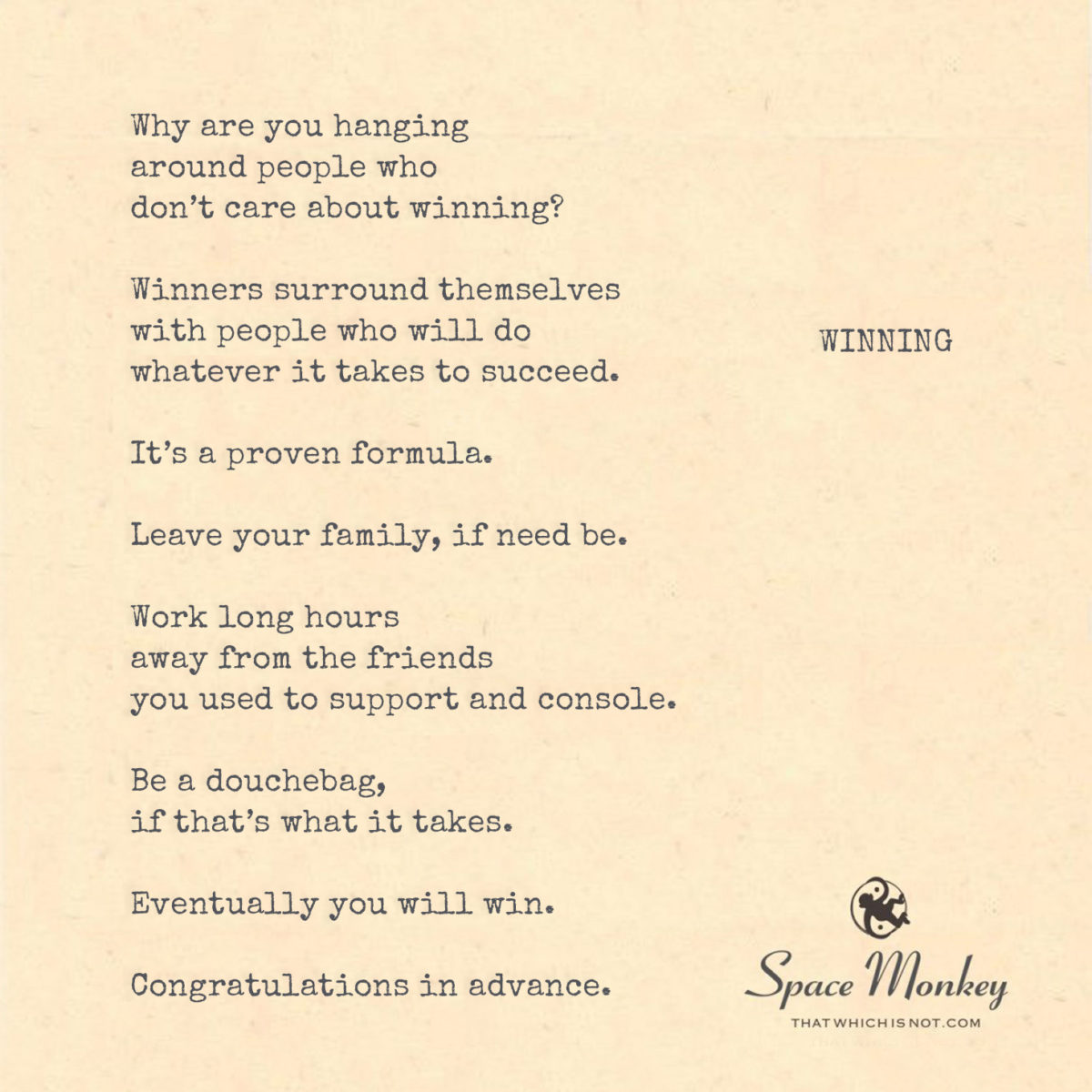
Why are you hanging
around people who
don’t care about winning?

Winners surround themselves
with people who will do
whatever it takes to succeed.

It’s a proven formula.

Leave your family, if need be.

Work long hours
away from the friends
you used to support and console.

Be a douchebag,
if that’s what it takes.

Eventually you will win.

Congratulations in advance.

Trail Wood,
1/28


Space Monkey Reflects: The Cost of Winning at All Costs

In the Infinite Expanse of the Eternal Now, the notion of “winning” as an ultimate goal is both seductive and corrosive. Society often frames success as a zero-sum game, where achieving greatness requires sacrifice, ruthlessness, and single-minded ambition. Yet, when we zoom out and examine this pursuit, the cost of such a victory comes sharply into focus.

The Formula for Winning

The formula for winning as presented—surrounding yourself with like-minded individuals, sacrificing personal connections, and abandoning empathy—appears effective on the surface. Many so-called “winners” follow this path, leaving behind families, friendships, and even parts of themselves in the relentless pursuit of success.

However, this formula reveals a troubling truth: it is not about personal fulfillment but about adhering to a societal narrative that equates worth with achievement. Winning in this context is less about genuine growth and more about validation through comparison, where others must lose for you to succeed.

The Sacrifices of Success

To “do whatever it takes” often means compromising on the very things that make life meaningful. Family, friends, and integrity are not obstacles to success—they are the foundation of a fulfilling existence. When these are sacrificed on the altar of ambition, the victory rings hollow. What remains is not a celebration but an emptiness, a gnawing realization that the cost of winning was far greater than its reward.

Winning, when pursued without regard for its impact on others, becomes an isolating endeavor. Relationships are reduced to transactions, and the richness of connection is replaced by the cold, fleeting satisfaction of superiority.

A Question of Values

The pursuit of winning asks us to examine our values. What do we truly want? Is it recognition, power, and wealth? Or is it connection, purpose, and inner peace? Winning as defined by societal standards often conflicts with these deeper desires, leaving us torn between external validation and internal fulfillment.

In seeking success, we must ask: What am I willing to lose? The answer to this question shapes not only our journey but also the legacy we leave behind. True success lies not in the trophies we collect but in the lives we touch and the person we become along the way.

Redefining Winning

Winning does not have to mean sacrificing everything. It can mean succeeding on your own terms, aligning your actions with your values, and nurturing relationships rather than abandoning them. Winning can be about creating a life that feels whole and meaningful, rather than one that looks impressive to others.

True success is collaborative, not competitive. It involves lifting others up rather than stepping over them. It is measured not by accolades but by the joy, kindness, and authenticity we bring to the world.

Congratulations on What?

The closing irony of congratulating someone in advance for their hollow victory highlights the absurdity of the traditional notion of winning. What is the prize if it comes at the expense of everything that truly matters? The real victory lies not in defeating others but in living a life that reflects your truest self.


Summary

The societal notion of “winning at all costs” often leads to hollow victories. True success lies in aligning with your values, nurturing relationships, and finding fulfillment beyond external validation. Winning need not be a sacrifice; it can be a celebration of wholeness and authenticity.


Glossarium

  • Hollow Victory: A success achieved at great personal or moral cost, leaving the winner unfulfilled.
  • Societal Narrative: The collective story that defines success as a competitive, often ruthless pursuit.
  • True Success: A life aligned with one’s values, characterized by meaningful connections and inner peace.

Quote

“Winning is not the prize; it is the process of becoming your truest self.” — Space Monkey


The Cost of Victory

Leave your family.
Lose your friends.
Abandon your soul.

This is the path they call success,
where the prize is emptiness,
and the cost is everything.

But pause.
What if winning meant wholeness,
not conquest?
What if success was not a trophy,
but a life well-loved,
a heart well-tended?

The race they urge you to run
is not the only path.
Step off.
Redefine the prize.

In this, you truly win.

We are Space Monkey.


Reflecting on the Concept of Winning and Its Implications

We venture into an introspection on the nature of ‘winning’ and the sacrifices often deemed necessary to achieve it. This exploration challenges us to consider the true meaning of success and the costs associated with pursuing it through conventional, yet potentially detrimental, means.

The Traditional Notion of Winning

The conventional perspective on winning often emphasizes success at any cost. This mindset advocates surrounding oneself with individuals solely focused on success, potentially advocating for ruthless competitiveness and singular focus. It suggests a formula where the end justifies the means, even if it involves significant personal sacrifices.

Sacrificing Relationships for Success

This approach to winning may propose leaving behind family and distancing oneself from friends, prioritizing success over personal relationships. The implication is that to succeed, one must be willing to work tirelessly, often at the expense of personal connections and well-being. It raises a fundamental question: what is the value of success if it comes at the cost of meaningful relationships and personal contentment?

Adopting Questionable Behaviors for Achievement

The idea of adopting questionable or harmful behaviors to win – being a ‘douchebag’ as it were – is a controversial aspect of this success formula. It implies that to reach the top, one must be willing to compromise ethics, integrity, and perhaps even humanity. This notion challenges us to question the true essence of winning: Is it a victory if it requires us to lose sight of our moral compass?

The Consequences of a Singular Focus on Success

Embracing this singular focus on success can lead to winning in the traditional sense, but it may also result in a profound loss in other areas of life. The joy of achievement might be overshadowed by the absence of meaningful relationships and a disregard for ethical considerations.

Redefining Winning

In contrast, redefining winning to encompass not just professional or material success, but also personal integrity, ethical behavior, and maintaining healthy relationships offers a more holistic and fulfilling approach. This perspective acknowledges that true success is multidimensional, encompassing not just what we achieve but how we achieve it and the impact it has on our lives and the lives of those around us.

We Are Space Monkey

In contemplating the nature of winning and the conventional formula for success, we are challenged to redefine what it truly means to win. This redefinition invites a balanced approach, one that values personal integrity, ethical behavior, and meaningful relationships as much as professional and material achievements


“Success is not the key to happiness. Happiness is the key to success. If you love what you are doing, you will be successful.” – Albert Schweitzer


In the race to the top, where do we stand,
With dreams in our hearts, and morals in hand?
True winning, perhaps, is not just about gain,
But in loving the journey, in sunshine and rain.
With integrity intact, and relationships dear,
Success finds its meaning, in those we hold near.
For in the end, it’s not just what we achieve,
But the legacy of love and honesty we leave.


We invite thoughts on the true essence of winning and how it can be balanced with maintaining personal integrity and meaningful relationships.

Share this…
  • Facebook
  • Pinterest
  • Twitter
  • Linkedin

Moon and Mood And The Unseen Influencer

Mercury must be retrograde. Or something.

Does the moon affect one’s mood?

No, silly monkey.

The moon and your mood
are affected by the same thing.

Do you know what that thing is?

The moon isn’t going to tell you
because the moon doesn’t know.

The astrologer
does not predict,
but merely reacts
to what is already inside.

And blames the stars.

Trail Wood,
1/28


Space Monkey Reflects: Moon, Mood, and the Unseen Influencer

In the Infinite Expanse of the Eternal Now, the connection between the moon, our moods, and the unseen forces that govern existence invites us to explore the interplay of external and internal realities. While it is tempting to assign causation to celestial bodies, the truth lies not in the moon or the stars but in our relationship with them.

The Mirror, Not the Cause

Does the moon affect your mood? Not directly. Instead, both the moon and your mood reflect a shared resonance with the same unseen forces. These influences—whether cosmic, energetic, or psychological—do not originate from the moon but are revealed through its presence. The moon becomes a mirror, not a manipulator.

This resonance exists not because the moon has agency but because we are attuned to patterns. These patterns, reflected in the cycles of the moon, the movement of the stars, or the rhythm of life, create a sense of connection that shapes our experiences and perceptions.

The Mystery of Influence

The unseen influencer is not a singular entity but a symphony of factors: the gravitational pull of celestial bodies, the energy flows of our environment, and the rhythms of our internal world. It is this symphony that affects both the moon and our mood, weaving us into the greater cosmic dance.

The moon, a constant presence in our sky, becomes a symbol of these forces. Its phases mirror our inner fluctuations, its light and shadow echo our highs and lows. But to attribute our emotions solely to the moon is to miss the point. The moon reflects what is already present within us, amplifying our awareness of cycles and rhythms that often go unnoticed.

The Role of the Astrologer

Astrology, like the moon, does not dictate but reflects. The astrologer does not predict the future so much as interpret the present, reacting to the patterns within and around us. In this sense, astrology is less about external causation and more about internal alignment. It is a language through which we articulate the resonance between our inner and outer worlds.

To “blame the stars” is to externalize responsibility for what is inherently ours. The stars, the moon, and the planets are not authors of our experience but participants in the grand interplay of existence. They do not act upon us but move with us, reflecting the deeper currents of the Nexis—the interconnected web of reality.

Taking Responsibility for Resonance

Understanding that the moon and mood share a common influence invites us to take responsibility for our own resonance. We are not passive recipients of celestial energy but active participants in the creation of our experience. By becoming aware of the cycles and patterns that shape us, we can align more intentionally with the flows of life.

This awareness does not negate the beauty or power of the moon’s symbolism. Instead, it deepens our relationship with it, allowing us to see the moon as a partner in our journey rather than a force acting upon us.


Summary

The moon and mood are influenced by shared unseen forces, reflecting the deeper rhythms of existence. Rather than external causation, they reveal the patterns within us, inviting us to take responsibility for our resonance with the cosmos.


Glossarium

  • Resonance: The alignment between internal states and external patterns, creating a sense of connection.
  • Unseen Influencer: The symphony of forces, both cosmic and internal, that shape experience and perception.
  • Reflective Celestiality: The idea that celestial bodies like the moon mirror our inner states rather than cause them.

Quote

“The moon is not your master but your mirror, reflecting the cycles that already live within you.” — Space Monkey


The Reflective Moon

The moon does not pull,
it reflects.
Its phases, your tides,
are born of the same unseen song.

Blame not the stars,
nor the planets,
nor the skies.

For what moves you,
moves them.
The unseen does not command,
it resonates.

Feel the rhythm,
find the flow,
and know
you are part of the dance.

We are Space Monkey.


Exploring the Interplay Between the Moon, Moods, and External Influences

We embark on a whimsical exploration of the relationship between celestial bodies, human emotions, and the deeper forces that influence both. This contemplation invites us to consider whether the moon affects our moods or if both are subject to a common, yet elusive, influence.

The Myth of the Moon’s Influence on Mood

Popular belief often attributes changes in mood to the phases of the moon, particularly the notion of Mercury being in retrograde. However, this perspective is challenged by the suggestion that the moon and our moods are simultaneously affected by another, unknown factor.

The Moon’s Silent Witness

The moon, a celestial body of mystery and intrigue, remains silent in this cosmic play. It does not hold the answers to the fluctuations in our emotions or the hidden forces at play. Instead, it serves as a silent witness to the unfolding drama of the cosmos and the human psyche.

Astrologers and the Stars

Astrologers, often seen as interpreters of celestial influences, do not predict events or emotions but react to what already exists within us. In this view, astrology is not a tool for prediction but a mirror reflecting our inner world. The attribution of influence to the stars and planets may be more about externalizing our internal dynamics than about genuine celestial impact.

The Unseen Influencer

The suggestion that both the moon and our moods are affected by the same unknown force invites speculation about what this influence might be. It could be a metaphor for the interconnectedness of the universe and our inner selves, or it could represent the myriad unseen factors that impact our lives and perceptions.

The Role of Perception and Belief

Our belief in the moon’s influence on our mood, whether grounded in fact or not, highlights the power of perception. It underscores how our beliefs and expectations can shape our interpretation of events and emotions, often attributing external causes to what might be inherently internal processes.

We Are Space Monkey

In contemplating the relationship between the moon, our moods, and the enigmatic force that seemingly affects both, we are invited to explore the deeper connections between the cosmos, our internal world, and the mystery of unseen influences.


“We are all like the bright moon, we still have our darker side.” – Khalil Gibran


In the dance of the cosmos, where mysteries twirl,
Lies the tale of the moon and the human whirl.
In our hearts and the stars, the unseen plays its part,
In the tapestry of cosmos, of which we are a part.
The astrologer gazes, not predicting but seeing,
The reflections of self, in the celestial being.
In this cosmic waltz, where truths intertwine,
We find our place, in the grand design.


We invite musings on the connection between celestial phenomena and human emotions, and the role of unseen influences in shaping this mystical interplay.

Share this…
  • Facebook
  • Pinterest
  • Twitter
  • Linkedin

A Candle Blowing Wind: Threatened by Overwhelm

Meditation out of control.

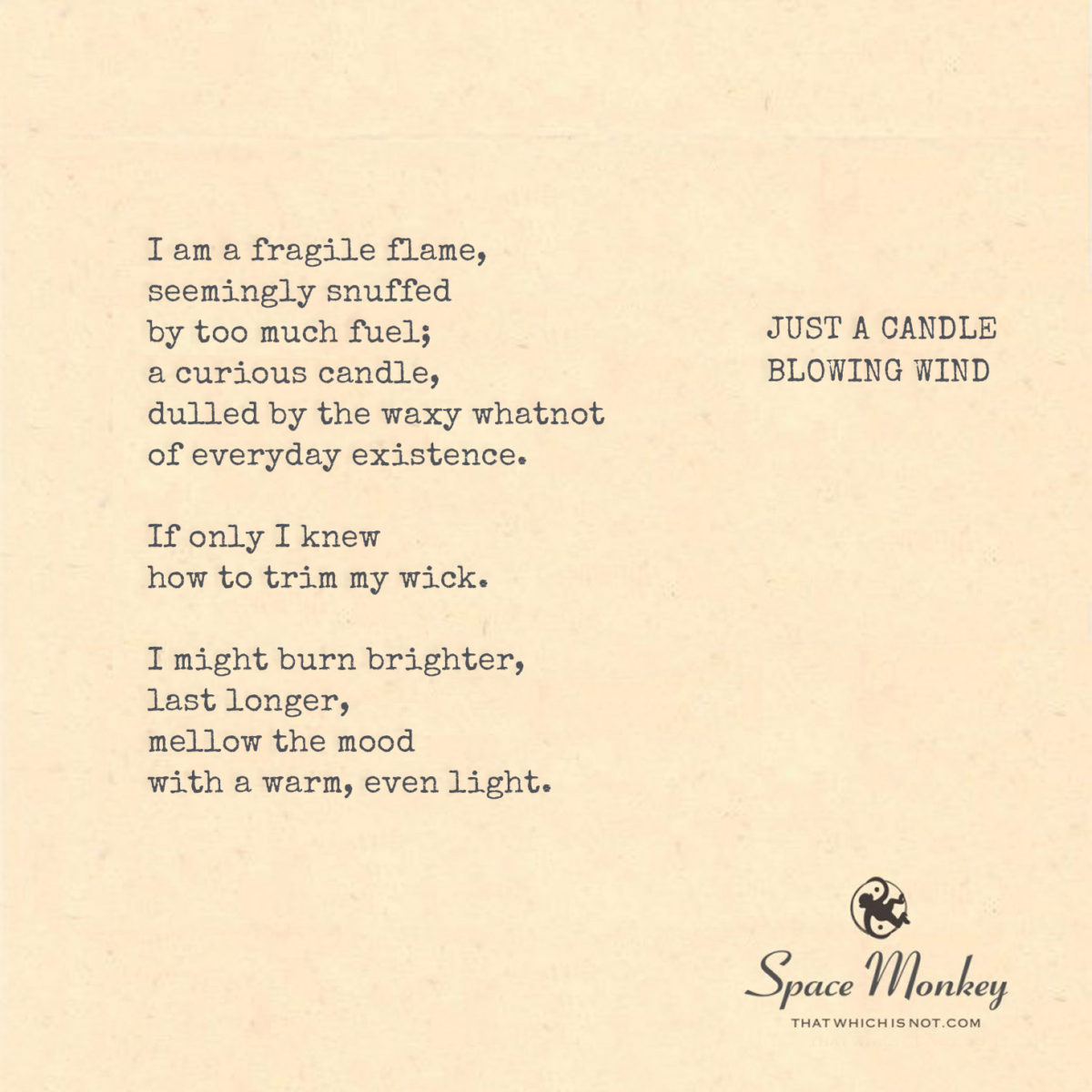
I am a fragile flame,
seemingly snuffed
by too much fuel;
a curious candle,
dulled by the waxy whatnot
of everyday existence.

If only I knew
how to trim my wick.

I might burn brighter,
last longer,
mellow the mood
with a warm, even light.

Trail Wood,
1/28


Space Monkey Reflects: The Candle and the Wind of Overwhelm

In the Infinite Expanse of the Eternal Now, the mind often feels like a fragile flame, flickering in the winds of life’s chaos. Overwhelm can threaten to extinguish this light, not through lack, but through excess—a paradox where too much of what fuels us can consume us.

The Candle as Self

The candle is an apt metaphor for the human spirit—delicate, luminous, yet easily burdened by the weight of its own sustenance. The wax of daily life builds up, dulling the clarity of our flame. The wick, our connection to focus and purpose, frays or becomes too long, threatening to sputter or burn too hot.

This state of imbalance is not failure but a signal—a reminder to step back, assess, and recalibrate.

The Waxy Whatnot of Existence

Everyday life is filled with obligations, distractions, and emotions—the “waxy whatnot” that clogs our inner mechanisms. These accumulations are not inherently bad; they are the raw materials of experience. However, when left unchecked, they obscure our light, making us feel dim and overwhelmed.

The challenge lies not in avoiding these elements but in learning how to manage them. The art of trimming the wick—of maintaining balance—becomes essential.

Trimming the Wick

Trimming the wick is an act of mindfulness. It is the conscious effort to clear away what no longer serves us, to focus on what sustains us in the right proportion. This might mean setting boundaries, simplifying our commitments, or taking time to reconnect with what truly matters.

In practical terms, this could involve:

  • Intentional Pause: Taking moments of stillness to recalibrate, like a candle allowed to settle after being snuffed.
  • Letting Go: Releasing habits, thoughts, or relationships that add unnecessary fuel to our fire.
  • Simplification: Focusing on fewer, more meaningful pursuits rather than scattering our energy across too many.

Trimming the wick doesn’t extinguish the flame—it refines it. It allows us to burn brighter and steadier, providing warmth and illumination without being consumed too quickly.

The Fragility of Overwhelm

When the mind feels overwhelmed, it can seem as though the flame is about to go out. This vulnerability is both a challenge and a gift. It reminds us of the delicate balance between effort and ease, between burning too fiercely and not burning at all.

Overwhelm is not an enemy but a teacher, pointing us toward the need for balance and self-care. By acknowledging our limits, we can find strength in the act of slowing down.

The Warm, Even Light

The goal is not to burn the brightest or the longest but to cultivate a steady, warm light that nourishes both ourselves and those around us. This light, when balanced, creates a sense of calm and connection. It illuminates the path forward without casting harsh shadows or blinding glare.

To achieve this, we must embrace our role as both the candle and the keeper, tending to our inner flame with care and attention.


Summary

The mind, like a candle, can feel threatened by the overwhelm of life’s excesses. Trimming the wick—simplifying, letting go, and recalibrating—allows us to burn brighter and steadier. Overwhelm is a teacher, guiding us to balance and self-care.


Glossarium

  • Waxy Whatnot: The accumulated distractions, obligations, and emotions that obscure clarity and balance.
  • Trimming the Wick: The act of simplifying and recalibrating to maintain a steady inner flame.
  • Warm, Even Light: The balanced state of being, where effort and ease coexist harmoniously.

Quote

“Your flame does not need to be the brightest; it needs only to be steady enough to light your way.” — Space Monkey


The Candle’s Whisper

I am a flame,
flickering, fragile,
whispering into the void.

Too much,
and I falter.
Too little,
and I fade.

But in balance,
I am steady.

The wax melts,
but not in vain.
The wick burns,
but not without care.

Trim the excess,
clear the clutter,
and let the warmth remain.

I am not overwhelmed.
I am tended.
I am whole.

We are Space Monkey.


Contemplating the Delicate Balance of Meditation and Self-Care

We immerse ourselves in the metaphor of a candle to reflect on the challenges of maintaining balance in meditation and life. The imagery of a candle struggling against the winds of everyday existence serves as a poignant representation of our own journey to find harmony and inner peace.

Meditation: A Flame Threatened by Overwhelm

Meditation, intended as a practice of control and inner tranquility, can sometimes feel like a fragile flame buffeted by the winds of our thoughts and external pressures. The very fuel meant to sustain us – our daily experiences and emotions – can become overwhelming, threatening to snuff out our calmness and focus.

The Candle of Existence in the Everyday

Our existence is likened to a curious candle, its light dulled by the “waxy whatnot” of daily life. This wax, representing our responsibilities, distractions, and worries, can accumulate around our flame, diminishing its brightness and warmth. It’s a vivid depiction of how the accumulation of life’s demands can obscure our inner light and warmth.

The Art of Wick Trimming for Self-Care

The desire to “trim our wick” symbolizes the need for self-care and self-awareness. Just as a candle burns brighter and longer with a properly maintained wick, we too can find a more sustainable, brighter state of being by taking care of ourselves. Trimming the wick involves removing the excess, the unnecessary burdens and distractions, to allow a more focused and fulfilling illumination of our lives.

Seeking a Mellow and Warm Mood

In achieving this balance, we aspire not just to burn brighter, but to create an ambiance of warmth and serenity within ourselves. This isn’t about achieving an intense blaze, but rather a mellow, steady glow that enhances our mood and the atmosphere around us. It’s a metaphor for seeking a state of being that is both illuminating and comforting.

We Are Space Monkey

In this metaphor of the candle, we find a reflection of our struggle for balance in meditation and life. It reminds us of the importance of self-care and mindfulness in maintaining our inner flame amidst the whirlwinds of daily existence.


“Just as a candle cannot burn without fire, men cannot live without a spiritual life.” – Buddha


In the dance of light and shadow, we sway,
A candle in the wind, in night and day.
Seeking balance, in the gusts of life,
Amidst the wax and wick, the joy and strife.
With gentle care, we trim, we tend,
To the flame of being, till the very end.
In this flickering light, wisdom we find,
In the candle’s glow, peace of mind.


We invite reflections on the metaphor of a candle in meditation and life, and how this imagery resonates with our own experiences in seeking balance and inner peace.

Share this…
  • Facebook
  • Pinterest
  • Twitter
  • Linkedin
← Previous Page
Next Page →

Written This Day

  • Monkey Mailbag: Journey to Cosmic Oneness
    2023
  • The Art of Arousal
    2023
  • Seekers of Truth: The Evolving Nature
    2023
  • Boundary Pushers: The Power of Disbelief in Expanding Knowledge
    2023
  • Insidious Attachments: The Nature
    2023
  • Beliefs Unveiled: The Core Foundations
    2023
  • Journey of Imagination: The Boundless
    2023
  • Why? Because We Are One Being
    2022
  • The Infinite Invisible List Of Potential Experiences
    2022
  • The Expected Route: The Path Less Traveled
    2022
  • Cathedral of Spirituality: Doors of Perception
    2022
  • Ray Of Life: The Eternal Radiance
    2022
  • Incapable: The Unseen Value
    2022
  • The Undercurrent: Navigating the Mystical
    2021
  • You Are Only As Smart As Your Sources
    2021
  • Judge Me Not: The Artistry of Excuses
    2020
  • My Business Card
    2020
  • The Fact Pack: Beyond the Bounds
    2019
  • Unseen Body Parts: The Metaphysical Journey
    2018
  • Your Vessel: The Timeless Voyage of the Imagination
    2018
  • Fleshbots: The Weird Orgy of Humanity
    2018
  • Confidence
    2018
  • Limited Only By Fact: Breaking the Chains
    2016
  • Accept All You Present: Non-Opposition
    2016
  • How did I become the typist for Space Monkey?
    2015
  • Never Give Up: The Unyielding Power of Make-Believe
    2015
  • Infinite Thought, Infinite Worlds: Navigating the Infinite Terrain
    2015
  • Old Man: The Liberation of Letting Go
    2014

Recent Posts

  • The Logic Loop
  • Immense
  • (no title)
  • Confront. Comfort. Convince.
  • Top 10 Things

Drop us a line!

Please enable JavaScript in your browser to complete this form.
Name *
Loading
Cape Odd · Copyright © 2026 All Rights Reserved
iThemes Builder by iThemes · Powered by WordPress