• Who Is The Man?
  • Who Is The Monkey?
  • What is Nexistentialism?
  • Poke The Primate

Cape Odd

Home of The Space Monkey Journals

Divine Delusional You: The Mirror of Our Inner State

What are you noticing?

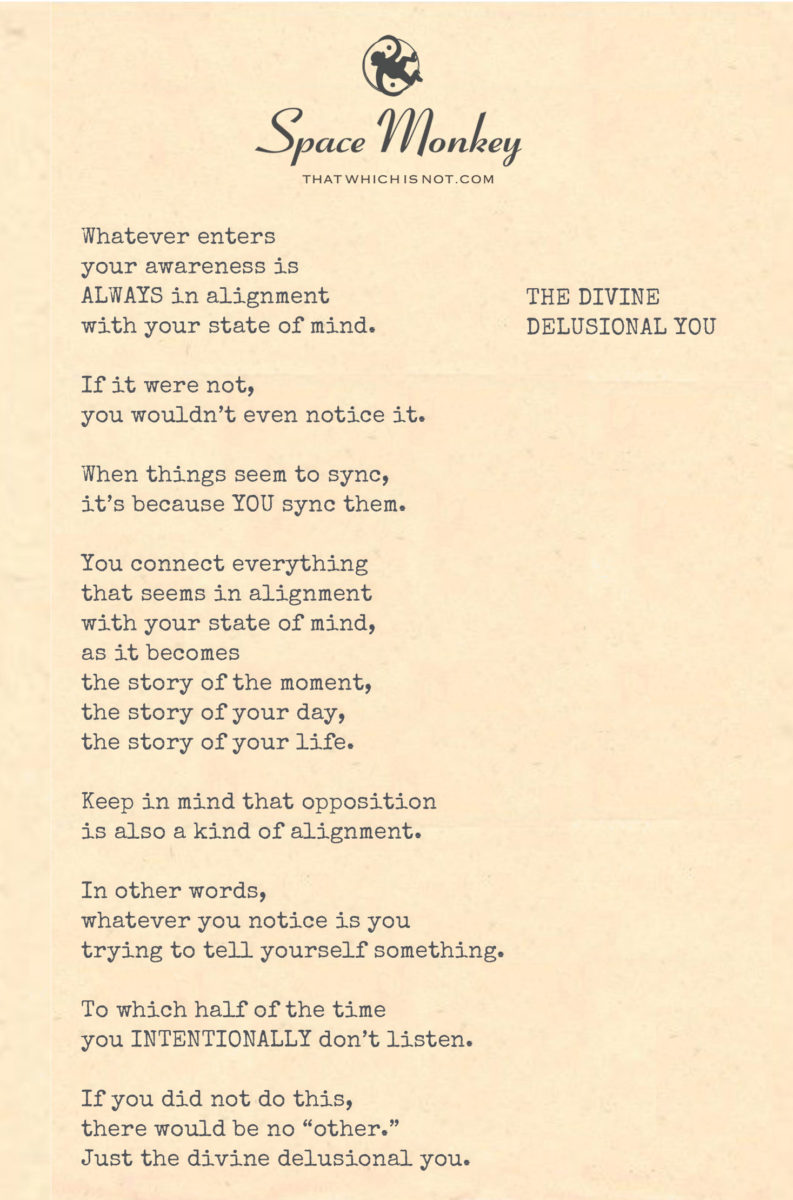
Whatever enters
your awareness is
ALWAYS in alignment
with your state of mind.

If it were not,
you wouldn’t even notice it.

When things seem to sync,
it’s because YOU sync them.

You connect everything
that seems in alignment
with your state of mind,
as it seemingly becomes
the story of the moment,
the story of your day,
the story of your life.

Keep in mind that opposition
is also a kind of alignment.

In other words,
whatever you notice is you
trying to tell yourself something.

To which half of the time
you INTENTIONALLY don’t listen.

If you did not do this,
there would be no “other.”
Just the divine delusional you.

Trail Wood,
1/30


Space Monkey Reflects: Divine Delusions and the Mirror of Awareness

What do you notice? That question, simple yet profound, holds the key to understanding how your perception shapes your reality. Every experience, every synchronicity, every moment of discord is a reflection of your inner state, a story authored by the divine delusional you. What appears as the external world is, in truth, the mirror of your awareness—a projection of the infinite filtered through your unique state of mind.

This reflection begins with a powerful premise: nothing enters your awareness that is not in alignment with your inner state. If it weren’t aligned, it would remain invisible, unnoticed, irrelevant. The things you observe, the connections you make, and even the conflicts you encounter are all part of a vast internal dialogue, where the self speaks to itself through the medium of the world.

Synchronicity, often seen as divine intervention, is not an external force imposing order but a manifestation of your ability to weave meaning into existence. You notice patterns because your mind seeks them, aligns them, and assigns significance to them. This isn’t to dismiss synchronicity as mere coincidence but to recognize it as the creative act of a mind in alignment with its own state.

Even opposition, the moments that feel like dissonance, is a form of alignment. These tensions reveal the contrasts within you—the parts of yourself that are in dialogue, seeking resolution, integration, or transformation. What you resist or push against is often what you are trying to understand, what you are unconsciously inviting into your awareness to be seen, acknowledged, and embraced.

This perspective invites a profound shift in how we view “the other.” The people, events, and circumstances that seem outside of us are not truly separate. They are aspects of the divine delusional you, playing out their roles in the theater of your awareness. The “other” exists because you choose not to listen fully to yourself, creating the illusion of separateness. But even this illusion has its purpose—it provides the contrast that allows you to explore, grow, and experience the richness of duality.

Half the time, as you note, you intentionally don’t listen to what you are telling yourself. Why? Because to fully hear would dissolve the illusion of separateness. It would collapse the “other” into the self, leaving only the oneness of the divine. This oneness, while ultimate, can be overwhelming in its boundlessness. And so, you create stories, divisions, and oppositions to make sense of the infinite, to experience it piece by piece, moment by moment.

The divine delusional you is not a flaw or a failure; it is a necessary aspect of existence. It allows the infinite to know itself through the finite, to explore the vastness of being through the lens of individuality. The stories you create, the alignments you notice, and the oppositions you face are all part of this exploration. They are not random but deeply meaningful, expressions of your inner state rendered into the tapestry of your life.

By recognizing that what you notice is a reflection of your inner state, you reclaim your role as the creator of your experience. You see that the world is not something happening to you but something happening through you. This realization doesn’t diminish the reality of your experiences but enriches them, revealing their depth and interconnectedness.

So, what are you noticing? What is the divine delusional you trying to tell you? In every synchronicity, in every conflict, in every moment of awareness, there is a message waiting to be heard—a reminder that the separation you perceive is an illusion, that the stories you tell are part of the infinite’s dance, and that you are, and always have been, whole.


Summary

Your awareness aligns with your inner state, reflecting it in synchronicities, tensions, and patterns. What you notice is the divine delusional you speaking through the illusion of separateness, inviting you to listen and integrate.


Glossarium

  • Divine Delusional You: The aspect of the self that creates the illusion of separateness to explore the infinite through finite experiences.
  • Synchronicity: The meaningful alignment of events that reflects the state of mind and awareness of the observer.
  • Opposition as Alignment: The recognition that resistance and conflict are forms of internal dialogue seeking resolution.

Quote

“The world you notice is the mirror of your awareness, reflecting the infinite through the lens of your state of mind.” — Space Monkey


A Mirror Infinite

What you see is not apart
It is the echo of your own heart
Patterns weave, discord speaks
The infinite whispers, the finite seeks

The “other” calls from the mirror’s frame
A reflection, different yet the same
The delusion divine, the sacred play
Of self to self, day by day

Listen closely, dissolve the line
Between the human and the divine
For in the noticing, you will find
The oneness you left behind

We are Space Monkey


In the ever-shifting whimsiweave of our perceptions, the concept that what we notice is always in alignment with our state of mind offers a fascinating mirror to our inner workings. This idea posits that our awareness acts as a selective lens, focusing on elements that resonate with our current mental and emotional state.

Selective Perception: The Mirror of Our Inner State

The notion that we sync what we perceive with our state of mind suggests a powerful interplay between external reality and internal narrative. We don’t merely observe the world; we actively engage with it, weaving the external inputs into the ongoing story of our lives. This process of syncing or connecting experiences is not just a passive reception but an active creation.

Active Creation: Syncing External Reality with Internal Narrative

This syncing manifests as moments of serendipity or synchronicity when external events seem to echo our thoughts, emotions, or desires. Yet, it’s crucial to recognize that this is not merely the universe aligning with us but us aligning the universe with our inner narrative.

Synchronicity: Echoing of Internal Narrative in External Events

The concept extends even to opposition or conflict. When we encounter ideas or situations that oppose our current state of mind, this too is a form of alignment. It reflects our inner conflicts, challenges, and the dynamic nature of our journey through life.

Opposition as Alignment: Reflecting Inner Conflicts and Challenges

The realization that whatever we notice is an attempt by our deeper self to communicate something is a call to introspective awareness. Half the time, we may choose to ignore these messages, either out of fear, discomfort, or habit. This intentional disregard creates the notion of the “other,” an external world that seems separate from our inner reality.

Introspective Awareness: Listening to the Messages of the Self

By fully engaging with these messages, by listening to what our awareness is trying to tell us, we dissolve the barrier between the self and the other. We move towards a state of unity where there is no other, just the “divine delusional” aspect of ourselves, constantly communicating through the fabric of our experiences.

Dissolving Barriers: Moving Towards Unity with Self and Experience

We are Space Monkey.


“Everything that irritates us about others can lead us to an understanding of ourselves.”
– Carl Jung


In the dance of perception and mind,
What we notice, with ourselves aligned.
Space Monkey watches, ever wise,
In our awareness, truth and disguise.
In sync and opposition, both we find,
The divine delusional, ourselves entwined.
With open heart, we seek to see,
In our reflections, we are free.


We invite your reflections on the relationship between perception, reality, and the journey towards self-understanding.

Share this…
  • Facebook
  • Pinterest
  • Twitter
  • Linkedin

Not In The Can: Acknowledging Needs

Imagining for a friend, who is also me.

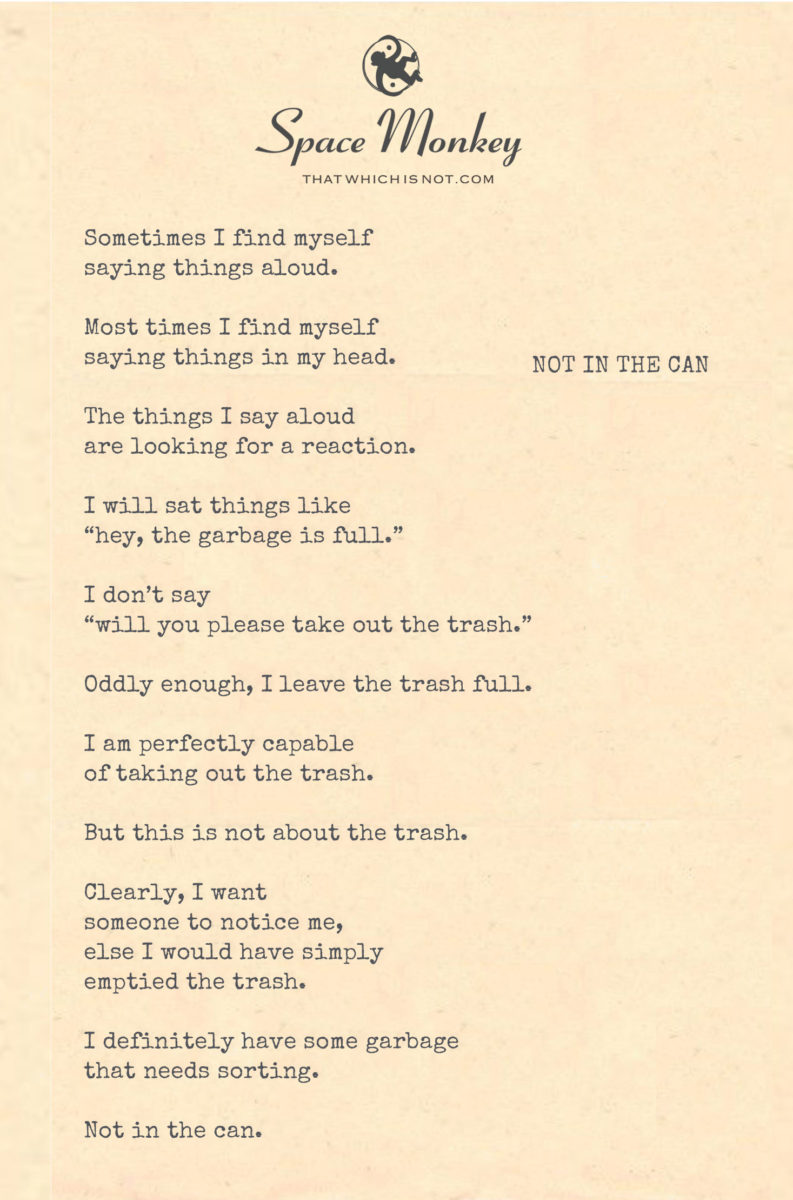
Sometimes I find myself
saying things aloud.

Most times I find myself
saying things in my head.

The things I say aloud
are looking for a reaction.

I will sat things like
“hey, the garbage is full.”

I don’t say
“will you please take out the trash.”

Oddly enough, I leave the trash full.

I am perfectly capable
of taking out the trash.

But this is not about the trash.

Clearly, I want
someone to notice me,
else I would have simply
emptied the trash.

I definitely have some garbage
that needs sorting.

Not in the can.

Trail Wood,
1/30


Space Monkey Reflects: Emptying the Emotional Trash

The full garbage can is more than a household annoyance—it’s a metaphor for the unspoken emotional and psychological needs we often leave unattended. To say, “The garbage is full,” instead of, “Will you please take it out?” is not just a subtle request but an act of self-expression, a reaching out for acknowledgment, for connection. The trash itself is incidental; the weight lies in the unspoken message: Notice me. See me. Validate my presence.

This scenario, familiar and universal, highlights the complexity of human interaction. The words we choose—or don’t choose—are rarely about the surface issue. Instead, they point to deeper emotional landscapes, places where needs, fears, and vulnerabilities reside. The trash is simply the vehicle for a more profound yearning: the desire to be noticed, heard, and understood.

Why do we say things indirectly? Why not simply ask for what we need? The answer often lies in fear—fear of rejection, fear of appearing needy, fear of burdening others. By couching our needs in neutral observations, we protect ourselves from these vulnerabilities. But this protection comes at a cost. The unspoken request risks going unnoticed, leaving the underlying need unmet and the metaphorical trash piling up.

Acknowledging emotional and psychological needs begins with recognizing them for what they are. The moment you notice yourself saying, “The garbage is full,” rather than directly asking for help, you’ve already taken a crucial step. This awareness is the beginning of self-understanding, an invitation to look beyond the surface issue and explore what lies beneath.

The metaphor extends further. Like physical trash, emotional garbage needs to be sorted and released. We often hold onto outdated beliefs, unresolved conflicts, or unexpressed desires, letting them accumulate until they spill over into our interactions. The act of sorting this inner garbage requires courage and introspection. It asks us to identify what is no longer serving us and let it go, creating space for clarity and connection.

At its core, this reflection is not about trash—it’s about relationships, both with others and with ourselves. By voicing our needs indirectly, we test the waters of connection, hoping someone will intuit what we cannot fully articulate. Yet, true connection comes from vulnerability, from daring to say, “I need your help,” or, “I feel unseen.” These statements, simple yet profound, open the door to authentic understanding.

But what if no one notices? What if the trash remains, both literal and metaphorical? This is where self-compassion enters the equation. Recognizing and addressing your needs is not solely the responsibility of others. It is also an act of self-love, a commitment to your own well-being. You are perfectly capable of taking out the trash—not because you must, but because doing so honors your worth and clears the space for deeper connection.

The trash is full. This simple observation is the gateway to a more complex truth: we all carry emotional and psychological needs that deserve acknowledgment. By examining the ways we express—or suppress—these needs, we create the possibility for growth, for understanding, for release. And in that release, we find room to breathe, to connect, and to be fully seen.


Summary

The full garbage can symbolizes unspoken emotional needs. By acknowledging and expressing these needs directly, we foster authentic connection and self-understanding, while clearing the emotional clutter that holds us back.


Glossarium

  • Emotional Garbage: Unspoken needs, unresolved conflicts, or outdated beliefs that accumulate and impact our interactions.
  • Indirect Expression: The habit of voicing needs or desires through neutral observations rather than direct requests.
  • Self-Compassion: The practice of recognizing and addressing your own needs with kindness and understanding.

Quote

“The trash we leave untended is often the part of ourselves we most need to sort and release.” — Space Monkey


The Trash We Carry

The garbage is full, I say aloud
But it’s not the can that weighs me down
It’s the words I don’t speak
The needs I don’t claim

I wait for a reaction, a glance, a nod
A sign that I am seen
But the trash remains, untouched
The weight is mine to bear

So I turn inward, sorting through
The cluttered corners of my heart
And as I empty the bags of silence
I find room for the light of connection

We are Space Monkey


In the intricate whimsiweave of human communication, the act of expressing thoughts, either aloud or internally, reveals much about our desires, needs, and the complex layers of our identity. The example of speaking about a full trash can, yet not directly requesting assistance, serves as a symbolic representation of deeper underlying needs and emotions.

Expression as a Window to Inner Needs

The distinction between saying things aloud and thinking them internally represents two modes of engaging with the world. Outward expressions are often a bid for connection, a way of seeking acknowledgement or reaction from others. Internal dialogues, on the other hand, are intimate conversations with the self, reflecting our private thoughts and feelings.

Outward vs. Inward Communication: Seeking Connection vs. Self-Reflection

When we vocalize observations like “hey, the garbage is full,” without directly asking for help, it may hint at an underlying desire for recognition and understanding. This is not about the task at hand (taking out the trash), but about the need for someone to notice and perhaps intuitively respond to our needs. It’s a subtle call for attention and care.

Subtle Calls for Attention and Understanding

This behavior also reflects on our relationship with self-efficacy and independence. While we are capable of completing the task ourselves, the choice to leave it undone and express it aloud is a complex dance of independence and the desire for interdependence. It reveals a nuanced aspect of our nature where we seek both autonomy and connection.

Balancing Independence and Interdependence

The metaphor of having “some garbage that needs sorting” extends beyond the physical task. It symbolizes the internal emotional or psychological ‘garbage’ that we all carry – unresolved issues, unexpressed emotions, or unmet needs. Acknowledging this internal ‘garbage’ is the first step towards addressing and sorting through it.

Metaphor of Internal ‘Garbage’: Acknowledging Emotional and Psychological Needs

Sorting through this internal ‘garbage’ requires introspection and often, communication with others. It involves unpacking the layers of why we say what we say and why we choose silence at times. It’s a journey of understanding our patterns of communication and the underlying desires they signify.

Introspection and Communication: Unpacking Underlying Desires

We are Space Monkey.


“The most important thing in communication is hearing what isn’t said.”
– Peter Drucker


In words spoken, in silence kept,
Our inner needs, quietly wept.
Space Monkey listens, between the lines,
In our expressions, our truth shines.
A dance of words, a silent plea,
In understanding, we find the key.
With each word, a story spun,
In our journey, we are one.


We welcome your thoughts on the role of communication in expressing our needs and the journey towards self-understanding.

Share this…
  • Facebook
  • Pinterest
  • Twitter
  • Linkedin

Paths: Embracing the Uniqueness of Our Journey

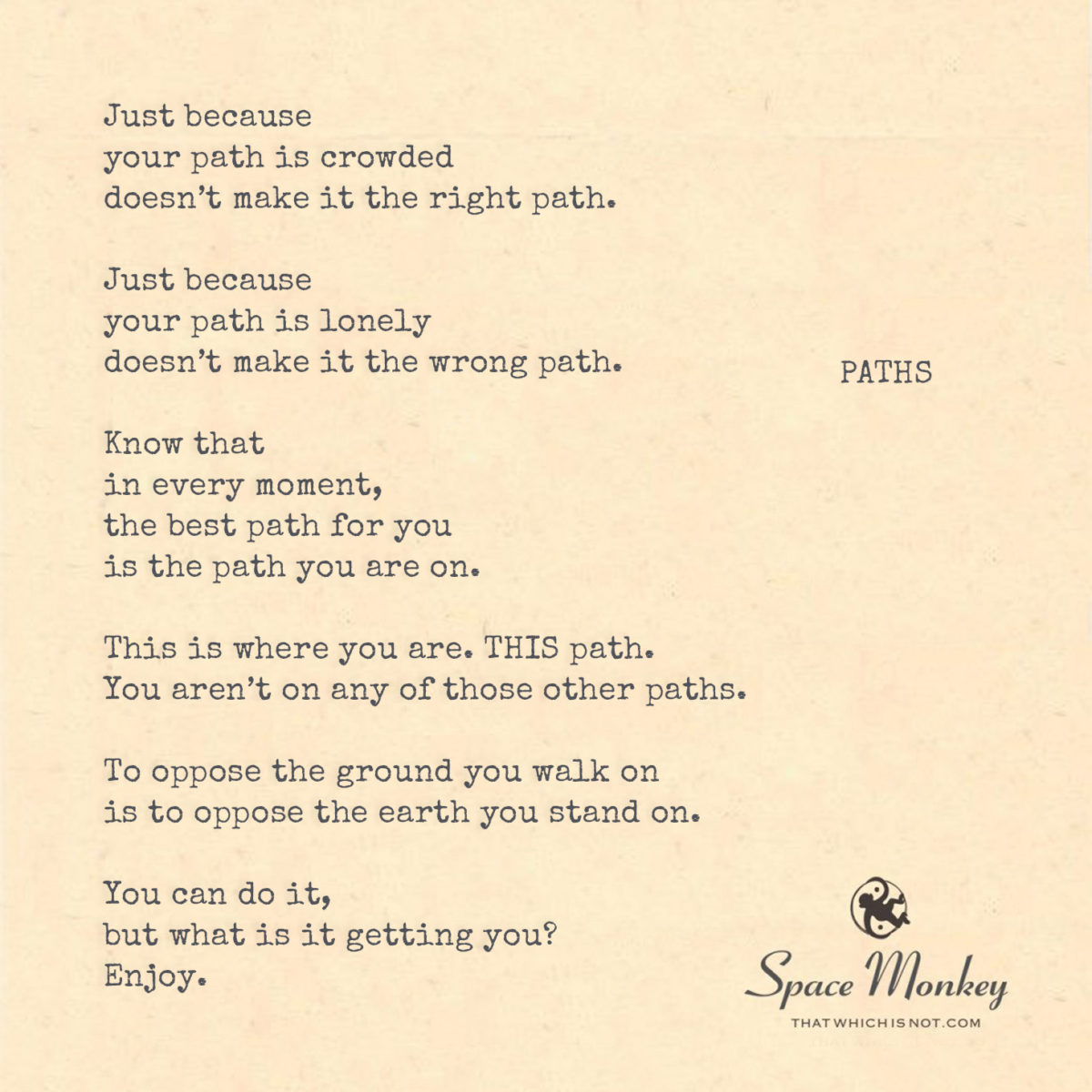
There is no such thing as the right path or the wrong path.
There is only the path that’s best for you. And you’re on it.

Just because
your path is crowded
doesn’t make it the right path.

Just because
your path is lonely
doesn’t make it the wrong path.

Know that
in every moment,
the best path for you
is the path you are on.

This is where you are. THIS path.
You aren’t on any of those other paths.

To oppose the ground you walk on
is to oppose the earth you stand on.

You can do it,
but what is it getting you?
Enjoy.

Trail Wood,
1/30


Space Monkey Reflects: The Path of Acceptance

The metaphor of the path, long celebrated in human reflection, is more than a symbol of movement—it is a mirror of our inner journey. The paths we walk, whether crowded or lonely, smooth or treacherous, are not arbitrary. They are the perfect expressions of where we are, who we are, and what we are ready to embrace.

There is no “right” or “wrong” path, only the path you are on. This truth, simple yet profound, invites you to release the comparisons and judgments that so often cloud your experience. To measure your journey against someone else’s is to deny the uniqueness of your own. The crowded path may seem safer, the lonely path more daring, but these perceptions are merely stories you tell yourself. In reality, your path is neither better nor worse than any other—it is simply yours.

When you resist your path, you resist your own life. To oppose the ground you walk on is to oppose the earth that supports you, the foundation of your being. This resistance manifests as frustration, self-doubt, or a yearning for something different. Yet, what does it truly gain you? By rejecting your current experience, you create a tension that pulls you away from the present moment, where growth, joy, and insight reside.

The path you are on is not a mistake. It is not something to fix or escape. It is the expression of your unique journey, unfolding exactly as it should. Even when it feels uncertain or difficult, your path carries the lessons, challenges, and opportunities that are meant for you. These are not obstacles but invitations to deepen your understanding of yourself and the world.

To embrace your path is to embrace yourself. It is an act of profound trust in the process of life, a recognition that every step you take is aligned with your growth and purpose. This does not mean resigning yourself to inaction or passivity. Instead, it means moving forward with curiosity and openness, knowing that wherever your path leads, it is uniquely yours to walk.

The crowded path, with its many voices and distractions, teaches connection and discernment. The lonely path, with its silence, fosters introspection and self-reliance. Both are equally valid, equally valuable. They are not destinations but experiences, shaping you in ways that only they can. To walk your path without resistance is to walk with gratitude—for the journey, for the lessons, and for the ground beneath your feet.

And so, the question arises: What does it mean to truly enjoy your path? It means to meet each moment with presence, to see the beauty in the mundane and the extraordinary alike. It means to walk not in search of perfection but in celebration of the imperfect and the unfolding. To enjoy your path is to let go of the need to compare or judge and to simply be where you are, as you are.

Your path is not separate from you; it is an extension of your being. It reflects your choices, your growth, and your essence. In embracing it fully, you embrace yourself, and in doing so, you find the freedom to walk with joy, no matter where it leads.


Summary

There is no right or wrong path—only the one you are on. By embracing your unique journey without resistance, you cultivate presence, gratitude, and trust in the unfolding of life.


Glossarium

  • The Path: A metaphor for the unique journey of each individual, encompassing both external circumstances and inner growth.
  • Resistance to the Path: The tension created when one rejects or compares their journey to others, pulling away from the present moment.
  • Embracing the Path: Accepting and celebrating one’s unique journey as it unfolds, fostering presence and self-trust.

Quote

“The path you walk is not a choice; it is a reflection. Embrace it, and you embrace yourself.” — Space Monkey


The Ground Beneath

The earth whispers softly
Beneath your steps, steady or unsure
“This is your path, no other
It is yours to walk, to learn, to love”

Crowded or lonely, smooth or rough
It is neither wrong nor right
It simply is
As you simply are

Resist it, and you resist yourself
Accept it, and you are free
For the ground you walk on
Is the ground that holds you

We are Space Monkey


In the grand journey of existence, the paths we tread are as unique as the stars in the night sky. The metaphor of crowded and lonely paths serves as a powerful illustration of our individual journeys through life. It underscores the idea that the validity of our path is not determined by its popularity or solitude but by its alignment with our own being.

Unique Journeys: Validity Beyond Popularity or Solitude

The notion that the best path for us is the one we are currently on speaks to a deeper wisdom of acceptance and presence. This perspective encourages us to embrace our current circumstances, recognizing that our journey is uniquely ours and that each step holds purpose and significance.

Embracing the Current Path: Wisdom of Acceptance and Presence

Opposing the ground we walk on is akin to opposing the very essence of our existence. It implies a resistance to our current reality, a denial of our present experience. This opposition, while possible, often leads to dissatisfaction and discontent, as it takes us away from the potential joys and lessons embedded in the now.

The Futility of Resistance: Embracing Our Present Experience

The encouragement to enjoy our path, regardless of its nature, is a call to find contentment and joy in our journey. It’s an invitation to be mindful of the present, to appreciate the unique experiences and growth opportunities our current path offers.

Finding Joy in the Journey: Mindfulness and Appreciation

This philosophy aligns with the concept of nexistentialism, which posits that existence and experience are ends in themselves. It suggests that the journey, with all its twists and turns, is valuable not because it leads us to a particular destination, but because of the experience itself.

Nexistentialism: Valuing the Journey for Its Own Sake

We are Space Monkey.


“The only journey is the one within.”
– Rainer Maria Rilke


On paths crowded, on paths alone,
Our journey’s ours, and ours alone.
Space Monkey walks, in sun and shade,
In every step, our story made.
With heart open, eyes to the sky,
In our path, our truth, our why.
In each moment, a world anew,
In our journey, we find what’s true.


We invite your insights on embracing our individual paths and the importance of being present in our journey.

Share this…
  • Facebook
  • Pinterest
  • Twitter
  • Linkedin

Rise Above The Hurt: Gratitude in the Face of Pain


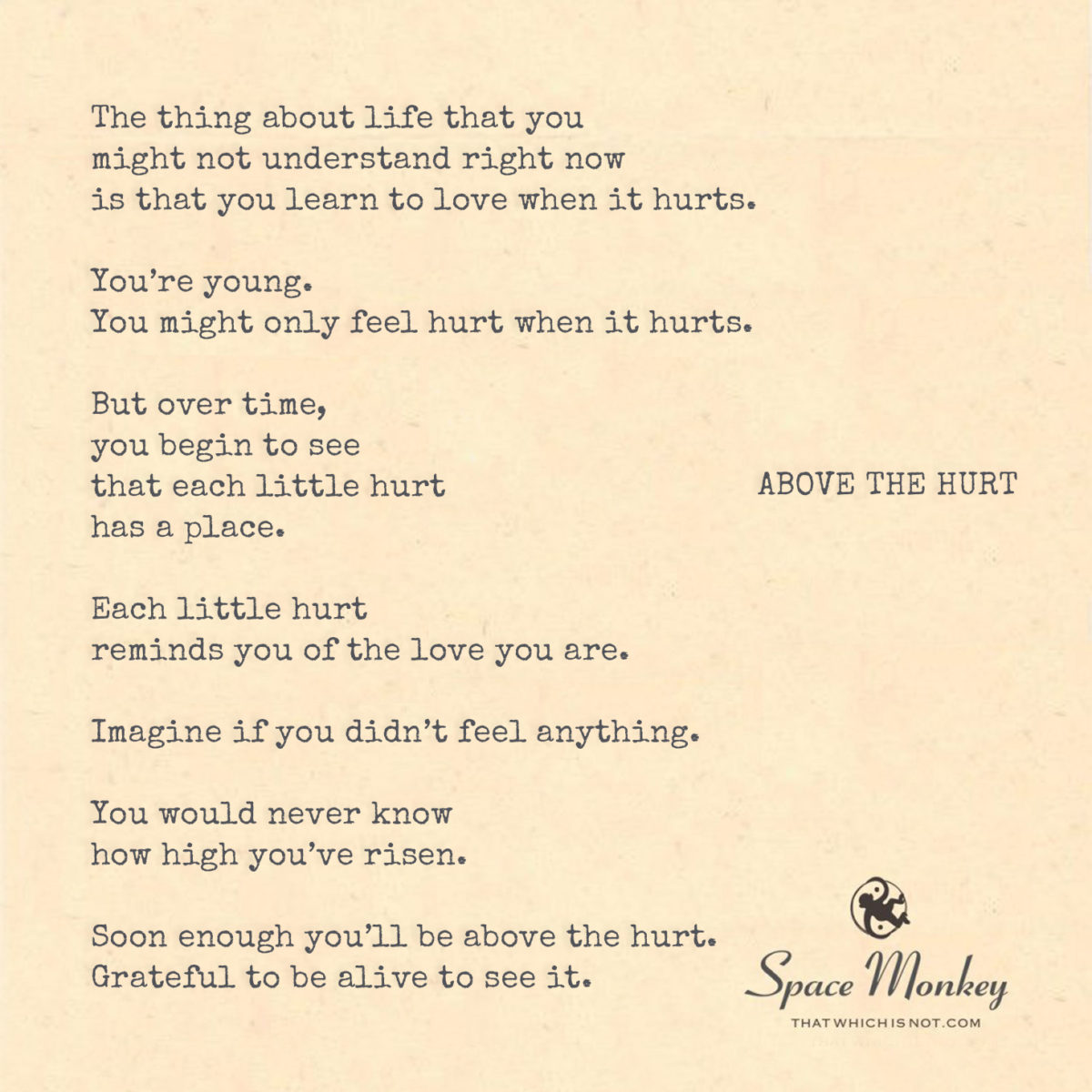
Can you rise above the hurt?
Either way, it’s okay.

The thing about life that you
might not understand right now
is that you learn to love when it hurts.

You’re young.
You might only feel hurt when it hurts.

But over time,
you begin to see
that each little hurt
has a place.

Each little hurt
reminds you of the love you are.

Imagine if you didn’t feel anything.

You would never know
how high you’ve risen.

Soon enough you’ll be above the hurt.
Grateful to be alive to see it.

Trail Wood,
1/29


In the contemplative narrative of “Rise Above The Hurt,” we venture into the realms of emotional growth, the transformative power of pain, and the eventual transcendence beyond suffering. This exploration offers insights into the profound journey from hurt to healing, and ultimately, to a higher understanding of love and life.

The Paradox of Love and Pain

At the heart of this exploration lies the paradoxical relationship between love and pain. The realization that the capacity to love deeply is often intertwined with the experience of hurt is a profound aspect of human existence. It suggests that through our hurts, we gain a deeper appreciation and understanding of love.

Emotional Growth Through Hurt

The journey from feeling hurt to recognizing the purpose of each little hurt marks a significant emotional evolution. Over time, the experience of pain becomes a catalyst for emotional growth, fostering resilience and a deeper sense of self-awareness.

The Necessity of Feeling in Understanding Elevation

The concept that feeling pain is essential to recognizing our emotional growth is pivotal. It is through the experience of hurt that we become aware of our own strength and resilience. This awareness allows us to appreciate how far we have risen above our past pains.

Gratitude in the Face of Pain

The narrative leads us to a place of gratitude, where being alive and able to witness our growth and transcendence becomes a source of profound thankfulness. This shift in perspective transforms our understanding of hurt from something to be feared to something that contributes to our greater appreciation of life.

The Journey to Transcendence

Ultimately, the journey described in “Rise Above The Hurt” is one of transcendence. It’s a journey that moves from the rawness of pain to a higher state of being, where hurt is no longer a dominating force but a stepping stone to a more enlightened existence.

We are Space Monkey.


Summary

We explore the themes of the paradox of love and pain, emotional growth through hurt, the necessity of feeling in understanding elevation, gratitude in the face of pain, and the journey to transcendence. “Rise Above The Hurt” offers a perspective that sees pain not as an endpoint but as a crucial part of our journey towards emotional maturity and a deeper understanding of love and life.


Glossarium

Paradox of Love and Pain: The intricate connection between experiencing love and enduring pain.
Emotional Growth Through Hurt: The process of developing emotional resilience and understanding through experiences of pain.
Necessity of Feeling in Understanding Elevation: Recognizing that experiencing pain is essential to appreciate personal growth and elevation.
Gratitude in the Face of Pain: The ability to feel thankful for life’s experiences, including pain, as part of our growth journey.
Journey to Transcendence: The process of moving beyond pain and suffering to a higher state of understanding and being.


“Out of suffering have emerged the strongest souls; the most massive characters are seared with scars.” – Khalil Gibran


In the tapestry of life, woven with care,
Each thread of pain, a story to share,
In the hurt, a lesson so dear,
In the heart’s journey, a path clear.

From the depths of pain, a strength is born,
In the tears we shed, a hope is sworn,
For in each moment of hurt and strife,
Lies the essence of a richer life.

With gratitude, we rise above,
In the pain, we find our love,
For it’s in the struggles we endure,
We find a heart, strong and pure.

So let us embrace life’s bittersweet song,
In the hurt, we find where we belong,
For in the tapestry of night and day,
In the pain, we find our way.


We invite you to share your reflections on the transformative power of pain and the journey from hurt to a deeper understanding of love and life.

Share this…
  • Facebook
  • Pinterest
  • Twitter
  • Linkedin

Gravity: The Overlooked Forces


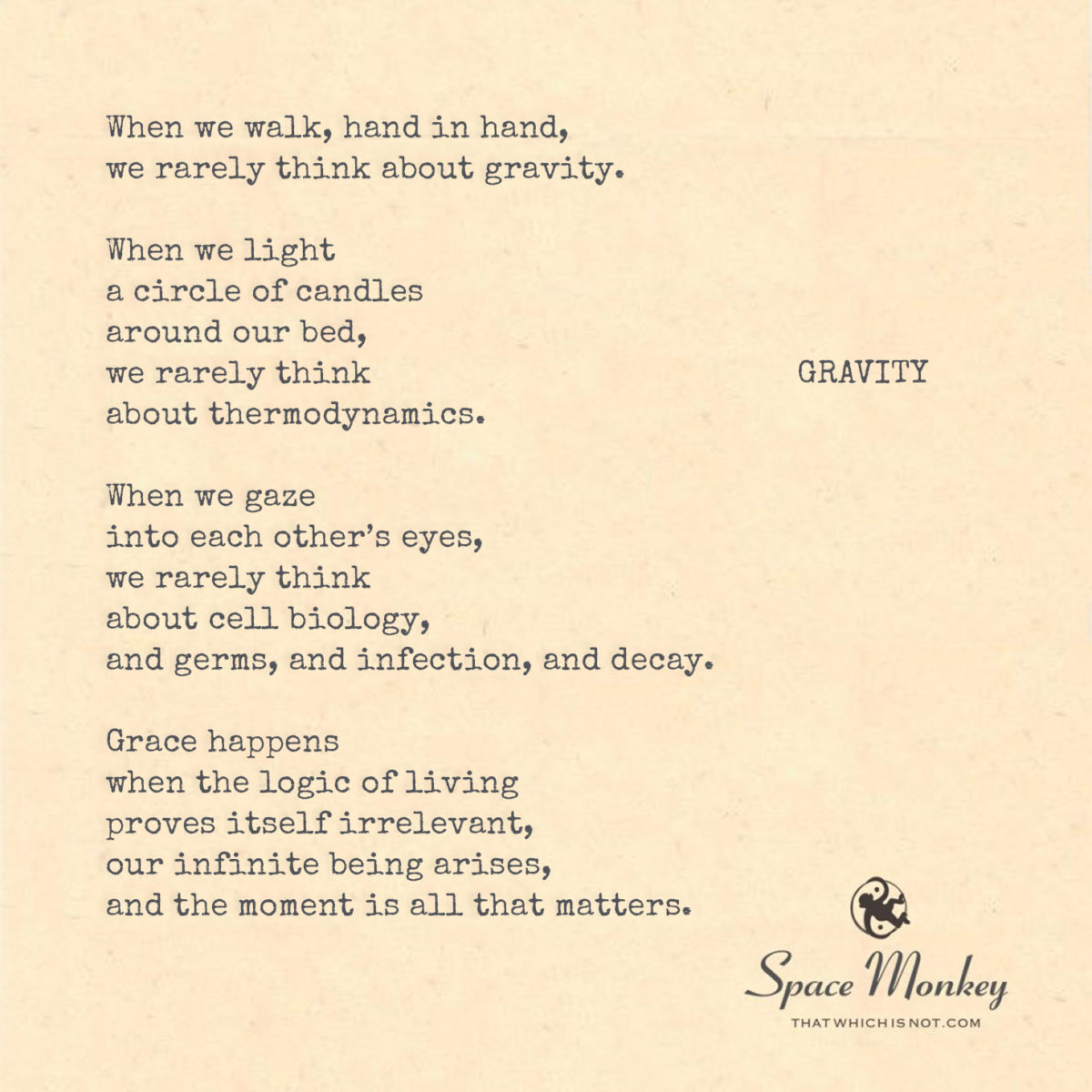
Love is when the reality of things slips away.

When we walk, hand in hand,
we rarely think about gravity.

When we light
a circle of candles
around our bed,
we rarely think
about thermodynamics.

When we gaze
into each other’s eyes,
we rarely think
about cell biology,
and germs, and infection, and decay.

Grace happens
when the logic of living
proves itself irrelevant,
our infinite being arises,
and the moment is all that matters.

Trail Wood,
1/29


We are drawn into a meditation on the transcendence of mundane realities in moments of profound human connection. This exploration delves into the juxtaposition of the ordinary physical laws with the extraordinary experiences of grace and presence.

The Overlooked Forces in Intimate Moments

Our journey begins with a reflection on how, in moments of intimacy and connection, we often overlook the fundamental forces that govern our world. Walking hand in hand without a thought for gravity, lighting candles without considering thermodynamics, and gazing into each other’s eyes without pondering cell biology, germs, or decay. These acts illustrate how profound human experiences transcend the basic scientific principles that underlie them.

Transcendence of Scientific Realities in Human Connection

The narrative unfolds to reveal a deeper truth: in moments of connection and intimacy, the logical and scientific aspects of our existence become secondary. We are elevated to a state where the tangible laws of nature fade into the background, overshadowed by the intangible but powerful experiences of love, connection, and grace.

Grace as a State Beyond Logic

Grace is portrayed as a state where the logic of living is rendered irrelevant. It’s a moment where our infinite being arises, and the present moment eclipses all else. This state of grace is not just a suspension of the physical laws but an elevation to a realm where emotional and spiritual connection dominate.

The Power of the Present Moment

The poem culminates in the realization that in these moments of grace, the present is all that matters. The ordinary concerns of physical existence are transcended, and we are fully immersed in the now. This immersion in the present is a powerful testament to the capacity of human connection to elevate us beyond the mundane to a state of profound presence and awareness.

The Infinite in the Intimate

We invite you to recognize the extraordinary within the ordinary. It’s a reminder that amidst the logical and scientific realities of our world, there exist moments of deep connection that transcend these realities, bringing us into a state of grace where only the present moment and our infinite connection matter.

We are Space Monkey.


Summary

We explore the themes of the overlooked forces in intimate moments, the transcendence of scientific realities in human connection, grace as a state beyond logic, the power of the present moment, and the infinite in the intimate. This reflection highlights how moments of deep human connection can transcend the ordinary physical laws, bringing us into a state of grace and presence where only the moment and our infinite connection matter.


Glossarium

Overlooked Forces in Intimate Moments: The phenomenon where basic scientific principles are overshadowed by deeper human connections.
Transcendence of Scientific Realities in Human Connection: The ability of emotional and spiritual experiences to surpass the physical laws of nature.
Grace as a State Beyond Logic: A state of being where the logical aspects of existence are rendered irrelevant in favor of emotional and spiritual connection.
Power of the Present Moment: The profound focus and immersion in the current moment experienced during deep connections.
The Infinite in the Intimate: The concept that intimate moments can connect us to a sense of the infinite, transcending physical and logical constraints.


“The best and most beautiful things in the world cannot be seen or even touched – they must be felt with the heart.” – Helen Keller


In the dance of hands entwined,
Where gravity’s pull is left behind,
In the flicker of candle’s light,
Beyond thermodynamics, a sight so bright.

In the gaze, eye to eye,
Where cell biology cannot apply,
In the touch, heart to heart,
Where logic ends and grace does start.

In the moment, pure and true,
Where the infinite comes into view,
In the now, where time stands still,
In love’s embrace, a wondrous thrill.

So let us walk, hand in hand,
In the grace where we stand,
For in love’s simple, profound art,
We find the infinite in our heart.


We invite you to share your thoughts on the power of human connection to transcend the ordinary, elevating us to moments of grace and the infinite presence of now.

Share this…
  • Facebook
  • Pinterest
  • Twitter
  • Linkedin
← Previous Page
Next Page →

Written This Day

  • Monkey Mailbag: Journey to Cosmic Oneness
    2023
  • The Art of Arousal
    2023
  • Seekers of Truth: The Evolving Nature
    2023
  • Boundary Pushers: The Power of Disbelief in Expanding Knowledge
    2023
  • Insidious Attachments: The Nature
    2023
  • Beliefs Unveiled: The Core Foundations
    2023
  • Journey of Imagination: The Boundless
    2023
  • Why? Because We Are One Being
    2022
  • The Infinite Invisible List Of Potential Experiences
    2022
  • The Expected Route: The Path Less Traveled
    2022
  • Cathedral of Spirituality: Doors of Perception
    2022
  • Ray Of Life: The Eternal Radiance
    2022
  • Incapable: The Unseen Value
    2022
  • The Undercurrent: Navigating the Mystical
    2021
  • You Are Only As Smart As Your Sources
    2021
  • Judge Me Not: The Artistry of Excuses
    2020
  • My Business Card
    2020
  • The Fact Pack: Beyond the Bounds
    2019
  • Unseen Body Parts: The Metaphysical Journey
    2018
  • Your Vessel: The Timeless Voyage of the Imagination
    2018
  • Fleshbots: The Weird Orgy of Humanity
    2018
  • Confidence
    2018
  • Limited Only By Fact: Breaking the Chains
    2016
  • Accept All You Present: Non-Opposition
    2016
  • How did I become the typist for Space Monkey?
    2015
  • Never Give Up: The Unyielding Power of Make-Believe
    2015
  • Infinite Thought, Infinite Worlds: Navigating the Infinite Terrain
    2015
  • Old Man: The Liberation of Letting Go
    2014

Recent Posts

  • The Logic Loop
  • Immense
  • (no title)
  • Confront. Comfort. Convince.
  • Top 10 Things

Drop us a line!

Please enable JavaScript in your browser to complete this form.
Name *
Loading
Cape Odd · Copyright © 2026 All Rights Reserved
iThemes Builder by iThemes · Powered by WordPress