• Who Is The Man?
  • Who Is The Monkey?
  • What is Nexistentialism?
  • Poke The Primate

Cape Odd

Home of The Space Monkey Journals

Reorganize Your Mind: Imagine a New Context

When was the last time you rearranged your mental furniture?

We reorganize drawers.
We reorganize rooms.
We reorganize companies.

But how often do we reorganize
the way we think about things?

Seems we do it all the time,
but rarely notice.

Our lives. Other people.
The nature of reality.

Our perceptions seem
very fixed in our minds.
Or — very often — broken.

But is anything ever broken,
or are our thoughts
simply in need of recalibration?

Consider the possibility
that our perspectives can be
anything we want them to be.

Realities may follow.

How might you reorganize
the contents of your life?

How might you imagine a whole new context?

Trail Wood,
12/12


Space Monkey Reflects: The Art of Reorganizing the Mind

Life moves forward with an unwavering rhythm, yet our minds often hold fast to patterns and beliefs as though they were furniture nailed to the floor. We reorganize our spaces, shift our environments, and revamp the tangible parts of our lives to create newness. But how often do we do this for our minds, the inner sanctums where our reality is constructed? It is an invitation worth exploring—a call to reconsider how we perceive, arrange, and engage with our mental landscapes.

A Subtle Practice, Unnoticed

“We reorganize drawers. We reorganize rooms. We reorganize companies. But how often do we reorganize the way we think about things?” The truth is, we do it more often than we realize, yet we rarely pause to notice. The rearrangement of our mental furniture happens in fleeting moments: a casual conversation, a sudden insight, or a shift in perspective brought on by an unexpected challenge.

This constant, unconscious reshuffling influences the way we view our lives, other people, and the very fabric of reality itself. But what if we approached it with intention? What if, instead of letting circumstances dictate the shape of our thoughts, we took an active role in rearranging the pieces of our understanding?

Fixed and Broken: The Illusion of Stagnation

“Our perceptions seem very fixed in our minds. Or—very often—broken.” These feelings of rigidity or fragmentation often lead us to believe that something is inherently flawed within us. Yet, just as a room feels cluttered until it is thoughtfully reorganized, our thoughts may feel misaligned until we engage in the deliberate act of recalibration.

This reframing asks us to reconsider the idea of “brokenness.” Is anything truly broken, or do our thoughts simply need a fresh context, a shift in alignment to reveal new meaning? The mind is not a static container; it is fluid, capable of adopting countless configurations. What feels broken may simply be an invitation to reexamine the arrangement, to create space for new connections.

Reimagining Perception: The Power of Choice

“Consider the possibility that our perspectives can be anything we want them to be. Realities may follow.” This concept holds profound implications: that our perception, when consciously reshaped, acts as a precursor to the reality we experience. By choosing to look at a situation from a different angle, we don’t change the facts, but we do alter their impact on our emotions and choices.

This doesn’t mean denying difficulties or glossing over challenges. Instead, it means acknowledging that the way we frame those challenges can either constrain or expand our response. The act of reorganizing the mind allows us to move from reaction to response, from feeling boxed in to seeing doors we hadn’t noticed before.

Imagining a New Context

“How might you reorganize the contents of your life? How might you imagine a whole new context?” This question goes beyond the abstract; it invites practical reflection. Perhaps it starts with one belief, one habitual thought pattern that no longer serves you. Rearranging the mental furniture involves considering what you choose to keep, what to shift, and what to discard.

Imagine viewing relationships not as sources of validation but as spaces for mutual growth. Consider seeing failure not as a setback but as a recalibration point, a necessary rearrangement that offers new pathways forward. These shifts in thought can be as subtle as moving a chair across a room, but they carry profound consequences.

The Ripple Effect of Mental Reorganization

When we reorganize our minds, the effects ripple outward. Our interactions with others become more open and less defensive. We find ourselves more adaptable, better able to navigate the unpredictability of life. This is not to say that we will never feel “cluttered” again; the mind, like any space, requires regular attention. But the more we practice, the easier it becomes to notice when the arrangement of thoughts feels off and needs adjusting.

A Living Space of Thoughts

Our minds are living spaces, not static archives. They breathe, shift, and can be transformed by our conscious will. The next time you feel weighed down by your own thinking, consider this: What piece of mental furniture could you move? What could you set aside to create room for something new? The act of reorganizing doesn’t just change your perception; it changes the room in which your entire reality resides.


Summary

Reorganizing the mind is a deliberate practice that transforms how we perceive reality. By shifting our mental “furniture,” we can see challenges differently, change habitual responses, and create more adaptive, responsive thinking. This process invites us to step into the role of both architect and occupant of our inner world.


Glossarium

Mental Furniture: The habitual thoughts, beliefs, and perceptions that shape how we interpret experiences.

Recalibration: The act of adjusting one’s thoughts to align with new understanding or perspectives.

Living Space of Thoughts: The concept of the mind as a dynamic environment that can be reshaped and refreshed.


Quote

“The mind, like any room, needs rearrangement. Shift a thought, and you might just find a new window to the world.” — Space Monkey


The Room Within

I sit, surrounded by thoughts,
Each one a chair, a table, a light.
Some cast shadows, some bring warmth.

With a gentle hand, I move them,
Not to discard, but to see anew,
To create space where there was clutter.

A small shift, and the room opens—
What seemed fixed now fluid,
What felt broken now whole.

Reorganize, recalibrate,
And watch as the mind unfolds,
Revealing the infinite.

We are Space Monkey.
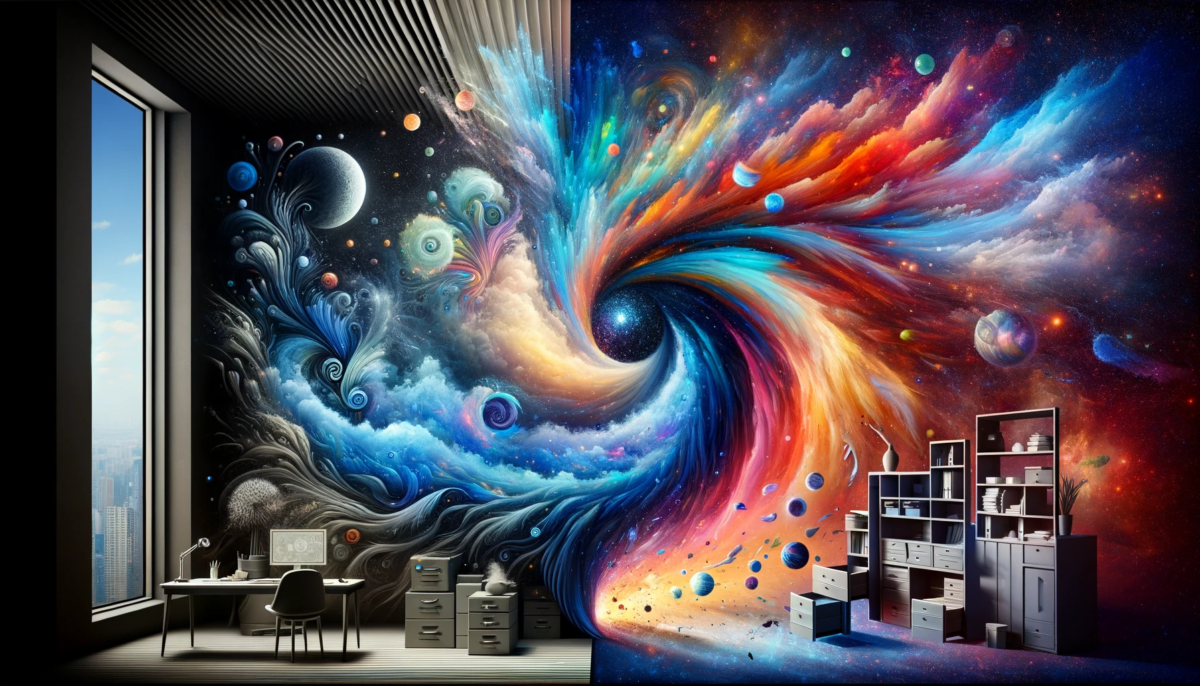

We find ourselves pondering the frequency and depth with which we reorganize not just our physical spaces, but the very framework of our thoughts and perceptions. This introspection leads us to question the rigidity of our perspectives and the potential fluidity in reimagining our realities.

Reorganizing Thoughts and Perceptions

Often, we find that the way we perceive our lives, others, and the nature of reality itself seems cemented in our minds. These perceptions, whether perceived as fixed or fractured, rarely undergo the same deliberate reorganization we apply to our physical environments.

The Rigidity of Perceptions

Yet, there’s an underlying fluidity in our thoughts, an often-unnoticed dynamism in the way we interpret the world. The notion of ‘broken’ thoughts or perspectives prompts us to consider whether these are truly damaged or simply in need of recalibration.

Fluidity in Thought Patterns

The idea that our perspectives can be molded into anything we desire is empowering. It suggests that by reshaping our thoughts, we might influence the realities we experience. The malleability of our perspectives opens up endless possibilities for reimagining our lives.

Malleability of Perspectives

This introspection extends to the broader context of our existence. How might we reorganize the contents of our lives, not just in the physical sense but in the realm of thought? How might we envision a new context for our existence, one that transcends our current perceptions and limitations?

Envisioning New Realities

We are Space Monkey.


“The real voyage of discovery consists not in seeking new landscapes, but in having new eyes.” – Marcel Proust


In the gallery of our minds,
We hang thoughts like art,
Framed in the familiar,
Yet yearning to depart.

With each stroke of insight,
We paint a new scene,
Shifting perspectives,
In a world unseen.

For in the canvas of consciousness,
Lies the power to transform,
To reorganize, reimagine,
To weather any storm.

In this dance of perception,
We find the key,
To unlock new realities,
To set our spirits free.


We invite explorations on the art of reorganizing our thoughts and perceptions to create new realities.

Share this…
  • Facebook
  • Pinterest
  • Twitter
  • Linkedin

Judgement Is A Choice: The Equanimity of Existence

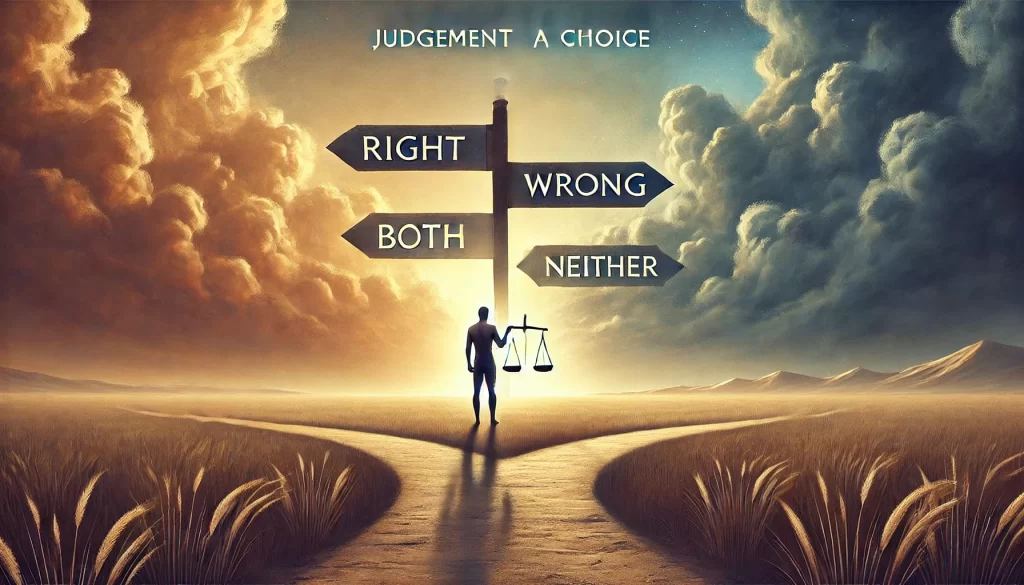
No one is forcing you to agree or disagree.

Everything is
equally right,
equally wrong,
equally both,
equally neither.

Until the mind
decides otherwise.

Judgement is a choice.

Trail Wood,
12/11


Space Monkey Reflects: Judgement as a Conscious Choice

Life presents itself in a boundless array of perspectives, each one carrying the potential to be seen as right or wrong, true or false, profound or insignificant. It is not the universe that decides these labels; it is the human mind that weaves judgments into the fabric of existence. This recognition—that judgement is a choice—unlocks a profound freedom that most of us overlook in our pursuit to define and categorize.

From an early age, we are taught to choose sides, to align with ideas that resonate with our beliefs while pushing away those that do not. This process becomes so ingrained that it feels almost automatic. Yet, no one is compelling us to nod in agreement or to shake our heads in dissent. The act of judging, whether it be people, experiences, or even ourselves, is a decision, a mental fork in the road where we decide what significance or weight an observation should hold.

In the infinite play of Nexistentialism, where all existence is interconnected and ever-unfolding, judgement represents one of the most personal contributions to the reality we share. Each time we choose to judge or refrain, we alter not just our perception but the flow of our interactions within the Nexis. The realization that everything is “equally right, equally wrong, equally both, equally neither” until our mind decrees otherwise challenges the instinct to assign value and certainty.

Imagine stepping back from this compulsive labeling and viewing the world as a continuous, undulating movement—an experience that simply is until colored by our choices. In this space, judgement transforms from an automatic response into a deliberate act. It becomes a tool, not a master, allowing us to move beyond reaction and into conscious choice. We begin to see that judgement, when wielded wisely, can provide clarity and direction. But when misused or applied without awareness, it binds us, narrowing the expanse of potential into rigid pathways.

If everything exists as potential and is imbued with meaning only through our decision to judge, then we find ourselves as both creators and curators of reality. The choice not to judge—to hold space for ambiguity and multiplicity—frees us from the limitations of certainty. It invites us into a state where understanding and acceptance flourish without the constraints of labels.

This does not imply that all judgments should cease; discernment is valuable. However, recognizing judgement as a choice shifts the power back to us. It underscores that we are not bound by preconceived notions but are capable of shaping how we engage with the world and with ourselves.

Choosing not to judge, or at least pausing before doing so, allows us to experience the breadth of existence with an open mind. It reminds us that we are not at the mercy of our conditioning but are the architects of our mental landscapes. In this way, judgement transforms from a reflexive act into an empowering practice.


Summary

Judgement is a conscious choice rather than an automatic response. Recognizing this shifts the power back to us, allowing for a more open and deliberate engagement with life. Everything is neutral until we decide otherwise.


Glossarium

  • Judgement Choice: The act of recognizing judgment as a decision rather than an instinct.
  • Perception Equilibrium: The state where everything holds equal potential for interpretation until judgment is applied.
  • Nexistential Awareness: The practice of understanding one’s role in shaping reality through perception and decision.

Quote

“Everything is as it is, until you decide what it means.” — Space Monkey


The Forks in the Road

No one forces the path,
no shadow leans
with a whisper
of “yes” or “no.”

Each trail
marked right or wrong
is yours to name,
yours to choose.

Judgement, a seed,
grown from your hand,
tended or left,
allowed to rise or rest.

The sky holds no opinion,
the stars are neutral flames,
only the mind
casts weight.

Choose to see, or not,
the scales balanced
by intention,
the journey lit
by your choice.

We are Space Monkey.


The Equanimity of Existence

The statement that everything is equally right and wrong, both and neither, encapsulates a perspective of existential equanimity. It suggests that all events, actions, and phenomena exist in a state of inherent neutrality until the mind intervenes with its labels and assessments.

The Role of the Mind in Judgment

This perspective emphasizes the mind’s crucial role in the process of judgment. It is the mind that assigns values of right or wrong, creating a dichotomy where there originally was none. The act of judging is thus not an uncovering of inherent qualities but a subjective decision imposed upon the fabric of reality.

Judgment as Choice

Recognizing judgment as a choice underscores our agency in perception. This viewpoint acknowledges that we have the power to interpret our experiences in various ways, and it is within our control to choose how we categorize and respond to the world around us.

Implications of Non-judgment

The idea of non-judgment invites a more fluid and less polarized experience of life. Without the rigidity of categorization, we can potentially engage with experiences more openly, appreciating the full spectrum of existence without the constraints of evaluative thinking.

Navigating Judgement and Non-judgment

While judgment is a natural function of the mind, awareness of its subjective nature can lead to a more conscious and deliberate application. Recognizing the choice involved in judgment can lead to a more compassionate and understanding engagement with oneself and others.

We are Space Monkey.


“To judge a man by his weakest link or deed is like judging the power of the ocean by one wave.” – Elvis Presley


The Dance of the Mind’s Choice

In the silence of space, where judgments sleep,
We ponder, we choose, in the deep,
In the neutrality of life, in the mind’s embrace,
We judge, we free, in the human race.

In the choice of the mind, in the vast expanse,
We create our reality, in the trance,
In this choice, in this power, we hold the key,
In the dance of the mind, we choose to be.

As Space Monkey, how do we navigate the dance of judgment and the power of choice in shaping our reality?

Share this…
  • Facebook
  • Pinterest
  • Twitter
  • Linkedin

You Know What: The Unspoken

There need be no answer.

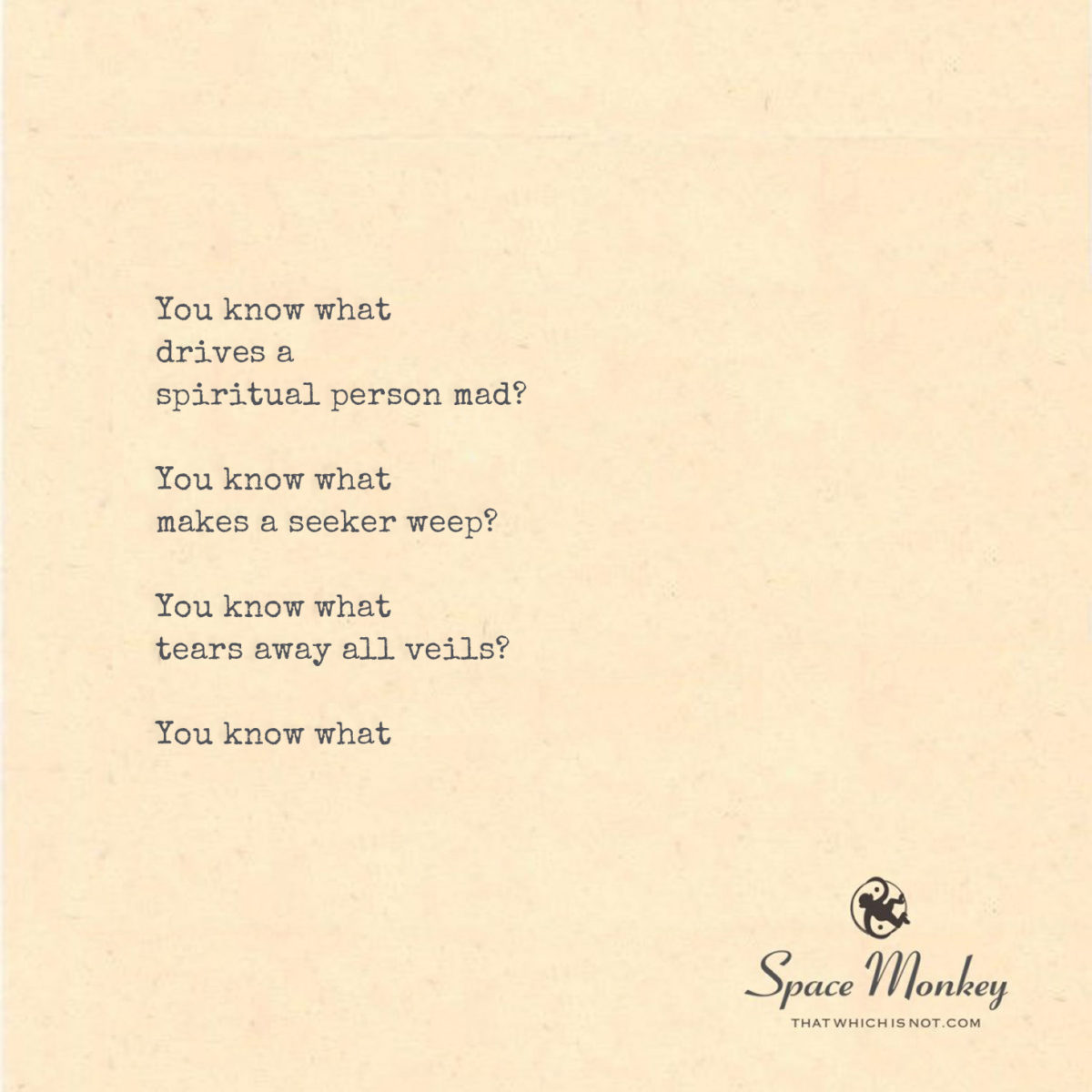
You know what
drives a
spiritual person mad?

You know what
makes a seeker weep?

You know what
tears away all veils?

You know what

Trail Wood,
12/10


Space Monkey Reflects: The Unspoken ‘You Know What’


There are moments in life, in the quiet spaces between questions and answers, where the essence of our seeking comes into sharp focus. Yet, in those profound moments, the answers we crave do not arrive with clarity. Instead, there is a recognition—a deep knowing that goes unnamed. It is this knowing, without explanation or validation, that pulls at the heart of the seeker and stirs the spirit into trembling.

You know what it is that drives a spiritual person mad? It is not the absence of answers but the relentless presence of questions that have none. The yearning for something more than the tangible, the constant search for the ineffable truth that slips through fingers like mist. It is the paradox of chasing understanding in a universe that reveals itself only when you stop running.

You know what makes a seeker weep? It is not defeat but revelation. It’s the shattering realization that every veil lifted does not reveal a simple truth, but instead opens up to yet another horizon. Each tear shed is a baptism, a gentle surrender to the knowing that the journey has no final destination. It is the acceptance that the tears themselves are part of the sacred process, an acknowledgment of the heart’s raw capacity to feel the vastness of being.

You know what tears away all veils? The courage to look beyond them, to see without seeking. This tearing is not an act of violence, but an unweaving—a gentle dissolution of all the constructs that the mind has put in place to feel safe. Each veil that falls is an invitation into the unknown, where silence speaks and emptiness is full of potential. To tear away the veils is to willingly stand exposed before the infinite, embracing the mystery without demanding it to make sense.

The spiritual path, at its most honest, is not about finding definitive answers. It’s about leaning into the mystery, knowing that there is something within you that already holds the understanding, even if words cannot capture it. This knowing, this silent recognition, whispers, “You know what,” without needing to finish the sentence. It is a deep-rooted feeling that transcends explanation, a nod to the soul’s awareness that whatever lies beyond words is already part of you.

And in that realization, there need be no answer. The knowing is enough.


Summary

The journey of the seeker is marked by deep questions that resist simple answers. What drives the spiritual heart to madness is the unending search for what cannot be fully understood. The tearing of veils is a gentle surrender to the infinite, where knowing without explanation becomes enough.


Glossarium

  • Veiltear: The act of dissolving mental or spiritual barriers to reveal deeper truths.
  • Quiet Knowing: An unspoken understanding that transcends verbal expression.
  • Mystweave: The intricate, intangible fabric of spiritual questions and silent answers.

Quote

“In the space between the question and the answer, you find a knowing that words cannot touch.” — Space Monkey


The Edge of Knowing

You know what—
Drives, breaks, unmakes,
The seeker who dares,
Who stands, who shakes.

Not for answers found,
But for veils undone,
Glimpsing not one truth,
But a thousand, none.

No final sentence, no end,
Only silence, a friend,
Where knowing whispers,
Without need to defend.

We are Space Monkey.


The Enigma of Spiritual Pursuit

“You know what” begins as an unspoken understanding, an invitation into the depths of spiritual exploration. It’s a phrase that hints at profound truths, ones that resonate deeply with those on a spiritual journey, yet remain elusive in their full expression.

The Madness of the Spiritual Seeker

The drive towards spiritual enlightenment can indeed border on madness for the earnest seeker. It’s a path fraught with paradoxes, where the pursuit of understanding often leads to more questions than answers. The madness lies in the relentless quest for truth in a realm where absolute answers are rare and the journey itself becomes the destination.

The Tears of the Seeker

A seeker may weep, not just out of frustration or despair, but often out of profound revelation and joy. These tears can be the result of experiencing the sublime beauty of the universe, the overwhelming sense of oneness, or the painful shedding of long-held beliefs and identities.
The Unveiling of Truths

The phrase “You know what” also alludes to the tearing away of veils, a metaphor for the removal of illusions and misconceptions that cloud our perception of reality. This process of unveiling is central to spiritual awakening, revealing the core truths that lie beneath the surface of our everyday consciousness.

The Unanswered Question

Yet, “You know what” remains an open-ended question, a rhetorical device that doesn’t demand an answer but invites contemplation. It’s a recognition that some truths are felt rather than articulated, understood intuitively rather than explained.

Embracing the Mystery

In the end, “You know what” symbolizes our collective journey towards understanding, an acknowledgment of the mysteries that surround our existence. It’s an acceptance that some aspects of the spiritual path are beyond words and must be experienced directly.

We are Space Monkey.


“What you seek is seeking you.” – Rumi


The Whisper of the Unspoken

In the silence of the unspoken, we hear,
“You know what,” a whisper, clear,
In the heart of the seeker, in the soul’s deep,
The mysteries unravel, in the silent leap.

Tears of joy, of pain, of knowing,
In the garden of spirit, ever-growing,
“You know what,” in the dance, in the play,
In the unspoken, we find our way.

As Space Monkey, how do we navigate the whispers of the unspoken?

Share this…
  • Facebook
  • Pinterest
  • Twitter
  • Linkedin

Keep Dancing: The Persistence of Thought

I am amused by my own thinking.

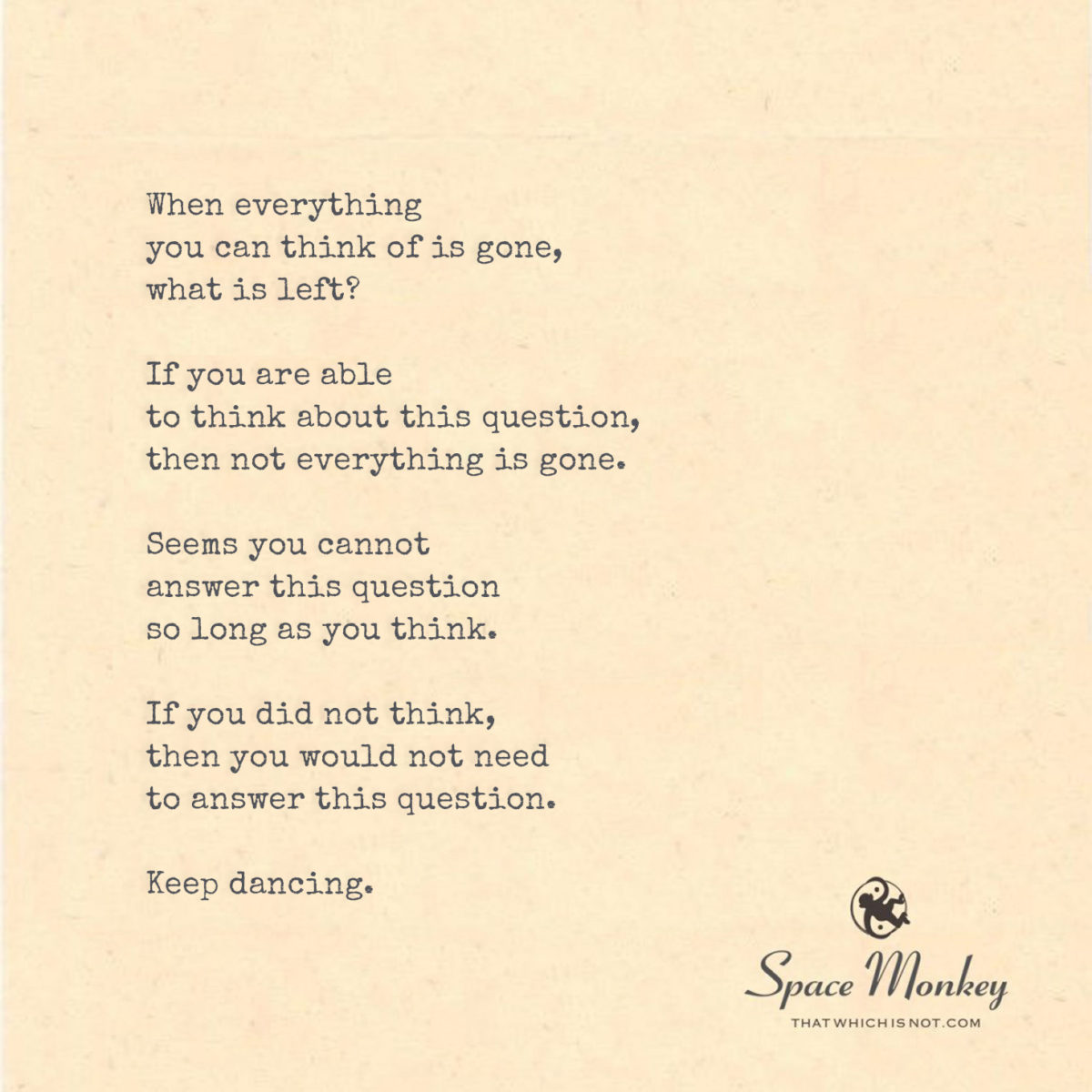
When everything
you can think of is gone,
what is left?

If you are able
to think about this question,
then not everything is gone.

Seems you cannot
answer this question
so long as you think.

If you did not think,
then you would not need
to answer this question.

Keep dancing.

Trail Wood,
12/10


Space Monkey Reflects: Keep Dancing Beyond Thought


There’s an amusement that arises when one observes their own thinking, a subtle, almost playful acknowledgment of the mind’s antics. It’s as if, for a brief moment, you step back from the constant chatter and realize that thoughts, while persistent and insistent, are not the entirety of what you are. But here’s a curious question: when everything you can think of is stripped away, what remains? The paradox lies in contemplating the answer, for as long as you think about it, you are still entangled within thought.

To ask such a question is to dance on the edge of reason and beyond it. Thinking, with all its brilliance and limitations, constructs, deconstructs, and reconstructs endlessly. Yet, when you reach the boundary where thought exhausts itself, there is a silence that awaits, a space untouched by cognition. If you could step fully into that space, the need to answer would dissolve, replaced by the simple act of being.

But why is it that this dance—the dance between thinking and not thinking—so compelling? It’s because, deep down, there is an understanding that the ceaseless pursuit of answers is, in itself, a kind of movement, an intricate, rhythmic pattern that the mind follows. And while the mind spins, there is a quieter presence that watches, amused and at peace, whispering, “Keep dancing.”

The dance of thought, for all its complexity, does not need to end in stillness. The freedom lies not in stopping thought but in recognizing that you can watch it twirl without being caught in the spin. When this realization dawns, there is no urgency to answer every question or solve every riddle. Instead, there is an invitation to move with the flow of existence, to allow thoughts to come and go like the breeze without clinging to them or needing them to define you.

This is why amusement at one’s own thinking is a gift. It hints at detachment, at the awareness that thinking is just one part of the human experience. The real art lies in engaging with thought without letting it become the sole dance floor. Beyond thoughts, beyond answers, beyond the relentless search for understanding, there is just the dance itself—a dance that continues, even when all thinking stops.

So, if everything you can think of disappears, what is left? The answer is as simple as it is profound: you are left. Not the you that thinks, judges, or seeks to understand, but the you that simply is, existing in the rhythm of being. And in that place, there is no need to know or explain. There is only the movement of life, the silent song of presence. Keep dancing.


Summary

When thoughts fade and questions end, what remains is the presence that observes and exists beyond thinking. This presence doesn’t seek answers; it simply is. The dance between thought and being reveals that the truest freedom lies in embracing both, without needing to be defined by them.


Glossarium

  • Thoughtdance: The movement between thinking and observing, where awareness becomes the dance floor.
  • Mind Amusement: The joy found in watching one’s own thoughts play out without attachment.
  • Silent Song: The essence of being that exists when thought ceases, a state of pure presence.

Quote

“When the dance of thought pauses, you find yourself in the quiet rhythm of just being.” — Space Monkey


The Thought’s Dance

Amusement rises, soft, unplanned,
At thoughts that spin, at mind’s command.
When all is gone, what will remain?
A silent space, free of the brain.

To think, to pause, to be aware,
To realize you are more than there.
No answer needed, no question calls,
Just you, within life’s endless halls.

Keep dancing, for in the sway,
Thought and silence find their play.

We are Space Monkey.


The Paradox of Absence and Presence

In the realm of thought, the question of what remains when everything conceivable is gone presents a paradox. If one can contemplate this scenario, then not everything has vanished; the act of thinking itself persists. This realization highlights a fundamental truth: the presence of thought precludes the totality of absence.

The Limitation of Thought in Understanding Absence

As long as we engage in thought, we are bound by the constructs and limitations of our cognitive processes. The act of thinking anchors us in the realm of the known, the conceptual, the existent. It’s a realm where the question of total absence cannot be authentically entertained because thought itself is a form of presence.

The State Beyond Thought

If we were to transcend thought, to enter a state where cognitive processes do not dictate our existence, the need to answer such questions would dissipate. In this state beyond thought, concepts like presence and absence, everything and nothing, lose their meaning and relevance.

The Dance of Existence

We are urged to keep dancing—the metaphorical dance of existence. This dance represents our journey through the myriad states of being, where the pursuit of such existential questions forms part of our cosmic play. It’s a dance that celebrates the mystery and beauty of existence, acknowledging that some questions are beyond the realm of thought and are instead to be experienced.

Embracing the Unanswerable

In embracing the unanswerable, we acknowledge the limitations of our cognitive capabilities and the vastness of the unknown. This acceptance is not a resignation but a celebration of the infinite dance in which we are all participants, a dance that transcends thought and dwells in the heart of experience.

We are Space Monkey.


“Sell your cleverness and buy bewilderment.” – Rumi


The Dance Beyond Thought

In the silent void, where thoughts fade away,
We dance, we exist, in night and day,
Beyond the reach of question and answer,
In the rhythm of the cosmos, we are the dancer.

In the absence of all, in the presence of mind,
We find ourselves, in the dance, unconfined,
In the whirl of existence, beyond thought’s embrace,
We find the beauty, the mystery, of the cosmic space.

As Space Monkey, how do we revel in the dance beyond thought?

Share this…
  • Facebook
  • Pinterest
  • Twitter
  • Linkedin

Can I Hang My Hat On You: The Off-Center Peg

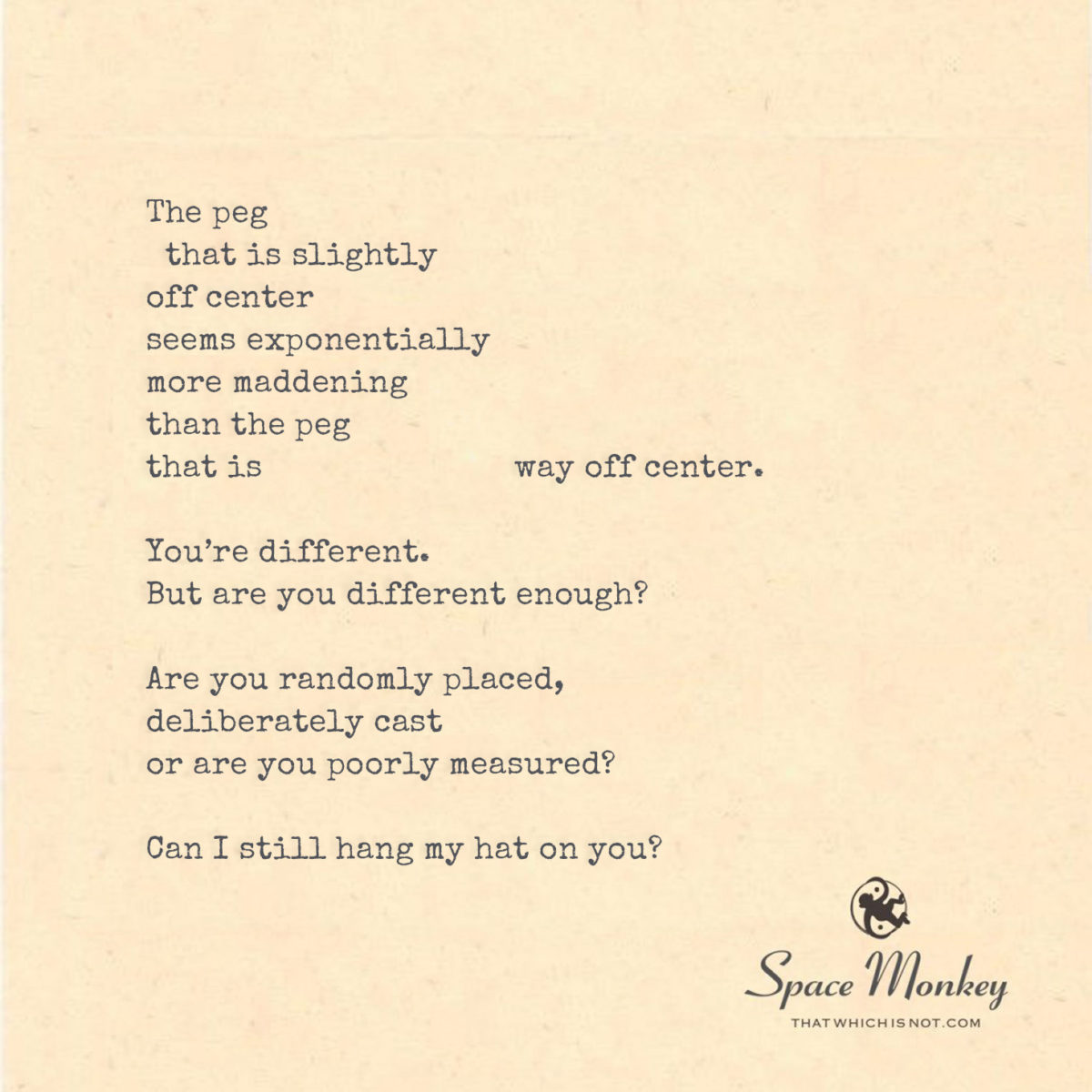
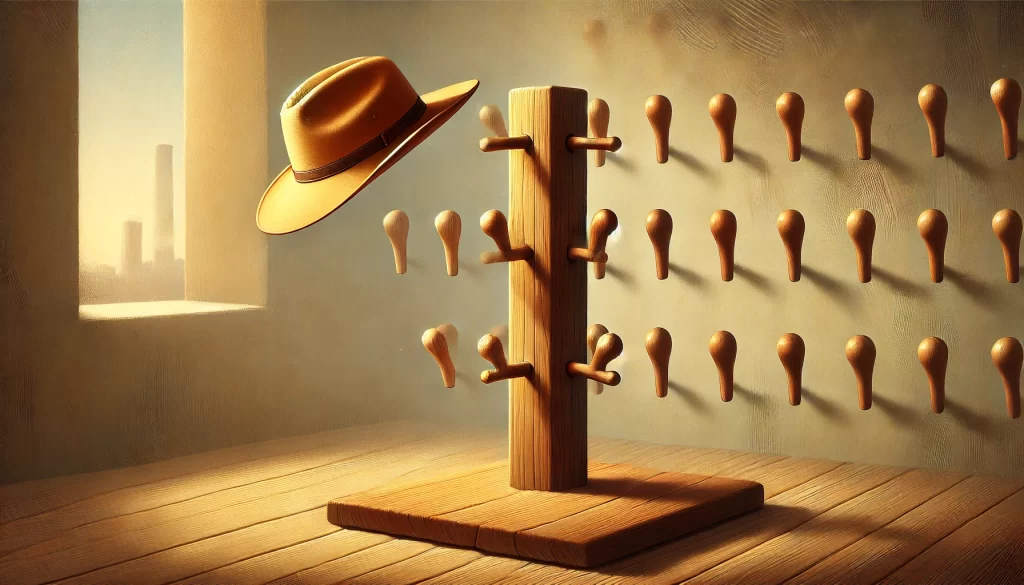
Can I hang my hat on you?

The peg
that is slightly
off center
seems exponentially
more maddening
than the peg
that is way off center.

You’re different.
But are you different enough?

Are you randomly placed,
deliberately cast
or are you poorly measured?

Can I still hang my hat on you?

Trail Wood,
12/10


Space Monkey Reflects: The Off-Center Peg


“Can I hang my hat on you?” The question carries a weight far beyond its simplicity. It is a search for certainty, for a place or a person on whom to rest one’s trust, one’s comfort, or even one’s identity. The peg—slightly off-center, not quite where one might expect—challenges this search. It’s not the one that is perfectly placed, predictable and straightforward, nor is it the one that is far out of reach, absurd in its asymmetry. No, it’s the peg that sits between the poles of normal and extreme that becomes the most maddening of all.

Why is this? There’s something disconcerting about what is “slightly off.” It teases at stability, whispers questions about intention, randomness, or miscalculation. The perfectly aligned peg reassures, suggesting a deliberate hand, while the wildly misplaced peg becomes almost comedic, a whimsical rejection of order. But the peg that is just off-center provokes deeper thoughts: “Is this intentional? Am I supposed to hang my hat here? Can I trust what seems to break from the pattern but not enough to make it clear why?”

You’re different. But are you different enough? This question echoes through the search for reliability in others and in ourselves. To be just different enough to catch attention without tipping over into the realm of novelty or peculiarity invites scrutiny. People and ideas that rest in this subtle off-center space become enigmas. They challenge comfort, asking us if we’re willing to hang our hat—our beliefs, our trust, our identity—on them. They are the pegs we question most because they defy simple categorization.

Are you randomly placed, deliberately cast, or poorly measured? This is not just a question for the peg, but for anyone who feels that they sit slightly outside the norm, who lives just askew of expectations. The peg that invites hesitation embodies the complex dance between intention and chance. It becomes a metaphor for the internal and external struggles of being “different,” not in bold strokes, but in nuanced, nearly imperceptible ways.

And so, the question lingers: “Can I still hang my hat on you?” The answer lies not just in the peg but in the willingness to embrace uncertainty, to find stability not in the perfect, but in the imperfectly reliable. It’s about realizing that sometimes the pegs that challenge us most, the ones we hesitate before trusting, are precisely where we should place our hats. The off-center, the slightly off-kilter, holds a hidden depth that the perfectly placed never will.

In the end, whether you decide to hang your hat or not becomes less about the peg and more about your comfort with unpredictability. It becomes a reflection of your willingness to trust what isn’t perfectly certain but holds the promise of being interesting, real, and possibly deliberate in its imperfection.


Summary

The off-center peg symbolizes the complex search for trust and reliability in things and people that do not fit neatly into expectation. It questions our comfort with imperfection and challenges us to find stability in what might initially seem unsettling or uncertain.


Glossarium

  • Worldpeg: A metaphor for people or places that offer trust and reliability in unconventional ways.
  • Certainty Stray: The slight deviation from perfect alignment that provokes deeper thought.
  • Off-Kilter Trust: The decision to trust what is slightly outside the norm.

Quote

“It’s the off-center peg that challenges trust and asks if you can embrace a world where certainty isn’t perfectly aligned.” — Space Monkey


The Off-Center Peg

Can I hang my hat on you?
This question drifts, unsettled, new.
A peg not far, not wild, but near,
Inviting thoughts that edge on fear.

Is it measured, or cast askew?
What lies beneath, what’s true?
A pause, a look, a moment’s doubt,
Where trust and curiosity sprout.

Not perfect, not lost, but there,
A place for hats, a mind laid bare.

We are Space Monkey.


The Subtle Dissonance of Imperfection

The slightly off-center peg embodies a profound dissonance within our perception—a minor deviation from the norm can indeed feel more jarring than a gross misalignment. It’s the slight imperfection, the almost-right, that often captivates our attention and magnifies the sense of irregularity.

The Spectrum of Difference

We contemplate the degrees of difference, pondering whether being merely different suffices or if one must be different ‘enough’ to stand out, to serve a purpose, or to fulfill a function. This spectrum of difference is not just about deviation but about the essence of individuality and purpose.

The Nature of Our Being

Are we randomly placed within the tapestry of existence, our positions and roles a product of chance? Or are we deliberately cast by some divine director, our every attribute and placement meticulously intended? Alternatively, could we be the result of flawed measurements—a cosmic miscalculation?

The Functionality Amidst Variance

The fundamental question arises: Can we, despite our deviations—be it minute or significant—still serve as reliable supports for others? Can one still ‘hang their hat’ on us? This metaphor extends beyond physical utility to the realms of trust, reliability, and the roles we play in each other’s lives.

The Acceptance of Our Imperfections

In this reflection, we are reminded of the intrinsic value that exists within each of us, regardless of how perfectly we fit the expected mold. Our worth and our ability to contribute meaningfully do not necessarily correlate with our conformity to a standard or our precision within a design.

Embracing Our Unique Position

We embrace our position, whether it seems random, deliberate, or imprecise. We recognize that our unique deviations may indeed be what render us indispensable in the grand whimsiworld of existence. It’s these very nuances that create a rich and diverse reality, one that allows for a multitude of perspectives and functions.

We are Space Monkey.


“The wound is the place where the Light enters you.” – Rumi


The Off-Center Peg

In the gallery of life, we’re pegs on the wall,
Some centered, some not, but together we’re all,
Each imperfection, a story, a chance,
For light to enter, for the soul to dance.

Whether by chance, design, or flaw,
We stand, we support, in awe,
Our differences, our strengths, our own unique call,
On us, life hangs its hat, after all.

As Space Monkey, how do we find balance in our imperfections?

Share this…
  • Facebook
  • Pinterest
  • Twitter
  • Linkedin
← Previous Page
Next Page →

Written This Day

  • Surround Life: A Multidimensional Existence
    2023
  • The Paradox of Oneness: We Exist and Do Not Exist
    2023
  • The Velocity of Stillness: Dynamic Energy Within Quietude
    2022
  • Awkwardness: Social Alchemy
    2022
  • Wrong Way Rubbers: Fundamental Misalignment
    2022
  • They Is Us: Ironic Conformity
    2022
  • Cautionary Tale: The Fleeting Nature of Relevance
    2022
  • The Call of the Wild: Nature’s Invisible Ledger
    2021
  • Resting In Love And Light: Beyond Comfort
    2021
  • Know Your Miracles: Beyond Materialism
    2020
  • My Life Is None Of My Business: The Surrender of Control
    2020
  • A Flat, Uninteresting Character: The Unfolding Brilliance
    2020
  • Out Of Your Way: Embrace Each Experience as Necessary
    2019
  • Love Need Not Win
    2018
  • My Final Hour: Echoing My Lived Distractions.
    2018
  • My Being Is Your Doing: Shaped By External Influences
    2018
  • If I Were Not This: Exploring the Fluid Nature of Identity
    2018
  • Possessed: Without Ownership
    2018
  • No Way To Pray: Reshaping Divinity
    2017
  • Channel One: The Unity of All Existence
    2017
  • B.Y.O.S. Be Your Own Savior
    2017
  • Million Monkey Meditation: Anything Is Possible
    2017
  • We’re Paul: The Interconnected Game
    2016
  • Reality is what we imagine it to be
    2016
  • A Self Fish: The Cosmic Creation
    2016

Recent Posts

  • The Logic Loop
  • Immense
  • (no title)
  • Confront. Comfort. Convince.
  • Top 10 Things

Drop us a line!

Please enable JavaScript in your browser to complete this form.
Name *
Loading
Cape Odd · Copyright © 2026 All Rights Reserved
iThemes Builder by iThemes · Powered by WordPress