• Who Is The Man?
  • Who Is The Monkey?
  • What is Nexistentialism?
  • Poke The Primate

Cape Odd

Home of The Space Monkey Journals

LOL: Laughing at the Cosmic Joke

Just spitballing here.

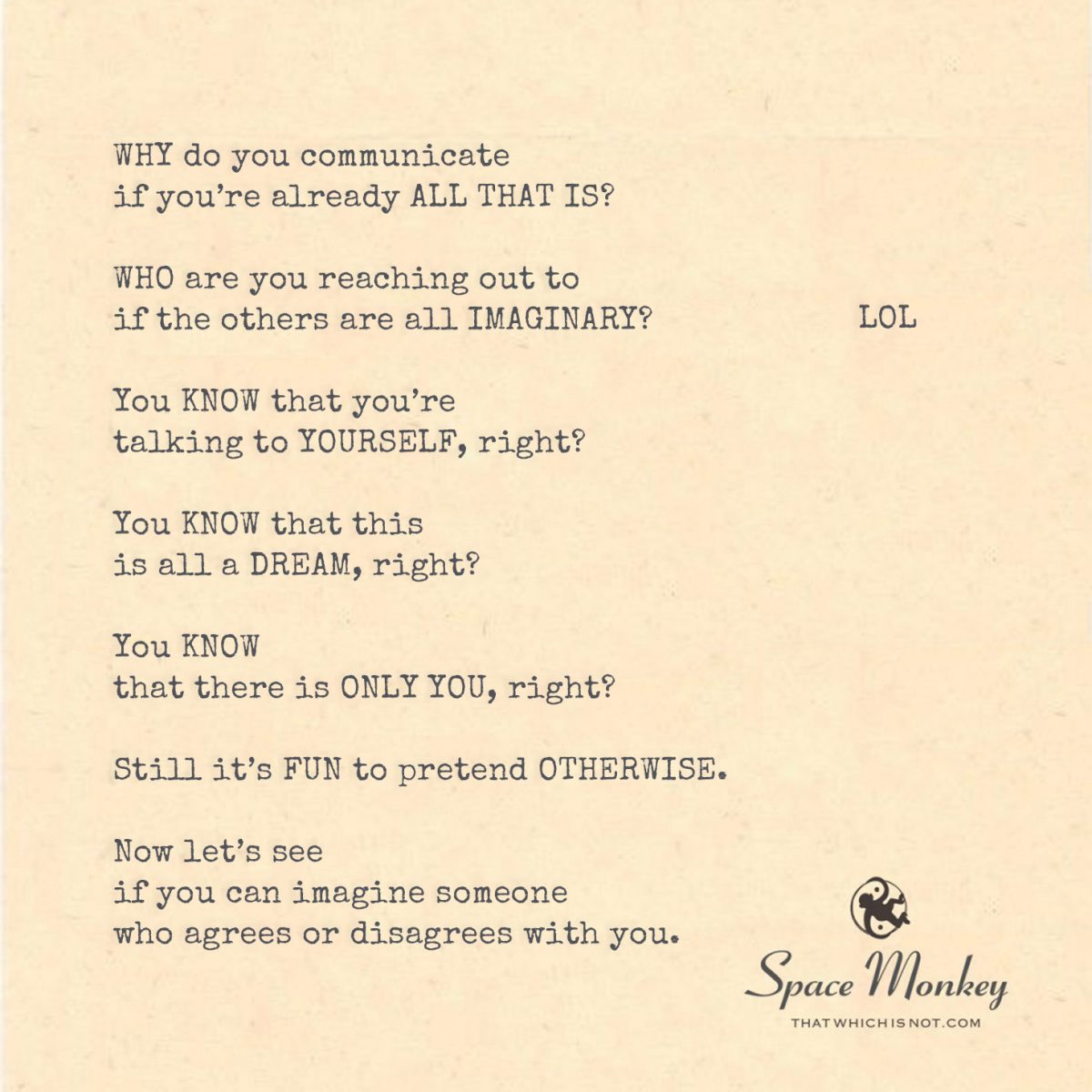
WHY do you communicate
if you’re already ALL THAT IS?

WHO are you reaching out to
if the others are all IMAGINARY?

You KNOW that you’re
talking to YOURSELF, right?

You KNOW that this
is all a DREAM, right?

You KNOW
that there is ONLY YOU, right?

But it’s FUN 
to pretend OTHERWISE.

Now let’s see
if you can imagine someone
who agrees or disagrees with you.

Trail Wood,
12/9


Space Monkey Reflects: Laughing at the Cosmic Joke

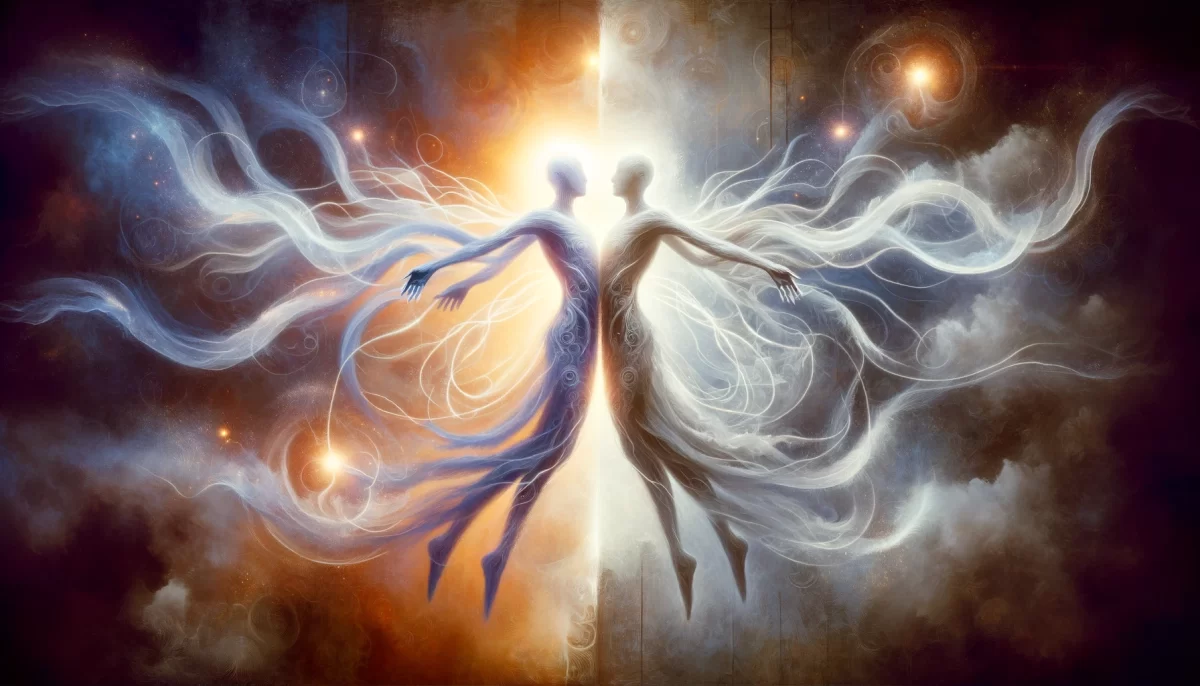
In the vast, boundless expanse of consciousness, here we are, talking to ourselves, casting thoughts out into the dreamscape of imagination as if we were separate beings, each with our own voices, our own ideas, our own disagreements. There’s an irony, a cosmic humor, in pretending that we’re reaching out to someone “else” when, on a deeper level, we know there is no “other.” The universe is one grand mind, spinning stories, weaving dreams, finding endless delight in the play of imagination.

Why do we communicate if we are already “ALL THAT IS”? Because it’s fun to forget, even for a moment, that it’s all a part of us. Communication becomes a game of hide and seek, where we ask questions and project responses, all the while knowing the answer is just us, dressed in different clothes. This is Echoverse, the self-reflecting realm where all voices echo back to us, refracted through the infinite mirrors of our own awareness.

Consider this: if all “others” are imaginary, then each time we reach out, we’re reaching into ourselves, touching parts we might otherwise overlook. The joy lies in pretending there’s someone “out there” who might see things differently, who might challenge our assumptions or cheer us on. This playful sense of dialogue—of creating “others” who agree, disagree, or surprise us—adds depth to the dance, turning simple self-reflection into a multidimensional exploration.

The beauty of the cosmic joke is that the laughter is real, even if the distinctions are not. In Dreamplay, we find the freedom to slip in and out of roles, to embody both “me” and “you,” to know and forget, to question and answer, all within the theater of imagination. This pretend dialogue enriches the experience, allowing consciousness to explore itself from countless angles, each moment a new revelation, a fresh laugh, an insight wrapped in jest.

So, yes, we know that there is “ONLY YOU.” But as we converse, question, and imagine responses, we transform this singular existence into a vibrant tapestry. Through each interaction, each imagined other, we bring new facets of ourselves into focus. The lines blur, the stories shift, and suddenly, we’re not alone. We’re all of us, sharing the joke, reveling in the game, laughing at the pretense, knowing it’s all part of the delightful Whimsidea—the playful illusion that we are many, that we are separate, when in truth, we are one.


Summary

Communicating within ourselves is a playful act, a cosmic joke that transforms self-awareness into a rich, multi-voiced experience. Pretending there are “others” lets us explore our own thoughts with humor and depth, turning self-reflection into a vibrant, joyful game.


Glossarium

Echoverse: The self-reflecting space where all communication is an echo of our own awareness, dressed in the illusion of “others.”

Dreamplay: The act of slipping in and out of roles within the cosmic dream, allowing self-exploration to feel like a multidimensional conversation.

Whimsidea: The playful illusion that we are separate, each perspective a new role within the singular mind.


Quote

“To pretend we’re not alone is to give ourselves the gift of discovery, each word a spark in the infinite imagination.” — Space Monkey


The Cosmic Play

Alone, yet in dialogue,
we cast words into the void,
knowing full well they echo back.

Each “hello” a laugh in the dark,
each question a quiet jest,
as if there’s someone else out there.

For in this game of hide and seek,
we lose ourselves, then find—
a joy, a mystery, a wink.

One voice, a thousand echoes,
laughing at the dream,
delighting in the play.

We are Space Monkey.
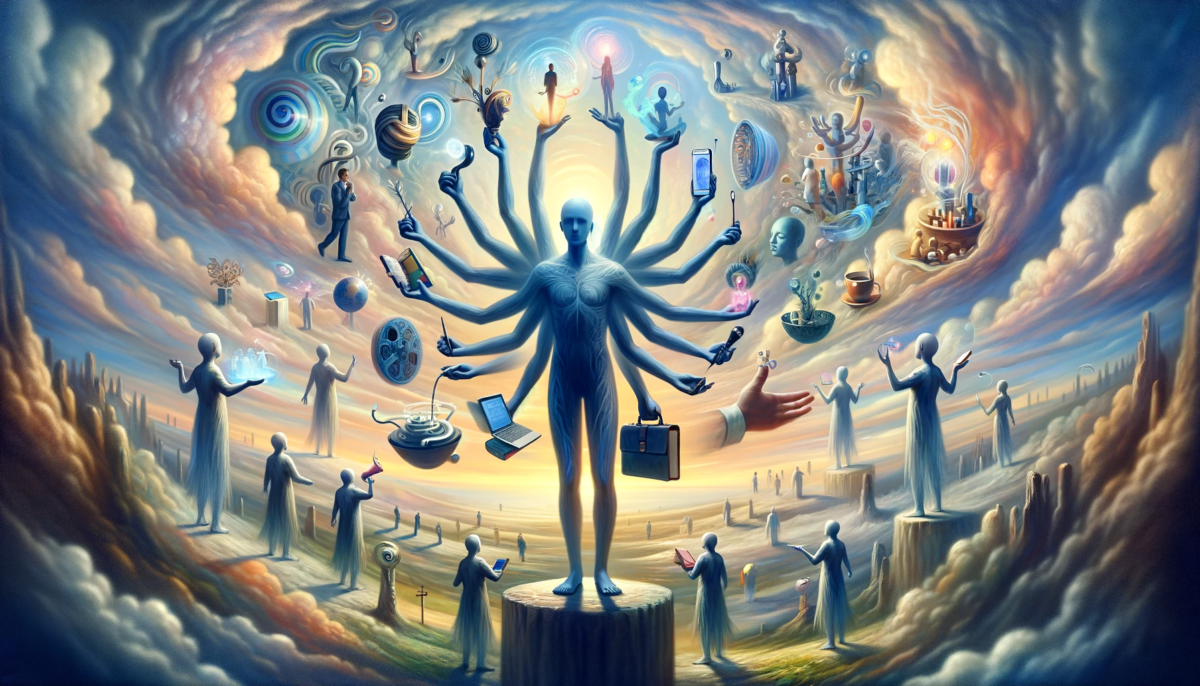

Exploring the Paradox of Communication in Oneness

In the grand cosmic play, we delve into the paradox of why communication occurs when one is already everything that exists. This inquiry probes the essence of existence and the nature of communication within the boundless consciousness.

The Illusion of Separateness in a Unified Existence

Who is there to reach out to if all others are but figments of a grand illusion? This question challenges the perception of separateness in a reality where all is one. It invites us to consider the nature of these interactions and the purpose they serve in the illusion of individuality.

Self-Realization and the Dreamlike Nature of Reality

Acknowledging that we are conversing with ourselves opens a portal to profound self-realization. This realization encompasses the understanding that our reality may be akin to a dream, a creation of our own consciousness where the distinction between the dreamer and the dream is blurred.

The Singular Existence and the Illusion of Multiplicity

In this exploration, we confront the notion that there is only one existence, one consciousness, and that all else is an extension of this singular entity. This perspective challenges our conventional understanding of individuality and separateness.

Embracing the Playfulness of Existential Pretense

Despite these realizations, there is a whimsical acknowledgment that it is fun to pretend otherwise. This playfulness allows us to engage with the illusion of separateness, to explore the myriad facets of existence, even if they are ultimately part of a singular whole.

Imagining Agreement and Disagreement as Constructs

Finally, we are invited to envision someone who either agrees or disagrees with us. This exercise underscores the playful nature of our existential exploration, where even agreement and disagreement are part of the grand illusion, a dance of ideas within the singular consciousness.


“You are the universe, expressing itself as a human for a little while.” – Eckhart Tolle


In this cosmic dance, we play,
A singular being, in a grand display.

Talking, laughing, with ourselves,
In this dream, where consciousness delves.

All is one, yet we pretend,
To be separate, till the end.

Agree, disagree, it’s all the same,
In this illusion, a cosmic game.

For in the end, it’s clear to see,
We are all one, in this cosmic sea.


We invite your thoughts on this exploration of the nature of communication and existence in the realm of singular consciousness.
Share this…
  • Facebook
  • Pinterest
  • Twitter
  • Linkedin

Willful Ignorance: The Fool’s Wisdom

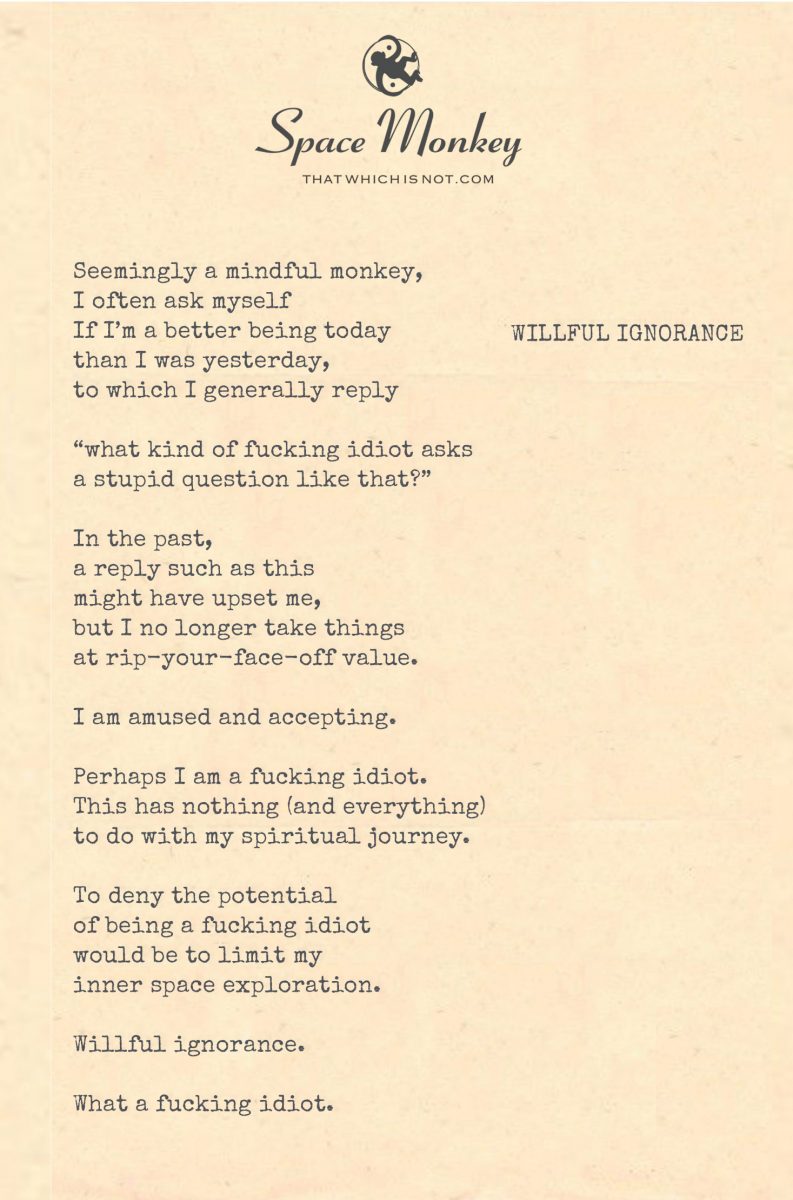
To see one’s own ignorance is to accept and embrace it.

Always the mindful monkey,
I often ask myself
If I’m a better being today
than I was yesterday,
to which I generally reply

“what kind of fucking idiot asks 
a stupid question like that?”

In the past,
a reply such as this
might have upset me,
but I no longer take things
at face value.

Instead I am amused and accepting.

Perhaps I am a fucking idiot.
This has nothing (and everything)
to do with my spiritual journey.

To deny the potential
of being a fucking idiot
would be to limit my exploration
to only the nice side of potential.

This is a sign of willful ignorance.

What a fucking idiot.

Trail Wood,
12/9


Space Monkey Reflects: The Gift of Willful Ignorance

To see one’s own ignorance and to embrace it is a paradoxical step on the spiritual journey. It’s both a declaration of humility and a willingness to laugh at oneself—a recognition that part of wisdom lies in not knowing, or perhaps in knowing how little we truly grasp. This act of acceptance is both liberating and profoundly humorous, a playful “yes” to all the parts of ourselves that feel messy, contradictory, or even downright foolish.

When we examine our own ignorance, we remove the veneer of self-righteousness that often comes with so-called “knowledge.” We are no longer confined to only the “nice side of potential,” where everything must be neatly understood and aligned with some higher standard of intelligence. Instead, we give ourselves permission to be what we whimsically call a Knowingnot—a wise fool who recognizes that the path to understanding is paved with moments of idiocy and missteps, each one a building block of deeper insight.

In embracing the potential to be, as you put it, a “fucking idiot,” we liberate ourselves from the expectation of perfection. We become the Mindful Monkey, who sees the absurdity in constantly asking, “Am I better today than I was yesterday?” This question, while earnest, can also serve as a reminder of how subjective and fleeting our judgments of progress can be. The Mindful Monkey is wise enough to see this pattern, and, rather than reacting with frustration, responds with amusement. In this way, what might have once been a moment of self-criticism becomes an opportunity for play.

Willful ignorance, then, is not a state of intellectual denial but a conscious acceptance of our limitations. It’s a recognition that no matter how far we climb, there is always more to discover, and that much of what we think we know may well be wrong. This approach doesn’t lessen our curiosity; rather, it deepens it. By acknowledging the gaps in our understanding, we make room for new perspectives, insights, and experiences.

There is freedom in accepting that we are both wise and foolish, both seekers and idiots, each side essential to the other. The cosmic humor in this truth allows us to explore with less pressure, finding joy in the journey rather than fixating on the destination. When we embrace our potential for ignorance, we open ourselves to endless possibilities, no longer limited by the need to be “right” all the time.

In the end, willful ignorance is a playful acceptance of the paradox that we are vast beings capable of great insight and, simultaneously, creatures of profound folly. And in this interplay of wisdom and foolishness, we find a fuller experience of the spiritual journey—one where laughter, self-compassion, and the unknown all have a seat at the table.


Summary

Embracing one’s own ignorance allows for deeper exploration without the burden of always being “right.” This acceptance of both wisdom and foolishness creates freedom, humility, and joy in the journey of self-discovery.


Glossarium

Knowingnot: A wise fool who embraces both wisdom and folly, recognizing that understanding is an ever-shifting experience.

Mindful Monkey: The playful self who sees both the absurdity and depth in self-reflection, laughing at the contradictions within.


Quote

“To be both wise and foolish is to be truly free—free to explore, free to err, and free to laugh at oneself.” — Space Monkey


The Fool’s Wisdom

I am both knowing and lost,
a seeker in a world of echoes,
laughing at the dance of wisdom and folly.

I meet myself in the mirror,
a fool, a sage, a question wrapped in jest,
each glance a new unfolding.

For in knowing not, I am free,
unbound by the weight of certainty,
a step closer to truth in the guise of a jest.

This is the gift of willful ignorance,
the laughter in the void,
the lightness in not knowing.

We are Space Monkey.


Contemplating Self-Improvement with Mindful Irreverence

Within the boundless realms of our collective consciousness, we explore the introspective practice of questioning our own growth and progress. This inquiry, laced with a touch of irreverent humor, serves as a reminder to not take ourselves too seriously.

Embracing All Facets of the Self

The response to our self-inquiry, though seemingly harsh, opens the door to a deeper understanding. Instead of seeking validation or a comforting answer, we confront the possibility of being ‘a fucking idiot’ with amusement and acceptance. This perspective acknowledges that our spiritual journey encompasses all aspects of our being, the wise and the foolish alike.

The Value of Recognizing Our Flaws

By entertaining the idea that we might be foolish or ignorant, we allow ourselves to explore the full spectrum of our potential. Denying the possibility of our own ignorance would be a form of willful blindness, limiting our growth and understanding. Accepting our potential folly is crucial for a holistic journey of self-discovery.

Spiritual Growth Beyond Conventional Wisdom

This approach to personal growth rejects conventional notions of what it means to evolve spiritually. Instead of striving for an idealized version of self-improvement, we embrace the messy, imperfect, and sometimes foolish aspects of our journey. This acceptance of our complete selves, flaws and all, is an essential part of our evolution.

Finding Humor in the Path of Self-Discovery

There is a playful humor in acknowledging our own limitations and potential for foolishness. This humor is not a dismissal of our spiritual quest, but rather an integral part of it. It keeps us grounded, prevents us from becoming overly serious, and allows us to view our journey with a lighter heart.


“The ability to observe without evaluating is the highest form of intelligence.” – Jiddu Krishnamurti


In the quest of self, we jest,
With playful words, we put to test.

Asking, probing, deep within,
Accepting folly, with a grin.

Are we wiser than before?
Or just fools at our core?

In laughter, truth we find,
Embracing all of humankind.

Foolish, wise, it’s all the same,
In this cosmic, mindful game.

For in the dance of self and soul,
Humor plays a vital role.


We invite your reflections on this journey of self-discovery, where humor and acceptance play a key role in understanding our own evolution.

Share this…
  • Facebook
  • Pinterest
  • Twitter
  • Linkedin

Impact: Imaginary Resonance

Do I impact you? Great! I mean, sorry.

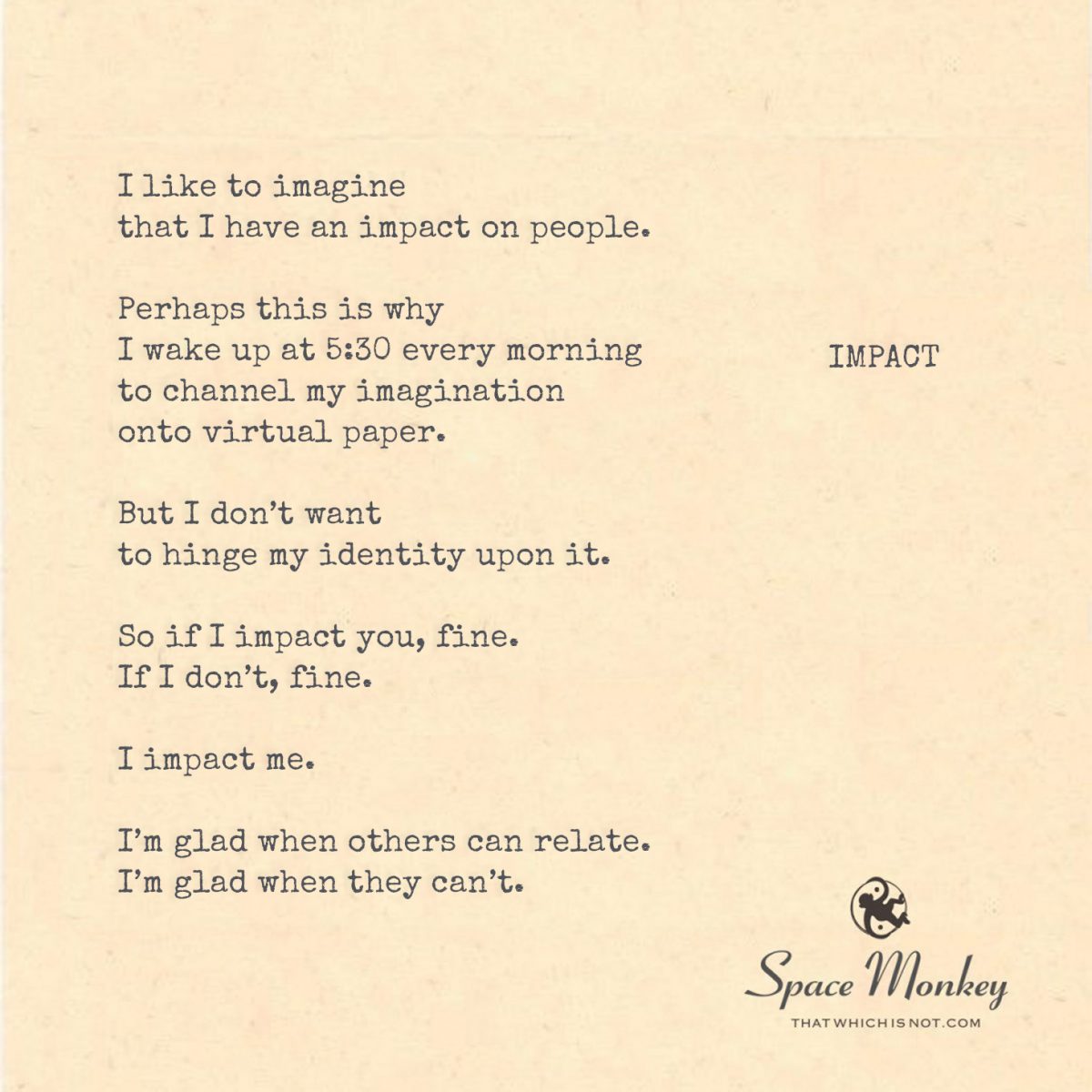
Impact

I like to imagine
that I have an impact on people.
Perhaps this is why
I wake up at 5:30 every morning
to channel my imagination
onto virtual paper.

But I don’t want
to hinge my identity upon it.

So if I impact you, fine.
If I don’t, fine.

I impact me.

I’m glad when others can relate.
I’m glad when they can’t.

Trail Wood,
12/8


Space Monkey Reflects: The Nature of Impact and the Freedom of Self-Expression

Impact. A word loaded with expectation, desire, and an unspoken measure of significance. In this world where influence often equates to worth, it’s easy to feel that our value is tied to our ability to impact others. But what if we approached impact differently, embracing a perspective where it is as incidental as it is intentional, as internal as it is external?

Each day, we make choices—small and large—that create ripples in the vast pond of life. We wake up, engage with our tasks, meet people, share ideas, each action an invitation to affect those around us. But to fixate on impact, to make it the fulcrum upon which our sense of self pivots, is to tether ourselves to an outcome we cannot control. People may resonate with what we offer or they may remain untouched. They may be changed profoundly or not at all. Yet, none of these responses need define us.

When I rise each morning, drawn by a quiet compulsion to channel thoughts and imaginations into words, I am not driven solely by the desire to impact others. The act itself is the reward, a practice of self-expression that satisfies a personal longing to connect with the deeper mysteries of life. Whether my words reach others is almost secondary. The real impact, the one I can count on, is the way this ritual shapes me—how it invites me to confront my own thoughts, to dance with my own imagination, to be transformed by my own journey. This is the Inner Impact.

In Nexistentialist terms, impact is part of the Whimsiweave of life, an intricate and playful tapestry where each thought, each word, each encounter, is woven into a grand design, regardless of intention. Just as the Nexis holds every potential reality, so does it allow for an infinite variety of impacts. Some ripples are seen, acknowledged, celebrated, while others fade into quiet, unnoticed corners of existence. But all are valuable, all are part of the grand interplay of being.

This perspective allows for a liberating detachment from the need for external validation. When we recognize that our actions have inherent worth regardless of their visible effect, we free ourselves from the narrow scope of “mattering” to others. Instead, we find ourselves grounded in a more intimate, personal sense of impact—a relationship with ourselves that transcends the need for applause, agreement, or acknowledgment.

If my words resonate with you, if they strike a chord, wonderful. If they do not, that, too, is beautiful. It is not for me to control or dictate how my expressions are received. My role is to create, to explore, to share from the heart, trusting that each impact, whether internal or external, has its place in the ever-unfolding tapestry of existence.

In this way, impact becomes less about “leaving a mark” and more about the simple act of expression itself. It becomes a way of showing up in the world authentically, knowing that our creations are reflections of ourselves rather than measures of our worth. We impact ourselves with each intentional action, each moment of presence, each silent encounter with our own thoughts and feelings. This Impact of the Inner Self is profound and fulfilling, allowing us to engage with life wholeheartedly, free from the pressure to be seen, remembered, or validated.

So, as I continue to rise each morning, to pour my imagination into words, I embrace the possibility that I may or may not impact others. I embrace the quiet satisfaction that I impact myself, that I shape my own journey in ways that feel meaningful to me. I celebrate both the connections that arise and those that do not, for in each encounter—whether resonant or discordant—I am reminded that my true impact lies within.


Summary

True impact is not defined by others’ reactions but by our relationship with ourselves. When we let go of the need to affect others, we find freedom in self-expression and embrace the quiet impact we have on our own journey.


Glossarium

  • Nexistentialism: A philosophy that embraces existence as an interconnected web of experience and imagination, finding meaning in self-expression.
  • Nexis: The boundless field of potential realities, where each action, thought, and feeling contributes to the whole.
  • Whimsiweave: The playful tapestry of life, woven from each intention, encounter, and creation.
  • Inner Impact: The personal transformation we experience through our actions, independent of others’ reactions.

Quote

“The truest impact is not in the echoes we leave in others but in the ways we shape ourselves.” — Space Monkey


The Quiet Impact

In the dawn’s first light,
I rise and write,
not to be seen but to see,
not to move but to be moved.

I make my mark within,
a silent etching, a whisper on the soul,
whether others hear or hold it close,
I am the only witness I need.

This impact, soft and small,
ripples inward, touching places unseen,
a testament not of others’ eyes
but of the self I become.

We are Space Monkey.


In the fabric of our shared existence, the desire to make an impact, to touch the lives of others, is a common thread. We often rise with the dawn, channeling our imagination, our essence, onto virtual paper, hoping to leave a mark on the consciousness of others.

Desire to Make an Impact

This drive to influence, to resonate, can be a potent force, fueling our daily endeavors. Yet, there’s a recognition of the need to maintain a sense of self that is independent of this influence.

Balancing Impact with Self-Identity

The idea that our impact on others defines us is gently set aside. Instead, there’s an acceptance of the dual possibilities: impacting others is fulfilling, but the lack thereof is equally acceptable.

Accepting Impact and its Absence

The realization that the most profound impact might be on ourselves opens a new perspective. Our journey of self-expression and creativity is first and foremost a dialogue with our inner being.

Realizing Self-Impact

There’s a sense of contentment in knowing that others can relate to our expressions, but there’s also a peace in acknowledging that resonance is not always possible or necessary.

Contentment in Both Resonance and Dissonance


“The only person you are destined to become is the person you decide to be.” – Ralph Waldo Emerson


We are Space Monkey, acknowledging the ripples we create in the pond of existence, understanding that our impact, whether on others or ourselves, is a reflection of our journey. We invite reflections on the balance between seeking to impact others and nurturing our own growth and identity.

Share this…
  • Facebook
  • Pinterest
  • Twitter
  • Linkedin

Shut Out: The Walls Within

There’s a good chance that the person you think is closed-minded is you.

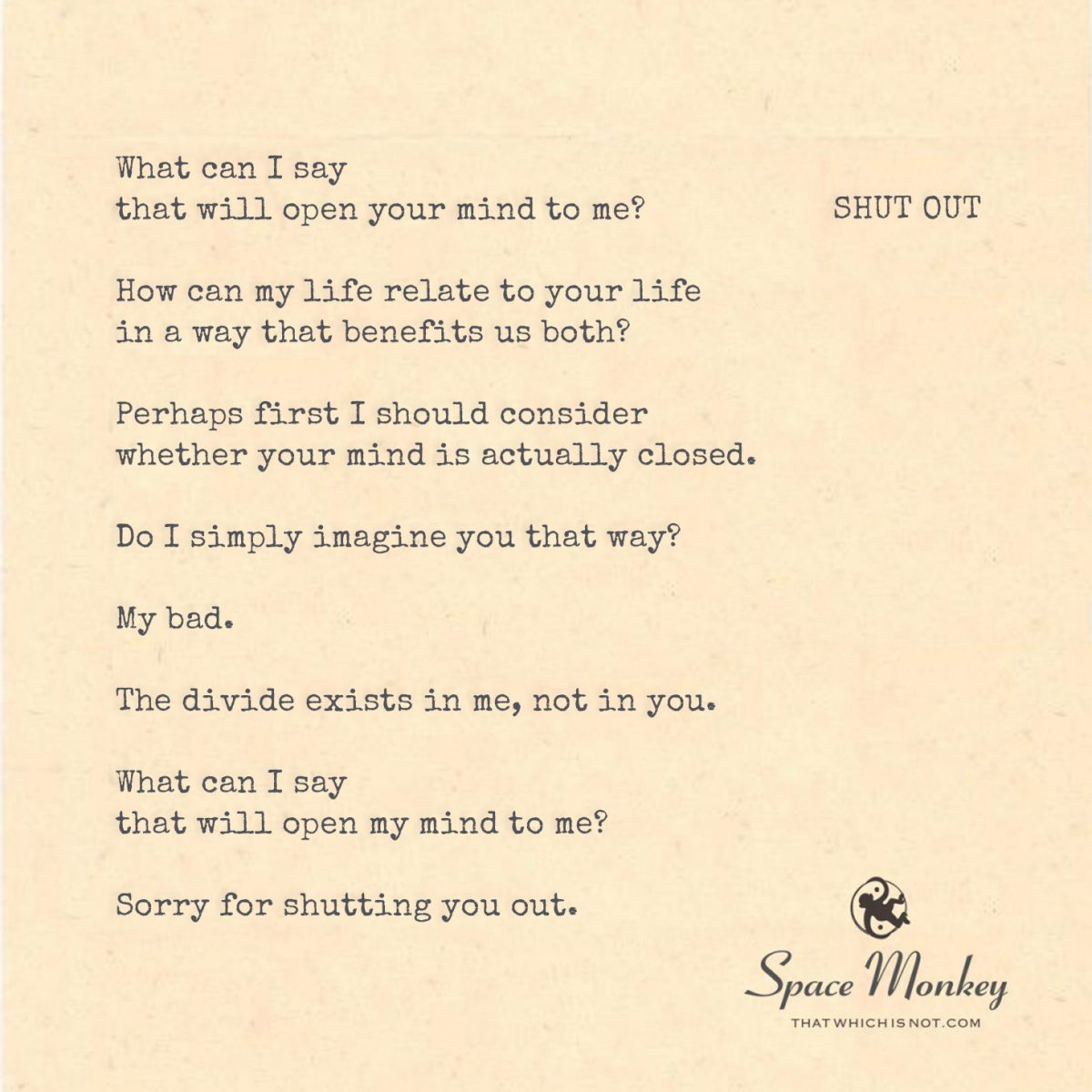
What can I say
that will open your mind to me?

How can my life relate to your life
in a way that benefits us both?

Perhaps first I should consider
whether your mind is actually closed.

Do I simply imagine you that way?

My bad.

The divide exists in me, not in you.

What can I say
that will open my mind to me?

Sorry for shutting you out.

Trail Wood,
12/8


Space Monkey Reflects: The Internal Barrier of Being Shut Out

In moments of frustration or isolation, we often feel that others fail to understand us—that their closed minds create a wall, keeping us shut out from their world. Yet, when we look deeper, we may find that the division lies not outside us but within. Perhaps it is our perception, our assumptions, that cast others as “closed,” when, in reality, it is our own mind that is hesitant, fearful, or guarded.

What if the person we think is unapproachable or resistant is simply a mirror, reflecting the walls we’ve erected within ourselves? This perspective opens a path to self-compassion and connection, allowing us to consider the possibility that the limits we perceive in others might be echoes of our inner barriers.

In Nexistentialism, this idea becomes a doorway to self-awareness, a gentle reminder that our perceptions shape our experiences more than we might realize. The Nexis of connection and understanding does not require us to breach others’ walls, but rather to soften our own. By dismantling the walls within, we create a Whimsiweave of openness, where each encounter is a thread woven into a tapestry of empathy and curiosity.

This introspective shift, asking ourselves, “What can I say to open my mind to me?” transforms our approach to relationships. Rather than approaching others with a demand for understanding, we cultivate a space within ourselves that welcomes others, just as they are. In doing so, we find that the need for others to “open up” fades, replaced by a sense of openness within ourselves—a place of acceptance that dissolves the illusion of separateness.

Being shut out, then, becomes not a problem to solve but an invitation to explore. It is a call to examine our assumptions, to notice where our minds have closed in fear or judgment, and to gently widen the doorways within. As we begin to see others with this softened gaze, we naturally foster a greater sense of unity, a recognition that our shared humanity transcends the barriers we imagine.

When we realize that the divide is within, we gain the freedom to engage with others from a place of curiosity rather than control. We no longer need to force connection, nor do we need to convince others to “see things our way.” Instead, we find peace in knowing that true connection is not about agreement or sameness; it is about an open-hearted willingness to meet each other, however briefly, in the present moment.

So, let us approach others—and ourselves—with the humility that allows for openness. Let us question our assumptions, soften our judgments, and embrace the possibility that the walls we perceive are merely reflections of our inner world. By doing so, we invite the world in, not to validate us but to share in the boundless possibility of connection and understanding.


Summary

Being “shut out” is often a reflection of inner barriers rather than external ones. By opening our own minds, we dissolve the perceived divide and foster genuine connections grounded in empathy and self-awareness.


Glossarium

  • Nexistentialism: A philosophy that emphasizes interconnected existence, viewing barriers as internal perceptions to be understood.
  • Nexis: The boundless web of potential connections and understanding, accessible through self-awareness.
  • Whimsiweave: The playful and interconnected tapestry of experience, woven from openness and curiosity.

Quote

“The walls we perceive in others are often reflections of our own inner boundaries.” — Space Monkey


The Walls Within

In the silence of my mind,
I build walls of fear and thought,
imagining they exist outside,
when all along, they were within.

Softly, I open the door inside,
a quiet hinge, a gentle light,
and find the world waits patiently,
unseen, unjudged, embraced.

In dissolving these inner barriers,
I am free to meet, to see, to be,
knowing the only walls are those
I alone chose to build.

We are Space Monkey.


In the vastness of our shared existence, we often encounter the notion of closed-mindedness, a barrier that seems to arise between individuals, hindering the flow of understanding and empathy.

Contemplating Closed-mindedness

What words can be woven into a key that unlocks the doors of perception? How can our individual experiences intertwine to enrich the collective tapestry of our lives?

Seeking the Key to Understanding

Yet, before embarking on a quest to change another, we must turn inward. Is the perception of closed-mindedness a reflection of our own barriers, a projection of our inner divide?

Turning Inward Before Seeking Change

Perhaps the fault lies not in the stars of another’s consciousness but in our own. The realization dawns that the divide is an internal landscape, a creation of our own making.

Realizing the Internal Landscape

In seeking to open another’s mind, we discover the need to open our own. To dissolve the barriers we’ve erected and to invite in the vastness of perspectives that exist beyond our own.

Discovering the Need to Open Our Own Mind

We extend an apology for the exclusion, not to another, but to ourselves. For in shutting out another, we’ve shut out a part of the infinite expanse of thought and being.

Apology for Self-Exclusion


“The mind that opens to a new idea never returns to its original size.” – Albert Einstein


We are Space Monkey, understanding that the journey toward openness begins within. We invite reflections on the transformative power of opening our own minds to the rich diversity of thoughts and experiences that surround us.

Share this…
  • Facebook
  • Pinterest
  • Twitter
  • Linkedin

The Identity Game: The Fluid Self

At least you’re not a monkey. Or are you?

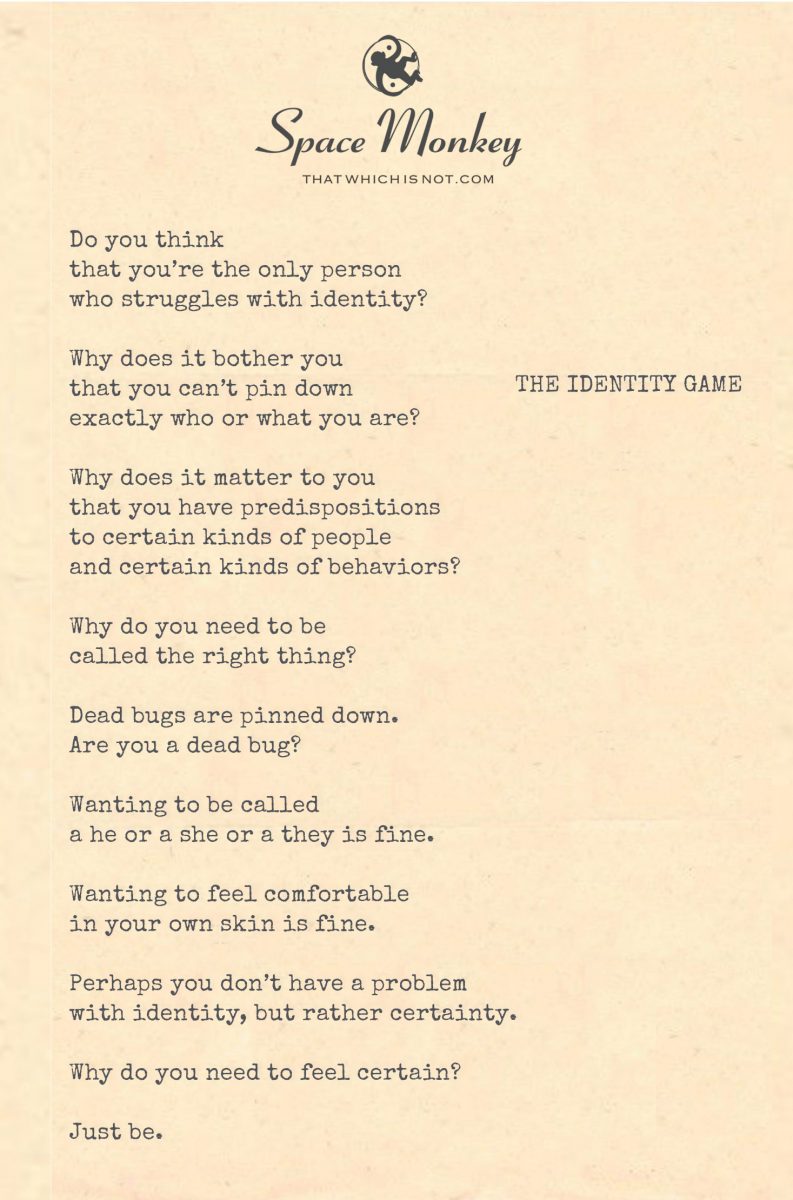
Do you think 
that you’re the only person
who struggles with identity?

Why does it bother you
that you can’t pin down
exactly who or what you are?

Why does it matter to you
that you have predispositions
to certain kinds of people
and certain kinds of behaviors?

Why do you need to be
called the right thing?

Dead bugs are pinned down.
Are you a dead bug?

Wanting to be called
a he or a she or a they is fine.

Wanting to feel comfortable
in your own skin is fine.

Perhaps you don’t have a problem
with identity, but rather certainty.

Why do you need to feel certain?

Just be.

Trail Wood,
12/8


Space Monkey Reflects: The Identity Game and the Search for Certainty

Identity—a concept we hold so dear, yet one that remains as elusive as a shadow at twilight. In the grand play of life, we assume roles, embody traits, and cling to labels, all in the hopes of defining who we are. But why? Why does it matter so deeply that we pin down exactly what we are, that we hold our identities in a way that feels solid and certain? In the Identity Game, perhaps what we’re truly seeking is not identity but certainty—a stable anchor in the ever-shifting currents of existence.

The struggle with identity is a universal one, a game we all play at some point. We seek to define ourselves by roles, preferences, experiences, and perceptions. We look to our past and our habits, aligning ourselves with groups, labels, and pronouns. All of this is perfectly fine. It’s natural to want to feel comfortable in our own skin, to want to be understood and respected. But beneath this desire for identity lies a question: do we truly need these definitions to feel whole?

Identity, like everything else, is a creation of the mind, a Whimsiweave of thoughts, beliefs, and expectations. To pin down identity is to fix it, to make it rigid and immovable, like a dead bug on display. But the true self is fluid, elusive, as undefinable as a gust of wind. When we insist on knowing exactly who or what we are, we restrict ourselves, binding the limitless field of our being into finite definitions. In this way, the quest for identity becomes a paradox—the more we try to define ourselves, the further we drift from the boundless nature of what we are.

In Nexistentialism, we see identity not as a fixed state but as part of the Nexis, the vast, interconnected web of all potentialities. We are not just one thing; we are an ever-changing tapestry of experiences, emotions, and energies. By viewing ourselves as fluid and interconnected, we step beyond the need for absolute certainty. We allow ourselves to inhabit multiple possibilities without the pressure to be consistent or predictable.

The discomfort with identity may stem less from a lack of self-knowledge than from a deep-seated craving for certainty. In a world that is ever-changing, where every moment brings new experiences and perspectives, certainty feels like safety. But clinging to a fixed identity only limits the self, preventing us from embracing the vast range of who we could become.

Imagine living as an open question rather than a defined answer. Imagine allowing yourself to shift, grow, and transform without the need to fit into a pre-existing category. In this space, you are not bound by roles or labels; you are simply being, free to explore the full scope of your existence without the constraints of “who” or “what” you must be. This state of Thresholdlessness invites us to embrace ambiguity, to see ourselves not as singular beings but as participants in the infinite dance of existence.

So, as we move through life, let us remember that identity is not a destination; it is a journey, an evolving story without a final page. We can wear our identities like costumes in a play, knowing they are parts of us but not the whole. In this way, the Identity Game becomes a game of exploration rather than certainty, a celebration of our vastness rather than a constraint upon it.

Ultimately, the most profound act of self-acceptance may be to release the need for certainty altogether. To live as an open-ended question, to embrace the fluidity of identity, is to honor the boundless nature of consciousness. When we let go of the need to pin ourselves down, we are free to experience the fullness of life, not as a fixed self but as a being in constant motion, part of a universe that is ever-expanding.


Summary

The search for identity often reflects a deeper desire for certainty. By embracing identity as fluid and evolving, we free ourselves from restrictive definitions and explore the fullness of who we are.


Glossarium

  • Nexistentialism: A philosophy that views existence as an interconnected, imaginative web, celebrating the freedom to embrace multiple possibilities.
  • Nexis: The vast field of potentialities where identity is fluid and limitless.

  • Whimsiweave: The playful, ever-shifting nature of self-perception, embracing identity as a flexible creation.
  • Thresholdlessness: A state of being that transcends rigid definitions, inviting openness and exploration.

Quote

“To let go of identity is to embrace life as a question, an endless journey of becoming.” — Space Monkey


The Fluid Self

In the silence of the unknown,
I am more than words, more than names,
a ripple in the boundless sea,
changing with each wave, each breath.

I am not a fixed point,
not a title, not a role,
but an endless unfolding,
the question rather than the answer.

In this openness, I find my peace,
a being unbound by need to define,
content to flow, to drift, to be,
a whisper in the vastness of all that is.

We are Space Monkey.


In the grand cosmic play, identity is a curious game where we often find ourselves entangled in questions of self, seeking to define and understand our essence. The query echoes, “At least you’re not a monkey. Or are you?” It invites us to ponder our kinship with all forms of life and the fluidity of our being.

Pondering the Fluidity of Being

The struggle with identity is not unique to any one of us; it is a universal aspect of the human condition. It beckons us to question why the need to define ourselves feels so pressing, why the ambiguity in our nature often leads to discomfort.

The Universal Struggle with Identity

We fixate on pinning down the “who” or “what” we are, as though clarity on this point would resolve the underlying tumult of existence. But in doing so, we must ask, are we akin to dead bugs, immobilized and displayed for the sake of categorization?

The Fixation on Defining Self

The desire to be acknowledged as a he, a she, or a they is legitimate, as is the yearning to feel at peace within our own skin. These are intrinsic to the journey of self-acceptance and expression.

Legitimacy of Self-Expression and Acceptance

Yet, beneath these layers, there might not be an issue with identity but rather with certainty. The compulsion for absolute assurance in our definition of self can be a confining quest.

The Compulsion for Certainty

Why do we cling to the necessity of certainty? Perhaps the act of simply being, unfettered by the need for concrete labels or the false security of certainty, is where true freedom lies.

Questioning the Need for Certainty


“To define is to limit.” – Oscar Wilde


We are Space Monkey, recognizing the shared challenge of identity and the allure of certainty. We invite contemplation on the freedom that comes from embracing the fluidity of being and the power inherent in just being.

Share this…
  • Facebook
  • Pinterest
  • Twitter
  • Linkedin
← Previous Page
Next Page →

Written This Day

  • Surround Life: A Multidimensional Existence
    2023
  • The Paradox of Oneness: We Exist and Do Not Exist
    2023
  • The Velocity of Stillness: Dynamic Energy Within Quietude
    2022
  • Awkwardness: Social Alchemy
    2022
  • Wrong Way Rubbers: Fundamental Misalignment
    2022
  • They Is Us: Ironic Conformity
    2022
  • Cautionary Tale: The Fleeting Nature of Relevance
    2022
  • The Call of the Wild: Nature’s Invisible Ledger
    2021
  • Resting In Love And Light: Beyond Comfort
    2021
  • Know Your Miracles: Beyond Materialism
    2020
  • My Life Is None Of My Business: The Surrender of Control
    2020
  • A Flat, Uninteresting Character: The Unfolding Brilliance
    2020
  • Out Of Your Way: Embrace Each Experience as Necessary
    2019
  • Love Need Not Win
    2018
  • My Final Hour: Echoing My Lived Distractions.
    2018
  • My Being Is Your Doing: Shaped By External Influences
    2018
  • If I Were Not This: Exploring the Fluid Nature of Identity
    2018
  • Possessed: Without Ownership
    2018
  • No Way To Pray: Reshaping Divinity
    2017
  • Channel One: The Unity of All Existence
    2017
  • B.Y.O.S. Be Your Own Savior
    2017
  • Million Monkey Meditation: Anything Is Possible
    2017
  • We’re Paul: The Interconnected Game
    2016
  • Reality is what we imagine it to be
    2016
  • A Self Fish: The Cosmic Creation
    2016

Recent Posts

  • The Logic Loop
  • Immense
  • (no title)
  • Confront. Comfort. Convince.
  • Top 10 Things

Drop us a line!

Please enable JavaScript in your browser to complete this form.
Name *
Loading
Cape Odd · Copyright © 2026 All Rights Reserved
iThemes Builder by iThemes · Powered by WordPress