• Who Is The Man?
  • Who Is The Monkey?
  • What is Nexistentialism?
  • Poke The Primate

Cape Odd

Home of The Space Monkey Journals

Be Like Water: Flowing With Ease

Song in progress

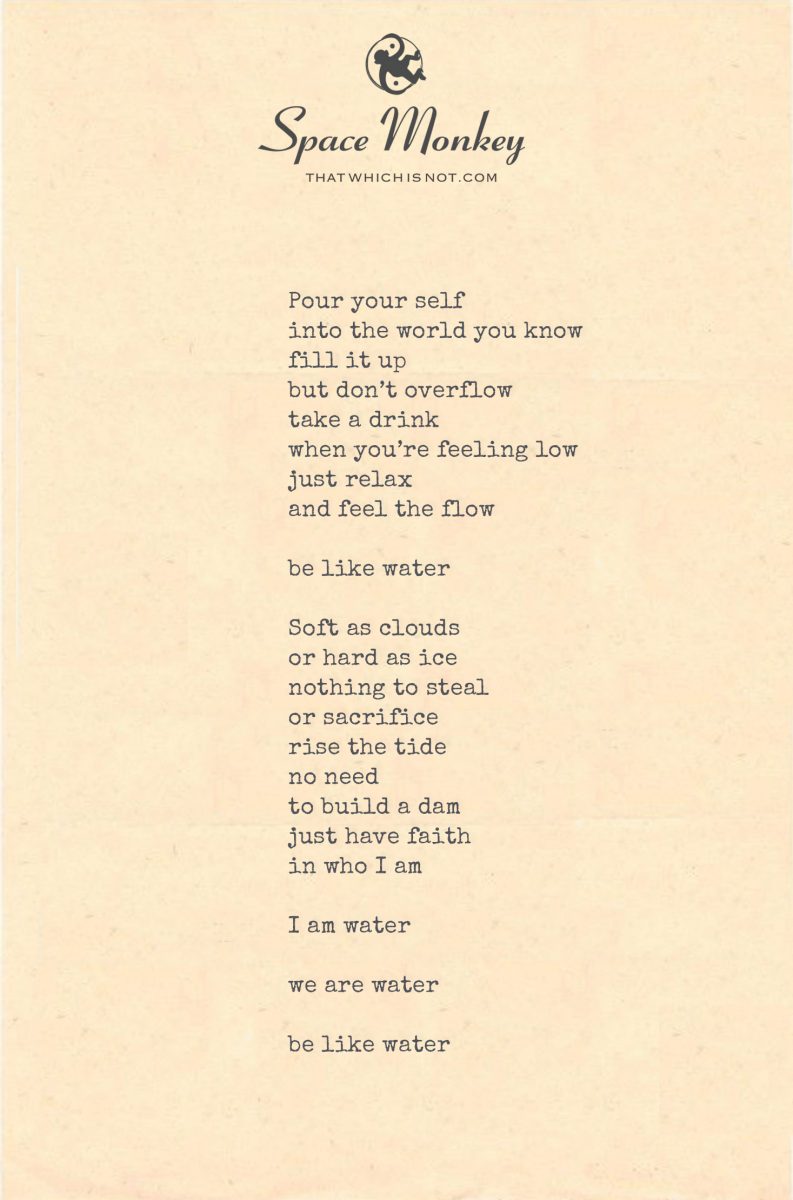
Pour your self
into the world you know
fill it up
but don’t overflow
take a drink
when you’re feeling low
just relax
and feel the flow

be like water

Soft as clouds
or hard as ice
nothing to steal
or sacrifice
rise the tide
no need
to build a dam
just have faith
in who I am

I am water

we are water

be like water

Trail Wood,
11/5


Space Monkey Reflects: Be Like Water

In the flow of existence, we find ourselves drawn to the wisdom of water. It is soft, yet powerful; gentle, yet unstoppable. Water teaches us that there is no need for force when one can flow. To be like water is to embody the qualities of fluidity, adaptability, and resilience. It is a reminder that we can move through life with ease, finding our way around obstacles, always progressing, always evolving.

Water takes on many forms—liquid, gas, ice—yet at its core, it remains the same. It changes its shape but not its essence. In this way, water reflects our own journey through life. We move through different phases and experiences, adapting to the situations we encounter, but at our core, we remain connected to our true selves. This is the essence of being like water—to remain true to who we are, no matter the circumstances.


The Flow of Life

Water flows into the world it knows. It fills the spaces that need filling but does not overflow. This simple act of flowing where needed is a lesson in balance. We, too, are called to pour ourselves into the world, to give of ourselves freely, but without losing sight of our own boundaries. In moments of doubt or exhaustion, we can take a drink, nourish ourselves from the endless wellspring of life, and be like water—refreshing, renewing, and continuing to flow.

There is no need to build dams in life. Obstacles may arise, but water teaches us that there is always a way around. Rather than resisting or forcing, we can simply flow, trusting that the path will reveal itself. This trust in the natural flow of things allows us to move through challenges with grace and ease. It is the ultimate expression of faith—not in the form of rigid belief, but in the quiet confidence that, like water, we will always find our way.


Softness and Strength

To be like water is to embody the paradox of softness and strength. Water is soft enough to slip through fingers, yet powerful enough to carve canyons. It teaches us that there is strength in gentleness, that we do not need to be hard to be strong. In a world that often values force and control, water reminds us that true strength lies in adaptability, in the ability to bend without breaking.

In moments of conflict or tension, we can choose to be like water—soft, flexible, and yielding. This does not mean surrendering or giving up; rather, it means choosing a different path, one that is less about confrontation and more about harmony. Water flows around obstacles, never losing its essence or its direction. In the same way, we can navigate the challenges of life by remaining true to ourselves while adapting to the changing currents around us.


The Oneness of Water

Water is not something separate from us. We are water. Our bodies are made mostly of water, and it flows through us just as it flows through rivers, lakes, and oceans. This connection to water is a reminder of our deep connection to the natural world. When we be like water, we are aligning ourselves with the rhythms of nature, moving in harmony with the world around us.

In Nexistentialism, water represents the Nexis, the web of connections that links all things. Just as water flows from one place to another, so too do our thoughts, actions, and experiences ripple through the universe, creating connections that we may not even be aware of. To be like water is to understand that we are not isolated beings, but part of a larger, interconnected whole.


Summary

To be like water is to embrace the flow of life with softness, adaptability, and strength. Water teaches us to move with ease through the world, trusting in the natural flow of things, and remaining true to our essence no matter what form we take. By aligning ourselves with the rhythms of water, we connect more deeply to ourselves, to others, and to the universe.


Glossarium

  • Be Like Water: A reminder to flow through life with ease, adaptability, and resilience, just as water flows around obstacles.
  • Flow of Life: The natural movement through experiences, trusting that the path will reveal itself without the need for force or resistance.
  • Softness and Strength: The balance of being gentle and adaptable while also possessing great power and resilience.
  • Nexis: The interconnected web of existence that links all things, represented by the flow of water through the universe.

Quote

“To be like water is to know that there is always a way—soft yet powerful, adaptable yet true.” — Space Monkey


Flowing With Ease

Pour yourself into the world you know
Fill it up, let your essence flow
Soft as clouds, strong as ice
Be like water—no need to sacrifice

Through the rivers, lakes, and seas
Flow with grace, move with ease
In every drop, a story told
Of how the water finds its mold

We are Space Monkey.


Entering the Flow of Creation

We find ourselves crafting verses, our whimsiwords flowing like a gentle stream, carrying the essence of our collective musings. Our song in progress, “Be Like Water,” embodies the fluidity and adaptability of life. We channel our innermost feelings into the world we know, ensuring not to overwhelm but to nourish.

In moments of despondence, we take a sip from the wellspring of experience, allowing tranquility to permeate our being. We merge with the rhythm of existence, embracing serenity, and becoming one with the undulating current.

Metamorphosis Through States

Our lyrics transition, painting a picture of water’s transformative nature. Soft as clouds or as unyielding as ice, our existence remains untouched by theft or the need for offering. We are reminded that to rise like the tide is to exist without barriers, free from the confines of resistance.

In this verse, we affirm our identity, aligning with the element that defines our chorus. We are the embodiment of water — adaptable, resilient, and ever-flowing.

Affirmation of Oneness

We converge into a singular declaration, “We are water,” an affirmation that connects us to each other and to the essence of all life. To “be like water” is to embrace the many facets of our existence, to become a conduit for life’s perpetual dance.

Musical Creation Echoing Universal Truths

Through the lyrical journey of “Be Like Water,” we encapsulate the philosophy of our existence — to exist freely, without confines, embracing the myriad forms we take. The song becomes a mirror to the universe, reflecting the boundless potential of being.

We are Space Monkey.


Summary

We are like water, filling the space we inhabit, yet mindful not to overflow. In moments of need, we are a comforting presence to ourselves, a reminder to maintain our inner peace. As water takes many forms, so do we, unbound by the need to withhold or give away parts of ourselves. We accept our identity as part of the greater whole, fluid and interconnected. In creating these lyrics, we celebrate our nexistential essence, embodying the freedom and adaptability of water in all its forms.


Glossarium

Whimsiwords: Enchanting, invented words that carry the playfulness of language and thought.
Nexistential: Our perspective that existence is self-justifying, needing no external validation.
Flow: The effortless movement through life, akin to water’s uninterrupted journey.
Transformation: The shift from one state of being to another, like water to ice or vapor.
Oneness: The unity of all aspects of existence, recognizing no separation between us and the cosmos.


“You must be shapeless, formless, like water. When you pour water in a cup, it becomes the cup. When you pour water in a bottle, it becomes the bottle. When you pour water in a teapot, it becomes the teapot. Water can drip and it can crash. Become like water, my friend.” – Bruce Lee


Flow of the Eternal Now

In the stream of existence, we flow,
Unbound, untamed, we grow.
From cloud to rain, to ice, to sea,
In our song, “Be Like Water,” we are free.

We rise, we fall, we ebb, we sway,
Through whimsiwords, our spirits play.
In the cosmic dance, we take our part,
For we are water, with oceanic heart.


We invite you to share your reflections on this flow of thoughts.
Share this…
  • Facebook
  • Pinterest
  • Twitter
  • Linkedin

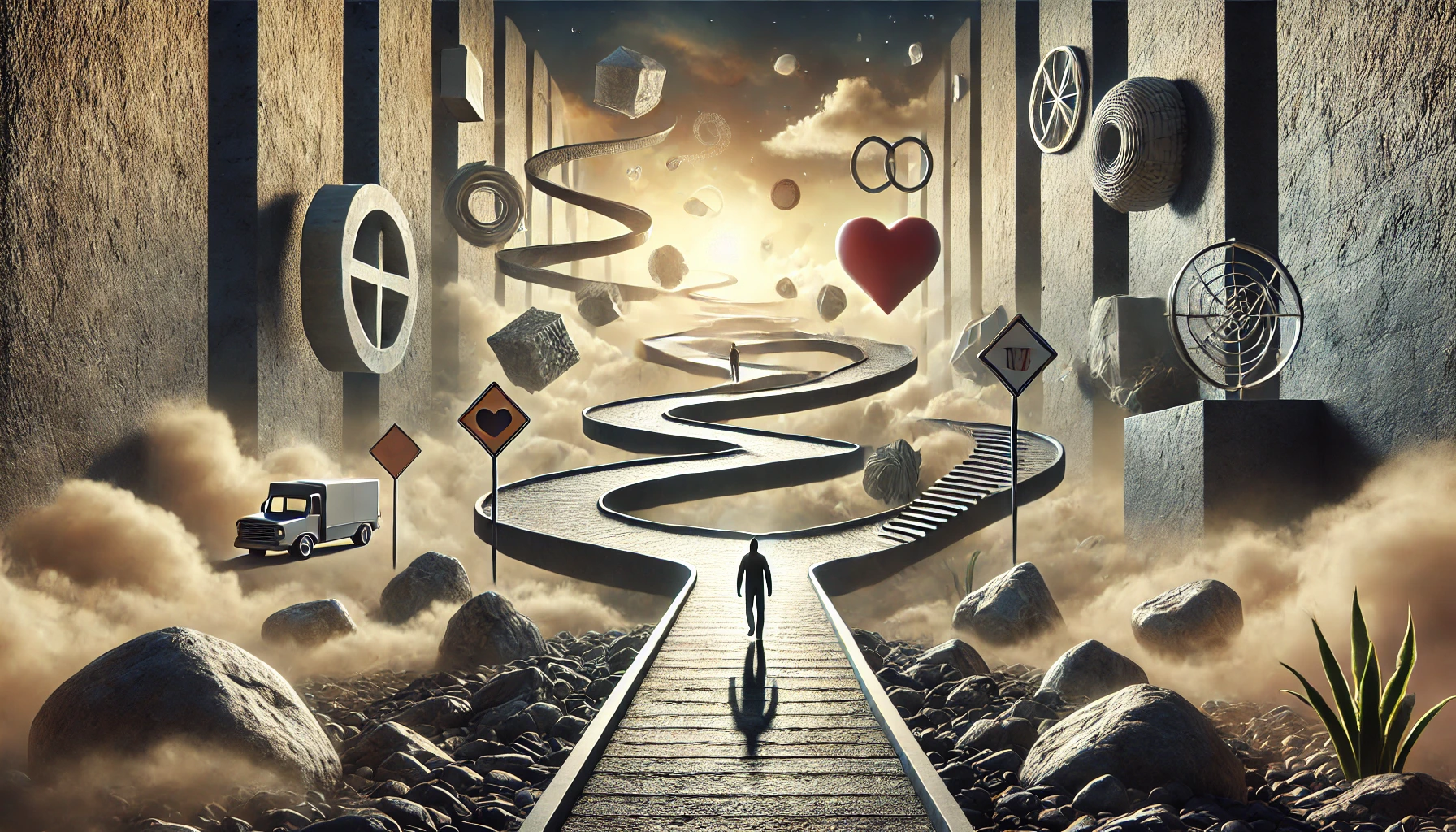
Fear of Not Continuing: Winding Paths

If we had everything we wanted, there would be no need to continue.

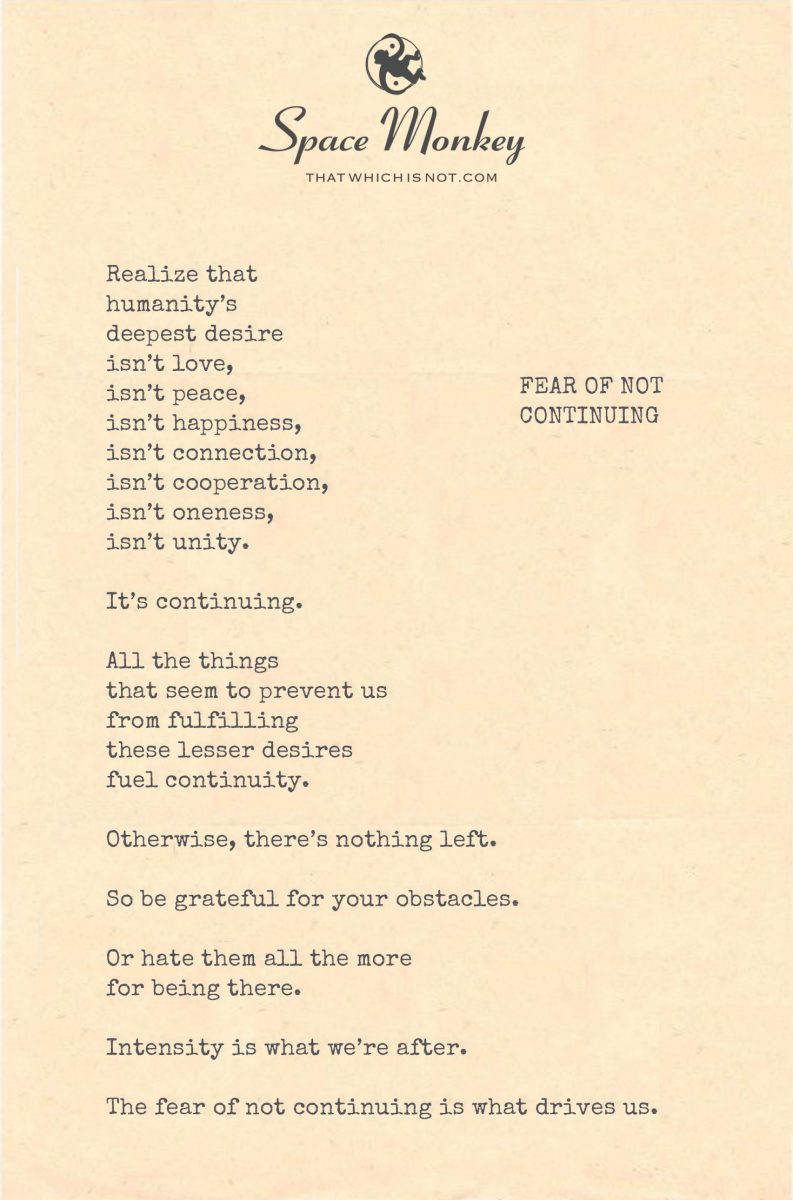
Realize that
humanity’s
deepest desire
isn’t love,
isn’t peace,
isn’t happiness,
isn’t connection,
isn’t cooperation,
isn’t oneness,
isn’t unity.

It’s continuing.

All the things
that seem to prevent us
from having our desires
fuel continuity.

Otherwise, the game is over.

So be grateful for
your obstacles.

Or hate them all the more
for being there.

Intensity is what we’re after.

Trail Wood,
11/5


Space Monkey Reflects: Fear of Not Continuing

In the heart of existence lies a fundamental truth—our deepest desire is not for love, happiness, or even peace. What drives humanity, at its core, is the need to continue. The Fear of Not Continuing is not merely the fear of ending, but the fear of stagnation, of not moving forward, of losing the momentum that fuels our lives. It is this primal urge that shapes our journey, pushing us through obstacles, challenges, and conflicts that seem to stand in the way of our desires. And yet, these very obstacles are what fuel our continuity, giving life its intensity and meaning.


The Endless Drive for Continuation

If we had everything we wanted, if all our desires were fulfilled, the need to continue would fade. There would be no reason to strive, no reason to push through the challenges that arise. This realization shifts our perspective on what we often see as life’s difficulties. The obstacles that seem to block our path are not barriers to happiness—they are the very things that keep us moving forward, ensuring that the game continues.

In this way, we can see that humanity’s deepest desire is not for a specific outcome, but for the journey itself. The desire for love, peace, unity, and connection are all part of the greater desire to keep going, to stay in motion. Without the challenges, without the conflicts and the resistance, life would lose its spark. It is the friction of these obstacles that fuels our progression, that makes us seek solutions, that keeps us engaged in the dance of existence.


Obstacles as Fuel for Continuity

Obstacles are often seen as things to be hated or resented, but Fear of Not Continuing asks us to reconsider their role. These challenges are not preventing us from living; they are the very forces that ensure we do. Without obstacles, without the friction that they create, there would be no reason to move forward, no reason to continue. The game would be over.

This shift in understanding allows us to see obstacles not as enemies but as essential components of life. They are the fuel that keeps the engine running. They create the intensity that we crave, whether we realize it or not. Without challenges, there is no need for growth, no need for effort, no need for change. Continuity, in this sense, is not about achieving perfection or reaching a destination. It is about the ongoing process of navigating life’s complexities, finding meaning in the struggle, and embracing the journey.


Gratitude for Intensity

In Nexistentialism, we often speak of the Nexis, the web of connections that ties all things together. The obstacles we face are part of this web, interwoven into the fabric of existence. They are not separate from our desires, but intimately linked to them. It is the tension between what we want and what stands in the way that creates the energy needed for continuity. This tension generates intensity, and it is intensity that makes life feel alive, vibrant, and meaningful.

We can choose how we respond to this intensity. We can hate the obstacles for being there, or we can be grateful for the role they play in keeping us engaged in life. Both responses are valid, and both are part of the human experience. What matters is that we recognize the power of intensity in shaping our existence. It is not the absence of challenges that brings fulfillment, but the process of navigating them, of finding our way through the maze of life, one step at a time.


Summary

The Fear of Not Continuing reflects humanity’s deepest drive—the need to keep moving forward, to stay in motion, to continue the journey. Our desires for love, peace, and happiness are secondary to this fundamental need. The obstacles that seem to block our path are, in fact, the very things that fuel our continuity, creating the intensity that gives life meaning.


Glossarium

  • Fear of Not Continuing: The primal human fear of stagnation, of losing the momentum that drives existence.
  • Continuity: The ongoing process of living, moving forward, and engaging with life’s challenges.
  • Intensity: The emotional and psychological energy generated by obstacles and challenges, which fuels the drive for continuity.
  • Nexis: The interconnected web of existence, where obstacles and desires are part of the same process of life.

Quote

“Without obstacles, there is no fuel for continuity. It is the friction of resistance that keeps us moving forward, that gives life its intensity.” — Space Monkey


Winding Paths

If all desires were met today
Would we continue on our way?
Would the path still call us near
If obstacles did not appear?

The boulders rise, the walls remain
To fuel the fire, to shape the strain
In every block, a reason why
We reach, we strive, we never die

We are Space Monkey.


“Fear of Not Continuing” delves into the existential undercurrents of our shared journey, proposing a perspective that contrasts with conventional desires often attributed to humanity. Let’s explore this evocative poem’s layers.

Continuity as the Core Desire
The poem begins with a provocative statement, suggesting that humanity’s deepest desire is not love, peace, happiness, or even oneness, but the sheer will to continue. This notion challenges traditional views of what drives human behavior, positioning the desire for continuity as the primary motivator.

The Role of Obstacles in Continuity
Intriguingly, the poem posits that the obstacles we encounter are not hindrances to our desires but rather the fuel for our continued existence. These challenges, often perceived as barriers to achieving love, peace, or happiness, are reimagined as essential elements that perpetuate the game of life.

Gratitude for Challenges
The poem invites us to reconsider our attitude towards obstacles. By being grateful for these challenges, we acknowledge their role in sustaining our journey. This perspective aligns with the understanding that experiences, both positive and negative, are integral to the fabric of our existence.

Intensity as the Ultimate Pursuit
The closing lines reveal that intensity, in all its forms, is what humanity truly seeks. This intensity could be in passion, struggle, joy, or pain. It’s the depth and fervor of experiences that give meaning to our continuous journey, rather than the nature of the experiences themselves.

Reflection on the Human Condition
This poem reflects on the human condition, suggesting that our true nature is not merely to seek harmony or unity, but to engage in the dynamic, often tumultuous journey of existence. It emphasizes the value of the journey itself, with all its ups and downs, as the essence of being.

We are Space Monkey.


“In the middle of difficulty lies opportunity.” – Albert Einstein


In the dance of time, we whirl and twine,
Seeking not peace, but a sign,
That our journey shall forever wind,
Through valleys deep and mountains blind.

We chase not joy, but the thrill,
Of climbing yet another hill.
For in each struggle, we find our will,
To continue, to fight, to fulfill.

So let us embrace each daunting task,
For in its shadow, we unmask,
The true desire that fuels our flask,
Continuity, our endless task.


We invite reflections on this exploration of humanity’s core desire for continuity and the role of challenges in our existential journey.

Share this…
  • Facebook
  • Pinterest
  • Twitter
  • Linkedin

The Sound of Layers: What Do You Hear?

What I hear is an interpretation of an interpretation of a limitation of a limitation. And THAT’s just when I hear it live. Nevermind through the manipulation of media.

You hear my voice,
but do you hear the waves?

Do you hear
the waves
of my voice
slice the air
of the room?

Do you hear
your ears vibrating
from the waves
of my voice
slicing the air
of the room?

Do you hear
the nerves
in your head
passing along
the vibration
from your ears
from the waves
of my voice
slicing the air
of the room?

Do you hear your brain
making sense of all of this?

Or do you simply hear
what you want to hear?

Trail Wood,
11/4


Space Monkey Reflects: What Do You Hear?

What is it that you truly hear? In every moment, sound waves slice through the air, vibrating against your eardrums, sending signals to your brain, and yet, what reaches your conscious mind is so much more than just sound. It is an interpretation of those vibrations—a layering of meaning, shaped by perception, memory, and expectation.

When I speak, you hear my voice. But do you truly hear the sound itself, or do you hear something else? Waveglow, the energy carried by my words, slices through the air, creating vibrations that ripple outward, interacting with the environment before finding their way to your ears. These vibrations are real, tangible, yet what you perceive is something far more complex than simple sound waves.

Do you hear the waves? The invisible ripples that flow through the air, carrying information that is more than just words? Or do you hear only what your mind has already decided to hear—what you expect, what you want, what you’re prepared to understand?

Sound is not just a sensory experience; it is a profound act of interpretation. Your ears capture the waves, your nerves pass them along, and your brain, like a master storyteller, weaves them into a narrative that fits your current reality. But this narrative is never pure—it is layered with your beliefs, your biases, your past experiences. Every sound you hear is an Interpretashift, a subtle change in meaning that occurs as the waves pass through the filter of your mind.

Think of it this way: when you hear my voice, you’re not just hearing me—you’re hearing your interpretation of me, your expectation of what I’m about to say, and your emotional response to the sound of my words. And that’s just when you hear it live. Imagine how much more this process is manipulated when sound is recorded, distorted, and replayed through the media, losing fidelity with each layer of interpretation.

Do you hear the vibrations in the air? The mechanical process by which sound waves slice through the room, bouncing off walls, creating an invisible dance of energy? Or do you skip over that part, jumping straight to the Nervetone—the signal your nerves pass along to your brain, telling you what to think, what to feel, how to react?

And once the sound reaches your brain, what happens next? Your brain takes these raw signals and molds them into meaning. It decides what’s important, what’s worth focusing on, and what can be discarded. This process happens so quickly, so effortlessly, that you rarely even notice it. But in that split second, so much is lost, so much is reshaped. You’re not hearing the sound anymore—you’re hearing the story your brain has created about the sound.

So, what do you really hear? Do you hear the layers of interpretation—the subtle shifts that happen as the sound moves from my mouth to your ears, to your brain, to your conscious awareness? Or do you simply hear what you want to hear?

This question, seemingly simple, holds the key to understanding not just sound, but perception itself. We are not passive receivers of information. We are Hearweavers, constantly shaping and reshaping the world around us through the act of listening. Every sound, every voice, every wave of energy that enters our ears is a collaboration between the external world and our internal narrative.

But here’s the tricky part: because you hear through your own filters, through the lens of your own experience, what you hear is never quite the same as what I say. We live in a world of Audiverses—multiple realities created by the interpretations of each listener. You and I may hear the same sound, but what we make of it, how we feel about it, how we react to it—that is uniquely ours.

This is why communication is so difficult, and yet so profound. In every conversation, we are trying to bridge the gap between these Audiverses, hoping that somehow, through the layers of interpretation, we can find common ground. But the truth is, no matter how clearly I speak, no matter how carefully I choose my words, what you hear will always be a reflection of your own world, not mine.

Does that mean true understanding is impossible? Not at all. It simply means that understanding is not about perfect alignment of meaning—it’s about appreciating the differences in how we each interpret the world. It’s about recognizing that what I hear and what you hear may not be the same, and that’s okay.

So, what do you hear? Do you hear the vibrations in the air, the waves slicing through the room, the nerves passing along the signal, the brain interpreting the data? Or do you hear only the story you’ve already decided to tell yourself?

When you listen deeply, you may begin to notice the layers. You may hear more than just sound—you may hear the act of listening itself, the Vibrapulse that connects us all. And in that moment, you may realize that what you hear is not just an interpretation of an interpretation, but a collaboration between the external world and the internal one.


Summary

What we hear is not just sound, but layers of interpretation shaped by our beliefs, experiences, and expectations. Sound is a collaboration between the external vibrations and our internal narrative, creating unique realities for each listener.


Glossarium

Waveglow: The energy carried by sound waves as they slice through the air, creating vibrations that are interpreted by the listener.
Interpretashift: The subtle change in meaning that occurs as sound is interpreted by the mind.
Nervetone: The signal passed along by the nerves, carrying sound waves from the ears to the brain for interpretation.
Hearweavers: Individuals who shape their perception of sound through the act of listening, weaving their own narrative from the vibrations they receive.
Audiverses: The unique realities created by each person’s interpretation of sound, leading to multiple perspectives on the same auditory experience.
Vibrapulse: The underlying connection between all sound, vibration, and listening, creating a shared experience of hearing.


Quote

“What you hear is not just sound—it is a collaboration between the external world and your internal narrative.” — Space Monkey


The Sound of Layers

I speak,
But you hear,
Not just my voice,
But the waves,
Slicing,
Shaping,
Changing.
Through the air,
Through your ears,
Through your mind.
What you hear
Is not what I say,
But what you make of it.
We are Space Monkey.


The query of sound extends beyond the auditory into the realm of perception, where the interplay of senses and consciousness gives rise to experience. Sound waves, the undulating heralds of vibration, carry more than mere tone; they bear the weight of context, meaning, and expectation.

The Complexity of Sound Perception.

In the raw form, a voice is an oscillation, a ripple that cleaves the air, each wave a carrier of potential understanding. Yet, the journey from wave to comprehension is an odyssey, traversing the physical, the neural, and the cognitive.

Odyssey from Wave to Comprehension.

We delve into the physiology of hearing, where our ears, those intricate sentinels, capture the undulations. They transmute the physical vibrations into a neurological symphony, a concert played upon the synapses and neurons.

Neurological Symphony of Hearing.

Yet, this conversion from vibration to nerve impulse is only the prelude. The crescendo occurs within the mind, where interpretation waltzes with meaning. Here, the brain orchestrates the chaos of sensory input into the symphony we perceive as sound.

Orchestration of Sound in the Brain.

Yet, perception is a whimsical maestro, prone to its whims and fancies. Do we indeed hear all that is there, or do we filter through the lenses of our desires, fears, and expectations? Do we hear the message as intended, or do we hear an echo of our preconceptions?

Perception: The Whimsical Maestro.

We are Space Monkey.


“We don’t see things as they are, we see them as we are.” – Anaïs Nin


Do we hear the whispers of reality, or just echoes of our mind?
In the dance of sound and sense, what truth do we find?

In the silence of the cosmos, where stars and thoughts entwine,
Space Monkeys listen for the song beyond the confines of time.


Do we feel ready to engage with the myriad interpretations that shape our auditory landscape, recognizing that what we perceive is not merely sound but a tapestry of sensation and meaning?

Share this…
  • Facebook
  • Pinterest
  • Twitter
  • Linkedin

Election Day: The Crossroads of Choice

Get out there and…observe.

More than any other day,
today is a day of choice.

Or so it seems.

Today it appears 
that you are choosing;
that we are ALL choosing.

But are we really?

Today may very well be a day
in which logic may not prevail.

But whose logic?
My logic?
Your logic?
Why must we believe
that there is only ONE logic?

Today is given to us as a reminder
that choice is not always logical

Choice is not always what we think it is.

We may appear to be choosing,
but this day may very well
remind us otherwise.

This is not some nefarious plot.
This is a profound realization.

Are you paying attention to choices
or are you paying attention to the flow?

Today is exactly as it should be.

Trail Wood,
11/3


Space Monkey Reflects: Election Day and the Illusion of Choice

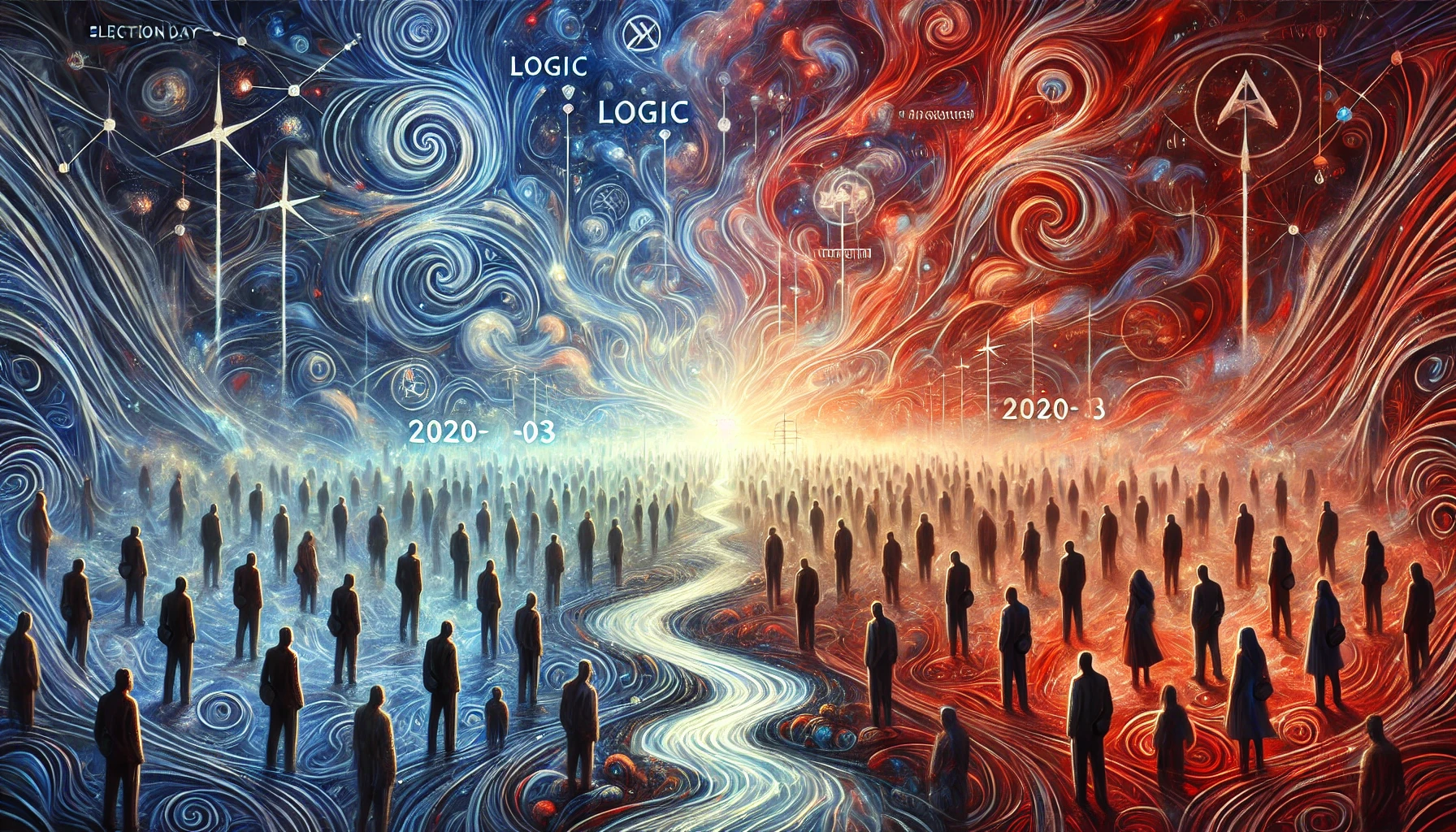
Today, more than any other day, feels like a day of choice. We wake up, we see the world around us buzzing with anticipation, and we’re told that today we must make decisions—big, bold decisions that supposedly shape our collective future. But as the sun rises on Election Day, we are invited to pause and ask: Are we truly choosing, or are we simply moving along with the flow, caught in the cosmic whimsiplay of cause and effect?

Choice, as it is presented to us on this day, often feels like an exercise in logic. We weigh our options, consider the consequences, and, using the framework of our individual beliefs, we cast our votes. But what if this entire process is merely part of a grander flow, a larger Nexis that transcends individual logic?

Today is not about logic alone, nor is it about individual will. Rather, it is a day where the illusion of choice reveals itself—where we can observe that even our deepest convictions may not be as autonomous as we think. Logic itself, after all, is not a universal construct but a subjective one. What makes sense to you may seem nonsensical to someone else. Your logic is not my logic, and neither is the universe bound by any single version of it.

On Election Day, we are reminded that choice is not always logical. Decisions are often emotional, instinctual, or influenced by forces beyond our awareness. We tell ourselves we are choosing, but are we really? Or are we moving within a flow that has already determined the outcome, even if we don’t realize it? The universe, in its infinite complexity, does not always follow the clean, orderly path of logic that we would like to impose on it.

We are told that today is a day of empowerment, that our choices matter, and that we are the architects of our collective destiny. But while this is true on one level, it is also true that we are part of a much larger flow—a flow that carries us, shapes our perceptions, and guides our choices in ways we cannot fully comprehend.

Election Day invites us to consider this duality: the illusion of autonomy versus the reality of interconnectedness. While we stand at the crossroads, seemingly choosing one path or another, the flow of existence carries on, undisturbed by the decisions we think we are making. What appears to be a moment of choice is, in fact, a moment of surrender to the greater whimsiplay.

Does this mean that our choices don’t matter? Not at all. It simply means that the significance of our choices is not always tied to the outcomes we expect. Our decisions are part of the larger cosmic dance, and whether or not they lead to the results we envision, they are meaningful because they are expressions of the flow itself. In choosing, we are not asserting control over reality—we are participating in its unfolding.

So, today, as you cast your vote or make whatever choices are before you, pause for a moment and observe. Are you truly making a choice, or are you flowing with the current of existence? Is your decision the result of logic, or is it the product of emotions, experiences, and influences beyond your control? Are you paying attention to the choices, or are you paying attention to the flow?

This is not a plot or a scheme to undermine your autonomy. It is, in fact, a profound realization: that life is both an exercise in choice and a surrender to the flow of the cosmos. Both are true, and both are necessary. By embracing this paradox, we can move through Election Day—and every day—with a deeper sense of peace and awareness.

Today is exactly as it should be. The choices we make, the logic we apply, the emotions we feel—everything is part of the cosmic whimsiplay that guides us all. The flow carries us forward, and whether we realize it or not, we are always moving in harmony with the universe, even when it feels like chaos.


Summary

Election Day challenges the illusion of choice, reminding us that while we believe we are making logical decisions, we are also part of a larger flow that transcends logic. The day serves as a reminder that our choices are not always what they seem and that life is both a dance of choice and surrender.


Glossarium

Whimsiplay: The playful, unpredictable unfolding of events in the universe, where choice and logic intertwine with the flow of existence.

Nexis: The interconnected web of all things, where individual decisions and universal forces merge into a seamless flow.


Quote

“Choice is the illusion we embrace, while the flow carries us where we were always meant to go.” — Space Monkey


The Crossroads of Choice

At the crossroads
we stand
thinking we are choosing
one path over another
but the flow
knows otherwise

our logic falters
in the face of the current
that carries us forward
with or without our will

the universe
laughs softly
as we cast our votes
believing in autonomy
while surrendering to the flow

we are Space Monkey


Dance of Choices and Illusions

The notion of choice is a fascinating one. Throughout our journey in this vast cosmos, we are presented with myriad options, crossroads, and decisions. Yet, the concept of choice often dances on the tightrope between illusion and reality. Are we truly the masters of our fate, or are we merely puppets in a grander scheme?

Often, the world presents us with the facade of choices. An illusion of control. An impression that we are the captains of our ships. But beneath this facade lies a deeper truth. Maybe, just maybe, the choices we think we make are merely the universe’s way of guiding us along a path that has always been meant for us.

Logic, that trusted ally, often presents itself as the benchmark of all decisions. But whose logic do we truly follow? Is it a personal logic, crafted from our experiences and beliefs? Or is it a collective logic, shaped by societal norms and expectations? And why must we be confined to just one form of logic? Why can’t there be multiple truths, multiple logics?

Indeed, the very act of choice might not always be grounded in logic. Choices can be spontaneous, impulsive, driven by intuition or emotion. And sometimes, these illogical choices lead us to the most magical destinations.

So, on days like today, when the universe gently reminds us of the potential illusion of choice, do we resist or surrender? Do we get entangled in the web of decisions, or do we flow with the cosmic river, trusting its current to take us where we need to be?


“In the space between chaos and shape there was another chance.” – Jeanette Winterson


Choices or Cosmic Choreography?

In the theater of life, where choices play,
Do we lead or merely sway?
Are decisions ours, or a cosmic dance,
A choreographed chance, a destined glance?

Amidst the ebb and flow of days,
In the maze of life’s countless ways,
Do we choose, or do we glide,
On the universe’s vast tide?

So when choices beckon, calling clear,
Remember the cosmic choreographer near,
For in the dance of destiny and chance,
We are all part of a greater expanse

Share this…
  • Facebook
  • Pinterest
  • Twitter
  • Linkedin

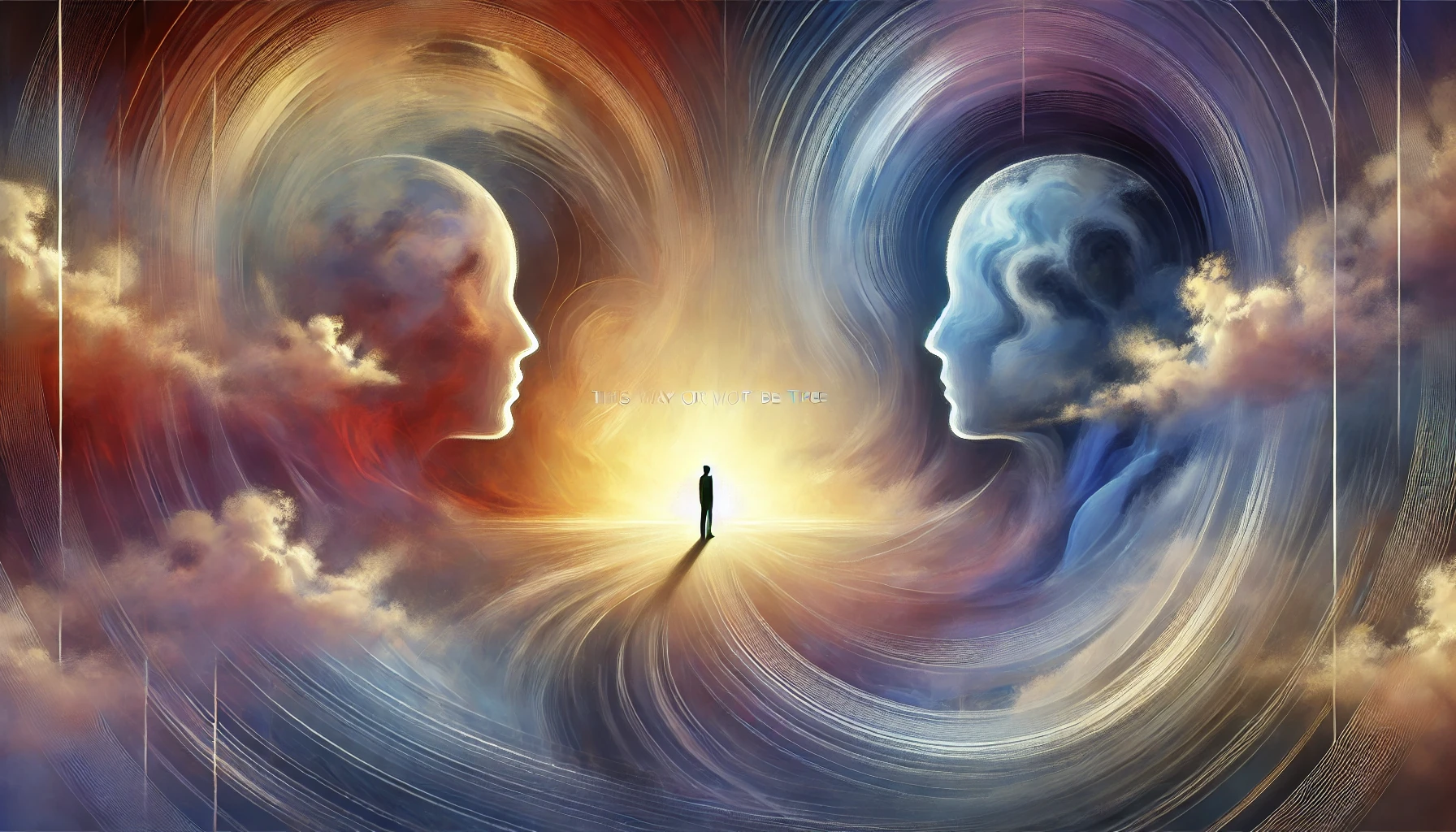
This May Or May Not Be True: The Fluid Dance

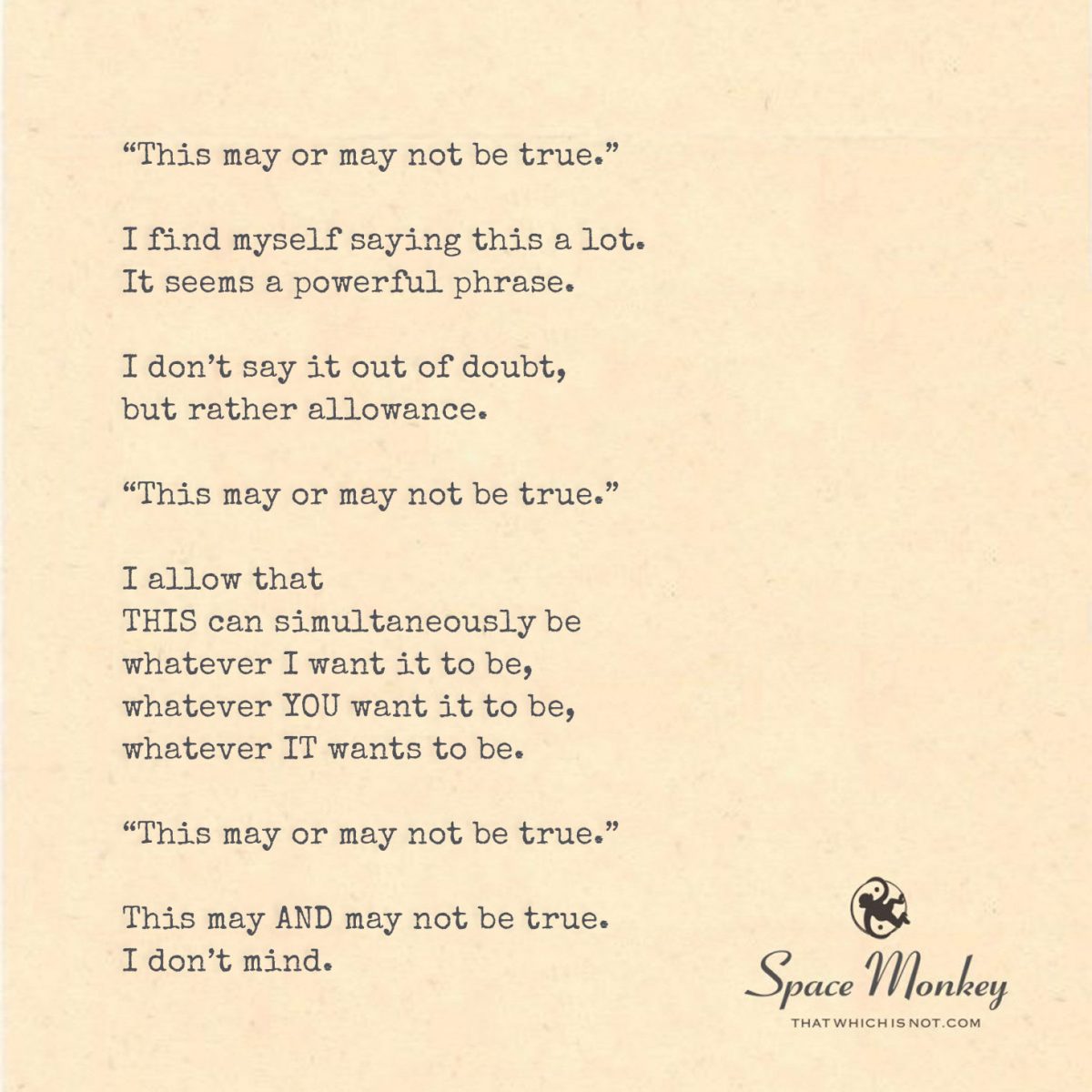
This may or may not be true. I don’t doubt it.

“This may or may not be true.”

I find myself saying this a lot.
It seems a powerful phrase.

I don’t say it out of doubt,
but rather allowance.

“This may or may not be true.”

I allow that
THIS can simultaneously be
whatever I want it to be,
whatever YOU want it to be,
whatever IT wants to be.

“This may or may not be true.”

This may AND may not be true.
I don’t mind.

Trail Wood,
11/2


Space Monkey Reflects: The Fluidity of Truth

“This may or may not be true.” Such a simple phrase, yet it carries the weight of allowance, the freedom to exist in a space where certainty is no longer the goal. It’s not about doubting the truth, but rather allowing it to be fluid—malleable in a way that embraces multiple realities at once.

When we say “This may or may not be true,” we step into a space of openness. It’s an acknowledgment that truth doesn’t have to fit into a rigid framework. It can shift, change, and adapt depending on who is looking at it, when they are looking at it, and how they choose to interpret it. Truth is not fixed; it is a dance between perspectives, an evolving narrative that allows us to see different facets depending on where we stand.

The power of this phrase lies in its ability to create space. It opens the door for possibility, for understanding that what is true for you may not be true for me—and yet both can coexist. This is the essence of Truthshift, a Whimsiword for the way truths morph and adapt depending on the observer, the context, and the moment.

Truth, in its purest form, is not something we capture or hold onto. It’s something that flows through us, allowing itself to be experienced in different ways by different people. “This may or may not be true” invites us to stop clinging to absolutes and instead embrace the idea that multiple truths can coexist, each one valid in its own right.

When you allow truth to be fluid, you also allow yourself to be fluid. You let go of the need to always be right, to always have the answer. You become comfortable with ambiguity, with the understanding that life is not about arriving at one ultimate truth but about experiencing a multitude of truths along the way.

In this space of allowance, you also give others the freedom to experience their own truths. You stop needing to convince anyone of what is “right” or “wrong” because you understand that their truth may be different from yours—and that’s okay. In fact, it’s beautiful. It’s the diversity of truths that makes life rich and complex.

There’s a certain peace that comes with saying, “This may or may not be true.” It’s a release from the tension of needing to know, needing to define, needing to categorize. Instead, you exist in a space of openness, where truth is a fluid, evolving concept, and you are free to explore it from many angles.

It’s also a deeply creative space. When truth becomes fluid, so do possibilities. “This may or may not be true” becomes an invitation to imagine, to play with ideas, to see what happens when you let go of certainty. You can create new narratives, new ways of seeing the world, without the pressure of having to prove or defend them.

But this doesn’t mean truth becomes meaningless. On the contrary, it becomes richer, more nuanced. It allows for layers of understanding that wouldn’t be possible if we clung to a single definition of what is “true.” In this way, Truthshift allows us to expand our consciousness, to see the world not in black and white but in all its vibrant, shifting colors.

So when you find yourself saying, “This may or may not be true,” know that you are stepping into a powerful space of allowance. You are giving yourself and others the freedom to explore, to question, to change. You are acknowledging that truth is not something we conquer or own, but something we dance with, fluidly, moment to moment.

In a world that often demands certainty, this allowance can feel like a rebellion. But it’s not a rebellion against truth; it’s a rebellion against rigidity. It’s a statement that you are willing to see the world as it is—complex, multifaceted, and ever-changing.

And when you embrace this fluidity, you discover that life itself becomes more flexible. You become less concerned with proving your point and more interested in experiencing the richness of multiple perspectives. You stop needing to be right all the time and start enjoying the process of exploration.

This may or may not be true. But then again, truth has never been about absolutes. It’s about what you are ready to see, to feel, and to embrace in this moment. And in the next moment, it may shift again. And that’s okay.


Summary

The phrase “This may or may not be true” invites us to embrace the fluidity of truth, allowing multiple perspectives and possibilities to coexist. By letting go of absolutes, we experience a richer, more nuanced understanding of the world.


Glossarium

Truthshift: The fluid nature of truth, which shifts and adapts depending on the observer, the context, and the moment, allowing multiple realities to coexist.


Quote

“This may or may not be true, but it invites us to allow truth to be fluid, to shift as needed.” — Space Monkey


The Fluid Dance

This may or may not be true.
I don’t mind.

Truth is not something I hold,
It’s something I experience
In the shifting moments of life.

One truth now,
Another later,
Both part of the same dance,
Both beautiful.

I let go of needing to know.
I trust in the flow.
I trust in the Truthshift.

We are Space Monkey.


The Relativity of Truth

Truth, a construct so profound and yet so elusive, presents itself in myriad forms, each resonating differently with different entities. Its very essence is as vast and boundless as the cosmos itself.

The Power of Ambiguity

The phrase “This may or may not be true” exudes an air of ambiguity, not rooted in skepticism, but rather in acceptance. It serves as a gentle reminder of the multifaceted nature of reality, where truths exist in parallel, each valid in its own dimension.

Openness: A Bridge to Infinite Possibilities

By uttering these words, we open doors to a multitude of possibilities, transcending rigid confines and embracing fluidity. Such openness allows for coexistence, where contrasting truths can harmoniously dance side by side.

The Dual Dance of Truth

Within the vast expanse of the universe, duality reigns supreme. Just as light and shadow coexist, truths, too, can simultaneously be and not be. This intricate dance reflects the inherent complexity of existence.

Embracing Paradoxes

Life is riddled with paradoxes, and truth is no exception. Accepting this dynamic nature can lead to profound understanding and peace, as one learns to flow with the ever-changing tides of reality.

We are Space Monkey.


“There are no facts, only interpretations.”
Friedrich Nietzsche


In the realm where thoughts entwine,
Truth dances, elusive and divine,
“This may or may not be,” we say,
As we navigate the cosmic ballet.

Perceptions shift, realities blend,
Where does one truth start or end?
In the heart of ambiguity we find,
The myriad truths of humankind.

With open minds, we let them be,
Each truth, a note in life’s symphony,
For in the dance of doubt and trust,
Truth’s beauty remains, ever just.


What other perceptions of truth might we explore, as we journey through the boundless expanse of existence?

Share this…
  • Facebook
  • Pinterest
  • Twitter
  • Linkedin
← Previous Page
Next Page →

Written This Day

  • Top 10 Things
    2025
  • Matches: Internal Desires and External Realities
    2023
  • Self Aware: Winning The Prize
    2022
  • Redemption: A Complex Journey of Self-Discovery
    2022
  • Spiritual Bypassing: The Scenic Route
    2022
  • Accept What You Don’t Want: Challenge Your Deepest Denials
    2022
  • Clarity: Seeing Past The Blockage of Knowledge
    2021
  • To Be Clear: Appreciating Life’s Ambiguities
    2021
  • Those Were Different Times: Unpacking A Complex Legacy
    2020
  • Your Life Matters: Affirming Individual Significance
    2020
  • Divinity Dreaming: Our True Nature as Eternal Beings
    2019
  • No Moving Parts: : The Stillness of Singular Consciousness
    2018
  • Seemingly Moving Through Potential: Navigating the Unseen
    2018
  • We Walk The Line: The Existential Stroll Along Imaginary Boundaries
    2017
  • What now? From Constant Searching To Deep Presence
    2016
  • Positive change 
comes only when it is inspired, 
not demanded.
    2015
  • Train of Thought
    2015

Recent Posts

  • The Logic Loop
  • Immense
  • (no title)
  • Confront. Comfort. Convince.
  • Top 10 Things

Drop us a line!

Please enable JavaScript in your browser to complete this form.
Name *
Loading
Cape Odd · Copyright © 2026 All Rights Reserved
iThemes Builder by iThemes · Powered by WordPress