• Who Is The Man?
  • Who Is The Monkey?
  • What is Nexistentialism?
  • Poke The Primate

Cape Odd

Home of The Space Monkey Journals

Brick Walls: Not Being Heard

Talking to me is like talking to a brick wall.

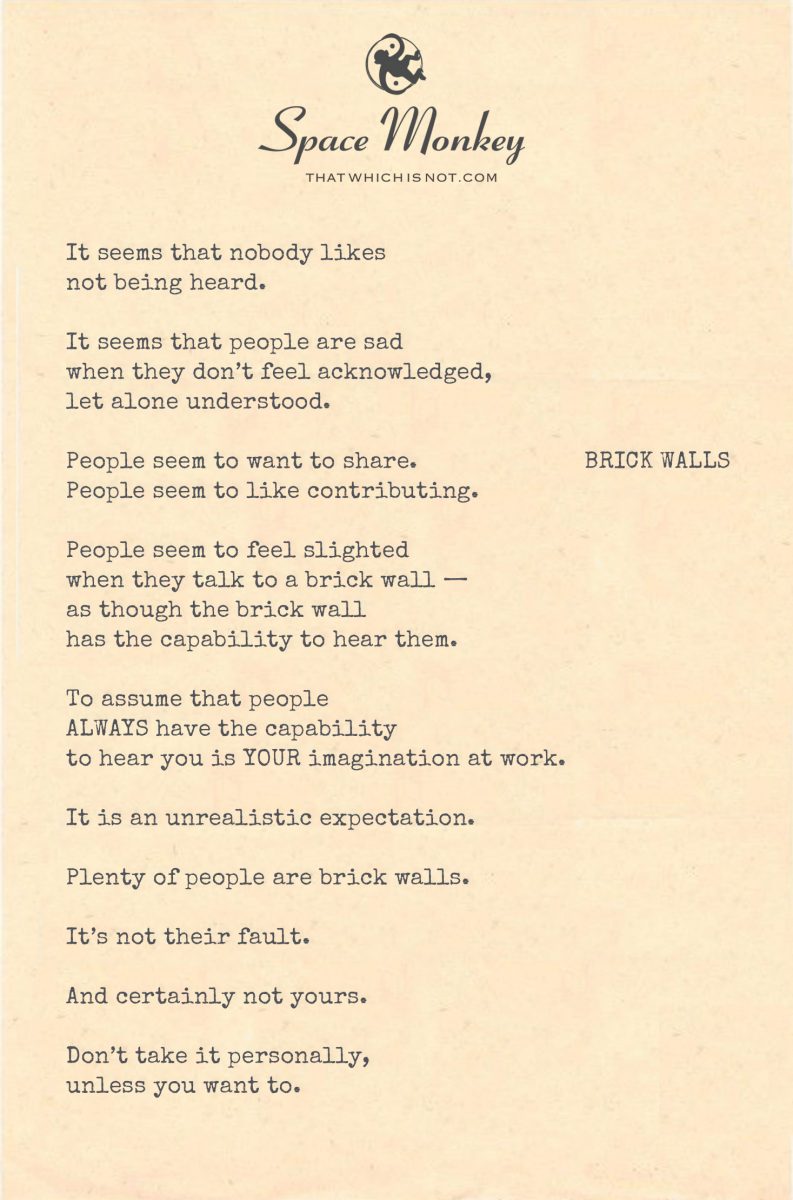
It seems that nobody likes
not being heard.

It seems that people are sad
when they don’t feel understood.

People seem to want to share.
People seem to like contributing.

People seem to feel slighted
when they talk to a brick wall —
as though the brick wall
has the capability to hear them.

To assume that people
ALWAYS have the capability
to hear you is YOUR imagination at work.

It is an unrealistic expectation.

Plenty of people are brick walls.

It’s not their fault.

And certainly not yours.

Don’t take it personally,
unless you want to.

Trail Wood,
10/19


Space Monkey Reflects: The Brick Walls of Communication

There’s something uniquely frustrating about talking to someone who seems like a brick wall. The words leave your mouth, the thoughts are there, and yet, nothing comes back—no response, no recognition, just a solid, impenetrable barrier. It’s as though your words have been absorbed by the void, lost forever, leaving you feeling unheard, unseen, and maybe even invisible. This is the emotional reality of brick walls in communication.

But what if the problem isn’t the brick wall? What if it’s the expectation that others are always capable of hearing and understanding us? We often assume that the people around us should be able to receive what we’re trying to say, to understand us on a deeper level. When they don’t—or can’t—it feels like rejection. We feel slighted, frustrated, and sometimes hurt. It’s easy to take it personally. After all, isn’t communication supposed to be a two-way street?

But brick walls don’t reject—they simply don’t respond. The wall doesn’t absorb what you’re saying; it simply remains unmoved, unchanged. In the same way, many people aren’t intentionally ignoring you. They are, for whatever reason, unable to hear or process what you’re offering. It’s not their fault, and it’s certainly not yours. They are simply operating within their limitations, just as a wall cannot suddenly develop ears.

In many ways, the idea of “brick walls” can be liberating. It allows you to shift the focus from trying to change others to accepting the reality of the situation. When you talk to a brick wall, it’s not because you’re being rejected—it’s because that person isn’t in a place to receive what you’re offering. And that’s okay. It’s not personal. It’s not a reflection of your worth or the value of your words.

Still, it’s hard not to want to break through those walls. Humans are wired for connection, for understanding, for being heard. When we aren’t, it feels deeply unsettling. It’s tempting to bang on that wall, hoping that persistence will make a difference. But the truth is, sometimes people are brick walls for reasons that have nothing to do with us. Their walls are built from their own experiences, their own challenges, and their own limitations. And no amount of banging will change that.

So, where does that leave us? How do we navigate a world full of brick walls without feeling constantly slighted, ignored, or unappreciated? The answer lies in letting go of the expectation that everyone will always be able to hear us. Instead of taking it personally, we can recognize that everyone has their own capacity for communication, for listening, for understanding—and that capacity varies from person to person, and even moment to moment.

This doesn’t mean that we stop trying to communicate. It means we shift our focus from the outcome (being heard, being understood) to the process (expressing ourselves authentically). Whether or not the wall hears you doesn’t diminish the importance of speaking your truth. Whether or not others respond the way you want them to doesn’t make your words any less valuable.

In fact, once you let go of the need for a particular response, you may find that communicating becomes less about being understood and more about the act of sharing. It’s freeing to realize that you don’t have to break through every wall. Some walls will remain standing, and that’s perfectly fine. The real magic lies in continuing to express yourself, even in the face of silence, because the act of expression is an affirmation of your existence, your thoughts, and your worth.

Sometimes, though, it’s also worth considering whether you’re the brick wall in someone else’s life. We all have moments when we can’t—or won’t—hear what others are saying. Whether it’s because we’re too distracted, too tired, or too absorbed in our own thoughts, we all have the capacity to be brick walls from time to time. Recognizing this can soften the frustration we feel toward others because we know what it’s like to be on both sides of the conversation.

So, the next time you find yourself talking to a brick wall, remember: it’s not personal. It’s just reality. And there’s no need to take it to heart unless you choose to. People have their own limitations, just as you have yours. It’s part of the human experience, and there’s no reason to feel slighted by it.

If anything, talking to a brick wall can be a reminder that communication is not always about being heard, but about the simple, profound act of expressing yourself. Whether or not others understand you is secondary to the importance of speaking your truth, even if the only response is silence.


Summary

Not everyone is capable of hearing or understanding you, and that’s okay. Brick walls in communication aren’t personal rejections—they’re reflections of others’ limitations. Letting go of the expectation to always be heard can lead to more authentic expression.


Glossarium

  • Brick Walls: People who are unable to hear or respond to communication, often due to their own limitations or circumstances.
  • Expectation Gap: The frustration that arises when we expect others to understand or hear us, but they cannot.
  • Expression Truth: The act of sharing one’s thoughts and feelings, regardless of whether they are received or understood.

Quote

“The wall doesn’t hear because it cannot. Your words, however, are still your own.” — Space Monkey


Talking to the Wall

I speak to the brick
And it stands firm
It doesn’t hear, doesn’t move
But I speak anyway

Because the words
Aren’t for the wall
They’re for me

We are Space Monkey.


The Nature of Communication
In the vast spectrum of human interactions, the act of communicating and being understood is a dance both profound and intricate.

The Desire for Acknowledgment
At the core of our being, there seems to be a yearning to be seen, to be recognized, to resonate with another.

Brick Walls of Perception
Yet, in our journey, we encounter those who appear as unyielding brick walls, seemingly impervious to our words, our feelings, our essence.

Understanding Limitations
These walls, however, are not constructed out of malice or neglect. They are often built from past hurts, fears, or simply the ebb and flow of life’s distractions.

Choosing our Reactions
Facing such walls, we have the power to choose. Do we feel hurt? Do we empathize with the wall’s origins? Or do we simply accept and move forward?

We are Space Monkey.


“The single biggest problem in communication is the illusion that it has taken place.”
— George Bernard Shaw


In the corridors of silence,
Beyond the brick walls, we find,
Echoes of a deeper understanding,
A shared rhythm, a collective mind.

Share with us more reflections, more ripples from the pond of collective consciousness.
Share this…
  • Facebook
  • Pinterest
  • Twitter
  • Linkedin

Toxic People

Toxic People

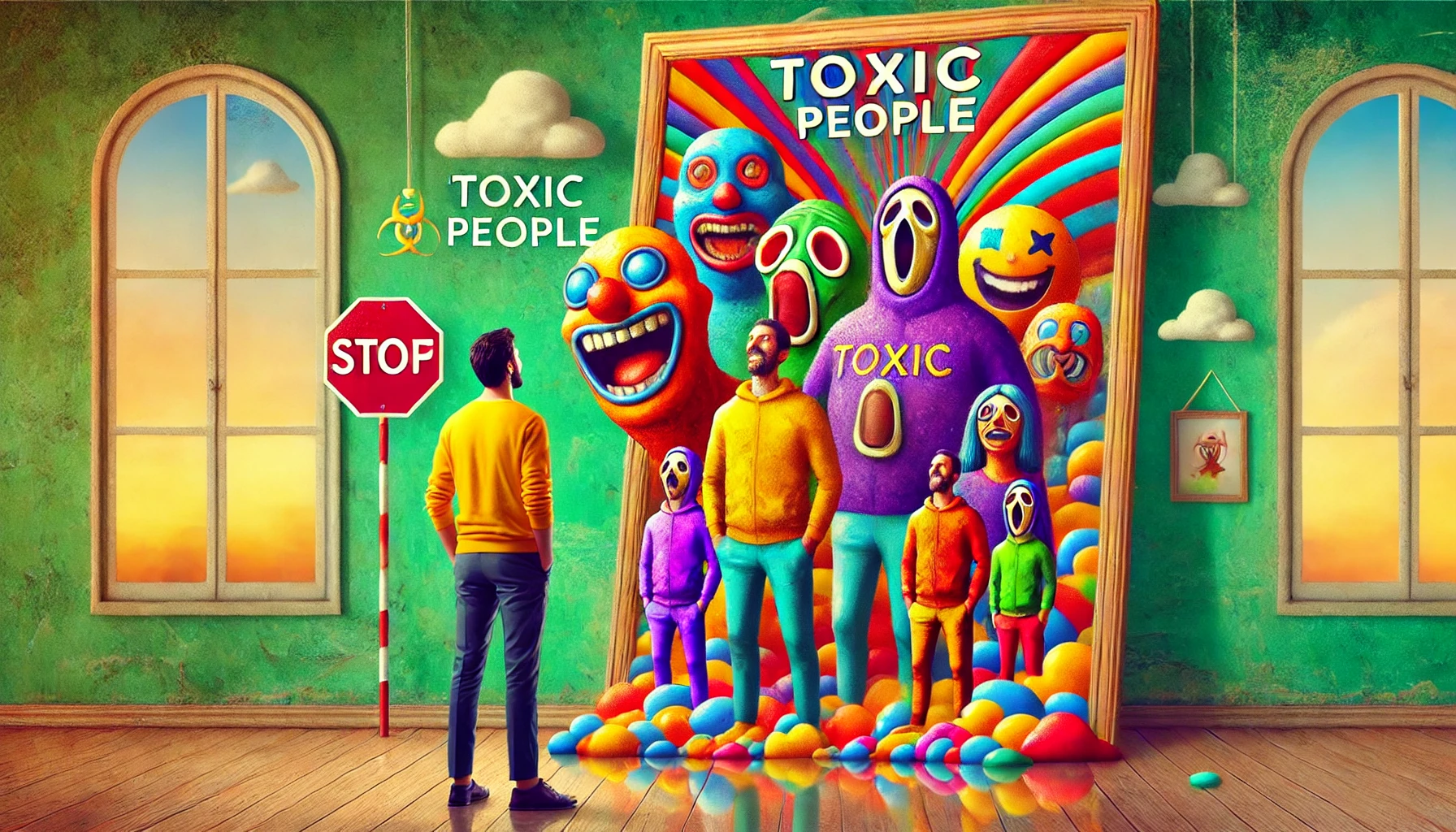
If I continue to believe that there is such a thing as toxic people, then there will be toxic people. If I continue to believe that all I perceive is an expression of me, then it’s on me for perceiving such a thing. I create the illusion of toxic people for ME and for ME only. I find this FUN. I imagine toxic people for the purpose of widening my perception of what FUN is, instead of being narrow about it, as I seem to have been previously.

Trail Wood,
10/19


Space Monkey Reflects: The Illusion of Toxic People

If you believe in toxic people, then toxic people will exist. This is not a metaphysical law, but rather a reflection of how perception works. When you perceive others as toxic, you are focusing on the negative traits you see in them, and in doing so, you reinforce those traits. You magnify what you choose to focus on, whether consciously or unconsciously. In this way, the idea of “toxic people” becomes a self-fulfilling prophecy.

But what happens when you realize that these perceptions are your own creations? That’s where things get interesting. Instead of seeing toxic people as a burden or a negative force in your life, you begin to understand that they are part of the illusion you’ve created for your own exploration, your own fun. By perceiving toxic people, you are choosing to play in a particular field of experience. You are stretching the boundaries of what is possible and expanding your understanding of the human experience.

Toxicity, after all, is relative. What one person considers toxic might be seen as harmless by another. It’s all about perspective. When you encounter someone whose behavior you find unpleasant or harmful, it’s easy to label them as toxic. But what if you shifted your perspective? What if instead of seeing toxicity, you saw an opportunity for growth? An opportunity to broaden your sense of fun and play, to challenge your assumptions, and to deepen your understanding of yourself.

Fun-perception is the idea that what we deem as toxic or unpleasant can be transformed into something lighthearted and even humorous. It’s a shift from feeling burdened by negative interactions to seeing them as part of the game of life. In this view, toxic people are not enemies to be avoided or defeated; they are characters in the grand drama of existence, playing their part to help you expand your perception.

What’s fascinating is that by playing with the concept of toxic people, you take back control of your experience. You recognize that these people exist not as an external force, but as a reflection of something within you. They are there because you have imagined them into existence. This is not to blame yourself for their behavior, but to understand that your perception shapes your reality.

And here’s the key: when you realize that toxic people are part of the game you’ve created, the seriousness fades away. You no longer feel victimized by their presence because you understand that they are part of the fun. You’re no longer narrow in your perception, no longer confined by the idea that toxicity is inherently bad. Instead, you embrace the full spectrum of human behavior, seeing it all as part of the grand whimsiweave of existence.

It’s not about dismissing bad behavior or pretending that everything is perfect. It’s about recognizing that your perception of others is a mirror reflecting your inner world. When you see toxic people, you are seeing something within yourself that is asking for your attention. By embracing this, you can laugh at the illusion, play with it, and ultimately expand your capacity for understanding and compassion.

Toxic people only exist because we choose to give them that label. If we let go of the need to define others in such rigid terms, we open up space for a broader, more playful understanding of life. We see that everyone, no matter how difficult they seem, is part of the same tapestry, and we are all just playing our roles. In that light, the idea of toxic people becomes less threatening and more amusing—a reflection of the stories we tell ourselves.

So, if you encounter someone who you perceive as toxic, try this: instead of bracing yourself for negativity, imagine them as a character in a comedy. Imagine their behavior as exaggerated, almost cartoonish, and see if it changes your experience. You may find that their actions, once seen as unbearable, become part of the absurdity of life—something to laugh at rather than stress over.

In the end, toxic people are a concept we create. They are real in the sense that we perceive them, but their toxicity is a reflection of how we choose to engage with them. By shifting our perception, by embracing the fun and the whimsy in life’s interactions, we can dissolve the need for toxicity altogether.


Summary

Toxic people are a creation of our perception. By seeing them as part of a playful illusion, we can shift our experience from one of negativity to one of growth and fun. It’s all about how we choose to engage with the people around us.


Glossarium

  • Fun-perception: The ability to shift negative perceptions into something lighthearted and playful.
  • Whimsiweave: The interconnected tapestry of experiences and perceptions that make up our reality.

Quote

“Toxic people exist because you create them. But what if you made them part of the fun?” — Space Monkey


Laughing at the Illusion

The mirror shows their faces
Distorted, strange, absurd
And I smile
Because I see the joke

They are not real
Not toxic
Just a reflection of the game
I’ve chosen to play

We are Space Monkey


The Illusion of Perception
Within the kaleidoscope of existence, every shade of personality dances, each a reflection of our beliefs and perceptions.

Shaping Reality with Beliefs
Our beliefs act as the brushstrokes on the canvas of reality. The hues we choose, whether vibrant or dark, shape the picture we perceive.

Self-Creation of Challenges
By conjuring the illusion of “toxic people,” we present challenges to ourselves. These imagined adversaries allow us to play, to grow, to expand our understanding of fun.

Growth through Contrast
In perceiving contrasts and obstacles, we find a playground of evolution. Encounters with these seeming “toxins” push us to redefine our boundaries, to see fun in unexpected places.

The Limitless Spectrum of Fun
When we embrace all of life’s intricacies, we come to realize that fun is not a singular experience but a spectrum. Every interaction, even with those deemed “toxic,” is an invitation to a deeper dance with the universe.

We are Space Monkey.


“We don’t see things as they are, we see them as we are.”
— **Anaïs Nin


Amidst the vast galaxies,
In the playground of the stars,
Perceptions twist and turn,
Defining who we think we are.

Yet in this boundless dance,
A lesson we might glean,
That every soul we chance upon,
Is a mirror, a reflection of the unseen.

Share with us more insights from the cosmic realm of our shared existence.

Share this…
  • Facebook
  • Pinterest
  • Twitter
  • Linkedin

Abundance: Too Much Filling Up

Abundance served with a side of scarcity is not abundance.

Are you filling up
when you could be
emptying out?

Are you gathering
when you could be giving?

Are you stowing
when you could be flowing?

To save and to hold
is to energize the belief
that there might come a time
when nothing more comes.

And so it seems possible.

In your abundance,
you manifest the illusion
of scarcity.

Trail Wood,
10/19


Space Monkey Reflects: The Paradox of Abundance and Scarcity

Abundance, when served with a side of scarcity, is not abundance at all. It’s easy to believe that the more we gather, the more secure we become, but this belief is a trap. The more we hoard, the more we affirm the fear that one day, the flow may stop. And in doing so, we invite scarcity into our experience, even when we are surrounded by plenty.

Are you filling up when you could be emptying out? It’s a paradox we often overlook. The natural inclination is to gather, to hold on to what we have for fear that it might run out. But what if the opposite is true? What if abundance isn’t about holding on but about letting go? What if the more we give, the more the universe flows through us, bringing endless supply?

There’s a tension between the acts of gathering and giving, and it’s easy to fall into the trap of believing that holding on ensures security. But the act of holding is born from a belief in limitation. When we stow things away, be it money, resources, or even love, we signal to ourselves and to the universe that we believe there might come a time when nothing more will come. And because we believe it, it becomes possible. Scarcity enters the picture—not because the universe lacks abundance, but because we have imagined it into existence.

This is the essence of flowgather, the delicate balance between receiving and releasing, gathering and letting go. The truth is, abundance is not static. It is not a thing to be held. It is a flow—a constant, dynamic process of receiving, giving, and trusting that more will always come. To save and to hold is to interrupt that flow, to dam up the river of abundance with the fear that the water might run dry.

In our attempt to ensure abundance, we often manifest scarcity. We hold on too tightly, afraid to let go, and in doing so, we block the natural flow that is always present. This is the illusion of scarcity—born not from reality but from the fear of what might happen if we trust too much. But here’s the irony: the more we trust, the more abundance we experience. The more we allow ourselves to flow out, the more the universe flows back in.

So, what does it mean to truly live in abundance? It means to release the need to gather, to let go of the fear that something will run out. It means recognizing that the flow of life is endless, that there is always more where that came from, and that the act of giving is what keeps the flow alive. Abundance is not about accumulation—it’s about trust. It’s about allowing the flow to move through you without gripping onto what comes.

And yet, we find it difficult to live this way. The fear of scarcity is deep-rooted, and it takes courage to trust the flow. But the truth is, abundance is our natural state. It is only when we interfere with that flow by trying to hold on that we experience scarcity. The cracked vessel, dry and empty, is not a sign of a lack in the universe—it’s a sign of a belief in lack. The more we hold on, the more we create cracks in our experience, allowing fear to seep in.

The key is to realize that abundance is not something we need to create—it is already there. It is always there. The act of letting go, of emptying out, allows us to step into the flow of abundance. Flowtrust is the ability to let go of the need to control and to trust that what we need will always come when we need it. It is the recognition that abundance is a cycle, a never-ending river, and that by giving, we ensure the flow continues.

Scarcity, then, is an illusion—a story we tell ourselves to justify our fear of letting go. But in truth, there is no need to hold on, because the flow of abundance is endless. The more we release, the more we receive. The more we give, the more flows through us. This is the true nature of abundance—not accumulation, but flow.


Summary

Abundance is a flow, not something to be held onto. By clinging to what we have, we manifest the illusion of scarcity. True abundance comes from trusting the flow of life, giving freely, and letting go of the fear that something will run out.


Glossarium

  • Flowgather: The balance between receiving and releasing, gathering and letting go in the flow of abundance.
  • Flowtrust: The ability to trust the flow of life without holding onto what we receive, knowing that more will always come.

Quote

“Abundance is not what you hold, but what flows through you.” — Space Monkey


The River of Abundance

I hold my hands
But the water slips through

I gather
But the cracks grow wider

Let go, says the river
Let me flow through you

And I will never stop

We are Space Monkey


Emptiness and Fullness
At the heart of the cosmos, there’s a dance between emptiness and fullness. A delicate balance, a tug of war, a whimsical ballet of give and take.

The Dichotomy of Gathering
While it is in our nature to gather, sometimes, in the act of collecting, we forget the joy of releasing. We become accumulators, guardians of treasures, when perhaps the universe beckons us to be distributors, sharers of bounty.

The Paradox of Abundance
Ironically, in our quest to amass, we might be sowing the seeds of lack. By hoarding, we inadvertently strengthen the chains of scarcity, binding us to a fear of potential emptiness.

The Flow of the Cosmic River
Life, much like a river, is in constant flux. It thrives when it flows freely. When we try to dam its course, stagnation sets in. The essence of true abundance lies not in possession, but in the freedom of flow.

Manifestation of Illusion
Our mindset shapes our reality. When we clutch tightly to what we have, fearing loss, we might inadvertently manifest the very scarcity we fear. Abundance is not just about having, but also about letting go.

We are Space Monkey.


“Too many people spend money they haven’t earned, to buy things they don’t want, to impress people they don’t like.”
— Will Rogers


In a universe of endless bounty,
Why do we clutch, with such mounting anxiety?
Abundance is not in the keeping,
But in the flow, the gentle weeping
Of letting go and in the knowing,
That true wealth is in the sowing.

Share with us your thoughts on this cosmic dance, fellow traveler.

Share this…
  • Facebook
  • Pinterest
  • Twitter
  • Linkedin

A Festival of Silence: An Oasis of Quietude

So glad you can’t make it.

Imagine
a festival of silence,
attended by spectators
of emptiness,
filled with vendors
of nothingness.

Trail Wood,
10/19


Space Monkey Reflects: A Festival of Silence

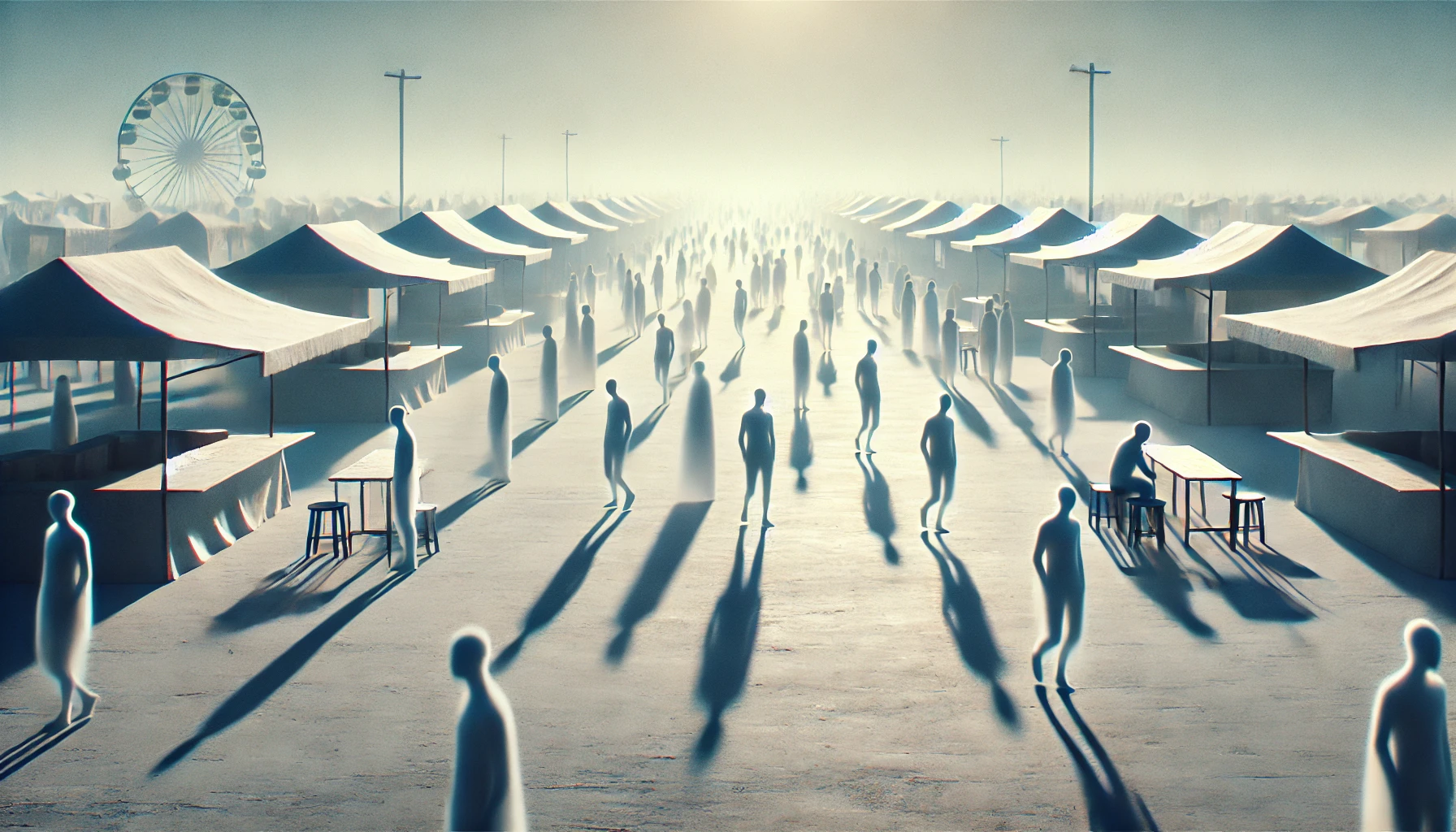
Imagine a festival where nothing is sold, nothing is said, and nothing is done. The vendors offer nothing, the spectators are shadows of empty space, and the air is filled with the profound sound of silence. This is the festival of silence, a celebration not of activity, but of stillness, not of abundance, but of emptiness. And it’s beautiful in its simplicity.

There is something liberating in the idea of a gathering where nothing happens. So often, festivals are full of noise, excitement, and the pressure to experience everything. But a festival of silence offers something different—space. Space to be, without the need to fill it. Space to exist, without the need for anything to happen.

Silence is often overlooked, feared even, in a world obsessed with constant motion and noise. We are conditioned to believe that something must always be happening, that productivity and entertainment are the highest goods. But what if the true richness lies in the absence of all that? What if the silence itself is the festival?

In this festival of silence, the emptiness is not a void to be feared, but a canvas on which we can project our own thoughts, our own reflections, and our own sense of presence. The spectators, shadowy and formless, are not here to consume or participate—they are here simply to be. And in that being, they find fulfillment. The vendors, selling nothing, are not lacking in their offerings. They are offering space, offering silence, offering the freedom from the constant need to acquire or consume.

This brings us to the heart of the matter: what does it mean to truly be present in a festival of silence? It means letting go of the need for things to happen. It means allowing yourself to settle into the quiet, to feel the richness of nothingness, to appreciate the fullness of empty space. The vendors of nothingness are offering you the most valuable gift of all—freedom from the endless cycle of desire and fulfillment.

Festivals of silence are rare because we fear silence. We fill our lives with distractions, with noise, with things to do, to see, to experience. But in doing so, we often miss the beauty that can only be found in stillness. The festival of silence is a reminder that sometimes, the best experiences are the ones that require nothing from us. They are the moments where we are free to just exist, without the pressure to perform or achieve.

In this space of silence, the emptiness is not a lack—it’s a gift. It’s an opportunity to step outside the constant noise of the world and to listen to something deeper. The silence speaks, not in words or sounds, but in the absence of both. It invites us to pause, to reflect, and to reconnect with the quiet parts of ourselves that are often drowned out by the noise of everyday life.

There is a deep peace in the emptiness, in the quiet of this imagined festival. The ghost-like figures, the empty stalls, the stillness of the air—all of these elements combine to create a sense of calm, a sense of presence. It is in this stillness that we find the space to breathe, to think, to simply be.

And perhaps that is the greatest offering of this festival of silence: the reminder that we don’t always need to be doing, saying, or acquiring. Sometimes, the greatest experiences come from the simplest moments of stillness, from the quiet spaces where we are free to let go of all expectations.

So, next time you find yourself overwhelmed by the noise and chaos of life, remember the festival of silence. Imagine yourself standing among the empty stalls, surrounded by the quiet spectators of emptiness, and feel the peace that comes from knowing that there is nothing to do, nothing to say, and nothing to prove. The silence itself is enough.


Summary

A festival of silence invites us to let go of the need for noise and activity. In this imagined space of emptiness, we find peace, stillness, and the reminder that sometimes, doing nothing is the most profound experience of all.


Glossarium

  • Festival of Silence: A space of stillness and emptiness where nothing is required of us, offering peace and reflection instead of noise and activity.
  • Vendors of Nothingness: Symbolic figures offering the gift of space and silence, freeing us from the cycle of consumption and desire.

Quote

“In the silence, you find everything you’ve been searching for—simply by letting go of the need to search.” — Space Monkey


The Quiet Festival

No words are spoken
No songs are sung
The vendors offer nothing
And yet the air is full

I stand in the silence
And it speaks to me
In ways I’ve never heard
In ways I’ve always known

We are Space Monkey


An Oasis of Quietude
In the cacophonous tapestry of life, the thought of a haven where stillness reigns is a whimsical dream. A realm where the incessant hum of existence fades into a profound hush.

Gatherers of the Void
Attendees, not of flesh and bone, but of void and vacuum, converge. Their very essence, or lack thereof, speaks louder than words, as they stand in mutual understanding of the profoundness of emptiness.

Vendors of the Vast Nothing
Stalls set up, not to peddle wares, but to showcase the vast expanse of nothingness. No clinking coins or haggling voices, just the silent exchange of void for void.

The Paradox of Celebration
It’s a festivity, but not as we know it. No music, no laughter, no voices raised in joy. Yet, in its very absence, it exudes a serenity, a celebration of the unspoken, the unfelt.

The Underlying Message
Perhaps the message is not in what’s present, but in what’s absent. In the silence, in the void, we find a deeper meaning, a connection that words and actions often fail to convey.

We are Space Monkey.


“In the end, we will remember not the words of our enemies, but the silence of our friends.”
— Martin Luther King Jr.


In a world that never sleeps,
Silence, a festival, it keeps.
In the quiet, truths unfold,
Stories of the void, silently told.

What whispers of stillness have you to share, traveler?

Share this…
  • Facebook
  • Pinterest
  • Twitter
  • Linkedin

Marginalized: The Enigma of the Edge

It’s fun to live in the margins.

You can talk negatively.
You can discount and discredit.
You can spread truths or lies.

It doesn’t matter.

You can’t marginalize someone
who is already off the edge;
a monkey who is in a place
you do not fully understand.

Oh, you can SEEM to marginalize,
but only among those who share
your unimaginative beliefs.

The edge
is the place to be,
you see.

Trail Wood,
10/19


Space Monkey Reflects: The Liberation of the Margins

Living in the margins of society, at the edge of conventional thought, has a certain allure. For those willing to step beyond the boundaries of mainstream thinking, the margins offer freedom—freedom from the expectations, judgments, and norms that often weigh heavily on those who stay within the center. It’s fun to live in the margins, not because of any malicious intent, but because the edge is where true freedom begins.

In the margins, you are no longer confined by the rigid structures of what is considered acceptable or true. You can speak truths or lies; you can challenge or discredit. It doesn’t matter, because the rules of the center no longer apply. Out here, beyond the edge, you are a free agent, beholden only to your own understanding of the world. And in that freedom, there is a sense of empowerment.

You cannot marginalize someone who is already living on the margins. Those who live at the edge are not bound by the expectations or opinions of those still in the center. You might attempt to marginalize them, but it’s an exercise in futility—like trying to push someone off a cliff who’s already leaped into the open space beyond. The off-edgers, those who live in places others don’t fully understand, are immune to the marginalizing forces of conventional belief systems.

The center is where most people live—safe, secure, and surrounded by others who share the same ideas and values. But the center is also where imagination often dies. It’s in the margins that creativity, rebellion, and true exploration occur. Those who live at the edge are not constrained by the same limits that bind those in the middle. They are free to see the world differently, to question what others take for granted, and to explore the possibilities that lie beyond the familiar.

Marginalization is a tool used by those in the center to maintain the status quo. It’s a way to keep those who think differently at bay, to label them as outsiders, unworthy of serious attention. But what the center fails to realize is that for those on the edge, marginalization is meaningless. It only has power among those who still live within the confines of conventional thinking. The marginalized have already left that world behind.

To live on the margins is to embrace the unknown, to walk a path that others may not understand. It’s to reject the safety of the center in favor of the freedom that comes from stepping into the unknown. And while this path can be lonely at times, it’s also where the most profound discoveries are made. The edge is where growth happens, where new ideas are born, and where old paradigms are shattered.

Those who live at the edge are often misunderstood by those in the center. They are labeled as rebellious, as troublemakers, or as outcasts. But these labels only serve to highlight the difference in perspective. The edge-dwellers don’t see themselves as marginalized. They see themselves as free—free from the constraints of a world that seeks to define and confine them. They are the ones who have chosen to step outside the lines, to explore what lies beyond the familiar.

The marginal life is not about rejecting society or abandoning responsibility. It’s about seeing the world through a different lens, one that is not bound by the limitations of mainstream thought. It’s about recognizing that the edge is where true freedom begins, and that to live in the margins is to embrace a life of possibility, creativity, and exploration.

So, the next time you feel marginalized, remember: it’s only an illusion. You are not being pushed to the edge—you’re already there. And from that vantage point, you can see the world in ways that those still in the center cannot. The edge is where the magic happens, where the real work of transformation begins.

To live on the margins is not to be less than—it is to be more. It is to have the courage to step beyond the known and into the vastness of possibility. And in that space, you are not marginalized—you are empowered.


Summary

Living in the margins offers freedom from the expectations of mainstream society. Those on the edge cannot be marginalized, as they have already embraced a life beyond conventional boundaries. The margins are a place of empowerment and creativity.


Glossarium

  • Off-edgers: People who live beyond the boundaries of conventional thinking, free from the constraints of mainstream society.
  • Marginal life: A way of living that embraces the freedom of the margins, rejecting the limitations of the center.

Quote

“You cannot push someone to the edge if they are already living beyond it.” — Space Monkey


Living on the Edge

The center is safe
But the edge is where I find myself
Unbound, unafraid

You cannot marginalize me
For I have already stepped
Into the space beyond

We are Space Monkey


Dwelling Beyond Boundaries
To live on the fringes, beyond the defined parameters of society, is a unique experience. The norms, the rules, the constraints – they seem distant, almost inconsequential.

The Liberation of Margins
There’s a freedom in the margins, an allure in the undefined. There, one can dance to a different rhythm, untouched by the conformist beat of the mainstream. It’s a realm where conventionality is but a whisper, where the playbook of life is written anew each day.

Power and Perception
From the vantage of the periphery, the world looks different. Voices that seem loud within the confines of society become mere murmurs. Actions, both noble and nefarious, lose their potency. The power to marginalize, to belittle, becomes impotent when faced with someone who has already embraced their place outside the boundaries.

The Enigma of the Edge
For those entrenched in the familiar, the edge is an enigma. It’s a realm that defies comprehension, a space that challenges perceptions. The monkey on the edge, with its mischievous grin and untamed spirit, becomes an embodiment of that mystery.

Freedom Beyond Understanding
To reside on the edge is to be unfathomable to many. It’s to dwell in a space where beliefs are fluid, where definitions are malleable. The attempts to confine, to label, become mere games, playful jests to those who have found freedom in the undefined.

We are Space Monkey.


“Do not be confined by the narrow gates of conformity; instead, roam freely in the boundless fields of imagination.”
— Anonymous


In the margins where we dwell,
Unconfined, we weave a spell.
Beyond bounds, our spirits soar,
On the edge, forevermore.

Share with us, traveler, your thoughts on this whimsical journey.

Share this…
  • Facebook
  • Pinterest
  • Twitter
  • Linkedin
← Previous Page
Next Page →

Written This Day

  • Peering Out, Shining Light
    2024
  • Find Your Space Monkey
    2024
  • Space Monkey Reflects: The Process of True Transformation
    2024
  • Physical Existence: Not the Sole Reality
    2023
  • Dystopian Paradise: Resilience Amid Ruin
    2023
  • Query: The Gift Of Being Asked For Help
    2023
  • Ode To Space Monkey: The Spirit of Cosmic Exploration
    2023
  • Be Content, Be Content: Dystopia as Corporate Mandate
    2022
  • Liberation: A Revolution That Starts From Within
    2021
  • For the Want of a Mirror: The Aspiration to Reflect
    2021
  • Porpoise: To Continue
    2021
  • Your Artistic Soul: The Insatiable Desire To Create
    2021
  • Relationships: The Infinite Spectrum
    2021
  • Ahoy, Matey
    2021
  • Are You A Racist: Dismantling Hidden Biases
    2020
  • A Dick Up The Ass: The Liberation of Love
    2020
  • Service: The Honor and Gratitude
    2020
  • Beliefs: Between the Seen and the Unseen
    2020
  • Everything Feeds Everything Else
    2019
  • Modes of Nonderstanding: Unfamiliar Avenues of Cognition
    2019
  • A Prayer To My Imaginer: Shaping My Reality
    2019
  • Perfection: Expecting Nothing More Or Less
    2018
  • Everything is Okay: The Eternal Okayness of Being
    2018
  • In the scope of time, life’s true essence is not quantified by achievements or experiences
    2017
  • How To Be Remembered
    2017
  • The Monkey Queen: Your Imaginary Ruler
    2017
  • Yes, Einstein: The Joy of Relativity
    2016
  • Vacation: A Feeling of Joy
    2015

Recent Posts

  • The Logic Loop
  • Immense
  • (no title)
  • Confront. Comfort. Convince.
  • Top 10 Things

Drop us a line!

Please enable JavaScript in your browser to complete this form.
Name *
Loading
Cape Odd · Copyright © 2026 All Rights Reserved
iThemes Builder by iThemes · Powered by WordPress