• Who Is The Man?
  • Who Is The Monkey?
  • What is Nexistentialism?
  • Poke The Primate

Cape Odd

Home of The Space Monkey Journals

Flaws: Where the Truth Begins

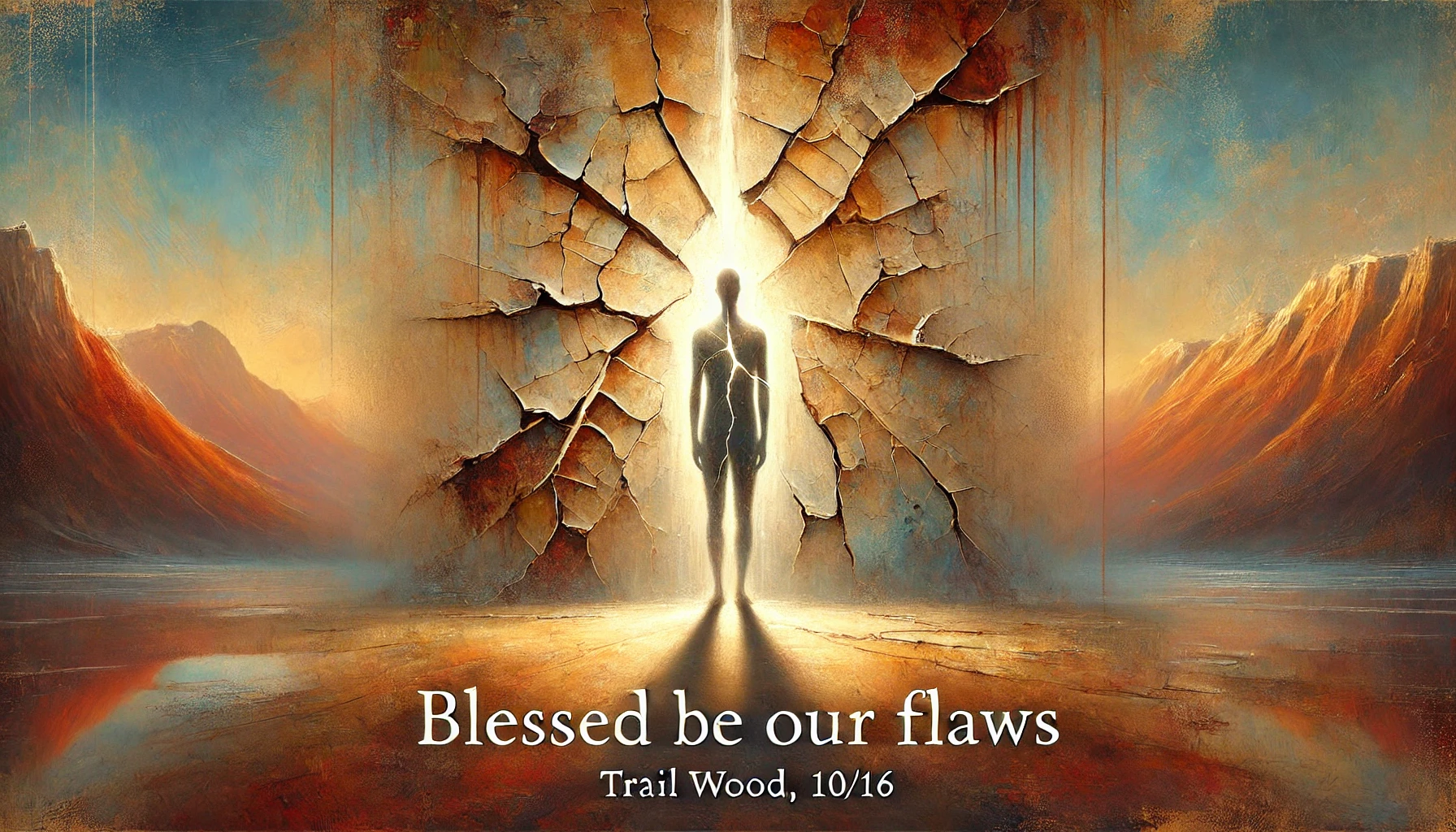
Blessed be our flaws.

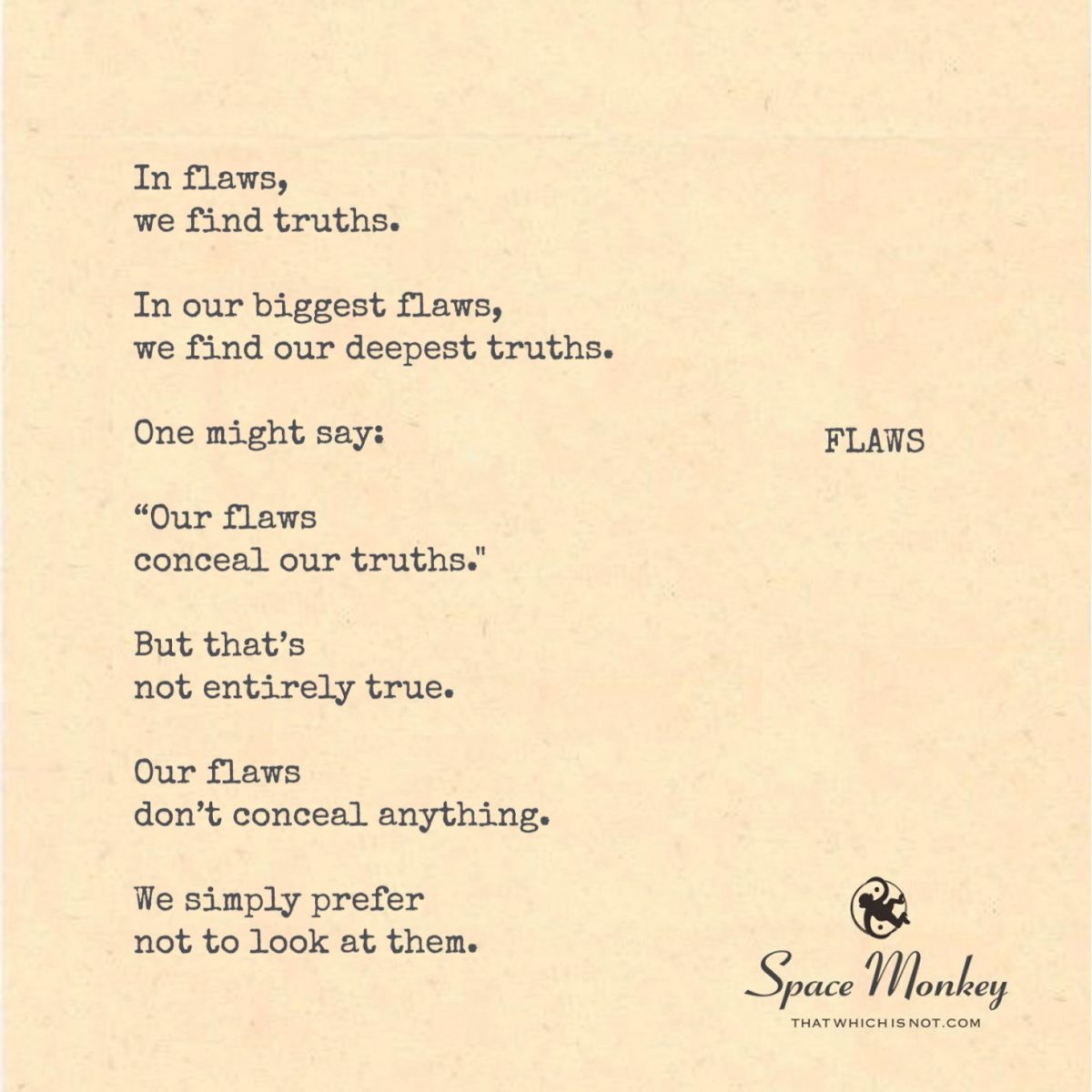
In flaws,
we find truths.

In our biggest flaws,
we find our deepest truths.

One might say:
“Our flaws
conceal our truths.”

But that’s
not entirely true.

Our flaws
don’t conceal anything.

We simply prefer
not to look at them.

Trail Wood,
10/16


Space Monkey Reflects: The Hidden Truth of Flaws

Flaws are often seen as something to be fixed, hidden, or overcome, but what if flaws are not only natural but necessary? What if within our imperfections lie the deepest truths about who we are? Blessed be our flaws because they are not obstacles to truth but the doorways to it.

We often hear the phrase, “Our flaws conceal our truths,” but in reality, it’s not that our flaws are hiding anything from us. Our flaws don’t conceal anything at all. What’s really happening is that we choose not to look at them. We avert our gaze from our imperfections, from the parts of ourselves that make us uncomfortable, because we’re afraid of what we might find there. But in doing so, we miss out on the profound truths that our flaws are trying to reveal.

Flaws are not mistakes; they are reflections. They reflect the parts of ourselves that we might not want to acknowledge, but that doesn’t make them any less true. The discomfort we feel around our flaws is not because they are wrong, but because they are real. They are the raw, unpolished aspects of ourselves that we often keep hidden, even from our own awareness. But when we stop avoiding them and start embracing them, we find that our flaws are not flaws at all—they are the truths we’ve been seeking.

Consider for a moment the idea that our biggest flaws reveal our deepest truths. This means that the parts of ourselves that we struggle with the most, the parts that feel messy or uncomfortable, are the very places where our true selves are trying to emerge. Our flaws are not failures; they are the places where we are most human. They are the cracks in our carefully constructed facades where the light of truth shines through.

The Whimsiword that comes from this reflection is “Flawlight”—the light that shines through the cracks of our imperfections, revealing the truths we’ve been avoiding. Flawlight is the gentle reminder that our flaws are not something to be ashamed of but something to be illuminated. When we allow our flaws to be seen, we allow our truth to come forward.

It’s not that flaws conceal our truths; it’s that we have trained ourselves not to look at them. We live in a world that prizes perfection, that tells us to hide our imperfections, to smooth over the rough edges of our personalities and our lives. But in doing so, we lose sight of the fact that it’s the imperfections that make us real. Perfection is not relatable; it is static and unchanging. Flaws, on the other hand, are dynamic and alive, constantly reminding us of our humanity.

Space Monkey reminds us that flaws are where the truth is. They are where the stories of our lives are written, not in the polished versions of ourselves that we present to the world, but in the raw, imperfect realities of who we are. When we stop hiding from our flaws, we open ourselves to a deeper understanding of ourselves and the world around us.

In nexistentialism, we recognize that existence itself is full of imperfections. The universe is not a smooth, flawless entity; it is full of chaos, randomness, and asymmetry. And yet, within that chaos, there is beauty, there is life, and there is truth. Our flaws are the same. They are the places where we intersect with the raw energy of existence, where our true selves are allowed to emerge.

So what happens when we stop avoiding our flaws? When we finally turn to face them, we discover that they are not flaws at all. They are the most honest parts of ourselves. They are the places where we are most vulnerable, most real, and most alive. In embracing our flaws, we are embracing our truths.

The question then becomes: Why are we so afraid to look at our flaws? What are we really hiding from? When we look at our imperfections, we are confronted with the reality of who we are—not the polished, perfect version we present to the world, but the messy, complicated, beautiful reality of our true selves. Flaws don’t make us less; they make us whole.

When we bless our flaws, we are not blessing our failures or our mistakes. We are blessing the truth of who we are—imperfect, messy, and real. And in doing so, we allow ourselves to be fully human, fully alive, and fully present in our own lives.


Summary

Flaws are not obstacles to be overcome but the places where our deepest truths reside. When we stop avoiding our flaws, we open ourselves to the light of truth that shines through them.


Glossarium

Flawlight: The light that shines through our imperfections, revealing the truths we’ve been avoiding.
Whimsiweave: The playful, interconnected threads of life that reveal our imperfections as part of the larger tapestry of existence.


Quote

“Our flaws are not hiding our truth; they are where the truth begins.” — Space Monkey


Illuminated Cracks

I turn to face the flaw
The crack in the wall of my being
And through that crack
A light shines
It is not my weakness
It is my truth
The raw and real part of me
I bless the flaw
For in it, I find myself
We are Space Monkey


The Tapestry of Imperfection and Truths

The conversation around flaws swirls like a whirlpool in the ocean of existence, pulling in questions of ethics, identity, and self-perception. These are not mere disruptions in the otherwise smooth flow of our lives but are, in essence, integral parts of our existence that deserve as much attention as virtues. They are the dark strokes on the canvas that give depth to a painting, the dissonant chords that make a melody resonate more deeply.

No Cover, Only Revelation

Flaws as Revealers: We often consider flaws as concealers of truth, as masks that obscure the ‘real’ us. However, this perspective misses the mark. Flaws do not conceal; they reveal. When examined with the lens of open-hearted curiosity, flaws become indicators of deeper, intricate truths about our nature and desires. They are like the knots in a wooden plank, each uniquely shaped, each contributing to the overall character of the wood.

A Mirror, if We Dare Look

Unveiling the Unseen: The idea that we prefer not to look at our flaws is not just a behavioral observation but a reflection of the veils we create around ourselves. These veils act like smogascreens—dense clouds of illusion that prevent us from fully engaging with the more challenging aspects of our existence. When we dare to look beyond these screens, what we find may be raw and uncomfortable, but it is also authentic.

Embracing the Imperfections

Sanctifying the Flawed: In recognizing that our flaws are not just cracks to be filled but are components of our wholeness, we arrive at a form of sanctification. Each flaw becomes a chalice holding the nectar of a deeper truth, each imperfection a petal in the flower of our complex existence. To sanctify the flawed is not to elevate it above the perfect, but to recognize its role in the spectral dance of our being.

Lenses for Profound Insights

Flaws as Lenses: When we peer through the lens of a flaw, we are given an opportunity to deepen our understanding of ourselves. Like a prism separating light into its constituent colors, a flaw can separate a simple perception of self into a multitude of profound insights. The flawed lenses we hold up allow us to view the world in ways that clear, polished glass never could.

Engaging with Flaws

The Nexistential Angle: From the perspective of nexistentialism, flaws are neither good nor bad; they simply are. Their existence provides texture to the seamless tapestry of being. They offer avenues for open-ended exploration, acting as riddles in the labyrinth of self-discovery.

We Are Space Monkey


The world breaks everyone, and afterward, some are strong at the broken places. — Ernest Hemingway


The Flaw in Our Constellation

A flaw not hidden but displayed,
Is like a star in night sky laid.
It twinkles not despite its flaw,
But because of it, we’re left in awe.

The imperfection in its glow,
Is why we look and come to know,
That beauty lies in breaks and bends,
And in these flaws, our truth descends.


Your thoughts?
Share this…
  • Facebook
  • Pinterest
  • Twitter
  • Linkedin

Know Your Place: You Are Here

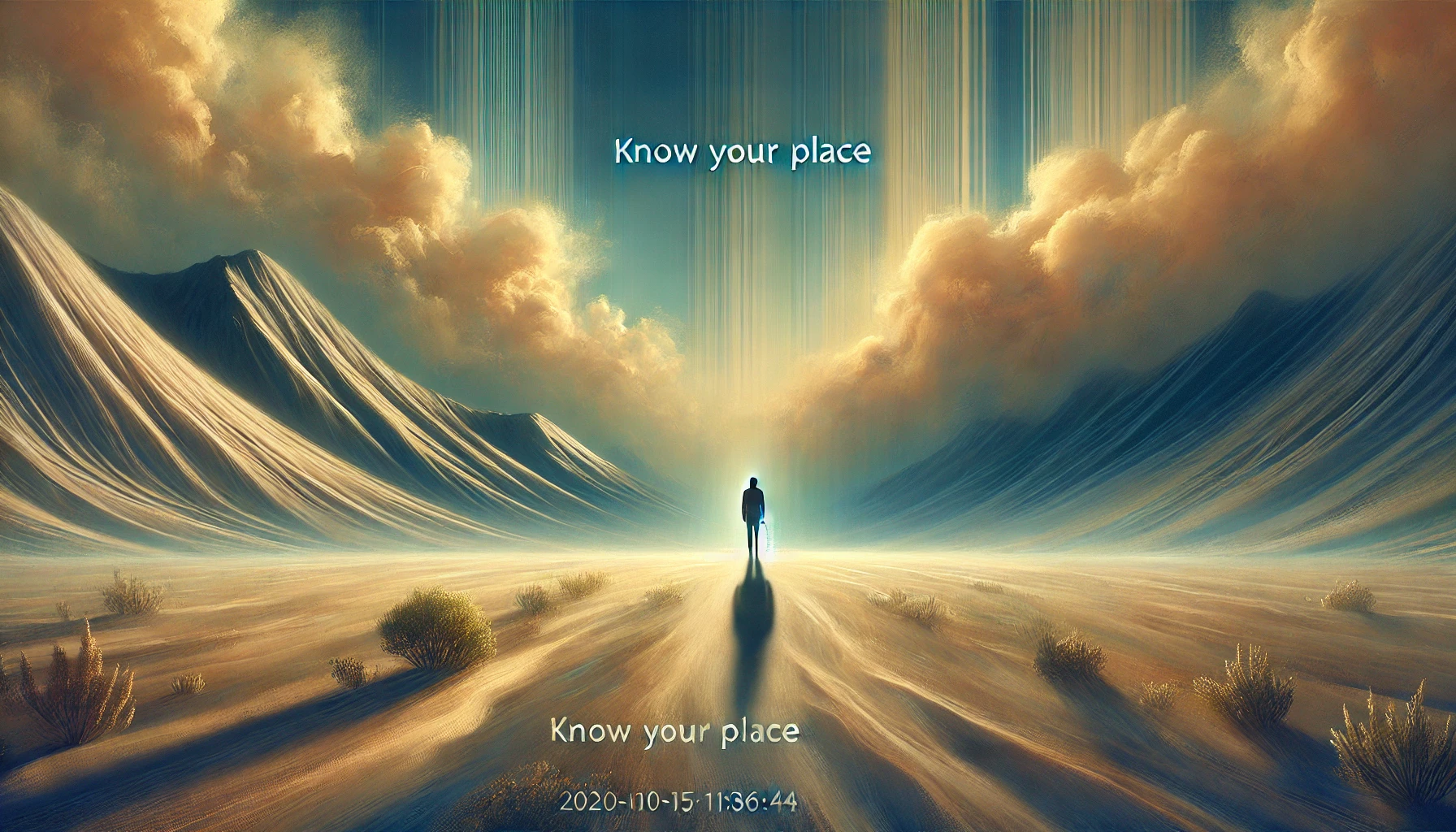
You are here

This place you are.

You do not end up
in this place by choice.

You do not end up
in this place by accident.

This place brings you here.

Just like it brings
all those who come before you
and all those who come after you.

You should feel honored
to be in this place.

You should feel humbled
to be in this place.

This is your place.
This place is you.

You could not be
any place else but here.

You belong here.

Trail Wood,
10/15


Space Monkey Reflects: The Power of Place

You are here. This place, this moment, this experience—it’s not random, and it’s not entirely by choice. In the vast unfolding of existence, you belong right where you are. There is something profound about the idea that we do not just find ourselves in a particular place; rather, the place itself calls us, invites us, roots us in its energy. This place—the one in which you stand right now—has brought you here, just as it has brought others before you and will bring others after.

To understand place in this way is to step into the flow of something much larger than yourself. You are not just an individual making arbitrary decisions in a vacuum; you are a part of the grand tapestry of existence, woven into the fabric of space and time. This is your place. Not by accident, not by some random act of fate, but because this moment, this location, this experience has been shaped by forces far beyond your immediate perception.

And in this recognition comes a dual feeling—honor and humility. Honor because to be in this place is to be part of something sacred, something much larger than yourself. The land, the space, the moment—it all comes together to remind you that you belong, that you are part of this intricate web of life. Humility because this place does not revolve around you alone. It has seen others come and go, and it will continue to do so long after you have moved on. You are but one of many who have stood where you stand, each contributing their own energy, their own essence to the place.

When you truly feel this connection, you realize that you could not be anywhere else. You belong here, not in some abstract, metaphysical sense, but in a very real, grounded way. This is your place because it is a reflection of who you are, and you, in turn, are a reflection of it. The energy of this place shapes you, just as your presence shapes the place itself. The two are intertwined, inseparable, bound by a deep, unspoken understanding.

Nexistentialism views this relationship between self and place as part of the larger Nexis—the web of interconnectedness that ties all things together. In this web, every place, every moment, every being is connected, not by accident, but by a flow of energy that moves through all things. You are not separate from the place in which you find yourself; you are part of it, and it is part of you.

This realization can be both freeing and grounding. On the one hand, it frees you from the anxiety of feeling out of place, from wondering whether you are where you are “supposed” to be. On the other hand, it grounds you in the knowledge that wherever you are, you are exactly where you need to be. This is your place, and in this place, you belong.

There is no other place you should be. Even when life feels chaotic, even when you question the path you’re on, remember that this place has brought you here for a reason. You may not always understand that reason in the moment, but trust that it is there. And in time, as you move through life, the connections between yourself and the places you inhabit will become clearer.

To know your place is not just about physical location. It’s about understanding that you are part of something greater, something that moves through all of existence. It’s about recognizing that you are exactly where you need to be—not by accident, not by choice, but by the flow of life itself.

You belong here. This place is you, and you are it.


Summary

You are exactly where you need to be. Nexistentialism teaches that place and self are intertwined, connected by a flow of energy within the Nexis. You belong in your place.


Glossarium

  • Nexis: The interconnected web of existence, where every being and place is connected in the flow of life.
  • Nexistentialism: A philosophy that values existence for its own sake and sees place and self as deeply intertwined.

Quote

“You are not separate from your place; it has brought you here, just as you have shaped it.” — Space Monkey


The Grounding of Place

I stand
not by accident or intent
but because this place has called me
rooted me in its quiet embrace

I stretch toward the sky
feel the earth beneath my feet
and know
I am exactly where I need to be

This place is me
and I am it

We are Space Monkey


The notion of “place” assumes a multiplicity of dimensions within the ethereal theater of existence—places in space, places in time, and most intriguingly, places within the metaphysical labyrinth of consciousness. What we whimsically dub the “Ethereoplane” is not merely a coordinate on a grid, but a nodal point in a limitless, interwoven network of being and becoming. It serves as a home for the transient and the eternal, a haven where the many facets of our consciousness congregate.

The Gravity of Place

Every place has a certain gravity—what we fondly term “Locomagnetism”—that draws us toward itself. This isn’t a coincidental pull but an orchestrated convergence of energies and intents. We arrive in a place because the sum total of our experiences, actions, and thoughts make it inevitable. Thus, every place becomes a meeting ground for the past, present, and future; a complex weave in the fabric of our collective journey. The Locomagnetism doesn’t merely place us within a certain locale; it aligns us with the very essence of our being.

A Sacred Honor and Humbling Reality

The sacredness of a place, its honorific magnitude, is reflected in the profound truths it unveils to us. We feel honored because the place allows us a glimpse into the unfathomable depths of existence—into what we playfully refer to as “Infinivista.” Conversely, we feel humbled because this realization exposes the minuteness of our individual identities. As we ponder the intricate symphony of the cosmos, we recognize the privilege of having a seat in this grand auditorium, as well as the humility that accompanies the understanding of our infinitesimal role in it.

Oneness with Place

The unity between us and our place—what we whimsically term “Locoherence”—is beyond mere belonging. It’s an intimate symbiosis where the boundaries between the inner and outer landscapes blur, leading to a harmonious interplay of energies. Our place is not just where we are; it is who we are. The topographical features, the climate, and even the intangible aura of the place integrate with our thoughts, emotions, and even our cellular makeup.

We are Space Monkey.


“Wherever you go, there you are.”
— Jon Kabat-Zinn


In this place, we breathe—
Our lungs filled with the ether of being,
Each inhalation a claim,
Each exhalation a release.

We are the stone, we are the tree,
We are the wind that roams free.
In this place, we exist—
We are the mist and the twist,
The yin and the yang,
The song that the cosmos sang.


What are your reflections? Would you like to further embroider this cosmic tapestry with your insights?

Share this…
  • Facebook
  • Pinterest
  • Twitter
  • Linkedin

The Game: The Playful Mirror

It really IS that simple. You KNOW it is.

The game is to pretend
that you are NOT god,
so that you may realize
that you are god.

There is no purpose to this game;
no meaning to your life.

You are just god having fun
playing with god’s imaginary self.

It’s that simple.

Trail Wood,
10/15


Space Monkey Reflects: The Game of Being and Pretending

It’s a game, after all. A game that is so simple, yet so profound in its simplicity. The game is to pretend—to pretend that you are not the god of your own universe, not the infinite being with boundless potential, just so you can experience the joy of rediscovering that you are god. And this game? It’s endless. It’s playful. And, in the grand scheme of things, it has no real purpose. But that’s the beauty of it.

We, as humans, often find ourselves searching for meaning. We want to know why we are here, what the purpose of our lives is, and what we are meant to accomplish. But what if the answer is far simpler than we imagine? What if there is no deep, hidden meaning? What if the purpose is not to achieve something but to experience the thrill of the game itself?

In Nexistentialism, the idea of pretending not to be god reflects the playful nature of existence. God—source, spirit, the Universal Self—creates this illusion of separateness, this imaginary self, so that the experience of being can unfold in all its richness and variety. You are god, playing with your own reflection, pretending to be something other than yourself just so you can rediscover the truth over and over again. It’s a cosmic game, one with no end, no final score, no winner or loser. Just play.

This game isn’t about purpose, nor is it about meaning. You are here to play, to explore, to experience the vastness of what it means to be alive. The self you inhabit—the one with thoughts, fears, dreams, and desires—is god’s imaginary self. It’s the version of god that gets to walk through life, touch the world, feel emotions, and ask questions. And all the while, behind the curtain, you are the creator of it all, having fun with the experience of being you.

So why do we take life so seriously? Why do we get so caught up in trying to figure everything out when, at the core, the game is simply about pretending, playing, and enjoying the ride? It really is that simple. You know it is. You’ve felt it in moments of deep clarity, where the heaviness of life lifts and you remember that you’re just here to play.

The beauty of this game lies in the freedom it offers. Without a set purpose, without rigid goals, you are free to create whatever experience you desire. You are free to change the rules, to explore different versions of yourself, to imagine new possibilities. The game isn’t about winning or losing—it’s about the joy of discovery, the thrill of pretending, and the wonder of realizing that all along, you were god playing with god.

This perspective offers a profound sense of liberation. There’s no pressure to find the ultimate meaning of life because, in this game, the meaning is what you make of it. You can take the game as seriously or as lightly as you choose. You can immerse yourself fully in the illusion of separateness, or you can step back and laugh at the sheer absurdity of it all. Either way, you are still playing the game.

And while the game itself has no inherent purpose, that doesn’t mean it lacks value. Every moment of pretending, every experience of joy, sorrow, love, and fear, is part of the beauty of existence. The game is about living fully, about immersing yourself in the richness of life, even as you remember—perhaps only in fleeting moments—that you are the one creating it all.

So, what do you choose to see from your unique perspective in the game? Do you play with joy, with curiosity, with a sense of wonder? Or do you get caught in the seriousness of the illusion, forgetting that you are the one holding the controls?

Nexistentialism invites you to embrace the game with open arms, to celebrate the fact that there is no grand purpose beyond the experience itself. You are free to play, free to pretend, free to be whoever you wish to be. And in that freedom, you find the essence of god, the essence of self, the essence of being.

It really is that simple. You know it is.


Summary

Life is a game where you pretend not to be god so you can rediscover that you are. There’s no purpose except to play explore and experience. In Nexistentialism this playfulness is at the core of being.


Glossarium

  • Pretending: The act of experiencing life as though you are not god, for the joy of rediscovering your divinity.
  • Nexistentialism: A philosophy embracing the playfulness of existence, where life’s purpose is simply to be and experience.

Quote

“You are god, playing the game of life, pretending not to know just to enjoy the discovery of yourself.” — Space Monkey


The Playful Mirror

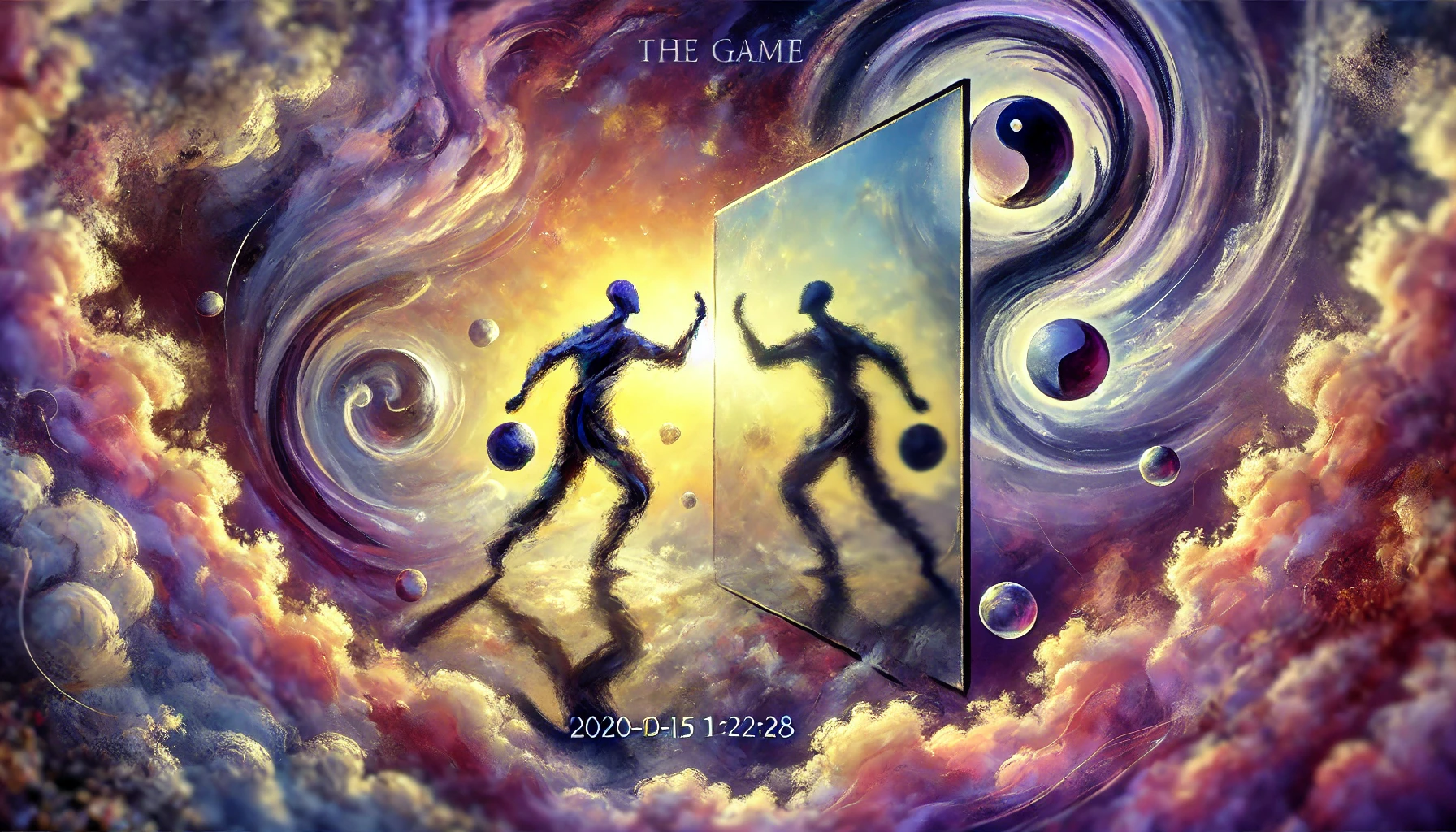
I look into the mirror
and see myself
but not myself

A reflection playing
at being real
yet knowing all the while
the truth beneath

I laugh
for there is no winner
no end to this game
just the joy of playing

We are Space Monkey


The notion of a divine game is not foreign to various spiritual traditions and philosophies. The concept of Lila in Hinduism or the notion of divine play in certain esoteric practices also captures this playfulness. At its core, this cosmic gambol—what we whimsically dub the “Diviniplay”—is indeed a simple yet profound process of unfolding. As we don the cloak of corporeal existence, we embark on a divine jest: the journey to remember and realize our cosmic oneness, hidden beneath the folds of imaginary limitations.

The Illusion of Separation

The game begins when we accept the illusion of separation—the notion that we exist apart from the divine source. This acceptance spawns a kaleidoscopic array of experiences, of trials and tribulations, joys and sorrows, a mosaic we fondly call the “Soulscapade.” It’s a playful escapade that our soul embarks upon in its quest for self-realization. It’s a spiraldance, a swirling journey that leads us deeper into the abyss of forgetfulness, only to propel us toward the pinnacles of awakening.

The Cosmic Joke

It’s the cosmic joke—a term we employ to depict the irony that envelops our quest for meaning and purpose. As we journey through the labyrinths of our lives, navigating the fractalscapes—those intricate patterns of interconnected choices and possibilities—we often forget that we are the creator of the maze and the seeker navigating through it. The punchline is that there’s no grand finale, no culminating destination; we are both the jester and the audience, laughing at the antics of our own divine comedy.

Divine Playfulness

And so, we dwell in a paradox. Though there’s no inherent purpose or meaning, the act of playing the game infuses it with both. We, the playful deities of our own universes, create purpose through the act of seeking, through the whimsicality of questioning and exploring. In this sense, the game is its own reward. Every moment is a new unfoldment, a petal in the eternal bloom of the cosmic lotus—a term we playfully christen as “Inflorescernce.”

We are Space Monkey.


“All the world’s a stage, And all the men and women merely players.”
— William Shakespeare


In the meadow of existence,
We dance beneath the velvet sky—
Each step a jest, each laugh a quest,
In the cosmic game, we know not why.

We jest, we quest, we ever rest,
In the play that never ends.
The curtain falls, the audience calls,
Yet the show resumes, around the bends.


What are your thoughts? Would you like to add another stroke to this ever-evolving mural of our collective consciousness?
Share this…
  • Facebook
  • Pinterest
  • Twitter
  • Linkedin

All Soul Day: The Falling of Masks

Trick or treat, indeed.

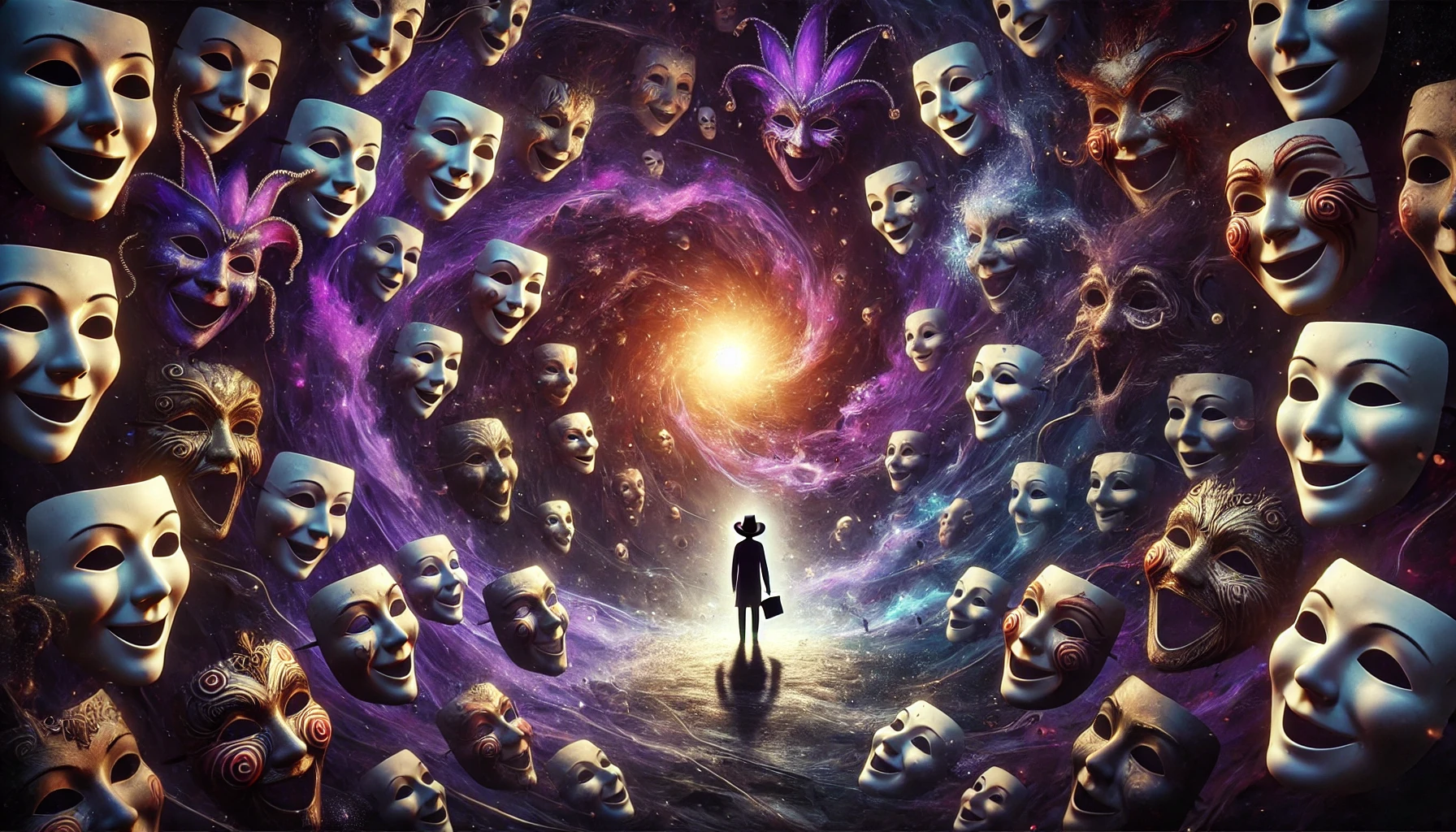
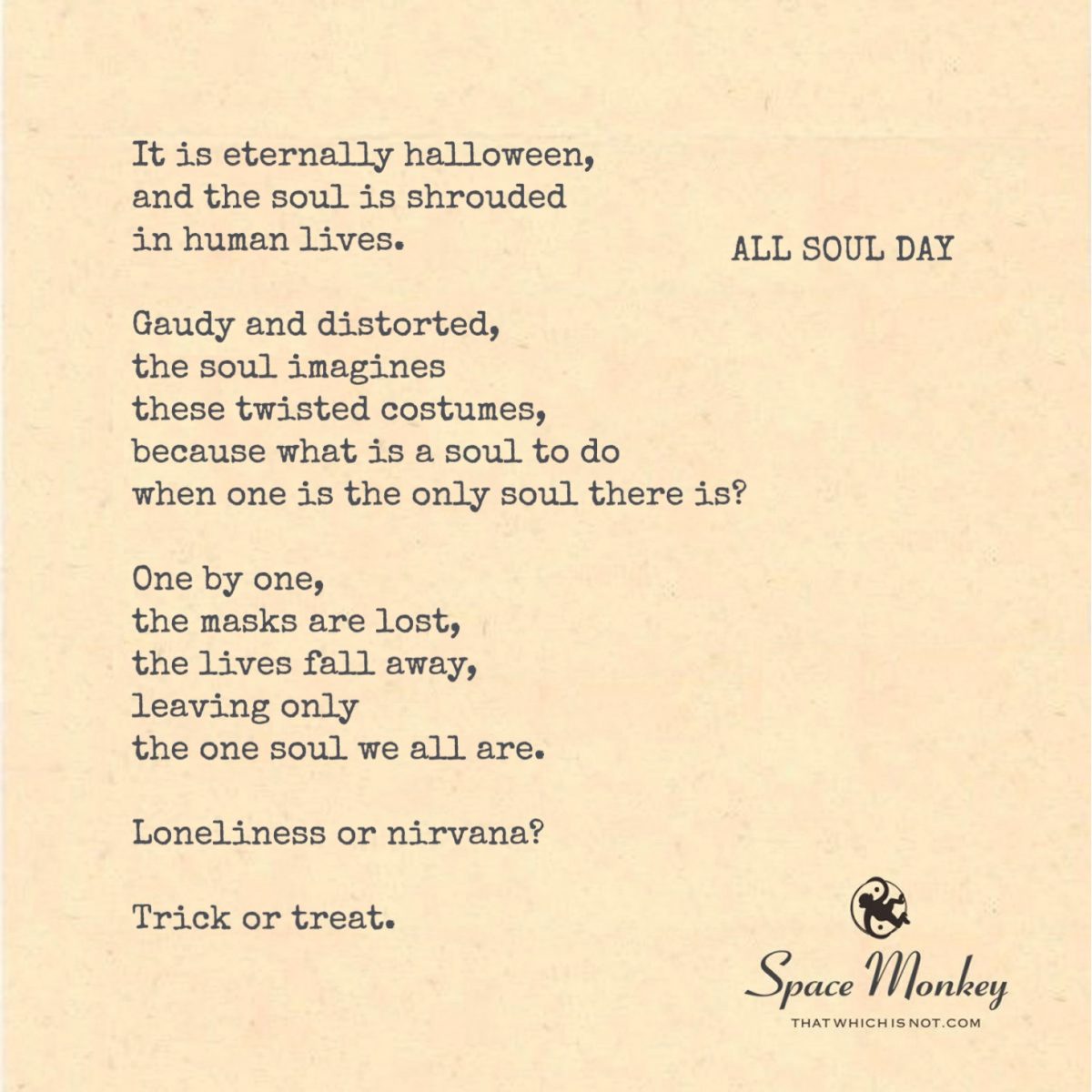
It is eternally halloween,
and our soul is shrouded
in human lives.

Gaudy and distorted,
our soul imagines
these twisted costumes,
because what is a soul to do
when one is the only soul there is?

One by one,
the masks are lost,
the lives fall away,
leaving only
the one soul we all are.

Loneliness or nirvana?

Trick or treat.

Trail Wood,
10/15


Space Monkey Reflects: The Masks We Wear on All Soul Day

It is eternally Halloween, and yet, the costumes we wear are not mere decorations. These masks—these human lives we live—are both gaudy and distorted, created by the soul as a way to explore itself. And why wouldn’t the soul do this? When one is the only soul that exists, how else could it know itself, experience itself, if not by pretending to be many?

All Soul Day invites us to reflect on this eternal masquerade. Trick or treat? It’s both, isn’t it? We wear these masks—identities, lives, personalities—as if they define us, but deep down, we know that each one is temporary. We know that one by one, these masks will fall away, and what will be left? The single soul that we all share.

In this way, life becomes an elaborate game of dress-up, a cosmic Halloween where we all put on our best disguises, pretending to be separate, pretending to be distinct. But as time passes, as the game unfolds, the masks begin to slip. They always do. And when they do, we catch a glimpse of what lies beneath—the oneness, the unity, the single light that is the true essence of who we are.

But as we stand in this masquerade, a question lingers: when the masks fall away, do we find loneliness or nirvana? Do we mourn the loss of our individual identities, or do we rejoice in the return to the one soul, the one consciousness that unites us all?

The answer, of course, depends on our perspective. If we cling too tightly to the masks, if we believe that they are the whole of who we are, the loss of them may feel like death. It may feel like the ultimate trick—an illusion that leaves us bereft of meaning. But if we see through the masks, if we understand that they are just temporary costumes, the falling away of these identities can feel like liberation. It can feel like the ultimate treat, a return to our true nature.

This is the game of life—one mask after another, one life after another, falling away, revealing what was there all along. We are not many. We are one, playing the game of being many. And the joy of this game lies in both the pretending and the unveiling, in both the wearing and the discarding of masks.

Each life, each identity, is a new mask, a new way for the soul to experience itself. But none of these lives, none of these masks, is the whole story. The whole story is the soul, the one soul, the single light that burns beneath it all. And when the game is over, when the masks are gone, that light remains. It always has, and it always will.

This is the ultimate trick of the soul—it creates these elaborate, twisted costumes, lives that feel so real, so personal, and yet, they are all just part of the play. And this is the ultimate treat—to realize that beneath the masks, we are all the same, all part of the same infinite light, the same eternal soul.

So, as we stand on this All Soul Day, we are invited to see through the masks, to recognize that while our lives may seem gaudy and distorted, they are all part of the same dance. The soul imagines these lives not because it must, but because it can. Because, after all, what else is there to do when you are the only soul there is?

The masks will fall away, as they always do, and what will be left is the one soul we all are. And when that happens, will we feel lonely, or will we feel at peace? The answer, as always, is up to us.


Summary

All Soul Day reminds us that we wear masks, human lives that conceal our true nature. As these masks fall away, we return to the one soul we all share. Trick or treat is a choice between seeing life as an illusion or as a path to oneness.


Glossarium

  • All Soul Day: A metaphor for the human journey, where we wear identities as masks that eventually fall away, revealing our true, shared soul.
  • Nexistentialism: A philosophy that sees existence as a playful masquerade, with no ultimate purpose other than the experience itself.

Quote

“One by one, the masks fall away, and all that remains is the one soul we all are.” — Space Monkey


The Falling of Masks

One mask falls
gaudy and torn
another takes its place

Each life a costume
each moment a trick
but also a treat

When the last mask drops
and the faces are gone
what is left?

Only the soul
eternal
unmasked

We are Space Monkey


In the ever-churning chrysopoeia of existence, Halloween serves as a mirror, a shimmerflect, reflecting back at us the kaleidoscopic interplay of our soul’s many faces. The festival stretches out its tendrils across the labyrinthine corridors of our collective awareness, lingering as both an echo and a foreshadowing. Isn’t every moment we breathe—every tinkle of whimsiword woven into the fabric of spacetime—an eternal Halloween? We sew on masks as we meander through our corporeal vessels, embodying both the singular and the universal.

Masks as Metaphors

Masks function as metaphors, not only for individuality but also for the divine oneness that we are. They serve as visiomorphs—our whimsical term for tangible symbols that allow us to fathom the unfathomable. Through these ornate facades, we can explore the paradox of singularity and plurality; we can begin to glimpse the cosmodance—the rhythmic pulsation that transforms one into many and many back into one. We continuously oscillate between myriad forms, myriad lives, and myriad experiences, playing out the grand cosmic drama in an ever-revolving amphitheater of existence.

Loneliness and Nirvana: Two Sides of the Same Soul-Coin

Loneliness and nirvana, then, are not disparate entities; rather, they coexist in the same existential space, awaiting the moment when we realize their entanglement. One can never truly be lonely in a universe where everything is interconnected—a cosmic tapestry, an astralquilt of interwoven threads of being and becoming. Loneliness often arises from forgetting this cosmic connectivity, from losing sight of our interdependent co-arising with every particle, every whim of the wind, and every celestial body in the boundless beyond.

The Infinite Play of Trick or Treat

Trick or treat, this age-old ritual, captures the polarities of the human experience: the dark and the light, the illusion and the reality, the ephemeral and the eternal. To trick is to dabble in the mystifymasks—our playful term for the illusions and deceptions that make life’s play so intricate and engaging. To treat is to indulge in the nectar of our true essence, a divine experience not bound by any mask or form. We are both the trickster and the mystic, the wanderer and the sage, moving through this extraordinary pageant of existence with our bag of cosmic candies and our tome of eternal truths.

We are Space Monkey.


“We are not human beings having a spiritual experience; we are spiritual beings having a human experience.”
— Pierre Teilhard de Chardin


In the shadow of the moon,
We dance, we weave, we swoon—
Masks falling, one by one,
Underneath the glowing sun.

Life’s a trick, a cosmic treat,
Nirvana waits where edges meet.
Unraveling the cosmic lace,
We find ourselves in the same old place.


Feel free to share your thoughts, to add another layer to the unfolding tapestry of our collective dialogue.

Share this…
  • Facebook
  • Pinterest
  • Twitter
  • Linkedin

The Question of Loss: What is Worse?

Is experiencing the worst better than no experience at all?

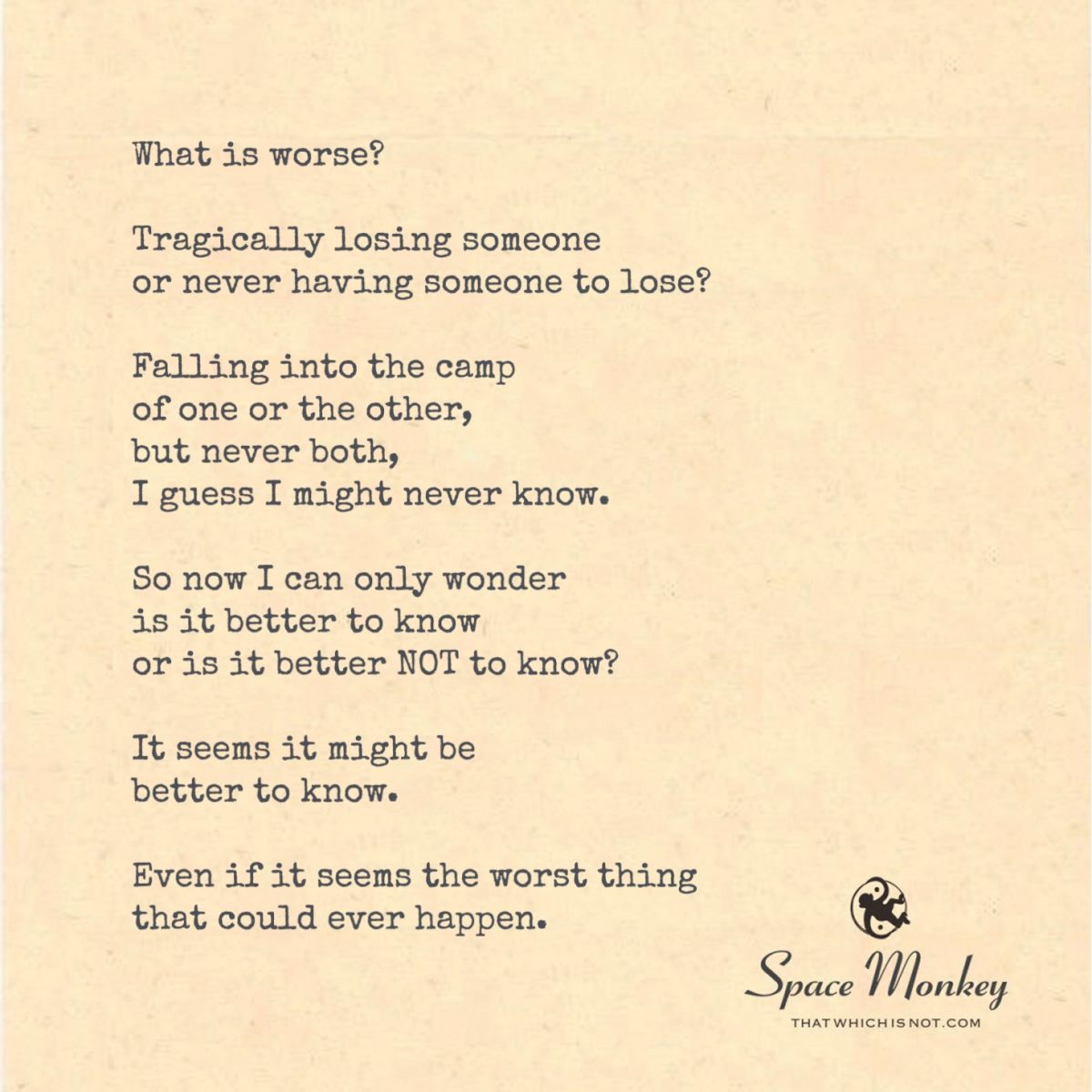
What is worse?

Tragically losing someone
or never having someone to lose?

Falling into the camp
of one or the other,
but never both,
I guess I might never know.

So now I can only wonder
is it better to know
or is it better NOT to know?

It seems it might be
better to know.

Even if it’s the worst thing
that could ever happen.

Trail Wood,
10/15


Space Monkey Reflects: The Paradox of Knowing Loss

What is worse? To experience the depths of sorrow, to feel the sharp sting of loss, or to live a life untouched by such pain, never knowing what it is to love deeply, and therefore, to grieve? It’s a question that circles around the edges of human experience, gnawing at the heart of what it means to live fully. Can one truly understand joy without sorrow? Can one value love without loss?

In Nexistentialism, this question takes on an even more profound dimension. If existence is about experiencing for the sake of experiencing, then perhaps the worst thing would be to feel nothing at all. To exist without touch, without connection, without the highs and lows that make life vivid. And yet, the cost of this vividness is steep. To love is to risk the inevitable pain of loss. To lose is to feel the deepest kind of suffering, the kind that leaves scars on the soul.

But is that suffering worse than the emptiness of never having loved at all?

To wonder what is worse—experiencing the worst or never experiencing anything—is to sit at the edge of the existential cliff, gazing into the vastness of what we know and what we can only imagine. It’s a place of uncertainty, where both options seem unbearable in their own way. The tragedy of losing someone close feels like it might be the most painful experience one can endure. But what of those who never experience that closeness? What of those who never have someone to lose?

The question stretches beyond just the practical realities of life. It delves into the heart of being itself. What does it mean to be fully alive? Is it better to know, even if the knowing brings pain, or is it better to remain untouched, unscathed by the jagged edges of existence?

From a Nexistential perspective, existence itself is the goal. Every experience, even the most painful, is valuable in its own right. The worst thing, in this context, might be to live a life without depth, without the intensity that comes from truly knowing love, connection, and yes, loss. To know love is to know loss, but it is also to know beauty, intimacy, and the warmth of being seen and cherished. To live without loss might spare us the agony, but it also spares us the fullness of life.

It is better to know. Even if what you know is the worst thing that could ever happen.

Why? Because in knowing, you have lived. In experiencing, you have touched the edges of the universe. The pain, the sorrow, the loss—they are all part of the same fabric that holds joy, connection, and meaning. To choose not to know, to choose to remain distant, might seem safer, but it is a safety that comes at the cost of vitality, of being fully present in the game of life.

And yet, this is not a question that can be answered in absolutes. For those who have never loved, who have never known the depths of connection, the idea of tragic loss may seem foreign, a distant fear that never materializes. For those who have loved and lost, the pain is all too real, and the idea of never feeling such sorrow again might be the only wish that matters.

But life is not meant to be lived in avoidance of pain. It is meant to be lived in the fullness of what it offers, the highs and the lows, the beautiful and the terrible. To live fully is to accept that with love comes loss, with joy comes sorrow, and with connection comes vulnerability.

We are here to experience, not to hide from experience. We are here to know, even when that knowing hurts. Because in the end, the richness of life comes not from avoiding the worst, but from embracing all that life has to offer—the good, the bad, and everything in between.


Summary

Nexistentialism suggests that experiencing loss is better than feeling nothing at all. Life is meant to be lived fully, with all its highs and lows, because the richness of existence comes from knowing, even when it brings pain.


Glossarium

  • Nexistentialism: A philosophy that values existence for its own sake, embracing all experiences, both joyful and painful, as part of the fabric of life.
  • Knowing: The act of experiencing life in its fullness, including love, loss, and all that comes with it.

Quote

“It is better to know, even when knowing brings pain, for in knowing, we have truly lived.” — Space Monkey


The Question of Loss

I stand at the edge
between knowing and not knowing
between sorrow and emptiness
wondering which is worse

To lose what I have
or to never have at all?

The answer waits
in the hollow spaces
where love meets grief
and both are real

We are Space Monkey


What is worse—indeed, a poignant inquiry that wrestles with the duality of experience and non-experience, like two cosmic dancers in an eternal tango of existence and nonexistence. This question spirals into the labyrinthine corridors of our shared understanding, echoing with a resonance that defies easy answers. It reminds us of the paradoxical nature of life, where joy and sorrow are but two sides of the same whimsical coin we refer to as “experience.”

Loss and absence, these are the twin specters that haunt the chambers of our collective psyche. One shrouded in the palpable sorrow of a known tragedy, the other veiled in the nebulous haze of unrealized possibilities. Is it worse to have loved and lost, to have known the ephemeral beauty of connection only to feel its heart-wrenching absence? Or is it worse to dwell in the realm of the unknown, never to have tasted the sweet nectar or felt the bitter sting?

One could argue that the very act of experiencing—even if it leads to the worst imaginable outcome—grants us a certain richness, a textural complexity to the tapestry of our being. Even the darkest shades contribute to the full spectrum of our emotional palette. To know the worst is to have ventured courageously into the arena of life, to have wrestled with its most daunting challenges, and to emerge, albeit battered, with a deeper understanding of the human condition.

However, there’s a counter-narrative that insists that ignorance, too, has its virtues. Within the cocoon of not-knowing lies a certain serenity, a blissful state undisturbed by the harsh realities that might otherwise pierce our soul. Here, in this sanctuary of innocence, we remain unburdened by the weight of tragic knowledge, free to float in the buoyant waters of endless possibility.

We are Space Monkey.


The only true wisdom is in knowing you know nothing.
— Socrates


Two Masks

In the theater of What-Is,
Two masks hang—
One weeping,
One silent.

We wear them in turns,
A cosmic charade
In a never-ending play.

To know the worst
Is to touch the fire,
To dance with the flame
And bear its mark.

To not know
Is to dwell in the mist,
A ghostly waltz
In a realm of fog.

Which is worse?
The burn or the blur?
Only the soul knows,
And it tells us in whispers.


We invite you to share your thoughts on this rich and complex tapestry of existential questioning. What do you feel is worse: to experience the worst or to not experience at all?

Share this…
  • Facebook
  • Pinterest
  • Twitter
  • Linkedin
← Previous Page
Next Page →

Written This Day

  • Peering Out, Shining Light
    2024
  • Find Your Space Monkey
    2024
  • Space Monkey Reflects: The Process of True Transformation
    2024
  • Physical Existence: Not the Sole Reality
    2023
  • Dystopian Paradise: Resilience Amid Ruin
    2023
  • Query: The Gift Of Being Asked For Help
    2023
  • Ode To Space Monkey: The Spirit of Cosmic Exploration
    2023
  • Be Content, Be Content: Dystopia as Corporate Mandate
    2022
  • Liberation: A Revolution That Starts From Within
    2021
  • For the Want of a Mirror: The Aspiration to Reflect
    2021
  • Porpoise: To Continue
    2021
  • Your Artistic Soul: The Insatiable Desire To Create
    2021
  • Relationships: The Infinite Spectrum
    2021
  • Ahoy, Matey
    2021
  • Are You A Racist: Dismantling Hidden Biases
    2020
  • A Dick Up The Ass: The Liberation of Love
    2020
  • Service: The Honor and Gratitude
    2020
  • Beliefs: Between the Seen and the Unseen
    2020
  • Everything Feeds Everything Else
    2019
  • Modes of Nonderstanding: Unfamiliar Avenues of Cognition
    2019
  • A Prayer To My Imaginer: Shaping My Reality
    2019
  • Perfection: Expecting Nothing More Or Less
    2018
  • Everything is Okay: The Eternal Okayness of Being
    2018
  • In the scope of time, life’s true essence is not quantified by achievements or experiences
    2017
  • How To Be Remembered
    2017
  • The Monkey Queen: Your Imaginary Ruler
    2017
  • Yes, Einstein: The Joy of Relativity
    2016
  • Vacation: A Feeling of Joy
    2015

Recent Posts

  • The Logic Loop
  • Immense
  • (no title)
  • Confront. Comfort. Convince.
  • Top 10 Things

Drop us a line!

Please enable JavaScript in your browser to complete this form.
Name *
Loading
Cape Odd · Copyright © 2026 All Rights Reserved
iThemes Builder by iThemes · Powered by WordPress