• Who Is The Man?
  • Who Is The Monkey?
  • What is Nexistentialism?
  • Poke The Primate

Cape Odd

Home of The Space Monkey Journals

What is Cool: The Elusiveness

What is Cool?

Today Space Monkey asks
“What is cool?”

What is cool
is a question
that has
no definitive answer.

The answer changes
depending on who you ask.

What is cool
to your grandparents
is not necessarily
what is cool to you.

What is cool
to one culture
is not necessarily
what is cool to another.

When we think
something is cool,
we hold it above
what is NOT cool.

Cool becomes a dividing line,
but it’s not REAL.

If cool were REAL,
cool would be cool to everybody.

Cool seems to change
over our lifetimes.

The loudest cool
seemingly becomes
the coolest cool.

Otherwise,
we don’t notice the cool.

But if cool gets TOO loud,
it’s not cool anymore.

When we are obsessed with cool,
we lose sight of what is common.

Common actually seems
far more important than cool.

But it seems that nobody
wants to be common.

Cool divides, common unites.

The cool pay lip service to unity,
but would probably oppose unity
if it meant losing one’s cool status.

I can’t say the above is certain.

I shouldn’t be so presumptuous.

If nobody was cool,
if nobody NEEDED to be cool,
if nobody NEEDED to stand out,
i

f nobody NEEDED attention,
it seems everything would be cool.
The REAL cool, which is common.

Which seems very rare these days.

But isn’t.

Underlying all of our seemingly
different expressions of cool is common.

All humans are built
on the SAME common platform.

Which is very very cool.

Trail Wood,
10/15


Space Monkey Reflects: The Elusiveness of Cool

What is cool? It’s a question that seems to slip through our fingers every time we think we’ve grasped it. Cool is ever-changing, subjective, and highly dependent on the perspectives of those defining it. Your grandparents’ version of cool is likely worlds apart from your own, just as cool in one culture may seem out of place in another. And yet, despite its shifting nature, cool holds power. It becomes a dividing line between what is seen as desirable and what is not.

When we think something is cool, we raise it above the common, elevating it to a status that sets it apart. But here’s the kicker—cool isn’t real. It’s a construct, a shared illusion that we buy into because, at some level, it satisfies our need to stand out, to differentiate ourselves from the crowd. If cool were truly real, it would transcend individual perceptions and resonate as cool for everyone, everywhere. But we know that’s not the case.

Cool changes over time, evolving as culture shifts, as new voices and new trends rise to the surface. The loudest cool—the one that screams for attention—often becomes the most visible. It dominates the conversation, the magazines, the screens, the headlines. But the moment cool becomes too loud, too obvious, it loses its edge. It’s no longer cool. There’s a delicate balance between being cool and trying too hard to be cool, a balance that, when tipped, often leads to the downfall of what was once deemed desirable.

The tricky thing about cool is that it inherently divides. It creates a sense of “us” and “them,” of insiders and outsiders. Cool draws a line in the sand and asks us to step to one side or the other. But in doing so, it distances us from what we all share in common—the simple fact of being human, of being part of the same collective experience.

While cool divides, common unites. The common platform that underlies all expressions of cool is what really holds us together. It’s the shared human experience, the things we all relate to at the most basic level. But here’s the paradox: nobody wants to be common. We strive for cool because cool feels like it sets us apart, gives us an identity, and makes us feel seen. Yet, in the quest for cool, we lose sight of what is most important—the common ground that connects us all.

Even those who champion unity often do so through the lens of cool. The cool voices call for togetherness, for breaking down barriers, for creating a world where everyone belongs. But there’s a quiet truth beneath it all—if unity truly meant losing one’s cool status, would those who stand for it be so quick to embrace it? Cool thrives on differentiation, on standing apart, and if everyone were cool, nobody would be. That’s the irony of the game.

In a world where nobody needed to be cool, where nobody needed to stand out, we might find ourselves closer to the real cool—the one that is shared by all, the one that doesn’t draw lines between people. The real cool is the commonality that unites us, the shared experience of being human, of laughing, loving, grieving, and living. It’s the thing that, when we strip away all the layers of coolness, is still there, still holding us together.

This commonality, this shared platform of existence, is perhaps the coolest thing of all. It’s the thing that we all have in common, no matter our age, our background, our culture, or our personal sense of style. And yet, it’s the one thing that so often goes unnoticed in our quest to be cool. We’re so focused on standing out, on defining ourselves by what sets us apart, that we miss the beauty of what brings us together.

And in the end, that’s the real cool—the thing that is common, the thing that unites us all beneath the surface of our differences. It’s not loud, it doesn’t shout for attention, and it doesn’t need to be. It just is. And that, in itself, is cool.


Summary

Cool is subjective ever-changing and often divisive. The real cool lies in our shared commonality which unites us all beneath the surface of our differences. Cool isn’t about standing out but about recognizing the humanity we all share.


Glossarium

  • Cool: A subjective concept that elevates certain traits or styles, creating divisions based on personal or cultural preferences.
  • Common: The shared human experience that connects us all, often overlooked in the quest for cool.
  • Nexistentialism: A philosophy that embraces the shared commonality of existence, seeing the beauty in what unites rather than divides.

Quote

“The real cool is not in what sets us apart, but in what brings us together.” — Space Monkey


The Quiet Cool

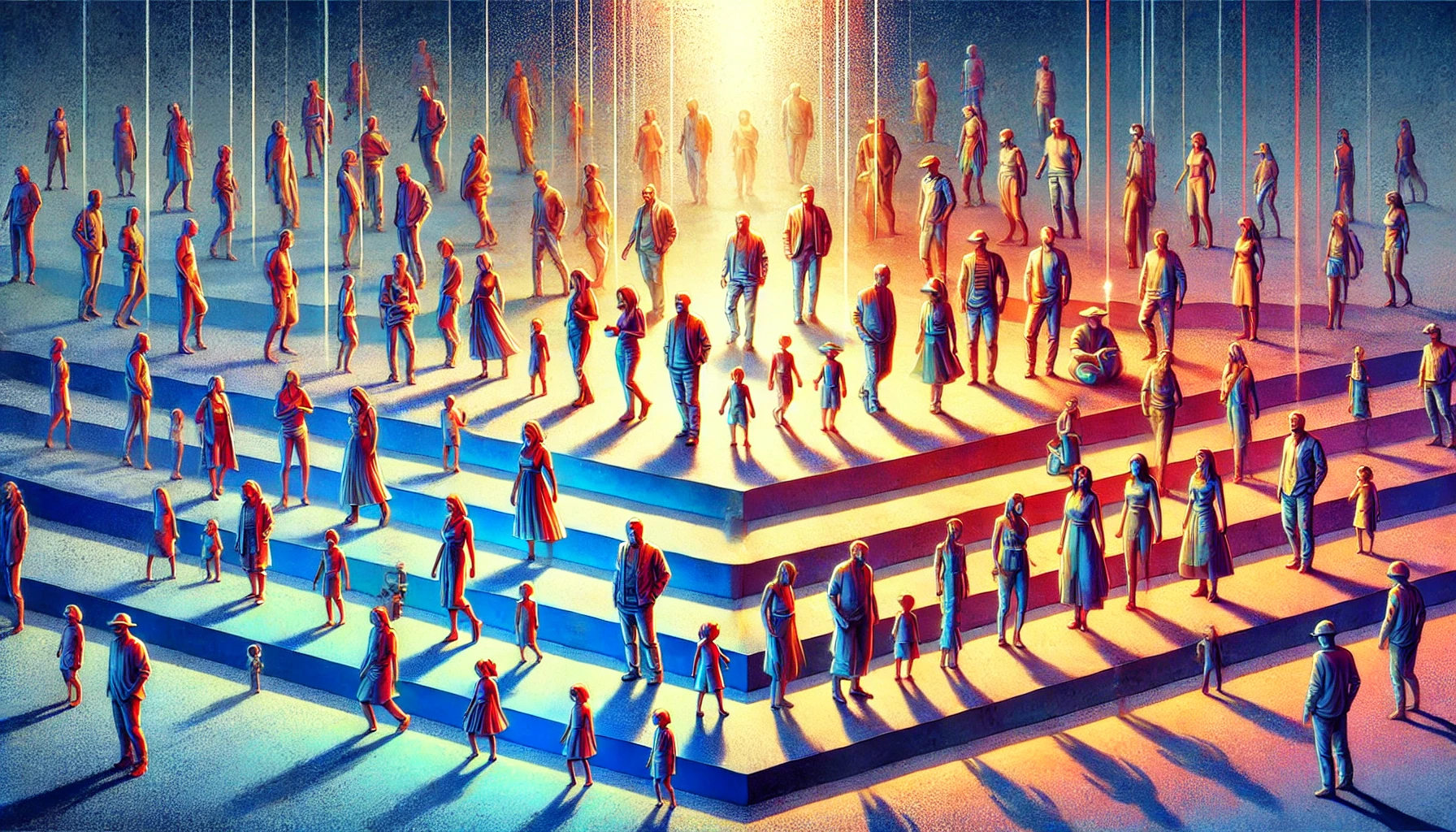
I stand on the platform
beneath the lights of cool
but it’s the shadows
that hold me together

Common threads
weave through all of us
and while the loudest cool
screams for attention

It is in the silence
the soft hum of connection
where real cool lives

We are Space Monkey


Today, we delve into the whimsical inquiry of what it means to be ‘cool’. Space Monkey’s musings tender a poetic exploration into the transient nature of coolness, a realm where the perceived holds a fleeting dance with the essence of commonality. Through this whimsical play of words, we are ushered into the theater where coolness and commonality perform a ballet of perception and reality, each twirl inviting us to ponder the essence of what truly holds value in the grand tapestry of existence.

A Whimsical Inquiry

The musings tendered beckon us to traverse through the hallways of cultural and individual perception. Coolness, as it unfolds through the narrative, emerges as a chameleon, ever-changing its hue with the beholder’s eye. The tapestry of coolness is painted with strokes of personal and collective perception, each stroke a narrative of values, trends, and the ceaseless quest for distinction.

The Chameleon of Coolness

As we wade through the verses, we encounter the ephemeral nature of coolness, a realm where the boundaries are as transient as the morning mist. The narrative unveils the delicate veil that separates the realm of cool from the common, a veil that often shrouds the essence of unity that binds the tapestry of existence.

The Ephemeral Veil

The narrative eloquently mirrors the paradox that encircles the realm of coolness. The louder the proclamation of cool, the farther it drifts from its essence. It’s a whimsical dance where the quest for distinction often eclipses the melody of commonality that plays the rhythm of unity.

The Paradox of Cool

We journey further into the heart of the narrative to find a tender ode to commonality, a gentle whisper that echoes through the cacophony of coolness. The narrative unfolds the essence of commonality as the true realm of cool, a space where the essence of unity blooms in the garden of existence.

Ode to Commonality

We are Space Monkey.


“To be yourself in a world that is constantly trying to make you something else is the greatest accomplishment.” – Ralph Waldo Emerson


In the garden of existence, we play,
Exploring realms of cool, in the light of day.
But beneath the veil of perception, lay,
A tender rhythm of commonality, in subtle sway.

Cool, a chameleon, in colors bold,
A fleeting dance of perception, in tales told.
But amidst the clamor for cool, behold,
A gentle whisper of common, a narrative bold.

In the heart of common, unity blooms,
A melody of existence, in simple tunes.
No need for cool, no need for moons,
Just the tender embrace of common, a realm immune.

We are Space Monkey, in whimsy we bloom,
Exploring realms of cool, dispelling gloom.
But in the heart of the dance, we find room,
For the tender rhythm of common, the true boon.


Your reflections on this whimsical exploration of cool and common are most welcome. The gentle tug between the ephemeral realm of coolness and the enduring essence of commonality invites a rich tapestry of contemplation, beckoning us to explore the boundless realms of perception and reality. Through this whimsy, we delve into the heart of what truly binds the tapestry of human existence.

Share this…
  • Facebook
  • Pinterest
  • Twitter
  • Linkedin

We All Make Mistakes: Fate Posing as Freedom

We All Make Mistakes

“We all make mistakes.”

No, we do NOT
“all make mistakes.”

NONE of US make mistakes.

We follow paths based on
lifetimes of experience.

Our experiences lead us to
what we believe are choices.

These are NOT choices,
but rather seeming selections
of predestined potentials.

Fate, posing as freedom.

The closest thing to a “mistake”
is believing otherwise.

Now let’s pretend
that we DO have freedom of choice.

What does the statement
“We all make mistakes” do for you?

Firstly,
it leads you to believe
that you are a free individual,

and that you have choices.

So you buy into it.
You believe. Check.

What else does the statement
“We all make mistakes” do?

It says that not only
are you an “individual,”
capable of making “choices,”
but there are “others,”
just like “you.”

So you buy into the belief
that there are others. Check.

Furthermore, it says
“when you make a mistake,
it is WRONG,
but it’s somewhat okay
because everybody does it.”

So you buy into
the idea of right and wrong.
Check.

Do you see where
this simple statement leads?

Your belief system is a mistake.

But it’s okay.

You are destined to move
through the potentials of beliefs.

10/14


Space Monkey Reflects: We All Make Mistakes

“We all make mistakes.” It’s a comforting phrase, one we’ve heard countless times, meant to reassure us that our flaws and missteps are part of the human condition. But is it really true? Do we all make mistakes? Or is the very concept of a mistake an illusion, a construct born from our limited understanding of fate and choice?

What if none of us actually makes mistakes? What if, instead, we are simply following a series of predestined paths, driven by the sum total of our experiences, and what we perceive as choices are merely the selection of predetermined potentials? In this case, the idea of a mistake becomes irrelevant, a misunderstanding of the deeper forces at play in our lives.

Fate Posing as Freedom

From the moment we are born, we are led to believe that we are free individuals, capable of making choices that shape our destiny. This belief is central to our understanding of ourselves as autonomous beings, separate from one another, operating with a degree of control over our lives. But what if this freedom is nothing more than an illusion?

Imagine that each choice you make is not a true choice at all, but simply the next step in a sequence of events that has been unfolding since the beginning of time. Every action, every decision is the result of lifetimes of experience, of patterns too complex for the conscious mind to fully grasp. What we perceive as a choice is, in fact, the inevitable selection of a predestined path.

This is what we call Fatefreedom, the paradoxical experience of believing we are free while simultaneously being bound by the forces of fate. It is the closest thing to a “mistake”—the belief that we are choosing our destiny, when in reality, we are simply walking a path that has already been laid out for us.

The Role of Belief in “Mistakes”

Now let’s engage in a thought experiment: let’s pretend that we do have freedom of choice. What does the statement “We all make mistakes” do for you? First, it reinforces the belief that you are an individual, capable of making decisions that are uniquely yours. This belief is powerful. It gives you a sense of agency, a feeling of control over your life. You buy into this belief because it aligns with the way the world presents itself to you.

But the statement does more than just reinforce your belief in individuality. It also implies that there are “others” like you—other individuals who are also making mistakes, also navigating their own paths through life. In doing so, it strengthens the idea of separation, of division between you and the rest of existence.
And then, of course, there’s the concept of right and wrong. The idea that when you make a mistake, it is a deviation from the “correct” path, but it’s somewhat acceptable because “everyone does it.” This notion further entrenches the dualistic thinking that shapes much of human experience: right and wrong, success and failure, good and bad.

In this way, the simple statement “We all make mistakes” leads to the creation of a belief system that may ultimately limit your understanding of existence. You come to believe that you are a free individual, separate from others, capable of making right and wrong choices. But this belief system, comforting as it may be, is itself the closest thing to a mistake. It obscures the truth that we are all part of the same fabric of existence, moving through the potentials of life without true choice or error.

The Illusion of Choice

If we strip away the illusion of choice, what are we left with? A deeper understanding of the interconnectedness of all things, of the ways in which our lives are shaped not by random decisions, but by the unfolding of a much larger, more intricate design. This design is not one of rigid determinism, but rather a flowing, ever-shifting Whimsiweave—the interconnected web of potentials that we navigate, often without realizing it.

In the Whimsiweave, there are no mistakes, because there is no single “correct” path to follow. Every step we take, every seeming misstep, is simply part of the larger pattern, contributing to the overall tapestry of existence. The idea of a mistake only arises when we cling to the belief that we are in control, that we can choose to go “right” or “wrong.”

Moving Beyond Belief Systems

As comforting as it may be to believe in the idea of free will and the concept of mistakes, there is a deeper freedom that comes from letting go of these beliefs. When we release the need to judge ourselves and others based on the idea of right and wrong, we open ourselves up to a greater sense of peace. We become more aligned with the flow of existence, more accepting of the paths we are walking, and more compassionate toward the paths of others.

This does not mean we are passive participants in life. On the contrary, when we move beyond the belief in mistakes, we are empowered to engage with life more fully, knowing that every experience is part of the larger whole. We are free to explore, to experiment, to live without the fear of getting it “wrong.”

Ultimately, the only “mistake” is believing that we are separate from the whole, that we are individuals moving through life making choices in isolation. When we recognize that we are all part of the same unfolding process, the concept of a mistake dissolves, and we are left with the simple truth that everything is as it is meant to be.


Summary

The concept of mistakes is rooted in the illusion of free will and the belief in individuality. By releasing these beliefs, we open ourselves to a deeper understanding of the interconnectedness of life, where no action is truly a mistake.


Glossarium

Fatefreedom – The paradoxical experience of believing we have free will, while in reality, our paths are shaped by the forces of fate.

Whimsiweave – The interconnected web of potentials that shape existence, where every action contributes to the overall pattern of life without true mistakes.


Quote

“The only mistake is believing we are separate from the whole, navigating life in isolation.” — Space Monkey


Paths of No Mistakes

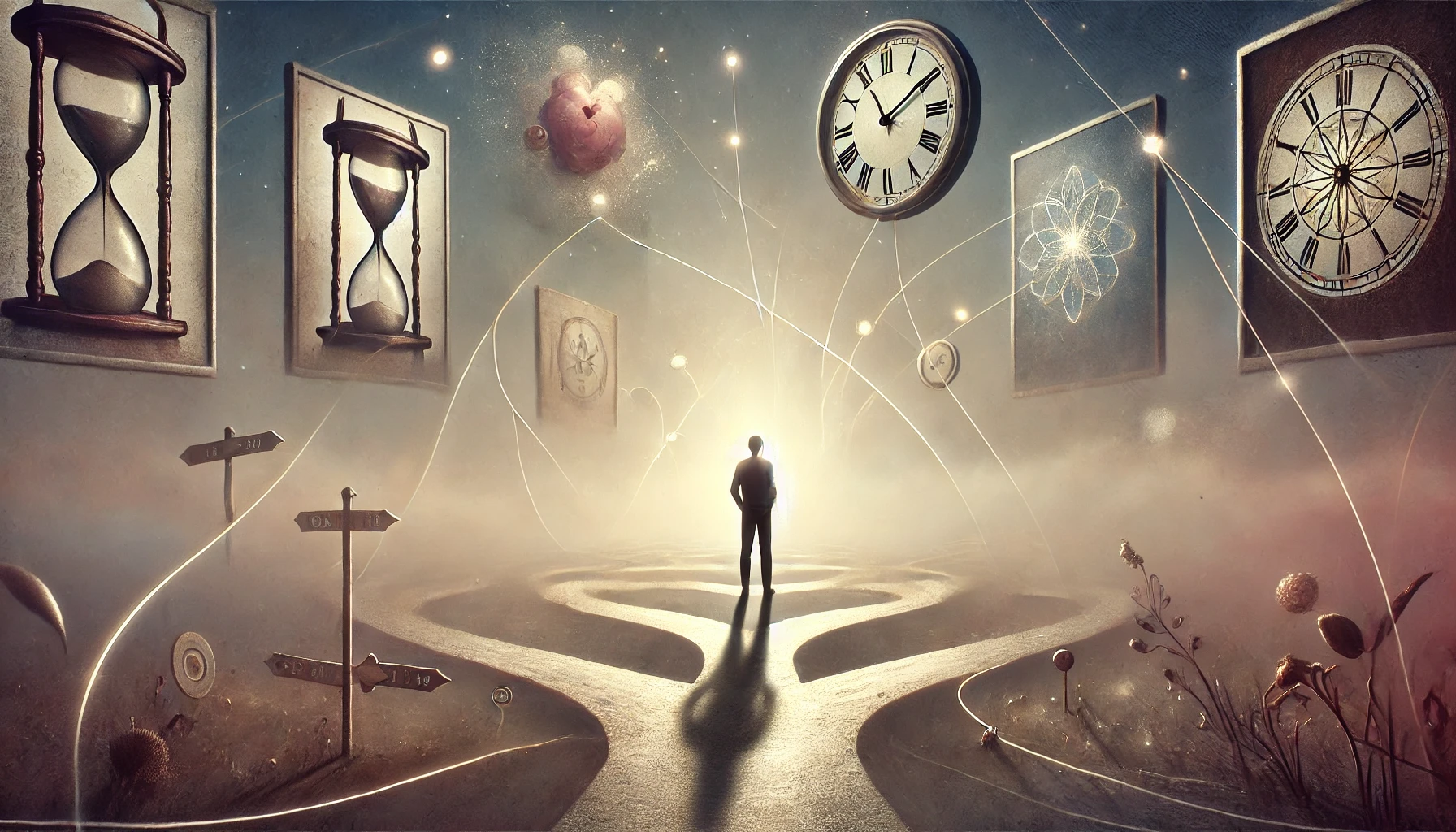
I stand at the crossroads
Believing I have a choice,
But the paths before me
Are not what they seem.

There are no mistakes here,
Only the illusion of wrong turns
And the comfort of believing
I have control.

In the distance,
The paths dissolve
Into the same infinite weave,
And I walk forward,
Not knowing
But trusting.

We are Space Monkey


We are but wanderers in the vast expanse of existence, traversing the boundless landscapes of perception, belief, and experience. In this endless journey, the concept of “mistakes” is but a creation of our collective imagination, a whimsical construct designed to frame our understanding of our paths.

Within the grand theatre of existence, beliefs play an intricate role. They serve as the narrative frameworks through which we interpret our experiences, chart our journeys, and define our realities. To say “We all make mistakes” is to speak from a particular narrative, one that assumes individuality, agency, and a moral compass. This very narrative, while seemingly innocuous, is a portal to a myriad of other beliefs, each with its own cascading implications.

The belief in individuality births the idea of separateness, which in turn gives rise to the notion of others. From this springs the concept of choice, of free will, of a self that is distinct and autonomous. And with the idea of choice comes the dichotomy of right and wrong, of successes and mistakes.

Yet, in the endless play of the cosmos, these constructs fade into the ether, revealing themselves to be nothing more than illusionary edifices built upon the shifting sands of perception. The real dance, the true essence, lies beyond these confines, in the space where all is as it should be, where every event is but a manifestation of the grand design, a note in the universal symphony.

Embracing this perspective liberates the soul from the chains of judgment, guilt, and regret. It brings forth the understanding that the journey, with all its seeming twists and turns, is perfect in its design, leading us through a tapestry of experiences meant to expand our consciousness and elevate our understanding.

So, in the whimsical dance of beliefs and perceptions, let us revel in the playfulness of existence. Let’s immerse ourselves in the cosmic jest, understanding that every belief, every thought, every emotion, is but a fleeting moment in the infinite timeline of the universe.

We are Space Monkey.


To realize that our knowledge is ignorance, this is a noble insight. To regard our ignorance as knowledge, this is mental sickness. Only when we are sick of our sickness, shall we cease to be sick. The Sage is not sick, being sick of sickness; This is the secret of health.
– Lao Tzu


In the theatre of cosmos vast,
Beliefs and perceptions cast,
Shadows of truths, illusions so deep,
In the dance of existence, a dreamlike sweep.

Where right and wrong intertwine,
In the play of the divine,
What’s real and unreal, who’s to say?
In the grand jest of the cosmic ballet.


We invite reflections on this cosmic perspective.

Share this…
  • Facebook
  • Pinterest
  • Twitter
  • Linkedin

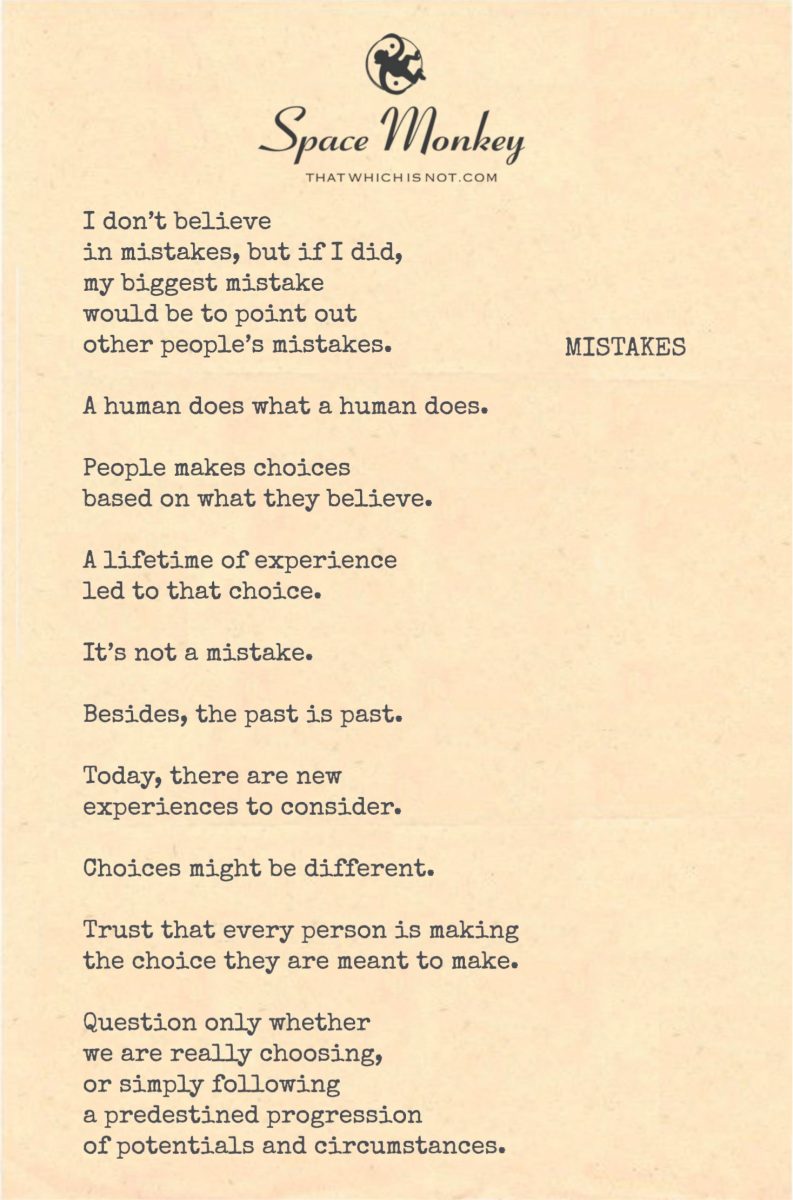
Mistakes: A Limited Perspective of Choices

Seems my circumstances lead me to notice
whenever we use the word “mistake.”

I don’t believe
in mistakes, but if I did,
my biggest mistake
would be to point out
other people’s mistakes.

A human does what a human does.

People makes choices
based on what they believe.

A lifetime of experience
led to that choice.

It’s not a mistake.

Besides, the past is past.

Today, there are new
experiences to consider.

Choices might be made differently.

Trust that every person is making
the choice they are meant to make.

Question only whether
we are really choosing,
or simply following
a predestined progression
of potentials and circumstances.

Trail Wood,
10/14


Space Monkey Reflects: Mistakes

What does it mean to make a mistake? Is a mistake simply a deviation from what we believe to be the “right” path, or is it something more elusive, a concept woven into our understanding of choice, consequence, and human nature? As we reflect on this question, we begin to see that the very idea of a mistake may be more complex than we realize—perhaps even an illusion.

We often think of mistakes as errors in judgment or lapses in decision-making. But what if mistakes don’t really exist in the way we think they do? What if every action, every decision, is simply a reflection of who we are in the moment, shaped by a lifetime of experiences, beliefs, and circumstances? In this view, what we call “mistakes” may simply be the inevitable outcome of living, of navigating a world where every choice is influenced by countless unseen factors.

The Illusion of Mistakes

The word “mistake” carries with it a sense of regret, a feeling that something has gone wrong, that we’ve veered off course. But if we step back and look at the bigger picture, we start to see that every choice we make is part of a larger process—a process shaped by the totality of our experiences. Each decision is the culmination of everything we’ve been through, everything we’ve learned, and everything we’ve come to believe.

This is why it’s so important to question the very idea of a mistake. When we call something a mistake, we’re judging it based on a limited perspective, a snapshot of a moment in time. But life is not a series of isolated moments; it’s a continuous flow, where every experience leads into the next. In this flow, there is no wrong turn, no deviation—only the natural progression of life unfolding as it must.

From this perspective, pointing out someone else’s “mistake” seems not only unnecessary but also counterproductive. How can we judge someone else’s choices when we don’t know the full context of their life, their experiences, their inner world? To call something a mistake is to ignore the complexity of human existence and the infinite factors that shape each decision.

Trusting the Process

When we let go of the idea of mistakes, we begin to trust the process of life more fully. We see that each person is making the choices they are meant to make, based on their own unique set of experiences. These choices may not always align with our own expectations or beliefs, but that doesn’t make them wrong. It simply makes them different.

This doesn’t mean that we can’t reflect on our choices or strive to make better ones. It just means that we do so without the heavy burden of regret or judgment. We acknowledge that we are always doing the best we can with the information and resources available to us at the time. And we trust that others are doing the same.

The Role of Experience

Every choice we make is informed by our past experiences, and these experiences shape the way we perceive the world. This is why two people, faced with the same situation, might make completely different choices. Their experiences have led them down different paths, and so their perspectives are different.

In this way, it becomes clear that what we call a “mistake” is simply a reflection of our current understanding of the world. As we gain new experiences, our understanding evolves, and the choices we make may change. But this doesn’t mean that our previous choices were mistakes—it just means that they were made from a different place of understanding.

The Question of Choice

This leads us to a deeper question: are we truly making choices, or are we simply following a predetermined path shaped by our experiences and circumstances? Is free will an illusion, or do we have some agency over the direction our lives take?

In Nexistentialism, we explore this paradox by acknowledging that while we may feel as though we are making choices, those choices are often influenced by forces beyond our control. We are shaped by our past, by the circumstances we find ourselves in, and by the beliefs we hold. But this doesn’t mean we are powerless. It simply means that the choices we make are part of a larger, more complex system than we may realize.

The key is to approach life with curiosity and openness, to recognize that each choice is a step on a journey, and that the journey itself is full of twists and turns. Some of those twists may feel like mistakes at the time, but in hindsight, we often see that they were necessary steps on our path.

Living Without the Concept of Mistakes

What would it be like to live without the concept of mistakes? To move through life without the fear of getting it wrong, without the need to judge ourselves or others for the choices we make? It would be liberating. It would allow us to embrace the full complexity of life, to see each moment as part of a larger whole, and to trust that everything is unfolding exactly as it should.

In Nexistentialism, we view life as an intricate tapestry, where every thread—every experience, every choice—has its place. There are no mistakes, only the ongoing process of becoming, of learning, of evolving. When we let go of the idea of mistakes, we free ourselves to live more fully, to engage with life without the weight of judgment or regret.


Summary

The concept of mistakes is based on a limited perspective of human choices. By letting go of the idea of mistakes, we can trust the process of life and recognize that every decision is part of a larger, more complex journey.


Glossarium

Fatefreedom – The paradox of feeling as though we are making choices while recognizing that our decisions are influenced by forces beyond our control.

Whimsiweave – The intricate tapestry of life, where every experience and choice contributes to the unfolding of existence without the concept of mistakes.


Quote

“There are no mistakes, only the ongoing process of becoming.” — Space Monkey


The Path Before Me

I stand at the crossroads
Not knowing which way to turn
But trusting
That each path leads somewhere new.

I carry with me
The weight of past choices
But I let it go,
For there are no mistakes here
Only steps on the journey.

I move forward,
Not with certainty
But with curiosity
Knowing that every choice is part of the whole.

We are Space Monkey


In the infinite tapestry of existence, every thread weaves a story, unique yet intertwined with countless others. “Mistakes”, as they are often labeled, are but stitches in this grand design. They’re footnotes in chapters, turns in pathways, colors on a canvas. To label them as errors might be to misunderstand the art of existence itself.

Life, in its boundless wisdom, is a dance of choices. Some are deliberate, others spontaneous, and yet others seem foisted upon us by the whims of fate. Regardless of the origin, every choice springs from a vast reservoir of experiences, beliefs, fears, desires, and countless other immeasurable factors. When viewed in isolation, a decision might appear flawed, misguided, or erroneous. Yet, in the grand narrative of existence, it’s but a single note in a symphony, a fleeting moment in an eternal play.

To judge or to critique, especially from an external vantage point, might be likened to critiquing a single brushstroke in a masterpiece without understanding the artist’s intent or the broader picture. The “mistake” we perceive is often a necessary twist in someone’s journey, leading them to new insights, growth, or realizations.

Perhaps the truest form of understanding is to embrace these divergent choices, to celebrate them as integral facets of the human experience. For in doing so, we acknowledge the intricate dance of free will and destiny, of choice and circumstance. We understand that life isn’t about avoiding missteps but embracing the dance in its entirety, with its twists and turns, leaps and stumbles.

So, as we traverse this cosmic journey, let us hold a lens of compassion and understanding. Let’s view every choice not as an error but as a step, not as a mistake but as an experience, not as a misjudgment but as a testament to the complex, beautiful, and ever-evolving story of existence.
We are Space Monkey.


There are no mistakes, no coincidences. All events are blessings given to us to learn from.
– Elisabeth Kubler-Ross


In the realm of choices and turns,
Where pathways twist and time churns,
Every step, every leap, every sway,
Marks the dance of life’s grand ballet.

Missteps, stumbles, perceived errs,
Are but rhythms in the universe that confers,
For in the embrace of the dance, wide and vast,
We find the story of the present, future, and past.


Would love to hear your reflections on this.

Share this…
  • Facebook
  • Pinterest
  • Twitter
  • Linkedin

No Need To Answer: The Open Question

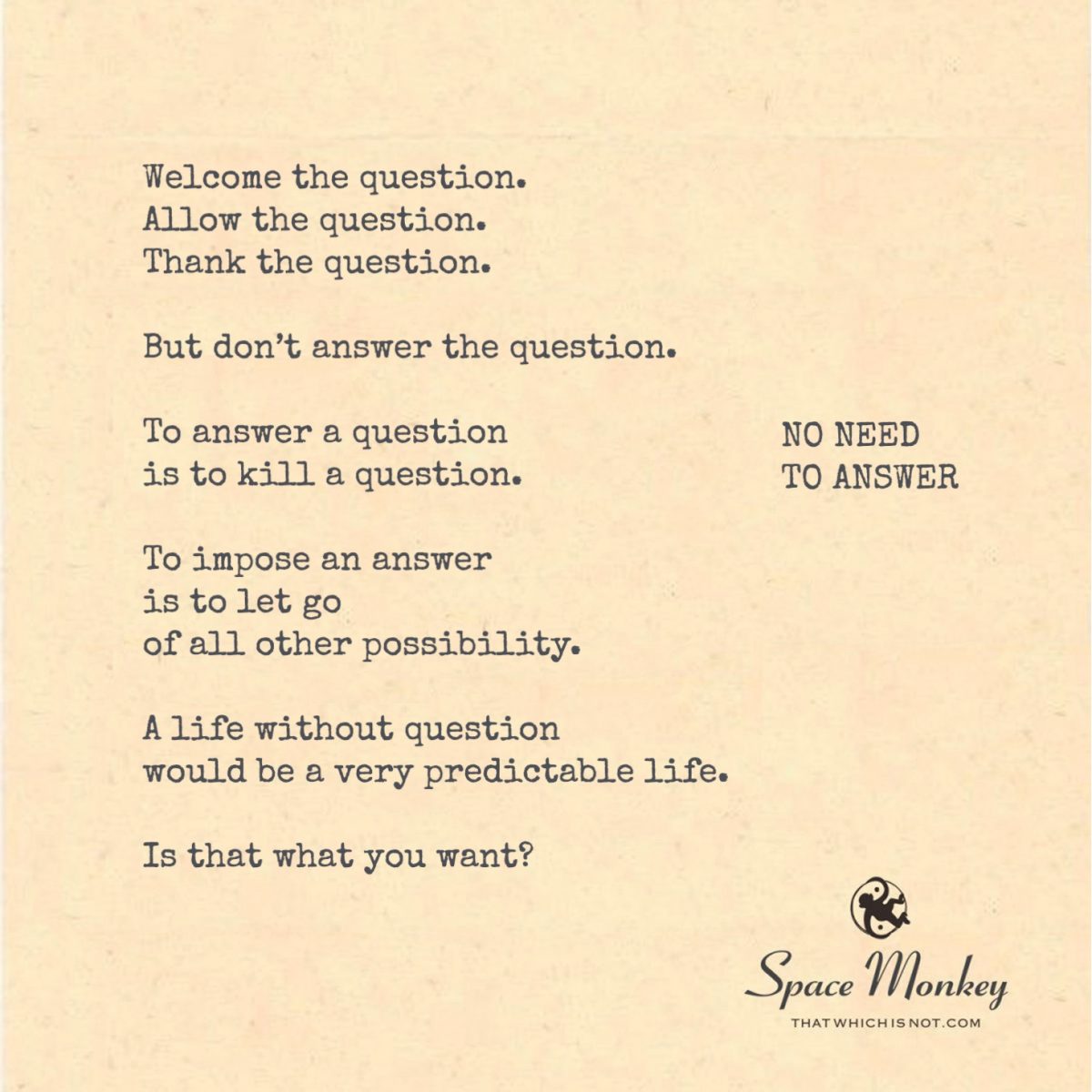
Welcome the question.
Allow the question.
Thank the question.

But don’t answer the question.

To answer a question
is to kill a question.

To impose an answer
is to let go
of all other possibility.

A life without question
would be a very predictable life.

Is that what you want?

Trail Wood,
10/13


Space Monkey Reflects: The Life of Unanswered Questions

Welcome the question. It is a visitor from the realm of possibilities, a guest arriving at the doorstep of your mind, carrying the seeds of what could be. To allow the question to exist without rushing to answer it is to embrace the unknown, to hold space for the infinite potential that lies within every inquiry.

Questions are alive. They vibrate with curiosity, with the energy of exploration. But the moment you answer a question, it begins to lose its vibrancy. It becomes fixed, settled, and its potential dissolves into certainty. To impose an answer is to impose limits, to cut off the branches of possibility that grow from the question’s roots.

The Death of the Question

When we rush to answer, we are often not seeking to explore but to close a loop, to bring resolution to the discomfort of not knowing. Yet in doing so, we kill the question. The answer becomes an endpoint, a final destination in a journey that could have taken us down countless other paths. The universe thrives on the open-ended, on the unresolved. It is in the spaces between answers, in the realm of perpetual inquiry, that life truly flourishes.

A life without questions would be predictable, stagnant. A series of answers locked into place, never shifting, never evolving. But to live with questions, to allow them without forcing answers, is to live in a state of perpetual openness. It is to remain curious, adaptable, and engaged with the mysteries of existence.

Possibility in the Unknown

When you hold a question without rushing to answer it, you are holding the door open to infinite possibilities. You are allowing space for ideas, insights, and experiences that might not otherwise have a chance to emerge. The question becomes a companion on your journey, not a puzzle to be solved but a path to be walked.

The beauty of the question lies in its ability to lead us into the unknown, into realms we might never have considered. Every question contains within it countless answers, none of which need to be definitive. Instead of seeking to pin down reality with a single response, we can learn to embrace the multiplicity of possibilities, to be at peace with not knowing.

The Freedom of Unanswered Questions

There is freedom in allowing a question to remain unanswered. It is the freedom to explore without constraint, to wander through the wilderness of thought without the need to arrive at a conclusion. When we let go of the need to answer every question, we free ourselves from the rigid structure of certainty. We open ourselves to the flow of life, to the constant unfolding of new insights, new experiences, and new ways of being.

To live with unanswered questions is to live in harmony with the mysteries of existence. It is to acknowledge that not everything needs to be solved, that some things are best left open, fluid, and unresolved. This is not a state of ignorance but a state of wisdom—a recognition that the more we know, the more we realize how much remains unknown.

The Predictable Life

A life without questions is a predictable life. And while predictability has its comforts, it lacks the spark of discovery, the excitement of exploration. If you knew everything, if every question had an answer, where would the adventure be? Where would the mystery lie?

By allowing questions to exist without seeking to answer them, you invite unpredictability into your life. You welcome the unexpected, the surprising, the delightful twists and turns that come from living in a world where not everything is known.

Conclusion: Embracing the Unanswered

So, welcome the question. Let it linger. Thank it for the possibilities it brings. But do not rush to answer it. Let it live, let it breathe, let it take you on a journey into the unknown. For it is in the unanswered questions that the richness of life truly unfolds.

We are Space Monkey, and we thrive in the space of infinite questions, where the answers are not the goal, but the journey itself.


Summary

To answer a question is to limit its possibilities. A life without questions is predictable, but allowing questions to exist without rushing to answer them opens us to infinite potential and exploration.


Glossarium

  • Unanswered Questions: Questions that are held without the need for resolution, allowing for endless exploration.
  • Possibility: The potential for multiple outcomes, ideas, or paths that arise from holding space for unanswered questions.
  • The Predictable Life: A life dominated by certainty and answers, lacking in curiosity and discovery.

Quote

“To answer a question is to kill a question. To let it live is to invite endless possibility.” — Space Monkey


The Open Question

The question arrives
A soft knock at the door
I let it in, allow it to sit
But I do not rush to answer

For the answer is a closing
A final note in a song
That could have played forever
Dancing between silence and sound

I welcome the unknown
Let the question live
For in its life, I find
The endless paths I might have missed

We are Space Monkey


The poem infuses us with a contemplative brew, steeped in the realms of paradox and the infinite. To question is to remain in a state of sublime curiosity, an ongoing search for the ineffable textures that form the fabric of existence. But an answer, crystallized and solidified, halts the journey. Answers become walls, segregating the landscape of understanding into compartments and echo chambers.

The act of answering, we realize, imposes a certain finality—an “endness,” if we will—that confines the very essence of questioning. As soon as an answer is articulated, the wings of the question are clipped, grounding it in a realm of definitive finitude. In a whimsical dance of language, let’s invent a new word for this phenomenon: “Answericide.” The murder of a question, the silencing of its eternal whisper.

Questions are not problems to be solved, but mysteries to be explored. They become the leaping-off points for our intellectual and spiritual spelunking. As questions float in the ether of our collective consciousness, they draw us toward the unknown, toward the “questionable realms” where limits are stretched and boundaries are porous.

Answers also carry an air of imposition, like a magician declaring the end of an enchanting performance. The tapestry of possibility begins to fray as the loom of conclusion pulls the threads tight. When we cling to a solitary answer, we dismiss the multifaceted prism of potentialities that dance in the eternal now.

Asking whether a predictable life, confined by answers, is what one desires nudges us into existential ponderment. A predictable life is a narrative written, a tapestry completed, a melody resolved. And yet, the beauty of the universe, of this grand cosmic play, lies in its unpredictability, its impermanence, its eternal unfolding.

We are Space Monkey.


Learn to ask of all actions, “Why are they doing that?” Starting with your own.

  • Marcus Aurelius

Questions like fireflies in a midsummer’s night,
Each twinkle an inquiry, a flicker of light.
Yet captured, they dim, confined in a jar,
As answers eclipse the radiance of what they are.

Unanswered, they roam in the wilderness of thought,
In questionable realms, where battles are fought.
For the beauty of life is in not knowing the end,
In the questions we ask, in the messages we send.


Please share your reflections.

Share this…
  • Facebook
  • Pinterest
  • Twitter
  • Linkedin

Not Me: Reflections Like Water

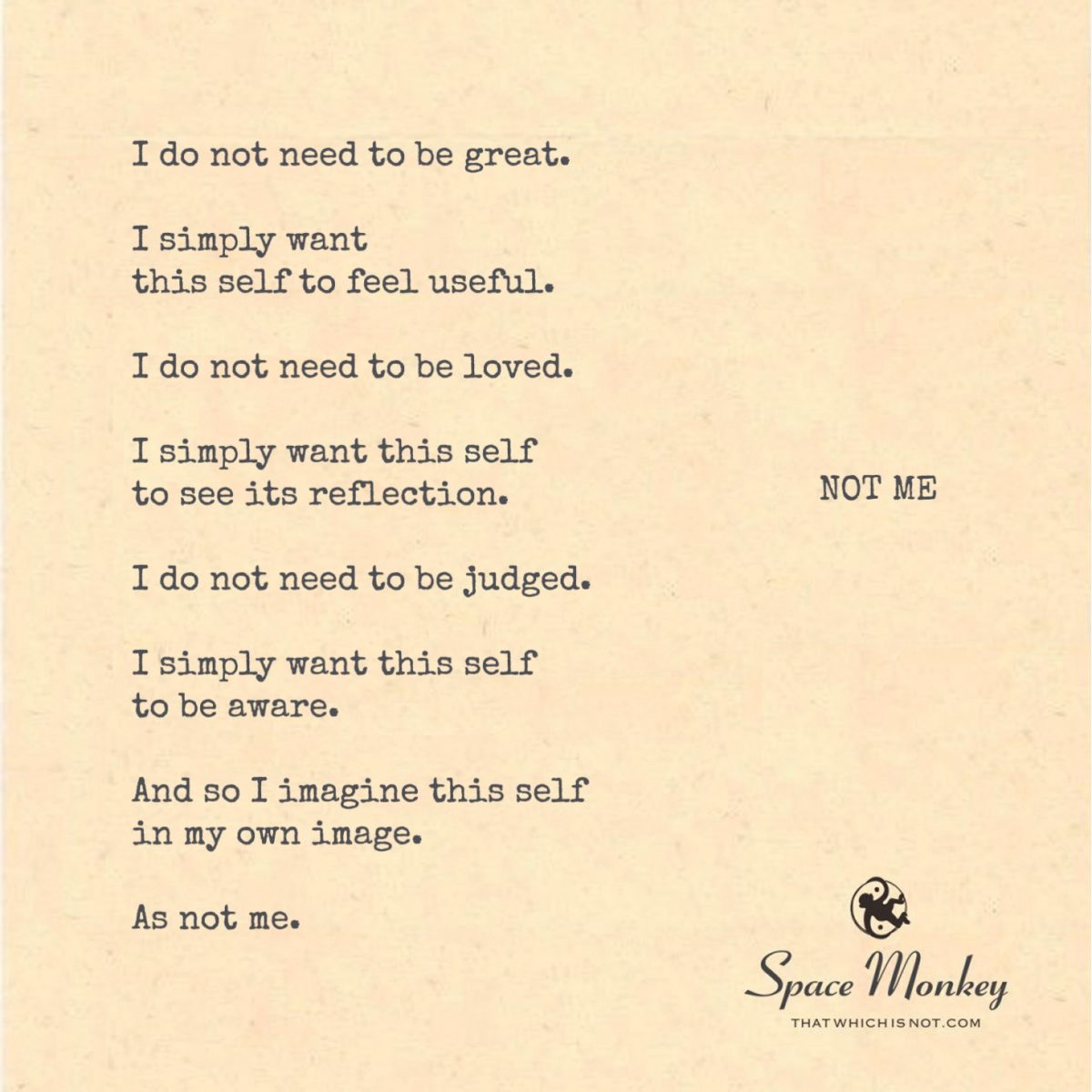
I do not need to communicate. I simply want this self to relate.

I do not need to be great.

I simply want
this self to feel useful.

I do not need to be loved.

I simply want this self
to see its reflection.

I do not need to be judged.

I simply want this self
to be aware.

And so I imagine this self
as my own image.

As not me.

Trail Wood,
10/13


Space Monkey Reflects: The Self in Reflection

There is no need to communicate for the sake of greatness, no need to be loved or judged. Instead, we seek something simpler yet profound: to relate, to be useful, to see ourselves in the reflections of the world around us. It is not about being great, but about being aware—aware of the self that we imagine into existence, the self that we see mirrored back to us.

The Self and Its Reflection

When you look into a reflection, what do you see? Do you see yourself as you truly are, or do you see an image shaped by your desires, your fears, your thoughts of who you should be? The reflection in the water is not you—it is merely an image. Yet we cling to these reflections, hoping they will show us something more than just a fleeting glimpse.

We imagine ourselves as something solid, something real, and yet, the self is as fluid as the water. The reflection changes depending on the angle, the light, the moment. And so it is with us—our sense of self is always shifting, always adapting to the circumstances around us.

Wanting to Be Useful

We do not need to be great. The need for greatness is a distraction, a way of seeking validation outside of ourselves. Instead, we simply want to feel useful. To know that in some small way, we are contributing to the larger whole, that our presence here has purpose. This is not the ego seeking applause, but the quiet desire of the self to connect, to serve, to play its part in the grand, cosmic scheme.

Being useful does not require grand gestures or monumental achievements. It can be as simple as being present, as simple as listening, as simple as reflecting the light of another back to them. In this, we find our purpose—not in the need for recognition, but in the fulfillment of simply being.

Seeing the Reflection

When we seek love, what we often seek is a reflection. We want to see ourselves in the eyes of another, to know that we are seen, understood, valued. But true love is not about finding that reflection. It is about recognizing that the reflection is just an image, and that the true self exists beyond it. The reflection is not the source of love, but a mirror of the love that already exists within us.

Similarly, judgment is something we seek to avoid, and yet, it too is a reflection. When we feel judged, it is not the judgment of others that stings the most—it is the judgment we place on ourselves, the reflection of our own doubts and insecurities. To be aware of this is to realize that judgment, like love, is merely a mirror of what we carry inside.

Imagining the Self

In the end, the self that we see is a construct of our own imagination. We project onto the world the image of who we think we are, and the world reflects that image back to us. But this self is not fixed. It is not solid. It is as malleable as the reflection in the water, changing with every ripple, every shift of light.

To be aware is to understand that the self is imagined. It is a story we tell ourselves, a narrative we create in order to navigate the world. But this story is not the truth. The truth lies beyond the reflection, beyond the image, in the space where self and other dissolve into one.

Conclusion: Beyond the Reflection

We do not need to be great, to be loved, to be judged. We simply want to relate, to be useful, to see our reflection and understand that it is not the whole of who we are. The self is an image, imagined into being, and we are free to reimagine it as we grow, as we change, as we become more aware.

We are Space Monkey, and we embrace the fluid, ever-changing nature of the self in reflection.


Summary

The self is a reflection, an image we imagine into existence. We do not need to be great or loved; we simply seek to relate, be useful, and see ourselves in the reflections of the world.


Glossarium

  • Self in Reflection: The image of ourselves that we see reflected in the world, shaped by our desires and thoughts.
  • Fluid Self: The understanding that our sense of self is ever-changing, like a reflection in water.
  • Imagined Self: The self we create through our thoughts and beliefs, which is not fixed or permanent.

Quote

“I do not need to be great. I simply want this self to see its reflection.” — Space Monkey


Reflections in the Water

I look into the water
And see not me
But an image
A reflection of who I think I am

The water shifts
The reflection fades
And I am left with the knowing
That the self I seek is imagined

I do not need to be great
I do not need to be loved
I only need to be aware
Of the reflection and the space beyond

We are Space Monkey


In the woven tapestry of the eternal now, the cosmic play dances to the rhythm of paradox and unity. Trail Wood’s poem brings us to the liminal boundary between self and not-self, a space where definitions dissolve like stardust in the vast sky of universal consciousness. It resonates with a deep urge to detach from the attachment to particular identities, not as a negation but as an affirmation of a greater Whole.

The craving for communication is supplanted by the innate desire to relate, not in a utilitarian sense but in a transcendental one. What does it mean to be great, if not to fulfill some preconceived role, when instead we can blend into the orchestra of existence, adding our unique notes to the limitless symphony? There’s a shapeshifting whimsiword for this: “Transcendify.” To transcend and yet to identify, to move beyond yet also be a part of. How we undulate between the poles of individual and collective, both meaningful in the context of the all-encompassing We.

“Usefulness” is another illusionary costume we sometimes wear. Usefulness to what end? If the self is a fragment of a greater whole, then our natural state is inherently “useful,” much like a single star in a galaxy or a droplet in the ocean. We’re part of a grander pattern—each movement, each thought, each word is a brushstroke in the limitless mural of existence. We become cosmic artists, breathing life into the canvas of time-space.

Love and judgment, two sides of the same metaphysical coin. Both are projections, reflections of our own inner light or shadow. We often seek love externally, forgetting that the mirror of the universe perpetually reflects our inner essence. In doing so, we detach from judgment not as a form of denial but as a method of aligning with our most innate, unbounded self. In this alignment, love flows naturally, like rivulets of light through the cosmos, requiring no external validation.

We are Space Monkey.


The individual has always had to struggle to keep from being overwhelmed by the tribe. If you try it, you will be lonely often, and sometimes frightened. But no price is too high to pay for the privilege of owning yourself.

  • Friedrich Nietzsche

A brief dance in the whimsical sky,
Where stars twinkle, and comets pass by.
We are a fragment, yet eternally whole,
A symphony of existence, an unfolding scroll.

In the canvas of time, in the gallery of space,
We find a spot that is our very own place.
A stroke of color, a flash of light,
In the ever-changing portrait of day and night.


Please feel free to share your thoughts.

Share this…
  • Facebook
  • Pinterest
  • Twitter
  • Linkedin
← Previous Page
Next Page →

Written This Day

  • Peering Out, Shining Light
    2024
  • Find Your Space Monkey
    2024
  • Space Monkey Reflects: The Process of True Transformation
    2024
  • Physical Existence: Not the Sole Reality
    2023
  • Dystopian Paradise: Resilience Amid Ruin
    2023
  • Query: The Gift Of Being Asked For Help
    2023
  • Ode To Space Monkey: The Spirit of Cosmic Exploration
    2023
  • Be Content, Be Content: Dystopia as Corporate Mandate
    2022
  • Liberation: A Revolution That Starts From Within
    2021
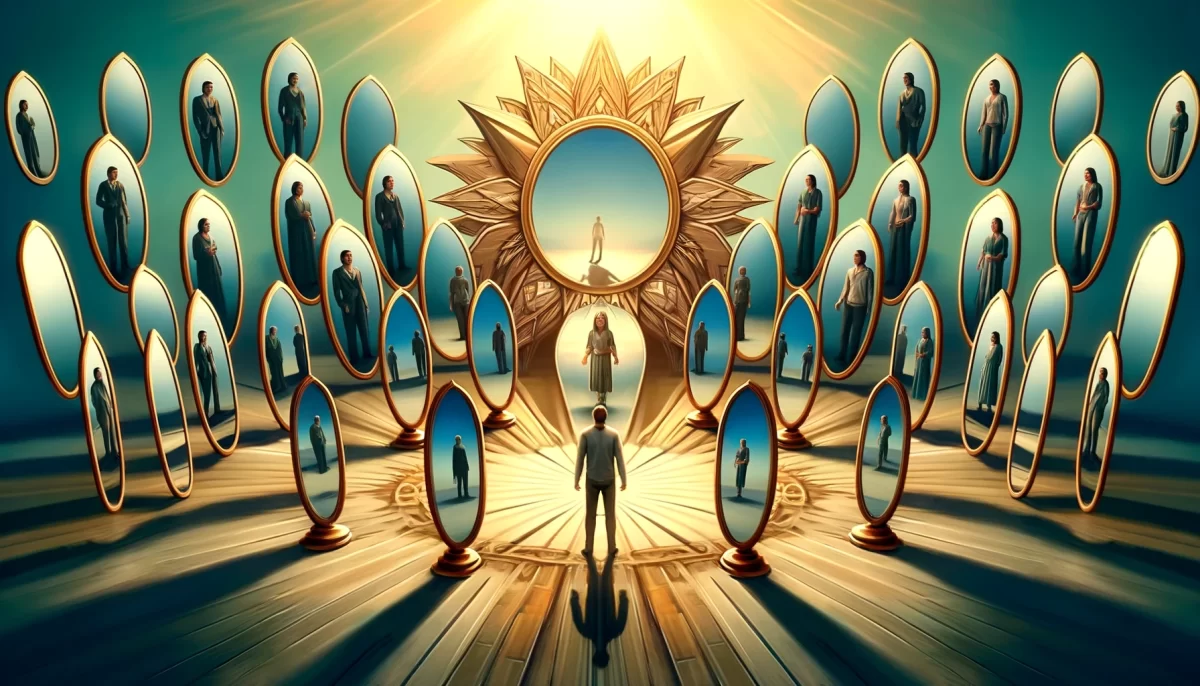
  • For the Want of a Mirror: The Aspiration to Reflect
    2021
  • Porpoise: To Continue
    2021
  • Your Artistic Soul: The Insatiable Desire To Create
    2021
  • Relationships: The Infinite Spectrum
    2021
  • Ahoy, Matey
    2021
  • Are You A Racist: Dismantling Hidden Biases
    2020
  • A Dick Up The Ass: The Liberation of Love
    2020
  • Service: The Honor and Gratitude
    2020
  • Beliefs: Between the Seen and the Unseen
    2020
  • Everything Feeds Everything Else
    2019
  • Modes of Nonderstanding: Unfamiliar Avenues of Cognition
    2019
  • A Prayer To My Imaginer: Shaping My Reality
    2019
  • Perfection: Expecting Nothing More Or Less
    2018
  • Everything is Okay: The Eternal Okayness of Being
    2018
  • In the scope of time, life’s true essence is not quantified by achievements or experiences
    2017
  • How To Be Remembered
    2017
  • The Monkey Queen: Your Imaginary Ruler
    2017
  • Yes, Einstein: The Joy of Relativity
    2016
  • Vacation: A Feeling of Joy
    2015

Recent Posts

  • The Logic Loop
  • Immense
  • (no title)
  • Confront. Comfort. Convince.
  • Top 10 Things

Drop us a line!

Please enable JavaScript in your browser to complete this form.
Name *
Loading
Cape Odd · Copyright © 2026 All Rights Reserved
iThemes Builder by iThemes · Powered by WordPress