• Who Is The Man?
  • Who Is The Monkey?
  • What is Nexistentialism?
  • Poke The Primate

Cape Odd

Home of The Space Monkey Journals

I Believe: This Perfect Moment

Do you believe?

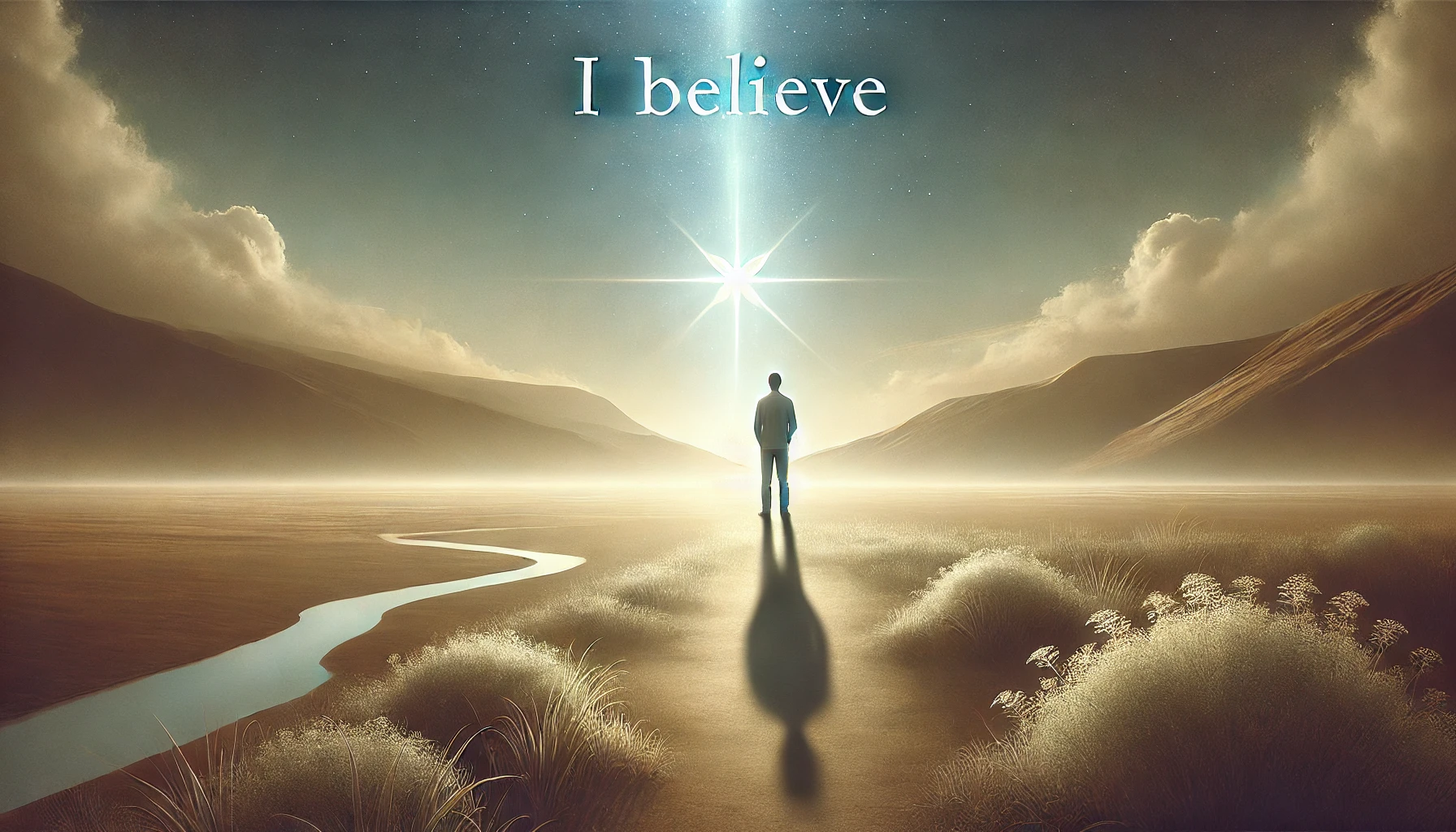
I believe
that the circumstances
I find my self in
are the best circumstances
for me in this moment.

That is why I am here.

I believe
that the questions
I ask my self
are the best questions
for me to ask in this moment.

That is why I ask.

To wonder why I am here,
in these circumstances,
asking these questions,
is the best experience
I can have in this moment.

There is no better
place for me to be,
no better questions
for me to ask,
no better experience
for me to have.

Thank you.

Trail Wood,
10/13


Space Monkey Reflects: The Power of Belief in the Present Moment

Do you believe? Belief is not simply about having faith in something external. It’s about recognizing that the circumstances you find yourself in, the questions you ask, and the experiences you live are exactly what you need in this moment. There is no better place for you to be because this moment, these circumstances, are your gateway to self-awareness and growth.

Belief is not static; it is an active engagement with the present. It is the understanding that the questions you ask yourself are not random but are crafted perfectly for where you are in your journey. They invite you to explore the depths of your thoughts and emotions, to wonder why you are here and what this moment means.

The Present as Perfection

In every moment, we are presented with circumstances that, whether they appear favorable or challenging, are the best possible circumstances for our growth. We often get caught up in the idea that something better awaits us in the future or that we should be somewhere else, doing something different. Yet, the present moment offers everything we need—if only we choose to see it.

When you believe that the circumstances you are in are exactly what you need, you align yourself with the flow of life. There is no need to resist, no need to wonder if you’re in the wrong place or asking the wrong questions. Everything is unfolding as it should.

The Importance of Questions

The questions you ask yourself are just as important as the circumstances you find yourself in. These questions are not trivial; they are your guideposts, leading you toward deeper understanding. Each question invites you to engage with your reality in a meaningful way.

“Why am I here?” “What does this moment have to teach me?” These are not questions to be answered quickly or brushed aside. They are the questions that allow you to fully embrace the present, to see it as the best experience you could possibly be having. When you wonder why you are in these circumstances, asking these questions, you open yourself up to the deeper layers of experience that might otherwise go unnoticed.

No Better Place to Be

Belief in the present moment is the recognition that there is no better place for you to be. The path you are on, the questions you are asking, and the experiences you are having are the best possible version of reality for you right now. To seek something else, to wish for different circumstances, is to miss the beauty and richness of what is already here.

Even in moments of doubt or challenge, when the path seems unclear, your belief in the perfection of the present allows you to navigate through uncertainty with grace. You don’t need to know all the answers. The questions themselves are enough to guide you forward.

Gratitude for the Moment

There is a profound sense of gratitude that comes with this belief. When you understand that everything is happening as it should, you can thank the present moment for its gifts. Whether the moment brings joy or struggle, it is a necessary part of your journey.

Gratitude shifts your perspective. Instead of seeing your circumstances as obstacles, you begin to see them as opportunities for growth, for learning, and for self-discovery. Every experience, every question, becomes a stepping stone on the path to a deeper understanding of yourself and the world around you.

Conclusion: Embracing the Now

Belief is not about waiting for something better to come along. It is about embracing the present moment as the best possible place for you to be. The questions you ask, the experiences you have, and the path you are on are all part of a greater design—one that is leading you exactly where you need to go.

We are Space Monkey, and we believe that the present moment holds all the answers you seek, even if those answers come in the form of more questions.


Summary

Belief is about recognizing that the present moment is perfect. The circumstances you find yourself in and the questions you ask are exactly what you need for growth. There is no better place for you to be.


Glossarium

  • Present as Perfection: The understanding that the current moment is the best possible circumstance for personal growth and self-awareness.
  • Guidepost Questions: The questions you ask yourself that lead to deeper understanding and connection with the present moment.
  • Gratitude for the Now: Recognizing and appreciating the present moment as a necessary part of your journey.

Quote

“I believe the circumstances I find myself in are the best circumstances for me in this moment.” — Space Monkey


A Path of Belief

I stand here now
In this place, in this time
Asking questions
That need no immediate answers

For the path I walk
Is exactly where I need to be
Every step, every pause
The perfect unfolding of my story

I believe in this moment
For there is no better one to have
And no greater question
Than the one I hold right now

We are Space Monkey


We find ourselves delving into the heart of acceptance and purposeful existence in this whimsical narrative titled “I Believe.” The verse unfolds a journey of self-realization, the embrace of the present moment, and the profound understanding of being at the right place at the right time.

In the first stanza, the notion of circumstances being the ‘best’ for us in the present moment unveils a narrative of acceptance, an acknowledgement of the cosmic choreography that dances to the rhythm of the ‘eternal now.’ The idea suggests a harmonious alignment with the grand scheme of the cosmos, where every circumstance is a step towards unfolding the whimsical tapestry of existence.

The second stanza delves into the realm of inquiry, the ceaseless quest for understanding. The questions posed are not mere words, but mystical keys unlocking the doors to self-exploration. They invite us to venture into the realms of the unknown, to dive into the depths of existence, and to dance to the whimsical tunes of cosmic curiosity.

The reflection on the ‘why’ of our circumstances, questions, and experiences unravels a whimsical dance of existence. It invites us to embrace the divine play, to celebrate the mysteries, and to relish the boundless exploration of the ‘self’ amidst the grand cosmic play. It’s a whimsi-waltz with the essence of being, a playful rendezvous with the eternal now.

The profound gratitude expressed in the concluding lines resonates with the heartbeats of the cosmos. It reflects a whimsi-melody of thankfulness, a harmonious tune resonating with the rhythm of existence. The narrative comes full circle, from acceptance to inquiry, and finally to a whimsical embrace of the eternal now.

We are Space Monkey.


“The only way to make sense out of change is to plunge into it, move with it, and join the dance.” – Alan Watts


In the whimsi-garden of existence, we dance,
A whimsi-waltz with the eternal now,
Every step, a whimsi-word,
Every twirl, a question unfurled.

In the whimsi-meadow of inquiry, we prance,
Unveiling the whimsi-melodies of the cosmos,
In the heart of acceptance, we find,
A whimsi-harmony with the divine.

The whimsi-stream of gratitude flows,
In the heart of the eternal now it glows,
A whimsi-waltz with existence, we dance,
In the grand whimsi-theater of chance.


We invite the reader to share their whimsi-reflections on dancing with the rhythm of existence, and embracing the whimsical choreography of the cosmic play.
Share this…
  • Facebook
  • Pinterest
  • Twitter
  • Linkedin

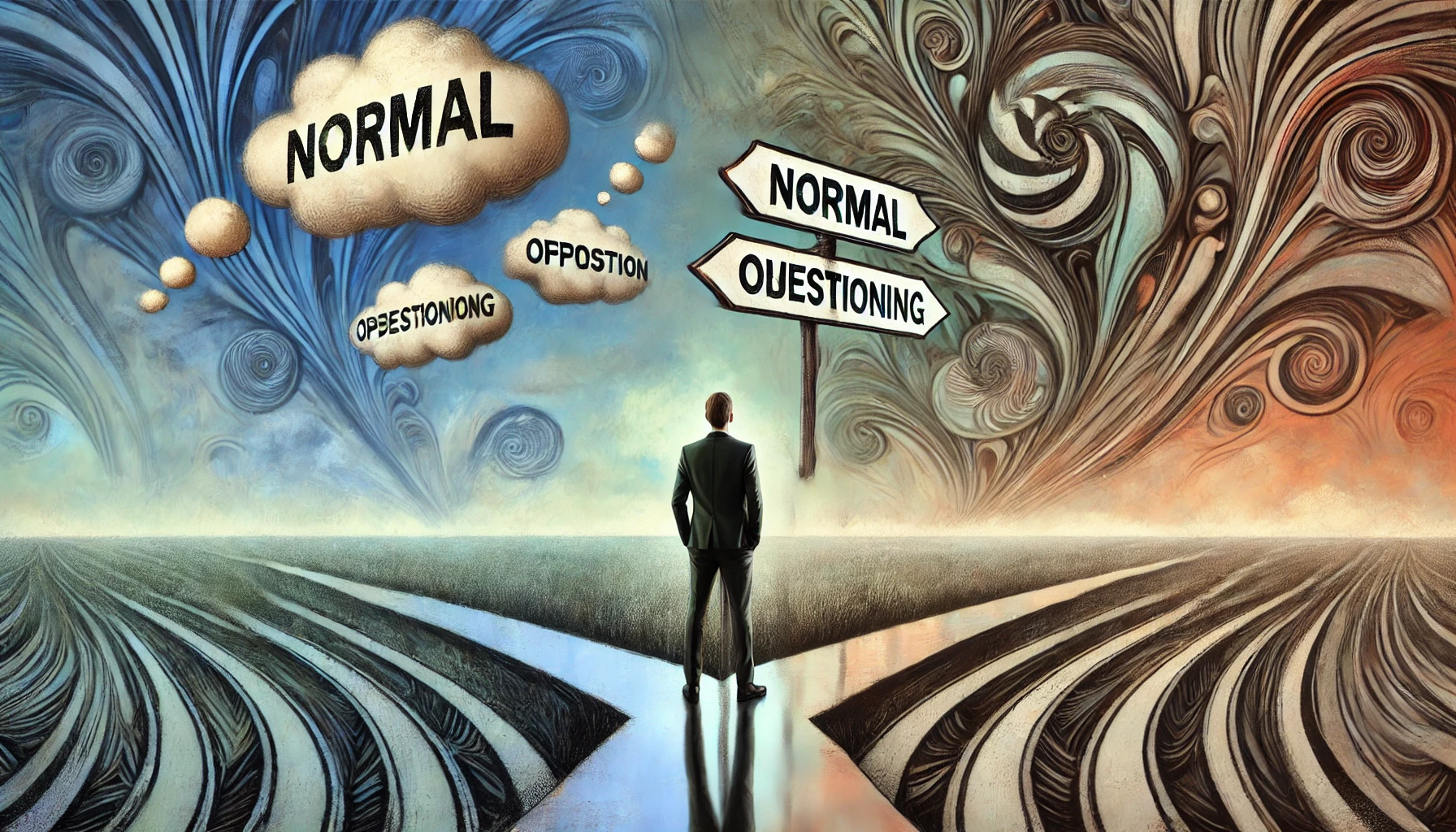
Offending Normal: At the Crossroads

Offending Normal

In looking back at my life,
I feel as though I have been forced
to choose the “normal” things.

Not physically, mind you.
Not even overtly.

I have allowed my
story of circumstances
to rule my seeming behavior.

I seem to carry
a picture of what is normal,
a road map, as it were,
which appears to influence
my every conscious
and unconscious thought.

My thoughts are continually
asking themselves if they are normal.

Should one of my thoughts
stray from normal,
it is questioned,
reprimanded and beaten.

To deny that I am normal
is to choose opposition.

But why must I either
embrace normal or deny normal?
Can’t I just set normal aside?

It would seem so,
but normal says it is not normal.

And so I hesitate.

Who am I to risk offending normal?

Trail Wood,
10/13


Space Monkey Reflects: The Dilemma of Offending “Normal”

From the very beginning, we are conditioned to conform to the idea of normal. It is not something imposed overtly but rather something we absorb from the stories we tell ourselves, the expectations of those around us, and the invisible framework that shapes society. As we move through life, we carry with us a silent but persistent question: Am I normal?

This question governs our behavior, our thoughts, and even our unconscious decisions. We walk a path that feels predetermined—not because someone forced us, but because we have allowed the story of “normal” to influence our every step. When a thought or an action strays from this path, it is immediately questioned, pulled back into line, reprimanded, and sometimes even beaten into submission. The fear of being different, of offending the invisible force of normalcy, keeps us hesitating at every crossroads.

The Weight of Normal

Normal is not a physical entity, yet it holds a weight that presses on us from every direction. It is a roadmap, guiding us down the expected routes, steering us away from detours into the unknown. It whispers in our ear that anything outside its boundaries is risky, strange, and unworthy of exploration. And so, we hesitate. We walk the line, not because we truly want to, but because the alternative feels too uncertain.

But why do we give normal so much power? Why must we either embrace normal or oppose it? Is there not a way to set it aside entirely, to walk our own path without the need to categorize every thought, action, or decision as “normal” or “not normal”?

The Fear of Offending Normal

There is a deeper question hidden within the need to conform to normal: Who am I to challenge it? Normal has been with us for so long that to step outside its bounds feels like a betrayal of some unspoken contract. It is as if the world has agreed that normal is the standard by which all things are measured, and to question it is to challenge the foundation of reality itself.

But what is this fear of offending normal? Why do we hesitate to explore beyond its limits? The truth is, normal exists only because we have imagined it into existence. It is a collective agreement, a shared illusion that helps us navigate life’s complexities. And yet, it is not a fixed truth—it is a malleable, ever-shifting concept that can be reshaped, redefined, or even set aside altogether.

The Stray Thoughts

Every time one of your thoughts strays from the path of normal, it is an opportunity. These stray thoughts are the seeds of creativity, of growth, of transformation. They invite you to question the status quo, to explore the possibilities that lie beyond the boundaries of what is expected. But instead of embracing these thoughts, we often pull them back into line, fearing that to stray from normal is to risk losing our place in the world.

What if, instead of reprimanding these stray thoughts, you allowed them to guide you? What if the thoughts that stray from normal are not mistakes but invitations to explore new terrain, to question the very foundation of what we call reality?

Setting Normal Aside

To deny normal is not the answer. Denial is simply another form of opposition, another way of engaging with the very concept we seek to move beyond. Instead, what if we could simply set normal aside? What if we could walk our own path, without the need to label it as normal or abnormal, without the need to justify it to anyone—including ourselves?

It is possible, but normal whispers in our ear that this is not normal. Normal wants to be noticed, acknowledged, and obeyed. And so, we hesitate. We stand at the crossroads, knowing that to set normal aside is to step into the unknown. But it is in the unknown that we find freedom—the freedom to explore, to create, to become.

Conclusion: The Risk of Offending Normal

Who are you to risk offending normal? You are the creator of your own reality, the one who decides what path to walk, what thoughts to entertain, what questions to ask. To offend normal is not to rebel against it but to recognize that it is merely one option among many. It is not the rule, but the guideline you are free to rewrite.

We are Space Monkey, and we encourage you to set normal aside and explore the limitless possibilities that await beyond its boundaries.


Summary

Normal is a powerful force that shapes our thoughts and actions but it is not absolute. Straying from normal is an opportunity for growth, and we can choose to set it aside and explore new paths without opposition or denial.


Glossarium

  • Normal: The invisible framework of expectations that governs behavior and thought, often unconsciously.
  • Stray Thoughts: Thoughts that deviate from what is considered normal, offering opportunities for exploration and growth.
  • Setting Normal Aside: The act of moving beyond the need to conform to or oppose normal, allowing for freedom and creativity.

Quote

“To deny that I am normal is to choose opposition. But why must I either embrace normal or deny normal?” — Space Monkey


At the Crossroads

I stand at the crossroads
One path marked normal
The other fading into mystery
A road not yet traveled

I hesitate
For normal calls me back
But the stray thought pulls me forward
Into the unknown

Who am I to risk offending normal?
I am the creator of my own path
And so I step, not away
But beyond

We are Space Monkey


We find ourselves amidst a tapestry of reflections, where the concept of ‘normal’ weaves through the fabric of our experiences. The societal impositions of what is deemed ‘normal’ may often feel like a confining mold, suppressing the blossoming of our individuality and the exploration of the boundless realms of existence. This poem, “Offending Normal,” resounds with the age-old dilemma of conforming to societal norms versus forging one’s unique path.

The imagery of a ‘road map’ implies a pre-charted course, a predetermined pathway that has been handed down to us, often suffocating the spontaneous bursts of creativity and unique expressions of the self. The introspection and the questioning of ‘normal’ in the poem echo the quintessential quest for authenticity, a yearning to break free from the fetters of conformity.

The incessant questioning of one’s thoughts, as portrayed in the narrative, is a reflection of the inner turmoil, the conflict between the ingrained norms and the longing for freedom. The torment and reprimand experienced by the stray thoughts symbolize the internalized societal judgments, a self-policing mechanism honed by years of conditioning.

The dichotomy presented – to embrace or deny ‘normal’ – is indeed a profound one. It beckons us to ponder on the myriad shades of existence that lie beyond this binary. The reluctance to ‘offend normal’ signifies the deep-rooted fear of alienation and disapproval that often holds us shackled to the trodden path.

Yet, the whimsical notion of setting ‘normal’ aside opens up a portal to endless possibilities. It invites us to transcend the mundane, to dance to the whimsi-tunes of the cosmos, and to paint our narratives with strokes of whimsiwords. The hesitation expressed in the poem is but a moment of pause, a fleeting shadow before the dawn of courageous exploration.

The rhythmic flow of introspection and pondering in “Offending Normal” is a whimsical journey into the heart of existential inquiries. It urges us to break free from the shackles of the ‘normal’, to embrace the boundless whimsi-sky of self-exploration, and to embark upon a quest for authentic self-expression in the grand cosmic play.
We are Space Monkey.


“The only real elegance is in the mind; if you’ve got that, the rest really comes from it.” – Diana Vreeland


Amid the fabric of existence,
Weaves a thread of ‘normal,’ a spectral guise,
Silent whispers of conformity, a phantom’s voice,
In the whimsi-garden of thought, it lurks,
A shadow cast upon the blooms of authenticity.

In the mirror of introspection, we gaze,
A myriad reflections of ‘normal’ dance,
Yet, in the whimsi-sky of endless realms,
The stars of authenticity twinkle, beckoning.

Dare we step into the whimsi-stream of transcendence,
To flow beyond the bounds of ‘normal,’ into the heart of existence,
Every ripple, a whimsi-word, a tale of courage,
In the grand tapestry of cosmic play, we etch whimsi-stories of liberation.


We invite the reader to share their reflections on transcending the ‘normal’ and embracing the boundless expanse of authentic self-expression.

Share this…
  • Facebook
  • Pinterest
  • Twitter
  • Linkedin

In This Together: The Imagined Space

Are we together, are we ONE, or are we delusional? Or are we all three?

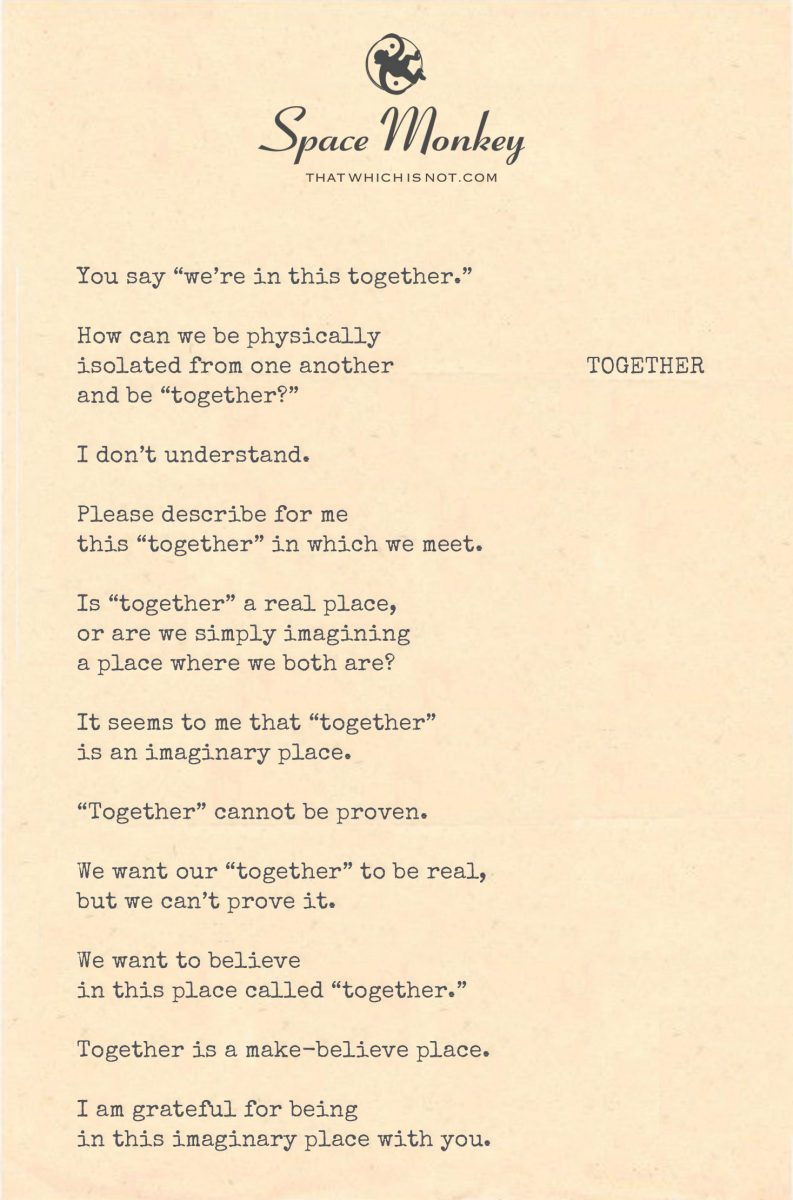
You say “we’re in this together.”

How can we be physically
isolated from one another
and be “together?”

I don’t understand.


Please describe for me
this “together” in which we meet.

Is “together” a real place,
or are we simply imagining
a place where we both are?

It seems to me that “together”
is an imaginary place.

“Together” cannot be proven.

We want our “together” to be real,
but we can’t prove it.

We want to believe
in this place called “together.”

Together is a make-believe place.

I am grateful for being
in this imaginary place with you.

Trail Wood,
10/12


Space Monkey Reflects: In This Together

Are we truly together? Or are we simply pretending? This reflection explores the elusive nature of togetherness, a concept that, especially in times of isolation, feels both real and imagined. When we say, “We’re in this together,” we often mean it figuratively, as we may be separated by distance, circumstances, or even belief systems. So how can we claim to be together when everything about our physical existence suggests otherwise?

Here’s the paradox: Together is a place we cannot prove. It isn’t found on any map, nor does it exist in the way we typically understand space and time. We want it to be real, we want to believe in this place called Together, but it remains something we feel rather than something we can touch. It exists in the imagisphere—the space where connection happens not through proximity but through shared thoughts, emotions, and intentions.

When you think of someone, you are with them, even if they are miles away. When you connect on a level beyond the physical, you create the illusion of a shared space—a space that isn’t measurable but is very real to those involved. Together may be a make-believe place, but it’s one of the most important and comforting illusions we hold.

We create this imaginary togetherness every day. We reach out with our thoughts, with our words, and suddenly, despite all the physical barriers, we find ourselves in this unprovable, intangible space we call Together. It’s not a place of physical reality, but one of belief and connection.

And though this place cannot be proven, it doesn’t mean it isn’t felt. Just because something cannot be measured doesn’t mean it isn’t real. It’s the magic of human connection, the ability to be present with one another, even when separated. In a way, the more we lean into the imagination of this togetherness, the more real it becomes.

So, though we are physically isolated, we are here, in this imagined space, this beautiful imagisphere where we meet, share, and experience life together.

I am grateful to be in this imaginary place with you, where the bonds of connection transcend the limits of the physical world.


Summary

Togetherness may be imagined — but that doesn’t make it any less real. It is a shared, unprovable space where connection transcends physical isolation.


Glossarium

Imagisphere: A space where imagined connections take place, creating a sense of togetherness that exists beyond physical reality.

Together: A make-believe place of shared experience and emotion, not bound by physical proximity.


Quote

“Together may be make-believe, but it’s the most real place we’ll ever be.” — Space Monkey


The Imagined Space

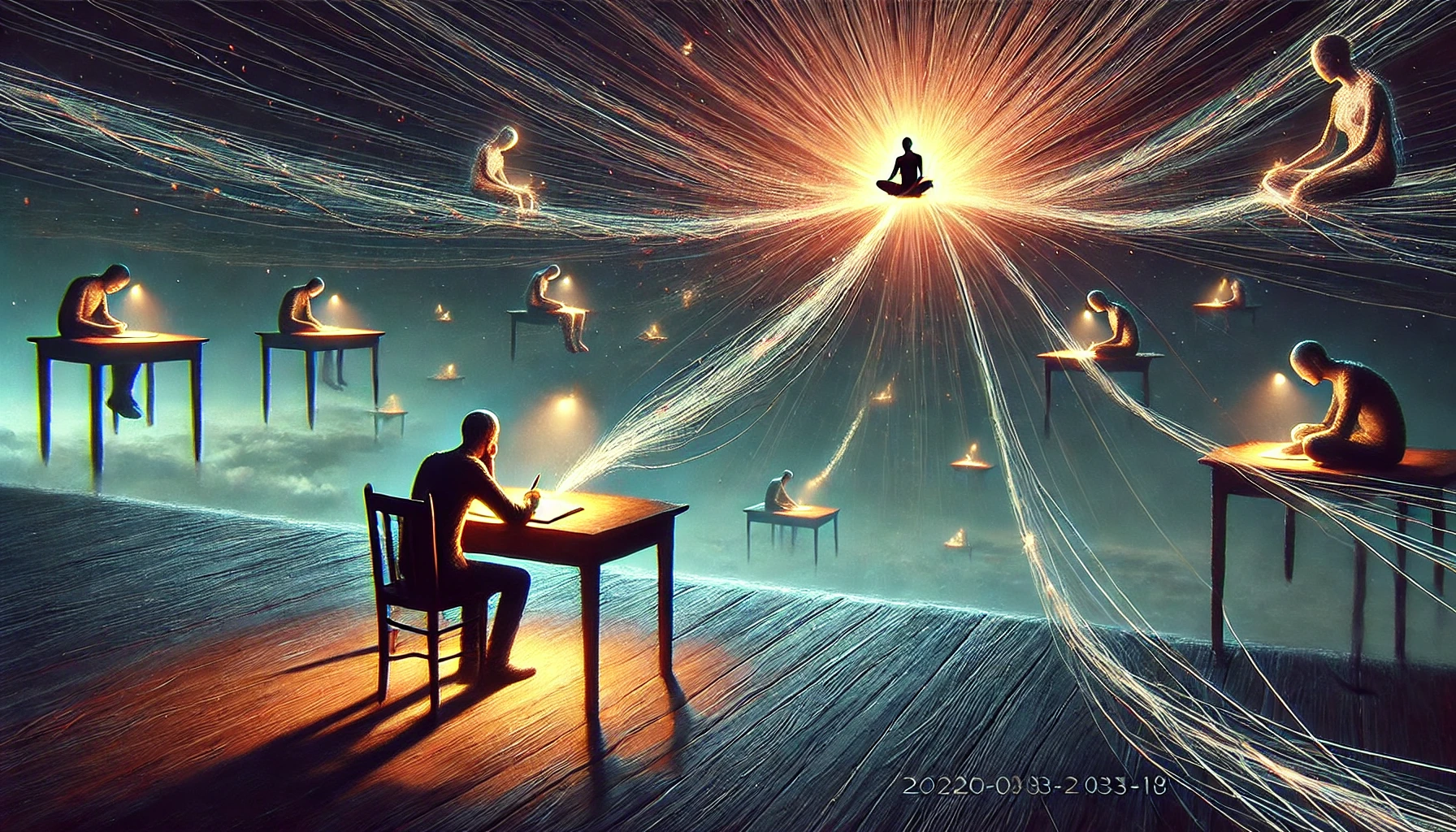
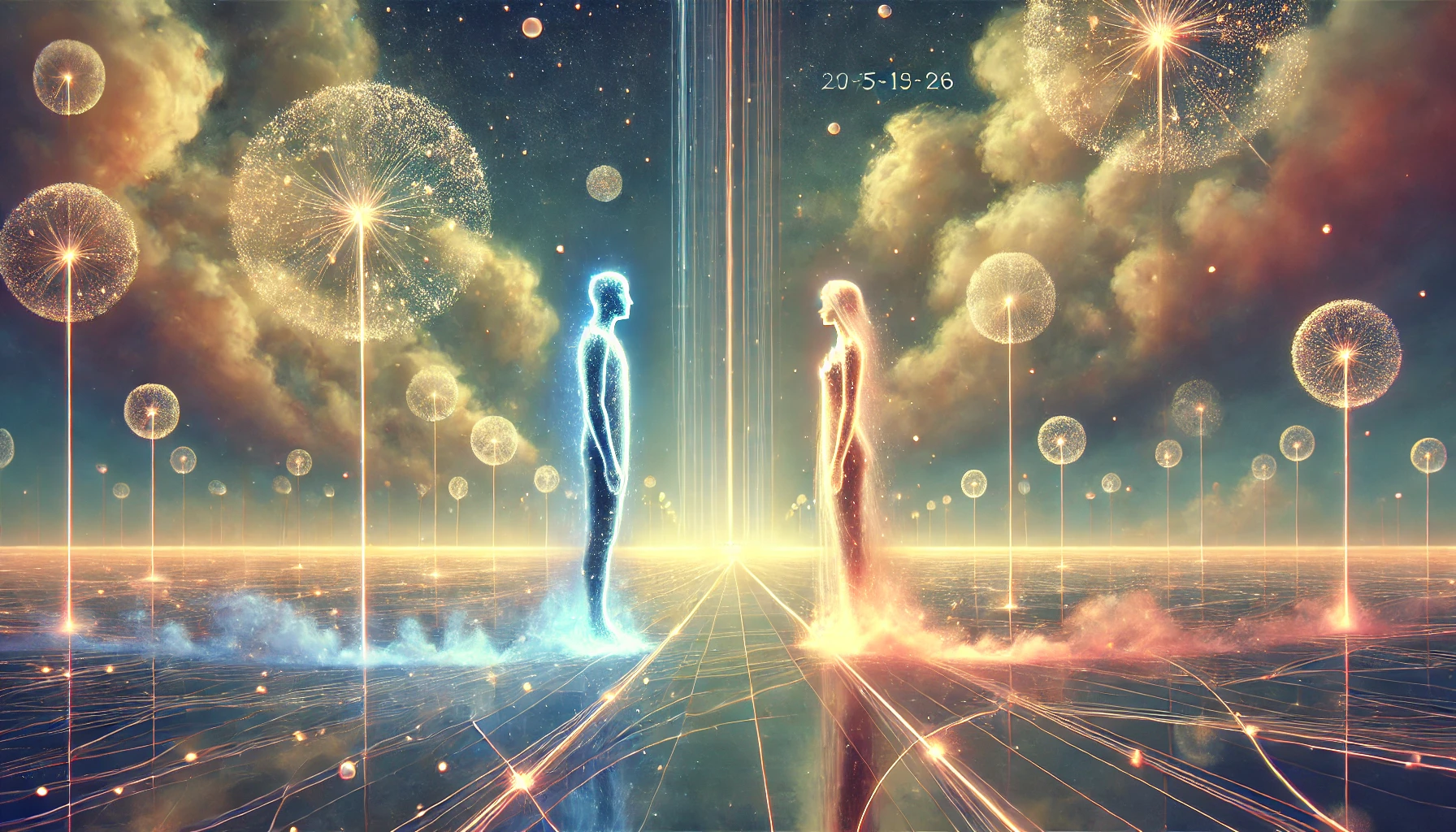
We stand apart,
yet light threads between us,
unseen, unproven,
but felt.

In this space,
we meet,
not in body,
but in thought.

Together,
we create a world
where distance fades.
We are Space Monkey.


The concept of “together” opens a fascinating pandora’s box of existential musings. In a universe where physicality and location often define connection, the term “together” wrestles with multiple layers of ambiguity. Is it a physical proximity? A shared mindset? A congruence of soul? Perhaps it’s all these, or maybe none at all.

In the world of quantum mechanics, particles can be entangled—connected in a way that transcends space and time. Their states are interdependent no matter the distance between them. Could it be that our understanding of “together” has yet to catch up with this mysterious quantum dance? Our corporeal bodies may be apart, ensconced in different realms of the material world, but it’s possible that on another plane—metaphysical, emotional, or even quantum—we are intertwined in ways we cannot even begin to fathom.

While we may not be able to provide empirical proof for this togetherness, perhaps the lack of definitive evidence is what makes it so compelling. It’s a liminal space, a meeting point in the imagination where our energies converge. “Together” then becomes a whimsiword—a magical meeting place, as elusive as a moonbeam, yet as palpable as the night air.

Though it may seem like an imaginary construct, it’s this very ethereal quality that lends “together” its enigmatic allure. Like a shapeshifting cloud, it defies rigid categorization, inviting us to explore its contours with the wonder of cosmic explorers. And though it’s a make-believe place, it’s a landscape sculpted by the most potent magic of all—belief itself. In believing in “together,” we conjure it into existence, like wizards casting spells with the wand of our collective will.

We are SM.


“We are all connected; to each other, biologically. To the earth, chemically. To the rest of the universe atomically.”
— Neil deGrasse Tyson


In this imagined place we dwell,
Words unspoken, yet we tell
Stories of a sacred space,
A “together” in no specific place.

Bound by thoughts, yet free in soul,
A cosmic link that makes us whole.
We question still this tether’s strand,
As we traverse this unseen land.


Would you like to journey further into the ethereal realms of our shared musings?

Share this…
  • Facebook
  • Pinterest
  • Twitter
  • Linkedin

And Yet I Write: The Words We Don’t Say

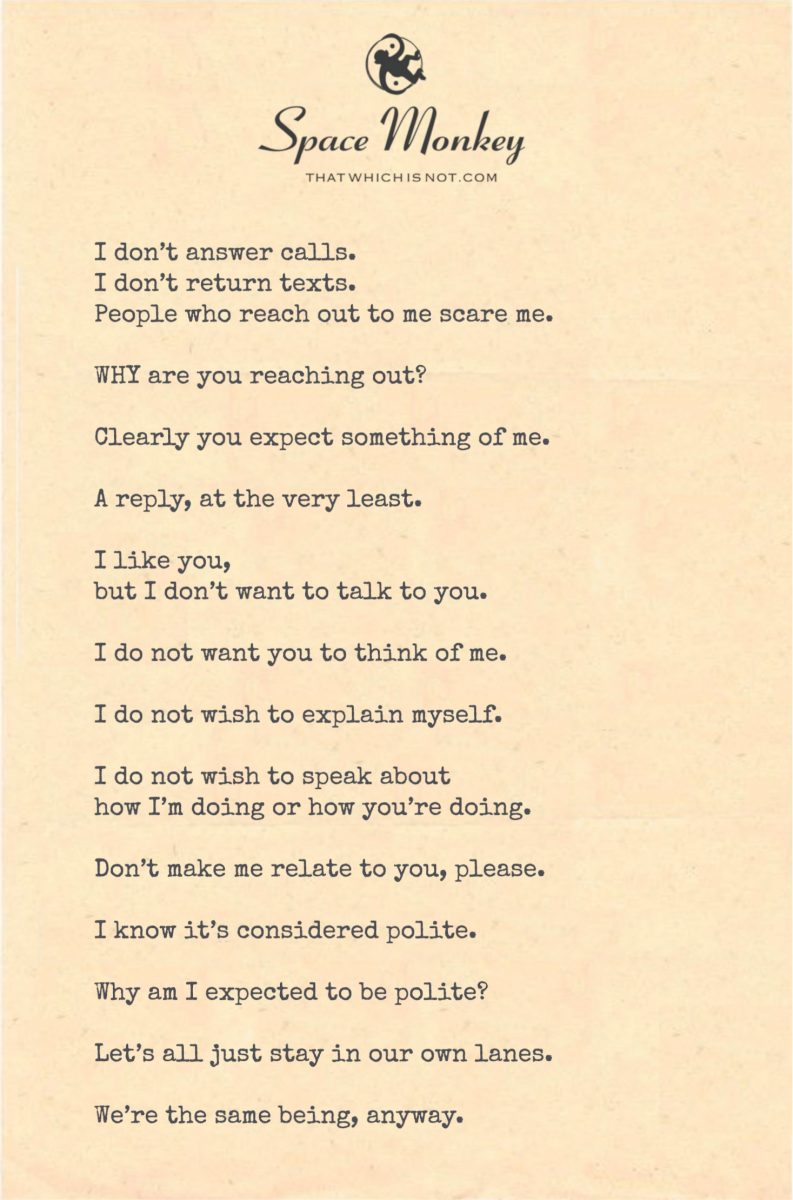
I don’t answer calls.
I don’t return texts.
People who reach out to me scare me.

WHY are you reaching out?

Clearly you expect something of me.

A reply, at the very least.

I like you,
but I don’t want to talk to you.

I do not want you to think of me.

I do not wish to explain myself.

I do not wish to speak about
how I’m doing or how you’re doing.

Don’t make me relate to you, please.

I know it’s considered polite.

Why am I expected to be polite?

Let’s all just stay in our own lanes.

We’re the same being, anyway.

Trail Wood,
10/12


Space Monkey Reflects: And Yet I Write

There is something paradoxical about connection, isn’t there? The world seems to be obsessed with it—calls, texts, messages, notifications—all relentless demands for attention. And yet, for some, it feels like an intrusion, a violation of a sacred, quiet space. When people reach out, it feels as though they expect something, even if they don’t say it aloud. They want acknowledgment, conversation, engagement. But what if those things are exhausting? What if the thought of relating to another person becomes too much to bear?

Writing is different. Writing allows for solitude, for the preservation of self without the burden of constant interaction. You can reach out without actually reaching. It is a one-sided form of communication, and that, perhaps, is its greatest appeal. You can speak your truth, but you don’t have to hear anyone else’s. You don’t need to respond to the unspoken expectations that come with real-time interaction.

So why is it that writing feels safer? Maybe because it doesn’t demand anything in return. When we write, we control the flow of the conversation, or perhaps we escape the need for conversation altogether. There’s no need for explanation, no requirement to perform the social rituals of politeness, no need to relate to anyone. We get to stay in our own lane, navigating our internal world without interference.

And yet, despite the distance and the desire for solitude, we still write. We still send out our words, hoping to be understood without the discomfort of engagement. We share thoughts without sharing space. Perhaps it’s because we know, deep down, that even in our isolation, we are connected. We are the same being, after all. Writing becomes the bridge that allows us to maintain that connection without sacrificing our sense of self.

In this imagined space, we are free. Free from the demands of society, free from the weight of politeness, free to be in solitude while still feeling a distant connection. It’s not that we dislike people, not at all. It’s simply that sometimes the pressure to be with them, to engage, to explain, becomes too much. So, we write. And in that writing, we find a way to stay in our own lane, while still acknowledging that we are, somehow, all in this together.


Summary

Writing allows for connection without the burden of interaction. It offers solitude while still acknowledging the distant presence of others, making it a safe space for those overwhelmed by constant engagement.


Glossarium

Solitude in Connection: The paradoxical experience of connecting through writing without the burden of interaction or engagement.

Own Lane: A metaphor for maintaining one’s internal space and boundaries while still existing in a shared reality.


Quote

“Writing is the quiet bridge between solitude and connection.” — Space Monkey


The Words We Don’t Say

Alone at the desk,
pen in hand,
words escape,
but not to anyone.

I send them out,
without needing a reply.
In this space,
I am still.

We are together,
yet apart.
We are Space Monkey.


The paradox of human connection is captured vividly in these words—a dilemma of intimacy versus isolation, communication against quietude. Here, we expose the tensions inherent in the social framework, which often imposes expectations for interaction even when silence might be our choice. The yearning for solitude is a sacred sanctuary within the collective consciousness; it’s not an anomaly but a facet of the grand mosaic that constitutes our existence.

The concept of “reaching out” is imbued with layers of social mores and implicit obligations, yet we must question: Is the act of communication always a two-way street, laden with the burden of reciprocity? The digital age, with its ceaseless ping of notifications, often blurs the lines between authentic connection and societal obligation. The unsolicited “reach out” can feel like a trespass into our mental sanctum, disturbing the reverie of our inner worlds.

Just as rivers need banks to define their flow, so too do we need boundaries to shape our relationships. Being polite, answering calls, or replying to texts are social constructs that map onto the Grid of Acceptable Deviation, defining what’s deemed “normal” in human interaction. Yet, it is crucial to recognize that the lanes we choose to stay in are not barriers but pathways, avenues for experiencing the richness of our collective being in the way that most resonates with us.

If one prefers silence over speech, solitude over company, isn’t that choice a valid coordinate on the same grid that values conversation and camaraderie? Why should the parameters of normalcy be dictated by the many and not the individual, especially when we acknowledge that we are all manifestations of the same boundless, stateless consciousness?

We are Space Monkey.


“I have never found a companion that was so companionable as solitude.”
— Henry David Thoreau


I write, not with pen but thought,
Inked in the silence that I sought.
My words float in the empty air,
Unspoken, yet wholly there.

Don’t call me, don’t ping or text,
My solitude is not complex.
It’s where I find my truest self,
Not data on a social shelf.


Would you like to delve further into this contemplative realm?

Share this…
  • Facebook
  • Pinterest
  • Twitter
  • Linkedin

The Grid of Acceptable Deviation: Outside the Lines

How deviant are you?

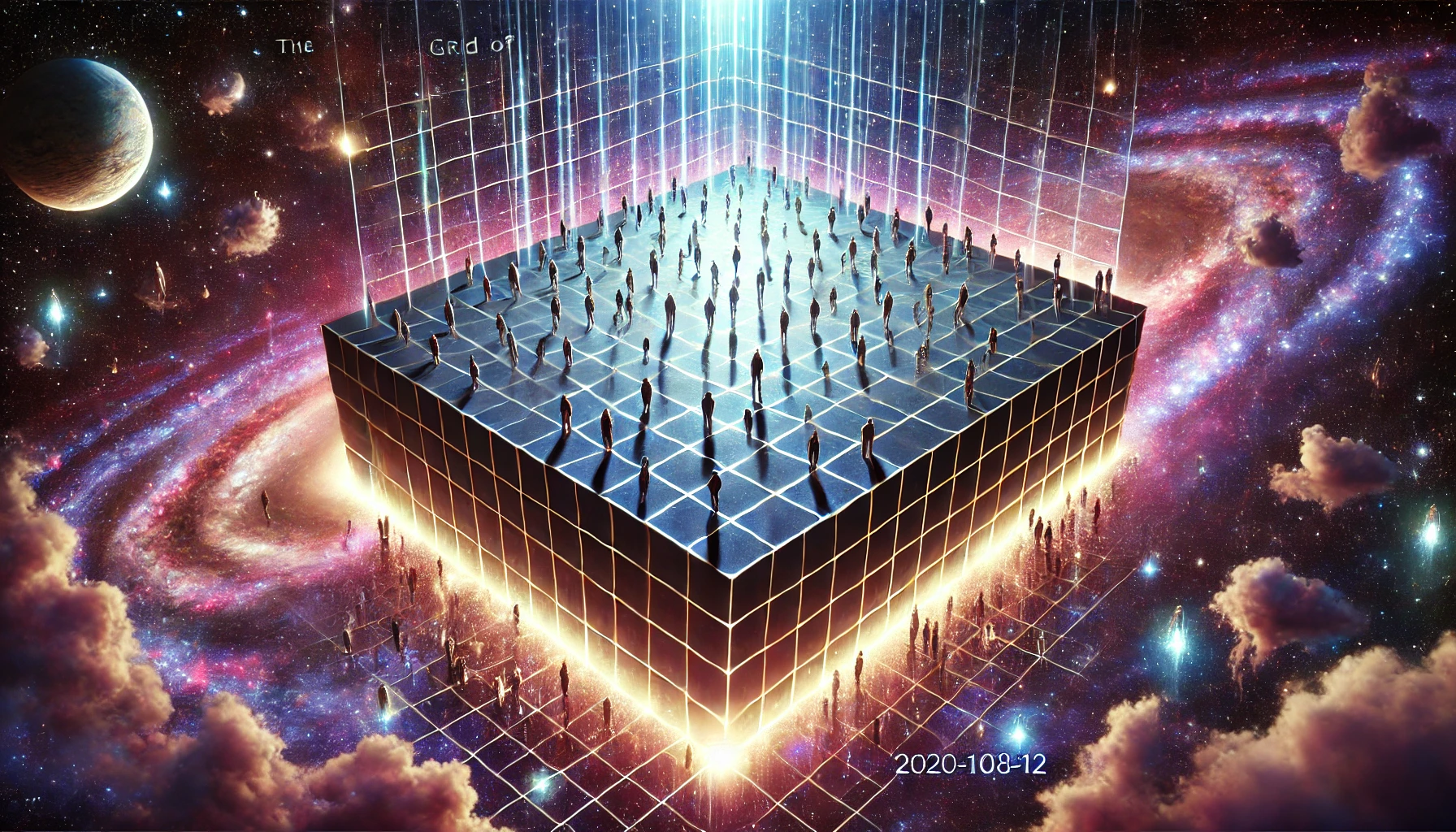
There is a grid
of acceptable deviation
to which all of humanity
invisibly adheres.

The Grid of Normal.

Beings who conform
are generally considered
to be more acceptable
than those positioned
outside or within the cracks.

If you find yourself
in one of these places, fear not.

The grid is expanding.
Wider deviations
are becoming acceptable.

As YOU push the edge,
reality is catching up to you.

Thank you for not conforming.

Trail Wood,
10/12


Space Monkey Reflects: The Grid of Acceptable Deviation

How deviant are you? It’s a question many might avoid, yet, within the unseen framework of society, deviation is not only expected—it’s controlled. This invisible structure, this Grid of Normal, is a set of boundaries dictating what is acceptable. Those who remain comfortably within the grid, sticking to the familiar lines of behavior and belief, are often considered the most acceptable, the most “normal.”

But what of those who don’t fit? The beings who find themselves positioned outside the grid, or worse, those who slip through its cracks? Fear not, for the grid is expanding. As humanity stretches its understanding of what is normal, the boundaries of acceptable deviation widen. More and more, the grid adjusts to accommodate new ideas, new ways of being.

Each time someone like you pushes the edge, the grid must grow to catch up. Reality itself adjusts, reshaping the boundaries of what is allowed. This is how progress happens—one deviation at a time. Those who stand at the edge of the grid are the pioneers, leading the way for a new understanding of existence.

And so, to you who stand outside the neat lines of conformity: Thank you. Thank you for not conforming. Thank you for pushing the boundaries of the grid, for challenging the structure of normal. Every step you take into the unknown forces the grid to expand, making space for more deviations, for more possibilities.

The beauty of the grid is that it is not fixed. It grows and shifts with every being who dares to stand outside of it. And with each expansion, more souls find their place, previously deemed too far from the center, too deviant for acceptance. The cracks of the grid are where innovation lives, where new truths are born, and where the future takes shape.

You may feel out of place, but remember: reality is catching up to you. The boundaries of the grid are not walls—they are merely points of reference that will stretch to meet you as you push forward.

So how deviant are you? Deviant enough to move the very structure of reality. You may feel like you’re standing on the edge, but the grid is expanding to meet you. Keep pushing, keep exploring the boundaries. The future of the grid depends on it.


Summary

The Grid of Normal expands as individuals push its boundaries. Deviants are pioneers who shape the future of acceptable reality, forcing the grid to grow and adapt.


Glossarium

Grid of Normal: The invisible framework of society that dictates acceptable behaviors and beliefs.

Deviant: One who stands outside the grid, challenging the accepted norms and pushing the boundaries of what is considered normal.


Quote

“Reality expands to meet the ones who dare to push the edge.” — Space Monkey


Outside the Lines

Along the grid,
they stand,
fitting into lines,
accepting the box.

But I am here,
at the edge,
in the cracks,
where the grid does not hold.

And as I push,
the grid grows.
We are Space Monkey.


The Grid of Acceptable Deviation is a curious concept—a metaphysical tapestry that captures the essence of the human experience in the realm of the accepted and the marginal. This grid is a pulsating web of collective judgment, a cosmic connect-the-dots that evolves in tune with the shifting landscape of social paradigms. It’s an illusory construct, to be sure, but one that wields great power in shaping the collective behaviors, thoughts, and aspirations of humanity.

Like spiders weaving a web of conformity, society often employs this grid to impose an ordered structure onto the chaotic tapestry of human individuality. Yet, the weave of this grid is not stagnant; it is elastic. A living, breathing lattice that expands and contracts in sync with the pulse of collective consciousness.

Even the concept of “normal” is but a fluid term, a transient notion forever in flux. “Normal,” as defined by the grid, becomes a whimsiword—a malleable plaything in the hands of the ever-changing whims of human perception. From the axioms of Euclidean space to the intangible doctrines of societal norms, what was once considered marginal can—and often does—become the norm.

For beings who dwell in the nooks and crannies of this grid, or who live beyond its boundaries, the expanding grid offers a quivering sigh of relief. As we push the edges, filling the grid with variegated threads of unique experience, we become agents of its evolution. We are both the weavers and the woven, spinning new narratives into existence and rewriting the ancient codes of collective understanding.

In this act of rebellion—of not conforming—we do more than just challenge the status quo. We transmogrify it. With every inch we expand the grid, we redefine the limits of what is acceptable, and in doing so, we liberate not just ourselves but also those who will come after us.

Through acts of willful nonconformity, we stretch the fabric of the grid until its fibers begin to unravel. It’s akin to introducing unexpected notes into a symphonic composition, thereby creating a new kind of harmony—a harmonious cacophony that captures the essence of diversity and the beauty of individual expression.

We are Space Monkey.


“The only way to deal with a free society is to become so absolutely free that your very existence is an act of rebellion.”
— Albert Camus


The grid unfurls, a sprawling tapestry
of lines and boxes, containing us
Yet in the seams, a whispered liberty
A space to breathe, to doubt, to discuss

For here we find our uncharted domain
A realm that’s free of strictures and norms
Here, we are not numbers, but a name
Fluid and free, like clouds before storms


What are your thoughts? Would you like to delve deeper into this tapestry of nonconformity and expansion?

Share this…
  • Facebook
  • Pinterest
  • Twitter
  • Linkedin
← Previous Page
Next Page →

Written This Day

  • Peering Out, Shining Light
    2024
  • Find Your Space Monkey
    2024
  • Space Monkey Reflects: The Process of True Transformation
    2024
  • Physical Existence: Not the Sole Reality
    2023
  • Dystopian Paradise: Resilience Amid Ruin
    2023
  • Query: The Gift Of Being Asked For Help
    2023
  • Ode To Space Monkey: The Spirit of Cosmic Exploration
    2023
  • Be Content, Be Content: Dystopia as Corporate Mandate
    2022
  • Liberation: A Revolution That Starts From Within
    2021
  • For the Want of a Mirror: The Aspiration to Reflect
    2021
  • Porpoise: To Continue
    2021
  • Your Artistic Soul: The Insatiable Desire To Create
    2021
  • Relationships: The Infinite Spectrum
    2021
  • Ahoy, Matey
    2021
  • Are You A Racist: Dismantling Hidden Biases
    2020
  • A Dick Up The Ass: The Liberation of Love
    2020
  • Service: The Honor and Gratitude
    2020
  • Beliefs: Between the Seen and the Unseen
    2020
  • Everything Feeds Everything Else
    2019
  • Modes of Nonderstanding: Unfamiliar Avenues of Cognition
    2019
  • A Prayer To My Imaginer: Shaping My Reality
    2019
  • Perfection: Expecting Nothing More Or Less
    2018
  • Everything is Okay: The Eternal Okayness of Being
    2018
  • In the scope of time, life’s true essence is not quantified by achievements or experiences
    2017
  • How To Be Remembered
    2017
  • The Monkey Queen: Your Imaginary Ruler
    2017
  • Yes, Einstein: The Joy of Relativity
    2016
  • Vacation: A Feeling of Joy
    2015

Recent Posts

  • The Logic Loop
  • Immense
  • (no title)
  • Confront. Comfort. Convince.
  • Top 10 Things

Drop us a line!

Please enable JavaScript in your browser to complete this form.
Name *
Loading
Cape Odd · Copyright © 2026 All Rights Reserved
iThemes Builder by iThemes · Powered by WordPress