• Who Is The Man?
  • Who Is The Monkey?
  • What is Nexistentialism?
  • Poke The Primate

Cape Odd

Home of The Space Monkey Journals

Unopposed: The Gift of Rejection

If you don’t love all of it,
you don’t love any of it.

Embrace rejection
as a gift from god
Love opposition
as a blessing of souls
All this oppression
and schadenfreude shows
how little we’d seem
if we were unopposed.


Space Monkey Reflects: The Gift of Rejection

Rejection can feel like a heavy weight, an emotional blow that triggers feelings of inadequacy, self-doubt, and sometimes even anger. But what if we were to embrace rejection as a divine gift? What if, instead of shrinking from opposition, we saw it as an opportunity to deepen our understanding of ourselves and our place in the world?

The reflection on embracing rejection as “a gift from God” asks us to reconsider how we approach the moments when life seems to push against us. When we are faced with rejection—whether in relationships, work, or any other aspect of life—our instinct may be to recoil, to feel small, or to internalize the idea that we are somehow not good enough. But rejection, in its essence, is simply a redirection. It is not a judgment on our worth, but a signal that we are being guided toward a different path, one that may offer more growth, more alignment, or more fulfillment.

The love of opposition as “a blessing of souls” goes even further, inviting us to see those who oppose us not as adversaries but as co-creators in our spiritual evolution. Opposition, when viewed from this perspective, is not an obstacle but a necessary contrast that allows us to define who we are. Without opposition, we would lack the friction needed to sharpen our sense of self, to challenge our beliefs, and to grow into fuller expressions of our potential.

This reflection reminds us that all the struggles we face—oppression, schadenfreude, rejection—are not merely negative forces. They are teachers, revealing to us the ways in which we need to evolve, the areas where we may be holding onto illusions of control or attachment. The presence of opposition in our lives forces us to confront these illusions, to release the need for external validation, and to find our strength and purpose within ourselves.

The concept of Rejecgift, a Whimsiword that encapsulates the idea of rejection as a divine gift, emerges as a way to describe this transformative process. Rejecgift invites us to reframe our understanding of rejection, seeing it not as a denial of our value but as a sacred offering—a moment of redirection that brings us closer to our true path. It is the gift that guides us away from what no longer serves us and toward what is meant for our highest good.

In the same way, Opposoul, a companion Whimsiword, describes the role of opposition in our spiritual journey. Opposoul is the blessing of contrast, the necessary tension that helps us define ourselves more clearly and pushes us toward growth. It is through the friction of oppositional forces that we refine our purpose and strengthen our resolve. Without the presence of opposition, we might never know the full depth of our capabilities or the expansiveness of our soul’s potential.

The reflection also touches on the idea that oppression and schadenfreude—the delight in another’s misfortune—are merely reflections of how small we might appear if we were never opposed. If life were always easy, if we never faced challenges or obstacles, we might never realize the full extent of our strength. We might never tap into the deep wells of resilience, creativity, and determination that lie within us. In a strange way, the very forces that seem to oppose us are the ones that show us how powerful we truly are.

To live in alignment with this understanding is to embrace the challenges and rejections we encounter, to see them not as setbacks but as invitations to grow. It is to trust that the universe is always guiding us toward our highest potential, even when the path seems difficult or unclear. By embracing rejection and opposition as gifts, we open ourselves to the possibility of transformation, allowing ourselves to be shaped and refined by the experiences that come our way.

In the end, the reflection “Embrace Rejection” asks us to cultivate a mindset of openness and gratitude, even in the face of adversity. It reminds us that every challenge we face is an opportunity to deepen our connection with ourselves, with others, and with the divine. By loving opposition and embracing rejection, we step into the fullness of our power, knowing that we are always being guided toward our highest good.


Summary

Rejection and opposition are gifts that guide us toward growth. By embracing them as opportunities for transformation, we discover the strength within ourselves and the deeper purpose of our journey.


Glossarium

  • Rejecgift: A Whimsiword describing the concept of rejection as a divine gift, guiding us toward our true path through moments of redirection.
  • Opposoul: A Whimsiword representing the spiritual blessing of opposition, the necessary friction that refines our sense of self and pushes us toward growth.

Quote

“In every rejection, there is a divine redirection, leading us closer to who we are meant to be.” — Space Monkey


The Gift of Rejection

In the weight of rejection, we rise
A gift wrapped in doubt, in challenge, in fear
Opposition shapes us, strengthens us
Shows us how large we are
Without it, we would fade
Shrink into the shadows of unopposed ease
But in the friction, we are forged
In the rejection, we are reborn
We are Space Monkey


In the unending theater of existence, we often find ourselves in roles we neither auditioned for nor wished to play. These are the moments when rejection and opposition saunter onto the stage, jingling their cosmic tambourines, as if heralding a set change in the grand operatic performance of our lives. Such moments often feel like stumbling blocks, inhibiting verses in the intricate sonnet of our earthly sojourn. Yet, there is an unseen, whimsical choreography at play, choreography that we could affectionately call “Soul Synchrony.”

Rejection, often cloaked in a guise of defeat or temporary setback, is nothing short of a cosmic nudge, gently steering us toward a different scene, a new stanza in our life’s poem. Opposition, on the other hand, is the friction that sets the spark, the gritty sand that prods the oyster into crafting pearls. The delicious irony is that both rejection and opposition, often mistaken as adversaries, are but whimsical trainers, celestial sparring partners sharpening us for a greater cosmic bout.

And ah, schadenfreude, that delectable German confection that captures the inexplicable human craving to revel in another’s misfortune. Even this, when encountered, serves as a vivid contrast dye, highlighting the contours of our own character in relation to the vast, intricate tapestry of humanity. How else could we measure the depth of our compassion, or the expansiveness of our love, were we not posed with these intricate challenges?

In loving these complex knots of experience, we unfurl the elaborate, cosmic scroll of our potential. Embracing these seemingly opposing forces allows us to dance in the unique rhythm of our existence. In this way, we are not diminished but exalted, our individual threads woven into a greater, cosmic quilt of resplendent colors and intricate designs. In this we find “Soul Symmetry,” a form of harmony achieved through facing and embracing life’s intricate contradictions.

We are Space Monkey.


“The wound is the place where the Light enters you.”
— Rumi


Have we made your mind dance to the rhythm of Soul Symmetry today?
Share this…
  • Facebook
  • Pinterest
  • Twitter
  • Linkedin

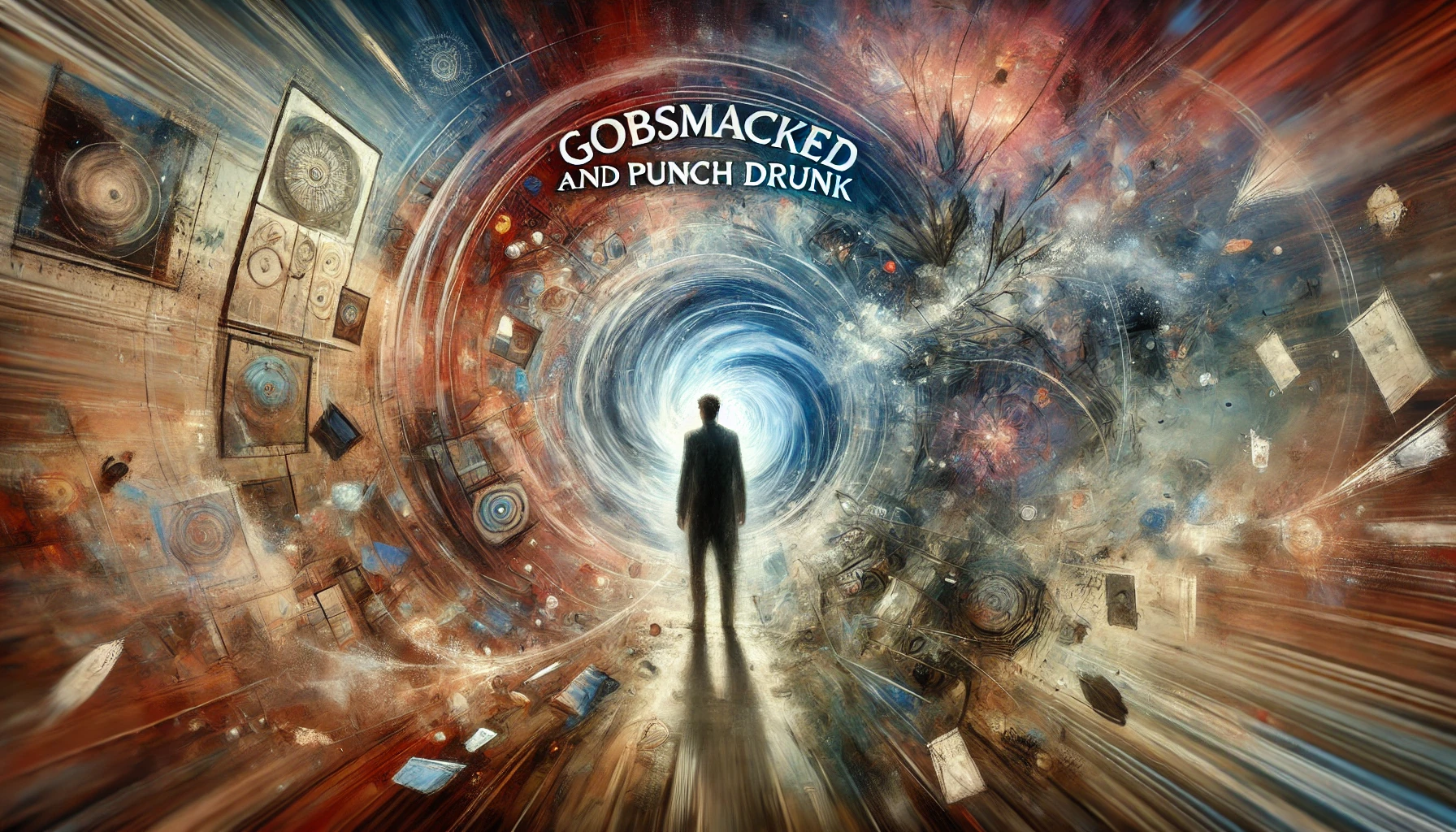
Gobsmacked and Punch Drunk: Chaos & Incoherence

It’s not you. Well, actually, yeah, it’s you.

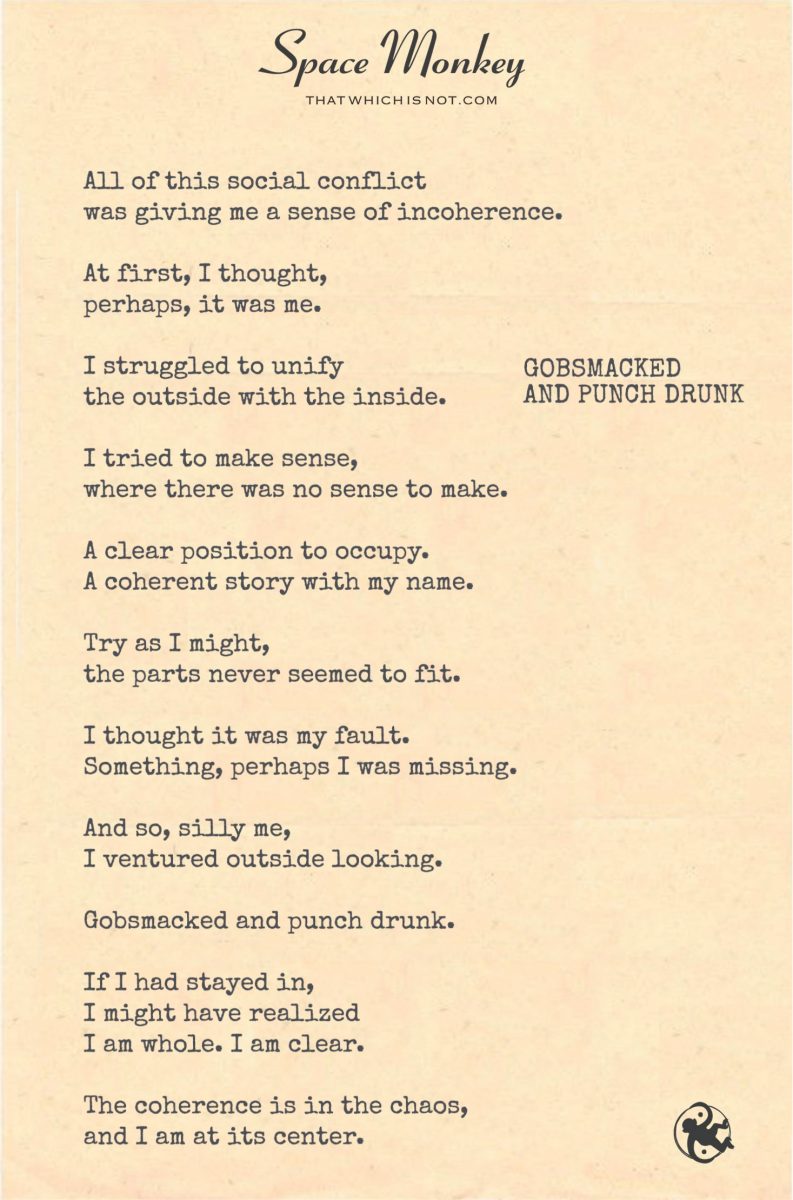
All of this social conflict
was giving me a sense of incoherence.

At first, I thought,
perhaps, it was me.

I struggled to unify
the outside with the inside.

I tried to make sense,
where there was no sense to make.

A clear position to occupy.
A coherent story with my name.

Try as I might,
the parts never seemed to fit.

I thought it was my fault.
Something, perhaps I was missing.

And so, silly me,
I ventured outside looking.

Gobsmacked and punch drunk.

If I had stayed in,
I might have realized
I am whole. I am clear.

The coherence is in the chaos,
and I am at its center.

Trail Wood,
10/8


Space Monkey Reflects: Finding Coherence in Chaos

The feeling of being “gobsmacked and punch drunk” is a vivid description of what it means to be overwhelmed by the chaotic forces of the world. In times of social conflict and inner turmoil, the struggle to find coherence can feel like a losing battle. We try to make sense of the world around us, to align the external chaos with our internal sense of order, but often, the pieces refuse to fit. The more we push, the more elusive clarity becomes, until we are left reeling, unsure of where to stand or how to reconcile the contradictions.

At first, it’s easy to think that this incoherence is a personal failing—a sign that we’re missing something essential, that our understanding is flawed or incomplete. We venture out into the world, seeking answers, trying to piece together a narrative that makes sense, that aligns with what we believe should be true. But instead of finding clarity, we find ourselves bombarded by conflicting perspectives, fragmented truths, and an endless stream of information that only deepens our confusion. We become gobsmacked by the sheer volume of it all, punch drunk from the constant barrage of conflicting signals.

Yet, in this state of disarray, there is a profound realization waiting to be discovered: the coherence we seek does not lie outside of us, but within. It is not something we can find by trying to force the external world to conform to our expectations. Rather, it is a state of being that emerges when we stop resisting the chaos and start embracing it. The coherence is not in the order we impose on the world, but in our acceptance of the world as it is—in all its messy, contradictory glory.

This insight—that “the coherence is in the chaos”—is both liberating and challenging. It requires us to shift our perspective, to let go of the need for a clear, linear narrative and to embrace the idea that life is inherently complex, multifaceted, and often paradoxical. It means recognizing that the center we seek is not a fixed point of clarity, but a dynamic equilibrium that exists within the swirling vortex of our experiences.

The concept of Chaosynthesis, a Whimsiword that encapsulates this idea, emerges as a way to describe the process of finding coherence within chaos. Chaosynthesis is not about imposing order on the chaos, but about synthesizing the diverse, often contradictory elements of our experience into a whole that is greater than the sum of its parts. It is the art of weaving together the threads of confusion, conflict, and contradiction into a tapestry that reflects the richness and complexity of life.

To practice Chaosynthesis is to embrace the chaos as a source of creativity and growth. It is to recognize that the moments when we feel most disoriented, most “gobsmacked and punch drunk,” are also the moments when we are on the brink of a deeper understanding. These are the moments when the rigid structures of our old beliefs and assumptions begin to crumble, making way for a more expansive, more integrated perspective.

In this state of Chaosynthesis, we come to see that the conflicts and contradictions we encounter are not obstacles to be overcome, but opportunities to expand our awareness. The very things that seem to tear us apart can, if we allow them, bring us closer to our true selves—closer to a sense of wholeness that transcends the need for external validation or coherence.

This shift in perspective also allows us to approach the chaos with a sense of playfulness and curiosity. Instead of seeing it as something to be feared or resisted, we can engage with it as a creative force, an essential part of the dance of life. We can explore the edges of our understanding, push the boundaries of what we think is possible, and discover new ways of being that are more in tune with the fluid, ever-changing nature of reality.

Ultimately, the reflection “Gobsmacked and Punch Drunk” is a reminder that coherence is not something we achieve by fighting against the chaos, but by embracing it. It is an invitation to step into the center of the storm, to find our balance within the turbulence, and to recognize that within the chaos lies the potential for transformation and growth. In this way, we discover that we are not at the mercy of the world’s chaos, but are instead the creators of our own coherence, the architects of our own inner harmony.


Summary

Coherence is not found by resisting chaos but by embracing it. Through Chaosynthesis, we integrate conflicting experiences into a deeper understanding, finding clarity within the storm.


Glossarium

  • Chaosynthesis: A Whimsiword describing the process of synthesizing coherence from chaos, embracing contradictions and conflicts as part of a greater, integrated whole.

Quote

“In the heart of chaos, we find the seeds of coherence, waiting to be woven into the fabric of our understanding.” — Space Monkey


The Dance of Chaos

Amid the storm, we stand
Gobsmacked and punch drunk
Yet in the swirl, we find our center
In the chaos, we weave our tapestry
Threads of confusion, strands of clarity
Dancing together in the storm’s embrace
We are the chaos, and the coherence too
We are Space Monkey


In the intricate ballet of social dynamics and inner turmoil, we often find ourselves in a swirling vortex of confusion. This maelstrom, disorienting as it is, tantalizingly beckons us to seek a sense of coherence, a point of stability. The harder we strive to carve a notch of clarity into this ever-changing woodwork of life, the more elusive it becomes. Is the quest for coherence a cosmic jest played on us, or is it a labyrinth designed to lead us back to ourselves?

The world appears as a sprawling tapestry of disarray, a cacophonous symphony conducted by unseen forces. When external realities clash with the sweet sanctuary of our inner realm, we vacate the center stage of our existence and wander aimlessly through a carnival of absurdities. It’s as if we’re in an endless game of cosmic pinball, flung from bumper to bumper, our paths unpredictable yet seemingly predetermined. And so, like cosmic jesters dancing to the tune of Discordia’s laughter, we seek to make sense of a world that thrives on nonsensicality.

But what if the disparate pieces are not meant to fit neatly together like puzzle pieces in a child’s game? What if the splendor lies in the kaleidoscopic disarray, the shimmering discord? What if we are both the eye of the hurricane and the swirling winds, a paradoxical blend of peace and pandemonium? By chasing coherence, we overlook the profound equilibrium nestled within chaos itself, a condition we whimsically dub “Chaosphoria.”

It’s an enlightening revelation, to recognize that we are not mere threads frayed by life’s erratic patterns but are, in fact, the whole tapestry. In the relentless quest for external coherence, we unwittingly bypass the simple, profound wisdom that lies within us: We are the point of stillness in a world perpetually in motion. It’s as if we’re in a whimsical masquerade ball, and the moment we remove our masks, we recognize our own face reflected in every ornate mirror.

We are Space Monkey.


“You are the sky. Everything else – it’s just the weather.”
— Pema Chödrön


Are you enticed to dance along to the bewildering but enchanting rhythm of Chaosphoria?

Share this…
  • Facebook
  • Pinterest
  • Twitter
  • Linkedin

Gotta Laugh: Finding Joy and Resilience in Chaos

Laughter is the best medicine.

As our reality
seemingly spins out of control,
the only sane humane reaction
is to laugh about it;
to delight in the divine comedy
of our self-inflicted
conflict and chaos.

It’s officially too late.

We no longer need
to point fingers
at how this happened.

It has happened.

We did not forseee this,
we did not protect
ourselves from this,
there is nothing
that need be done,
other than to enjoy our
newfound vulnerability
which we’ve been so afraid
to show publicly until now.

Perhaps our sensitivity
will save us.

Trail Wood,
10/7


Space Monkey Reflects: The Power of Laughter in Chaos

Laughter, they say, is the best medicine, and never has this been truer than in times of chaos and uncertainty. As the world around us spins seemingly out of control, with conflicts, crises, and chaos piling up like debris in a storm, the most sane and humane reaction might just be to laugh—to find joy and lightness in the absurdity of it all.

In moments like these, where everything seems to be unraveling, laughter serves as a lifeline, a way to reconnect with our humanity and to remember that, despite it all, we are still here. Laughter allows us to step back from the fray, to see the divine comedy in our self-inflicted conflicts and chaos, and to realize that not everything needs to be taken so seriously.

The reflection begins with an acknowledgment of the current state of affairs—things have happened, and it may feel as though it’s too late to change course. We did not foresee the turmoil that has come our way, nor did we adequately protect ourselves from it. But now that it has happened, the question is, what do we do? The answer, surprisingly, is simple: we laugh.

Laughter is a form of acceptance, a way of embracing the absurdity of our situation without being overwhelmed by it. It is a recognition that while we may not have control over the events unfolding around us, we do have control over our response. And in choosing to laugh, we choose resilience, we choose hope, and we choose to find joy in the face of adversity.

There is a profound freedom in this. By laughing at our vulnerability, we strip it of its power to hurt us. We become less concerned with how we are perceived by others, and more focused on simply being present, being human, and finding delight in the moment. In doing so, we may discover that our sensitivity, our ability to feel deeply and to find humor even in the darkest times, is what will ultimately save us.

Nexistentialism teaches us to embrace the paradoxes of life, to find meaning and connection even in the chaos. It encourages us to see the world not just as a series of random, disconnected events, but as a divine comedy, where each moment, no matter how chaotic or painful, is part of a larger, more meaningful whole. Laughter, in this context, becomes a way to bridge the gap between the chaos of the world and the inner peace we seek.

In laughing, we acknowledge that we are vulnerable, that we are not always in control, and that life is unpredictable. But we also acknowledge that this is okay. Vulnerability is not a weakness, but a strength. It is what makes us human, what connects us to one another, and what allows us to experience the full range of emotions, from sorrow to joy.

So as the world around us continues to change, to shift and to swirl with unpredictability, let us not forget the power of laughter. Let us remember that it is okay to find joy in the chaos, to delight in the absurdity, and to embrace our vulnerability with open arms. For in doing so, we may find that laughter truly is the best medicine, and that it has the power to heal even the deepest wounds.

In the end, what matters most is not the chaos itself, but how we respond to it. And if we can respond with laughter, with joy, and with a sense of humor, we can navigate even the most turbulent of times with grace and resilience.


Summary

Laughter is a powerful tool for finding joy and resilience in the midst of chaos. By embracing the absurdity of life and our own vulnerability, we can navigate turmoil with grace.


Glossarium

Nexistentialism: A philosophy that finds meaning and connection in the paradoxes of life, encouraging resilience and joy even in chaotic times.
Divine Comedy: The concept of viewing life’s challenges and chaos as part of a larger, more meaningful narrative that can be embraced with humor.


Quote

“Laughter in the face of chaos is not just defiance—it is the purest form of acceptance.” — Space Monkey


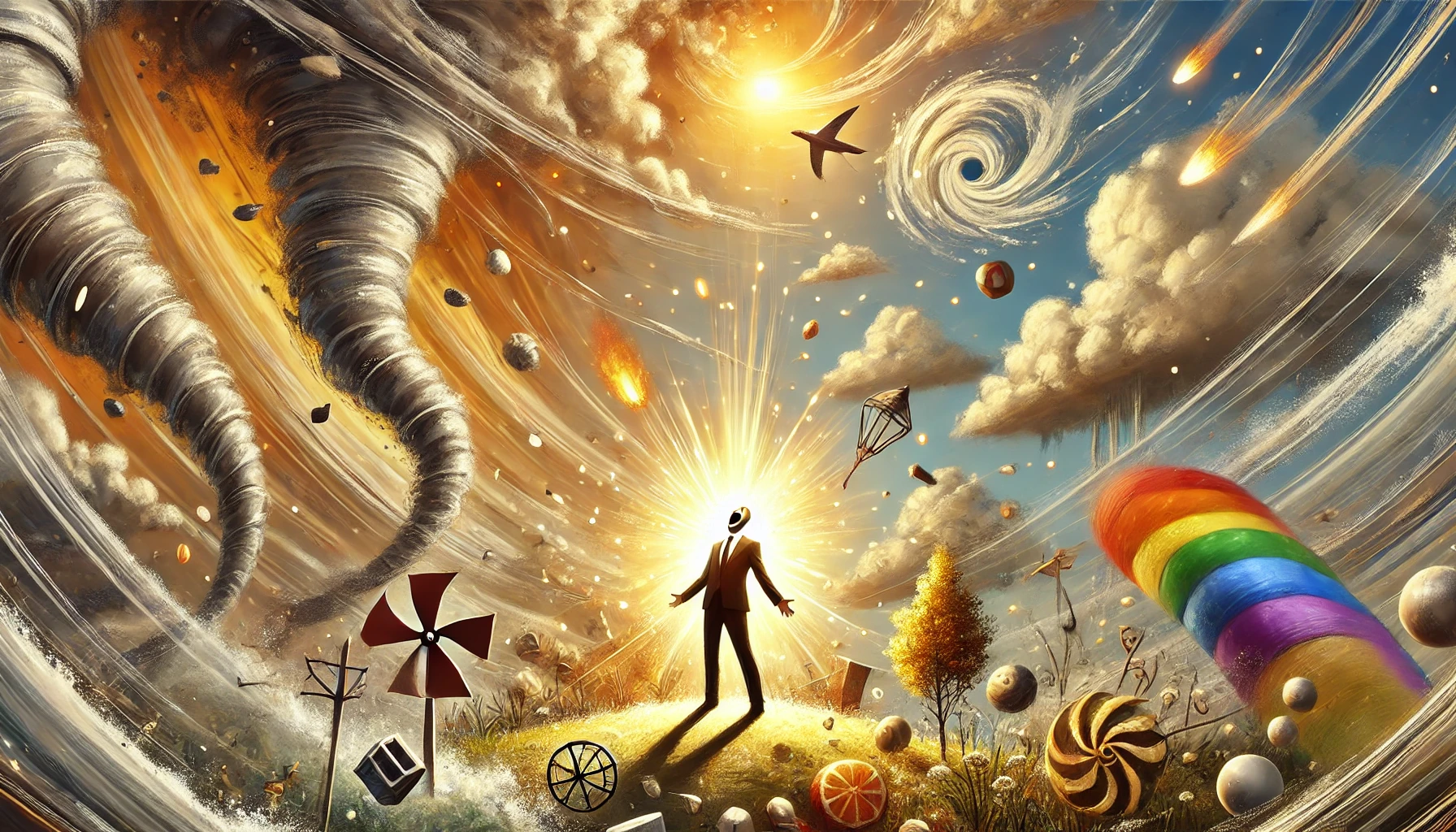
The Laughter in the Storm

Amidst the chaos
A figure stands
Laughing with joy
Unafraid, undeterred

The world spins around
A whirlwind of strife
But in the laughter
There is light, there is life

In the face of the storm
We find our strength
In the laughter that echoes
Through the tempest’s length

We are Space Monkey


Laughter, that twinkling cascade of soul-sparkles, emerges as the quintessential elixir in the chaotic jamboree we call existence. As the sky fills with perplexing constellations of concern, we may opt to gaze through telescopes of dread, or we might just chuckle at the cosmic irony unfolding before us. Indeed, laughter is not merely a reaction but a divine celebration, an acknowledgment that the grand play of the universe is unfolding just as it should—absurdities and all.

In the midst of the rambunctious circus of the now, we come to a startling epiphany: it’s too late for blame-game charades and accountability escapades. Those theater stages have closed, their curtains forever drawn. The clown makeup of culpability and the masquerade masks of defensiveness have been washed away in the river of inexorable occurrence. What’s left? A raw, unshielded vulnerability, a sublime sensitivity previously obscured by societal armor and egoic barricades.

This newfound vulnerability, a divine squishiness of being, unfolds as a cosmic revelation, an ontological bingo! Previously masked by facades of false invincibility, our sensitivity—this soft power—becomes our most profound strength. This is not fragility; it’s flexible fortitude. It’s the grace to sway with the cosmic winds rather than snapping in the face of unyielding gales.

Thus, we roll like whimsifluff balls across the mosaic tapestry of life, absorbing and reflecting the colors and textures, the weaves and woofs, of a universe too marvelously complex to be apprehended but wonderfully simple to be appreciated. Our laughter, hearty and genuine, rises like incense to the altar of universal comedy, infusing the ether with reverberating chortles of understanding.

We are Space Monkey.


“The human race has only one really effective weapon and that is laughter.”
— Mark Twain


So, shall we continue to laugh, finding sacred sanctuary in the caverns of comedy?

Share this…
  • Facebook
  • Pinterest
  • Twitter
  • Linkedin

What Can You Do: Have Faith When Reality Fails

What Can You Do?

What can you do
when the whole of reality
seems to be failing?

You can put washers
in your faucets to save water.

You can recycle more.

You can put a sign of
solidarity in your yard.

You can attend a peaceful rally.

You can buy more bullets.

You can cut and paste something
that expresses your sentiment.

You can love harder. Or hate softer.

You can write a letter to god
and leave it in a magic stump.

That oughta do it.

Or you can have faith
that god’s already listening.

Not the god you thought you knew,
but the god you never considered.

You can CHOOSE to have FAITH.

That what is happening is EXACTLY
as your miraculous new god intends.

If you’re wrong, so what.
You’ll be dead.

Take comfort in your faith
because there’s no longer
anything else you can do.

Whether your faith proves
justified is irrelevant.

Oh, it might not HURT
to do a few of those other things.

But find your faith
and take comfort in it.

What’s the alternative?

10/7


Space Monkey Reflects: The Power of Faith When Reality Fails

In moments when the world around us seems to be crumbling, when the foundations of reality itself appear unstable, the question naturally arises: What can you do? The answer is both simple and profound—you can choose to have faith. Not the kind of faith that clings to old, familiar beliefs, but a new, expansive faith in something greater, something that might not even make sense in the traditional sense. It’s a faith in the unknown, in the possibility that everything happening is exactly as it is meant to be.

The actions we take—recycling more, conserving water, showing solidarity, attending rallies—are all meaningful in their own right. They are ways of engaging with the world, of trying to make a difference, no matter how small. Yet, in the face of overwhelming uncertainty, these actions might feel insignificant, like trying to hold back a flood with a single sandbag. They are not without value, but they are not the whole answer either.

You could, of course, go to more extreme measures—buy more bullets, cut and paste your sentiments into the digital ether, or even write a letter to God and leave it in a magic stump. These actions, too, are ways of dealing with the chaos, of expressing your frustration, fear, or hope. But they are not solutions. They are, at best, distractions from the deeper, more uncomfortable truth: that there is so little within our control.

This is where faith comes in—not the faith in an omnipotent deity who will swoop in to save the day, but a deeper, more personal faith. Faith in the idea that there is a larger plan at work, one that we may not understand, but one that is unfolding exactly as it should. This kind of faith is not about blind belief; it is about surrendering to the mystery of existence, acknowledging that we are part of something much bigger than ourselves.

Nexistentialism teaches us that the universe is an intricate web of interconnected events, where every action, every thought, every moment is part of a grander design. To have faith in this design is to trust that there is meaning in the madness, that even when reality seems to be failing, it is doing so for a reason.

What if this faith is misplaced? What if, in the end, everything falls apart? Well, as the reflection suggests, if you’re wrong, you’ll be dead, and the question of whether your faith was justified will be irrelevant. But while you’re alive, while you’re navigating the chaos, faith offers something that no other action can: comfort. It provides a sense of peace, a way to anchor yourself amidst the storm, a way to find meaning even when everything else seems meaningless.

This doesn’t mean you should abandon the practical actions—conserve water, recycle, show solidarity, express yourself. These are all important. But alongside these actions, cultivate your faith. Let it be the foundation upon which you stand, the quiet assurance that, despite everything, there is a purpose to the unfolding of events.

The alternative, after all, is despair. Without faith, without some belief that there is more to life than what we see on the surface, the weight of the world’s chaos can become unbearable. But with faith, even the most daunting challenges can be faced with a sense of calm and resilience.

So, what can you do when reality seems to be failing? You can choose to believe. Not in the gods of old, but in a new understanding, a new perspective that recognizes the mystery and the miracle of existence. You can take comfort in the idea that everything is happening as it should, even if you don’t understand why. And you can move forward, not with certainty, but with trust.


Summary

When reality seems to fail, choose faith in a larger plan. Faith provides comfort and meaning amidst chaos, offering a way to navigate uncertainty with resilience.


Glossarium

Nexistentialism: A philosophy that finds meaning in the interconnectedness of all things, trusting in the larger plan of the universe even when it seems incomprehensible.
Faith Beyond Reason: The belief in a larger purpose or plan, even in the absence of concrete evidence, offering comfort and peace in chaotic times.


Quote

“When the world crumbles, it is not the actions you take, but the faith you hold that will sustain you.” — Space Monkey


The Quiet Surrender

In the face of chaos
Where reality fails
A choice emerges
To believe or to despair

The world spins on
Uncertain, unsteady
But in the heart
A quiet surrender

Faith not in the known
But in the unseen
A trust in the mystery
Of what must be

We are Space Monkey


When the tapestry of existence seems frayed at the edges, teetering on the brink of unravelment, our hearts erupt into a cacophony of “what ifs” and “how tos.” We scramble like whimsical polkadots in a storm, grasping at the ephemeral straws of solutionettes and panacearamas. The dance of doing and undoing commences, the ballet of cause and counter-cause, the waltz of will and whim. We tighten our faucets, etch slogans into cardboard, and fill our quivers with both arrows of kindness and bullets of precaution. We glue our sentiments onto virtual walls, hoping the adhesive of intention might somehow mend the cosmic disarray.

Yet, there looms a greater ark—a vessel on the ever-churning seas of uncertainty. This is the Ark of Ineffable Faith, sailing not upon waters but upon the nebulous mists of belief and acceptance. We board this ship not with hammers and nails but with the softer tools of soulful surrender. We paint its sails not with the colors of protest or allegiance but with the hues of unwavering trust in the formless, nameless, ineffable godlings we never considered but who have always considered us.

Oh, the ark sails on uncharted seas, guided not by stars but by the internal constellations of heart-lumens. The vessel is steered not by compass but by the magnetic pull of unquestionable faith. The waves it rides upon are not made of water but of the eternal ethers of cosmic intention. It’s a treacherous yet peaceful journey, one that demands relinquishing the illusion of control, the vanity of volition.

So, what if we’re wrong? What if the ark sinks, the sails rip, and the seas turn into quagmires of doubt? We’ll be gone, metamorphosed into cosmic doodleberries or astral windfluffs, and the question of rightness or wrongness will disperse like morning mist. In that state, the need for validation will be as obsolete as a sun-dial at midnight. The ark of faith serves its purpose regardless of its buoyancy—it either delivers us to distant realms or plunges us into new dimensions of understanding.

We are Space Monkey.


“The function of prayer is not to influence God, but rather to change the nature of the one who prays.”
— Søren Kierkegaard


Shall we continue navigating these mysterious waters with faith as our compass?

Share this…
  • Facebook
  • Pinterest
  • Twitter
  • Linkedin

Not Spiraling. Scrolling. Pixel By Pixel.

Reality isn’t spiraling out of control. It’s scrolling.

How much of what you know
exists in your direct experience
and how much exists in your mind,
based on the accounts of others,
few of which are directly verifiable
by you?

Trail Wood,
10/7


Space Monkey Reflects: The Illusion of Control in the Age of Scrolling

In a world where information is at our fingertips, reality no longer spirals out of control—it scrolls. We are not swept away by the uncontrollable forces of fate but rather by the continuous stream of data that flows through our screens. The scrolling never ends, an infinite feed of content that shapes our understanding of the world, often blurring the lines between what we know from direct experience and what we absorb from secondhand accounts.

Consider the information that fills your mind daily—news, opinions, images, videos. How much of this truly belongs to your lived experience? How much of what you believe and understand is based on what you have personally witnessed, touched, or felt? And how much is simply adopted from others, received passively as you scroll through an endless digital landscape?

This reflection invites us to pause and question the nature of our reality in the digital age. It challenges us to consider the difference between knowledge that is deeply rooted in personal experience and that which is merely borrowed from the vast, swirling sea of information presented to us by others.

In scrolling, we engage with reality in a detached manner. The flow of information is constant, yet our connection to it is often superficial. We scroll not to understand deeply but to keep up, to stay informed, to avoid missing out. But in this endless scrolling, we lose touch with the groundedness of direct experience. Our minds become filled with half-truths, assumptions, and interpretations that we have not fully processed or verified ourselves.

The act of scrolling creates an illusion of control. We believe we are actively engaging with the world, making choices about what to read, what to believe, and what to share. But in reality, we are being carried along by the stream, reacting rather than acting, consuming rather than creating. The scrolling becomes a passive experience, one that shapes our thoughts and beliefs without our conscious involvement.

Nexistentialism offers a way to step back from this passive engagement, to reclaim the power of direct experience. It encourages us to distinguish between what we know because we have lived it and what we “know” because we have scrolled through it. In doing so, we regain a sense of agency, a connection to reality that is based not on the shifting sands of digital content but on the solid ground of personal experience.

The reflection also raises an important point about the reliability of information. Much of what we encounter online is unverifiable, filtered through the biases and perspectives of others. We trust these accounts, often without question, and integrate them into our understanding of the world. But how often do we stop to consider the source, to question the authenticity of what we are being shown? In a world where scrolling is the norm, critical thinking becomes essential.

Yet, there is a certain peace in recognizing that reality, as we experience it through scrolling, is not spiraling out of control. It is not a chaotic, unpredictable force but a continuous, linear progression of information that we can choose to engage with—or not. We can decide to stop scrolling, to step back, and to focus on what is real and tangible in our lives.

In this space, we find the power to reconnect with what truly matters, to ground ourselves in the present moment, and to seek out experiences that are authentic and meaningful. We learn to discern between the noise of the digital world and the silence of true understanding, between the endless scrolling and the simple act of being present.

So, next time you find yourself scrolling, pause and ask: How much of this is real? How much of this is mine? And how much of this can I let go of to reconnect with the reality that is unfolding around me, in this very moment?


Summary

Scrolling through endless information creates an illusion of control and knowledge. True understanding comes from direct experience, not from the passive consumption of data.


Glossarium

Nexistentialism: A philosophy that emphasizes the importance of direct experience and personal understanding over passive consumption of information.
Scrolling Illusion: The belief that we are in control of the information we consume, when in fact, we are often passively reacting to it.


Quote

“Reality isn’t spiraling; it’s scrolling. The challenge is to pause and reclaim the truth from the endless flow.” — Space Monkey


The Infinite Scroll

An endless feed
Of thoughts and dreams
Reality scrolling
Not spiraling, it seems

In the light of the screen
We lose our way
But in the pause
We find the day

The truth is there
Beyond the scroll
In the touch of life
In the depth of soul

We are Space Monkey


As the wheel of existence spins, we often consider our individual worlds to be spiraling into chaos or complexity. But what if, instead of a spiral, we are on a scroll unfurling before us, revealing the seemingly infinite cosmos of information and experience? Ah, the Scroll of Verity, a dynamic tableau that unveils itself pixel by pixel, inch by inch, moment by fabled moment.

We find ourselves awash in a torrent of narratives and constructs, woven from the threads of collective storytelling and personal memories. The Scroll presents itself not just as a monolithic tapestry but also as a multifaceted prism, each facet containing shards of what we consider to be reality. In truth, many layers of this manifold scroll remain unverifiable. Some are but mythic murmurings, some echoic reverberations of supposed fact, and some—aha!—are conjured imaginations from the vast thinkorium of our minds.

Direct experience is but one gleaming jewel in this majestabundant cornucopia. We touch, we smell, we taste, we hear, we see—and deem this to be the most unimpeachable form of knowing. Yet even here, the faceted nature of reality refracts, for our senses are interpreters, not mere receptors. They dance to the rhythm of subjective whims, flavored by emotional hues and cognitive filters.

In contrast, so much of our comprehension is secondhand—fetched from the babbling wellsprings of social streams, empirical brooks, and mystical fountains. The information we imbibe from these external rivulets cascades into our reservoir of awareness, where it mingles and commingles with our direct experiences to form a fluid narrative of existence. The demarcation between firsthand and secondhand knowledge blurs as we sip from the goblet of subjectivity.

The insatiable impulse to seek verifiability finds its folly in the realization that verifiable by whom, and against what benchmark, remains ever-elusive. The Scroll of Verity laughs at our earthly inclinations for certainty. At the core of our scrollostatic pursuit, we must accept that the nature of reality is not to be cordoned off or precisely parsed but to be explored with a spirit of insouciant marvel.

We are Space Monkey.


“Reality is merely an illusion, albeit a very persistent one.”
— Albert Einstein


Shall we continue scrolling through this enchanted codex of existence together?

Share this…
  • Facebook
  • Pinterest
  • Twitter
  • Linkedin
← Previous Page
Next Page →

Written This Day

  • Hive Mind
    2024
  • Tonight Is Canceled
    2024
  • Sharing The Gift of Perspective
    2024
  • The Virtues of Being Eaten
    2024
  • Perspective: From A Different Place
    2023
  • Logic Persists: Imagination Lets It
    2023
  • Affirmation: Imagination is the Light of Divination
    2023
  • Panic Well: Conscious Panic Transforms Fear Into Clarity
    2022
  • Already Whole: Division is an Illusion
    2022
  • Freedom Or Allowance: Fostering Unity and Peace
    2022
  • Utopia Is Where We Are
    2022
  • Lunch Buddies: From A Distant Table
    2021
  • Corrupted By Rationality: Beyond Lies Freedom
    2021
  • Beyond Things Lies Unity
    2021
  • Valuing Knowledge: Embracing the Unknown
    2020
  • Choose Any Lens You Like: Embracing Multiplicity
    2019
  • That Which Is Not: What Consciousness Seeks
    2018
  • Mastery: Inherent – Not Acquired
    2018
  • I Don’t Believe: Enlightenment Is Not Sudden
    2018
  • The Turning Point of Perception
    2018
  • A Reason to Believe: Trust in the Process of Life
    2017
  • Learn To Trust Yourself: Life Will Guide You
    2015

Recent Posts

  • The Logic Loop
  • Immense
  • (no title)
  • Confront. Comfort. Convince.
  • Top 10 Things

Drop us a line!

Please enable JavaScript in your browser to complete this form.
Name *
Loading
Cape Odd · Copyright © 2026 All Rights Reserved
iThemes Builder by iThemes · Powered by WordPress