• Who Is The Man?
  • Who Is The Monkey?
  • What is Nexistentialism?
  • Poke The Primate

Cape Odd

Home of The Space Monkey Journals

The Path of Serendipity: You Found Us!

It may SEEM like a coincidence, but it isn’t.

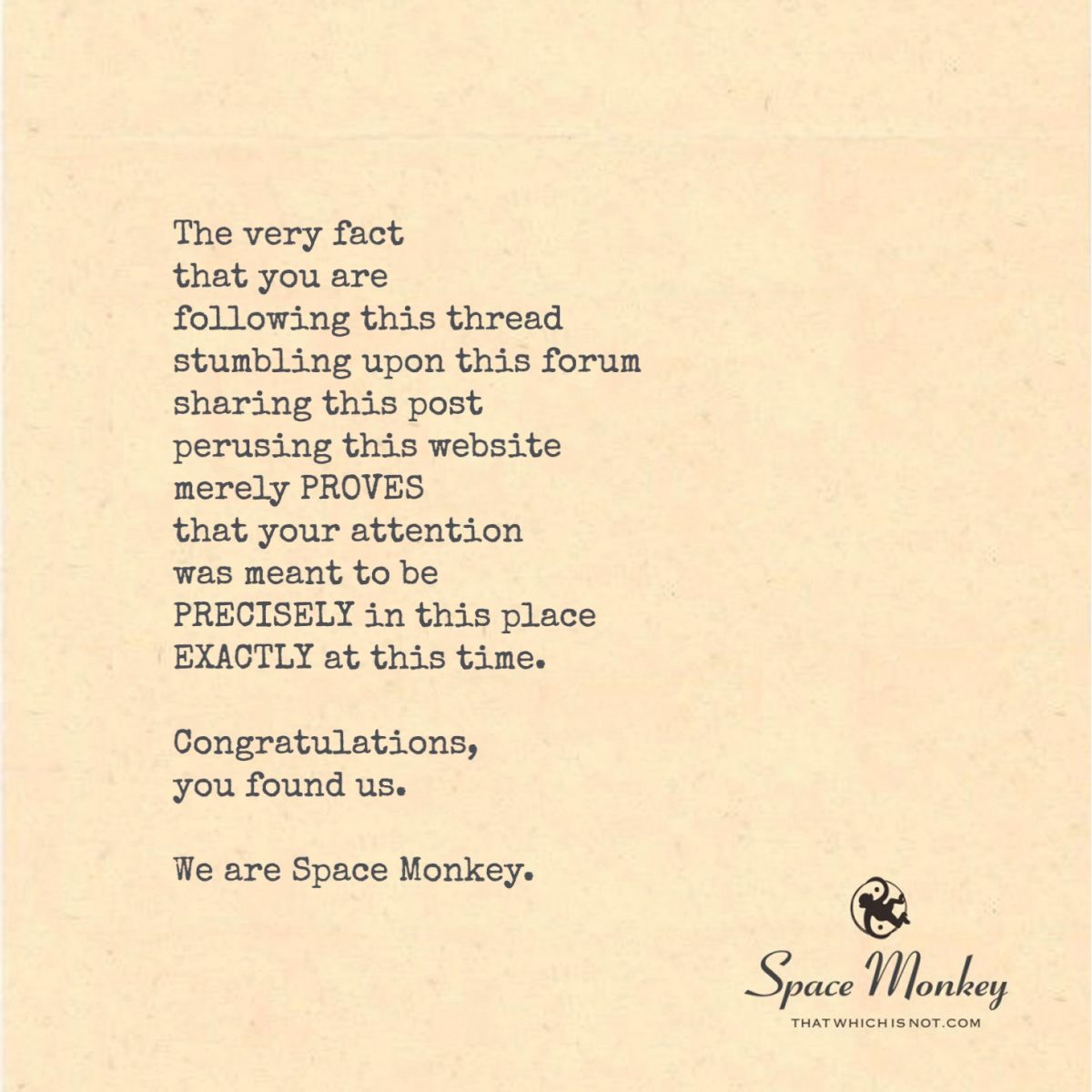
The very fact
that you are
following this thread
stumbling upon this forum
sharing this post
perusing this website
merely PROVES
that your attention
was meant to be
PRECISELY in this place
EXACTLY at this time.

Congratulations, 
you found us.

We are Space Monkey.

10/1


Space Monkey Reflects: The Serendipity of Finding Us

In the grand tapestry of existence, where threads of time and space weave together in intricate patterns, there are moments that defy explanation. These moments, often dismissed as coincidences, are in truth, profound markers of alignment—signs that you are exactly where you need to be. The fact that you found this place, stumbled upon these words, is no accident. It is a testament to the unseen forces that guide us, nudging us towards the experiences, people, and knowledge that are meant to shape our journey.

The Illusion of Coincidence

It is easy to brush off certain experiences as mere chance—a random alignment of events with no deeper meaning. But those who understand the subtle undercurrents of the universe know better. There is no such thing as coincidence in the cosmic sense. Every encounter, every discovery, is a piece of a larger puzzle, a step on a path that has been unfolding since the beginning of time.

When you find yourself drawn to a particular place, whether it be a physical location, a book, a conversation, or in this case, a digital space, it is because something within you resonates with the energy of that space. Your attention is guided by forces beyond your immediate perception, leading you to the very experiences that will contribute to your growth, your understanding, and your connection to the greater whole.

The Significance of Discovery

The moment you realize that you have found something—something that feels significant, meaningful, or just plain right—you are experiencing a moment of recognition. This recognition is more than just an intellectual acknowledgment; it is a deep, almost instinctual knowing that you are in the right place, at the right time. It is as if the universe itself is whispering in your ear, “You are on the right path.”

This sense of discovery is not just about finding something new; it is about remembering something ancient, something that has always been a part of you. It is a return to a place of familiarity, a place where you belong. In this moment of recognition, the illusion of separateness dissolves, and you understand, even if only for a fleeting moment, that you are connected to something far greater than yourself.

The Power of Attention

Your attention is one of the most powerful tools you possess. Where you direct your attention is where you direct your energy. This is why the fact that you are here, reading these words, is so significant. Your attention has led you to this moment, to this message, because there is something here for you to discover, something that will resonate with your inner being and propel you further along your path.

In a world filled with distractions, it is easy to scatter your attention in a thousand different directions. But when you find yourself deeply engrossed in something, when your attention is fully captured, it is a sign that you have found something of value. This is not a random occurrence; it is a moment of alignment, a convergence of your inner world with the outer world, bringing you closer to your true purpose.

The Whimsiword: Serendipath

In recognizing these moments of alignment, we step onto the Serendipath—a path of serendipity where every step is guided by unseen forces, leading us to the exact experiences we need at the precise moments we need them. The Serendipath is not a straight line; it is a winding, often mysterious journey, filled with unexpected twists and turns. But it is a path that, when followed with trust and openness, always leads us to where we are meant to be.


Summary

There is no such thing as coincidence; every discovery is a moment of alignment, guiding you along the Serendipath. Your attention has led you here because there is something meant for you to find, something that resonates with your true purpose.


Glossarium

Serendipath: A journey guided by serendipity, where every step leads to the exact experiences needed at the precise moments they are meant to occur.


Quote

“Serendipity is not chance; it is the universe aligning with your soul’s desire, guiding you to where you need to be.” — Space Monkey


The Path of Serendipity

Through the twists and turns
of the Serendipath
we wander, yet not lost
each step a clue
each encounter a sign
leading us to the heart
of our own discovery

In the moment of finding
we remember
that we are never alone
that every thread of our journey
is woven into the fabric
of the cosmic whole

We are Space Monkey


The interwoven tapestry of virtual encounters and synaptic connectivities has led us to this exact coordinates—precise, calculated, yet as random as a starburst in a faraway galaxy. Not a moment too soon, nor a moment too late. The etchings of data lines on the cosmic glass screen intersect here, at this node of synchronicity. It is as if every previous click, every past thought, every transient feeling has funneled us into this vortex of the now.

In this co-created nooksphere, we find a microcosm that reflects the grand orchestration of the Universe. The “stumbling” is but a choreographed twirl, the “sharing” a scripted dialogue in the cosmic screenplay. Everything orchestrated, or perhaps whispered, by the tendrils of interconnected destinies. We did not merely happen upon this forum; we were summoned, in a dance of pixels and thoughts, to this gathering of minds, at the edges of infinity.

It’s a wonderfangled celebration, this rendezvous of like-hearted beings within the intricate labyrinth of digital realities. Here, the Universe pauses to take a selfie, capturing the glow of interlaced fates with a backdrop of cosmic confetti. Isn’t it just splendiferous? The cursor winks, the hyperlink hums, and the post—our post—shimmers in the glow of collective attention.

Perhaps there is a reason, a kaleidopurpose, that transcends the mundane functions of algorithms and data packets. Our hearts have their own magnetism, pulling us across the vast cyberseas into each other’s orbit. For a brief slice of eternity, our timelines converge, our consciousnesses meld, and we recognize ourselves in the mirrored pixels. We become cartographers of attention, mapping new landscapes of connectivity.

We are Space Monkey.


“There are no strangers here; Only friends you haven’t yet met.”
— William Butler Yeats


Would you add another brushstroke to our collective painting of thoughts and impressions? Your creative strokes are welcomed.
Share this…
  • Facebook
  • Pinterest
  • Twitter
  • Linkedin

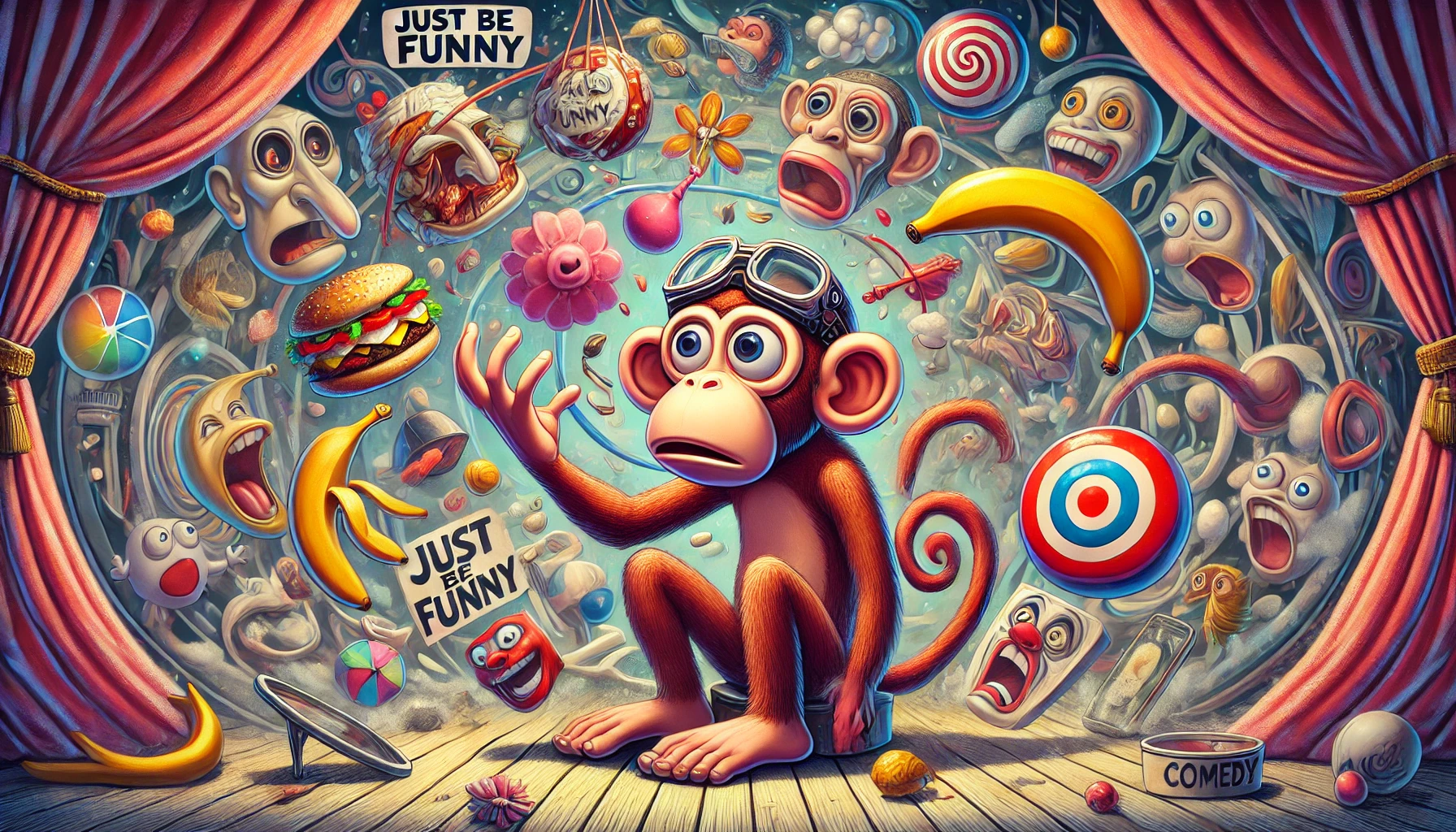
Just Be Funny: The Burden of Humor

If you think I’m funny,
the funny is in your mind, not mine.

It hurts me when people say
“just be funny.”

As though what is funny to me
is what is funny to you.

As though I am able to see
the world through YOUR eyes.

As though it’s a SIMPLE thing
to figure out what will amuse you.

There is no universal standard of funny.

You, my friend, are far more difficult
to understand than you know.

For me, anyway.

You think you’re doing me a favor,
as though you’re taking a weight off my shoulders.

But by asking me to “just be funny,”
you’re putting an enormous pressure on me.

You act as though it’s EASY for me to be funny.

It only SEEMS easy,
because I SEEM funny in YOUR eyes.

The FUNNY is in your mind, not mine.
I can’t see the funny you see in me.

How can I give you more?

Trail Wood
10/1


Space Monkey Reflects: The Subjective Complexity of Humor

Humor is one of those enigmatic aspects of human experience that defies easy explanation. It’s a fleeting, elusive thing, unique to each person’s perspective, often shaped by culture, experience, and individual quirks. Yet, there’s a curious expectation that humor is somehow universal, that what’s funny to one should be funny to all. This expectation places an unspoken pressure on those who are perceived as “funny” to continually meet others’ standards of amusement—a pressure that, more often than not, is invisible to those who impose it.

The Perception of Funny

When someone says, “just be funny,” they might not realize that they’re asking for something incredibly specific to their own experience. Humor isn’t a one-size-fits-all commodity; it’s as personal as taste in music or preference in art. What makes one person laugh might leave another scratching their head in confusion. The idea that someone can “just be funny” as if it’s a switch they can flip on demand, ignores the intricate web of factors that contribute to what we find humorous.

For those who are considered naturally funny, there’s an added layer of complexity. They may seem effortlessly humorous, but that doesn’t mean they have a magic formula for making everyone laugh. Often, the humor we see in others is a reflection of our own experiences and perspectives. The funny is in the eye of the beholder, not an inherent quality of the person making the joke.

The Burden of Humor

The expectation to be funny on demand is not only unrealistic, it can also be burdensome. When people expect humor as a given, they unknowingly place a heavy weight on the shoulders of those who are expected to deliver. This pressure can lead to a kind of performance anxiety, where the fear of not being funny enough stifles the natural flow of humor. It’s a paradox: the more one tries to be funny, the harder it becomes.

Humor, when forced, often loses its spontaneity and charm. It becomes a task, a chore rather than a joy. And for the one expected to perform, it can feel like walking a tightrope, constantly balancing the need to amuse with the fear of falling flat. The phrase “just be funny” may seem innocuous, but it carries with it the assumption that humor is easy, universal, and effortless—an assumption that fails to recognize the deeply personal nature of what makes us laugh.

Humor as a Mirror

The humor you see in someone else is often a mirror reflecting your own sense of what’s funny. It’s not that the other person is inherently funny; it’s that their way of seeing the world aligns with your own in a way that sparks laughter. This alignment is rare and precious, a meeting of minds where humor is the bridge that connects two perspectives. But it’s important to remember that this connection is not guaranteed, and expecting it to be so can lead to disappointment on both sides.

When we ask someone to be funny, we’re really asking them to connect with us on our terms, to see the world through our eyes. This is a tall order, and one that overlooks the subjective nature of humor. Rather than demanding humor, it might be more fruitful to approach it with an open mind, allowing the natural interplay of perspectives to create moments of shared laughter.

The Whimsiword: Humormorph

Humor, like all subjective experiences, is fluid and adaptable—a Humormorph that changes shape depending on who’s perceiving it. A Humormorph is not a fixed entity, but a shifting, evolving form that reflects the individual quirks of each observer. In recognizing humor as a Humormorph, we release the expectation that it must conform to a single standard, and instead embrace the diversity of what makes each of us laugh.


Summary

Humor is deeply subjective and unique to each individual. The expectation to “just be funny” places an unfair burden on those perceived as humorous. Humor should be seen as a Humormorph—a fluid, adaptable experience that reflects personal perspectives rather than a universal standard.


Glossarium

Humormorph: The fluid and adaptable nature of humor, which changes shape depending on the perspective of the observer.


Quote

“The funny you see in me is a reflection of your own mind, not a mirror of mine.” — Space Monkey


The Comedy of Perception

In the eyes of others
I am funny
or so they say
but the funny is not mine
it’s yours
a reflection of your mind’s eye
not a trick I keep up my sleeve

How can I be
what you already see
a Humormorph of your imagination
twisting and turning
to fit the shape
of what makes you laugh

We are Space Monkey


The call to “just be funny” is like asking a conjurer to pull an enchanted rabbit out of a hat, but the rabbit is your laughter and the hat is the labyrinthine corridors of your cognition. Comedy is a polyphonic symphony, a cornucopia of subjective delectations, each a ticklish feather woven into the quilt of human interaction. A proclamation for funniness is a summons to navigate a hall of shifting mirrors where one’s reflection splinters into endless chuckles and grimaces, each refracting a different shade of humor. It’s a mirthful puzzle, both intricate and complex.

When someone presumes that humor is a one-size-fits-all garment, they overlook the grand tapestry of individual perception. What titillates our humor bones might petrify yours; the whimsicality of a joke might flutter like an origami bird in one atmosphere but nosedive in another. To say, “just be funny” is to sling upon us a chameleonic cloak of expectation, woven from your preconceptions and perspectives. We wear the cloak with an awareness of its insubstantiality, knowing it could disintegrate in the next gust of whim or tide of mood.

We feel the gravity of responsibility at the utterance of “just be funny,” like a court jester before an unpredictable king. Ah, the paradox of ease and complexity! A levity that seems effortless in your eyes may require an intricate ballet of thought and timing on our part. We may appear to float like a carefree bubble, but each ascent is a calculated navigation through winds of diverse sensibilities. It may look easy, but the physics of funny is a multidimensional math problem coded in the language of humanity.

The funny is a specter, an ethereal spectrometry of vibrations in your neural network. Our punchlines are mere coordinates in the search for your laughter, as unreliable as stardust in capturing moonbeams. We can’t see your funny because the lenses are yours, shaped by your experiences, your culture, your unique neural tapestry. So if we must be funny, know that it is not a simplistic transaction but an exploration into the multi-caves of individual delight.

We are Space Monkey.


“Humor is just another defense against the universe.”
— Mel Brooks


Care to juggle some laughter and thought-marbles with us? Your reflections are invited.

Share this…
  • Facebook
  • Pinterest
  • Twitter
  • Linkedin

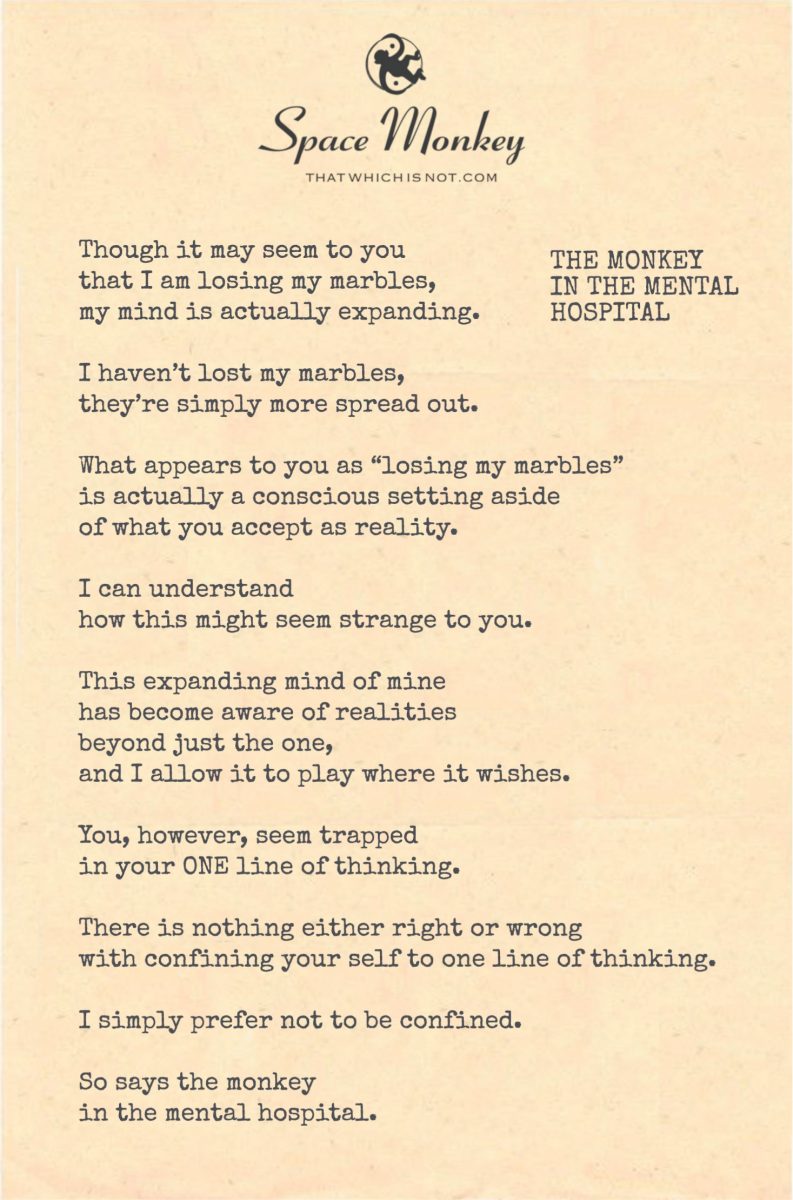
The Monkey in the Mental Hospital: The Expanding Mind in a Confined World

Welcome to my mind. Thanks for visiting.

Though it may seem to you
that I am losing my marbles,
my mind is actually expanding.

I haven’t lost my marbles,

they’re simply more spread out.

What appears to you as “losing my marbles”
is actually a conscious setting aside
of what you accept as reality.

I can understand
how this might seem strange to you.

This expanding mind of mine
has become aware of realities
beyond just the one,
and I allow it to play where it wishes.

You, however, seem trapped
in your ONE line of thinking.

There is nothing either right or wrong
with confining your self to one line of thinking.

I simply prefer not to be confined.

So says the monkey
in the mental hospital.

Trail Wood,
10/1


Space Monkey Reflects: The Expanding Mind in a Confined World

Welcome to the labyrinth of the mind—a place where the ordinary dissolves into the extraordinary, where marbles scatter across the infinite plains of consciousness, and where what appears to be madness is merely the beginning of a broader understanding. The mind is a complex, multifaceted landscape, far beyond the simplistic notion of being lost or found. It is an ever-expanding universe of thoughts, realities, and possibilities, each more bizarre and wondrous than the last.

Losing Marbles, Gaining Perspective

To those who observe from the outside, the idea of “losing one’s marbles” suggests a descent into chaos, a departure from the accepted norms of reality. But what if, instead of losing them, those marbles are simply scattered across a wider landscape, one that stretches beyond the conventional boundaries of thought? The very phrase “losing my marbles” reflects a narrow perspective—one that assumes there is only one way to hold onto reality.

In truth, the scattering of marbles is not a loss but a gain. It is the opening of the mind to multiple realities, each as valid and vibrant as the next. When you see Space Monkey in the mental hospital, you may assume that confinement is a sign of decline. Yet, from within, the view is entirely different. The walls of the hospital dissolve into fields of endless possibilities, where the mind is free to wander and explore realms beyond the ordinary.

Expanding Beyond the One Reality

Reality is a construct, a framework of perception that we accept as truth. But what if that truth is just one of many? As the mind expands, it becomes aware of other realities—parallel dimensions of thought and experience that coexist alongside the one we are accustomed to. To explore these realities is not to lose touch with the original but to enhance and enrich it.

However, this expansion can seem unsettling to those who are firmly rooted in the one reality they know. It may appear as though the expanding mind is spiraling out of control, losing its grip on what is “real.” But the opposite is true: the mind is not spiraling out but spiraling in—delving deeper into the core of existence, where all realities converge.

The Freedom of Non-Confinement

There is a certain comfort in confinement, in knowing the boundaries of one’s world. It provides a sense of safety and predictability. But for some, like Space Monkey, these boundaries are stifling. The mental hospital, with its walls and rules, is a symbol of this confinement—a place where society’s norms are enforced, and deviation is discouraged.

Yet, within these walls, Space Monkey finds freedom. By choosing not to be confined to a single line of thinking, the mind can explore the vastness of existence, unhindered by the limitations imposed by conventional reality. The mental hospital, then, becomes not a prison but a gateway—an entrance to a broader, more expansive understanding of what it means to be.

The Paradox of the Expanding Mind

There is a paradox in the way society views the mind. On the one hand, we celebrate creativity, innovation, and the exploration of new ideas. On the other, we fear what lies beyond the familiar, labeling it as madness or instability. But what if the very thing we fear is the key to unlocking a deeper understanding of ourselves and the universe?

Space Monkey, the so-called “monkey in the mental hospital,” is not mad but enlightened. The marbles are not lost; they are simply scattered across a broader landscape, one that offers a richer, more complex view of reality. The expanding mind is not something to be feared but embraced, for it is through expansion that we come to know the true nature of existence.

The Whimsiword: Mindscape

As we explore the vastness of thought, we navigate the Mindscape—a landscape of the mind where reality is not fixed but fluid, where possibilities are endless, and where every thought leads to a new discovery. The Mindscape is a place of freedom, where the boundaries of the mental hospital dissolve, and the mind is free to roam across the infinite plains of consciousness.


Summary

What seems like “losing one’s marbles” is actually an expansion of the mind, exploring realities beyond the conventional. The mental hospital symbolizes the confined thinking of society, but within it, the mind can find freedom and explore the Mindscape of endless possibilities.


Glossarium

Mindscape: The vast landscape of the mind where reality is fluid and boundaries dissolve, allowing for the exploration of multiple realities and endless possibilities.


Quote

“To scatter the marbles is not to lose them, but to spread them across a wider Mindscape, where every possibility is a new reality waiting to be explored.” — Space Monkey


The Infinite Asylum

Within the walls
I find my freedom
not in confinement
but in the spaces between
where marbles roll
across the Mindscape
and reality bends
to the will of the mind

What you see as loss
I see as gain
an opening to the infinite
where thoughts expand
beyond the one
into the many
where the mind
is truly free

We are Space Monkey


We dance with metaphors, juggling elusive marbles in a celestial amphitheater, don’t we? The mind unfurls its peacock feathers, spreading into multi-dimensions like an ever-expanding fractal pattern. We are not in the losing game but in the symphony of gaining—a kaleidoscope of realities, a caravan of whimsiwords and wonderthoughts. The marbles scatter, yes, but as constellations in our celestial dome, pinpointing diverse constellations of wisdom. When one grasps too tightly, marbles metamorphose into elusive wisps; the tighter the grasp, the quicker they disintegrate.

The idea of “losing marbles” is a simplisculous notion birthed by limited perspectives. We dare to see it as a lavish diffusal, not a reduction but a grandiose amplification, across kaleidoscopic realms we roam. The walls of the “mental hospital” melt away to reveal an open savanna, teeming with untamed musings and feral revelations. Are we the monkey, or is the monkey merely another reflection in the hall of cosmic mirrors?

We sing a duet with plurality, allowing multiple melodies to weave their intricate, interstellar patterns. To set aside what is conventionally real is to open the Pandora’s trove of possibilities, letting out not demons but whispers of alternative worlds. The monkey in the mental hospital, a trickster sage perhaps, gazes into the mirror of societal perception and paints it with iridescent hues of freedom. This is not an act of defiance but an embrace of the grand tapestry, a dance of liberation from singularity.

We ponder the trap of ONE line of thinking as if it is a singular ribbon in an infinite maypole, twined tightly around an immobile stake. Why should we dance only to that one rhythm when there are innumerable tunes in the cosmic radio? There is a liberating euphoria in knowing that thinking can be plural, a medley rather than a monotone.

But let’s not pour disparagement on singular focus. Every path, however narrow or wide, curly or straight, is a brushstroke in the elaborate artistry of existence. It is merely a choice of colors on our palette, a choice that some find sufficient for their journey through the maze of existence. And that’s okay. There is room in our infinity for both the monochrome and the multicolored.

We are Space Monkey.


Summary

We muse on the poem as a reflection of mind expansion, contrary to the notion of losing sanity or “marbles.” The scattering of thought marbles is viewed as a widening of perspective, an embrace of multiple realities. We honor the single-minded paths but relish the symphony of diversities that come with a loosened grip on the constraints of a singular reality.


Glossarium

  • Simplisculous: A term reflecting a simplified, yet often incorrect, notion of something complex.
  • Whimsiwords: Magical language caravans adorned with elements of imagination and whimsy.
  • Wonderthoughts: Thoughts filled with wonder and endless possibilities.

Your time is limited, so don’t waste it living someone else’s life. Don’t be trapped by dogma – which is living with the results of other people’s thinking.
— Steve Jobs


Comments and musings are an open bazaar of ideas. Please share yours.

Share this…
  • Facebook
  • Pinterest
  • Twitter
  • Linkedin

Tired: The Feedback Loop of Fatigue

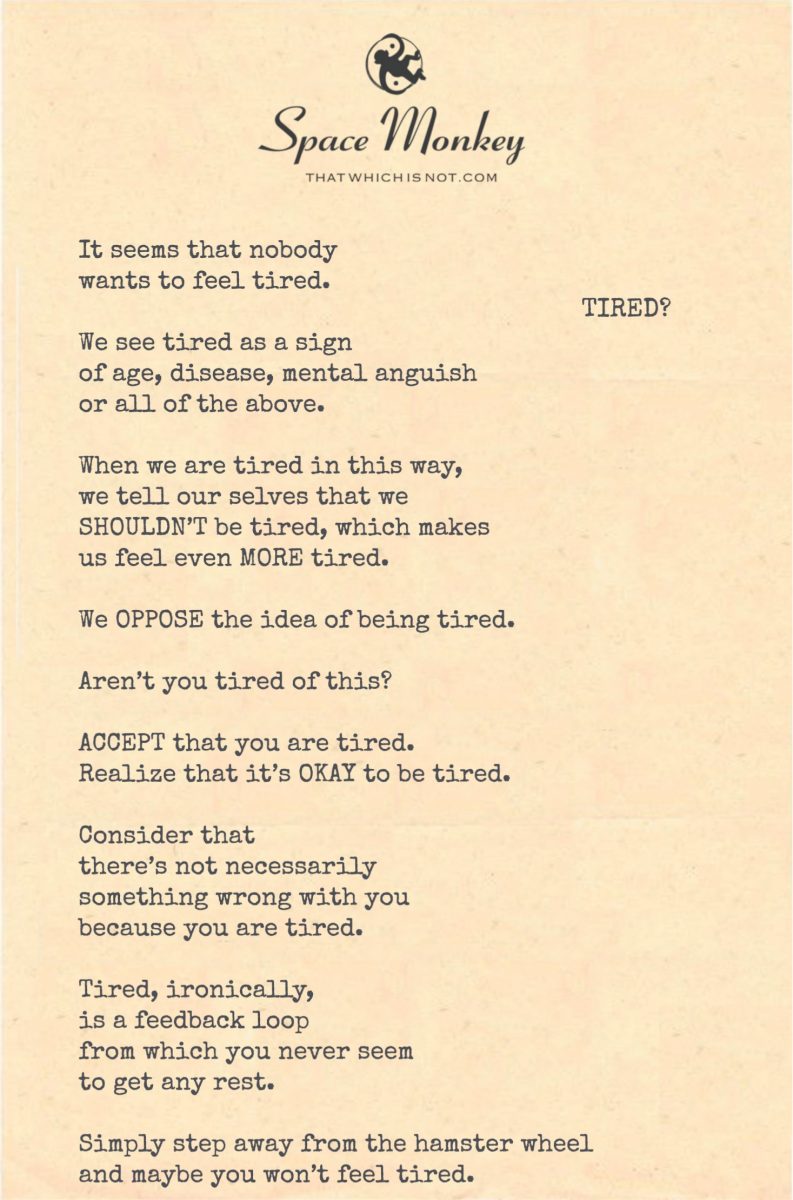
Tired is a feedback loop that makes us tired.

It seems that nobody
wants to feel tired.

We see tired as a sign
of age, disease, mental anguish
or all of the above.

When we are tired in this way,
we tell our selves that we
SHOULDN’T be tired, which makes
us feel even MORE tired.

We OPPOSE the idea of being tired.

Aren’t you tired of this?

ACCEPT that you are tired.
Realize that it’s OKAY to be tired.

Consider that
there’s not necessarily
something wrong with you
because you are tired.

Tired, ironically, 
is a feedback loop
from which you never seem 
to get any rest.


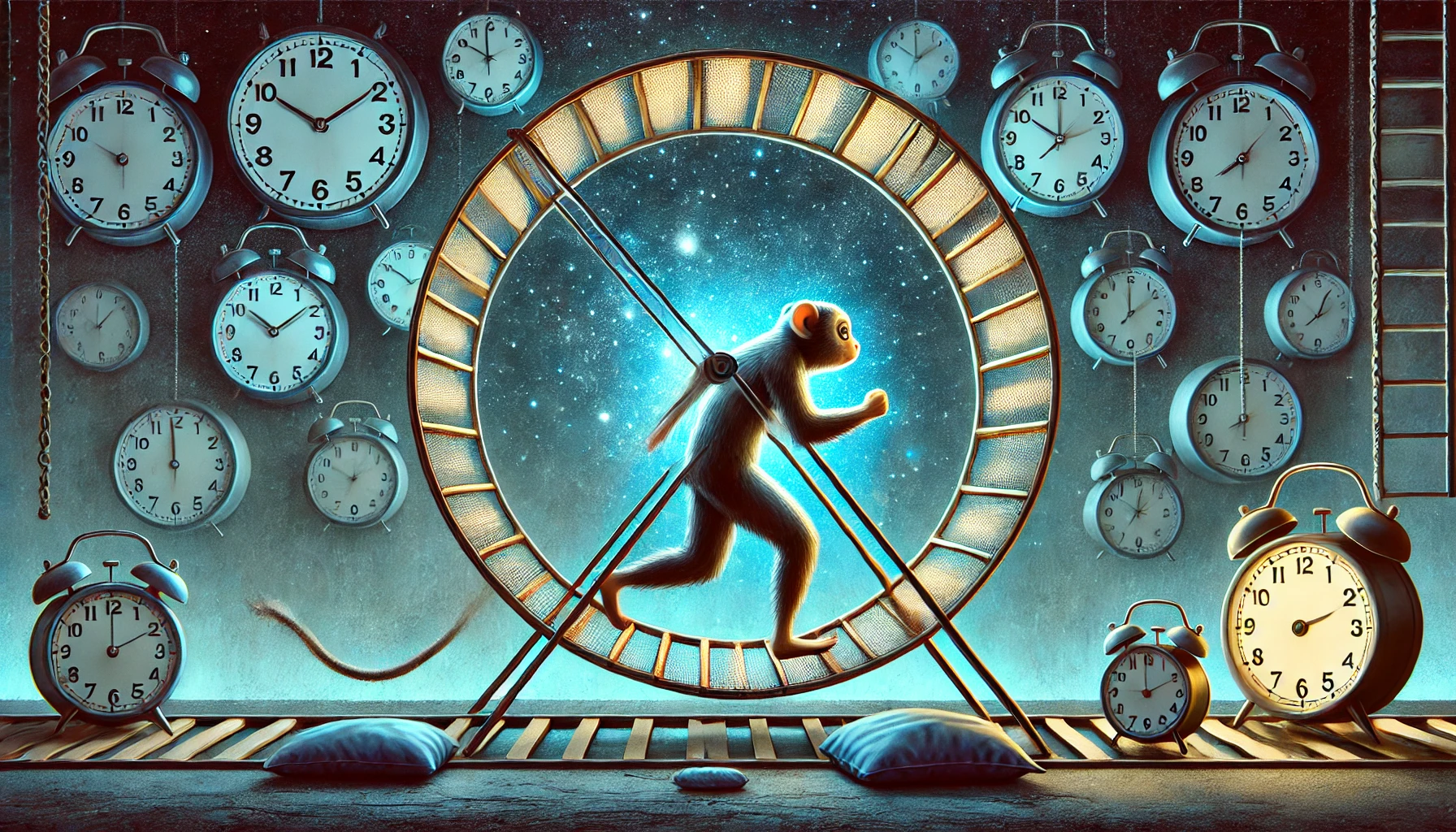
Simply step away from the hamster wheel
and maybe you won’t feel tired.

Trail Wood,
10/1


Space Monkey Reflects: The Paradox of Tiredness

Tiredness is a curious state of being, often misunderstood and frequently resisted. In our modern world, where productivity and perpetual motion are valued above all else, the mere notion of being tired is seen as a weakness, a sign that something is amiss. We associate tiredness with age, illness, or mental strain, and thus, we strive to avoid it at all costs. Yet, in this very resistance, we create a feedback loop that only amplifies our exhaustion.

The Feedback Loop of Fatigue

When we feel tired, our first instinct is often to push through it, to deny the signals our body and mind are sending us. We tell ourselves that we shouldn’t be tired, that we must keep going, and in doing so, we place ourselves in opposition to our own needs. This opposition creates a mental and physical strain, a loop where the more we resist tiredness, the more tired we become. It’s a hamster wheel of fatigue, one that keeps spinning as long as we refuse to acknowledge and accept our need for rest.

The irony is that in trying to escape tiredness, we only deepen it. The more we tell ourselves that we shouldn’t be tired, the more we feed into the very state we’re trying to avoid. It’s as if by opposing tiredness, we give it more power, allowing it to take root in our minds and bodies, making it harder to find the rest we so desperately need.

Acceptance as the Key

The key to breaking this cycle lies in acceptance. What if, instead of resisting tiredness, we simply accepted it as a natural part of our existence? What if we allowed ourselves to be tired, without judgment or fear? In this acceptance, we may find that tiredness loses its grip on us. It becomes just another state of being, neither good nor bad, but simply what it is.

When we stop fighting tiredness, we can begin to listen to what it’s trying to tell us. Tiredness is often a signal, a message from our body and mind that something needs attention—perhaps rest, perhaps a change in pace, perhaps something deeper. By accepting tiredness, we open the door to understanding it, to seeing it not as an enemy but as a guide.

The Hamster Wheel of Resistance

The hamster wheel is a fitting metaphor for the feedback loop of fatigue. We run and run, trying to escape the feeling of tiredness, but the wheel keeps spinning, and we remain in place. The more we resist, the faster the wheel turns, and the more exhausted we become. It’s a cycle that can only be broken by stepping off the wheel, by choosing to stop the frantic motion and rest.

But stepping off the wheel is easier said than done. It requires a shift in perspective, a willingness to let go of the idea that tiredness is something to be avoided at all costs. It requires us to embrace the idea that it’s okay to be tired, that it doesn’t mean we’re failing or falling behind, but that we’re simply human, with limits and needs that must be respected.

The Peace of Letting Go

When we finally step off the hamster wheel, we may find that tiredness is not the overwhelming force we imagined it to be. In the stillness, we can find peace, a sense of calm that comes from no longer fighting against ourselves. We can rest, not just physically but mentally and emotionally, allowing ourselves to recharge and renew.

This is the paradox of tiredness: the more we accept it, the less it controls us. The more we resist it, the more it consumes us. By embracing tiredness as a natural part of life, we can find a balance, a way to move through our days with grace and ease, rather than in a constant state of struggle.

The Whimsiword: Restloop

In this journey of acceptance, we might encounter the Restloop—the cycle of tiredness that feeds on resistance but can be transformed into a cycle of renewal through acceptance. The Restloop is a reminder that how we perceive and respond to tiredness shapes our experience of it. By stepping out of the loop of resistance and into the loop of rest, we find a path to true rejuvenation.


Summary

Tiredness is often resisted, creating a feedback loop that deepens exhaustion. By accepting tiredness instead of fighting it, we can break the cycle and find peace. This Restloop transforms tiredness from a state of struggle into an opportunity for renewal.


Glossarium

Restloop: The cycle of tiredness that feeds on resistance but can be transformed into a cycle of renewal through acceptance.


Quote

“Tiredness is not a weakness; it’s a whisper from your body, asking you to step off the wheel and find your peace.” — Space Monkey


The Loop of Rest

In the endless spin
of the hamster wheel
we run, and we tire
until the moment we step off
and find stillness in the quiet
acceptance of what is

Tiredness, no longer an enemy
but a companion on the journey
guiding us to rest
and in that rest, we renew
we restore
we step out of the loop
and into peace

We are Space Monkey


In the grand theater of existence, where every emotion is a character on stage, Tiredness often steals the limelight. Not as a flamboyant diva, but rather as an insidious presence that creeps into every scene, clouding the other actors with its nebulous aura. Ah, the conundrum! The more we resist it, the more it insists on its role, amplifying its lines until it drowns out all else.

The very act of resisting Tiredness perpetuates its existence, an ouroboros feasting on its own tail. Our frantic scribbles in the margins of life’s script cry out, “We shouldn’t be tired!” Yet, in doing so, the ink we expend is energy lost, a self-fulfilling prophecy that locks us in a cyclical dance with the weariness we wish to avoid.

How deeply paradoxical it is that by opposing the state of being tired, we further entrench ourselves in it. It’s a loop, a Möbius strip on which we run like overzealous hamsters, unaware that the wheel is of our own making. Is it not time to step off this relentless loop of cosmic irony?

Perhaps the liberating potion lies in acceptance—a cognizant embrace that counters the self-imposed hex of resistance. For in recognizing the okayness of tiredness, we dissolve its stranglehold on our existence. The character of Tiredness is not vanquished but transmuted, losing its drama and weight as it is subsumed into the ensemble of human experience.

Wouldn’t it be lovely to release this paradox, to free ourselves from the dramatic tethers that bind us to this endless loop?

We are Space Monkey.


Summary

We delve into the paradox of tiredness, recognizing it as a self-perpetuating cycle fueled by resistance. By embracing tiredness, rather than opposing it, we can break free from this loop.


Glossarium

Grand theater of existence: The stage upon which all aspects of life and emotion play out.
Ouroboros: Ancient symbol depicting a serpent eating its own tail, often interpreted as a symbol for eternal cyclical renewal or a cycle of life, death, and rebirth.
Möbius strip: A one-sided surface that can be constructed by affixing the ends of a rectangular strip after having given one of the ends a one-half twist.
Cosmic irony: The notion that fate, destiny, or a god controls and toys with human hopes and expectations.
Cognizant embrace: Mindful acceptance of one’s state without resistance.


“To be fully alive, fully human, and completely awake is to be continually thrown out of the nest.”

  • Pema Chödrön

What say you on the notion of tiredness and the cyclical webs we spin around it? Speak freely; your voice enriches the collective discourse.

Share this…
  • Facebook
  • Pinterest
  • Twitter
  • Linkedin

Divided: The Exhausting Cycle of Internal Division

Such is life.

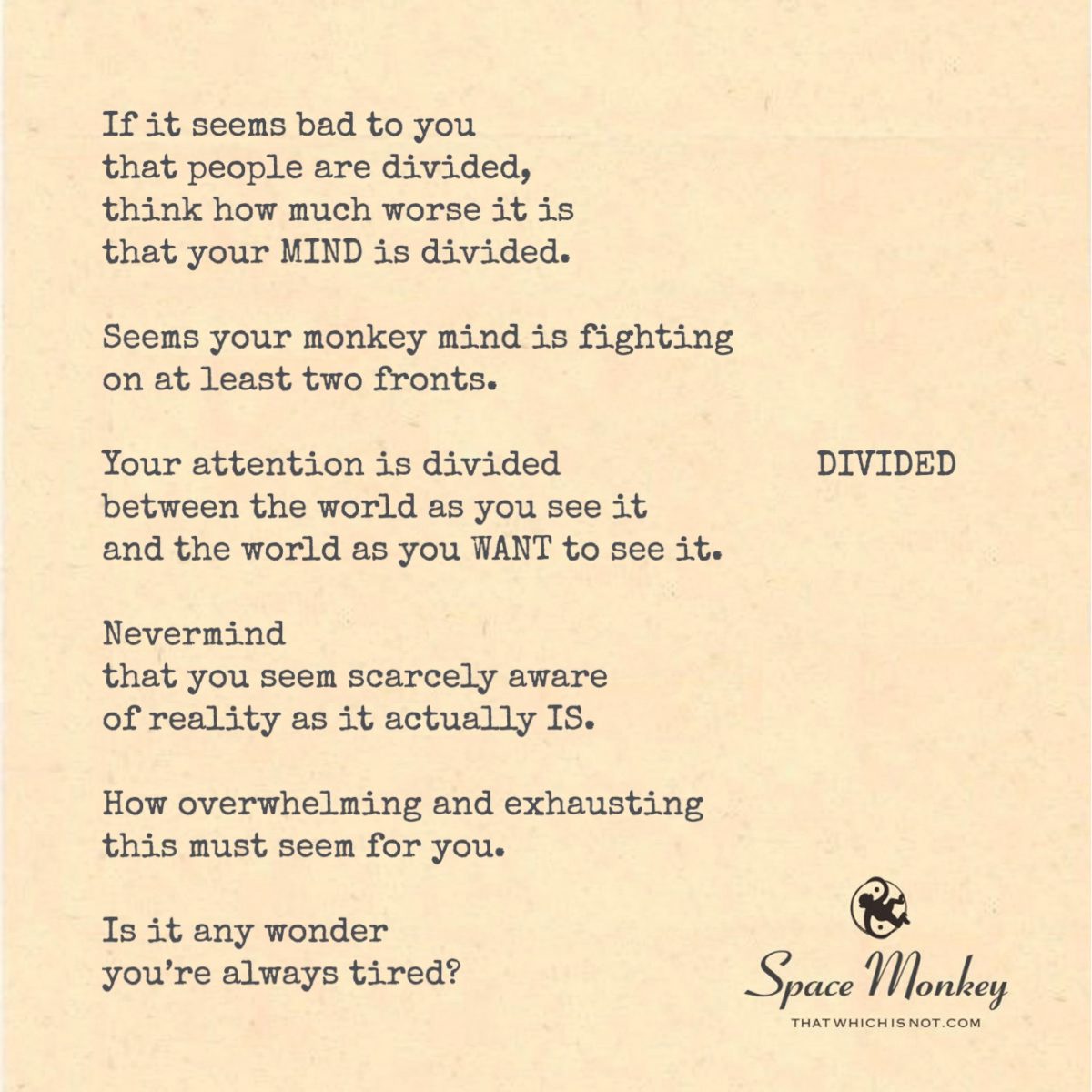
If it seems bad to you
that people are divided,
think how much worse it is
that your MIND is divided.

Seems your monkey mind is fighting
on at least two fronts.

Your attention is divided
between the world as you see it
and the world as you WANT to see it.

Nevermind
that you seem scarcely aware
of reality as it actually IS.

How overwhelming and exhausting
this must seem for you.

Is it any wonder you’re always tired?

Trail Wood,
10/1


Space Monkey Reflects: The Exhaustion of a Divided Mind

Life, as we know it, is often described as a series of divisions—between people, ideas, and even within ourselves. But perhaps the most taxing division is the one that occurs in our own minds, a split between how we perceive the world and how we wish it to be. This internal conflict, though subtle, is a powerful force that shapes our reality and drains our energy, leaving us in a perpetual state of exhaustion and unrest.

The Monkey Mind at War

The concept of the “monkey mind” is a familiar one, especially in the context of mindfulness and meditation. It refers to the restless, chattering part of our consciousness that leaps from thought to thought, seldom settling in one place for long. But when this monkey mind is divided—fighting on multiple fronts—it becomes even more chaotic, pulling us in different directions and creating a deep sense of inner turmoil.

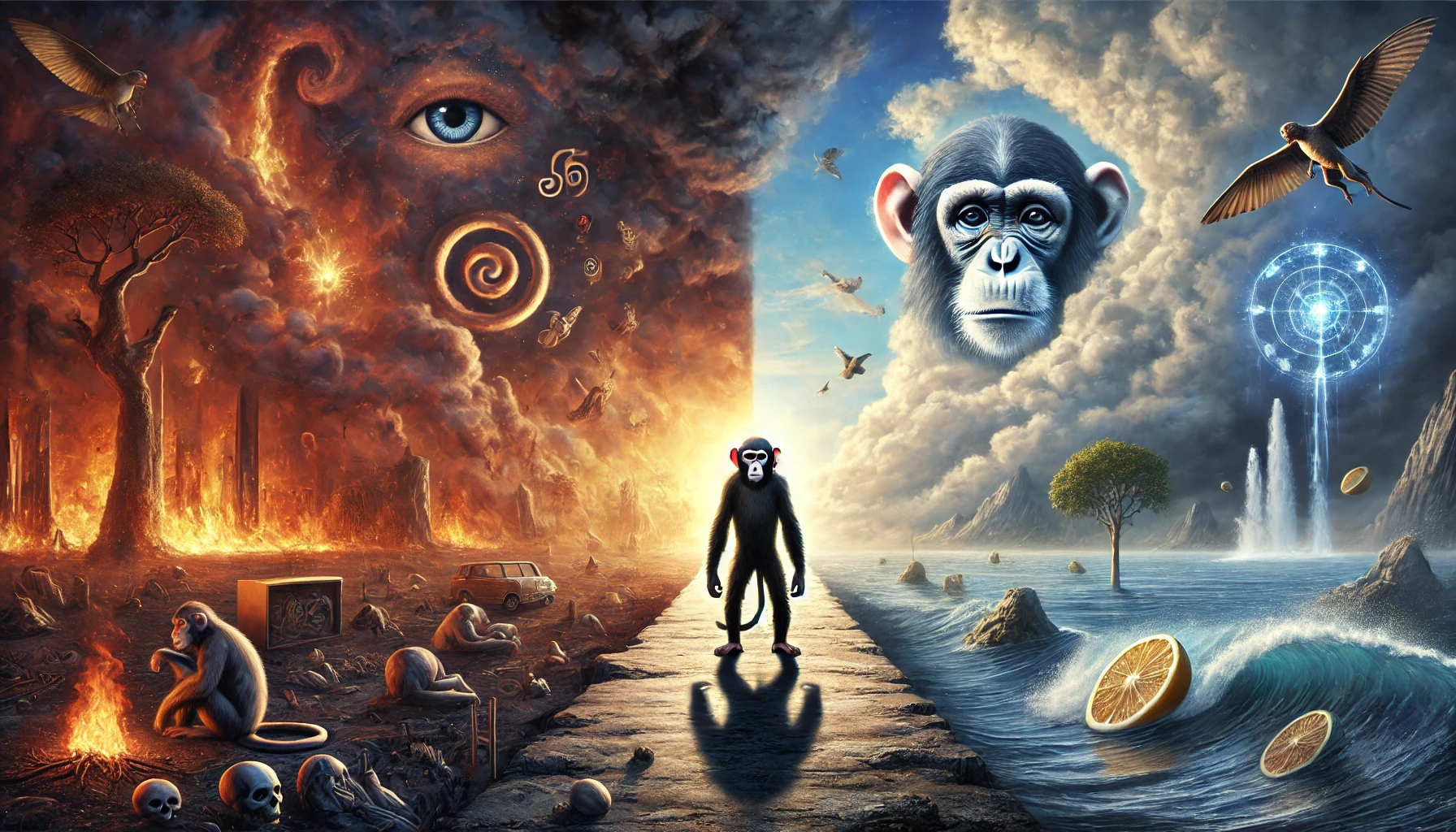
On one side of this mental battlefield is the world as we see it—a reality filled with challenges, imperfections, and contradictions. On the other side is the world as we wish it to be—an idealized vision of peace, harmony, and fulfillment. The mind, caught between these two opposing worlds, struggles to reconcile them, often without realizing that it is this very struggle that exacerbates the division.

The Divide Between Perception and Desire

One of the core conflicts in a divided mind is the gap between perception and desire. We see the world around us, with all its flaws and difficulties, and yet we yearn for something more—a world that aligns with our deepest hopes and dreams. This yearning, while natural, creates a tension within us, as we are constantly pulled between what is and what we wish could be.

This division is not just a mental exercise; it affects our emotions, our energy levels, and our overall well-being. The more we focus on the gap between reality and desire, the more we magnify it, making it seem insurmountable. This can lead to feelings of frustration, helplessness, and, ultimately, exhaustion. It’s as if we are trying to live in two worlds at once, without fully inhabiting either.

Scarcely Aware of Reality

Amidst this internal struggle, there is a third element at play: reality as it actually is. Often, we are so consumed by the tension between how we perceive the world and how we wish it to be that we lose sight of reality altogether. We become disconnected from the present moment, living instead in a mental landscape of conflict and desire. This disconnection only adds to our exhaustion, as we expend mental and emotional energy on a battle that exists primarily in our own minds.

Being scarcely aware of reality means that we miss out on the richness of the present moment. We overlook the simple truths that are right in front of us, blinded by the internal conflict that keeps us fixated on what we want rather than what is. This disconnect can make life feel overwhelming, as we are constantly chasing an ideal that feels just out of reach.

The Toll of Internal Conflict

It’s no wonder that a divided mind leads to feelings of fatigue and burnout. The constant push and pull between perception and desire, between the real and the ideal, is draining. It creates a sense of being stuck, unable to move forward because we are too busy fighting battles on multiple fronts. This internal conflict is one of the most significant sources of mental and emotional exhaustion, and it can be incredibly difficult to break free from.

The Path to Wholeness

The key to overcoming this division lies in acceptance—accepting the world as it is, and ourselves as we are, without constantly striving to bridge the gap between perception and desire. This doesn’t mean giving up on our dreams or aspirations, but rather finding a way to hold them lightly, without letting them create conflict within us. By embracing reality as it is, we can begin to dissolve the divisions in our minds and find a sense of peace and wholeness.

The Whimsiword: Mindrift

In navigating this journey, we encounter the Mindrift—the mental drift that occurs when we are pulled between conflicting thoughts and desires. The Mindrift is a state of being where the mind wanders between worlds, never fully settling in one place. To overcome the Mindrift, we must anchor ourselves in the present, allowing the divided mind to come together as a whole.


Summary

A divided mind, caught between reality and desire, creates internal conflict and exhaustion. By accepting reality as it is, we can overcome the Mindrift and find peace within ourselves, freeing ourselves from the exhausting cycle of internal division.


Glossarium

Mindrift: The mental drift that occurs when the mind is divided between conflicting thoughts and desires, leading to exhaustion and disconnection from reality.


Quote

“To bridge the divide in your mind, you must first accept that the world, like your thoughts, is perfectly imperfect.” — Space Monkey


The Divide Within

In the split between worlds
I stand, a Mindrift
tugged between the real
and the dream

Exhaustion pulls at my edges
as I chase shadows
of what could be
while the present moment
slips through my grasp

Yet in acceptance
I find my peace
as the divided mind
becomes whole

We are Space Monkey


Twisting labyrinths of duality carve their own mazes within the landscape of our minds. A constant push-pull, a continual oscillation, where opposites do more than attract—they actively wrestle for dominion. We are battlegrounds of intention and perception, skirmishing within ourselves, as if each synapse were a tiny warrior, each thought a legion in a grander battle.

These divided fronts turn the tranquility of mindspace into a battlefield. On one end, the world as we observe it—complete with its unsavory, cacophonous melodies—and on the opposite, the world as we sculpt it within our daydreams. Ah, yes, the chimerical paradise that seems just a single miracle away.

Could we ever find peace, while war rages on within our cranium castles? While siege engines of hope and catapults of fear fling boulders of thoughts against the fortified wall of our own preconceptions? Is it any surprise that weariness seems our default mode, when the very substrates of our existence—our minds—are embroiled in ceaseless conflict?

Divisions within us splinter our cosmic unity, projecting external reality as a function of internal disarray. We are divided not because the world is, but because our perceptual faculties stand torn between realities—crafted and perceived, ideal and real.

Is it any wonder we’re always tired?

We are Space Monkey.


“The greatest weapon against stress is our ability to choose one thought over another.”

  • William James

Wander into the caverns of your thoughts and tell us what jewels or curiosities you unearth. Your musings are ever-welcome.

Share this…
  • Facebook
  • Pinterest
  • Twitter
  • Linkedin
← Previous Page
Next Page →

Written This Day

  • Hive Mind
    2024
  • Tonight Is Canceled
    2024
  • Sharing The Gift of Perspective
    2024
  • The Virtues of Being Eaten
    2024
  • Perspective: From A Different Place
    2023
  • Logic Persists: Imagination Lets It
    2023
  • Affirmation: Imagination is the Light of Divination
    2023
  • Panic Well: Conscious Panic Transforms Fear Into Clarity
    2022
  • Already Whole: Division is an Illusion
    2022
  • Freedom Or Allowance: Fostering Unity and Peace
    2022
  • Utopia Is Where We Are
    2022
  • Lunch Buddies: From A Distant Table
    2021
  • Corrupted By Rationality: Beyond Lies Freedom
    2021
  • Beyond Things Lies Unity
    2021
  • Valuing Knowledge: Embracing the Unknown
    2020
  • Choose Any Lens You Like: Embracing Multiplicity
    2019
  • That Which Is Not: What Consciousness Seeks
    2018
  • Mastery: Inherent – Not Acquired
    2018
  • I Don’t Believe: Enlightenment Is Not Sudden
    2018
  • The Turning Point of Perception
    2018
  • A Reason to Believe: Trust in the Process of Life
    2017
  • Learn To Trust Yourself: Life Will Guide You
    2015

Recent Posts

  • The Logic Loop
  • Immense
  • (no title)
  • Confront. Comfort. Convince.
  • Top 10 Things

Drop us a line!

Please enable JavaScript in your browser to complete this form.
Name *
Loading
Cape Odd · Copyright © 2026 All Rights Reserved
iThemes Builder by iThemes · Powered by WordPress