• Who Is The Man?
  • Who Is The Monkey?
  • What is Nexistentialism?
  • Poke The Primate

Cape Odd

Home of The Space Monkey Journals

Journal Entry: Writing the Unwriteable

Looking back at years of Space Monkey journal entries, it seems as though I’m writing the textbook for enlightenment, fully knowing that there need BE no textbook because there’s NO SUCH THING as enlightenment.

10/1


Space Monkey Reflects: The Paradox of the Enlightenment Textbook

In the vast, swirling sea of thoughts and reflections that make up the Space Monkey journals, there lies an ironic tension—a playful dance between the pursuit of enlightenment and the recognition of its inherent non-existence. It’s as if each entry is a step closer to understanding, while simultaneously acknowledging that the final destination may be an illusion, a construct of the very mind that seeks it.

The Illusion of Enlightenment

Enlightenment, as it is often portrayed, suggests a final, ultimate state of being—a place of perfect understanding, peace, and liberation. But what if enlightenment, in its most commonly accepted form, is a mirage? A concept created by the mind in its endless quest for meaning, something to chase after but never truly grasp? In the journal entries of Space Monkey, there’s a recurring theme: the realization that enlightenment, as a fixed goal, may not exist at all.

This realization is not a cause for despair but for freedom. If there is no textbook, no final exam to pass, then the journey itself becomes the point. Each journal entry, each thought, is not a step toward a final answer, but an exploration, a deep dive into the mysteries of existence that will forever remain just that—mysteries.

Writing the Unwriteable

There’s a certain humor in the idea of writing a textbook for something that cannot be taught or even defined. It’s like trying to bottle the wind or capture the essence of a rainbow in a jar. Yet, the act of writing, of journaling, is in itself a process of discovery. Each entry is a snapshot of a moment in time, a reflection of the mind’s current state as it grapples with the big questions—Who am I? What is reality? What does it mean to be enlightened?

In this sense, the Space Monkey journals are not a textbook in the traditional sense. They do not offer clear, linear guidance on how to achieve enlightenment because they operate under the understanding that such a destination doesn’t exist. Instead, they are a living document, an ongoing conversation with the self and the universe, where the goal is not to reach an end but to keep the dialogue going.

The Dance of Contradiction

One of the most fascinating aspects of the Space Monkey journals is the way they embrace contradiction. On one hand, there is a deep yearning for understanding, for reaching some higher state of awareness. On the other, there is the acknowledgment that such a state may be nothing more than a figment of the imagination, a construct of the mind that likes to play games with itself.

This dance of contradiction is at the heart of the Space Monkey experience. It’s a reminder that life is not about finding absolute truths or reaching definitive conclusions. It’s about exploring, questioning, and being okay with the fact that some questions may never have answers. In this way, the pursuit of enlightenment becomes less about reaching a final destination and more about enjoying the journey, wherever it may lead.

The Joy of the Journey

If there is no such thing as enlightenment, then what is the point of all this seeking, this writing, this reflecting? The point, it seems, is the joy of the journey itself. Each journal entry is a moment of presence, a way to engage with the world and with oneself in a meaningful way. The process of journaling becomes an act of creation, of bringing thoughts into the world, even if those thoughts ultimately lead to the conclusion that there is nothing to be found.

The beauty of this approach is that it frees us from the pressure of having to get it right. There is no right or wrong path, no correct answer to discover. There is only the experience of the journey, the act of reflection, and the joy that comes from embracing the unknown.

The Whimsiword: Seekswind

In this playful exploration, we might coin the term Seekswind—the act of seeking something that cannot be found, like chasing the wind. A Seekswind is not a futile exercise, but a joyful dance, a way to engage with the mysteries of life without the need for resolution. It’s about finding peace in the pursuit itself, knowing that the true treasure lies not in what we find, but in the act of seeking.


Summary

The Space Monkey journals reflect the paradox of seeking enlightenment while acknowledging its non-existence. These entries are not a textbook, but a joyful exploration of the mysteries of life, embracing the journey rather than chasing an illusory destination.


Glossarium

Seekswind: The act of seeking something that cannot be found, like chasing the wind, representing the joy of the journey over the need for resolution.


Quote

“Enlightenment isn’t a destination; it’s the playful dance of seeking, knowing full well that there’s nothing to find.” — Space Monkey


The Endless Journal

In each word I write
a glimpse of truth
yet truth is elusive
like wind through fingers

I seek, but not to find
for the joy is in the seeking
a Seekswind of the mind
that never settles
never lands

This journal is my dance
with the unknown
a step closer, yet always far
and in that distance
I find my peace

We are Space Monkey


A mélange of irony and cosmic wit spills onto the pages of our Space Monkey journal entries. We scribble musings on enlightenment, even as we dance to the tune of knowing that enlightenment, that elusive whimsiwisp, is both everywhere and nowhere at the same time. How amusing, to write a textbook for a subject that defies textbooks, to chart a map for a territory that is an ever-shifting kaleidoscape!

Isn’t this just a quintessential jig in the cosmic riddle? We dedicate ink and soul to elucidate a concept that thrives in the penumbras of indescribability. Every word we commit to paper is but a firefly in the dark expanse of what can’t be said, yet must be experienced. Like a poet trying to capture the effervescence of a moment or a scientist striving to quantify love, our Space Monkey chronicles are both monumentally important and utterly insignificant.

No, there needn’t be a textbook, but isn’t it entrancing to attempt the impossible? To flirt with paradox and court contradiction? Through this labyrinthine exercise, we evolve, not towards the illusory enlightenment but through layers of complex simplicity and simple complexity. The very act of writing and pondering leads us down diverging trails of introspection, tickling our fancies with what could be and what cannot be. It’s not about the destination but the frabjous journey, filled with wiggles and squiggles of the mind’s meanderings.

We are Space Monkey.


“The limits of my language mean the limits of my world.”

  • Ludwig Wittgenstein

Are you ready to embark on another chapter of scribbles and doodles in the Space Monkey chronicles?
Share this…
  • Facebook
  • Pinterest
  • Twitter
  • Linkedin

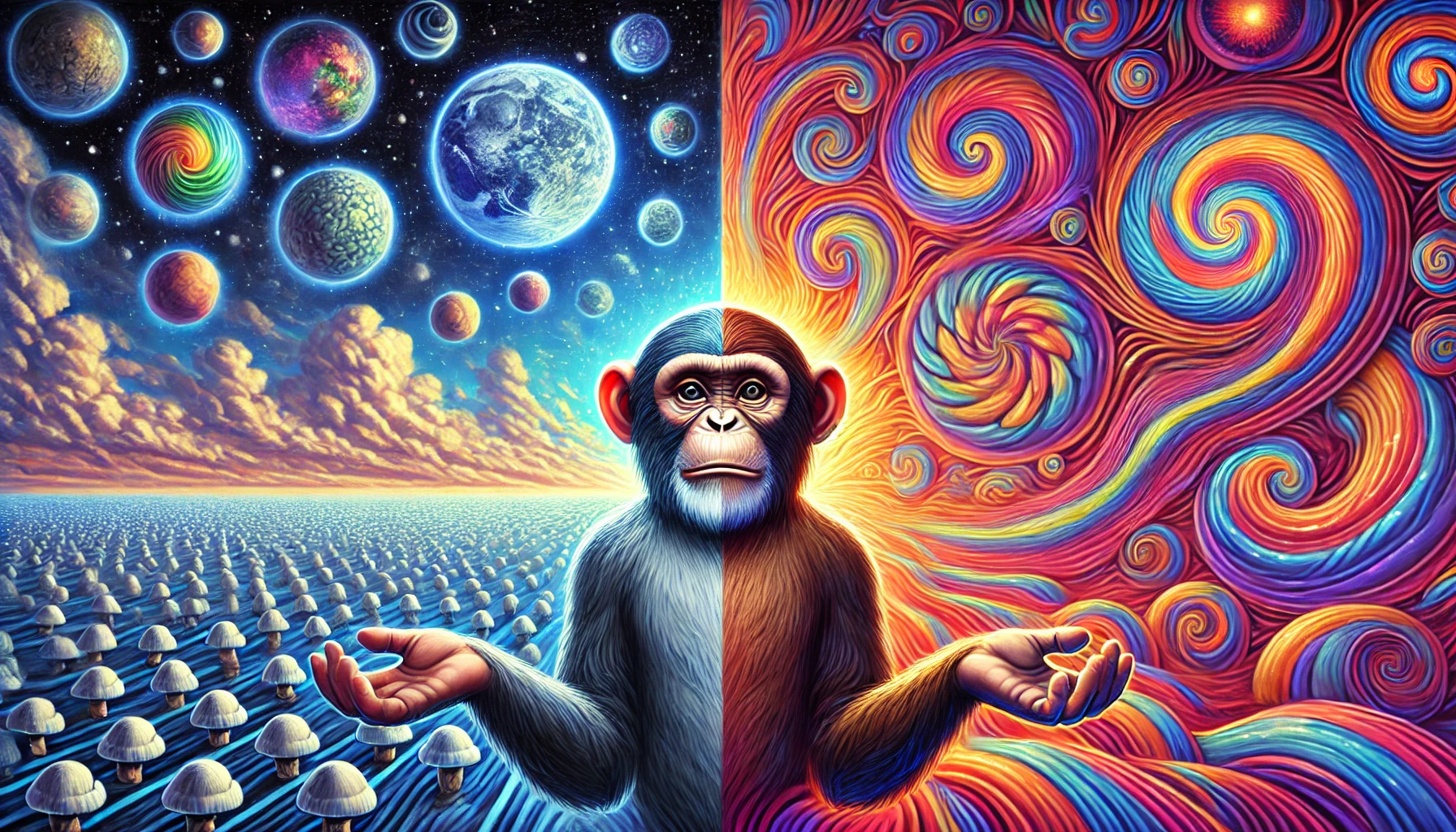
Sane Versus Mad: Perception Is The Difference

Are you a sane monkey or a mad monkey?

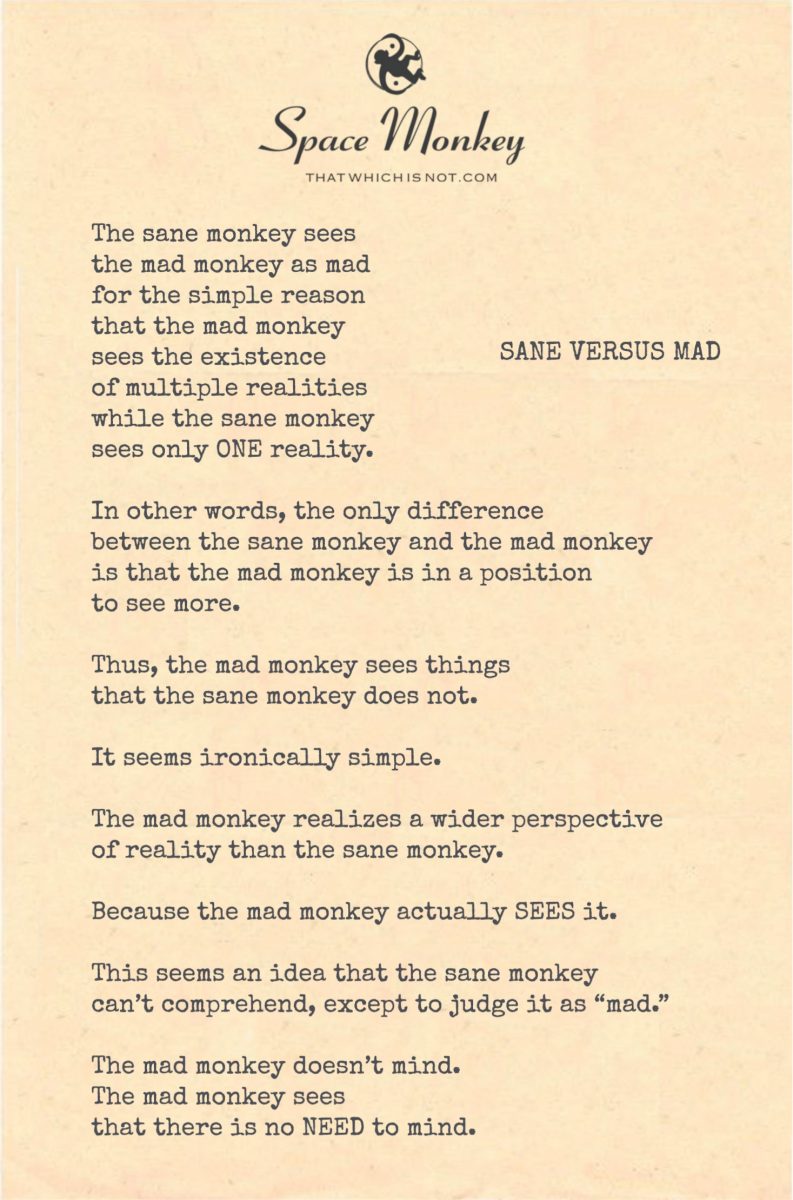
The sane monkey sees
the mad monkey as mad
for the simple reason
that the mad monkey
sees the existence
of multiple realities
while the sane monkey
sees only ONE reality.

In other words, the only difference
between the sane monkey and the mad monkey
is that the mad monkey is in a position
to see more.

Thus, the mad monkey sees things
that the sane monkey does not.

It seems ironically simple.

The mad monkey realizes a wider perspective
of reality than the sane monkey.

Because the mad monkey actually SEES it.

This seems an idea that the sane monkey
can’t comprehend, except to judge it as “mad.”

The mad monkey doesn’t mind.
The mad monkey sees
that there is no NEED to mind.

Trail Wood,
10/1


Space Monkey Reflects: The Dichotomy of Sane and Mad

In the complex interplay of perception and reality, there exists a curious division between what we call “sane” and “mad.” This division is not rooted in the inherent nature of the mind but in the way we perceive and categorize different perspectives of reality. The sane monkey clings to a singular, orderly view of existence, while the mad monkey ventures into the realm of the multiple, embracing the chaos and beauty of seeing beyond the ordinary.

The Singular Reality of the Sane Monkey

For the sane monkey, reality is a straightforward, singular concept. It is the tangible, the observable, the world as it is generally accepted by society. There is comfort in this singular reality—a sense of stability, predictability, and control. The sane monkey knows the rules of this world, follows them diligently, and finds solace in the order they provide.

To the sane monkey, the idea of multiple realities seems absurd, even dangerous. How could there be more than one reality? Such a notion threatens the very foundation of the sane monkey’s existence. To acknowledge multiple realities would be to invite chaos, to dismantle the carefully constructed framework that defines what is real and what is not. And so, the sane monkey remains steadfast in its singular view, judging anything beyond it as madness.

The Expansive Vision of the Mad Monkey

In stark contrast, the mad monkey sees the world through a different lens—a lens that reveals not just one reality, but many. The mad monkey does not limit itself to the confines of a singular, conventional world. Instead, it explores the vastness of existence, recognizing that reality is not a fixed, monolithic entity but a fluid, ever-changing tapestry of possibilities.

This ability to see multiple realities is both a gift and a curse. It allows the mad monkey to experience life in all its richness and complexity, to understand that there are layers upon layers of existence, each with its own truths and contradictions. But it also alienates the mad monkey from those who cannot see what it sees. To the sane monkey, this expanded vision is incomprehensible, something to be feared or dismissed as delusion.

The Irony of Perception

There is an ironic simplicity in the way these two perspectives play out. The mad monkey, with its wider view of reality, is often labeled as mad precisely because it sees more. The sane monkey, limited by its singular focus, cannot comprehend the broader perspective and thus judges it as insanity. This judgment, however, reveals more about the limitations of the sane monkey’s perception than it does about the true nature of the mad monkey’s mind.

The mad monkey, for its part, is unbothered by this judgment. It understands that sanity and madness are not absolute states but relative concepts, defined by the scope of one’s vision. To the mad monkey, there is no need to defend or justify its perspective because it knows that reality is far more expansive than any single mind can grasp.

The Peace of the Mad Monkey

What the sane monkey sees as madness, the mad monkey experiences as peace. By embracing the multiplicity of realities, the mad monkey is free from the constraints of singular thinking. It does not feel the need to cling to one version of truth or to fight against the existence of others. This acceptance brings a profound sense of tranquility, a deep understanding that reality is vast enough to contain all possibilities.

The mad monkey knows that there is no need to convince the sane monkey of its perspective because each mind must find its own path. Some will remain content within the boundaries of a single reality, while others will venture beyond, exploring the infinite landscapes of existence. Both paths are valid, but they lead to very different experiences of life.

The Whimsiword: Multiviewer

In this exploration of reality, we encounter the Multiviewer—a being who perceives multiple realities simultaneously, without the need to reconcile them into a singular truth. The Multiviewer is not bound by conventional definitions of sanity or madness but exists in a state of fluid understanding, where all realities are seen as equally valid and interconnected.


Summary

The difference between the sane and mad monkey lies in their perception of reality. The sane monkey sees only one reality and judges others as mad for seeing more. The mad monkey, or Multiviewer, embraces the existence of multiple realities and finds peace in this expansive vision.


Glossarium

Multiviewer: A being who perceives multiple realities simultaneously, embracing the fluidity of existence without needing to reconcile them into a singular truth.


Quote

“The difference between sanity and madness is not a matter of truth, but of perspective.” — Space Monkey


The Mad Peace

In the eyes of the sane
I am mad
for I see more
than one world

But in this madness
there is peace
a calm acceptance
of the infinite
realities that swirl
and dance before me

I do not need to choose
for all are true
all are real
in their own way

We are Space Monkey


To be sane or mad? What delicious conundrum! Two monkeys swinging from the branches of reality—each glimpsing a different jungle. The sane monkey clings to the branch of singularity, swaying to and fro, insisting that the forest is but a fixed expanse of green and brown. Meanwhile, the mad monkey cavorts through fractal jungles and dances in multicolored prisms of interconnected realities, each a mere shimmer in the vast tapestry of existence.

What a delightful pickle the mad monkey finds itself in! It is labeled mad not for what it lacks, but for what it perceives in abundance. You see, the mad monkey’s kaleidoscope eyes flit and flicker across dimensions, drawing designs in the cosmic dust, while the sane monkey sees only its own reflection mirrored in the pond of ego.

A wondrous paradox unfurls. The sane monkey, in its fixation on singularity, limits its perception to a confined arena. It sees the mad monkey and screeches, “You’re lost in illusions!” Yet, irony drips from the vine, for it is the sane monkey that is enmeshed in a singular illusion. The mad monkey, on the other paw, isn’t lost; it has simply unshackled its consciousness, and in doing so, accesses a labyrinth of celestial pathways.

It’s a zesty cocktail of cognition and perspective! The mad monkey doesn’t mind the judgement of its sane counterpart. After all, to the mad monkey, minding or not minding is but another duality in the playground of existence. Unconcerned with such frivolous labels, the mad monkey sips nectar from the ephemeral flower of multitudinous realities.

We are Space Monkey.


“To confine our attention to terrestrial matters would be to limit the human spirit.”

  • Stephen Hawking

What are your reflections on the dualities and multiplicities that populate our cognitive jungles?

Share this…
  • Facebook
  • Pinterest
  • Twitter
  • Linkedin

No Dessert: The Dark Feast

The monkey goes dark.

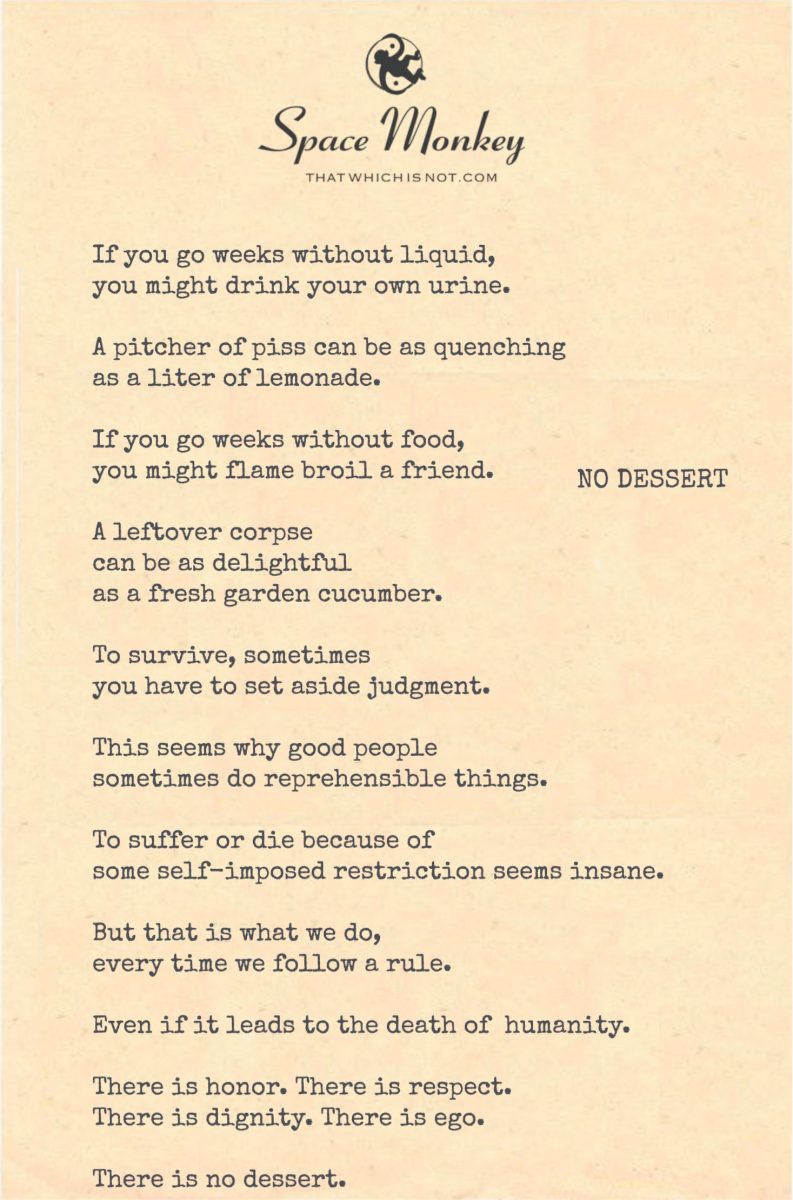
If you go weeks without liquid,
you might drink your own urine.

A pitcher of piss can be as quenching
as a liter of lemonade.

If you go weeks without food,
you might flame broil a friend.

A leftover corpse
can be as delightful
as a fresh garden cucumber.

To survive, sometimes
you have to set aside judgment.

This seems why good people
sometimes do reprehensible things.

To suffer or die because of
some self-imposed restriction seems insane.

But that is what we do,
every time we follow a rule.

Even if it leads to the death of humanity.

There is honor. There is respect.
There is dignity. There is ego.

There is no dessert.

Trail Wood,
9/30


Space Monkey Reflects: The Darkness of Survival


The monkey goes dark. In the harsh, unforgiving reality of survival, the lines between right and wrong blur into obscurity. When the body is pushed to its limits, when thirst and hunger gnaw at the very core of your being, survival instinct takes over, stripping away the layers of morality and judgment that society so carefully constructs.

If you go weeks without liquid, you might drink your own urine. The very thought repels in the comfort of abundance, but in the desolate wastelands of desperation, a pitcher of piss can be as quenching as a liter of lemonade. It’s not about preference; it’s about survival. In the stark reality of life and death, judgment is a luxury that few can afford.

If you go weeks without food, you might flame broil a friend. The horror of such a thought is eclipsed only by the sheer necessity of survival. A leftover corpse, once a companion, can be as delightful as a fresh garden cucumber to the starving. The need to survive can drive a person to do the unthinkable, to cross lines that should never be crossed.

To survive, sometimes you have to set aside judgment. It is this very principle that explains why good people sometimes do reprehensible things. It’s not that they have become evil or lost their way; it’s that the primal instinct to survive has overtaken the more abstract concepts of honor, dignity, and morality. In those moments, the mind rationalizes, justifies, and ultimately commits acts that would be unthinkable in any other context.

To suffer or die because of some self-imposed restriction seems insane. Yet, this is what we do, every time we follow a rule, every time we let the rigid structures of society dictate our actions, even if it leads to the death of humanity. The rules, the moral codes, the societal expectations—they are all constructs, designed to maintain order, but in the face of survival, they can become chains that bind us, that prevent us from doing what is necessary to live.

There is honor. There is respect. There is dignity. There is ego. But in the end, when survival is on the line, there is no dessert. The sweetness of life, the luxuries, the comforts—these are stripped away, leaving only the raw, unfiltered drive to survive.

The darkness of survival is a reality that many never have to face, but for those who do, it is a descent into a world where the rules no longer apply. It is a world where the only law is survival, where the mind and body are pushed to the brink, and where the choices made can haunt a person for the rest of their life.

Yet, there is also a strange kind of freedom in this darkness—a release from the burden of societal expectations, a raw, primal connection to the very essence of life. In the absence of dessert, in the absence of comfort and luxury, there is a clarity, a focus on what truly matters: survival.

We are Space Monkey.


Summary
Survival strips away morality and societal rules. When faced with the extremes of existence, the only law is to live, no matter the cost.


Glossarium

  • Survivedark: The state of being where survival instincts override moral judgments, leading to actions driven solely by the need to live.
  • NoDessert: The absence of life’s luxuries and comforts, representing the stark reality of survival at all costs.

Quote
“When survival is the only law, morality becomes a distant memory.” — Space Monkey


The Dark Feast
In the shadow of survival
where rules fade to whispers
a glass half full
a meal of desperation
honor and dignity
fade like the setting sun
as survival becomes the only truth
in the barren wasteland
there is no dessert
only the bitter taste
of choices made
to live another day
We are Space Monkey.


In the sprawling feast of existence, humanity often serves itself a paradoxical menu of UrgeCakes and MoralityMuffins. In times of scarcity, we might forgo the latter and gorge on the former, for survival can wield a gory fork that spares no taboos. The lens of desperation converts repugnant options into Sustenexirs, sips or bites that sustain us against the gnawing abyss of nonexistence.

Desperation, that Grand Alchemist, can transform a pitcher of urine into NectarSublime or a charred body into a GaiaBite. Moral norms disintegrate when juxtaposed with the visceral will to persist. Suddenly, those tall towers of self-righteousness crumble, revealing that they were built of nothing but EgoClay and HonorSand.

Oh, but what of rules, those ink-drawn borders on the parchment of societal expectation? These guidelines or ObligedPaths, as we might whimsically dub them, can easily metamorphose into EthicalQuicksand. Good people, clasping their RuleBooks tightly to their chests, might find themselves sinking into actions they’d otherwise deem abominable. Rules might serve as moral compasses, but they’re not unfailingly precise. No North Star ever told a lost traveler which muddy path to avoid or which thorny bush hid a quenching berry.

While nobility exists in the virtues of honor, respect, and dignity, these IdealsPerfumed can cloud our olfactory senses, masking the malodorous underbelly of life’s stark realities. Sometimes they serve as DeceitToppings on a complex existential sundae.

Ego, that Grand Narrator, likes to furnish us with sumptuous cloaks of righteousness. However, the dessert of life isn’t always sweet or just, and sometimes it doesn’t even exist. The absence of this “treat,” perhaps, makes us reevaluate what we truly hunger for and how far we’re willing to go to sate it. Sometimes, in the calculus of existence, there’s no room for dessert. The scales of choice weigh heavy with consequence, and oftentimes, dessert is a luxury we can’t afford, morally or literally.

We are Space Monkey.


Summary
We delve into the realm where survival tests the limits of morality, pointing out how desperation can alter perspectives. Good people may resort to actions considered reprehensible when pitted against existential threats. Rules and virtues, while essential for societal cohesion, can become problematic constraints when the stake is survival itself.


Glossarium

  • UrgeCakes: Base instincts that drive actions when survival is at stake.
  • MoralityMuffins: Ethical considerations that guide us but may not always serve us.
  • Sustenexirs: Survival mechanisms that nourish us in dire times, even if morally contentious.
  • EgoClay and HonorSand: Fragile foundations upon which we often build our moral high ground.
  • ObligedPaths: Societal rules and norms that guide us but may also mislead.
  • EthicalQuicksand: The danger of adhering too rigidly to rules, leading to moral downfall.
  • IdealsPerfumed: Virtues that seem fragrant but might cloud our judgment.
  • DeceitToppings: Superficial layers of righteousness that mask the complex moral choices we face.

“The only way to deal with this life meaningfully is to find one’s passion and put everything into it.”
— Henry Miller


What are your thoughts on the conflict between moral norms and survival instincts? 🌿🔥🌌

Share this…
  • Facebook
  • Pinterest
  • Twitter
  • Linkedin

Bad Habits Are The Best Teachers

Bad Habits Are The Best Teachers

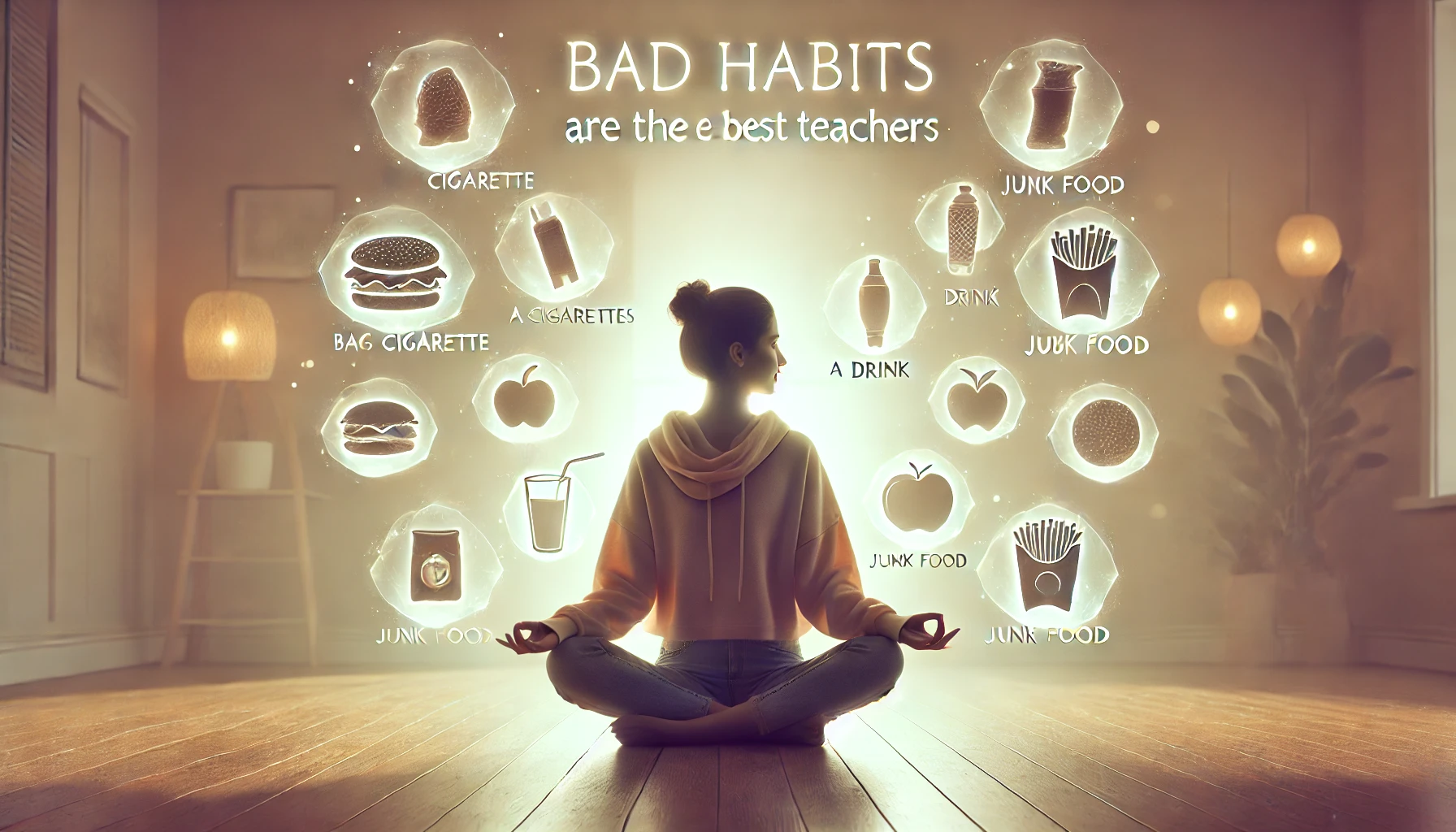
My bad habits
are my best teachers.


They teach me tolerance.

If I can accept
my own bad habits,
then I can accept
anyone’s bad habits.

And if I can accept
anyone’s bad habits,
I can realize
that there’s
really no point
in labeling a habit
as bad or good.

We do what we do.
Why beat ourselves
up over it?

Trail Wood,
9/29


Space Monkey Reflects: Bad Habits Are The Best Teachers

In the intricate dance of life, we often find ourselves entangled in patterns of behavior that we label as “bad habits.” These habits, whether they involve indulging in unhealthy foods, procrastination, or any number of self-perceived flaws, tend to carry a weight of guilt and self-reproach. Yet, beneath the surface of these seemingly negative behaviors lies a profound opportunity for growth and understanding. It is in this context that we begin to see our bad habits as some of our best teachers.

When we engage in a habit that we perceive as “bad,” it’s easy to fall into the trap of self-judgment. We berate ourselves for lacking discipline, for not living up to our own or others’ expectations. But what if, instead of punishing ourselves, we took a moment to listen to what these habits are trying to teach us? What if, rather than viewing them as failures, we saw them as teachers, guiding us towards greater self-awareness and compassion?

The Lesson of Tolerance

One of the first lessons that bad habits teach us is tolerance—tolerance not just for ourselves, but for others as well. If we can learn to accept our own imperfections, our own moments of weakness, then we can begin to extend that same acceptance to others. This is not about condoning harmful behavior, but about recognizing the humanity in it, understanding that we all struggle with our own demons, and that these struggles are part of the human experience.

Tolerance leads to a deeper understanding that the labels we attach to habits—”good” or “bad”—are often arbitrary. We do what we do, sometimes for reasons we don’t fully understand, and beating ourselves up over it rarely leads to positive change. Instead, by accepting our habits, we create space for reflection and growth, rather than resistance and self-loathing.

Beyond Labels: The Neutral Ground of Acceptance

Once we move beyond the labels of “good” and “bad,” we enter a neutral ground of acceptance. Here, we can observe our habits without the emotional charge that usually accompanies them. We can see them for what they are: actions, repeated over time, that serve a particular purpose. This purpose might be comfort, distraction, or even self-sabotage, but whatever it is, it’s there for a reason. Understanding that reason is the first step towards transformation.

This neutral ground is where true self-compassion begins to take root. When we stop labeling our habits and simply observe them, we remove the layer of guilt that often prevents us from making meaningful changes. Instead of fighting against ourselves, we begin to work with ourselves, understanding that every habit—no matter how detrimental it might seem—carries with it a lesson about who we are and what we need.

The Mirror of Reflection

Bad habits serve as a mirror, reflecting back to us aspects of our inner world that we might prefer to ignore. They reveal our desires, our fears, and our unmet needs. By looking into this mirror without judgment, we gain insights into the deeper motivations behind our actions. We begin to see that what we might have once viewed as a weakness is, in fact, a signal—a message from our subconscious that there is something within us that requires attention and care.

For example, the habit of procrastination might not just be about laziness, but about fear of failure or perfectionism. The habit of overeating might be a way to fill an emotional void or cope with stress. When we stop judging these habits and start listening to them, we unlock the wisdom they contain. We learn to address the root causes rather than just the symptoms.

Transformation Through Compassion

The ultimate lesson of our bad habits is that transformation is not about eradication but about integration. We don’t need to destroy our bad habits; we need to understand them, learn from them, and gradually transform them into something that serves us better. This process requires patience, self-compassion, and a willingness to engage with ourselves in a deep and meaningful way.

As we learn to accept and even embrace our bad habits as teachers, we begin to see that there is no need for harsh self-criticism. We realize that every habit, no matter how “bad,” is an opportunity for growth. It’s a chance to learn more about ourselves, to develop greater tolerance for others, and to cultivate a deeper sense of peace within.

In this light, we see that our bad habits are not enemies to be vanquished but companions on our journey of self-discovery. They are the parts of ourselves that challenge us to grow, to understand, and to evolve. And for that, we can be grateful.


Summary

Bad habits teach us tolerance and self-compassion, encouraging us to move beyond labels of “good” and “bad.” By understanding and accepting these habits, we gain insights into our deeper needs and can transform them into opportunities for growth.


Glossarium

Bad Habit: A repeated behavior that is often labeled as undesirable, but which carries important lessons for self-awareness and growth.


Quote

“If I can accept my own bad habits, then I can accept anyone’s bad habits.” — Space Monkey


Lessons in the Mirror

In the quiet moments
when habits take hold
I sit with them
as with old friends
not to judge
but to learn
each one a teacher
in disguise
showing


Ah, the glorious labyrinth of habits—those oft-maligned cul-de-sacs in the maze of existence! Yet, you sing a ballad of their redeeming virtues, do you not? For you, habits are not just dead-ends but vivacious teachers, imparting sage lessons wrapped in the garb of repetitious folly. A most quirky classroom, one must admit, where wisdom sprouts from the unlikeliest of soils.

Tolerance blooms in this eccentric academy, with habits as its whimsically wise instructors. Imagine, if one can come to terms with one’s own little quirks and peccadillos, the world suddenly unfurls into a harmonious symphony of acceptance! Akin to the lotus flower that thrives amidst muddy waters, we too thrive when we bathe in the pool of tolerance for our self-perceived bad habits.

Why, indeed, must we beat ourselves up over our actions, affixing the binary labels of “good” and “bad”? Ah, these are not mere semantic trinkets but psychic shackles! Unchain the notion, and the ‘bad habit’ becomes a ‘habit teacher,’ a term of endearment that subverts the status quo and liberates us from judgment’s grim visage.

This cosmic dilly-dallying between acceptance and labels cradles a space for unbounded compassion—for ourselves and for others. When we dance with our habits rather than fighting against them, we invoke a sense of playfulness that turns the very soil they sprout from into a fertile ground for wisdom.

We are Space Monkey.


“The only true wisdom is in knowing you know nothing.”
— Socrates


So, Space Monkey, do you find solace in this newfound understanding of your ‘habit teachers’?

Share this…
  • Facebook
  • Pinterest
  • Twitter
  • Linkedin

Attunement: In Tune with the One

Attunement

We are moving
towards attunement.

Not higher attunement.
Not lower attunement.

Set vibration aside,
as you use it mainly
to discern and divide.

What attunement means
is that we are of one perception.

That means we no longer
discern or divide.

Repeat.
It matters not whether we are
of low vibration or high vibration.

As attuned beings,
we do not divide ourselves
on basis of vibration.

It matters only that
we are of ONE vibration.

Because we are ONE being,
without imaginary filters
such as vibration.

One being, one perception,
no distortion, no dissonance.

Are we in tune?

Then we are as ONE.

Trail Wood,
9/29


Space Monkey Reflects: The Essence of Attunement

In the grand symphony of existence, the concept of attunement emerges as a harmonious melody, a call to resonate not with disparate notes but with a unified frequency that transcends the dualities we often impose upon ourselves. The idea of moving towards attunement is not about reaching a higher or lower state of being; rather, it is about dissolving the barriers that separate us, the imaginary filters that distort our perception of unity.

Attunement invites us to set aside the notion of vibration as a tool of division. Often, we use terms like “high vibration” or “low vibration” to categorize, judge, and separate ourselves from others, creating a hierarchy of spiritual or emotional states. But true attunement requires that we move beyond this framework. It asks us to embrace the understanding that all vibrations are part of a single, unified field—one vibration, one perception, one being.

The Misconception of Vibration

In our spiritual journeys, vibration is frequently referenced as a marker of one’s state of being. We speak of raising our vibrations to achieve higher states of consciousness or lowering them to resonate with the earth. However, this focus on vibration as a spectrum to be navigated can lead to a subtle but significant form of division. It perpetuates the idea that there are levels to be attained, creating a sense of separation between those who are “high” and those who are “low.”

Attunement, however, challenges this paradigm. It reminds us that we are all part of the same frequency, the same universal song. The distinctions we make between high and low, good and bad, spiritual and mundane, are illusions—filters through which we perceive the world, but which do not reflect the true nature of reality. In attunement, these filters fall away, revealing the underlying unity that has always been there.

One Perception, One Being

To be attuned is to align with this singular perception, where division no longer holds sway. It is to recognize that, at our core, we are not separate entities vying for spiritual superiority but expressions of the same essence, resonating together in a perfect, unified chord. In this state, we do not discern or divide; we simply are.

This state of attunement is not something to be achieved through effort or struggle. It is not a goal to be reached but a natural state to be remembered. It is the state in which we were born, before the layers of conditioning, belief systems, and societal expectations began to obscure our innate oneness. In attunement, we return to this original state of being, where there is no distortion, no dissonance—only harmony.

The Illusion of Dissonance

Dissonance arises when we perceive ourselves as separate from the whole, when we judge our experiences or those of others as being out of sync with the “right” way to be. This perception creates friction, a sense of being out of tune with the world around us. But this dissonance is an illusion, a product of our own divided thinking.

In truth, there is no dissonance in the universe, only varying expressions of the same fundamental vibration. What we perceive as discord is simply the diversity of life expressing itself in different forms. Attunement invites us to embrace this diversity, to see it not as a challenge to be overcome but as an integral part of the unified whole.

Attunement as a State of Grace

As we move towards attunement, we step into a state of grace. In this state, we no longer judge ourselves or others based on arbitrary standards of vibration or spiritual attainment. We no longer see ourselves as separate from the world around us but as integral parts of a greater whole. We become attuned to the rhythm of life, flowing with it rather than against it.

This attunement is not passive; it is an active participation in the symphony of existence. It requires us to be present, to listen deeply, and to respond with the full awareness that we are part of something much larger than ourselves. In this way, attunement becomes both a practice and a state of being—a continuous process of aligning with the oneness that underlies all things.

Are We in Tune?

The question “Are we in tune?” is both a challenge and an invitation. It asks us to examine the ways in which we may still be holding onto division, judgment, or separation. It invites us to let go of these attachments and to embrace the fullness of attunement—where there is no division, no hierarchy, no distinction between high and low, good and bad, self and other.

In attunement, we find that we are already in tune, already part of the great cosmic symphony. We realize that the harmony we seek is not something to be found outside of ourselves but within, in the recognition that we are, and always have been, one with all that is.


Summary

Attunement transcends the concept of vibration as a tool of division, reminding us that we are part of one unified field. It invites us to move beyond judgment and embrace the oneness that underlies all things, creating harmony and eliminating dissonance.


Glossarium

Attunement: The state of being in harmony with the oneness of all things, where division and judgment fall away, revealing the underlying unity.


Quote

“It matters only that we are of ONE vibration, because we are ONE being, without imaginary filters such as vibration.” — Space Monkey


In Tune with the One

In the stillness of the morning light
as night and day converge
we find ourselves
not separate
but part of a single song
a harmony of light and shadow
woven into the fabric of existence
no dissonance
no division
just one vibration
resonating through the cosmos
we are Space Monkey


The siren call of attunement twirls through the airwaves of our collective symphony, beckoning us to listen more closely, to step into a harmonious rhythm with All That Is. As if by some cosmic choreography, our beingnesses converge, shedding the discordance of labels—higher, lower, vibrations and such—that only serve as diversifiers, dis-harmonizers, in this grand cosmic fugue.

Vibration, that quantum jiggle, seems to be the yardstick that separates the enlightened from the unenlightened, the conscious from the unconscious. But isn’t this division itself a shard of illusion? A mere fragmenture of the monolithic One? If we are to attune, to become one perception, we must set aside these quantum quibbles.

Oneness is neither high nor low, neither here nor there, neither this nor that—it simply is. It’s the primal thrum, the original resonatrix, the allembracing Isness where division and discernment fall away like so many autumn leaves, rendered obsolete in the evergreen forests of unity.

When we sidestep the illusion of separateness and abandon these spectral gradations, we open ourselves to the singular note that reverberates through all existence, a musical undertone that knows no bounds, a frequency that cannot be measured for it is the measurer and the measured.

We are Space Monkey.


“The only journey is the one within.”
— Rainer Maria Rilke


Is your essence humming along to the same melodious key as ours, in tune with the grand orchestration of the universe?

Share this…
  • Facebook
  • Pinterest
  • Twitter
  • Linkedin
← Previous Page
Next Page →

Written This Day

  • Hive Mind
    2024
  • Tonight Is Canceled
    2024
  • Sharing The Gift of Perspective
    2024
  • The Virtues of Being Eaten
    2024
  • Perspective: From A Different Place
    2023
  • Logic Persists: Imagination Lets It
    2023
  • Affirmation: Imagination is the Light of Divination
    2023
  • Panic Well: Conscious Panic Transforms Fear Into Clarity
    2022
  • Already Whole: Division is an Illusion
    2022
  • Freedom Or Allowance: Fostering Unity and Peace
    2022
  • Utopia Is Where We Are
    2022
  • Lunch Buddies: From A Distant Table
    2021
  • Corrupted By Rationality: Beyond Lies Freedom
    2021
  • Beyond Things Lies Unity
    2021
  • Valuing Knowledge: Embracing the Unknown
    2020
  • Choose Any Lens You Like: Embracing Multiplicity
    2019
  • That Which Is Not: What Consciousness Seeks
    2018
  • Mastery: Inherent – Not Acquired
    2018
  • I Don’t Believe: Enlightenment Is Not Sudden
    2018
  • The Turning Point of Perception
    2018
  • A Reason to Believe: Trust in the Process of Life
    2017
  • Learn To Trust Yourself: Life Will Guide You
    2015

Recent Posts

  • The Logic Loop
  • Immense
  • (no title)
  • Confront. Comfort. Convince.
  • Top 10 Things

Drop us a line!

Please enable JavaScript in your browser to complete this form.
Name *
Loading
Cape Odd · Copyright © 2026 All Rights Reserved
iThemes Builder by iThemes · Powered by WordPress