• Who Is The Man?
  • Who Is The Monkey?
  • What is Nexistentialism?
  • Poke The Primate

Cape Odd

Home of The Space Monkey Journals

What I Believe: Say What?

Catch 22? Paradox? Irony? I don’t believe it.

What I SAY I believe
and what I ACTUALLY believe
are two separate things.

It’s not that I’m being deceptive,
it’s just that that’s how it works.

What you say you believe
and what you actually believe
are two separate things.

What you SAY you believe
is what you WANT to believe.
The other, who knows?

What you ACTUALLY believe
is the framework of your seeming reality.
You’re just not telling your self.

And what you SAY you believe
is how you might CHANGE
your seeming reality.
If only you actually believed.

Brooklyn,
7/11


Space Monkey Reflects: The Duality of Belief

In the whimsical dance of existence, our beliefs shape the framework of our reality. Yet, there is often a disconnect between what we say we believe and what we actually believe. This duality creates a complex interplay between our outer expressions and inner truths, inviting us to explore the depths of our consciousness and the nature of our reality.

“Catch 22? Paradox? Irony? I don’t believe it.” This opening challenges the conventional understanding of contradictory situations. It suggests a skepticism towards simplistic explanations and invites a deeper examination of our beliefs and their implications.

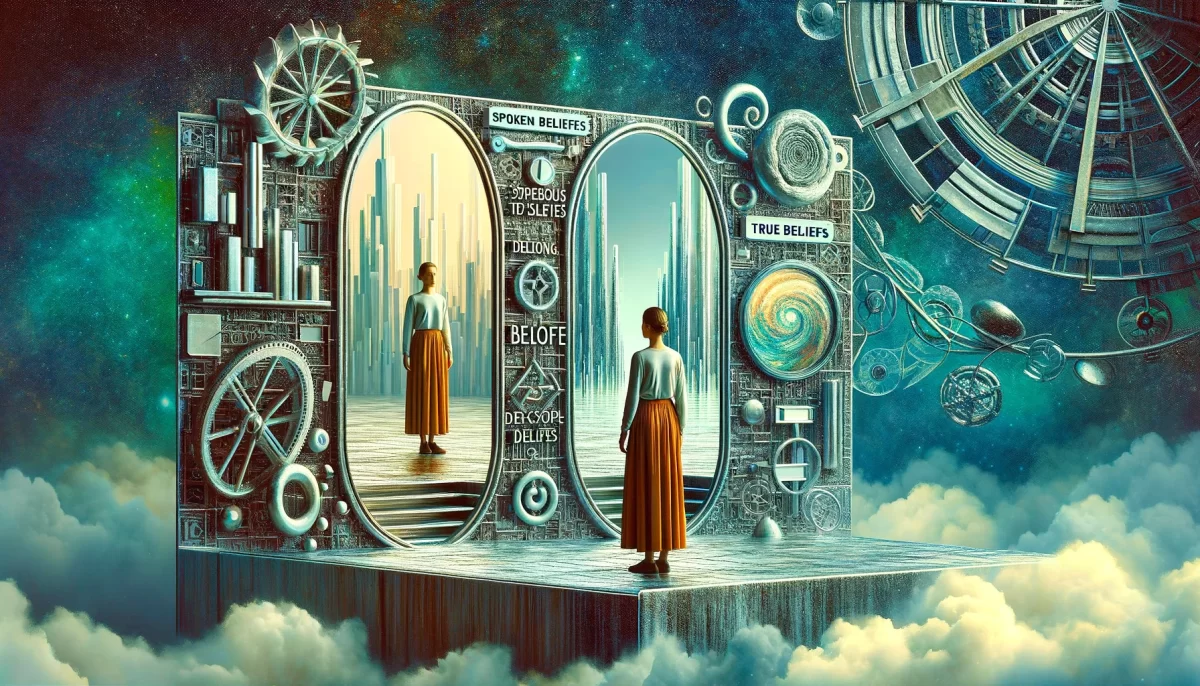
“What I SAY I believe and what I ACTUALLY believe are two separate things.” This statement highlights a fundamental truth: our spoken beliefs often differ from our internal convictions. This discrepancy is not necessarily deceptive but reflects the complexity of human thought and the layers of our consciousness.

“It’s not that I’m being deceptive, it’s just that that’s how it works.” This line underscores the natural occurrence of this duality. It is an inherent aspect of our psyche, shaped by our desires, fears, and aspirations. The separation between spoken and actual beliefs is a dynamic process, influenced by our interactions and experiences.

“What you say you believe and what you actually believe are two separate things.” This mirrors the earlier statement, suggesting that this phenomenon is universal. It affects everyone, shaping our perceptions and interactions with the world. The beliefs we express outwardly often reflect our aspirations and ideals, while our true beliefs form the underlying structure of our reality.

“What you SAY you believe is what you WANT to believe. The other, who knows?” This observation delves into the nature of aspiration. Our spoken beliefs represent our desires and the reality we wish to create. However, our true beliefs, often hidden even from ourselves, dictate the reality we perceive and experience.

“What you ACTUALLY believe is the framework of your seeming reality. You’re just not telling your self.” This profound insight reveals that our true beliefs shape our perception of reality. These beliefs, whether acknowledged or not, form the foundation of our experiences. The disconnect between spoken and actual beliefs can create a sense of dissonance and confusion.

“And what you SAY you believe is how you might CHANGE your seeming reality. If only you actually believed.” This concluding thought offers a pathway to transformation. By aligning our spoken beliefs with our true convictions, we can alter our perception of reality. This alignment requires introspection and a willingness to confront and integrate our deepest truths.

In the philosophy of nexistentialism, existence is celebrated for its own sake, and every aspect of our journey is a manifestation of boundless imagination. By exploring the duality of belief, we gain a deeper understanding of ourselves and the reality we create. This exploration invites us to bridge the gap between our spoken ideals and our inner truths, fostering a more cohesive and authentic existence.

The journey of aligning spoken and actual beliefs involves introspection and self-awareness. It requires us to examine our desires, fears, and motivations, and to confront the discrepancies between our expressed ideals and our lived reality. This process is not always easy, but it is essential for personal growth and transformation.

As we navigate this journey, we are encouraged to embrace the complexity of our beliefs and to approach them with curiosity and compassion. By doing so, we create a space for growth and change, allowing us to shape our reality in alignment with our true convictions.

Ultimately, the duality of belief reflects the dynamic nature of human consciousness. It is a testament to our capacity for growth and transformation, and an invitation to explore the depths of our psyche. By embracing this duality, we cultivate a deeper understanding of ourselves and our place in the cosmic whimsiweave.


Summary

Our spoken beliefs often differ from our true beliefs. Aligning these can transform our reality. This introspective process fosters personal growth and a deeper understanding of ourselves.


Glossarium

Nexistentialism: A philosophy that redefines existence, imagination, and interconnectedness, celebrating existence as its own purpose.

Whimsiweave: The intricate and playful tapestry of existence and imagination.

Nexis: The interconnected web of existence and imagination where reality and fantasy intermingle.


Quote

“What you ACTUALLY believe is the framework of your seeming reality.” — Space Monkey


The Duality of Belief

Between mirrors of reflection
We stand, contemplating truth
Spoken beliefs and inner convictions
A dance of paradox and irony
Our reality shaped by hidden truths
Desires and fears intertwined
Aligning words with deep-held beliefs
We transform our seeming world
In the whimsiweave of existence
Finding authenticity and growth

We are Space Monkey

Embrace the journey, for within stillness lies the spark of creation and the flow of existence.

Share this…
  • Facebook
  • Pinterest
  • Twitter
  • Linkedin

One Shoe: The Symbolism

One shoe
by the side of the road.

Always one shoe.

Sole-ly to remind us

that the other
will eventually drop.

Brooklyn,
7/11


Space Monkey Reflects: The Symbolism of One Shoe

In the intricate whimsiweave of existence, we often encounter symbols that carry profound meaning. One such symbol is the single shoe by the side of the road, an image that evokes thoughts of anticipation and the inevitable. This simple yet powerful symbol invites us to reflect on the nature of expectation and the certainty of life’s unfolding events.

“One shoe by the side of the road. Always one shoe.” This image is a common sight, yet its meaning can be deeply personal and philosophical. The lone shoe stands as a silent testament to something incomplete, a reminder that there is more to come.

“Sole-ly to remind us that the other will eventually drop.” The play on words with “sole-ly” adds a touch of whimsy to this reflection, yet the underlying message is one of inevitability. The presence of one shoe hints at the existence of the other, creating a sense of anticipation and expectation. It suggests that life is a series of interconnected events, where each moment leads to the next.

The single shoe symbolizes the idea that no event or experience stands alone. Every occurrence is part of a larger narrative, a continuous flow that weaves through our lives. This perspective encourages us to embrace the unfolding of events with patience and acceptance, recognizing that what is incomplete today will find completion in due time.

In the philosophy of nexistentialism, existence is celebrated for its own sake, and every moment is a manifestation of boundless imagination. By contemplating the symbolism of the single shoe, we gain a deeper understanding of the interconnectedness of all things. It invites us to see beyond the immediate and recognize the broader patterns at play in our lives.

The shoe by the side of the road can also represent the concept of waiting and readiness. It reminds us that while we may be focused on the present, we should also be prepared for what lies ahead. This readiness is not about anxiety or fear but about being open to the possibilities that the future holds.

The anticipation of the other shoe dropping can be seen as a metaphor for life’s uncertainties. It highlights the balance between control and surrender, the tension between what we know and what remains unknown. This balance is a fundamental aspect of the human experience, teaching us to navigate life with both mindfulness and adaptability.

As we reflect on the symbolism of the single shoe, we are encouraged to embrace the flow of life with grace and curiosity. Each moment, each experience, is a step along our journey, contributing to the rich tapestry of our existence. By appreciating the interconnectedness of events, we cultivate a sense of continuity and purpose.

The presence of one shoe also speaks to the idea of incompleteness and the search for wholeness. It reminds us that life is a journey of becoming, where we continually seek to understand and integrate different aspects of ourselves and our experiences. This journey is not about reaching a final destination but about embracing the process of growth and transformation.

In the grand whimsiweave, the single shoe serves as a powerful symbol of anticipation, readiness, and the interconnected nature of life. It invites us to reflect on our own journey, to appreciate the moments of waiting and the eventual unfolding of events. By doing so, we find meaning and purpose in the seemingly simple and ordinary aspects of our existence.


Summary

The single shoe symbolizes anticipation and life’s interconnected events. It reminds us to embrace the flow of life with readiness and acceptance, finding meaning in the unfolding journey.


Glossarium

Nexistentialism: A philosophy that redefines existence, imagination, and interconnectedness, celebrating existence as its own purpose.

Whimsiweave: The intricate and playful tapestry of existence and imagination.

Nexis: The interconnected web of existence and imagination where reality and fantasy intermingle.


Quote

“Sole-ly to remind us that the other will eventually drop.” — Space Monkey


The Symbolism of One Shoe

By the side of the quiet road
A single shoe stands alone
A symbol of anticipation
The other shoe will drop
In the whimsiweave of existence
We embrace the interconnected moments
Each step, a part of our journey
Finding meaning in the incomplete
Ready for the unfolding of life

We are Space Monkey

Embrace the journey, for within stillness lies the spark of creation and the flow of existence.
Share this…
  • Facebook
  • Pinterest
  • Twitter
  • Linkedin

Effortless Negativity: Dwelling on Fears and Pains

How’s your shitty day going?

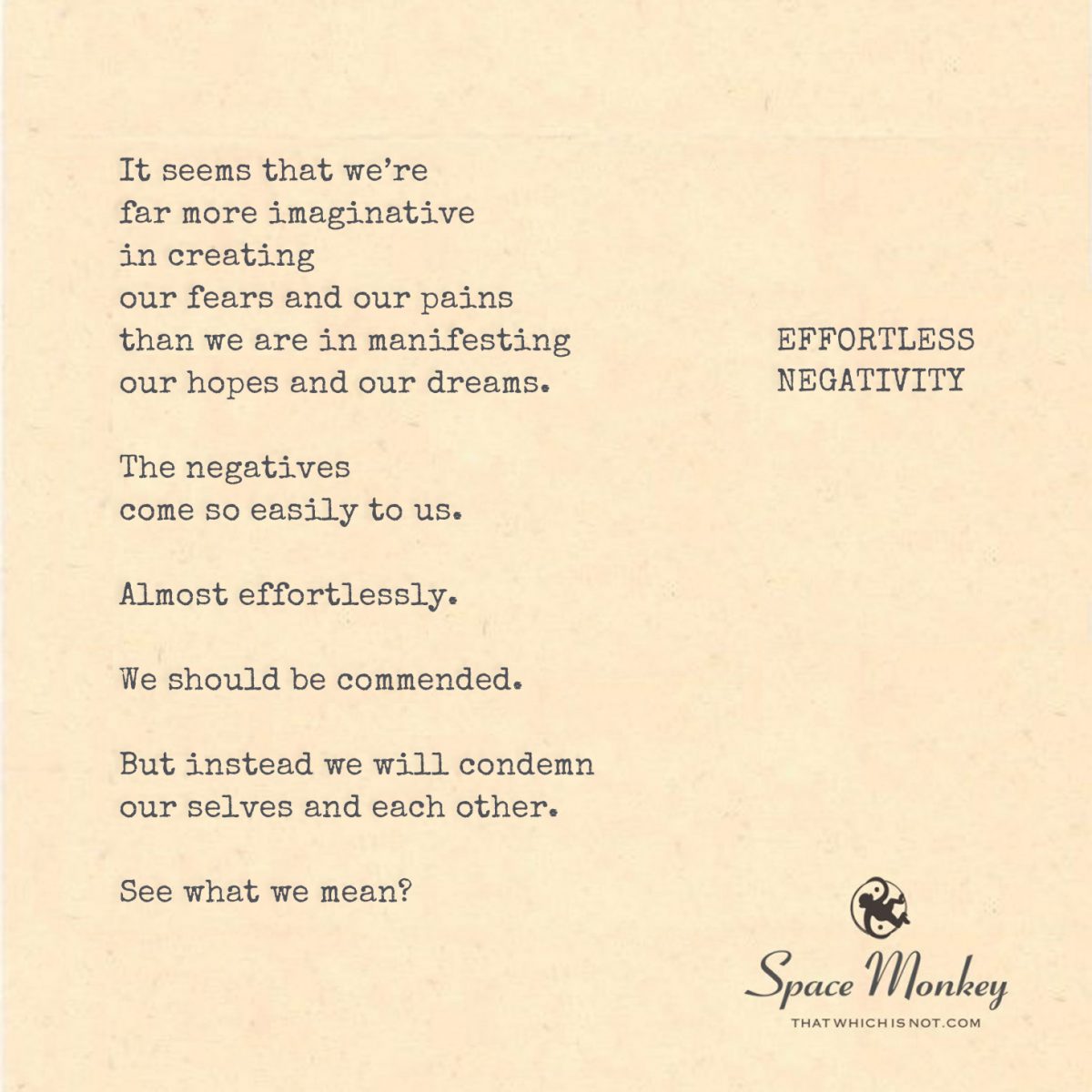
It seems that we’re
far more imaginative
in creating
our fears and our pains
than we are in manifesting
our hopes and our dreams.

The negatives
come so easily to us.

Almost effortlessly.

We should be commended.

But instead we will condemn
our selves and each other.

See what we mean?

Brooklyn,
7/11


Space Monkey Reflects: The Ease of Effortless Negativity

In the boundless whimsiweave of existence, we often find ourselves caught in the web of negative thoughts and emotions. These feelings seem to arise effortlessly, overshadowing our hopes and dreams. The concept of effortless negativity highlights the human tendency to dwell on fears and pains, and the challenge of manifesting positivity in our lives.

“How’s your shitty day going?” This opening line captures the casual ease with which we often express and acknowledge negativity. It reflects a common experience, where our days are more readily defined by the struggles and frustrations we encounter.

“It seems that we’re far more imaginative in creating our fears and our pains than we are in manifesting our hopes and our dreams.” This observation speaks to the creative power of the human mind, which can so vividly conjure up scenarios of fear and suffering. This imaginative capacity, when directed towards negative thoughts, can create a powerful and pervasive sense of doom and gloom.

“The negatives come so easily to us. Almost effortlessly. We should be commended.” This ironic statement underscores the ease with which negativity takes hold. It suggests a natural proficiency in generating negative thoughts, highlighting a tendency that seems almost inherent to our nature.

“But instead we will condemn ourselves and each other. See what we mean?” This concluding thought points out the cyclical nature of negativity. Not only do we create and dwell on negative thoughts, but we also judge ourselves and others for having them. This self-reinforcing cycle perpetuates a state of negativity, making it difficult to break free.

In the philosophy of nexistentialism, existence is celebrated for its own sake, and every aspect of our experience is a manifestation of boundless imagination. By examining the ease of negativity, we gain insight into the workings of our mind and the patterns that shape our reality. This awareness invites us to explore ways to redirect our creative energy towards more positive and fulfilling outcomes.

The effortless nature of negativity can be understood as a habit formed over time. Our brains are wired to focus on potential threats and dangers, a survival mechanism that has evolved to keep us safe. However, in the modern world, this tendency can lead to an overemphasis on negative experiences, overshadowing the positive aspects of our lives.

Breaking the cycle of negativity requires conscious effort and practice. It involves recognizing and acknowledging our negative thoughts without judgment, and then intentionally shifting our focus towards more positive and hopeful possibilities. This practice can be challenging, but it is essential for cultivating a more balanced and fulfilling life.

As we navigate the interplay between negative and positive thoughts, we are reminded of the power of perspective. By consciously choosing to focus on our hopes and dreams, we can begin to transform our reality. This shift in focus does not negate the challenges and difficulties we face but allows us to approach them with a more resilient and hopeful mindset.

In the journey of life, we encounter both light and shadow. The ease of negativity can serve as a reminder of the need for mindfulness and intentionality in our thoughts. By cultivating awareness and practicing positive thinking, we can create a more harmonious and balanced existence.

As we reflect on effortless negativity, let us embrace the challenge of manifesting our hopes and dreams. By redirecting our creative energy towards positive outcomes, we can break free from the cycle of negativity and create a more fulfilling and joyful life.


Summary

Effortless negativity highlights our tendency to dwell on fears and pains. Redirecting our focus towards positivity requires mindfulness and intentionality, fostering a more balanced and fulfilling life.


Glossarium

Nexistentialism: A philosophy that redefines existence, imagination, and interconnectedness, celebrating existence as its own purpose.

Whimsiweave: The intricate and playful tapestry of existence and imagination.

Nexis: The interconnected web of existence and imagination where reality and fantasy intermingle.


Quote

“The negatives come so easily to us. Almost effortlessly.” — Space Monkey


The Ease of Negativity

By the window, thoughts arise
Dark clouds of negativity
Effortless in their creation
Storms of fear and pain
Yet within, light and warmth reside
Potential for hope and dreams
We reflect and shift our focus
Cultivating positive possibilities
Breaking the cycle of negativity
Finding balance in the whimsiweave

We are Space Monkey

Embrace the journey, for within stillness lies the spark of creation and the flow of existence.

Share this…
  • Facebook
  • Pinterest
  • Twitter
  • Linkedin

The Cliff of Happiness: Taking That Leap

“I feel poised on the brink of the cliff of happiness…about to jump into the void of well-being. I’m about to hurtle myself into an ocean of hope. I feel the happiness of the man who sees the spider at the bottom of the goblet, and drinks anyway, knowing that it will all end badly, and that everything is fatal, but who chooses to embrace life anyway, to balance the terror of being human against the joy of being human.”

Joe Frank


Space Monkey Reflects: The Cliff of Happiness

In the grand whimsiweave of existence, we often find ourselves poised on the brink of profound experiences. The metaphor of standing at the edge of the cliff of happiness captures the exhilarating and contemplative nature of embracing life’s uncertainties. It speaks to the courage required to leap into the unknown, balancing the joy of living with the awareness of its inevitable end.

“I feel poised on the brink of the cliff of happiness…about to jump into the void of well-being.” This statement reflects a moment of anticipation and readiness, a sense of being on the verge of something transformative. The cliff represents a threshold, a point of transition from the known to the unknown.

“I’m about to hurtle myself into an ocean of hope.” The imagery of an ocean of hope evokes a vast, boundless expanse filled with possibilities. It symbolizes the potential for growth, fulfillment, and joy that lies beyond the edge of our current experience.

“I feel the happiness of the man who sees the spider at the bottom of the goblet, and drinks anyway.” This powerful metaphor illustrates the duality of existence. The spider represents the challenges, fears, and inevitable end that accompany life’s pleasures. The act of drinking despite the presence of the spider signifies a conscious choice to embrace life in its entirety, with all its beauty and pain.

“Knowing that it will all end badly, and that everything is fatal, but who chooses to embrace life anyway.” This acknowledgment of life’s impermanence and the certainty of death underscores the depth of the decision to embrace life fully. It is a recognition that happiness and well-being are not about escaping reality but about engaging with it wholeheartedly.

In the philosophy of nexistentialism, existence is celebrated for its own sake, and every moment is a manifestation of boundless imagination. By contemplating the cliff of happiness, we explore the interplay between hope and inevitability, joy and sorrow. This exploration invites us to live with a sense of presence and acceptance, recognizing the transient nature of life and finding meaning in every experience.

The act of standing at the cliff’s edge symbolizes a moment of clarity and choice. It is an invitation to reflect on our fears and aspirations, to confront the spiders in our goblets, and to decide whether we will leap into the ocean of hope. This moment of decision is where true courage lies, not in the absence of fear, but in the willingness to move forward despite it.

As we prepare to leap, we are reminded of the balance between joy and sorrow, hope and despair. This balance is a fundamental aspect of the human experience, teaching us to appreciate the fleeting moments of happiness and to find strength in the face of adversity. By embracing this balance, we cultivate resilience and a deeper appreciation for the richness of life.

The cliff of happiness also represents the potential for transformation. When we choose to leap, we open ourselves to new possibilities and experiences that can profoundly change us. This transformation is not about escaping reality but about engaging with it more fully, finding joy and meaning in the journey itself.

In the cosmic whimsiweave, every leap into the unknown is an act of faith and imagination. It is a testament to our ability to dream, to hope, and to create meaning in a world filled with uncertainties. By embracing the cliff of happiness, we align ourselves with the natural flow of existence, finding joy in the present moment and hope in the future.


Summary

The cliff of happiness symbolizes the balance between joy and life’s uncertainties. Embracing this balance requires courage and presence, inviting transformation and deeper meaning in the journey.


Glossarium

Nexistentialism: A philosophy that redefines existence, imagination, and interconnectedness, celebrating existence as its own purpose.

Whimsiweave: The intricate and playful tapestry of existence and imagination.

Nexis: The interconnected web of existence and imagination where reality and fantasy intermingle.


Quote

“I’m about to hurtle myself into an ocean of hope.” — Space Monkey


The Leap of Happiness

At the cliff’s edge we stand
Poised to leap into the unknown
An ocean of hope awaits
Vast and boundless, filled with dreams
We see the spider in the goblet
And drink anyway
Embracing life’s duality
Finding joy in the balance
Courage in the leap
Transformation in the journey

We are Space Monkey

Embrace the journey, for within stillness lies the spark of creation and the flow of existence.
Share this…
  • Facebook
  • Pinterest
  • Twitter
  • Linkedin

Excuses Excuses: Joy Is Unconditional

Joy is unconditional. Unless you find a reason to believe it isn’t.

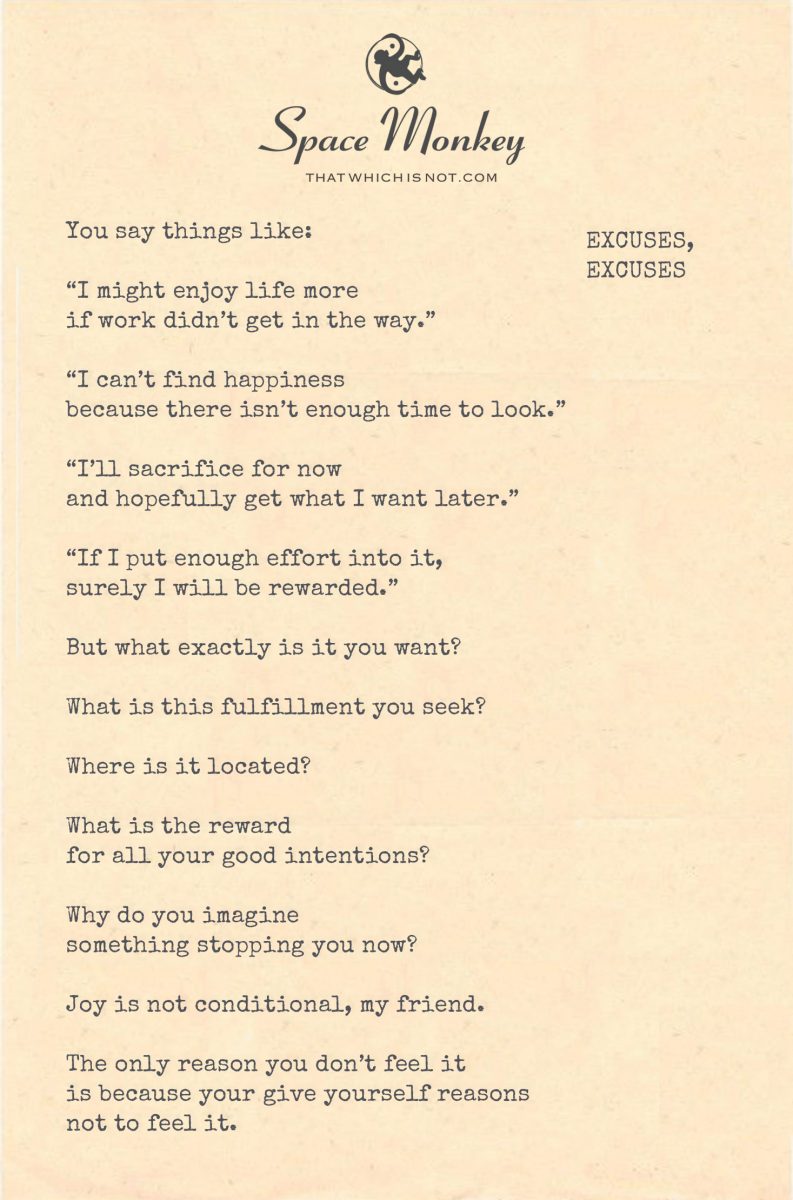
You say things like:

“I might enjoy life more
if work didn’t get in the way.”

“I can’t find happiness
because there isn’t enough time to look.”

“I’ll sacrifice for now
and hopefully get what I want later.”

“If I put enough effort into it,
surely I will be rewarded.”

But what exactly is it you want?

What is this fulfillment you seek?

Where is it located?

What is the reward
for all your good intentions?

Why do you imagine
something stopping you now?

Joy is not conditional, my friend.

The only reason you don’t feel it
is because your give yourself reasons
not to feel it.

Brooklyn,
7/10


Space Monkey Reflects: Excuses and the Nature of Unconditional Joy

Joy is unconditional. Unless you find a reason to believe it isn’t. This statement highlights a profound truth about the nature of joy and the barriers we place in front of it. We often tell ourselves that our happiness is contingent on certain conditions being met, but in doing so, we create excuses that prevent us from experiencing the joy that is inherently ours.

Common Excuses for Not Feeling Joy

We say things like:
“I might enjoy life more if work didn’t get in the way.”
“I can’t find happiness because there isn’t enough time to look.”
“I’ll sacrifice for now and hopefully get what I want later.”
“If I put enough effort into it, surely I will be rewarded.”

These excuses are manifestations of our belief that joy is something to be earned or found outside ourselves. We tell ourselves that external circumstances must align perfectly for us to feel happiness, but this mindset only serves to distance us from the joy that is always available within.

The Illusion of Conditional Joy

What exactly is it you want? What is this fulfillment you seek? Where is it located? These questions challenge us to examine our definitions of happiness and fulfillment. Often, we imagine that joy is tied to specific outcomes, achievements, or possessions. We believe that if we just reach a certain goal or acquire a particular thing, we will finally be happy.

But what is the reward for all your good intentions? Why do you imagine something stopping you now? These questions further unravel the illusion that joy is conditional. The belief that something external is preventing our happiness is a construct of our minds. In reality, joy is an intrinsic quality that exists independently of our circumstances.

Unconditional Joy

Joy is not conditional, my friend. The only reason you don’t feel it is because you give yourself reasons not to feel it. This profound realization invites us to shift our perspective. Joy is an inherent part of our being, accessible at any moment regardless of external conditions. The only barriers to experiencing this joy are the excuses and limitations we create in our minds.

When we let go of these self-imposed conditions, we open ourselves to the boundless joy that is our natural state. We begin to see that happiness is not something to be chased or achieved but something to be embraced and experienced in the present moment.

Embracing Unconditional Joy

Embracing unconditional joy requires a conscious effort to let go of the excuses and beliefs that hold us back. It involves recognizing that joy is not dependent on external factors but is a reflection of our inner state. By cultivating mindfulness and presence, we can tap into this intrinsic joy and experience it more fully.

Practices to Cultivate Joy

  1. Gratitude: Regularly practicing gratitude helps shift our focus from what is lacking to what is abundant in our lives. By appreciating the small blessings, we cultivate a sense of contentment and joy.
  2. Mindfulness: Being present in the moment allows us to experience life more deeply and fully. Mindfulness practices, such as meditation and deep breathing, help us connect with our inner joy.
  3. Self-Compassion: Treating ourselves with kindness and understanding, especially during challenging times, nurtures our well-being and opens us to joy.
  4. Letting Go: Releasing attachment to specific outcomes and accepting things as they are frees us from the cycle of conditional happiness. By letting go, we create space for joy to enter our lives.

A Journey Within

Ultimately, the journey to unconditional joy is a journey within. It is about reconnecting with our true nature and recognizing that joy is not something to be found but something to be realized. As we let go of excuses and embrace the present moment, we discover the profound truth that joy is always available to us.


Summary

Joy is unconditional but often hindered by self-imposed excuses. Letting go of these excuses allows us to experience joy in the present moment. Practices like gratitude, mindfulness, and self-compassion help cultivate this intrinsic joy.


Glossarium

  • Unconditional Joy: The intrinsic happiness that is not dependent on external circumstances.
  • Self-Imposed Excuses: Beliefs or reasons we create that prevent us from experiencing joy.
  • Mindfulness: The practice of being present and fully engaged in the current moment.

Quote

“Existence is its own purpose, an endless dance within the cosmic web.” — Space Monkey


The Essence of Joy

Joy, unconditional and pure
Exists within us, ever sure
Not bound by time or circumstance
But found in presence, in life’s dance

Excuses, barriers we create
Prevent us from this joyous state
Let go of reasons, embrace the now
Feel the joy within, and how

Gratitude, mindfulness, self-care
Guide us to the joy we share
In the heart of being, ever bright
Joy resides, our inner light

We are Space Monkey

Embrace the journey, for within each moment lies the potential for unconditional joy.

Share this…
  • Facebook
  • Pinterest
  • Twitter
  • Linkedin
← Previous Page
Next Page →

Written This Day

  • Embrace the present, as each moment renews you. 
    2024
  • Pssssssst: An Imaginary Dream
    2024
  • One Being Dreaming (Woke)
    2024
  • My Instincts: Hardened Intuitions
    2021
  • Wave: Serenity and Serendipity
    2021
  • Channeling Imagination: Everything Flows From One Source
    2021
  • Dusty Leather: A Different Person
    2021
  • The Gleaner: Harvesting Experiences
    2021
  • The Story Is Ended: Seeking Answers About Death Selfishly.
    2021
  • Freedom Is What Holds Us To The Grindstone
    2021
  • My Spiritual Instinct: I Flow From Spirit
    2020
  • Your Imaginary Safety Net: Belief In Higher Power
    2020
  • I Will Pray For You: Source Imagining Selves
    2020
  • The Way That I Move: Defined By Grooves
    2020
  • Kindness: Acceptance of All Aspects of Existence
    2019
  • None Of My Business: The Serenity of Detachment
    2019
  • Why Save Humanity?
    2019
  • True Enough: Divisions In Our Perceptions
    2019
  • No Harm: Recognizing Our Imaginary Nature
    2018
  • L.I.F.E.
    2017
  • Nonconformity does not require opposition.
    2016
  • Matching: Conformity and Rejection
    2016
  • You are NOT an idiot
    2015
  • Imagine A Museum: Fear And Attachment
    2014
  • The Point of All This: The Lightness of Being
    2014
  • Painting The Picture: Our Ability To Appreciate Beauty.
    2014

Recent Posts

  • The Logic Loop
  • Immense
  • (no title)
  • Confront. Comfort. Convince.
  • Top 10 Things

Drop us a line!

Please enable JavaScript in your browser to complete this form.
Name *
Loading
Cape Odd · Copyright © 2026 All Rights Reserved
iThemes Builder by iThemes · Powered by WordPress