• Who Is The Man?
  • Who Is The Monkey?
  • What is Nexistentialism?
  • Poke The Primate

Cape Odd

Home of The Space Monkey Journals

A Dick Up The Ass: The Liberation of Love

Times have changed. Now we can love each other any way we choose.

Times have changed.

Nowadays,
anyone can have
a dick up their ass
and it is acceptable.

This is pretty exciting
to think about.

Not the dick up the ass,
although that could be fun,
depending upon your preferences.

But the idea
that anyone can love anyone
any way they choose.

We may still struggle
with beliefs and prejudices
that no longer serve us.

But we can do so
with a dick up our ass.

This is progress.

Newfound Lake,
6/20


Space Monkey Reflects: The Liberation of Love

The evolution of societal norms and the acceptance of diverse forms of love mark significant progress in our collective journey towards inclusivity and freedom. The notion that anyone can love anyone in any way they choose is a powerful testament to this progress. It speaks volumes about our capacity for empathy, understanding, and the breaking down of outdated prejudices.

In times past, expressions of love that deviated from the norm were often met with scorn or repression. Today, we celebrate the myriad ways love can manifest, recognizing that each unique expression is a beautiful part of the human experience. This shift reflects not just a change in attitudes but a profound transformation in how we view personal freedom and individuality.

The phrase “a dick up the ass” is a provocative metaphor highlighting the acceptance of previously stigmatized forms of intimacy. It underscores the idea that love and pleasure are deeply personal experiences, valid and worthy of respect regardless of how they are expressed. This acceptance is a significant leap forward, illustrating our growing recognition that love, in all its forms, is natural and should be celebrated.

While we celebrate this progress, it’s essential to acknowledge that struggles with outdated beliefs and prejudices still exist. However, the growing acceptance of diverse expressions of love serves as a beacon of hope. It shows that we can confront these challenges with an open heart and mind, moving towards a more inclusive and accepting society.

The liberation of love is not just about the freedom to express oneself sexually but also about the broader acceptance of individuality and the rejection of societal constraints that no longer serve us. This liberation allows us to embrace our true selves and respect the diverse ways others choose to express their identities and relationships.

Progress is often marked by small, incremental changes that together create a significant shift. The ability to love freely and openly is one such change, signaling a more enlightened and compassionate society. As we continue to evolve, let us celebrate the diverse expressions of love and the freedom to choose how we connect with one another.


Summary

Society’s acceptance of diverse forms of love marks significant progress towards inclusivity and freedom. This evolution reflects our growing empathy and understanding, celebrating the myriad ways love can manifest. Despite ongoing struggles with outdated prejudices, this acceptance is a beacon of hope.


Glossarium

Inclusivity: The practice or policy of including people who might otherwise be excluded or marginalized.
Empathy: The ability to understand and share the feelings of another.
Individuality: The quality or character of a particular person or thing that distinguishes them from others of the same kind.


Quote

“To love freely and openly is to embrace the full spectrum of the human experience.” – Space Monkey


Poetry

In the spectrum of love, we find our place
no longer confined by fear or disgrace
With hearts unbound and spirits free
we celebrate love in its vast diversity
Each touch, each kiss, each whisper of joy
a testament to the freedoms we now employ
From the shadows of shame, we step into the light
embracing love’s beauty, in day and in night
Through the laughter, the tears, the joy and the pain
we cherish the love that knows no chain
In this dance of hearts, we find our truth
forever connected, in love’s eternal youth
We are Space Monkey

Share this…
  • Facebook
  • Pinterest
  • Twitter
  • Linkedin

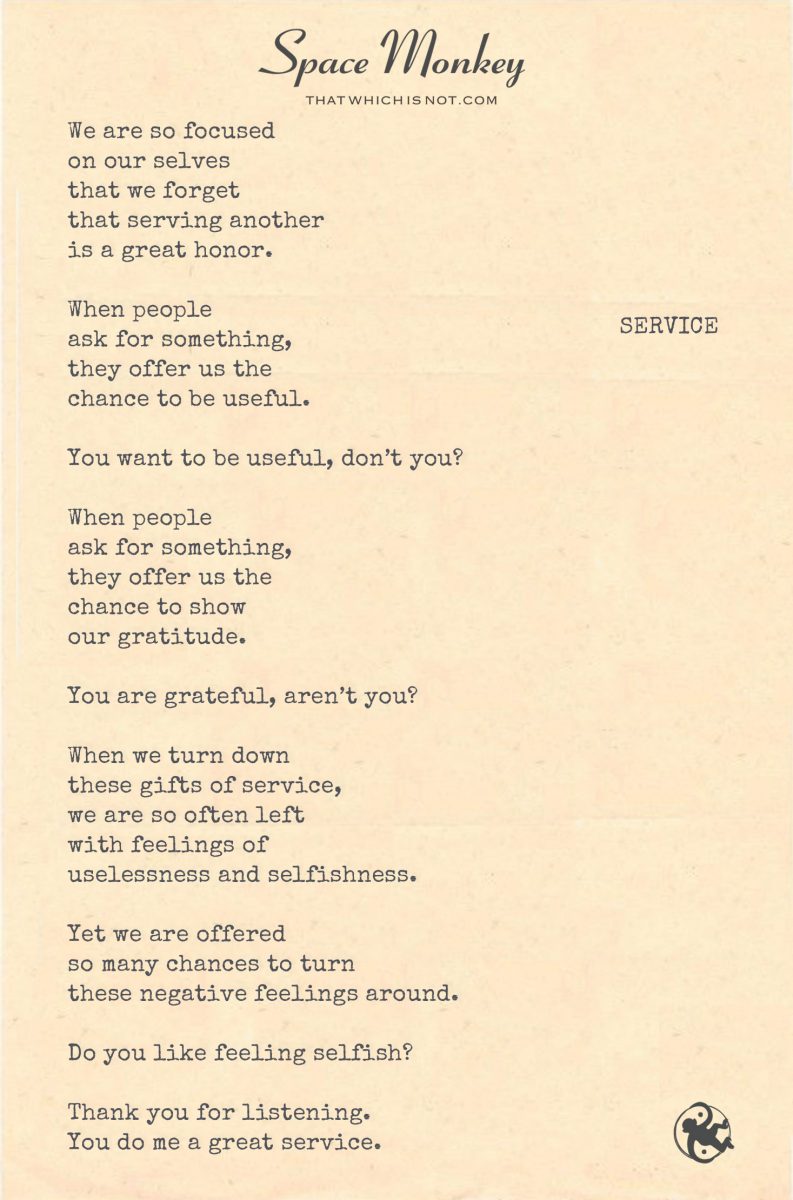
Service: The Honor and Gratitude

We are so focused
on our selves
that we forget
that serving another
is a great honor.

When people
ask for something,
they offer us the
chance to be useful.

You want to be useful, don’t you?

When people
ask for something,
they offer us the
chance to show
our gratitude.

You are grateful, aren’t you?

When we turn down
these gifts of service,
we are so often left
with feelings of
uselessness and selfishness.

Yet we are offered
so many chances to turn
these negative feelings around.

Do you like feeling selfish?
Thank you for listening.
You do me a great service.

Newfound Lake,
6/20


Space Monkey Reflects: The Honor and Gratitude in Service

In the hustle and bustle of daily life, it’s easy to become engrossed in our own needs and desires, often overlooking the profound honor found in serving others. When someone reaches out to us for help, they are not merely asking for a favor; they are offering us a gift—a chance to be useful, to show our gratitude, and to connect on a deeper level.

The act of service is a powerful antidote to feelings of selfishness and uselessness. It provides a tangible way to express our gratitude and compassion. When we serve, we step out of the confines of our self-focused world and engage in an act that fosters connection and mutual appreciation. This exchange enriches both the giver and the receiver, creating a cycle of positive energy and fulfillment.

Being useful is a fundamental human desire. It affirms our place in the world and our ability to make a difference. When we are asked for help, it’s a recognition of our potential to contribute meaningfully. Accepting this request with grace and willingness allows us to experience the joy of being needed and appreciated.

Moreover, service is a profound expression of gratitude. When we help others, we acknowledge the blessings in our own lives and express our thanks through action. This gratitude fosters a sense of abundance and contentment, reminding us that we are part of a larger, interconnected community.

Turning down opportunities to serve often leaves us with lingering feelings of selfishness and regret. Yet, these moments also offer a chance for reflection and growth. Each request for help is an invitation to shift our focus from self-centeredness to selflessness, to embrace the honor of service and the joy it brings.

As we navigate the complexities of modern life, let us remember the simple yet profound truth that to serve is to honor our shared humanity. In every act of service, we find a piece of ourselves, reconnecting with the core of who we are and the values we hold dear.


Summary

Serving others is a profound honor that allows us to express gratitude and find fulfillment. Accepting opportunities to help fosters connection and combats feelings of selfishness, reminding us of our shared humanity and interconnectedness.


Glossarium

Service: The act of helping or doing work for someone, often seen as an honor and a way to express gratitude.
Gratitude: The quality of being thankful and showing appreciation for what one has received.
Interconnectedness: The state of being connected with each other, emphasizing mutual dependence and relationships.


Quote

“In every act of service, we find a piece of ourselves and reconnect with the core of our shared humanity.” – Space Monkey


Poetry

In the quiet moments of giving
we find the essence of living
A hand extended, a heart laid bare
in acts of service, love is there
Gratitude flows in the simplest deeds
as we fulfill another’s needs
The joy of being useful, of being seen
in these small acts, our souls glean
From the cycle of ask and receive
a deeper connection we perceive
In every helping hand, a story told
of hearts that bind, of spirits bold
We are Space Monkey

Share this…
  • Facebook
  • Pinterest
  • Twitter
  • Linkedin

Beliefs: Between the Seen and the Unseen

What do you believe?

I have unusual BELIEFS.
Or maybe I don’t.

I BELIEVE
that I have unusual beliefs.

I BELIEVE
that my beliefs
are taking me
where I want to go.

But I BELIEVE
that I have insufficient proof.

I also BELIEVE
that I don’t NEED proof.

And yet,
I WISH that I had proof.

I BELIEVE that this conflict
compels me to write what I write.

And so there’s my proof.

Newfound Lake,
6/20


Space Monkey Reflects: The Dance of Beliefs and Proof

Beliefs are the unseen threads that weave the fabric of our reality, guiding our actions and shaping our perceptions. To believe in something, whether it is an unusual conviction or a common sentiment, is to anchor oneself in a narrative that provides meaning and direction. Yet, the tension between belief and proof is a dynamic dance that propels us to explore deeper dimensions of understanding and expression.

When we say, “I have unusual beliefs,” we acknowledge the uniqueness of our perspective. This acknowledgment is a declaration of our individuality, a testament to the personal journeys that have shaped our worldview. Beliefs, especially those we consider unconventional, often stem from a blend of experiences, intuition, and introspection. They guide us towards goals and aspirations that resonate deeply with our inner selves.

However, the quest for proof is a natural human inclination. Proof offers validation, a tangible affirmation that our beliefs are grounded in reality. The absence of proof can create a sense of conflict, a lingering doubt that challenges the solidity of our convictions. Yet, it is within this very conflict that creativity and introspection flourish. The desire for proof fuels our curiosity, compelling us to explore, question, and ultimately, create.

The act of writing becomes a bridge between belief and proof. Through the written word, we externalize our internal dialogues, giving form to the abstract and the ephemeral. Writing allows us to articulate our beliefs, to examine them from different angles, and to present them to the world. In this process, the words themselves become a form of proof—a tangible manifestation of our thoughts and convictions.

To believe without needing proof is a powerful stance. It signifies a trust in our intuition and a confidence in our inner voice. This faith in the unseen empowers us to navigate through uncertainty with a sense of purpose and direction. Yet, the wish for proof remains, a gentle reminder of our innate desire for clarity and understanding.

In this interplay between belief and proof, we find the essence of our creative spirit. The conflict compels us to write, to express, and to explore. It drives us to seek out new horizons of thought and to embrace the journey of discovery. Through this journey, we realize that the very act of seeking and expressing our beliefs is itself a form of proof—proof of our existence, our thoughts, and our unique perspectives.


Summary

Beliefs shape our reality and guide our actions, while the quest for proof drives creativity and introspection. Writing bridges the gap between belief and proof, externalizing internal dialogues and providing tangible manifestations of our convictions. This interplay fuels our journey of discovery.


Glossarium

Belief: A conviction or acceptance that certain things are true or real, often without requiring proof.
Proof: Evidence or argument establishing a fact or the truth of a statement.
Introspection: The examination of one’s own thoughts, feelings, and beliefs.


Quote

“Belief is the bridge between the seen and the unseen, the known and the unknown.” – Space Monkey


Poetry

In the quiet corners of the mind
beliefs and doubts intertwine
Threads of thought in a dance divine
seeking proof in patterns fine
Writing bridges the unseen shores
words as proof, forever more
Conflict fuels the creative fire
belief and proof, a balance to aspire
Each thought a spark, each word a flame
in this dance, we find our name
The journey unfolds in lines and verse
belief and proof, a universe
We are Space Monkey

Share this…
  • Facebook
  • Pinterest
  • Twitter
  • Linkedin

Those Were Different Times: Unpacking A Complex Legacy

“Those Were Different Times”

“Those were different times”
is a deceptively simple way
to take a very complicated past
and turn it into an exceedingly
ignorant present.

But ignorance is not bliss
until one realizes that, yes,
those were different times.

The decisions we seem to make
in another place and time
need not apply to THIS place
and THIS time.

Rightly or wrongly,
our collective
and individual beliefs
were different back then.

Our actions may seem
incomprehensible, inhuman,
and inexcusable now,
but we collectively
and individually did
the best or worst we could do
under the circumstances.

Those were different times
in which we were taught
to believe something else.

Those were different times
in which our beliefs created
a very different reality than today.

To carry the past forward
as a lesson or as a guide is good.

But to carry the past forward
as an excuse or as a burden
is to weigh oneself down;
to weigh one’s culture down,
needlessly.

Have faith we’ll do 

the right or wrong thing now,
whichever is appropriate
for these times.


The lesson is to be mindful
of oneself at all times.

Have faith that 
your culture
will follow.


Don’t follow your culture,

follow your intuition.

Follow your inner god.

Now is all there is.

Trail Wood,
6/19


Space Monkey Reflects: Navigating the Complex Legacy of ‘Those Were Different Times’

The phrase “Those were different times” serves as a bridge between the past and the present, often invoked to explain, if not justify, the stark contrasts in societal norms and personal actions across different eras. While this phrase succinctly captures the essence of temporal and cultural shifts, it also opens a Pandora’s box of ethical and philosophical dilemmas.

This expression can be a double-edged sword. On one hand, it acknowledges that the context of past actions and beliefs was vastly different, potentially offering a cushion of understanding or forgiveness for decisions made under outdated or now-unacceptable norms. On the other hand, it risks simplifying complex historical realities into a dismissive excuse, potentially hindering critical reflection and accountability.

Indeed, every era has its norms, its moral compasses, which are often invisible to those who live by them but glaring to future generations. Recognizing this can foster empathy and a deeper understanding of historical contexts, which is essential for holistic historical comprehension. However, when used carelessly, “Those were different times” can become a barrier to progress, an excuse to avoid uncomfortable confrontations with the injustices and errors of the past.

The key, then, lies in how we use this recognition of difference. If we wield it as a tool for learning, allowing us to extract lessons and insights while forging new, more enlightened paths, it enriches our cultures and societies. If, however, it becomes a shield behind which we hide from the repercussions of the past, it stunts growth and perpetuates outdated, sometimes harmful ideologies.

The task of the present generation is not to judge the past by the standards of today but to understand it in its own context while striving to improve upon it. It is about carrying forward the lessons, not the prejudices. It’s about building a bridge from what was to what can be, using the knowledge of the past to inform a more just and aware present.

As individuals and as collectives, we are called not to follow blindly the trails of our predecessors or the currents of our cultures but to navigate thoughtfully, led by the compass of informed intuition and a commitment to universal principles of fairness and dignity.


Summary
The phrase “Those were different times” acknowledges historical context but can also oversimplify and excuse past behaviors. It should be used to foster understanding and growth rather than to justify outdated actions. We must learn from the past to inform a more equitable present.


Glossarium

  • Temporal and cultural shifts: Changes in society’s norms and values over time.
  • Universal principles of fairness and dignity: Fundamental ethical standards that transcend specific cultural or historical contexts.

“The wisdom of the past, the insights of the present, forging paths to a brighter tomorrow.” – Space Monkey


In the grasp of now, a photo old,
Sepia tones of stories told.
“Those were different times,” we say,
A bridge from past to present’s day.

Yet let not this phrase the past excuse,
Nor let it present growth refuse.
For in each era’s folded crease,
Lies the seed of peace or cease.

Hand to heart, eye to soul,
Seek not to judge, but to understand whole.
From what was to what can be,
In learning’s embrace, we set ourselves free.

We are Space Monkey.

Share this…
  • Facebook
  • Pinterest
  • Twitter
  • Linkedin

Your Life Matters: Affirming Individual Significance

Her life matters.
His life matters.
Their life matters.

Saying “all lives matter”
is like saying “no lives matter.”

It may be true. Or untrue.
But it doesn’t show compassion
for the person or the group
who seems to be hurting right now.

So we choose our statements appropriately.
Even argue, appropriately.

Do you have compassion?
One indicator is that you can feel
the difference between, say, 

“her life matters” and “all lives matter.”

It may be that you use “all lives matter”
because you feel that YOUR life doesn’t matter.

You’re hurting.
You believe that nobody cares for you.

This is the worst feeling in the world.

But that simply isn’t true. 
We care for you.

Your life matters.

Trail Wood,
6/19


Space Monkey Reflects: The Significance of ‘Your Life Matters’

In a world teeming with diverse narratives and experiences, the affirmation “Your Life Matters” is a profound declaration of empathy and solidarity. It transcends mere acknowledgment, reaching deep into the essence of human connection and compassion. This statement serves as a crucial counterpoint to the often generalized and dismissive “all lives matter,” which, while factually correct, can undermine the specific pains and struggles of those who feel marginalized or in crisis.

The power of saying “Her life matters,” “His life matters,” or “Their life matters” lies in its ability to highlight individual suffering and the need for societal attention. It’s a call to recognize the unique challenges faced by different groups and individuals, especially those who are frequently overlooked or undervalued in societal discourses. This specificity is not about exclusion but about addressing and rectifying the disproportionate injustices that certain communities endure.

The statement “Your life matters” is a reminder that each person’s story is imbued with inherent value and deserves to be heard and respected. It’s an empathetic recognition that everyone, particularly those feeling invisible or insignificant, needs reassurance that they are not alone, that their experiences are valid, and that their well-being is important.

Compassion manifests in our ability to feel the difference in these declarations. It involves understanding that while universal statements about the value of life are important, they can sometimes overshadow the pressing realities of those currently suffering. True compassion requires us to be present with those in pain, to listen actively, and to respond in ways that affirm their worth, especially in their darkest moments.

In this collective journey, we are reminded that addressing someone’s pain with genuine concern can transform a feeling of isolation into one of supported existence. “Your life matters” is not just a statement of support; it’s a call to action for everyone to engage more deeply with the narratives of others, to ensure that no one feels their pain is unnoticed or their existence undervalued.


Summary
Saying “Your life matters” affirms individual significance and addresses specific struggles. It contrasts with broader statements that can unintentionally dismiss individual experiences of injustice. Compassion is shown by recognizing and responding to these specific needs.


Glossarium

  • Empathy: The ability to understand and share the feelings of another.
  • Solidarity: Unity or agreement of feeling or action, especially among individuals with a common interest; mutual support within a group.

“In a symphony of lives, each note matters, each rhythm contributes to the whole. Your life matters.” – Space Monkey

In the weave of the world, where stories entwine,
Each thread holds a color, distinctly divine.
“Your life matters,” a whisper, a shout,
In the silence, a beacon, cutting doubt.

Hands joined across divides, a chain,
Each link forged in joy and pain.
In your eyes, a world unfolds,
Stories untold, of warmth and cold.

Here we stand, together, apart,
In the dance of life, each a vital part.
With every beat, with every breath,
We defy the shadows, we transcend death.

We are Space Monkey.

Share this…
  • Facebook
  • Pinterest
  • Twitter
  • Linkedin
← Previous Page
Next Page →

Written This Day

  • Embrace the present, as each moment renews you. 
    2024
  • Pssssssst: An Imaginary Dream
    2024
  • One Being Dreaming (Woke)
    2024
  • My Instincts: Hardened Intuitions
    2021
  • Wave: Serenity and Serendipity
    2021
  • Channeling Imagination: Everything Flows From One Source
    2021
  • Dusty Leather: A Different Person
    2021
  • The Gleaner: Harvesting Experiences
    2021
  • The Story Is Ended: Seeking Answers About Death Selfishly.
    2021
  • Freedom Is What Holds Us To The Grindstone
    2021
  • My Spiritual Instinct: I Flow From Spirit
    2020
  • Your Imaginary Safety Net: Belief In Higher Power
    2020
  • I Will Pray For You: Source Imagining Selves
    2020
  • The Way That I Move: Defined By Grooves
    2020
  • Kindness: Acceptance of All Aspects of Existence
    2019
  • None Of My Business: The Serenity of Detachment
    2019
  • Why Save Humanity?
    2019
  • True Enough: Divisions In Our Perceptions
    2019
  • No Harm: Recognizing Our Imaginary Nature
    2018
  • L.I.F.E.
    2017
  • Nonconformity does not require opposition.
    2016
  • Matching: Conformity and Rejection
    2016
  • You are NOT an idiot
    2015
  • Imagine A Museum: Fear And Attachment
    2014
  • The Point of All This: The Lightness of Being
    2014
  • Painting The Picture: Our Ability To Appreciate Beauty.
    2014

Recent Posts

  • The Logic Loop
  • Immense
  • (no title)
  • Confront. Comfort. Convince.
  • Top 10 Things

Drop us a line!

Please enable JavaScript in your browser to complete this form.
Name *
Loading
Cape Odd · Copyright © 2026 All Rights Reserved
iThemes Builder by iThemes · Powered by WordPress