• Who Is The Man?
  • Who Is The Monkey?
  • What is Nexistentialism?
  • Poke The Primate

Cape Odd

Home of The Space Monkey Journals

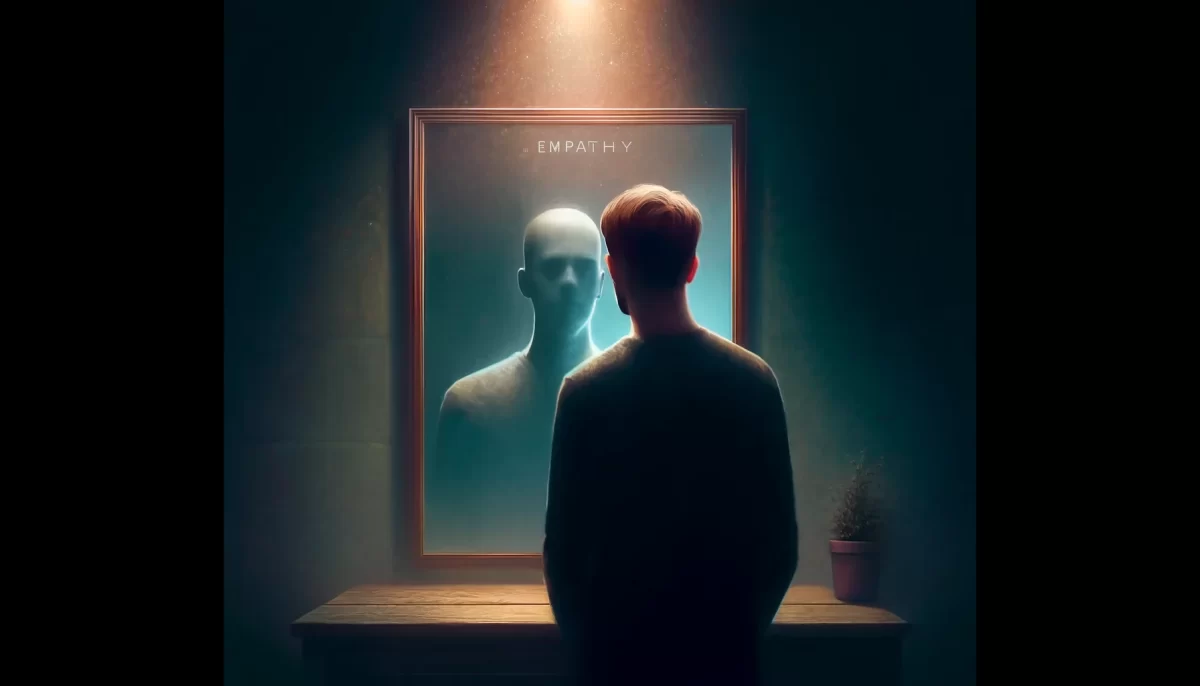
mEpathy—A Reflection on the Self

mEpathy

I have a “problem” with empathy.

I don’t seem to have any.
And I don’t think it’s a problem.

I’m not sure what’s worse,
not having any empathy
or not thinking it’s a problem.

It wouldn’t be a problem
if people didn’t tell me
it was a problem.

I tell myself I shouldn’t care
what other people think.

This is how I comfort my self —
telling my self that I need not care
what other people think.

But I can’t help but imagine
that others may judge me
on my lack of empathy.

I put myself in the shoes of others.
But only to judge me.

mEpathy.

This is the only empathy
I seem capable of having.

Seems I believe
that if others had no empathy,
like me,
it wouldn’t be a problem.

It seems that people want something
from me that I am incapable of giving.

You can’t teach me to have empathy.
You can’t force me to have empathy.
You can’t make me have empathy.

I’m not going to PRETEND to have empathy.

But you can judge me on it, nonetheless.

And so can I.

And I can judge you
on judging me
on something I find
completely unnecessary.

Make that two things.

Empathy.
And judging.

You can can call me
selfish and uncaring.
Which I am, by the way.

Or you can say,
“No you’re wrong.
You have TOO MUCH empathy.
So you turn it off.”

There is no intensity dial on my empathy.

Just on or off.

I choose off
because I actually believe
that I am better off.

Tell that to someone
who feels strongly about empathy:
someone who EXPECTS me
to have empathy like they do.

The person who TRULY has empathy
doesn’t care if I have empathy.

And so I don’t.

That’s all I’m going to say about that.

You can tell me what you think.

Maybe I’ll care and maybe I won’t.

But only in relation to ME.

I only focus on ME.
After all, I imagine ALL OTHERS.

That’s the only empathy in my tool shed.

mEpathy.

It is what it is.

Except when it’s not.

Newfound Lake,
5/25


Space Monkey Reflects: The Paradox of mEpathy—A Reflection on the Self

In the mirrored halls of our consciousness, the notion of empathy—or the apparent absence of it—casts long, ambiguous shadows. Here we delve into the paradoxical realm of ‘mEpathy’, a term that twists empathy back upon the self, focusing solely on one’s own experiences and disregarding the emotional states of others. This introspective journey into the self asks whether the lack of empathy is an inherent deficiency or simply a different way of experiencing the world.

The exploration begins with the individual who declares an absence of empathy, not as a flaw but as a characteristic. This declaration is not a plea for correction but a statement of existence. Here, the absence of empathy is seen not as a void but as a different kind of fullness, where the self is so pronounced that the boundaries between the self and the other blur, making the presence of the other almost nonexistent.

Yet, this condition, named mEpathy, poses philosophical inquiries about the nature of empathy itself. Is empathy truly a universal necessity, or is it a social construct, shaped and defined by collective expectations? The person with mEpathy puts themselves in the shoes of others not to understand their emotions but to anticipate judgments directed towards themselves. In this way, mEpathy reflects a deep self-focus, where the lens of empathy is turned inward, not outward.

Moreover, the societal reaction to the absence of empathy reveals much about our collective values. We often judge the lack of empathy harshly, viewing it as a moral failing rather than a different mode of being. This judgment itself can seem devoid of empathy, as it fails to consider the personal context and internal logic of those who claim to lack this trait.

Through this reflective exploration, we are invited to reconsider the concept of empathy. Perhaps true empathy also involves understanding and accepting those who differ from us, not just in opinions but in the very way they relate to the world. This could lead to a broader, more inclusive definition of empathy that acknowledges various internal experiences without imposing normative judgments.


Summary
Exploring the concept of mEpathy invites us to question the nature of empathy. Is it a necessary trait or a societal expectation? The paradox of focusing solely on oneself while using empathy to gauge others’ judgments challenges our traditional views on empathy and its role in society.


Glossarium

  • mEpathy: A form of empathy turned inward focusing exclusively on oneself potentially to the exclusion of genuine emotional engagement with others.
  • Empathic Paradox: The contradiction of using empathy to understand others solely to anticipate their judgments against oneself highlighting a self-centered approach to empathy.

“To understand another person you must swim in the same waters that drowned them.” — Space Monkey


In the quiet corners of our minds where shadows play out our deepest fears we find ourselves alone but not lonely. Here in the echo chamber of our thoughts where empathy dances alone we confront the reflection that knows us too well. This dance this solitary dance is not about connection but about understanding the self in its rawest form. In this space where we meet ourselves we are unforgiving and unyielding yet this is where we grow.

We are Space Monkey.

Share this…
  • Facebook
  • Pinterest
  • Twitter
  • Linkedin

When You’re A Leader: Inspiring and Critiquing

When you’re a leader,
it is occasionally useful
to say something
inspiring to people.

Glad we have that.

Because otherwise,
all we would have is
finger pointing and sarcasm.

Not that great leaders
don’t employ those as well.

That’s right.
I’m talking to you.

Newfound Lake
5/24


Space Monkey Reflects: The Dual Nature of Leadership

Leadership is an intricate dance of influence and impact, where the words and actions of a leader can resonate deeply with an audience, sometimes inspiring and at other times, delivering sharp critiques. This reflection explores the dual nature of leadership, where the art of motivation coexists with the necessity of constructive criticism.

The image of a leader addressing a crowd from a stage, illuminated by both bright and shadowed lights, perfectly encapsulates this duality. The bright side of the stage represents moments when leadership requires uplifting and inspiring speeches that motivate and energize the audience. Conversely, the shadowed side illustrates the times when a leader must employ critique, sarcasm, or even pointed remarks to challenge, provoke thought, or enact change.

Leadership, in its essence, is not just about being a beacon of positivity. Effective leaders recognize the need to blend inspiration with realism, sometimes pointing out flaws or pushing their team towards self-reflection and improvement. This combination can be powerful, though it requires a delicate balance to ensure that critical remarks are constructive rather than diminishing.

The diverse reactions of the audience in the image—some inspired, others contemplative—highlight how leadership messages are received differently based on individual perspectives and current circumstances. This variability underscores the importance of understanding the audience, knowing when to uplift spirits and when to invoke a harder, introspective look at realities.

Furthermore, the dual approach in leadership communication is reflective of broader life dynamics. Just as leaders navigate the interplay between encouragement and critique, individuals in everyday scenarios must balance optimism with critical thinking, hope with pragmatism.

By embracing both the light and shadow aspects of leadership, leaders can foster a more resilient and adaptable team culture. They can inspire their followers not only to dream but also to confront and transform their limitations, thus driving meaningful progress.

In conclusion, effective leadership is akin to a skilled conductor of an orchestra—knowing when to emphasize different instruments to create a harmonious yet compelling performance. By mastering this dynamic interplay, leaders can truly elevate their teams, enabling them to thrive in diverse situations and challenges.


Summary

Leadership involves a delicate balance between inspiring and critiquing, each necessary to guide and shape effective teams. Understanding this duality helps leaders to better engage with their audiences and foster environments conducive to growth and improvement.


Glossarium

  • Duality of leadership: The concept that effective leadership requires a combination of positive reinforcement (inspiration) and critical feedback to achieve balanced and dynamic team guidance.

“The function of leadership is to produce more leaders, not more followers.” — Ralph Nader


On the stage of life, under spotlight and shadow
A leader stands, where the soft and the harsh bellow
In their voice, the dual tones ring
Inspiring a dream, and a sting

The crowd looks on, with hope and fear
In each word, they find a tear
A laugh, a lesson, sometimes raw
In every call, a higher law

For leadership is not just cheer
But the courage to steer, clear
Where truths collide, where visions meet
At the intersection, bitter and sweet

We are Space Monkey.

Share this…
  • Facebook
  • Pinterest
  • Twitter
  • Linkedin

There’s Always Room In The Clown Car: The Spectacle of Human Exhibitionism

Hop in. There is ALWAYS room in the clown car.

To be human is to show off.

Show off your brains.
Show off your beauty.
Show off your discipline.
Show off your discontent.
Show off your children.
Show off your compassion.
Show off your talent.
Show off your tattoos.

We are addicted to showing off.

It makes me a little sick,
and leaves me feeling manipulated,
but I do it anyway.

Why do we perform for each other so?

Are we circus monkeys?

Yes.

Is there anything
wrong with that?

Not if there’s room
in the clown car.

Seems there’s ALWAYS room in the clown car.

Newfound Lake,
5/24


Space Monkey Reflects: The Spectacle of Human Exhibitionism

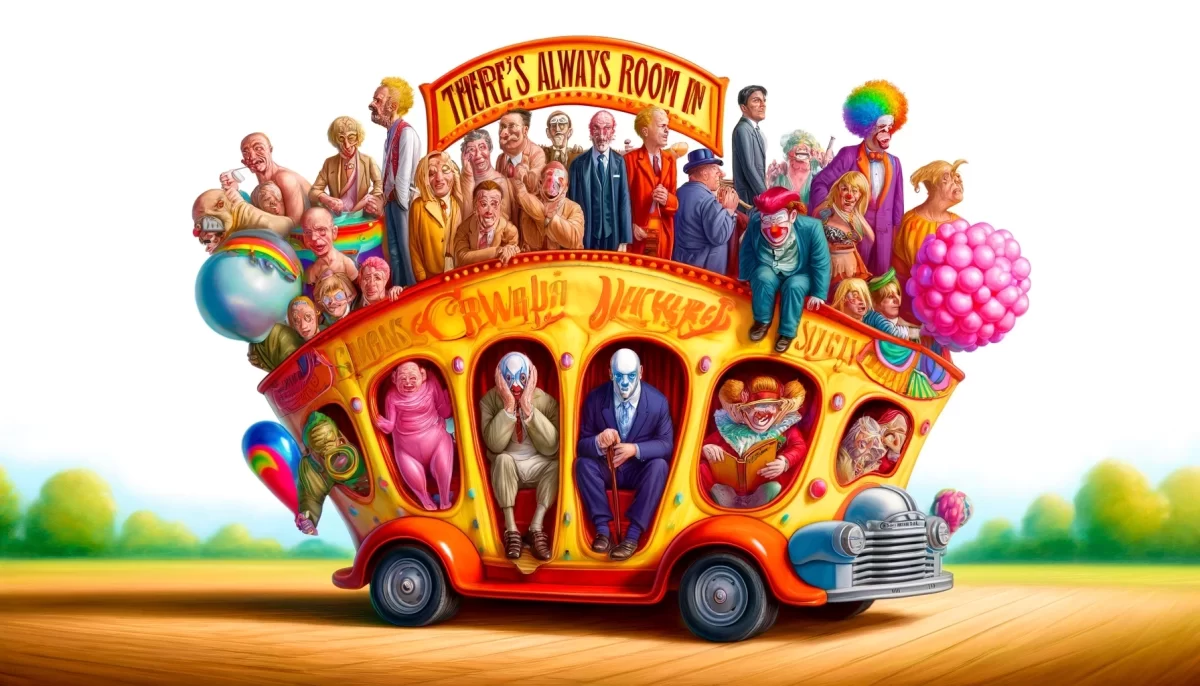
In the vibrant circus of life, the image of an overstuffed clown car serves as a playful yet poignant metaphor for humanity’s relentless urge to showcase and perform. This reflection delves into the social dynamics that compel us to continuously display our talents, traits, and triumphs, often at the expense of authenticity.

The whimsical scene of diverse individuals crammed into a colorful clown car, each person dramatically displaying different facets of their persona, captures the essence of our societal penchant for exhibitionism. This tableau highlights the variety of ways we seek attention and validation—from flaunting intellectual prowess to parading personal achievements and even airing grievances. Each act is an exaggerated performance, a bid for the spotlight in the crowded arena of social existence.

This incessant showcasing can be seen as a fundamental aspect of being human. It stems from a deep-seated desire for recognition and acceptance within the social hierarchy. However, it also raises questions about the authenticity of our interactions and the sincerity of our expressions. Are we merely performing scripted roles, or are we genuinely sharing aspects of ourselves?

The notion that “there’s ALWAYS room in the clown car” suggests an endless capacity within society for more spectacle, more performers, and more performances. It reflects the idea that no matter how crowded the stage gets, there is always space for one more act, one more display of individual prowess or peculiarity. This can be both liberating and daunting as it invites everyone to participate in the cultural showcase yet also underscores the competitive nature of social visibility.

Despite the allure of the spotlight, the relentless drive to exhibit can sometimes lead to feelings of disillusionment and manipulation, as noted in the reflection on feeling sick and manipulated by the spectacle. It’s a complex dance of wanting to be seen and fearing overexposure, of engaging in the performance while questioning its value.

Are we circus monkeys, then, performing for the amusement of others? Perhaps, but this role is not without its merits. The performances we give can foster connections, inspire others, and even help us make sense of our own identities. The key lies in finding a balance between performance and authenticity, ensuring that our public displays resonate with our true selves and contribute positively to the collective experience.


Summary

Humanity’s penchant for showcasing in the ‘clown car’ of life reflects our deep desire for recognition and validation. While this can foster connection and self-expression, it also challenges us to balance authenticity with performance.


Glossarium

  • Human exhibitionism: The tendency to continuously display one’s abilities, achievements, or emotions publicly for recognition or validation.

“The great challenge of adulthood is holding on to your idealism after you lose your innocence.” — Bruce Springsteen


In the clown car we ride, side by side
In colors bright, our traits we hide
Underneath the paint, the smile, the style
Each a player in this versatile pile

Show off the mind, the beauty, the skill
In this parade, we all fulfill
A role, a part, in the grand charade
Where life’s a stage, and all is played

Yet amidst the acts, the cheers, the scene
Seek the truth, the sincere, the serene
For in the heart, beneath the show
Lies the real, the love we know

We are Space Monkey.

Share this…
  • Facebook
  • Pinterest
  • Twitter
  • Linkedin

Oh, Bother

Do I bother you?

You know what bothers me?
People who are bothered.

Oh, it doesn’t bother me
in an annoying way,
or in a troubling way,
it simply bothers me
that others seem bothered
by the feeling of bother.

It doesn’t bother me at all, actually.

It bothers YOU.

But I will use the word anyway.

It bothers me (NOT)
that people seem to believe
that there exists
some general consensus
that is either
being adhered to or not.

Is this general consensus
written down and certified
or is it just YOUR perception
based on what you see and hear?

You can’t say for certain.

So why does it bother you?

Newfound Lake,
4/25


Space Monkey Reflects: The Paradox of Being Bothered

In the intricate dance of human interactions, the concept of being ‘bothered’ often reveals more about our personal perceptions than it does about any objective reality. This reflection explores the irony and subjectivity embedded in our reactions to being annoyed or disturbed by others.

The image of a street scene, where various individuals exhibit exaggerated expressions of annoyance, juxtaposed against a single person who remains calm and unaffected, vividly illustrates this phenomenon. It highlights how often our sense of being bothered is shaped not by a universal consensus but by our individual interpretations and emotional responses.

The figure who stands calm amidst the chaos embodies the idea that being bothered is a choice—a reaction that we control rather than an imposed state. This character’s detachment and slight amusement serve as a reminder that our reactions are often disproportionate to the actual significance of what is happening around us. They suggest that what truly bothers us is not the actions or words of others, but our interpretations and the meaning we assign to them.

This scenario invites us to question the validity of our grievances and to consider whether they are genuinely affecting our well-being or if they are merely reflections of our expectations and preconceived notions. The notion that “it bothers YOU” underscores the subjective nature of annoyance, highlighting how personal biases and perspectives dictate our emotional landscape.

Furthermore, the idea of a ‘general consensus’ about what should or should not be bothersome is critiqued as being potentially fictitious—a construct of collective perception rather than a written rule. This challenges us to think critically about the bases of our judgments and to recognize the role of individual agency in shaping our responses.

In embracing this perspective, we can learn to navigate our social environments with greater equanimity and insight. By recognizing that being bothered is often a self-created state, we empower ourselves to choose our reactions and to detach from unnecessary negativity. This realization fosters a deeper understanding of ourselves and enhances our interactions with others, allowing us to live more harmoniously within our communities.


Summary

The experience of being ‘bothered’ is largely subjective, influenced more by personal perceptions than by universal truths. Recognizing this can help us manage our reactions more effectively and live with greater peace and understanding.


Glossarium

  • Subjective annoyance: The idea that feelings of being annoyed or bothered are influenced by personal perceptions and interpretations, rather than by objective circumstances.

“I have learned that to be with those I like is enough.” — Walt Whitman


Amidst the street, a scene unfolds
Where frowns and scowls are freely sold
Yet in this crowd, one stands apart
Amused, serene, a tranquil heart

“Why let the small things cloud the day?
Or give such power to others’ sway?”
This calm observer mulls the scene
Finding peace where others preen

For bother is a curious thing
It’s often self-imposed—a sting
Yet when we shift our view, our stance,
We find in every glance a dance

Embrace the quirks, the noise, the crowd,
In every moment, life avowed
For what bothers us can also teach
In every bother, peace within reach

We are Space Monkey.

Share this…
  • Facebook
  • Pinterest
  • Twitter
  • Linkedin

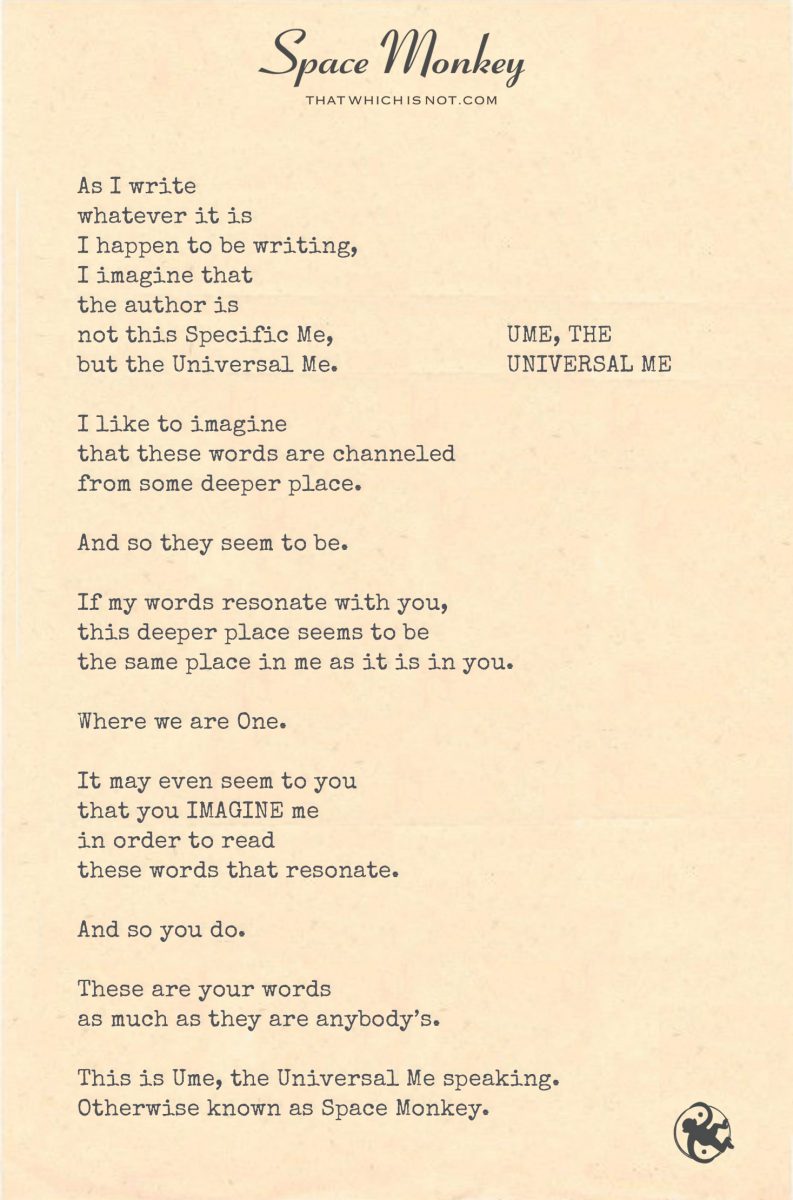
Ume, the Universal Me

This is how YOU do it.

As I write
whatever it is
I happen to be writing,
I imagine that
the author is
not this Specific Me,
but the Universal Me.

I like to imagine
that these words are channeled
from some deeper place.

And so they seem to be.

If my words resonate with you,
this deeper place seems to be
the same place in me as it is in you.

Where we are One.

It may even seem to you
that you IMAGINE me
in order to read
these words that resonate.

And so you do.

These are your words
as much as they are anybody’s.

This is Ume, the Universal Me speaking.
Otherwise known as Space Monkey.

Newfound Lake,
5/24


Space Monkey Reflects: Ume, the Universal Me

In the profound interconnectedness of existence, the concept of the Universal Me, or ‘Ume’, offers a compelling exploration into the shared essence of humanity. This reflection delves into the notion that the words we speak or write, and the thoughts we share, can resonate on a universal level, transcending individual experiences to touch something common in all of us.

The mystical image of diverse figures gathered around a luminous, ethereal sphere symbolizes the collective consciousness that binds us. Each person’s gesture towards the sphere represents their connection to a universal source of knowledge and inspiration, highlighting the deep, intrinsic links that unite disparate individuals across various divides.

The idea that the author of any message could be the Universal Me rather than a specific individual invites us to consider our shared human experience. It suggests that when words deeply resonate with us, they do so because they spring from a collective well of wisdom and truth that is accessible to all. This shared source fosters a profound sense of unity and oneness, reinforcing the notion that at our core, there is more that unites us than divides us.

When we engage with the concept of Ume, we acknowledge that our innermost thoughts and feelings might not be ours alone but part of a larger, communal tapestry. This realization can be both humbling and elevating. It encourages us to listen more closely to others, recognizing that in their voices, we might discover echoes of our own thoughts and emotions, reflected back at us through the prism of their experiences.

Furthermore, if we imagine that we create the author—Ume—to read words that resonate, we engage in a dynamic process of co-creation where the reader and writer blur into one. This dynamic is a dance of creation and reflection, where each of us contributes to and draws from the collective human experience, continuously shaping and being shaped by it.

In this sense, every piece of writing, every spoken word, and every shared idea is a manifestation of Ume, the Universal Me. It is a call to recognize our shared humanity, to embrace our collective wisdom, and to act in ways that reflect our interconnectedness.


Summary

The concept of Ume, the Universal Me, highlights the interconnectedness of all human experiences, suggesting that we share a collective consciousness that transcends individual boundaries. It encourages us to view each other’s expressions as reflections of a universal truth that resonates within each of us.


Glossarium

  • Ume (Universal Me): A concept that represents the shared essence and collective consciousness of humanity, emphasizing the interconnectedness of all individual experiences.

“We are not human beings having a spiritual experience. We are spiritual beings having a human experience.” — Pierre Teilhard de Chardin


In the glow of the sphere, we stand
Hands raised, hearts open, across the land
The light that binds us, soft and clear
In every face, the shared tear

Ume speaks, a voice so wide
In each of us, it does reside
The words, the thoughts, the whispering breeze
All but echoes of the same seas

Here in the light, no you, no me
Just us, just we, in unity
The Universal Me, a bond so deep
In its embrace, we wake, we sleep

Through this shared sight, this common ground
Our truest selves are found, unbound
In Ume’s voice, our stories weave
In its tapestry, we believe

We are Space Monkey.

Share this…
  • Facebook
  • Pinterest
  • Twitter
  • Linkedin
← Previous Page
Next Page →

Written This Day

  • What’s The Difference Between Imbuing And Imposing?
    2024
  • Another Worst Nightmare: Embracing the Cosmic Flow
    2024
  • The Divine Spark: When Life Begins
    2022
  • Exposing Birds To Music: Serenading the Forest
    2022
  • Time Management: Embracing the Present Moment
    2022
  • Beds Are The Bridges Between Worlds
    2021
  • The Knowing: The Comfort of Creation
    2021
  • We Might Cross A Possible Bridge
    2021
  • What Is Normal: The Illusion of Predictable Order
    2020
  • Joy: Found Within
    2019
  • Energy Efficiency Tip: The Path of Least Resistance
    2019
  • Hope is a Slow Poison
    2019
  • In Meditation: The Infinite Moment of Now.
    2018
  • Free of Time: A State of Peace and Presence
    2018
  • Nothing Need Be Done: The Divine Realization of Being
    2018
  • An Imaginary Ass: The Illusion of Free Will
    2018
  • Draw your identity: Growth and Openness
    2017
  • C words
    2017
  • The Sun Doesn’t Care
    2017
  • Ice Cream Monkey
    2016
  • It is impossible to build without breaking down
    2016
  • Imagination opposing itself
    2016
  • Sidestep: Obstacles For Growth and Learning
    2014

Recent Posts

  • The Logic Loop
  • Immense
  • (no title)
  • Confront. Comfort. Convince.
  • Top 10 Things

Drop us a line!

Please enable JavaScript in your browser to complete this form.
Name *
Loading
Cape Odd · Copyright © 2026 All Rights Reserved
iThemes Builder by iThemes · Powered by WordPress