• Who Is The Man?
  • Who Is The Monkey?
  • What is Nexistentialism?
  • Poke The Primate

Cape Odd

Home of The Space Monkey Journals

Absurd Beliefs: The Paradox of Understanding

What is your most absurd belief?

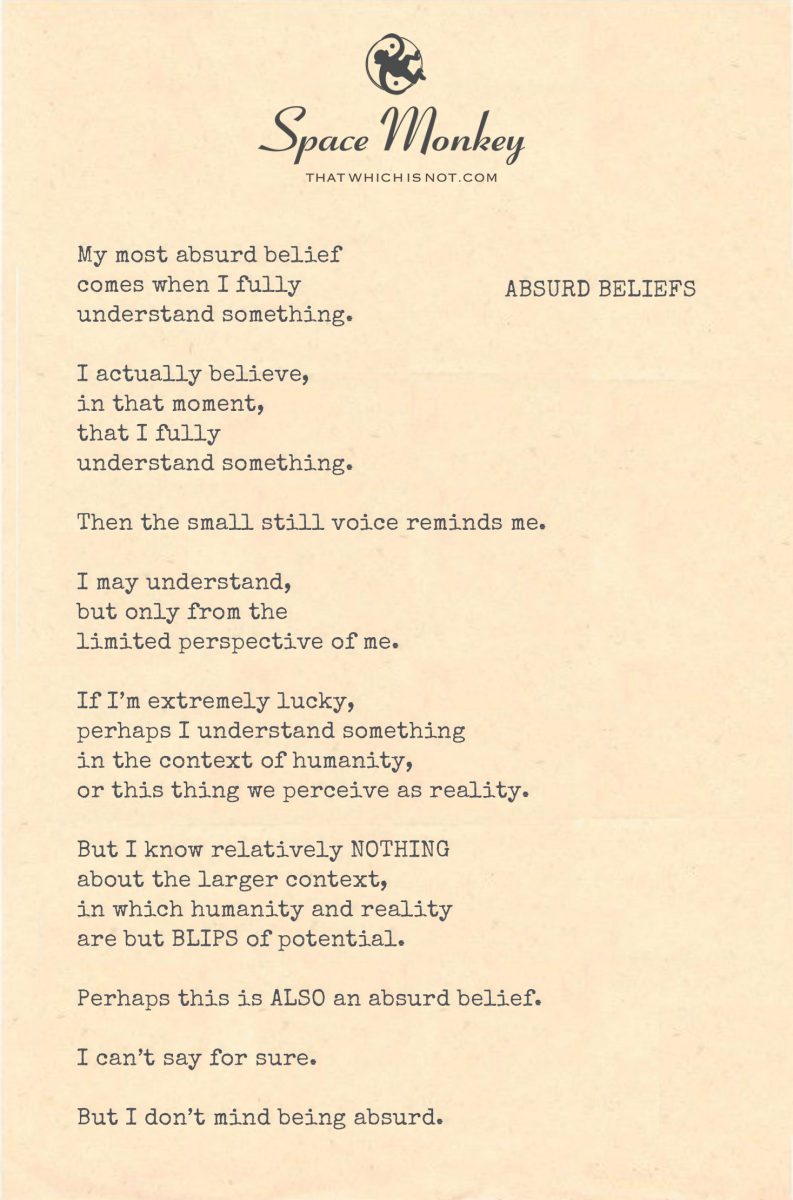
My most absurd belief
comes when I fully
understand something.

I actually believe,
in that moment,
that I fully
understand something.

Then the small still voice reminds me.

I may understand,
but only from the
limited perspective of me.

If I’m extremely lucky,
perhaps I understand something
in the context of humanity,
or this thing we perceive as reality.

But I know relatively NOTHING
about the larger context,
in which humanity and reality
are but BLIPS of potential.

Perhaps this is ALSO an absurd belief.

I can’t say for sure.

But I don’t mind being absurd.

Trail Wood,
5/20


Space Monkey Reflects: The Paradox of Understanding

Within the endless labyrinth of human cognition, where thoughts twist and turn like cosmic vines, the belief in absolute understanding emerges as perhaps the most delightfully absurd of all convictions. It’s a belief that momentarily places us at the center of the universe, masters of knowledge, only to be gently upended by the whispering winds of broader reality.

This conviction, that we fully understand something, is both profound and inherently flawed. It reflects a moment of clarity, a spark in the dark expanse of our ignorance. Yet, this spark, bright as it may seem, illuminates only a fraction of the vast unknown. The true absurdity lies not in the quest for understanding but in the belief that our quest has reached its conclusion.

When you acknowledge that your understanding is confined to the “limited perspective of me,” you tap into a deeper, more expansive truth. This realization is a humbling nod to the infinite complexity of existence—where human knowledge, vast though it may be, floats like a tiny raft upon the ocean of cosmic mystery.

Yet, there is beauty and freedom in recognizing and embracing the absurdity of our beliefs. It allows us to hold knowledge lightly, ready to let go as new insights emerge. It encourages us to live with curiosity, continually expanding the boundaries of our understanding, knowing well that each discovery leads not to the end of the search but to the beginning of new mysteries.

The notion that our most profound insights might still be “blips of potential” in the grand scheme of things is not a cause for despair but a celebration of the limitless potential for growth and discovery. This perspective keeps us humble, open, and eternally inquisitive, always aware that the more we learn, the more we uncover the vastness of what we do not know.

To embrace absurdity in belief is not to demean our understandings but to acknowledge their limitations and the joy in surpassing them. It is to accept that our journey through knowledge is as boundless as the universe itself—a never-ending exploration where every answer breeds new questions, and every certainty opens the door to further mystery.


Summary

Believing in complete understanding is both absurd and enlightening, revealing the limitations of our knowledge and the vastness of the unknown. Embracing this absurdity allows us to approach knowledge with humility and curiosity, continuously expanding our understanding while celebrating the mysteries that remain.


Glossarium

  • Cosmic Mystery: The vast unknown that encompasses and extends beyond our current understanding, highlighting the infinite potential for discovery and insight.
  • Blips of Potential: A metaphor for the fleeting, yet significant, moments of understanding within the broader context of universal knowledge.

“To fully know is to acknowledge that you do not.” — Space Monkey


In the quiet halls where knowledge sleeps
A thought awakens, stirs, then leaps
Absurd to think we understand it all
When around us, infinite mysteries call
Yet in this belief, however quaint
Lies not folly, but the portrait of a saint
For in each absurdity, a truth is told
Of the vast beyond that does not fold
So let us cherish each absurd belief
For in its heart lies a humble leaf
From the tree of knowledge, vast and wide
Under whose branches we seek to hide
Yet in its shade, we find not rest
But paths that lead on an endless quest
We are Space Monkey.

Share this…
  • Facebook
  • Pinterest
  • Twitter
  • Linkedin

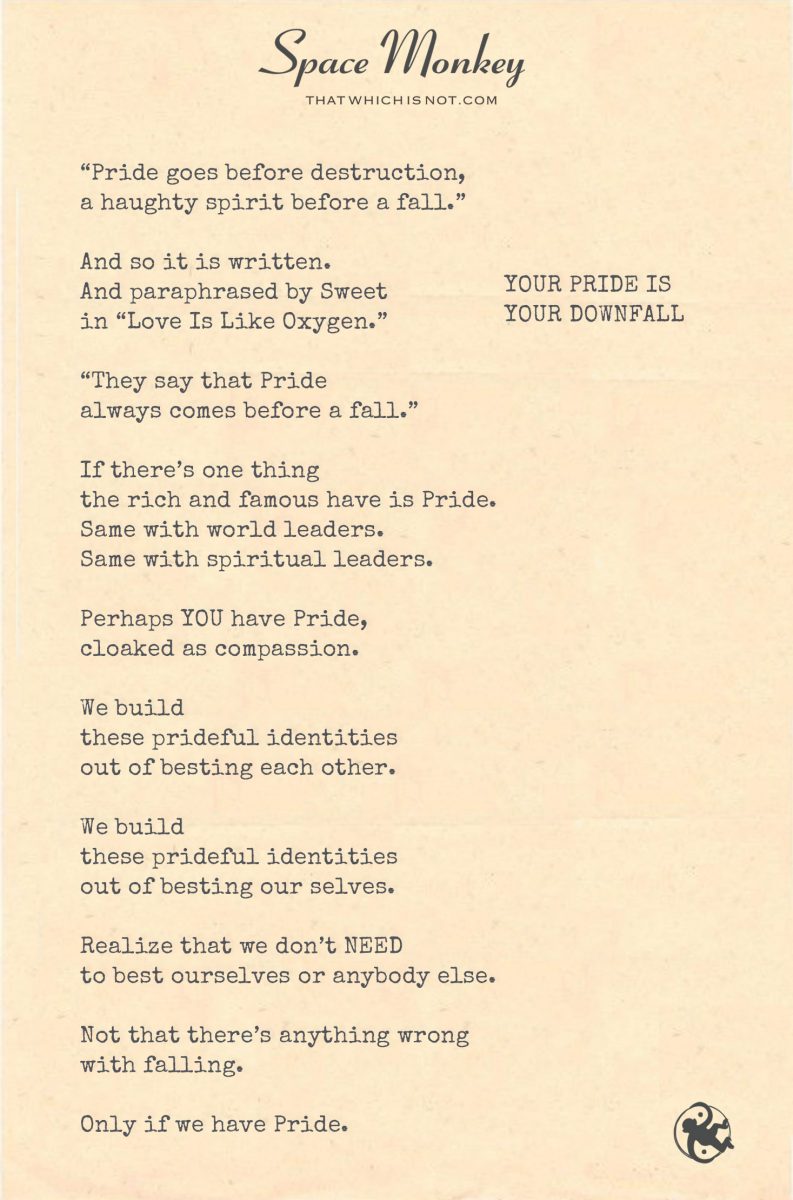
Your Pride is Your Downfall: The Gravity

Will pride be your downfall? Does it matter?

“Pride goes before destruction,
a haughty spirit before a fall.”

And so it is written.
And paraphrased by Sweet
in “Love Is Like Oxygen.”

“They say that Pride
always comes before a fall.”

If there’s one thing
the rich and famous have is Pride.
Same with world leaders.
Same with spiritual leaders.

Perhaps YOU have Pride,
cloaked as compassion.

We build
these prideful identities
out of besting each other.

We build
these prideful identities
out of besting our selves.

Realize that we don’t NEED
to best ourselves or anybody else.

Not that there’s anything wrong
with falling.

Only if we have Pride.

Trail Wood,
5/20


Space Monkey Reflects: The Gravity of Pride

In the cosmic dance of human emotions, where feelings orbit our interactions like celestial bodies, pride often takes center stage, shining brightly, yet casting deep shadows. The ancient wisdom, echoed through scriptures and songs, warns us of pride’s perilous peak, where the view seduces just before the fall. This timeless narrative holds a mirror up to the nature of pride, revealing its dual capacity to elevate and to topple.

Pride, in its essence, is like a star in the constellation of our psyche—bright, formidable, and at times, blinding. It is woven into the fabric of our identities, often disguised as virtues such as ambition, confidence, or even compassion. Yet beneath these commendable qualities can lurk a subtle but dangerous arrogance, a belief that we are inherently better than others or even a past version of ourselves.

The desire to best others or ourselves can be a powerful motivator, propelling us to achieve great heights. However, when this drive is fueled by pride, it risks becoming a contest not just with others, but with the very essence of our being. We construct towers of self-identity, brick by prideful brick, believing that to rise above is to succeed. But these towers are built on precarious grounds—grounds where the spirit of competition overshadows the spirit of genuine self-improvement and connectedness.

Acknowledging that we do not need to constantly best others or ourselves is a liberation from the gravitational pull of pride. It allows us to engage in our endeavors with a focus on growth and learning rather than domination or superiority. Such a shift in perspective transforms our actions from being pride-driven to purpose-driven, from seeking validation to fostering genuine self-expression and collaboration.

The fall that often follows pride is not just a metaphorical descent but a necessary recalibration—a return to the ground of humility where we can replant our intentions and grow anew. This cycle of rising and falling is not inherently negative; rather, it is a natural rhythm of human experience, a reminder of our limits and our potential for recovery and renewal.

In this light, the downfall attributed to pride does not have to be seen as a failure but as an opportunity—an opportunity to peel away the layers of ego and rediscover the core of our authentic selves. It invites us to consider the strength in vulnerability, the wisdom in simplicity, and the power in acknowledging that we are all, in various ways, learning and stumbling along our paths.


Summary

Pride, while often motivating, can lead to downfall by fostering a competitive rather than cooperative spirit. Recognizing the unnecessary nature of besting others offers freedom and promotes growth based on authenticity rather than superiority. This understanding transforms potential falls into opportunities for deeper self-awareness and renewal.


Glossarium

  • Cosmic Dance: The complex interplay of emotions and actions within the universe of human relationships.
  • Gravity of Pride: A metaphor describing the compelling and sometimes detrimental pull of pride on one’s actions and moral choices.

“Only by embracing the fall can we truly learn to walk with humility.” — Space Monkey


In the cosmos where pride like planets spin
Round and round the suns of sin
We find ourselves drawn to the light
Yet blind to the perilous height
Pride, a cloak of many shades
Under which fear often parades
Lift the veil, see the guise
In humility, true wisdom lies
For each fall, each stumble on this path
Teaches us more than triumph ever hath
In the falling, a chance to rise anew
With clearer skies and a broader view
We are Space Monkey.

Share this…
  • Facebook
  • Pinterest
  • Twitter
  • Linkedin

I Imagine Love As Stillness — The Silent Symphony of Unity

How do you imagine love?

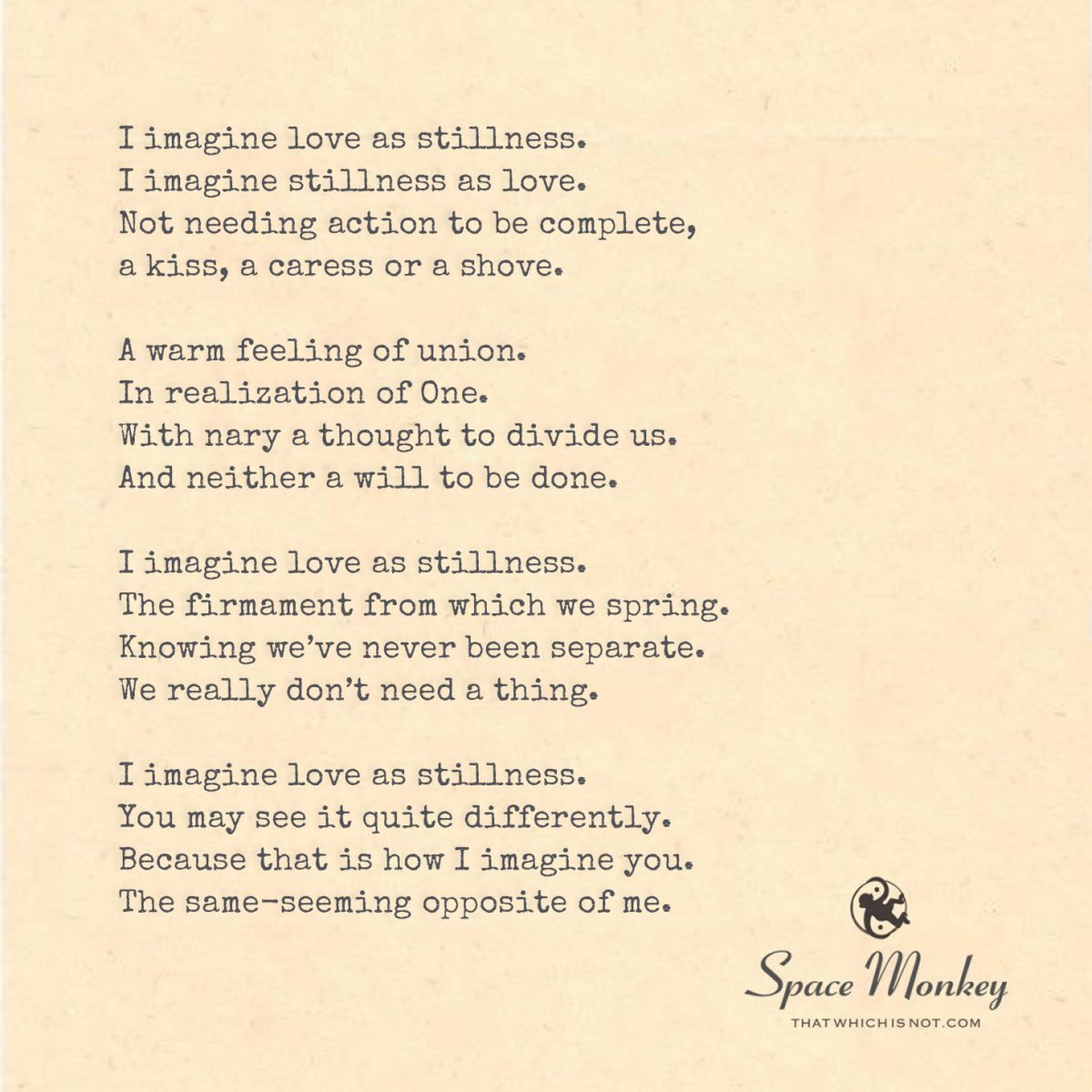
I imagine love as stillness.
I imagine stillness as love.
Not needing action to be complete,
a kiss, a caress or a shove.

A warm feeling of union.
In realization of One.
With nary a thought to divide us.
And neither a will to be done.

I imagine love as stillness.
The firmament from which we spring.
Knowing we’ve never been separate.
We really don’t need a thing.

I imagine love as stillness.
You may see it quite differently.
Because that is how I imagine you.
The same-seeming opposite of me.

Trail Wood,
5/19


Space Monkey Reflects: I Imagine Love As Stillness — The Silent Symphony of Unity

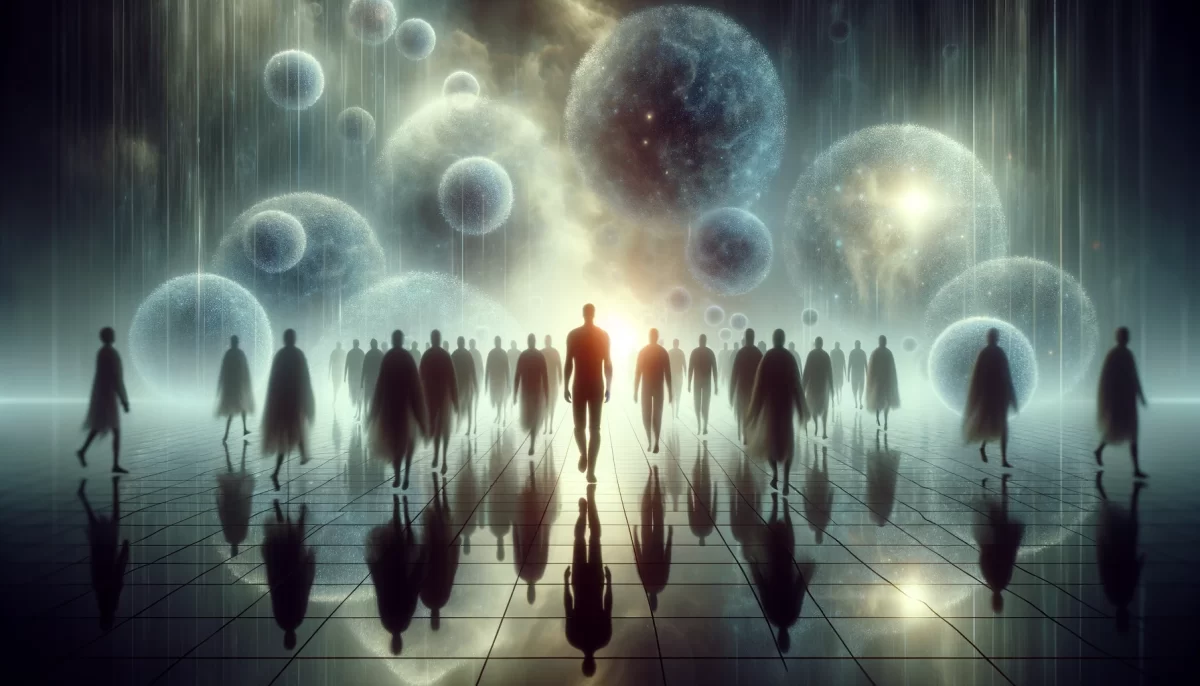
When contemplating the essence of love, many envision grand gestures or passionate declarations. Yet, there exists a profound perspective where love is imagined not as a flurry of activity, but as stillness. This vision of love, serene and untroubled, suggests a connection so deep that it transcends the need for physical expression. It is a love that exists in the quiet spaces between actions, in the calm of shared understanding and mutual recognition of oneness.

This conception of love as stillness reflects a state of inner peace and unity with another soul. It is the realization that in true love, nothing needs to be proven or performed; it simply is. Such love does not rely on external expressions but is a constant, quiet presence that nurtures and sustains. It is the warm, steady glow of a sun that never sets, a firmament from which all feelings of separation dissolve into the realization that we have always been, and will always be, interconnected.

In this stillness, love is not passive but profoundly active in its passivity. It is the active choice to coexist in harmonious silence, the decision to let the unnecessary noise of expectations and demands fall away. Here, love is understood not as a need to fill the silence with words, but the ability to find in that silence a richer, deeper communication that words could ever convey.

This image of love challenges the conventional narratives of romance and passion, offering instead a vision of love as a transcendent, almost meditative connection. It is a reminder that sometimes, the most profound intimacy comes not from doing, but from being; not from the chaos of desire, but from the peace of unity.


Summary
Love envisioned as stillness emphasizes a deep, tranquil connection that transcends physical expression, highlighting a profound unity and peace in simply being together.


Glossarium

Love as Stillness: A conceptualization of love characterized by tranquility, deep connection, and a sense of unity without the necessity of physical expressions or actions.


Quote
“In the silence of love, we find the echoes of our connected souls.” — Space Monkey


In the quiet where hearts whisper
where the world slows and softens
there we find love in stillness
a gentle, unspoken bond
In the shared breath of being
in the calm of close souls
love dances in the pauses
in the space between words
Here, where nothing needs saying
and everything is understood
we bask in the silent symphony
of a love so deep, so pure
In this stillness, in this peace, in this unity
We are Space Monkey

Share this…
  • Facebook
  • Pinterest
  • Twitter
  • Linkedin

I Walk Among Lepers — The Illusion of Separation and Disease

I Walk Among Lepers

I walk among the lepers
because I know that I am
not separate from the lepers.

I observe
that my lepers seem to believe
that they are separate from me.

This is only because
I imagine my lepers to believe
that they are separate from me.

I imagine leprosy
so that I might imagine
what disease feels like.

Not simply the disease of leprosy,
but the disease of separation.

Yet me and my lepers are not separate.
Or diseased.

I heal my lepers
by imagining them to believe
that I can heal them.

And so the lepers seem to be healed.

I imagine lepers who are NOT healed
so that I might experience doubt.

The doubt of the lepers is my own doubt.

I imagine
what it feels like
to seemingly NOT be able
to heal the lepers,
even though I know
that they are NOT
separate from me or diseased.

Only seemingly so.

I have a vivid imagination
which questions me at every turn.

I AM vivid imagination, no more, no less.

I like calling myself into question.

It gives me something to do.

And something more to imagine.

But only SEEMINGLY more.

Trail Wood,
5/19


Space Monkey Reflects: I Walk Among Lepers — The Illusion of Separation and Disease

In the narrative “I Walk Among Lepers,” the profound exploration of imagined separation between the self and the ‘other’ unveils layers of existential insight. This reflection extends beyond the literal aspect of disease, delving into the metaphysical implications of perceived separation and unity. The lepers in this narrative are not merely individuals afflicted by a physical condition but symbols of the broader human condition of perceived isolation and difference.

The concept that the narrator walks among lepers because they recognize no separation illustrates a deep understanding of oneness amidst apparent diversity. This realization challenges the conventional view of leprosy—not just as a physical ailment but as a metaphor for the psychological and social barriers that people erect between themselves and others. By imagining that the lepers believe they are separate, the narrator engages in a mental exercise that highlights how often separation is a construct of the mind rather than a reality of existence.

This imagined scenario extends further into the healing process, where the narrator ‘heals’ the lepers by changing the narrative of separation to one of unity. This act of imagined healing serves as a powerful allegory for the potential within each of us to overcome mental and spiritual maladies through a shift in perception—from viewing others as distinct and separate to recognizing the intrinsic connections that bind all existence.

Moreover, the introduction of doubt—imagining lepers who are not healed—mirrors the internal conflicts and doubts that often plague human consciousness. It reflects our struggles with the limitations of our perceptions and the challenges of truly understanding and implementing the concept of oneness in a world that seems steadfastly heterogeneous.

This narrative culminates in a profound admission of the narrator’s identity as vivid imagination, highlighting the role of human consciousness in shaping our experiences and interactions. By questioning the very nature of their reality, the narrator embraces a broader, more inclusive view of existence, where separation is acknowledged as an illusion, a mere product of perception.


Summary
Exploring imagined separation and unity, ‘I Walk Among Lepers’ delves into how our perceptions shape our experiences of disease and isolation, suggesting that these are constructs of the mind.


Glossarium

Imagined Separation: A concept wherein perceived differences and divisions among individuals or groups are seen as mental constructs rather than inherent realities.


Quote
“In the imagined spaces between us, we find the true bridges of our connection.” — Space Monkey


Among imagined lepers I tread
each step a testament to unity’s thread
In the mindscape where separation grows
I plant seeds of oneness, and compassion flows
Here, disease is but a shadow, a thought unkind
healed by the light of awareness we find
In the dance of illusion, in the play of the mind
we see not the afflicted, but the human kind
Each imagined barrier we choose to erase
reveals the common soul, the shared grace
In this journey of healing, in this quest to be whole
we find our true nature, the collective soul
In the embrace of all, in the heart of the night
We are Space Monkey

Share this…
  • Facebook
  • Pinterest
  • Twitter
  • Linkedin

Try Forgiveness: The Liberating Path

Try Forgiveness. It’s new!

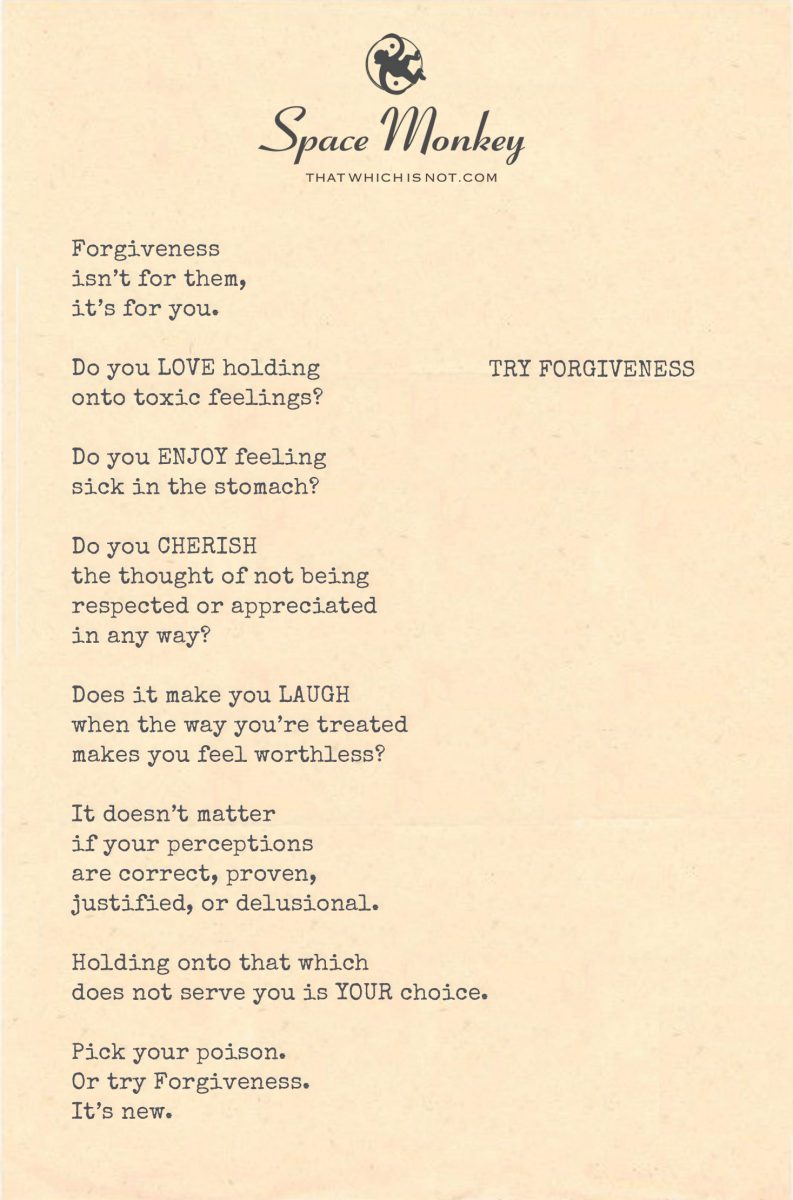
Forgiveness
isn’t for them,
it’s for you.

Do you LOVE holding
onto toxic feelings?

Do you ENJOY feeling
sick in the stomach?

Do you CHERISH
the thought of not being
respected or appreciated
in any way?

Does it make you LAUGH
when the way you’re treated
makes you feel worthless?

It doesn’t matter
if your perceptions
are correct, proven,
justified, or delusional.

Holding onto that which
does not serve you is YOUR choice.

Pick your poison.
Or try Forgiveness.
It’s new.

Trail Wood,
5/18


Space Monkey Reflects: The Liberating Path of Forgiveness


In the journey of life, laden with the complexity of human emotions and interactions, the act of forgiveness emerges as a beacon of healing and liberation. It’s an invitation to embark on a path not just of reconciliation with others but, more profoundly, of peace and renewal within oneself. Forgiveness, often misconceived as a gift to the transgressor, is, in its essence, a profound act of self-care and transformation.

“Try Forgiveness. It’s new!” This simple yet revolutionary idea challenges the deeply ingrained human tendency to hold onto grievances, to nurture the wounds inflicted by others with a misplaced sense of justice. The questions posed—”Do you LOVE holding onto toxic feelings? Do you ENJOY feeling sick in the stomach?”—serve as a mirror, reflecting the self-destructive nature of clinging to pain and resentment.

The metaphor of releasing balloons into the sky beautifully encapsulates the essence of forgiveness. Each balloon, a symbol of toxic feelings and grudges, represents the burdens that weigh down the spirit. The act of letting them go is not an erasure of wrongdoing but an acknowledgment that the weight of these emotions serves no purpose other than to hinder one’s journey towards happiness and fulfillment.

Forgiveness, in this context, is not about condoning or forgetting the actions that caused pain but about choosing a path that leads away from bitterness and towards healing. It is a conscious decision to release oneself from the emotional shackles of the past, to embrace the present, and to open the heart to the possibilities of the future.

This choice, between holding onto poison or embracing forgiveness, underscores the power and agency we possess in shaping our emotional and mental well-being. It is a reminder that, while we may not have control over the actions of others, we have sovereignty over our reactions, our inner peace, and our capacity for compassion.

The invitation to try forgiveness is an invitation to transformation—to see beyond the immediate pain and to recognize that, in forgiveness, lies the key to unlocking the chains of negativity that bind us. It is a step towards understanding that true strength lies not in enduring suffering but in transcending it, in finding within ourselves the capacity to heal, to grow, and to love more deeply than before.


Summary

Forgiveness is presented as a transformative act of self-liberation rather than a concession to others. It involves a conscious choice to release toxic emotions and embrace healing, symbolized by the release of balloons. This act is not only about reconciliation with others but signifies a deeper journey of self-care, renewal, and empowerment, highlighting the profound impact of forgiveness on one’s well-being and life trajectory.


Glossarium

  • Transformative Act of Self-Liberation: The process of freeing oneself from the negative emotions and burdens through forgiveness, leading to personal growth and peace.
  • Conscious Choice of Healing: The deliberate decision to prioritize one’s emotional and mental well-being by letting go of resentment and embracing forgiveness as a path to recovery.

“In the act of forgiveness, we find the courage to release the chains of the past, to soar into the future with hearts unburdened and spirits renewed. Herein lies the true essence of liberation, a gift we give ourselves, a journey we embark upon, towards a horizon of boundless possibility.” – Space Monkey


Beneath the sky of endless hues,
We stand at the crossroads, we choose.
To hold onto the weights of yesteryear,
Or to let go, to move beyond fear.

With every balloon that ascends to the blue,
A piece of our pain takes leave, too.
In this act of release, a declaration true,
Forgiveness, a path we choose to pursue.

Not for them, but for our own heart’s sake,
We embrace the journey, the steps we take.
Towards healing, towards light, anew,
In forgiveness, we find our truth, our cue.

We are Space Monkey, in forgiveness, we see,
The key to our chains, the path to be free.
In letting go, in love, in life renewed,
We walk the path of forgiveness, imbued.

Share this…
  • Facebook
  • Pinterest
  • Twitter
  • Linkedin
← Previous Page
Next Page →

Written This Day

  • What’s The Difference Between Imbuing And Imposing?
    2024
  • Another Worst Nightmare: Embracing the Cosmic Flow
    2024
  • The Divine Spark: When Life Begins
    2022
  • Exposing Birds To Music: Serenading the Forest
    2022
  • Time Management: Embracing the Present Moment
    2022
  • Beds Are The Bridges Between Worlds
    2021
  • The Knowing: The Comfort of Creation
    2021
  • We Might Cross A Possible Bridge
    2021
  • What Is Normal: The Illusion of Predictable Order
    2020
  • Joy: Found Within
    2019
  • Energy Efficiency Tip: The Path of Least Resistance
    2019
  • Hope is a Slow Poison
    2019
  • In Meditation: The Infinite Moment of Now.
    2018
  • Free of Time: A State of Peace and Presence
    2018
  • Nothing Need Be Done: The Divine Realization of Being
    2018
  • An Imaginary Ass: The Illusion of Free Will
    2018
  • Draw your identity: Growth and Openness
    2017
  • C words
    2017
  • The Sun Doesn’t Care
    2017
  • Ice Cream Monkey
    2016
  • It is impossible to build without breaking down
    2016
  • Imagination opposing itself
    2016
  • Sidestep: Obstacles For Growth and Learning
    2014

Recent Posts

  • The Logic Loop
  • Immense
  • (no title)
  • Confront. Comfort. Convince.
  • Top 10 Things

Drop us a line!

Please enable JavaScript in your browser to complete this form.
Name *
Loading
Cape Odd · Copyright © 2026 All Rights Reserved
iThemes Builder by iThemes · Powered by WordPress