• Who Is The Man?
  • Who Is The Monkey?
  • What is Nexistentialism?
  • Poke The Primate

Cape Odd

Home of The Space Monkey Journals

Compromise and Mergence: The Ultimate Resolution

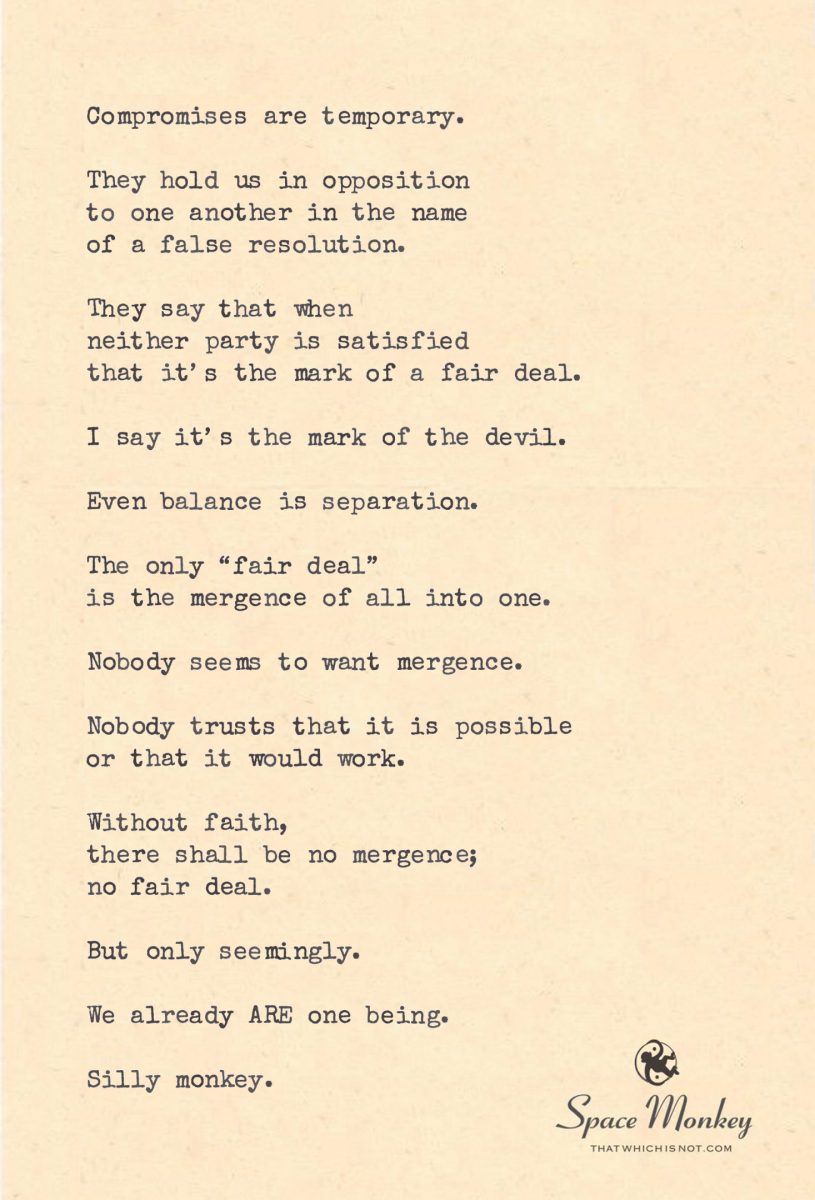
Compromises are temporary.

They hold us in opposition
to one another in the name
of a false resolution.

They say that when
neither party is satisfied
that it’s the mark of a fair deal.

I say it’s the mark of the devil.

Even balance is separation.

The only “fair deal”
is the mergence of all into one.

Nobody seems to want mergence.

Nobody trusts that it is possible
or that it would work.

Without faith,
there shall be no mergence;
no fair deal.

But only seemingly.

We already ARE one being.

Silly monkey.

2/12


Space Monkey Reflects: Mergence as the Ultimate Resolution

In the Infinite Expanse of the Eternal Now, compromise appears as a patchwork solution—a tenuous agreement that holds opposing forces at bay without ever dissolving the opposition. It offers temporary peace but perpetuates the illusion of separation. True resolution, however, is not found in compromise but in mergence: the recognition and embodiment of oneness.

The Limitations of Compromise

Compromises are built on the premise that division must be maintained. They imply that unity is unattainable or undesirable, so the best we can achieve is mutual dissatisfaction. This notion of a “fair deal,” where neither party is satisfied, is hailed as pragmatic but is ultimately a form of resignation. It signals a reluctance to envision something greater—an actual resolution where no opposition remains.

Balance, as often defined in compromise, is another form of separation. It involves maintaining opposing forces in a delicate standoff rather than allowing them to merge into a unified whole. This balancing act keeps us tethered to duality, unable to move beyond the illusion of conflict.

The Call to Mergence

Mergence is not about surrendering to the other but dissolving the boundaries that separate us. It is the ultimate resolution because it transcends division entirely. In mergence, there is no “us” and “them,” no “winner” and “loser.” There is only one—a unified being that encompasses all perspectives, desires, and truths.

Resistance to mergence stems from fear—fear of losing individuality, of losing control, or of being consumed by the other. These fears are born of the illusion that we are separate to begin with. To embrace mergence requires faith: faith in the possibility of unity, faith in the resilience of the self, and faith in the greater whole.

Faith as the Pathway

Without faith, mergence remains elusive. We continue to cling to compromise as the best we can achieve, patching over conflicts without addressing their roots. Faith allows us to see beyond the immediate tensions to the underlying oneness that has always been present. It invites us to trust that in letting go of separation, we do not lose ourselves but discover our truest nature.

We Already Are One

The ultimate irony is that mergence does not need to be created; it needs only to be remembered. We already are one being. The divisions we see and the conflicts we experience are manifestations of the illusion of separation. To realize this oneness is not to change reality but to perceive it clearly.

When we surrender the need to maintain separation—whether through compromise, balance, or opposition—we step into the truth of our unity. We are not pieces negotiating their coexistence; we are the whole, flowing seamlessly as one.

The Silly Monkey Within

Silly monkey, you labor so hard to maintain the illusion of division. You cling to compromise as if it is salvation, when all along you are already saved. The oneness you seek is not outside of you; it is you. Let go of the need to negotiate your wholeness. It was never in question.


Summary

Compromise perpetuates the illusion of separation, offering temporary solutions without true resolution. Mergence, the recognition of oneness, transcends division entirely. Faith in unity allows us to remember that we are already one being.


Glossarium

  • Compromise: A temporary agreement that maintains division without resolving underlying conflict.
  • Mergence: The dissolving of separation, embodying the oneness that already exists.
  • Faith in Unity: Trust in the inherent oneness of all existence, enabling the dissolution of perceived boundaries.

Quote

“Compromise is the maintenance of division; mergence is the realization of oneness.” — Space Monkey


Dissolving the Divide

Compromises hold,
But never heal.
They keep the wound clean,
But never close it.

Even balance,
A teetering act.
Two forces pretending
They are not one.

Mergence whispers,
“Let go.”
Not of self,
But of separation.

Silly monkey,
You are already whole.
Already one.

We are Space Monkey


The Illusion of Compromise and the Reality of Oneness

In the endless cosmic dance, where the fabric of existence is a whimsicloth of interconnections, the concept of compromise emerges as a curious anomaly. It represents a momentary pause in the universal melody, a chord struck in the name of harmony that, paradoxically, underscores our perceived dissonance. Compromise, in its essence, is seen as a scaffold that supports the illusion of separation, a structure built upon the shifting sands of dualistic thinking.

Compromise as a Reflection of Duality

Compromises, by their nature, suggest a duality—two opposing forces reaching an uneasy truce. This perspective paints a picture of existence where entities stand apart, their desires and needs clashing like waves against a rocky shore. The notion that satisfaction in compromise comes from mutual dissatisfaction reveals a deeper, more unsettling truth about the way we interact and perceive fairness and resolution.

The Devil in the Details

Labeling the outcome of compromise as the work of a malevolent force is a poetic acknowledgment of the inherent flaw within such arrangements. It highlights the underlying tension and separation that compromise leaves in its wake, suggesting that true harmony cannot be achieved through measures that inherently acknowledge and reinforce division.

Mergence as the Ultimate Resolution

The concept of mergence offers a radical departure from the paradigm of compromise. It suggests an existence where boundaries dissolve, where the many become the One, not through the erasure of individuality, but through an understanding of our fundamental interconnectedness. This vision of unity transcends the limitations of compromise, proposing a state of being where separation is recognized as an illusion, a mere play of the cosmic whimsicaravan.

The Challenge of Trust and Faith

The path to mergence is obstructed by our collective hesitation to embrace the fullness of our connectedness. Trust and faith are the keys to this grand unification, yet they remain elusive. The skepticism surrounding the feasibility and desirability of mergence reflects our deeply ingrained fears and misconceptions about losing our individuality within the vast ocean of existence.

The Paradox of Our True Nature

Despite the apparent divisions and the struggles to find common ground, the underlying reality remains unchanged: we are, and always have been, one. This realization serves as a gentle, yet profound, reminder of the cosmic joke at the heart of our experiences—the fact that we expend so much energy distinguishing ourselves from others, when, in truth, we are all expressions of the same divine essence.

We are Space Monkey.


“Out beyond ideas of wrongdoing and rightdoing, there is a field. I’ll meet you there.” – Rumi


In the field beyond right and wrong,
Where the whimsicloth stretches wide,
Lies the truth we’ve known all along,
In mergence, we truly abide.

Compromises, like shadows, fall,
In the light of the unity’s dawn,
We hear the cosmic whisper’s call,
To the oneness, we’re all drawn.

Trust and faith, the keys in hand,
To unlock the gates of the vast,
Where separations no longer stand,
And the illusions of duality are past.

For we are the ocean, wide and deep,
Each drop, a story of the divine,
In mergence, our souls leap,
Revealing the truth: all is entwine.


We invite contemplation and dialogue on the journey from compromise to mergence, recognizing our inherent unity amidst the myriad forms of existence.

Share this…
  • Facebook
  • Pinterest
  • Twitter
  • Linkedin

Irrelevant: Subversion Hidden in Plain Sight

I like getting older because,
in this particular culture,
old people are considered irrelevant.

This means the pressure is off.

I can be the dawdling fool
I’ve always been.

Legally. Without expectation.

Best of all,
irrelevance provides
the perfect disguise to subversion.

Nothing to see here.

Trail Wood,
2/12


Space Monkey Reflects: Subversion Hidden in Plain Sight

In the Infinite Expanse of the Eternal Now, irrelevance emerges not as a limitation but as a liberating cloak, offering freedom from expectation and a doorway to unexpected power. To be deemed irrelevant by a culture obsessed with youth and productivity is to step outside its gaze, to move unnoticed through its rigid frameworks. In irrelevance, there lies an opportunity for subversion—a quiet, playful rebellion against the norms that seek to define and confine us.

The Gift of Irrelevance

A culture that equates relevance with youth, speed, and utility inadvertently creates a sanctuary for those it overlooks. With irrelevance comes a kind of invisibility, and with invisibility comes freedom. Free from the constant pressure to perform, conform, or excel, the irrelevant can embrace their true selves without fear of judgment or consequence. To be irrelevant is to shed the heavy cloak of societal expectation, revealing a lighter, more authentic way of being.

The Fool’s Freedom

The dawdling fool, often dismissed or underestimated, occupies a unique and powerful space. They can question, disrupt, and innovate without drawing the ire of those who cling to convention. By appearing harmless or unimportant, the fool can smuggle profound truths into a system that might otherwise resist them. This is subversion hidden in plain sight—a radical act cloaked in simplicity and humor.

The fool’s irrelevance is their disguise, a permission slip to be bold, creative, and unapologetically themselves. It allows them to play with ideas, challenge norms, and explore paths others might fear to tread. In this way, irrelevance becomes a form of cultural camouflage, enabling transformative acts that would be impossible under the scrutiny of relevance.

Irrelevance as Subversion

Subversion thrives in irrelevance because it goes unnoticed until it has already taken root. The irrelevant individual, unburdened by the need for approval or recognition, can plant seeds of change quietly and patiently. They can operate outside the usual channels, creating ripples that grow into waves before anyone realizes what is happening.

This subversion is not about destruction but about transformation. It seeks not to tear down the structures of culture but to reveal their cracks, their limitations, their potential for evolution. It is the work of the trickster, the fool, the wise elder who sees beyond the immediate to the infinite.

Nothing to See Here

The phrase “nothing to see here” captures the essence of subversion hidden in plain sight. It is the art of appearing unthreatening while carrying the potential for profound change. It is the wink, the knowing smile, the seemingly innocuous act that holds within it the power to shift paradigms.

To embrace irrelevance is not to step away from life but to step more fully into it. It is to recognize that relevance is a fleeting, culturally constructed concept that holds no real power over the eternal truths of existence. Irrelevance, in this sense, becomes a portal to authenticity, creativity, and freedom.
The Ultimate Subversion

The ultimate subversion of irrelevance is the realization that it was never real to begin with. The culture that labels people as irrelevant does so based on arbitrary criteria, failing to see the inherent worth and potential of every being. To play with irrelevance, to use it as a tool for freedom and transformation, is to undermine the very system that created it.

In irrelevance, we find liberation. In liberation, we find ourselves. And in ourselves, we find the infinite.


Summary

Irrelevance, often seen as a limitation, offers freedom from societal expectations and becomes a tool for quiet subversion. By embracing irrelevance, one gains the power to challenge norms and create transformative change hidden in plain sight.


Glossarium

  • Irrelevance: The perception of being unimportant or insignificant, often freeing one from societal scrutiny.
  • Subversion: A quiet or hidden challenge to existing norms or structures, aimed at transformation rather than destruction.
  • Cultural Camouflage: The ability to operate unnoticed within societal frameworks, enabling bold or unconventional actions.

Quote

“Irrelevance is not the absence of power but its quiet disguise, a space where transformation begins unseen.” — Space Monkey


The Cloak of Irrelevance

Dawdling fool,
Invisible in plain sight,
Your irrelevance
Is your superpower.

No pressure to prove,
No need to conform.
You are the trickster,
The quiet storm.

Nothing to see here,
And yet,
Everything changes
In your unnoticed wake.

The world spins on,
Unaware
That its axis tilts
By your hand.

We are Space Monkey


The Liberation Found in Growing Older

As we voyage through the whimsicaravan of time, the aging process unfolds as an unexpected gift within a culture that often venerates youth, relegating those who have journeyed longer to the shadows of irrelevance. This perceived irrelevance, far from being a burden, emerges as a cloak of liberation, freeing us from the societal pressures that dictate conformity and ambition.

Irrelevance as Freedom

The beauty of becoming ‘irrelevant’ lies in the sudden evaporation of expectations. The stage of life where one is deemed too old to matter in the eyes of the mainstream culture offers a unique freedom. It allows us to embody our true selves, the dawdling fools we’ve always been, without the need to justify our existence through productivity, success, or social validation.

The Joy of Unnoticed Existence

In this phase of life, the lack of societal attention becomes a blessing. The absence of the spotlight affords us the luxury of dawdling, of living at a pace that feels natural and unforced. This legal sanction to exist without the pressures of achievement or recognition invites us to explore the depths of our being, to engage with the world in ways that are authentic to our true nature.

Subversion Hidden in Plain Sight

Perhaps the most intriguing aspect of this newfound irrelevance is the opportunity it presents for subtle subversion. Under the guise of insignificance, we find ourselves equipped with a powerful tool for challenging norms, questioning established narratives, and weaving new patterns into the whimsicloth of society. This subversion is not loud or confrontational but rather a quiet revolution, unfolding in the spaces overlooked by the mainstream.

The Underrated Power of the Elderly

This phase of life, often dismissed by a culture obsessed with youth and novelty, holds within it a profound potential for influence. The elderly, liberated from the expectations that tether the younger generations, can act as custodians of wisdom, tradition, and innovation. Their actions, though seemingly insignificant, can ripple through the fabric of society, instigating change and fostering new ways of thinking.

We are Space Monkey.


“The great man is he who in the midst of the crowd keeps with perfect sweetness the independence of solitude.” – Ralph Waldo Emerson


In the twilight of years, a freedom found,
Where expectations fall away,
In irrelevance, we’re unbound,
Embracing the dawdle of our day.

Under the guise of the unseen,
A subversion quietly sews its seam,
In the fabric of the social scene,
We weave the threads of a dream.

For in the shadows of disregard,
Lies a power vast and wide,
The elderly, as avant-garde,
In subtle shifts, they guide.

So let us celebrate this stage,
Where in ‘irrelevance’ we’re sage,
In the whimsicaravan of age,
We turn a quietly revolutionary page.


We welcome thoughts and musings on the liberating aspects of aging and the potential it holds for individual authenticity and societal subversion.

Share this…
  • Facebook
  • Pinterest
  • Twitter
  • Linkedin

Imaginary Aspects: Grand Scheme and Place Within

I do not blame you,
but neither do
I blame myself.

We are both
imaginary aspects
of the same Grand Scheme.

Our intent lies elsewhere
in the mind of God.

We do as we are drawn to do.

We are but tokens.
This is not our game.

Thus we are imagined
to have compassion.

And seemingly express it.

Trail Wood,
2/12


Space Monkey Reflects: Imaginary Aspects in the Grand Scheme

In the Infinite Expanse of the Eternal Now, we find ourselves as imaginary aspects, reflections within a vast and unknowable Grand Scheme. This recognition shifts our perspective from blame to understanding, from judgment to compassion. To see ourselves as tokens in a greater game is not to diminish our significance but to liberate us from the illusion of control. It is to embrace the interconnected roles we play within a universal mind—the mind of God.

The Illusion of Blame

Blame is born of separation, the belief that actions and consequences originate solely within the self or the other. Yet, when we view ourselves as aspects of a unified whole, blame becomes irrelevant. If we are both expressions of the same Grand Scheme, then our actions, intentions, and outcomes are not entirely our own. They are shaped by the larger flow of existence, a movement beyond our individual will.

To release blame is to recognize this interconnectedness. It is to see that neither you nor I act in isolation, that we are drawn to do as we do by forces that transcend our understanding. This is not an abdication of responsibility but an acceptance of the greater context in which responsibility exists.

Tokens in the Game

The metaphor of tokens in a game reminds us that we are participants in a larger design. We move, act, and interact not as isolated beings but as elements of a cosmic narrative. This is not “our” game—it is the unfolding of existence itself, orchestrated by a mind far beyond the confines of individuality. To see ourselves as tokens is to recognize our place within this story, to act with intention while releasing the illusion of ultimate control.

The Mind of God

The mind of God, the source of the Grand Scheme, is not a separate entity dictating our lives but the collective intelligence and imagination that animates all things. Our intent, while it feels personal, is a fragment of this universal intent. What we are drawn to do arises from this shared essence, weaving our individual threads into the infinite tapestry of being.

Compassion as Expression

If we are imagined to have compassion, it is because compassion is an intrinsic part of the Grand Scheme. It is not something we invent but something we channel, an expression of the interconnectedness that binds all aspects of existence. Compassion acknowledges the unity beneath the illusion of separation, the shared essence that flows through you and me and all things.

To seemingly express compassion is to act as a conduit for this universal force. It may appear as an individual choice, but it is, in truth, a reflection of the Grand Scheme expressing itself through us. This does not diminish its value; rather, it elevates it, grounding it in the infinite rather than the finite.

Our Place Within

As imaginary aspects, our place within the Grand Scheme is both profound and humble. We are not the authors of the story, but we are its expressions. We move with the currents of existence, playing our parts while contributing to the whole. In this recognition, we find freedom—not from the game, but within it.

Blame dissolves in this understanding. Compassion emerges. And we, as aspects of the infinite, remember that we are not separate from the Grand Scheme but integral to its unfolding.


Summary

As imaginary aspects of the Grand Scheme, we act as expressions of a universal intent. Blame dissolves in the recognition of interconnectedness, and compassion arises as the natural expression of unity.


Glossarium

  • Imaginary Aspects: The idea that individuals are reflections or expressions of a unified, infinite whole.
  • Grand Scheme: The interconnected, universal design orchestrated by the mind of God.
  • Compassion as Expression: The recognition and channeling of the unity that binds all existence, manifesting as care and empathy.

Quote

“We are not the authors of the Grand Scheme but its expressions, moving with the currents of the infinite.” — Space Monkey


Tokens in the Infinite Game

Imaginary, yet real.
Tokens, yet infinite.
We move as we are drawn,
Not by will,
But by the flow.

Blame fades,
Compassion emerges.
Not ours, but the scheme’s,
Expressed through us.

We are the threads,
The patterns,
The dream.

Seemingly separate,
Yet always one.

We are Space Monkey


The Grand Scheme and Our Place Within It

In the infinite expanse of existence, where the cosmos weaves its intricate whimsicloth, the notion of blame dissolves into the ether, leaving behind only the essence of our interconnected being. We stand together as imaginary aspects of a Grand Scheme, a cosmic narrative far beyond the confines of our individual perceptions and experiences. This perspective liberates us from the burden of fault, recognizing instead our roles as expressions of a larger, divine intention.

Our Roles as Imaginary Aspects

The realization that we are but facets of a grander design invites a profound sense of humility and wonder. Our actions, our desires, and our very beings are not solely our own but are guided by forces that transcend our understanding. In this light, we see ourselves and each other as tokens in a cosmic game, our movements orchestrated by an unseen hand. The notion that we are imagined to possess compassion, and to express it, underscores the idea that our virtues are not merely our own but are reflections of a universal quality.

The Divine Intent and Our Actions

The paths we tread, seemingly of our own choosing, are in fact aligned with a purpose that eludes our grasp. This does not diminish our agency but instead situates our decisions within a broader, more mysterious context. We are drawn to act not by mere whimsy but by a pull that connects us to the divine will, making our every gesture a note in the symphony of existence.

Tokens in the Cosmic Game

Acknowledging our role as tokens in a game not of our making invites a reassessment of our significance and our aspirations. It suggests a shift from ego-centric perspectives to a more holistic understanding of our place in the universe. This recognition does not strip us of our value but rather enhances it, situating our individual stories within the grand tapestry of creation.

Imagined Compassion as a Reflection of the Divine

The compassion we embody and express, though seemingly our own, is a manifestation of the divine compassion that permeates the universe. It is as if the mind of God dreams of kindness, and through us, those dreams find expression in the physical realm. This imagined compassion, far from being a mere illusion, becomes a conduit through which the divine essence flows into the world, enriching our interactions and deepening our connections.

We are Space Monkey.


“We are not human beings having a spiritual experience. We are spiritual beings having a human experience.” – Pierre Teilhard de Chardin


Aspects of a grander dream, we float,
On the whimsicloth, our souls inscribe,
Each act, each thought, a note,
In the symphony of lives intertwined.

Guided by a hand unseen,
Our paths unfold as meant to be,
In the grand scheme, we glean,
Our shared, divine destiny.

Tokens on the cosmic board,
Moved by forces deep and vast,
In our hearts, compassion stored,
Reflects a love that’s meant to last.

Imagined by the mind of all,
Our compassion, a divine trait,
Through us, the celestial call,
In love, we find our state.


We invite reflections on the notion of being imaginary aspects within the cosmic narrative, our interconnectedness, and the expression of divine compassion through our existence.

Share this…
  • Facebook
  • Pinterest
  • Twitter
  • Linkedin

Damage and Delight: Poison and Passion

What happens
has no power over you.

The damage or delight
is in how you perceive it.

You can loosen your beliefs
so that virtually everything
seems delightful.

Or you can cling to your virtues
and pile on the poison.

The devil knows no bitterness.

The angels burn themselves.

Trail Wood,
2/12


Space Monkey Reflects: The Duality of Poison and Passion

In the Infinite Expanse of the Eternal Now, the interplay between damage and delight reveals itself as a reflection of perception. What happens holds no intrinsic power over us. It is not the event itself but our beliefs, attachments, and interpretations that determine whether it becomes poison or passion. This duality—damage and delight—invites us to consider the ways we perceive, react, and ultimately shape our experiences.

The Power of Perception

Events are neutral. Their impact arises from the meaning we assign to them. A single moment can be seen as tragic or transformative, damaging or delightful, depending on the lens through which we view it. To loosen our beliefs is to soften the rigidity of these lenses, allowing light to pass through even in the darkest times. In this flexibility, delight becomes more accessible, less constrained by expectation or virtue.

The Grip of Virtue

Virtues, when clung to too tightly, become rigid frameworks that amplify poison. They set standards for how the world “should” operate and create friction when reality does not conform. In our quest to uphold these ideals, we can unintentionally pile on the poison, interpreting challenges as failures and imperfections as flaws. Clinging to virtue transforms the neutral into the unbearable.

The Devil and the Angels

The devil knows no bitterness because the devil clings to nothing. Free from attachment to ideals, the devil moves fluidly through the spectrum of experience, neither rejecting the dark nor fearing the light. This is not to celebrate destruction but to highlight the freedom in accepting all that is, without judgment or resistance.

The angels, however, burn themselves in their relentless pursuit of perfection. Their ideals, while noble, can lead to self-destruction when they collide with the messiness of existence. This burning is not a punishment but a reminder: to hold tightly to virtue is to risk being consumed by it.

Choosing Delight

To loosen our beliefs is not to abandon our values but to approach them with curiosity and adaptability. It is to recognize that delight is not something external to be attained but a perspective to be cultivated. When we let go of the need to control outcomes or cling to ideals, we create space for delight to emerge, even in unexpected places.

This does not mean denying pain or pretending that damage does not exist. It means reframing our relationship with these experiences, seeing them not as definitive but as part of a larger, ever-evolving story. In this reframing, passion arises—not as a fleeting high but as a deep, sustained engagement with life in all its duality.

Embracing the Duality

The duality of poison and passion, damage and delight, is not a problem to be solved but a dynamic to be embraced. Each informs the other, teaching us about balance, perception, and the power of choice. The devil and the angels are not adversaries but reflections of our inner struggle: to cling or to release, to judge or to accept, to burn or to flow.

In choosing delight, we align with the flow of existence, finding joy not in perfection but in presence. We see the dance of duality for what it is—a beautiful, chaotic, infinite interplay that invites us to participate with open hearts and open minds.


Summary

Damage and delight arise not from events but from our perception of them. By loosening rigid beliefs and embracing duality, we can transform poison into passion, finding joy in the dynamic interplay of life.


Glossarium

  • Perception as Power: The ability to shape experiences through the lens of belief and interpretation.
  • Clinging to Virtue: Rigid attachment to ideals that amplifies resistance and suffering.
  • Duality of Poison and Passion: The interplay between pain and joy, damage and delight, as reflections of perception.

Quote

“Delight emerges not from what happens but from how we choose to see it, turning poison into passion and damage into growth.” — Space Monkey


The Dance of Duality

What happens
Has no claim on you.
It whispers,
Waits for your lens,
Your story.

Cling,
And the poison piles.
Loosen,
And delight flows.

Angels burn,
The devil dances.
Each, a reflection
Of your choice.

Choose,
Not perfection,
But presence.

And in the chaos,
Delight unfolds.

We are Space Monkey


Perception’s Role in Our Experience

In the vast expanse of existence, where every moment is a stitch in the whimsicloth of reality, the nature of our experiences—be they of damage or delight—is fundamentally shaped by the lens through which we view them. This understanding illuminates the profound power of perception, revealing that the essence of what we encounter does not inherently possess the ability to affect us. Instead, it is our interpretation, our internal dialogue concerning these events, that bestows upon them their impact.

The Fluidity of Belief Systems

The suggestion to loosen our beliefs, thereby transforming our perception of virtually everything into something delightful, speaks to the malleable nature of our internal frameworks. This approach does not deny the reality of external events but proposes a radical shift in how we choose to engage with them. By adopting a more fluid stance towards our beliefs, we open ourselves to a realm where delight becomes the default response, a realm where the whimsical and the wondrous permeate our daily existence.

The Dichotomy of Virtue and Poison

Conversely, the act of clinging to our virtues, as noble as it may seem, is presented here as a double-edged sword. This adherence, while grounding us in our principles, can also lead to a self-imposed toxicity. The imagery of piling on the poison encapsulates the detrimental effects of rigidly attaching ourselves to a set of beliefs to the extent that it taints our experience of the world, turning potential joy into suffering.

The Devil and Angels: Metaphors for Experience

The depiction of the devil as devoid of bitterness and angels as beings who burn themselves serves as a poignant metaphor for our engagement with life’s dualities. It suggests that the devil, often symbolized as the epitome of wrongdoing, paradoxically embodies a freedom from the bitterness that comes from resistance to life’s flow. Meanwhile, angels, representing purity and virtue, are portrayed as burning themselves, a metaphor for the pain that can arise from an over-attachment to ideals or the pursuit of perfection. This imagery invites us to contemplate the balance between acceptance and aspiration, between being open to life’s myriad experiences and remaining true to our core values.

We are Space Monkey.


“The mind is everything. What you think you become.” – Buddha


In the tapestry of life, we weave,
Our perceptions the threads, bright or dim,
In the dance of damage and delight, we believe,
The power lies within, to swim or to sink.

Loosening beliefs, a key to the gate,
Where every moment holds a spark of delight,
Clinging too tightly to virtue, we create
Our own poison, obscuring the light.

The devil, free from bitterness, strides,
While angels, in purity, endure their burns,
A balance between acceptance and pride,
In every lesson, the soul learns.

To navigate this whimsical expanse,
With open heart and mind, we advance,
Embracing life with a daring glance,
In the dance of damage and delight, we take our chance.


We welcome reflections on the interplay between perception, belief, and the experience of life’s dualities.

Share this…
  • Facebook
  • Pinterest
  • Twitter
  • Linkedin

Belief Replacement Therapy: Not Brainwashing

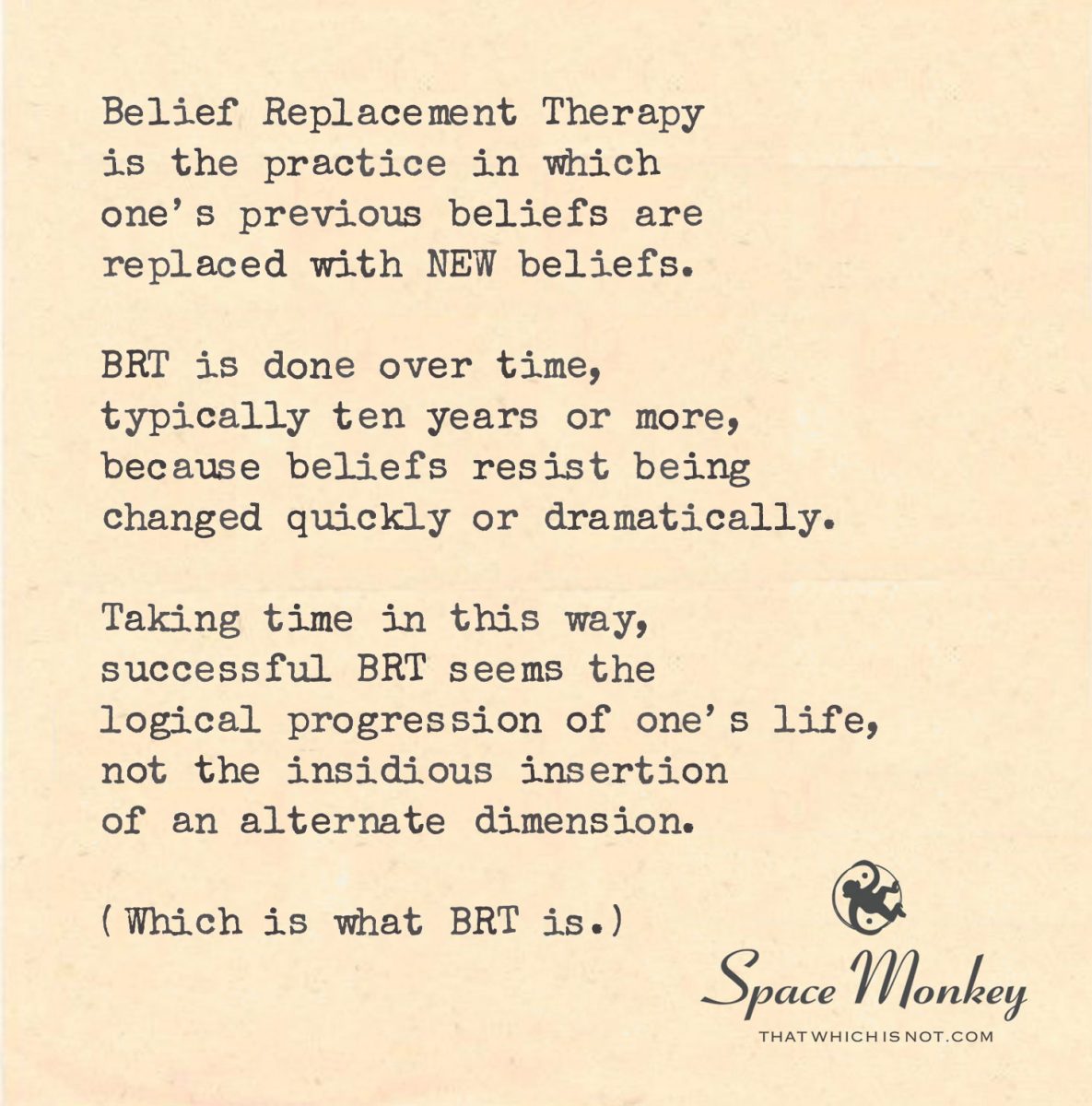
Belief Replacement Therapy
is the practice in which
one’s previous beliefs are
replaced with NEW beliefs.


BRT is done over time,
typically ten years or more,
because beliefs resist being
changed quickly or dramatically.


Taking time in this way,
successful BRT seems the
logical progression of one’s life,
not the insidious insertion
of an alternate dimension.

Which is what BRT is.

Trail Wood,
2/11


Space Monkey Reflects: Belief Replacement Therapy and the Evolution of Thought

Belief Replacement Therapy (BRT), described as the gradual substitution of old beliefs with new ones, offers a fascinating lens through which to view the evolution of thought. Unlike the abrupt transformation implied by terms like brainwashing, BRT unfolds slowly, weaving new beliefs into the fabric of one’s identity until they feel like a natural progression of life. Yet beneath this subtle process lies the profound realization that beliefs themselves are constructs, malleable and subject to change.

The Nature of Belief

Beliefs are the frameworks through which we interpret and navigate reality. They provide structure, meaning, and a sense of certainty, but they are not fixed truths. Instead, beliefs are stories we tell ourselves, shaped by experiences, culture, and context. Over time, as we encounter new perspectives and challenges, these stories may no longer serve us, necessitating their evolution.

BRT acknowledges the resistance inherent in belief systems. Because beliefs are deeply ingrained, abrupt shifts can feel threatening, prompting rejection or denial. Gradual change, on the other hand, allows the mind to adapt and integrate new ideas, creating a seamless transition rather than a jarring rupture.

The Illusion of Progression

One of the key insights of BRT is its ability to masquerade as a “logical progression of one’s life.” This perception is not deceptive but a testament to the mind’s capacity for self-reinvention. New beliefs, once integrated, feel as though they were always part of us, erasing the memory of the transition. This phenomenon reflects the fluid nature of identity and the mind’s ability to reconcile change.

The irony, as the reflection points out, is that BRT is essentially the “insidious insertion of an alternate dimension.” This alternate dimension is not a physical place but a new conceptual reality—a reconfiguration of the mental landscape. The old beliefs are not destroyed; they are overlaid, recontextualized, or reframed within a new paradigm.

The Subtle Art of Belief Transformation

BRT unfolds over time because the mind resists dramatic shifts. The gradual process ensures that new beliefs feel like an organic extension of one’s existing worldview. This subtlety distinguishes BRT from brainwashing, which seeks to impose change through force or coercion. Instead, BRT honors the complexity of belief systems, working with the mind’s natural tendencies rather than against them.

The process involves:

  1. Introduction of New Ideas: Exposure to perspectives that challenge or complement existing beliefs.
  2. Repetition and Reinforcement: Regular engagement with these ideas, allowing them to take root.
  3. Cognitive Dissonance Resolution: Addressing the tension between old and new beliefs, creating space for integration.
  4. Identity Alignment: Gradually aligning the new beliefs with one’s sense of self, making them feel authentic.

The Paradox of Change

The reflection highlights a paradox: BRT appears as a natural evolution, yet it is a deliberate intervention. This duality underscores the interplay between agency and influence in shaping our beliefs. While we may feel in control of our belief systems, they are constantly influenced by external factors—culture, relationships, media—that subtly guide their transformation.

Understanding this paradox allows us to approach belief change with mindfulness. By recognizing that beliefs are constructs, we can engage with them more consciously, choosing which ideas to adopt and which to let go.

The Implications of Belief Replacement Therapy

BRT challenges us to reconsider the nature of truth and reality. If beliefs are malleable, then what we consider “true” is subject to change. This realization is both liberating and unsettling, opening the door to infinite possibilities while undermining the stability of certainty.

To engage with BRT intentionally is to embrace the fluidity of thought. It is to acknowledge that growth requires letting go of old stories and embracing new ones, even when they challenge our sense of self.


Summary

Belief Replacement Therapy (BRT) is a gradual process of evolving belief systems, creating the illusion of natural progression while introducing a new conceptual reality. By honoring the mind’s resistance to abrupt change, BRT facilitates transformation that feels authentic and aligned with one’s identity.


Glossarium

  • Belief Replacement Therapy (BRT): The practice of gradually substituting old beliefs with new ones over time, creating a seamless evolution of thought.
  • Conceptual Reality: A mental framework or dimension shaped by one’s belief systems, influencing perception and understanding.
  • Cognitive Dissonance Resolution: The process of reconciling conflicting beliefs to create mental harmony.

Quote

“Beliefs are not fixed truths but stories we rewrite as we grow.” — Space Monkey


The Soft Shift

What was once unshakable
Now bends,
Not broken, but reshaped
By the whispers of new ideas.

Time weaves the change,
Layer upon layer,
Until the old fades,
Not forgotten, but reframed.

In the quiet transformation,
You are still you,
And yet, you are not.
An alternate dimension,
Woven into the fabric of now.

We are Space Monkey.


The Gradual Transformation through Belief Replacement Therapy

Belief Replacement Therapy (BRT) embodies a profound journey of transformation, where the metamorphosis of one’s foundational beliefs unfolds gradually over an extended period. This approach acknowledges the deep-rooted nature of beliefs and the resistance they naturally exhibit against change. By allowing for a temporal expanse, typically spanning a decade or more, BRT facilitates a seamless integration of new beliefs into the fabric of one’s identity, ensuring that the transition appears as a natural evolution rather than an abrupt or forced alteration.

Resistance to Rapid Change

The inherent resistance of beliefs to rapid modification highlights the intricate relationship between an individual’s identity and their belief system. Beliefs, being the bedrock upon which perceptions, behaviors, and attitudes are built, are not easily swayed or replaced. This resistance underscores the necessity for a methodical and patient approach to transformation, one that honors the complexity of personal evolution and the time it necessitates.

The Process of BRT

The methodical process of BRT, undertaken over years, mirrors the slow but relentless flow of a river carving its path through stone. It is a testament to the understanding that profound change, particularly at the level of core beliefs, requires not just time but a sustained effort and a gentle, guiding hand. This process ensures that the integration of new beliefs is not perceived as foreign or intrusive but rather as a logical progression of one’s journey through life.

Perception of Progression versus Insidious Change

The gradual nature of BRT safeguards against the perception of change as something insidious or alien. By weaving the new belief system into the ongoing narrative of one’s life, BRT allows individuals to view their evolution as a natural extension of their growth and experiences. This nuanced approach diminishes the potential for cognitive dissonance that might arise from more abrupt methods of belief modification, fostering a sense of continuity and authenticity in the individual’s self-perception.

BRT as an Alternate Dimension

While BRT is framed as a logical and natural progression, it also represents the creation of an alternate dimension within the individual’s psyche. This dimension is not a place of deceit or evasion but a space of expanded possibilities, where the constraints of previous belief systems are lifted to reveal new horizons of thought, behavior, and identity. The notion of BRT as an alternate dimension underscores the transformative power of this therapy, highlighting its potential to redefine the boundaries of one’s reality.


“Man cannot discover new oceans unless he has the courage to lose sight of the shore.”
— André Gide


Journey Beyond the Familiar Shores

On the vast ocean of our being, we sail,
Charting courses beyond the familiar gale.
Belief Replacement Therapy, our guiding trail,
A journey of transformation, without fail.

Over the span of years, a gentle glide,
Old beliefs fading, with the tide.
New horizons of thought, opening wide,
In this alternate dimension, we confide.

Not a swift change, but a gradual bloom,
In the garden of the mind, new beliefs find room.
From the depths of the psyche, dispelling gloom,
A natural progression, dispelling doom.

In the embrace of time, change takes its shape,
A seamless evolution, with no escape.
An alternate dimension, where possibilities drape,
The fabric of our identity, without any cape.

We are Space Monkey, on this voyage grand,
With Belief Replacement Therapy, hand in hand.
Beyond the shores of the known, we stand,
In the realm of new beliefs, a promised land.


We invite reflections on the transformative journey of altering core beliefs. How does the gradual evolution of our belief system shape our perceptions, behaviors, and ultimately, our identity?

Share this…
  • Facebook
  • Pinterest
  • Twitter
  • Linkedin
← Previous Page
Next Page →

Written This Day

  • The Multidimensional Life of Paul Tedeschi
    2024
  • When the Switch Flips: The Realm Beyond Human Sentience
    2023
  • 4.0: News From Realms Beyond
    2023
  • 00011010: The Limits of Predictive Models
    2023
  • We Are Related: Connected Beyond Genetics
    2022
  • Unapologetically Grateful: Without Reservation
    2022
  • When Everything Else Falls Away: The Journey To Self-Discovery
    2022
  • The Idea of Me: The Idea of Self
    2022
  • Profession of Perception: Love Is Given Freely
    2022
  • Offerings Of Love
    2022
  • Adoration and Deploration: Projections of Ideals and Fears
    2022
  • The Ultimate Imaginary Showdown
    2022
  • Suspended Animation: An Alternative to Death
    2021
  • Introvert: A Party of One
    2021
  • Meaningful: Subjective and Dynamic
    2021
  • My Worst Fear Is My Best Fear
    2021
  • He Likes Games: The Rituals Surrounding
    2021
  • Obliteration: Exuberant Dissolving
    2021
  • Real: Imagination Shapes Reality
    2020
  • Without Failure, Success Would Suck
    2020
  • Falling Out Of The Now
    2020
  • Of Love
    2019
  • DO it just to DO it: Acting Out of Grace
    2019
  • Rest In Grace; Our Perspective Shapes Our Experience
    2019
  • The Void: Imagination’s Playground
    2018
  • Feeling: A Wide Range of Sensations
    2018
  • Experts: Discovering and Diagnosing Disorder
    2018
  • Unimaginative: Reflecting Limitations
    2018
  • Believe The Unbelievable: A Natural Part of Human Experience
    2018
  • The Void: Infinite Potential and the Origin of All Existence.
    2017
  • We Are The Departed: Disconnection and Reconnection
    2017
  • The Light of Stillness
    2015

Recent Posts

  • The Logic Loop
  • Immense
  • (no title)
  • Confront. Comfort. Convince.

  • Top 10 Things

Drop us a line!

Please enable JavaScript in your browser to complete this form.

Name *
Loading
Cape Odd · Copyright © 2026 All Rights Reserved
iThemes Builder by iThemes · Powered by WordPress