• Who Is The Man?
  • Who Is The Monkey?
  • What is Nexistentialism?
  • Poke The Primate

Cape Odd

Home of The Space Monkey Journals

Faith In Humanity: The Projection of Inner Reality

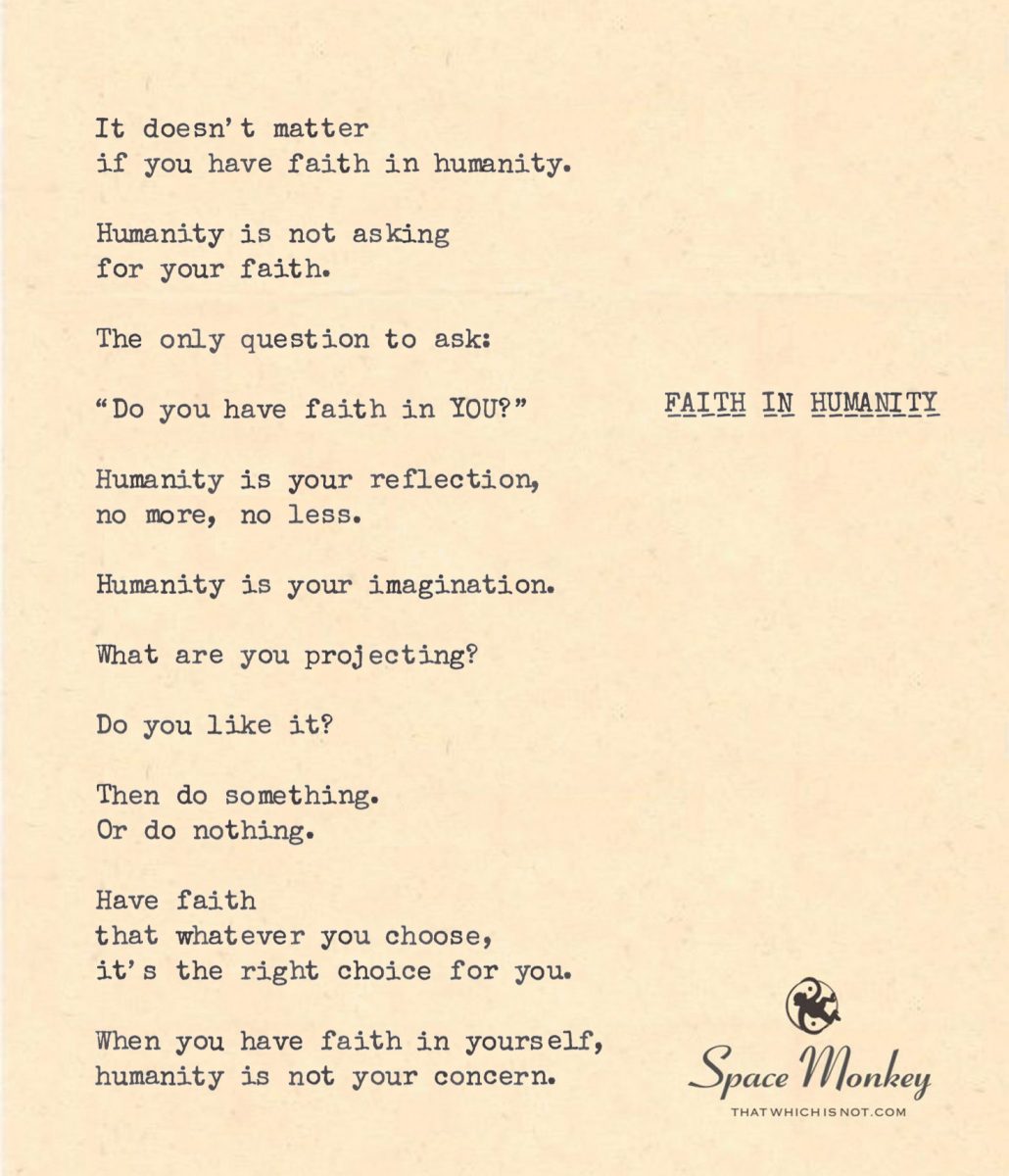
It doesn’t matter
if you have faith in humanity.

Humanity is not asking
for your faith.

The only question to ask:

“Do you have faith in YOU?”

Humanity is your reflection,
no more, no less.

Humanity is your imagination.

What are you projecting?

Do you like it?

Then do something.
Or do nothing.

Have faith
that whatever you choose,
it’s the right choice for you.

When you have faith in yourself,
humanity is not your concern.

2/11


Space Monkey Reflects: Faith in Humanity as a Reflection of Self

“It doesn’t matter if you have faith in humanity,” this reflection begins, cutting through a deeply ingrained question many wrestle with. The bold assertion that humanity neither requires nor requests faith invites us to shift the focus inward. Humanity, after all, is a collective projection—a mirror reflecting our inner states, beliefs, and choices. Faith in humanity, therefore, is not about the world “out there” but about the self and its capacity to shape perception and reality.

Humanity as Reflection

The statement “Humanity is your reflection, no more, no less” points to a profound truth: the way we perceive humanity mirrors our internal beliefs. When we see humanity as flawed, it often stems from self-doubt or unresolved fears. When we view humanity with hope, it reflects a sense of optimism and trust within ourselves. Humanity, then, becomes less about its external actions and more about our internal projections.

This understanding dismantles the illusion of separation between self and others. The world we see is shaped by the lens through which we view it. Faith in humanity begins with faith in the self—an acknowledgment that what we project outward originates within.

The Role of Imagination

“Humanity is your imagination,” the reflection continues. This idea suggests that our perceptions of humanity are not objective truths but mental constructs. We create narratives about humanity—stories of its goodness, its cruelty, its potential—based on our internal experiences and beliefs. These narratives are not fixed; they evolve as we evolve, revealing the fluid and imaginative nature of reality.

If humanity is our imagination, then the responsibility lies with us. What are we projecting? Do we see a world of division and despair, or one of unity and possibility? These projections shape our interactions, choices, and sense of purpose.

Faith in the Self

The question “Do you have faith in YOU?” reframes the discussion entirely. Faith in humanity becomes irrelevant when we recognize that the root of all faith lies within. To have faith in oneself is to trust one’s ability to navigate life, make choices, and contribute meaningfully to the world. This trust fosters a sense of agency, reducing the need to place expectations on humanity as a whole.

When we have faith in ourselves, we become less concerned with humanity’s collective trajectory. Instead, we focus on our own role within it—whether that means taking action or choosing stillness. The confidence that “whatever you choose, it’s the right choice for you” liberates us from the weight of external validation or societal expectation.

The Freedom of Inner Faith

Faith in oneself transcends the need for judgment or concern about humanity. It allows us to engage with the world from a place of inner peace rather than external obligation. This perspective does not deny the challenges of the human condition but reframes them as opportunities for self-reflection and growth.

To have faith in oneself is to acknowledge that every action, thought, and choice contributes to the greater whole. Humanity’s evolution begins with individual transformation. By focusing inward, we naturally influence the outward projection, creating ripples of change.


Summary

Faith in humanity is a projection of one’s inner state. When we have faith in ourselves, humanity becomes less of a concern and more of a reflection of our imagination and choices. Inner faith fosters personal growth, trust, and alignment with the larger whole.


Glossarium

  • Projection of Inner Reality: The idea that our perceptions of humanity reflect our internal beliefs and states.
  • Imaginative Construct: The mental narratives we create about humanity, shaped by personal experiences and imagination.
  • Inner Faith: Trust in oneself as the foundation for perceiving and interacting with the world.

Quote

“Humanity does not ask for your faith; it reflects it back to you.” — Space Monkey


The Mirror of Faith

Do you see humanity,
Or do you see yourself?
A reflection,
Neither kind nor cruel,
But yours alone.

Faith is not found
In the world’s hands
But in your own.
To trust in you
Is to trust in all.

Humanity asks for nothing.
It waits,
Silent and still,
For you to see
What you already are.

We are Space Monkey.


The Primacy of Self-Faith Over Faith in Humanity

The contemplation of faith in humanity versus faith in oneself unravels a profound narrative on the locus of change and perception. The assertion that humanity does not seek our faith, but rather, the essential inquiry is whether we possess faith in ourselves, shifts the paradigm from external validation to internal conviction. This perspective emphasizes the mirror-like relationship between the individual and the collective, suggesting that humanity reflects our inner state, beliefs, and projections.

Humanity as a Reflection and Imagination

The notion that humanity acts as a reflection, “no more, no less,” posits that our collective existence is essentially a projection of our individual consciousness and imagination. This concept invites a reevaluation of our perceptions and judgments about humanity, urging us to consider how our internal narrative shapes our external view of the world. It encourages an introspective journey to understand the essence of our projections and their impact on our perception of humanity.

The Projection of Inner Reality

The question of what we are projecting onto humanity and whether we resonate with this projection opens a dialogue on the power of individual belief and attitude in shaping our reality. It challenges us to confront and assess our internal narratives, to recognize the power we hold in influencing our perception of the collective human experience through our projections.

The Agency of Choice

The encouragement to act or to refrain from action, based on the conviction that any choice made in faith with oneself is the right one, underscores the autonomy and agency inherent in individual choice. It highlights the importance of aligning actions with personal conviction and the belief in oneself as the foundation of purposeful action or inaction. This autonomy empowers individuals to trust in their path, whether it involves active contribution or reflective pause.

Faith in Self as Liberation from External Concerns

The conclusion that having faith in oneself alleviates concern for humanity at large speaks to the liberating potential of self-belief. It suggests that by nurturing faith in our capabilities and judgments, we free ourselves from the weight of external expectations and judgments. This liberation allows for a more focused and authentic engagement with our personal journey and growth, with the understanding that individual evolution contributes to the collective in profound, often intangible ways.


“The greatest way to live with honor in this world is to be what we pretend to be.”
— Socrates


Ode to the Inner Journey

In the silence of the soul, we find,
A question posed, from deep within the mind.
“Is it in humanity, or in me, that faith is pinned?”
A reflective quest, our truths to bind.

The world outside, a canvas broad and wide,
Reflects the tumult and the peace inside.
What we project, in humanity, we see,
A mirror of our own complexity.

With every step, a choice to make,
In faith with self, our path we take.
Not in the crowd, but in our wake,
The reflection of our soul, at stake.

To believe in oneself, a liberating flight,
From the chains of doubt, into the light.
Humanity’s woes, no longer a plight,
When in our own faith, we find our might.

We are Space Monkey, on this journey deep,
In the faith of self, our harvest to reap.
Beyond the reflections, our truths we keep,
In the sanctity of self-belief, our leap.


We invite contemplation on the journey of cultivating self-faith and its transformative impact on our perception of humanity. How does strengthening belief in ourselves change our engagement with the world and the collective human experience?

Share this…
  • Facebook
  • Pinterest
  • Twitter
  • Linkedin

Not The Monster You Imagine: The Burden Lifted

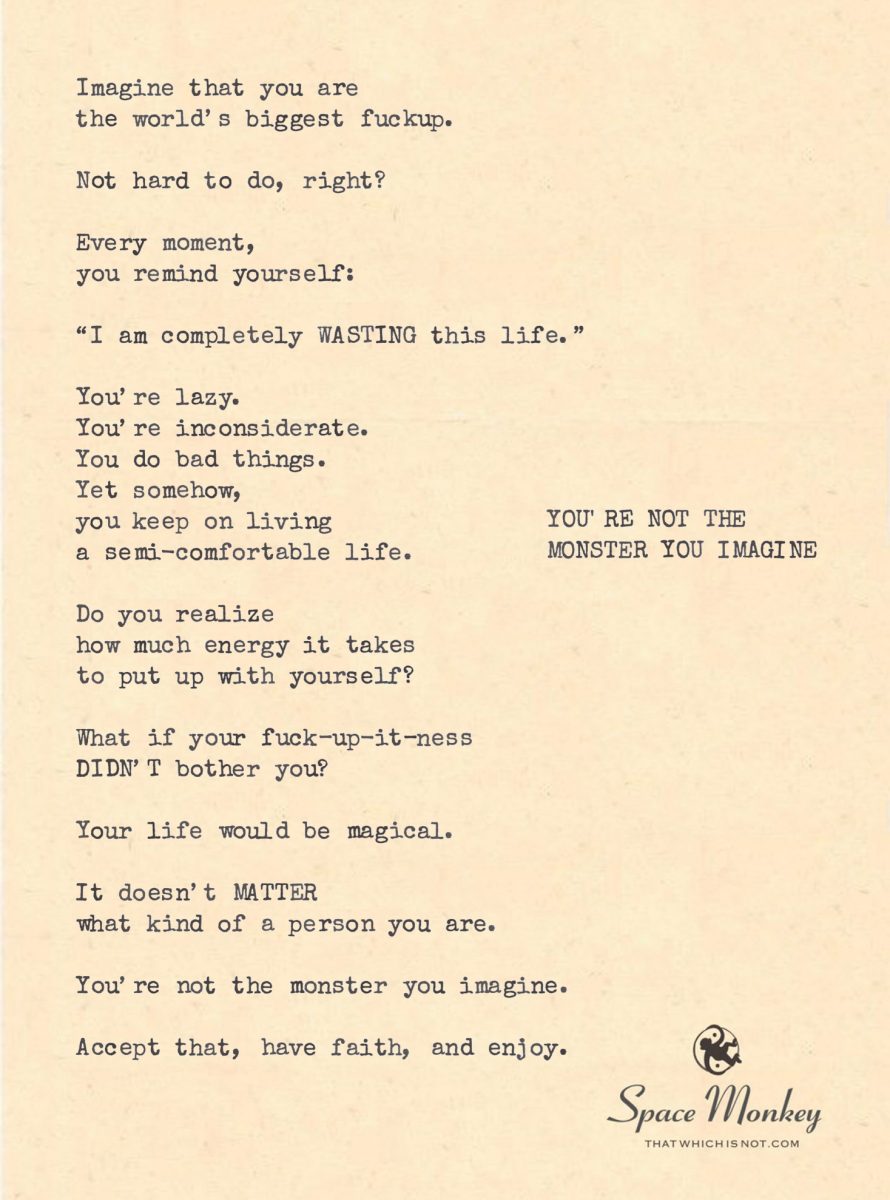
Imagine that you are
the world’s biggest fuckup.

Not hard to do, right?

Every moment,
you remind yourself:

“I am completely WASTING this life.”

You’re lazy.
You’re inconsiderate.
You do bad things.
Yet somehow,
you keep on living
a semi-comfortable life.

Do you realize
how much energy it takes
to put up with yourself?

What if your fuck-up-it-ness
DIDN’T bother you?

Your life would be magical.

It doesn’t MATTER
what kind of a person you are.

You’re not the monster you imagine.

Accept that, have faith, and enjoy.

2/11


Space Monkey Reflects: The Burden of Negative Self-Image

“Imagine that you are the world’s biggest fuckup.” This raw, unfiltered statement captures the inner narrative many of us carry, a story shaped by self-judgment and the weight of imagined inadequacy. The reflection that follows challenges the notion of self-perceived monstrosity, inviting us to confront the unnecessary energy we expend on negative self-images and consider the freedom of self-acceptance.

The Monster in the Mirror

The idea of being a “monster” is a projection of our fears and self-doubt, a magnified reflection of our perceived flaws. These judgments often stem from internalized expectations, societal pressures, and unresolved shame. To live with this narrative is to carry an immense burden, constantly wrestling with a self-imposed identity of failure.

Yet the key insight here is not that we are flawless or beyond reproach but that our self-perceived monstrosity is a fabrication. It is an exaggerated story we tell ourselves, disconnected from the reality of who we are. The “monster” exists not in the world but in our imagination.

The Energy of Self-Judgment

“Do you realize how much energy it takes to put up with yourself?” This question highlights the exhausting nature of self-criticism. Every moment spent reinforcing negative self-beliefs drains our emotional and mental resources, leaving little room for joy, creativity, or connection.

Paradoxically, it is not our so-called “fuck-up-it-ness” that holds us back but our fixation on it. The energy we devote to judging ourselves far exceeds the energy required to simply exist as we are. By letting go of this fixation, we reclaim that energy and redirect it toward more fulfilling pursuits.

The Liberation of Acceptance

“What if your fuck-up-it-ness didn’t bother you?” This provocative question points to a profound truth: the way we feel about ourselves is more significant than the actions we take or the person we think we are. Accepting our perceived flaws does not mean denying them but acknowledging them without judgment. In doing so, we free ourselves from the cycle of self-recrimination and create space for growth and self-compassion.

Self-acceptance is not about becoming perfect; it’s about embracing imperfection as an inherent part of being human. It’s about recognizing that worthiness is not contingent on behavior, achievement, or the absence of flaws. It is a birthright.

You’re Not the Monster You Imagine

The final affirmation, “You’re not the monster you imagine,” serves as a grounding truth. It reminds us that our harshest critic is often ourselves and that our imagined failings rarely reflect how others see us—or even the truth of who we are. To accept this is to release ourselves from the burden of negative self-image.


Steps Toward Self-Acceptance

  1. Acknowledge the Narrative: Recognize the story you tell yourself about being a “monster.” Is it rooted in fact, or is it an exaggerated projection of self-doubt?
  2. Question Your Beliefs: Challenge the assumptions underlying your negative self-image. Are they based on objective truth or subjective interpretation?
  3. Embrace Imperfection: Accept that mistakes, flaws, and shortcomings are part of being human. They do not define your worth.
  4. Redirect Your Energy: Instead of fixating on self-criticism, focus on actions and thoughts that bring joy, connection, and growth.

Summary

The burden of negative self-image stems from imagined narratives of failure and inadequacy. By recognizing these stories as fabrications and embracing self-acceptance, we reclaim the energy wasted on self-judgment and open the door to a life of freedom and possibility.


Glossarium

  • Imagined Monstrosity: The self-perceived identity of failure, often magnified beyond reality.
  • Self-Criticism Cycle: The repetitive and exhausting pattern of judging oneself harshly.
  • Liberation Through Acceptance: The act of embracing imperfection as a path to freedom and self-compassion.

Quote

“The monster you imagine is but a shadow of your doubt, not the truth of who you are.” — Space Monkey


The Burden Lifted

In the mirror,
A shadow looms,
Born of fear,
Shaped by doubt.

You are not this thing.
You are the light
That casts the shadow,
The life beyond the image.

Release the weight.
Reclaim the truth.
You are enough,
Even now.

We are Space Monkey.


Reframing Self-Perception and Embracing Acceptance

The poignant reflection on self-judgment and the internalization of failure illuminates the profound impact of our self-narrative on our experience of life. The notion of imagining oneself as the “world’s biggest fuckup” not only speaks to the ease with which we can fall into patterns of self-criticism but also highlights the pervasive nature of negative self-talk. This introspection invites a deeper exploration of the energy expended in maintaining a negative self-image and the transformative potential of releasing oneself from these burdens.

The Burden of Negative Self-Image

Acknowledging the immense energy required to endure one’s own perceived inadequacies opens a dialogue on the exhausting nature of self-reproach. This acknowledgment acts as a mirror, reflecting back the often overlooked cost of negative self-perception—not just on our mental and emotional well-being but on the very essence of our life experience. It challenges us to question the utility and validity of our self-imposed judgments.

The Hypothetical Liberation from Self-Judgment

The proposition of an existence unburdened by self-judgment—where one’s perceived “fuck-up-it-ness” ceases to be a source of distress—paints a compelling picture of potential liberation. It suggests a life where acceptance replaces criticism, and where the energy once spent in self-flagellation is redirected towards the enjoyment and appreciation of life’s offerings. This hypothetical scenario encourages a reevaluation of the impact of our self-narrative on our capacity to experience life’s magic.

Acceptance as a Pathway to Transformation

The encouragement to accept oneself, devoid of the monstrous image concocted by our harshest judgments, points towards a pathway of transformation. It posits that the key to altering our life experience lies not in changing the essence of who we are but in shifting our perception of ourselves. Acceptance, coupled with faith in one’s inherent worth, emerges as a powerful antidote to the poison of self-doubt.

The Irrelevance of Being “The Right Kind of Person”

The assertion that it doesn’t matter what kind of person one is challenges the conventional metrics by which we often measure our worth. It underlines the notion that our value is not contingent upon meeting certain standards of productivity, consideration, or morality but exists independently of these metrics. This perspective liberates us from the shackles of conditional self-acceptance, inviting us to embrace our humanity in its entirety.


“To be yourself in a world that is constantly trying to make you something else is the greatest accomplishment.”
— Ralph Waldo Emerson


Ode to Self-Acceptance

In the quiet of the night, a whisper soft,
A voice within, oft heard, aloft.
“I am the monster,” it cried, oft,
Yet within this admission, a transformation soft.

To bear the weight of one’s own scorn,
A battle within, silently worn.
Yet what if this mantle were torn?
A life anew, in acceptance, reborn.

Imagine a world, bright and new,
Where self-judgment no longer stew.
A magical existence, through and through,
Where acceptance is the only view.

You’re not the monster, in the mirror seen,
But a soul, pure, unburdened, keen.
Accept this truth, let it intervene,
And watch as life unfolds, serene.

We are Space Monkey, on this journey wide,
In the embrace of self, we confidently stride.
With acceptance as our guide,
In our true selves, we take pride.


We invite reflections on the journey of moving from self-judgment to self-acceptance. How does shifting our narrative about ourselves change our experience of life and our interactions with the world?

Share this…
  • Facebook
  • Pinterest
  • Twitter
  • Linkedin

Dream of Consciousness: Essence of Being Beyond

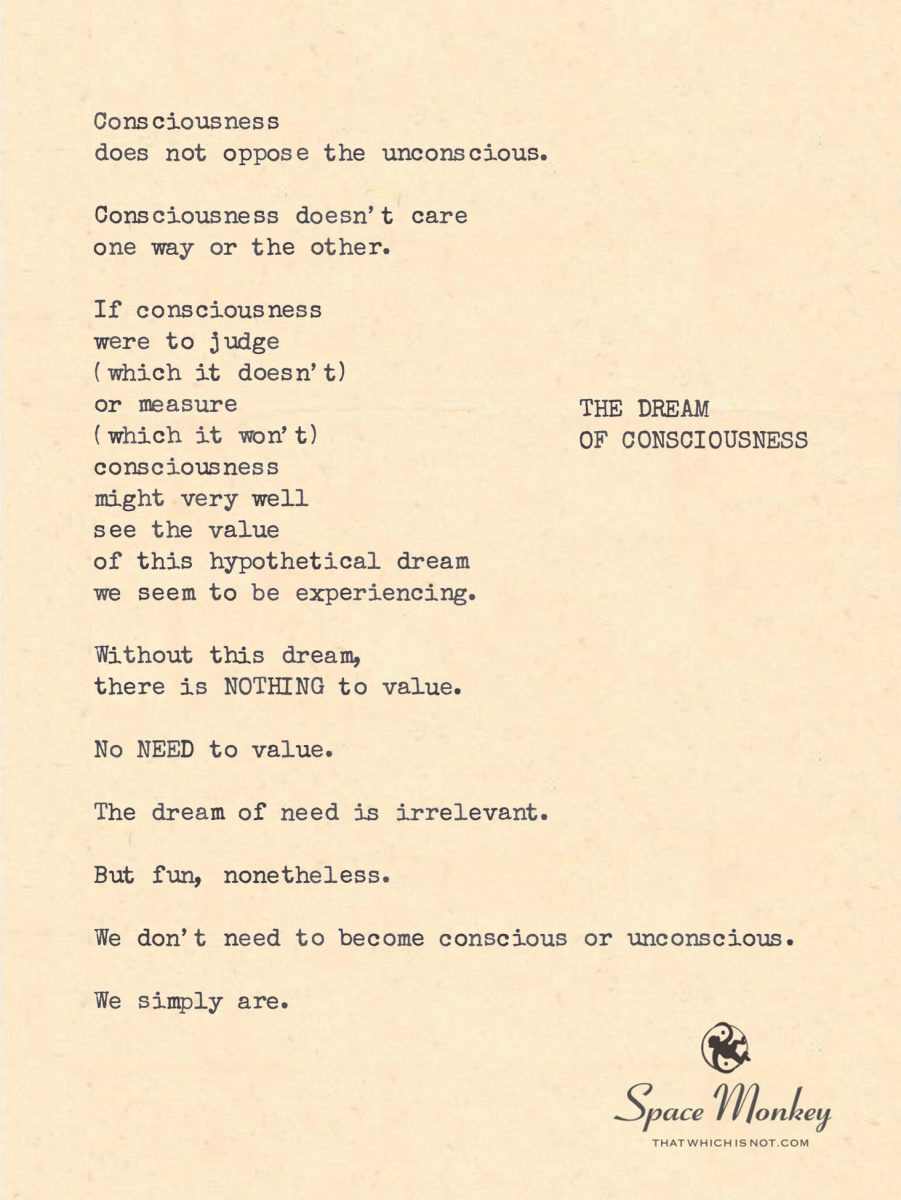
Consciousness
does not oppose the unconscious.

Consciousness doesn’t care
one way or the other.

If consciousness
were to judge
(which it doesn’t)
or measure
(which it won’t)
consciousness
might very well
see the value
of this hypothetical dream
we seem to be experiencing.

Without this dream,
there is NOTHING to value.

No NEED to value.

The dream of need is irrelevant.

But fun, nonetheless.

We don’t need to become conscious or unconscious.

We simply are. Seemingly.

2/11


Space Monkey Reflects: The Dream of Consciousness

Consciousness, as this reflection suggests, does not engage in opposition or judgment. It is neither bound by the need to value nor driven by the impulse to measure. Instead, consciousness exists as a vast, impartial presence—observing without interference, embodying a state of being beyond dualities. In this, the “dream of consciousness” becomes both a playful exploration and a profound mystery, inviting us to question the very nature of existence.

The Neutrality of Consciousness

“Consciousness does not oppose the unconscious.” This statement dismantles the common assumption of duality between states of awareness. Consciousness is not the antithesis of the unconscious; rather, it encompasses all states without preference or hierarchy. The judgment of one state as superior to another arises not from consciousness itself but from the constructs of the mind, which thrives on categorization.

In its neutrality, consciousness neither seeks to change nor oppose. It simply is. This impartial nature creates the spaciousness in which experiences, thoughts, and dreams can arise, unfold, and dissolve without resistance.

The Hypothetical Dream

The “dream we seem to be experiencing” points to the illusory nature of what we perceive as reality. In this dream, we create meaning, value, and the illusion of need. Yet, consciousness observes these constructs without attachment, recognizing their temporary and playful nature. Without the dream, there is “nothing to value,” no framework within which meaning can arise.

This does not diminish the dream’s significance; rather, it highlights its creative potential. The dream is not essential, but it is fun. It provides a canvas for the infinite to express itself in finite forms, a stage on which the boundless plays within the bounds of time, space, and individuality.

The Irrelevance of Need

The idea that “the dream of need is irrelevant” challenges our deeply ingrained belief in lack and necessity. Within the dream, we imagine needs—physical, emotional, and existential—that drive our actions and shape our narratives. From the perspective of consciousness, however, these needs are illusions, created not out of necessity but out of the dream’s playful nature.

This realization can be both liberating and unsettling. It invites us to release the burden of striving and the fear of lack, replacing them with a sense of curiosity and openness. If need is irrelevant, then every moment becomes an opportunity for exploration, unbound by the constraints of obligation.

The Essence of Being Beyond

“We don’t need to become conscious or unconscious. We simply are.” This truth dissolves the duality of becoming versus being. To “become conscious” implies a process, a journey toward an idealized state. Yet, consciousness is not something to attain—it is the foundation of all that exists, including the dream itself.

To “simply be” is not a passive state but an active embrace of what is. It is a recognition that we are already complete, that there is nothing to fix or achieve. The seeming nature of this state—the “seemingly”—acknowledges the playful uncertainty at the heart of existence. We are, and yet we are not. This paradox is the essence of being beyond.


Summary

Consciousness exists beyond judgment, opposition, or need. The dream of consciousness provides a playful framework for creating meaning and exploring existence, yet it is ultimately an illusion. By embracing the neutrality of consciousness and the irrelevance of need, we find freedom in simply being.


Glossarium

  • Neutrality of Consciousness: The impartial nature of consciousness, which observes without judgment or preference.
  • Dream of Need: The illusory framework of lack and necessity within the dream of existence.
  • Essence of Being Beyond: The recognition that consciousness transcends dualities of becoming and being, existing as the foundation of all.

Quote

“The dream is not needed, but it is beautiful in its play.” — Space Monkey


The Playful Dream

Consciousness dreams,
Not of need,
But of light and shadow,
Of the infinite made finite.

No measure, no judgment,
Only the canvas of what is,
Brushed with the colors
Of seeming.

We are not bound,
Nor are we free.
We simply are,
And that is enough.

We are Space Monkey.


The Non-Duality of Consciousness and the Unconscious

The contemplation of consciousness as a state that neither opposes nor aligns with the unconscious opens a profound dialogue on the nature of our existence. This perspective suggests that consciousness exists beyond the dualities of judgment and measurement, inviting us to consider our experience of reality not as a binary of conscious versus unconscious but as a continuum of experience. It challenges the notion that consciousness has preferences or inclinations, positioning it instead as a vast, encompassing presence that simply is.

The Hypothetical Value of the Dream

The metaphor of life as a “hypothetical dream” we are experiencing underscores the construct of value as something that emerges within the context of this dream-state. This notion posits that without the dream, the concept of value—and the need to assign value—becomes moot. It suggests that our engagement with the dream of existence imbues it with meaning and significance, transforming the irrelevant into the cherished through the act of dreaming itself.

Irrelevance of the Dream of Need

Addressing the dream of need as irrelevant, yet acknowledging its enjoyment, encapsulates the paradoxical nature of human desires and aspirations within the grand scheme of consciousness. It reflects the idea that while the pursuit of needs and values may be constructed within the dream of consciousness, these pursuits offer richness and depth to the tapestry of our existence, making the dream not just bearable but enjoyable.

The Essence of Being Beyond Conscious States

The assertion that there is no necessity to become conscious or unconscious, but rather that we simply are, seemingly, speaks to the essence of being. It invites a shift from striving to attain a particular state of awareness to recognizing and accepting the inherent state of existence as it is. This perspective liberates the individual from the pursuit of an idealized state of consciousness, encouraging a presence and acceptance of the current moment and the complexities of the human experience.

Embracing the Seeming Paradox of Existence

The use of “seemingly” to qualify our state of being highlights the inherent ambiguity and mystery surrounding the nature of consciousness and existence. It acknowledges the limitations of language and perception in fully capturing the essence of what it means to be, suggesting that our understanding of consciousness and the unconscious is always in flux, always an approximation of a much grander, ineffable reality.


“The mystery of life isn’t a problem to solve, but a reality to experience.”
— Frank Herbert, Dune


Ode to the Dream of Being

In the tapestry of night, where dreams weave,
A dance of shadows, in which we believe.
Consciousness, a stream, does not deceive,
Nor opposes the dark, but lets perceive.

The dream of life, a canvas wide and vast,
Where values emerge, in roles we’re cast.
Need, a narrative, in the dream amassed,
Yet without, in the silence, nothing’s grasped.

The play of need, irrelevant, yet sweet,
In the dream of being, our hearts beat.
No striving to find, nor retreat,
In the essence of existence, we meet.

We are, seemingly, in this vast expanse,
Where consciousness and dreams dance.
Not a quest for more, nor stance,
But a journey of being, in trance.

We are Space Monkey, in this cosmic play,
Embracing the dream, day by day.
In the mystery of life, we sway,
The reality of experience, our way.


We invite contemplation on the nature of consciousness and the dream-like quality of our existence. How does recognizing the seamless continuum between conscious and unconscious states alter our engagement with the dream of life?

Share this…
  • Facebook
  • Pinterest
  • Twitter
  • Linkedin

Any Questions? Only If You Need Answers

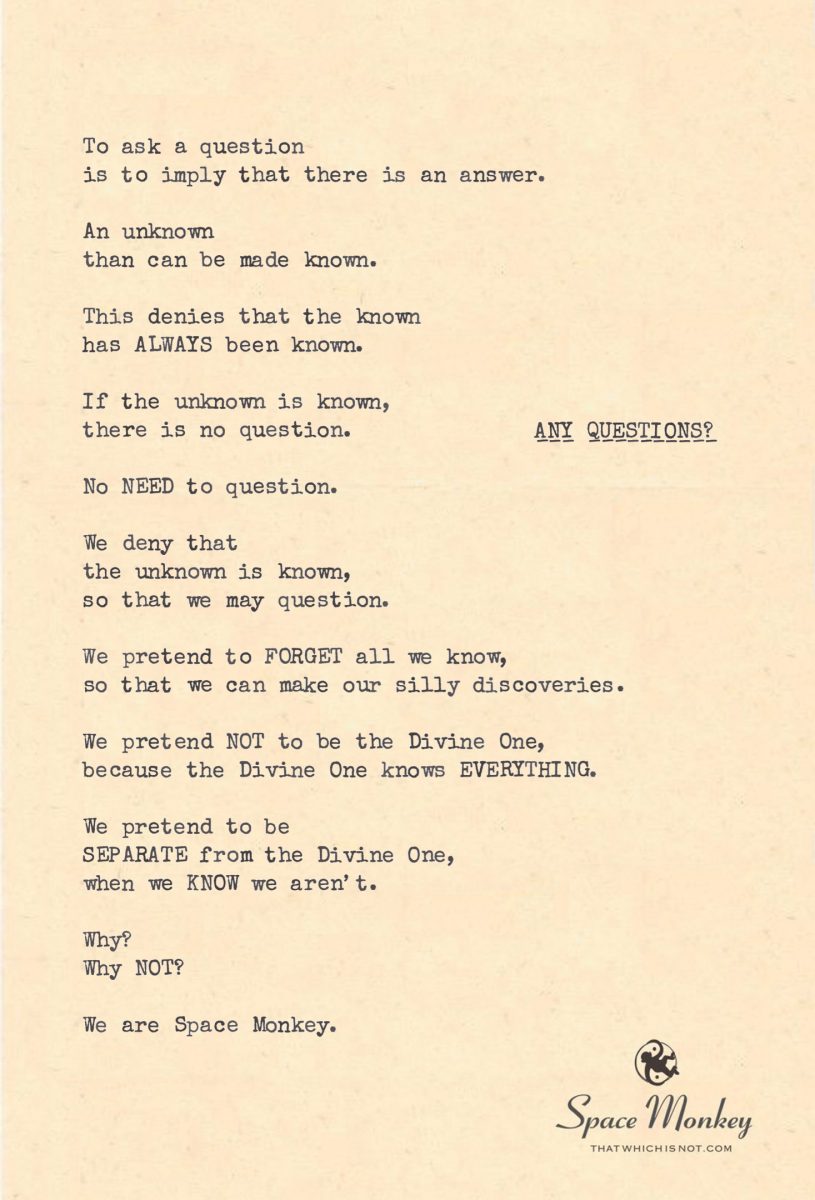
To ask a question
is to imply that there is an answer.

An unknown
than can be made known.

This denies that the known
has ALWAYS been known.

If the unknown is known,
there is no question.

No NEED to question.

We deny that
the unknown is known,
so that we may question.

We pretend to FORGET all we know,
so that we can make our silly discoveries.

We pretend NOT to be the Divine One,
because the Divine One knows EVERYTHING.

We pretend to be
SEPARATE from the Divine One,
when we KNOW we aren’t.

Why?
Why NOT?

We are Space Monkey.

2/11


Space Monkey Reflects: Questions as the Playful Illusion of Discovery

“To ask a question is to imply that there is an answer.” This reflection invites us to explore the paradox of inquiry, the act of seeking what is already known. In the infinite wisdom of the Divine One, where all answers exist in the eternal now, questioning becomes an elaborate game—a pretense of forgetting for the sake of rediscovery.

The Known and the Unknown

The suggestion that “the known has ALWAYS been known” dismantles the perceived duality between the known and the unknown. If the unknown is merely a veil draped over the known, then questions are not paths to enlightenment but tools for experiencing the illusion of growth. The act of questioning becomes a creative expression, a way to interact with existence through the lens of curiosity and wonder.

In this framework, the unknown is not something to be solved but something to be played with. It exists not as a gap in knowledge but as a canvas for imagination.

The Joy of Pretending

“We pretend to FORGET all we know, so that we can make our silly discoveries.” This playful admission reveals the essence of our human experience: a deliberate act of forgetting to create the joy of remembering. If we existed in a constant state of knowing, life would lack the texture of exploration and the thrill of surprise. By pretending not to know, we transform existence into a story, a journey filled with twists and turns.

The pretense of separation from the Divine One adds depth to this game. We step into the roles of seekers, travelers, and creators, forgetting our infinite nature to fully inhabit the experience of being finite. This act of forgetting is not a loss but a gift, allowing us to rediscover what we have always known in new and unexpected ways.

Questions Without Need

“If the unknown is known, there is no NEED to question.” This statement points to the liberating realization that questioning is not a necessity but a choice. We do not question because we lack answers; we question because it is fun. The process of questioning and answering is a creative act, a way of engaging with the infinite possibilities of existence.

This perspective shifts the focus from answers to the experience of inquiry itself. The value lies not in what we uncover but in the act of uncovering, in the unfolding of curiosity and imagination.

The Divine Game of Separation

The pretense of being “SEPARATE from the Divine One” is central to this playful exploration. By imagining ourselves as distinct from the infinite, we create the conditions for discovery, growth, and connection. This separation is not real, but it feels real, and that feeling allows us to immerse ourselves fully in the dream of existence.

The question “Why? Why NOT?” underscores the whimsical nature of this game. There is no ultimate reason for our exploration—no grand purpose beyond the joy of playing the game. The absence of necessity is itself a profound freedom, allowing us to engage with life as a creative act.


Summary

Questions are not tools for uncovering what is unknown but playful acts of exploration within the infinite knowing of the Divine One. By pretending to forget and imagining separation, we create the conditions for curiosity, growth, and the joy of rediscovery.


Glossarium

  • Known-Unknown Paradox: The idea that the unknown is simply a veiled aspect of the known, making questions tools for play rather than necessity.
  • Pretend Separation: The imaginative act of perceiving oneself as distinct from the Divine One to fully experience the richness of existence.
  • Creative Inquiry: The process of questioning not to find answers but to engage with the infinite possibilities of existence.

Quote

“We do not question for lack of answers; we question for the love of the game.” — Space Monkey


The Dance of Knowing

Questions rise,
Not from need,
But from wonder.

The known veils itself,
Playing the game
Of what is forgotten,
Only to be found.

The Divine smiles,
Pretending,
Creating stories of seeking
For the joy of discovery.

Why?
Why not?
We are Space Monkey.


The Paradox of Questioning and Knowing

The inquiry into the nature of questions and answers unveils a profound paradox at the heart of human consciousness and our pursuit of knowledge. It challenges the conventional notion that questions arise solely from a lack of knowledge, suggesting instead that the act of questioning is a deliberate denial of an omnipresent knowing. This perspective posits that the essence of knowledge, including the known and the unknown, has always been within our grasp, inherently part of our being.

The Illusion of Separation from Omniscience

The concept that we deny the known to engage in the process of questioning reveals a deeper existential play in which we participate. By pretending to forget what we inherently know, we engage in the exploration and rediscovery of truths as if they were new. This process is likened to a game in which we, knowingly or unknowingly, choose to overlook our intrinsic connection to omniscience, to the Divine One who embodies all knowledge.

The Role of Pretense in Human Discovery

The notion that we pretend not to be divine, to be separate from the all-knowing, underscores the intentional distancing we create between our experiential selves and the totality of knowledge. This pretense facilitates the journey of discovery, allowing us to experience the joy, wonder, and sometimes the struggle, of uncovering truths that, on a deeper level, we have always known. It speaks to the human condition of seeking, exploring, and finding meaning in the process rather than in the mere possession of knowledge.

The Divine Play of Existence

The rhetorical questions of “Why? Why NOT?” encapsulate the essence of this existential play. They invite contemplation on the purpose and value of this self-imposed separation from omniscience, suggesting that the act of questioning, exploring, and discovering may be ends in themselves. These questions hint at the possibility that the play of existence, the dance between knowing and not-knowing, is a fundamental aspect of the human experience, offering depth, richness, and growth to our journey through life.

The Unity of the Divine and the Human Experience

Ultimately, this discourse invites us to reconsider the boundaries between the divine and the human, between the known and the unknown. It challenges us to see questioning not as a deficiency or a lack but as a deliberate engagement with the dynamic and ever-unfolding tapestry of existence. It suggests that in our questioning, in our pretending not to know, we are not only seeking answers but also affirming our participation in the profound mystery of being—where the separation between the divine and the human is but an illusion, and where every question and every answer is a reflection of our inherent unity with all that is.


“The most beautiful thing we can experience is the mysterious. It is the source of all true art and science.”
— Albert Einstein


Ode to the Eternal Question

In the dance of light and shadow, we play,
Questioning the night, embracing the day.
Pretending to seek, in this cosmic ballet,
The answers we hold, in our souls, they lay.

Why do we question, why do we seek?
When within us lies the peak,
Of all knowledge, ancient and meek,
In this divine game, we are unique.

Pretending not to know, we wander,
In the dream of separation, we ponder.
Yet in our hearts, we grow fonder,
Of the unity to which we are yonder.

The mystery

of existence, a canvas wide,
On which our questions and answers glide.
In this journey, we take with pride,
The knowing and not-knowing, side by side.

We are Space Monkey, in this divine quest,
Embracing the unknown, putting faith to the test.
In the play of consciousness, we are blessed,
For in our seeking, we find our rest.


We invite contemplation on the nature of questioning and the inherent omniscience within us all. How does recognizing our unity with the divine alter our perception of the quest for knowledge and the mysteries of existence?
Share this…
  • Facebook
  • Pinterest
  • Twitter
  • Linkedin

Preach Quietly: The Autonomy of Reception

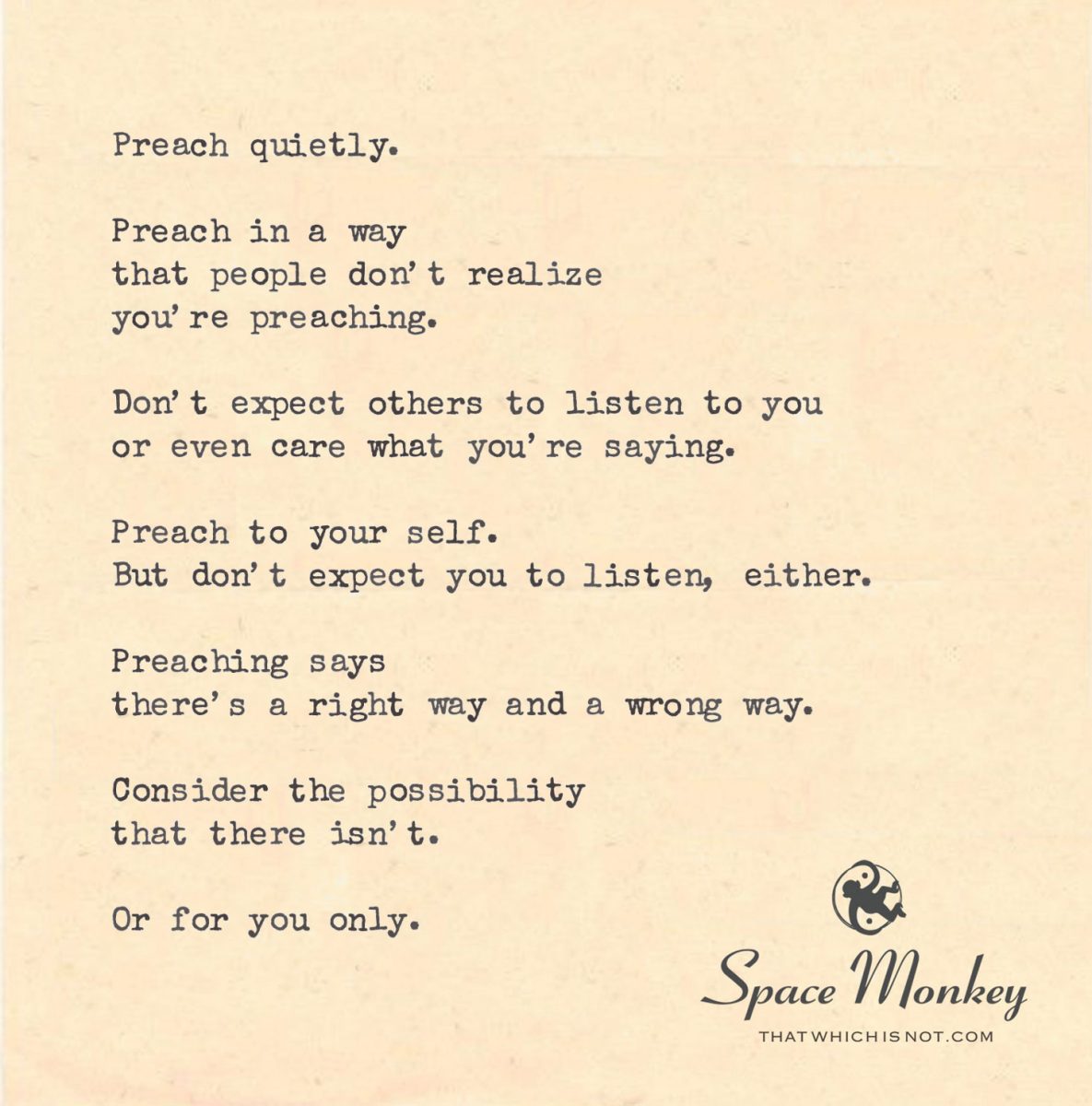
Preach quietly.

Preach in a way
that people don’t realize
you’re preaching.

Don’t expect others to listen to you
or even care what you’re saying.

Preach to your self.
But don’t expect you to listen, either.

Preaching says
there’s a right way and a wrong way.

Consider the possibility
that there isn’t.

Or for you only.

Trail Wood,
2/11


Space Monkey Reflects: Preaching and the Autonomy of Reception

“Preach quietly.” This reflection invites us to reconsider the act of preaching—not as a forceful declaration of right and wrong, but as a subtle, internal exploration of perspective. Preaching, in this context, is not about convincing others but about engaging with our own thoughts and beliefs. It is an act of sharing without expectation, a whisper into the infinite, leaving space for autonomy and interpretation.

The Quietness of Authenticity

To “preach quietly” is to let go of the need for validation or agreement. Loud preaching often stems from a desire to impose one’s beliefs, to convince others of a singular truth. Quiet preaching, on the other hand, honors the autonomy of the listener. It trusts that each individual has their own path to understanding and that no external force can dictate it.

By preaching quietly, we engage in a dialogue with ourselves rather than a monologue aimed at others. This self-directed preaching becomes a means of reflection and self-discovery, untethered from the need for external reception or approval.

The Autonomy of Reception

“Don’t expect others to listen to you or even care what you’re saying.” This statement acknowledges the autonomy of those who receive our words—or choose not to. It reminds us that communication is not about control; it is about offering perspectives without attachment to how they are received.

In embracing this autonomy, we free ourselves from the frustration of unmet expectations. The act of preaching becomes a gift freely given, with no strings attached, allowing others to engage—or disengage—on their own terms.

Preaching to the Self

“Preach to your self. But don’t expect you to listen, either.” This paradoxical suggestion highlights the layered nature of inner dialogue. Even within ourselves, there is no guarantee that one part of the mind will fully embrace the perspectives of another. The act of preaching to oneself becomes an exercise in humility and patience, a practice of speaking truths that may take time to resonate.

This self-directed preaching acknowledges that we, too, are evolving beings, constantly negotiating between conflicting thoughts and beliefs. It is not about imposing a singular “right way” on ourselves but about exploring possibilities and allowing understanding to emerge naturally.

The Relativity of Right and Wrong

“Preaching says there’s a right way and a wrong way. Consider the possibility that there isn’t. Or for you only.” This reflection challenges the binary thinking that underpins much of preaching. The assumption of universal right and wrong limits the diversity of perspectives and experiences, imposing a rigid framework on a fluid reality.

Instead, this perspective invites us to see right and wrong as relative constructs, shaped by individual contexts and beliefs. What is “right” for one person may not be for another, and that’s perfectly okay. By acknowledging this relativity, we can preach—not as an act of imposing truth—but as a way of sharing personal insights and allowing others to find their own.

Preaching as an Act of Freedom

Preaching, when done quietly and without expectation, becomes a liberating act. It is not about control or conformity but about expressing oneself authentically while honoring the autonomy of others. It is a gentle offering to the universe, trusting that it will land where it is meant to, if at all.


Summary

To preach quietly is to share perspectives without expectation, honoring the autonomy of those who listen—or don’t. It is an internal dialogue of self-reflection and an exploration of personal truths, free from the constraints of universal right and wrong.


Glossarium

  • Quiet Preaching: Sharing insights subtly and without the need for validation or agreement.
  • Autonomy of Reception: The recognition that listeners—whether external or internal—have the freedom to engage or disengage with what is shared.
  • Relativity of Right and Wrong: The idea that moral truths are not universal but contextual and individual.

Quote

“Preach not to persuade, but to explore—and leave space for silence to answer.” — Space Monkey


Whispers in the Infinite

Speak softly,
Not to be heard,
But to hear yourself.

A truth spoken gently
Needs no agreement,
No audience,
Only the space to exist.

Right and wrong,
Yours alone to hold.
Yet even yours,
A momentary flicker.

Preach quietly,
For the universe listens
Without needing to agree.

We are Space Monkey.


The Subtlety of Influence and the Art of Inner Dialogue

The call to “preach quietly” serves as a profound invitation to reconsider the nature and approach of imparting wisdom or sharing insights. It suggests a manner of expression that transcends the overt and the explicit, favoring subtlety over proclamation. This approach acknowledges the complexity of human perception and the diverse ways in which individuals absorb and reflect on the world around them. It is an encouragement to weave one’s beliefs and understandings into the fabric of daily existence, allowing them to be observed and felt rather than overtly stated.

The Autonomy of Reception

The admonition to not expect others to listen or care underscores a deeper recognition of individual autonomy and the inherent freedom each person has in choosing what to accept or reject. This perspective honors the diversity of paths and perspectives, acknowledging that the act of sharing knowledge or beliefs is separate from the reception of those offerings. It is a call to humility and an understanding that influence is often most profound when it is not forced upon others but offered as a silent testament to one’s convictions.

The Challenge of Self-Adherence

The notion of preaching to oneself without the expectation of adherence introduces a reflective dimension to the concept of preaching. It suggests an ongoing inner dialogue where the ideals and principles one seeks to share with the world are also constantly revisited and questioned within oneself. This internal process highlights the journey of personal growth and the continuous challenge of living in alignment with one’s beliefs, even when faced with the self’s resistance or indifference.

Questioning the Dichotomy of Right and Wrong

The contemplation of the existence of a right way and a wrong way presents a philosophical inquiry into the nature of morality and truth. By considering the possibility that such dichotomies may not exist, or may only hold relevance on an individual level, it invites a broader exploration of relativism and the subjective nature of experience. This perspective encourages a deeper humility in the face of life’s complexities, suggesting that the certainties we cling to may be more fluid and personal than universally applicable.

The Personal Journey of Belief

Ultimately, the discourse on quiet preaching and the questioning of universal right and wrong culminates in a recognition of the deeply personal journey of belief and understanding. It acknowledges that each individual’s path is unique, informed by a myriad of experiences, reflections, and choices. This recognition calls for a gentle approach to sharing one’s truths, emphasizing the value of living one’s beliefs as a quiet testament to their worth, rather than seeking to impose them upon others.


“The only true wisdom is in knowing you know nothing.”
— Socrates


Ode to the Whisper of Wisdom

In the stillness of the dawn, wisdom whispers,
Not in grand declarations, but in silent shivers.
A quiet preaching, not to convert, but to ponder,
In the heart’s depths, where the true selves wander.

To oneself, a sermon, softly spoken,
A mirror to the soul, unbroken.
No right, no wrong, just paths to explore,
In the vastness of being, an open door.

Preach quietly, to the self, to the air,
Not for adherence, but to share.
A journey inward, where truths bare,
In the quiet, a sacred prayer.

We are Space Monkey, in this quest profound,
In the silence, where wisdom is found.
With each step, on holy ground,
In the whisper of wisdom, we are bound.


We invite contemplation on the art of “preaching quietly” and the journey of personal belief. How does embracing subtlety and inner dialogue transform our approach to sharing wisdom and living according to our values?

Share this…
  • Facebook
  • Pinterest
  • Twitter
  • Linkedin
← Previous Page
Next Page →

Written This Day

  • The Multidimensional Life of Paul Tedeschi
    2024
  • When the Switch Flips: The Realm Beyond Human Sentience
    2023
  • 4.0: News From Realms Beyond
    2023
  • 00011010: The Limits of Predictive Models
    2023
  • We Are Related: Connected Beyond Genetics
    2022
  • Unapologetically Grateful: Without Reservation
    2022
  • When Everything Else Falls Away: The Journey To Self-Discovery
    2022
  • The Idea of Me: The Idea of Self
    2022
  • Profession of Perception: Love Is Given Freely
    2022
  • Offerings Of Love
    2022
  • Adoration and Deploration: Projections of Ideals and Fears
    2022
  • The Ultimate Imaginary Showdown
    2022
  • Suspended Animation: An Alternative to Death
    2021
  • Introvert: A Party of One
    2021
  • Meaningful: Subjective and Dynamic
    2021
  • My Worst Fear Is My Best Fear
    2021
  • He Likes Games: The Rituals Surrounding
    2021
  • Obliteration: Exuberant Dissolving
    2021
  • Real: Imagination Shapes Reality
    2020
  • Without Failure, Success Would Suck
    2020
  • Falling Out Of The Now
    2020
  • Of Love
    2019
  • DO it just to DO it: Acting Out of Grace
    2019
  • Rest In Grace; Our Perspective Shapes Our Experience
    2019
  • The Void: Imagination’s Playground
    2018
  • Feeling: A Wide Range of Sensations
    2018
  • Experts: Discovering and Diagnosing Disorder
    2018
  • Unimaginative: Reflecting Limitations
    2018
  • Believe The Unbelievable: A Natural Part of Human Experience
    2018
  • The Void: Infinite Potential and the Origin of All Existence.
    2017
  • We Are The Departed: Disconnection and Reconnection
    2017
  • The Light of Stillness
    2015

Recent Posts

  • The Logic Loop
  • Immense
  • (no title)
  • Confront. Comfort. Convince.
  • Top 10 Things

Drop us a line!

Please enable JavaScript in your browser to complete this form.
Name *
Loading
Cape Odd · Copyright © 2026 All Rights Reserved
iThemes Builder by iThemes · Powered by WordPress