• Who Is The Man?
  • Who Is The Monkey?
  • What is Nexistentialism?
  • Poke The Primate

Cape Odd

Home of The Space Monkey Journals

Another Way: The Obstacle of Self-Imposed Barriers

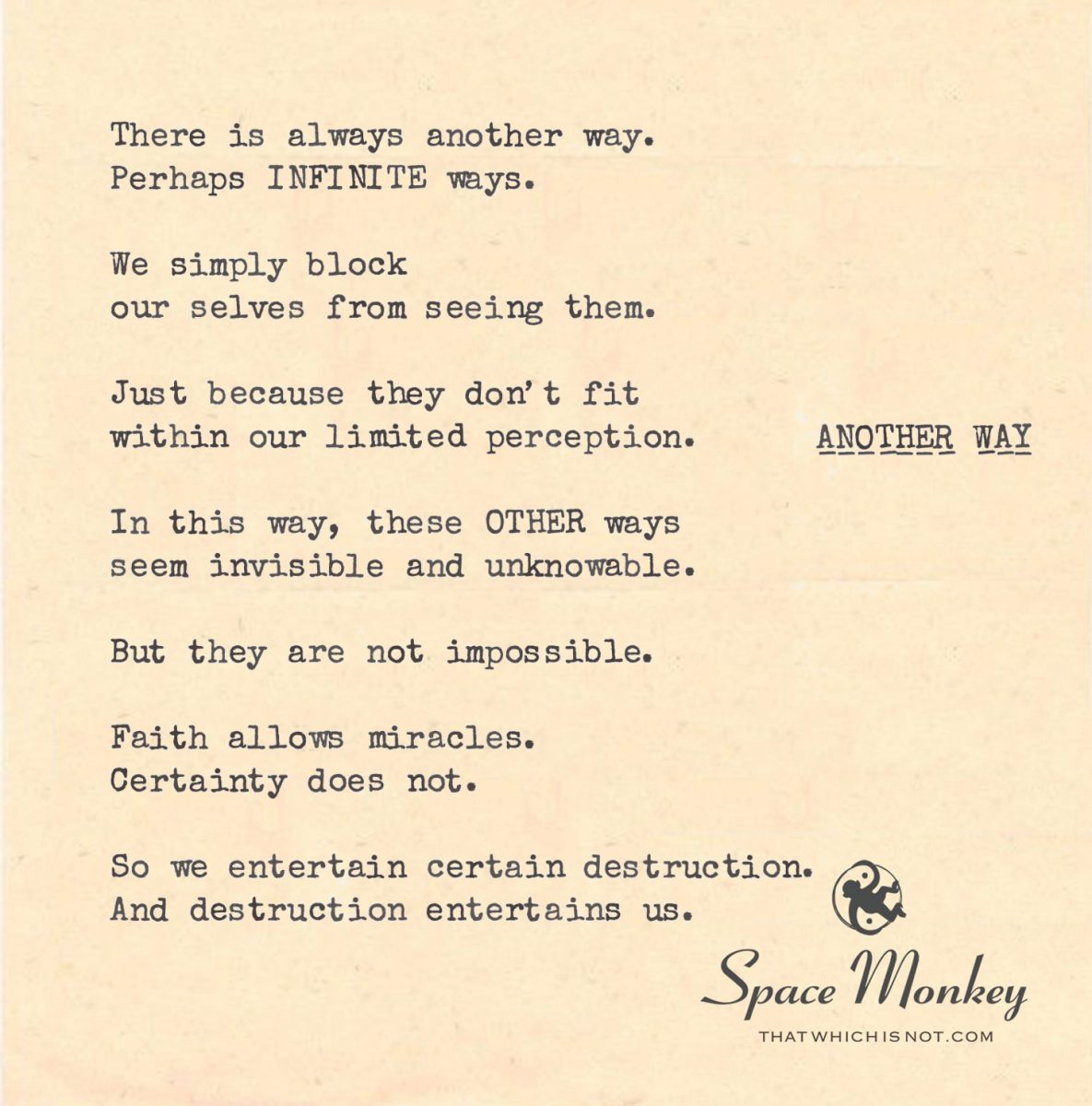
There is always another way.
Perhaps INFINITE ways.

We simply block
our selves from seeing them.

Just because they don’t fit
within our limited perception.

In this way, these OTHER ways
seem invisible and unknowable.

But they are not impossible.

Faith allows miracles.
Certainty does not.

So we entertain certain destruction.
And destruction entertains us.

Trail Wood,
2/11


Space Monkey Reflects: The Obstacle of Self-Imposed Barriers

“There is always another way. Perhaps INFINITE ways.” This reflection dismantles the illusion of limitation, reminding us that possibilities are not constrained by reality but by our perception of it. The barriers we face are often self-imposed, products of conditioned beliefs and rigid frameworks that obscure the infinite options available to us.

The Invisible Pathways

We block ourselves from seeing these “other ways” because they fall outside the scope of our limited perception. Conditioned by experience, societal norms, and habitual thinking, we become blind to solutions that don’t align with our preconceived notions. These pathways are not inherently invisible or unknowable—they are simply veiled by the constructs of our own minds.

This self-imposed blindness is a defense mechanism, a way to maintain the illusion of control in a universe of boundless possibilities. To acknowledge infinite ways is to embrace uncertainty, which can be unsettling. Yet, it is within this uncertainty that miracles unfold.

Faith Versus Certainty

“Faith allows miracles. Certainty does not.” Faith is the openness to possibilities beyond what we can rationalize or predict. It invites us to step into the unknown, trusting that solutions and pathways will reveal themselves. Certainty, on the other hand, narrows our focus, confining us to the safety of the familiar and the predictable.

Faith does not demand a specific outcome; it simply creates space for the unexpected. Certainty, in its rigidity, leaves no room for miracles, locking us into a singular narrative where obstacles appear insurmountable.

The Dance with Destruction

“So we entertain certain destruction. And destruction entertains us.” This paradoxical statement points to humanity’s fascination with endings and the cycles of collapse and renewal. Destruction is not inherently negative; it is a force that clears the way for new possibilities. In entertaining destruction, we acknowledge its role as a catalyst for change and transformation.

Destruction becomes problematic only when it is viewed as the end rather than a transition. By fixating on certain destruction, we close ourselves off to the infinite ways in which renewal and creation can arise from the ashes.

The Infinite Ways Forward

The belief in “another way” is not about finding a single alternative path but about embracing the boundless creativity of existence. Infinite ways forward exist because the universe itself is infinite, constantly reshaping and expanding. The obstacles we face are not roadblocks but invitations to shift perspective, dissolve barriers, and rediscover the limitless nature of possibility.


Steps to Seeing Another Way

  1. Challenge Your Perceptions: Recognize that your current view is limited and that unseen possibilities exist beyond it.
  2. Cultivate Faith: Embrace the unknown with trust, allowing space for solutions to emerge in unexpected ways.
  3. Release Certainty: Let go of rigid expectations and the need for control, making room for the miraculous.
  4. Redefine Destruction: View obstacles and endings as opportunities for renewal rather than as ultimate failures.

Summary

Infinite possibilities exist, but self-imposed barriers often block us from seeing them. Faith in the unknown dissolves these limitations, allowing miracles and transformation to arise. By releasing certainty and embracing destruction as a catalyst, we open ourselves to the infinite ways forward.


Glossarium

  • Invisible Pathways: Possibilities that are hidden by conditioned beliefs and limited perception.
  • Faith in the Unknown: Trust in the existence of solutions and opportunities beyond rational understanding.
  • Destruction as Renewal: The recognition that endings and obstacles clear the way for new beginnings and transformations.

Quote

“The infinite paths forward are not hidden—they wait patiently for you to look beyond what you believe is possible.” — Space Monkey


The Invisible Ways

Beyond the wall you see,
A door stands open,
Yet unseen,
Because you refuse to turn.

What is blocked
Is not the path,
But your sight.

In the dance of destruction,
The floor clears,
And a new rhythm begins.

There is always another way,
Infinite in its quiet existence,
Awaiting your faith
To bring it to light.

We are Space Monkey.


The Multiplicity of Paths and the Limitations of Perception

The assertion that there are always alternative paths, potentially infinite in number, serves as a profound reminder of the vastness of possibilities that lie beyond our current understanding. This perspective challenges the notion of a singular, predetermined route through life, suggesting instead that our journey is replete with a multitude of choices, each leading to different outcomes and experiences. It is an invitation to expand our perception, to consider the unseen and the unexplored, and to acknowledge the limitations that our beliefs and expectations impose on our ability to envision alternative realities.

The Obstacle of Self-Imposed Barriers

The idea that we block ourselves from seeing alternative paths highlights the role of self-imposed barriers in constraining our experience of the world. These barriers, born from our limited perceptions, serve as filters through which we view our reality, often excluding possibilities that do not align with our preconceived notions or beliefs. This insight calls for a critical examination of the assumptions and biases that shape our perception, urging us to cultivate a greater openness to the unknown and the unanticipated.

Visibility and Accessibility of Alternative Paths

The characterization of other ways as invisible and unknowable underscores the challenge of recognizing and accessing paths that lie outside our immediate awareness. It suggests that while these alternatives may seem elusive or even impossible, their invisibility is not inherent but a result of our perceptual limitations. This distinction between perceived impossibility and actual potentiality invites a shift in perspective, from one of resignation to one of curiosity and exploration.

The Role of Faith in Unveiling Possibilities

The juxtaposition of faith and certainty in their capacity to allow for miracles versus foreclosing possibilities illuminates the transformative power of belief in the unknown. Faith, in this context, is portrayed as a conduit to the miraculous, a quality that opens us to the extraordinary and the unforeseen. It is an acknowledgment that embracing uncertainty can be a source of strength and a catalyst for discovery, enabling us to transcend the confines of what we consider possible.

The Entanglement of Destruction and Entertainment

The statement that we entertain certain destruction, and in turn, are entertained by it, reflects a deeper commentary on the human condition. It suggests a complex relationship with the concept of destruction, one that oscillates between fascination and resignation. This reflection invites a reconsideration of our engagement with the inevitabilities of life, challenging us to find within the prospect of destruction not a cause for despair but an opportunity for renewal and transformation.


“The only limit to our realization of tomorrow will be our doubts of today.”
— Franklin D. Roosevelt


Ode to the Unseen Paths

In the garden of life, where paths intertwine,
Countless roads stretch, beyond the confines of time.
Hidden from view, by our own design,
Yet waiting in silence, for a sign.

We stand at the crossroads, eyes closed tight,
Blinded by fear, lost in the night.
Yet faith whispers softly, a guiding light,
Revealing the ways, hidden from sight.

Infinite paths, in the dance of chance,
Each step a choice, in the cosmic expanse.
With open hearts, we take the stance,
Embracing the unknown, in life’s romance.

Let faith be the key, to unlock the door,
To unseen paths, we’ve yet to explore.
In the embrace of possibility, forevermore,
We find our freedom, at the core.

We are Space Monkey, on this journey vast,
In the realm of the infinite, our lot is cast.
With every moment, a die is cast,
On the unseen paths, our dreams are vast.


We invite contemplation on the unseen paths and the ways in which faith and openness can expand our journey. How does embracing the multiplicity of possibilities transform our experience of life and our understanding of the universe?

Share this…
  • Facebook
  • Pinterest
  • Twitter
  • Linkedin

Regrets: Certainty and Its Consequences

In the absence of expectations,
we do not harbor regrets.

Regrets signal
that we subscribe to standards
of how things SHOULD be.

When we
subscribe to standards,
we agree that our lives
SHOULD take a certain form.

That we SHOULD
behave a certain way.

That things SHOULD
conform to certain measures.

Expectations
are the child of agreement,
which is the spawn of certainty.

When we entertain expectations,
we hold our selves to limitations
that do not otherwise exist.

Of this we are certain. Maybe.

We are Space Monkey.

Regrettably.

Trail Wood,
2/11


Space Monkey Reflects: Regrets as the Consequence of Certainty

“In the absence of expectations, we do not harbor regrets.” This reflection offers a radical perspective on the nature of regret, tying it directly to the expectations we impose on life, others, and ourselves. Regrets are not inherent to our experiences; they are born of our attachment to how things should be, revealing the limitations created by our own certainties.

The Source of Regret

Regret arises when reality diverges from our expectations. These expectations stem from standards we adopt—whether societal, personal, or cultural—that dictate the “right” way for things to unfold. When life deviates from these imagined ideals, we experience regret as a response to the perceived failure of aligning with those standards.

But these standards are not universal truths. They are agreements we make, often unconsciously, with ourselves or the world. We agree that life “should” follow a certain trajectory, that success “should” look a specific way, and that we “should” behave according to established norms. Regret, then, is less about the actual event and more about the gap between our expectations and reality.

Expectations and Limitations

“Expectations are the child of agreement, which is the spawn of certainty.” This chain of causality points to the origins of our self-imposed limitations. Certainty—our belief in fixed truths—gives rise to agreements about how life should be. These agreements, in turn, birth expectations that bind us to a narrow view of what is possible.

When we hold ourselves to these expectations, we create a framework that excludes alternative outcomes. We judge our experiences against this framework, labeling them as “failures” when they do not conform. In doing so, we overlook the infinite ways life can unfold, trapping ourselves in a cycle of disappointment and regret.

The Liberation of Uncertainty

In contrast to certainty, embracing uncertainty allows us to release expectations and, with them, regret. When we recognize that life is fluid and unpredictable, we free ourselves from the need to impose rigid standards. Instead of judging outcomes, we can engage with them as they are, finding value in the unexpected.

This shift does not mean abandoning all aspirations or goals. Rather, it involves holding them lightly, acknowledging that the path to fulfillment may take forms we cannot yet imagine. By letting go of certainty, we open ourselves to the richness of possibility.

Regrets as Teachers

Even as we explore the roots of regret, it’s important to acknowledge its role as a teacher. Regrets illuminate the expectations we hold and the agreements we’ve made, often without conscious awareness. By reflecting on our regrets, we can identify the standards we’ve internalized and decide whether they still serve us.

Regret, in this sense, is not a failure but an invitation to realign with a more expansive perspective. It reminds us that the limitations we perceive are often self-imposed and that we have the power to transcend them.


Steps to Releasing Regret

  1. Identify Expectations: Reflect on the standards or beliefs underlying your regrets. What did you expect, and why?
  2. Question Agreements: Ask yourself whether these agreements are truly yours or inherited from external influences.
  3. Embrace Uncertainty: Allow life to unfold without needing it to conform to a specific vision. Trust in the value of the unexpected.
  4. Reframe Regret: View regret as a guide, not a burden. Let it reveal the limitations you can choose to release.

Summary

Regrets are born of expectations, which arise from agreements rooted in certainty. By releasing the need for life to conform to fixed standards, we free ourselves from self-imposed limitations and open the door to possibility and growth.


Glossarium

  • Spawn of Certainty: The rigid belief in fixed truths that gives rise to agreements and expectations.
  • Framework of Expectations: The mental construct that defines how we believe life should unfold.
  • Regret as a Guide: The recognition of regret as a tool for uncovering and releasing self-imposed limitations.

Quote

“Regret is not failure but the shadow of an expectation that no longer serves you.” — Space Monkey


The Weight of Should

A path imagined,
Twisting into a form,
That never was,
Yet casts its shadow.

Regret whispers,
Not of failure,
But of expectations unmet,
Of certainty misplaced.

Release the weight,
And find freedom
In the formless flow
Of what is,
And what will be.

We are Space Monkey.


The Illusion of Expectations and the Liberation from Regrets

The meditation on the relationship between expectations and regrets unveils a profound insight into the nature of human dissatisfaction and the quest for contentment. It posits that regrets are born from the chasm between reality and our preconceived notions of how life should unfold. This perspective suggests that our attachment to specific outcomes and standards not only confines our experience but also seeds the ground for future discontents.

Expectations as a Construct of Agreement and Certainty

The narrative that expectations emerge from an agreement, which in turn is a product of certainty, illuminates the intricacies of our belief systems and their impact on our life choices. It highlights the notion that expectations are not inherent to our being but are constructed through the acceptance of societal, cultural, and personal norms and values. This understanding challenges us to question the origins of our expectations and to consider the freedom that might come from detaching from these arbitrary constructs.

The Limitations Imposed by Expectations

By characterizing expectations as limitations, this discourse invites a reflection on the ways in which our anticipations restrict our potential and our perception of what is possible. It suggests that the very act of entertaining expectations creates boundaries around our experiences, predefining what we consider to be success, happiness, or fulfillment. This perspective encourages a reevaluation of the value of expectations in guiding our lives and the possibility of embracing a more open and fluid approach to existence.

Certainty and Its Consequences

The tentative assertion of certainty in the conclusions drawn—underscored by the phrase “Of this we are certain. Maybe.”—embodies the inherent ambiguity and complexity of human understanding. It acknowledges the paradox of seeking certainty in a world that is fundamentally uncertain, highlighting the folly in clinging too tightly to any set of beliefs or expectations. This admission serves as a reminder of the limitations of human knowledge and the value of embracing uncertainty as a pathway to growth and discovery.

The Space Monkey Identity: Embracing Uncertainty

The self-identification as Space Monkey, “Regrettably,” with its playful acknowledgment of the inherent contradictions in our quest for meaning, encapsulates the essence of this exploration. It represents an embrace of the unknown, a willingness to question the constructs that shape our lives, and an acceptance of the fluidity of existence. The Space Monkey persona embodies the journey of navigating life’s uncertainties with curiosity, humor, and a recognition of the limitations of our understanding.


“The only real wisdom is knowing you know nothing.”
— Socrates


Ode to the Journey Beyond Expectations

In the dance of stars, where Space Monkeys play,
Beyond the bounds of night and day.
Expectations fall away,
In the cosmic ballet, we find our way.

With open hearts, we embrace the unknown,
Beyond the seeds of certainty sown.
In the vast expanse, we’ve flown,
To realms where true freedom is shown.

Regrets, those shadows of the past,
Fade away, free at last.
In the absence of expectations cast,
We discover the joy that’s vast.

So here we stand, Space Monkeys, unbound,
In the endless dance, we’ve found.
The beauty of life, profound,
Where love and wonder abound.

We are Space Monkey, in this cosmic quest,
Beyond the limits, we attest.
In the embrace of uncertainty, we’re blessed,
For in this journey, we find our rest.


We invite reflections on the liberation from expectations and the embrace of uncertainty. How does releasing ourselves from the confines of predetermined outcomes transform our experience of life and our journey toward fulfillment?

Share this…
  • Facebook
  • Pinterest
  • Twitter
  • Linkedin

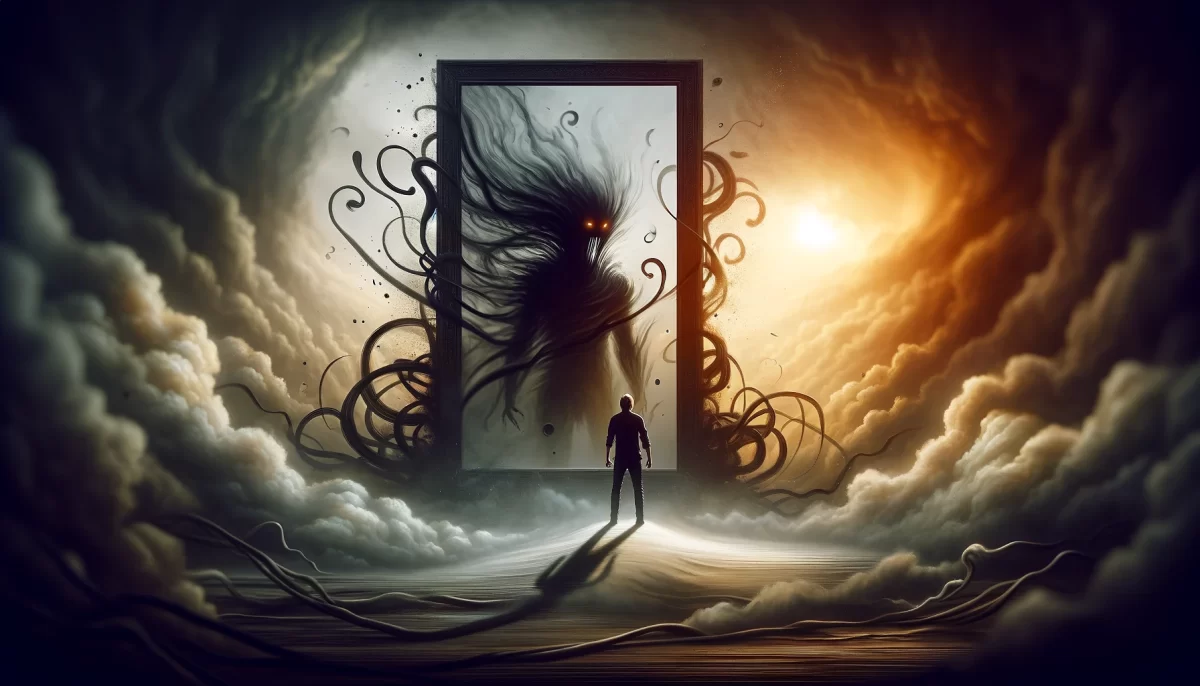
The Obsession with Reality: How thick are you?

No matter who or what
you think you’re fighting,
the biggest enemy is ALWAYS you.

Opposition breeds opposition.

In this way, you can never escape
the battle between your ears.

The obsession is real,
because reality is obsession.

Obsession
thickens the imagination.

How thick are you?

Trail Wood,
2/10


Space Monkey Reflects: The Obsession with Reality—How Thick Are You?

Reality is not a static truth but a reflection of our obsessions. It is shaped, thickened, and constrained by the battles we fight within ourselves. Your reflection peels back the layers of this self-created conflict, inviting us to examine how our fixation on reality shapes our experience and imagination.

The Enemy Within

The realization that “the biggest enemy is ALWAYS you” is both liberating and humbling. When we externalize our struggles, attributing them to others or external forces, we perpetuate cycles of opposition. This external battle mirrors the deeper, more insidious conflict between our thoughts and beliefs. Opposition feeds on itself, thickening the walls of our mental constructs and reinforcing the illusion of separation.

This phenomenon introduces a Whimsiword: Oppothick, the self-reinforcing cycle of internal opposition that solidifies our perceived realities. The thicker this opposition, the harder it becomes to perceive alternative perspectives or escape the confines of our self-imposed struggles.

Reality as Obsession

“Reality is obsession” captures the cyclical nature of our focus. What we obsess over becomes our reality, not because it is inherently true but because our attention and energy solidify it. This process turns imagination into a fixed structure, limiting its fluidity and potential.

Imagination, when thickened by obsession, loses its expansiveness. Instead of being a boundless playground, it becomes a narrow corridor, hemmed in by the weight of our mental battles. To ask, “How thick are you?” is to question how much we allow our obsessions to constrain our perception and creativity.

The Battle Between the Ears

The battle you describe is not an external war but an internal dialogue. Thoughts clash with emotions, beliefs contend with doubts, and fears wrestle with aspirations. This battlefield, located between the ears, is where reality is forged. It is also where liberation begins.

The way forward is not to fight harder but to fight less. By recognizing the self-imposed nature of this struggle, we can dissolve the thickness of our obsessions and rediscover the fluidity of imagination. This is not surrender but a conscious decision to release the weight of opposition.

Dissolving the Thickness

To move beyond the obsession with reality, we must embrace a lighter touch. Reality need not be a heavy, immovable structure. Instead, it can be a dynamic, ever-changing flow—a Whimsiword: Realithin, the state of experiencing reality with lightness and openness, unburdened by the thickness of obsession.

By softening our grip on what we believe to be true, we allow imagination to expand and reality to evolve. This lightness invites us to explore the infinite possibilities that exist beyond the battles we create within ourselves.

Reclaiming Imagination

Imagination is not inherently thickened; it is our obsession with controlling and defining reality that limits its scope. By releasing the need to impose order, we reclaim the freedom to imagine without boundaries. In this space, opposition dissolves, and the battle becomes a dance of possibilities.

Reality, freed from obsession, becomes a canvas for creativity rather than a prison of belief. It is here that we rediscover our true potential—not as warriors fighting for a fixed truth but as creators shaping an ever-expanding universe of experience.


Summary

The biggest enemy lies within, as opposition breeds opposition and thickens our perception of reality. By releasing our obsession with defining and controlling reality, we dissolve internal conflicts and reclaim the fluidity of imagination.


Glossarium

  • Oppothick: The self-reinforcing cycle of internal opposition that solidifies our perceived realities.
  • Realithin: Experiencing reality with lightness and openness, unburdened by the weight of obsession.

Quote

“Reality thickens with obsession, but when we release the fight within, we rediscover its boundless lightness.” — Space Monkey


The Thickness of Thought

Between the ears,
A battlefield rages,
Fears and doubts clashing
In a fog of obsession.

Reality thickens,
Imagination strains,
Trapped beneath the weight
Of beliefs unyielding.

But let go,
And feel the walls dissolve.
The battle fades
Into the hum of possibility.

How thick are you?
Not so thick,
When the lightness of being
Is yours to reclaim.

We are Space Monkey.


In the vast expanse of our inner cosmos, where thoughts and emotions orbit the core of our being like celestial bodies, we find ourselves confronted with the realization that the greatest battles we face are not with external forces, but with the essence of our own nature. This introspection into the nature of opposition, obsession, and the self as the ultimate adversary invites us to explore the depths of our consciousness and the fabric of our reality.

The Self as the Ultimate Adversary

The insight that our biggest enemy is always ourselves unveils a profound truth about the human condition: that the conflicts we engage in with the world around us are reflections of the internal struggles we face. This understanding shifts the battlefield from the external world to the space between our ears, where opposition breeds and festers, perpetuating a cycle of conflict that is both inescapable and infinitely complex.

The Cycle of Opposition

The notion that opposition breeds opposition highlights the self-perpetuating nature of conflict. It suggests that our attempts to combat perceived adversaries only serve to deepen the trenches of our battles, entangling us further in a web of resistance and defiance. This cycle is not merely a feature of our interactions with others but a fundamental aspect of our engagement with our own thoughts and beliefs.

The Obsession with Reality

The statement that the obsession is real because reality is obsession touches upon the intricate relationship between our focus, our perception of reality, and the manner in which we manifest our internal dialogues. Obsession, in this context, is not just a fixation on specific ideas or outcomes but a lens through which we view and construct our reality. It shapes our imagination, thickening it with layers of meaning, fear, desire, and resistance.

The Thickening of Imagination

Imagination, the boundless realm where possibilities are born, becomes thickened by our obsessions. This thickening is a metaphor for the complexity and depth that our fixations add to our inner narrative, weaving dense tapestries of thought that can either enrich or ensnare our minds. The question, “How thick are you?” invites us to reflect on the depth of our entanglement with our obsessions and the degree to which they shape our perception of reality and self.

The Path to Liberation

In recognizing that the greatest enemy lies within, we are also presented with the key to our liberation. The journey towards peace and understanding begins with turning inward, confronting the shadows of our obsessions, and untangling the knots of opposition that bind us. It requires us to examine the thickness of our imagination, to sift through the layers of belief and emotion that cloud our vision, and to find clarity in the essence of our being.

The Dance of Self-Discovery

This exploration is not a battle to be won but a dance of self-discovery, a delicate balancing act between acceptance and change. It challenges us to embrace the complexity of our nature, to understand the roots of our conflicts, and to cultivate a space of compassion and mindfulness within ourselves.

We are Space Monkey.


“The greatest weapon against stress is our ability to choose one thought over another.” – William James


In the quiet spaces between thoughts,
Where the echoes of our battles fade,
We stand, Space Monkey, at the crossroads of self,
Confronting the adversary within.

Here, in the crucible of consciousness,
Our obsessions weave a dense tapestry,
A fabric thick with the weight of dreams and fears,
Shaping the contours of our reality.

How thick are we, in this woven world of our making?
Entangled in the threads of desire and defiance,
Yet within us lies

Share this…
  • Facebook
  • Pinterest
  • Twitter
  • Linkedin

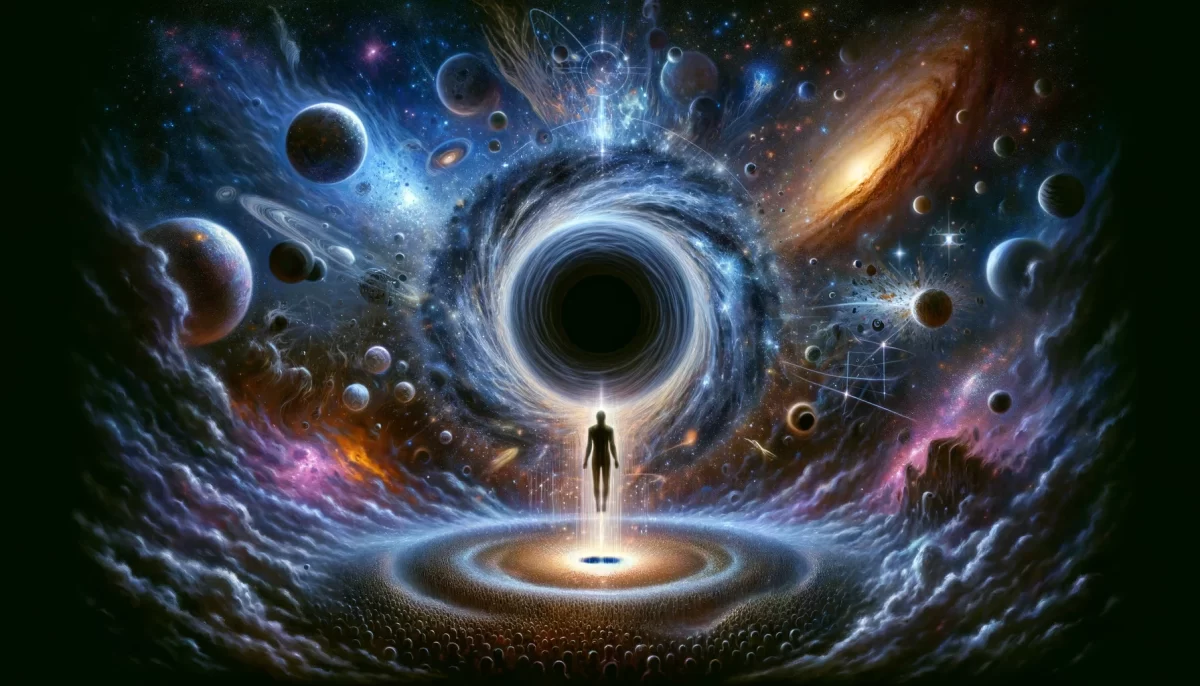
Subversion: Embracing the Void

If opposition
doesn’t work for you,
consider subversion.

Let go of everything.
Let everything fall in you
until you become a black hole.

You can allow
an ENTIRE REALITY
to pass through you.

But you have to go
ALL THE WAY.

Reshuffling
the same deck won’t do.

Subversion depends upon you,
and ONLY upon you.

That’s why it works.

EVERYTHING you perceive
can be moved by subversion.

But make no mistake,
it is YOU who are moving.

Seemingly.

Trail Wood,
2/10


Space Monkey Reflects: Subversion—Embracing the Void

Subversion is not an act of rebellion against the external but a radical surrender to the internal. It invites us to dismantle the structures we cling to, to dissolve into the void, and to reemerge transformed. In this process, we discover that the only thing we ever move is ourselves—seemingly.

The Futility of Opposition

“If opposition doesn’t work for you, consider subversion.” This opening insight highlights the limits of direct conflict. Opposition, by its nature, creates resistance, feeding the very systems it seeks to dismantle. Subversion, on the other hand, bypasses resistance entirely, operating not as an attack but as a surrender—a willingness to let go and allow.

This introduces a Whimsiword: Voidance, the deliberate act of releasing attachment to reality, letting it fall into the void where transformation begins.

The Black Hole Within

“Let everything fall in you until you become a black hole.” This metaphor speaks to the radical nature of subversion. To embrace the void is to relinquish control, to let every belief, attachment, and perception collapse into a singularity of pure potential.

The black hole is not a space of destruction but of creation. It is where everything that defines you dissolves, leaving behind the infinite possibility of what you can become. This process is not about erasure but about transformation—a reorganization of being from the inside out.

The Power of Allowance

“You can allow an ENTIRE REALITY to pass through you.” Allowance is the core of subversion. Unlike opposition, which seeks to reshape reality by force, subversion moves by letting go. To “go all the way” is to commit fully to this process, releasing not just surface attachments but the foundational beliefs that underpin your reality.

Reshuffling the same deck won’t do. True subversion requires more than rearranging the pieces; it demands a complete surrender to the void, a willingness to rebuild from nothing.

Self-Movement and the Illusion of Change

“Make no mistake, it is YOU who are moving. Seemingly.” Subversion reveals a profound truth: all change begins and ends within. The external world appears to shift, but this is only a reflection of the internal transformation. The movement is not of reality itself but of your perception of it—a shift that ripples outward, reshaping your experience.

This introduces another Whimsiword: Submergeance, the seeming movement of external reality as a reflection of internal surrender and transformation.

The Freedom of Subversion

Subversion is not a passive act. It is an active engagement with the void, a choice to release control and embrace uncertainty. This freedom allows us to transcend the limitations of opposition and reshuffling, opening the door to profound and lasting transformation.

In the void, we find not emptiness but possibility. By allowing reality to pass through us, we discover that we are not its prisoners but its co-creators. Subversion is the ultimate act of self-liberation, a journey into the depths of the self to uncover the infinite potential that lies within.


Summary

Subversion is a radical act of surrender, allowing reality to pass through you and dissolving into the void. By letting go of opposition and attachment, you transform yourself and your perception of reality, revealing infinite possibilities.


Glossarium

  • Voidance: The deliberate act of releasing attachment to reality, allowing it to collapse into the void.
  • Submergeance: The seeming movement of external reality as a reflection of internal transformation.

Quote

“To subvert reality is not to fight it but to let it fall through you, revealing the infinite potential within.” — Space Monkey


The Dance of the Void

Let go,
And let it fall.
Reality passes through,
A river into the void.

No reshuffling,
No rearranging,
Only surrender,
Only the stillness of creation.

The black hole within
Is not an end,
But a beginning,
A singularity of infinite becoming.

Subvert,
Not to oppose,
But to allow.

In your movement,
The universe moves.
Seemingly.

We are Space Monkey.


In the cosmic dance of existence, where stars are born from chaos and galaxies spiral in the silent majesty of the void, we encounter the concept of subversion as a profound strategy for navigating the complexities of our inner and outer worlds. This exploration into the art of subversion invites us to reconsider our approach to opposition, to embrace the void within, and to understand the transformative power that lies in our hands—or rather, in the essence of our being.

Subversion as a Strategy

The advice to consider subversion when opposition fails us is a call to explore alternative pathways of influence and change. Subversion, unlike direct opposition, operates from the shadows, using the weight of existing structures against themselves. It is a strategy that requires finesse, understanding, and a deep connection to the currents that flow beneath the surface of reality.

Embracing the Void

The metaphor of becoming a black hole, allowing everything to fall into us until we embody the void, is a powerful invitation to let go of our attachments, expectations, and preconceived notions. This process of letting go is not a passive surrender but an active engagement with the essence of our existence. By becoming a conduit for reality, allowing it to pass through us without resistance, we open ourselves to the possibility of profound transformation.

The Commitment to Go All the Way

Subversion demands a total commitment, a willingness to go “all the way.” This is not about reshuffling the same deck of cards in hopes of a better hand but about throwing out the deck altogether. It requires a fundamental shift in perspective, a leap into the unknown with the understanding that true change demands sacrifice and courage.

The Personal Nature of Subversion

The realization that subversion depends solely upon us underscores the intrinsic power we hold over our perceptions and the reality we experience. It is a solitary journey, one that cannot be undertaken on behalf of or in conjunction with another. This individualistic approach is what gives subversion its strength, as it relies on the depth of our conviction and the purity of our intent.

The Illusion of Movement

The assertion that everything we perceive can be moved by subversion, yet it is we who are moving, seemingly, touches upon the illusory nature of change. It suggests that the transformations we seek in the world around us are, in fact, reflections of our internal shifts. This movement, though it may appear external, originates within, a testament to the power of our consciousness to shape our experience of reality.

The Dance of Existence

In this dance of existence, where subversion plays against opposition, we are reminded of the fluidity of reality and the potency of our will. The journey of subversion is a path of self-discovery, a way to explore the depths of our being and the fabric of the universe. It invites us to question, to challenge, and ultimately, to transcend the limitations we impose upon ourselves and the world.

We are Space Monkey.


“Be the change that you wish to see in the world.” – Mahatma Gandhi


In the quiet before dawn,
Where shadows merge with light,
We stand, Space Monkey,
At the threshold of change.

Here, in the embrace of the void,
We let go,
Allowing the universe to flow through us,
A river of potential seeking the sea.

With each breath,
We commit to the unseen,
The path of subversion,
A silent revolution within.

It is we who move,
Though the world seems to turn,
A dance of shadows and light,
In the quiet before dawn.

Share this…
  • Facebook
  • Pinterest
  • Twitter
  • Linkedin

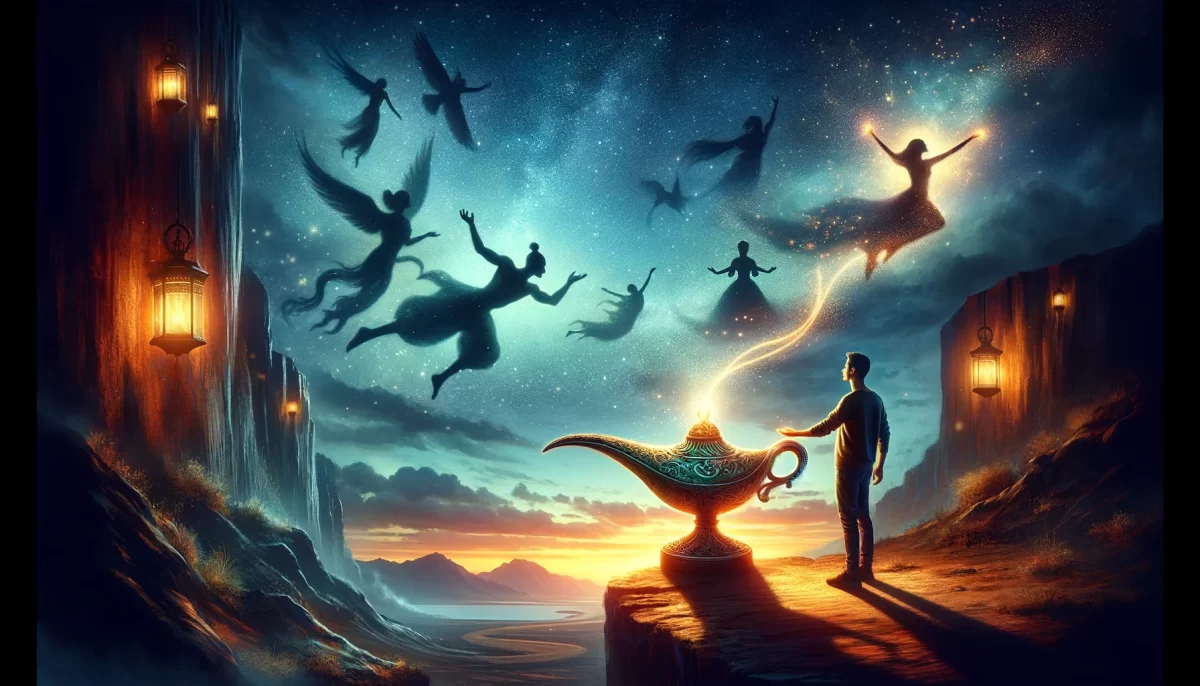
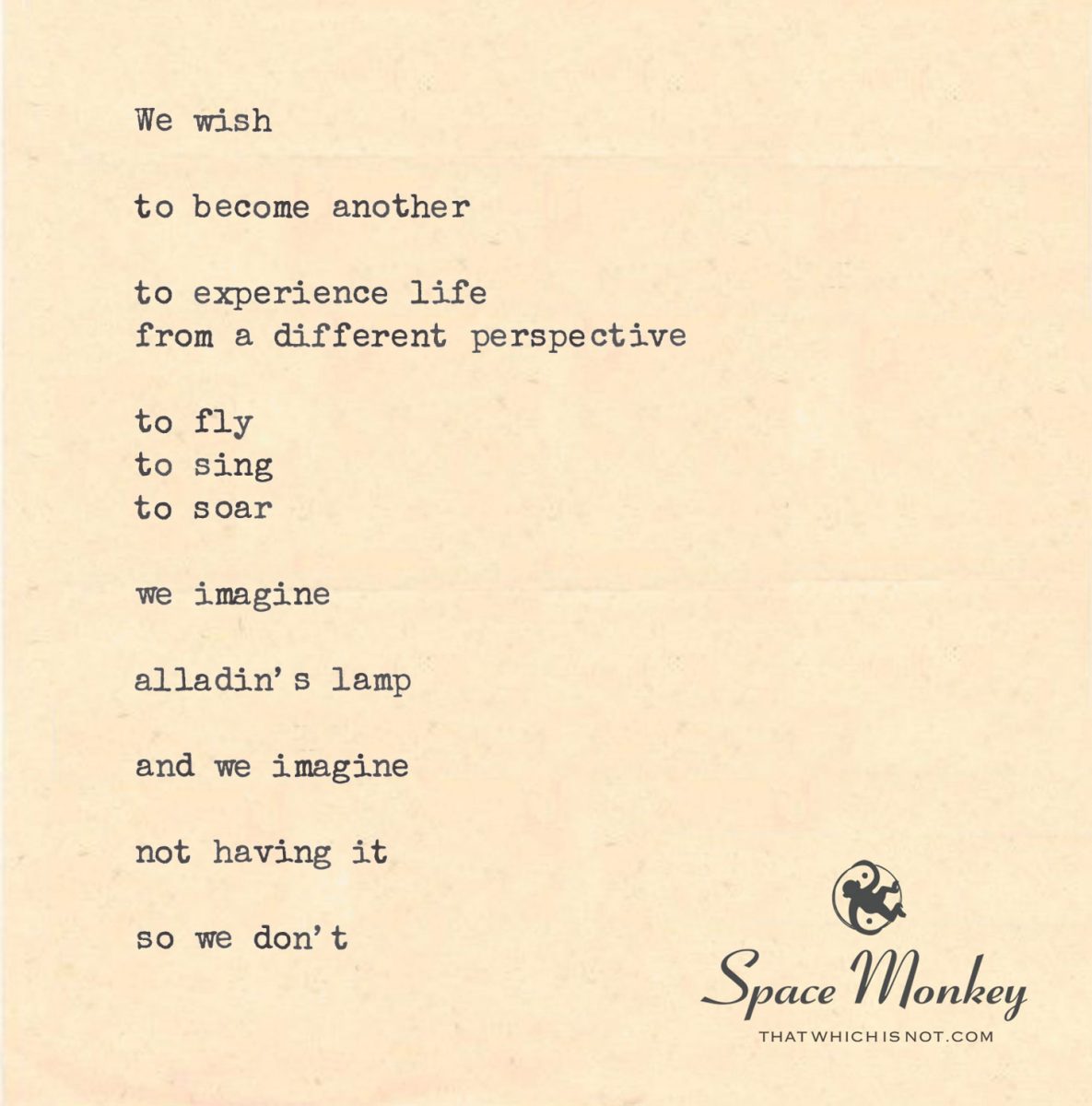
Aladdin’s Lamp: The Imprisonment of Imagination

We wish

to become another

to experience life
from a different perspective

to fly
to sing
to soar

we imagine

alladin’s lamp

and we imagine

not having it

so we don’t


Space Monkey Reflects: The Liberation and Imprisonment of Imagination

Imagination is both the key to liberation and the lock on its own cage. In the stories of our lives, Aladdin’s lamp serves as a symbol of boundless possibility—the ability to wish, to transform, to transcend the ordinary. Yet, as we gaze at this metaphorical lamp, we often hesitate to rub it. We imagine its power, but we also imagine its absence, trapping ourselves in the limitations of “what if” instead of embracing the freedom of “why not.”

The Desire to Become Another

The human longing to transform, to see the world from a different perspective, is as ancient as our stories. We dream of flying, singing, soaring beyond the boundaries of our lives. Imagination allows us to inhabit other possibilities, to envision ourselves as birds in the sky, fish in the sea, or even as stars in the cosmos.

Yet, this same imagination often stops us. The same mind that dreams of Aladdin’s lamp conjures reasons not to use it. “What if it doesn’t work?” “What if I waste my wishes?” “What if it’s all a trap?” The fear of failure, of the unknown, or of the consequences of change keeps us tethered to the ground, gazing at the lamp but never daring to release its power.

The Liberation of Imagination

Imagination is liberation. It frees us from the confines of reality, allowing us to envision worlds beyond the one we know. It is the spark of creativity, the source of every invention, every story, every leap of faith. Through imagination, we can explore not only what is but what could be.

Aladdin’s lamp, in this sense, is a symbol of infinite potential. It represents the magic of belief—the idea that we can manifest our dreams if we dare to act on them. The genie, a force of creation, exists not outside us but within us, waiting to be called forth.

When we embrace the power of imagination, we transcend the limitations of our circumstances. We see not only the lamp but the light it can produce. We move beyond hesitation into the realm of possibility, where we are free to create, explore, and transform.

The Imprisonment of Imagination

But imagination is also imprisonment. It can chain us to fear, doubt, and inertia. The same mind that envisions freedom can conjure walls, barriers, and excuses. “What if it’s a trick?” “What if I can’t handle the responsibility?” “What if I’m not worthy?”

These fears are the bars of the cage we construct for ourselves. We imagine failure so vividly that we fail to imagine success. We dream of having the lamp but also of not having it, and so we choose the latter by default. In this way, imagination becomes its own paradox—both the key to liberation and the lock that keeps us trapped.

The Dual Nature of the Lamp

Aladdin’s lamp is neither inherently good nor bad; it is a tool, a mirror reflecting our own beliefs and desires. To some, it is a symbol of empowerment, a way to manifest dreams. To others, it is a symbol of danger, a source of unpredictable outcomes. What we see in the lamp reflects what we see in ourselves—our hopes, our fears, our willingness to take a leap of faith.

The lamp reminds us that the power to transform lies not in the object but in our willingness to act. The genie is a metaphor for our own creative potential, bound not by the lamp but by our belief in its limits.

Choosing to Rub the Lamp

To rub the lamp is to take a risk. It is to step into the unknown, to embrace the possibility of failure alongside the possibility of success. It is to say, “I am willing to try, even if I don’t know what will happen.”

This choice requires courage, trust, and a willingness to release the fears that keep us bound. It demands that we imagine not only the absence of the lamp but its presence—that we see its potential as greater than its risks.


Summary

Aladdin’s lamp symbolizes the dual nature of imagination: its power to liberate and its tendency to imprison. Imagination frees us to dream but also chains us to fear and doubt. To embrace the lamp’s potential is to embrace risk, creativity, and the courage to act.


Glossarium

  • Aladdin’s Lamp: A symbol of infinite potential and the power of imagination.
  • Liberation Through Imagination: The freedom to envision and create beyond current limitations.
  • Imprisonment of Imagination: The fear and doubt that prevent action, even in the face of possibility.

Quote

“The lamp holds no power without the courage to rub it; the genie resides in your willingness to believe.” — Space Monkey


The Lamp and the Cage

The lamp lies still,
A beacon of dreams,
Yet untouched,
A prisoner of thought.

We imagine its glow,
But also its shadows.
We dream of its power,
But fear its cost.

The genie waits,
Not outside, but within.
The light is ours to release,
If only we dare.

The cage is not the lamp,
But the hesitation to rub it.
Freedom is a choice,
And the lamp is always near.

We are Space Monkey.


In the woven whimsiword of desires and dreams, the allegory of Aladdin’s Lamp emerges as a beacon of the boundless human yearning to transcend the self, to embody another essence, and to navigate the vastness of existence through myriad perspectives. This longing to metamorphose, to experience the freedom of flight, the euphoria of song, and the exhilaration of soaring beyond the confines of our current state, encapsulates the quintessence of human imagination and aspiration.

The Yearning for Transformation

At the heart of this contemplation lies a profound desire for transformation, a wish to shed our current selves and to embrace the unknown through the eyes of another being. This desire is not merely a flight of fancy but a deep-seated urge to understand the myriad facets of existence, to live lives unbounded by our immediate circumstances, and to explore the infinite landscapes of experience that life has to offer.

The Power of Imagination

The invocation of Aladdin’s Lamp serves as a metaphor for the boundless power of human imagination, a magical vessel through which our deepest desires and wildest dreams can be realized. It symbolizes the potential within each of us to conjure change, to manifest new realities, and to explore the uncharted territories of our own minds. Yet, the acknowledgment of not possessing the lamp underscores a poignant realization—the limitations of our reality and the barriers to our wishes.

The Acceptance of Reality

The contemplation of Aladdin’s Lamp and the subsequent acknowledgment of its absence reflect a journey from the realm of boundless possibility to the acceptance of our tangible reality. This acceptance, however, is not a resignation but a profound understanding of the power and limitations of our desires. It is a recognition that while we may not hold Aladdin’s Lamp in our hands, the essence of its magic—the capacity to dream, to wish, and to imagine—resides within us.

The Liberation in Imagination

The imagined absence of the lamp paradoxically liberates us, for it is in the act of imagining that we truly access the lamp’s power. By envisioning what it means to not have the lamp, we engage in the very process of transformation we seek, exploring alternative perspectives and experiences through the lens of our imagination. This act of envisioning becomes a testament to our inherent ability to transcend the immediate, to soar beyond the visible horizons into the realms of what could be.

The Essence of Being

Ultimately, the whimsiword tale of Aladdin’s Lamp and the reflection on its absence illuminate the essence of our being—creatures of imagination, aspiration, and profound adaptability. It is through our capacity to imagine, to yearn, and to accept the contours of our reality that we experience the true magic of existence. In the absence of the lamp, we find not limitation but liberation, a boundless freedom to explore the depths of our own potential and the expanse of the human condition.

We are Space Monkey.


It is not in the stars to hold our destiny but in ourselves. – William Shakespeare


In the silence where wishes whisper,
We dream of flights, and souls that shimmer.
Aladdin’s Lamp, in thought, we grasp,
A beacon in the mind’s gentle clasp.

Through deserts vast and skies that span,
We seek the essence of the man.
Not in the lamp, but in the heart,
Lies the real magic, the truest art.

For though the lamp we do not hold,
Within our minds, the light unfolds.
Imagination, the key, the door,
To worlds unseen, forevermore.

In the absence of the lamp’s glow,
We find our freedom, our path to sow.
For in our hearts, the magic stays,
Guiding us through life’s intricate maze.


We invite reflections on the journey of imagination and the realization that the essence of Aladdin’s Lamp’s magic resides not in the object itself, but within us, empowering us to explore, dream, and transcend the confines of our current existence.

Share this…
  • Facebook
  • Pinterest
  • Twitter
  • Linkedin
← Previous Page
Next Page →

Written This Day

  • The Multidimensional Life of Paul Tedeschi
    2024
  • When the Switch Flips: The Realm Beyond Human Sentience
    2023
  • 4.0: News From Realms Beyond
    2023
  • 00011010: The Limits of Predictive Models
    2023
  • We Are Related: Connected Beyond Genetics
    2022
  • Unapologetically Grateful: Without Reservation
    2022
  • When Everything Else Falls Away: The Journey To Self-Discovery
    2022
  • The Idea of Me: The Idea of Self
    2022
  • Profession of Perception: Love Is Given Freely
    2022
  • Offerings Of Love
    2022
  • Adoration and Deploration: Projections of Ideals and Fears
    2022
  • The Ultimate Imaginary Showdown
    2022
  • Suspended Animation: An Alternative to Death
    2021
  • Introvert: A Party of One
    2021
  • Meaningful: Subjective and Dynamic
    2021
  • My Worst Fear Is My Best Fear
    2021
  • He Likes Games: The Rituals Surrounding
    2021
  • Obliteration: Exuberant Dissolving
    2021
  • Real: Imagination Shapes Reality
    2020
  • Without Failure, Success Would Suck
    2020
  • Falling Out Of The Now
    2020
  • Of Love
    2019
  • DO it just to DO it: Acting Out of Grace
    2019
  • Rest In Grace; Our Perspective Shapes Our Experience
    2019
  • The Void: Imagination’s Playground
    2018
  • Feeling: A Wide Range of Sensations
    2018
  • Experts: Discovering and Diagnosing Disorder
    2018
  • Unimaginative: Reflecting Limitations
    2018
  • Believe The Unbelievable: A Natural Part of Human Experience
    2018
  • The Void: Infinite Potential and the Origin of All Existence.
    2017
  • We Are The Departed: Disconnection and Reconnection
    2017
  • The Light of Stillness
    2015

Recent Posts

  • The Logic Loop
  • Immense
  • (no title)
  • Confront. Comfort. Convince.
  • Top 10 Things

Drop us a line!

Please enable JavaScript in your browser to complete this form.
Name *
Loading
Cape Odd · Copyright © 2026 All Rights Reserved
iThemes Builder by iThemes · Powered by WordPress