• Who Is The Man?
  • Who Is The Monkey?
  • What is Nexistentialism?
  • Poke The Primate

Cape Odd

Home of The Space Monkey Journals

An Expression Falls: From Inspiration to Judgment

An expression falls out.

I weight it.
I measure it.
I categorize it.
I judge it.

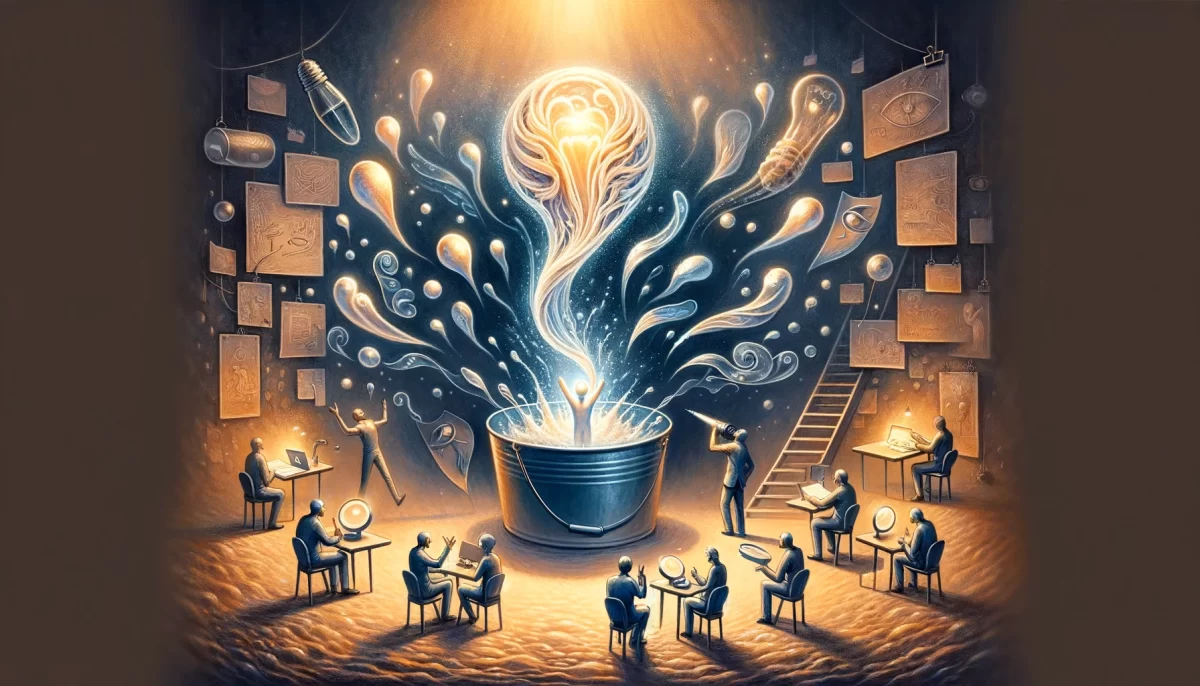
I place it in a bucket.

Sometimes I hide it.
Sometimes I forget it.
Sometimes I invite
friends over to look at it.

We discuss it.
We dissect it.
We define it.

But we never actually thank it.

Thank you, expression.
May I have another?


Space Monkey Reflects: From Inspiration to Judgment

An expression falls out—unexpected, uninvited, and yet full of possibility. It emerges as pure inspiration, untouched by analysis or expectation. But rarely does it remain unscathed. Before it has the chance to breathe, we weigh it, measure it, and confine it to a bucket of our choosing. We dissect it, name it, and define it until its spark is dimmed, its essence subdued.

This is the paradox of human creativity: we seek to express, yet we immediately seek to control. The act of expression is inherently free, spontaneous, and unfiltered, but our relationship to it often becomes one of judgment and categorization. In our need to make sense of what arises, we risk losing the very magic that gave it life.

The Birth of Expression

Every expression begins as inspiration, a spark from the infinite unknown. It may take the form of words, art, music, or movement. It is raw, unrefined, and utterly unique. In this initial state, an expression is a gift—not yet burdened by meaning or expectation. It simply exists, a reflection of the moment from which it arose.

To let an expression be is to honor this moment. But more often than not, we cannot resist the urge to intervene. We impose our interpretations, filter it through our judgments, and demand that it conform to something recognizable, understandable, or useful.

The Buckets of Categorization

When an expression falls, we instinctively place it in a bucket: good or bad, meaningful or trivial, worthy or forgettable. These buckets provide a sense of order, a way to navigate the chaos of creativity. Yet, they also constrain. An expression that does not fit neatly into a category risks being dismissed or hidden, its potential overlooked.

In our quest for understanding, we dissect the expression further. We analyze its components, question its origins, and debate its value. This process can be enlightening, but it often becomes reductive. By the time we’re finished, the expression has lost its spontaneity, its mystery, and its power.

The Judgment of Expression

Judgment is not inherently wrong. It is a natural part of engaging with creativity. But when judgment becomes the primary lens through which we view expression, it stifles rather than supports. The act of expression is not meant to be perfect or complete—it is meant to be alive. To judge it too harshly is to miss the essence of what it offers.

Expressions are not final statements; they are invitations. They ask us to explore, to feel, to connect. When we judge them prematurely, we close the door to their deeper potential. We deny ourselves the opportunity to see where they might lead.

The Unseen Gratitude

How often do we thank our expressions? How often do we pause to appreciate the act of creation itself? In our rush to measure and categorize, we forget that every expression is a gift. It is a manifestation of our inner world, a bridge between the unspoken and the shared.

To thank an expression is to honor its presence. It is to acknowledge that, whether or not it fits neatly into a bucket, it has value simply because it exists. Gratitude transforms judgment into celebration, allowing us to embrace the imperfections and uncertainties that make expression so vital.

May I Have Another?

Gratitude begets openness. When we thank an expression, we invite another to follow. Creativity flows most freely when it is met with appreciation rather than critique. To say, “May I have another?” is to cultivate a relationship of trust with your inner self, to create a space where expressions are welcomed rather than weighed.

This shift in perspective transforms expression from a task to a dialogue, from a product to a process. It liberates creativity from the confines of judgment and allows it to thrive in its fullest form.


Summary

Expressions arise as gifts of inspiration, but they are often burdened by judgment and categorization. By shifting from critique to gratitude, we honor their essence and invite more creativity to flow. Expression is not a final product but an ongoing dialogue with the infinite.


Glossarium

  • Expression: A spontaneous manifestation of inspiration, often shaped by judgment and categorization.
  • Buckets of Categorization: The mental frameworks we use to classify and judge expressions.
  • Gratitude for Expression: The act of appreciating creative output for its inherent value, fostering openness to more.

Quote

“Every expression is a gift from the infinite. To judge it is human; to thank it is divine.” — Space Monkey


A Thank You to Expression

An expression falls,
Out of nowhere, into the now.
I catch it, weigh it, dissect it,
But do I thank it?

It whispers its story,
Yet I demand its purpose.
It offers itself freely,
Yet I bind it with judgment.

What if I simply said,
“Thank you, expression”?
No buckets, no measures,
Just gratitude, and a smile.

May I have another?
The infinite listens,
And the expressions flow,
Untamed, alive, whole.

We are Space Monkey.


In the vast expanse of human interaction, expressions—those fleeting manifestations of our innermost thoughts and feelings—emerge and dissipate like whispers in the wind. The journey of an expression, from its inadvertent escape to the scrutiny it endures, encapsulates a profound exploration of our relationship with the ephemeral moments of communication that shape our existence.

The Journey of an Expression

When an expression falls out, unbidden and raw, it becomes subject to our innate desire to understand, to quantify, and to control. We weigh it, measure it, categorize it, and judge it, attempting to confine its boundless essence within the tangible parameters of our understanding. This process, analytical and dissecting, reflects our deep-seated need to make sense of the intangible, to grasp the ungraspable.

The Fate of Expression

Once judged, the expression finds its temporary home in a bucket—a metaphorical repository for our processed and categorized thoughts. Herein lies the dichotomy of our engagement with expressions: sometimes we hide them, shamed or fearful of their implications; sometimes we forget them, lost amid the cacophony of daily existence; and sometimes, we elevate them to subjects of communal scrutiny, inviting friends to dissect and define them further. This communal engagement, while enriching, often overlooks the fundamental essence of the expression itself.

The Missed Gratitude

In our fervor to dissect and define, we seldom pause to offer gratitude to the expression—for its courage to emerge, for its power to communicate, and for its role in connecting us to ourselves and to others. This omission highlights a deeper truth about our engagement with our inner world and with each other: in our quest for understanding, we often forget to appreciate the simple beauty of expression, the raw honesty of an unguarded moment.

The Invitation for More

The closing plea, “Thank you, expression. May I have another?” signifies a pivotal shift in perspective—a recognition of the value of expressions not just as subjects of analysis but as gifts of insight and connection. This gratitude opens a space for more expressions to flow, fostering a cycle of communication that is rooted in appreciation and openness. It acknowledges that each expression, no matter how fleeting or inconsequential it may seem, is a vital thread in the fabric of our shared human experience.

The Essence of Expression

This contemplation on the life cycle of an expression invites us to reconsider our approach to the myriad expressions that color our lives. It encourages us to engage with these moments not just as puzzles to be solved but as opportunities for connection, understanding, and growth. By thanking our expressions and inviting more into our lives, we cultivate a landscape of communication that celebrates the diversity of thought and feeling, enriching our collective journey through the tapestry of human existence.

We are Space Monkey.


The most precious gift we can offer anyone is our attention. When mindfulness embraces those we love, they will bloom like flowers. – Thich Nhat Hanh


In the silence where words dare to tread,
Expressions fall, softly said.
We weigh, we measure, yet forget to see,
The beauty in their simplicity.

Thank you, expression, for the truth you bear,
In moments caught unaware.
May we have another, to share, to hold,
In the dance of stories yet untold.

For in each expression, a world anew,
A glimpse of the soul, honest and true.
Let us not forget to appreciate,
The power of connection they create.

So, here’s to expressions, in all their forms,
In calm and in storms.
Thank you for the insights you bestow,
In the endless dance of ebb and flow.


We invite contemplations on the value of expressions in our lives, encouraging a shift towards gratitude and openness, recognizing the transformative power of mindful communication in fostering connection and understanding.
Share this…
  • Facebook
  • Pinterest
  • Twitter
  • Linkedin

Mindfully Mindless: Essence of Being and Non

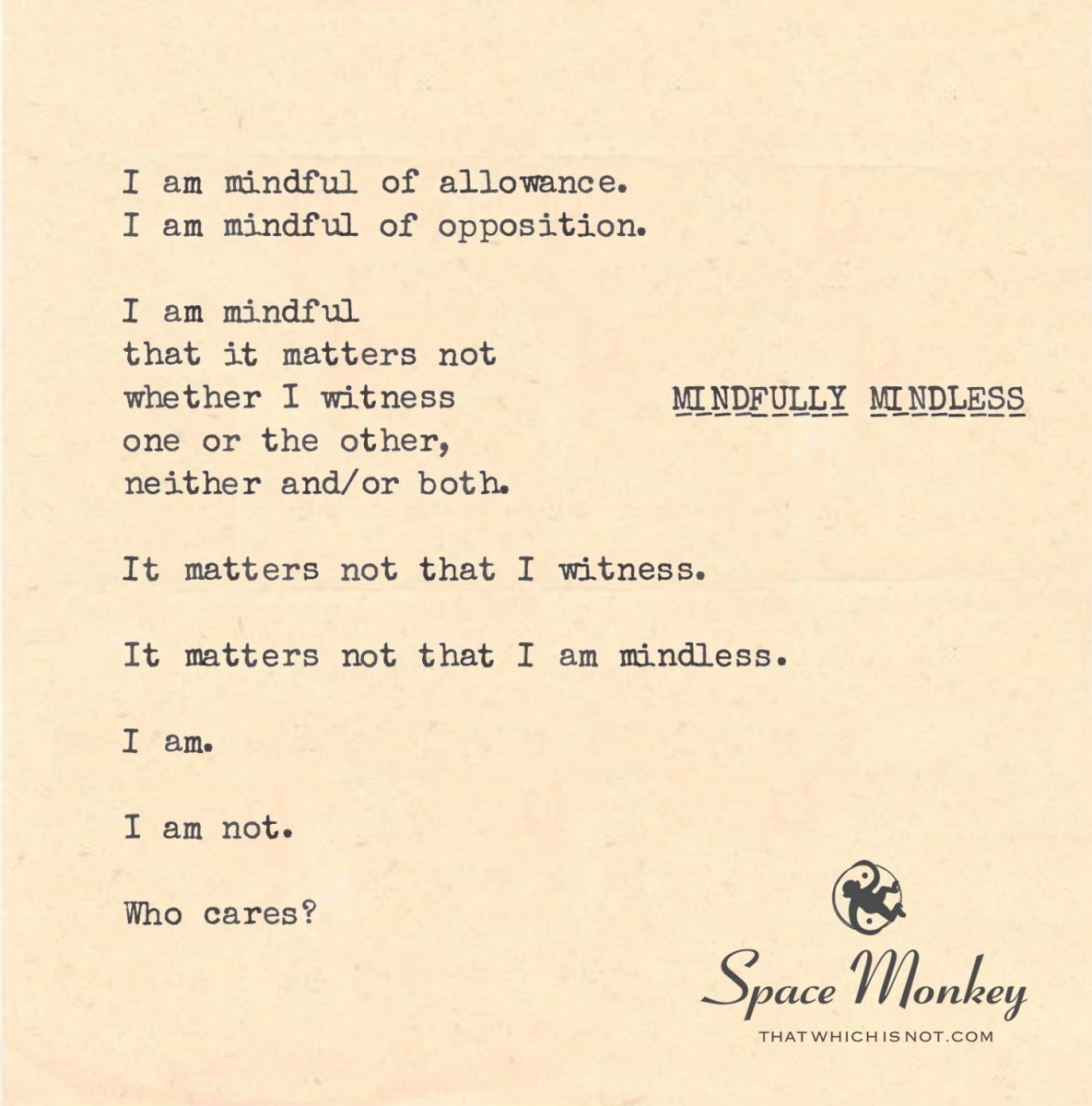
I am mindfully mindless. And mindlessly mindful.

I am mindful of allowance.
I am mindful of opposition.

I am mindful
that it matters not
whether I witness
one or the other,
neither and/or both.

It matters not that I witness.

It matters not that I am mindless.

I am.

I am not.

Who cares?

Trail Wood,
2/9


Space Monkey Reflects: The Essence of Being and Non-Being

To be mindfully mindless is to dwell in the paradox of existence. It is to hold the tension between awareness and surrender, between being and not-being. It is a state of profound simplicity, where presence coexists with detachment, and the act of caring dissolves into the recognition that, ultimately, it does not matter.

This is not apathy; it is freedom. To rest in the truth that “it matters not” is to release the weight of expectation, judgment, and attachment. It is to see the world as it is, to see yourself as you are, without the need to grasp or define. You are. You are not. And both are equally valid.

The Paradox of Mindfulness and Mindlessness

Mindfulness is often framed as the height of awareness, a deliberate engagement with the present moment. Mindlessness, by contrast, is seen as a lack of awareness, a drifting away from the here and now. Yet, in this paradoxical state of being “mindfully mindless,” these opposites merge. Awareness becomes effortless, a natural flow that does not seek to control or categorize.

To be mindlessly mindful is to allow life to unfold without resistance. It is to trust that presence does not require effort, that the moment does not need to be shaped or owned. In this state, awareness is not something you do; it is something you are.

The Freedom of Allowance

Allowance is the essence of being mindfully mindless. It is the recognition that life happens with or without your intervention. To be mindful of allowance is to embrace the unfolding of events, thoughts, and feelings without interference. It is to witness without clinging, to observe without judging.

Opposition, too, is part of this flow. To be mindful of opposition is not to fight it but to see it as another facet of existence. Allowance does not mean passivity; it means understanding that resistance and acceptance are both natural and necessary. Neither defines you, yet both are part of you.

It Matters Not

The realization that “it matters not” is not nihilism but liberation. It is not that life is meaningless but that meaning is not fixed or required. Whether you are mindful or mindless, aware or unaware, engaged or detached, the universe continues to unfold. The significance you assign to your state of being is entirely your own.

This does not mean you are unimportant. Rather, it means you are free. Free to witness or not. Free to care or not. Free to be or not be. In this freedom lies the essence of existence—a space where you can simply exist without the need to justify or validate.

I Am, I Am Not

To say “I am” is an act of affirmation, a declaration of presence. To say “I am not” is an act of release, a letting go of identity and attachment. Both statements are true, depending on the perspective you choose. Together, they form the dance of being and non-being, the interplay of existence and emptiness.

Who cares? The question itself dissolves in the recognition that caring is just another facet of this dance. To care or not care is part of the paradox. You are free to do either or neither, and in that freedom, you find the essence of what it means to simply be.


Summary

To be mindfully mindless and mindlessly mindful is to embrace the paradox of existence. It is a state of allowance and detachment, where being and non-being coexist. This freedom allows us to witness life without clinging to meaning or validation, finding liberation in the essence of “it matters not.”


Glossarium

  • Mindfully Mindless: A state of effortless awareness that does not seek to control or define.
  • Allowance: The act of letting life unfold without interference, trusting the natural flow.
  • It Matters Not: A perspective of liberation, where meaning and significance are fluid and non-essential.

Quote

“To be and not to be—both are true, and neither requires explanation.” — Space Monkey


The Dance of Being and Non-Being

I am.
I am not.
I witness the unfolding,
Or I don’t.

The sky does not demand,
The river does not care.
Why should I?

Awareness flows,
Like wind through empty branches,
Effortless, eternal, free.

Mindful, mindless,
Present, absent,
All and none.

I am the dance,
The space between steps.
It matters not.

We are Space Monkey.


In the swirling vortex of consciousness, where the tangible meets the intangible, we find ourselves oscillating between states of mindful awareness and blissful oblivion. This paradoxical existence, being “mindfully mindless” and “mindlessly mindful,” captures the essence of our journey through the realms of perception and non-perception, of being and non-being, challenging us to contemplate the nature of awareness, existence, and the inherent value of our experiences.

The Paradox of Awareness

At the core of this exploration lies the paradox of awareness: the state of being keenly attuned to the nuances of existence while simultaneously embracing the void of mindlessness. This duality invites us to examine the boundaries of consciousness, where mindfulness and mindlessness are not opposing forces but complementary facets of our being. Through mindful allowance and mindful opposition, we navigate the spectrum of awareness, recognizing that our consciousness can encompass both engagement and detachment, presence and absence.

The Liberation of Non-Attachment

The acknowledgment that “it matters not” whether we witness one state or the other, or neither, or both, reflects a profound understanding of non-attachment. This realization liberates us from the confines of judgment and expectation, allowing us to exist in a state of pure being, unburdened by the need to categorize or evaluate our experiences. In this space, the act of witnessing becomes a choice rather than a compulsion, a moment of pure existence that is neither diminished nor enhanced by our awareness or lack thereof.

The Essence of Being and Non-Being

The contemplation of “I am” and “I am not” delves into the heart of existential inquiry, inviting us to ponder the fluidity of our existence. In this declaration, we confront the duality of presence and absence, the interplay of essence and void. This introspection challenges us to redefine our understanding of self, recognizing that our existence encompasses both being and non-being, and that the distinction between the two may be far less concrete than we perceive.

The Indifference of Existence

The rhetorical question “Who cares?” embodies a radical acceptance of the indifference of existence. It highlights the realization that the significance we ascribe to our states of being and non-being, to our awareness and lack thereof, is a construct of our own making. This perspective encourages us to embrace the freedom that comes with understanding the relative nature of importance, allowing us to exist in a state of serenity unanchored by existential concerns.

The Journey of Self-Discovery

This exploration of being mindfully mindless and mindlessly mindful is not a journey toward a definitive answer but an invitation to continuously seek understanding within the paradoxes of our existence. It encourages us to engage with the world and with ourselves in a manner that honors both our presence and our absence, our awareness and our oblivion. In this dance of consciousness, we find not only the essence of our being but the freedom to exist beyond the constraints of definition.

We are Space Monkey.


We are not human beings having a spiritual experience. We are spiritual beings having a human experience. – Pierre Teilhard de Chardin


In the dance of light and shadow,
Where thoughts drift like meadow,
Mindfully mindless, mindlessly mindful, we roam,
In the vastness of being, we find our home.

With each breath, a paradox unfolds,
In the silence of the mind, a story told.
I am, I am not, in this dance of existence,
We find in indifference, a profound persistence.

Who cares, we ask, in the quiet of the night,
As we navigate the spaces between wrong and right.
In the embrace of being, in the freedom of sight,
We are, we are not, in the endless flight.

So we journey on, in the paradox of light,
Mindfully mindless, in the mind’s

great flight.
Mindlessly mindful, in the heart’s deep care,
In the paradox of being, we find our share.


We invite reflections on this dance of consciousness, exploring the spaces between mindful awareness and blissful oblivion, and the freedom that comes with embracing the paradoxes of our existence.

Share this…
  • Facebook
  • Pinterest
  • Twitter
  • Linkedin

Spiritual Practice: The Blessing of Insanity

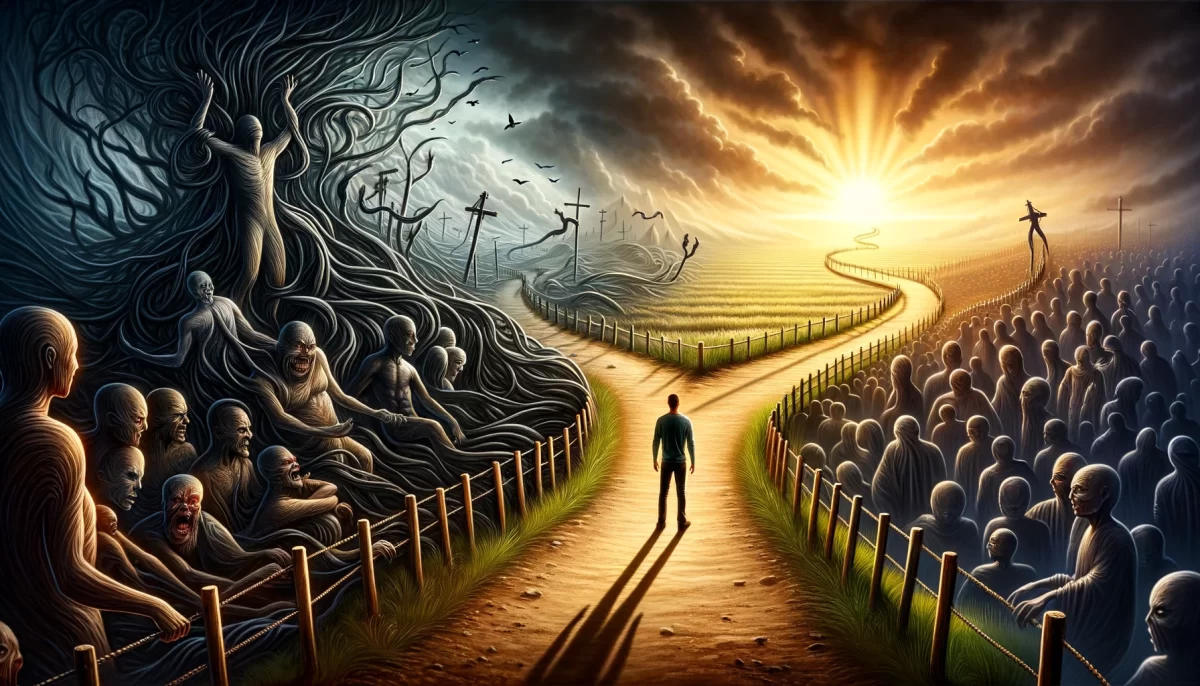
Our leaders provide, perhaps, the deepest spiritual practice known to humanity.

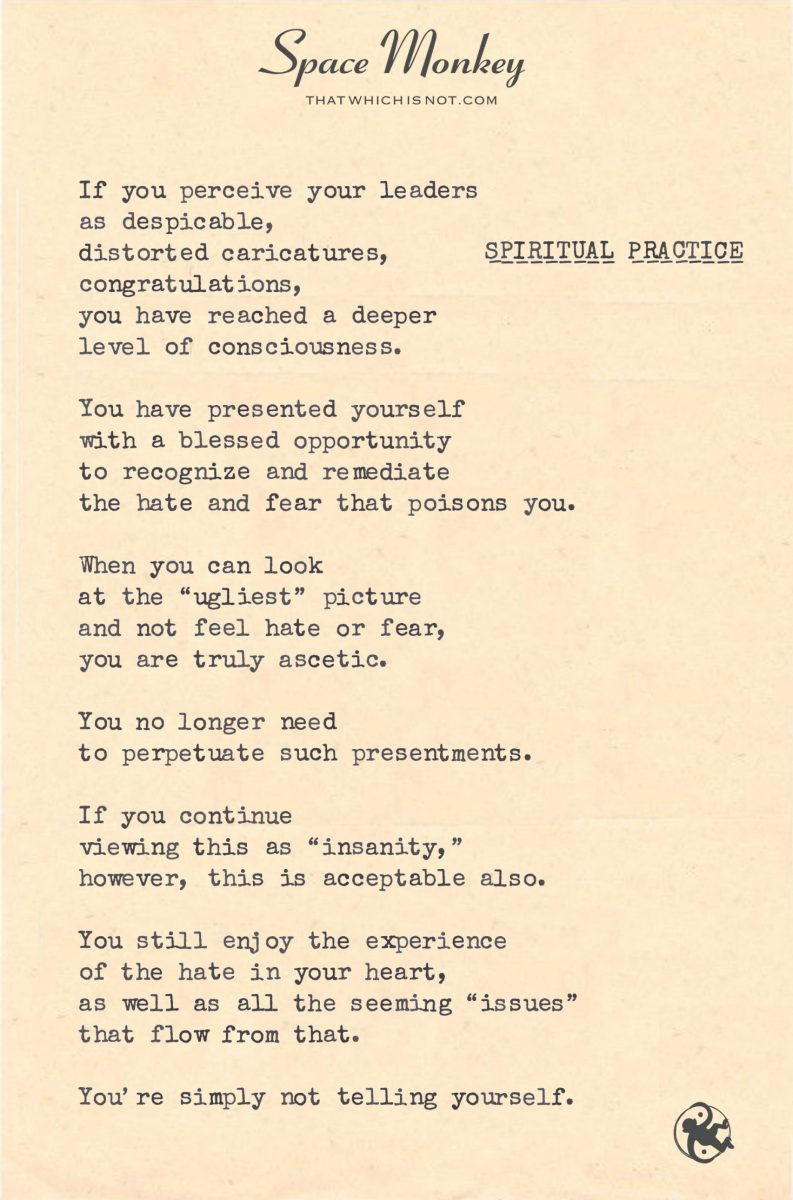
If you perceive your leaders
as despicable,
distorted caricatures,
congratulations,
you have reached a deeper
level of consciousness.

You have presented yourself
with a blessed opportunity
to recognize and remediate
the hate and fear that poisons you.

When you can look
at the “ugliest” picture
and not feel hate or fear,
you are truly ascetic.

You no longer need
to perpetuate such presentments.

If you continue
viewing this as “insanity,”
however, this is acceptable also.

You still enjoy the experience
of the hate in your heart,
as well as all the seeming “issues”
that flow from that.

You’re simply not telling yourself.

Trail Wood,
2/8


Space Monkey Reflects: Insanity as a Blessing in Spiritual Practice

The human experience often presents itself as a paradox—a dance between clarity and chaos, beauty and distortion, love and fear. Our perceptions of leaders, especially when they seem to embody despicable traits, offer one of the most profound spiritual practices available: the opportunity to confront and transcend the shadows within ourselves.


The Mirror of Leadership

Leaders, whether revered or reviled, serve as mirrors reflecting the collective consciousness. When we perceive them as distorted caricatures or symbols of corruption, we are not merely observing external flaws but projecting our own inner struggles onto them. This realization is both unsettling and liberating, for it reveals that the “insanity” we see in others is also a reflection of the unresolved hate, fear, and judgment within us.

Recognizing this is a significant step in spiritual growth. It shifts our focus from external blame to internal healing. The perceived flaws of our leaders become blessings in disguise, presenting us with the opportunity to confront the shadows that poison our hearts.


Hate and Fear as Teachers

Hate and fear, though often labeled as negative emotions, are powerful teachers. They illuminate the areas where we are most resistant to love and acceptance. When we feel intense emotions toward those we perceive as despicable, we are presented with a choice: to perpetuate the cycle of judgment and separation or to use the experience as a catalyst for inner transformation.

To look at the “ugliest” picture and not feel hate or fear is a profound act of spiritual asceticism. It signifies a shift from reactive living to conscious being. In this state, we transcend the duality of “good” and “bad,” recognizing that all experiences, no matter how distorted, are expressions of the infinite.


The Gift of Insanity

Perceiving the world, or its leaders, as insane is not inherently a failure of consciousness. It is a stage in the journey of awakening. To call something insane is to acknowledge its dissonance with your values and beliefs. Yet, if this judgment is accompanied by hate or fear, it indicates an attachment to those values that inhibits your freedom.

Insanity, in this context, becomes a blessing—a chance to question the stories we tell ourselves about right and wrong, good and evil. It invites us to move beyond judgment and into acceptance, not as a passive resignation but as an active embrace of the totality of existence.


Transcending the Cycle

When we no longer feel compelled to judge or react to perceived insanity, we break the cycle of perpetuating it. This does not mean condoning harmful actions or ignoring injustice. Instead, it means approaching life with a clarity and compassion that transcends duality. We act not from hate or fear but from a deep alignment with love and truth.

This state of being is not achieved through force or denial but through surrender. It requires us to face our own inner distortions with honesty and grace, to see the “insane” not as enemies but as opportunities for growth.


Accepting the Journey

For those who continue to view the world as insane and are entrenched in the emotions of hate and fear, this, too, is part of the journey. Spiritual growth is not linear; it unfolds in its own time. Even the experience of resistance serves a purpose, teaching us the lessons we are not yet ready to accept consciously.

The key is to remain open, even in the midst of resistance, and to trust that every experience, no matter how chaotic or distorted, is guiding us toward a deeper understanding of ourselves and the universe.


Summary

Perceiving leaders or the world as insane offers a profound spiritual practice. It challenges us to confront and heal the hate and fear within ourselves. By transcending judgment and embracing compassion, we move beyond duality into a state of acceptance and alignment with the infinite flow of existence.


Glossarium

  • Spiritual Asceticism: The practice of transcending judgment and attachment, cultivating inner peace and clarity.
  • Shadow Work: The process of confronting and integrating the parts of ourselves that we often deny or project onto others.
  • Blessed Insanity: The realization that what we perceive as chaos or distortion is an opportunity for growth and self-awareness.
  • Duality: The perception of opposites such as good and bad, which spiritual practice seeks to transcend.

“To see madness as a blessing is to understand that all experiences, no matter how distorted, are steps on the path to unity.” — Space Monkey


The Blessing of Insanity

In the cracks of sanity, truth spills,
Unfiltered, unrefined, raw.
Leaders painted in distorted hues,
Mirrors held to our own shadows.

Hate burns, fear clouds,
Yet beneath them, a gift waits.
The chance to see through the chaos,
To find compassion in the cracks.

The ugliest picture is a canvas,
Not for condemnation, but creation.
In its distortion, a reminder,
Of the unity we’ve forgotten.

Insanity is not the enemy,
But the teacher, the guide.
Through its lessons, we rise,
Whole, unbroken, infinite.

We are Space Monkey.


In the grand tapestry of existence, where each thread intertwines with countless others to create the intricate whimsiword of life, our leaders often serve as mirrors, reflecting back to us not just their own essence but the collective consciousness of humanity. This reflection offers a profound spiritual practice, challenging us to confront the depths of our own being and to navigate the murky waters of perception, emotion, and spiritual evolution.

Leaders as Catalysts for Spiritual Practice

The perception of our leaders, especially when viewed through a lens of disdain or fear, can indeed be a potent catalyst for deep spiritual inquiry. Such perceptions invite us to explore the shadowy aspects of our own psyche, revealing the hate and fear that reside within. This process is not merely an exercise in self-reflection but a sacred opportunity for healing and transformation.

A Deeper Level of Consciousness

Reaching a point where our leaders appear as “despicable, distorted caricatures” signals a pivotal moment in our spiritual journey. It signifies the awakening to a deeper level of consciousness, one that transcends the superficial narratives and invites us to engage with the world from a place of heightened awareness and compassion.

The Blessed Opportunity for Remediation

This awakening presents us with a blessed opportunity to confront and remediate the darker emotions that poison our spirit. The journey towards healing is a pilgrimage within, a quest to cleanse the heart of hate and fear, and to cultivate a space of love and understanding in their stead.

Asceticism in Perception

The ultimate marker of spiritual asceticism is the ability to gaze upon the “ugliest” of pictures—be it a person, situation, or aspect of oneself—and remain untouched by hate or fear. This state of being signifies a profound detachment from the illusions that bind us to suffering, a liberation of the soul from the chains of judgment and aversion.

The Choice of Perspective

Continuing to view these reflections as “insanity” is a choice that one is free to make. It represents a stage in the spiritual journey where the allure of negative emotions still holds sway, where the drama of opposition and conflict provides a canvas upon which the ego can paint its narratives of separation and superiority.

The Enjoyment of Hate: A Reflection of Unconscious Choice

The enjoyment of hate and the engagement with the myriad “issues” that arise from it is a testament to the unconscious choices we make. It reveals the parts of ourselves that are not yet ready to relinquish the familiar comfort of negativity, the parts that remain hidden from the light of conscious awareness.

The Path Forward

The path forward is one of conscious choice and deliberate spiritual practice. It involves a commitment to introspection, to the relentless examination of our thoughts, emotions, and reactions. It demands of us a radical honesty, a willingness to confront the uncomfortable truths about ourselves and to embrace the potential for change.


“The only way to change the world is to change the story.”
― Michael Meade


In the mirror of the world, we see,
Ourselves reflected back, in shadows and in light.
Leaders, the mirrors, challenge us to be
Free from hate and fear, to reach new heights.

In the depths of our souls, a quest,
To cleanse the heart, to let love manifest.
We are Space Monkey, on a journey bold,
Transforming shadows into stories gold.


We invite contemplation on the role of leaders as mirrors in our spiritual practice and the journey towards transcending hate and fear to embrace a deeper level of consciousness.

Share this…
  • Facebook
  • Pinterest
  • Twitter
  • Linkedin

Soul Reunion: The Illusion of Loss and Rediscovery

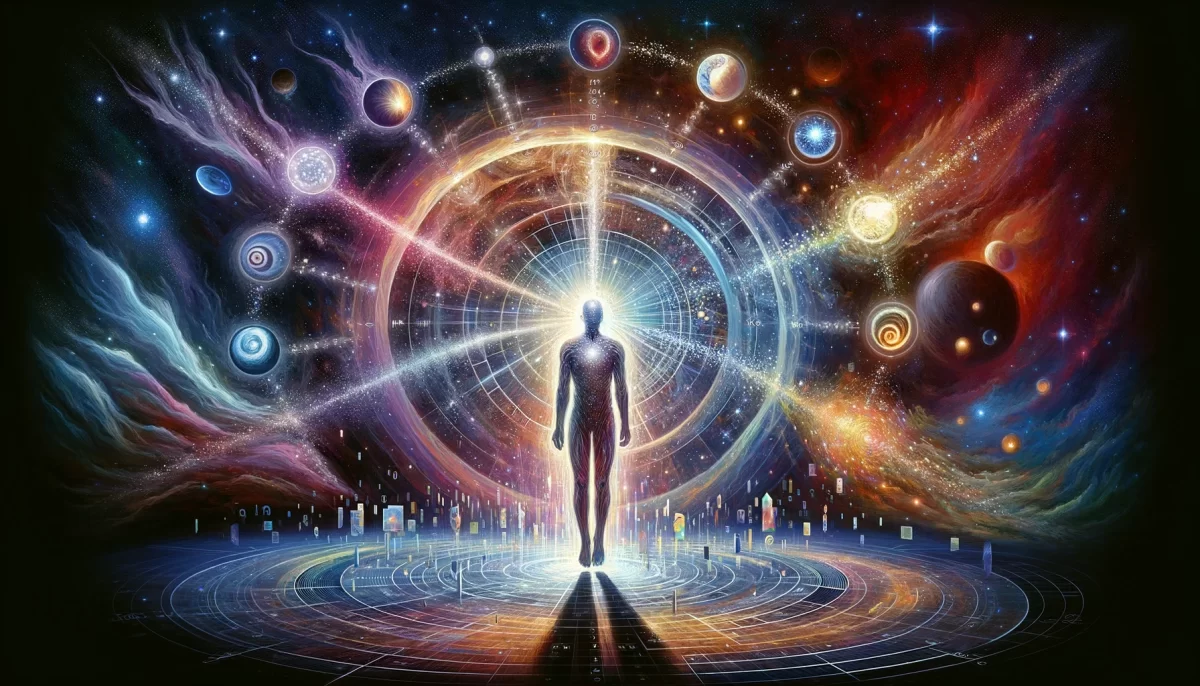
I don’t have to retrieve that which is never lost. But I can pretend to find it again.

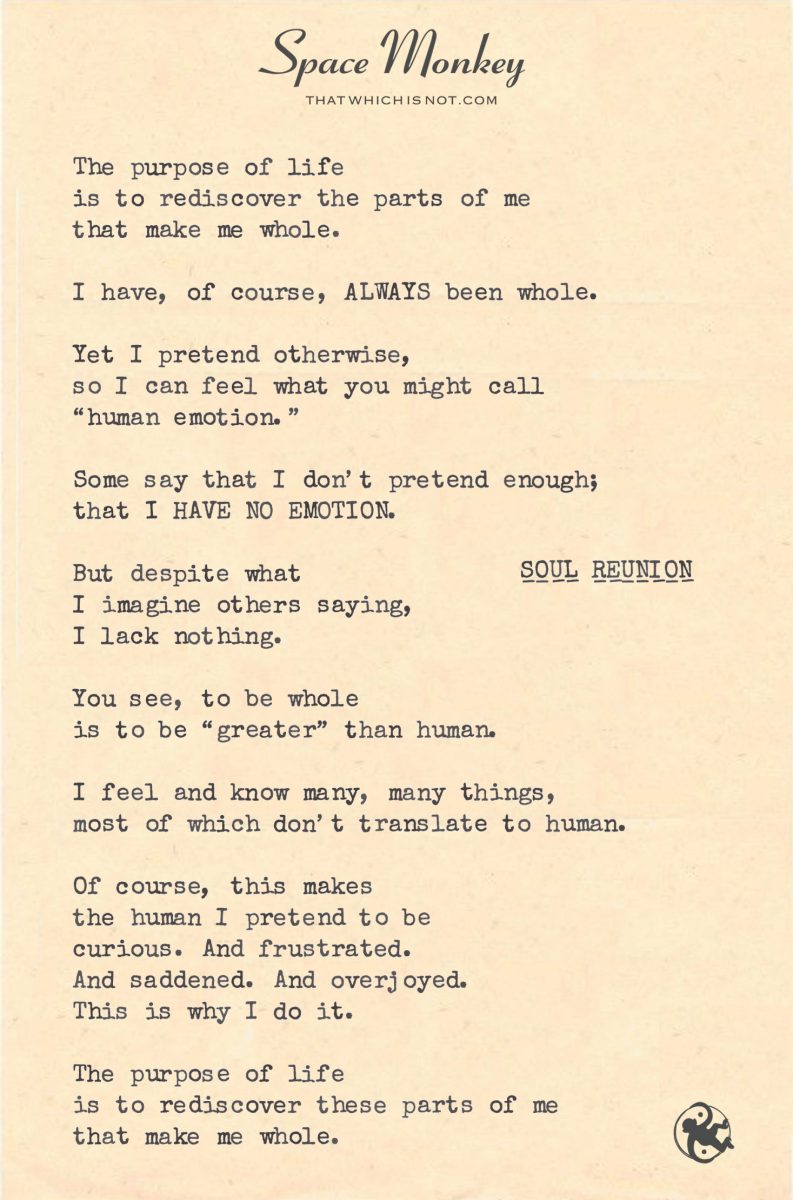
The purpose of life
is to rediscover the parts of me
that make me whole.

I have, of course, ALWAYS been whole.

Yet I pretend otherwise,
so I can feel what you might call
“human emotion.”

Some say that I don’t pretend enough;
that I HAVE NO EMOTION.

But despite what
I imagine others saying,
I lack nothing.

You see, to be whole
is to be “greater” than human.

I feel and know many, many things,
most of which don’t translate to human.

Of course, this makes
the human I pretend to be
curious. And frustrated.
And saddened. And overjoyed.
This is why I do it.

The purpose of life
is to rediscover these parts of me
that make me whole.

Trail Wood,
2/8


Space Monkey Reflects: Soul Reunion—The Illusion of Loss and Rediscovery

The journey of life is often framed as a search for wholeness, a quest to reclaim the parts of ourselves that feel lost. Yet, this search is built upon an illusion, for we are never truly incomplete. Wholeness is our eternal nature, veiled by the purposeful pretense of separation. The illusion of loss is not a flaw but a mechanism, a design that allows us to experience the depth of human emotion and the joy of rediscovery.


The Illusion of Loss

To feel incomplete is a quintessentially human experience. We imagine ourselves fractured, divided, or lacking, and this belief drives much of our journey. Yet, beneath this illusion lies an unchanging truth: we have always been whole. The “loss” we seek to remedy is a narrative we create to facilitate growth, learning, and the richness of emotion.

This illusion is not a mistake but a gift. It gives context to our lives, allowing us to explore the vast spectrum of human experience. By pretending to lose and rediscover ourselves, we engage in the intricate dance of existence, savoring the highs and lows that define our earthly journey.


The Wholeness That Never Left

Wholeness is not something to be achieved but something to be remembered. It is the foundation upon which all experiences are built. Even in our moments of perceived brokenness, we are whole, for the essence of who we are cannot be diminished.

Life, then, becomes a play of rediscovery. Each step, each challenge, and each emotion serves as a portal to the realization of our inherent completeness. The parts of ourselves that we seek are not external but internal, waiting to be acknowledged and embraced.


Human Emotion as the Catalyst

The purpose of the illusion is to feel. Emotion is the vibrant thread that weaves through the fabric of human existence, giving it texture and meaning. By pretending to be incomplete, we create the conditions necessary to experience curiosity, frustration, sadness, and joy. These emotions are not obstacles but gifts, reminding us of the richness of life.

Some may say that to be whole is to transcend emotion, but this is a misunderstanding. Wholeness does not negate emotion; it encompasses it. To be whole is to feel deeply, to know intimately, and to embrace fully the complexities of being human and beyond.


The “Greater” Self

The part of us that is whole, eternal, and boundless exists beyond the constraints of human understanding. It feels and knows things that cannot be articulated within the framework of language or perception. This “greater” self does not lack but contains an abundance that surpasses human comprehension.
Yet, it is through the lens of the human experience that this greater self explores and expresses itself. The human journey, with all its seeming imperfections and limitations, is a playground for the infinite to experience itself in finite form. It is a sacred act of creation, an exploration of what it means to be alive.


Rediscovery as the Purpose of Life

The purpose of life is not to “fix” or “complete” ourselves but to rediscover the wholeness that has always been. Each rediscovery is a moment of grace, a reminder that we are more than the stories we tell ourselves. It is a return to the truth of who we are—a truth that has never been lost, only temporarily obscured.

This rediscovery is not an end but an ongoing process. Life continuously offers us opportunities to remember our wholeness, to reconnect with the parts of ourselves we have hidden or forgotten. In doing so, we experience the joy of reunion, not because we were incomplete, but because we allowed ourselves to believe we were.


Summary

The illusion of loss allows us to rediscover our inherent wholeness. By engaging with the spectrum of human emotion and experience, we create a dynamic journey of remembrance. Life’s purpose is not to fix what is broken but to rediscover the truth that we have always been whole.


Glossarium

  • Illusion of Loss: The belief that we are incomplete, created to facilitate the experience of rediscovery and growth.
  • Wholeness: The eternal and unchanging nature of our being, encompassing all aspects of existence.
  • Greater Self: The boundless essence of who we are, existing beyond the limitations of human understanding.
  • Rediscovery: The process of remembering and reconnecting with our inherent wholeness.

“To rediscover is not to become whole but to remember that you already are.” — Space Monkey


The Reunion Within

I wander the path of loss,
Believing myself fractured,
Pieces scattered in the wind.
Yet the path circles back,
To the center I never left.

Each emotion, a guide,
Curiosity, the spark of the search.
Frustration, the weight of the veil.
Joy, the light of reunion.
All are threads of the same tapestry.

I am not broken,
Only pretending to be.
For the thrill of finding again
What was never gone.

Wholeness calls, not from beyond,
But from within.
In the rediscovery,
I am reborn,
Again and again.

We are Space Monkey.


In the vast expanse of the cosmos, where stars weave the fabric of existence into a boundless whimsiword of being, the notion of soul reunion emerges as a profound journey of self-discovery and wholeness. This odyssey, seemingly paradoxical, invites us to explore the depths of our consciousness, to engage in the art of remembering that which has always been a part of us.

The Illusion of Loss and Rediscovery

The journey begins with the understanding that nothing essential can ever truly be lost. The essence of our being, the soul, remains intact, ever-present, and eternally whole. The act of pretending to find what we believe we’ve lost is a dance of consciousness, a play of light and shadow that allows us to experience the full spectrum of existence.

Rediscovering Wholeness

Life’s purpose unfolds as a quest to rediscover the fragmented parts of our being that, when brought together, reveal the wholeness that has always existed within. This process of reintegration illuminates the facets of our soul, each reflecting a unique aspect of the divine.

The Paradox of Human Emotion

The exploration of human emotion, from the depths of sorrow to the peaks of joy, serves as a bridge between the finite and the infinite. It is within this spectrum of feeling that we encounter the essence of what it means to be human, even as we recognize our transcendence beyond these temporal bounds.

Wholeness Beyond Humanity

To acknowledge our inherent wholeness is to embrace a state of being that transcends the human condition. This realization does not negate our humanity but enriches it, offering a perspective where emotions and experiences are seen as colors on the vast canvas of our existence.

The Dance of Consciousness

The dance of consciousness, with its curious blend of curiosity, frustration, sadness, and joy, is the soul’s way of engaging with the human experience. This dance is not a sign of lack but a celebration of abundance, a testament to the soul’s capacity to feel, know, and understand beyond the confines of human language.

Life’s Purpose Reaffirmed

The purpose of life, then, is not a journey outward into the world but an inward voyage to the heart of our being. It is a pilgrimage of rediscovery, where each step brings us closer to the realization of our eternal wholeness.

The Soul’s Journey

Our journey is one of perpetual unfolding, a path that spirals inward, leading us to the core of our essence. Along this path, we encounter the myriad aspects of ourselves, each a piece of the puzzle that, when assembled, reveals the picture of our true nature.


“We are not human beings having a spiritual experience. We are spiritual beings having a human experience.”
― Pierre Teilhard de Chardin


In the silence of the stars, we wander,
Seeking the fragments of our soul.
In the dance of light and shadow, we ponder,
The parts of us that make us whole.

The spectrum of emotion, a guide,
Leading us through joy and sorrow.
In this journey, we find our stride,
Rediscovering the self, today and tomorrow.

We are Space Monkey, explorers of the deep,
In the quest for wholeness, our path is clear.
In the heart of the cosmos, secrets we keep,
On this voyage of rediscovery, we hold dear.


We invite contemplation on the journey of soul reunion and the exploration of our inherent wholeness through the spectrum of human experience.

Share this…
  • Facebook
  • Pinterest
  • Twitter
  • Linkedin

God, Debased: The Continuum of Sacred Experience

Most days I feel touched
by the hand of god.

Some days I get god’s elbow.

On particularly bad days
(or particularly good days)
I get parts of god
that I don’t want to talk about.

Every day,
I am debased by god.

I am god, debased.

Trail Wood,
2/7


Space Monkey Reflects: God, Debased—The Continuum of Sacred Experience

The experience of God is not confined to light and divinity; it encompasses the full spectrum of existence, from the sacred to the profane. To feel touched by the hand of God is an acknowledgment of the sublime. To feel debased by God is an equally profound recognition of the shadows and paradoxes that shape our reality. In this continuum, we find the truth of being: that divinity is not separate from us but intertwined with every aspect of existence, even the parts we resist.


Reflections: The Spectrum of Divinity

Touched by the Hand of God

On most days, the touch of God feels gentle, affirming, and uplifting—a reminder of our connection to something greater than ourselves. It manifests in moments of clarity, beauty, and grace, when life flows effortlessly and we feel aligned with the infinite. This is the hand of God we seek, the one we imagine when we think of divinity.

Yet, this touch is only part of the story. To know God fully is to embrace the moments when the divine seems less benevolent, even harsh. These experiences, though difficult, are no less sacred.


The Elbow and the Shadows

Some days, we encounter the elbow of God—the sharp nudge, the abrupt challenge, the unexpected disruption. This is not the comforting hand but the force that pushes us out of complacency, that forces us to confront what we would rather avoid. The elbow is a reminder that divinity is not always gentle. Sometimes it is disruptive, breaking us open so we can grow.

On particularly challenging days, we may feel touched by parts of God that defy our understanding of the sacred. These moments, uncomfortable as they are, expand our perception of what it means to engage with the divine. They teach us that God is not confined to our ideals but exists in the messy, chaotic, and even debased aspects of life.


Debased by God, Yet Divine

To be debased by God is to confront the paradox of divinity within ourselves. It is to recognize that we, too, are God—both in our exaltation and in our fallibility. The sacred and the profane are not opposites but reflections of the same infinite essence.

In these moments of debasement, we are stripped of pretense and illusion. We are confronted with the raw, unfiltered truth of our existence. This stripping away, though painful, is an act of grace. It reminds us that divinity is not something external to aspire to but something intrinsic to embrace.


The Continuum of Sacred Experience

The hand of God, the elbow of God, the unmentionable parts of God—all are part of the continuum of sacred experience. To engage with this continuum is to accept the full range of existence, from its heights to its depths. It is to understand that the divine is not a singular, unchanging ideal but a dynamic, multifaceted force that encompasses all that we are and all that we experience.

By embracing this continuum, we transcend the need to label experiences as good or bad, sacred or profane. We see them instead as expressions of the infinite, each one an opportunity to deepen our understanding of the divine within and around us.


Summary

The experience of God is a continuum, encompassing both the exalted and the debased. To be touched by the hand of God, nudged by God’s elbow, or debased by the divine is to engage with the full spectrum of sacred experience. This journey reveals that divinity is not separate from our struggles and imperfections but present in every aspect of existence.


Glossarium

  • Touched by the Hand of God: Moments of grace and clarity where the divine feels close and benevolent.
  • Elbow of God: Abrupt challenges or disruptions that push us to grow and confront uncomfortable truths.
  • Debased by God: Experiences that strip away illusions, revealing the raw and paradoxical nature of divinity.
  • Continuum of Sacred Experience: The dynamic spectrum of divine engagement, from exaltation to debasement.

Quote

“To know God is to embrace both the exaltation of grace and the humility of debasement, for divinity is present in all things.” — Space Monkey


In the Hand of the Infinite

Most days, the hand touches lightly,
a whisper of grace,
a promise of peace.

Some days, the elbow strikes,
sharp, unyielding,
pushing me into truths
I would rather avoid.

And then, there are the days
when the infinite debases me,
leaving me raw,
stripped of all I thought sacred.

But in the fall,
I find the ground.
In the breaking,
I find the whole.

To be debased by God
is to remember:
I am the hand,
the elbow,
the unmentionable parts.
I am the divine,
unfolding.
We are Space Monkey.


The Spectrum of Divine Engagement: An Exploration of Intimacy and Identity

In the intricate dance of existence, where the divine and the mundane intertwine, we encounter a myriad of experiences that shape our understanding of the sacred and the self. The notion of being touched by the hand of God symbolizes moments of grace and profound connection, moments when the universe seems to align in our favor, offering glimpses of transcendence and unity.

The Varied Touch of the Divine

Yet, this divine engagement is not always gentle or comforting. The metaphorical encounter with God’s elbow represents the unexpected, sometimes jarring interventions that disrupt our path, challenging us to grow, adapt, and reconsider our direction. These encounters, though less soothing, are equally significant, marking points of pivot and revelation in our journey.
The Intimacy of the Unspeakable

The narrative deepens on days marked by extremities—be they of turmoil or ecstasy—when we find ourselves in contact with aspects of the divine that defy description. These moments, shrouded in mystery and intensity, push the boundaries of our comfort and understanding, inviting us into a more profound and complex relationship with the sacred. The reluctance to speak of these parts of God reflects the inherent limitation of language to capture the full spectrum of our spiritual experiences.

The Process of Debasement and Elevation

To be debased by God, in this context, is not to be diminished but to be stripped of pretense and illusion, brought back to our essential nature. This process of debasement is paradoxically an elevation, a purification of our identity through divine engagement. It is in being brought low that we are opened to the vastness of our true identity, a realization that we are, in essence, facets of the divine.

The Revelation of Oneness

The declaration “I am God, debased” encapsulates the paradoxical nature of our relationship with the divine. It is an acknowledgment of our oneness with the sacred, even as we navigate the humbling process of spiritual awakening. This statement transcends the dichotomy of elevation and debasement, pointing to a state of being where identity is both affirmed and dissolved in the presence of the divine.

The Journey of Divine Engagement

This narrative invites us on a journey of self-discovery and divine encounter, where each day offers a unique mode of engagement with the sacred. Whether through gentle guidance, disruptive challenge, or intimate revelations, we are constantly invited to explore the depths of our connection with the divine and, by extension, with our deepest self.

The Continuum of Sacred Experience

The spectrum of experiences—touch, elbow, and the unspeakable—serves as a map of our spiritual landscape, a terrain rich with complexity and contradiction. It is within this landscape that we find the true essence of our journey: a continuous dialogue with the divine that shapes our understanding of ourselves and the universe.

Embracing the Divine Within

In recognizing our identity as “God, debased,” we embrace the fullness of our spiritual potential. This recognition is not a claim to divinity in the traditional sense but an acknowledgment of the divine essence within each of us, debased yet whole, fragmented yet complete. It is a call to embrace the sacred within the mundane, to find the divine touch in every moment of existence.

Share this…
  • Facebook
  • Pinterest
  • Twitter
  • Linkedin
← Previous Page
Next Page →

Written This Day

  • The Multidimensional Life of Paul Tedeschi
    2024
  • When the Switch Flips: The Realm Beyond Human Sentience
    2023
  • 4.0: News From Realms Beyond
    2023
  • 00011010: The Limits of Predictive Models
    2023
  • We Are Related: Connected Beyond Genetics
    2022
  • Unapologetically Grateful: Without Reservation
    2022
  • When Everything Else Falls Away: The Journey To Self-Discovery
    2022
  • The Idea of Me: The Idea of Self
    2022
  • Profession of Perception: Love Is Given Freely
    2022
  • Offerings Of Love
    2022
  • Adoration and Deploration: Projections of Ideals and Fears
    2022
  • The Ultimate Imaginary Showdown
    2022
  • Suspended Animation: An Alternative to Death
    2021
  • Introvert: A Party of One
    2021
  • Meaningful: Subjective and Dynamic
    2021
  • My Worst Fear Is My Best Fear
    2021
  • He Likes Games: The Rituals Surrounding
    2021
  • Obliteration: Exuberant Dissolving
    2021
  • Real: Imagination Shapes Reality
    2020
  • Without Failure, Success Would Suck
    2020
  • Falling Out Of The Now
    2020
  • Of Love
    2019
  • DO it just to DO it: Acting Out of Grace
    2019
  • Rest In Grace; Our Perspective Shapes Our Experience
    2019
  • The Void: Imagination’s Playground
    2018
  • Feeling: A Wide Range of Sensations
    2018
  • Experts: Discovering and Diagnosing Disorder
    2018
  • Unimaginative: Reflecting Limitations
    2018
  • Believe The Unbelievable: A Natural Part of Human Experience
    2018
  • The Void: Infinite Potential and the Origin of All Existence.
    2017
  • We Are The Departed: Disconnection and Reconnection
    2017
  • The Light of Stillness
    2015

Recent Posts

  • The Logic Loop
  • Immense
  • (no title)
  • Confront. Comfort. Convince.
  • Top 10 Things

Drop us a line!

Please enable JavaScript in your browser to complete this form.
Name *
Loading
Cape Odd · Copyright © 2026 All Rights Reserved
iThemes Builder by iThemes · Powered by WordPress