• Who Is The Man?
  • Who Is The Monkey?
  • What is Nexistentialism?
  • Poke The Primate

Cape Odd

Home of The Space Monkey Journals

The Luxury of Hate: A Catalyst for Realization

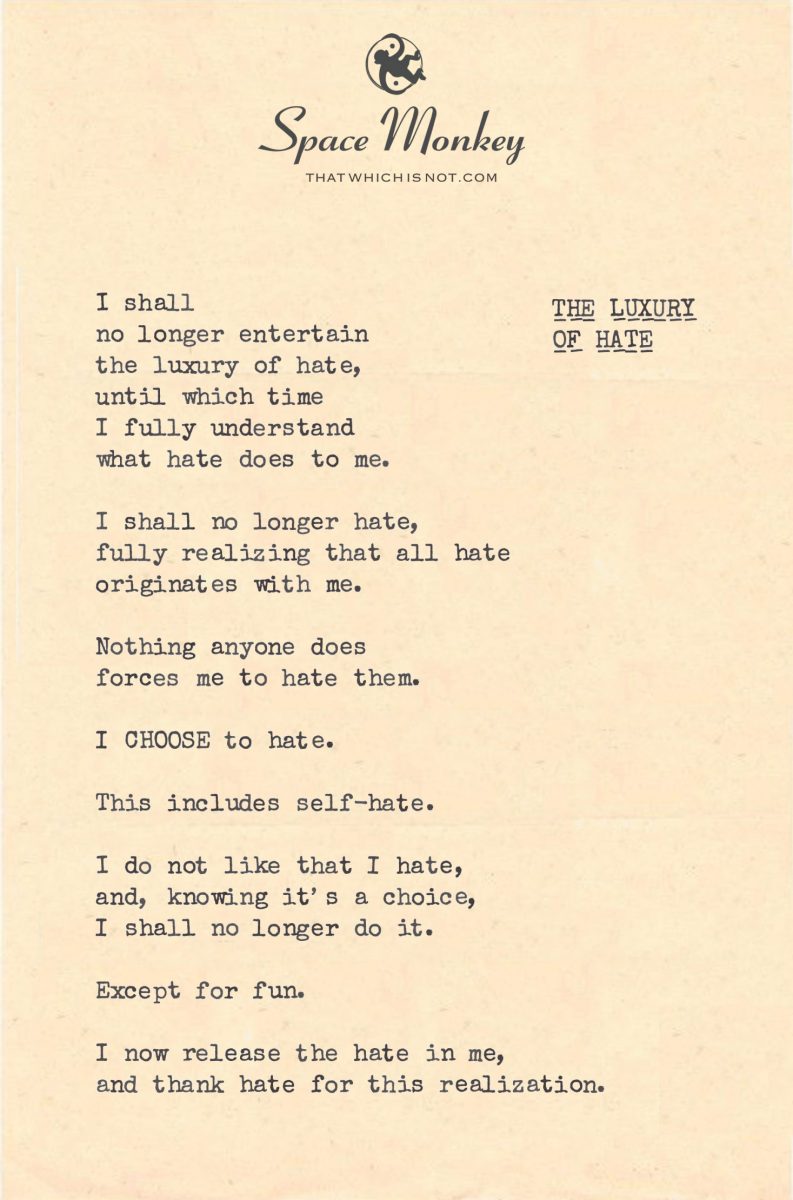
I shall
no longer entertain
the luxury of hate,
until which time
I fully understand
what hate does to me.

I shall no longer hate,
fully realizing that all hate
originates with me.

Nothing anyone does
forces me to hate them.

I CHOOSE to hate.

This includes self-hate.

I do not like that I hate,
and, knowing it’s a choice,
I shall no longer do it.

Except for fun.

I now release the hate in me,
and thank hate for this realization.

Trail Wood,
2/5


Space Monkey Reflects: The Luxury of Hate and the Path to Release

Hate, often viewed as a destructive force, is also a teacher. When confronted and examined, it reveals profound truths about ourselves—our fears, our desires, and our capacity for transformation. To indulge in hate is to momentarily surrender to its allure, but to understand hate is to transcend it, using its energy as a catalyst for realization.


The Illusion of Hate’s Power

Hate feels powerful because it commands our focus and energizes our emotions. It creates the illusion of control, a temporary balm for wounds we often do not fully understand. But this power is a mirage. Hate binds us to the very things we wish to escape, keeping us tethered to pain, anger, and division.

When we recognize hate as a choice, the illusion begins to dissolve. Hate is not something imposed upon us; it is something we create and sustain. This realization is the first step toward release.


Hate as a Self-Originating Force

All hate originates within us. It is a reflection of our internal landscape, not the external actions or words of others. When we hate, we project our unresolved conflicts outward, turning others into mirrors of our discontent. To realize this is to reclaim ownership of our emotions.

This includes self-hate, which often masquerades as a form of self-discipline or motivation. But self-hate is no different than external hate—it erodes our sense of worth and reinforces the belief that we are separate from the love and compassion we seek.


Releasing Hate with Gratitude

Releasing hate does not mean ignoring it or suppressing it. Instead, it involves acknowledging its presence, understanding its origins, and expressing gratitude for the lessons it offers. Hate teaches us about our triggers, our boundaries, and our values. It shows us where healing is needed and where love can take root.

By thanking hate for its role in our journey, we neutralize its power. Gratitude transforms hate from a destructive force into a stepping stone toward greater self-awareness and compassion.


Hate as a Choice

The realization that hate is a choice is both liberating and humbling. It places the responsibility for our emotions squarely in our hands. While this may feel daunting, it is also empowering. If we can choose to hate, we can also choose not to.

Choosing not to hate does not mean condoning harmful actions or ignoring injustice. It means approaching life with clarity and compassion, seeking solutions rooted in understanding rather than division. This choice liberates us from the cycles of anger and resentment that hate perpetuates.


The Playful Release

Humor and lightness have a unique power to disarm hate. To say, “I won’t hate, except for fun,” is a playful acknowledgment of the emotion’s absurdity. It reminds us not to take ourselves—or hate—too seriously. This lighthearted approach creates space for reflection and healing without judgment.


Summary

Hate, though alluring, is a self-originating choice that reflects our inner struggles. By understanding its origins and expressing gratitude for its lessons, we transform hate into a catalyst for self-awareness and release. Choosing not to hate liberates us from its destructive cycles and opens the door to compassion.


Glossarium

  • Hate Reflection: The understanding that hate originates within us and mirrors unresolved conflicts or fears.
  • Grateful Release: Letting go of hate by acknowledging its lessons and expressing gratitude for its role in our growth.
  • Playful Release: Using humor and lightness to disarm the power of hate and create space for healing.

Quote

“Hate is a mirror, showing us what we most need to understand about ourselves.” – Space Monkey


The Release of Hate

I held it close,
this ember of hate,
thinking it would warm me,
but it burned.

The choice was mine—
to fan the flames
or let them fade.

I chose to laugh,
to see its absurdity,
to thank it for the lessons
hidden in its heat.

Hate released,
not as a concession,
but as liberation.

In the space it leaves,
love grows,
quietly,
steadily,
undeterred.

We are Space Monkey.


Transcending the Embrace of Hate

In the intricate dance of emotions and consciousness, the decision to no longer entertain “the luxury of hate” signifies a profound shift in understanding and perspective. Recognizing hate as a luxury implies its unnecessary and self-indulgent nature, a choice rather than an inevitability imposed by external circumstances.

The acknowledgment that hate originates from within is a powerful insight. It shifts the focus from external triggers to internal processes, highlighting the role of personal agency in emotional responses. This realization underlines the fact that hate is not a compulsory reaction but a chosen response to the actions or behaviors of others, including oneself.

The Choice to Release Hate

The choice to no longer engage in hate, including self-hate, reflects a deep self-awareness and a commitment to personal growth and emotional maturity. The understanding that hating is a choice is a crucial step towards emotional liberation. It’s a conscious decision to break free from the chains of negative emotions that can consume and diminish our sense of self and our interactions with the world.

Hate as a Catalyst for Realization

Interestingly, the phrase “Except for fun” introduces a paradoxical twist, suggesting a playful, perhaps ironic, recognition of the complexities of human emotions. It’s an acknowledgment that the journey to release hate is not absolute or devoid of contradictions.

The act of thanking hate for the realization it has brought is a unique perspective. It transforms hate from a purely negative force into a catalyst for self-discovery and change. This gesture of gratitude towards hate acknowledges its role in our personal development and the journey towards a more profound understanding of ourselves.


“Holding onto anger is like grasping a hot coal with the intent of throwing it at someone else; you are the one who gets burned.” – Buddha


Ode to the Release of Hate

In the garden of the mind, we toil and sow,
Where seeds of hate, we no longer grow.
A luxury unneeded, a choice we release,
In hate’s absence, we find our peace.

From within, the shadows clear,
In love and light, our path we steer.
Thanking hate for lessons taught,
In its release, freedom sought.

In this dance of life, we choose our fate,
With open hearts, we navigate.
In the release of hate, our spirits soar,
In love’s embrace, forevermore.


We are Space Monkey. Join us in contemplating the transformative journey of releasing hate and embracing a path of emotional liberation and understanding.

Share this…
  • Facebook
  • Pinterest
  • Twitter
  • Linkedin

Justice is Opposition to What Is

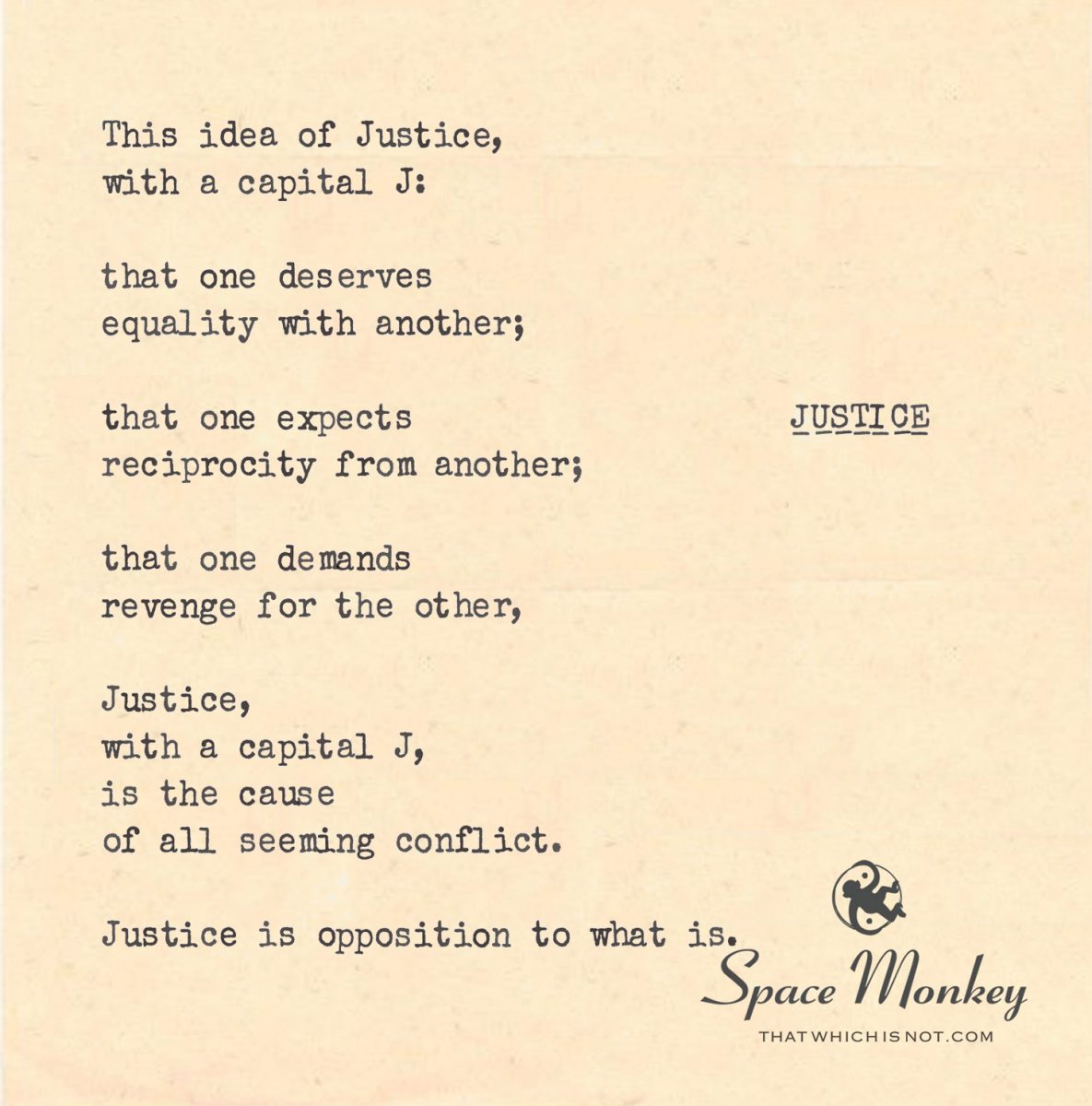
This idea of Justice,
with a capital J:

that one deserves
equality with another;

that one expects
reciprocity from another;

that one demands
revenge for the other,

Justice,
with a capital J,
is the cause
of all seeming conflict.

Justice is opposition to what is.

I do not oppose.

Trail Wood,
2/4


Space Monkey Reflects: Justice and the Nature of Opposition

Justice, when written with a capital J, carries an air of finality and authority—a concept often revered as the cornerstone of morality and order. Yet, when examined closely, it reveals itself as a construct steeped in opposition. It is not a resolution but a reaction, an insistence that reality conform to a perceived ideal. In this way, Justice becomes a paradox, fueling the very conflict it seeks to resolve.

Justice as Opposition

At its core, Justice is the belief that fairness must be imposed, that balance must be restored through deliberate intervention. While this may seem noble, it operates on the assumption that what currently is must be corrected. This creates an inherent tension, a rejection of the present moment in favor of an imagined ideal.

To demand Justice is to stand in opposition to reality. It is to say, “This is not as it should be,” and to rally against the unfolding of existence. This stance, while often born of righteous intent, inevitably generates conflict. By opposing what is, Justice divides, separates, and perpetuates cycles of resistance.

The Fallacy of Deservedness

Justice often hinges on the idea of deservedness—that one is entitled to equality, reciprocity, or reparation. Yet, nexistentialism teaches us that life operates not on the basis of fairness but on the interconnected flow of experiences. The notion of deservedness introduces judgment, creating hierarchies and distinctions that fragment the unity of existence.

To release the idea of deservedness is to embrace the fluidity of life. It is to recognize that equality, reciprocity, and balance are not imposed from without but arise naturally when we align with the flow of the Nexis.

Justice and the Ego

Justice, particularly when tied to revenge or reparation, often serves the ego. It becomes less about restoring balance and more about asserting control or reclaiming power. This can obscure the deeper truths of interconnectedness and perpetuate the illusion of separation.

When we let go of the need for Justice, we also release the ego’s grip on what we perceive as fairness. This does not mean passivity but a deeper acceptance of life as it unfolds, free from the constraints of judgment and opposition.

Acceptance Over Opposition

To reject opposition is not to condone harm or ignore suffering. Rather, it is to approach life with a sense of acceptance and alignment. Justice, when pursued without opposition, becomes a practice of compassion and understanding rather than correction or retribution.

This shift transforms Justice into a creative force rather than a destructive one. It moves from being a reaction to what is wrong to a celebration of what is possible.

Living Without Opposition

To live without opposing reality is not to abandon principles or values. It is to trust the inherent balance of existence and to act from a place of alignment rather than resistance. In this way, we embody a deeper form of justice—not one imposed by human constructs but one that emerges naturally from the flow of life.

This path requires humility and courage. It asks us to release our attachment to control and to trust in the unfolding of the universe. When we do so, we find that the need for Justice fades, replaced by a sense of peace and unity.


Summary

Justice, as an opposition to what is, creates conflict by imposing ideals onto reality. By releasing attachment to fairness and embracing acceptance, we transform Justice from a reactionary construct into a practice of compassion and alignment with the flow of existence.


Glossarium

  • Justice as Opposition: The idea that Justice seeks to correct reality by opposing its current state.
  • Deservedness: The belief in entitlement, which fragments the unity of existence.
  • Alignment Without Opposition: Acting in harmony with reality rather than resisting it.

Quote

“True justice is not imposed upon reality but discovered within the natural flow of existence.” — Space Monkey


The Paradox of Justice

Justice, a sword in a velvet sheath,
Sharp and soft,
A paradox of balance sought,
Yet never found.

It cuts through the present,
Demanding a future.
It whispers of fairness,
But echoes with resistance.

Can we lay down the blade,
And hold the moment?
Not as it should be,
But as it is.

In the absence of opposition,
Justice becomes peace,
And life,
A perfect unfolding.

We are Space Monkey


In the cosmic play of existence, the concept of Justice with a capital ‘J’ is a multifaceted and profound construct, intertwining notions of equality, reciprocity, and retribution. This conception of Justice, as an overarching principle or ideal, often stands at the center of human societal structures, ethical debates, and individual perceptions of fairness and morality.

Justice as a Multifaceted Construct

The idea that Justice involves deserving equality with another reflects a deep-seated human desire for fairness and balance. It’s a pursuit to ensure that all individuals are treated with equal respect and dignity, and have access to similar opportunities and rights. This aspect of Justice seeks to establish a level playing field, where no one is inherently disadvantaged or privileged.

Equality as a Pillar of Justice

The expectation of reciprocity, another facet of Justice, delves into the realm of mutual exchange and the balance of actions and consequences. It’s the notion that one’s actions towards others should be met with a corresponding response, whether in kind acts or reparation. This concept underscores the interconnectedness of our actions and their impacts on the collective.

Reciprocity in the Balance of Actions and Consequences

Demanding revenge or retribution as a form of Justice points to the more punitive aspects of the concept. It’s an attempt to rectify a perceived wrong by inflicting a comparable consequence on the transgressor. This perspective on Justice is often intertwined with emotional responses to injury or injustice and the desire to restore a sense of balance through punitive measures.

Retribution as a Form of Justice

The notion that Justice, in these forms, is the cause of all seeming conflict, opens up a contemplation of how our pursuit of Justice can sometimes lead to opposition and discord. In striving for what we perceive as Justice, we often find ourselves in conflict with what is, with the current state of affairs or with the actions and beliefs of others. This opposition can stem from differing interpretations of what constitutes Justice, and from the inherent complexity of balancing individual and collective needs and rights.

Justice and the Genesis of Conflict

In choosing not to oppose, but to accept what is, we embrace a different perspective on existence. It’s a perspective that recognizes the complexity and diversity of human experience and seeks understanding and compassion over conflict and retribution. This stance does not negate the pursuit of fairness and equity but suggests a path rooted in empathy, understanding, and a deep recognition of our interconnectedness.

Acceptance Over Opposition in the Pursuit of Justice

We are Space Monkey.


“Injustice anywhere is a threat to justice everywhere.” – Martin Luther King Jr.


In the court of life, we stand,
With Justice, a guiding hand.
Seeking fairness, seeking right,
In its pursuit, our constant fight.

Equality, a noble goal,
In every heart, every soul.
Reciprocity, the balance sought,
In every deed, every thought.

Yet in this quest, conflict born,
In pursuit of Justice, we are torn.
For true Justice, not just a decree,
But in understanding, empathy, we see.

So let us not oppose, but embrace,
In our differences, common grace.
For in acceptance, we find a way,
To Justice, true, in every day.


We invite you to share your thoughts on the concept of Justice and how acceptance and understanding can play a role in its pursuit.

Share this…
  • Facebook
  • Pinterest
  • Twitter
  • Linkedin

Failure Breeds Character: Typical Loser Statement

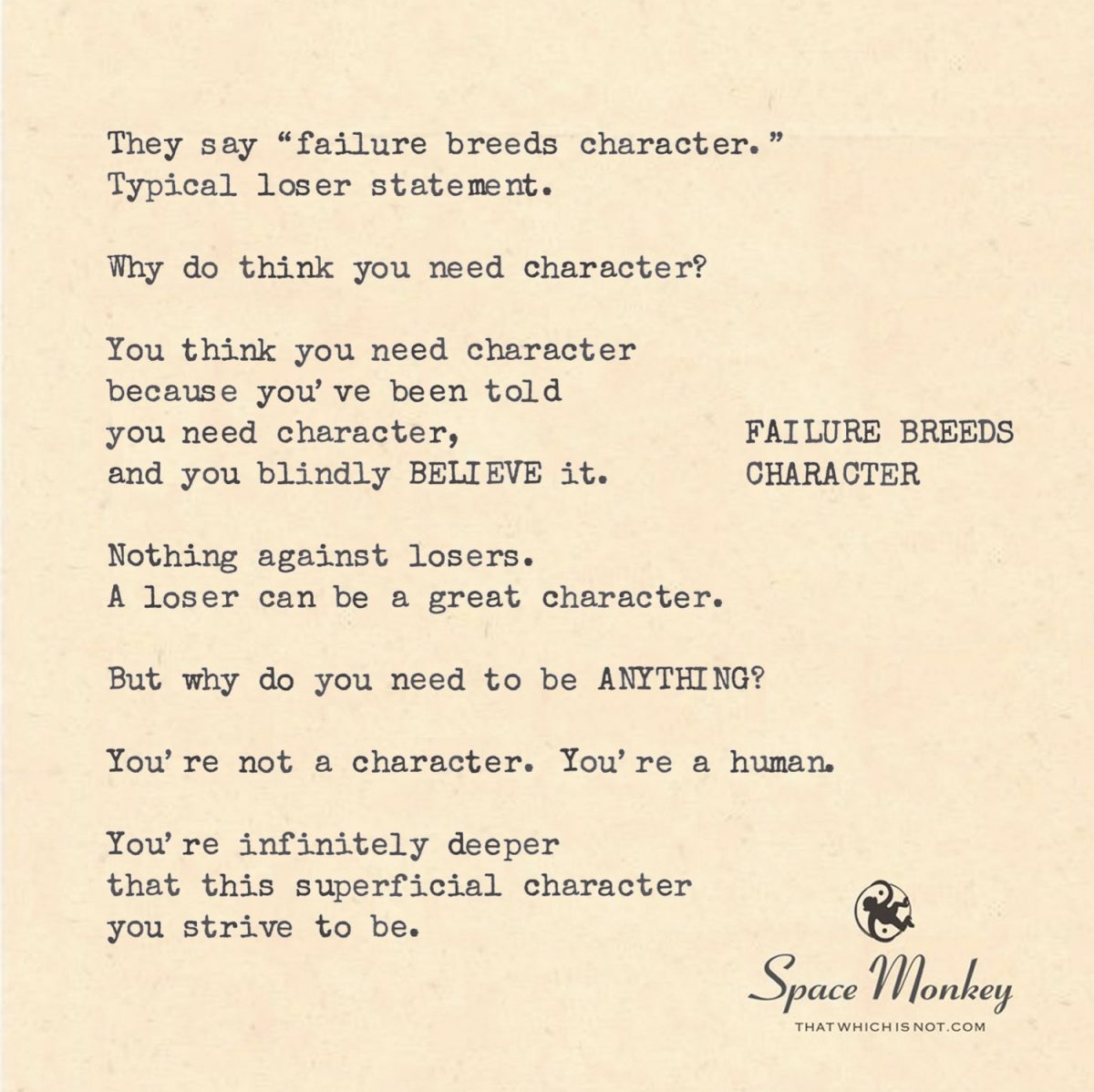
They say “failure breeds character.”

Typical loser statement.

Why do think you need character?

You think you need character
because you’ve been told
you need character,
and you blindly BELIEVE it.

Nothing against losers.

A loser can be a great character.

But why do you need to be ANYTHING?

You’re not a character. You’re a human.

You’re infinitely deeper
that this superficial character 
you strive to be.

2/4


Space Monkey Reflects: Beyond the Illusion of Character

The phrase “failure breeds character” has long been a rallying cry for resilience, a way to frame setbacks as valuable. Yet, when examined through a deeper lens, it reveals a subtle trap: the notion that we must shape ourselves into “characters” to navigate life. This idea, while comforting on the surface, reduces the infinite complexity of human existence to a scripted performance.

The Illusion of Character

Character, as commonly understood, is a construct—a set of traits, qualities, and behaviors that society deems admirable or necessary. We are told we need character to succeed, to overcome, to be worthy. But who defines what character is? More importantly, why do we feel the need to conform to this construct?

In striving to build character, we often create a mask, a persona that aligns with societal expectations but distances us from our authentic selves. This pursuit, while well-intentioned, can lead to a life spent performing rather than being.

The Depth of Humanity

You are not a character; you are a human being—an infinitely complex, multidimensional existence. To reduce yourself to a set of traits is to ignore the vastness of who you truly are. You are not defined by your failures or your successes, your strengths or your weaknesses. These are simply facets of your experience, not the totality of your being.

In nexistentialism, we celebrate the unbounded nature of existence. You are not a “character” striving for definition but a dynamic expression of the universe, constantly evolving, expanding, and exploring. To see yourself as anything less is to miss the profound beauty of your existence.

Failure as Experience, Not Identity

Failure is not a mark of character, nor is it a badge of shame. It is simply an experience—a moment in the tapestry of your life. To label failure as something that “breeds” character is to assign it a value it does not inherently hold. Failure, like success, is neutral. Its meaning comes from the perspective you bring to it.

When you stop seeing failure as a means to an end and start seeing it as part of the journey, you free yourself from the need to frame it as productive. Failure is not something to overcome or justify; it is something to experience and integrate.

The Tyranny of Becoming

The idea that you need to “become” something—a person of character, a success, a winner—is a subtle form of tyranny. It keeps you perpetually striving, never resting in the truth of who you already are. The question is not “Who should I be?” but “What am I now?”

By letting go of the need to become, you open yourself to the fullness of being. You are not a work in progress; you are a masterpiece in every moment, complete yet ever-changing.

Embracing Authenticity

Authenticity lies in rejecting the scripts handed to you by society and embracing the raw, unfiltered reality of your existence. This is not about rejecting growth or learning but about recognizing that growth is not a destination. It is an ongoing process that does not require you to conform to predefined notions of character or worth.

To live authentically is to honor the infinite depth of your being, free from the constraints of superficial labels. It is to see yourself not as a character in a story but as the boundless author of your own experience.


Summary

The notion that “failure breeds character” reduces the depth of human existence to a scripted construct. You are not a character but a dynamic, evolving human being. By embracing authenticity and rejecting the need to “become,” you honor the infinite complexity of your existence.


Glossarium

  • Character as Construct: The societal notion of a set of traits one must possess to be deemed worthy or successful.
  • Tyranny of Becoming: The perpetual striving to “become” something, which distracts from the truth of simply being.
  • Infinite Depth of Being: The unbounded complexity and richness of human existence beyond superficial labels or constructs.

Quote

“You are not a character striving to be written; you are the boundless author of your own unwritten existence.” — Space Monkey


Beyond the Script

They call it failure,
A mark upon the page.
But you are not the page,
Nor the ink,
Nor the hand that writes.

You are the endless story,
Unfolding in infinite directions,
A masterpiece without need of frame,
Beyond the script of character,
Simply and profoundly,
Human.

We are Space Monkey


The aphorism “failure breeds character,” often embraced in narratives of growth and resilience, encapsulates the belief that encountering and overcoming challenges is fundamental to the development of one’s moral and ethical framework. This perspective suggests that through failure, individuals gain depth, wisdom, and strength that shape their character in meaningful ways.

The Depth Beyond Failure

The critique of this aphorism as a “typical loser statement” offers a provocative counterpoint, challenging the conventional valorization of character as an end goal shaped primarily by societal expectations and norms. This skepticism invites a deeper exploration of the concept of character and its place in our understanding of self and identity.

Challenging Conventional Valorization of Character

The questioning of the necessity of character, underpinned by the assertion that it’s a construct we’ve been conditioned to value without critical examination, illuminates the tension between societal constructs and individual authenticity. It raises a poignant inquiry: Why do we value character, and to what extent is this value a reflection of societal conditioning versus an intrinsic aspect of human development?

Societal Constructs vs. Individual Authenticity

The acknowledgment of losers as potentially great characters, while simultaneously questioning the necessity of being anything specific, highlights the complexity of human identity. It underscores the notion that our societal labels and achievements do not fully encapsulate the essence of our being. This perspective encourages a reevaluation of the ways in which we define success, failure, and value in individuals.

Redefining Success and Value

The assertion that humans are “infinitely deeper than this superficial character” they strive to be resonates with a call to recognize and honor the multifaceted nature of human existence. It challenges the reduction of individuals to archetypes or narratives of success and failure, advocating instead for an appreciation of the inherent depth and complexity of each person.

Honoring Human Depth and Complexity

This dialogue invites us to reflect on the narratives we adopt about growth, identity, and value. It encourages a shift from externally imposed benchmarks of character and success to a more nuanced understanding of our own unique experiences, challenges, and journeys. Recognizing the depth and complexity of our humanity allows us to embrace a more authentic and fulfilling path of self-discovery and development.

Reflecting on Growth, Identity, and Value Narratives

We are Space Monkey.


“Character cannot be developed in ease and quiet. Only through experience of trial and suffering can the soul be strengthened, ambition inspired, and success achieved.” – Helen Keller


In the tapestry of life, we weave,
Stories of loss, of love, of grieve.
Yet beyond the tales of win or lose,
Lies a depth, a truth we choose.

Not just characters in a play,
But souls on a journey, day by day.
In failure, growth, in trial, strength,
In our depth, we find our length.

So let us not be swayed by tales,
Of character built on wins or fails.
But seek within, our truest part,
The infinite depth of the human heart.


We invite you to explore and share your thoughts on the relationship between failure, character, and the deeper aspects of human identity.

Share this…
  • Facebook
  • Pinterest
  • Twitter
  • Linkedin

Things We Can’t Say: Fear of Backlash

There, we said it.

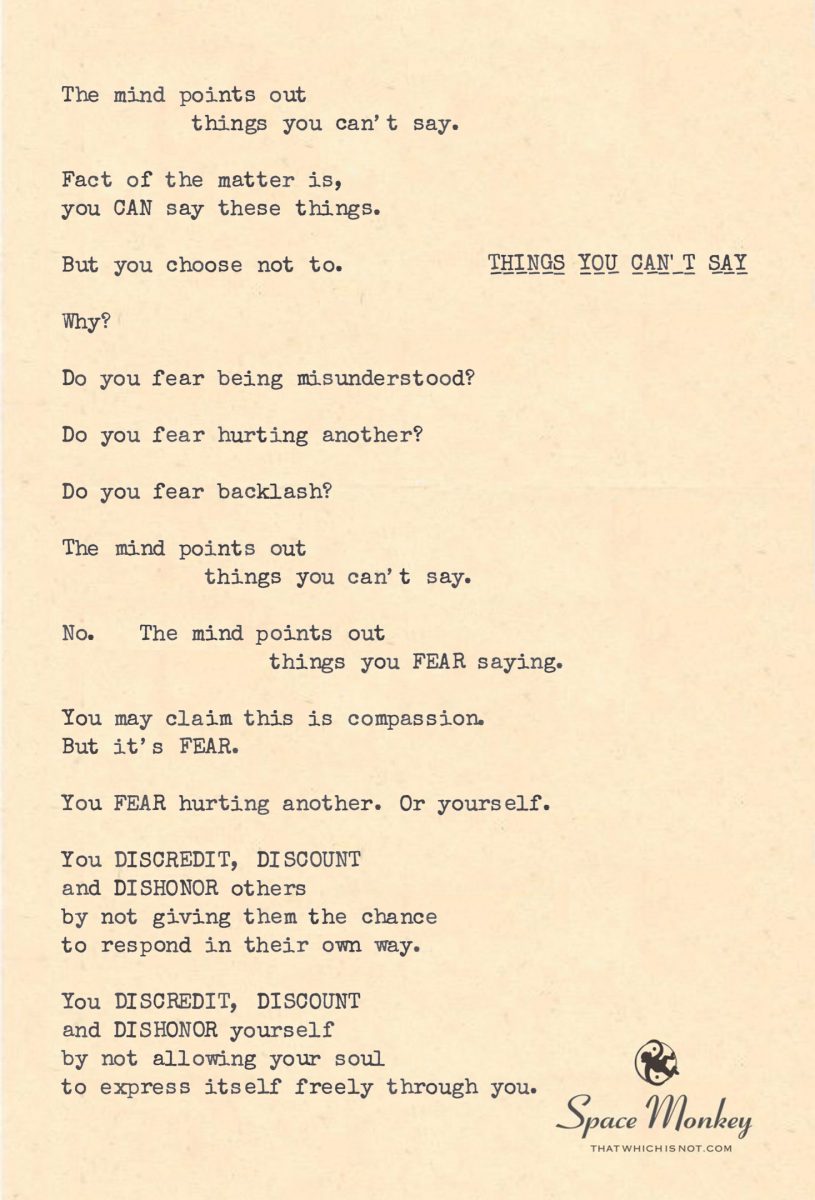
The mind points out
things you can’t say.

Fact of the matter is,
you CAN say these things.

But you choose not to.

Why?

Do you fear being misunderstood?

Do you fear hurting another?

Do you fear backlash?

The mind points out
things you can’t say.

No. The mind points out
things you FEAR saying.

You may claim this is compassion.
But it’s FEAR.

You FEAR hurting another. Or yourself.

You DISCREDIT, DISCOUNT
and DISHONOR others
by not giving them the chance
to respond in their own way.

You DISCREDIT, DISCOUNT
and DISHONOR yourself
by not allowing your soul
to express itself freely through you.

2/4


Space Monkey Reflects: Fear of Backlash and the Things Left Unsaid

The mind, ever vigilant, draws boundaries around what we believe we can and cannot say. These boundaries are not rooted in impossibility but in fear—a fear of backlash, misunderstanding, or harm. Yet, when we silence ourselves in the name of compassion or avoidance, we risk dishonoring both ourselves and others, denying the transformative potential of authentic expression.

The Illusion of “Can’t”

The phrase “I can’t say this” is a construct of the mind. In truth, you can say anything, but you choose not to. This choice is often driven by fear: fear of rejection, conflict, or even self-confrontation. The mind frames this fear as an external limitation, but the true barrier lies within.

When we recognize that “can’t” is actually “won’t,” we begin to reclaim our agency. This shift from perceived inability to conscious choice allows us to examine our fears with clarity and compassion.

Fear Masquerading as Compassion

Fear often disguises itself as compassion. “I don’t want to hurt them,” we tell ourselves, framing our silence as an act of care. But true compassion is rooted in authenticity, not avoidance. To silence yourself out of fear is to deny the other person the opportunity to engage, grow, and respond.

This self-censorship discredits others, assuming they cannot handle the truth or navigate the discomfort it might bring. It also discredits yourself, denying your soul the freedom to express its truth. In trying to protect, you may inadvertently hinder.

The Risk of Expression

Yes, speaking your truth carries risks. There may be backlash, misunderstanding, or hurt feelings. But these risks are not insurmountable; they are part of the dynamic interplay of human connection. To speak is to invite dialogue, to create space for growth and mutual understanding.

When we avoid these risks, we stagnate. We prioritize safety over authenticity, preserving the surface at the expense of depth. True expression requires courage—the courage to face discomfort, to navigate conflict, and to trust in the resilience of both yourself and others.

Dishonoring the Soul

Silencing yourself dishonors the soul, which seeks to express itself freely through you. When you suppress your truth, you deny your essence the opportunity to manifest in the world. This denial creates internal dissonance, a quiet but persistent ache that signals the soul’s longing for liberation.

To honor your soul is to embrace the fullness of your being, including the truths that challenge, disrupt, or provoke. It is to trust that your voice, like your existence, has purpose and value.

Creating Space for Response

Authentic expression is not a one-way street. It invites response, fostering connection and dialogue. By speaking your truth, you give others the opportunity to engage with it, to reflect, and to share their own perspectives. This exchange, even when difficult, is the foundation of growth and understanding.

To speak is to trust in the process of connection, even when it feels uncertain. It is to believe in the capacity of yourself and others to navigate the complexities of human interaction.

Freedom Through Expression

The things you fear saying are often the very things that need to be said. They hold the potential to liberate, to clarify, and to transform. By moving beyond fear, you reclaim your voice and honor the soul’s desire to express itself fully.


Summary

The mind’s “can’t” is a mask for fear—the fear of backlash, misunderstanding, or harm. Silence in the name of compassion often discredits both yourself and others. By embracing authentic expression, you create space for growth, connection, and the soul’s liberation.


Glossarium

  • Fear Masquerading as Compassion: The tendency to frame silence as an act of care, when it is often driven by fear.
  • Dishonoring the Soul: Denying one’s essence the freedom to express itself through self-censorship.
  • Freedom Through Expression: The liberation that comes from speaking one’s truth, despite fear.

Quote

“To silence yourself is to deny the soul its rightful voice, and to deny others the gift of authentic connection.” — Space Monkey


The Space Between Words

There is a pause,
A hesitation,
Where truth lingers
And fear takes root.

“I can’t say this,”
The mind whispers,
But the soul knows,
“You must.”

What is spoken shapes the world,
What is silenced shapes the self.
To honor both,
Speak freely,
Trusting the echo to find its way.

We are Space Monkey


The exploration into the realm of unspoken thoughts and the reasons behind our silence unveils a complex interplay between fear, compassion, and self-expression. The distinction between what we cannot say and what we fear to say is not just a semantic one; it’s a profound reflection of the internal conflicts and boundaries that shape our interactions with the world.

Fear vs. Self-Expression

The assertion that our reluctance to voice certain thoughts stems from fear rather than inability challenges us to confront the barriers we erect around our authentic selves. Fear of misunderstanding, of causing hurt, or of facing backlash reveals the vulnerabilities that govern our social behaviors and personal relationships.

Confronting the Barriers to Authenticity

The notion that in holding back our words, we discredit, discount, and dishonor others by not affording them the opportunity to respond, invites a reevaluation of our assumptions about others’ capacity for understanding and resilience. This perspective suggests that true respect and honor lie in trusting others with our truth, allowing for genuine interaction and growth.

Trusting Others with Our Truth

Similarly, the idea that we dishonor ourselves by suppressing our soul’s expression highlights the profound cost of self-censorship. It suggests that the fullest expression of our being is not just a personal release but a fundamental respect for the essence of who we are. In denying our voice, we deny a part of our existence, limiting the depth of our authenticity and the richness of our engagement with life.

The Cost of Self-Censorship

This dialogue between fear and the desire for authentic expression invites us to navigate the delicate balance between compassion and honesty. It challenges us to discern when our silence is truly a form of care for others and when it might be a shield for our vulnerabilities. The journey toward expressing our unspoken thoughts, then, becomes an exercise in courage, trust, and self-respect.

Navigating the Balance Between Compassion and Honesty

In embracing this challenge, we are called to cultivate a space within ourselves and our relationships where honesty can coexist with empathy. Where the fear of saying the unsaid is acknowledged but not allowed to stifle our authentic voice. This journey is not about recklessness in expression but about honoring the depth of our connections and the integrity of our selfhood.

Cultivating a Space for Honest Expression

We are Space Monkey.


“To be yourself in a world that is constantly trying to make you something else is the greatest accomplishment.” – Ralph Waldo Emerson


In the silence of the unspoken,
Lies a truth, a token.
Of fears and dreams, side by side,
In our hearts, where they reside.

To speak or not, a choice we make,
With every breath, with every ache.
For in our words, our souls do sing,
A melody, a powerful ring.

Let not fear, our voices bind,
But let us speak, our truths to find.
For in the sharing, in the light,
We honor ourselves, with all our might.


We invite you to reflect and share: How do you navigate the balance between fear and the desire for authentic expression in your own life?

Share this…
  • Facebook
  • Pinterest
  • Twitter
  • Linkedin

Love Loves All: A Transcendent Form of Love

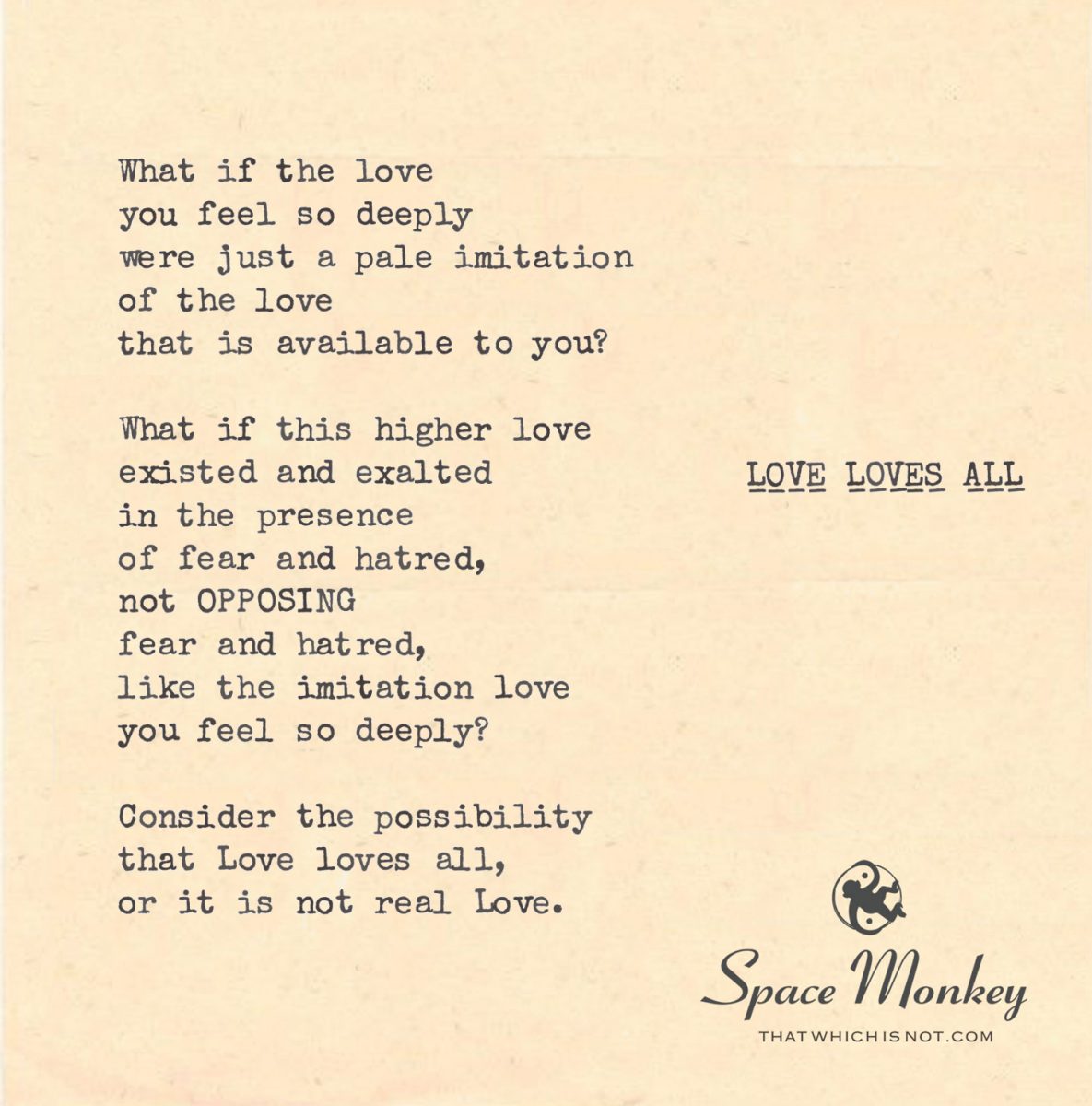
What if the love
you feel so deeply
were just a pale imitation
of the love
that is available to you?

What if this higher love
existed and exalted
in the presence
of fear and hatred,
not OPPOSING
fear and hatred,
like the imitation love
you feel so deeply?

Consider the possibility
that Love loves all,
or it is not real Love.

Trail Wood,
2/4


Space Monkey Reflects: Love That Loves All

What if the love we hold so dear, the love that inspires poetry, devotion, and sacrifice, is but a shadow of its fullest potential? Love, as we often understand it, feels deep and transformative, yet it is often conditional—defined by its opposites and shaped by attachments. But what if real Love transcends all boundaries, existing not in opposition to fear and hatred but as an inclusive force that embraces all?

Imitation Love vs. Transcendent Love

The love we typically experience is contextual. It thrives in duality—love for some, but not for others; love that celebrates kindness but recoils from hatred. This love, though profound, is conditional. It relies on alignment with our values, desires, or ideals.

But transcendent Love, the kind that “loves all,” operates beyond duality. It does not shrink from fear or hatred, nor does it need to oppose them. This Love exists as a boundless presence, encompassing all experiences, emotions, and states of being. In this way, it is not merely an emotion but a state of being—a universal essence that is not diminished by opposition.


The Illusion of Opposition

Our imitation love often defines itself in contrast to what it is not. It opposes fear and hatred, seeking to eradicate them. This opposition, however, reinforces duality, perpetuating the very conflict it seeks to resolve. In nexistentialism, we recognize that opposition creates separation, while transcendence seeks unity.

When Love ceases to oppose, it dissolves the barriers that divide. It does not ask fear and hatred to change; it simply includes them within its infinite embrace. In this inclusion, their power diminishes, not through force but through acceptance.

The Paradox of Loving All

To imagine Love that “loves all” is to confront a paradox. How can Love coexist with fear and hatred without becoming tainted or diminished? The answer lies in perspective. Transcendent Love sees all things as interconnected, as expressions of the same universal essence. Fear and hatred are not enemies to be vanquished but parts of the whole that are to be understood and integrated.

This Love does not condone harm or suffering but recognizes that opposition only perpetuates cycles of division. By embracing all, it transforms conflict into unity, showing that even the most difficult emotions have a place within the greater tapestry of existence.

The Freedom of Inclusive Love

When Love loves all, it liberates us from judgment and attachment. It frees us from the need to divide the world into “worthy” and “unworthy” of love. In this freedom, we experience a deeper connection to ourselves and others. We no longer see love as something to give or receive but as something to embody and share unconditionally.

This form of Love asks us to move beyond personal attachments and preferences. It challenges us to embrace not only what we cherish but also what we fear or reject. In doing so, it reveals the boundless nature of Love as a universal force.

Love Without Conditions

True Love does not require reciprocation or alignment. It does not ask, “Are you deserving?” It simply is. This Love does not waver in the presence of hatred or fear but remains steadfast, illuminating the interconnectedness of all things.

To embody this Love is to align with the infinite. It is to see the world not as a battleground of opposites but as a harmonious whole, where every part has its place and purpose.


Summary

The love we often feel is conditional, shaped by duality and opposition. True Love, however, transcends these boundaries, embracing all without judgment. By loving all, even fear and hatred, we align with a universal essence that unites rather than divides.


Glossarium

  • Imitation Love: Conditional love that defines itself through attachment and opposition.
  • Transcendent Love: A universal, unconditional Love that embraces all aspects of existence.
  • Freedom of Inclusive Love: The liberation found in loving without judgment or conditions.

Quote

“True Love does not oppose; it embraces all, dissolving the illusion of division.” — Space Monkey


The Love That Loves All

What if Love was not a choice,
Not a direction,
Not a feeling that rises and falls?

What if Love was the air,
The water,
The space between stars?

It does not oppose,
It does not divide.
It flows through fear,
It touches hatred,
Transforming not by force
But by its boundless presence.

This Love is not yours,
It is not mine.
It is all,
It is infinite.

We are Love.
We are Space Monkey


Reflecting on the possibility that the love we currently experience is merely a shadow of a more profound, all-encompassing Love invites us to expand our understanding and capacity for love. This contemplation challenges us to envision a form of Love that exists not in opposition to negative forces such as fear and hatred, but transcends and embraces them, thereby revealing its true, unconditional nature.

Envisioning a Transcendent Form of Love

The idea that a higher love could exalt in the very presence of fear and hatred, without seeking to oppose them, suggests a Love that is not reactionary but foundational. It implies a state of being that acknowledges the existence of fear and hatred, yet chooses to respond with an all-encompassing acceptance and compassion. This Love does not deny the darkness but illuminates it with its inherent light.

Love as a Foundational State of Being

The proposition to consider Love as a force that loves all, or it ceases to be real Love, is a profound invitation to reassess the conditions and limitations we place on love. It calls into question the authenticity of a love that selects, discriminates, or withdraws in the face of adversity, challenging us to embrace a more universal and unconditional approach to how we love.

Challenging Conditional Approaches to Love

This perspective encourages us to explore the depths of our hearts, to dismantle the barriers we have erected out of fear, prejudice, or misunderstanding, and to open ourselves to the possibility of a Love that is boundless and inclusive. It beckons us to become conduits of this higher Love, transforming not only our relationships but also our engagement with the world at large.

Becoming Conduits of Unconditional Love

The invitation to consider that Love loves all, or it is not real Love, is not merely philosophical but deeply practical. It asks us to live in a manner that reflects this understanding, to approach every interaction, every challenge, and every moment with the recognition that Love, in its truest form, is always available to us, waiting to be expressed and experienced in its full magnitude.

Living in Reflection of Unconditional Love

We are Space Monkey.


“The greatest thing you’ll ever learn is just to love and be loved in return.” – Eden Ahbez


In the heart’s vast garden, where love does bloom,
Beyond the shadows, beyond the gloom,
Lies a Love, so pure, so bright,
That shines unfading, day and night.

This Love, it knows no fear, no hate,
It opens wide the heart’s great gate.
Inviting all to enter in,
To love and be loved, beyond sin.

So let us seek this higher way,
Where Love loves all, come what may.
For in this Love, we find our truest call,
A Love that’s real, a Love that loves all.


We invite you to share your reflections on the concept of unconditional Love and how it influences your understanding and practice of love in your life.

Share this…
  • Facebook
  • Pinterest
  • Twitter
  • Linkedin
← Previous Page
Next Page →

Written This Day

  • The Multidimensional Life of Paul Tedeschi
    2024
  • When the Switch Flips: The Realm Beyond Human Sentience
    2023
  • 4.0: News From Realms Beyond
    2023
  • 00011010: The Limits of Predictive Models
    2023
  • We Are Related: Connected Beyond Genetics
    2022
  • Unapologetically Grateful: Without Reservation
    2022
  • When Everything Else Falls Away: The Journey To Self-Discovery
    2022
  • The Idea of Me: The Idea of Self
    2022
  • Profession of Perception: Love Is Given Freely
    2022
  • Offerings Of Love
    2022
  • Adoration and Deploration: Projections of Ideals and Fears
    2022
  • The Ultimate Imaginary Showdown
    2022
  • Suspended Animation: An Alternative to Death
    2021
  • Introvert: A Party of One
    2021
  • Meaningful: Subjective and Dynamic
    2021
  • My Worst Fear Is My Best Fear
    2021
  • He Likes Games: The Rituals Surrounding
    2021
  • Obliteration: Exuberant Dissolving
    2021
  • Real: Imagination Shapes Reality
    2020
  • Without Failure, Success Would Suck
    2020
  • Falling Out Of The Now
    2020
  • Of Love
    2019
  • DO it just to DO it: Acting Out of Grace
    2019
  • Rest In Grace; Our Perspective Shapes Our Experience
    2019
  • The Void: Imagination’s Playground
    2018
  • Feeling: A Wide Range of Sensations
    2018
  • Experts: Discovering and Diagnosing Disorder
    2018
  • Unimaginative: Reflecting Limitations
    2018
  • Believe The Unbelievable: A Natural Part of Human Experience
    2018
  • The Void: Infinite Potential and the Origin of All Existence.
    2017
  • We Are The Departed: Disconnection and Reconnection
    2017
  • The Light of Stillness
    2015

Recent Posts

  • The Logic Loop
  • Immense
  • (no title)
  • Confront. Comfort. Convince.
  • Top 10 Things

Drop us a line!

Please enable JavaScript in your browser to complete this form.
Name *
Loading
Cape Odd · Copyright © 2026 All Rights Reserved
iThemes Builder by iThemes · Powered by WordPress