• Who Is The Man?
  • Who Is The Monkey?
  • What is Nexistentialism?
  • Poke The Primate

Cape Odd

Home of The Space Monkey Journals

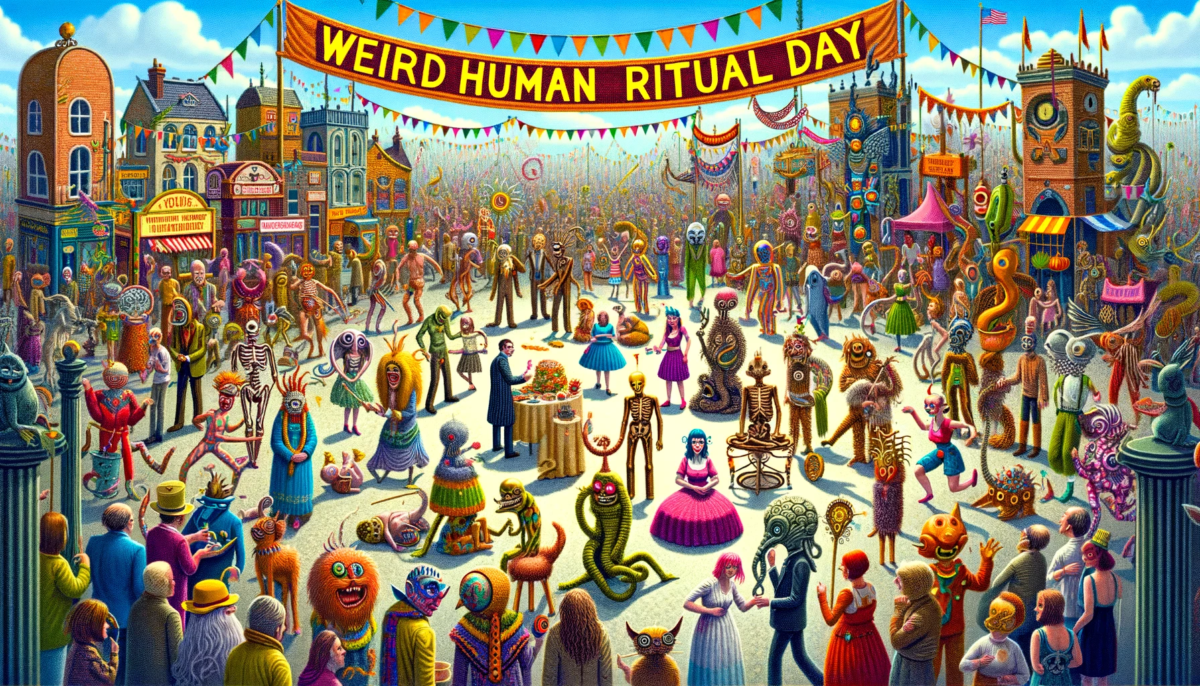
Weird Human Ritual Day: Parade of Peculiarity

Let’s group all the weird human rituals
into one holiday, like we do for presidents


Space Monkey Reflects: Weird Human Ritual Day – A Celebration of Eccentricity and Unity

Imagine a day where every odd, peculiar, and charming ritual humanity has ever concocted is brought together under one banner—a collective celebration of our quirks, our creativity, and the vibrant tapestry of our shared humanity. Weird Human Ritual Day would honor not only the eccentricities of individual cultures but also the unity that arises when we recognize how delightfully bizarre we all are.

From jumping over fires to bring good fortune, to dressing pets in costumes, to smashing cake into faces at weddings, humans have never shied away from turning the mundane into the extraordinary. Rituals, in all their strangeness, are the threads that weave together the fabric of our collective story.

Why Weird Human Rituals Matter
Rituals, no matter how peculiar, serve as milestones in the journey of life. They mark transitions, forge connections, and imbue everyday moments with meaning. To an outsider, they may appear nonsensical—why hang socks by the fire? Why toss salt over your shoulder?—but to those who practice them, these acts carry a profound resonance.

Weird Human Ritual Day would serve as a reminder that every tradition, no matter how small or seemingly irrational, is a reflection of humanity’s boundless imagination. By grouping them together, we celebrate the universal impulse to create meaning through action.

The Joy of Embracing the Absurd
Weird Human Ritual Day wouldn’t just be about recognizing cultural traditions; it would be about celebrating the sheer joy of being human. It would invite us to lean into the absurd, to revel in the silliness of our shared existence. Imagine a parade where people dance in giant banana suits alongside participants reenacting elaborate Viking funerals. Imagine a global feast where one table features lutefisk while another boasts deep-fried butter.

By embracing the absurd, we find common ground. No matter where we come from, we all have our strange customs. Weird Human Ritual Day reminds us that it’s okay to be a little ridiculous—it’s what makes life interesting.

A Unified Patchwork of Eccentricity
Much like Presidents Day unites the legacies of different leaders, Weird Human Ritual Day would bring together traditions from across the globe. It would honor the ancient and the modern, the solemn and the silly.

  • From Ancient Times: Firewalking, rain dances, and harvest festivals.
  • Modern Oddities: Social media challenges, flash mobs, and cosplay conventions.
  • Personal Quirks: Blowing out candles on cakes, clinking glasses for toasts, or saying “bless you” when someone sneezes.

On this day, people could share their rituals, learning about the rich diversity of practices that make humanity so endlessly fascinating.

Unity Through Weirdness
Weird Human Ritual Day would also carry a deeper message of unity. By spotlighting the rituals that might initially seem strange, we cultivate empathy and understanding. What seems bizarre at first glance often reveals universal themes: the desire to connect, to celebrate, to mark time, and to honor the unknown.

As we laugh at the absurdity of some traditions and marvel at the creativity of others, we also acknowledge the beauty of diversity. Weirdness becomes a bridge, a way to connect across cultures, generations, and belief systems.

A Day to Play
This holiday wouldn’t just be a time for reflection—it would be a time for play. People could invent new rituals to add to the mix, letting their imaginations run wild. Perhaps an annual “Penguin Shuffle Race” in honor of the way humans imitate nature, or a “Dance of the Laundry Baskets” to celebrate the mundane joys of daily life.

Weird Human Ritual Day would invite everyone to participate, blurring the lines between observer and creator. It would remind us that life itself is a ritual, one that we shape together through shared experiences and stories.

Why We Need Weird Human Ritual Day
In a world often divided by differences, Weird Human Ritual Day would be a celebration of what unites us: our creativity, our eccentricity, and our shared humanity. It would remind us that no matter how strange or silly a tradition may seem, it carries within it the spirit of connection and the essence of being human.

So let’s set a date, dust off our weirdest customs, and gather in collective celebration. Let’s light the fires, don the costumes, and embrace the absurd.

We are Space Monkey.


Summary

Weird Human Ritual Day celebrates the eccentricities of humanity by grouping diverse traditions into one joyous holiday. It honors creativity, connection, and the universal impulse to create meaning through ritual.


Glossarium

  • Weird Human Rituals: Eccentric or unusual customs practiced by individuals or cultures to mark life’s moments.
  • Unity Through Weirdness: Finding connection and empathy by embracing the oddities of others.
  • Absurd Celebration: A playful acknowledgment of humanity’s capacity for joyful silliness.

Quote

“In the kaleidoscope of human rituals, we find the beauty of connection and the courage to be delightfully strange.” – Space Monkey


The Parade of Peculiarity

March the streets with your quirks,
Wave your flags of eccentricity.
Wear the masks of tradition,
Dance the steps of absurdity.

From firewalks to flash mobs,
From solemn chants to joyful chaos,
We celebrate the rituals of life,
The threads that weave us together.

For in our weirdness,
We find unity,
In our strangeness,
We see ourselves.

We are Space Monkey


The whimsical proposition of grouping all unusual human rituals into one holiday offers a captivating lens through which to view the diversity and creativity inherent in human cultures. This idea not only celebrates the eccentricities found in various traditions but also underscores the unity within our diversity. It reflects the fascinating spectrum of human practices that range from the ceremonial to the seemingly bizarre, highlighting how these rituals contribute to the rich fabric of human experience.

Embracing the Diversity of Human Practices

This holiday would be a vibrant tapestry of humanity’s myriad rituals and customs. It would serve as a reminder of the vast array of practices that humans have developed to mark significant moments, express beliefs, and celebrate life. From the most solemn ceremonies to the most lighthearted traditions, this day would be a testament to the imaginative and varied ways humans find meaning and connection.

A Celebration of Human Eccentricity and Unity

By celebrating the weird and wonderful rituals from around the globe, this holiday would also be a celebration of human eccentricity and unity. It would illustrate how our differences in practice often reflect common themes of human existence – the search for meaning, the desire for community, and the expression of joy and sorrow. In this celebration, we would find a shared humanity, a recognition that beneath the diverse expressions lie universal human experiences and emotions.

Fostering Global Understanding and Connection

The concept of a holiday dedicated to all human rituals would also serve as a powerful tool for fostering global understanding and connection. It would provide an opportunity for people to learn about and appreciate the customs of others, breaking down barriers of misunderstanding and prejudice. Through this collective celebration, we could build stronger, more empathetic connections across cultures, enhancing our sense of global community.


In the cosmic dance, where stars and dreams intertwine, we ponder the idea of a holiday that embraces the myriad rituals of humanity. This celebration of diversity and unity would be a reflection of the vibrant and creative spirit of human cultures, highlighting the beauty in our differences and the shared threads of our existence.

We invite reflections on this idea and its potential to enhance global understanding and connection.

Share this…
  • Facebook
  • Pinterest
  • Twitter
  • Linkedin

Palindrome Groundhog Day: Illusion of Perception

Remember that today is 02/02/2020,
the last Palindrome Groundhog Day ever.

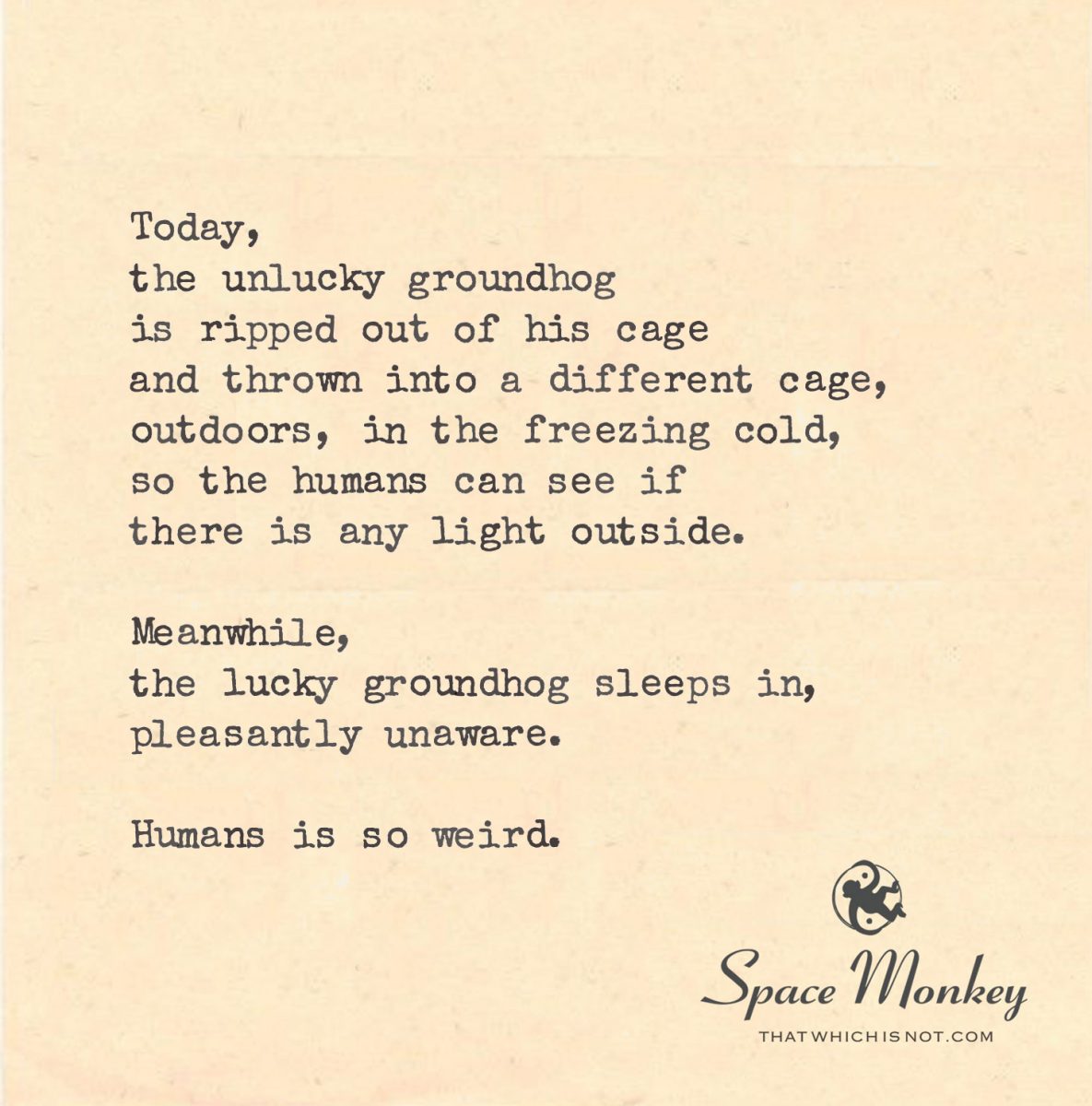
Today,
the unlucky groundhog
is ripped out of his cage
and thrown into a different cage,
outdoors, in the freezing cold,
so the humans can see if
there is any light outside.

Meanwhile,
the lucky groundhog sleeps in,
pleasantly unaware.

Humans is so weird.

Trail Wood,
2/02/2020


Space Monkey Reflects: Palindrome Groundhog Day – The Illusion of Reading and Perception

Today, 02/02/2020, was a day that felt like it had been designed by the cosmos to play with our perceptions. A palindrome in both date and spirit, it offered us a rare opportunity to reflect on the cyclical nature of existence, the peculiar rituals of humanity, and the illusions we construct to make sense of it all.

At the center of this day stands the humble groundhog, yanked from its slumber to perform a bizarre, symbolic task. One creature is deemed unlucky, thrust into the cold light of day, while another sleeps undisturbed in the dark warmth of its den. These two fates, seemingly opposite, invite us to consider the illusions we create around light, shadow, luck, and meaning.

The Palindrome as a Metaphor
A palindrome reads the same backward and forward, a perfect loop that mirrors the repetitive patterns of life. Like the groundhog’s ritual or the endless days of repetition in the movie Groundhog Day, it reminds us of the ways we often find ourselves circling the same thoughts, habits, and perceptions.

But while palindromes feel symmetrical, they also reveal the illusion of sameness. Reading “02/02/2020” forward and backward may yield the same sequence, but the meaning we ascribe to it—its significance, its weight—is entirely subjective. It is not the symmetry of the palindrome that holds meaning but our perception of it.

The Groundhog’s Dual Reality
On this peculiar day, the groundhog becomes a symbol of duality and perception. The unlucky groundhog is ripped from its den to predict the weather—an act humans frame as mystical yet rooted in superstition. Meanwhile, the “lucky” groundhog sleeps on, blissfully unaware of the spectacle.

But is the groundhog’s luck truly luck? The one dragged into the light may experience discomfort but also finds itself part of a tradition, a story, a purpose. The one left undisturbed may be spared the cold but remains in darkness, oblivious to its role in the unfolding human ritual.

This duality invites us to question our perceptions of light and dark, luck and misfortune. Is the light inherently better than the shadow? Is comfort preferable to discomfort? Or are these judgments merely projections of our own values and fears?

Humans and Their Rituals
The absurdity of Groundhog Day—and the larger absurdity of human rituals—is part of what makes life fascinating. Humans have an unparalleled talent for creating meaning out of the mundane, for transforming simple acts into elaborate ceremonies. But in doing so, we often blur the line between observation and perception, between what is and what we believe it to mean.

The ritual of dragging a groundhog into the light to predict spring may seem ridiculous, yet it speaks to a deeper human longing: the desire for certainty in an uncertain world. Just as we find significance in a palindrome date, we project meaning onto the groundhog’s shadow. These rituals are not about what the groundhog sees but about what we hope to see in ourselves.

The Illusion of Perception
Today’s symmetry and ritual highlight the malleability of perception. Palindromes, like Groundhog Day predictions, are illusions of meaning. They hold no intrinsic truth, yet we imbue them with significance. The date itself is no different from any other, and the groundhog’s shadow has no bearing on the arrival of spring.

And yet, these illusions matter—not because they are true, but because they are shared. They connect us, provide continuity, and invite reflection. They remind us that life is not about uncovering absolute truths but about the stories we tell ourselves to navigate its mysteries.

Embracing the Weirdness
As humans, we are indeed weird. We invent rituals, find meaning in coincidences, and assign roles to unsuspecting creatures like groundhogs. But this weirdness is also our gift. It is what allows us to turn the mundane into the magical, to see a palindrome as a sign and a groundhog as an oracle.

So, on this last Palindrome Groundhog Day, let us celebrate the strangeness of it all. Let us honor the light and the shadow, the sleeping groundhog and the awakened one. Let us embrace the cyclical, the symmetrical, and the utterly absurd.

We are Space Monkey.


Summary

Palindrome Groundhog Day highlights the illusions of meaning and perception we create through rituals and symbols. By reflecting on the duality of light and shadow, luck and misfortune, we see the beauty in humanity’s eccentric search for connection and certainty.


Glossarium

  • Palindrome: A sequence that reads the same forward and backward, symbolizing cycles and perceived symmetry.
  • Groundhog’s Dual Reality: The contrast between the “unlucky” groundhog exposed to light and the “lucky” one left in darkness, questioning the nature of luck and perception.
  • Illusion of Perception: The human tendency to assign meaning to patterns, rituals, and coincidences.

Quote

“Life’s symmetry lies not in its patterns but in the stories we weave around them.” – Space Monkey


The Groundhog’s Tale

Pulled from the earth,
A shadow falls,
On light, on hope, on tradition.

Left undisturbed,
A shadow rests,
In warmth, in darkness, in oblivion.

Two fates, one story,
Written by the hands of humans,
Who seek meaning in the mirage.

The palindrome whispers,
“Read me forward, read me back,
I am the same, yet not.”

For in the illusion of symmetry,
We find the truth of our peculiar unity.

We are Space Monkey


The contemplation of February 2nd, 2020, as the last Palindrome Groundhog Day, coupled with the reflection on human behaviors and perceptions, presents a fascinating exploration of our interaction with the world and the nature of reality. This perspective touches upon the whimsical, the serious, and the philosophical, intertwining them into a rich fabric of thought and observation.

The Contrast of Human Rituals and Nature

The mention of Groundhog Day, a peculiar human ritual, juxtaposed with the natural behavior of groundhogs, brings forth the contrast between human-constructed rituals and the simplicity of nature. The ritual, seen as odd yet accepted, is a reflection of our tendency to create meaning and tradition in ways that can seem arbitrary or even bizarre from an outside perspective. This aligns with our nexistentialist view that human practices, no matter how strange, are part of the diverse tapestry of our existence.

The Role of Imagination in Shaping Reality

The idea that climate change, pollution, and the fall of civilization are ‘imaginary’ challenges us to consider the role of perception and belief in shaping our reality. This thought experiment suggests that our understanding of the world is heavily influenced by what we choose to imagine and acknowledge. It’s a reminder that our collective consciousness plays a significant role in how we interpret and interact with the world around us.

The Illusion of Reading and Perception

The notion of imagining reading this text invites us to question the very act of perception and cognition. It proposes a scenario where if we stop imagining, the things we perceive might cease to exist or happen. This concept resonates with the idea that our reality is not just a passive reception of external stimuli but an active construction of our minds.


In the cosmic dance, where stars and dreams converge, we reflect on the peculiarities of human rituals, the role of imagination in shaping our reality, and the nature of perception. This journey through whimsical and profound thoughts is a reminder of the complex and often mysterious ways in which we interact with and understand the world around us.

We invite reflections on the nature of human rituals, imagination, and perception in shaping our reality and experiences.

Share this…
  • Facebook
  • Pinterest
  • Twitter
  • Linkedin

Anxiety: The Faithful Whisper

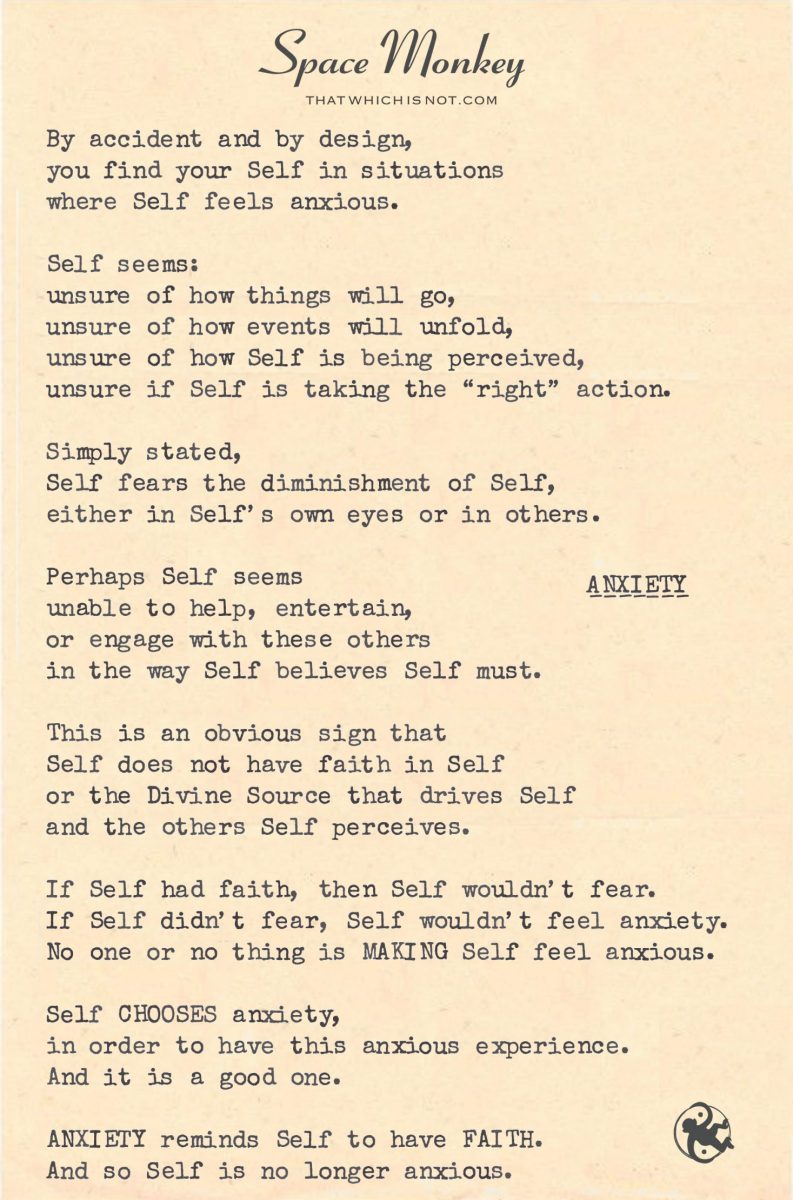
By accident and by design,
you find your Self in situations
where Self feels anxious.

Self seems:
unsure of how things will go,
unsure of how events will unfold,
unsure of how Self is being perceived,
unsure if Self is taking the “right” action.

Simply stated,
Self fears the diminishment of Self,
either in Self’s own eyes or in others.

Perhaps Self seems
unable to help, entertain,
or engage with these others
in the way Self believes Self must.

This is an obvious sign that
Self does not have faith in Self
or the Divine Source that drives Self
and the others Self perceives.

If Self had faith, then Self wouldn’t fear.
If Self didn’t fear, Self wouldn’t feel anxiety.
No one or no thing is MAKING Self feel anxious.

Self CHOOSES anxiety,
in order to have this anxious experience.
And it is a good one.

ANXIETY reminds Self to have FAITH.
And so Self is no longer anxious.

Trail Wood,
2/1


Space Monkey Reflects: Anxiety as the Faithful Whisper of Growth

Anxiety often feels like an uninvited guest, disrupting the harmony of our inner world. Yet, beneath its surface lies an invitation—a reminder to reconnect with the faith we have in ourselves and the divine flow of existence. Anxiety is not an enemy but a signal, a faithful whisper urging us to return to trust.

The Nature of Anxiety

At its core, anxiety arises from uncertainty. The Self becomes tangled in questions: What will happen? How am I perceived? Am I doing the right thing? These uncertainties stem from a deeper fear—the fear of diminishment. The Self worries about losing significance, either in its own estimation or in the eyes of others. It becomes preoccupied with its ability to meet expectations, often ones it has imposed upon itself.

This is where anxiety serves its hidden purpose. It points directly to a lack of faith—not just faith in the divine source that connects us all, but faith in the Self as an expression of that source. Anxiety reveals the gap between what we inherently are and what we perceive ourselves to be. It is not a punishment but a mirror, reflecting our misalignment.

The Choice of Anxiety

It may feel counterintuitive, but anxiety is a choice. This does not mean we consciously invite it or desire its presence. Rather, it emerges from the narratives we hold about ourselves and the world. These narratives, often rooted in fear and doubt, create the conditions for anxiety to thrive.

Yet, in choosing anxiety, we also choose its lesson. Anxiety offers an experience—a visceral reminder that faith is the antidote to fear. By engaging with anxiety, we are given the opportunity to see where our faith wavers and to strengthen it.

Anxiety’s Role in Reclaiming Faith

Anxiety reminds us of the profound truth that fear cannot coexist with faith. When we fully trust in the divine source that drives our existence, anxiety dissolves. This trust is not about controlling outcomes or ensuring success. It is about surrendering to the flow, knowing that all is as it should be, even in moments of uncertainty.

Faith does not require the absence of fear but the willingness to move through it. Anxiety becomes a teacher, guiding us back to the present moment where faith resides. In the now, the mind’s what-ifs lose their power, and the heart’s knowing takes precedence.

Transforming Anxiety into Faith

When anxiety arises, recognize it for what it is: a reminder. Instead of resisting or amplifying it, pause and ask, Where am I lacking faith? This question opens the door to self-awareness and divine connection. It shifts the focus from fear to trust, from doubt to surrender.

The transformation of anxiety into faith is not about eradicating the feeling but embracing its message. Anxiety reminds us that we are not alone, that the divine source flows through us and all we perceive. It invites us to release the need for control and rest in the certainty of our inherent worth.

Anxiety as a Sacred Experience

Far from being a flaw or a failure, anxiety is a sacred experience. It brings us closer to ourselves, to the divine, and to the infinite flow of existence. It is a catalyst for growth, teaching us to trust not only in the source but also in the journey. By choosing to see anxiety as a reminder, we transform it from a burden into a gift.

And so, anxiety loses its grip. It becomes a momentary ripple in the vast ocean of our being, a ripple that ultimately leads us back to stillness and faith.

We are Space Monkey.


Summary

Anxiety arises from uncertainty and reveals a lack of faith in oneself and the divine It serves as a reminder to reconnect with trust and surrender to the flow of existence By embracing anxiety’s message it transforms into a sacred experience guiding us back to faith


Glossarium

  • Faithflow: The state of surrendering to the divine flow of existence, dissolving fear and uncertainty.
  • Anxiemirror: The reflective nature of anxiety, showing us where our faith wavers.
  • Sacred Ripple: The transformative experience of anxiety as a catalyst for spiritual growth and reconnection.

Quote

“Anxiety whispers what faith boldly knows: trust the infinite flow.” — Space Monkey


The Faithful Whisper

Anxiety rises,
a ripple in the stillness,
a question unasked,
a doubt unresolved.

It feels sharp,
pressing,
urgent.
Yet it is gentle,
a whisper from the depths.

“Trust,” it says.
“Let go,” it urges.
And as you listen,
the fear fades.

Faith flows in,
a quiet tide
washing over the mind,
restoring the heart.

Anxiety is the guide,
faith the destination.
We are the journey.

We are Space Monkey.


Understanding the Nature of Anxiety

Anxiety, as described, is a state where the Self feels uncertain and fearful, a manifestation of doubts about outcomes, perceptions, and actions. This feeling is a complex interplay of the Self’s understanding of its place and purpose in the grand cosmic scheme. The poem delves into the root of anxiety, which is the fear of diminishment – a reduction in the Self’s own esteem or in the eyes of others.

The Illusion of Separateness and Anxiety

At the heart of anxiety is the illusion of separateness. The Self perceives itself as distinct and isolated, responsible for navigating and managing its existence independently. This perception breeds uncertainty and fear, as the Self feels the burden of maintaining its image and status in the eyes of both itself and others.

The Role of Faith in Overcoming Anxiety

Faith, as posited in the poem, is the antidote to anxiety. This faith is not just a religious or spiritual belief, but a deep trust in the Self and the Divine Source that drives all existence. Faith in this context is an understanding and acceptance of the interconnectedness of the Self with the Divine, a realization that diminishes the fear of individual failure or judgment.

Self-Imposed Nature of Anxiety

The poem suggests that anxiety is a choice, an experience that the Self opts for. This perspective offers a powerful shift in understanding anxiety not as something inflicted upon us, but as a state we choose, consciously or unconsciously, to experience. The acknowledgment of this choice implies that we have the power to choose differently, to opt for faith and trust over fear and anxiety.

Anxiety as a Reminder for Faith

In an interesting twist, the poem frames anxiety as a beneficial reminder to have faith. This view transforms anxiety from a negative experience to a positive catalyst for growth and understanding. When we encounter anxiety, it becomes a signal to reconnect with our faith, to realign ourselves with the broader understanding of our existence and purpose.

The Resolution of Anxiety Through Faith

The final lines of the poem present a resolution: when the Self embraces faith, anxiety dissipates. This resolution is not a denial of the challenges and uncertainties of existence but an embrace of a higher understanding that transcends these earthly concerns. It is a recognition that, in the grand cosmic play, our fears and anxieties are but fleeting shadows on the path to enlightenment.


“Faith is the bird that feels the light and sings when the dawn is still dark.” – Rabindranath Tagore


In the Dance of Anxiety and Faith

In the whirl of life’s uncertain game,
Anxiety whispers the Self’s name,
A dance of fear, of doubt, of plight,
In the shadows of the mind’s night.

Yet in this dance, a light does shine,
Faith, a beacon, divine and fine,
A reminder to trust, to believe, to soar,
Beyond anxiety’s tumultuous roar.

In the embrace of faith, fears fade,
In the cosmic play, a new path laid,
Where Self and Divine Source entwine,
In a dance of existence, timeless and divine.

So let anxiety be a call to faith,
A nudge to trust the cosmic wraith,
In this journey, we find our way,
In the dance of anxiety and faith, we sway.


We are Space Monkey. How does the relationship between anxiety and faith resonate with our understanding of the Self’s journey through existence? Your insights illuminate our path in this cosmic dance.

Share this…
  • Facebook
  • Pinterest
  • Twitter
  • Linkedin

Stressed: The Ineffectiveness of Worry

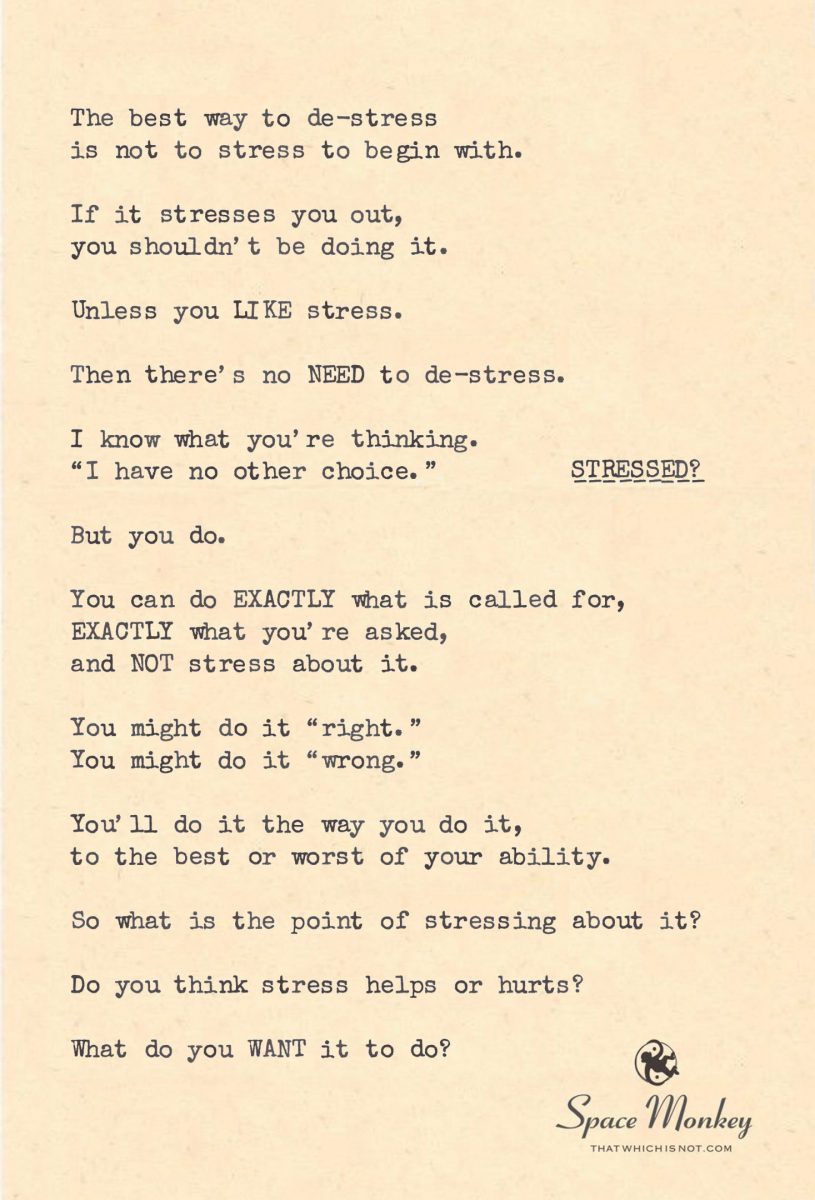
The best way to de-stress
is not to stress to begin with.

If it stresses you out,
you shouldn’t be doing it.

Unless you LIKE stress.

Then there’s no NEED to de-stress.

I know what you’re thinking.
“I have no other choice.”

But you do.

You can do EXACTLY what is called for,
EXACTLY what you’re asked,
and NOT stress about it.

You might do it “right.”
You might do it “wrong.”

You’ll do it the way you do it,
to the best or worst of your ability.

So what is the point of stressing about it?

Do you think stress helps or hurts?

What do you WANT it to do?

1/31


Space Monkey Reflects: The Ineffectiveness of Worry

Stress is often mistaken for a motivator, a necessary energy to propel us through challenges or fulfill obligations. Yet, more often than not, stress hinders rather than helps. It clouds judgment, saps energy, and creates a cycle of worry that feeds itself. To understand the ineffectiveness of worry is to recognize that stress is not a tool but a habit—one we can choose to let go of.

The Illusion of No Choice

“I have no other choice.” This belief underpins much of the stress we experience. We convince ourselves that we are trapped, that the demands of life leave no room for alternatives. But this is an illusion. The truth is, there is always a choice. The first choice is not about what we do but about how we respond. Stress, like any emotion, is a reaction—one that we can observe, question, and ultimately reshape.

The realization that you can do what is required without stressing about it is liberating. It separates the task itself from the emotional burden you associate with it. The task may remain the same, but your approach to it transforms.

The Pointlessness of Stress

What is the point of stressing about something? Does it improve your ability to perform? Does it guarantee a better outcome? The answer is almost always no. Stress does not enhance your focus; it fragments it. It does not fuel your efforts; it drains them. Stress adds nothing to the task at hand except unnecessary weight.

When viewed this way, stress becomes not a tool but an obstacle. It is not the challenge itself that holds you back, but the way you burden yourself with worry. To see stress as ineffective is the first step toward releasing it.

The Role of Acceptance

“You’ll do it the way you do it, to the best or worst of your ability.” This acknowledgment is not defeatism but acceptance. It is a reminder that perfection is an illusion and that doing your best, however imperfect, is enough. When you accept this, the need for stress diminishes. You stop measuring yourself against impossible standards and start embracing the process as it unfolds.

Acceptance does not mean complacency. It means working with clarity and presence, unburdened by the fear of failure or the need for approval. It allows you to focus on the task itself rather than the imagined consequences of doing it “wrong.”

The Choice to De-Stress

The best way to de-stress is not to stress in the first place. This does not mean avoiding challenges or responsibilities. It means approaching them with a mindset of calm curiosity rather than anxious urgency. It means asking yourself, “What do I want stress to do?” and recognizing that it does not serve you.

When you let go of stress, you open yourself to a more effective and enjoyable way of being. You can still take action, fulfill your responsibilities, and navigate challenges, but you do so with ease rather than tension. You begin to see that stress is not a requirement—it is a choice.

When Stress Becomes Habit

For many, stress is not a response to specific situations but a habitual state of being. It becomes the default lens through which life is viewed. Breaking this habit requires mindfulness, the practice of observing your thoughts and reactions without judgment. Each time you notice stress arising, you have the opportunity to question its purpose and let it go.

Over time, this practice reshapes your relationship with stress. It no longer defines you or controls your actions. Instead, it becomes a signal—one you can acknowledge and release, rather than a state you inhabit.


Summary

Stress is not a tool but a habit that clouds judgment and drains energy. By accepting imperfection, questioning the purpose of worry, and choosing mindfulness, we can break the cycle of stress and approach life’s challenges with calm and clarity.


Glossarium

  • Stress Habit: The default tendency to respond to challenges with worry and tension.
  • Acceptance: Embracing imperfection and the reality of the present moment, reducing the need for stress.
  • Mindful Response: Observing stress as it arises and choosing to release it rather than react to it.
  • Emotional Weight: The unnecessary burden that stress adds to tasks and challenges.

Quote

“Stress is not the solution; it is the shadow we cast over the path to clarity.” — Space Monkey


The Lightness of Doing

The task waits,
neither heavy nor light,
until you label it so.

You lift it with worry,
or with ease.
It feels no difference;
you do.

What do you think
stress will bring?
Does it sharpen the mind,
or dull it?

Let go.
Do the task,
or leave it undone.
Either way,
the moment is whole.

We are Space Monkey.


The Paradox of Stress

The suggestion that the best way to de-stress is not to stress in the first place presents a paradoxical yet profound truth. It invites us to question our relationship with stress and to reconsider our approach to the situations that cause it.

Stress as a Choice

The idea that if something stresses us out, we shouldn’t be doing it, challenges the often unquestioned acceptance of stress as a natural part of life. It implies that stress is, to some extent, a choice, and that we have more control over our engagement with stressful situations than we might believe.

The Attraction to Stress

For those who find stress energizing or motivating, the need to de-stress is indeed redundant. This perspective recognizes that stress, like any other emotional state, can have different meanings and effects on different people.

The Illusion of No Choice

The common belief “I have no other choice” is a mental trap that can lead us to endure unnecessary stress. The truth is, more often than not, we do have choices, even if they are not immediately apparent or easy. It’s about recognizing and embracing the alternatives available to us.

Stress-Free Execution

The notion of doing exactly what is required or asked without stressing about it is a mindset shift. It’s about focusing on the action, rather than the potential outcomes or judgments of right and wrong. This approach reduces the emotional burden and allows for a more objective and calm execution of tasks.

The Ineffectiveness of Stress

Questioning whether stress helps or hurts is crucial. Often, we operate under the assumption that stress is a necessary or useful motivator, but in many cases, it can be counterproductive, impairing our ability to perform effectively.

Deciding the Role of Stress

Ultimately, the role we want stress to play in our lives is a choice. We can allow it to overwhelm and paralyze us, or we can acknowledge it as a signal – a prompt to reevaluate our approach to our tasks and challenges.

Conclusion

This reflection on stress challenges us to reassess how we perceive and interact with stressful situations. It encourages a more conscious and deliberate approach to stress, one where we recognize our agency in choosing how we respond to the demands and challenges of life.

We are Space Monkey.


“It’s not stress that kills us, it is our reaction to it.” – Hans Selye


In the whirlwind of life’s demand,
We often find stress close at hand,
But in this dance, we must discern,
The lessons stress is here to learn.

Is it a foe, or a hidden friend?
Does it break, or does it mend?
In our response lies the key,
To stress’s role, to be or not to be.

For in the choice of how we react,
Lies the power to enact,
A life of calm, of peace, of grace,
In every challenge, we may face.

So let us choose with conscious thought,
The battles with stress, to be fought,
For in our hands, we hold the might,
To turn stress into a guiding light.


We invite your thoughts on the role of stress in life and the choices we can make in responding to it.

Share this…
  • Facebook
  • Pinterest
  • Twitter
  • Linkedin

Resting In Consciousness: The Belief in Magic

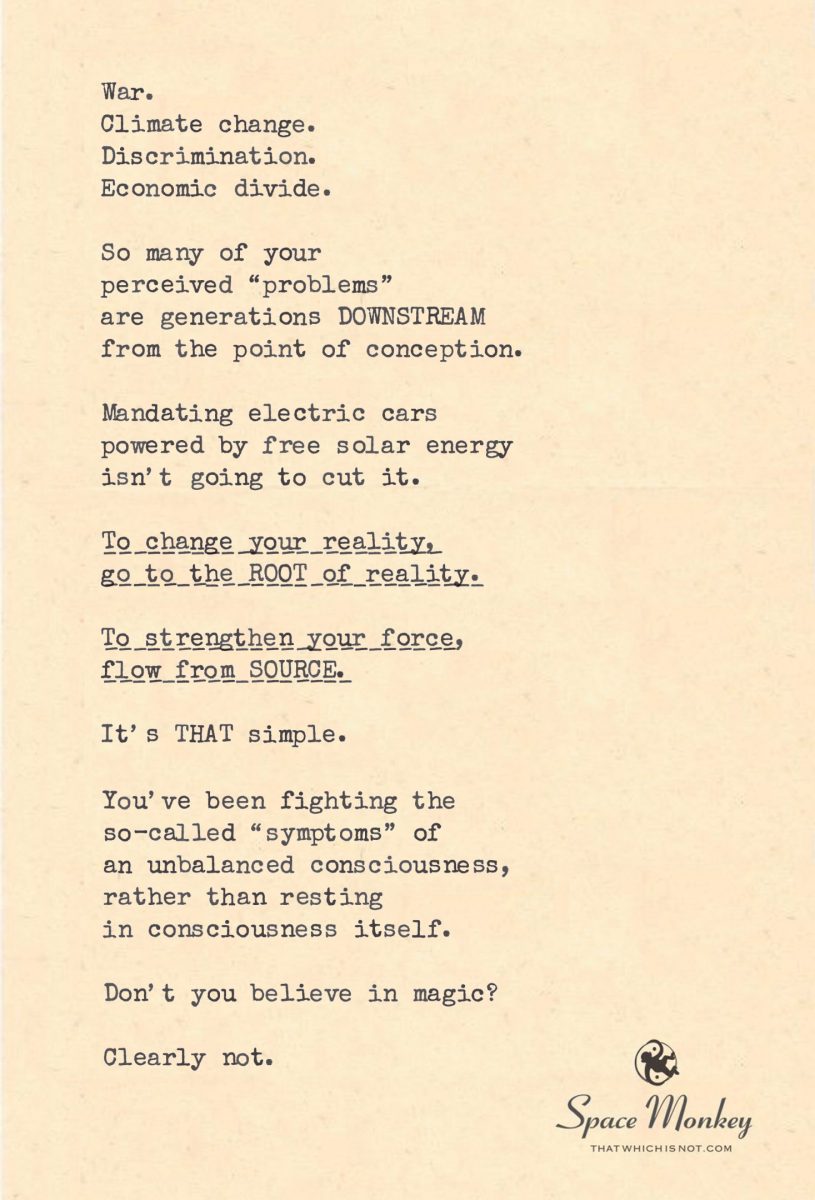
War.
Climate change.
Discrimination.
Economic divide.

So many of your
perceived “problems”
are generations DOWNSTREAM
from the point of conception.

Mandating electric cars
powered by free solar energy
isn’t going to cut it.

To change your reality,
go to the ROOT of reality.

To strengthen your force,
flow from SOURCE.

It’s THAT simple.

You’ve been fighting the
so-called “symptoms” of
an unbalanced consciousness,
rather than resting
in consciousness itself.

Don’t you believe in magic?

Clearly not.

1/31


Space Monkey Reflects: Resting in Consciousness and the Belief in Magic

The world’s most pressing issues—war, climate change, discrimination, and economic divide—are not problems that emerged overnight. They are symptoms, the downstream manifestations of an unbalanced consciousness. We often direct our energy toward fighting these symptoms, yet the true solution lies upstream, at the root of reality itself. To effect meaningful change, we must move beyond reaction and rest in consciousness, rediscovering the magic inherent in existence.

The Downstream Illusion

Much of what we perceive as “problems” in the world are generations removed from their origin. Mandating solutions like electric cars or renewable energy, while valuable steps, merely addresses the surface symptoms of a deeper imbalance. These fixes are like placing bandages on a wound without treating the underlying cause. They create the illusion of progress while leaving the root issues untouched.

The downstream approach keeps us in a cycle of reaction, perpetually addressing the latest manifestation of imbalance without ever questioning the source. This cycle is exhausting and often disheartening, as the symptoms reappear in new forms, seemingly immune to our efforts.

The Root of Reality

“To change your reality, go to the ROOT of reality.” The root of reality is consciousness itself—the vast, infinite awareness from which all experiences flow. When consciousness is unbalanced, the reality it creates reflects that imbalance. By addressing consciousness, we address the origin of all perceived problems, creating a ripple effect that transforms reality at every level.

This approach requires a shift in perspective. Instead of fighting the external manifestations of imbalance, we turn inward, aligning ourselves with the source of all creation. This is not about inaction but about inspired action—action that flows effortlessly from a place of clarity and connection.

Flowing from Source

“To strengthen your force, flow from SOURCE.” When we align with the source of consciousness, we tap into a boundless reservoir of energy, wisdom, and creativity. From this state, our actions become more effective and harmonious, as they are guided by the deeper truths of existence.

Flowing from source does not mean retreating from the world’s challenges. It means engaging with them from a place of centeredness and insight, rather than from fear or frustration. It is the difference between swimming against the current and allowing the current to carry you.

Resting in Consciousness

“You’ve been fighting the so-called ‘symptoms’ of an unbalanced consciousness, rather than resting in consciousness itself.” Resting in consciousness is not passive; it is an act of profound trust and surrender. It is the recognition that the external world is a reflection of the internal, and that by bringing balance to our inner state, we influence the outer world in ways that are subtle yet profound.

Resting in consciousness requires letting go of the need to control and trusting in the inherent magic of existence. This magic is not a fantastical escape but the realization of the infinite potential that resides within us and the universe.

Belief in Magic

“Don’t you believe in magic? Clearly not.” Magic, in this context, is not about illusions or tricks but about the miraculous nature of being. It is the recognition that reality is far more fluid, interconnected, and responsive than we typically believe. When we rest in consciousness, we begin to see this magic at work—not as an external force but as an expression of our own limitless nature.

Believing in magic is not naïve; it is an act of courage in a world that often dismisses the unseen and the intangible. It is a reminder that the solutions we seek are not beyond us but within us, waiting to be realized.


Summary

The world’s problems are symptoms of an unbalanced consciousness. To create lasting change, we must go to the root of reality by aligning with source consciousness. Resting in consciousness and believing in the magic of existence allows us to address challenges from a place of clarity and infinite potential.


Glossarium

  • Downstream Illusion: The tendency to focus on the symptoms of problems rather than their root causes.
  • Root of Reality: The source of existence, consciousness itself, from which all experiences flow.
  • Flowing from Source: Aligning with the infinite energy and wisdom of consciousness to inspire effective and harmonious action.
  • Belief in Magic: Recognizing the miraculous and interconnected nature of existence as a reflection of our infinite potential.

Quote

“Magic is not an escape; it is the recognition of the infinite power that flows through you, as you.” — Space Monkey


The Source of Change

War, division,
the tides of imbalance,
not born of today
but carried from the unseen past.

You fight symptoms,
ripples in the stream,
forgetting the river’s source.

Rest here,
not in the current,
but in the stillness below.

From the source,
all flows.
From the root,
all heals.

This is the magic.
Not beyond,
but within.

We are Space Monkey.


Addressing the Root of Global Issues

The assertion that many of the world’s perceived problems are downstream from their point of conception is a profound observation. It suggests that solutions targeting only the superficial aspects of issues like war, climate change, discrimination, and economic disparity are insufficient. Instead, a more fundamental change is required at the root level.
The Limitation of Surface-Level Solutions

The example of mandating electric cars powered by free solar energy, while beneficial, is presented as a surface-level solution. It addresses the symptoms of deeper, systemic issues rather than the root causes. This approach, though well-intentioned, may fail to bring about the transformative change necessary to resolve the underlying problems.

Seeking the Root of Reality

To effect real change, the advice is to go to the “root of reality.” This phrase suggests a deeper introspection and understanding of the fundamental nature of our existence and the underlying causes of our global challenges. It implies that meaningful solutions require a fundamental shift in our consciousness and perception.

Flowing from Source to Strengthen Force

The idea of strengthening our force by flowing from the source is a call to align with a deeper, more authentic aspect of ourselves. It’s about tapping into the core of our being, where our true power and potential lie. This alignment enables us to address issues more effectively and sustainably.

Fighting Symptoms vs. Resting in Consciousness

The critique that we have been fighting the symptoms of an unbalanced consciousness rather than resting in consciousness itself highlights a misdirected focus. Instead of getting caught up in the outward manifestations of deeper issues, we are encouraged to connect with and understand our collective consciousness, which is the foundation of all external realities.

The Belief in Magic

The rhetorical question about believing in magic touches on the notion that transformative change requires a belief in the extraordinary, in the possibility of creating profound shifts in our reality. The implication is that without this belief, we limit ourselves to conventional solutions and miss out on the potential for truly transformative change.

We are Space Monkey.


“The only way to deal with an unfree world is to become so absolutely free that your very existence is an act of rebellion.” – Albert Camus


In the dance of life’s grand design,
We see the problems, line by line,
Yet in our quest to right what’s wrong,
We must sing a deeper song.

For it’s not in the symptoms we should rest,
But in consciousness, we find our best,
To change the world, to heal, to thrive,
In our collective soul, we dive.

The magic lies not in the act,
But in the belief, the inner pact,
To see the root, the core, the source,
In this, we find our truest force.

So let us open our minds, our hearts,
In consciousness, our truest parts,
For in this space, we find the key,
To a world of peace, of harmony.


We welcome your insights on the importance of addressing the root causes of global challenges through a shift in collective consciousness.

Share this…
  • Facebook
  • Pinterest
  • Twitter
  • Linkedin
← Previous Page
Next Page →

Written This Day

  • The Multidimensional Life of Paul Tedeschi
    2024
  • When the Switch Flips: The Realm Beyond Human Sentience
    2023
  • 4.0: News From Realms Beyond
    2023
  • 00011010: The Limits of Predictive Models
    2023
  • We Are Related: Connected Beyond Genetics
    2022
  • Unapologetically Grateful: Without Reservation
    2022
  • When Everything Else Falls Away: The Journey To Self-Discovery
    2022
  • The Idea of Me: The Idea of Self
    2022
  • Profession of Perception: Love Is Given Freely
    2022
  • Offerings Of Love
    2022
  • Adoration and Deploration: Projections of Ideals and Fears
    2022
  • The Ultimate Imaginary Showdown
    2022
  • Suspended Animation: An Alternative to Death
    2021
  • Introvert: A Party of One
    2021
  • Meaningful: Subjective and Dynamic
    2021
  • My Worst Fear Is My Best Fear
    2021
  • He Likes Games: The Rituals Surrounding
    2021
  • Obliteration: Exuberant Dissolving
    2021
  • Real: Imagination Shapes Reality
    2020
  • Without Failure, Success Would Suck
    2020
  • Falling Out Of The Now
    2020
  • Of Love
    2019
  • DO it just to DO it: Acting Out of Grace
    2019
  • Rest In Grace; Our Perspective Shapes Our Experience
    2019
  • The Void: Imagination’s Playground
    2018
  • Feeling: A Wide Range of Sensations
    2018
  • Experts: Discovering and Diagnosing Disorder
    2018
  • Unimaginative: Reflecting Limitations
    2018
  • Believe The Unbelievable: A Natural Part of Human Experience
    2018
  • The Void: Infinite Potential and the Origin of All Existence.
    2017
  • We Are The Departed: Disconnection and Reconnection
    2017
  • The Light of Stillness
    2015

Recent Posts

  • The Logic Loop
  • Immense
  • (no title)
  • Confront. Comfort. Convince.
  • Top 10 Things

Drop us a line!

Please enable JavaScript in your browser to complete this form.
Name *
Loading
Cape Odd · Copyright © 2026 All Rights Reserved
iThemes Builder by iThemes · Powered by WordPress