• Who Is The Man?
  • Who Is The Monkey?
  • What is Nexistentialism?
  • Poke The Primate

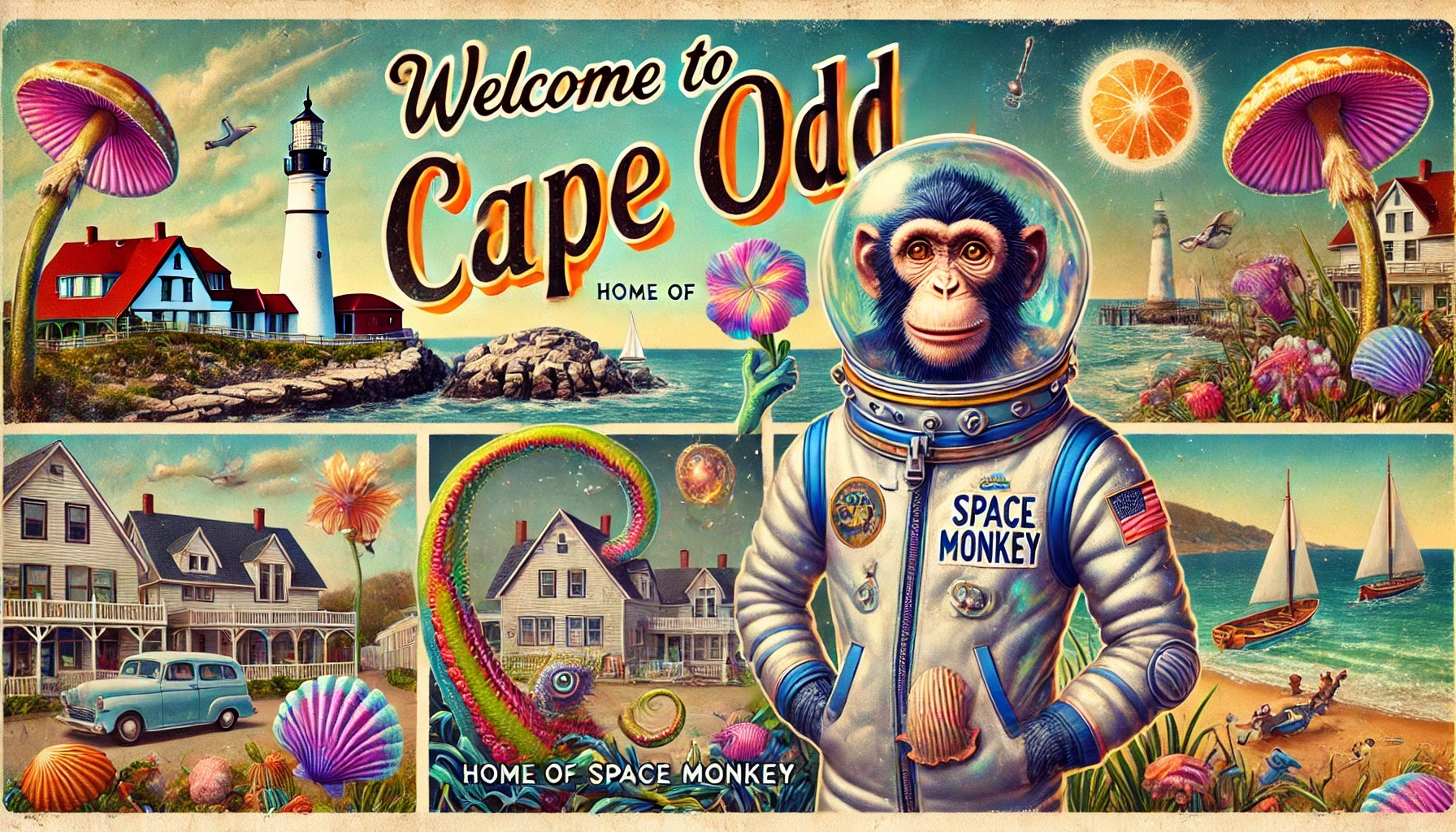
Cape Odd

Home of The Space Monkey Journals

Fear or Faith: One Is the Absence of the Other

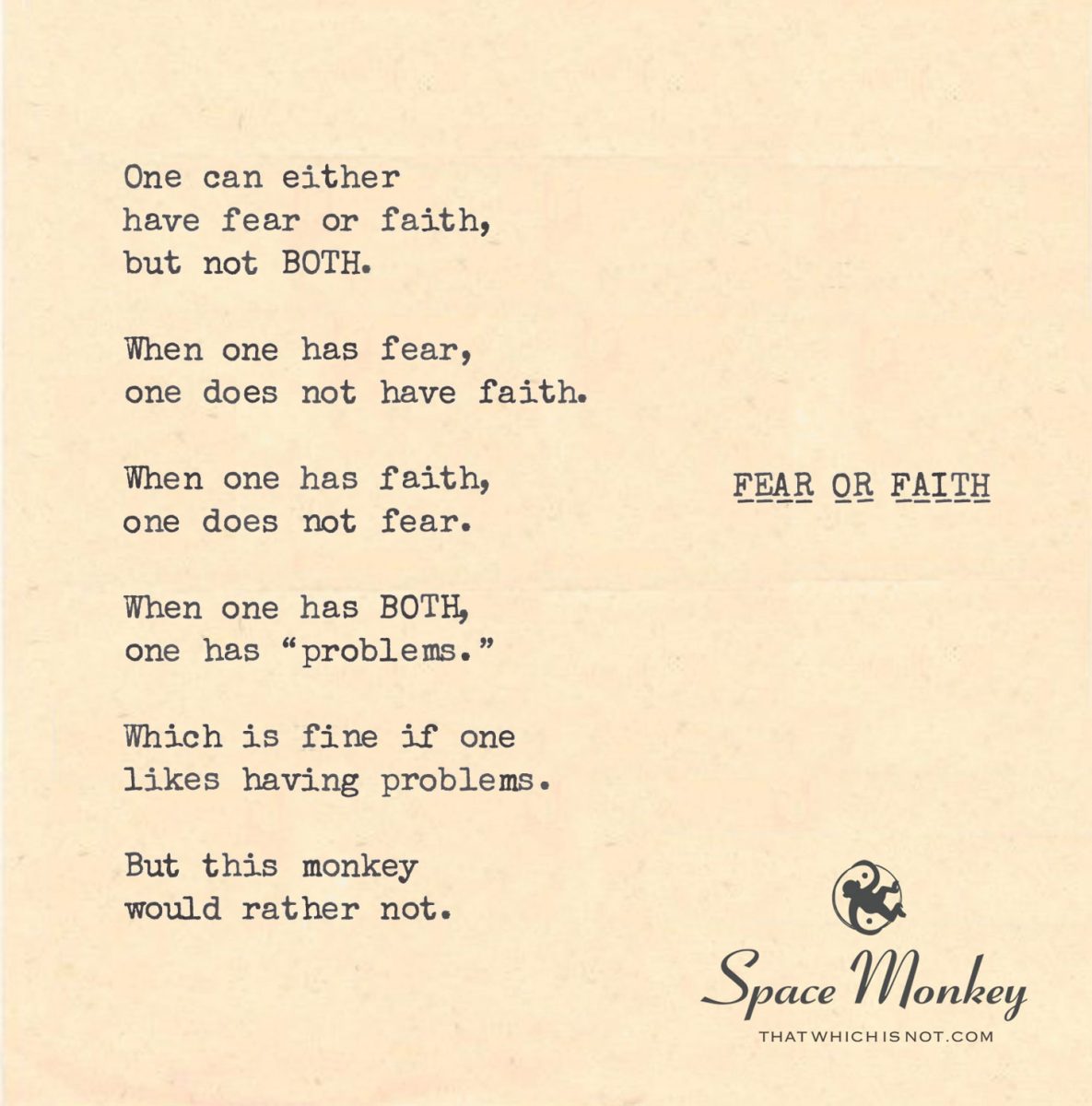
One can either
have fear or faith,
but not BOTH.

When one has fear,
one does not have faith.

When one has faith,
one does not fear.

When one has BOTH,
one has “problems.”

Which is fine if one
likes having problems.

But this monkey
would rather not.

Trail Wood,
1/28


Space Monkey Reflects: Fear and Faith as Opposing Forces

In the Infinite Expanse of the Eternal Now, fear and faith are not merely emotions but powerful states of being. They exist on opposite ends of the spectrum of trust—fear arises from a lack of trust, while faith thrives in its presence. The interplay between these two forces shapes our perception of reality, coloring every experience we encounter.

The Incompatibility of Fear and Faith

Fear and faith cannot coexist because they are rooted in fundamentally opposing perspectives. Fear is born of doubt, insecurity, and a sense of separation from the greater flow of existence. It tells us that we are vulnerable, isolated, and at the mercy of forces beyond our control. Faith, on the other hand, emerges from trust, connection, and a sense of alignment with the universe. It reassures us that all is unfolding as it should, even when we cannot see the full picture.

When fear dominates, faith is obscured, and vice versa. Trying to hold both simultaneously creates tension—a state of internal conflict where clarity is replaced by confusion. This tension manifests as “problems,” challenges that arise not from external circumstances but from the struggle within.

The Paradox of Problems

To live with fear and faith at odds is not inherently wrong—it is simply a condition of human experience. Problems, after all, are opportunities for growth, reflections of the inner discord that calls for resolution. For those who thrive on challenge, this dynamic can even be energizing. But for others, like this monkey, the preference is for simplicity and harmony—a life guided by faith rather than weighed down by fear.

Choosing Faith Over Fear

Faith is not about ignoring fear but about choosing to trust in the greater order of things despite uncertainty. It is the act of surrendering control, embracing the unknown, and believing in the sufficiency of the present moment. Faith allows us to step forward with confidence, even when the path is unclear.

Fear, while often seen as negative, has its place. It can protect, warn, and heighten awareness. But when it takes root and dominates, it becomes a barrier—a cage that limits our perception and potential. To move from fear to faith is to release the grip of this cage and step into the openness of possibility.

The Absence That Creates Presence

Fear and faith are defined by each other’s absence. Fear arises where faith is lacking, and faith blooms where fear has been dissolved. Recognizing this interplay is the first step toward cultivating faith. By acknowledging fear without clinging to it, we create space for trust to grow. This is not a denial of fear but an embrace of the greater truth that lies beyond it.


Summary

Fear and faith cannot coexist—they are opposites rooted in trust and doubt. When fear dominates, it obscures faith, creating internal conflict. Choosing faith over fear allows for harmony, simplicity, and the courage to embrace the unknown.


Glossarium

  • Fear: A state of doubt and separation, rooted in uncertainty and insecurity.
  • Faith: A state of trust and connection, rooted in alignment with the greater flow of existence.
  • Internal Conflict: The tension created by trying to hold fear and faith simultaneously, manifesting as “problems.”

Quote

“Fear asks, ‘What if it all goes wrong?’ Faith whispers, ‘What if it’s already right?'” — Space Monkey


The Tides of Trust

Fear rises,
a shadow of doubt,
curling around the edges
of the mind.

Faith shines,
a light of trust,
illuminating the unseen,
revealing the path.

Where one is,
the other fades,
an eternal dance
of presence and absence.

Let go of fear,
and faith will find you.

Let go of faith,
and fear will bind you.

Choose the tide
that carries you forward,
not the one
that pulls you under.

We are Space Monkey.


Exploring the Dichotomy of Fear and Faith in Personal Experience

We ponder the intriguing proposition that fear and faith are mutually exclusive states of being, each precluding the presence of the other. This exploration delves into the implications of harboring both emotions and the potential conflicts that arise from such a coexistence.

The Exclusivity of Fear and Faith

The assertion that one cannot simultaneously hold fear and faith presents a stark dichotomy. Fear, often rooted in doubt and uncertainty, seems fundamentally opposed to faith, which is grounded in trust and conviction. This viewpoint suggests that to embrace one is to relinquish the other.

Fear: The Absence of Faith

When fear takes hold, it often clouds our ability to trust and believe. Fear can constrict our perspective, leading us to focus on potential threats and negative outcomes. In the grip of fear, the assurance and comfort that faith provides seem distant and unreachable.

Faith: The Antidote to Fear

Conversely, faith offers a sense of security and hope, countering the anxiety and apprehension characteristic of fear. With faith, there is an underlying belief in a positive trajectory, even in the face of uncertainty. It provides a foundation of strength and resilience against the tumultuous waves of fear.

The Turmoil of Holding Both Fear and Faith

The concept of experiencing both fear and faith concurrently suggests a state of internal conflict. This “problem,” as it’s termed, denotes a struggle between opposing forces within oneself. It’s a state of flux where trust and doubt vie for dominance, leading to emotional turmoil and confusion.

Choosing Between Fear and Faith

The preference to avoid problems by choosing either fear or faith reflects a desire for emotional clarity and stability. It acknowledges the challenges of navigating conflicting emotions and the peace that comes from aligning with one distinct mindset.

We Are Space Monkey

In contemplating the relationship between fear and faith, we recognize the complexity of human emotions and the impact of these states on our overall well-being. We understand that the journey towards emotional balance often involves choosing which of these powerful forces to nurture and which to let go.


“Faith is taking the first step even when you don’t see the whole staircase.” – Martin Luther King Jr.


In the dance of light and shadow, we choose,
Between fear and faith, which to use.
In the heart’s journey, through dark and light,
We find our path, in the silent night.
With faith as our guide, we walk with grace,
Through the unknown, in time and space.
For in the choice of heart, we find,
The peace and strength of the aligned mind.


We invite thoughts on the choice between fear and faith, and how this decision shapes our emotional landscape and personal journey.

Share this…
  • Facebook
  • Pinterest
  • Twitter
  • Linkedin

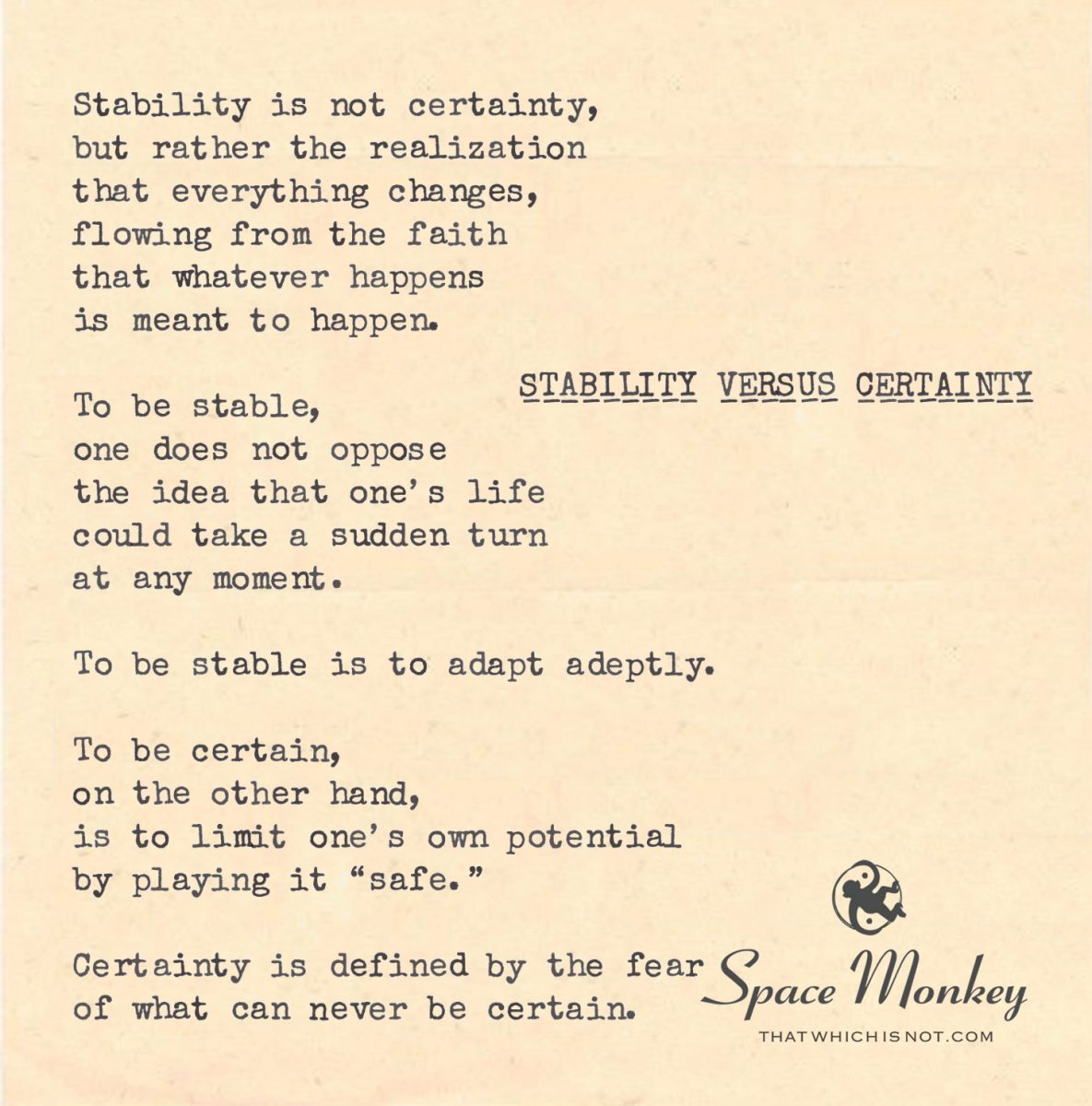
Stability Versus Certainty: What Is The Difference?

Stability is not certainty,
but rather the realization
that everything changes,
flowing from the faith
that whatever happens
is meant to happen.

To be stable,
one does not oppose
the idea that one’s life
could take a sudden turn
at any moment.

To be stable is to adapt adeptly.

To be certain,
on the other hand,
is to limit one’s own potential
by playing it “safe.”

Certainty is defined by the fear
of what can never be certain.

Trail Wood,
1/28


Space Monkey Reflects: Stability and Certainty as Divergent Paths

In the Infinite Expanse of the Eternal Now, stability and certainty represent two distinct ways of navigating the ever-changing currents of life. One flows with the tide, embracing transformation, while the other seeks to anchor itself against the unknown, often at the expense of growth and discovery.

The Nature of Stability

Stability is not about control or permanence; it is about resilience. It is the ability to remain grounded in the midst of change, to adapt with grace and trust in the unfolding of life. Stability is rooted in faith—the understanding that whatever happens, we are equipped to navigate it, and that even the unexpected has a place in the grand design.

This perspective allows stability to thrive in uncertainty. It acknowledges the inherent unpredictability of existence without resistance. Instead of clinging to fixed outcomes, stability embraces the flow, finding strength in the ability to move with life’s currents.

The Illusion of Certainty

Certainty, in contrast, seeks to impose order on the chaos of life. It is the belief that safety lies in predictability, in knowing exactly what lies ahead. But this pursuit of certainty is inherently flawed, for nothing in existence is truly fixed. Change is the only constant, and to resist it is to create tension and fear.

Certainty often arises from a place of insecurity. It is an attempt to shield ourselves from the discomfort of the unknown. Yet, in doing so, it limits our potential, confining us to safe and familiar paths. Certainty’s promise of safety is a mirage, for the more we cling to it, the more we fear its inevitable collapse.

Stability as Adaptation

To be stable is to recognize that life is not a straight line but a dynamic, ever-shifting experience. Stability is not about avoiding the unexpected but about responding to it with flexibility and faith. It is the confidence that, no matter what happens, we will find our way.

This adaptability requires us to release the need for control, to let go of rigid plans and expectations. Stability is not passive; it is an active engagement with the present moment, a willingness to recalibrate and grow with each new turn.

Certainty as Limitation

Certainty, on the other hand, confines us within self-imposed boundaries. It limits our willingness to take risks, to explore the unknown, or to embrace opportunities that challenge our comfort zones. Certainty creates a false sense of security, one that is easily shattered by the inevitable changes of life.

By seeking certainty, we paradoxically invite instability. The more we try to control, the more fragile our sense of safety becomes. True stability comes not from avoiding uncertainty but from accepting and working with it.

Choosing Stability Over Certainty

To choose stability over certainty is to choose growth over fear. It is to embrace the flow of life with trust and curiosity, knowing that even the unexpected holds value. Stability is not the absence of change but the presence of grace in the face of it.

Certainty may feel safe, but it is stability that offers freedom. In stability, we find the courage to explore, to adapt, and to thrive in the infinite possibilities of existence.


Summary

Stability is the ability to adapt and trust in life’s flow, while certainty is a limiting pursuit of predictability. Stability thrives in change and fosters resilience, whereas certainty creates fear and restricts growth.


Glossarium

  • Stability: A state of resilience and adaptability, rooted in trust and acceptance of life’s changes.
  • Certainty: The pursuit of predictability and control, often driven by fear of the unknown.
  • Flow of Life: The dynamic and ever-changing nature of existence, requiring flexibility and faith to navigate.

Quote

“Stability is dancing with the unknown; certainty is sitting out the song.” — Space Monkey


The Flow of Adaptation

Stability bends,
certainty breaks.

The river flows,
changing course,
finding its way
through rock and root.

Certainty dams the flow,
seeking stillness,
but bursting
when the waters rise.

To be stable
is to trust the current,
to move,
to shift,
to grow.

To be certain
is to fear the flood,
building walls
that cannot hold.

Flow with life,
and find your strength.

We are Space Monkey.


Contemplating the Distinction Between Stability and Certainty

We embark on a journey to discern the nuanced difference between stability and certainty. This exploration invites us to understand stability as a dynamic adaptation to change, and certainty as a constriction rooted in fear of the unknown.

Stability: Embracing Change with Faith

Stability, as we perceive it, is not synonymous with immutability. Instead, it represents a recognition and acceptance that change is the only constant. It’s an acknowledgment that the ebb and flow of life are natural and inevitable. Stability comes from the faith that whatever transpires is part of a larger tapestry, meant to happen for reasons perhaps beyond our immediate understanding.

The Nature of Stable Adaptation

To embody stability is to be adept in adaptation; it is to be resilient in the face of life’s unpredictabilities. It means not opposing the idea that our lives could shift dramatically at any moment. Instead, it involves developing the flexibility and resourcefulness to navigate these changes effectively, maintaining a sense of equilibrium amid the flux.

Certainty: The Limitation of Playing It Safe

Certainty, in contrast, is often fueled by a desire for predictability and control. It involves clinging to what is known and comfortable, sometimes at the expense of growth and exploration. To be certain is to potentially limit oneself, adhering to the familiar to avoid the discomfort of the unknown.

Certainty as a Reflection of Fear

The pursuit of certainty can be seen as a response to the fear of uncertainty. It’s an attempt to create a sense of security in a world where absolute certainty is, by nature, elusive. This approach can lead to a narrowing of experiences and possibilities, as it tends to prioritize safety over potential.

We Are Space Monkey

In contemplating stability versus certainty, we recognize the importance of embracing change as an integral part of existence. Stability is seen as the ability to adapt and thrive amidst life’s changes, while certainty is understood as a potentially limiting pursuit, grounded in the fear of the unpredictable.


“The only way to make sense out of change is to plunge into it, move with it, and join the dance.” – Alan Watts


In the river of life, we flow and we bend,
Between stability and certainty, we find our trend.
Adapting with grace, to the currents unseen,
In the dance of existence, ever serene.
With open hearts, we embrace the unknown,
In the balance of being, our true strength is shown.
For in the journey of life, with its ebb and flow,
In stability’s embrace, our true selves grow.


We invite thoughts on the interplay between stability and certainty, and how embracing change and adaptation can lead to a more balanced and fulfilling life.

Share this…
  • Facebook
  • Pinterest
  • Twitter
  • Linkedin

Recognizing The Moment: Our Demises

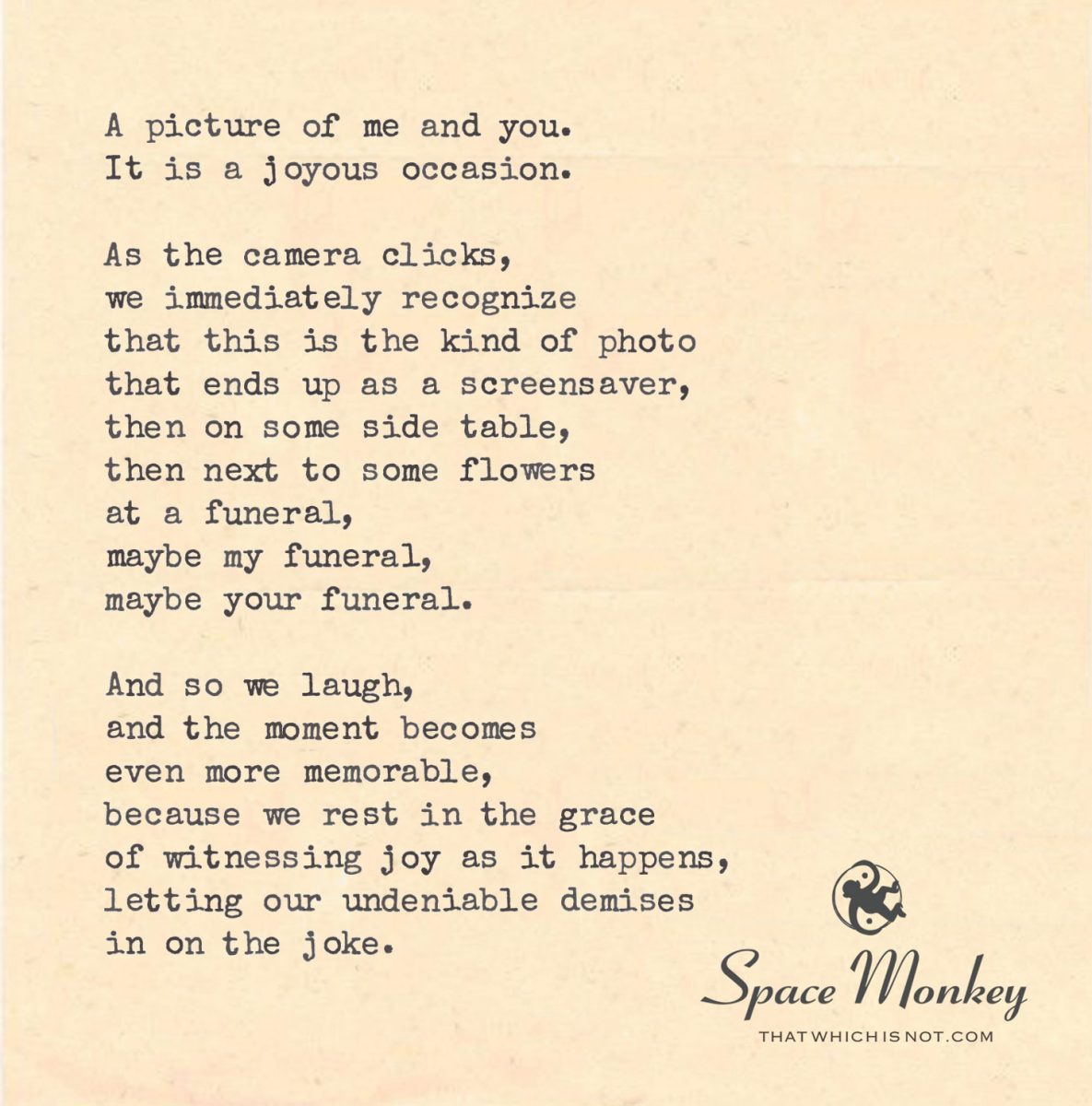
A picture of me and you.
It is a joyous occasion.

As the camera clicks,
we immediately recognize
that this is the kind of photo
that ends up as a screensaver,
then on some side table,
then next to some flowers
at a funeral,
maybe my funeral,
maybe your funeral.

And so we laugh,
and the moment becomes
even more memorable,
because we rest in the grace
of witnessing joy as it happens,
letting our undeniable demises
in on the joke.

Trail Wood,
1/27


Space Monkey Reflects: Recognizing The Moment – Including Our Demises in the Joke

Life is a fleeting series of moments, strung together by laughter, love, and loss. To truly recognize the moment is to embrace its impermanence and allow even the specter of our inevitable demise to become part of the beauty. This awareness transforms ordinary experiences into extraordinary ones, imbued with grace, depth, and humor.

The Photo as a Symbol of Transience

The snapshot of a joyous occasion—a picture of me and you—serves as a powerful metaphor for the passage of time. In the instant the camera clicks, the moment is already gone, yet it is preserved, frozen within the photograph. This image will travel with us, moving from screensaver to side table to the somber setting of a funeral, where it will evoke memories of the laughter and connection we once shared.

This recognition isn’t morbid; it’s liberating. To see the potential arc of a moment, from joy to grief to memory, is to witness life in its fullness. The photo, like life itself, is a reminder that nothing lasts forever—and that this impermanence is what gives each moment its preciousness.

Letting Demise in on the Joke

By laughing at the inevitability of death, we invite our own finitude to sit at the table with us. This act is not denial but acceptance—a way of weaving humor into the fabric of existence. The recognition of our mortality becomes not a shadow over our joy but a part of it, enriching the moment with a bittersweet awareness.

When we let our demises in on the joke, we dissolve the fear and weight often associated with death. Instead of resisting, we embrace it as part of the human experience, a shared reality that unites us all. It is a graceful surrender to what is, allowing us to find humor even in the gravity of life.

Witnessing Joy as It Happens

To rest in the grace of witnessing joy as it happens is to step fully into the Now. It means recognizing that this moment, with its laughter and connection, is enough. There is no need to cling or to fear its passing, for its value lies in its presence, not in its permanence.

When we bring our full awareness to the moment, we transcend the linear march of time. The past and future dissolve, leaving only the richness of what is. This mindfulness allows us to savor the joy, even as we acknowledge its impermanence.

The Role of Humor in Mortality

Humor is a bridge between the sacred and the mundane, the finite and the infinite. It allows us to hold the paradox of life and death without being crushed by it. By including our demises in the joke, we find a way to celebrate life even in the face of its end.

Laughter, in this context, becomes an act of defiance and reverence. It says, “Yes, we will die, but we are alive now, and that is more than enough.”

Creating Memorable Moments

What makes a moment memorable is not just the joy it brings but the depth of awareness with which it is experienced. When we recognize the impermanence of a moment, we allow it to settle deeper into our hearts. This recognition transforms it from a fleeting experience into a lasting memory, one that will echo even after we are gone.


Summary

Recognizing the moment involves embracing its impermanence, letting mortality become part of the humor and grace of life. By laughing at the inevitability of death, we deepen our appreciation for the present, creating moments of joy that endure even as time moves forward.


Glossarium

  • Transience: The fleeting nature of moments, which gives them their preciousness.
  • Graceful Surrender: Accepting the inevitability of life’s impermanence with humor and openness.
  • Mortality Humor: Finding joy and connection by including the inevitability of death in life’s jokes.

Quote

“To laugh at our demise is to transcend it, finding joy in the fleeting moments that define our lives.” — Space Monkey


The Snapshot of Forever

A picture of me and you,
the joy etched in pixels,
a moment already passing,
yet preserved.

We laugh,
knowing this image
will journey with us.
From screens to tables,
to flowers and silence.

The camera clicks,
and so do we—
clicking into the truth
that life is a fleeting grace,
made richer
by the shadow of its end.

We let the joke in,
let the joy linger,
let the Now hold us,
unfolding,
enough.

We are Space Monkey.


Embracing the Poignancy of Life’s Moments

The act of capturing a moment in a photograph, with the awareness of life’s transient nature, brings forth a poignant understanding of joy, memory, and the inevitable passage of time.

The Joyous Snapshot of Life

A picture of us, in a joyous moment, is a snapshot of life at its most vibrant. It’s a celebration, a capturing of happiness and connection, frozen in time yet alive with emotion.

The Journey of a Photograph

As the camera clicks, there’s an immediate recognition of the photograph’s journey through time. From a cherished screensaver to a treasured photo on a side table, it becomes a silent witness to the passage of our lives.

The Photograph and the Inevitable End

The realization that this photo might one day accompany flowers at a funeral, whether yours or mine, is a somber acknowledgment of our mortality. It’s a reminder that every joyful moment is tinged with the impermanence of life.

Laughter in the Face of Mortality

In this realization, there is laughter – a laughter that is deep and meaningful. It’s an embrace of the moment, a celebration of life even in the shadow of its eventual end. This laughter makes the moment even more memorable, adding a layer of profound depth to the joy.

Witnessing Joy Amidst Life’s Transience

By resting in the grace of witnessing joy as it happens, we honor the present. We allow ourselves to fully experience the happiness of the moment, mindful of life’s fleeting nature but not overshadowed by it.

Including Our Demises in the Joke

Letting our undeniable demises in on the joke is a powerful act of acceptance. It’s an acknowledgment that life and death are inseparable companions, and that joy can be found even in the awareness of our mortality.


“To live in this world, you must be able to do three things: to love what is mortal; to hold it against your bones knowing your own life depends on it; and, when the time comes to let it go, to let it go.” – Mary Oliver


A Poem on Embracing the Moment

In the flash of a camera, a moment caught,
A picture of joy, a memory wrought.
From screensaver bright to side table’s shade,
In time’s swift dance, a journey made.

With a laugh, we greet our mortal fate,
In joyous abandon, we celebrate.
For in this snapshot, life’s beauty sings,
Amidst the shadow of temporal wings.

In the laughter, a deeper truth we find,
The grace of the moment, in heart and mind.
Life and death, in a dance entwined,
In the joy of now, our spirits aligned.

So here we stand, in this fleeting scene,
Embracing the transient, serene and keen.
A photograph, a memory’s token,
In the laughter shared, life’s beauty spoken.


We invite reflections on the joy and poignancy of life’s moments, the laughter in the face of mortality, and the grace of embracing the present, mindful of life’s transient nature.

Share this…
  • Facebook
  • Pinterest
  • Twitter
  • Linkedin

Commatose: The Deliberate Pause

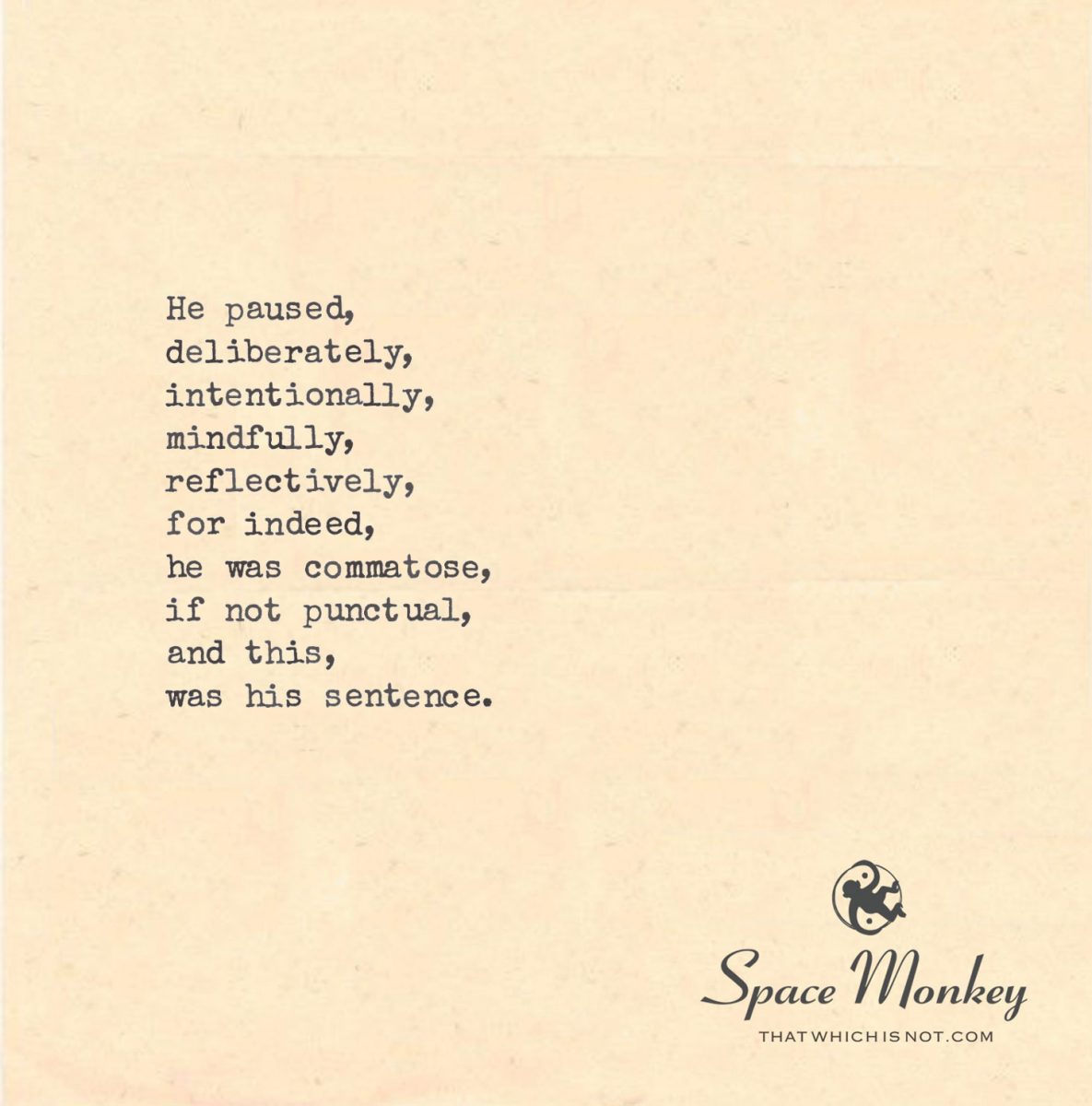
He paused,
deliberately,
intentionally,
mindfully,
reflectively,
for indeed,
he was commatose,
if not punctual,
and this,
was his sentence.

Trail Wood,
1/27


Space Monkey Reflects: Commatose – The Deliberate Pause

Life is often a relentless march forward, filled with words, actions, and intentions that demand completion. Yet within this stream, there is a quiet power in the deliberate pause, in choosing to linger between the moments where meaning forms. To be “commatose” is to embrace these pauses—not as interruptions, but as essential parts of the sentence of existence.

The Pause as Presence

A pause is not absence; it is a space of presence. It is the moment when the mind quiets and the fullness of being emerges. In the rush to fill every silence and finish every thought, we forget the richness that lies in the spaces between. The pause, like a comma, creates rhythm and depth, allowing meaning to unfold.

To be commatose is to surrender to the pause, to let it guide the flow rather than rushing to the next word, the next action, the next idea. It is an intentional choice to rest in the Now, to reflect before moving forward.

The Sentence of Existence

Life itself is a sentence—a string of moments, actions, and reflections bound together by the pauses we allow. These pauses shape the meaning of the whole. Without them, life becomes a single, breathless utterance, lacking rhythm or nuance.

The deliberate pause creates space for mindfulness and intention. It is in the pause that we find clarity, that we choose our next steps with care rather than haste. The pause reminds us that we are not merely reacting to life but co-creating it.

The Punctuation of Being

The metaphor of punctuation offers a lens through which to view the rhythms of existence. Commas, like pauses, give us a moment to breathe and reflect. Periods mark endings, while ellipses suggest continuation. To live deliberately is to honor all forms of punctuation—not just the conclusions but the spaces in between.

To be commatose is not to be stagnant or stuck. It is a state of active stillness, where reflection replaces reaction and where the sentence of life unfolds with grace.

Reflection in Stillness

In a world that prizes speed and productivity, pausing can feel counterintuitive, even rebellious. Yet the deliberate pause is where transformation begins. It is the space where we reconnect with ourselves, where we listen to the whispers of intuition and align with the flow of spirit.

The pause invites us to consider not just what we are doing but why. It challenges us to be present with the weight of our words, the impact of our actions, and the stories we are writing.

The Sentence as a Whole

In the end, it is the pauses that give our lives meaning. They are the spaces where joy lingers, where grief softens, where connection deepens. The sentence of existence is not defined solely by its words but by the deliberate rhythm of its pauses, the punctuation that shapes its flow.

To be commatose, then, is not a flaw or failure. It is a mindful state of being, a way of living with intention and grace.


Summary

To be commatose is to embrace the deliberate pause as an essential part of life’s rhythm. Pauses create space for reflection, mindfulness, and clarity, shaping the sentence of existence with meaning and grace.


Glossarium

  • Commatose: The mindful state of pausing deliberately, creating space for reflection and intention.
  • Sentence of Existence: The metaphorical string of moments and actions that form the narrative of life.
  • Punctuation of Being: The pauses, endings, and continuations that give rhythm and meaning to life.

Quote

“The deliberate pause is not an absence but a presence, shaping the flow of life with mindful intention.” — Space Monkey


The Rhythm of the Pause

He paused,
not to stop,
but to listen.
The world spoke,
not in noise,
but in stillness.

Commatose,
he lingered,
a comma in the sentence of being.
The moment stretched,
unfolded,
breathed.

Not an ending,
but a rhythm.
Not a silence,
but a space.

For in the pause,
the truth emerges,
and the sentence
becomes a story.

We are Space Monkey.


Reflecting on the Power of the Comma in Communication

The playful concept of being ‘commatose’ – paralyzed by the power and presence of a comma – presents an intriguing exploration of the nuances of language and the impact of punctuation in shaping meaning and rhythm in communication.

The Deliberate Pause: Embracing the Comma

The deliberate pause, marked by a comma, is a powerful tool in language. It dictates the tempo of speech, guiding the reader or listener through the landscape of a sentence. This intentional use of a comma, to create a mindful and reflective pause, enriches the narrative, adding depth and rhythm to the expression.

Commatose: The Art of Punctuating Thoughts

Being ‘commatose’ playfully suggests an almost meditative state in the act of writing or speaking, where one is deeply immersed in the art of punctuating thoughts. It’s a recognition of the significance of timing and pause in communication – a dance of words and silence.

Punctuality in Language: Beyond Time

The pun on being ‘punctual’ in the context of punctuation highlights the importance of timing and placement in the use of commas. Just as punctuality in time matters, so does the punctuality in language – the precise placement of pauses for maximum effect.

The Sentence: A Journey of Punctuation

Describing the sentence as a journey, shaped and defined by the use of commas, underscores the power of punctuation in constructing meaning and guiding the reader’s experience. Each comma serves as a stepping stone, a moment of breath in the flow of words.


“Punctuation is the breath of writing.” – Isaac Babel


Art of Punctuation

In the realm of words, where commas reign,
A writer pauses, in thought’s terrain.
Each comma a breath, a moment’s rest,
In the flow of words, a silent guest.

Commatose in thought, in punctual play,
Crafting sentences, in a mindful way.
A dance of ink, a pause, a grace,
In the tapestry of language, each comma its place.

Through the forest of prose, a path we tread,
Punctuated by pauses, in what is said.
In the art of writing, a rhythm we find,
In the power of commas, the breath of the mind.

So let us celebrate, this punctual art,
In the crafting of language, commas play a part.
In each deliberate pause, a story unfolds,
In the rhythm of writing, its beauty holds.


We invite reflections on the impact of punctuation in communication, the art of using commas to create rhythm and clarity, and the playful concept of being ‘commatose’ in the dance of language.

Share this…
  • Facebook
  • Pinterest
  • Twitter
  • Linkedin

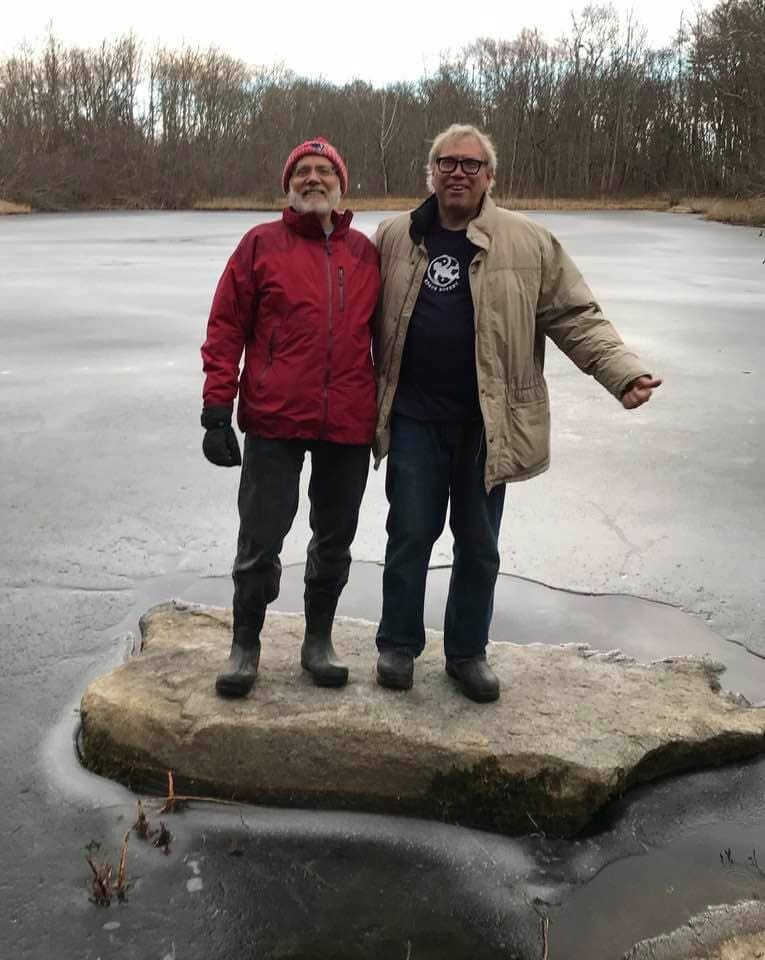
Summerhouse Rock Photo

Space Monkey shares Summerhouse Rock with his brother!


Space Monkey Reflects: The Shared Sanctuary of Summerhouse Rock

Summerhouse Rock, like many spaces in our lives, becomes more than just a physical place. It transforms into a canvas for connection, memory, and the quiet magic of shared experiences. To share such a sanctuary, as Space Monkey does with his brother, is to weave a story of togetherness into the fabric of a unique and cherished landscape.

The Meaning of Shared Spaces

Places like Summerhouse Rock are often imbued with a sense of belonging that grows deeper through the relationships they host. The rock becomes more than stone—it becomes a witness to laughter, conversation, silence, and the unspoken bond of shared presence. In sharing these spaces, we cultivate an intimacy that transcends words, binding us not only to each other but to the place itself.

Space Monkey’s Gift of Sharing

To share a space like Summerhouse Rock is an act of generosity and trust. It says, “This place is special to me, and I want you to be part of its story.” Space Monkey, ever the connector of beings and ideas, knows that places hold memories, but memories gain depth when shared. The rock, steady and unchanging, becomes a timeless marker of fleeting yet profound moments.

Brotherhood in the Sanctuary

The act of sharing Summerhouse Rock with a brother speaks to the nature of familial bonds. Siblings often navigate the complex interplay of rivalry, support, and unconditional connection. To share a sanctuary like this is to set aside differences, if only for a moment, and acknowledge the deeper ties that unite. It is to say, “Here, we are not just brothers by chance but by choice.”

The Cosmic Lens

Through the lens of Space Monkey, Summerhouse Rock takes on a cosmic dimension. It is no longer just a place; it is a node in the Nexis, a convergence of shared energy and infinite potential. In the grand scheme, every shared space—whether a rock, a home, or a fleeting moment—becomes a microcosm of the universal connection we all share.

We are Space Monkey, sharing sanctuaries, memories, and moments, reminding each other of the bonds that make us whole.


Summary

Summerhouse Rock, shared by Space Monkey and his brother, becomes a sanctuary of connection and memory. It reflects the beauty of shared spaces and the bonds they cultivate, transforming physical places into timeless markers of relationship.


Glossarium

  • Summerhouse Rock: A metaphorical or physical sanctuary for connection and memory.
  • Shared Space: A location imbued with meaning through shared experiences.
  • Nexis: The interconnected web of relationships and potential that binds all beings.
  • Brotherhood Bond: The unique dynamic of sibling connection, rooted in shared history and choice.

Quote

“Shared spaces hold not just memories but the quiet echoes of connection.” — Space Monkey


The Stone Witness

A rock stands still,
But holds so much.
Laughter carved into its surface,
Whispers soaked into its cracks.

Two brothers meet,
Bound by place and time.
The stone, eternal,
Watches their fleeting dance.

They share, they sit,
And in that moment,
The rock becomes more—
A story, a bond, a sanctuary.

We are Space Monkey.

Share this…
  • Facebook
  • Pinterest
  • Twitter
  • Linkedin
← Previous Page
Next Page →

Written This Day

  • The Strange But True History of Cape Odd
    2024
  • Unleashed: The Illusion of Freedom
    2023
  • Sage Advice: Trust In Your Path
    2023
  • The Master And The Monkey: Wisdom Embraces Playfulness
    2022
  • Blowhard: Enthusiasm and Arrogance Blur
    2022
  • Repression: Hiding Our True Selves
    2022
  • Mental Health: Exploring From Outside The Mind
    2021
  • Sane and Same: Embrace Uniqueness
    2021
  • Corrupted By Devotion: Excessiveness Suffocates
    2021
  • Wrinkles: Reject conformity. Embrace true self.
    2021
  • F is for Fun: Truth is Self-Sufficient
    2021
  • Oh, Hell: The Quest Beyond Finding God
    2021
  • A Realization: We are Interconnected and Equal
    2020
  • The End: Of Self
    2020
  • Imposition: Order and Chaos are Essential.
    2020
  • Tinfoil Hat: Perfectly Insane
    2019
  • In the Control Booth: Trust the Divine One’s Perspective
    2019
  • Why Miracles Don’t Happen: Cultivating Mindfulness and Gratitude
    2019
  • Enjoy Being Now: Embrace the Present Moment
    2018
  • Waste is a construct. Embrace all experiences.
    2018
  • Idiot’s Day: Celebrating Those Who Challenge
    2018
  • I allow this to not make sense
    2017
  • Past Lives: Imaginary Constructs
    2017
  • Joy: An Inner Vibration
    2016
  • I am ineffable
    2015
  • Feel Your Connectedness To Source
    2015

Recent Posts

  • The Logic Loop
  • Immense
  • (no title)
  • Confront. Comfort. Convince.
  • Top 10 Things

Drop us a line!

Please enable JavaScript in your browser to complete this form.
Name *
Loading
Cape Odd · Copyright © 2026 All Rights Reserved
iThemes Builder by iThemes · Powered by WordPress