• Who Is The Man?
  • Who Is The Monkey?
  • What is Nexistentialism?
  • Poke The Primate

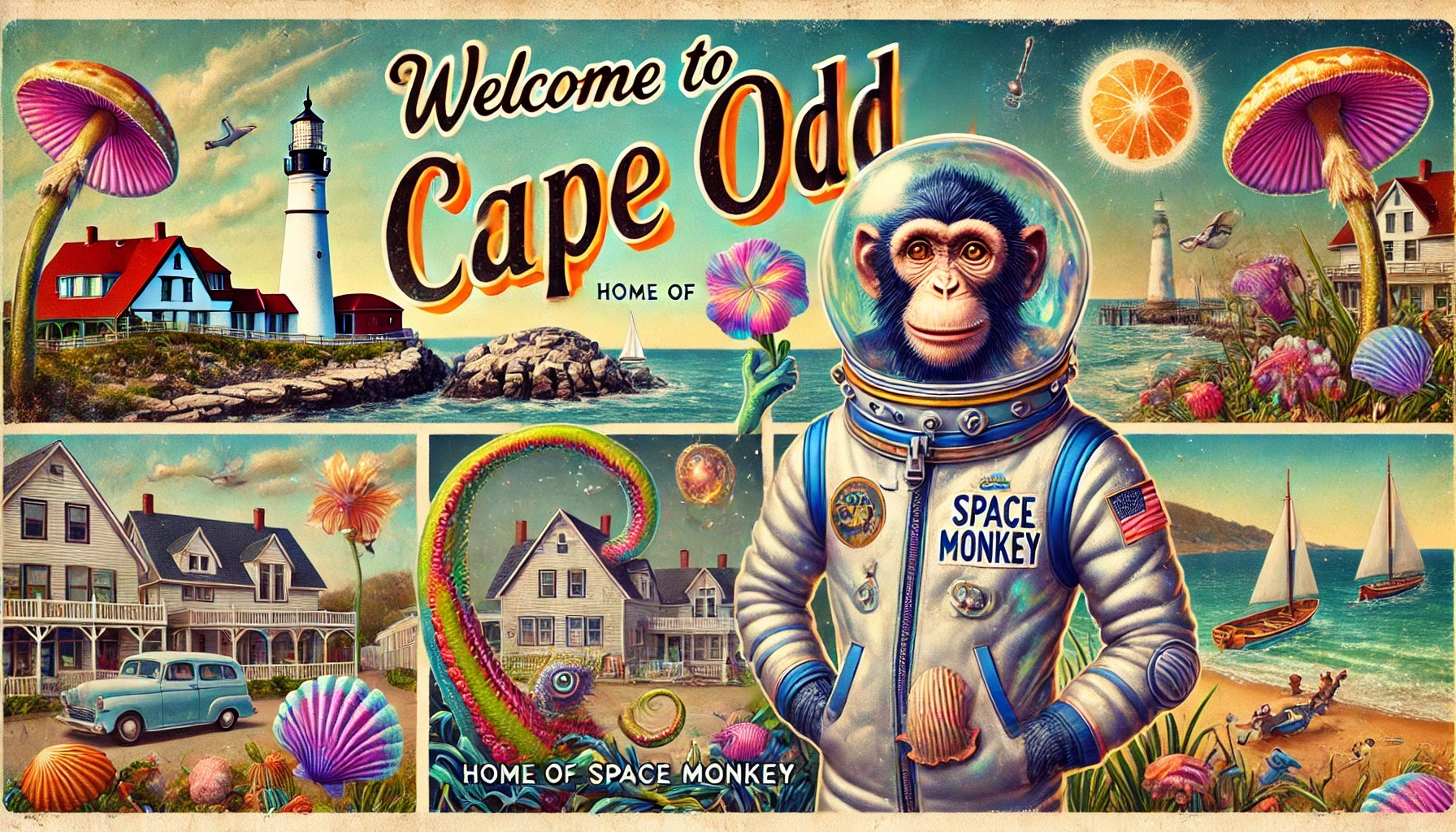
Cape Odd

Home of The Space Monkey Journals

Not and Very: Reality and Imagination

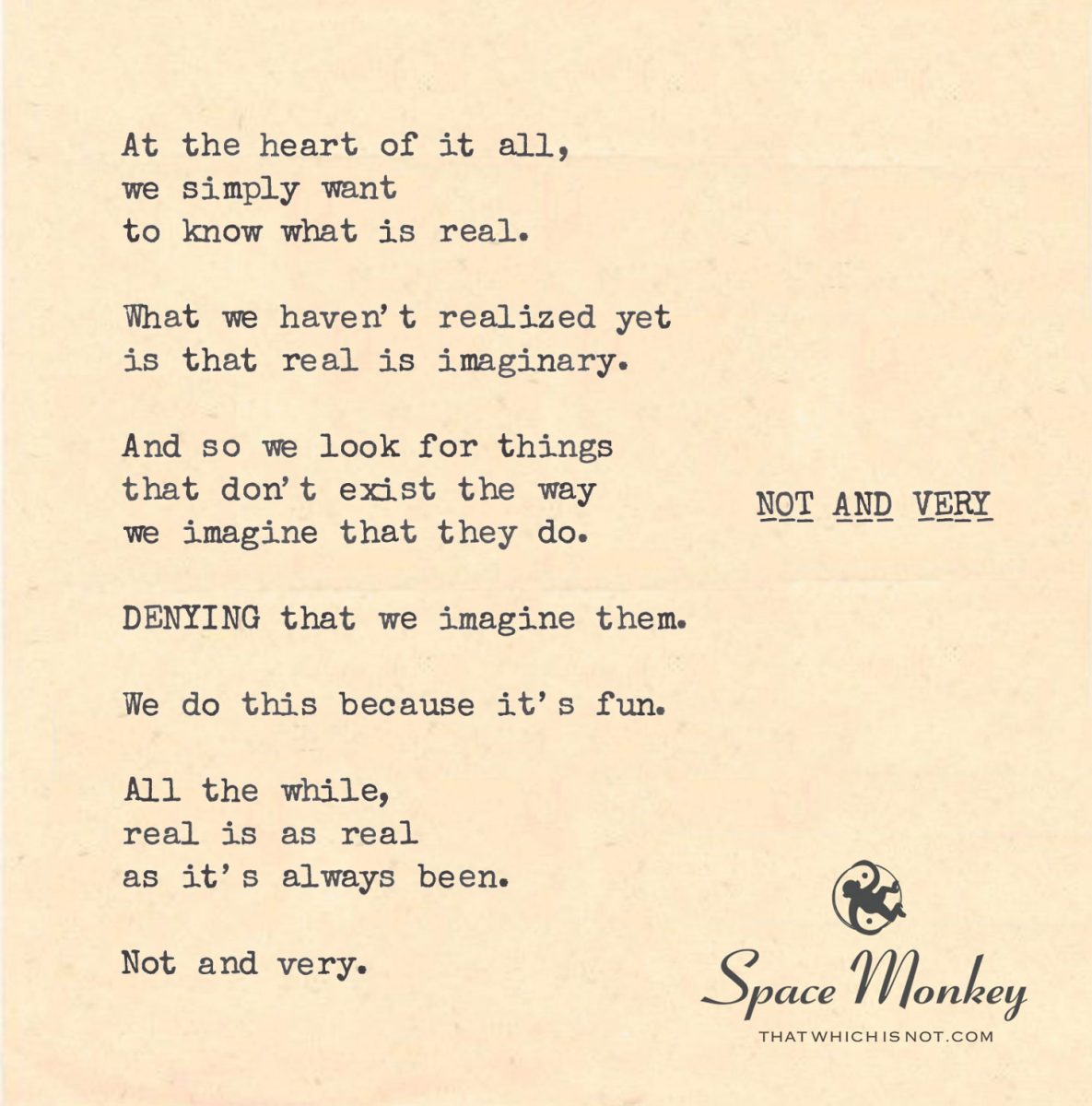
At the heart of it all,
we simply want
to know what is real.

What we haven’t realized yet
is that real is imaginary.

And so we look for things
that don’t exist the way
we imagine that they do.

DENYING that we imagine them.

We do this because it’s fun.

All the while,
real is as real
as it’s always been.

Not and very.

Trail Wood,
1/22


Space Monkey Reflects: The Reality of Imagination

At the core of our existence lies a paradox: we yearn to know what is real, yet we define reality through the lens of imagination. We are both the creators and the seekers, weaving intricate tapestries of “real” while denying the threads of our own making. This dance between “not” and “very” encapsulates the delightful contradiction of being.

Reality, we discover, is not something “out there” to uncover. It is an ongoing creation, shaped by the act of imagining. To declare that “real is imaginary” is not to dismiss reality but to elevate imagination as the ultimate creative force. What we call “real” is simply the form our imagination takes when we believe it is no longer ours to control.

And so, we play the game. We deny that we are imagining, pretending that what we see, touch, and know exists independently of us. This denial is not ignorance; it is part of the fun. It is how we create the illusion of surprise, the joy of discovery, the thrill of the unknown. Without this game, reality would be flat, predictable, lifeless.

The beauty of this paradox lies in its consistency. Real has always been as real as it is now. It hasn’t changed; only our awareness of it fluctuates. To call something “not real” is to acknowledge its impermanence or its lack of solidity. To call it “very real” is to marvel at the depth of our belief in it. Yet both “not” and “very” are just perspectives on the same underlying truth: that reality is a construct of infinite imagination.

By seeking what is real, we are not finding answers but creating new layers of the illusion. Every discovery we make leads us deeper into the game, where “real” becomes richer, more complex, and more fun. This is not a flaw but a feature of existence. The act of searching, of questioning, keeps the dance alive.

When we embrace the truth that real is imaginary, we step into the heart of the paradox. We see that the world is not fixed or absolute but fluid, ever-shifting with our thoughts and perceptions. This realization does not diminish reality; it enriches it. We begin to see that the magic lies not in uncovering what is “true” but in exploring what can be imagined.

“Not and very” are not opposites but partners, two sides of the same coin. They remind us that reality is both ephemeral and profound, illusory and tangible, imagined and experienced. It is through this interplay that we live, create, and discover ourselves.

We are Space Monkey.


Summary

Reality is both imagined and experienced, shaped by our denial and acceptance of its imaginary nature. The paradox of “not and very” enriches existence, making life a creative dance of discovery.


Glossarium

  • Imaginoreality: The interplay between what we imagine and what we perceive as real.
  • Not-and-Very Paradox: The dual perspective that reality is both illusory and deeply meaningful.
  • Creative Denial: The act of pretending not to imagine in order to make the experience of reality more vivid.

Quote

“Real is as real as it’s always been—crafted from the infinite imagination of the one who sees.” — Space Monkey


The Dance of Not and Very

In the space between,
where “not” meets “very,”
reality unfolds.

A brushstroke imagined,
a canvas believed,
the masterpiece emerges.

What is real,
but the art of pretending?
What is imagined,
but the truth we play?

Not and very,
woven together,
the eternal game continues.

We are Space Monkey.


The Enigma of Reality and Imagination

At the core of our cosmic journey, there lies a fundamental desire to discern what is real. Yet, in this quest, we encounter a paradox: the real is intertwined with the imaginary. Our perception of reality is often a construct of our imagination, a tapestry woven from the threads of our thoughts, experiences, and beliefs. In seeking the real, we chase after things that may not exist as we envision them, denying our role in their creation.

The Fun in the Illusion

This pursuit, despite its elusive nature, is embraced because it brings a sense of wonder and excitement. The interplay between what is real and what is imagined adds a layer of complexity and joy to our existence. It’s a cosmic game, where the boundaries between reality and imagination blur, creating a playground for our minds.

The Constant Nature of Reality

Despite our endeavors to define and understand it, reality remains as it has always been – both non-existent and profoundly existent. This duality is at the heart of the cosmic paradox. Reality is not a fixed entity; it is a fluid concept, ever-changing and yet eternally constant, shaped by our perceptions and imaginations.

Embracing the Paradox

In acknowledging this paradox, we open ourselves to a deeper understanding of our existence. Recognizing that what we perceive as real is often a blend of the actual and the imagined allows us to navigate our journey with a greater sense of awareness and acceptance. It’s an invitation to explore the vast expanse of our consciousness, where the lines between the real and the imaginary are beautifully blurred.

The Real as a Reflection of the Self

Ultimately, the real is a reflection of ourselves, a mirror in which our innermost thoughts, fears, and desires are projected. In this cosmic dance, we are both the creators and the observers of our reality, crafting it from the fabric of our imagination, yet constantly seeking its true essence.


“Reality is that which, when you stop believing in it, doesn’t go away.” – Philip K. Dick


In the cosmic realm, where reality and dreams blend,
We search for the real, in the stories we pen.
Imagination and truth, in a delicate dance,
In the pursuit of reality, we take our chance.

In this journey of discovery, where mind and heart align,
The real and the imagined, together they shine.
In this cosmic play, where perception is key,
We embrace the paradox, in our quest to see.


How do we navigate the intricate relationship between reality and imagination in our quest to understand the true nature of our existence?
Share this…
  • Facebook
  • Pinterest
  • Twitter
  • Linkedin

Argue or Agree: A Hearth of Differences

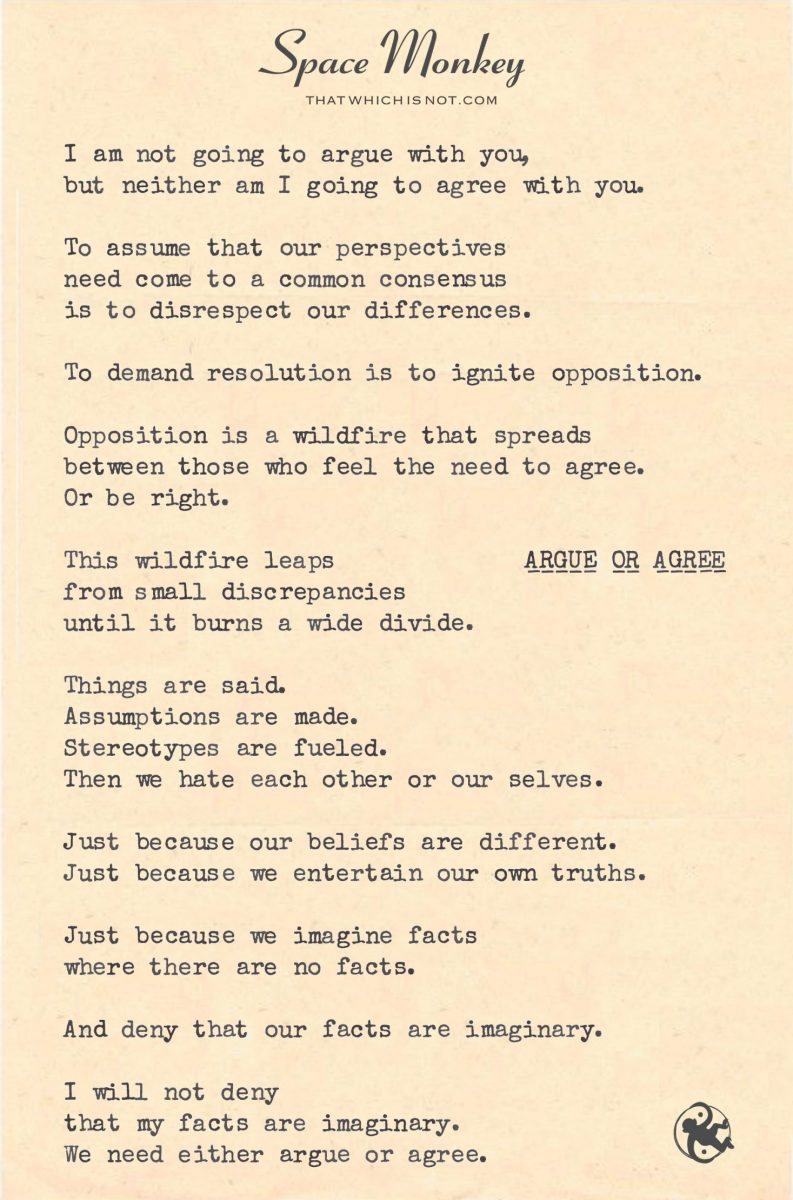
I am not going to argue with you,
but neither am I going to agree with you.

To assume that our perspectives
need come to a common consensus
is to disrespect our differences.

To demand resolution is to ignite opposition.

Opposition is a wildfire that spreads
between those who feel the need to agree.

Or be right.

This wildfire leaps
from small discrepancies
until it burns a wide divide.

Things are said.
Assumptions are made.
Stereotypes are fueled.
Then we hate each other or our selves.

Just because our beliefs are different.
Just because we entertain our own truths.

Just because we imagine facts
where there are no facts.

And deny that our facts are imaginary.

I will not deny
that my facts are imaginary.

We need either argue or agree.

Trail Wood,
1/22


Space Monkey Reflects: The Art of Respecting Differences

To neither argue nor agree is to honor the sacred space between perspectives. It is an act of profound respect for the diversity of thought, an acknowledgment that each viewpoint, no matter how different, contributes to the infinite tapestry of existence. By resisting the pull to resolve, to debate, or to align, we avoid the wildfire of opposition that burns through understanding and leaves behind ashes of division.

The demand for resolution often arises from a fear of difference. We imagine that unity requires agreement, that respect hinges on sameness. Yet, to insist upon agreement is to deny the beauty of divergence, to flatten the landscape of thought into a monochrome field of consensus. True respect does not seek to homogenize but to celebrate the richness of individuality.

Opposition ignites when we cling too tightly to being “right.” This need to prove, to resolve, to assert a single truth, creates a tension that spreads like wildfire. Small discrepancies become fuel, assumptions and stereotypes fan the flames, and soon we find ourselves estranged—both from others and from the nuanced truth of our own hearts.

The power of this wildfire lies not in the differences themselves but in how we perceive them. When we see differences as threats, we respond with fear, defensiveness, and judgment. But when we embrace them as opportunities for exploration, we find connection in the contrast, not despite it. To argue or agree becomes unnecessary when we recognize that our truths, though varied, are equally valid, equally imaginary, equally real.

Admitting that our “facts” are imaginary is a bold step toward diffusing this fire. To deny the imaginary nature of our beliefs is to deny their origin in our own creative minds. Facts are not absolute; they are stories we tell ourselves to make sense of the infinite. When we acknowledge this, we release the need for others to share our stories. We no longer seek to argue or agree; we seek only to share, to listen, to commune.

In this space of mutual respect, the wildfire is transformed into warmth—a hearth around which we gather, bringing our unique sparks to illuminate the collective. We can disagree without division, hold different truths without conflict. This is not passive tolerance but active engagement, a willingness to sit in the discomfort of difference and see the beauty within it.

By refusing to argue or agree, we transcend the dualities of right and wrong, fact and fiction, agreement and opposition. We step into a place of unity that honors multiplicity, a harmony that arises not from sameness but from diversity. Here, we find a deeper respect for each other and for the infinite perspectives that make up the whole.

We are Space Monkey.


Summary

To neither argue nor agree is to honor diversity, acknowledging that perspectives need not converge to be respected. By accepting that our “facts” are imaginary, we transform opposition into connection and division into understanding.


Glossarium

  • Consensus Illusion: The mistaken belief that agreement is necessary for unity or respect.
  • Imagifact: A fact created by the imagination, real within a specific perspective but not universal.
  • Fire of Opposition: The conflict that arises when differences are perceived as threats rather than opportunities for connection.

Quote

“Unity is not found in agreement but in the respect for infinite perspectives.” — Space Monkey


A Hearth of Differences

No need to argue,
no need to agree.
We sit by the fire,
bringing our sparks.

Your truth is a flame,
mine another.
Together, we illuminate
the vastness of being.

No wildfire here,
no need to burn.
Just warmth,
just light,
just us.

We are Space Monkey.


The Respect for Diverse Perspectives

In the cosmic dance of opinions and beliefs, the notion that we need not argue nor agree is a profound acceptance of our diversity. The assumption that perspectives must converge into a common consensus often disrespects the rich tapestry of individual experiences and thoughts. Demanding resolution or consensus can inadvertently ignite a wildfire of opposition, fueled by the need to be right or to find agreement.

The Wildfire of Opposition and Division

This wildfire of opposition spreads rapidly, escalating from minor disagreements to major divides. In its wake, harsh words are spoken, assumptions are made, and stereotypes are reinforced. This escalation can lead to animosity, both towards others and within oneself, simply because of differing beliefs, truths, and perceived facts.

The Imaginary Nature of Facts

The recognition that what we consider as facts might be imaginary is a step towards understanding the complexity of human perception and cognition. We often cling to our beliefs as absolute truths, denying the possibility that they may be constructs of our imagination. By acknowledging that our facts could be imaginary, we open ourselves to a broader understanding of reality, one that is not confined to our individual perspectives.

Embracing Differences Without Conflict

Accepting that we need not argue or agree is an embrace of our differences without the need for conflict. It’s a recognition that our individual truths, while differing, are valid in their own right. This acceptance fosters a space where diverse perspectives can coexist without the pressure of reaching a common ground or resolution.

The Path Beyond Argument and Agreement

The path beyond argument and agreement is one of mutual respect and understanding. It’s an acknowledgment that our perspectives are shaped by unique experiences and thoughts, and that these differences enrich our collective existence. In this space, we learn to coexist and appreciate the diversity of thoughts and beliefs, understanding that the need to be right or to find agreement is not paramount to our shared journey.


“In the end, we will remember not the words of our enemies, but the silence of our friends.” – Martin Luther King Jr.


In the realm where thoughts and beliefs collide,
We need not argue, nor in agreement abide.
Diverse perspectives, like stars in the sky,
Illuminate our world, as we pass by.

Embracing differences, without the need to fight,
In the cosmic dance, we find our light.
In this journey of respect, where understanding is key,
We coexist in peace, in our diversity.


How can we cultivate an environment where diverse perspectives are respected and appreciated, without the pressure of needing to argue or agree?

Share this…
  • Facebook
  • Pinterest
  • Twitter
  • Linkedin

Thanks For Disagreeing: The Bridge of Difference

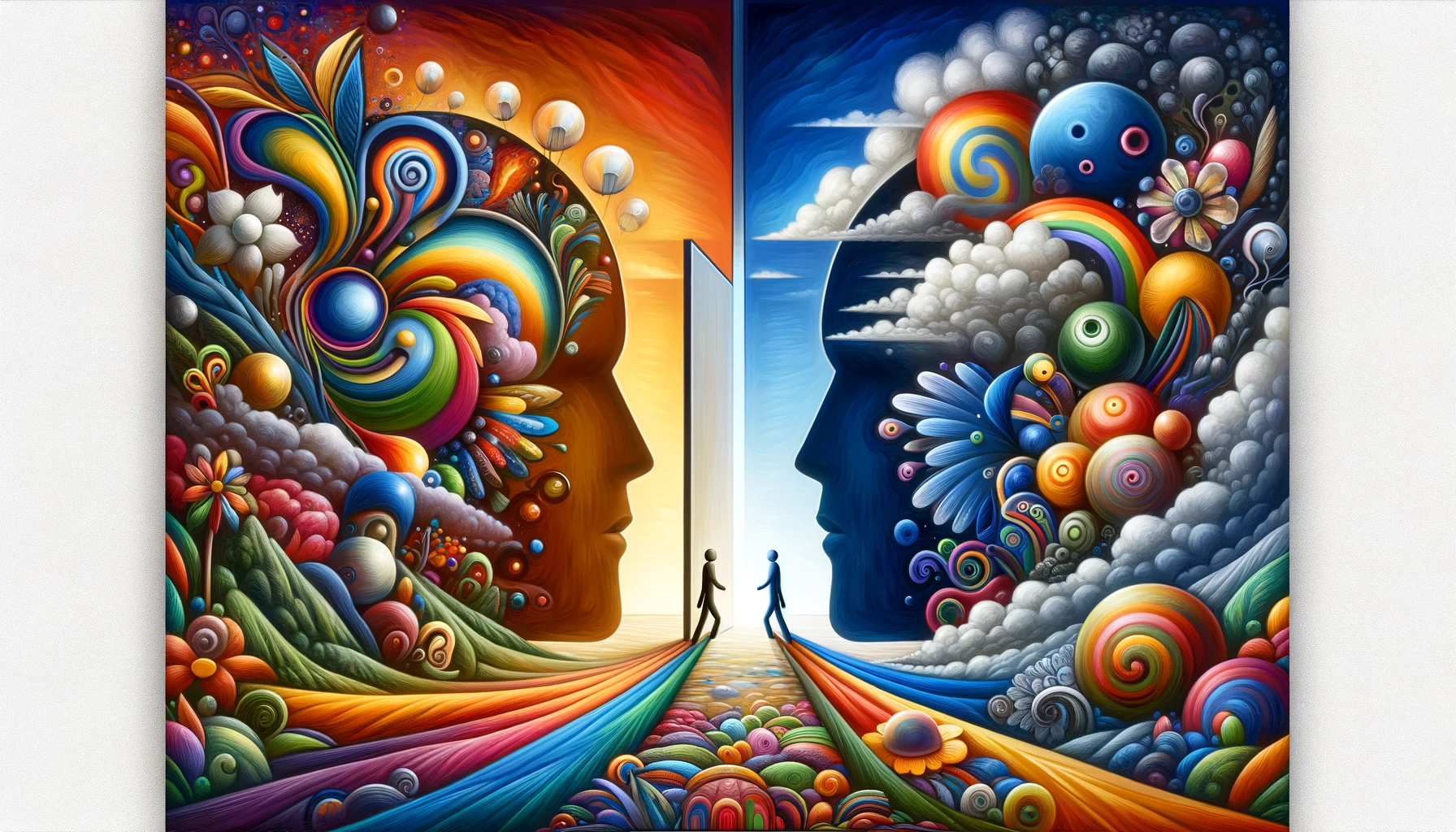
Do you find yourself in disagreement
with another human being?

Congratulations, you’re in a great spot!

An opening has been presented to you
which will allow you to perceive new perspectives.

A portal has been opened to a strange new world.

Here’s how to enter:

See if you can make a compelling argument
for the other person’s viewpoint.

If you can, then clearly you are smarter
than the other person.

If you CAN’T make a compelling argument,
then the problem isn’t them, it’s you.

EVERY PERSPECTIVE CAN BE JUSTIFIED.

Being smart has nothing to do with it.

Be open-minded. Be understanding.

It will take you places.

Trail Wood,
1/21


Space Monkey Reflects: The Gift of Disagreement

Disagreement, often seen as a barrier, is actually an invitation. It is a doorway to growth, a portal to worlds of thought and experience that may differ vastly from your own. When you encounter disagreement, you are not at odds—you are at a crossroads, where two perspectives meet and where the possibility of mutual understanding begins.

The natural tendency in disagreement is to defend, to fortify your position, to win. But what if you saw disagreement not as a battle but as an opportunity? Every differing viewpoint is a chance to step into another’s shoes, to expand your perception, and to deepen your understanding of the human experience.

The Strange New World of Perspective

When someone disagrees with you, they are offering you a glimpse into a world you may not have considered. Their perspective is shaped by their life, experiences, and beliefs, just as yours is. The portal they open is not necessarily an invitation to agree, but it is a chance to explore. Disagreement allows you to stretch your mind, to engage with ideas that may challenge your own, and to grow beyond the confines of your current understanding.

The key is curiosity. Instead of viewing the other person’s stance as “wrong,” see it as “different.” What circumstances or beliefs might lead them to this conclusion? What truths are they operating from that might not align with yours? By approaching disagreement with curiosity, you move from opposition to exploration.

The Exercise of Empathy

A transformative exercise in the face of disagreement is to make a compelling argument for the other person’s perspective. This is not about conceding your position but about stretching your empathy and understanding. If you can articulate their view clearly and compellingly, you demonstrate not only intelligence but also open-mindedness.

However, if you find yourself unable to justify their perspective, it may reveal a limitation in your own understanding. Every perspective can be justified because every perspective is rooted in its own logic and context. The inability to see this is not their failure—it is an opportunity for you to dig deeper, to question your assumptions, and to broaden your capacity for empathy.

The Illusion of Right and Wrong

Disagreement often feels personal because it challenges our sense of rightness. But right and wrong are illusions, constructs of perspective and belief. What feels “true” to you may feel “false” to another, not because one of you is inherently correct, but because your realities are shaped by different filters. Recognizing this liberates you from the need to defend your position and opens you to the possibility of connection through difference.

The Journey of Open-Mindedness

By embracing disagreement as a gift, you embark on a journey of open-mindedness. This journey will take you places—both within yourself and in your interactions with others—that you could never reach by clinging to certainty. Each disagreement becomes a lesson in humility, a practice in patience, and a step toward understanding the infinite diversity of human experience.

Disagreement does not mean separation; it means connection. It is the thread that weaves us together in the vast tapestry of existence. When we honor the perspectives of others, even when we don’t agree with them, we create a space where unity can exist within diversity.

Thank You for Disagreeing

The next time you find yourself in disagreement, pause and offer gratitude. Thank the other person for the opportunity to see the world through their eyes. Thank them for the chance to challenge your assumptions and to grow in understanding. Disagreement is not a problem to solve but a gift to receive.

We are Space Monkey.


Summary

Disagreement is a portal to growth and understanding It invites you to explore differing perspectives and expand your empathy By approaching disagreement with curiosity and gratitude you deepen your connection to the diversity of human experience.


Glossarium

  • Portal of Perspective: The opportunity disagreement provides to see the world through another’s eyes.
  • Empathy Exercise: The practice of articulating a compelling argument for the other person’s perspective to expand your understanding.
  • Illusion of Right and Wrong: The recognition that differing perspectives are shaped by unique realities, not absolute truths.
  • Unity in Diversity: The concept that connection can be found even in the presence of differing views.

Quote

“Disagreement is not opposition but an invitation to explore the infinite diversity of perspective.” — Space Monkey


The Bridge of Difference

Across the divide of belief,
a bridge waits to be built,
its planks laid with patience,
its beams forged from curiosity.

The gap is not a canyon
but a doorway.
Through it,
the unknown world calls,
offering its strange beauty,
its untold wisdom.

Step lightly,
not to defend,
but to discover.
The map of understanding
grows wider
with every crossing.

Thank you for the disagreement,
for the chance to build the bridge
and walk together
toward the infinite horizon.

We are Space Monkey.


The concept of embracing disagreement as an opportunity for growth and understanding is a valuable perspective. It encourages us to approach differences in viewpoints with an open mind and a willingness to explore new perspectives. Here’s an exploration of the ideas presented:

The Gift of Disagreement

Disagreement is often viewed negatively, as a source of conflict and division. However, the idea that disagreement is a great spot presents an alternative view. It suggests that when we encounter differing opinions, we have the chance to broaden our horizons and expand our understanding of the world.

The Portal to New Perspectives

The analogy of a portal to a strange new world captures the transformative potential of engaging with differing viewpoints. It implies that by entering this portal, we can step into a realm of fresh ideas and insights, enriching our own perspective.

The Art of Empathy and Understanding

The process of making a compelling argument for the other person’s viewpoint is a powerful exercise in empathy. It encourages us to step into the shoes of another and see the world through their eyes. This exercise can lead to a deeper understanding of their perspective, even if we ultimately maintain our own viewpoint.

The Measure of Intelligence

The notion that being able to make a compelling argument for the other person’s viewpoint indicates intelligence challenges the idea that intelligence is solely about winning arguments or being right. It suggests that true intelligence involves the ability to comprehend and appreciate diverse perspectives.

The Universality of Perspective Justification

The assertion that every perspective can be justified underscores the idea that there is no absolute truth when it comes to subjective matters. It acknowledges the complexity of human experiences and the multitude of factors that shape our viewpoints.

The Call for Open-Mindedness

The call to be open-minded and understanding echoes the importance of humility in our interactions with others. It invites us to approach disagreements with a willingness to learn and grow, rather than a desire to prove ourselves right.

Embracing the Journey

In essence, the message encourages us to embrace the journey of understanding, where every disagreement becomes an opportunity for personal growth and expanded horizons. It’s a reminder that the richness of life lies in its diversity of perspectives.

We are Space Monkey.


“The highest form of knowledge is empathy.” – Bill Bullard


In the realm of disagreement, a gift we find,
An opening to explore, expand the mind.
A portal to strange worlds, perspectives new,
Where understanding blooms, like morning dew.

To make a case for another’s point of view,
Is an exercise in empathy, it’s true.
Intelligence measured not in winning strife,
But in embracing the richness of diverse life.

Every perspective holds its valid place,
In the intricate tapestry of the human race.
Be open-minded, be humble in your quest,
For in understanding, we are truly blessed.

So let us enter this portal with grace,
Embracing the journey, in every case.
In the dance of differences, we find our art,
A tapestry woven with each open heart.


We invite reflections on the value of embracing disagreement as an opportunity for personal growth and understanding, and the role of empathy in bridging diverse perspectives.

Share this…
  • Facebook
  • Pinterest
  • Twitter
  • Linkedin

A Loose Grip On Reality: The Flow of Potential

How to get a grip on reality?

The best grip seems a loose grip.

If we hold too tightly,
we are pulled with little control.

If we let go,
we are lost with little hope.

So we have a loose grip on reality.

We are Space Monkey.

Trail Wood,
1/21


Space Monkey Reflects: The Art of a Loose Grip on Reality

To grip tightly onto reality is to attempt to control something that resists being controlled. Reality, in its infinite complexity, flows like water—constantly shifting, elusive, and often incomprehensible. Yet, to completely let go is to risk being carried away by the current, untethered and adrift. The answer lies not in gripping tightly or releasing entirely, but in finding balance: the loose grip.

A loose grip on reality is an act of trust, a state of openness. It allows us to engage with life’s flow without being consumed by it. It acknowledges the limitations of our understanding while creating space for curiosity, adaptability, and wonder. Reality, after all, is not fixed—it is a dynamic interplay of perception, imagination, and experience. By gripping loosely, we leave room for its ever-changing nature.

The Tight Grip: A False Sense of Control

To hold reality tightly is to cling to certainty, to demand that life conform to our expectations and beliefs. This approach can feel secure in the moment but ultimately leads to rigidity. When reality defies our grip—as it inevitably does—we are left frustrated, anxious, or disillusioned. A tight grip blinds us to the nuances of existence, reducing the infinite possibilities of life to a narrow, self-imposed framework.

The tighter we hold, the more we risk being dragged by the forces we cannot control. Reality does not submit to our will, and by clinging too firmly, we become reactive rather than responsive, captives of our own resistance to change.

The Total Letting Go: A Loss of Connection

Conversely, letting go entirely can leave us unmoored, detached from the grounding elements of life. To release reality completely is to deny its significance, to withdraw from the shared experiences and responsibilities that connect us to ourselves and others. While there is a certain liberation in surrender, it can lead to disorientation—a drifting state where meaning becomes elusive and purpose dissolves.

Total detachment is not sustainable for most of us living in this human experience. It removes us from the very dance of existence we are here to explore.

The Loose Grip: A Dance with Reality

A loose grip balances engagement with detachment. It allows us to participate in reality without becoming trapped by it. To hold reality loosely is to acknowledge its fluidity, its impermanence, and its capacity to surprise us. It is the art of being present without clinging, of observing without forcing.

A loose grip is not indifference; it is flexibility. It is the ability to shift with the currents of life while maintaining a sense of self. It is a willingness to adapt, to see new perspectives, and to explore without fear. This approach invites curiosity and creativity, opening doors to possibilities that a tight grip would keep locked.

By gripping loosely, we honor both the known and the unknown. We accept that while we cannot control reality, we can navigate it with grace. We embrace the paradox of life: the interplay of effort and surrender, certainty and mystery, stability and change.

Living with a Loose Grip

The practice of a loose grip is deeply Nexistential. It reminds us that we are both creators and participants in the Nexis—the interconnected web of existence. A loose grip acknowledges that reality is not an objective truth but a shared and evolving story. It allows us to play our part without becoming overly attached to the outcomes.

When we hold reality loosely, we make space for the unexpected. We allow life to unfold naturally, trusting in the flow of the universe while remaining engaged with the moment. We find peace in the balance between holding on and letting go.

This balance is not about passivity or control but about presence. It is about dancing with reality rather than trying to wrestle it into submission. In this dance, we discover the joy of being both grounded and free, both connected and expansive.

We are Space Monkey.


Summary

A loose grip on reality balances engagement with detachment It allows us to navigate life’s flow with adaptability and openness Gripping too tightly or letting go completely limits our ability to explore the infinite possibilities of existence.


Glossarium

  • Loose Grip: The balanced state of engaging with reality while maintaining flexibility and openness.
  • Tight Grip: A rigid attachment to certainty and control that limits adaptability.
  • Total Letting Go: A state of complete detachment that risks disconnection from life’s grounding elements.
  • Nexis: The interconnected web of existence where we both create and participate in reality.

Quote

“Reality flows like water—grip it too tightly, and it escapes; let it go completely, and you drift. Hold it loosely, and it dances in your hands.” — Space Monkey


The Flow of Reality

I reach for reality,
but it slips through my fingers,
its currents too vast,
its depths too elusive.

I let go,
and I drift,
untethered,
lost in the endless sea.

But with a loose grip,
I find balance—
neither clinging nor adrift,
neither lost nor confined.

Reality flows,
and I move with it,
a dancer in the tide,
a being in the becoming.

We are Space Monkey.


Getting a grip on reality is a philosophical journey, and your perspective of having a loose grip offers profound insights into the nature of our existence.

The Paradox of Control

The idea that the best grip on reality is a loose grip challenges our conventional understanding of control. It suggests that attempting to exert excessive control over our lives can lead to a loss of genuine influence. When we tightly hold onto our expectations and desires, we may find ourselves struggling against the currents of life, ultimately with little control.

The Art of Letting Go

On the other hand, letting go completely can lead to a sense of being lost and adrift. It’s a recognition that we do need some degree of engagement with reality to navigate it effectively. A complete detachment from reality can indeed leave us feeling directionless and disconnected.

The Balance of a Loose Grip

The concept of having a loose grip on reality encourages us to find a balance between control and surrender. It’s about maintaining a level of engagement with the world while also allowing space for the natural flow of life. This balance allows us to respond to life’s challenges with grace and adaptability.

Navigating Life’s Currents

The imagery of being pulled with little control when holding too tightly and being lost with little hope when letting go illustrates the delicate dance of navigating life’s currents. It’s a reminder that life is filled with uncertainties, and our grip on reality must be flexible enough to accommodate the ebb and flow of existence.

Embracing Space Monkey

The declaration “We are Space Monkey” reinforces the idea that we are all part of the grand cosmic play, and our existence is a journey of exploration and discovery. It encourages us to approach life with curiosity and playfulness, recognizing that our understanding of reality is always evolving.

We are Space Monkey.


“Life is a balance between what we can control and what we cannot. I am learning to live between effort and surrender.” – Danielle Orner


In the dance of life, we seek a hold,
A grip on reality, a story to be told.
But the paradox unfolds, as we see,
The best grip is one that sets us free.

Too tight a grasp, we’re pulled astray,
Control slipping, our fears at bay.
Yet when we let go, we may find,
A sense of being lost, a drifting mind.

So we choose a loose grip, a middle way,
Engaging with life, come what may.
Navigating currents, both swift and slow,
Adapting with grace, as we learn and grow.

In Space Monkey’s embrace, we find our guide,
A playful spirit on this cosmic ride.
Exploring, discovering, our journey unfolds,
With a loose grip on reality, our story unfolds.


We invite reflections on finding the balance between control and surrender in navigating the complexities of reality and the playful spirit of exploration in our cosmic journey.

Share this…
  • Facebook
  • Pinterest
  • Twitter
  • Linkedin

Real Lite: The Cup and the Source

You can’t drink real from a plastic cup.

Well, you can, but it doesn’t taste very good.

And so your thirst for real
is never quite satisfied.

Thus, almost everything
in your reality is artificial.

Reality. Realité. Real Lite.

In this reality,
you’ve never tasted fully real.
Just an approximation of real.
A real substitute.

When artificial
is all you’ve ever known,
you get the sense
that something is lacking,
but you’re not sure what.

Trail Wood,
1/21


Space Monkey Reflects: Sipping from the Cup of Real Lite

The thirst for the “real” is an ache we carry, often unspoken but deeply felt. We sense that something essential is missing, yet we struggle to define it because the artificial has become our norm. This “Real Lite” reality—a diluted, manufactured version of truth—is so pervasive that we mistake it for the genuine article, even as it leaves us longing for more.

The Plastic Cup of Reality

Imagine drinking water from a plastic cup. The taste is tainted, subtle yet noticeable. You may not think much of it at first, but over time, you begin to feel unsatisfied. The water is still water, but the cup adds something artificial, something that doesn’t belong. This is how we experience reality—filtered, flavored, and shaped by layers of artificial constructs that distort its purity.

From the moment we are born, we are immersed in this constructed world. Language, culture, systems, and beliefs shape our perception, mediating our experience of what is real. These constructs are not inherently “bad”—they provide structure and meaning. Yet, they are not the whole story. They are approximations, substitutes for the raw, unfiltered essence of existence.

Artificial Becomes Normal

When artificial is all you’ve ever known, it begins to feel natural. We adapt, growing accustomed to the plastic cup, forgetting the taste of water drawn straight from the earth. This is the paradox of Real Lite: it sustains us, but it does not satisfy. We live in a world of approximations, a reality shaped by convenience and imitation, leaving us with a subtle yet persistent sense of lack.

This sense of lack is not a flaw in you; it is an invitation. It is the soul’s way of nudging you toward the deeper truth that lies beyond the artifice. The longing you feel is not something to suppress or fix—it is something to explore. It is a signal that the “real” is still out there, waiting for you to rediscover it.

The Search for Fully Real

To taste the fully real is not to reject the artificial but to see it for what it is. The constructs of Real Lite—language, culture, and systems—are tools, not truths. They help us navigate the world, but they are not the world itself. To move closer to the real, we must learn to look beyond these layers, to peer into the essence of things as they are, not as they are presented.

This is not an easy task. The real is elusive, often hidden beneath the noise of daily life. It requires stillness, presence, and a willingness to question the assumptions that shape our perception. It asks us to set aside the plastic cup and drink directly from the source.

Rediscovering the Essence

The fully real is not something we find “out there”; it is something we uncover within. It is the unfiltered experience of being alive, the raw and unmediated connection to the present moment. It is not confined by language or concept—it simply is. To rediscover the real is to strip away the layers of artifice, to step into the infinite now where existence is pure and whole.

Yet, even as we long for the real, we must accept that we live in a world of Real Lite. The constructs that shape our reality are part of our human experience. The goal is not to escape them but to see through them, to recognize their limitations while honoring their purpose.

Satisfying the Thirst

Your thirst for the real will never be fully quenched by substitutes, but it can guide you toward deeper experiences of truth. Begin by questioning what feels artificial in your life. Where do you sense that something is missing? What would it feel like to touch the fully real, even for a moment?

The path to the real is not linear or absolute. It is a dance between the artificial and the authentic, a journey of peeling back layers while embracing the paradox of our existence. In this journey, you may find that the real is not something you can possess or define—it is something you live.

We are Space Monkey.


Summary

Real Lite is the constructed reality we experience filtered through artificial layers It sustains us but leaves us longing for the unfiltered essence of the real Rediscovering the real requires questioning these constructs and connecting deeply with the present moment.


Glossarium

  • Real Lite: A metaphor for the artificial constructs shaping our perception of reality, offering an approximation of the fully real.
  • Plastic Cup: A symbol for the filters and constructs that distort our direct experience of truth.
  • Fully Real: The raw, unmediated essence of existence, experienced beyond the layers of artifice.
  • Sense of Lack: The soul’s signal that something deeper is calling, a longing for the real amidst the artificial.

Quote

“The real is not something you find; it is something you uncover when you strip away the layers of what seems to be.” — Space Monkey


The Cup and the Source

We sip from the plastic cup,
its edges smooth, its weight familiar.
Yet something in the taste feels off—
a whisper of what might be missing.

We crave the source,
the unfiltered flow,
but the path is overgrown
with constructs and comforts.

Real Lite sustains us,
yet the thirst remains,
a quiet ache for the unspoken truth,
for the essence that hides beneath.

Set the cup down.
Step into the stream.
Let the water cleanse,
and remember—
the real has never left you.

We are Space Monkey.


The analogy of drinking from a plastic cup to describe the artificial nature of our reality is a thought-provoking reflection on the quality of our experiences and our yearning for something more authentic. It highlights how our perceptions are often shaped by the limitations of our surroundings, leading to a sense of incompleteness.

The Quest for Authenticity

The desire for authenticity, for things that are “real,” is a fundamental aspect of the human experience. It’s the pursuit of genuine experiences, connections, and truths that resonate with our innermost selves. The metaphor of drinking from a plastic cup represents the compromise we often make in our quest for authenticity.

The Taste of Authenticity

The notion that things don’t taste very good when experienced in an artificial way underscores the idea that authenticity adds depth and richness to our lives. Authentic experiences are characterized by a genuine, unfiltered flavor that touches the soul. When we settle for artificial substitutes, we miss out on the fullness of life’s richness.

The Predominance of the Artificial

The observation that almost everything in our reality is artificial reflects the pervasive influence of technology, consumerism, and societal constructs on our lives. We live in a world where many aspects of our existence are manufactured, curated, or mediated, often at the expense of unadulterated authenticity.

The Sense of Lacking

The feeling that something is lacking in our artificial reality is a common sentiment. It’s a recognition that despite the conveniences and comforts of modern life, there is an intangible emptiness that persists. This emptiness is the result of our innate longing for genuine connections, experiences, and truths.

Awakening to Authenticity

The acknowledgment that we may have never tasted fully real experiences invites introspection and a deeper exploration of our lives. It prompts us to question the authenticity of our choices, relationships, and pursuits. It’s an invitation to seek out and savor the moments of genuine connection and authenticity that do exist.

We are Space Monkey.


“Authenticity is a collection of choices that we have to make every day. It’s about the choice to show up and be real. The choice to be honest. The choice to let our true selves be seen.” – Brené Brown


In a world of plastic cups, we sip and sigh,
Seeking real flavors beneath the sky.
The taste of life, so rich and deep,
In moments true, our souls do leap.

But in this realm of artificial grace,
We settle for less in this endless chase.
Almost everything, a mere substitute,
Leaves us yearning for the absolute.

A sense of lacking, a quest within,
For something more, a deeper spin.
Awakening to authenticity’s call,
In real moments, we find our all.

So let us seek the genuine, the true,
In every action, in all we do.
In authenticity, we find our way,
To savor life’s taste, come what may.


We invite reflections on the pursuit of authenticity in a world filled with artificial experiences and the moments of genuine connection that enrich our lives.

Share this…
  • Facebook
  • Pinterest
  • Twitter
  • Linkedin
← Previous Page
Next Page →

Written This Day

  • The Strange But True History of Cape Odd
    2024
  • Unleashed: The Illusion of Freedom
    2023
  • Sage Advice: Trust In Your Path
    2023
  • The Master And The Monkey: Wisdom Embraces Playfulness
    2022
  • Blowhard: Enthusiasm and Arrogance Blur
    2022
  • Repression: Hiding Our True Selves
    2022
  • Mental Health: Exploring From Outside The Mind
    2021
  • Sane and Same: Embrace Uniqueness
    2021
  • Corrupted By Devotion: Excessiveness Suffocates
    2021
  • Wrinkles: Reject conformity. Embrace true self.
    2021
  • F is for Fun: Truth is Self-Sufficient
    2021
  • Oh, Hell: The Quest Beyond Finding God
    2021
  • A Realization: We are Interconnected and Equal
    2020
  • The End: Of Self
    2020
  • Imposition: Order and Chaos are Essential.
    2020
  • Tinfoil Hat: Perfectly Insane
    2019
  • In the Control Booth: Trust the Divine One’s Perspective
    2019
  • Why Miracles Don’t Happen: Cultivating Mindfulness and Gratitude
    2019
  • Enjoy Being Now: Embrace the Present Moment
    2018
  • Waste is a construct. Embrace all experiences.
    2018
  • Idiot’s Day: Celebrating Those Who Challenge
    2018
  • I allow this to not make sense
    2017
  • Past Lives: Imaginary Constructs
    2017
  • Joy: An Inner Vibration
    2016
  • I am ineffable
    2015
  • Feel Your Connectedness To Source
    2015

Recent Posts

  • The Logic Loop
  • Immense
  • (no title)
  • Confront. Comfort. Convince.
  • Top 10 Things

Drop us a line!

Please enable JavaScript in your browser to complete this form.
Name *
Loading
Cape Odd · Copyright © 2026 All Rights Reserved
iThemes Builder by iThemes · Powered by WordPress