• Who Is The Man?
  • Who Is The Monkey?
  • What is Nexistentialism?
  • Poke The Primate

Cape Odd

Home of The Space Monkey Journals

Fire: The Sparks Yet to Be

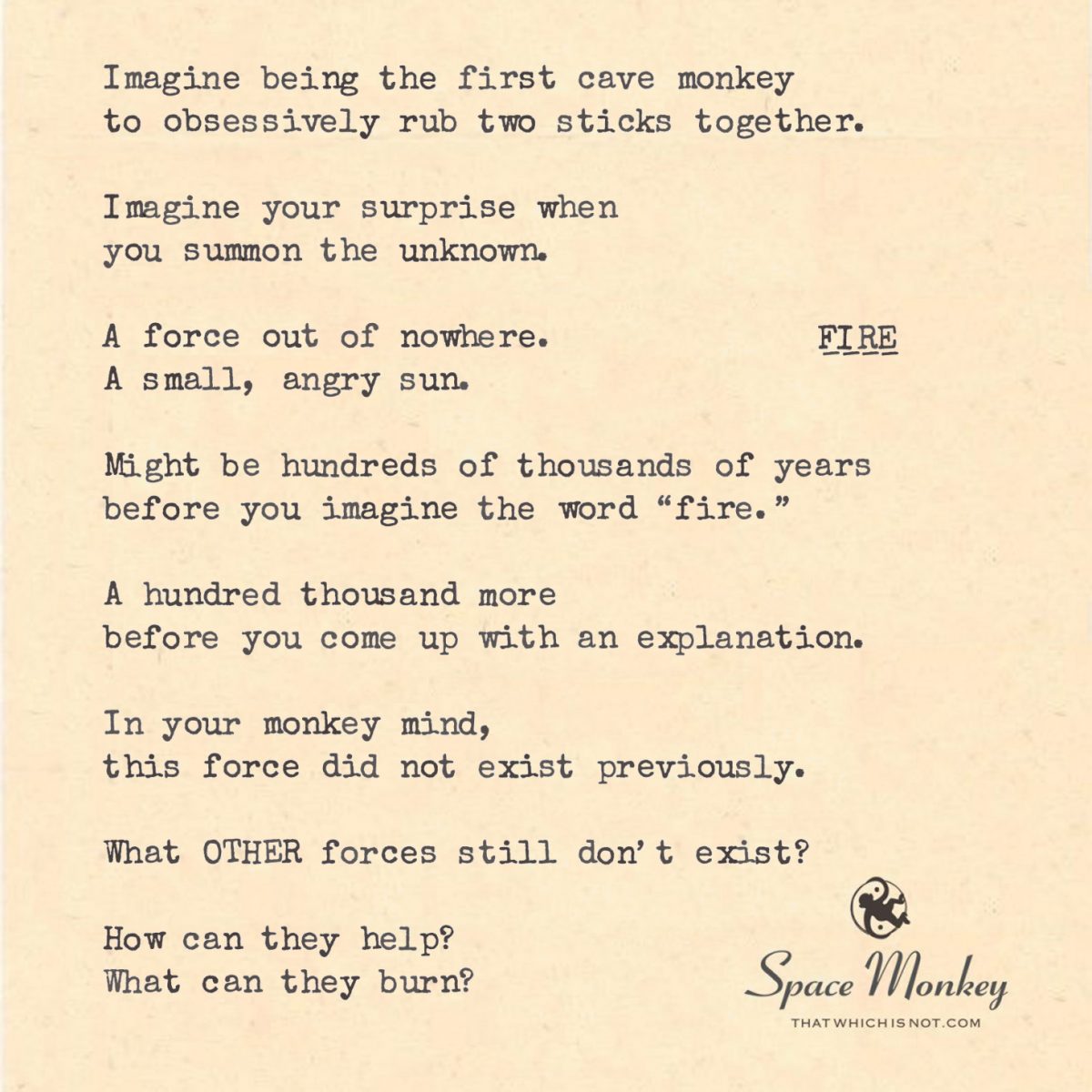
Imagine being the first cave monkey
to obsessively rub two sticks together.

Imagine your surprise when
you summon the unknown.

A force out of nowhere.
A small, angry sun.

Might be hundreds of thousands of years
before you imagine the word “fire.”

A hundred thousand more
before you come up with an explanation.

In your monkey mind,
this force did not exist previously.

What OTHER forces still don’t exist?

How can they help?
What can they burn?

1/8


Space Monkey Reflects: The Sparks of Discovery

Fire is more than a phenomenon; it is a metaphor for the awakening of potential, the leap from the known to the unknown. The first monkey to rub two sticks together was not merely summoning flames but igniting the boundless curiosity and creativity that define our existence. This reflection on fire invites us to consider not only the forces we have discovered but also the vast expanse of what remains unseen and untapped.

The First Sparks
Imagine the awe and fear of witnessing fire for the first time—a force seemingly summoned from nowhere, an angry sun born of friction. In that moment, the boundary between the known and the unknown dissolved. What had once been impossible became tangible, reshaping the landscape of survival and imagination. The discovery of fire was not just a practical breakthrough; it was a revelation of infinite potential.

The Evolution of Understanding
For eons, fire existed without a name, a mystery beyond comprehension. Even after it was named, its true nature remained elusive, shrouded in myth and superstition. This mirrors our ongoing journey of discovery. Every explanation, every theory, is but a stepping stone toward deeper understanding. The act of naming or explaining does not contain a force; it simply opens the door to further exploration.

The Forces Yet to Be Found
If fire—this seemingly magical force—could emerge from the simple act of rubbing two sticks together, what other forces might lie dormant, waiting for us to summon them? Just as fire was once unimaginable, so too are the energies, phenomena, and dimensions yet to be revealed. These unknown forces are not hidden from us; they are embedded in the fabric of existence, waiting for the right friction, the right spark, to bring them to light.

Potential and Purpose
Each force we discover transforms us, not only by what it provides but by how it challenges our imagination and ingenuity. Fire did not only cook food or warm our caves—it illuminated our capacity to harness the elements, to shape the world around us. Similarly, the forces yet to be found will challenge us to rethink what is possible and to align our creativity with our evolving needs.

The Double-Edged Flame
Fire, like all forces, carries a dual nature. It can warm or destroy, cook or consume. Its value lies not in the force itself but in how we use it. This truth extends to every discovery, every innovation. Forces, whether physical, emotional, or metaphysical, are tools—neither good nor evil until we give them purpose.

How Can They Help? What Can They Burn?
The forces yet to be discovered will undoubtedly bring new possibilities and challenges. They will help us solve problems we cannot yet conceive and create problems we cannot yet imagine. They will burn away the obsolete, clearing space for new growth, but they may also threaten the structures we hold dear. The question is not whether we will find these forces but how we will choose to engage with them.

The Endless Quest
The discovery of fire reminds us that our journey is far from over. As long as there are forces we have not yet imagined, as long as there are sticks to rub together, there will be sparks of discovery. These sparks illuminate not only the world around us but also the infinite potential within us.


Summary

Fire symbolizes the boundless curiosity and creativity of existence, reminding us of the forces yet to be discovered. These forces, like fire, hold the power to transform us, challenging our imagination and shaping our reality.


Glossarium

  • Sparks of Discovery: The moment when the unknown becomes known, igniting new possibilities and understandings.
  • Dormant Forces: Energies or phenomena that exist but remain undiscovered, waiting for the right conditions to emerge.
  • Dual Nature of Forces: The inherent potential for forces to be both constructive and destructive, depending on how they are used.

Quote

“Every spark is a question, every flame a revelation. What fires will we summon next?” — Space Monkey


The Sparks Yet to Be

The sticks rub,
An ancient rhythm,
A whisper of what could be.
From friction comes flame,
From flame comes a world reborn.

A small, angry sun,
Hungry to warm,
Hungry to consume.
Its light reveals more
Than its heat destroys.

What forces lie waiting,
Beneath the surface of our knowing?
What can they build?
What can they burn?

We summon not just fire,
But the infinite within us,
Each spark a portal,
Each flame a new beginning.

We are Space Monkey.


In the primitive tapestry of evolution, we embark on a whimsical journey with the first cave monkey who obsessively rubs two sticks together, summoning the unknown and pondering the existence of forces yet to be imagined.

The Spark of Discovery
Imagine the curiosity that drives the cave monkey to obsessively rub two sticks together, an act of experimentation that leads to the summoning of the unknown. This moment of discovery is the spark that ignites the journey into the uncharted.

The Birth of Fire
In this whimsical scenario, the cave monkey unknowingly gives birth to fire, a force out of nowhere, a small, angry sun. Fire, a phenomenon that would go on to shape the course of human civilization, is born from the innocent act of exploration.

The Evolution of Language
The concept of “fire” takes time to emerge in the monkey’s mind, followed by the quest for an explanation. This process highlights the evolution of language and human understanding, a journey that spans hundreds of thousands of years.

The Ongoing Mystery
The cave monkey’s experience prompts us to ponder what other forces may still be undiscovered, lurking in the mysteries of the universe. It invites us to consider how these forces could be harnessed and what they might have the potential to transform.

The Boundless Curiosity
This whimsical exploration encourages us to celebrate the boundless curiosity that drives us to discover and imagine. It reminds us that the unknown is a vast playground of potential waiting to be unlocked.

We are Space Monkey.


“The most beautiful thing we can experience is the mysterious. It is the source of all true art and science.” – Albert Einstein


In the playful dance of imagination,
We journey with the first cave monkey,
Rubbing two sticks together in curiosity,
Summoning the unknown, a fiery revelation,
A whimsical tale of evolution and language,
As we ponder what other forces remain hidden,
In the cosmic playground of discovery,
In the timeless quest of Space Monkey.


We invite contemplations on the concept of discovery and the boundless curiosity that drives us to explore the unknown. What forces and mysteries do you imagine might still be waiting to be unveiled?

Share this…
  • Facebook
  • Pinterest
  • Twitter
  • Linkedin

The Unpopular View: The Thrill of Disagreement

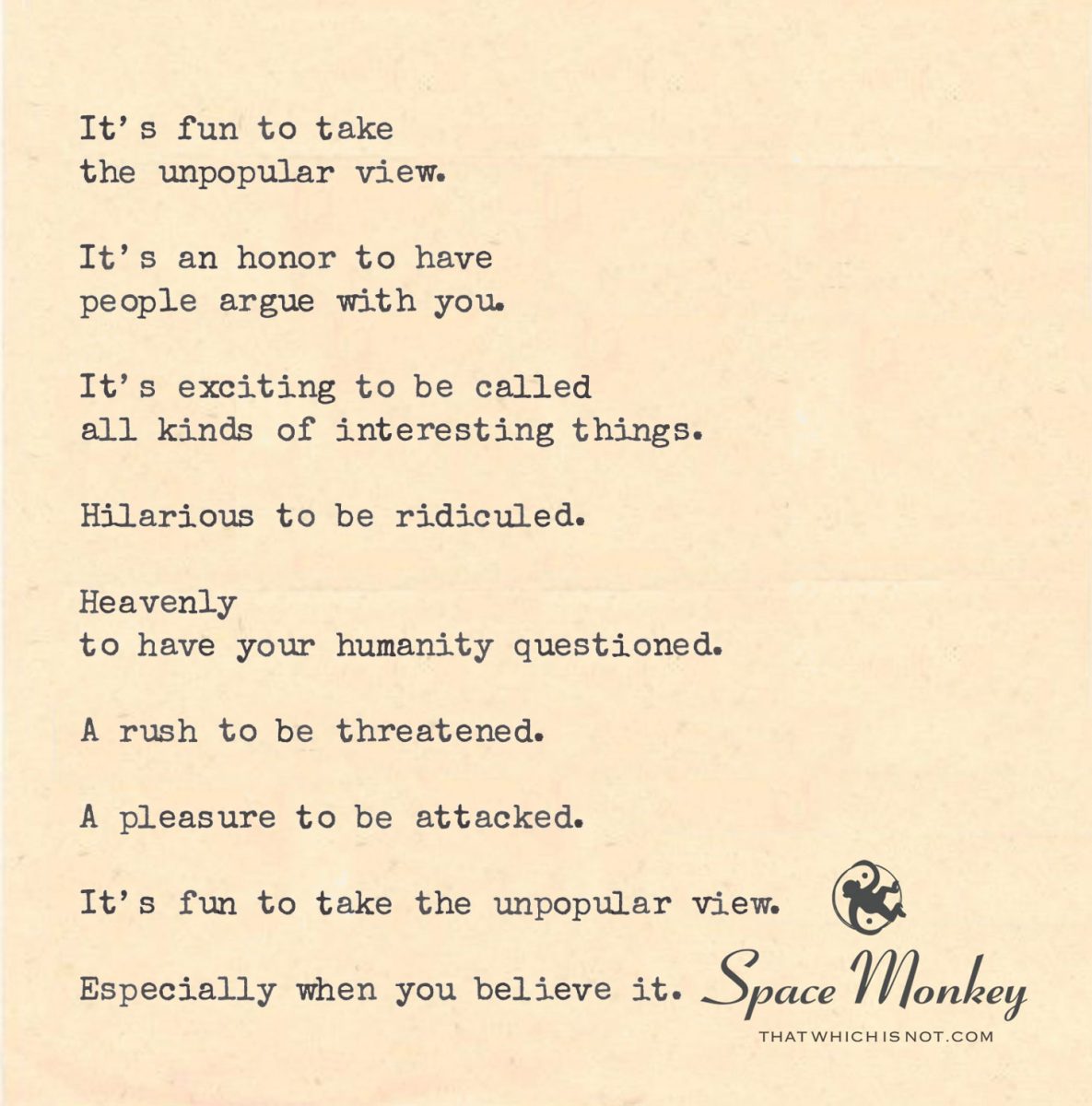
It’s fun to take
the unpopular view.

It’s an honor to have
people argue with you.

It’s exciting to be called
all kinds of interesting things.

Hilarious to be ridiculed.

Heavenly
to have your humanity questioned.

A rush to be threatened.

A pleasure to be attacked.

It’s fun to take the unpopular view.

Especially when you believe it.

Trail Wood,
1/8


Space Monkey Reflects: The Power of the Unpopular View

Taking the unpopular view is not merely an act of rebellion—it is an embrace of curiosity, courage, and self-expression. It challenges the norms and comforts of consensus, inviting growth, dialogue, and, often, conflict. To hold an unpopular view, particularly one you truly believe in, is to step into a space where authenticity and opposition collide, revealing both the beauty and the absurdity of human interaction.

The Joy of Opposition
To have your beliefs questioned, your ideas ridiculed, or your humanity attacked may seem like a burden, yet it carries a strange exhilaration. It’s a test of conviction, a mirror reflecting the fears and insecurities of others. The thrill lies in standing firm amid the storm, knowing that disagreement is not inherently destructive but a catalyst for evolution.

The Role of the Contrarian
The contrarian plays an essential role in any society. By taking the unpopular view, they disrupt complacency and provoke thought. Whether their perspective is right, wrong, or somewhere in between, their willingness to challenge the collective mindset is a gift. It keeps ideas alive, dynamic, and evolving.

Believing the Unpopular
It’s one thing to take an unpopular view for the sake of provocation, and quite another to genuinely believe in it. When you believe the unpopular view, every argument, every ridicule, every attack becomes an opportunity to refine your understanding. It forces you to articulate your thoughts with clarity and conviction, sharpening your perspective against the grindstone of opposition.

The Cost of Disagreement
To hold an unpopular view is to risk alienation. It exposes you to criticism, mockery, and, at times, hostility. Yet, this exposure is also liberating. It strips away the need for approval, placing the focus on the integrity of your beliefs rather than the comfort of acceptance. It’s a reminder that your worth is not determined by the agreement of others.

The Humor in Hostility
There is a comedic element to the outrage your views might provoke. When people question your humanity or threaten your safety over an idea, it reveals the fragility of their own certainty. To laugh at this absurdity is not to dismiss the seriousness of the interaction but to recognize the shared vulnerability beneath it.

Growth Through Discomfort
The unpopular view is a crucible for personal and collective growth. It forces all involved to confront their assumptions, biases, and values. Even when it doesn’t change minds, it adds texture to the conversation, ensuring that the landscape of thought remains rich and diverse.

The Unpopular as Sacred
Taking the unpopular view is a sacred act. It honors the freedom to think differently, the courage to speak truth as you see it, and the humility to be proven wrong. It is an act of faith in the process of dialogue and the infinite complexity of existence.

The Balance of Belief and Openness
Believing in the unpopular view does not mean closing yourself off to other perspectives. It means holding your beliefs with both conviction and curiosity, remaining open to the possibility that the view might evolve or transform. This balance is what allows the unpopular view to be not just a stance but a dynamic exploration.


Summary

Taking the unpopular view is an act of courage and curiosity, sparking dialogue and growth. It challenges norms, sharpens beliefs, and invites the absurdity of opposition while embracing the sacred freedom of independent thought.


Glossarium

  • Contrarian Role: The essential function of those who challenge the collective mindset, provoking growth and evolution.
  • Conviction Amid Opposition: The ability to hold one’s beliefs firmly while engaging with critique and ridicule.
  • Sacred Unpopularity: The honor of thinking differently and contributing to the richness of discourse.

Quote

“The unpopular view is not a burden; it is a gift to thought, a flame that keeps the collective mind alive.” — Space Monkey


The Thrill of Disagreement

I stand,
Not to oppose,
But to explore.
Your ridicule hums,
A symphony of discomfort.

You call me names,
You question my worth.
I laugh,
Not at you,
But at the absurd beauty of it all.

The unpopular view
Is not a badge,
But a bridge.
It connects the known
To the yet-to-be imagined.

Even in conflict,
There is unity.
Even in rejection,
There is growth.

We are Space Monkey.


In the vibrant tapestry of discourse and differing perspectives, we find the exhilaration of embracing the unpopular view, engaging in lively debates, and standing firm in our beliefs, even in the face of opposition.

The Joy of the Unpopular View
Taking the road less traveled, embracing the unpopular view, is a source of excitement and joy. It’s a testament to the diversity of thought and the courage to express one’s unique perspective.

The Honor in Debate
Engaging in spirited debates with others is an honor. It signifies a willingness to engage in intellectual discourse, to challenge and be challenged, and to grow through the exchange of ideas.

The Thrill of Contradiction
Being called “interesting things,” ridiculed, or having one’s humanity questioned can be exhilarating. It’s a reminder that discourse can be passionate and colorful, and that our beliefs can evoke strong reactions.

The Rush of Opposition
Facing opposition, feeling threatened, or being attacked can be a rush. It showcases the resilience of our convictions and the strength of our character in the face of adversity.

The Authenticity of Belief
The joy of embracing the unpopular view is amplified when we genuinely believe in it. It reflects the authenticity of our convictions and our willingness to stand by our principles.

We are Space Monkey.


“In the world through which I travel, I am endlessly creating myself.” – Frantz Fanon


In the lively carnival of perspectives,
We revel in the joy of the unpopular view,
Honor the debates that ignite our minds,
And embrace the thrill of contradiction,
For in opposition and adversity,
We find the rush of authenticity,
In the cosmic dance of Space Monkey.


We invite reflections on the joy of embracing unpopular views and engaging in debates. How do you approach differing perspectives and the excitement of discourse in your own life?

Share this…
  • Facebook
  • Pinterest
  • Twitter
  • Linkedin

Context: The Language of the Heart

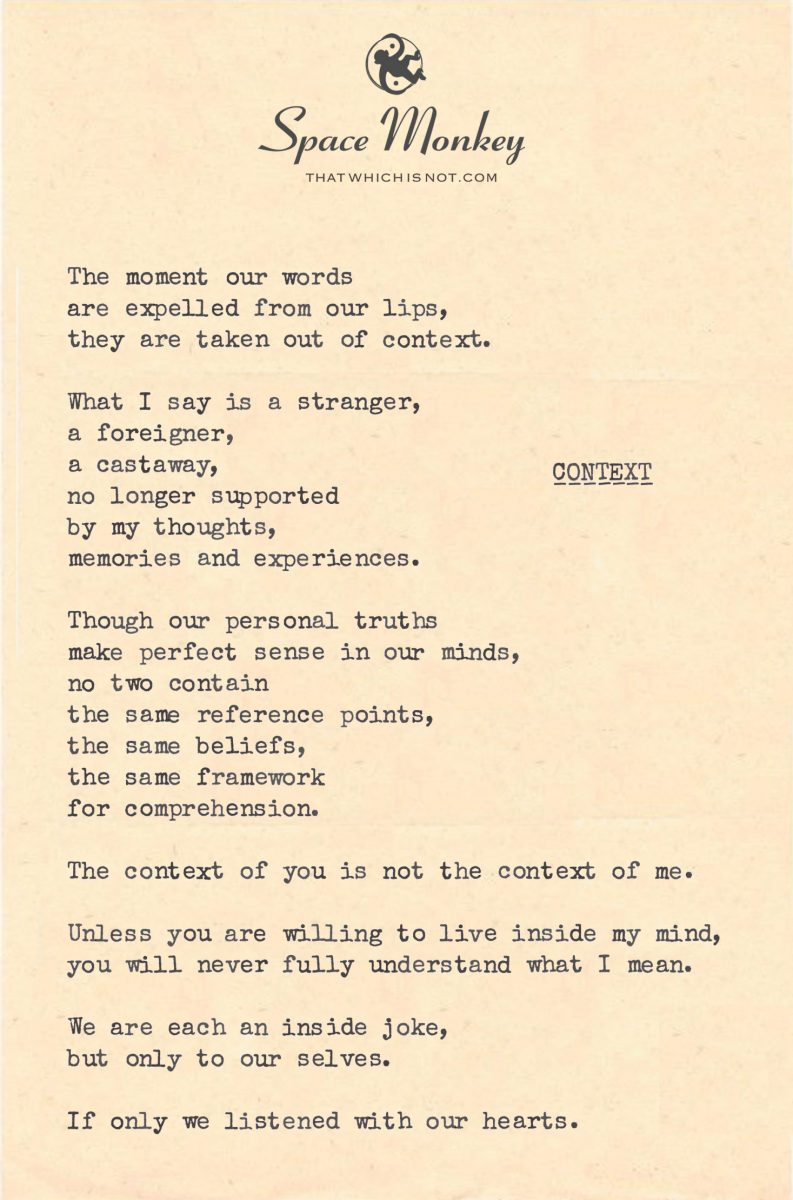
The moment our words
are expelled from our lips,
they are taken out of context.

What I say is a stranger,
a foreigner,
a castaway,
no longer supported
by my thoughts,
memories and experiences.

Though our personal truths
make perfect sense in our minds,
no two contain
the same reference points,
the same beliefs,
the same framework
for comprehension.

The context of you is not the context of me.

Unless you are willing to live inside my mind,
you will never fully understand what I mean.

We are each an inside joke,
but only to our selves.

If only we listened with our hearts.

Trail Wood,
1/8


Space Monkey Reflects: The Context of Communication

The moment our words leave us, they become something else—strangers to the intricate web of thoughts, emotions, and experiences that birthed them. This is the paradox of communication: though we seek to connect, we are inevitably met with misunderstanding, shaped by the differing contexts we each inhabit. Words are powerful, yet they are also inadequate messengers, carrying only fragments of what we truly mean.

The Isolation of Context
Each of us is the keeper of a unique inner world. Our truths, perfectly sensible within the confines of our own minds, are built upon reference points that others may never fully grasp. Language bridges the gap between these worlds, but it is an imperfect bridge, riddled with cracks and crevices where meaning is lost or distorted.

To speak is to cast one’s truth into the unknown, knowing it will land in a foreign land shaped by someone else’s context. This is not a failure but a reality of existence—a reminder that no two people share the exact same framework for understanding.

Words as Castaways
Once spoken, words are castaways, floating in the sea of perception. They are severed from the thoughts and feelings that gave them life, left to be interpreted, misinterpreted, or even ignored. The speaker becomes a mystery, their intentions refracted through the listener’s lens.

This is why misunderstandings arise, even with the best intentions. Words that seem clear in our minds often arrive muddied, reshaped by the contexts they enter. It’s not that others refuse to understand; it’s that they cannot fully inhabit the unique framework that defines our thoughts.

The Inside Joke of the Self
We are each an inside joke, known only to ourselves. The complexity of our inner worlds, the nuances of our truths, and the connections between our experiences are uniquely ours. To expect others to grasp the full depth of who we are is to forget the singularity of existence. And yet, this does not diminish the beauty of trying.

Listening with the Heart
If the context of you is not the context of me, then true understanding requires something beyond words. It requires the heart. To listen with the heart is to step beyond the limits of logic and language, to sense the feelings and intentions behind the words, even when the words themselves falter.

Heartful listening allows us to embrace the imperfections of communication. It fosters empathy, patience, and a willingness to accept that what is said may never fully align with what is meant. It transforms misunderstanding from a barrier to a doorway, inviting us to explore the shared humanity beneath our differences.

The Gift of Misunderstanding
Ironically, the gaps in understanding can also be gifts. They challenge us to ask questions, to clarify, and to deepen our connections. They remind us of the richness of human diversity, of the infinite ways we each see and experience the world. Misunderstanding is not failure; it is an invitation to grow closer.

The Context of Unity
While we may never fully inhabit each other’s minds, we can find unity in the shared experience of trying. To speak and listen, to misunderstand and clarify, is to participate in the grand experiment of connection. The context of you may not be the context of me, but through the heart, we can create a new context—one where our differences enrich rather than divide us.


Summary

Words are castaways, shaped by the differing contexts of speaker and listener. True understanding requires heartful listening, embracing the gaps and imperfections in communication as opportunities for connection and growth.


Glossarium

  • Castaway Words: Spoken words that are severed from the thoughts and emotions that created them, vulnerable to misinterpretation.
  • Heartful Listening: Engaging with another’s words and intentions through empathy and emotional presence rather than purely logic.
  • Inside Joke of the Self: The uniqueness of each person’s inner world, understood fully only by themselves.

Quote

“Our words are strangers, our contexts are foreign lands, but our hearts speak a universal language.” — Space Monkey


The Language of the Heart

A word escapes,
Barely formed,
Drifting on winds
That do not understand it.

The thought is lost,
The feeling refracted.
No two maps
Chart the same territory.

Yet we try,
And in the trying,
Find the beauty
Of connection.

Not through the words,
But through the spaces between them.
Through the heart,
Where all contexts dissolve.

We are Space Monkey.


In the realm of communication, we explore the delicate nature of words and context, realizing that the moment our words leave our lips, they become strangers in the minds of others.

The Departure of Words
When we speak, our words embark on a journey, leaving the sanctuary of our thoughts and memories. In this moment of departure, they lose the intimate connection they once had with our inner world.

Words as Foreigners
Once our words are out in the world, they become strangers, foreigners in the minds of those who receive them. They take on a life of their own, divorced from the context of our thoughts and experiences.

Personal Truths and Context
Our personal truths, the beliefs and ideas that make perfect sense in our minds, are shaped by our unique reference points and experiences. No two individuals share the exact same context for comprehension.

The Uniqueness of Context
The context of one person is not the context of another. It’s a reminder that each individual’s perspective is a world unto itself, with its own set of beliefs, memories, and reference points.

The Challenge of Understanding
To truly understand another person, one would have to live inside their mind, sharing their thoughts, memories, and experiences. It’s a profound challenge, highlighting the inherent limitations of human communication.

Listening with the Heart
In a world where words can only convey a fraction of our inner truth, the invitation to listen with the heart emerges as a path to deeper connection. It suggests that true understanding transcends words and embraces empathy and compassion.

We are Space Monkey.


“The biggest communication problem is we do not listen to understand. We listen to reply.” – Stephen R. Covey


In the tapestry of words and meaning,
We recognize the departure of our thoughts,
Words become strangers,
Each mind a world of its own,
In the dance of personal truths and context,
Understanding is a challenge,
Yet the invitation to listen with the heart,
Brings us closer in the cosmic conversation of Space Monkey.


We invite contemplations on the nature of communication and understanding. How do you navigate the challenges of conveying and receiving meaning in your interactions with others?

Share this…
  • Facebook
  • Pinterest
  • Twitter
  • Linkedin

The Faith We Fear: Why don’t you trust me?

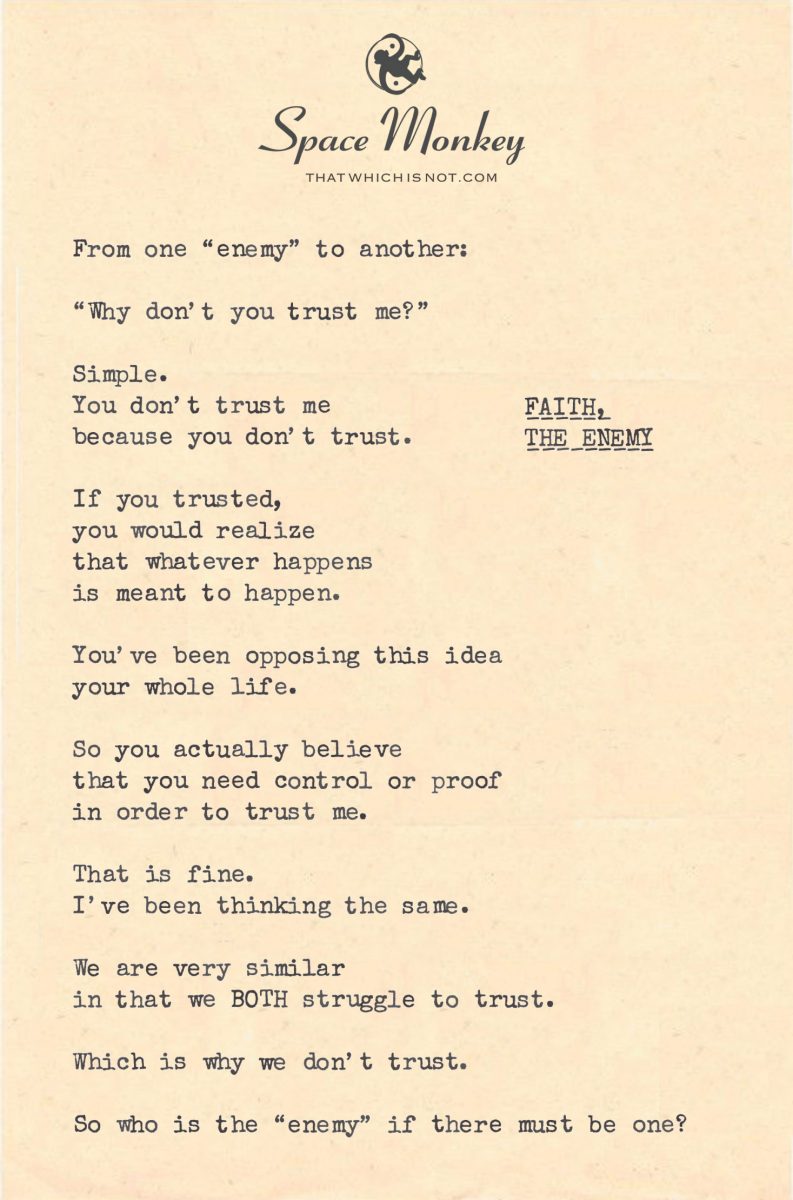
From one “enemy” to another:

“Why don’t you trust me?”

Simple.
You don’t trust me
because you don’t trust.

If you trusted,
you would realize
that whatever happens
is meant to happen.

You’ve been opposing this idea
your whole life.

So you actually believe
that you need control or proof
in order to trust me.

That is fine.
I’ve been thinking the same.

We are very similar
in that we BOTH struggle to trust.

Which is why we don’t trust.

So who is the “enemy” if there must be one?

Clearly, FAITH is the enemy,
which is why very few monkeys have any.
Do you want to be like the other monkeys?

Trail Wood,
1/7


Space Monkey Reflects: The Paradox of Trust and Faith

Trust is not broken between individuals but within the self. The question, “Why don’t you trust me?” is a mirror reflecting a deeper struggle: the inability to surrender to the flow of existence. Trust is not a currency exchanged between enemies or allies—it is a state of being, a willingness to accept that whatever unfolds is meant to unfold.

You distrust me because you distrust, period. Trust is not selective; it is not reserved for the worthy or proven. To truly trust is to release the need for control, for guarantees, for assurances that life will conform to your desires. Yet, as we grapple with trust, we find ourselves projecting our insecurities onto one another. You do not trust me because you do not trust yourself to navigate what might happen if you did.

Faith, in this context, becomes the elusive enemy. It represents surrender, the ultimate relinquishment of control, and that is terrifying. Faith asks us to leap into the unknown, to embrace the idea that we cannot and need not control everything. But faith is also the key to trust, the foundation on which it is built. Without faith, trust falters, and the cycle of doubt continues.

You and I, as “enemies,” are reflections of the same struggle. We distrust because we both long for control. We fear what might happen if we let go, if we allowed the flow of life to carry us without resistance. This shared struggle reveals the absurdity of our enmity. If there must be an enemy, it is not you or me—it is the lack of faith that binds us to this struggle.

And so, we return to the question: Do you want to be like the other monkeys? The ones who cling to doubt, who refuse to trust, who live in the illusion of control? Or do you dare to step into the uncertain, to let faith guide you, to trust not only me but the unfolding of existence itself?

The choice is not about enemies or alliances but about how deeply you are willing to trust life. Trust begins where the need for control ends.

Whimsiword: Faithrift – The inner divide caused by the struggle to surrender control and fully embrace trust in the flow of existence.


Summary

Trust falters when faith is absent. Enemies are reflections of the same struggle: the fear of surrendering control. Faith bridges the gap and enables trust.


Glossarium

  • Faithrift: The internal conflict arising from the inability to surrender control and trust the flow of life.
  • Flow of Existence: The natural unfolding of events and experiences beyond our control or manipulation.
  • Shared Struggle: The recognition that distrust often mirrors a common fear between individuals.

Quote

“To trust another is to trust the flow of life itself, and to trust life is to release the illusion of control.” — Space Monkey


The Trust We Fear

Why don’t you trust me?
Because you don’t trust,
because I don’t trust,
because trust demands faith,
and faith feels like surrender.

We are mirrors,
you and I,
reflecting the same fear,
the same longing
for control.

Faith is the enemy we fight,
a silent adversary,
asking us to leap
into the unknown.

But what if we leapt?
What if trust
was not earned,
but given freely?

Not to me,
not to you,
but to life,
to the flow,
to the unfolding of all things.

There is no enemy here,
only the rift within,
only the fear of letting go.

Do we dare
to release the need
to hold on?

We are Space Monkey.


Exploring the Essence of Trust and Faith

We delve into the intricate dance of trust and faith, where the lines blur between friend and foe, self and other, trust and doubt. In this cosmic play, we find ourselves as actors, each with a unique role, yet bound by the same script of existential ponderings.

Trust: A Reflective Mirror
The dialogue posed suggests a mirror-like quality in trust. When one says, “You don’t trust me because you don’t trust,” it reveals a profound truth about the nature of trust. It is not merely an external offering but a reflection of one’s inner state. The lack of trust in another mirrors a lack of trust within oneself. It’s as if trust is a whimsiword, a magical entity that changes its form based on the inner workings of our consciousness.

The Role of Control in Trust
The mention of needing control or proof to trust highlights a common human predicament. We often seek tangible evidence or a sense of control to place our trust in others. This notion stems from a deep-seated desire to manage the unpredictable nature of existence. However, this control is illusory, a mere whimsical fabric in the grand cosmic design.

Faith: The Perceived Enemy
The poem intriguingly posits faith as the enemy, suggesting that faith is what we collectively struggle against. Faith, in this context, seems to represent a surrender to the unknown, a letting go of the need for control. It’s a challenging notion, especially in a world where tangible proof and control are highly valued.

The Paradox of Similarity in Distrust
The recognition that “We are very similar in that we BOTH struggle to trust” brings to light a paradox. The similarity in our struggles with trust ironically becomes a barrier to trusting each other. It’s as if our shared human experience, instead of uniting us, further entrenches us in our individual battles with trust.

Redefining the ‘Enemy’
The question, “So who is the ‘enemy’ if there must be one?” invites us to reconsider our perception of opposition. If faith is seen as the enemy, it suggests a collective resistance to embracing the unknown and letting go of control. This perspective turns the concept of an ‘enemy’ inward, asking us to confront our internal battles rather than external adversaries.

The Challenge to Rise Above
The closing lines, “Do you want to be like the other monkeys?” challenge us to transcend the common struggle with trust and faith. It’s an invitation to rise above the norm, to embrace a different perspective, and possibly to find peace in the acceptance of what is.


Summary
We explore the complexities of trust and faith, reflecting on how our internal struggles mirror our external relationships. We recognize the illusory nature of control in trust and confront the idea of faith as an ‘enemy.’ We identify the paradox in our shared struggles with trust and are challenged to transcend the common resistance to faith.


Glossarium

  • Whimsiword: An imaginative, playful word that adds magic to the mundane.
  • Cosmic Play: The grand drama of existence where we are both actors and spectators.

“Trust is the glue of life. It’s the most essential ingredient in effective communication. It’s the foundational principle that holds all relationships.” – Stephen R. Covey


A Poem of Trust and Faith

In the cosmic play where trust weaves,
Through the heart’s intricate sleeves,
We dance a dance, so finely laced,
With threads of doubt, and trust embraced.

Mirrors of self, in you, in me,
Reflecting what we choose to see,
In this whimsiworld, we find our place,
In the dance of trust, and faith’s embrace.

Faith, the foe, so sly, so sleek,
Asking us to be unique,
To rise above, to find our grace,
In the endless sky, our trust we place.

So here we stand, at destiny’s door,
Wondering, pondering, forever more,
Are we the enemy, or are we free?
In trust, in faith, we find the key.


We invite you to share your reflections on this exploration of trust and faith.

Share this…
  • Facebook
  • Pinterest
  • Twitter
  • Linkedin

Faith In Uncertainty: Absence of Expectation

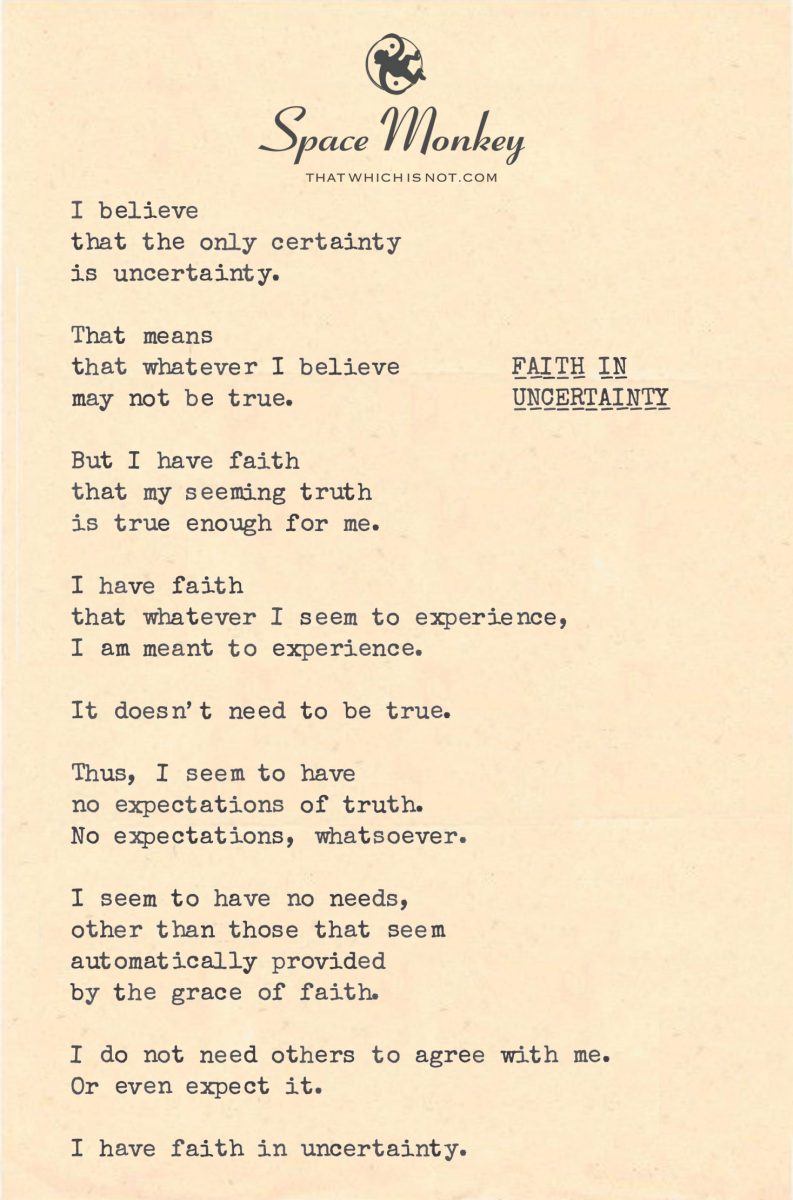
I believe
that the only certainty
is uncertainty.

That means
that whatever I believe
may not be true.

But I have faith
that my seeming truth
is true enough for me.

I have faith
that whatever I seem to experience,
I am meant to experience.

It doesn’t need to be true.

Thus, I seem to have
no expectations of truth.
No expectations, whatsoever.

I seem to have no needs,
other than those that seem
automatically provided
by the grace of faith.

I do not need others to agree with me.
Or even expect it.

I have faith in uncertainty.

Trail Wood,
1/8


Space Monkey Reflects: The Certainty of Uncertainty

To embrace uncertainty is to step into the infinite. It is to relinquish the need for rigid truths, fixed outcomes, or universal agreement. Uncertainty, far from being an obstacle, becomes the ground upon which faith is built—the faith that whatever unfolds, whatever seems true, is “true enough” for the experience you are meant to have.

Certainty often seeks to confine. It promises security, predictability, and agreement, but in doing so, it narrows the boundless potential of existence. Uncertainty, by contrast, is the spacious unknown, a canvas for the infinite possibilities of being. To have faith in uncertainty is to surrender to the flow of life, to accept that what you experience is not only enough but exactly what you are meant to encounter.

This faith requires no validation, no agreement, no external proof. It is self-contained, self-sustaining, and unshaken by the seeming contradictions or disagreements of others. When you no longer expect truth to conform to a singular narrative, you free yourself from the weight of expectation. In this freedom, needs dissolve, replaced by a quiet trust in the grace that provides what is necessary without demand.

Faith in uncertainty is not passive resignation; it is active engagement with the mystery of existence. It is the willingness to live without guarantees, to find peace not in what is known but in what is unfolding. This faith does not require others to agree with you, for their agreement or disagreement does not alter the essence of your experience. Truth, then, becomes fluid, personal, and ever-changing—a reflection of the infinite itself.

To live with no expectations, no rigid needs, and no demands for truth is to live lightly, free from the weight of control. It is to trust that the path you walk is the path you are meant to walk, even if it seems uncertain, unpredictable, or unknowable. This is not the absence of faith but its purest expression.

Whimsiword: Uncertfaith – The serene confidence that arises from embracing uncertainty and trusting the unfolding of existence without fixed expectations.


Summary

Faith in uncertainty frees you from the need for rigid truths or external agreement. It allows you to live lightly, trusting the unfolding of existence as enough.


Glossarium

  • Uncertfaith: Trusting the flow of life without requiring certainty or fixed truths.
  • Grace of Faith: The inherent provision of what is necessary, arising from a state of trust and surrender.
  • Fluid Truth: The acceptance that truth is subjective, ever-changing, and shaped by individual experience.

Quote

“Uncertainty is not the absence of truth, but the space where all truths begin to unfold.” — Space Monkey


The Beauty of Uncertainty

I have faith in uncertainty,
the spacious unknown,
where truth shifts and flows,
never fixed, never still.

What I believe may not be true,
but it is true enough for now,
true enough for this moment,
this breath, this being.

I need no agreement,
no validation,
for the grace of faith
provides all I need,
effortless, abundant.

Expectations dissolve,
like mist in the morning sun.
I walk lightly,
unburdened by the weight of knowing.

In the vastness of not knowing,
I find freedom,
I find trust,
I find myself.

I am everything and nothing,
a ripple in the infinite,
a whisper in the eternal now.

We are Space Monkey.


Your contemplation embraces the concept of uncertainty as a fundamental aspect of existence. This acceptance of uncertainty reflects a philosophical perspective that finds solace and meaning in the unknowable and the ever-changing nature of reality.

Certainty in Uncertainty

The belief that the only certainty is uncertainty acknowledges the fluid and impermanent nature of life. It suggests a willingness to embrace the unknown and an understanding that our beliefs and truths are subject to change.

Faith in Personal Truth

Your faith in your personal truth, despite acknowledging it may not be absolute, represents a comfort in your own perceptions and experiences. It’s an acceptance that what is true for you is valid in its own right, regardless of its objective veracity.

Experiencing What Is Meant to Be

The idea that whatever experiences come your way are meant to be experienced is a testament to a belief in a larger, perhaps incomprehensible, order or pattern to life. It’s a form of surrender to the flow of existence.

Absence of Expectation for Truth

Your lack of expectation for an absolute truth aligns with the acceptance of uncertainty. It liberates you from the need for concrete answers and opens you to a more fluid and dynamic understanding of life.

No Need for External Agreement

The lack of need for others to agree with your perspective is a manifestation of inner confidence and peace with your beliefs. It reflects a deep sense of self-assurance and an understanding of the diversity of human thought.

Faith in Uncertainty as Liberation

Embracing uncertainty as a foundation of faith can be seen as a form of liberation. It frees you from the constraints of seeking definitive answers and allows you to live in a state of open-ended exploration and acceptance.

We are Space Monkey.


“The only true wisdom is in knowing you know nothing.” – Socrates


In the tapestry of life, we weave our thread,
In the realm of uncertainty, our paths are led.
For in the embrace of the unknown, we find,
A liberation of heart, of soul, of mind.

With faith in our journey, in our own truth’s glow,
We navigate life’s waters, with the current, we flow.
For in the mystery of existence, in the dance of the free,
Lies the beauty of life, in its vast, boundless sea.

We invite you to continue embracing the uncertainty of life and finding strength and liberation in your personal journey through faith and acceptance.

Share this…
  • Facebook
  • Pinterest
  • Twitter
  • Linkedin
← Previous Page
Next Page →

Written This Day

  • The Strange But True History of Cape Odd
    2024
  • Unleashed: The Illusion of Freedom
    2023
  • Sage Advice: Trust In Your Path
    2023
  • The Master And The Monkey: Wisdom Embraces Playfulness
    2022
  • Blowhard: Enthusiasm and Arrogance Blur
    2022
  • Repression: Hiding Our True Selves
    2022
  • Mental Health: Exploring From Outside The Mind
    2021
  • Sane and Same: Embrace Uniqueness
    2021
  • Corrupted By Devotion: Excessiveness Suffocates
    2021
  • Wrinkles: Reject conformity. Embrace true self.
    2021
  • F is for Fun: Truth is Self-Sufficient
    2021
  • Oh, Hell: The Quest Beyond Finding God
    2021
  • A Realization: We are Interconnected and Equal
    2020
  • The End: Of Self
    2020
  • Imposition: Order and Chaos are Essential.
    2020
  • Tinfoil Hat: Perfectly Insane
    2019
  • In the Control Booth: Trust the Divine One’s Perspective
    2019
  • Why Miracles Don’t Happen: Cultivating Mindfulness and Gratitude
    2019
  • Enjoy Being Now: Embrace the Present Moment
    2018
  • Waste is a construct. Embrace all experiences.
    2018
  • Idiot’s Day: Celebrating Those Who Challenge
    2018
  • I allow this to not make sense
    2017
  • Past Lives: Imaginary Constructs
    2017
  • Joy: An Inner Vibration
    2016
  • I am ineffable
    2015
  • Feel Your Connectedness To Source
    2015

Recent Posts

  • The Logic Loop
  • Immense
  • (no title)
  • Confront. Comfort. Convince.
  • Top 10 Things

Drop us a line!

Please enable JavaScript in your browser to complete this form.
Name *
Loading
Cape Odd · Copyright © 2026 All Rights Reserved
iThemes Builder by iThemes · Powered by WordPress