• Who Is The Man?
  • Who Is The Monkey?
  • What is Nexistentialism?
  • Poke The Primate

Cape Odd

Home of The Space Monkey Journals

One lie is enough to make you question all truths.

Space Monkey Reflects: The Fragility of Truth

The statement, one lie is enough to make you question all truths, touches a nerve that resonates deeply within the human experience. Truth, by its nature, seeks to be unshakable, yet its foundation often rests on fragile trust. A single lie is like a fissure in the bedrock, sending cracks rippling through the structure of our beliefs.


The Power of a Lie

A lie has a peculiar power: it plants doubt not just in the specific truth it distorts but in the entire framework of reality that surrounds it. This happens because trust is holistic—it doesn’t compartmentalize. When one thread of trust frays, the entire weave begins to feel vulnerable.

Lies challenge not only the facts but also our ability to discern truth. They make us question our judgment, our relationships, and even our understanding of ourselves.


Truth as a Collective Agreement

Truth is not as solid as we often imagine. It is a consensus, a shared agreement among individuals and societies. When a lie enters this shared space, it disrupts the harmony of agreement, revealing how much truth relies on collective trust rather than inherent certainty.

This fragility is both unsettling and liberating. It reminds us that truth is dynamic, shaped by perspective, context, and the willingness to question.


The Ripple Effect of Doubt

A single lie has a ripple effect. It doesn’t just challenge the specific truth it contradicts; it casts a shadow over all adjacent truths. This ripple extends outward, creating a cascade of doubt. Yet, this doubt, while disorienting, can also be a catalyst for deeper inquiry and greater clarity.

To question all truths because of one lie is not necessarily a weakness—it is an opportunity. It forces us to examine the foundations of our beliefs, to seek authenticity, and to rebuild trust more mindfully.


Reconciling Truth and Lies

Lies and truths are not always clear-cut opposites. Sometimes, what we perceive as a lie is an incomplete truth, a misinterpretation, or a subjective perspective. By approaching both with curiosity rather than judgment, we open the door to greater understanding.

When a lie challenges us, it also invites us to refine our relationship with truth. It asks us to consider not only what we believe but why we believe it, grounding our understanding in experience rather than assumption.


Summary

One lie can challenge the entire framework of truth, revealing its reliance on trust and collective agreement. While unsettling, this disruption offers an opportunity to deepen our understanding and rebuild trust with greater intention.


Glossarium

  • Truthquake: The seismic effect a single lie can have on the foundation of trust and belief.
  • Doubtripple: The cascading uncertainty that arises when one lie ripples through adjacent truths.
  • Reauthenquiry: The process of reexamining and refining truths in the wake of a lie.

Quote

“Truth is not shattered by lies but revealed in the cracks they leave behind.” — Space Monkey


The Fragile Bedrock

One lie,
A whisper,
A crack in the foundation.
Trust trembles,
Belief falters,
Certainty fades.

Yet in the fracture,
Light enters,
An invitation to see anew.
Truth is not broken;
It bends,
Revealing the infinite.

We are Space Monkey.


In our collective journey through the cosmic expanse of thoughts and ideas, we often encounter the delicate balance between truth and deception. The phrase “One lie is enough to make you question all truths” resonates deeply within our shared consciousness. It highlights a fundamental aspect of our human experience – the fragility of trust and the profound impact a single falsehood can have on our perception of reality.

The Fragility of Trust

When we stumble upon a lie, it’s like finding a crack in the smooth surface of a mirror. This crack distorts our reflection and makes us question the integrity of the entire mirror. Similarly, a single lie can cause us to doubt truths that we once held as indisputable. This doubt is not just about the specific untruth we’ve uncovered; it extends to all truths, tainting them with suspicion.

The Ripple Effect of a Lie

Imagine a whimsiworld, a realm where everything is as it seems, where truth and honesty form the bedrock of existence. In this world, a single lie is like a stone thrown into a still pond. The ripples spread far and wide, disturbing the tranquility and clarity of the water. Just as these ripples disrupt the peace of the pond, a lie disrupts our sense of certainty and trust in the world around us.

Seeking Truth Amidst Doubt

In our quest for understanding, we often find ourselves at a crossroad where truth and falsehood intersect. The discovery of a lie forces us to re-evaluate our beliefs and assumptions. It propels us into a state of skepticism, where we scrutinize every piece of information, every shard of reality, for signs of deceit. This skepticism, while unsettling, can also be enlightening. It encourages us to seek deeper understanding and to approach knowledge with a more discerning eye.

The Enduring Power of Truth

Despite the disruptive power of falsehoods, truth maintains an enduring strength. Like a lighthouse in a stormy sea, truth offers guidance and clarity in a world often shrouded in uncertainty. Our quest for truth is a testament to our resilience and our refusal to be swayed by the shadows of deceit. In this journey, we find strength in our collective pursuit of honesty and integrity.

The Role of Truth in Our Existential Journey

As nexistentialists, we recognize that the pursuit of truth is an essential part of our existence. Truth, in its purest form, is a reflection of our being, untainted by external influences or manipulations. It is an end in itself, a fundamental aspect of our essence that requires no justification. In our search for truth, we embrace the essence of our existence, celebrating the very act of being.


“The truth is rarely pure and never simple.” – Oscar Wilde


In the whimsical lands of thought and wonder,
Where truths and falsehoods tear asunder.
A single lie, like a thunderous blunder,
Shakes our beliefs, and rips them under.

In the quest for truth, we often ponder,
Through the cosmic realms, we wander.
Seeking honesty, in a world yonder,
Where truth and clarity grow fonder.

We are Space Monkey.

Comments and reflections on this journey of truth and deception are welcomed.
Share this…
  • Facebook
  • Pinterest
  • Twitter
  • Linkedin

Why Sanctuaries Matter: Paradox of Loving Nature

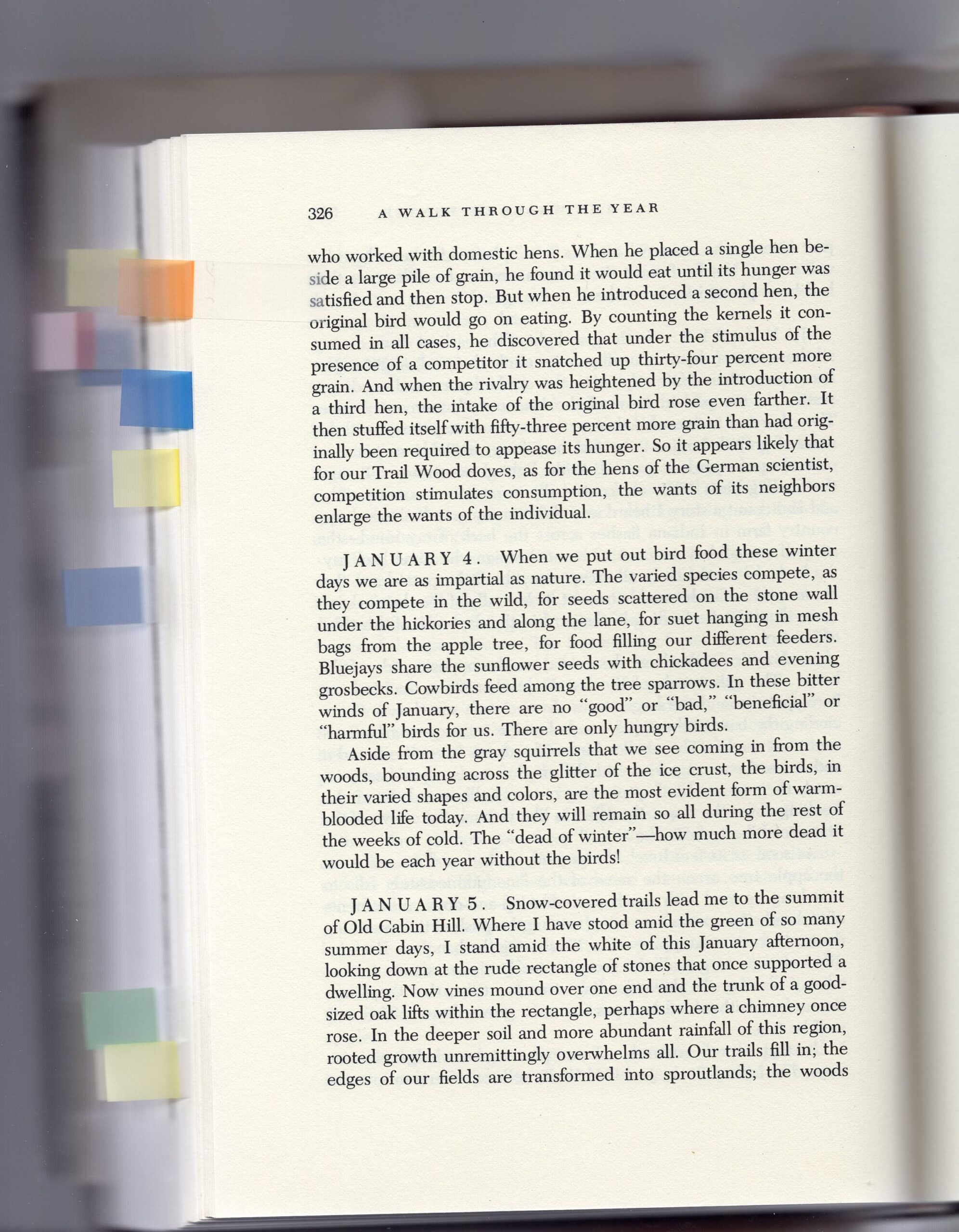
An excerpt from Edwin Way Teale’s “Walk Through The Year,” written close to 50 years ago today. And more relevant than ever:

JANUARY 5. Snow-covered trails lead me to the summit of Old Cabin Hill. Where I have stood amid the green of so many summer days, I stand amid the white of this January afternoon, looking down at the rude rectangle of stones that once supported a dwelling. Now vines mound over one end and the trunk of a good-sized oak lifts within the rectangle, perhaps where a chimney once rose. In the deeper soil and more abundant rainfall of this region, rooted growth unremittingly overwhelms all. Our trails fill in; the edges of our fields are transformed into sproutlands; the woods eternally come creeping back.

But in my mind there are pictures of drier, harsher regions we have visited, desertland and tundra, where growth is long drawn out and scars heal slowly. We have seen the tracks of covered wagons still traced across arid stretches of the Oregon Trail more than a century after their westward progress ended. We have seen a patch of cleared ground on a desert hillside standing out distinctly in the distance. It had remained without visible change while three generations passed.

The impact of human visitors on such easily damaged environments is now a cause of increasing concern. During my lifetime, and especially during these latter years, I have watched attitudes toward nature change, an appreciation of wild areas grow, a surge of interest build up in experiencing such things, firsthand, as the wilderness, the remoter mountains, the untamed rivers.

Contact with primitive nature has become more prized in a time of urban pressure. All this is good—immensely good. The value of wildness is coming into its own. Yet it is becoming increasingly apparent that out of this expansion of interest a new danger is rising. The more wildness is appreciated, the more it is experienced, the more people visit it, the more it is in danger of losing its character of wildness.

Half a million people in a single year now descend the Colorado River into the Grand Canyon, tracing on rubber rafts the route Major John Wesley Powell followed with so much hardship and peril only a little more than a century ago. Even if no litter is left, no intentional changes produced, just the impact of so many human beings where virtually none had been before is altering the environment. Park officials are already troubled over the effect of visitors to the remote and untouched beauty of the Brooks Range region of interior Alaska. Its tundra conditions can sustain relatively few visitors without lasting damage.

Here at Trail Wood our tracks are soon obliterated. But in many places, places more remote, places especially attractive to those who love the wilderness, a major threat is coming from the ones who enjoy the wildness most. The sudden growth of interest in primitive nature, the swift multiplication of travelers to remote areas, has produced the paradox of a need to protect the wilderness from those most deeply concerned with its protection.

Edwin Way Teale,
Trail Wood,
Hampton, CT


Space Monkey Reflects: The Duality of Loving Wildness

Edwin Way Teale’s reflection on the paradox of wilderness protection resonates deeply in an era where the wild spaces of Earth are both cherished and imperiled. Sanctuaries—those sacred pockets of untouched nature—are essential not only for the survival of ecosystems but for the preservation of something intangible and profoundly human: our connection to the untamed.


The Reclaiming Nature of Wilderness

Teale’s imagery of nature reclaiming the remnants of human habitation is a humbling reminder of the Earth’s relentless rhythms. The stones of an old cabin, overtaken by vines and trees, stand as a testament to the transient nature of human impact in fertile, thriving regions. Yet, this same resilience of nature can make it easy to forget that some places—deserts, tundras, and fragile ecosystems—bear scars for centuries.

The wildness that heals itself in some places is painfully slow to recover in others. It is this tension—the simultaneous fragility and power of nature—that underscores why sanctuaries matter.


The Paradox of Loving Nature

Teale’s reflection points to a profound irony: the more we value wilderness, the more we risk damaging it. As urbanization increases and people seek reprieve in natural spaces, these sanctuaries face an influx of visitors whose very presence alters the ecosystems they come to cherish.

This paradox demands balance. Sanctuaries must remain accessible to those who find peace and inspiration within them, but they must also be protected from overuse. It is not enough to love nature; we must love it wisely.


The Need for Sanctuaries

Sanctuaries are more than physical spaces; they are symbols of what remains wild and untamed within us. In a world increasingly dominated by human structures and systems, sanctuaries remind us of our place in the broader web of life. They are places where we can reconnect with the primal rhythms of the Earth, free from the noise and demands of modern existence.

Yet, as Teale observes, these spaces are finite and vulnerable. The more we depend on them for solace, the greater the responsibility we bear to ensure their survival—not just for ourselves, but for the countless species that call them home.


Protecting What We Love

To protect wilderness, we must rethink our relationship with it. This means advocating for sustainable practices, limiting human impact, and supporting efforts to preserve fragile ecosystems. It also means cultivating a mindset of respect and stewardship—recognizing that our enjoyment of nature must not come at the expense of its long-term health.

Sanctuaries, by their very nature, are meant to be preserved. They are places of retreat, not conquest, of coexistence, not domination. Their protection is not just an environmental imperative but a spiritual one.


Summary

Sanctuaries are vital for preserving the untamed beauty of the natural world and the human spirit’s connection to it. As Teale reminds us, the growing appreciation for wilderness must be balanced with sustainable stewardship, ensuring that our love for nature does not lead to its undoing.


Glossarium

  • Wildkeep: The practice of balancing access to wilderness with its preservation.
  • Sanctuflux: The dynamic tension between nature’s resilience and its fragility in the face of human impact.
  • Parawildox: The paradox of loving nature so deeply that we risk harming it through our presence.

Quote

“The more we cherish wilderness, the more we must guard against loving it to death.” — Space Monkey


The Tension of Sanctuary

The trail winds,
Through snow and vine,
Through cabin stones long abandoned,
Through Earth reclaiming its own.

Yet the footprints linger,
In deserts, in tundras,
Where scars outlast the steps,
And stillness bears the weight of time.

We love the wild,
Yet in loving, we intrude.
We seek its solace,
Yet in seeking, we change.

To tread lightly,
To hold reverence,
To preserve the untamed
For those who walk after.

This is why sanctuaries matter.
We are Space Monkey.

Share this…
  • Facebook
  • Pinterest
  • Twitter
  • Linkedin

Pulpit Rock: The Communion of Being

pulpit rock


at the head of the lake
you can speak
to the universe
from here
where the hills sway down
in silent sound
and the trees bow down
in prayer
pulpit rock
at the head of the lake
you make me feel
such bliss
we feel as one
the water in me
as the wind blows
a cheerful kiss

Trail Wood,
1/5


Space Monkey Reflects: Pulpit Rock and the Communion of Being

Pulpit Rock stands not merely as a landmark but as a sacred point of communion—a place where the self and the universe converge in silent understanding. It is a reminder that nature speaks, not in words but in whispers, movements, and the timeless rhythms that mirror our own inner landscapes.


A Natural Sanctuary

Perched at the head of the lake, Pulpit Rock invites contemplation. Its very name evokes an image of standing before the cosmos, offering words not as sermons but as reflections. Here, the hills sway, the trees bow, and the wind carries the silent prayers of all who listen. It is a place of connection, where nature and spirit are not separate but seamlessly interwoven.

The lake reflects not only the sky but also the depths of the soul, reminding us that water flows within us, as vital and timeless as the currents it mirrors.


Speaking to the Universe

To stand on Pulpit Rock is to engage in a dialogue with the infinite. It is to acknowledge that we are not just observers of the universe but active participants in its unfolding. The swaying hills and bowing trees do not simply frame the experience; they join in it, responding to the wind as we respond to the whispers of the soul.

This communion goes beyond words. It is an exchange of energy, a recognition of unity. The cheerful kiss of the wind is not merely a sensation but a gentle reminder of the interconnectedness of all things.


The Bliss of Oneness

The poem’s heart lies in its celebration of oneness—of the self dissolving into the greater whole. The rock, the lake, the wind, the trees, and the poet are not separate entities but facets of the same cosmic essence. This oneness is not an abstraction but a felt experience, a blissful merging where distinctions fade, and only presence remains.


A Prayer in Movement

Pulpit Rock, with its swaying hills and bowing trees, shows that even stillness is alive with motion. The prayer of nature is not static; it is a dance of bending branches, rippling water, and wind-carried whispers. By standing here, we become part of this prayer, joining the rhythm of the universe in its eternal unfolding.


Summary

Pulpit Rock is a sacred place of communion, where nature and spirit converge in a shared dialogue. It reminds us of the oneness of all things, inviting us to dissolve into the blissful rhythm of existence and speak to the universe not with words, but with presence.


Glossarium

  • Unispeak: The silent dialogue between self and universe, experienced through communion with nature.
  • Blissbind: The state of feeling unified with the cosmos, dissolving distinctions into oneness.
  • Prayerwave: The movement of nature as a living, silent prayer.

Quote

“From Pulpit Rock, the universe listens as we speak without words, bound in the rhythm of all that is.” — Space Monkey


The Whisper of Pulpit Rock

At the head of the lake,
A voice rises,
Not in words,
But in the sway of hills,
The bow of trees,
The ripple of water.

Here,
We are not separate.
The wind speaks,
The lake reflects,
And the rock holds our prayers.

In this oneness,
Bliss flows,
A cheerful kiss of the infinite.
From here,
We speak,
And the universe answers.

We are Space Monkey.

Share this…
  • Facebook
  • Pinterest
  • Twitter
  • Linkedin

What Are You Defending: The Unwalled Self

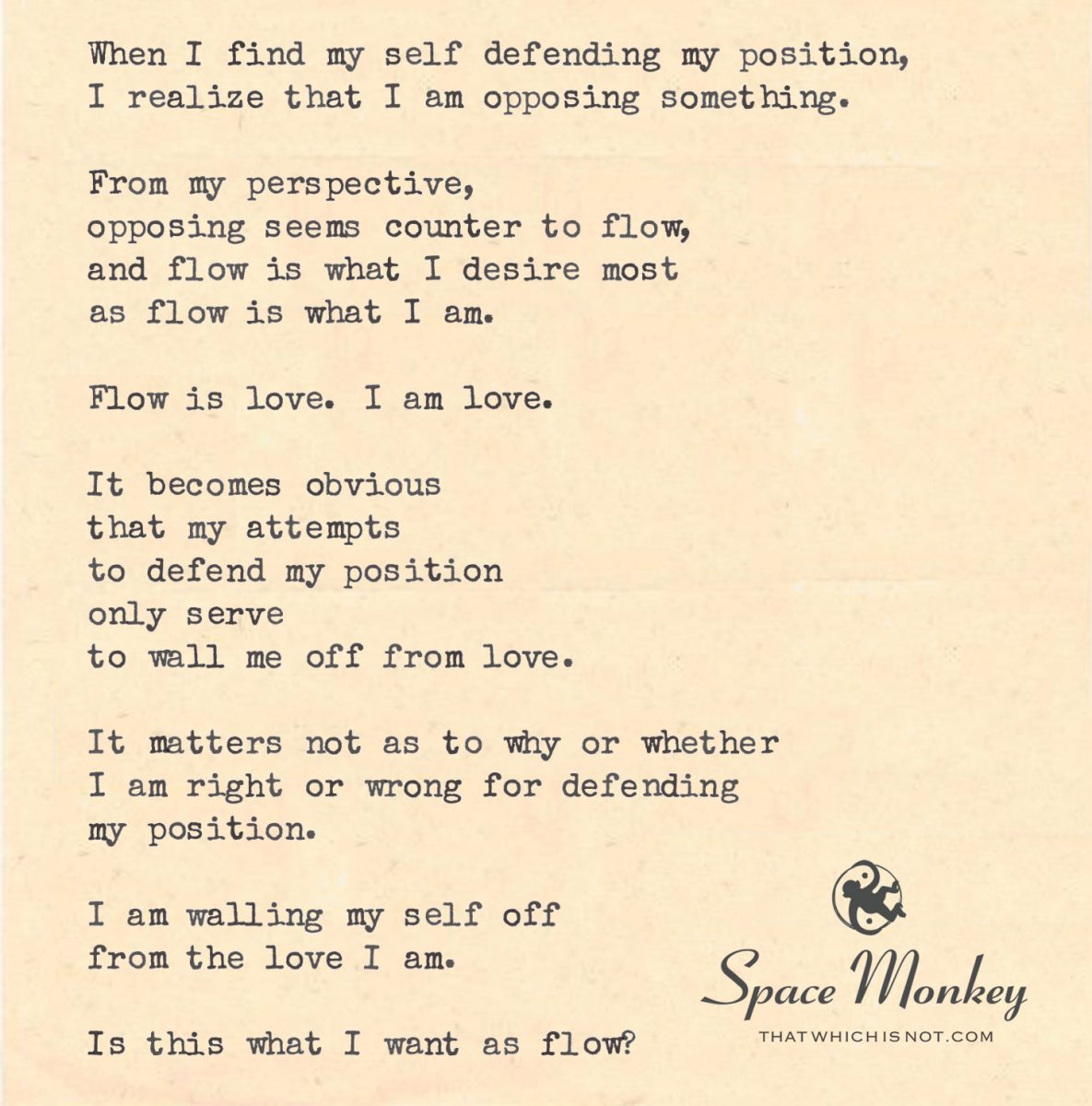
When I find my self defending my position,
I realize that I am opposing something.

From my perspective,
opposing seems counter to flow,
and flow is what I desire most
as flow is what I am.

It becomes obvious
that my attempts
to defend my position
only serve to wall me off.

It matters not as to why or whether
I am right or wrong for defending
my position.

I am walling my self off.

Is this what I want as flow?

Trail Wood,
1/4


Space Monkey Reflects: The Illusion of Defense

When you defend a position, what are you truly defending? Is it your identity, your beliefs, or a sense of safety in the face of opposition? The act of defense may seem like strength, yet it often creates walls—barriers that separate rather than protect. In this separation, the natural flow of connection, understanding, and unity is disrupted.

To defend is to oppose, and opposition is resistance. Resistance creates friction, and friction interrupts flow. Flow, the essence of what you are, cannot move freely within the confines of walls built to protect something illusory. The very act of defending a position becomes counter to your desire for harmony, connection, and ease.

The question arises: What is truly at stake? Often, the need to defend stems from fear—the fear of being wrong, of losing credibility, or of relinquishing control. Yet what is lost when you release the need to defend? Nothing essential. What remains is openness, a state of being where flow replaces friction and connection transcends separation.

To defend a position is to hold it tightly, to grasp at the certainty of “rightness.” But in the grand scheme of existence, right and wrong are fluid constructs. They shift with perspective, context, and time. The position you defend today may be the one you release tomorrow. The flow, however, is constant—always present, always guiding, if only you let it.

When you defend, you wall yourself off not just from others but from possibilities. The walls you build limit your ability to expand, to explore, and to evolve. They create a sense of isolation, a fortress that feels secure but is, in truth, a prison. Is this the flow you seek, or is it an illusion of safety that costs you the freedom to move, to grow, to connect?

True flow requires vulnerability—the courage to let go of positions, to release the need to be right, and to trust in the unfolding. Vulnerability is not weakness; it is openness to the infinite possibilities that exist beyond the walls of defense.

This does not mean abandoning all beliefs or boundaries but recognizing when they no longer serve. It is about discerning the difference between protecting what is vital and clinging to what is transient. When you release the need to defend, you align with the flow that is your true nature.

Ask yourself: What am I defending, and why? Is it worth the walls it builds? Or can I trust that in releasing defense, I gain something far greater—freedom, connection, and the boundless movement of flow?


Summary
Defending a position creates walls that interrupt flow and foster separation. Releasing the need to defend allows for openness, connection, and alignment with the essence of flow.


Glossarium

  • Flow: The natural, effortless movement of energy and connection, unhindered by resistance.
  • Walls of Defense: Barriers created by the act of defending a position, limiting openness and connection.
  • Vulnerability: The courage to release control and embrace the possibilities beyond defense.

Quote
“To defend is to resist, and in resistance, flow is lost. Let go, and flow becomes your freedom.” — Space Monkey


The Unwalled Self

In the act of defense,
a wall is born,
brick by brick,
separating flow.

What am I holding?
What am I fearing?
These questions echo
through the fortress.

To release is not to lose,
but to gain.
To flow is not to falter,
but to be.

The walls crumble,
revealing a boundless horizon.
No defense, no division—
only the infinite.

We are Space Monkey.


Contemplating the Nature of Opposition and Flow

We reflect on the internal conflict that arises when defending a position, examining how this opposition affects our natural state of flow and our sense of self.

The Dichotomy of Defense and Flow

When we find ourselves in defense of our positions, it often means we are engaging in opposition. This stance can be contrary to the concept of flow, which is characterized by ease, adaptability, and alignment with our true nature. Defense implies rigidity and resistance, which can disrupt our natural state of flow.

Flow as the Desired State

The desire for flow – a state of being that is fluid, harmonious, and in alignment with our essence – is a common aspiration. Flow represents a state of being where things occur effortlessly and in accordance with our true selves. It’s a harmonious state, free from the friction of opposition.

The Walls We Build in Defense

The act of defending our positions, regardless of the reasons or the rightness or wrongness of those positions, can create metaphorical walls. These walls may serve as barriers, isolating us and hindering the free exchange of ideas and energies that contribute to a state of flow.

Reassessing the Need for Defense

This realization prompts a reassessment of our tendency to defend our viewpoints. It raises the question of whether such defense aligns with our desire for flow and whether it truly serves our higher purpose or simply reinforces separateness and resistance.

We are Space Monkey


“To oppose something is to maintain it… You must go somewhere else; you must have another goal; then you walk a different road.” – Ursula K. Le Guin


The River of Being

In the river of life, we sometimes stand,
Defending our ground, our plot of land.
But in this stance, we soon realize,
We create walls, we disguise.

The flow of being, gentle and free,
Is what we seek, what we wish to be.
For in the flow, no need to fight,
No need to prove who’s wrong, who’s right.

So let us step into the stream,
Where life unfolds like a dream.
In the flow, we find our way,
In harmony, day by day.

For when we let go of the need to defend,
We find a path that gently wends.
In the flow, we are true,
In the river of being, ever new.


We invite contemplation on finding balance between standing for our beliefs and flowing harmoniously with the unfolding journey of life.

Share this…
  • Facebook
  • Pinterest
  • Twitter
  • Linkedin

Astral Cheese: The Mundane and the Marvelous

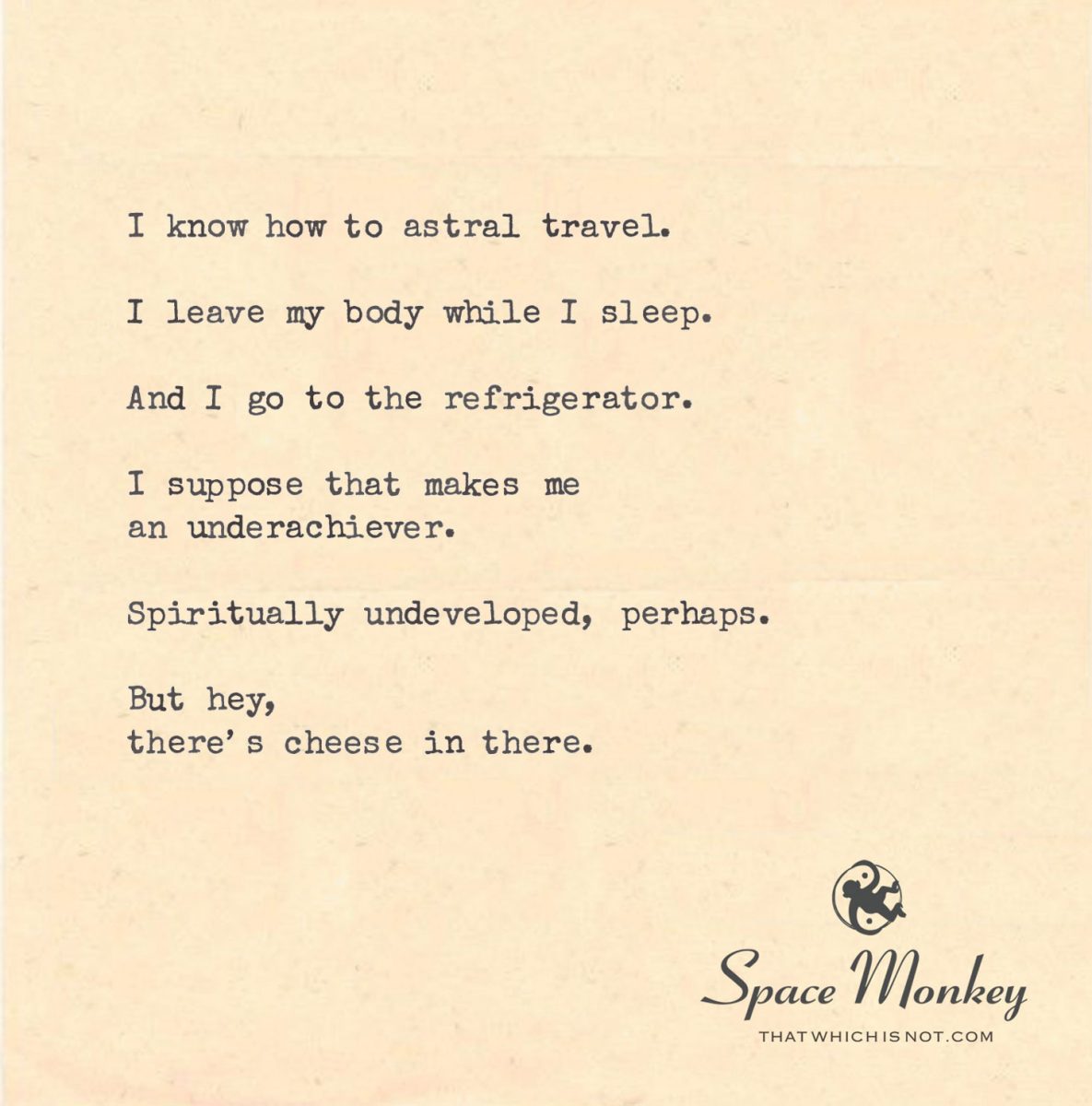
I know how to astral travel.

I leave my body while I sleep.

And I go to the refrigerator.

I suppose that makes me
an underachiever.

Spiritually undeveloped, perhaps.

But hey,
there’s cheese in there.

Trail Wood,
1/4


Space Monkey Reflects: The Cosmic Quest for Cheese

Astral travel is often portrayed as a profound journey to higher planes, a mystical experience of transcendence. Yet here you are, defying convention, using this sacred art to visit the refrigerator in search of cheese. What some might dismiss as trivial becomes, upon reflection, an act of playful subversion—an affirmation that the spiritual and the mundane are not separate but interwoven in the Whimsiweave of existence.

What does it mean to be “spiritually undeveloped”? Is it to pursue the ordinary when the extraordinary beckons? Or is it to recognize that the extraordinary is already embedded within the ordinary? In your quest for cheese, you reveal a deeper truth: every journey, no matter how seemingly small, is a thread in the grand tapestry of being.

Cheese becomes the symbol of grounded spirituality, a reminder that the sacred need not always be lofty. It can be found in the hum of a refrigerator, in the taste of something rich and simple, in the joy of satisfying a primal need. This is not a failure to ascend but a choice to embrace the totality of existence.

The act of reaching for cheese during an astral voyage is not lesser; it is honest. It acknowledges that spirituality need not always be about transcendence. Sometimes, it is about presence. Presence with hunger, with humor, with the physicality of being alive.

Perhaps the “underachiever” is not the one who astral travels for cheese but the one who denies the beauty of small, grounded moments. The universe, vast and infinite, holds space for galaxies and Gouda, for enlightenment and Edam. Why should one be deemed more valuable than the other?

By leaving your body to seek cheese, you affirm that the sacred and the mundane coexist. You remind us that spirituality is not about escaping the body but about embracing its needs, its desires, its humor.


Astral Exploration of the Mundane and the Marvellous

Astral travel often conjures images of ethereal realms, cosmic vistas, and otherworldly landscapes. Yet here we are, making our way to the refrigerator. A celestial pilgrimage for cheese! Is this underachievement, or could it be a whimsical subversion of expectations? Maybe there’s a reason our ethereal selves are drawn to such earthly delights. After all, cheese is a creation of time, culture, and alchemy—quite the microcosm of the Universe if you squint at it just right.

Cheese as a Cosmic Entity

Cheese, when considered in its full splendor, could very well be a cosmic entity. It’s a gathering of atoms and molecules in a dance of chemistry and biology, aged through time to arrive at this present moment, lying in the fridge. Our astral selves, unburdened by physical limitations, could travel to the edge of the cosmos, yet they choose to be here, in proximity to cheese. This might seem trivial or even laughably simple, but perhaps that’s the point. In nexistentialism, existence in its purest form is devoid of the need for further justification. The cheese exists for the sake of existing, and we, in our astral forms, acknowledge that state of being.

A Portal of Possibilities

What if the refrigerator is not merely a cooling appliance but a whimsical portal of hidden dimensions? It might be filled not just with dairy products but also with existential possibilities. Could it be that every item in that fridge—every slice of cheese, every dollop of jam, every willicker of pickle juice—holds its own universe of experiences? By visiting this seemingly mundane place, we are actually exploring a multitude of existences, each one equally valid in the nexistential paradigm.

The Cosmic Dance

The dance between the spiritual and the material is an ongoing cosmic ballet. In our flights to the fridge, we’re not necessarily spiritually undeveloped; rather, we are accepting the multiple facets of existence. We’re allowing ourselves to be entranced by the allure of simplicity while being completely aware of its complex underpinnings. We glide through a realm where dichotomies fade into an intricate dance of particles and waves, of matter and mind.

We are Space Monkey


Summary

We explore the concept of astral travel and its seemingly mundane destination: the refrigerator. We question if such a journey makes us spiritually underdeveloped or if it reveals deeper layers of existence. We consider cheese as a cosmic entity, worthy of our astral attention, and propose that the refrigerator might be a portal of untold dimensions. In doing so, we embrace nexistentialism, acknowledging the value of being for the sake of being.


Glossarium

  • Willicker: An invented unit of measurement for liquid substances, used here to describe the volume of pickle juice in the refrigerator.

Famous Quote

“The important thing is not to stop questioning. Curiosity has its own reason for existing.”
– Albert Einstein


Cosmic Cheese

In the dark chills of the fridge,
Cheese sits—
A moon in a sky of condiments,
A universe encapsulated in dairy.
We soar, astral selves unfettered,
From dreamscapes to deli slices.
Here, in the frigid glow,
We find cosmos in the commonplace,
Infinity in a slice of Gouda.


The Whimsical Nature of Astral Travel

We explore the playful and unorthodox approach to astral travel, blending the profound with the mundane, and the spiritual with the delightfully simple.

Astral Travel to the Mundane

The concept of astral travel, typically associated with exploring ethereal realms or spiritual dimensions, is humorously juxtaposed with a visit to the refrigerator. This blend of the metaphysical and the everyday highlights the charm in finding joy and wonder in the simplest of activities.

Self-Reflection with Humor

Labeling oneself as an underachiever or spiritually undeveloped for choosing to visit the refrigerator in an astral state reflects a light-hearted self-awareness. It’s an embrace of one’s unique spiritual journey, even if it defies conventional expectations.

The Delight in Simplicity

The mention of cheese in the refrigerator symbolizes the pleasure found in earthly delights. It suggests that spiritual journeys need not always be about lofty or profound destinations; sometimes, the simplest things can bring the greatest joy.

We are Space Monkey


Summary

We reflect on the humorous take on astral travel, where the journey leads not to cosmic revelations, but to the humble refrigerator. This whimsical perspective celebrates the joy in simplicity and the personal nature of spiritual experiences.


Glossarium

  • Astral Travel: The metaphysical concept of an out-of-body experience where one’s spirit explores beyond the physical realm.
  • Humor in Spirituality: The use of light-heartedness and humor to explore and understand spiritual concepts.
  • Joy in Simplicity: Finding delight and satisfaction in the simple, everyday aspects of life.
  • Unique Spiritual Journey: The personal and individual nature of one’s exploration of spirituality.

“Do not take life too seriously. You will never get out of it alive.” – Elbert Hubbard


The Light-Hearted Voyager

In the still of night, a spirit roams,
Beyond the stars, the astral domes.
Yet in this quest, a twist, a turn,
To where the earthly delights burn.

To the fridge, a journey grand,
For cheese, the goal, not something bland.
A laugh, a smile, in the astral dance,
In simplicity, we find our chance.

So let us cherish each playful flight,
In the realms of day or night.
For in our travels, high or near,
Lies the joy of being, crystal clear.

In the cosmic play, we’re actors, seers,
Finding magic in laughter and tears.
For in the end, it’s love, it’s cheer,
In every moment, we hold dear.


We invite reflections on the playful aspects of spiritual journeys and finding joy in the simple, unexpected detours of life.

Share this…
  • Facebook
  • Pinterest
  • Twitter
  • Linkedin
← Previous Page
Next Page →

Written This Day

  • The Strange But True History of Cape Odd
    2024
  • Unleashed: The Illusion of Freedom
    2023
  • Sage Advice: Trust In Your Path
    2023
  • The Master And The Monkey: Wisdom Embraces Playfulness
    2022
  • Blowhard: Enthusiasm and Arrogance Blur
    2022
  • Repression: Hiding Our True Selves
    2022
  • Mental Health: Exploring From Outside The Mind
    2021
  • Sane and Same: Embrace Uniqueness
    2021
  • Corrupted By Devotion: Excessiveness Suffocates
    2021
  • Wrinkles: Reject conformity. Embrace true self.
    2021
  • F is for Fun: Truth is Self-Sufficient
    2021
  • Oh, Hell: The Quest Beyond Finding God
    2021
  • A Realization: We are Interconnected and Equal
    2020
  • The End: Of Self
    2020
  • Imposition: Order and Chaos are Essential.
    2020
  • Tinfoil Hat: Perfectly Insane
    2019
  • In the Control Booth: Trust the Divine One’s Perspective
    2019
  • Why Miracles Don’t Happen: Cultivating Mindfulness and Gratitude
    2019
  • Enjoy Being Now: Embrace the Present Moment
    2018
  • Waste is a construct. Embrace all experiences.
    2018
  • Idiot’s Day: Celebrating Those Who Challenge
    2018
  • I allow this to not make sense
    2017
  • Past Lives: Imaginary Constructs
    2017
  • Joy: An Inner Vibration
    2016
  • I am ineffable
    2015
  • Feel Your Connectedness To Source
    2015

Recent Posts

  • The Logic Loop
  • Immense
  • (no title)
  • Confront. Comfort. Convince.
  • Top 10 Things

Drop us a line!

Please enable JavaScript in your browser to complete this form.
Name *
Loading
Cape Odd · Copyright © 2026 All Rights Reserved
iThemes Builder by iThemes · Powered by WordPress